The meaning of 'Varosha'
Varosha is a roman transliteration of the Greek Βαρώσια. Βαρώσια in turn comes from the Turkish word merash, meaning "swamp." This, at least, is what I hear from someone on the Return to Varosha list.
Later: Someone else on the list claims it comes from the Turkish word varosh, meaning suburb. My own considerably abbreviated Turkish-English dictionary cannot confirm either of these meanings, but I suppose they're plausible.
17 August 2005


Mystery solved
Several months ago I asked whether there really might be a hymn titled, Gladly the Cross I'd Bear, which generations of children had mistaken for Gladly the Cross-Eyed Bear. Well, there isn't. But a certain Angharad has cleared up the mystery. It seems that in 1894 the great Fanny Crosby wrote a hymn, Keep Thou My Way, whose third stanza contains the line, "Gladly the cross I'll bear." Now I can sleep at night again.
Several months ago I asked whether there really might be a hymn titled, Gladly the Cross I'd Bear, which generations of children had mistaken for Gladly the Cross-Eyed Bear. Well, there isn't. But a certain Angharad has cleared up the mystery. It seems that in 1894 the great Fanny Crosby wrote a hymn, Keep Thou My Way, whose third stanza contains the line, "Gladly the cross I'll bear." Now I can sleep at night again.
15 August 2005
14 August 2005
Famagusta and the future of Cyprus
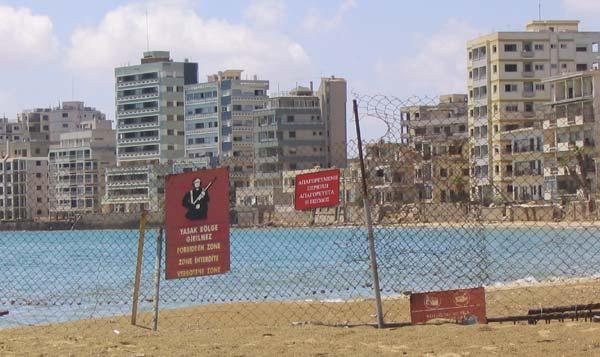
In recent months I have been on an email list called Return to Varosha, Famagusta, Cyprus. I joined this list at the invitation of the moderator, who, I assume, must have come across my own Cyprus page. Participants include those who have had some connection with the Varosha section of Famagusta south of the old walled city, whose inhabitants were almost wholly Greek prior to the troubles of 1974. It is now an uninhabited ghost city, surrounded by a fence guarded (lightly, in some places) by the Turkish military.

David Koyzis
The abandoned city of Varosha
from south of the Green Line
Varosha was the centre of the tourist industry in Cyprus after independence in 1960 and for the next 14 years. I myself never had the opportunity to go there, but my father was raised there and my relatives were exiled from there in '74. Many people on this list have indeed lived there, and this includes some British families as well. I have been moved by their expressions of love for a place to which they cannot return. They tell of favourite restaurants, ice cream shops, beaches, hotels, schools, streets and other once familiar landmarks.
Although I can feel no nostalgia for a city where I've never been, I am getting a pretty good sense of the politics surrounding the issue of Famagusta, which is apparently being held as a sort of pawn by the Turks, to be used at some future negotation to settle the Cyprus issue.
Last year, in the runup to Cyprus' entry into the European Union, the people of both sides of the island voted in a referendum on the Kofi Annan Plan to unify the island. Turkish Cypriots in the north voted in favour, while Greek Cypriots in the south voted against, at the urging of their fairly new president, Tassos Papadopoulos.
To be sure, the plan was inequitable in many respects, although the list members have mentioned another reason for its rejection which had not occurred to me before. Since 1974, much of the tourist industry has moved south to such cities as Paphos, Limassol and Ayia Napa, the last of which was once a sleepy village now turned into a garish resort city. If the north is opened up and the barriers removed, much of the tourism on which the south is dependent could move to the less expensive north. If the Varosha section of Famagusta is reopened, these southern cities could end up suffering economically as a consequence. Since no one wishes to see his restaurant or hotel lose business, he would quite naturally vote to maintain the status quo — which means no to the Annan Plan.
Former residents of Famagusta look at this differently, of course. They just want to go home. Their houses are deteriorating physically and badly need to be restored. All they want is to reclaim something of their former lives in a city cruelly taken from them. If this means accepting an imperfect settlement to a three-decade-old stalemate, so be it.
Return to Varosha
The fence around Varosha
My prayer is that they will indeed go home again before too long. To paraphrase the Jewish Passover liturgy: Next year in Varosha. . . .
In recent months I have been on an email list called Return to Varosha, Famagusta, Cyprus. I joined this list at the invitation of the moderator, who, I assume, must have come across my own Cyprus page. Participants include those who have had some connection with the Varosha section of Famagusta south of the old walled city, whose inhabitants were almost wholly Greek prior to the troubles of 1974. It is now an uninhabited ghost city, surrounded by a fence guarded (lightly, in some places) by the Turkish military.
David Koyzis
The abandoned city of Varosha
from south of the Green Line
Varosha was the centre of the tourist industry in Cyprus after independence in 1960 and for the next 14 years. I myself never had the opportunity to go there, but my father was raised there and my relatives were exiled from there in '74. Many people on this list have indeed lived there, and this includes some British families as well. I have been moved by their expressions of love for a place to which they cannot return. They tell of favourite restaurants, ice cream shops, beaches, hotels, schools, streets and other once familiar landmarks.
Although I can feel no nostalgia for a city where I've never been, I am getting a pretty good sense of the politics surrounding the issue of Famagusta, which is apparently being held as a sort of pawn by the Turks, to be used at some future negotation to settle the Cyprus issue.
Last year, in the runup to Cyprus' entry into the European Union, the people of both sides of the island voted in a referendum on the Kofi Annan Plan to unify the island. Turkish Cypriots in the north voted in favour, while Greek Cypriots in the south voted against, at the urging of their fairly new president, Tassos Papadopoulos.
To be sure, the plan was inequitable in many respects, although the list members have mentioned another reason for its rejection which had not occurred to me before. Since 1974, much of the tourist industry has moved south to such cities as Paphos, Limassol and Ayia Napa, the last of which was once a sleepy village now turned into a garish resort city. If the north is opened up and the barriers removed, much of the tourism on which the south is dependent could move to the less expensive north. If the Varosha section of Famagusta is reopened, these southern cities could end up suffering economically as a consequence. Since no one wishes to see his restaurant or hotel lose business, he would quite naturally vote to maintain the status quo — which means no to the Annan Plan.
Former residents of Famagusta look at this differently, of course. They just want to go home. Their houses are deteriorating physically and badly need to be restored. All they want is to reclaim something of their former lives in a city cruelly taken from them. If this means accepting an imperfect settlement to a three-decade-old stalemate, so be it.
Return to Varosha
The fence around Varosha
My prayer is that they will indeed go home again before too long. To paraphrase the Jewish Passover liturgy: Next year in Varosha. . . .
10 August 2005
Concert notice
Given my longstanding interest in the Genevan Psalms, I would love to attend this event: Concert of Psalms at Concord church.
Given my longstanding interest in the Genevan Psalms, I would love to attend this event: Concert of Psalms at Concord church.
09 August 2005
The diaeresis
English is nearly unique among European languages in having so few diacritical marks. I've recently received a new computer, and one of the things I have done is to enable the language functions so that I can type in French, German and Greek. If I have need of other languages, it is fairly simple to add them by clicking on START, then SETTINGS, then CONTROL PANEL, and then REGIONAL AND LANGUAGE OPTIONS.
One of the diacritical marks that appears occasionally in English is the diaeresis, which is placed on the second of two adjacent vowels, thereby indicating that they are pronounced separately. One word containing this mark is naïve, which is, of course, a loan word from French. In some older books one also sees coöperate spelt with a diaeresis, though this seems to be less common nowadays. Following this logic, one might conceivably come across preëminent, although, to be honest, I've never seen this spelling in use anywhere.
Our surname in Greek contains a diaeresis (also called a dialytika) over the letter ι, as in Κοϊζής, pronounced Koi-ZEES. The presence of this diacritical mark is an indication that the o and i sounds are pronounced separately, an unusual pronunciation in modern spoken Greek, wherein ι, η, υ, ει and οι are now pronounced identically. Without the diaeresis, our surname would sound like Kee-ZEES. Its presence is evidence that the name was not originally Greek but was transliterated from another language, probably French, where it may originally have been Coizy.
My father was not born with this surname. In fact, he was born without a surname at all, only a patronymic. Not until later did he adopt our current surname, with which his grandfather and, apparently, father were born. Since the diaeresis is scarcely used in English, he made the Κοϊ into Koy, with a y replacing the ϊ. Some of my relatives in the US and elsewhere spell our name Koizis, but no one has retained the diaeresis.
07 August 2005
Political reverberations from a football victory
Cyprus is a much smaller country than Turkey. Thus the victory of Anorthosis Famagusta over Trabzonspor continues to stir up emotions in both countries, as reported in this Cyprus Mail article: How a football club came to symbolise Cyprus. Incidentally, although I have not personally met sociologist Nicos Peristianis of Intercollege, who is quoted at length in this article, I did know his sister when we were both living in Toronto 25 years ago. Small world? Perhaps. Then again Cyprus is a small island.
Later: I found the websites of the two clubs, Trabzonspor and Anorthosis. Note that the latter flies the flag of Greece prominently in the upper left corner. This would appear to indicate a rightwing nationalist political orientation. The flag of the Cyprus Republic is nowhere in sight. That dampens my enthusiasm somewhat. Yet Anorthosis did win the match and thus deserves to be congratulated.
06 August 2005
A Sinai treasure
Here is one place that would be well worth a visit: St. Catherine's Monastery, the oldest such monastery in continuous use.
Here is one place that would be well worth a visit: St. Catherine's Monastery, the oldest such monastery in continuous use.
Orthodox group leaves ecumenical body
Could this be the beginning of a trend: Antiochian archdiocese votes to leave church council? The National Council of Churches sees itself as the principal ecumenical body in the United States, but, if enough Orthodox jurisdictions withdraw membership, it will be increasingly sidelined, especially given that the Roman Catholic Church and most evangelical protestant bodies remain outside. Here is another report on this development from the Institute for Religion and Democracy, an organization explicitly targeted for opposition by the NCC. Oddly enough, the NCC website is not yet carrying the news.
Could this be the beginning of a trend: Antiochian archdiocese votes to leave church council? The National Council of Churches sees itself as the principal ecumenical body in the United States, but, if enough Orthodox jurisdictions withdraw membership, it will be increasingly sidelined, especially given that the Roman Catholic Church and most evangelical protestant bodies remain outside. Here is another report on this development from the Institute for Religion and Democracy, an organization explicitly targeted for opposition by the NCC. Oddly enough, the NCC website is not yet carrying the news.
New Comment articles
This week’s edition of Comment boasts three new articles. The first, North America and the New Christendom, is by Gideon Strauss. Drawing on Philip Jenkins’ observation that the global centre of Christianity is moving south, Strauss argues that North American neocalvinists have resources from which the new African and Asian Christians might well benefit.
The second, Heidi Metcalf’s The destructive power of good, offers a disturbing look at the practice of human trafficking around the globe, along with biblical hope for a way out.
The third, Pantagruelian paradoxes and post-Modern cop-outs, sees author Brian Dijkema revisit the recent Koyzis/Jape debate, with a persuasive response to Fr. Jape’s spirited, if not altogether convincing, broadside.
By the way, I have just received a copy of the WRF’s Best of Comment, an impressive-looking publication which deserves a wide reading.
04 August 2005
And now for today's sporting news. . .
Our top story: Anorthosis of Cyprus triumph in grudge Turkey game. This was an unprecedented football (i.e., North American soccer) match pitting a Greek Cypriot team exiled from the occupied "ghost city" of Famagusta against a Turkish team from the ancient city of Trabzon. Ironically, prior to the 1923 Treaty of Lausanne, even the latter was once occupied by Pontic Greeks, who called it Τραπεζούντα (Trapezounda). This city was the seat of the last independent Byzantine outpost to be conquered by the Turks in 1461, eight years after the conquest of Constantinople.
Our top story: Anorthosis of Cyprus triumph in grudge Turkey game. This was an unprecedented football (i.e., North American soccer) match pitting a Greek Cypriot team exiled from the occupied "ghost city" of Famagusta against a Turkish team from the ancient city of Trabzon. Ironically, prior to the 1923 Treaty of Lausanne, even the latter was once occupied by Pontic Greeks, who called it Τραπεζούντα (Trapezounda). This city was the seat of the last independent Byzantine outpost to be conquered by the Turks in 1461, eight years after the conquest of Constantinople.
Another priest 'disciplined'
The ongoing drama of the Episcopal Church's implosion moves to Saginaw, Michigan, where Bishop Edwin Leidel of Eastern Michigan has deposed the Rev. Gene Geromel, an orthodox priest in his diocese. However, 13 of Leidel’s fellow bishops have declared Fr. Geromel a priest in good standing in their own dioceses. As one commentator put it, "The boundaries of inclusion grow ever narrower."
The ongoing drama of the Episcopal Church's implosion moves to Saginaw, Michigan, where Bishop Edwin Leidel of Eastern Michigan has deposed the Rev. Gene Geromel, an orthodox priest in his diocese. However, 13 of Leidel’s fellow bishops have declared Fr. Geromel a priest in good standing in their own dioceses. As one commentator put it, "The boundaries of inclusion grow ever narrower."
Our new governor general
The Queen will have a new representative in Canada next month to replace the outgoing Adrienne Clarkson. She is Michaëlle Jean, a Haitian-born journalist familiar to Québec television viewers. She is being touted as the first black to fill the governor general's post, the third woman, and the second non-Canadian-born since 1952. Before that year governors general were always sent from Britain, appointed from the aristocracy or even the royal family. The one exception was Scottish novelist John Buchan, known during his tenure in Canada as Lord Tweedsmuir. In 1952 Vincent Massey became the first Canadian-born governor general. Since then the office has alternated between an anglophone and a francophone. However, with Mme. Jean's appointment, we will have had two CBC/SRC journalists in a row, which some might deem a minor breach of convention. At age 48 Mme. Jean will become one of the youngest persons to represent Her Majesty in the True North.

RDI
Michaëlle Jean
The Queen will have a new representative in Canada next month to replace the outgoing Adrienne Clarkson. She is Michaëlle Jean, a Haitian-born journalist familiar to Québec television viewers. She is being touted as the first black to fill the governor general's post, the third woman, and the second non-Canadian-born since 1952. Before that year governors general were always sent from Britain, appointed from the aristocracy or even the royal family. The one exception was Scottish novelist John Buchan, known during his tenure in Canada as Lord Tweedsmuir. In 1952 Vincent Massey became the first Canadian-born governor general. Since then the office has alternated between an anglophone and a francophone. However, with Mme. Jean's appointment, we will have had two CBC/SRC journalists in a row, which some might deem a minor breach of convention. At age 48 Mme. Jean will become one of the youngest persons to represent Her Majesty in the True North.
RDI
Michaëlle Jean
Christian heritage day
The province of Ontario has come up with its own solution to the problem of religious diversity: Give Christians their own heritage day, along with Greeks, Poles and other cultural groups, thereby putting ultimate belief on a par with ethnicity. What would Bob Ferguson think of that?

Sights and Culture
Christians
in typical costumes
performing typical dances
The province of Ontario has come up with its own solution to the problem of religious diversity: Give Christians their own heritage day, along with Greeks, Poles and other cultural groups, thereby putting ultimate belief on a par with ethnicity. What would Bob Ferguson think of that?
Sights and Culture
Christians
in typical costumes
performing typical dances
03 August 2005
Osama's new suzerain
A smooth transfer of power for this oil-rich middle eastern kleptocracy: King Abdullah receives oaths of loyalty.
A smooth transfer of power for this oil-rich middle eastern kleptocracy: King Abdullah receives oaths of loyalty.
Darwin and ID
Are male academics programmed by natural selection to defend Darwin over Intelligent Design as a means of protecting their status against rivals? David Klinghoffer thinks there's something to this.
Are male academics programmed by natural selection to defend Darwin over Intelligent Design as a means of protecting their status against rivals? David Klinghoffer thinks there's something to this.
02 August 2005
Little on church-state separation
The Rev. Kevin Little is a minister in the United Church of Canada and a one-time candidate for the House of Commons. One assumes from this op-ed piece in the Toronto Star that he would oppose Bob Ferguson's draconian proposal to regulate all religions but his own. Indeed Little recalls his own denomination's roots in Methodist social and political activism. Arguments for separating church and state did not stop his forebears from pushing for medicare, unemployment insurance and other social programmes which Canadians now take for granted.
Now if only Little could manage to correct his faulty comprehension of the personalism of Emanuel Mounier and Jacques Maritain. Pierre Trudeau may indeed have believed that "faith was irrational and therefore did not belong in public discourse," but he would have received scant support for this from the likes of Mounier and Maritain.
Turkey's EU bid
Must Turkey recognize the Republic of Cyprus before accession talks can begin with the European Union? Yes, says the French Prime Minister. Austria's Deputy Chancellor agrees. Ankara will not be pleased.
Must Turkey recognize the Republic of Cyprus before accession talks can begin with the European Union? Yes, says the French Prime Minister. Austria's Deputy Chancellor agrees. Ankara will not be pleased.
The ICR: a viable alternative?
Someone responded to my request for biblically consistent resources on dinosaurs by referring me to the Institute for Creation Research, an organization of which I know little other than its name and less than positive reputation in most scientific circles. After perusing some of its materials on dinosaurs, I would judge that this group's approach seems to amount to: (1) denying the evidence for the great age of the earth and its fossilized creatures, (2) denying that there was ever a time when mostly dinosaurs inhabited the earth, (3) affirming, against considerable evidence to the contrary, that human beings and dinosaurs cohabited earth, (4) finding evidence for dinosaurs in the Bible (e.g., Job's leviathan and behemoth), (5) ascribing the various sedimentary layers in the earth's rock formations to the biblical flood, and (6) reading the Bible in a woodenly literal way as if it were a scientific treatise. While not wishing to impugn the sincerity of the good people at the ICR, I am inclined to think an approach is needed which better accounts for empirical evidence as well as for the different literary genres in scripture itself. At the same time, as I admitted earlier, I am hardly an expert in this field.
Someone responded to my request for biblically consistent resources on dinosaurs by referring me to the Institute for Creation Research, an organization of which I know little other than its name and less than positive reputation in most scientific circles. After perusing some of its materials on dinosaurs, I would judge that this group's approach seems to amount to: (1) denying the evidence for the great age of the earth and its fossilized creatures, (2) denying that there was ever a time when mostly dinosaurs inhabited the earth, (3) affirming, against considerable evidence to the contrary, that human beings and dinosaurs cohabited earth, (4) finding evidence for dinosaurs in the Bible (e.g., Job's leviathan and behemoth), (5) ascribing the various sedimentary layers in the earth's rock formations to the biblical flood, and (6) reading the Bible in a woodenly literal way as if it were a scientific treatise. While not wishing to impugn the sincerity of the good people at the ICR, I am inclined to think an approach is needed which better accounts for empirical evidence as well as for the different literary genres in scripture itself. At the same time, as I admitted earlier, I am hardly an expert in this field.
Prayers requested
Please pray for my niece, Bethany Givens, who is spending the summer and autumn in Tanzania and has now contracted malaria.
Please pray for my niece, Bethany Givens, who is spending the summer and autumn in Tanzania and has now contracted malaria.
Subscribe to:
Posts (Atom)
