The (new/old) Russian anthem
The Russian national anthem came up in conversation yesterday in my Russian politics class. Coincidentally this story appeared in the international press: Atheist challenges Russian national anthem. Oddly, the tune to this anthem is that of the old anthem of the Soviet Union, with music composed by Alexander Alexandrov. In 1990, just prior to the demise of the Soviet Union, Boris Yeltsin's government adopted a distinctive anthem for the Russian Federation, called simply Patriotic Song, with no lyrics and composed by Mikhail Glinka, the founder of the national movement in 19th-century Russian music. But when Vladimir Putin became president in 2000, he brought back the music of the former Soviet anthem, albeit with new lyrics. Putin is not, of course, a communist and he is reputed to be a practising Orthodox Christian. Yet in many respects he is resuscitating the autocratic ways of his predecessors, thus seemingly vindicating the tired cliché that the more things change the more they stay the same.
Those interested in the history of the Russian anthems should look up the Russian Anthems museum, a wonderfully informative website boasting many recordings of the relevant music. My personal favourite is the Osipov Orchestra of Folk Instruments' recording of the Patriotic Song — a version I am confident Glinka would have approved.
11 November 2005


A Muslim's assessment of Islam
Irshad Manji is the author of The Trouble With Islam Today and writes on this subject in the Los Angeles Times: From books to virgins. Manji argues that "dogma is hobbling our faith, because we Muslims have forgotten Islam's own tradition of independent thinking: ijtihad," which left the doors open to "discussion, debate and dissent." At one time the islamic world was a hotbed of philosophical thinking, with Moorish Spain playing a prominent role. Cordoba, one of the largest cities in Europe at the time, had 70 libraries. From the 8th to the 12th centuries "Islamic civilization led the world in ingenuity."
So what happened? The Caliph in Baghdad suppressed ijtihad in an attempt to secure the political unity of his empire. Since then unity has come to be conflated with uniformity. The chief casualty is the vitality of Islam itself. The solution? Ordinary Muslims need to be informed of "their God-given right to think for themselves," and thereby seize the initiative from the extremists. All of this sounds good, of course, but my guess is that Manji's "feminist-lesbian-journalist perspective" (see the Amazon.com description) just might be an obstacle to her gaining a wide following among her fellow Muslims.
10 November 2005
Marshall at Redeemer
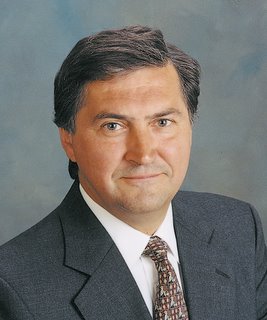
Yesterday we were privileged to have Dr. Paul Marshall deliver the second annual Bernard Zylstra Lectures here at Redeemer University College. He spoke three times. His chapel address, titled, "The Church at the Start of the Third Millennium," was a sobering survey of the state of the church around the world, focussing especially on the persecution of Christians. Yet out of this we were also heartened to hear of the growth of the church, especially in China, where it has expanded phenomenally over the past 25 years. The afternoon featured an in-house open forum in which my esteemed colleague, Al Wolters, and I were part of a panel discussion with Marshall concerning Islamic Law, on which he has just published an edited volume, Islam’s Rules: The Worldwide Spread of Extreme Shari'a Law. The evening's public lecture was titled, "Understanding Radical Islam," in which he gave the audience something of a history of Islam itself over the course of some 1,400 years.
Marshall is a Senior Fellow at the Center for Religious Freedom, Freedom House, in Washington, DC. From 1980 until the late 1990s, Marshall was a professor of political theory at the Institute for Christian Studies, Toronto, where he succeeded the late Bernard Zylstra, after whom the lecture series was named. I myself first met him a few years before that, when he was still a Ph.D. student at York University and I was just beginning masters studies at the ICS under Zylstra.
Among the many articles he has written are the following: The Islamists' other weapon and Islamic Counter-Reformation. Here is a recent interview with Marshall in FrontPage magazine on the subject of "extreme Sharia."
I think I speak for others in saying that I was impressed by the thoughtfulness of Marshall's presentations, given the potentially polarizing nature of the topics. All in all, it was a worthwhile and stimulating day.
08 November 2005
One man's prognostication
One of my students alerted me to this site. If Gregory D. Morrow's predictions are at all plausible, then perhaps we shall soon have a Conservative minority government.
One of my students alerted me to this site. If Gregory D. Morrow's predictions are at all plausible, then perhaps we shall soon have a Conservative minority government.
Classical Christian education
In today's Breakpoint commentary, Chuck Colson endorses something called "classical Christian education," whose goal is the cultivation of both knowledge and character. Of his own alma mater Colson says that it "no longer has a core curriculum. You can go through the school without ever knowing who Plato, Aristotle, Darwin, or Freud were." Perhaps he should urge prospective undergraduate students to come to Redeemer and similar institutions. On the other hand, Colson errs in thinking it possible "to [free] science from philosophical assumptions and instead [look] at what God has made." Rather he should be urging the application of correct philosophical assumptions to the exploration of God's world.
In today's Breakpoint commentary, Chuck Colson endorses something called "classical Christian education," whose goal is the cultivation of both knowledge and character. Of his own alma mater Colson says that it "no longer has a core curriculum. You can go through the school without ever knowing who Plato, Aristotle, Darwin, or Freud were." Perhaps he should urge prospective undergraduate students to come to Redeemer and similar institutions. On the other hand, Colson errs in thinking it possible "to [free] science from philosophical assumptions and instead [look] at what God has made." Rather he should be urging the application of correct philosophical assumptions to the exploration of God's world.
Dallmayr on democracy
Fred Dallmayr was one of my professors at Notre Dame more than two decades ago. As part of the Opening Democracy debate, Dallmayr writes of Mobilising global democracy, arguing, in a not so veiled critique of the Bush administration, against those who who would spread democracy by force of arms. Instead he makes a case for cross-cultural learning as a better alternative, drawing on the centuries-old pattern of harmonious coexistence among Christians, Jews and Muslims in Moorish Spain as just one example. Point well taken. But will such a pacific approach be an adequate response to this: The Islamists' other weapon?
Fred Dallmayr was one of my professors at Notre Dame more than two decades ago. As part of the Opening Democracy debate, Dallmayr writes of Mobilising global democracy, arguing, in a not so veiled critique of the Bush administration, against those who who would spread democracy by force of arms. Instead he makes a case for cross-cultural learning as a better alternative, drawing on the centuries-old pattern of harmonious coexistence among Christians, Jews and Muslims in Moorish Spain as just one example. Point well taken. But will such a pacific approach be an adequate response to this: The Islamists' other weapon?
07 November 2005
Reading the signs of the times
Recently I have not commented much on Comment and the excellent articles it runs from week to week. The debate on agrarianism continues with three recent entries. I myself will shortly be making my own contribution with a piece on cities. (I'll let you know when it's published.) But I especially want to call belated attention to Gideon Strauss's trenchant essay, What is to be done... to understand our moment? Strauss organizes his thoughts around four challenges to "Christian cultural faithfulness in these times": those of (1) modern liberal capitalism; (2) Salafiyyah Islam; (3) China; and (4) post-western Christianity in Africa, Asia and Latin America. Not only is Strauss's essay well worth reading and thinking about, but it might also provide fodder for informal discussion at a soirée with one's friends.
Recently I have not commented much on Comment and the excellent articles it runs from week to week. The debate on agrarianism continues with three recent entries. I myself will shortly be making my own contribution with a piece on cities. (I'll let you know when it's published.) But I especially want to call belated attention to Gideon Strauss's trenchant essay, What is to be done... to understand our moment? Strauss organizes his thoughts around four challenges to "Christian cultural faithfulness in these times": those of (1) modern liberal capitalism; (2) Salafiyyah Islam; (3) China; and (4) post-western Christianity in Africa, Asia and Latin America. Not only is Strauss's essay well worth reading and thinking about, but it might also provide fodder for informal discussion at a soirée with one's friends.
La crise française — encore une fois
The continuing violence in France threatens President Jacques Chirac and the government of Prime Minister Dominique de Villepin. Could it bring down the Fifth Republic after nearly half a century? There are precedents. Four, to be exact. My prediction? Assuming the régime survives, the Front National will improve its showing in the next elections.
The continuing violence in France threatens President Jacques Chirac and the government of Prime Minister Dominique de Villepin. Could it bring down the Fifth Republic after nearly half a century? There are precedents. Four, to be exact. My prediction? Assuming the régime survives, the Front National will improve its showing in the next elections.
05 November 2005
Organizing ecclesiastical labour
Time to send in the CLAC? CAW fails in bid to unionize United Church. Of course, as the Globe article points out, it is difficult to distiguish management from labour in such an organization. Given the polity of the United Church, might the congregations themselves be considered management?
Time to send in the CLAC? CAW fails in bid to unionize United Church. Of course, as the Globe article points out, it is difficult to distiguish management from labour in such an organization. Given the polity of the United Church, might the congregations themselves be considered management?
La crise française
Paris is burning and France is in turmoil. What next for Chirac and Villepin? Could last year's headscarf ban have been a contributing factor to the current troubles?
Paris is burning and France is in turmoil. What next for Chirac and Villepin? Could last year's headscarf ban have been a contributing factor to the current troubles?
04 November 2005
Another birthday
Seven years ago yesterday our daughter Theresa was born unexpectedly 14 weeks early. Her original due date had been set for 10 February 1999, but she came into the world more than three months before then. Thank God she was born in a hospital with a level-3 neonatal intensive care unit (NICU). There she remained for the first three and a half weeks of her life until she was out of danger, after which she was transferred to a hospital across town with a level-2 unit. Altogether she was in hospital for over 10 weeks. When she finally came home, she was still very small, weighing less than 5 pounds. It was a scary time for us, and I kept a huge number of people informed of her progress over email, asking for their prayers. At some point I intend to turn our experience into a book, but it is still not emotionally easy for me to reread those emails and my own personal journal entries from then.
Two sundays ago Nancy was in church talking with Susan, the director of the junior choir with which Theresa sang for just over a year. Nancy mentioned to her the upcoming birthday, and something clicked in Susan's head at hearing this information. It seems Susan was part of a Bible study back in 1998, and the group was asked to pray for a little girl who had been born early to a Redeemer professor and his wife. Only now was she putting two and two together.
Nancy told me about this when we were home, and I was deeply moved — as well as humbled at the ways of God — to learn that a woman we didn't even know at the time was among the many people praying for Theresa throughout those trying early weeks of her life.
03 November 2005
Letting go of the past
The following is my column for the 24 October issue of Christian Courier:
A few weeks ago I became aware of a campaign to have the fabled Aghia Sophia, the Church of the Holy Wisdom, in Istanbul returned to the Ecumenical Patriarch of Constantinople. HagiaSophiaBlog.com is trying to collect at least one million signatures on a petition to convince the European Union (EU) to make return of this architectural wonder a condition for Turkey’s membership in that organization.
As a Christian with Orthodox roots on the paternal side, I must admit that this initially struck a chord with me. The Patriarchate has never relinquished its claim on the building, which the Ottoman Turks turned into a mosque after they conquered the city in 1453. As recently as the end of the Great War, many Greeks hoped that the defeat of the Ottoman Empire and the occupation of Constantinople by the victorious allies would lead to the Divine Liturgy once again being celebrated beneath the dome of the church built by the Emperor Justinian in 537.
Indeed, Aghia Sophia contains some of the most beautiful mosaics in the world, including this haunting icon of Christ (see the third image in the sidebar under "Web pages"), thought to have been fashioned shortly after the Byzantine Greeks recovered Constantinople from the Crusaders in 1261. These were covered over by the Muslims after the conquest, but in the early 1930s, shortly after the secularizing government of Mustafa Kemal had made the historic building into a museum, restoration of the mosaics was permitted. It continues as a museum to this day, despite the competing claims of two religious communities.
When I learned of the petition for its return, my first inclination was to sign. After all, the seizure of this historic place of worship was an obvious injustice. Shouldn’t it be rectified after all these centuries?
The answer to this question is not as obvious as some might think. If we say yes, we risk opening a pandora’s box in which long dormant injustices come pouring out, awaiting a resolution that may be impossible to achieve without unleashing further injustice. Should the two American continents be returned to the aboriginal peoples? If so, what do we do with the scores of millions of people of nonaboriginal descent? Should Israel be returned to the Palestinians, who were displaced from their homes nearly 60 years ago? If so, what do we do with the sabras, the generations of Israelis who were born there and know no other home?
In common law jurisdictions there is a concept known as the statute of limitations, which imposes time limits on the opportunity for injured parties to redress grievances. Why? Because in its absence injustices would continue to multiply until they overwhelmed the mundane concerns of ordinary people, who would be unable to get on with their lives because they were so consumed with the desire to right the wrongs of an increasingly remote past. Eventually, their descendants would be stewing over crimes committed against forebears generations earlier, thereby poisoning lives that might be better lived if they could manage – as the cliché puts it – to forgive and forget.
It is precisely in those parts of the world where people have allowed the wounds of the past to fester that establishing and maintaining political community is such a precarious venture. The Middle East, the Caucasus and the Balkans come immediately to mind.
Aghia Sophia is unlikely to be returned to the Orthodox Church and will almost certainly remain a museum. However, there is ample reason for the EU to raise the issue of Turkey’s current treatment of its religious minorities, including the Patriarchate, while letting the past be the past.
Orthodoxy and original sin
The remarkable Mr. Rob Joustra, from his base in Japan, writes on why Orthodox theologians object to the western church's notion of original sin as inherited guilt. Something to ponder over a plate of sushi.
The remarkable Mr. Rob Joustra, from his base in Japan, writes on why Orthodox theologians object to the western church's notion of original sin as inherited guilt. Something to ponder over a plate of sushi.
Corruption in Russia
Has Russia become more corrupt under Vladimir Putin? Yes, says a recently released report from a Russian thinktank. However, after reading the report more carefully, Peter Lavelle concludes that the level of corruption has actually decreased, even if the amounts of money involved have gone up.
Has Russia become more corrupt under Vladimir Putin? Yes, says a recently released report from a Russian thinktank. However, after reading the report more carefully, Peter Lavelle concludes that the level of corruption has actually decreased, even if the amounts of money involved have gone up.
01 November 2005
Istanbul protest
This story will cause those who remember the events of 6-7 September 1955 to shudder: Nationalists demonstrate against Greek Orthodox patriarch. Someone needs to remind these "Turkish nationalists" that the Patriarchate was there first.
This story will cause those who remember the events of 6-7 September 1955 to shudder: Nationalists demonstrate against Greek Orthodox patriarch. Someone needs to remind these "Turkish nationalists" that the Patriarchate was there first.
New rules from Brussels
What? This sounds like a joke: European Union lowercases 'Christ': Brussels' grammar rule says title to be spelled with small 'c' in future. Who could possibly take this seriously? One can more easily believe that Pluto's "new" moons will be named Goofy and Mickey.
What? This sounds like a joke: European Union lowercases 'Christ': Brussels' grammar rule says title to be spelled with small 'c' in future. Who could possibly take this seriously? One can more easily believe that Pluto's "new" moons will be named Goofy and Mickey.
De Souza on Neuhaus
Fr. Raymond J. de Souza profiles Fr. Richard John Neuhaus for The National Post. My question: Although Fr. Neuhaus may have been born in this country, can he really be called a Canadian public intellectual? That seems to be stretching the definition a bit.
Fr. Raymond J. de Souza profiles Fr. Richard John Neuhaus for The National Post. My question: Although Fr. Neuhaus may have been born in this country, can he really be called a Canadian public intellectual? That seems to be stretching the definition a bit.

Subscribe to:
Posts (Atom)