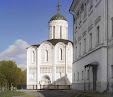
On sunday afternoon our family drove down to St. James Church in nearby Dundas to attend the opening of an exhibit by local Hamilton artist Guennadi Kalinine, a trained iconographer, painter and restorer of art. As Kalinine himself was present, I was able to converse with him about his approach to iconography in particular. As is typical, his own painted icons bear no signature, as they simply replicate much earlier works and are governed by the strict canons of Orthodox Christianity. There is no effort to express one's individuality. Kalinine told me he is often asked whether a particular icon is his own. He responds that it is not; it comes from, say, the 12th century. He is then asked whether he painted it. Yes, he replies, but it is not his own. When a musician plays a piece by Bach, he would never think of claiming it as his own; it remains Bach's. So it is with icons. Such an attitude is foreign to westerners.
We especially enjoyed Kalinine's efforts to incorporate traditional iconic images into his landscapes, which do bear his signature. Websters Falls is one of the more famous scenic locations in Hamilton. Kalinine managed to place an angel at Websters Falls in one of his "Fantazy" paintings.
The exhibit runs through 7 January 2011, which coincides with Christmas in the Julian calendar followed by the Orthodox Church. Definitely worth a visit.
When our family received the new issue of National Geographic, we were pleasantly surprised to read this photographically rich article on the Russian Orthodox Church. The author, Serge Schmemann, is the son of the late Orthodox theologian, Alexander Schmemann.
Turning to the fracturing Anglican communion, the GAFCON primates have welcomed the formation of the new Anglican Province in North America, whose first public liturgy, shown below, was held at the Evangelical Free Church in Wheaton, Illinois, whose spacious building I myself have been inside.
04 August 2008
Aleksandr Solzhenitsyn (1918-2008)
Famed Russian novellist Aleksandr Solzhenitsyn has died at the age of 89. He is widely regarded as the worthy successor to such 19th-century literary greats as Leo Tolstoy and Fyodor Dostoevsky. Together they carried on a long Russian tradition of men of letters serving as loyal opposition in a polity characterized by autocracy and totalitarianism. Tsar Nicholas I is said to have at once admired and feared the poet Aleksandr Pushkin. Similarly, the Soviet-era leaders so feared Solzhenitsyn that they attempted to suppress his output and exiled him for 20 years.
His output was prolific, beginning with his groundbreaking novel, One Day in the Life of Ivan Denisovich, which chronicles a single day in the life of an inmate in one of Stalin's forced labour camps. This work alone ranks with the likes of The Brothers Karamazov and Crime and Punishment as a significant exemplar of the Russian literary tradition.
I myself have been fascinated by Solzhenitsyn's political tracts, beginning with his 1973 Letter to the Soviet Leaders, through his controversial 1978 Harvard address to his 1990 Rebuilding Russia. In the second work he was sharply critical of western decadence and alienated many in the media who had once lionized him. In the first and third works, he sounded themes that would seem prophetic in retrospect: 1) Russia should discard the discredited Marxist-Leninist ideology that had done so much harm to the country; 2) Russia should cast off the nonslavic republics and allow them to go their own way; 3) it should focus on settling and developing the north and east rather than engaging in overseas adventurism; and 4) it must at all costs avoid a war with China, which cannot be won.
Despite or perhaps because of his experience living under an atheistic régime, Solzhenitsyn became a Christian during his time in the Gulag. Having seen for himself the consequences of pursuing a political illusion on a mass scale, he embraced faith in Jesus Christ as the only hope for Russia's future. Solzhenitsyn returned to his homeland in 1994 and lived there for the remainder of his life. Although he could with some justification be called a Russian nationalist and thus focussed most of his attention on his own country, he was capable of seeing through our own political illusions as well: "The West has finally achieved the rights of man, and even to excess, but man's sense of responsibility to God and society has grown dimmer and dimmer." May Solzhenitsyn's words continue to speak to us in a new century.
Quite coincidentally my wife gave me for my birthday two DVDs, Alfred Hitchcock's Rope and Aleksandr Sokurov's Russian Ark, unaware that both represent similar cinematic experiments more than half a century apart.
It was the Russian film director Sergei Eisenstein who pioneered the use of montage, a technique juxtaposing different camera shots of a single event and of related events to create an overall impression of the action. The use of this technique requires editing of sometimes very brief scenes into a thematic whole, something that has become so standard in film-making that we can hardly imagine it could be otherwise. (Apparently it also facilitated the work of Soviet-era censors!) Here is an example from Eisenstein's Aleksandr Nevsky:
Yet what if a director were to shoot a film in one continuous take from beginning to end, without editing? Up until recently this was not possible, as conventional film reels contained only eight minutes of film. In 1948 Hitchcock attempted the next best thing in shooting Rope and thus sought to replicate something of the flavour of the theatre on the silver screen — or perhaps I should take back the "silver" part, because it was Hitch's first colour film.
A number of reviewers have labelled this technique a mere gimmick. Yet there are at least two things to be said in its favour. First, this is how we experience life in real time. Second, this is how actors act on the stage. There is more than an incidental relationship between the stage and the screen, with stage plays being constantly adapted for the screen and, rather less often, vice versa. Rope is certainly a good example of the former.
Nevertheless, it's a difficult thing to pull off, even when the technical issues have been surmounted, as in Sokurov's more recent offering. The actors have to be thoroughly rehearsed before they can begin to shoot. The script must be completed (many directors begin filming without a complete script). The actors must come in precisely on cue and cannot make a mistake. The director has to resist the temptation to call "Cut!" in the midst of a less than fully perfect scene. Compared to Sokurov, Hitch had it easy. After the eight minutes were up, the camera man would focus on the dark back of a suit coat and then pull back again, a rather too obvious attempt to cover up a change of reels. Yet even within these eight minutes, Hitch sometimes had to cut to another part of the room, due, one assumes, to an actor's mistake that had to be covered up. So, no, Rope is not a seamless whole.
Fast forward to the beginning of the 21st century. The technical obstacles have been conquered, and it is now possible to shoot a film in one continuous take. The old-fashioned reels are gone. A steadicam can be taken virtually anywhere, and the footage can go in digital format directly to a single disk. No need for editing. But now the whole enterprise becomes precarious indeed, especially if you have your "studio" for only one day. In Sokurov's case, his studio was the famed State Hermitage Museum, once the tsars' Winter Palace, in St. Petersburg, Russia. Museum officials gave him a single day to accomplish this unlikely feat. Had anything gone wrong, the effort would have had to be abandoned, with much time and expense wasted. Yet after three (or four, depending on whose account you read) attempts, Sokurov and his thousands of actors met with success, producing what in my opinion is a minor masterpiece.
Now to the films themselves, beginning with Rope, the story of two young men who murder a former classmate just for the thrill of it. The plot is borrowed from the Leopold and Loeb murder case of 1924. Here Brandon Shaw (John Dall) and Philip Morgan (Farley Granger) strangle David Kentley (Dick Hogan) in the opening scene. This is not a whodunit. The audience knows what has happened. The only real uncertainty is how long it will take their former teacher Rupert Cadell (Jimmy Stewart) to figure it out for himself and bring the killers to justice. After murdering their friend, the young men hide the body in a chest in the living room. They then proceed to host a party for the victim's family and fiancée, with a buffet dinner spread on top of the chest. This is supposed to be the perfect murder, committed by ostensibly superior human beings against a supposed inferior.
Made only three years after the end of the nazi régime in Germany, the film has a Nietzschean element running through it. Cadell has taught this worldview to his students and, egged on by Shaw, even makes a tongue-in-cheek speech extolling the benefits of murder to the guests at the party. Yet when Cadell discovers the truth and becomes aware of his own intellectual contribution to the crime, he rather suddenly becomes a liberal believer in equality and human rights, a transformation that not only comes a little too late but lacks plausibility — as if Heinrich Himmler could become John Rawls overnight.
Granger's character comes across as whiny. It is his scarcely concealed anxieties that arouse Stewart's suspicions and give away the truth. Granger would be an attractive and convincing actor in Hitchcock's Strangers on a Train three years later, but here he comes across as weak and snivelling — hardly the Nietzschean Übermensch required to pull off the perfect murder. I've not seen or read the play, so this flaw could perhaps be traceable to the original script by Patrick Hamilton.
Now on to Russian Ark. There is no plot as such in this film, which instead takes us on a tour of Russian history from Peter the Great through the horrific siege of Leningrad up to the present. In the opening scene the director wakes up from an apparent accident to find himself in St. Petersburg's Winter Palace surrounded by figures from the early 18th century, including Peter the Great himself, who founded the city. No one can see the director, except for the similarly misplaced Marquis de Custine, who alone is able to interact with the people they meet on this most unusual journey through Russian history.
In addition to meeting Catherine the Great, Nicholas I, Nicholas II and his family, and even Aleksandr Pushkin, we are treated to the magnificent art in the Hermitage's many rooms — most of which is European in origin. Here we see something of a subtext in Sokurov's work: Russia's ongoing, if sometimes fraught, relationship with Europe — or should I say the rest of Europe. The Winter Palace is like an ark bearing the best of European civilization through the turbulent waters of Russia's history. The final scene of the film (unless the film itself is understood to be one long scene) is of the last masquerade ball held in the Winter Palace in 1913, complete with orchestra and dancers, and even Pushkin — or perhaps someone dressed like him. Lovers of Russian history and culture will find this film a treat for the eyes and ears. Nevertheless, it will take some prior knowledge to make sense of Russian Ark. It is worth reading some of that country's history to be able fully to enjoy the experience. This is a film to savour over multiple viewings.
14 May 2008
A 'Byzantine bloc'?
Though Europe is today a thoroughly secular place, this may have changed somewhat with the admission of Cyprus, Romania and Bulgaria, in addition to longtime member Greece. All of these are largely Orthodox Christian countries and may effectively constitute something of a "Byzantine bloc" within the EU. Daniel Jianu reports for Transitions Online: The Politics of Faith.
It is possible that, if pan-Orthodox solidarity becomes a reality, the rest of the EU may view these four countries as fifth columnists for Putin and Medvedev's increasingly belligerent Russia. While such solidarity may make sense from a cultural point of view, the Balkan countries would do well to recall from their own history that reliance on Russian assistance or protection is likely to meet with disappointment.
As for exerting a distinctively christian influence on the EU, it would be wise not to expect too much from this bloc.
The world is awaiting with bated breath the results of tomorrow's exciting conclusion to Russia's presidential cliffhanger. The odds makers must be out in full force.
23 February 2008
Europe's tinderbox: Kosovo
It is rare that Russian officials show more political sense than their American counterparts, but I agree, for once, with Vladimir Putin, as well as with our own former prime minister Jean Chrétien, as reported here:
On Friday, Russian President Vladimir Putin issued a sharp warning to the West about recognizing Kosovo's independence. He said the decision would have dire consequences.
"In the end, this is a stick with two ends and that other end will come back to knock them on the head someday," he said in a televised statement. "The Kosovo precedent is a terrifying precedent," he added. "It in essence is breaking open the entire system of international relations that have prevailed not just for decades but for centuries."
In Canada, former prime minister Jean Chrétien said Canada should proceed with caution as it decides whether to recognize Kosovo's independence or not. Chrétien, who described the situation as a political powder keg with far-reaching implications, appeared to back the go-slow approach of the Harper government.
"Canada has to be careful because we have people who want to separate from Canada," he said in Ottawa, where he was receiving the Order of Canada.
But in Washington, U.S. Secretary of State Condoleezza Rice said it was time for Serbs to accept that Kosovo is no longer theirs. She also suggested it was time to drop centuries of grievance and sentimentality in the Balkans.
"We believe that the resolution of Kosovo's status will really, finally, let the Balkans begin to put its terrible history behind it," Rice said Friday. "It's time to move forward."
Needless to say, Rice's statement is naïve in the extreme, amounting to little more than wishful thinking. To expect that Serbs will simply forget their troubled past and give up their own territory because she says so is not a credible policy. In fact, it will only solidify the Serb tendency to focus on past wrongs by adding one more to the litany of grievances. Perhaps it's time for the US to move forward and put aside the notion that it has the authority to act as arbiter over other, much smaller states' territorial integrity.
28 January 2008
The presidential campaign
No, this is not about the excessively lengthy campaign south of the border, but that exciting and unpredictable presidential race shaping up in the Russian Federation. Here is the list of contenders: Candidates in Russia's presidential election. Conspicuously absent is the name of former prime minister Mikhail Kasyanov, who was disqualified from running by Russia's Central Election Commission. One relative unknown remains in the race: the Democratic Party's Andrei Bogdanov (yes, Andrei, not Vladimir, as indicated in the Reuters report). The outcome of the 2 March poll is now as unpredictable as the likelihood of the temperature dipping below freezing during a southern Ontario January.
23 December 2007
Vlad the Emperor
The saga of Vladimir Putin continues, with what may be an attempt either to restore St. Petersburg to its former imperial glory or to gain control over the decisions of the Constitutional Court: Putin moves Russia's highest court to home town. After next May our maps and globes could well record that Russia now has two capital cities.
20 December 2007
Man of the year
TIME has made its selection this year: Vladimir Putin! Russians are not surprised, but not everyone agrees with the choice: Putin: Odd Choice as Person of the Year. David Stokes goes so far as to analyze Putin's leadership in light of Jesus' counter-emphasis on servanthood: Gore, Putin... and Jesus. Stokes notes that TIME has also picked Hitler, Stalin and Ayatollah Khomeini as men of the year. Whether Putin deserves to be in such august company remains to be seen.
Russian Ark
I hope to see this cinematic marvel one day soon:
18 December 2007
The play continues
The actors and the scriptwriter alike are following their cues precisely: Putin Will Be Medvedev's Premier. Thus far the plot lacks suspense. By now the audience must be dozing.
11 December 2007
Putin's next moves
It's all falling into place: Putin Names A Successor: 42-year-old Dmitri Medvedev, who appears to be doing as he was told in this speech:
In order to stay on this path, it is not enough to elect a new president who shares this ideology. It is not less important to maintain the efficiency of the team formed by the incumbent president. That is why I find it extremely important for our country to keep Vladimir Vladimirovich Putin at the most important position in the executive power, at the post of the chairman of the government.
He led the list of the biggest party, United Russia, which won an impressive victory at the elections to the State Duma and only with this composition, will the new legislative and executive power be able to work efficiently.
Expressing preparedness to run for the post of president of Russia, I appeal to him with a request to give a principled consent to head the government of Russia after the election of a new president of our country.
President Medvedev and Prime Minister Putin. Soon the only title Putin will not have worn is that of tsar.
Here are two somewhat contrasting views of Russia under Vladimir Putin after an election many observers are calling the least fair of the post-soviet era. First, Amy Knight writing for The Globe and Mail: Amy Knight on Putin, Russia's democratic future. Here is Prof. Knight:
The election, on the surface, affirms the idea that most people in Russia believe that Mr. Putin is doing a good job. His consistently high ratings in opinion polls (over 70 per cent) add to this impression. But it is important to remember that Russian people are not presented with a full and objective picture, because of the Kremlin's control of the media. Mr. Putin is virtually the only political figure with name recognition in Russia. He gets personal credit for everything, while the continuous stream of sycophantic praise for him on state television is drummed into the minds of the Russian populace. As for Washington trying to undermine Mr. Putin, I am not sure that this is the case. If anything, the Bush Administration has been bending over backwards (too far, in my opinion) to embrace Mr. Putin as a credible leader, with whom the West can do business.
But Mortimer Zuckerman, writing in US News and World Report, has a contrasting view: Has Russia Left the West? Here's Zuckerman:
The Russians' perspective is based on the following: They closed military bases in Vietnam and Cuba; they accepted America's unilateral exit from the antiballistic missile treaty; they cooperated in the war on terrorism; they acquiesced in NATO expansion into the Baltic States, as well as the use of military bases in Uzbekistan, Kirgizstan, and Tajikistan. And what did they get? Certainly not an understanding of Russia's special role in the post-Soviet territories, where some 25 million ethnic Russians live outside Russia. Instead, they had to cope with abrupt acceptance into NATO of the former Soviet republics of Estonia, Latvia, and Lithuania and our recent support for admission of Ukraine and Georgia. As they see it, "democracy" is being used to expand American interests, to embarrass and isolate Putin and undermine Russia's influence through the counterrevolutions described as the Orange Revolution in Ukraine and the Rose Revolution in Georgia. Ukraine is a specific hot spot since it is a neighboring state that joined the Russian Empire in the 17th century and has a large Russian population. These challenges to Russia in an area so central to its national identity were barely discussed in the West.
Russia also resented NATO when it went to war against Serbia over Russian objections and without the approval of the United Nations Security Council. And when Russia proposed joining NATO, it was rejected. That was not all. Instead of helping Russia's integration into the world economy, the United States turned out to be a major roadblock to Russia's membership in the World Trade Organization. And we have allowed our own laws to be violated in a manner insulting to Russia. The Jackson-Vanik amendment was passed to penalize and constrain trade with countries that restrict emigration. Russia responded positively by removing all restrictions. It was found to be in formal compliance with the immigration provisions of Jackson-Vanik. But it made no difference. The old resolution is still applied because of senatorial pressure, indeed because of a single senator.
03 December 2007
Putin wins big
There were no surprises in yesterday's parliamentary elections in Russia, with Putin's United Russia winning 315 out of 450 seats in the State Duma. Nevertheless, the opposition parties are crying foul. Presidential aspirant and former world chess champion Garry Kasparov has gone so far as to call the contest a struggle against tyranny, recounting his own experience in a Moscow jail. How are the Russian people taking this apparent return to Soviet-era tactics? Pre-election opinion polls gave little cause for optimism, according to this National Post article: "Public opinion polls show Mr. Putin enjoys an 84% approval rating and almost 50% of voters say they wouldn't mind if he became president for life." The lesson? Old habits die hard, and political cultures do not change overnight. Indeed it may take centuries.