The perils of the internet, continued
The prankster who authored the false biography of John Siegenthaler has been unmasked. In the meantime, Wikipedia has come off looking very bad indeed. Some months ago someone went so far as to post a biography of me on Wikipedia, but it was subsequently deleted by a Wikipedia administrator who judged that the subject of said biography was a "nonnotable." That's fine with me.
As for that ancient question, Quis custodiet ipsos custodes, here is a possible candidate: Wikipedia Watch.
11 December 2005


Last interview
Glenn Friesen has posted on his website an English translation of Herman Dooyeweerd's last interview, conducted by lawyer Pieter Boeles in 1975, the very year I first learned of Dooyeweerd's philosophy.
Glenn Friesen has posted on his website an English translation of Herman Dooyeweerd's last interview, conducted by lawyer Pieter Boeles in 1975, the very year I first learned of Dooyeweerd's philosophy.
10 December 2005
Zionism with a bolshevik twist
Iran's outspoken President Mahmoud Ahmadinejad has made yet another less than fully helpful foreign policy initiative by urging that Israel be relocated to Europe. One safely predicts that, after careful deliberation, the Israeli government will decline his generous offer.
While we're on the subject, few people are likely aware of the other Jewish homeland. It's called the Jewish Autonomous Republic of Birobidjan, established by the Soviet Union in the far east of Siberia along its sometimes tense Amur River border with China. A veritable promised land, if there was one.
08 December 2005
The end of an era
 For those of us who grew up in the Chicago area, the name Marshall Field & Co. has more than a familiar ring. It calls to mind the big clock at the State Street store in the Loop; the elaborate, animated Christmas displays in the windows along that same street; a meal at the foot of the giant Christmas tree in the Walnut Room; and waiting in a ridiculously long line to sit on Santa Claus's lap. I have especially fond memories of my mother's best childhood friend driving us into the Loop in her Volkswagen Beetle around 1960 and our lunching in the Walnut Room. But this is Fields' last Christmas. Next year all Fields stores will become Macy's, a result of the company's purchase by Federated Department Stores. Another link with the past – my own past – will be gone.
Photo: Bill and Jill Haueisen
For those of us who grew up in the Chicago area, the name Marshall Field & Co. has more than a familiar ring. It calls to mind the big clock at the State Street store in the Loop; the elaborate, animated Christmas displays in the windows along that same street; a meal at the foot of the giant Christmas tree in the Walnut Room; and waiting in a ridiculously long line to sit on Santa Claus's lap. I have especially fond memories of my mother's best childhood friend driving us into the Loop in her Volkswagen Beetle around 1960 and our lunching in the Walnut Room. But this is Fields' last Christmas. Next year all Fields stores will become Macy's, a result of the company's purchase by Federated Department Stores. Another link with the past – my own past – will be gone.Photo: Bill and Jill Haueisen
07 December 2005
The courts and the constitution
Chief Justice Beverly McLachlin spoke at Victoria University in Wellington, New Zealand, last week, arguing for an expansive view of the judiciary's role in a democracy. Thanks to Dan Postma for calling attention to this article in the National Post: Put rights before Constitution. Rather than respond directly, I will post a column I wrote for Christian Courier, dated 19 January 2004. It is a little out of date, but the basic argument is not:
The vast majority of the world’s states have written constitutions specifying the arrangement of government institutions, the relationship between the levels of government in a federal system, the rights of citizens, and the amending procedures. Unlike ordinary legislation, which requires only a simple majority in a parliamentary assembly, a constitution is usually protected by the requirement of a qualified or raised majority.
For example, a proposed amendment to the US Constitution must secure the approval of a two-thirds majority of both houses of Congress and three-quarters of the state legislatures. Here in Canada an amendment to our Constitution Acts generally requires the agreement of both chambers of Parliament and seven provinces containing at least 50 percent of the country’s population. But some issues, for example the status of the monarchy, require provincial unanimity. Not surprisingly, the US Constitution has been amended only a handful of times, while Canada’s two post-patriation attempts at amendment have failed.
Why should it be so difficult to amend a constitution? Why not allow an ordinary parliamentary majority? Because a constitution is assumed to represent a broad consensus among the citizenry in favour of a particular form of government and the political values that support it. To change a constitution thus requires a similar consensus in its favour. If such a consensus is not forthcoming, then the constitution remains as is.
This very consensual nature of a constitution indicates why the role of the courts in its interpretation is potentially troublesome. Since 1803 the United States Supreme Court has claimed the authority to rule on the constitutionality of federal and state legislation. In 1982 our own Supreme Court acquired similar powers under the Charter of Rights and Freedoms. There is in itself nothing wrong in this, as long as the courts understand their own role as functioning within this consensus.
However, in recent decades the courts have effectively changed their countries’ constitutions in ways that have departed from the consensus. Perhaps the most infamous example of this was the Roe v. Wade decision of 1973. Here the US Supreme Court invalidated the carefully constructed abortion laws of the several states on the basis of a supposed right of privacy nowhere found in the text of the Constitution itself and for which there was no consensus in the public at large. This single decision, so controversial at the time, unleashed three decades of political discord yet to be settled in a satisfactory manner.
Although the Supreme Court of Canada’s 1988 abortion decision, Morgentaler v. the Queen, took care to leave room for parliamentary action, later decisions have increasingly followed the American pattern. The Ontario Appeals Court's controversial Halpern ruling (2003), as well as the US Supreme Court's Lawrence v. Texas decision, can hardly be said to reflect an obvious popular consensus in the two countries. Had formal amendments been proposed to legalize same-sex marriage or to prohibit anti-sodomy laws, it is highly unlikely they would have overcome the qualified majority requirements.
The courts are thus undertaking, on highly questionable legal and constitutional grounds, to change their countries’ constitutions in ways that depart significantly from the consensus of the citizens and that undercut the formal amendment process. While the latter requires a qualified majority, the courts are effectively amending the constitution by doing an end run around the consensus. The problem is not so much that the courts are usurping democracy, as some would have it, as that they lack a proper understanding of what a constitution is, namely, something rooted in the consensual traditions and mores of a political community.
06 December 2005
Moscow municipal elections
Vladimir Putin's Kremlin is the victor in elections for Moscow's City Duma: United Russia Gets 28 Out of 35 Seats.
Vladimir Putin's Kremlin is the victor in elections for Moscow's City Duma: United Russia Gets 28 Out of 35 Seats.
Political architecture
From about age 6 until age 14 I had plans to become an architect, which I abandoned after discovering a lack of interest in some of the ancillary skills, such as drafting. Nevertheless, I still have an interest in the subject of architecture and city planning. I am especially interested in the design of government buildings, including the interior layout of parliamentary chambers. At some point I may write something more coherent on this topic. Here I will content myself with four pieces of trivia.
From about age 6 until age 14 I had plans to become an architect, which I abandoned after discovering a lack of interest in some of the ancillary skills, such as drafting. Nevertheless, I still have an interest in the subject of architecture and city planning. I am especially interested in the design of government buildings, including the interior layout of parliamentary chambers. At some point I may write something more coherent on this topic. Here I will content myself with four pieces of trivia.
- Both Canada and the United Kingdom have parliamentary chambers in which government and opposition members face each other across an open floor. This tends to reinforce the adversarial character of proceedings. Many, if not most, other countries have parliaments whose deputies are seated in semicircular fashion around the speaker. This is true of the French National Assembly, the German Bundestag and the United States House of Representatives and Senate. Australia and its component states have parliaments which combine these two patterns. Government and opposition MPs face each other through most of the chamber, but the seats form a "U" at the far end from the speaker.
- It seems that many Commonwealth countries have upper chambers whose interiors are coloured red, following the example of the House of Lords, the original Red Chamber. This includes the Canadian and Australian Senates, the Legislative Councils of five of the Australian states, as well as the Rajya Sabha in the Indian Parliament in New Delhi. (Canadian provinces abolished their own legislative councils long ago and now have unicameral legislatures. In Australia only Queensland's parliament is unicameral.) Senate reform is a semi-popular noncontact sport in this country, but thus far no one has managed to win at it, except for the senators themselves, who are appointed (not elected) to their positions until death or age 75, whichever comes first, and can put in as much or as little work as they please.
- When the British House of Commons was destroyed by German bombs during the Blitz in 1941, some thought was given to rebuilding it along continental European lines, i.e., in semicircular shape. Prime Minister Winston Churchill opposed this, arguing that "We shape our buildings, and afterwards our buildings shape us." His wishes carried the day and the Commons chamber was rebuilt along the lines of its predecessor.
- After our own parliament building burned in 1916, a number of designs were considered for its replacement. During my visit to Ottawa last February, I was privileged to visit the old Justice Building, courtesy of my good friend Eric Hogeterp. As we entered, I was astonished to see on the wall an artist's rendering of one such proposed design. Its style was neoclassical, complete with a domed capitol, making it resemble nothing other than the American federal government buildings in Washington. Needless to say, this design was not adopted, and the current Centre Block was rebuilt in neogothic style.
05 December 2005
The perils of the internet
Here is a timely warning against relying too heavily on Wikipedia as a source for information: Truth can be at risk in the world of the Web.
Here is a timely warning against relying too heavily on Wikipedia as a source for information: Truth can be at risk in the world of the Web.
'Red-state' Poland rankles 'blue-state' Europeans
Something of North America's culture wars is making its way to the old world, as indicated in this report from Brussels: Conservative Poland Roils European Union. It seems that Polish deputies to the European Parliament set up an anti-abortion display which deeply offended the otherwise assiduously tolerant members from elsewhere in the EU. Parliamentary guards quickly dismantled the display in a conspicuous manifestation of this tolerance.
Something of North America's culture wars is making its way to the old world, as indicated in this report from Brussels: Conservative Poland Roils European Union. It seems that Polish deputies to the European Parliament set up an anti-abortion display which deeply offended the otherwise assiduously tolerant members from elsewhere in the EU. Parliamentary guards quickly dismantled the display in a conspicuous manifestation of this tolerance.
04 December 2005
Princeton seminary professor applauds war and peace report
The following item was posted on CRC (Christian Reformed Church) Voices:
The members of the committee include two persons I know personally, Dr. James W. Skillen and Dr. Elaine Botha. I've not yet read the report, but I look forward to doing so.
The following item was posted on CRC (Christian Reformed Church) Voices:
Princeton Theological Seminary professor Max L. Stackhouse had fine words for the recently released CRC synodical report on war and peace. In an email to his Christian Social Ethics class, Dr. Stackhouse called the report “absolutely the best statement of the Reformed tradition's treatment of these issues in view of the contemporary debates over Iraq, etc., that I have seen.” The professor encouraged students to save the report “for future reference when and if you are called upon to preach or teach on these matters.”
The members of the committee include two persons I know personally, Dr. James W. Skillen and Dr. Elaine Botha. I've not yet read the report, but I look forward to doing so.
03 December 2005
Schaeffer and Muggeridge
During their lifetimes Malcolm Muggeridge (1903-1990) and Francis Schaeffer (1912-1984) tended to appeal to somewhat different constituencies within the larger christian community. Yet few are aware that the British journalist and convert to Christianity once met and conversed with the popular American apologist and author some four decades ago. This unexpectedly awkward meeting was arranged by David Virtue (whose surname sounds pseudonymous) and recounted here: The Collision of Two Minds.
Later: Coincidentally, David Warren eulogizes Muggeridge's son John, who has died at age 72 and was responsible for his father's conversion.
Is Hargrove confused?
From The London Free Press: "A Liberal minority government with the balance of power held by the New Democratic party would be the best outcome in the federal election, Canadian Auto Workers president Buzz Hargrove said yesterday." Well, correct me if I'm wrong, but didn't NDP leader Jack Layton just indicate that he could no longer support the current minority Liberal government? Isn't that why the government fell? What does Hargrove think will have changed after the election?
From The London Free Press: "A Liberal minority government with the balance of power held by the New Democratic party would be the best outcome in the federal election, Canadian Auto Workers president Buzz Hargrove said yesterday." Well, correct me if I'm wrong, but didn't NDP leader Jack Layton just indicate that he could no longer support the current minority Liberal government? Isn't that why the government fell? What does Hargrove think will have changed after the election?
02 December 2005
'Trudeaumania' it ain't
Michael Ignatieff's candidacy for Etobicoke-Lakeshore continues to stumble along in its early days: Talk of Harvard return was a joke, Ignatieff says. Oh, the trials of would-be philosopher-kings.
Michael Ignatieff's candidacy for Etobicoke-Lakeshore continues to stumble along in its early days: Talk of Harvard return was a joke, Ignatieff says. Oh, the trials of would-be philosopher-kings.
Bird flu
Is the current scare over a possible global flu pandemic an example of media hype? Chuck Colson (or at least his ghost writers) thinks so: Of Ganders and Geese: The Perils of Scientific Group-Think.
Is the current scare over a possible global flu pandemic an example of media hype? Chuck Colson (or at least his ghost writers) thinks so: Of Ganders and Geese: The Perils of Scientific Group-Think.
01 December 2005
To fight or not to fight
After months of trying, a Fr. Neuhaus wannabe has finally got the real thing to pay him some attention. It must be a terribly satisfying feeling. As for Fr. Neuhaus, it seems that he, like some of the rest of us, will decide for himself which battles are worth fighting and which are not.
After months of trying, a Fr. Neuhaus wannabe has finally got the real thing to pay him some attention. It must be a terribly satisfying feeling. As for Fr. Neuhaus, it seems that he, like some of the rest of us, will decide for himself which battles are worth fighting and which are not.
At last . . .

. . . the Peter Turkstra Library at Redeemer University College is now open and available for use.
. . . the Peter Turkstra Library at Redeemer University College is now open and available for use.
Defeat in the Commons
It's all happened before: Anger over budget brings PCs to brink of defeat in Commons, and TORIES FALL, 139 to 133.
It's all happened before: Anger over budget brings PCs to brink of defeat in Commons, and TORIES FALL, 139 to 133.
29 November 2005
From the Koyzis kitchen: spinach turnovers
Although this is not a cooking blog, I thought it might be nice to include a favourite from my mother’s kitchen. It apparently comes from an early effort of my father to communicate to her something his own mother used to make in Cyprus. I doubt she got it exactly right, but the result is delicious nonetheless. There may even be a subconscious influence from the Cornish pasties enjoyed by her immigrant Finnish forebears in the upper peninsula of Michigan. I hadn’t eaten spinach turnovers in probably more than two decades, but a few weeks ago I decided to try my hand at them once again, with great success. Nancy loved them. Here’s the recipe, using imperial measures:
2 pckg. frozen chopped spinach
2 pckg. ground meat (e.g., beef or turkey)
2 c. Uncle Ben’s® rice or other long grain rice
1 small chopped onion
Salt to taste
Approx. 2 Tbsp. cinnamon
Biscuit dough (or use boxed, commercial biscuit mix such as Jiffy® or Bisquick® — amount to be used depends on the number of turnovers desired)
Cook spinach in as small an amount of water as possible. Drain well in strainer. While spinach is cooking, begin cooking rice per directions on package, using slightly less water than suggested. Turn off burner under pan for the last five minutes and let rice sit, still covered. Chop onion. Brown meat in skillet, adding chopped onion. Mix spinach, rice, meat and onion. Add salt and cinnamon to taste – probably ½ teaspoon salt; possibly as much as 2 tablespoons cinnamon. (Cinnamon flavour will lessen during baking.) Mix well.
Roll out biscuit dough thinly. Cut out using round circle 5 to 6 inches in diameter (e.g., the top to a metal canister). Roll the resulting circle even thinner. Put above mixture on one side of the circle, pulling the other side over the mixture to form a half circle. Pinch edges together, marking entire edge with the tines of a fork. Pierce top of each turnover with fork tines. Bake 15-20 minutes in a 375-400 degree oven until lightly browned. Brush with butter, margarine or extra virgin olive oil while still hot. Enjoy.
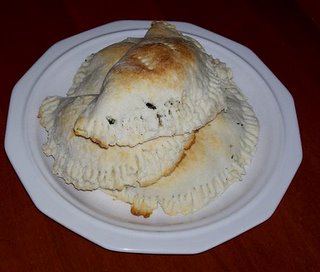
Spinach turnovers
Depending on the amount of biscuit dough you’ve prepared, you will likely have a large amount of the mixture left over. This can easily be frozen and used later. Altogether, making spinach turnovers from scratch takes about two hours. But with the mixture already prepared, the time is cut down to about an hour.
I remember as a child absolutely loving to drink a cold glass of milk with spinach turnovers. My tastes have evidently changed in the ensuing decades, because the milk didn’t quite go as well as I remembered it to. All the same, I would be hard pressed to recommend a good wine to go with it. I’ll leave the beverage up to you.
Although this is not a cooking blog, I thought it might be nice to include a favourite from my mother’s kitchen. It apparently comes from an early effort of my father to communicate to her something his own mother used to make in Cyprus. I doubt she got it exactly right, but the result is delicious nonetheless. There may even be a subconscious influence from the Cornish pasties enjoyed by her immigrant Finnish forebears in the upper peninsula of Michigan. I hadn’t eaten spinach turnovers in probably more than two decades, but a few weeks ago I decided to try my hand at them once again, with great success. Nancy loved them. Here’s the recipe, using imperial measures:
Cook spinach in as small an amount of water as possible. Drain well in strainer. While spinach is cooking, begin cooking rice per directions on package, using slightly less water than suggested. Turn off burner under pan for the last five minutes and let rice sit, still covered. Chop onion. Brown meat in skillet, adding chopped onion. Mix spinach, rice, meat and onion. Add salt and cinnamon to taste – probably ½ teaspoon salt; possibly as much as 2 tablespoons cinnamon. (Cinnamon flavour will lessen during baking.) Mix well.
Roll out biscuit dough thinly. Cut out using round circle 5 to 6 inches in diameter (e.g., the top to a metal canister). Roll the resulting circle even thinner. Put above mixture on one side of the circle, pulling the other side over the mixture to form a half circle. Pinch edges together, marking entire edge with the tines of a fork. Pierce top of each turnover with fork tines. Bake 15-20 minutes in a 375-400 degree oven until lightly browned. Brush with butter, margarine or extra virgin olive oil while still hot. Enjoy.

Depending on the amount of biscuit dough you’ve prepared, you will likely have a large amount of the mixture left over. This can easily be frozen and used later. Altogether, making spinach turnovers from scratch takes about two hours. But with the mixture already prepared, the time is cut down to about an hour.
I remember as a child absolutely loving to drink a cold glass of milk with spinach turnovers. My tastes have evidently changed in the ensuing decades, because the milk didn’t quite go as well as I remembered it to. All the same, I would be hard pressed to recommend a good wine to go with it. I’ll leave the beverage up to you.
Subscribe to:
Posts (Atom)