Showing posts with label architecture. Show all posts

12 August 2009

John M. Lyle: architect

A Progressive Traditionalist
Glenn McArthur. A Progressive Traditionalist: John M. Lyle, Architect. Toronto: Coach House Books, 2009. 220 pp.

I admit it. One of my guilty pleasures is the handsomely-illustrated coffee table book, and the current offering under review fulfils that role very nicely indeed. Glenn McArthur’s new book is a delight to page through for anyone possessing an interest in the arts and especially architecture.

John McIntosh Lyle (1872-1945) was one of the great architects of his day, and he had a strong connection with Hamilton, responsible for a number of familiar structures gracing our city.

Lyle was born in County Antrim, Ireland, in 1872. When his father, the Rev. Samuel Lyle, was called to the pastorate of Central Presbyterian Church in 1878, the family immigrated to Canada. The Rev. Dr. Lyle led the congregation for more than three decades, retiring in 1911. His son John studied at the Hamilton Art School, briefly at Cornell University, and at the Yale School of Art. In New York City he apprenticed at the office of Hamilton architect Frank Freeman before heading to Paris to enrol at the prestigious École des Beaux-Arts for further studies.

Once these were completed in 1896, Lyle returned to North America, settling in New York and eventually finding work in the firm of Howard & Cauldwell. Only three years earlier, the World’s Columbian Exposition in Chicago had changed the course of the continent’s architecture, securing the place of the distinctive Beaux-Arts neoclassical style, especially in public buildings. Lyle himself would design two bandstands for the 1901 Pan-American Exposition in Buffalo.

In 1905 Lyle returned to Canada, taking up residence in Toronto, where an extensive fire a year earlier seemed to promise opportunities to contribute to the vast rebuilding project. Although this promise did not pan out immediately, he did design the Royal Alexandra Theatre, built between 1905 and 1907, which was named for Edward VII’s queen consort.

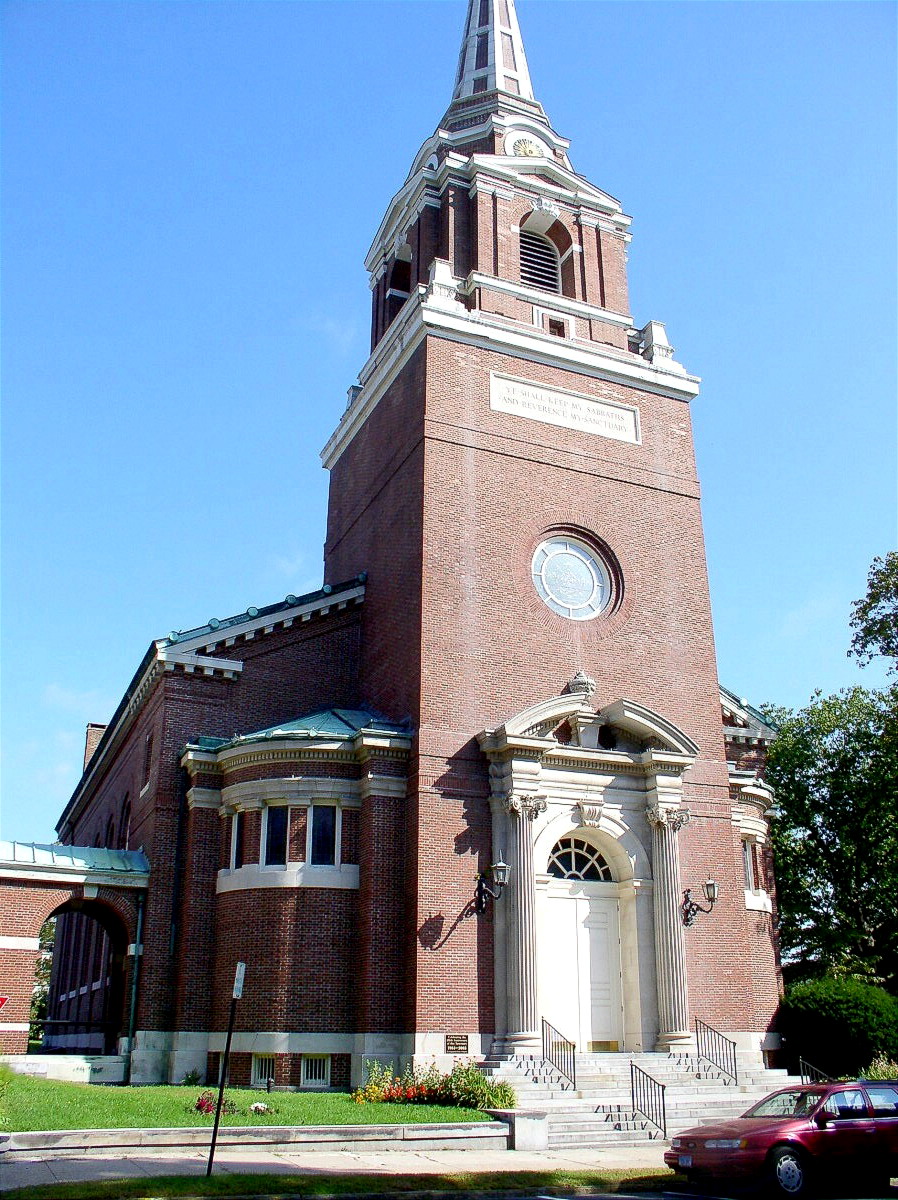
Central Presbyterian Church, Hamilton
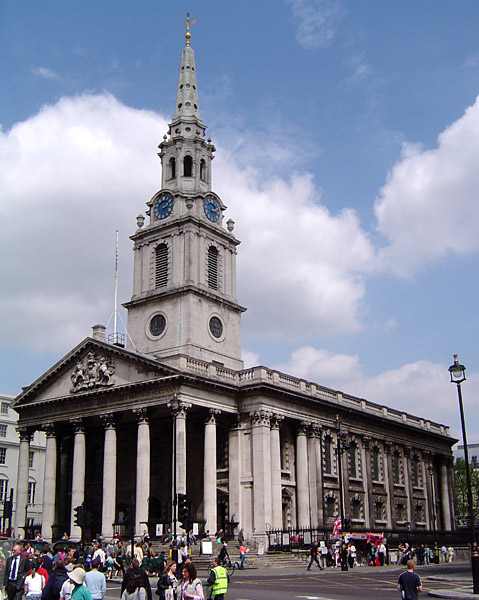
A fire in 1906 destroyed his father’s church, Central Presbyterian, which had occupied a quasi-gothic building constructed in 1858 at Jackson and MacNab Streets. The congregation decided to relocate a bit farther south of the city’s centre to Caroline and Charlton Streets. The completed structure borrows from a number of influences, including the Church of St. Martin-in-the-Fields in London and the Congregational Church of Naugatuck, Connecticut. One of its more unusual features is that it has a flat roof, thereby resembling more the public edifices favoured by the Beaux-Arts school than the traditional European church. Nevertheless, the church’s interior is dominated by a series of traditional stained-glass windows portraying stories from the Bible. This juxtaposition of the modern and the traditional appears to vindicate McArthur’s choice of title for his book. So satisfied was Lyle with the outcome of his efforts that he incorporated a black silhouette of the building into his personal bookplates. The spire of Central is a distinctive landmark visible throughout the surrounding neighbourhoods.

From here Lyle would go on in 1913 to design the Great Hall of Toronto’s Union Station (see book cover above), familiar to generations of commuters who have passed through it twice daily. While other urban railway terminals have seen the wrecker’s ball in recent decades, this building continues to serve the travelling public much as it did when it first opened.

Throughout his career, Lyle was much in demand by the nation’s banks, where the neoclassical style was favoured in the early years of the 20th century, perhaps as a way of impressing would-be depositors with the imposing nature of their own financial solidity.

Among the Hamilton landmarks for which Lyle was responsible are the palatial home Wynnstay, now Mount Mary Immaculate, in Ancaster (1925); the Gage Memorial Fountain in Gage Park (1926); and the Hamilton High Level Bridge, where York Boulevard passes over the Desjardins Canal (1932). Other well-known Lyle designs include the Memorial Arch at Kingston’s Royal Military College (1921); and the Runnymede branch of the Toronto Public Library (1929), which incorporated English, French Canadian and aboriginal elements. I myself used to live near that branch three decades ago and visited it on occasion.

Also notable are the designs Lyle submitted for projects later awarded to others. Two examples are worth mentioning. In 1907 his proposal for the buildings of the Justice Department would have altered the landscape of the federal government’s public architecture by making it more resemble that of Washington, DC. When in 1922 The Chicago Tribune sought designs for its new building, Lyle’s unsuccessful effort featured neoclassical columns and, of all things, a spire reminiscent of the one he had placed atop Central Presbyterian Church!

Incidentally, Lyle's grandson recently donated a copy of this book to that church's library, where I came across it a few weeks ago after sunday worship. The family is to be commended for helping to disseminate knowledge of their forebear's contribution to Canadian architecture.

23 May 2009

Michigan Central Station

When driving into Detroit from Windsor over the Ambassador Bridge we have often puzzled at the identity of the abandoned multi-storey building off to the right, which seems to embody the sorry state of the once thriving Motor City. I have recently learnt that it's the shell of the Michigan Central Station, an architectural landmark built in 1913 and closed in 1987. Efforts to refurbish the old station have thus far been unsuccessful, stymied by the lack of available funds.


Here is a tour of the building made the year it closed:


I am not at all keen on the casino idea mentioned in the first video, but perhaps the example of LIUNA Station here in Hamilton offers some promise for MCS. This was the old Canadian National station on James Street north, which operated between 1931 and 1993. In 2000 it was reopened as a banquet hall by the Labourers' International Union of North America. Trains may once again use the station as part of a long-term transportation plan for Ontario's Golden Horseshoe, and a platform is being built to accommodate them. Detroiters should take note.

22 October 2008

Neoclassical architecture

Paul M. Weyrich, of the Free Congress Foundation, is a fan, not only of rail transportation, but also of neoclassical architecture, as evidenced here: A Celebration of Railroads and Architecture. I am completely in agreement with him in his advocacy of train travel, which I am convinced needs to be favoured over air travel for short and intermediate distances. I am more ambivalent over his sweeping claim, following Prince Charles, that "classical architecture is a tribute to God Almighty."

Union Station, Washington (1907)
Union Station, Washington, DC


I have been to Washington's Union Station at least twice, most recently in July of last year. It was designed by architect Daniel Burnham, well known for his contribution to the World's Columbian Exposition in 1893 and his Plan of Chicago in 1909. I am pleased that this magnificent structure was successfully preserved and restored. Furthermore, I am happy to admit that all architecture is in some fashion a manifestation of God's creative intent that his image-bearing creatures should shape their environments in distinctive ways.

Yet architectural fashions also reflect the religious worldviews of the architects themselves, as well as of the larger culture that nurtures them. One looks in vain for Weyrich to recognize that neoclassicism in art and architecture was motivated by an effort more to recover the vaunted glories of pagan Greece and Rome than to honour God. Weyrich's conservatism could stand to be a bit more nuanced here.

29 August 2008

Architectural integrity

Yesterday we visited the revamped Royal Ontario Museum in Toronto and were left wondering whether we're the only ones who think it looks like a giant object from outer space crashed into the building. Architect Daniel Libeskind would have done better to respect the integrity of the original structure as designed in 1914 by Frank Darling and John A. Pearson, who would undoubtedly not have approved of this addition to their handiwork.

05 March 2008

Birks Building, Hamilton, Ontario, Canada
Hamilton streets

Which encyclopaedia carries articles on individual streets in Hamilton, Ontario? Wikipedia, of course. Read here about James Street, Locke Street, Dundurn Street, and even Concession Street and Mohawk Road on the "Mountain."

By the way, speaking of James Street, why was the old Birks Building, located at the corner of James and King and once described by Oscar Wilde as "the most beautiful building in all of North America," demolished back in 1972? It was a distinctive piece of Victorian architecture and a Hamilton landmark. It ought to have been preserved.

28 January 2008

'Traditional urbanism' and neighbourhoods

As an alumnus of the University of Notre Dame, I receive gratis Notre Dame Magazine, a glossy periodical that is usually not near the top of my "to read" pile. Nevertheless, the winter 2007-08 issue carries an article by John Nagy, The Once and Future Neighborhood, that is definitely worth reading. It features the ideas of Philip Bess, professor at the Notre Dame School of Architecture, who is described as a "traditional urbanist." Bess's academic interests frequently take him and his students to Cooperstown, New York, once an ordinary village, but now reshaped by the presence of the National Baseball Hall of Fame.

Bess makes urbanism relatable by talking about pizza, an analogy he borrows from the influential European architect and urban designer Leon Krier. A traditional neighborhood, Bess explains, is to a traditional city what a slice of pizza is to the whole pie, "because a slice of pizza has on it all the ingredients of the entire city." Residents can walk to schools, parks, the family doctor and the grocery store, their church and, ideally, their work: in short, the places that supply their lives with health and meaning.

Suburban development leaves us with separate piles of ingredients. Homes for the poor are in one pile; homes for the well-off somewhere else. Clusters of office buildings, public services and retail stores surrounded by oceanic parking lots crop up along congested connector roads paved at taxpayers' expense. We drive everywhere because we have no choice. As Bess says, "you can't just have a pizza; you've got to go get each little ingredient by itself."

We tagged this form of suburbia "sprawl" in the 1960s while our cities and towns hemorrhaged into never-ending subdivisions. In 1982, developed land in the United States covered 72.9 million acres. By 2003, federal data show, new construction left an Iowa-sized footprint of 35.2 million more acres -- a rate nearly double that of the growth of the population.

The problem at its deepest level is one of human nature. But it's also a byproduct of the postwar economic boom and faulty public policy. You may know the story: Public health concerns about industry set a precedent for single-use zoning codes that extend to everything, including housing by income level. Cheap, government-backed mortgages, nothing short of miraculous to a generation that had grown up in depression and war, favored new construction over renovation. Interstate highways promised swift commutes and an escape from polluted, crime-ridden cities and their failing schools. Developers, their crews and their corporate financiers benefitted from building plentifully and at low cost. They still do.

The impact on Americans and our communities, even idyllic and isolated ones like Cooperstown, has been palpable. We've lost apartments above stores and backyard coach houses -- the kind of affordable housing that doesn't come in menacing, publicly funded, cinder-block rectangles. Our streets have emptied of pedestrians as cars have become appendages rather than conveniences. In some areas, teachers, nurses and police officers can't afford to live in the communities they serve. Property taxes spike to cover the rising costs of infrastructure and basic services in far-flung areas. Children and the elderly who can't drive themselves to parks and shops have lost independence. Obesity has become a public health crisis.

While finding solutions is not a simple matter, Professor Bess does offer Ten Principles of Good Neighborhood Design. A good neighbourhood:

Has a discernible center: for example, a public square or main street bordered by civic buildings, shops and/or residences

Has a more or less discernible edge where it ends and another neighborhood or natural feature begins

Is pedestrian friendly, accommodating cars as well as those who want or need to walk

Consists of a variety of dwelling types: for example, single-family homes, apartments above stores and coach houses, which together encourage a healthy economic diversity

Has stores and offices located at and/or near its centers with enough variety of retail goods to meet weekly household needs

Has an elementary school and parks to which most young children can walk

Has small blocks with a network of through-streets (as opposed to feeder roads and cul-de-sacs), generous sidewalks and broad planter strips for trees

Places its buildings close to the street to create a stronger sense of place

Utilizes its streets for parking, rather than building lots and garages visible from the street

Reserves prominent sites for community monuments and civic buildings for education, religion, culture, sport and government, that front on public squares or terminate the ends of streets.

28 August 2007

Urban planning in the 'Windy City'


Although I am not quite a native of Chicago, I was born just outside the city limits in Oak Park and grew up in suburban Wheaton, about 40 km west of the Loop. I've not lived in the vicinity for decades now, but Chicagoland still holds a place in my heart, especially the city itself, with its unique neighbourhoods, lakefront parks, architecture, world class museums, railways, and even the perpetually disappointing Chicago Cubs baseball team.

In the space of barely two generations Chicago grew from a small village on the southwest shores of Lake Michigan in the 1830s to a huge metropolis of more than a million people by the 1890s. With such explosive growth the city had put down few roots and commanded little loyalty from its residents, the vast majority of whom had come from elsewhere in the US and, increasingly, from Europe. It was merely a place to make one's fortune with the ever-present possibility of pulling up stakes and moving on. Chicago grew in chaotic and haphazard fashion with little, if any, attention to the provision of basic urban amenities that might have a civilizing and humanizing effect on its people.

This began to change towards the end of the 19th century, starting with the 1893 World's Columbian Exposition, the great world's fair planned by Chicago architect Daniel Burnham. Thereafter Burnham and the Commercial Club of Chicago came to recognize the need for a comprehensive plan for developing and improving the entire urban environment for the sake of its people. The fascinating story of this plan — its development, reception and implementation — is told in Carl Smith's The Plan of Chicago: Daniel Burnham and the Remaking of the American City (above right).

Proposed Civic Center, Jules Guerin
The Plan of Chicago, often called the Burnham Plan after its principal author, was published in 1909 and was visionary in its proposals for improving and beautifying the city. It took as its model Napoleon III's Paris, as redesigned by Georges-Eugène Haussmann, the emperor's prefect of the Seine. The Plan envisioned a system of public parks throughout the city; straightening the south branch of the Chicago River; building a major bridge over the river to connect Michigan Avenue to Pine Street, making a single continuous boulevard connecting the north and south sides; filling land into the lake to create an extensive public park from Lake Park (later Grant Park) to Jackson Park (site of the 1893 fair); widening Congress Street to create the city's major east-west boulevard; and, most important of all, building a domed civic centre at a central place in the Congress Street boulevard (above left).

All of this was set forth in an aesthetically pleasing volume adorned with beautiful illustrations by Jules Guerin and Fernand Janin, thereby making the book itself a visual feast to savour at leisure. A limited number of copies were published and sent to the movers and shakers of industry, commerce and government, and even to the new US President William Howard Taft. (The complete volume can be perused on the Encyclopedia of Chicago's website, albeit not in the most readable format.)

The Plan was remarkable in a number of ways. To begin with, it was spearheaded by a group of self-appointed men prominent in their respective fields. They were idealistic and public-spirited, genuinely believing they had the best interests at heart of all Chicago's people, and not just the city's entrepreneurs. Although they disliked the corrupt municipal government of the day, they placed considerable confidence in government in general to effect change — in a "democratic enlightened collectivism coming in to repair the damage caused by exaggerated democratic individualism," as Harvard President Charles W. Eliot expressed it. In this they were typical men of the Progressive Era, believing in their own superior ability to undertake such a project and assuming that, with the proper public relations techniques, others could be persuaded to come on side of their agenda.

Michigan Avenue Bridge, 1 January 1983
At least some of the Plan was eventually implemented, though not always as conceived by Burnham and his associates, who lived just prior to the proliferation of automobile ownership. Congress Street was indeed expanded and extended as a great east-west corridor through the city, but it took the form of the first of the great expressways to connect the city's heart to its suburbs in the 1950s and '60s. The Civic Center never materialized, and its proposed location is now the site of the Circle Interchange connecting four major expressways. The Michigan Avenue Bridge (above right) was built in 1920. A lakefront park system was indeed built on landfill, though Grant Park did not become quite the cultural centre foreseen by the Plan. Nor does Chicago boast the neoclassical architecture shown in Guerin's and Janin's illustrations. Nevertheless, municipal zoning certainly caught on and is nowadays simply taken for granted in North American towns and cities.

The Commercial Club was, of course, an élite group, making bold plans for grand public spaces, monuments, boulevards and buildings. Smith notes that the late Jane Jacobs opposed Burnham's approach to urban planning:

In the introduction to her best known work, The Death and Life of Great American Cities (1961), Jacobs is particularly disparaging of Burnham's emphasis on civic centers and monumental designs, which, she contends, have degraded rather than improved the neighborhoods around them. It is true that neither the text nor the illustrations of the Plan pay much attention to the quality of the urban street life on which Jacobs focuses so much concern or to how the individual actually experiences the city, other than as a grid to move across as efficiently as possible. With few exceptions, people are either entirely missing from Guerin's and Janin's drawings or completely overwhelmed by the massive scale of the buildings (pp. 156-7).

When I was growing up, efforts at urban renewal often came at the expense of distinctive neighbourhoods, such as the old Greektown on the west side, which was razed to make way for the campus of the University of Illinois at Chicago. While I do not deny the need for urban planning, I would reiterate something I wrote three years ago about Planned cities and new beginnings: "justice is more likely to be found in the ordinary activities of a government conciliating diverse interests than in a government bent on capturing its citizens' imaginations and mobilizing them for flashy, expensive projects not immediately related to their genuine needs." Moreover, real renewal of a city requires co-ordinated efforts from multiple agents, including churches, neighbourhood associations, ethnic organizations, and civic societies, in addition to municipal governments.

26 February 2007

Local ecclesiastical architecture

An informative article was posted today by York University's Prof. Malcolm Thurlby: 19th-Century Churches in Hamilton: Barton Stone United Church and St Paul's Anglican Church, Glanford. These buildings are familiar to those living in Hamilton above the Niagara Escarpment, and Barton Stone Church is very close to our home.


This is a photograph of Stone Church taken by my mother back in the autumn of 1993 — probably Thanksgiving weekend. The vines on the outside were the most colourful I have seen them either before or since. This is one of our landmarks and possibly the oldest building on Hamilton Mountain.

18 September 2006

Architecture

From ages 6 to 14 I aspired to become an architect. As a child I used to spend hours drawing floor plans of homes, fancying myself the heir of the great Frank Lloyd Wright, who once lived in the city of my birth, Oak Park, Illinois. Taking a drafting course in high school convinced me that architecture was not for me after all. Nevertheless, I still have an interest in the subject. When my niece married a Chicago architect a few months ago, he and I discovered we had much to talk about. Moreover, when some friends visited my home many years ago, they noticed that much of the art on my walls consisted of cityscapes and buildings. I hadn't put two and two together before that, but I realized then that I still care about the buildings where we live our lives from day to day. A week ago last friday Comment published a thoughtful article by David Greusel, Why architecture matters. It's a great piece and I can easily resonate with the concerns expressed therein.

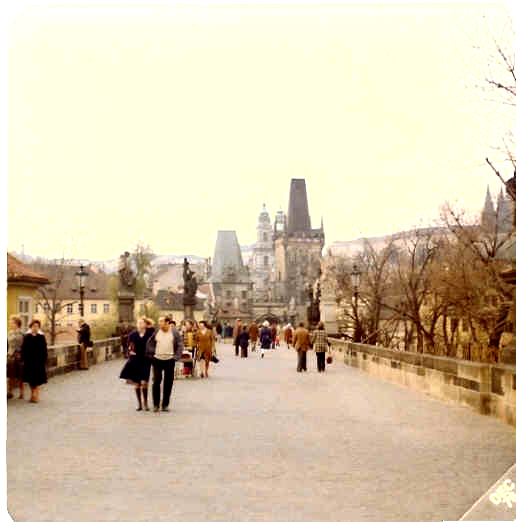
Charles Bridge, Prague (© 1976 David T. Koyzis)
In late 1976 I visited Prague (right), the capital of what was then still called Czechoslovakia. Immediately I fell in love with this perfect jewel of a city, with many of its buildings dating back to the 14th century when the Emperor Charles IV made it his capital. Because it was spared the destruction of the two world wars, it still retained its character — at least at its centre. Of course, three decades ago the country was under the communists, whose rule affected the architecture constructed between 1948 and 1989. Prague thus offered a fascinating contrast within its own borders. On the one hand was the old city, constructed in grand style befitting the seat of an emperor.

On the other hand, the periphery of the city suffered from the blight of a dour stalinist architectural style imported from the Soviet Union. For communists any human touches to our homes, schools, workplaces and public buildings are deemed remnants of a decadent capitalism, to be replaced eventually by a sternly proletarian functionalism divorced from the realities of human communities and the relationships nurtured therein.

We can be grateful that the communists saw fit to retain the late mediaeval heart of Prague, rather than effacing it altogether as they did the former East Prussian city of Königsberg, now known as Kaliningrad. This suggests that, despite the depredations of a destructive worldview, the rulers of Czechoslovakia recognized the treasures they had inherited from their precommunist predecessors and rightly sought to preserve them for future generations.

Chicago Skyline (© 1976 David T. Koyzis)
Yet there are places in the noncommunist western world where the architectural legacy of previous generations is too easily cast aside when economic imperatives dictate. For example, my home city of Chicago (above left in 1976) boasts some of the best known cutting-edge architecture in the world. However, in my personal library I have a nostalgic volume titled, Lost Chicago, by David Lowe, filled with more than 200 pages of photographs telling the sad story of a city's vanished heritage. Of course, some of this perished in the Great Fire of 1871, but most of it was deliberately destroyed to make way for something newer and ostensibly better.

Back in 1984, when the decision was made to demolish the old Chicago & Northwestern terminal on Madison and Canal Streets, and build in its place a metal and glass skyscraper to be called the Northwestern Atrium Center, I wrote a letter of protest to the Chicago Tribune, subsequently published in the 23 June issue of that year. Here is the letter, with which, apart from a few rhetorical flourishes, I still agree:

It saddens me to see the stately old Chicago & Northwestern terminal about to be demolished. To try to soften the blow, the railroad has put up signs and banners cheerily proclaiming, "We're on our way up," meaning, of course, that where the old station now stands will soon be erected yet another of those characterless glass office buildings with an enclosed shopping court at its base. One more link with the city's past will have been sacrificed barbarously at the altar of progress and the almighty dollar.

Chicago is rather like a vain movie star, afraid to let the world see the signs of its age and refusing to grow old gracefully. Every generation the city seems compelled to undergo a facelift, allowing itself to live on an illusion of perpetual youth while eradicating any continuity with its own past. Not every building should be preserved merely because it is old, of course, but the reckless compulsion to destroy and rebuild is not healthy either. Not only has such a city lost touch with its own soul, but it is hardly acting as a fit caretaker and steward of the valuable resources and treasures bequeathed by past generations. When will Chicago learn to value its own heritage instead of glorifying its rootlessness?

More than two decades later, as I look back on what I wrote then, it occurs to me that we need to address an important question: Given that we cannot and should not save every building that has ever been constructed, what criteria should we use to decide which to preserve and which to replace? I'd love to hear some discussion of this.

06 December 2005

Political architecture

From about age 6 until age 14 I had plans to become an architect, which I abandoned after discovering a lack of interest in some of the ancillary skills, such as drafting. Nevertheless, I still have an interest in the subject of architecture and city planning. I am especially interested in the design of government buildings, including the interior layout of parliamentary chambers. At some point I may write something more coherent on this topic. Here I will content myself with four pieces of trivia.

  1. Both Canada and the United Kingdom have parliamentary chambers in which government and opposition members face each other across an open floor. This tends to reinforce the adversarial character of proceedings. Many, if not most, other countries have parliaments whose deputies are seated in semicircular fashion around the speaker. This is true of the French National Assembly, the German Bundestag and the United States House of Representatives and Senate. Australia and its component states have parliaments which combine these two patterns. Government and opposition MPs face each other through most of the chamber, but the seats form a "U" at the far end from the speaker.

  2. It seems that many Commonwealth countries have upper chambers whose interiors are coloured red, following the example of the House of Lords, the original Red Chamber. This includes the Canadian and Australian Senates, the Legislative Councils of five of the Australian states, as well as the Rajya Sabha in the Indian Parliament in New Delhi. (Canadian provinces abolished their own legislative councils long ago and now have unicameral legislatures. In Australia only Queensland's parliament is unicameral.) Senate reform is a semi-popular noncontact sport in this country, but thus far no one has managed to win at it, except for the senators themselves, who are appointed (not elected) to their positions until death or age 75, whichever comes first, and can put in as much or as little work as they please.

  3. When the British House of Commons was destroyed by German bombs during the Blitz in 1941, some thought was given to rebuilding it along continental European lines, i.e., in semicircular shape. Prime Minister Winston Churchill opposed this, arguing that "We shape our buildings, and afterwards our buildings shape us." His wishes carried the day and the Commons chamber was rebuilt along the lines of its predecessor.

  4. After our own parliament building burned in 1916, a number of designs were considered for its replacement. During my visit to Ottawa last February, I was privileged to visit the old Justice Building, courtesy of my good friend Eric Hogeterp. As we entered, I was astonished to see on the wall an artist's rendering of one such proposed design. Its style was neoclassical, complete with a domed capitol, making it resemble nothing other than the American federal government buildings in Washington. Needless to say, this design was not adopted, and the current Centre Block was rebuilt in neogothic style.

18 June 2005

Vézelay

This is for our young travellers who were soliciting advice for places to visit in Europe. Between Paris and Geneva lies the village of Vézelay, which is definitely worth seeing. I myself was there 30 years ago with Gordon College's European Seminar. It's a lovely little town whose principal attraction is the Basilique de Marie Madeleine, a largely romanesque church bearing the remains of Mary Magdalene.


Bryn Mawr

The Basilica of Mary Magdalene


This is from the journal I was keeping at the time, dated 8 July 1975:

The atmosphere is somewhat similar to the Cathedral at Noyon at which Calvin grew up. It is very colourless and sombre. It is also lacking the tourists which throng Notre Dame [Paris] or St. Paul's [London]. The style of most of the church is romanesque. The quire is gothic, however, with typical pointed arches and airy architecture, the emphasis being on light. By contrast, the nave has smaller windows and a darker, heavier character. The façade of the basilica is similar to Notre Dame (smaller of course) except that there is but one tower on one side which seems to destroy the symmetry of the structure. To this church flocked pilgrims bent on seeing and venerating the presumed remains of Mary of Magdala which are stored in the crypt below the quire. It is much easier to pray and to maintain a worshipful attitude here than in the cathedrals of the large cities.

On a sloping hillside outside the town St. Bernard of Clairvaux preached the sermon which launched the Second Crusade to recover the Holy Land. We stayed at a youth hostel operated by the Catholic peace organization, Pax Christi. A year later I turned one of the photographs I took of a Vézelay street scene into an oil painting which now hangs in the dining room of our home.

Back in 1975 Vézelay was off the beaten path, having become somewhat obscure after centuries of being a bustling centre for pilgrims. I hear rumours that the town has once again become heavily touristed. Yet even if it has, it's still worth a visit.

04 October 2004

The sloping roof and the person of Christ

Not far down the street from where we live there is a Kingdom Hall of the Jehovah's Witnesses. The building resembles nearly every other Kingdom Hall I've seen elsewhere in North America. It looks much like a small ranch-style house with a shallow roof. Here is an example of one such building in Springhill, Nova Scotia:


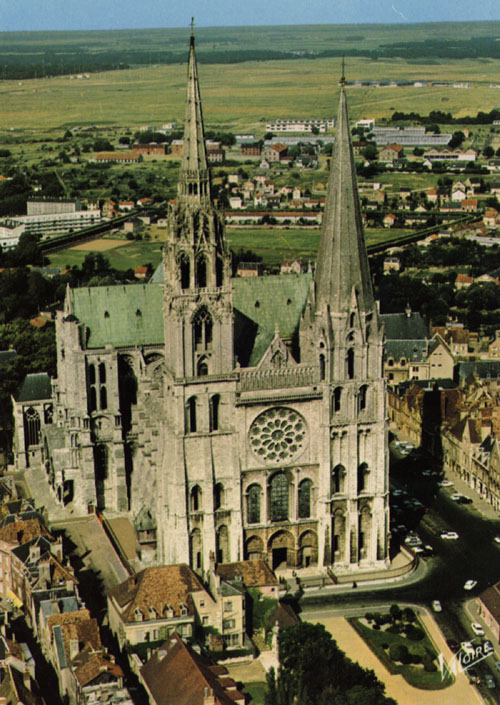
Now contrast this to Chartres Cathedral, shown below, with its soaring spires and steep roof line:


Ken Steiglitz, Princeton University


This raises an interesting question: does ecclesiastical architecture reflect the theology of the builders and worshippers? Might there be a connection between shallow roof lines and a low view of the person of Christ? Might there be a corresponding relationship between steep roof lines and a high view of the person and work of Christ? Just a thought.

18 September 2004

The Gothic Revival Cottage

Although my childhood ambition was to become an architect, I discarded this dream at age 14 after taking a drafting class in high school and realizing that my gifts lay elsewhere. That said, I have an abiding interest in the subject. I find it fascinating to explore the different living and working environments people construct for themselves as they work out the cultural mandate. The building materials are largely dictated by what is available in specific localities. But the styles characterizing the completed edifices vary according to the limits of the human imagination.

When I moved back to southern Ontario 17 years ago, I couldn't help noticing that the design of the house shown immediately below, located in the village of Simcoe, recurs throughout the region.


OntarioArchitecture.com


It's called the Gothic Revival Cottage, and it represents a 19th-century attempt to translate something of the English architectural tradition to rural Upper Canada. According to OntarioArchitecture.com,

Many elements of stone buildings in England are translated into wood on cottages and smaller residences in Ontario Gothic Revival buildings. The overall effect is eclectic and usually ornate. The Gothic Cottage is probably the most pervasive Ontario residential style prior to 1950. Not to be confused with Neo-Gothic, which is a twentieth century adaptation to large institutional buildings, the Gothic Revival is a direct translation of medieval details and building practices to the Ontario climate. . . . The basic design was promoted in the 19th century by academics J.C. Loudon and A.J. Downing as well as the Canadian Farmer (1865) where it is featured complete with construction drawings for the farmer to build.

The most distinctive element of the Gothic Revival Cottage is the small arched window above the door flanked by a fairly steep roofline. A drive through southern Ontario will reveal many such cottages, some made of brick and others of stone or wood, but all variations on the same basic theme.

It seems that the Gothic Revival Cottage is not altogether peculiar to southern Ontario. Here is one located in Hudson, Ohio, near the city of Cleveland:


Hudson Heritage Association


Other examples of this style are seen occasionally in various parts of the United States, but they are not nearly as common as here in southern Ontario.

25 August 2004

Planned cities and new beginnings

As a child I had aspirations to be an architect and perhaps even a city planner. I was particularly enthralled by an article in the May 1960 issue of National Geographic titled, "Metropolis Made to Order: Brasília," about the construction of a new capital city for Brazil. It was filled with photographs and illustrations of half-constructed buildings, including those housing the three branches of government, the various ministries, a cultural centre, commercial and banking establishments, residences, schools, and even a large teepee-like cathedral. Two aerial diagrams showed a symmetrical city spread out along a lake and resembling the torso and wings of a giant bird. Extensive green spaces carved out of the hinterland separated the buildings, undoubtedly making it rather taxing for would-be pedestrians.


John de Garis

Congressional buildings, Brasília


What a fascinating notion: building a city from scratch out of a wilderness! It seemed such a daring and exciting venture. I immediately set about trying to design capital cities of my own for fictitious countries of my devising. None of these boyish designs survive, so I can no longer recall what they looked like. But I rather think they shared many of the qualities of Brasília itself, excepting the huge expense.

I would eventually learn that the notion of a planned capital city was by no means new. It had been done before and it would be attempted again. In one of the earliest efforts the Emperor Constantine the Great moved his capital from Rome to a new Rome built on the foundations of ancient Byzantium, to be rechristened Constantinople. It would serve as a capital of the Roman and Ottoman Empires successively until 1924. In 1703 Russia's Peter the Great built a new capital on the banks of the Neva River and the shores of the Baltic Sea -- on land recently seized from Sweden. St. Petersburg ("Sankt Pieterburg") supplanted old Moscow and the Emperor forced Muscovite nobles to pull up roots and move to his new city. The fact that it was so vulnerable militarily would come back to haunt its residents some 240 years later when the nazis besieged what was then called Leningrad for 900 horrible days.

Two hundred years ago the United States built a new capital on the shores of the Potomac River in land detached from Maryland and Virginia. (The segment from Virginia was later returned to that state.) In the 20th century Australia built Canberra and Pakistan built Islamabad as the centres of their respective governments.


http://www.eryptick.net/

Parliament, Canberra, Australia


Nowadays I am less interested in the physical undertaking of building a new capital city than in what it symbolizes, namely, a new political beginning. Constantine built Constantinople in part to mark the adoption of a new religion for his empire. Old Rome was irretrievably pagan; new Rome was established as a christian city for a christianized empire. Peter the Great founded St. Petersburg as a symbol of a new Russia oriented towards western Europe. That neither imperial Rome nor imperial Russia fully put aside the old ways is immaterial. The very abandonment of the old capital represented an intention to break with tradition as fully as possible.

Rome and Russia were already ancient realms by the time their new capitals were chosen. However, the fledgling United States, formed in 1787 out of the 13 states which had so recently broken with the British Crown, required a new capital to correspond to its own newness. Its very name, honouring the first president, George Washington, carried the hopes and aspirations of the new federal republic. Much as Washington set the tone for his presidential successors, the building of the city of Washington would come to characterize the seemingly limitless possibilities of a country already expanding west beyond the Appalachian frontier.

And what of Brasília? From the time of independence in the 19th century, Brazil's rulers had wanted to settle the vast interior of the country. When republic replaced empire in 1889, an interior location was set aside for a prospective new capital city. However, not until 1956 were concrete steps taken in this direction. In 1960 Brasília replaced Rio de Janeiro as the centre of the federal government. Like all cities, it has never been entirely completed and undoubtedly never will be. Sad to say, however, only four years after Brasília's inauguration, a military coup dislodged the civilian government and misruled Brazil until 1985. Did the grand effort of planning a new city in a relatively poor country impair the political system's functioning, making it ripe for an authoritarian government? Perhaps.

I myself tend to wonder whether such a tangible symbol of breaking with the past might tend to mislead citizens into believing that they really have done so -- that they have succeeded in putting aside their own traditions, good and bad, and embracing entirely new ones created, as it were, ex nihilo. Even revolutions, such as the French and the Russian, change far less in the political culture than their proponents would like to see. The old ways are simply carried into the new capital or the new régime. I also wonder whether the resources employed to build a new capital might have been put to use in less spectacular pursuits that would nevertheless better have served the public interest.

Yes, there is an undeniable excitement in a national effort to build a new capital city from scratch. But justice is more likely to be found in the ordinary activities of a government conciliating diverse interests than in a government bent on capturing its citizens' imaginations and mobilizing them for flashy, expensive projects not immediately related to their genuine needs.

Followers

Blog Archive

About Me

My photo
Contact at: dtkoyzis at gmail dot com