US holiday observed in southern Ontario?
This is the first time in my memory that we in Hamilton have been able to take the day off for Martin Luther King's birthday.
15 January 2007


Trudeau was right after all
Here's another benefit for Canadians knowing both official languages: Bilingualism may delay onset of dementia: study.
Here's another benefit for Canadians knowing both official languages: Bilingualism may delay onset of dementia: study.
14 January 2007
The growth of Christianity: two contrasting tales
Could secularization in the Netherlands be running its course? That's what Joshua Livestro reports in Holland's Post-Secular Future. (Hat tip to Paul Bowman.) Despite recent predictions to the contrary, the future of that country may belong to . . . yes, Christianity! The Rev. Stanley Hofwijks pastors a fast-growing charismatic congregation in Amsterdam. The key to its success? Here's Hofwijks:
Perhaps. But here's another article on the growth of the Orthodox Church in the United States that suggests that not all conversions are fuelled by such an instrumental approach to liturgy: Orthodox appeal: More Americans are being drawn by liturgy, theology. Why?
Could secularization in the Netherlands be running its course? That's what Joshua Livestro reports in Holland's Post-Secular Future. (Hat tip to Paul Bowman.) Despite recent predictions to the contrary, the future of that country may belong to . . . yes, Christianity! The Rev. Stanley Hofwijks pastors a fast-growing charismatic congregation in Amsterdam. The key to its success? Here's Hofwijks:
"If you look closely, you'll see that only the traditional churches are affected by secularization. Almost all nontraditional churches are growing, and growing strongly. The reason is simple: While the message stays the same, the methods change to suit the times. If people want it, we'll have flags, loud music, people jumping up and down in the pews, even hip-hop. But Jesus remains the same as he was 2,000 years ago. The Word never changes."
Perhaps. But here's another article on the growth of the Orthodox Church in the United States that suggests that not all conversions are fuelled by such an instrumental approach to liturgy: Orthodox appeal: More Americans are being drawn by liturgy, theology. Why?
Many converts credit the beauty of the liturgy and the durability of the theology, which can be a comfort to those seeking shelter from divisive battles over biblical interpretation in other Christian traditions.
[The Rev. John] Dixon, who was raised an Old Regular Baptist, an austere faith of the Southern Appalachians, said his conversion grew from his studies about the origins of Christianity as an undergraduate at Marshall University. The turning point came when he first attended services at an Orthodox church.
"As soon as I came in that day," he says, "I knew I was home."
11 January 2007
And while we're on the subject. . .
Here is a transcript of President Bush's address to the American people last evening.
Here is a transcript of President Bush's address to the American people last evening.
10 January 2007
Bush’s dilemma
The following piece appears as my monthly column in the 8 January issue of Christian Courier:
President George W. Bush appears to have painted himself into a corner with respect to his middle eastern and central Asian policies. In 2001, within weeks of the 9/11 attacks, he sent American troops to Afghanistan to capture Osama bin Laden, who has nevertheless successfully eluded his would-be captors for half a decade. The US, with the help of Canadians and others, easily toppled the Taliban régime in Kabul, thus bolstering American confidence in its own ability to transform countries in the grip of tyrannical governments.
On an apparent roll, the US and its “coalition of the willing” attacked Iraq – once again quickly toppling Saddam Hussein’s oppressive Baath régime, and this time without overt Canadian assistance. From the outset this venture was fraught with risk, with a strong probability of it going wrong. Though Bush and his advisors may have had the best of intentions – with which, the old cliché assures us, the road to perdition is paved – they were gambling on a policy predicated on the successful confluence of at least five factors: (1) the presence or development of a cohesive sense of Iraqi identity, (2) the general applicability of democratic principles and institutions across cultural boundaries, (3) the willingness of Shiite and Sunni Muslims and Kurds to co-operate for political purposes, (4) the willingness of the American people to stay the course over the long term, and (5) the willingness of Bush’s successor to continue his policies.
Though Bush is often accused by his critics of being “too conservative,” he has in fact taken actions that many professed conservatives would judge entirely too incautious. There may be no such thing as a coherent conservative political philosophy, yet most conservatives share at least three things: the awareness (1) that well-meaning efforts at abrupt change are likely to make matters worse, (2) that institutions working well in one cultural context may not work in another, and (3) that policies lacking clear and feasible goals will almost certainly go awry. These principles were better understood by the elder Bush, who calmly presided over the end of the Cold War and skilfully cultivated a broad international consensus for the limited goal of expelling Hussein’s Iraq from Kuwait.
However, with the US bogged down in Iraq and Afghanistan, it is painfully obvious that toppling a régime does not guarantee that a just and workable government will replace it, especially if the country lacks a mature sense of common citizenship in a shared political enterprise. Like it or not, the US now has responsibility for these countries’ welfare. Quitting too precipitously will leave them to civil war and, in Iraq’s case, to a possible partition of its territory among Turkey, Syria and Iran, a disastrous development for an already unstable region of the world.
Bush is correct, of course, to argue that setting a date for American withdrawal would only strengthen the hands of the terrorists. Yet this is precisely what made his policy so risky to begin with. No democracy, in which government is necessarily responsive to its citizens, is in a position to fight a hundred-years war, whatever the apparent justice of the cause.
What now? None of the alternatives is obviously better than the others. One possible short-term option would be to bring in a larger multinational force to replace the Americans, providing that other nations, who after all opposed the initial attack in the first place, are willing to take on this responsibility. Over the longer term the US will have to abandon its current unilateral approach and return to acting in concert, where possible, with its historic allies.
07 January 2007
War on disabled heats up
This unsettling development highlights a conspicuous tension in the current mindset of the larger society:
One of the aims of this measure is to test for Down's Syndrome in unborn infants to allow expectant parents a choice whether or not to abort. The National Post article on the subject quotes Dr. André Lalonde, executive vice president of the society, as follows:
Lalonde would do well to unpack his concept of fairness for the rest of us who may not be inclined to follow his reasoning. A child is not a consumer item with a manufacturer's guarantee attached, as most parents intuitively understand. Pandering to such an immature notion of fairness can only confirm some people in the belief that quality of life — understood as a lack of hardship or even inconvenience — trumps life itself.
Prof. Joseph Boyle, an ethicist at the University of Toronto, is pro-life but admits that, if the Society's recommendation is implemented, even prospective parents opposed to abortion could be seduced into acting against their own convictions:
As for the tension mentioned above, some would have us suppress any awareness of the distinction between normal and abnormal by urging the use of such euphemisms as "differently abled", "mentally challenged" and the like. At the same time, much of the medical profession would have us rid ourselves of such persons before they reach the birth canal, thereby tacitly identifying such "differences" as, if not abnormalities, at least inconveniences that we cannot reasonably expect others to bear.
Yet living the good life does not consist in minimizing hardship and maximizing comfort. To live well means to take up the ordinary and extraordinary challenges that everyone encounters sooner or later and to act responsibly in the face of these. It means to "do justice, love kindness and walk humbly with [our] God" (Micah 6:8), recognizing that the blessings of this life are not rights to be grasped tenaciously for our own purposes, but gifts of God's grace to be enjoyed and shared with others. Furthermore, as many of us know from hard experience, even our adversities can become blessings, both to us and to others, as we try to live in ways manifesting this grace through the power of the Holy Spirit.
This unsettling development highlights a conspicuous tension in the current mindset of the larger society:
The Society of Obstetricians and Gynaecologists of Canada will recommend next month that all expectant mothers undergo screening for fetal abnormalities such as Down's syndrome — not just those over the age of 35, as is the practice.
One of the aims of this measure is to test for Down's Syndrome in unborn infants to allow expectant parents a choice whether or not to abort. The National Post article on the subject quotes Dr. André Lalonde, executive vice president of the society, as follows:
"Yes, it's going to lead to more termination [of pregnancy], but it's going to be fair to these women who are 24 who say, 'How come I have to raise an infant with Down's syndrome, whereas my cousin who was 35 didn't have to?'" Dr. Lalonde said. "We have to be fair to give women a choice."
Lalonde would do well to unpack his concept of fairness for the rest of us who may not be inclined to follow his reasoning. A child is not a consumer item with a manufacturer's guarantee attached, as most parents intuitively understand. Pandering to such an immature notion of fairness can only confirm some people in the belief that quality of life — understood as a lack of hardship or even inconvenience — trumps life itself.
Prof. Joseph Boyle, an ethicist at the University of Toronto, is pro-life but admits that, if the Society's recommendation is implemented, even prospective parents opposed to abortion could be seduced into acting against their own convictions:
"From the point of view of a lot of people, even people who are pretty stoutly resolved not to get abortions, it might be pretty tempting," he said. "And, of course, you don't put yourself into temptation's way without a very good reason. My wife and I are long past having to deal with an issue like that, but I don't know what we'd do."
As for the tension mentioned above, some would have us suppress any awareness of the distinction between normal and abnormal by urging the use of such euphemisms as "differently abled", "mentally challenged" and the like. At the same time, much of the medical profession would have us rid ourselves of such persons before they reach the birth canal, thereby tacitly identifying such "differences" as, if not abnormalities, at least inconveniences that we cannot reasonably expect others to bear.
Yet living the good life does not consist in minimizing hardship and maximizing comfort. To live well means to take up the ordinary and extraordinary challenges that everyone encounters sooner or later and to act responsibly in the face of these. It means to "do justice, love kindness and walk humbly with [our] God" (Micah 6:8), recognizing that the blessings of this life are not rights to be grasped tenaciously for our own purposes, but gifts of God's grace to be enjoyed and shared with others. Furthermore, as many of us know from hard experience, even our adversities can become blessings, both to us and to others, as we try to live in ways manifesting this grace through the power of the Holy Spirit.
04 January 2007
Abortion and partisan politics
In the January issue of First Things (not yet on-line), Fr. Neuhaus recounts at some length the argument of a recent Human Life Review article by George McKenna, Criss-Cross: Democrats, Republicans, and Abortion. Some 40 years ago it looked likely that the Republican Party in the US could become the pro-abortion party and the Democrats pro-life. At that time the old New Deal coalition remained at least partially intact, with four major groups constituting the Democratic Party's support base: southern whites, black (or African) Americans, liberal intellectuals and Roman Catholics. The Catholic bishops themselves were closely aligned with the party, perceiving its ongoing efforts to champion the cause of the "little guy" to be in keeping with the church's social and political teachings, as found in the encyclicals of Popes Leo XIII and Pius XI.
Given the significance of these ties, it would have been unthinkable, even as late as the early 1970s for the Democratic Party to thumb its nose at one of its largest constituencies by embracing the abortion licence, particularly since the party had been compelled to do precisely that to southern whites by embracing civil rights for blacks. Indeed, given the Republican Party's libertarian and free-market orientation, an educated guess made in, say, 1965 would have seen that party the more likely to allow freedom of choice on the issue and to spurn efforts to involve government in so personal a matter.
Yet by 1980 the two parties had polarized on abortion, with the Republicans pro-life and the Democrats definitely pro-choice. Although there are pro-life Democrats and pro-choice Republicans, they are increasingly marginalized within their own parties. Few recall anymore that Ted Kennedy, Jesse Jackson, Bill Clinton and Al Gore once opposed the abortion licence, only to embrace it as a right when the party began to make it a test of political orthodoxy. What had happened in the meantime? That's the story McKenna tells in what Fr. Neuhaus effusively labels "a remarkable article."
Though I largely agree with Neuhaus' assessment, something is conspicuously lacking in both McKenna and Neuhaus: a recognition of the historic trajectory of liberalism as it developed and worked out the logic of its own tenets in the public square. Their focus is almost entirely on policy programmes, issues and coalition groups, not on the spiritual underpinnings of the larger liberal project as manifested in different ways in the two American parties. My own view is that, because the Republicans and Democrats represented earlier and later stages respectively in the development of liberalism, it should not be surprising that the latter should take the side of the issue that would expand human choice virtually for its own sake. True, there was nothing inevitable in this and it's easy to be a retrospective prognosticator, but it shouldn't have been altogether unexpected.
On the other hand, perhaps no one should be surprised that Neuhaus at least should neglect the undergirding spiritual foundations of liberalism. As I have written before, Neuhaus is a liberal critic of liberalism who persists in believing that liberalism is basically a good thing that some have nevertheless merely distorted. All the same, I firmly believe that, as long as the debate over abortion remains within the parameters of an individualistic focus on rights, it will be difficult, if not impossible, to make any headway on the issue.
02 January 2007
Sidebar update
I have added two new blogs to my sidebar. One is that of my good friend, William G. Witt, an Anglican Christian and nonordained theologian whom I know from our graduate student days at Notre Dame.
The second is that of one Rick Moran, called Right Wing Nut House. Though I do not know Mr. Moran personally, he is first cousin to my wife's sister's husband, as well as brother to ABC News Nightline co-anchor Terry Moran.
I am also pleased with the name change to Steve Pypker's blog, A Closer Walk, which is far better than the old name.
25 December 2006
19 December 2006
Stéphane versus Stephen
What will Canada's next election be like? The Economist thinks that Dion has a chance against Harper:
Read more here: The geek shall inherit.
What will Canada's next election be like? The Economist thinks that Dion has a chance against Harper:
[Dion] is indeed bookish and lacking in charisma. But so is Mr Harper, and that did not stop him from turfing the Liberals out of office in last January's election. Mr Dion, said one commentator, is Mr Harper with a French accent. In an era when politics has degenerated into tawdry glitz, Canada seems to have bucked the trend. The next election campaign promises to be a real thumb-sucker.
Read more here: The geek shall inherit.
14 December 2006
Religion and politics down under
Does the Australian Labor Party's selection of Kevin Rudd as its leader mark the desecularization of Australian politics? Paul Kelly considers this possibility: God at the heart of ALP's new strategy.
Does the Australian Labor Party's selection of Kevin Rudd as its leader mark the desecularization of Australian politics? Paul Kelly considers this possibility: God at the heart of ALP's new strategy.
12 December 2006
Paul said it first
My employer, Redeemer University College, really ought to consider adopting this Latin phrase as its new motto: Omnia in Christo constant. Or might that be too similar to that of a neighbouring institution?
My employer, Redeemer University College, really ought to consider adopting this Latin phrase as its new motto: Omnia in Christo constant. Or might that be too similar to that of a neighbouring institution?
Mrs. Methuselah passes on
What would it be like to live to see the 7th generation of one's descendants? This woman knew: Woman listed as world's oldest person dies at 116 in Memphis nursing home. And I'm sure she must have sent every one of them a birthday card each year.
What would it be like to live to see the 7th generation of one's descendants? This woman knew: Woman listed as world's oldest person dies at 116 in Memphis nursing home. And I'm sure she must have sent every one of them a birthday card each year.
08 December 2006
'Beautiful British Columbia'
That's what's written on the licence plates in this western-most province, and it's an accurate description. I just came back from nearly a week there, as the guest of Trinity Western University, where my former colleague Mike Goheen currently teaches. I had the honour to deliver the Lamblight Lecture, titled "Globalization: Where are We Headed?," as part of a series sponsored by the Geneva Society. Everyone there was most hospitable, even going out of their way to ensure that the ground was covered with snow to make me feel more at home. What more could I ask?
Here are some photos of my time there:


This was one view of the mountains as seen through the trees of the TWU campus.

On tuesday Mike and Marnie and I had lunch at a restaurant in the coastal town of White Rock, not far from the border with Washington state. White Rock is a heavily touristed town during the summer months, but less so during the winter.
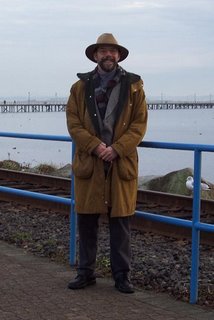
Here I am on the boardwalk at White Rock, with the inlet between BC and the US in the background.

I was fortunate to take this lovely shot of the sun setting over the Pacific.

It is claimed that Fort Langley is the oldest town in BC. It is another tourist town rather similar to Niagara-on-the-Lake, Ontario, but a bit less upscale.

I don't know whether this is in Fort Langley or not, but this is the lovely view from the Glover Road bridge over the Bedford Channel.

I took this photo from the gate at the Abbotsford Airport yesterday while waiting for the plane to return to Hamilton. This was my first visit to BC, which means that I have been to exactly half of Canada's provinces.
This evening Nancy and I had the pleasure of sampling a bottle of homemade mead, a gift from our good friend, Sir Bruce. What a nice way to spend a wintery evening with the family. It's good to be home again.
That's what's written on the licence plates in this western-most province, and it's an accurate description. I just came back from nearly a week there, as the guest of Trinity Western University, where my former colleague Mike Goheen currently teaches. I had the honour to deliver the Lamblight Lecture, titled "Globalization: Where are We Headed?," as part of a series sponsored by the Geneva Society. Everyone there was most hospitable, even going out of their way to ensure that the ground was covered with snow to make me feel more at home. What more could I ask?
Here are some photos of my time there:


This was one view of the mountains as seen through the trees of the TWU campus.

On tuesday Mike and Marnie and I had lunch at a restaurant in the coastal town of White Rock, not far from the border with Washington state. White Rock is a heavily touristed town during the summer months, but less so during the winter.

Here I am on the boardwalk at White Rock, with the inlet between BC and the US in the background.

I was fortunate to take this lovely shot of the sun setting over the Pacific.

It is claimed that Fort Langley is the oldest town in BC. It is another tourist town rather similar to Niagara-on-the-Lake, Ontario, but a bit less upscale.

I don't know whether this is in Fort Langley or not, but this is the lovely view from the Glover Road bridge over the Bedford Channel.

I took this photo from the gate at the Abbotsford Airport yesterday while waiting for the plane to return to Hamilton. This was my first visit to BC, which means that I have been to exactly half of Canada's provinces.
This evening Nancy and I had the pleasure of sampling a bottle of homemade mead, a gift from our good friend, Sir Bruce. What a nice way to spend a wintery evening with the family. It's good to be home again.
05 December 2006
A true innovation
This should be good news for Venezuela's poor: Chavez Promises to Eradicate Poverty Through Socialism. One wonders why nobody thought of this until now.
This should be good news for Venezuela's poor: Chavez Promises to Eradicate Poverty Through Socialism. One wonders why nobody thought of this until now.
03 December 2006
Liberal leadership race over
In a stunning upset over previous frontrunner Michael Ignatieff, Stéphane Dion is the new leader of the Liberal Party. Thus the historic pattern continues since 1887 (except for a few months in 1919) of alternating party leadership between an anglophone and a francophone. We shall see whether Ignatieff remains in politics or returns to academia. And we shall see how Dion stacks up against Harper.
In a stunning upset over previous frontrunner Michael Ignatieff, Stéphane Dion is the new leader of the Liberal Party. Thus the historic pattern continues since 1887 (except for a few months in 1919) of alternating party leadership between an anglophone and a francophone. We shall see whether Ignatieff remains in politics or returns to academia. And we shall see how Dion stacks up against Harper.
01 December 2006
The latest from Comment
Check out today's article in Comment, Living with Liberalism: six strategies for faithfulness, co-authored by a certain obscure Upper Canadian political scientist and his part-time colleague. Here's a brief snippet to whet the reader's appetite:
Check out today's article in Comment, Living with Liberalism: six strategies for faithfulness, co-authored by a certain obscure Upper Canadian political scientist and his part-time colleague. Here's a brief snippet to whet the reader's appetite:
For Christians living in North America, the notion of being in exile may not seem immediately relevant. To be sure, we are still a covenant people, but we are not defined by ethnicity or attachment to a particular piece of land. Nevertheless, Augustine's recognition that we are severed from the tranquility of order—and even our own recognition of the brokenness of our communities—should confirm the continuing reality of exile. The need to pray continually to the LORD for the larger communities in which we find ourselves—as well as acting on their behalf—is at the heart of living as a Christian in a society dominated by any secular ideology, including liberalism.
The Greeks were there first
Here is a story that would warm the heart of Gus Portokalos and confirm his every prejudice: Ancient Greeks charted skies with mechanical calculator. Opaaaa!
Here is a story that would warm the heart of Gus Portokalos and confirm his every prejudice: Ancient Greeks charted skies with mechanical calculator. Opaaaa!
Subscribe to:
Posts (Atom)
