Showing posts with label Cyprus. Show all posts

10 April 2011

Cyprus and Greece

Cyprus Updates poses an intriguing question to its readers: What would an Enosis referendum results be today [sic]? Those favouring enosis wanted to annex the island to Greece.
In December 1949, the Cypriot Orthodox Church challenged the British colonial government to put the Enosis question to a referendum. As was expected, the colonial government refused, and the Church proceeded to organize its own referendum which would take place in churches and be supervised by priests. The referendum took place on the two consecutive Sundays of January 15 and 22, 1950, with an overwhelming majority 95.7% of the people, including Greek Cypriots and Turkish Cypriots, voted in favor of extricating the island from the British Empire and annexing it to the Kingdom of Greece. It should be borne in mind that unlike modern elections and referendums which are decided by secret ballot, the 1950 referendum amounted to a public collection of signatures, not unlike a petition.

If Cyprus had been united with Greece, for ever after Cypriots would be complaining that they were being bled dry by the political élites in distant Athens for the latter's benefit. Cyprus is more prosperous than Greece, which is now on the verge of bankruptcy. Even dedicated enotists would be unhappy with Cyprus being no more than a far-away province of an economic basket case. Cyprus' independence has been a troubled one from the outset, but enosis would have been worse.

19 April 2010

Varosha

Varosha is the vast district of Famagusta, Cyprus, which extends south from the Venetian-era walls of the old city. Here most of my paternal relatives once lived until 1974. Since that time Varosha has been inside the UN buffer zone along the Green Line and is effectively a ghost city. A few years ago one of our students, Austin Miedema, was enroled in one of my classes where I talked about my extended family's experience in that troubled island. A musician, he was inspired to compose a song about Varosha, which he performed at Hamilton's Freeway Café at the weekend.

14 May 2008

A 'Byzantine bloc'?

Though Europe is today a thoroughly secular place, this may have changed somewhat with the admission of Cyprus, Romania and Bulgaria, in addition to longtime member Greece. All of these are largely Orthodox Christian countries and may effectively constitute something of a "Byzantine bloc" within the EU. Daniel Jianu reports for Transitions Online: The Politics of Faith.

It is possible that, if pan-Orthodox solidarity becomes a reality, the rest of the EU may view these four countries as fifth columnists for Putin and Medvedev's increasingly belligerent Russia. While such solidarity may make sense from a cultural point of view, the Balkan countries would do well to recall from their own history that reliance on Russian assistance or protection is likely to meet with disappointment.

As for exerting a distinctively christian influence on the EU, it would be wise not to expect too much from this bloc.

19 April 2008

Famagusta footage

It's remarkable what one can find on the internet. Here are two videos that have a certain poignancy for me. The first is of the old walled city of Famagusta, Cyprus, where my father's family spent the Second World War years:


The second takes us on a tour through the ghost city of Varosha, the once predominantly-Greek city south of the Venetian-era walls, and the centre of the tourist industry between 1960 and 1974: Return inside Varosha (embedding disabled).

03 April 2008

An end to division?

Back in 1995, during our visit to Cyprus, Nancy and I stood at the barrier in Ledra Street dividing the capital city of Nicosia between Greek and Turkish zones. More than a dozen years later there is potent symbolism in this positive development: Ledra Street crossing opens in Cyprus.

25 February 2008

Good night to knight

Fra Andrew Bertie, Prince and Grand Master of the Sovereign Military Hospitaller Order of St John of Jerusalem, of Rhodes and of Malta, Most Humble Guardian of the Poor of Jesus Christ, has died at age 78. The Knights of Malta, or Order of Malta, is nearly a thousand years old and is recognized as a sovereign entity in international law. As such, it enjoys diplomatic relations with a number of mostly, but not exclusively, Catholic states.

Although it is a Catholic order, the Order of Malta recognizes four protestant offshoots, encompassing the Brandenburg Bailiwick of the Knights' Order of the Hospital of St John in Jerusalem (Germany), the Johanniter Orde in Nederland, the Johanniterorden i Sverige (Sweden) and the British Order of St. John. Other claimants to the legacy of the Knights of Malta are regarded as illegitimate.

There is a Cyprus connection to the Knights, who once had their commanderie at Kolossi Castle in Limassol, where they produced the oldest named wine still in existence, Commandaria, a dessert wine for which the island is famous.

James-Charles Noonan, Jr., in The Church Visible: The Ceremonial Life and Protocol of the Roman Catholic Church, devotes several pages to the Death and Burial of the Grand Master and to the Conclave and Election, which are now taking place at the Order's headquarters in Rome. Here is a brief report from the Catholic News Agency about Bertie and the Order of Malta:

24 February 2008

New Cyprus president

Today's runoff election is over and the results are in: Communist wins Cyprus presidential vote.
Communist party leader Demetris Christofias won the presidential election in Cyprus on Sunday and immediately pledged to work to reunify the island after 34 years of division. Greek Cypriot parliament speaker Christofias, 61, garnered 53.36 percent of the vote against 46.64 percent for conservative former foreign minister Ioannis Kasoulides, according to final results of an election billed by the local media as one of the most crucial in the history of Cyprus.

"Tomorrow is a new day and there will be many difficulties before us, we need to gather our strength to achieve the reunification of our homeland," said Christofias, who is due to be sworn in on Friday. He has pledged to renew contacts with the rival Turkish Cypriots in a bid to end the partition of the strategic eastern Mediterranean island after negotiations stalled under outgoing president Tassos Papadopoulos.

Christofias's victory makes him the European Union's sole communist head of state and makes Cyprus the only European country with a communist president apart from ex-Soviet Moldova — over 16 years after the Soviet Union collapsed.

17 February 2008

Mid-February snippets

  • It's finally happened: Kosovo Declares Its Independence From Serbia. A lot of people will not be pleased over this, especially ethnic Serbs living in the province, but also a number of European Union members with their own separatist movements.

  • Here is very good news indeed: Cyprus vote goes to runoff, Papadopoulos out. Tassos Papadopoulos has obstructed a settlement in the island since attaining the presidency five years ago. I would still prefer Nicos Rolandis in office, but either Kassoulides or Christofias will be an improvement over Papadopoulos.

  • This makes little sense to me: 5 Anglican primates to boycott Lambeth. Ten years ago it became evident that there is a small-o orthodox majority in the Anglican communion. Why boycott the next Lambeth Conference where orthodox provinces would otherwise carry the day once again?

  • This I can understand more easily, given the current confessional disarray in the Anglican Church of Canada: Five Anglican parishes set to separate from Church. Archbishop Fred Hiltz is, of course, appealing selectively to the Windsor Report, thereby demonstrating, once more, that bishops are quite willing to defy any authority except their own.

  • The WRF's Comment runs an interview with a south central Upper Canadian political scientist of minor renown. It might be worth taking a peek at.

  • Tomorrow is the new provincial holiday, Family Day, instituted by Ontario Premier Dalton McGuinty upon being returned to office last autumn. My wife pointed out to me that it just happens to fall on what in the US is called Presidents' Day. Our holidays tend uncannily to coincide with American ones. Or are we simply copy cats?

19 December 2007

Dismembering Serbia, again

Like Canada, Cyprus too is opposed to the West's plans for this Balkan province: Cyprus will not consent to Kosovo's secession. With some justification, the island nation fears that it could suffer the same fate as Serbia.

In the meantime, the Russian news service Interfax keeps tabs on the destruction of Orthodox churches in Kosovo, the traditional heartland of Serbia: The Kosovo Tragedy.

While we're at it, could this mark the beginning of another European Union: Alexy II urges Orthodox [governments] to develop relations based on common spiritual tradition.

23 September 2007

Citizenship and the Cyprus Republic

The Cyprus Mail, located in the Greek-dominated south of the island, is to be commended for publishing this piece by Turkish-Cypriot Alkan Çağlar: Why the Republic of Cyprus is institutionally racist. As readers may recall from an earlier post, Çağlar has argued that Turkish-Cypriots are descended from converts to Islam from the island's Latin and Maronite christian communities after the Ottoman conquest in 1571. His current article calls attention to the plight of a mainland Turkish woman, married to a Turkish-Cypriot, attempting to gain citizenship in the Cyprus Republic. By behaving in such a petty way towards this couple, the legally-recognized government in the south is hurting its own cause by increasing the possibility of a permanent "apartheid" of the island and further tempting the international community to recognize the status of the TRNC.

In his mid-20s, Çağlar is still a young man. However, if Cyprus is ever to be reunified and its people reconciled, people like him will have to move into positions of influence on both sides of the divide.

19 June 2007

Seeking unity

Could the head of the Church of Cyprus help to bring reconciliation between the Papacy and the Moscow Patriarchate? His Beatitude, Archbishop Chrysostomos II of New Justiniana and All Cyprus thinks so and has offered his services in a visit to Rome last saturday.

23 May 2007

Tehran supports Cyprus

It is good to know that Iran, under its beneficent president Mahmoud Ahmadinejad, is a force for peace and justice in the region: Iran supports fair settlement of Cyprus problem. The Nobel committee should keep this in mind for future reference.

09 March 2007

Nicosia barrier dismantled

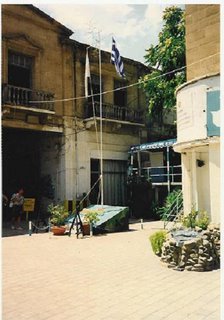
The internationally-recognized government of Cyprus has removed the barrier at Ledra Street in the divided capital of Nicosia, in response to a similar move last December by the Turkish Cypriot authorities on their side: Greek Cypriots remove wall, seek Turkish pullout. I took the photograph below at the Ledra Street barrier in 1995.

Ledra Street, Nicosia, Cyprus

Is this a move towards reuniting the island, or is it an effort to embarrass Turkey during a European Union summit? Unfortunately, reunification will likely remain stalled as long as Tassos Papadopoulos is president. I would much prefer to see Nikos Rolandis hold that office, for reasons I've indicated before.

25 August 2006

To stir the patriotic heart. . .

Three years ago, when the Kofi Annan Plan to unify Cyprus was still alive and a year before the island state's entry into the European Union, a competition was held to come up with a new national anthem. I decided to submit a song, but it lost out to a mediocre (to put it charitably) tune boasting basic harmonization errors. In any event, when the Annan Plan died, so did the quest for an anthem. When I initially learned of the competition, I had considered entering this. I should have done so. I think it would have been a winner.

05 May 2006

Unexpected origins

I have long suspected that Cyprus' ethnic Turkish community is descended, not so much from the invading Anatolian Turks after 1571, but from those who converted to Islam in the generations thereafter. My assumption was that the forebears of today's Turkish Cypriots spoke Greek and were Orthodox. However, Alkan Chaglar has uncovered evidence that his community is descended from Cyprus' formerly more numerous Latin and Maronite Christians, associated with the centuries of Frankish and Venetian rule between 1192 and 1571.

26 April 2006

Garden of Eden in Cyprus region?

When my father was a small child, he used to think that the biblical Garden of Eden was located in his grandfather's orchard in their village in the Karpass peninsula of Cyprus. As it turns out, there is an obscure religious cult of American origin that appears to believe something strikingly similar: Science and Evolution in the Urantia Book: Locating the Garden of Eden.

Incidentally, I have recently revised and upgraded my Cyprus page, adding information about its long and fascinating history, as well as the governments in the divided island state. I will likely be making further incremental changes with time.

11 April 2006

Refusing half a loaf

I know little of Mr. Nicos Rolandis, who was once Minister of Commerce, Industry and Tourism in the government of Cyprus, but I am coming to respect his opinions. Unlike many of his compatriots, he seems to understand that politics is the art of the possible and that, in the interest of conciliating diversity, as Bernard Crick famously described the political art, it may be necessary to scale back one's claims on the political authorities. Here Rolandis recites a litany of missed opportunities to return Varoshia to its inhabitants: The sad lady of the sea. And here he argues that history may one day judge Greek Cypriots to have "used improvement after improvement to destroy their cause": The twilight zone. Too bad Rolandis is not president of the republic.

Varoshia, Famagusta
Koyzis family archives

The abandoned city of Varoshia,
a ghost town since 1974,
as seen from the north

08 March 2006

Famagusta

Someone has posted video footage of a visit last year to Famagusta, Cyprus, including the old walled city, which is still inhabited, and the Varosia neighbourhood to the south, which is a ghost town. Extraordinary.

29 November 2005

Ledra Street to remain closed

As usual, the government of Cyprus appears determined to forgo another opportunity: Greek Cypriots reject new crossing point to the north.

27 November 2005

Cyprus: unilateral reunification?

This is a rather extraordinary development, coming as it does on top of last week's news: TRNC launches one-sided initiative towards reunification of divided Cyprus. Ten years ago this past summer, Nancy and I stood at the barricade at the north end of Ledra Street in Nicosia, saddened at our inability to walk any further into the occupied zone. And now it's being opened.


Could this be the beginning of the end of Cyprus' division? Perhaps, but there are possible complications: Greek side raises concerns over Ledra crossing. Nevertheless, this Cyprus Mail editorial holds out hope: Ledra crossing a step in the right direction.

Followers

Blog Archive

About Me

My photo
Contact at: dtkoyzis at gmail dot com