The voters of Québec went to the polls two days ago and brought the Parti québécois back to power for the first time since 2003. Its leader Pauline Marois thus becomes premier of the province and leader of a minority PQ government. Her Liberal predecessor, Jean Charest, lost his own seat and quickly resigned his leadership of the Parti libéral du Québec. According to the province's chief electoral officer, the PQ won 54 seats with 31.94% of the popular vote, the PLQ won 50 seats with 31.21%, the Coalition Avenir Québec won 19 seats with 27.06%, and Québec solidaire 2 seats with 6.03%. Total voter turnout was 74.61% of those eligible.
The main thing to be noted about these results is that the PQ and the PLQ were virtually tied in the popular vote, each winning less than a third of the total popular vote. Coalition Avenir Québec (Coalition for the Future of Quebec) trailed the other two parties by only 4 points yet won far fewer seats. This means that 23.83% of the province's eligible voters have, at least potentially, put the national unity issue back on the front burner for all of us. If Québec had some form of proportional representation in place, there would be two likely effects: (1) no party would have been capable of governing on its own, thus necessitating the formation of a coalition government of at least two parties and thereby softening the separatist influence; and (2) voter turnout would likely have been higher, as the risk of wasted votes is lower.
It's past time for electoral reform in this country.
Showing posts with label electoral reform. Show all posts
Showing posts with label electoral reform. Show all posts
06 September 2012


03 July 2010
Electoral reform across the pond?
Longtime readers know of my strong support for reforming our electoral system to make the results more proportional. Britain's third-place Liberal Democratic Party has long favoured electoral reform as well, and it seems LDP leader and Deputy Prime Minister Nick Clegg, has successfully exacted a price for his support of the Tory-LDP coalition government: a promised referendum on electoral reform set for 5 May 2011, to coincide with elections for the Scottish Parliament and the Welsh Assembly. The form to be voted on is the alternative vote system, in which voters rank candidates on the ballot.
Conservative leader David Cameron is unenthusiastic about the proposal and promises to campaign against it. Could this shatter the coalition government almost before it has had the chance to govern? Some think so.
Conservative leader David Cameron is unenthusiastic about the proposal and promises to campaign against it. Could this shatter the coalition government almost before it has had the chance to govern? Some think so.
29 April 2010
Conservatives favoured? Yes, but. . .
Anywhere else this might portend disaster for the governing party, yet our first-past-the-post electoral system somehow makes this good news: Tories' lead solid as Ignatieff slips: poll. Good news for Stephen Harper, no? Well, not exactly. The public favours him to the tune of 31.9 percent, which is rather less than overwhelming. Stated otherwise, a substantial majority of 68.1 percent of Canadians dislikes Harper. Yet he stays in office.
Perhaps one day we will have the presence of mind to recognize that elections are about, not winning and losing, but just representation in parliament. May such groups as Fair Vote Canada hasten that day.
Perhaps one day we will have the presence of mind to recognize that elections are about, not winning and losing, but just representation in parliament. May such groups as Fair Vote Canada hasten that day.
18 April 2010
Election upset imminent?
Fascinating developments are occurring in the current British election campaign, as the country's traditional third party, the Liberal Democrats, or Lib Dems, are making a strong showing in the public opinion polls: British election upended by TV debates.
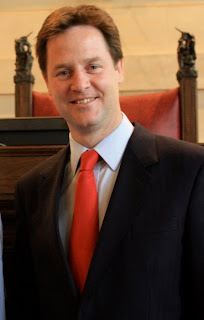
Here in Canada we are accustomed to minority governments, which we have had continuously since 2004. But not Britain. Of course, electoral reform would certainly necessitate multiparty coalition governments, which I personally think would be a good thing — for both countries.

A poll for The Sun newspaper taken Friday had the Tories at 33 per cent, the Lib Dems at 30 and Labour at 28. A Daily Mail poll had [Lib Dem leader Nick] Clegg's party in front at 32 per cent, with the Conservatives at 31 and Labour at 28.
The results suggest Britain may be headed for its first minority Parliament since February 1974, which lasted all of eight months before another election was called.
Both surveys also hint at a looming constitutional crisis. Because of the British first-past-the-post voting system, seat projections show Labour could keep a plurality in the House of Commons, while the Lib Dems may win the popular vote but still finish a distant third in the constituency count.
The Liberal Democrats — a left-leaning party that opposed the 2003 Iraq invasion, favours greenhouse-gas reductions and would hike taxes on mansions — have for years appealed for Britain to introduce a more proportional form of representation.
"The game changer really would be if a coalition allowed the Liberal Democrats to get the electoral reforms they want," said Steven Fielding, a professor [of] politics at the University of Nottingham.
Here in Canada we are accustomed to minority governments, which we have had continuously since 2004. But not Britain. Of course, electoral reform would certainly necessitate multiparty coalition governments, which I personally think would be a good thing — for both countries.
14 May 2009
Electoral reform failure
Efforts at electoral reform in British Columbia have received a severe setback as residents of that province decisively defeated proportional representation in yesterday's referendum: B.C. voters turn thumbs down on STV. It may take a political crisis similar to the one in New Zealand to galvanize the electorate to do something about our current first-past-the-post system.
05 December 2008
Prorogation: the day after
As the dust settles for now, Canadians are trying to come to grips with the events of the past few days. This sport story is clever, to be sure: Leafs Just Won The Cup, but it plays into the popular misconception that electoral politics is about winning and losing rather than representation. Fair Vote Canada tells us what a coalition government would look like if we had some form of proportional representation: The sound of one democratic hand clapping. As it turns out, not everyone in the back benches is happy with Dion and Layton's proposed coalition: Dissent in Liberal ranks appears after Parliament suspended.
Stephen Harper has his reprieve, but he will have to face the Commons once again at the end of next month. Now it's home for Christmas. And the Governor General can resume her European tour.
As the dust settles for now, Canadians are trying to come to grips with the events of the past few days. This sport story is clever, to be sure: Leafs Just Won The Cup, but it plays into the popular misconception that electoral politics is about winning and losing rather than representation. Fair Vote Canada tells us what a coalition government would look like if we had some form of proportional representation: The sound of one democratic hand clapping. As it turns out, not everyone in the back benches is happy with Dion and Layton's proposed coalition: Dissent in Liberal ranks appears after Parliament suspended.
Stephen Harper has his reprieve, but he will have to face the Commons once again at the end of next month. Now it's home for Christmas. And the Governor General can resume her European tour.
02 December 2008
Crisis in Ottawa, continued
Just when we thought that Prime Minister Stephen Harper's Conservative minority government was settling in for at least another two years in power, the events of the past several days have upset these expectations. Now we read that Her Majesty's representative, Governor General Michaëlle Jean, is cutting short her European state visit to deal with the current crisis. That two opposition political parties would conspire to topple the government and replace it with a coalition government is unprecedented in Canada's history. It would not be unusual in some European countries, but those of us living under Westminster-style systems have generally eschewed multiparty coalition governments as somehow undemocratic — as if party leaders collaborating to form a government thereby frustrate the will of the voters.
On the other hand, there is something rather surreal in the spectacle of a single party taking power based on only 37.63 percent of the vote and fewer than half the seats, and then having the effrontery to claim a mandate from the Canadian people to govern. It is scarcely less absurd when such a government receives an absolute majority of seats though most citizens have voted against it. This, once again, points to the need for electoral reform in this country.
Though I am not teaching Canadian politics this term, I have spent some time in each of my classes this week talking about the developments in the nation's capital, due to their historic nature. I have likened what is happening to pre-1992 Italian politics, when multiple parties would have to take great pains to form a government, with leaders deciding to elevate to the premiership, not one of themselves, but a comparative nonentity deemed least objectionable to them. I couldn't help thinking of this as we witnessed especially the Liberals haggling over who would become prime minister. Would it be Stéphane Dion, the current but outgoing leader? Or Michael Ignatieff? Or Bob Rae?
What are Stephen Harper's options? Some are suggesting he could request the Governor General to prorogue Parliament, that is, to end the current session. But given that it began only two weeks ago, ending it this early would be a highly unusual move that would certainly stretch our constitutional conventions beyond what any previous prime minister has attempted. There can be little doubt that this would flirt with the edges of democracy itself. What would the Governor General do? She has the authority to refuse Harper's request, but since 1926 her predecessors have chosen not to confront their prime ministers, even when it might be advisable for them to do so to protect the constitution.
A central question is, of course, whether the Liberals and New Democrats would actually be able to govern. Together they boast only 114 seats as compared to the 143 held by the Conservatives. One-hundred fifty-five are needed for a majority. This means that the separatist Bloc québécois holds the balance of power with 49 seats. This gives the BQ king-making power. They will not, of course, participate in a coalition government, because they have few aspirations beyond being a protest party. Though Dion and NDP leader Jack Layton claim that the BQ will support their proposed government, at least in the short term, it is not in its long term interest to continue to prop up two parties that are more centralizing in their federalism than the Conservatives. Yet it is difficult to imagine the BQ propping up the Conservatives either.
My own solution? I don't claim this to be the definitive answer, but it might just be wise for Harper, whom 62.37 percent of Canadian voted against, to enter into negotiations with Dion towards forming a grand coalition government, rather like that between Angela Merkel's Christian Democrats and the Social Democrats in Germany. To be sure, the business of government would not move quickly under such an arrangement, but the divided verdict of Canadians two months ago may have left our politicians with no real alternative. Harper might do well to cast a backward glance to consider what happened to Prime Minister Joe Clark back in December 1979, when he tried to govern as if he had a majority, but found his minority government quickly defeated on the budget. If, as Henry Milner believes, we are in for a protracted period of minority government, our political leaders will have to overcome their overwrought fears of co-operating with the other parties and sit down and actually talk with them rather than just shouting at them from across the floor of the Commons.
Just when we thought that Prime Minister Stephen Harper's Conservative minority government was settling in for at least another two years in power, the events of the past several days have upset these expectations. Now we read that Her Majesty's representative, Governor General Michaëlle Jean, is cutting short her European state visit to deal with the current crisis. That two opposition political parties would conspire to topple the government and replace it with a coalition government is unprecedented in Canada's history. It would not be unusual in some European countries, but those of us living under Westminster-style systems have generally eschewed multiparty coalition governments as somehow undemocratic — as if party leaders collaborating to form a government thereby frustrate the will of the voters.
On the other hand, there is something rather surreal in the spectacle of a single party taking power based on only 37.63 percent of the vote and fewer than half the seats, and then having the effrontery to claim a mandate from the Canadian people to govern. It is scarcely less absurd when such a government receives an absolute majority of seats though most citizens have voted against it. This, once again, points to the need for electoral reform in this country.
Though I am not teaching Canadian politics this term, I have spent some time in each of my classes this week talking about the developments in the nation's capital, due to their historic nature. I have likened what is happening to pre-1992 Italian politics, when multiple parties would have to take great pains to form a government, with leaders deciding to elevate to the premiership, not one of themselves, but a comparative nonentity deemed least objectionable to them. I couldn't help thinking of this as we witnessed especially the Liberals haggling over who would become prime minister. Would it be Stéphane Dion, the current but outgoing leader? Or Michael Ignatieff? Or Bob Rae?
What are Stephen Harper's options? Some are suggesting he could request the Governor General to prorogue Parliament, that is, to end the current session. But given that it began only two weeks ago, ending it this early would be a highly unusual move that would certainly stretch our constitutional conventions beyond what any previous prime minister has attempted. There can be little doubt that this would flirt with the edges of democracy itself. What would the Governor General do? She has the authority to refuse Harper's request, but since 1926 her predecessors have chosen not to confront their prime ministers, even when it might be advisable for them to do so to protect the constitution.
A central question is, of course, whether the Liberals and New Democrats would actually be able to govern. Together they boast only 114 seats as compared to the 143 held by the Conservatives. One-hundred fifty-five are needed for a majority. This means that the separatist Bloc québécois holds the balance of power with 49 seats. This gives the BQ king-making power. They will not, of course, participate in a coalition government, because they have few aspirations beyond being a protest party. Though Dion and NDP leader Jack Layton claim that the BQ will support their proposed government, at least in the short term, it is not in its long term interest to continue to prop up two parties that are more centralizing in their federalism than the Conservatives. Yet it is difficult to imagine the BQ propping up the Conservatives either.
My own solution? I don't claim this to be the definitive answer, but it might just be wise for Harper, whom 62.37 percent of Canadian voted against, to enter into negotiations with Dion towards forming a grand coalition government, rather like that between Angela Merkel's Christian Democrats and the Social Democrats in Germany. To be sure, the business of government would not move quickly under such an arrangement, but the divided verdict of Canadians two months ago may have left our politicians with no real alternative. Harper might do well to cast a backward glance to consider what happened to Prime Minister Joe Clark back in December 1979, when he tried to govern as if he had a majority, but found his minority government quickly defeated on the budget. If, as Henry Milner believes, we are in for a protracted period of minority government, our political leaders will have to overcome their overwrought fears of co-operating with the other parties and sit down and actually talk with them rather than just shouting at them from across the floor of the Commons.
05 March 2008
'Albertocracy' reaffirmed
The votes are in and, surprise, Premier Ed Stelmach's Progressive Conservatives were re-elected, the 11th Conservative government in a row. This comes as no surprise in a province that has known only three changes of government since 1905. What is surprising is that anyone should wonder why only 41 percent of eligible voters bothered to turn out in such a noncompetitive political environment. There has to be a better way.
The votes are in and, surprise, Premier Ed Stelmach's Progressive Conservatives were re-elected, the 11th Conservative government in a row. This comes as no surprise in a province that has known only three changes of government since 1905. What is surprising is that anyone should wonder why only 41 percent of eligible voters bothered to turn out in such a noncompetitive political environment. There has to be a better way.
01 December 2007
Proportional representation?
Writing for the Financial Post, Lawrence Solomon appears to be confused: Tories deny Ontario democracy. He begins with this:
So far so good. Or at least it seems so on the surface. He properly draws attention to a federal bill that would shortchange Ontario voters by eroding the principle of one-person one-vote. But towards the end of his piece he unexpectedly derides any measure that would actually do something to enfranchise "vast swathes of the electorate" and to keep millions of votes from being wasted at election time, namely, some form of proportional representation!
No, Mr. Solomon, Fair Vote Canada has not "appropriated" this term for its own purposes. Proportional representation is a well-known term and accurately describes the several electoral systems used in most of the world's constitutional democracies. What you are addressing is representation by population, or rep-by-pop, which is a related issue but certainly not the same thing.
Writing for the Financial Post, Lawrence Solomon appears to be confused: Tories deny Ontario democracy. He begins with this:
Canada needs electoral reform to bring in proportional representation. It is unconscionable that in a modern democracy such as ours, vast swathes of the electorate should be effectively disenfranchised by a voting system that is essentially corrupt, disproportionately weighted to favour some segments of the electorate to the misfortune of others.
So far so good. Or at least it seems so on the surface. He properly draws attention to a federal bill that would shortchange Ontario voters by eroding the principle of one-person one-vote. But towards the end of his piece he unexpectedly derides any measure that would actually do something to enfranchise "vast swathes of the electorate" and to keep millions of votes from being wasted at election time, namely, some form of proportional representation!
No, Mr. Solomon, Fair Vote Canada has not "appropriated" this term for its own purposes. Proportional representation is a well-known term and accurately describes the several electoral systems used in most of the world's constitutional democracies. What you are addressing is representation by population, or rep-by-pop, which is a related issue but certainly not the same thing.
27 October 2007
Subverting reform?
The CBC's Don Newman has an interesting take on Stephen Harper's likely ambivalence over the fixed election dates that were part of his package of constitutional reforms: Hard to Get a Date. Prior to adopting this reform, a government could easily time an election by requesting dissolution of Parliament at virtually any moment it deemed favourable to its own electoral fortunes. I myself have favoured fixed election dates because it promised to remove one more of the vast powers of the prime minister.
However, as Newman points out, a clever PM in a minority government may find a way around this. If the principal opposition party is in disarray, as are the Liberals at the moment, and if the opinion polls show the Conservatives in majority territory, the temptation will be great for Harper to engineer the defeat of his own government, as Trudeau did in 1974, in the hopes that he might receive a majority in the ensuing election. That may be what he's doing by proposing legislation he knows will be unpalatable to the opposition. Of course, this could all backfire on Harper if the public perceives him to be subverting his own reform for partisan purposes.
In a multiparty democracy, where coalition rather than minority governments are the norm, a prime minister would not be able to do this on his own, because he would have his coalition partners to answer to. Moreover, if he were leading a coalition government commanding the majority of seats in the lower chamber, the felt need to engage in this tactic would be unlikely to present itself.
This raises once again the issue of electoral reform. Ontario voters just defeated the mixed-member-proportional system (MMP), seemingly indicating that they are satisfied to be ruled by a government most of them opposed. As French political scientist Maurice Duverger demonstrated more than half a century ago, there is a causal connection between electoral and party systems. Proportional representation (PR) tends to produce multiple parties none of which by itself is likely to command a majority of seats in parliament. This forces them to co-operate in coalition governments, as they do in Germany, the Netherlands and elsewhere.
Meanwhile in New Zealand, which adopted MMP a decade and a half ago, Thérèse Arseneau, a Canadian expat living amongst the Kiwis, defends the new system against its detractors: MMP still the better option.
The CBC's Don Newman has an interesting take on Stephen Harper's likely ambivalence over the fixed election dates that were part of his package of constitutional reforms: Hard to Get a Date. Prior to adopting this reform, a government could easily time an election by requesting dissolution of Parliament at virtually any moment it deemed favourable to its own electoral fortunes. I myself have favoured fixed election dates because it promised to remove one more of the vast powers of the prime minister.
However, as Newman points out, a clever PM in a minority government may find a way around this. If the principal opposition party is in disarray, as are the Liberals at the moment, and if the opinion polls show the Conservatives in majority territory, the temptation will be great for Harper to engineer the defeat of his own government, as Trudeau did in 1974, in the hopes that he might receive a majority in the ensuing election. That may be what he's doing by proposing legislation he knows will be unpalatable to the opposition. Of course, this could all backfire on Harper if the public perceives him to be subverting his own reform for partisan purposes.
In a multiparty democracy, where coalition rather than minority governments are the norm, a prime minister would not be able to do this on his own, because he would have his coalition partners to answer to. Moreover, if he were leading a coalition government commanding the majority of seats in the lower chamber, the felt need to engage in this tactic would be unlikely to present itself.
This raises once again the issue of electoral reform. Ontario voters just defeated the mixed-member-proportional system (MMP), seemingly indicating that they are satisfied to be ruled by a government most of them opposed. As French political scientist Maurice Duverger demonstrated more than half a century ago, there is a causal connection between electoral and party systems. Proportional representation (PR) tends to produce multiple parties none of which by itself is likely to command a majority of seats in parliament. This forces them to co-operate in coalition governments, as they do in Germany, the Netherlands and elsewhere.
Meanwhile in New Zealand, which adopted MMP a decade and a half ago, Thérèse Arseneau, a Canadian expat living amongst the Kiwis, defends the new system against its detractors: MMP still the better option.
13 October 2007
Postmortem on electoral reform
Unlike many pundits who assume electoral reform is dead after wednesday's referendum, Andrew Coyne begs to differ: Electoral reform will rise again.
What is remarkable, Coyne observes, is that as many as 37 percent of voters in this province voted in favour of MMP, despite a "blizzard of misinformation." "If not quite a ringing endorsement of MMP, it suggests a significant level of dissatisfaction with the status quo — a conclusion amplified by the abysmal turnout, a historic low of 52%."
Unlike many pundits who assume electoral reform is dead after wednesday's referendum, Andrew Coyne begs to differ: Electoral reform will rise again.
The 37% of Ontario voters who voted in favour of the proposed mixed member proportional (MMP) scheme is within a few percentage points of the 42% who voted for Dalton McGuinty’s Liberals..., who were variously said to have won a massive, historic, decisive majority. It was about as many as voted for the “majority” NDP government in 1990, or the “majority” federal Liberal government in 1997.
Unfair, you say: Mr. McGuinty had more than one opponent. But what is common to all of the other parties is that voters preferred them to Mr. McGuinty’s Liberals. In the race between Dalton and Not Dalton, the Dalton party suffered a decisive defeat. Yet Mr. McGuinty is today congratulated on his majority government, while MMP, in the words of a National Post editorial, “took a pasting.”
What is remarkable, Coyne observes, is that as many as 37 percent of voters in this province voted in favour of MMP, despite a "blizzard of misinformation." "If not quite a ringing endorsement of MMP, it suggests a significant level of dissatisfaction with the status quo — a conclusion amplified by the abysmal turnout, a historic low of 52%."
11 October 2007
Post-election blues
This is cause for melancholy the day after: Ontario rejects electoral reform in referendum. In the meantime Dalton McGuinty's Liberal Party has won another majority, the first time a Liberal government has won back-to-back majorities since 1937. Yet 57.81 per cent of Ontarians voted against the Liberals, thanks to the distortions of our first-past-the-post electoral system. Adding up these two results can only yield the conclusion that voters in this province like having a single party govern against their expressed wishes. Go figure.
This is cause for melancholy the day after: Ontario rejects electoral reform in referendum. In the meantime Dalton McGuinty's Liberal Party has won another majority, the first time a Liberal government has won back-to-back majorities since 1937. Yet 57.81 per cent of Ontarians voted against the Liberals, thanks to the distortions of our first-past-the-post electoral system. Adding up these two results can only yield the conclusion that voters in this province like having a single party govern against their expressed wishes. Go figure.
26 September 2007
MMP vs MPP reform
The Work Research Foundation has published two pieces in the run-up to the referendum on electoral reform here in Ontario. The yea side is defended (ably, one hopes) by yours truly: Why Ontarians should vote for MMP. The nay side is taken by my genial nemesis, Russ Kuykendall, Senior Researcher for the WRF: MMP? Or, intestinal fortitude? I can agree with Kuykendall here:
This is all well and good, but there is a need for institutional reforms that would facilitate these desirable outcomes, and they will likely have to be implemented within the parties themselves. Simply relying on the courage of individual MPPs will almost certainly be inadequate, because they will need a larger support system to overcome the obstacles posed by current levels of party discipline. I would welcome from Kuykendall more specific proposals for giving effect to this.
That said, these really are reforms for another day. The question now at issue is the one of fair representation, which I don't see Kuykendall addressing as such. I understand the objection to a party leader selecting list candidates. However, this is not so much an argument against proportional representation (PR) as it is an argument against the specific form on which we will be voting in two weeks. The single-transferable-vote (STV) would not possess this perceived defect. Might Kuykendall be more favourable to STV?
Finally, I do not see him addressing the injustice of a single party governing over the objections of most voters. There is wisdom in James Madison's belief that a multiplicity of factions will be less likely to harm a polity than a single faction taking power on its own:
Madison would scarcely think it better for a minority faction to claim majority status and rule accordingly. By increasing the likelihood of multiparty coalition governments, MMP will help to address this danger.
I am sorry that the WRF has seen fit not to take a position on the issue, given that a number of like-minded organizations (e.g., the Center for Public Justice and Canada's Citizens for Public Justice) are in favour of PR. Yet I am pleased that they have disseminated these two essays to educate further the voting public in this province.
The Work Research Foundation has published two pieces in the run-up to the referendum on electoral reform here in Ontario. The yea side is defended (ably, one hopes) by yours truly: Why Ontarians should vote for MMP. The nay side is taken by my genial nemesis, Russ Kuykendall, Senior Researcher for the WRF: MMP? Or, intestinal fortitude? I can agree with Kuykendall here:
What Ontarians need is more MPPs [Members of Provincial Parliament] who set aside advancing their careers in caucus and cabinet and focus, instead, on advancing issues and policy perspectives. We need more MPPs who argue inside caucus, in committees and the legislative assembly, and in media and public meetings on behalf of issues. We need more MPPs who recruit pro-family volunteers, for example, to their campaigns and hire pro-family staff and interns so the next generation of activists is put in place. We need more MPPs who introduce pro-independent and home-schooling bills so that the law better reflects these concerns for fairness and human flourishing – to achieve what Augustine called “proximate justice.”
This is all well and good, but there is a need for institutional reforms that would facilitate these desirable outcomes, and they will likely have to be implemented within the parties themselves. Simply relying on the courage of individual MPPs will almost certainly be inadequate, because they will need a larger support system to overcome the obstacles posed by current levels of party discipline. I would welcome from Kuykendall more specific proposals for giving effect to this.
That said, these really are reforms for another day. The question now at issue is the one of fair representation, which I don't see Kuykendall addressing as such. I understand the objection to a party leader selecting list candidates. However, this is not so much an argument against proportional representation (PR) as it is an argument against the specific form on which we will be voting in two weeks. The single-transferable-vote (STV) would not possess this perceived defect. Might Kuykendall be more favourable to STV?
Finally, I do not see him addressing the injustice of a single party governing over the objections of most voters. There is wisdom in James Madison's belief that a multiplicity of factions will be less likely to harm a polity than a single faction taking power on its own:
If a faction consists of less than a majority, relief is supplied by the republican principle, which enables the majority to defeat its sinister views by regular vote. It may clog the administration, it may convulse the society; but it will be unable to execute and mask its violence under the forms of the Constitution. When a majority is included in a faction, the form of popular government, on the other hand, enables it to sacrifice to its ruling passion or interest both the public good and the rights of other citizens.
Madison would scarcely think it better for a minority faction to claim majority status and rule accordingly. By increasing the likelihood of multiparty coalition governments, MMP will help to address this danger.
I am sorry that the WRF has seen fit not to take a position on the issue, given that a number of like-minded organizations (e.g., the Center for Public Justice and Canada's Citizens for Public Justice) are in favour of PR. Yet I am pleased that they have disseminated these two essays to educate further the voting public in this province.
16 September 2007
Ontario's referendum
Our family finally received in the mail a flier about the upcoming referendum on reforming the province's electoral system. This was published by Elections Ontario, which maintains this website to provide information to voters. I, of course, will definitely be voting in favour of the mixed-member-proportional system (MMP). For those still in doubt, it needs to be emphasized that it entails, not an abandonment of our current first-past-the-post (FPTP) system, but an addition to it to ensure that every vote truly counts and that the diversity of political visions is better represented in the legislature.
In the meantime, Hamilton's own Sheila Copps defends our current electoral system with this measured and thoughtful op-ed piece: Foolish Ontario could muck up country. To her credit, Copps uses the words extreme or extremist only 5 times, which must have required considerable restraint on her part.
Conservative leader John Tory is hinting that he will vote no in the referendum. Why? Ostensibly "because some MPPs would be 'appointed by party bosses and accountable to no constituents'." The real reason? Both his party and the Liberals would no longer monopolize the political process as they do now. In short, Tory's Tories would lose out.
The October issue of The Walrus carries this article advocating MMP by Daniel Aldana Cohen: Blown Into Proportion. Cohen holds out an intriguing possibility for our future:
No wonder Tory is so skittish. Now we have to convince our fellow citizens of the merits of adopting MMP. It really will give them a stronger voice by ensuring that votes are not wasted. Without adequate information ordinary citizens are inclined to stick with what they know. When MMP is explained to them, they tend to become enthusiastic supporters. Let's break the conspiracy of silence in the corridors of power and vote YES on 10 October!
Our family finally received in the mail a flier about the upcoming referendum on reforming the province's electoral system. This was published by Elections Ontario, which maintains this website to provide information to voters. I, of course, will definitely be voting in favour of the mixed-member-proportional system (MMP). For those still in doubt, it needs to be emphasized that it entails, not an abandonment of our current first-past-the-post (FPTP) system, but an addition to it to ensure that every vote truly counts and that the diversity of political visions is better represented in the legislature.
In the meantime, Hamilton's own Sheila Copps defends our current electoral system with this measured and thoughtful op-ed piece: Foolish Ontario could muck up country. To her credit, Copps uses the words extreme or extremist only 5 times, which must have required considerable restraint on her part.
Conservative leader John Tory is hinting that he will vote no in the referendum. Why? Ostensibly "because some MPPs would be 'appointed by party bosses and accountable to no constituents'." The real reason? Both his party and the Liberals would no longer monopolize the political process as they do now. In short, Tory's Tories would lose out.
The October issue of The Walrus carries this article advocating MMP by Daniel Aldana Cohen: Blown Into Proportion. Cohen holds out an intriguing possibility for our future:
If Ontario’s voters opt for change, Canada could follow. Imagine Ottawa’s metamorphosis: a small but strong Green Party; the Bloc Québécois cut almost in half; Liberals and New Democrats from Alberta, Tories from the big cities; a new party or two; many more female and minority members; a bump in voter turnout; the pmo reined in by Parliament; stable coalition governments. For much of the old guard, this would be a nightmare.
No wonder Tory is so skittish. Now we have to convince our fellow citizens of the merits of adopting MMP. It really will give them a stronger voice by ensuring that votes are not wasted. Without adequate information ordinary citizens are inclined to stick with what they know. When MMP is explained to them, they tend to become enthusiastic supporters. Let's break the conspiracy of silence in the corridors of power and vote YES on 10 October!
10 September 2007
REAL Women needs to get real
Gwen Landolt, National Vice President of REAL Women of Canada, has issued a statement opposing the mixed-member-proportional (MMP) system that Ontarians will be voting on a month from today, as reported here: REAL Women of Canada Warns Against Ontario Proportional Representation Voting Change. Landolt claims that "it will undermine our democratic system of government." Admitting that under MMP parties will have to form coalition governments, she raises the spectre of short-lived Italian-style governments plaguing Canada's political process. Landolt also fears that feminist influence within the major parties will increase as a consequence of MMP.
Her objections need to be addressed and put to rest. First, MMP will produce a legislature more, not less, representative of the political opinions of ordinary voters. Under our current first-past-the-post (FPTP) system, a single party takes all the effective power over the opposition of most voters. Why Landolt would find this democratic is a mystery.
Second, Germany and New Zealand, both of which use MMP, are stable democracies with governments generally lasting as long as they are expected to. The Netherlands uses a straight party list system with no single-member constituencies, and its governments are also durable. Electoral reform and multiparty coalition governments do not by themselves foment political instability.
Finally, Landolt fears that the major parties would pander to special interests, including feminists, in allocating list seats. This misses the point. Under MMP the "major" parties would no longer be as strong as they are now, with other parties, along with the viewpoints they represent, gaining seats in the legislature, provided they receive at least 3 percent of the vote. This could include a party more in keeping with the convictions of Landolt and REAL Women — one that is currently handicapped by FPTP. The Family Coalition Party (FCP) comes to mind here.
Incidentally the FCP favours MMP. Landolt's group should rethink its opposition and consider the possible advantages of MMP to its own cause.
Gwen Landolt, National Vice President of REAL Women of Canada, has issued a statement opposing the mixed-member-proportional (MMP) system that Ontarians will be voting on a month from today, as reported here: REAL Women of Canada Warns Against Ontario Proportional Representation Voting Change. Landolt claims that "it will undermine our democratic system of government." Admitting that under MMP parties will have to form coalition governments, she raises the spectre of short-lived Italian-style governments plaguing Canada's political process. Landolt also fears that feminist influence within the major parties will increase as a consequence of MMP.
Her objections need to be addressed and put to rest. First, MMP will produce a legislature more, not less, representative of the political opinions of ordinary voters. Under our current first-past-the-post (FPTP) system, a single party takes all the effective power over the opposition of most voters. Why Landolt would find this democratic is a mystery.
Second, Germany and New Zealand, both of which use MMP, are stable democracies with governments generally lasting as long as they are expected to. The Netherlands uses a straight party list system with no single-member constituencies, and its governments are also durable. Electoral reform and multiparty coalition governments do not by themselves foment political instability.
Finally, Landolt fears that the major parties would pander to special interests, including feminists, in allocating list seats. This misses the point. Under MMP the "major" parties would no longer be as strong as they are now, with other parties, along with the viewpoints they represent, gaining seats in the legislature, provided they receive at least 3 percent of the vote. This could include a party more in keeping with the convictions of Landolt and REAL Women — one that is currently handicapped by FPTP. The Family Coalition Party (FCP) comes to mind here.
Incidentally the FCP favours MMP. Landolt's group should rethink its opposition and consider the possible advantages of MMP to its own cause.
06 September 2007
MMP in Ontario?
In a few short weeks the citizens of Ontario will be voting, not only for a new provincial government, but in a referendum on whether to adopt a mixed-member-proportional (MMP) electoral system. Readers of this blog will know that I am in favour of adopting this form of proportional representation, having contributed a submission to the Ontario Citizens Assembly on Electoral Reform earlier this year. Two days ago The Globe and Mail's Chris Selley wrote an article drawing on New Zealand's experience with MMP: Wake up and smell the kiwi: What New Zealand can teach us about proportional representation and electoral reform.
Unfortunately, and as far as I can tell, there has been next to no publicity about the referendum either by opponents or proponents. My fear is that the proposal may die for lack of awareness on the part of voters, who will not know what's at stake. Another opportunity like this may not arise, and thus far it's being squandered. Let's hope that changes between now and next month.
In a few short weeks the citizens of Ontario will be voting, not only for a new provincial government, but in a referendum on whether to adopt a mixed-member-proportional (MMP) electoral system. Readers of this blog will know that I am in favour of adopting this form of proportional representation, having contributed a submission to the Ontario Citizens Assembly on Electoral Reform earlier this year. Two days ago The Globe and Mail's Chris Selley wrote an article drawing on New Zealand's experience with MMP: Wake up and smell the kiwi: What New Zealand can teach us about proportional representation and electoral reform.
Unfortunately, and as far as I can tell, there has been next to no publicity about the referendum either by opponents or proponents. My fear is that the proposal may die for lack of awareness on the part of voters, who will not know what's at stake. Another opportunity like this may not arise, and thus far it's being squandered. Let's hope that changes between now and next month.
04 May 2007
Fixed election dates
It is rare for a sitting government to make a change that would limit its ability to act, but Prime Minister Stephen Harper has done just that with this overdue constitutional reform: Bill setting federal elections every 4 years about to become law. Now if only we could adopt proportional representation on the federal level.
It is rare for a sitting government to make a change that would limit its ability to act, but Prime Minister Stephen Harper has done just that with this overdue constitutional reform: Bill setting federal elections every 4 years about to become law. Now if only we could adopt proportional representation on the federal level.
16 April 2007
Electoral reform recommended
The Ontario Citizens' Assembly on Electoral Reform has made its recommendation for reforming the province's electoral system: replacing first-past-the-post (FPTP) with mixed-member proportional (MMP). I would like to think that my own submission had something to do with this, but it seems that MMP received the most support of the various suggested alternatives. This means we will be voting on whether to adopt MMP at the next provincial election in October. The Globe and Mail reports:
Needless to say, I have already decided how I will vote.
The Ontario Citizens' Assembly on Electoral Reform has made its recommendation for reforming the province's electoral system: replacing first-past-the-post (FPTP) with mixed-member proportional (MMP). I would like to think that my own submission had something to do with this, but it seems that MMP received the most support of the various suggested alternatives. This means we will be voting on whether to adopt MMP at the next provincial election in October. The Globe and Mail reports:
The referendum will have a high threshold in order to pass. It needs at least 60 per cent of the votes cast, along with at least 50 per cent of voters in a minimum of 64 individual provincial ridings. There are currently 103 ridings. . . .
Under [MMP], Ontario would have 90 MPs elected from local ridings, just as they are now, for 70 per cent of the seats in the legislature. Another 30 per cent of the seats, or 29 in total, would be awarded to candidates selected from lists put together by the parties. Candidates from the lists would be used to adjust the number of seats each party has to reflect its share of the popular vote.
Needless to say, I have already decided how I will vote.
20 March 2007
PR for Ontario
I just discovered today that my submission to the Ontario Citizens' Assembly for Electoral Reform has been posted to the Assembly's website. As the group's work continues, we have reason to hope that the province's first-past-the-post electoral system may eventually be supplemented or replaced by some form of proportional representation. If so, it would set a precedent for the rest of the country.
I just discovered today that my submission to the Ontario Citizens' Assembly for Electoral Reform has been posted to the Assembly's website. As the group's work continues, we have reason to hope that the province's first-past-the-post electoral system may eventually be supplemented or replaced by some form of proportional representation. If so, it would set a precedent for the rest of the country.
06 November 2006
Which PR? Part II
In my previous post on this topic, I argued for adopting a mixed-member proportional (MMP) electoral system for Canada, and offered two reasons. More reasons follow below.
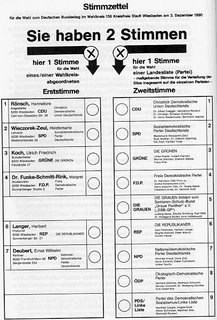
Third, although it is not necessarily an intrinsic part of MMP, the German variety provides for a 5 percent exclusion clause. German citizens have two votes, one for a local candidate representing a single-member constituency and another for a party list, as shown at right. Although many Germans split their votes, casting one for a deputy representing one party while voting for another party's list, they tend to cast both votes for the same party. If a party wins fewer than 3 single-member seats and less than 5 percent of the vote on the list side, it will receive no party-list seats at all. If, however, the party receives 3 or more single-member seats or succeeds in getting more than 5 percent of the list seats, it will receive the full number of seats to which it is entitled on the list side. The end result is a parliament that is roughly proportional, though not precisely so.
The reason for the exclusion clause is to prevent splinter parties and extremists from cluttering up the Bundestag. In the aftermath of the Second World War, when Germany had suffered through a dozen years of nazi misrule, a mechanism seemed necessary to prevent a resurgent national socialist party from entering parliament, as well as to put a premium on co-operation amongst would-be partisan groupings within the context of larger and more broad-based parties. This, it was hoped, would prevent the sort of cabinet instability plaguing the Weimar Republic between 1919 and 1933. More than half a century later, we can judge that MMP in Germany has been a success.
Admittedly, it has not succeeded everywhere. The Russian Federation has used a form of MMP since 1993, along with an exclusion clause. Unfortunately, because most political parties there tend to revolve around the personalities of local figures rather than around a programme commanding a nationwide following, up to half the electorate has gone unrepresented because their parties have not succeeded in surmounting the hurdle posed by the exclusion clause. As a consequence, next year's parliamentary elections will be contested on a straight party list system, which is almost certainly not appropriate for a country as large and diverse as Russia. We'll see how it works when the time comes.
Fourth and finally, MMP is more likely to be accepted within the North American context than, say, STV or a provincial/state party list system, as favoured by Skillen. Because single-member seats would continue to be contested, it would be less disruptive of something with which voters are by now thoroughly familiar. At this point, I would tend to favour dispensing with a party-list vote altogether and simply compensating with additional seats those parties with fewer seats than would be justified by their proportion of the popular vote. The end result would be not precisely proportional, but certainly more proportional than is currently the case. Little would change for the voters themselves, but they would know that, with their "losing" votes being combined to create extra seats, they would not be wasting their votes, as they effectively do now. This would almost certainly boost voter turnout in the two countries.
I might add that past editorials in The Globe and Mail have been on-side of adopting MMP here in Canada. Here in Ontario a Citizens' Assembly on Electoral Reform is getting off the ground, and public consultations are to be held. British Columbia went through a similar exercise, and a referendum last year came close to mandating the adoption of STV, largely through Nick Loenen's efforts.
I wonder, however, if it might be better for Ontario citizens to vote initially on the principle of PR versus FPTP, and then, if the former is approved, hold a second preferential ballot on the form of PR to be adopted. Some of the no votes in BC might have come from people who liked PR but disliked STV. Let's not make the same mistake here.
There is, of course, a possible drawback in adopting PR within the Canadian context, where we are accustomed to single-party "majority" governments that generally have the support of only between 38 and 43 percent of the electorate. Our last two governments have been single-party minority governments. If PR were adopted, we would probably never have another majority government again. Yet we could not keep having elections every year or so. This is where we reach the limits of institutional reform and where our developing unwritten constitution would have to fill in. Though we Canadians have had little experience with multiparty coalition governments, we would have to overcome our reluctance to see one party consorting with the "enemy" and consider this possibility. In fact, such coalition governments would be necessary if the political system as a whole is to continue functioning properly.
In the meantime, I plan to follow the work of the Ontario Citizens Assembly on Electoral Reform, and I may even make a submission.
In my previous post on this topic, I argued for adopting a mixed-member proportional (MMP) electoral system for Canada, and offered two reasons. More reasons follow below.
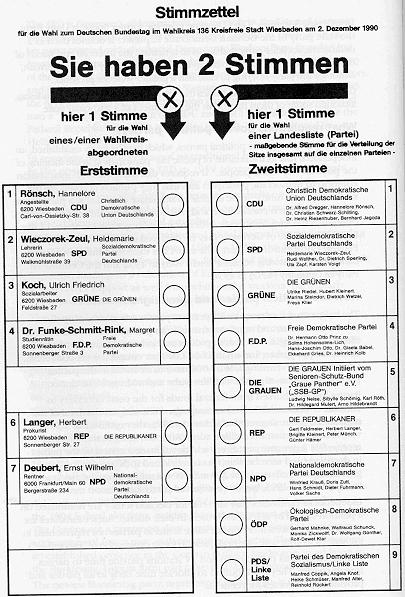
Third, although it is not necessarily an intrinsic part of MMP, the German variety provides for a 5 percent exclusion clause. German citizens have two votes, one for a local candidate representing a single-member constituency and another for a party list, as shown at right. Although many Germans split their votes, casting one for a deputy representing one party while voting for another party's list, they tend to cast both votes for the same party. If a party wins fewer than 3 single-member seats and less than 5 percent of the vote on the list side, it will receive no party-list seats at all. If, however, the party receives 3 or more single-member seats or succeeds in getting more than 5 percent of the list seats, it will receive the full number of seats to which it is entitled on the list side. The end result is a parliament that is roughly proportional, though not precisely so.
The reason for the exclusion clause is to prevent splinter parties and extremists from cluttering up the Bundestag. In the aftermath of the Second World War, when Germany had suffered through a dozen years of nazi misrule, a mechanism seemed necessary to prevent a resurgent national socialist party from entering parliament, as well as to put a premium on co-operation amongst would-be partisan groupings within the context of larger and more broad-based parties. This, it was hoped, would prevent the sort of cabinet instability plaguing the Weimar Republic between 1919 and 1933. More than half a century later, we can judge that MMP in Germany has been a success.
Admittedly, it has not succeeded everywhere. The Russian Federation has used a form of MMP since 1993, along with an exclusion clause. Unfortunately, because most political parties there tend to revolve around the personalities of local figures rather than around a programme commanding a nationwide following, up to half the electorate has gone unrepresented because their parties have not succeeded in surmounting the hurdle posed by the exclusion clause. As a consequence, next year's parliamentary elections will be contested on a straight party list system, which is almost certainly not appropriate for a country as large and diverse as Russia. We'll see how it works when the time comes.
Fourth and finally, MMP is more likely to be accepted within the North American context than, say, STV or a provincial/state party list system, as favoured by Skillen. Because single-member seats would continue to be contested, it would be less disruptive of something with which voters are by now thoroughly familiar. At this point, I would tend to favour dispensing with a party-list vote altogether and simply compensating with additional seats those parties with fewer seats than would be justified by their proportion of the popular vote. The end result would be not precisely proportional, but certainly more proportional than is currently the case. Little would change for the voters themselves, but they would know that, with their "losing" votes being combined to create extra seats, they would not be wasting their votes, as they effectively do now. This would almost certainly boost voter turnout in the two countries.
I might add that past editorials in The Globe and Mail have been on-side of adopting MMP here in Canada. Here in Ontario a Citizens' Assembly on Electoral Reform is getting off the ground, and public consultations are to be held. British Columbia went through a similar exercise, and a referendum last year came close to mandating the adoption of STV, largely through Nick Loenen's efforts.
I wonder, however, if it might be better for Ontario citizens to vote initially on the principle of PR versus FPTP, and then, if the former is approved, hold a second preferential ballot on the form of PR to be adopted. Some of the no votes in BC might have come from people who liked PR but disliked STV. Let's not make the same mistake here.
There is, of course, a possible drawback in adopting PR within the Canadian context, where we are accustomed to single-party "majority" governments that generally have the support of only between 38 and 43 percent of the electorate. Our last two governments have been single-party minority governments. If PR were adopted, we would probably never have another majority government again. Yet we could not keep having elections every year or so. This is where we reach the limits of institutional reform and where our developing unwritten constitution would have to fill in. Though we Canadians have had little experience with multiparty coalition governments, we would have to overcome our reluctance to see one party consorting with the "enemy" and consider this possibility. In fact, such coalition governments would be necessary if the political system as a whole is to continue functioning properly.
In the meantime, I plan to follow the work of the Ontario Citizens Assembly on Electoral Reform, and I may even make a submission.
Subscribe to:
Posts (Atom)