Showing posts with label constitution. Show all posts

30 March 2010

Senate reform, yet again

We've heard it all before, of course, but the government is trying again: Harper Tories take another stab at Senate reform. Eight-year term limits are on offer this time.
[Minister of state for democratic reform Steven] Fletcher also said the government plans further Senate tinkering, including legislation to consult Canadians at the polls about the choice of senators. That's a compromise between a system of direct election of senators — which likely would require a full-blown constitutional amendment — and the present direct appointments (emphasis mine).

The Senate chamber, Ottawa
Yes and no to the italicized phrase. We could provide by ordinary statute for the election of senators, in which case they would be appointed formally by the Governor General in Council, yet on the advice, not of the Prime Minister, but of the electorate of each province. This would in no way necessitate a change in section 24 of the Constitution Act, 1867, which would remain in place. Nevertheless, we would effectively have an elected Senate.

Of course, even short of statutory reform, the Prime Minister could simply allow the provinces to poll their own voters and then appoint the winners to the relevant seats. Since such appointments are entirely up to him, I should think he would be able to set the machinery in motion without having to consult the opposition parties. It might be worth a try.

12 June 2008

It can't happen here

Could this be true: Fascism has come to Canada? And this, not from an overtly nationalist or racist political party, but from a series of tribunals charged with protecting our human rights! David Warren summarizes the situation:
Among the spookiest aspects of these cases is the silence over, and indifference to them, on the part of journalists whose predecessors imagined themselves vigilant in the cause of freedom. As I’ve learned first-hand through email, many Canadian journalists today take the view that, 'I don’t like these people, therefore I don’t care what happens to them.' It is a view that, at best, is extremely short-sighted.

One hopes and prays that Catholic Insight and Warren are overstating their case. Nevertheless, it is clear that our historic right to freedom of speech, ostensibly protected by the Charter, is being eroded. If that ends up curtailing debate over important political issues, Canada's democracy will go with it.

03 June 2008

Second-guessing America's founders

This is not officially part of my series on authority, but I thought I should take this opportunity to mention a book I've been reading, titled Civilizing Authority: Society, State, and Church, edited by Patrick McKinley Brennan. It contains a number of essays worth noting, especially "Society, Subsidiarity, and Authority in Catholic Social Thought," by Russell Hittinger, who defines subsidiarity in a remarkably (but, one assumes, inadvertently) Kuyperian direction; and "A Rock on Which One Can Build: Friendship, Solidarity, and the Notion of Authority," by Thomas Kohler, who comes strikingly close to Dooyeweerd's modal analysis. But the most intriguing essay comes from J. Budziszewski, who writes on "How a Constitution May Undermine Constitutionalism."

Two years ago in Ottawa I met a scholar who has spent much of his career analyzing the growing power of Canada's courts since patriation and its impact on our political system as a whole. Having recently visited Australia, I had noticed that something similar has occurred in that country, despite the absence of a justiciable bill or charter of rights. I asked this scholar why the expansion of judicial power appears to be so universal in western, and particularly English-speaking, democracies. His answer didn't stick with me, but I seem to recall that he was as puzzled as I at the underlying reasons for this phenomenon.
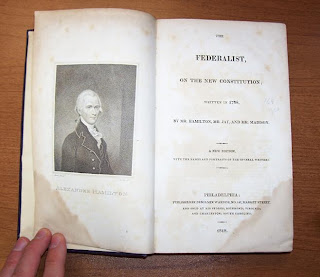
The Federalist, a New Edition, 1818
Budziszewski has now offered a compelling response, with a focus, to be sure, on the American context, but with implications for other federal systems as well, including those of Australia and Canada. Students of American government are generally familiar with the Federalist Papers, or The Federalist, a series of essays written, under the pseudonym Publius, in defence of the new federal constitution by James Madison, Alexander Hamilton and John Jay. The best known of these are numbers 10 and 51, the latter of which defends the internal checks and balances within the federal government itself.

By contrast, few Americans are aware of the Anti-Federalist Papers, written pseudonymously by opponents of the new constitution, one of whom took the name Brutus. Budziszewski focusses on numbers 11 and 12, where the author sets forth his reservations over the expansion of judicial power and its concomitant tendency to expand the legislative power as well. In particular, Brutus

recognizes that a written constitution is not merely a statement of political ideals, but a legal instrument. It is all well and good to say that the three branches [legislative, executive and judicial] shall be coequal, but the courts normally interpret legal instruments. A differently drafted legal instrument might have distributed the power of interpretation among all three branches. It might have identified particular respects in which the legislature, the executive, and the judiciary are each interpreters of the constitution. What the Constitution actually does, argues Brutus, is just the opposite. Rather than distributing the power of interpretation, it concentrates it in the courts. To make matters worse, he holds, the language by which this is done encourages judges to exercise this concentrated power of interpretation in extravagant ways that bear but a distant relation to what the Constitution actually says (p. 148).

It is a truism that the American founders fragmented government and distributed sovereignty among the three branches to prevent any one of them becoming tyrannical. This is what Americans have been taught for generations, the assumption being that the founders had a solid grasp of human nature and the tendency of people to compete with each other for various social and political goods. From my own American upbringing, I recall that Christians in particular viewed the founders as fellow believers who understood the sinfulness of man and thus placed checks in their proposed constitution to counteract its effects. This sounded good in theory. The founders were apparent realists in their estimation of human nature, while liberals and socialists of various stripes had an overly rosy view of man's potential.

Yet what if the founders too were working with a defective anthropology? Could they have imbibed a modified Hobbesian anthropology, perhaps by way of John Locke? Hobbes holds that human beings are creatures of restless desires and, left to their own devices, ruthless competitors for the means of survival. Hobbes famously argued that the prepolitical state of nature is characterized by a war of all against all. Locke, of course, could not bring himself to follow Hobbes' logic in its entirety, admitting only that the state of nature could degenerate into warfare if conditions were favourable. Hence the need for civil government to preside over this competition and to make it more manageable and less potentially deadly. As for government itself, its members are as prone as everyone else to compete for valued goods. Hence, following Montesquieu, the founders adopted a constitutional framework that would divide sovereignty amongst the three branches and between federal and state governments.

So many Americans have accepted this reasoning that they have difficulty imagining an alternative. Here is where, taking Brutus and Budziszewski as a springboard, I would make the following argument, which I believe is more congruent with a biblical worldview: the line between good and evil does not run between co-operation and competition, as so many have believed, but through each. Our own socialist New Democratic Party began life as the Co-operative Commonwealth Federation, on the assumption that economic co-operation is better than the competition characteristic of capitalism. Yet those exalting solidarity over individuality ignore the fact that even organized crime is characterized by a certain solidarity amongst its perpetrators.

I would argue instead that both competition and co-operation have their legitimate places in human life. Competition can aim at narrow self-interest, but it can also be an incentive to service to others, as, e.g., in a charitable fund-raising marathon or even a large manufacturing enterprise supplying a needed good to the public. Similarly co-operation may be for the good of all, as socialists assume. But it can also be a means of collusion for purposes of price-fixing and other forms of corruption. Might the American founders have missed this element of human nature in their ostensibly "realistic" view?

Thus it may be that the expanding power of the courts has come with the blessing of the legislative branch. Here's Budziszewski again:

Another fact bolstering Brutus's case is that whereas federal legislators periodically face the electorate, federal judges don't. This makes Congress much more risk-averse than courts are. Rather than resenting the judiciary for taking hot-button issues out of its hands, the legislature may be relieved and grateful that someone else has made the decision for them (p. 153).

This is a conclusion I came to some time ago with respect to Canada. Since 1982 our courts have been making decisions that are increasingly imaginative and even in open conflict with the intentions of the drafters of the Constitution Act, 1982. We know this because, unlike the American founders, most of the players in the patriation drama are still very much alive! Given our convention of responsible government, a sitting government is reluctant to make decisions of a controversial nature. It is easier to leave such decisions up to the courts, who do not have to face the people. The Supreme Court's Reference re Québec secession is in many respects an ingenious decision that gave something to both sides and helped to prop up the federalist cause in Québec. Nevertheless, one would be hard put to demonstrate that the ruling was based on a close reading of our Constitution Acts, which nowhere mention secession.

Here in Canada we have Section 33, the Notwithstanding Clause, that legislators can invoke to override judicial decisions based on Sections 2 and 7-15 of the Charter of Rights and Freedoms. Yet over the past quarter century few legislatures, with the exception of Québec's National Assembly, have been willing to invoke it. I believe Budziszewski, drawing on Brutus, has now given us a credible explanation for this reluctance.

Incidentally, the copy of The Federalist shown above is from my personal library. It is a rebound edition dating from 1818, when two of the authors, James Madison and John Jay, were still alive.

30 April 2008

Unnormed tolerance

A régime of imposed tolerance can be very oppressive indeed, as indicated by the decision handed down by the Ontario Human Rights Commission in Heintz v Christian Horizons. Here is Don Hutchinson's take on this: The Ontario's Human Rights Commission is trying to take the mission out of Christian Horizons. It is past time to rein in these tribunals for the sake of public justice. Because this decision obviously violates the Charter protection of freedom of religion, perhaps an appeal to the Supreme Court is in order.

14 May 2007

The Judicial Committee of the Privy Council

For the first years following Confederation in 1867, Canada had no federal supreme court, though it had the right to establish one under section 101 of what was then called the British North America Act. Not until 1875 was the Supreme Court of Canada set up, and even then it was not technically supreme. Those dissatisfied with rulings of this court could appeal one more level to the Judicial Committee of the Privy Council in London. After the Statute of Westminster of 1931, however, Canada was authorized to abolish such appeals which it did in 1949. Probably the most famous Privy Council ruling for this country was the 1929 "Persons" case, which established that women are persons under the law and thus eligible for Senate appointments.

Gradually most Commonwealth countries have abolished appeals to the Privy Council, including New Zealand as recently as 2004. However, appeals of cases decided before then have continued to make their way across two oceans to London for final decision. In what is apparently its last decision relevant to New Zealand, the Judicial Committee of the Privy Council has thrown out the murder convictions of David Bain, thereby calling into question the justice system of that country. Many New Zealanders see merit in cutting one more tie to the United Kingdom. However, the Campaign for the Privy Council is not persuaded, as indicated in the group's press release: Bain Decision Vindicates Privy Council Appeals. Supporters argue that "however good the New Zealand judiciary might be, there is nothing to equal an independent outside body to ensure quality control." Prime Minister Helen Clark defends the decision to abolish appeals and believes that access to a local Supreme Court may actually facilitate the appeal process.

04 May 2007

Fixed election dates

It is rare for a sitting government to make a change that would limit its ability to act, but Prime Minister Stephen Harper has done just that with this overdue constitutional reform: Bill setting federal elections every 4 years about to become law. Now if only we could adopt proportional representation on the federal level.

17 April 2007

The Charter at 25

A quarter century ago today Prime Minister Pierre Trudeau achieved his highest political dream of patriating Canada's constitution. Prior to that point this country had no entrenched constitutional documents on a par with the United States Constitution or the German Grundgesetz. We had the British North America Act of 1867, but this was no more than an act of the British Parliament, its validity originally resting on Canada's legal subordination to that Parliament. After the Statute of Westminster of 1931, Canada had the right to adopt its own entrenched constitution, but the anomaly of Canada's subordinate constitutional status continued right up to 1982, primarily because for 50 years federal and provincial leaders could not agree on how to amend such a document. With the "gentle" urging of Trudeau, this all changed on 17 April 1982, when the Queen signed the new constitution in Ottawa.

Patriating Canada's constitution
After this date the British North America Act became, with some modifications, the Constitution Act, 1867, an entrenched document possessing the status of "supreme law of the land," to quote its American counterpart. More significant yet was the adoption of the Constitution Act, 1982, a completely new document consisting of a Charter of Rights and Freedoms and the formulae for amending these documents. Among the consequences of the adoption of entrenched constitution acts was the empowering of the courts, which now had the authority to invalidate federal and provincial laws deemed to conflict with these acts. Some would argue that this has strengthened constitutional government against the threat of majoritarian tyranny. Others see it as having diminished the democratic character of our political system and increased the threat of judicial tyranny.

Here, from the CBC archives, is a video timeline of the lengthy process of giving Canada its own constitution, as some would put it.

22 March 2007

Liberty threatened

Are the traditional liberties enjoyed by English-speaking countries endangered in the motherland itself? Writing in Australia's The Age, this is what Melanie Phillips argues in Liberty fades as rights talk grows. Here's Phillips:

Real human rights — such as the equality of every human being and the intrinsic value of human life — are indeed universal and should be unarguable. The problem, however, comes with the "rights" that are enshrined in human rights law. These also claim to be universal and unarguable. But they are not. Indeed, the very act of codifying them makes them eminently contentious and divisive.

This is because almost every "right" in the convention is balanced by a rival "right". Judges have to decide between them. The way is therefore open for ideological, tendentious or prejudiced views to be set in judicial stone.

It has created a grasping "me too" culture that is as divisive as it is undemocratic. It has galvanised special interest groups to make demands, created a burgeoning industry of human rights lawyers and — despite acknowledging the ultimate supremacy of Parliament — effectively transferred much political power from Parliament to the courts. Instead of the rule of law, Britain now has rule by lawyers.

Though I disagree that "[h]uman rights law has nothing to do with true liberalism," I certainly concur with her belief that human rights has become "a religion for a godless age."

09 December 2004

Supreme Court reference

In most other countries a court cannot rule on an issue unless it hears a relevant case which has made its way through the judicial hierarchy. However, Canada is unusual in permitting its governments to refer a question to the Supreme Court for a ruling in the abstract. Two famous reference decisions were (1) the Patriation Reference of 1981 respecting the legality of Pierre Trudeau's effort to patriate the constitution without the backing of the provinces; and (2) the 1998 Reference re Secession of Quebec, in which the right of a province to secede unilaterally from confederation was at issue. Reference decisions are not strictly legally binding, but they are usually treated as if they were.

Today the Supreme Court handed down its long awaited reference decision on the federal government's same-sex marriage legislation. Here is the high court's decision in response to the federal government's four questions:

First question: Does Parliament have the exclusive legislative authority to change the legal definition of marriage?

Supreme Court's answer: Yes

Second question: Is extending the capacity to marry persons of the same sex consistent with the Charter of Rights and Freedoms?

Supreme Court's answer: Yes

Third question: Are religious leaders protected under the Charter of Rights from having to marry same-sex couples?

Supreme Court's answer: Yes

Fourth question: Is the traditional definition of marriage between a man and a woman constitutional?

Supreme Court's answer: The Court exercises its discretion not to answer this question.

From the court's ruling: "Several centuries ago, it would have been understood that marriage be available only to opposite-sex couples." Several centuries ago? Judging from this statement, the justices on the court must be very, very young indeed. I myself remember this ostensibly long-ago era, and I'm not quite at the half-century mark.

The issue will continue to be debated, most notably in the House of Commons itself.

14 November 2004

Judicial overreach, yet again


OTTAWA, 2011 - The Supreme Court of Canada today ruled unanimously that all legal definitions of everything are unconstitutional. Because they discriminate against whoever and whatever does not conform to them, such definitions violate the equality provisions of the Charter of Rights and Freedoms. Parliament has been given 60 days to rewrite all laws to conform to this decision.

Unthinkable? Would that it were so.

04 May 2004

Reining in the courts

Larry Kramer puts a different twist on the usual arguments in favour of a "living constitution," which is generally supposed to entail something approaching judicial supremacy. He argues instead, in "We the People: Who has the last word on the Constitution?", for something he calls popular constitutionalism, in which the courts would defer to the judgements of the electorate on issues of constitutional significance. Writes Kramer:

Making this shift would not entail major changes in the day-to-day business of deciding cases. There would still be briefs and oral arguments and precedents and opinions, and the job of being a Supreme Court justice would look pretty much the same as before. What presumably would change is the justices' attitudes and self-conceptions as they went about their routines. In effect -- though the analogy is more suggestive than literal -- Supreme Court justices would come to see themselves in relation to the public somewhat as lower-court judges now see themselves in relation to the Supreme Court: responsible for interpreting the Constitution according to their best judgment, but with an awareness that there is a higher authority out there with power to overturn their decisions -- an actual authority, too, not some abstract "people" who spoke once, two hundred years ago, and then disappeared.

One could, of course, argue that this popular supremacy is already enshrined in the formal amendment process, yet amending an entrenched constitutional document, in both the US and Canada, is "practically impossible." What is required instead is a sense of restraint on the part of judges themselves.

17 December 2003

Judicial overreach revisited yet again

The following report may or may not have been carried by the Canadian press:

Ottawa - Today the Supreme Court of Canada ruled 5 to 4 that the monarchy is unconstitutional insofar as it conflicts with the equality rights in section 15 of the Charter of Rights and Freedoms. Because the position of head of state is hereditary, passing from the current occupant of the throne to the eldest son, the high court ruled that monarchy violates constitutional guarantees against age and gender discrimination. The Court has given the federal government six months to change the country's form of government; otherwise it will consider Canada to have become a republic by default.

Far-fetched? Perhaps. But not by much.

14 July 2003

Judicial overreach

Here is the latest Capital Commentary by Jim Skillen of the Center for Public Justice: "From Legal Judgment to Political Approbation." Writes Skillen:

The U.S. Supreme Court was established to make one kind of judgment: to decide whether laws passed by state and federal governments square with the requirements of the Constitution. The court is increasingly becoming something else: a committee that gives the final stamp of approbation to laws that its majority believes best fit our changing society.

The court, it seems, has abandoned any pretence to be judging in accordance with the text of the Constitution. This was first seen in the Roe v. Wade decision of 1973 and it's become increasingly evident in more recent cases.

At one time I thought our own courts in Canada would act in a more restrained way after patriation of the constitution in 1982. But this has turned out to be far from the case. Here there is no confirmation process to scrutinize appointees to the Supreme Court. Appointment lies in the hands of the Prime Minister alone, albeit with the presumed input of the Minister of Justice, so a crucial check on the court is missing here. The Court has often been in the position of having to make controversial political decisions that the government of the day prefers not to have to make for fear of alienating voters. This has encouraged a certain irresponsibility in our elected officeholders, who are tempted to pass the buck to an unelected tribunal which need not worry about suffering defeat at the polls. Trudeau's patriation has thus made our political system markedly less democratic.

Perhaps it is finally time to consider ways to rein in the courts in both countries.

Followers

Blog Archive

About Me

My photo
Contact at: dtkoyzis at gmail dot com