Showing posts with label hymns. Show all posts

22 June 2010

Te Deum Laudamus

Ancient tradition tells us that the early Christian creedal hymn, Te Deum Laudamus, originated spontaneously with Sts. Ambrose and Augustine at the latter's baptism near the end of the 4th century. It was more likely written in the early 5th century by Nikitas, bishop of Remesiana, whose feast day is today.

The Te Deum is sung in Latin below by the Schola Gregoriana Mediolanensis of Milan, Italy. Anyone wishing to learn to read mediaeval musical notation, which is easier than one might think, will find it instructive to watch this.


Below the Concordia Oakland Choristers sing the Te Deum in English translation:


Many Christians will be aware of metrical versions of this hymn, the best known of which is probably Holy God, We Praise Thy Name, a translation of the German Großer Gott wir loben dich, written around 1774 by Ignaz Franz for the Ka­thol­isch­es Ge­sang­buch.


In 1696 Nahum Tate and Nicholas Brady included a versification of the Te Deum for their "New Version" Psalter. Some years ago I adapted their three stanzas and added three of my own to complete the hymn: O God, we praise you, we confess that you alone are Lord. In whatever form it is sung, the Te Deum deserves to be better known and more widely used amongst English-speaking evangelical Christians.

Crossposted at First Things: Evangel

09 December 2009

Wake, Awake, for Night Is Flying

I would love for our churches to sing Advent hymns all year round. Why? Because they convey the aching sense of longing that all of us Christians have as we continue to live between the times. As Dietrich Bonhoeffer put it,

Advent is a time of waiting. Our whole life, however, is Advent — that is, a time of waiting for the ultimate, for the time when there will be a new heaven and a new earth, when all people are brothers and sisters and one rejoices in the words of the angels: “On earth peace to those on whom God’s favor rests.” Learn to wait, because he has promised to come. “I stand at the door?” We however call to him: “Yes, come soon, Lord Jesus!” Amen.

Another of my favourite hymns nicely communicates this sense of anticipation of Jesus’ second Advent: Philipp Nicolai’s immortal 1599 text: Wachet Auf, Ruft Uns die Stimme, translated into English in the mid-19th century by Catherine Winkworth as Wake, Awake, for Night Is Flying. Inspired by Jesus’ parable of the wise and foolish virgins in Matthew 25: 1-13, it describes the coming nuptial feast in which the Bridegroom arrives to receive his bride, summoning the wise virgins who have been ready and waiting for this moment:

“Wake, awake, for night is flying,”
The watchmen on the heights are crying;
“Awake, Jerusalem, arise!”
Midnight hears the welcome voices
And at the thrilling cry rejoices:
“Oh, where are ye, ye virgins wise?
The Bridegroom comes, awake!
Your lamps with gladness take!
Hallelujah!
With bridal care
Yourselves prepare
To meet the Bridegroom, who is near.”

I had some difficulty locating a video performance of Wachet Auf that was not from J. S. Bach’s eponymous cantata, numbered BWV 140. I finally found this organ performance at the Friedenskirche in the north German city of Fedderwardergroden. This arrangement is closer to the original rhythm of Nicolai’s tune and is suitable for congregational singing.


06 December 2009

Veni Redemptor Gentium

Some of my favourite hymns are Advent hymns. No, not the Christmas songs that fill the malls and airwaves around this time of year, but the Advent hymns that fill us with a sense of expectation at both comings of the Messiah. One of the very best has to be Saviour of the Nations, Come. The Latin text, Veni, Redemptor gentium, is attributed to St. Ambrose of Milan, famed mentor to the even more famous St. Augustine of Hippo. It was translated into German as Nun Komm, Der Heiden Heiland by Martin Luther in 1523. The tune was adapted from a 12th-century gregorian chant by Johann Walther the following year.

As great as J.S. Bach, Buxtehude and others are, I much prefer the old German chorales before the baroque composers got their hands on them and so heavily ornamented them. Accordingly, here below the hymn is sung in Latin by the Schola Cantorum Riga in Latvia. Simple is better.


Here is a version of the same tune beautifully performed by lute and descant viol. (I make no apologies for the busy visuals at the edges!)


Finally here is an intriguing jazz rendition of the hymn as arranged by Christian Steyer for piano and choir, performed a year ago in Berlin:

16 December 2008

The 'O Antiphons'

In many churches of the western tradition, tomorrow marks the beginning of the "O Antiphons" in the Liturgy of the Hours. For those unfamiliar with these, here is Father William Saunders' fascinating explanation: What are the "O Antiphons"? In the 19th century John Mason Neale translated and adapted them as the beloved Advent hymn, O Come, O Come Emmanuel. (Hat tip: Mere Comments)

12 April 2008

No more chariots of fire please. . .

It seems that many Britons enjoy singing William Blake's Jerusalem, set to Hubert Parry's rousing 1916 melody. Now the Very Rev. Colin Slee, Dean of Southwark Cathedral in London, has banned the use of this song in his church. My response? Good riddance! I agree with Slee and Tim Footman that Jerusalem is not really a hymn at all and has no place in the church's liturgy. Whatever criteria are used to determine what belongs and does not belong in the liturgy, anything based on William Blake's quirky combination of "mysticism, Manichaeist dualism, anti-industrial pastoralism and Enlightenment radicalism" is highly unlikely to pass muster.

27 May 2007

Pentecost and Psalm 104

A little over two decades ago I wrote a hymn text titled simply A Hymn for Pentecost, which I have just posted on my Genevan Psalter website. Here is the text:

O Spirit of God, descend as a dove,
alight on our hearts, fill them with your love.
As once the apostles were touched by your flame,
so rest upon us that new life we may claim.

O Fount of our faith, come, grant us your grace
that we might believe and so find a place
within your blest Kingdom, as promised to all
whom God in his mercy has chosen to call.

O Breath of true life, breathe into our pleas
the words that we dare to speak on our knees;
for we are God's children and heirs of his love,
therefore may we call on our Father above.

O Source of all strength, make us to be bold,
as oft you inspired your prophets of old.
Now give us the courage plainly to declare
your life-giving message to all who will hear.

O Counsellor, come: our spirit renew,
and guide your elect in paths that are true.
O lead us through shadows that darken our way
that we may walk joyfully into the day.

Text copyright © 1985 by David T. Koyzis

The tune I chose was OLD 104TH, composed by Thomas Ravenscroft for his Whole Book of Psalms, published in 1621. I had recently heard a recording of Ralph Vaughan Williams' Fantasia on the Old 104th Psalm Tune, which was my introduction to this melody. My choice was influenced by the ancient tradition appointing the singing of Psalm 104 on the feast of Pentecost.

There appears to be a curious relationship between Ravenscroft's 104 and the Genevan Psalter's tune for the same psalm. The metre (10.10.11.11) is identical save for two things: (1) That of the Genevan melody is double that of Ravenscroft (10.10.11.11.10.10.11.11), and (2) the internal stresses are quite different. In Ravenscroft's Psalter this text is joined to his tune, as sung by the choral ensemble in Vaughan Williams' Fantasia. Yet it seems that in the Scottish Psalter of 1635 the Genevan melody was used, as indicated here. I personally find it more difficult to sing "My soul, Praise the Lord, speak good of his Name" to the Genevan tune than to Ravenscroft's, which better fits the text. Yet my own assessment was obviously not shared by many Christians in the 17th century.

There is obviously a story to be told about the relationship between these two tunes, but I don't know whether anyone has ever looked into it. It could, I suppose, make up a chapter in someone's dissertation, if there's a graduate student somewhere interested in pursuing the topic.

24 July 2006

Still more posted on psalter website

I have posted quite a lot more on my Genevan Psalter website in recent days, including the following:

1. Psalms 50 and 117, the latter of which is, of course, the shortest psalm. This I versified and arranged as recently as yesterday.

2. Six non-Genevan psalms written just over 20 years ago in the style of the English and Scottish psalters, with their regular metres. I wrote these prior to discovering the Genevan tunes, and they are posted for purposes of comparison with the more lively, and less regular metres of those tunes. Included are Psalms 25, 51, 95, 98, 130 and 137.

Psalms 51, 95 and 137 are set to original melodies composed especially for these texts. The tunes are titled MISERERE, VENITE and HICKORY ROAD respectively. I set Psalm 25 to Thomas Tallis' surprisingly haunting THIRD MODE MELODY, for which I composed transitional music between the stanzas. I say "surprisingly," because one wouldn't expect a tune with so little movement in the melody line to be as compelling as it is. The tune was further immortalized in 1910 by Ralph Vaughan Williams in his magnificent Fantasia on a Theme by Thomas Tallis, one of my all time favourites.

Psalm 98 is one of the earliest metrical psalms I wrote and it is set here to my own arrangement of KINGSFOLD, which I composed three years ago. Most of these six metrical psalms could easily be matched to another tune in common metre double (CMD) or long metre double (LMD).

3. Two more biblical canticles: the First Song of the Servant of the Lord from Isaiah 42:1,3b-7 (quoted by Jesus in Matthew 12); and the Magnificat of the Virgin Mary from Luke 1:47-55. The former is set to another tune by Orlando Gibbons, SONG 22. For the latter I composed a tune especially for the text which I named SOUTH BEND, after the city where I was living at the time. Last week I finally composed a descant for the last stanza.

4. Two extrabiblical hymns: my Credo in Septuple Metre, a metrical version of the Apostles' Creed; and I Belong, a versified paraphrase of Question and Answer 1 of the Heidelberg Catechism, easily the jewel of the 16th-century Reformation confessions. Both are set to original tunes. The Credo is set to a tune, LUSIGNAN, which I composed five years ago. It is written with a 7/8 time signature, unusual in western music but common in Greek music. I Belong was originally written some two decades ago to be sung to Jean Sibelius' beloved FINLANDIA, and I actually sang it with this tune as a solo at the South Bend Christian Reformed Church. However, five years ago I composed another tune for this, which I named simply HEIDELBERG. I hope it conveys something of the feel of the text.

22 October 2005

Songs of Syon

One of my all-time favourite hymnals is Songs of Syon, subtitled “A Collection of Psalms, Hymns, & Spiritual Songs set, for the most part, to their ANCIENT PROPER TUNES,” edited by the Rev. George Ratcliffe Woodward, M.A. My copy, purchased in 1989 (probably in Toronto), is the 4th edition, published in London in 1923, the original edition having come out in 1904. It is an exceedingly comprehensive collection, containing plainsong melodies, metrical melodies of the 13th to 16th centuries, Lutheran chorales, “Old English and Scotch psalm-tunes” and old French psalms and canticles. It is based on the earlier work of Robert Bridges' Yattendon Hymnal.
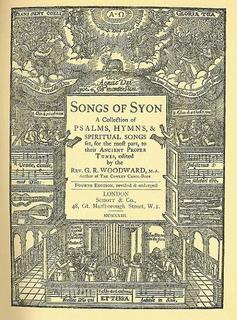


The plainsong texts are generally John Mason Neale’s famous 19th-century translations of the ancient Greek and Latin hymns. These are often rendered in mediaeval musical notation, which, with a little practice, is fairly easily sight-read. The titles of the German hymns are set in blackletter font, perhaps making them appear exotic to an early 20th-century English readership – or should I say “singership”? In his preface to the 4th edition, the Rev. Mr. Woodward felt it necessary to say the following:

If objection be taken to the number of foreign tunes which appear in this Edition, be it remembered that many of our favourite Hymn-tunes. E.g., The Old Hundredth, Luther’s Hymn, Adeste fideles, O Sacred Head surrounded, Now thank we all our God, Sing praise to God who reigns above, are not of English origin. It is confidently believed that many other exotics need only to be transplanted, and they will take equally deep root in the hearts of English-speaking people.

The material is organized at the outset in fairly typical manner, i.e., according to the church calendar. Hence Advent hymns come first, followed by Christmas-even, Christmas-tide, &c. Then come Holy Eucharist, Sundays and Week-days, Evensong, Mattins, Common of Our Lady, Common of Saints, Proper of Saints, &c. Then come sections devoted respectively to Psalms, Hymns and Spiritual Songs.

The Psalms section is of particular interest to me, because the editor put some effort into recovering for the English-speaking church the tunes of the Genevan Psalter, which, apart from a very few, are generally unknown to Anglo-Saxon Christians. Some of the translated texts are by Woodward himself. Here is the first stanza of his rendition of Psalm 150:

Alleluya. Praise the Lord;
Be his holy Name ador’d:
Praise him in the firmament,
Mighty, great and excellent:
In his noble acts revere him:
Praise him on the harp and lute,
Praise him with the trump and flute;
Love, adore, and greatly fear him.

Eight decades later, Woodward’s effort to recover the Genevan tradition appears largely to have fallen short. But his Songs of Syon stands as a monument to the rich liturgical heritage of both eastern and western Christendom. It deserves to be better known than it is.

Unfortunately I myself do not use this volume as often as I would like. My copy is redolent of mildew to which I am, sadly, allergic. Should I attempt to sing directly out of this book, I would have to stop every few bars to blow my nose. I would love to find a much newer reprint with which to replace this.

11 April 2004

A 6th century paschal hymn

This morning in church we sang two versions of the same hymn, Salve Festa Dies, by Venantius Fortunatus. These are "Hail Thee, Festival Day," sung to a rousing tune by Ralph Vaughan Williams, and "Welcome, Happy Morning." Unfortunately we did not sing those two wonderful hymns by St. John of Damascus, "The Day of Resurrection" and "Come, Ye Faithful, Raise the Strain," much beloved by Byzantine-rite Calvinists everywhere.

19 February 2004

The Daily Office

Some 25 years ago I discovered a form of prayer that has its origins in the monastic communities of the early christian centuries, particularly in the west. It is various called the Daily Office, or Divine Office, or Liturgy of the Hours. My initial introduction to this came in the form of a little volume purchased at the bookstore of Luther Theological Seminary in St. Paul, Minnesota: Herbert Lindemann, ed., The Daily Office: Matins and Vespers, Based on Traditional Liturgical Patterns, with Scripture Readings, Hymns, Canticles, Litanies, Collects, and the Psalter, Designed for Private Devotion or Group Worship (St. Louis: Concordia, 1965). Although its language is somewhat dated, it's a marvellous book, filled with all the riches of the Christian ages, some of which were familiar to me but much of which were not.

The daily office is a form of prayer growing out of the canonical hours observed in the monasteries. These are spaced about three hours apart and, in the western tradition, include Matins, Lauds, Prime, Terce, Sext, None, Vespers and Compline. Hence the name Liturgy of the Hours. Each of these offices consists of the following items more or less in order: opening versicle (e.g., Psalm 51:15 or 70:1); followed by Psalm 95 (for Matins) or another canticle; one or more additional psalms; readings from Old Testament, Epistles and Gospels; another canticle (e.g., the Te Deum, the Benedictus or Magnificat); the Kyrie ("Lord have mercy!"); petitions; the Our Father; collects; and a closing doxology or benediction. The prayers and readings are structured according to the traditional church calendar.

Outside the monasteries the canonical hours have been abbreviated into two or three daily prayer offices, usually Matins and Vespers, and sometimes Compline as well. In the Book of Common Prayer two daily prayer offices are prescribed: Morning Prayer, which combines Matins and Lauds, and Evening Prayer, a combination of Vespers and Compline.

What if we lived in communities where morning, evening and night prayer were prayed on a daily basis? Muslims pray five times a day of course. There is something rather awe-inspiring in seeing such huge numbers of people prostrating themselves before God so often. I have posted a pdf document devoted to the Daily Office, which includes the two rites of Matins and Vespers, a table for reading the Psalms, and the two-year Daily Office lectionary. The lectionary was probably put together some 30 years ago or so and is found in the liturgical books of several denominations. For other resources, look here and here.

At some point I may post something I wrote a decade ago about daily prayer.

02 February 2004

The church's songs

Yesterday morning I sang a solo at a local Presbyterian church, which I do about every eight weeks when I am healthy and in full voice. This time I sang my own versification of Psalm 96, set to the Genevan tune. The congregation sang three hymns of note. Two of these were by Fanny Crosby, one of the most prolific hymn writers in history. The first was "Praise Him, Praise Him," and the second "To God Be the Glory." For the most part I am not a fan of American revival hymns, which tend towards sentimentality and a rather sticky form of piety. Nevertheless, I have always rather liked Fanny Crosby's hymns, the best of which transcend the shortcomings of revivalism. Perhaps the knowledge that she spent nearly all of her 95 years in blindness contributes to my admiration for her witness in song to God's grace.

We also sang a metrical paraphrase from the Scottish Psalter, "All Who the Name of Jesus Bear," a versification of Philippians 2:5-11.

Unfortunately the three texts were altered in such a way as to remove virtually all (male!) pronominal references to God, which makes them sound clunky in the extreme. Moreover, the continual repetition of the word "God" without any subsequent pronouns might lead the unsuspecting worshipper to think she was singing the praises of more than one deity. We shouldn't be surprised if such bowdlerized texts fail to catch on over the long term. They make bad poetry, in addition to being somewhat dubious theologically.

25 July 2003

Continued influence of the 1912 Psalter

My parents-in-law are longtime members of Christ Church of Oak Brook, a large independent congregation with Reformed leanings. (Its founding pastor, Arthur DeKruyter, graduated from both Calvin College and Calvin Seminary.) For many years they sang from the OPC's Trinity Hymnal. But a few years ago they produced their own hymnal, the Christ Church Hymnal, undoubtedly making them one of a very few congregations to undertake such a project on their own. Not surprisingly perhaps, this hymnal contains a number of metrical psalms, and these come largely from the 1912 Psalter. The most surprising of these has the metrical text of Psalm 46 set to the tune for "America the Beautiful," a juxtaposition that many would likely find slightly jarring.

13 July 2003

More wonderful hymns

This morning we sang two more of my favourite hymns, Richard F. Littledale's translation of Bianco of Siena's "Come Down, O Love Divine," set to Ralph Vaughan Williams' Down Ampney; and Catherine Winkworth's translation of Johann Franck's "Deck Thyself, My Soul, with Gladness," that wonderful eucharistic hymn from the Lutheran tradition.

Followers

Blog Archive

About Me

My photo
Contact at: dtkoyzis at gmail dot com