Acton ad on target
Although I am not an uncritical supporter of the Acton Institute of Grand Rapids, Michigan, I believe that its current campaign to highlight the harmful side effects of well-intended charity is justified. Charity that creates dependence and stifles initiative is not charitable at all.
10 February 2006


Hail, Britannia?
Mark Steyn lauds the largely salutary influence of the British Empire on many of the key players on the world stage: Pip, pip for the Brits — despite the blips. To which I say, yes, but. . . .
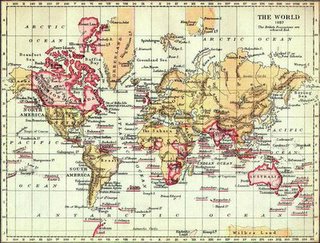
It is difficult nowadays to get people to admit that there might have been something good about the rule of a European colonial power. Ironically, Karl Marx thought that the consolidation of much of the world under a very few imperial powers was a progressive historical development, something almost entirely forgotten by his latter day followers. More than a century later we are wont to associate imperialism with exploitation of peripheral territories to enrich the mother country. In reality, of course, imperialism drained the resources of the metropolitan centre, which explains why Britain, France and others were so anxious to divest themselves of their holdings after the end of the Second World War.
So let's tally up the score. On the plus side, British-derived political institutions have been extraordinarily enduring and have lent to a number of former British territories — though by no means all — an enviable stability not to be taken for granted. I myself was born in such a country, am currently living in another such country, and recently returned from visiting yet a third. To be sure, Anglo-Saxons cannot rival the French or Italians for their cuisine, the Russians for their literature and music, or the Germans for their philosophy. Nevertheless, those of us living in Anglo-Saxon countries are generally able to enjoy all of these imported achievements — plus the rule of law, guaranteed personal liberty, and — to quote the Constitution Act, 1867 — peace, order and good government. This is very nearly the best of all possible worlds.
Steyn could have bolstered his case further by comparing Cyprus, a British possession for 82 years, with Greece, the latter of which has suffered under a series of interfering monarchs, overreaching nationalist governments, military dictatorships, and a weak sense of personal freedoms, including religious liberty. By contrast, Cyprus — at least the southern part of the island under the internationally recognized government — appears clean and efficient, with an excellent transportation and communication infrastructure. The people are unfailingly courteous and helpful. The greater prosperity of the island is achieved by an enterprising populace capable of bouncing back after the tragedy of invasion and partition. In Transparency International's recently released Corruption Perceptions Index Survey, Cyprus outscored Greece by 10 points.
On the minus side, however, Cyprus also weakens Steyn's case to no small degree. For decades Britain refused to reconsider Cyprus' status, deliberately defying the political aspirations of its people. During the emergency of the late 1950s, Britain employed a divide and rule tactic that ended up poisoning relations between the Greek and Turkish communities in the island, leading to the troubles of 1963-4, 1967 and 1974.
At the same time, it is true that Britain's Labour government offered Cyprus self-government short of full independence in 1948 — an offer that Cypriots, encouraged by an Orthodox Church in the dark grip of hellenic nationalism, unwisely declined. Yet in 1960, Britain, along with Greece and Turkey proper, imposed an unwieldy constitutional document on the people of Cyprus that took little account of pre-existing traditions of intercommunal co-operation in the island. And, of course, when Turkey invaded the north in 1974, Britain's presence in the form of its sovereign military bases did nothing to stop this.
If Britain could have bequeathed one more thing to the Greek Cypriot political culture, it should have been this: a willingness to accept the proverbial half a loaf rather than to insist on the whole and end up with nothing. Anglo-Saxons are skilled in the art of compromise. Sad to say, Greek Cypriots are much less so — which explains in no small measure why the political stalemate in the island is currently in its 32nd year.
Mark Steyn lauds the largely salutary influence of the British Empire on many of the key players on the world stage: Pip, pip for the Brits — despite the blips. To which I say, yes, but. . . .

It is difficult nowadays to get people to admit that there might have been something good about the rule of a European colonial power. Ironically, Karl Marx thought that the consolidation of much of the world under a very few imperial powers was a progressive historical development, something almost entirely forgotten by his latter day followers. More than a century later we are wont to associate imperialism with exploitation of peripheral territories to enrich the mother country. In reality, of course, imperialism drained the resources of the metropolitan centre, which explains why Britain, France and others were so anxious to divest themselves of their holdings after the end of the Second World War.
So let's tally up the score. On the plus side, British-derived political institutions have been extraordinarily enduring and have lent to a number of former British territories — though by no means all — an enviable stability not to be taken for granted. I myself was born in such a country, am currently living in another such country, and recently returned from visiting yet a third. To be sure, Anglo-Saxons cannot rival the French or Italians for their cuisine, the Russians for their literature and music, or the Germans for their philosophy. Nevertheless, those of us living in Anglo-Saxon countries are generally able to enjoy all of these imported achievements — plus the rule of law, guaranteed personal liberty, and — to quote the Constitution Act, 1867 — peace, order and good government. This is very nearly the best of all possible worlds.
Steyn could have bolstered his case further by comparing Cyprus, a British possession for 82 years, with Greece, the latter of which has suffered under a series of interfering monarchs, overreaching nationalist governments, military dictatorships, and a weak sense of personal freedoms, including religious liberty. By contrast, Cyprus — at least the southern part of the island under the internationally recognized government — appears clean and efficient, with an excellent transportation and communication infrastructure. The people are unfailingly courteous and helpful. The greater prosperity of the island is achieved by an enterprising populace capable of bouncing back after the tragedy of invasion and partition. In Transparency International's recently released Corruption Perceptions Index Survey, Cyprus outscored Greece by 10 points.
On the minus side, however, Cyprus also weakens Steyn's case to no small degree. For decades Britain refused to reconsider Cyprus' status, deliberately defying the political aspirations of its people. During the emergency of the late 1950s, Britain employed a divide and rule tactic that ended up poisoning relations between the Greek and Turkish communities in the island, leading to the troubles of 1963-4, 1967 and 1974.
At the same time, it is true that Britain's Labour government offered Cyprus self-government short of full independence in 1948 — an offer that Cypriots, encouraged by an Orthodox Church in the dark grip of hellenic nationalism, unwisely declined. Yet in 1960, Britain, along with Greece and Turkey proper, imposed an unwieldy constitutional document on the people of Cyprus that took little account of pre-existing traditions of intercommunal co-operation in the island. And, of course, when Turkey invaded the north in 1974, Britain's presence in the form of its sovereign military bases did nothing to stop this.
If Britain could have bequeathed one more thing to the Greek Cypriot political culture, it should have been this: a willingness to accept the proverbial half a loaf rather than to insist on the whole and end up with nothing. Anglo-Saxons are skilled in the art of compromise. Sad to say, Greek Cypriots are much less so — which explains in no small measure why the political stalemate in the island is currently in its 32nd year.
08 February 2006
Antipodean sojourn V: politics
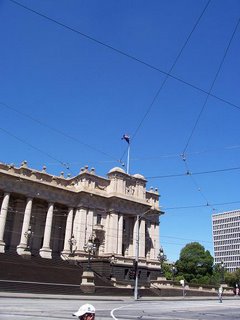
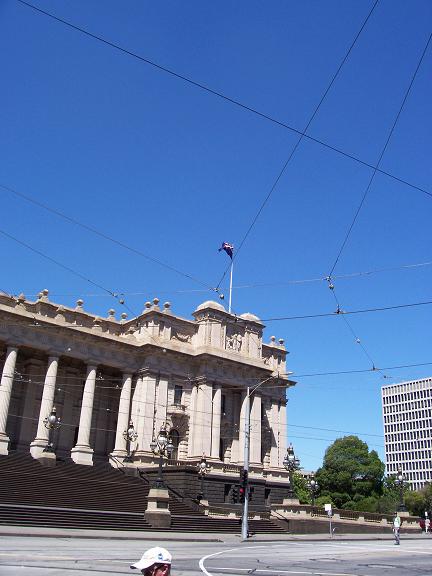
When my trip to Australia was still in the planning stages, I wondered whether I might be able to visit the national capital of Canberra. However, after looking at a map, I quickly realized that distances are as great in Australia as in North America and that it would be 6 hours driving distance from Melbourne. Obviously that would be impossible during such a brief visit. So, knowing that Melbourne is the capital of Victoria, Australia’s second-largest state, I requested of my hosts to be taken to visit the state parliament building in that city. Advance research indicated that parliament would not be sitting in January, when MLAs and MLCs would be on summer holidays. So I would be unable to see question time in the lower chamber. Nevertheless, even a visit to the buildings would be informative and likely to enrich my teaching of Canadian politics, given the similarities between the two countries’ constitutions.
Wednesday afternoon, the 18th, was designated free time for the Transforming Education conferees. Group tours were organized for wine-tasting (which quickly filled up) and riding Puffing Billy, Australia’s oldest functioning steam train. But Stuart Fowler had arranged through his MLA for a private tour for Ken Dickens and me of the Victorian Parliament building, which celebrates its 150th year in 2006. Because Ken lives in Sydney, neither of us knew Melbourne. However, I had purchased a map of the city, which helped us (eventually) to find our way into the central district.
We were a little late arriving at Parliament, mostly because my northern-hemispheric sense of direction didn’t serve me all that well in my unofficial role as Ken’s navigator. All the same, upon arrival, we didn’t have to wait but were greeted immediately by a bright young parliamentary clerk, who looked to be just under 30 years old and reminded me a great deal of one of my former students. Adding to this sense of familiarity, I was favourably impressed that, prior to our visit, he had taken the time to visit my websites to discover my research interests. As it turns out, he himself has a fascination for Canada, so we were able to compare notes between our respective countries’ political systems.
The Victorian Parliament, like those of four other Australian states, is a bicameral body, consisting of an upper chamber, the Legislative Council, and a lower chamber, the Legislative Assembly. Only Queensland has a unicameral parliament. Here in Canada, of course, all ten provincial legislatures are unicameral, Québec being the last to abolish its Conseil législatif in 1968, in an action eerily reminiscent of the opening volley of the French Revolution nearly two centuries earlier. (It even renamed its Legislative Assembly the National Assembly!) But because five of the six state parliaments are bicameral, they preserve more of the Westminster constitutional traditions, including the conventions of reading the Governor’s speech in the upper chamber and introducing money bills into the lower.
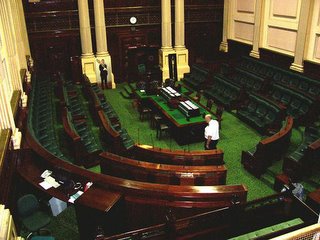
Even the internal layout of the two chambers reflects something of British parliamentary tradition. The Legislative Assembly, like the House of Commons, is predominantly green-coloured, while the Legislative Council, mirroring the House of Lords, is a red chamber. Nevertheless, although most parliamentarians face each other across the floor, the seats form a U at the end, as illustrated at left. Although the bottom of the U is often where members of minor parties sit, in the current parliament, with the Australian Labor Party holding an unprecedented 62 of 88 seats, the government benches extend around the U to the other side as well. The few Liberals and the even fewer Nats are crowded into the seats at the speaker’s immediate left.
I was surprised to learn, however, that, unlike British and Canadian practice, the state premier and the leader of the official opposition do not occupy the front benches of the Legislative Assembly. Rather both sit at a table in the middle of the floor facing each other across a row of law books, an arrangement perhaps intended to symbolize the rule of law in parliamentary government. The traditional Mace, carried by the Serjeant-at-Arms, lies between them at the other end of the table, perhaps as a way of keeping them from coming to metaphorical blows.

Between 1901, when the Commonwealth of Australia came into existence, and 1927, when Canberra became the federal capital, the federal Parliament met in this building, the House of Representatives and Senate occupying the two chambers. During this time the Victoria state parliament met in the Royal Exhibition Building several blocks to the north in Carlton Gardens. So the present parliament building has historic significance for the entire country, and not only for Victoria.
Between the two chambers lies Queen’s Hall. At one end stands a white statue of Queen Victoria, which, our guide informed us, is identical to the statue silently presiding over the interior of the Parliamentary Library in Ottawa. Victoria, of course, lent her name to the state, and references to “the Queen” abound in Australia’s constitution, which came into effect on 1 January 1901, exactly three weeks before her death.

Prior to my arrival in Australia, I discovered a fascinating anomaly in Australia’s relationship to the United Kingdom prior to the Australia Act 1986. When the Statute of Westminster was enacted, effectively recognizing the constitutional equality of the various “dominions” to the UK itself within the Empire/Commonwealth, there were a number of loose ends in these countries that would be tidied up only in the ensuing decades. In Canada, for example, until patriation in 1982, any change to the British North America Act, our chief constitutional document, required an act of the British Parliament, which Ottawa would have to request explicitly. In Australia, 1986 was the watershed year. After 1931 the appointment of a governor general by the reigning monarch would be on the advice of His Majesty’s ministers in Australia and not in Britain. However, due to an apparent oversight, the six Australian states remained in a position of technical subordination to Britain. State governors continued to be recommended by the Secretary of State for Commonwealth Relations in London, albeit with the input of the relevant state ministers. As J. D. B. Miller wrote nearly half a century ago:
This possibility was removed for good 20 years ago, after which time the relevant state ministers would advise the Queen whom to appoint as governor. (In Canada, of course, it is the Governor General in Council, i.e., the federal government, which appoints the provincial lieutenant governors.)
At the La Trobe University bookstore I purchased two books of relevance to the political system. The first is Australian Political Institutions, a standard undergraduate survey text. The second is Haig Patapan, Judging Democracy: The New Politics of the High Court of Australia, an analysis of the increasingly significant role of the High Court in shaping the domestic political process – a tendency very nearly universal in western constitutional democracies but which has nevertheless sparked severe criticism in those same countries.
Next: Antipodean sojourn VI: tying up loose ends.
When my trip to Australia was still in the planning stages, I wondered whether I might be able to visit the national capital of Canberra. However, after looking at a map, I quickly realized that distances are as great in Australia as in North America and that it would be 6 hours driving distance from Melbourne. Obviously that would be impossible during such a brief visit. So, knowing that Melbourne is the capital of Victoria, Australia’s second-largest state, I requested of my hosts to be taken to visit the state parliament building in that city. Advance research indicated that parliament would not be sitting in January, when MLAs and MLCs would be on summer holidays. So I would be unable to see question time in the lower chamber. Nevertheless, even a visit to the buildings would be informative and likely to enrich my teaching of Canadian politics, given the similarities between the two countries’ constitutions.
Wednesday afternoon, the 18th, was designated free time for the Transforming Education conferees. Group tours were organized for wine-tasting (which quickly filled up) and riding Puffing Billy, Australia’s oldest functioning steam train. But Stuart Fowler had arranged through his MLA for a private tour for Ken Dickens and me of the Victorian Parliament building, which celebrates its 150th year in 2006. Because Ken lives in Sydney, neither of us knew Melbourne. However, I had purchased a map of the city, which helped us (eventually) to find our way into the central district.
We were a little late arriving at Parliament, mostly because my northern-hemispheric sense of direction didn’t serve me all that well in my unofficial role as Ken’s navigator. All the same, upon arrival, we didn’t have to wait but were greeted immediately by a bright young parliamentary clerk, who looked to be just under 30 years old and reminded me a great deal of one of my former students. Adding to this sense of familiarity, I was favourably impressed that, prior to our visit, he had taken the time to visit my websites to discover my research interests. As it turns out, he himself has a fascination for Canada, so we were able to compare notes between our respective countries’ political systems.
The Victorian Parliament, like those of four other Australian states, is a bicameral body, consisting of an upper chamber, the Legislative Council, and a lower chamber, the Legislative Assembly. Only Queensland has a unicameral parliament. Here in Canada, of course, all ten provincial legislatures are unicameral, Québec being the last to abolish its Conseil législatif in 1968, in an action eerily reminiscent of the opening volley of the French Revolution nearly two centuries earlier. (It even renamed its Legislative Assembly the National Assembly!) But because five of the six state parliaments are bicameral, they preserve more of the Westminster constitutional traditions, including the conventions of reading the Governor’s speech in the upper chamber and introducing money bills into the lower.
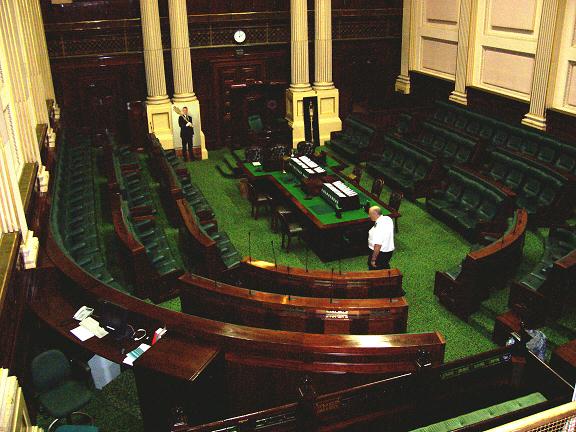
Even the internal layout of the two chambers reflects something of British parliamentary tradition. The Legislative Assembly, like the House of Commons, is predominantly green-coloured, while the Legislative Council, mirroring the House of Lords, is a red chamber. Nevertheless, although most parliamentarians face each other across the floor, the seats form a U at the end, as illustrated at left. Although the bottom of the U is often where members of minor parties sit, in the current parliament, with the Australian Labor Party holding an unprecedented 62 of 88 seats, the government benches extend around the U to the other side as well. The few Liberals and the even fewer Nats are crowded into the seats at the speaker’s immediate left.
I was surprised to learn, however, that, unlike British and Canadian practice, the state premier and the leader of the official opposition do not occupy the front benches of the Legislative Assembly. Rather both sit at a table in the middle of the floor facing each other across a row of law books, an arrangement perhaps intended to symbolize the rule of law in parliamentary government. The traditional Mace, carried by the Serjeant-at-Arms, lies between them at the other end of the table, perhaps as a way of keeping them from coming to metaphorical blows.

Between 1901, when the Commonwealth of Australia came into existence, and 1927, when Canberra became the federal capital, the federal Parliament met in this building, the House of Representatives and Senate occupying the two chambers. During this time the Victoria state parliament met in the Royal Exhibition Building several blocks to the north in Carlton Gardens. So the present parliament building has historic significance for the entire country, and not only for Victoria.
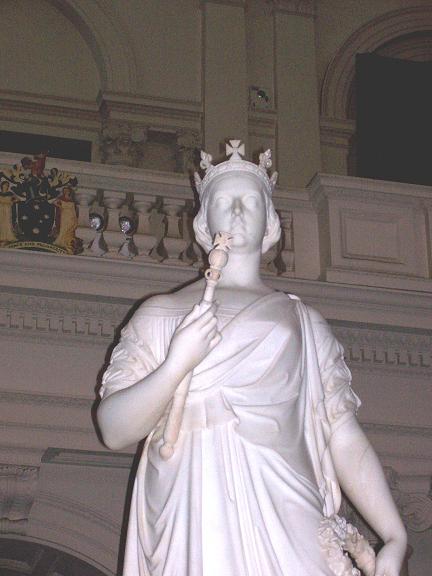
Between the two chambers lies Queen’s Hall. At one end stands a white statue of Queen Victoria, which, our guide informed us, is identical to the statue silently presiding over the interior of the Parliamentary Library in Ottawa. Victoria, of course, lent her name to the state, and references to “the Queen” abound in Australia’s constitution, which came into effect on 1 January 1901, exactly three weeks before her death.
Prior to my arrival in Australia, I discovered a fascinating anomaly in Australia’s relationship to the United Kingdom prior to the Australia Act 1986. When the Statute of Westminster was enacted, effectively recognizing the constitutional equality of the various “dominions” to the UK itself within the Empire/Commonwealth, there were a number of loose ends in these countries that would be tidied up only in the ensuing decades. In Canada, for example, until patriation in 1982, any change to the British North America Act, our chief constitutional document, required an act of the British Parliament, which Ottawa would have to request explicitly. In Australia, 1986 was the watershed year. After 1931 the appointment of a governor general by the reigning monarch would be on the advice of His Majesty’s ministers in Australia and not in Britain. However, due to an apparent oversight, the six Australian states remained in a position of technical subordination to Britain. State governors continued to be recommended by the Secretary of State for Commonwealth Relations in London, albeit with the input of the relevant state ministers. As J. D. B. Miller wrote nearly half a century ago:
In law, a State Governor could be ordered by the Commonwealth Relations Office to dissolve, or not to dissolve, his State parliament, or to refuse assent to a law passed by that parliament. In this sense the paradoxical situation exists of the British government being unable to interfere in the affairs of the Australian Federal government but able to interfere in those of the States.
This possibility was removed for good 20 years ago, after which time the relevant state ministers would advise the Queen whom to appoint as governor. (In Canada, of course, it is the Governor General in Council, i.e., the federal government, which appoints the provincial lieutenant governors.)
At the La Trobe University bookstore I purchased two books of relevance to the political system. The first is Australian Political Institutions, a standard undergraduate survey text. The second is Haig Patapan, Judging Democracy: The New Politics of the High Court of Australia, an analysis of the increasingly significant role of the High Court in shaping the domestic political process – a tendency very nearly universal in western constitutional democracies but which has nevertheless sparked severe criticism in those same countries.
Next: Antipodean sojourn VI: tying up loose ends.
07 February 2006
Conservative misstep and Senate reform
It seems I'm not the only one to think it dishonourable for the Honourable David Emerson to abandon the party under which he was elected only two weeks ago to accept a cabinet portfolio with the party the voters in his riding so recently rejected. In addition to the predictable protests of the opposition parties, the bloggers are getting into the act by urging him to stand down and seek re-election under the new label. Harper should have known better. This doesn't make him look good.
On the other hand, it is much less objectionable to appoint a cabinet minister from the Senate, for which there is ample precedent, even if reversing this order is somewhat unusual. Yet Harper is known to favour an elected Senate, so his appointment of Fortier may not go down well with his own supporters.
If the new Prime Minister is serious about an elected Senate, and if amending our Constitution Acts is impracticable, all he need do is allow a province for which there is a vacancy to put candidates before the voters, after which he would simply appoint their first choice. My understanding is that this is his favoured strategy. However, given that Senators serve until age 75, Harper ought to make the appointment conditional upon the candidate's signing a legal document requiring him or her to stand down after, say, six years. That would bring us into line with Australia and the US, whose Senates are elected. A precedent would be established that future governments would find difficult to break.
This would, of course, empower the Senate, which would then possess democratic legitimacy and could conceivably block legislation already approved by the Commons. Short of legally curtailing the powers of the upper chamber, as Britain has done over the past century, we might do well to look at the Australian Constitution, which makes provisions for resolving a deadlock between the two chambers of that country's parliament. It would not do for the Senate to become a confidence chamber, but it ought to be able to speak up for the West and Atlantic Canada, whose interests are chronically underrepresented in the Commons.
06 February 2006
The new team
The Right Honourable Stephen Joseph Harper is now Canada's 22nd prime minister. Like most new prime ministers, he has downsized his cabinet – from 37 to 27 ministers. Safe bet: the number will creep upwards, if his government lasts long enough. Surprises: David Emerson has pulled a belinda to become minister of International Trade. Michael Fortier, one of Harper's campaign managers, will be Public Works minister, provided, one assumes, that he wins a seat in a by-election.
The Right Honourable Stephen Joseph Harper is now Canada's 22nd prime minister. Like most new prime ministers, he has downsized his cabinet – from 37 to 27 ministers. Safe bet: the number will creep upwards, if his government lasts long enough. Surprises: David Emerson has pulled a belinda to become minister of International Trade. Michael Fortier, one of Harper's campaign managers, will be Public Works minister, provided, one assumes, that he wins a seat in a by-election.
04 February 2006
Will wonders never cease
Even the most hardened sceptic would have to take this as incontrovertible evidence for the miraculous: The Toronto Star, of all places, has published a balanced view of Stephen Harper's religious faith: Stephen Harper just can't quit his inner-Evangelical.
Incidentally, I've just begun reading Lloyd Mackey's The Pilgrimage of Stephen Harper, reviewed here and here. I may have something to say about this book at some point.
03 February 2006
Antipodean sojourn IV: Australians
I’ve discussed earth and sky; now it’s time to look at the people of Australia. Prior to my trip down under, I did some research into the manners and mores of my host country, so as not inadvertently to commit a faux pas and risk offending someone. I understood that there are some countries where, if you do not polish your shoes or if you fail to inquire about the health of a contact’s family, you will be considered a hopeless boor and no one will have anything to do with you. From my research I discovered, among other things, that Australians dress informally and have egalitarian sensibilities. (Okay; so leave the bowtie at home.) Among the things to avoid are: (1) failing to buy the next round of beers, if you are next in line to do so; (2) mentioning your hosts’ convict forebears; (3) assuming that Alice Springs is a suburb of Adelaide; (4) inquiring of a Sydney Anglican whether he believes in the Real Presence or the apostolic succession of bishops, and (5) asking whether your new acquaintances know Paul Hogan or Rupert Murdoch personally. Armed with this information, I figured I couldn’t go wrong.
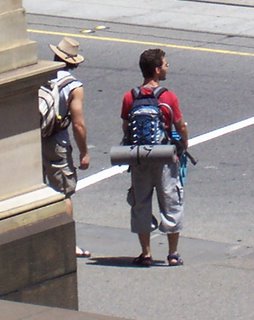
What I found when I actually arrived was that Australians are a warm and hospitable people, with unfailing good humour and a ready willingness to forgive the missteps of visitors. The first people I met at the Melbourne airport were Richard and Annette Edlin, whom I quickly came to like very much. They are originally from New Zealand but have lived in Australia for some years now. The person with whom I spent the most time was Ken Dickens, who had been designated my host during my visit. Once more, I found him to be an amiable person and enjoyed the times we spent together, including our memorable excursion into the centre of Melbourne wednesday afternoon. Thanks are due him for his generous hospitality. Over the following days I met and talked with scores of people, most of whom were attending the Transforming Education Conference. I was so warmly embraced by them that I immediately felt at home and scarcely thought myself to be a stranger in a new country. It’s difficult to imagine a nation filled with such genuine people having any external enemies.
There are, of course, many similarities between Australia and Canada. (To be sure, climate is not one of them.) Both are immigrant countries with predominantly European roots. Both grew to nationhood within the context of the British Empire/Commonwealth. Both countries’ constitutions combine a Westminster-style parliamentary/cabinet system with American-style federalism. But there are differences as well.
Australians are mad about sport — virtually any sport. But among their favourites are rugby-related Australian-rules football, football proper (formerly called soccer) and cricket, all of which I have reason to think I saw briefly on the television set in my room at the Holiday Inn. (All right, I confess — I'm not much of a sport fan.) Last year the Australian Soccer Association became the Football Federation Australia, which means that there are now at least two games being played under the name “football.” If there is any confusion about this, I didn’t detect it. Back home we have hockey. And then, of course, there’s hockey. Oh, and did I mention hockey? (Oh yes, also CFL football, but who pays attention to that?) The Commonwealth Games will shortly be taking place in Melbourne, and no visitor to that city would ever be allowed to leave without being informed of this repeatedly on every street corner. After returning to Canada, I discovered that a Greek Cypriot, 20-year-old Marcos Baghdatis, has been dazzling the spectators at the Australian Open Tennis Tournament, also in Melbourne. The impressive thing is that, unlike many North Americans, Australians do not seem content to remain spectators. Most everyone I saw during my visit appeared to be fit, suggesting that ordinary Australians themselves participate in sporting events, or at least engage in vigorous physical activity.
Australian humour is unique as well. Canadian humour tends to be self-deprecating. We’re good at poking fun at ourselves, as evidenced by our venerable national institution, the Royal Canadian Air Farce. (I’ll leave out Rick Mercer, who can be somewhat caustic at times.) By contrast, Australians like to give each other a hard time – something that may take some getting used to on the part of outsiders. However, if they give you, the visitor, a hard time, that means they like you and have come to think of you as one of their own. There’s no complaining about that. (Um, let's put aside Dame Edna Everage for now.)
My second evening in Melbourne, Richard and Annette invited me to tea in their rooms at Glenn College, where a number of people had gathered to socialize. That was my first taste of Australian conviviality. I had not yet uttered a word — my first keynote address would come the following morning — yet I was already being made welcome. I even received a gift for my daughter: a set of children’s Hebrew letter flashcards and an accompanying workbook to help children learn and practise writing the shapes of the letters. (With her fascination for foreign languages, our Theresa took to these immediately.) At the end of the conference — after my third keynote — I was presented with two wrapped gifts: Steve Parish's Australia: the journey, a beautiful photographic survey of the country; and Australian Politics and Government: The Commonwealth, the States and the Territories, a useful look at Australian federalism.
Small wonder I fell in love with the country and its people. One day I would love to return and take my wife and daughter with me.
Next: Antipodean sojourn V: politics.
I’ve discussed earth and sky; now it’s time to look at the people of Australia. Prior to my trip down under, I did some research into the manners and mores of my host country, so as not inadvertently to commit a faux pas and risk offending someone. I understood that there are some countries where, if you do not polish your shoes or if you fail to inquire about the health of a contact’s family, you will be considered a hopeless boor and no one will have anything to do with you. From my research I discovered, among other things, that Australians dress informally and have egalitarian sensibilities. (Okay; so leave the bowtie at home.) Among the things to avoid are: (1) failing to buy the next round of beers, if you are next in line to do so; (2) mentioning your hosts’ convict forebears; (3) assuming that Alice Springs is a suburb of Adelaide; (4) inquiring of a Sydney Anglican whether he believes in the Real Presence or the apostolic succession of bishops, and (5) asking whether your new acquaintances know Paul Hogan or Rupert Murdoch personally. Armed with this information, I figured I couldn’t go wrong.

What I found when I actually arrived was that Australians are a warm and hospitable people, with unfailing good humour and a ready willingness to forgive the missteps of visitors. The first people I met at the Melbourne airport were Richard and Annette Edlin, whom I quickly came to like very much. They are originally from New Zealand but have lived in Australia for some years now. The person with whom I spent the most time was Ken Dickens, who had been designated my host during my visit. Once more, I found him to be an amiable person and enjoyed the times we spent together, including our memorable excursion into the centre of Melbourne wednesday afternoon. Thanks are due him for his generous hospitality. Over the following days I met and talked with scores of people, most of whom were attending the Transforming Education Conference. I was so warmly embraced by them that I immediately felt at home and scarcely thought myself to be a stranger in a new country. It’s difficult to imagine a nation filled with such genuine people having any external enemies.
There are, of course, many similarities between Australia and Canada. (To be sure, climate is not one of them.) Both are immigrant countries with predominantly European roots. Both grew to nationhood within the context of the British Empire/Commonwealth. Both countries’ constitutions combine a Westminster-style parliamentary/cabinet system with American-style federalism. But there are differences as well.
Australians are mad about sport — virtually any sport. But among their favourites are rugby-related Australian-rules football, football proper (formerly called soccer) and cricket, all of which I have reason to think I saw briefly on the television set in my room at the Holiday Inn. (All right, I confess — I'm not much of a sport fan.) Last year the Australian Soccer Association became the Football Federation Australia, which means that there are now at least two games being played under the name “football.” If there is any confusion about this, I didn’t detect it. Back home we have hockey. And then, of course, there’s hockey. Oh, and did I mention hockey? (Oh yes, also CFL football, but who pays attention to that?) The Commonwealth Games will shortly be taking place in Melbourne, and no visitor to that city would ever be allowed to leave without being informed of this repeatedly on every street corner. After returning to Canada, I discovered that a Greek Cypriot, 20-year-old Marcos Baghdatis, has been dazzling the spectators at the Australian Open Tennis Tournament, also in Melbourne. The impressive thing is that, unlike many North Americans, Australians do not seem content to remain spectators. Most everyone I saw during my visit appeared to be fit, suggesting that ordinary Australians themselves participate in sporting events, or at least engage in vigorous physical activity.
Australian humour is unique as well. Canadian humour tends to be self-deprecating. We’re good at poking fun at ourselves, as evidenced by our venerable national institution, the Royal Canadian Air Farce. (I’ll leave out Rick Mercer, who can be somewhat caustic at times.) By contrast, Australians like to give each other a hard time – something that may take some getting used to on the part of outsiders. However, if they give you, the visitor, a hard time, that means they like you and have come to think of you as one of their own. There’s no complaining about that. (Um, let's put aside Dame Edna Everage for now.)
My second evening in Melbourne, Richard and Annette invited me to tea in their rooms at Glenn College, where a number of people had gathered to socialize. That was my first taste of Australian conviviality. I had not yet uttered a word — my first keynote address would come the following morning — yet I was already being made welcome. I even received a gift for my daughter: a set of children’s Hebrew letter flashcards and an accompanying workbook to help children learn and practise writing the shapes of the letters. (With her fascination for foreign languages, our Theresa took to these immediately.) At the end of the conference — after my third keynote — I was presented with two wrapped gifts: Steve Parish's Australia: the journey, a beautiful photographic survey of the country; and Australian Politics and Government: The Commonwealth, the States and the Territories, a useful look at Australian federalism.
Small wonder I fell in love with the country and its people. One day I would love to return and take my wife and daughter with me.
Next: Antipodean sojourn V: politics.
02 February 2006
Leo Strauss in the True North?
With the election of Stephen Harper's Conservative government in last month's federal election, could the conspiratorial Straussian cabal led by the notorious Paul Wolfowitz be extending its reach from Washington to Ottawa? Joseph Knippenberg explores this possibility in The Second Time as Farce. I am, of course, pleased to see Knippenberg cite my own The Calgary School and the Future of Canada, which he deems one of the "more measured accounts" of this school's influence.
One of the articles to which Knippenberg links is written by a certain professed "Red Tory" and aficionado of the late George Parkin Grant. While he charges the Calgarians with taking their cues from, among others, European émigrés such as Leo Strauss, and not from "indigenous Canadian tradition," he appears to have forgotten that Grant himself had considerable respect for Strauss and counted him one of the great influences on his own thought. Nationalist though Grant may have been, he was hardly one to limit his own grazing to native pastures. How else account for the formative influence of Jacques Ellul and Simone Weil, the latter of whom in particular he held in almost childlike awe?
01 February 2006
Intelligent design
Given that I am not a biologist, I risk going out on a limb in commenting on the controversy over intelligent design. As I've written before, I tend to be agnostic on the question of whether macroevolution actually occurred, although I strongly disagree with Darwin's assumption that a simple mechanism like natural selection can explain the irreducible complexity of especially human life and the multiple levels of causality operating within God's world. The only defence of intelligent design I've read thus far is that of Nancy Pearcey in Total Truth, and I did not find her altogether presuasive for reasons that I may get into at some point.
As I see it, a key reason why intelligent design cannot function as an alternative to Darwinian evolution is that it does not offer an alternative explanation for the rise of distinct species at particular stages in prehistory and appears to remove the issue from the realm of empirical investigation. After all, creatio ex nihilo occurred "in the beginning" (Gen. 1:1); everything else comes about through the subsequent unfolding of creation. It is the nature of this unfolding that is at issue. If proponents of the "special creation" of human beings and other species are arguing for multiple instances of creatio ex nihilo after God's initial creative act, they are going well beyond the teachings of scripture and, in any case, are arguing for something that cannot be empirically verified.
There's another reason why intelligent design is flawed, and this is picked up by James W. Skillen, commenting on a much longer article by Calvin College Professor Uko Zylstra. Here is where those multiple levels of causality come into play. In Intelligent Design as Science, Skillen writes:
In essence, what Zylstra does is to argue that the whole of reality begs for an answer deeper than science can provide of why anything exists at all and why things exist in the way they do, with millions of kinds of creatures conforming to various kinds of laws-physical, chemical, biotic, psychic, logical, historical, economic, and more. If some theorists hypothesize that everything can be explained in terms physical and chemical processes plus time and chance, their theory is reductionistic. But if intelligent-design theorists simply add the hypothesis that a designer, standing outside the physical and chemical processes, needs to be posited to account for irreducible complexity, they still haven't accounted for the biotic laws that hold for the development of living things. . . .
The key issue in the debate between evolutionary theorists and intelligent-design (ID) theorists, says Zylstra, is that of causality. “The ID theorists want to posit an intelligent cause in addition to 'natural causes.' The difficulty with this, however, is that both evolutionary biologists and ID theorists assume a reductionist ontology with regard to natural causes. Natural causes are seen as physical and chemical causality. . . . I don't believe that positing intelligent design as a causal agent for such irreducible complexity is the appropriate response,” says Zylstra. What hasn't been taken into account is the biotic mode of existence. “Life phenomena are not material in nature. Life is a mode of being, a function of living things. Biology textbooks generally promote this major misconception by the frequent reference to 'living matter'. But the expression 'living matter' is an oxymoron. Matter itself is never alive. . . . We always find whole living organisms. Matter is fundamentally physical and chemical in nature and thus subject to chemical and physical laws.” The inadequacy of ID theory, Zylstra believes, is its “failure to recognize the life function of living things,” which exist in accord with biotic laws and not only physical or chemical laws.
31 January 2006
Coretta Scott King (1927-2006)
The widow of the late Dr. Martin Luther King, who became a civil rights leader in her own right, is dead at age 78. In 1987, Scott King received an honorary doctorate from the University of Notre Dame, in the same ceremony which saw an earned doctorate conferred upon a soon-to-be Upper Canadian assistant professor of political science. David Rockefeller and former first lady Rosalind Carter also received honorary doctorates on the same occasion.
The widow of the late Dr. Martin Luther King, who became a civil rights leader in her own right, is dead at age 78. In 1987, Scott King received an honorary doctorate from the University of Notre Dame, in the same ceremony which saw an earned doctorate conferred upon a soon-to-be Upper Canadian assistant professor of political science. David Rockefeller and former first lady Rosalind Carter also received honorary doctorates on the same occasion.
Worth reading. . .
. . . is this thoughtful analysis of last week's federal election by Ray Pennings and Michael Van Pelt: Replacing the Pan-Canadian consensus. Incidentally, their soon to be former colleague, David Sweet, is now the Member of Parliament for Ancaster-Dundas-Flamborough-Westdale.
. . . is this thoughtful analysis of last week's federal election by Ray Pennings and Michael Van Pelt: Replacing the Pan-Canadian consensus. Incidentally, their soon to be former colleague, David Sweet, is now the Member of Parliament for Ancaster-Dundas-Flamborough-Westdale.
29 January 2006
Antipodean sojourn III: the skies and seasons
One of the obvious benefits of visiting Australia in January is that it’s summer in the southern hemisphere. One need hardly emphasize that anyone facing the prospect of a long Canadian winter would jump at the opportunity for even a brief respite from the ice and snow, as well as from the long nights and short days. In recent years I’ve discovered that I seem to suffer from Seasonal Affective Disorder, which is worst right before Christmas and then slowly improves over the following months. As I do not require a lot of sleep, I was quite happy, during my Melbourne visit, to wake up with the sun around 5.30 in the morning – with the help of the kookaburra, of course. My first and last nights were spent at the Holiday Inn at the airport, where my rooms faced east. This accorded me a breathtaking view of sunrise.
Somewhat to my surprise, being in the southern hemisphere played havoc with my sense of direction, which is usually quite good. When Ken Dickens and I drove into the city on Wednesday afternoon, I acted as navigator and kept a map open as we tried to find our way to the state parliament building on Spring Street. Unfortunately, my sense of direction often failed me, due, I am forced to conclude, to the sun being in the “wrong” part of the sky! I am generally not aware of taking my bearings from the sun, but I suppose I must do so on at least a subconscious level. I did get used to it eventually, but at first it was mildly disorienting.

The sun didn’t set until about 9.30 pm. Although I love the long days, I did not spurn the darkness. In fact, after sunset I deliberately walked into the grassy area to the north of Glenn College to view the night sky. Wanting to pack as much as possible into my visit, I had brought along a 36-year-old foldup National Geographic map of the heavens, showing sky charts for the 12 months and for each hemisphere. Never having seen the southern hemispheric constellations, I looked forward to taking these in for the first time. The first night was somewhat cloudy, so I had some difficulty identifying all but the major stars – except for those of Orion, which is visible in the northern hemisphere as well and is sufficiently distinctive to make it easily recognizable. The second night was clear, so I went out again with my sky charts and was quickly able to locate the famous Southern Cross, which adorns the flags of Australia and New Zealand, as well as those of Papua New Guinea, Christmas Island, the Australian states of Victoria and New South Wales, and the Northern and Capital Territories. I was able to identify this constellation by its relationship to Alpha and Beta Centauri, which point to it. (As some may know, Alpha Centauri is a three-star system, one of whose members, Proxima Centauri, is closest of all the stars to our solar system, at a “mere” 4.22 light years away.) Unfortunately, because of the artificial light on campus, I could make out only the three brightest stars of the cross.

In the northern sky is Orion, which appears “upside down” relative to its position as seen in the northern hemisphere. One of the conference participants gave me an amusing account of an aboriginal interpretation of this inverted constellation. It seems that the scabbard hanging from Orion’s belt was deemed by some aboriginal communities to be a phallus pointing upwards. Its bearer, Nirunja, was seen to be chasing the Seven Sisters (the Pleiades) with evident amorous intent. One assumes this piece of native folklore isn’t covered in school astronomy units until the upper grades! I understand that other aboriginal Australians view Orion as an emu, which is probably more suitable for the younger pupils.
Back to the daylight hours. I was told that Australians tend to suffer from skin cancer at higher rates than people in other western countries, due, of course, to prolonged exposure to the sun. Therefore, many Australians wear hats, including the famous Akubra hat, which has attained something approaching iconic status in that country. I myself would like to have acquired one of these – or at least a near imitation. However, as I found them priced at a level too high for my comfort, I decided to forego the privilege.
Ever since John F. Kennedy popularized the bare-headed look in the early 1960s, few North American men wear hats anymore. I suppose I’m the exception to this nearly half-century-old fashion trend. Indeed, people tend to know me by my hats, which change with the seasons and take up far too much space at the top of our front closet. Here in Canada, of course, the motivating factor is not so much the sun as the cold. To be sure, some think I’m making a fashion statement, but I actually get sick less frequently than I used to in my younger days before donning the chapeau. Probably the only thing that would keep me healthier would be to spend our winter months in – well, Australia.
Next: Antipodean sojourn IV: Australians.
One of the obvious benefits of visiting Australia in January is that it’s summer in the southern hemisphere. One need hardly emphasize that anyone facing the prospect of a long Canadian winter would jump at the opportunity for even a brief respite from the ice and snow, as well as from the long nights and short days. In recent years I’ve discovered that I seem to suffer from Seasonal Affective Disorder, which is worst right before Christmas and then slowly improves over the following months. As I do not require a lot of sleep, I was quite happy, during my Melbourne visit, to wake up with the sun around 5.30 in the morning – with the help of the kookaburra, of course. My first and last nights were spent at the Holiday Inn at the airport, where my rooms faced east. This accorded me a breathtaking view of sunrise.
Somewhat to my surprise, being in the southern hemisphere played havoc with my sense of direction, which is usually quite good. When Ken Dickens and I drove into the city on Wednesday afternoon, I acted as navigator and kept a map open as we tried to find our way to the state parliament building on Spring Street. Unfortunately, my sense of direction often failed me, due, I am forced to conclude, to the sun being in the “wrong” part of the sky! I am generally not aware of taking my bearings from the sun, but I suppose I must do so on at least a subconscious level. I did get used to it eventually, but at first it was mildly disorienting.
The sun didn’t set until about 9.30 pm. Although I love the long days, I did not spurn the darkness. In fact, after sunset I deliberately walked into the grassy area to the north of Glenn College to view the night sky. Wanting to pack as much as possible into my visit, I had brought along a 36-year-old foldup National Geographic map of the heavens, showing sky charts for the 12 months and for each hemisphere. Never having seen the southern hemispheric constellations, I looked forward to taking these in for the first time. The first night was somewhat cloudy, so I had some difficulty identifying all but the major stars – except for those of Orion, which is visible in the northern hemisphere as well and is sufficiently distinctive to make it easily recognizable. The second night was clear, so I went out again with my sky charts and was quickly able to locate the famous Southern Cross, which adorns the flags of Australia and New Zealand, as well as those of Papua New Guinea, Christmas Island, the Australian states of Victoria and New South Wales, and the Northern and Capital Territories. I was able to identify this constellation by its relationship to Alpha and Beta Centauri, which point to it. (As some may know, Alpha Centauri is a three-star system, one of whose members, Proxima Centauri, is closest of all the stars to our solar system, at a “mere” 4.22 light years away.) Unfortunately, because of the artificial light on campus, I could make out only the three brightest stars of the cross.
In the northern sky is Orion, which appears “upside down” relative to its position as seen in the northern hemisphere. One of the conference participants gave me an amusing account of an aboriginal interpretation of this inverted constellation. It seems that the scabbard hanging from Orion’s belt was deemed by some aboriginal communities to be a phallus pointing upwards. Its bearer, Nirunja, was seen to be chasing the Seven Sisters (the Pleiades) with evident amorous intent. One assumes this piece of native folklore isn’t covered in school astronomy units until the upper grades! I understand that other aboriginal Australians view Orion as an emu, which is probably more suitable for the younger pupils.
Back to the daylight hours. I was told that Australians tend to suffer from skin cancer at higher rates than people in other western countries, due, of course, to prolonged exposure to the sun. Therefore, many Australians wear hats, including the famous Akubra hat, which has attained something approaching iconic status in that country. I myself would like to have acquired one of these – or at least a near imitation. However, as I found them priced at a level too high for my comfort, I decided to forego the privilege.
Ever since John F. Kennedy popularized the bare-headed look in the early 1960s, few North American men wear hats anymore. I suppose I’m the exception to this nearly half-century-old fashion trend. Indeed, people tend to know me by my hats, which change with the seasons and take up far too much space at the top of our front closet. Here in Canada, of course, the motivating factor is not so much the sun as the cold. To be sure, some think I’m making a fashion statement, but I actually get sick less frequently than I used to in my younger days before donning the chapeau. Probably the only thing that would keep me healthier would be to spend our winter months in – well, Australia.
Next: Antipodean sojourn IV: Australians.
Two thumbs (mostly) up
Is it possible to be New Age and pro-life at the same time? Go rent Just Like Heaven and see for yourself. Sure, there are holes in the plot, but it manages to work all the same. And it raises doubts about the living will.
Is it possible to be New Age and pro-life at the same time? Go rent Just Like Heaven and see for yourself. Sure, there are holes in the plot, but it manages to work all the same. And it raises doubts about the living will.
27 January 2006
Antipodean sojourn II: the natural environment
The first thing to strike me about Australia was its relative aridity as compared to the parts of North America with which I am most familiar. Even from the air one can see the brownness of the grass below. Australia as a whole is fairly dry, with much of its interior – the famous outback – occupied by desert conditions. There is no lengthy river system, such as the Mississippi-Missouri, flowing through the heart of the country. As a consequence, the most fertile and arable parts of Australia lie in the southeastern corner, which, not incidentally, contains most of its 20 million people. This has political ramifications insofar as the two most populous states of New South Wales and Victoria tend to dominate the political process, much as Ontario and Québec do here in Canada.
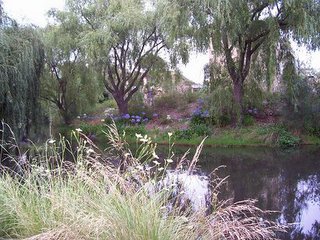
The second thing to note about the country is the beauty of its natural environment. For most of my visit I stayed at Glenn College on the campus of La Trobe University near Melbourne. Although some of the conference participants thought the campus ugly, I found it to be an incomparably lovely setting. (Perhaps Australians are so spoilt by the beauty of their own country that anything only moderately beautiful seems ugly in comparison.) Indeed many, if not most, of the photographs I took were of the exotic (by southern Ontario standards) flora and fauna inhabiting the land. A small stream wends it way through part of the grounds, and I loved to walk along its banks between Glenn College and Union Hall, where much of the conference took place. My best photographs were taken here.

Every morning I was awoken by the loud laughing sound of the kookaburra and the screech of the cockatoo – sounds that most North Americans would tend to associate with the jungle. I didn't get close enough to either of these creatures to photograph it, but at one point, while I was walking by the stream, I found myself only a metre away from a purple swamphen, which can be seen at right. The most visible of the many birds in the vicinity are the magpies, which are said to have a lovely song, but which, if I did manage to hear it, I failed to connect with this species. Another common bird is a variety of crow whose cry resembles that of a duck.

My host, Ken Dickens, was kind enough to walk me to a corner of the campus where the local kangaroos tend to congregate shortly before dusk. Sure enough, there they were. We were able to get close enough for me to capture them on camera. Was one of them a mother carrying a joey in its pouch? I couldn't tell from this distance. Needless to say, a mother with offspring would not have welcomed a closer look from us. What about the famous koala? We didn't see any of these. I was told that koalas are rather reclusive and stay up in their trees, uttering a loud grunting sound similar to that of a pig. It would have been a treat to see a platypus, one of the most unusual mammals on earth, but we didn't.
In future posts I will be writing about the climate and the heavens above Australia, the people and their ways, and the political system. Incidentally, yesterday was Australia Day, commemorating the first European settlement of the country in 1788.
Next: Antipodean sojourn III: the skies and seasons.
The first thing to strike me about Australia was its relative aridity as compared to the parts of North America with which I am most familiar. Even from the air one can see the brownness of the grass below. Australia as a whole is fairly dry, with much of its interior – the famous outback – occupied by desert conditions. There is no lengthy river system, such as the Mississippi-Missouri, flowing through the heart of the country. As a consequence, the most fertile and arable parts of Australia lie in the southeastern corner, which, not incidentally, contains most of its 20 million people. This has political ramifications insofar as the two most populous states of New South Wales and Victoria tend to dominate the political process, much as Ontario and Québec do here in Canada.
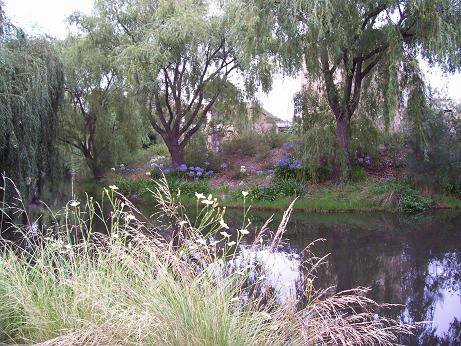
The second thing to note about the country is the beauty of its natural environment. For most of my visit I stayed at Glenn College on the campus of La Trobe University near Melbourne. Although some of the conference participants thought the campus ugly, I found it to be an incomparably lovely setting. (Perhaps Australians are so spoilt by the beauty of their own country that anything only moderately beautiful seems ugly in comparison.) Indeed many, if not most, of the photographs I took were of the exotic (by southern Ontario standards) flora and fauna inhabiting the land. A small stream wends it way through part of the grounds, and I loved to walk along its banks between Glenn College and Union Hall, where much of the conference took place. My best photographs were taken here.

Every morning I was awoken by the loud laughing sound of the kookaburra and the screech of the cockatoo – sounds that most North Americans would tend to associate with the jungle. I didn't get close enough to either of these creatures to photograph it, but at one point, while I was walking by the stream, I found myself only a metre away from a purple swamphen, which can be seen at right. The most visible of the many birds in the vicinity are the magpies, which are said to have a lovely song, but which, if I did manage to hear it, I failed to connect with this species. Another common bird is a variety of crow whose cry resembles that of a duck.

My host, Ken Dickens, was kind enough to walk me to a corner of the campus where the local kangaroos tend to congregate shortly before dusk. Sure enough, there they were. We were able to get close enough for me to capture them on camera. Was one of them a mother carrying a joey in its pouch? I couldn't tell from this distance. Needless to say, a mother with offspring would not have welcomed a closer look from us. What about the famous koala? We didn't see any of these. I was told that koalas are rather reclusive and stay up in their trees, uttering a loud grunting sound similar to that of a pig. It would have been a treat to see a platypus, one of the most unusual mammals on earth, but we didn't.
In future posts I will be writing about the climate and the heavens above Australia, the people and their ways, and the political system. Incidentally, yesterday was Australia Day, commemorating the first European settlement of the country in 1788.
Next: Antipodean sojourn III: the skies and seasons.
26 January 2006
Peace eludes Middle East once more
This is little short of disastrous for Palestinians and Israelis alike: Hamas wins majority in Palestinian parliament. Though there is considerable justice in the Palestinian cause, once again Palestinians themselves have proved to be their own worst enemy.
This is little short of disastrous for Palestinians and Israelis alike: Hamas wins majority in Palestinian parliament. Though there is considerable justice in the Palestinian cause, once again Palestinians themselves have proved to be their own worst enemy.
25 January 2006
Pope extols God's love
Benedict XVI has published the first encyclical of his papacy, Deus Caritas Est, subtitled "On Christian Love."
Benedict XVI has published the first encyclical of his papacy, Deus Caritas Est, subtitled "On Christian Love."
Antipodean sojourn: Transforming education
As promised, here is the first of my accounts of my visit to Australia last week. Slightly more than a year ago I was invited by Richard Edlin to be one of two keynote speakers at the Transforming Education Conference, subtitled "Grounded in Christ... Engaging the Culture." I was given the opportunity to speak on three occasions and on three related topics, the first two of which are immediately related to the subject matter of my book. The first, delivered on wednesday morning, the 17th, was titled "Visions and illusions in politics and life." The second, the following morning, was titled "Liberalism and its alternatives." The third and final address, delivered on friday, was titled "Illusions and vision for education." After each address someone got up to give a reflection on what I had said. One of these was Henry Contant, a fellow Canadian who is Executive Director of the Society of Christian Schools in British Columbia. Late friday morning I also fielded questions from interested conferees in a more informal setting. I found it a most enjoyable experience. My remarks were well received and I had fun engaging people during the break times.
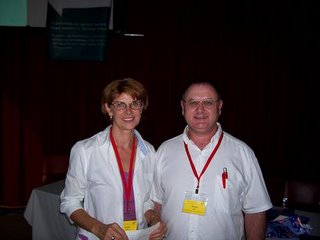
Carolyn Kelshaw and Richard Edlin
The second keynote speaker was Dr. Stuart Fowler, whom I can only describe as the elder statesman of the christian parent controlled school movement, as it is known in Australia. He spoke on friday afternoon and presented something of a history of the movement from its beginnings in 1962, through the granting of substantial government funding a decade later, and up to more recent times. I was favourably impressed by the dedication of the parents and teachers who have spearheaded the movement and lovingly nurtured these schools.
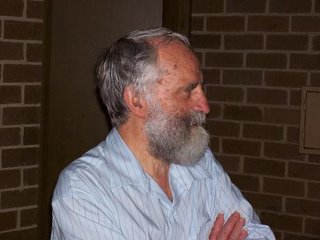
Stuart Fowler
Most of all, I was overwhelmed by the kindness and hospitality of everyone present. Australians are a most likable people living in a stunningly beautiful country. I'll write further about the people and their country over the next few days.
CPCS and NICE have produced two volumes containing essays related to previous Transforming Education conferences. The first of these, edited by Jill Ireland, Edlin and Ken Dickens, is titled Pointing the way: Directions for Christian education in a new millennium (2004), and contains essays by Fowler, Edlin and others. I was sent a copy of this early last year. The second collection, also edited by Edlin and Ireland (and with a much improved and more readable font), is called Engaging the culture: Christians at work in education, and was just released at last week's conference. I myself will be contributing to a future such volume.
Because Australia is such a huge country, people came, not only from the major urban centres on the south and east coasts, such as Brisbane, Sydney, Melbourne and Adelaide, but from as far away as Perth and Darwin on the west and north coasts respectively. An equivalent conference here in Canada would draw people from Toronto, Halifax, Vancouver, Yellowknife and Iqaluit. Attending such a gathering seems to be a priority for christian school teachers, who might otherwise find their geographic remoteness from fellow teachers lonely and discouraging. This is good reason to pray for future such conferences – that they might renew and strengthen participants to persevere in their calling, wherever they may be.
Next: Antipodean sojourn II: the natural environment.
As promised, here is the first of my accounts of my visit to Australia last week. Slightly more than a year ago I was invited by Richard Edlin to be one of two keynote speakers at the Transforming Education Conference, subtitled "Grounded in Christ... Engaging the Culture." I was given the opportunity to speak on three occasions and on three related topics, the first two of which are immediately related to the subject matter of my book. The first, delivered on wednesday morning, the 17th, was titled "Visions and illusions in politics and life." The second, the following morning, was titled "Liberalism and its alternatives." The third and final address, delivered on friday, was titled "Illusions and vision for education." After each address someone got up to give a reflection on what I had said. One of these was Henry Contant, a fellow Canadian who is Executive Director of the Society of Christian Schools in British Columbia. Late friday morning I also fielded questions from interested conferees in a more informal setting. I found it a most enjoyable experience. My remarks were well received and I had fun engaging people during the break times.

The second keynote speaker was Dr. Stuart Fowler, whom I can only describe as the elder statesman of the christian parent controlled school movement, as it is known in Australia. He spoke on friday afternoon and presented something of a history of the movement from its beginnings in 1962, through the granting of substantial government funding a decade later, and up to more recent times. I was favourably impressed by the dedication of the parents and teachers who have spearheaded the movement and lovingly nurtured these schools.
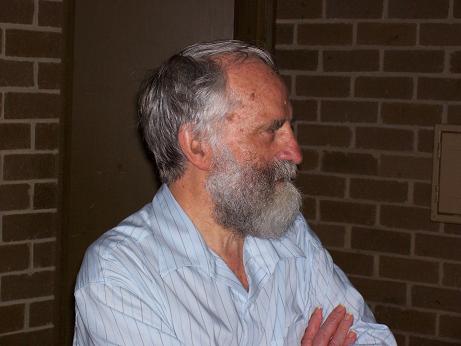
Most of all, I was overwhelmed by the kindness and hospitality of everyone present. Australians are a most likable people living in a stunningly beautiful country. I'll write further about the people and their country over the next few days.
CPCS and NICE have produced two volumes containing essays related to previous Transforming Education conferences. The first of these, edited by Jill Ireland, Edlin and Ken Dickens, is titled Pointing the way: Directions for Christian education in a new millennium (2004), and contains essays by Fowler, Edlin and others. I was sent a copy of this early last year. The second collection, also edited by Edlin and Ireland (and with a much improved and more readable font), is called Engaging the culture: Christians at work in education, and was just released at last week's conference. I myself will be contributing to a future such volume.
Because Australia is such a huge country, people came, not only from the major urban centres on the south and east coasts, such as Brisbane, Sydney, Melbourne and Adelaide, but from as far away as Perth and Darwin on the west and north coasts respectively. An equivalent conference here in Canada would draw people from Toronto, Halifax, Vancouver, Yellowknife and Iqaluit. Attending such a gathering seems to be a priority for christian school teachers, who might otherwise find their geographic remoteness from fellow teachers lonely and discouraging. This is good reason to pray for future such conferences – that they might renew and strengthen participants to persevere in their calling, wherever they may be.
Next: Antipodean sojourn II: the natural environment.
24 January 2006
Harper wins. . . or does he?
After a dozen years in power, the Liberal Party has been defeated, and the Conservatives will form a minority government, with leader Stephen Harper as Prime Minister. With 36.25% of the vote, the Conservatives have won 124 seats, including 10 seats in Québec, where Conservative voters are generally scarce as hen's teeth. Paul Martin's Liberals won but 103 seats, with 30.22% of the vote. Although Martin himself retained his own seat, he has announced his intention to quit as party leader.
The cloud in Harper's silver lining is that the separatist Bloc québécois now holds the balance of power, having won 51 seats and 10.48% of the vote. Will he be able to govern with the help of the Bloc, or is this the beginning of the end of Canadian unity? Jack Layton's New Democrats have 29 seats, with 17.49% of the vote.
A few items of interest:
Chris Charlton won my own riding of Hamilton Mountain for the NDP, beating out the Liberals' Bill Kelly.
Rob Merrifield held onto Yellowhead in Alberta.
David Sweet won the seat for Ancaster-Dundas-Flamborough-Westdale, thus making a lot of people I know very happy indeed. Sweet has a copy of my book and has read it.
Big name Michael Ignatieff, lately the Carr Professor of Human Rights at Harvard, won a seat in Etobicoke-Lakeshore. He has his eyes on Paul Martin's job. But read this about Ignatieff.
Olivia Chow won the seat for the NDP in Toronto's Trinity-Spadina riding. She is married to party leader Jack Layton.
Political turncoat Belinda Stronach holds on to Newmarket-Aurora for the Liberals.
Former Ontario provincial minister of finance Jim Flaherty won the riding of Whitby-Oshawa for the Conservatives. Flaherty was the author of the Equity in Education Tax Credit, which was subsequently undone by Dalton McGuinty's government in 2003.
Conservative candidate Rick Dykstra barely edged out the second-place Liberal candidate in St. Catharines. Dykstra is the son-in-law of my Redeemer colleague, Dr. John Vriend.
Voter turnout was up, at 64.9%, from an historic low of 60.9% in 2004. It had declined steadily after the historic 1993 election.
Here is a downloadable map of Canada showing riding-by-riding results. I found it useful for my Canadian politics class this morning.
After a dozen years in power, the Liberal Party has been defeated, and the Conservatives will form a minority government, with leader Stephen Harper as Prime Minister. With 36.25% of the vote, the Conservatives have won 124 seats, including 10 seats in Québec, where Conservative voters are generally scarce as hen's teeth. Paul Martin's Liberals won but 103 seats, with 30.22% of the vote. Although Martin himself retained his own seat, he has announced his intention to quit as party leader.
The cloud in Harper's silver lining is that the separatist Bloc québécois now holds the balance of power, having won 51 seats and 10.48% of the vote. Will he be able to govern with the help of the Bloc, or is this the beginning of the end of Canadian unity? Jack Layton's New Democrats have 29 seats, with 17.49% of the vote.
A few items of interest:
22 January 2006
The Antipodes and back
Yesterday I returned from nearly a week in Australia, where I was a keynote speaker at the Transforming Education Conference at La Trobe University in Melbourne. The conference was co-sponsored by the National Institute for Christian Education (NICE) and Christian Parent Controlled Schools Ltd (CPCS). Over the next several days I will be posting edited entries from the personal journal I kept of this marvellous experience. Watch this space.

Kangaroos on the
La Trobe University campus
Yesterday I returned from nearly a week in Australia, where I was a keynote speaker at the Transforming Education Conference at La Trobe University in Melbourne. The conference was co-sponsored by the National Institute for Christian Education (NICE) and Christian Parent Controlled Schools Ltd (CPCS). Over the next several days I will be posting edited entries from the personal journal I kept of this marvellous experience. Watch this space.

La Trobe University campus
18 January 2006
Stop the presses
Stephen Harper has come clean and finally revealed his party's hidden agenda: The Conservatives would govern within the parameters of Canada's constitution. Will he lose votes over this? Stay tuned.
Stephen Harper has come clean and finally revealed his party's hidden agenda: The Conservatives would govern within the parameters of Canada's constitution. Will he lose votes over this? Stay tuned.
14 January 2006
The party leaders on religion and public life
The Evangelical Fellowship of Canada's periodical, Faith Today, posed this question to the leaders of Canada's political parties: "What role do you think faith should play in developing public policy, and what is the place of religious institutions in contemporary Canadian society?" Their answers are revealing, as is the refusal of some to provide an answer at all. But come now; the editors didn't really think the Marijuana Party would have a position on this, did they?
The Evangelical Fellowship of Canada's periodical, Faith Today, posed this question to the leaders of Canada's political parties: "What role do you think faith should play in developing public policy, and what is the place of religious institutions in contemporary Canadian society?" Their answers are revealing, as is the refusal of some to provide an answer at all. But come now; the editors didn't really think the Marijuana Party would have a position on this, did they?
10 January 2006
Steyn on the west's decline
Western civilization has arguably been declining for at least two centuries. Could its collapse finally be in sight? If Mark Steyn is correct, it could end with neither a bang nor a whimper: It’s the demography, stupid. Needless to say, Steyn's article has touched a nerve, prompting a number of responses from readers. One of these has pointed to an informative map of global fertility rates.
Western civilization has arguably been declining for at least two centuries. Could its collapse finally be in sight? If Mark Steyn is correct, it could end with neither a bang nor a whimper: It’s the demography, stupid. Needless to say, Steyn's article has touched a nerve, prompting a number of responses from readers. One of these has pointed to an informative map of global fertility rates.
The Notwithstanding Clause
Paul Martin has gone and done it. In last evening's debate he promised a constitutional Amendment to End Federal Ability to Invoke Notwithstanding Clause. Is this really "the boldest defence of rights and freedoms in Canada since the creation of the Charter of Rights and Freedoms in 1982"? Or is it an abdication of responsible government and a concession to American-style judicial supremacy? According to The Potent Pew, Martin himself has not been consistent on this point. Will this new initiative win him more votes? Stay tuned.
Paul Martin has gone and done it. In last evening's debate he promised a constitutional Amendment to End Federal Ability to Invoke Notwithstanding Clause. Is this really "the boldest defence of rights and freedoms in Canada since the creation of the Charter of Rights and Freedoms in 1982"? Or is it an abdication of responsible government and a concession to American-style judicial supremacy? According to The Potent Pew, Martin himself has not been consistent on this point. Will this new initiative win him more votes? Stay tuned.
09 January 2006
The once and future labour union
I seem to have missed this article when it first came out two months ago: Labour for the Lord. Definitely a must-read.
I seem to have missed this article when it first came out two months ago: Labour for the Lord. Definitely a must-read.
07 January 2006
An exception to the Charter's failures?
Russ Kuykendall presents a persuasive litany of the failures of Canada's Charter of Rights and Freedoms. He concludes with the suggestion that Section 33, the Notwithstanding Clause, is "the Charter's saving grace." Would that this were so. In truth, the Clause is close to becoming a dead letter, because, outside Québec, our governments are afraid to invoke it.
Russ Kuykendall presents a persuasive litany of the failures of Canada's Charter of Rights and Freedoms. He concludes with the suggestion that Section 33, the Notwithstanding Clause, is "the Charter's saving grace." Would that this were so. In truth, the Clause is close to becoming a dead letter, because, outside Québec, our governments are afraid to invoke it.
Think beyond Iraq
Dr. Stanley Carlson-Thies, Director of Social Policy Studies at the Center for Public Justice, writes that the difficulties of bringing just governance to Iraq are not peculiar to that country alone and are not entirely to be blamed on Bush administration miscues. The author sums up his argument:
Dr. Stanley Carlson-Thies, Director of Social Policy Studies at the Center for Public Justice, writes that the difficulties of bringing just governance to Iraq are not peculiar to that country alone and are not entirely to be blamed on Bush administration miscues. The author sums up his argument:
States that support terror, and other states so weak that they cannot put terrorists down, demand a response. Notwithstanding theories of sovereignty, nations should not idly stand by when evil doers controlling other governments systematically brutalize and kill their own citizens. Nor, for all the virtues of international cooperation, will the United Nations and international law deserve deference unless they become reliable and effective promoters of justice and security.
Treating the difficulties of Iraq merely as mud to sling at the administration misinterprets the unavoidable dilemmas of that unhappy place. Worse, regarding Iraq in this crabbed way keeps us from the essential task of reconceiving how justice and security can be promoted in a world increasingly characterized by terror, globalization, massively destructive weapons, and divergent visions of life.
Quebeckers munch on their own past
Fr. Richard John Neuhaus comments on a bizarre fad in Canada's most secularized province: the marketing of unconsecrated communion hosts as a snack food.
Fr. Richard John Neuhaus comments on a bizarre fad in Canada's most secularized province: the marketing of unconsecrated communion hosts as a snack food.
Setback for educational justice
This is bad news for Floridians believing that the education of children is primarily a parental responsibility: Court orders tuition vouchers halted. Perhaps not surprisingly, Jewish organizations are divided on this ruling, with the American Jewish Committee applauding a move likely leave its supporters' great-grandchildren virtually indistinguishable from the gentile majority.
This is bad news for Floridians believing that the education of children is primarily a parental responsibility: Court orders tuition vouchers halted. Perhaps not surprisingly, Jewish organizations are divided on this ruling, with the American Jewish Committee applauding a move likely leave its supporters' great-grandchildren virtually indistinguishable from the gentile majority.
04 January 2006
Two historic defeats
The following is a slightly altered version of my column for the 19 December issue of Christian Courier and is, of course, primarily directed at my fellow Canadians:
In December 1979 I was privileged to pay my first visit to Canada’s capital. At the time I was a student at the Institute for Christian Studies, and a group of us drove to Ottawa, where we were guests of a research assistant for a Progressive Conservative member of Parliament from Alberta. Both the House of Commons and the Senate were in session, so we were easily able to see the two chambers in action. Question period in the Commons was of special interest, since I had been present 4 years earlier for question time at its British counterpart in London.
Joe Clark was prime minister in a recently-elected minority government and Pierre Trudeau was keeping his head low, as he had recently announced his retirement from politics. In the hallway we met in passing the late Stanley Knowles, then senior member of the New Democratic Party caucus, and found him an amiable and approachable person. We also stood on the same elevator with Jean Chrétien, who was more than a decade away from becoming prime minister himself.
The high point of our visit was lunch in the parliamentary dining room. We were sitting at table with our host when the 40-year-old Mr. Clark himself entered the room. He then proceeded to make his way from table to table, shaking hands with virtually everyone present. In due course he came to our table and, along with my luncheon companions, I shook the prime minister’s hand.
Although this may not have been tantamount to a kiss of death, I had to wonder whether it was mere coincidence that one week later Clark’s government was defeated on the budget. This, of course, plunged the country into a rare winter election that brought Trudeau’s Liberals back to power in February 1980.
I couldn’t help recalling these earlier events as I followed the developments leading to the defeat of Paul Martin’s minority government two months ago. There are obvious parallels between the two defeats. Yet there are differences as well.
The Conservative Party of Canada is quite different from the old Progressive Conservatives, absorbing, as it has, much of the ethos of the former Reform/Canadian Alliance Party, including its western-oriented populism. The Créditistes are long gone, having inadvertently finished themselves off by abstaining on Clark’s budget.
The biggest difference is the presence within the Commons now of the separatist Bloc québécois, which looks set to gain seats due to anger in Québec over the Sponsorship Scandal. The 1980 winter election precipitated years of what some observers have called mega-constitutional politics, beginning with patriation in 1982 and (possibly) ending with the Clarity Act of 2000. Even if we end up with another Liberal minority, the winter election of 2006 could bring back the constitutional issue, especially if the Parti québécois wins the next provincial election in Québec.
In the meantime, now that I’ve come clean about my encounter with Clark back in ’79, some readers might like to arrange for me to shake hands with one or more of the four party leaders currently in the Commons. Whether in the classroom or in this space, I do not plan to endorse publicly one party over the others. Nevertheless, along with many Canadians, I do not find it difficult to conclude that it’s time for a change. A healthy democracy is incompatible with protracted periods of one-party rule and would be better served by a more competitive party system.
In the meantime, make sure your parkas are zipped up before you go out to vote. And don’t forget your tuque.
03 January 2006
Holland breaks ground once again
For those who persist in believing that Bill C-38 will be the final stage in the deconstruction of a basic institution, there's more coming: Here Come the Brides: Plural marriage is waiting in the wings.
For those who persist in believing that Bill C-38 will be the final stage in the deconstruction of a basic institution, there's more coming: Here Come the Brides: Plural marriage is waiting in the wings.
31 December 2005
Singing the liturgy
From Zenit: "Gregorian chant has been unjustly abandoned and its place in the life of the Church should be recovered, says a Vatican aide." I wonder what Monsignor Grau would think of the Genevan Psalter?
From Zenit: "Gregorian chant has been unjustly abandoned and its place in the life of the Church should be recovered, says a Vatican aide." I wonder what Monsignor Grau would think of the Genevan Psalter?
23 December 2005
Cyprus decision
One awaits the long-range implication of this for the continuing division of Cyprus: Turkey faces huge payout for homes in Cyprus. According to the Guardian Unlimited report, "Turkey will have to pay hundreds of millions of pounds in compensation to Greek Cypriots who lost their land and homes during the invasion of northern Cyprus in 1974, the European court of human rights ruled yesterday." The European Court of Human Rights is, incidentally, an institution of the Council of Europe, not the European Union.
What shall we make of this story: How the U.N. betrayed Cyprus? Is there really hard evidence "that Turkey launched its invasion of Cyprus only after [US Secretary of State Henry] Kissinger gave the OK"? Did he also threaten "to have the U.S. Sixth Fleet sink a naval armada sent by Greece to defend Cyprus after Turkey launched its invasion"?
21 December 2005
The Council of Europe has spoken
One senses that this document, produced by the Parliamentary Assembly of the Council of Europe, is directed primarily at Islam: Resolution 1464 (2005): Women and religion in Europe. All the same, what is undoubtedly a well-intended effort to protect the rights of women in the member states of the Council of Europe risks making the state a dangerous arbiter of what can and cannot be believed by adherents of virtually every historic faith tradition, including Christianity and Judaism. The Assembly shows its hand in the second paragraph, which asserts that the influence of religion on women is "seldom benign." In response, the Moscow Patriarchate has published its own statement, affirming much of the document while questioning its more dangerous implications. (From Orthodoxy Today)
One senses that this document, produced by the Parliamentary Assembly of the Council of Europe, is directed primarily at Islam: Resolution 1464 (2005): Women and religion in Europe. All the same, what is undoubtedly a well-intended effort to protect the rights of women in the member states of the Council of Europe risks making the state a dangerous arbiter of what can and cannot be believed by adherents of virtually every historic faith tradition, including Christianity and Judaism. The Assembly shows its hand in the second paragraph, which asserts that the influence of religion on women is "seldom benign." In response, the Moscow Patriarchate has published its own statement, affirming much of the document while questioning its more dangerous implications. (From Orthodoxy Today)
18 December 2005

17 December 2005
Pro-life is not enough
As promised, I am posting a slightly altered version of my column for the 21 November issue of Christian Courier:
For just over three decades now – for as long as I have been aware of the abortion issue – I have considered myself pro-life. The premature birth of our daughter 7 years ago reinforced this conviction, due to our experience of her pains and joys when she should still have been in the womb. Nevertheless, I have opposed the argument that one should vote only for the obviously pro-life candidate at election time. Why?
To be sure, I do not accept the reasoning of those who, following the late Joseph Cardinal Bernardin of Chicago, claim to adhere to a “seamless garment” approach linking together abortion, capital punishment, warfare and poverty as pro-life issues. Good people can disagree on the best way to address poverty, on whether to wage war in contingent circumstances, and on whether the death penalty is proper retribution for those who have taken innocent life. However, the abortion issue is qualitatively different. Here disagreement revolves around, not how best to protect the unborn child, but whether to do so at all. For this reason those attempting to tie such different issues together sow confusion.
At the same time, there are professed pro-lifers who are so preoccupied with this single issue that they are in danger of overlooking the intrinsic worth of political order itself as a gift of God's grace. Some would seemingly risk bringing down this order if it would serve to prevent one more abortion. Yet John Calvin writes of civil government that “Its function among men is no less than that of bread, water, sun, and air; indeed, its place of honour is far more excellent.” Even when government tolerates specific injustices, it nevertheless plays a crucial larger role in the maintenance and flourishing of human social life. Although it would take too much space to recall every possible way it does this, it is worth pointing out six basic tasks: (1) to uphold the public legal framework within which a variety of human activities take place; (2) to defend life, liberty and property; (3) to protect the diversity of human communities; (4) to care for the commons, that is, the shared patrimony of the body politic; (5) to temper the harsh edges of the economic marketplace; and (6) to assume some responsibility for the economically disadvantaged.
The fact that a given government fails to, say, defend the lives of all the unborn or to protect marriage as a distinctive institution cannot by itself vindicate the single-issue voter, especially if the chosen issue is detached from a recognition of the larger task of government to do public justice. The 17th-century political philosopher Thomas Hobbes was arguably pro-life in the sense that he believed the chief task of the sovereign to be the protection of his subjects’ lives. Yet he also believed that the most effective government to this end was one ruled by a single will unconstrained by law. In short, Hobbes may have got that one issue right, but his overall understanding of government and its role was severely defective.
Fortunately, the vast majority of pro-lifers understand this and respect the institutions of government as the good gift of God. But when some ask their supporters, as one website does, to sign a pledge that they will vote only for pro-life candidates, they effectively ask them to overlook the importance of a variety of issues that may impact the well-being of the constitution as a whole. They ask them to overlook corruption, greed, incompetence and bad domestic and foreign policies, any of which might adversely affect the general functionality of the political system. This is far from adequate as a coherent political agenda.
Of course, we have every reason to call ourselves pro-life and to defend the unborn to the best of our abilities. But we shouldn’t use this label as an excuse to avoid the necessary but difficult job of thinking and working communally through the larger task of the state to do public justice. Nor should we allow it to shortcircuit the needed effort to discern the spirits behind the ideological visions that people bring to the public square.
Limbo to be abolished?
This story is likely to puzzle protestants: Roman Catholic Church Considers Abolishing Limbo Theory. It raises at least two crucial questions: How can one infallible pope abolish a doctrine seemingly affirmed by a previous infallible pope? And what is the source of authority for judging the veracity of such a doctrine or the lack thereof?
By the way, it was Pius X, not Pius V, who reigned from 1903 to 1914.
16 December 2005
The perils of the internet: another viewpoint
Controversy notwithstanding, perhaps there's something to be said in its favour: A Vote of Confidence in Wikipedia. But I still don't like to see my students quoting it in their written work.
Controversy notwithstanding, perhaps there's something to be said in its favour: A Vote of Confidence in Wikipedia. But I still don't like to see my students quoting it in their written work.
Lessons and carols
This sunday, 18 December, at 7 o'clock pm, there will be a Festival of Lessons and Carols at the Church of St. John the Evangelist, at the corner of Locke and Charlton Streets in Hamilton. Come one and all. Here is something I wrote two years ago about this annual event.
This sunday, 18 December, at 7 o'clock pm, there will be a Festival of Lessons and Carols at the Church of St. John the Evangelist, at the corner of Locke and Charlton Streets in Hamilton. Come one and all. Here is something I wrote two years ago about this annual event.
Candidates' debate: en français
The four party leaders went head to head last evening in the first verbal contest of the election campaign: First debate produces few fireworks. Tonight they go at it again, but in English.
The four party leaders went head to head last evening in the first verbal contest of the election campaign: First debate produces few fireworks. Tonight they go at it again, but in English.
15 December 2005
The election campaign: reform promised
On the campaign trail, Conservative leader Stephen Harper has promised a number of constitutional reforms, including an elected Senate and fixed election dates. What about proportional representation?
In a highly unusual move, a former representative of the Queen, Ed Schreyer, plans to run for the New Democratic Party in Manitoba. That will raise more than a few eyebrows, I should think. Perhaps even at Buckingham Palace.
14 December 2005
Social conservatism
The most recent Comment carries an article by Paul Tuns, Social conservatism's Canadian barriers. The responses to Tuns by John Kamphof and Stephen Vander Klippe raise the larger issue of the proper relationship between a normative understanding of politics in God's world and the so-called "hot moral issues" of the day. Unfortunately, as I have argued elsewhere, there is a pronounced tendency towards moralism amongst North Americans, and perhaps especially among Christians. What is the antidote? I will address this soon by posting here a recent Christian Courier column of mine, titled, "Pro-life is not enough."
The most recent Comment carries an article by Paul Tuns, Social conservatism's Canadian barriers. The responses to Tuns by John Kamphof and Stephen Vander Klippe raise the larger issue of the proper relationship between a normative understanding of politics in God's world and the so-called "hot moral issues" of the day. Unfortunately, as I have argued elsewhere, there is a pronounced tendency towards moralism amongst North Americans, and perhaps especially among Christians. What is the antidote? I will address this soon by posting here a recent Christian Courier column of mine, titled, "Pro-life is not enough."
Today's health news
Fibre's benefits questioned in fight against colon cancer. So much for our daily dose of porridge. Back to steak and eggs for breakfast.
Fibre's benefits questioned in fight against colon cancer. So much for our daily dose of porridge. Back to steak and eggs for breakfast.
13 December 2005
Deutero-Isaiah?
For at least two of the sundays in Advent, the three-year lectionary prescribes Old Testament readings from Isaiah, chapters 40 and following. In our church the past two sundays, the bulletin printed the following preface: "A reading from the second book of Isaiah," which the reader was expected to say aloud before reciting the passage itself. This struck me as odd. To be sure, many if not most biblical scholars believe that chapters 40 through 66 (or possibly only through 55) were written by someone, usually called Deutero-Isaiah, living centuries after the 8th-century prophet himself. Yet the church has always understood the book to be a canonical unity, and indeed there are a number of elements, such as the uniquely Isaian reference to God as the Holy One of Israel, tying together its chapters. The last two sundays' bulletins struck me as the product of a misguided effort to imbue a fallible and highly contestable scholarly theory concerning authorship with something approaching canonical status itself.
This past sunday, however, the reader (who is the husband of a Redeemer colleague) chose to ignore the word second and simply said, "A reading from the book of Isaiah." Good for him.
12 December 2005
Post-abortion trauma
This news is hardly surprising: 'Anguish of abortion is worse than miscarriage'.
This news is hardly surprising: 'Anguish of abortion is worse than miscarriage'.
The election campaign: childcare policy
The Prime Minister's Office is in damage control mode today after Scott Reid's ill-considered criticism of the opposition: Tory plan is 'beer and popcorn' money.
The Prime Minister's Office is in damage control mode today after Scott Reid's ill-considered criticism of the opposition: Tory plan is 'beer and popcorn' money.
11 December 2005
The perils of the internet, continued
The prankster who authored the false biography of John Siegenthaler has been unmasked. In the meantime, Wikipedia has come off looking very bad indeed. Some months ago someone went so far as to post a biography of me on Wikipedia, but it was subsequently deleted by a Wikipedia administrator who judged that the subject of said biography was a "nonnotable." That's fine with me.
As for that ancient question, Quis custodiet ipsos custodes, here is a possible candidate: Wikipedia Watch.
Last interview
Glenn Friesen has posted on his website an English translation of Herman Dooyeweerd's last interview, conducted by lawyer Pieter Boeles in 1975, the very year I first learned of Dooyeweerd's philosophy.
Glenn Friesen has posted on his website an English translation of Herman Dooyeweerd's last interview, conducted by lawyer Pieter Boeles in 1975, the very year I first learned of Dooyeweerd's philosophy.
10 December 2005
Zionism with a bolshevik twist
Iran's outspoken President Mahmoud Ahmadinejad has made yet another less than fully helpful foreign policy initiative by urging that Israel be relocated to Europe. One safely predicts that, after careful deliberation, the Israeli government will decline his generous offer.
While we're on the subject, few people are likely aware of the other Jewish homeland. It's called the Jewish Autonomous Republic of Birobidjan, established by the Soviet Union in the far east of Siberia along its sometimes tense Amur River border with China. A veritable promised land, if there was one.
08 December 2005
The end of an era
 For those of us who grew up in the Chicago area, the name Marshall Field & Co. has more than a familiar ring. It calls to mind the big clock at the State Street store in the Loop; the elaborate, animated Christmas displays in the windows along that same street; a meal at the foot of the giant Christmas tree in the Walnut Room; and waiting in a ridiculously long line to sit on Santa Claus's lap. I have especially fond memories of my mother's best childhood friend driving us into the Loop in her Volkswagen Beetle around 1960 and our lunching in the Walnut Room. But this is Fields' last Christmas. Next year all Fields stores will become Macy's, a result of the company's purchase by Federated Department Stores. Another link with the past – my own past – will be gone.
Photo: Bill and Jill Haueisen
For those of us who grew up in the Chicago area, the name Marshall Field & Co. has more than a familiar ring. It calls to mind the big clock at the State Street store in the Loop; the elaborate, animated Christmas displays in the windows along that same street; a meal at the foot of the giant Christmas tree in the Walnut Room; and waiting in a ridiculously long line to sit on Santa Claus's lap. I have especially fond memories of my mother's best childhood friend driving us into the Loop in her Volkswagen Beetle around 1960 and our lunching in the Walnut Room. But this is Fields' last Christmas. Next year all Fields stores will become Macy's, a result of the company's purchase by Federated Department Stores. Another link with the past – my own past – will be gone.Photo: Bill and Jill Haueisen
07 December 2005
The courts and the constitution
Chief Justice Beverly McLachlin spoke at Victoria University in Wellington, New Zealand, last week, arguing for an expansive view of the judiciary's role in a democracy. Thanks to Dan Postma for calling attention to this article in the National Post: Put rights before Constitution. Rather than respond directly, I will post a column I wrote for Christian Courier, dated 19 January 2004. It is a little out of date, but the basic argument is not:
The vast majority of the world’s states have written constitutions specifying the arrangement of government institutions, the relationship between the levels of government in a federal system, the rights of citizens, and the amending procedures. Unlike ordinary legislation, which requires only a simple majority in a parliamentary assembly, a constitution is usually protected by the requirement of a qualified or raised majority.
For example, a proposed amendment to the US Constitution must secure the approval of a two-thirds majority of both houses of Congress and three-quarters of the state legislatures. Here in Canada an amendment to our Constitution Acts generally requires the agreement of both chambers of Parliament and seven provinces containing at least 50 percent of the country’s population. But some issues, for example the status of the monarchy, require provincial unanimity. Not surprisingly, the US Constitution has been amended only a handful of times, while Canada’s two post-patriation attempts at amendment have failed.
Why should it be so difficult to amend a constitution? Why not allow an ordinary parliamentary majority? Because a constitution is assumed to represent a broad consensus among the citizenry in favour of a particular form of government and the political values that support it. To change a constitution thus requires a similar consensus in its favour. If such a consensus is not forthcoming, then the constitution remains as is.
This very consensual nature of a constitution indicates why the role of the courts in its interpretation is potentially troublesome. Since 1803 the United States Supreme Court has claimed the authority to rule on the constitutionality of federal and state legislation. In 1982 our own Supreme Court acquired similar powers under the Charter of Rights and Freedoms. There is in itself nothing wrong in this, as long as the courts understand their own role as functioning within this consensus.
However, in recent decades the courts have effectively changed their countries’ constitutions in ways that have departed from the consensus. Perhaps the most infamous example of this was the Roe v. Wade decision of 1973. Here the US Supreme Court invalidated the carefully constructed abortion laws of the several states on the basis of a supposed right of privacy nowhere found in the text of the Constitution itself and for which there was no consensus in the public at large. This single decision, so controversial at the time, unleashed three decades of political discord yet to be settled in a satisfactory manner.
Although the Supreme Court of Canada’s 1988 abortion decision, Morgentaler v. the Queen, took care to leave room for parliamentary action, later decisions have increasingly followed the American pattern. The Ontario Appeals Court's controversial Halpern ruling (2003), as well as the US Supreme Court's Lawrence v. Texas decision, can hardly be said to reflect an obvious popular consensus in the two countries. Had formal amendments been proposed to legalize same-sex marriage or to prohibit anti-sodomy laws, it is highly unlikely they would have overcome the qualified majority requirements.
The courts are thus undertaking, on highly questionable legal and constitutional grounds, to change their countries’ constitutions in ways that depart significantly from the consensus of the citizens and that undercut the formal amendment process. While the latter requires a qualified majority, the courts are effectively amending the constitution by doing an end run around the consensus. The problem is not so much that the courts are usurping democracy, as some would have it, as that they lack a proper understanding of what a constitution is, namely, something rooted in the consensual traditions and mores of a political community.
06 December 2005
Moscow municipal elections
Vladimir Putin's Kremlin is the victor in elections for Moscow's City Duma: United Russia Gets 28 Out of 35 Seats.
Vladimir Putin's Kremlin is the victor in elections for Moscow's City Duma: United Russia Gets 28 Out of 35 Seats.
Political architecture
From about age 6 until age 14 I had plans to become an architect, which I abandoned after discovering a lack of interest in some of the ancillary skills, such as drafting. Nevertheless, I still have an interest in the subject of architecture and city planning. I am especially interested in the design of government buildings, including the interior layout of parliamentary chambers. At some point I may write something more coherent on this topic. Here I will content myself with four pieces of trivia.
From about age 6 until age 14 I had plans to become an architect, which I abandoned after discovering a lack of interest in some of the ancillary skills, such as drafting. Nevertheless, I still have an interest in the subject of architecture and city planning. I am especially interested in the design of government buildings, including the interior layout of parliamentary chambers. At some point I may write something more coherent on this topic. Here I will content myself with four pieces of trivia.
- Both Canada and the United Kingdom have parliamentary chambers in which government and opposition members face each other across an open floor. This tends to reinforce the adversarial character of proceedings. Many, if not most, other countries have parliaments whose deputies are seated in semicircular fashion around the speaker. This is true of the French National Assembly, the German Bundestag and the United States House of Representatives and Senate. Australia and its component states have parliaments which combine these two patterns. Government and opposition MPs face each other through most of the chamber, but the seats form a "U" at the far end from the speaker.
- It seems that many Commonwealth countries have upper chambers whose interiors are coloured red, following the example of the House of Lords, the original Red Chamber. This includes the Canadian and Australian Senates, the Legislative Councils of five of the Australian states, as well as the Rajya Sabha in the Indian Parliament in New Delhi. (Canadian provinces abolished their own legislative councils long ago and now have unicameral legislatures. In Australia only Queensland's parliament is unicameral.) Senate reform is a semi-popular noncontact sport in this country, but thus far no one has managed to win at it, except for the senators themselves, who are appointed (not elected) to their positions until death or age 75, whichever comes first, and can put in as much or as little work as they please.
- When the British House of Commons was destroyed by German bombs during the Blitz in 1941, some thought was given to rebuilding it along continental European lines, i.e., in semicircular shape. Prime Minister Winston Churchill opposed this, arguing that "We shape our buildings, and afterwards our buildings shape us." His wishes carried the day and the Commons chamber was rebuilt along the lines of its predecessor.
- After our own parliament building burned in 1916, a number of designs were considered for its replacement. During my visit to Ottawa last February, I was privileged to visit the old Justice Building, courtesy of my good friend Eric Hogeterp. As we entered, I was astonished to see on the wall an artist's rendering of one such proposed design. Its style was neoclassical, complete with a domed capitol, making it resemble nothing other than the American federal government buildings in Washington. Needless to say, this design was not adopted, and the current Centre Block was rebuilt in neogothic style.
05 December 2005
The perils of the internet
Here is a timely warning against relying too heavily on Wikipedia as a source for information: Truth can be at risk in the world of the Web.
Here is a timely warning against relying too heavily on Wikipedia as a source for information: Truth can be at risk in the world of the Web.
'Red-state' Poland rankles 'blue-state' Europeans
Something of North America's culture wars is making its way to the old world, as indicated in this report from Brussels: Conservative Poland Roils European Union. It seems that Polish deputies to the European Parliament set up an anti-abortion display which deeply offended the otherwise assiduously tolerant members from elsewhere in the EU. Parliamentary guards quickly dismantled the display in a conspicuous manifestation of this tolerance.
Something of North America's culture wars is making its way to the old world, as indicated in this report from Brussels: Conservative Poland Roils European Union. It seems that Polish deputies to the European Parliament set up an anti-abortion display which deeply offended the otherwise assiduously tolerant members from elsewhere in the EU. Parliamentary guards quickly dismantled the display in a conspicuous manifestation of this tolerance.
04 December 2005
Princeton seminary professor applauds war and peace report
The following item was posted on CRC (Christian Reformed Church) Voices:
The members of the committee include two persons I know personally, Dr. James W. Skillen and Dr. Elaine Botha. I've not yet read the report, but I look forward to doing so.
The following item was posted on CRC (Christian Reformed Church) Voices:
Princeton Theological Seminary professor Max L. Stackhouse had fine words for the recently released CRC synodical report on war and peace. In an email to his Christian Social Ethics class, Dr. Stackhouse called the report “absolutely the best statement of the Reformed tradition's treatment of these issues in view of the contemporary debates over Iraq, etc., that I have seen.” The professor encouraged students to save the report “for future reference when and if you are called upon to preach or teach on these matters.”
The members of the committee include two persons I know personally, Dr. James W. Skillen and Dr. Elaine Botha. I've not yet read the report, but I look forward to doing so.
03 December 2005
Schaeffer and Muggeridge
During their lifetimes Malcolm Muggeridge (1903-1990) and Francis Schaeffer (1912-1984) tended to appeal to somewhat different constituencies within the larger christian community. Yet few are aware that the British journalist and convert to Christianity once met and conversed with the popular American apologist and author some four decades ago. This unexpectedly awkward meeting was arranged by David Virtue (whose surname sounds pseudonymous) and recounted here: The Collision of Two Minds.
Later: Coincidentally, David Warren eulogizes Muggeridge's son John, who has died at age 72 and was responsible for his father's conversion.
Is Hargrove confused?
From The London Free Press: "A Liberal minority government with the balance of power held by the New Democratic party would be the best outcome in the federal election, Canadian Auto Workers president Buzz Hargrove said yesterday." Well, correct me if I'm wrong, but didn't NDP leader Jack Layton just indicate that he could no longer support the current minority Liberal government? Isn't that why the government fell? What does Hargrove think will have changed after the election?
From The London Free Press: "A Liberal minority government with the balance of power held by the New Democratic party would be the best outcome in the federal election, Canadian Auto Workers president Buzz Hargrove said yesterday." Well, correct me if I'm wrong, but didn't NDP leader Jack Layton just indicate that he could no longer support the current minority Liberal government? Isn't that why the government fell? What does Hargrove think will have changed after the election?
02 December 2005
'Trudeaumania' it ain't
Michael Ignatieff's candidacy for Etobicoke-Lakeshore continues to stumble along in its early days: Talk of Harvard return was a joke, Ignatieff says. Oh, the trials of would-be philosopher-kings.
Michael Ignatieff's candidacy for Etobicoke-Lakeshore continues to stumble along in its early days: Talk of Harvard return was a joke, Ignatieff says. Oh, the trials of would-be philosopher-kings.
Bird flu
Is the current scare over a possible global flu pandemic an example of media hype? Chuck Colson (or at least his ghost writers) thinks so: Of Ganders and Geese: The Perils of Scientific Group-Think.
Is the current scare over a possible global flu pandemic an example of media hype? Chuck Colson (or at least his ghost writers) thinks so: Of Ganders and Geese: The Perils of Scientific Group-Think.
01 December 2005
To fight or not to fight
After months of trying, a Fr. Neuhaus wannabe has finally got the real thing to pay him some attention. It must be a terribly satisfying feeling. As for Fr. Neuhaus, it seems that he, like some of the rest of us, will decide for himself which battles are worth fighting and which are not.
After months of trying, a Fr. Neuhaus wannabe has finally got the real thing to pay him some attention. It must be a terribly satisfying feeling. As for Fr. Neuhaus, it seems that he, like some of the rest of us, will decide for himself which battles are worth fighting and which are not.
At last . . .

. . . the Peter Turkstra Library at Redeemer University College is now open and available for use.
. . . the Peter Turkstra Library at Redeemer University College is now open and available for use.
Defeat in the Commons
It's all happened before: Anger over budget brings PCs to brink of defeat in Commons, and TORIES FALL, 139 to 133.
It's all happened before: Anger over budget brings PCs to brink of defeat in Commons, and TORIES FALL, 139 to 133.
Subscribe to:
Posts (Atom)