Showing posts with label Washington DC. Show all posts

22 October 2008

Neoclassical architecture

Paul M. Weyrich, of the Free Congress Foundation, is a fan, not only of rail transportation, but also of neoclassical architecture, as evidenced here: A Celebration of Railroads and Architecture. I am completely in agreement with him in his advocacy of train travel, which I am convinced needs to be favoured over air travel for short and intermediate distances. I am more ambivalent over his sweeping claim, following Prince Charles, that "classical architecture is a tribute to God Almighty."

Union Station, Washington (1907)
Union Station, Washington, DC


I have been to Washington's Union Station at least twice, most recently in July of last year. It was designed by architect Daniel Burnham, well known for his contribution to the World's Columbian Exposition in 1893 and his Plan of Chicago in 1909. I am pleased that this magnificent structure was successfully preserved and restored. Furthermore, I am happy to admit that all architecture is in some fashion a manifestation of God's creative intent that his image-bearing creatures should shape their environments in distinctive ways.

Yet architectural fashions also reflect the religious worldviews of the architects themselves, as well as of the larger culture that nurtures them. One looks in vain for Weyrich to recognize that neoclassicism in art and architecture was motivated by an effort more to recover the vaunted glories of pagan Greece and Rome than to honour God. Weyrich's conservatism could stand to be a bit more nuanced here.

17 July 2007

Washington, DC: Taxation with representation?

In a previous post I pointed out that Washington, DC, licence plates carry the words, TAXATION WITHOUT REPRESENTATION. There have long been efforts to do something about the anomalous status of the District of Columbia, including a failed 20-year-old attempt to make it the 51st state. Now there is a bill before the United States Senate to add two representatives to the House of Representatives, including one for DC. TIME Magazine reports: Will D.C. Finally Get a Vote? The original District of Columbia was established in 1790 on land ceded by Maryland and Virginia. (The region south of the Potomac River was returned to Virginia in 1847.) The reason for establishing a federal capital on "neutral" territory was to avoid favouring or empowering one state over the others, an idea borrowed for other planned federal capitals, such as Canberra and Brasilia. The difficulty with the American version of this is that it effectively disenfranchised the residents of Washington, who could not even vote for the president until the 23rd Amendment was ratified in 1961. Obviously something must be done to regularize the status of US citizens who pay taxes but are not fully represented in the centres of decision-making power.

Yet it's not clear that the current legislation is constitutional, which is animating the opposition. Not so incidentally, Republicans oppose the measure, as enfranchising heavily Democratic DC residents would almost certainly strengthen the latter party's presence in Congress. Accordingly President Bush may veto the bill.


The Civitas group before the White House

Here in Canada we have a National Capital Region, but it does not have a distinct political status like federal capital districts elsewhere. Encompassing the cities of Ottawa, Ontario, and Gatineau, Québec, residents vote in the elections of their respective provinces, in addition to casting ballots in federal elections for a member of parliament. I cannot honestly say that this arrangement has avoided antagonizing the other provinces, mostly because the capital's location only underscores further the reality of central Canada's dominance over the country's political life.

I personally favour granting DC residents congressional representation. Nevertheless, it might be wise for American policy-makers to look into how other federal systems, such as Australia, Germany and Brazil, have addressed the need for representation in their own capital cities. Americans can rightly be said to have invented modern constitutional federalism, but it may be that others have solved dilemmas that the founding fathers did not anticipate more than two centuries ago.

12 July 2007

A working holiday

Our family just returned from travels to the US, where I managed to visit 5 states, one territory and three airports in the space of slightly more than a week. Two weekends ago we drove from Hamilton to Chicago, passing through Michigan and Indiana on the way. We visited family on both sides. On monday, 2 July, we visited the Brookfield Zoo with my sister-in-law and her young family. I had not been there since 1983. It's definitely worth a visit if you are ever in the Windy City.

On tuesday through thursday I was in Washington, DC, to speak to the annual Civitas Summer Leadership Seminar, sponsored by the Center for Public Justice. The title of my talk was "Beyond Ideological Thinking," in which I spoke about liberalism and its alternatives. It was an enjoyable and stimulating event.

Speaking to Civitas Leadership Seminar

The following day our group was privileged to tour the White House, which I found to be far smaller and less impressive than I had long envisioned it in my mind. Nevertheless, it's a fascinating place, with portraits of various presidents and first ladies covering the 2-century-old walls. There were portraits of both Bill and Hillary Clinton, prompting me to wonder whether these would have to trade places if the latter becomes president.

The White House

I did not visit the Capitol building, home of the United States Congress, but I was able to photograph it from a distance. This was taken from the roof of the building housing the CCCU's American Studies Program.
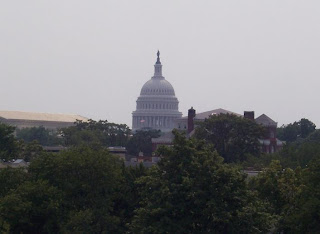
The Capitol

Wednesday was, of course, the Independence Day holiday, so in the evening our group walked down to a spot where we were able to view the fireworks on the National Mall, which had been temporarily evacuated earlier in the evening due to a tornado warning.

Licence plates typically carry a state motto, such as New Hampshire's notorious LIVE FREE OR DIE. The District of Columbia is not a state, and as such it has no voting representatives in Congress. Thus the DC plates carry this slogan in protest:

Taxation without representation

When I first told Theresa I would be going to Washington, DC, she heard Washington, BC, assuming I was travelling once again to Canada's westernmost province. When I corrected her and she asked what the DC stands for, I responded: "the District of Columbia," to which she retorted knowingly: "I thought the C must stand for Columbia!"

Thursday afternoon I returned to Chicago and family. While in the air, my plane grazed the top of a terrific storm, which we saw from above. The thunder clouds were impressive, but the turbulence was a bit unnerving.

Thunderstorm seen from above

At the weekend we drove to Hillsdale, Michigan, home of Hillsdale College, a small undergraduate university well known in politically conservative circles in the US.
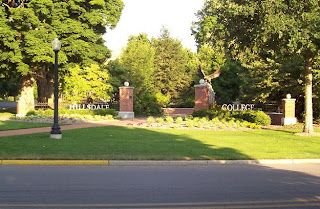
Hillsdale College

Hillsdale sells bricks to alumni, parents and supporters for $150 each to be placed in its Alumni Walk, which extends through the centre of the campus. Here are some typical examples:

Stopping Socialism

A Pox on Big Government

Outside the Dow Center on the Hillsdale campus is a plaque containing a selection from Thomas Paine's Dissertation on First Principles of Government. Paine was anything but a conservative, but he somehow managed to slip by Hillsdale's gatekeepers with an extremely unBurkean sentiment:

Thomas Paine's political ideas

We arrived home to Hamilton on monday. As usual, it's good to be back.

Followers

Blog Archive

About Me

My photo
Contact at: dtkoyzis at gmail dot com