Showing posts with label Chicago. Show all posts

22 October 2008

Neoclassical architecture

Paul M. Weyrich, of the Free Congress Foundation, is a fan, not only of rail transportation, but also of neoclassical architecture, as evidenced here: A Celebration of Railroads and Architecture. I am completely in agreement with him in his advocacy of train travel, which I am convinced needs to be favoured over air travel for short and intermediate distances. I am more ambivalent over his sweeping claim, following Prince Charles, that "classical architecture is a tribute to God Almighty."

Union Station, Washington (1907)
Union Station, Washington, DC


I have been to Washington's Union Station at least twice, most recently in July of last year. It was designed by architect Daniel Burnham, well known for his contribution to the World's Columbian Exposition in 1893 and his Plan of Chicago in 1909. I am pleased that this magnificent structure was successfully preserved and restored. Furthermore, I am happy to admit that all architecture is in some fashion a manifestation of God's creative intent that his image-bearing creatures should shape their environments in distinctive ways.

Yet architectural fashions also reflect the religious worldviews of the architects themselves, as well as of the larger culture that nurtures them. One looks in vain for Weyrich to recognize that neoclassicism in art and architecture was motivated by an effort more to recover the vaunted glories of pagan Greece and Rome than to honour God. Weyrich's conservatism could stand to be a bit more nuanced here.

06 August 2008

Did you know. . .

. . . that the St. Charles Air Line is not an airline at all but a very short railway?

12 July 2008

Suburban air quality

It has long been assumed that people flee to the suburbs to escape the foul air of the city. However, could it be that, because outlying communities are so tied to the automobile, its residents pollute more than those remaining behind in the cities? Ted Mitchell examines the evidence with a look at the Chicago area: Not My Problem: Taking Responsibility for Air Quality.

02 January 2008

Urban transport and urban decay

Longtime residents of Toronto will recall the controversy over the abortive Spadina Expressway, as recounted in this article in the past weekend's National Post: Expressways Went Nowhere. I myself lived a stone's throw away from Spadina Avenue in 1978-79 and quickly learned that, had things gone differently a few years earlier, that unique neighbourhood, at the edges of Chinatown with a few Jewish textile vendors left over from earlier days, might not have been there at all. Had it succeeded, more would have come, making Toronto similar to comparably-sized American cities, crisscrossed with expressways bisecting urban neighbourhoods and destroying others. Plans for the Spadina ignited grassroots protest that eventually brought a halt to the project:

In 1971, new Ontario premier William Davis, facing a looming election, stood in the [Ontario] Legislature and announced the expressway would not be completed, declaring: "Cities were built for people and not cars."

[Adam] Vaughan says the decision had huge ramifications for the city. "Look at the American cities that built these huge expressways," he says. "They carved up their downtown neighbourhoods and those neighbourhoods died. The Spadina would've killed half a dozen neighbourhoods in this city -- the Annex, Cabbagetown, the Beaches. All these now vibrant, viable neighbourhoods would've just withered and died."

Queen Street, Toronto
Mid-1980s

Half a century ago my hometown of Chicago began building the first of the great expressways towards the west of the city's centre, initially named the Congress Expressway, subsequently to be called the Eisenhower Expressway. This massive public works project ostensibly followed one of the recommendations of Daniel Burnham's 1909 Plan of Chicago. The construction of the Congress necessitated razing the existing structures in its way, including the Garfield Park elevated train line. Among other things, this led to the death of a very fine electric interurban railway line, the Chicago Aurora & Elgin, that had run over the Garfield Park tracks towards the communities of the Fox River Valley. In short, the city's commitment to the expressways spelled a commitment to the automobile as a primary mode of transportation, at the expense of mass rail transit.

It may not be incidental that, at the very moment American cities were being paved over with expressways, these same cities began their inexorable decline. I have friends who grew up in the Englewood and the once heavily Dutch-American Roseland neighbourhoods on the south side of Chicago. These neighbourhoods are now given over to gangs and crack houses, and are no longer safe to live in. Whether the expressways were the cause is difficult to say, but they certainly did not help, as they made it easier for one-time residents to move to the suburbs and commute, taking their tax base with them. The city was effectively remade for the convenience of the suburbs.

Is Toronto a model of how to do things right? Not entirely. To be sure, when I lived there between 1978 and 1980, I could happily live without a car, relying on the subways, buses and streetcars — and, of course, my own feet — to get me where I wanted to go. Toronto had much less crime than Chicago and still does, though there is more now than when I lived there. Yet I am happy that the Spadina Expressway failed. The city would have been a different place if it had not, and I doubt it would have been for the better.

Still I could wish for more focus on mass transit for the entire Golden Horseshoe region. Especially if one lives outside Toronto in one of the "905" cities, it is next to impossible to get along without a motorized vehicle. Ontario's Liberal government has promised more funds to upgrade mass transit in this urban belt around Lake Ontario. We shall see what comes of this.

Here in Hamilton we have recently observed the tenth anniversary of the opening of the Lincoln Alexander Parkway (the "Linc"), which runs across Hamilton Mountain. Just six weeks ago the Red Hill Valley Parkway opened to connect the Linc to the Queen Elizabeth Way to the east of Hamilton. No neighbourhoods were destroyed to build the Linc, as the right of way was already vacant and apparently reserved for it for quite a number of years beforehand. The Red Hill, by contrast, was built through the Red Hill Creek Valley and thus came under fire from environmentalists. Given our admitted dependence on the automobile in Hamilton, both thoroughfares make sense. Yet I wish alternatives could have been found to enable people to travel without the ubiquitous and polluting internal combustion engine. This would require the expansion of GO train and bus service in and out of Hamilton, as well as more frequent buses from the inaptly-named Hamilton Street Railway. I am under no illusion that such measures would build Jerusalem in Ontario's green and pleasant land. Yet it might make for a more livable urban environment, from which we would all benefit.

By the way, a colleague of mine has alerted me to an apparent urban success story south of the equator: Curitiba. I may come back to the subject and post something more specific about this Brazilian city.

06 September 2007

Town fairs and world's fairs

Martin's World's Fair Album Atlas and Family Souvenir, 1893
Our family spent much of this past saturday at the 149th annual Paris Fair, a local event held in the lovely town of Paris, half an hour to the west of Hamilton at the confluence of the Grand and Nith Rivers. It is basically an ordinary town fair, like many occurring across North America during the summer months. With her zoological proclivities, our Theresa loved seeing the animals, especially the poultry. We were all amused at Clarol the Clown's antics. We saw a pony show. And, of course, what fair would be complete without a midway, boasting various rides and amusements.

Although most such fairs tend to reflect local agrarian pursuits, with their horse and cattle shows and the like, world's fairs have highlighted industrial and technological accomplishments. In fact, the very label "midway" originated in one of the most famous of world's fairs: the World's Columbian Exposition of 1893 in Chicago, which I mentioned in passing in a recent post on Daniel Burnham's Plan for remaking that city. The fair was located in Jackson Park, on the south side of the city along the shores of Lake Michigan. Extending west from the Park was the Midway Plaisance, whose other end connected to Washington Park. This was the first "midway," boasting amusements from all over the world, including a gigantic wheel created by George Ferris for the occasion — one that would dwarf most future Ferris wheels.

Century of Progress Atlas of the World, 1934
Although world's fairs are still held, the heyday of world's fairs extended from the mid-19th to the mid-20th centuries, beginning with London's Crystal Palace Exhibition of 1851, showcasing the achievements of the British Empire, and ending (for all practical purposes) with Montreal's Expo 67, coinciding with Canada's centennial celebrations and marking my own introduction to this country. During this period fairs were held in, among many other places, Paris in 1889, St. Louis in 1904, again in Chicago in 1933-4, New York in 1939 and Seattle in 1962.

Incidentally one assumes that the Rockton World's Fair, in Rockton, Ontario, does not have the official sanction of the Bureau International des Expositions to call itself such.

28 August 2007

Urban planning in the 'Windy City'


Although I am not quite a native of Chicago, I was born just outside the city limits in Oak Park and grew up in suburban Wheaton, about 40 km west of the Loop. I've not lived in the vicinity for decades now, but Chicagoland still holds a place in my heart, especially the city itself, with its unique neighbourhoods, lakefront parks, architecture, world class museums, railways, and even the perpetually disappointing Chicago Cubs baseball team.

In the space of barely two generations Chicago grew from a small village on the southwest shores of Lake Michigan in the 1830s to a huge metropolis of more than a million people by the 1890s. With such explosive growth the city had put down few roots and commanded little loyalty from its residents, the vast majority of whom had come from elsewhere in the US and, increasingly, from Europe. It was merely a place to make one's fortune with the ever-present possibility of pulling up stakes and moving on. Chicago grew in chaotic and haphazard fashion with little, if any, attention to the provision of basic urban amenities that might have a civilizing and humanizing effect on its people.

This began to change towards the end of the 19th century, starting with the 1893 World's Columbian Exposition, the great world's fair planned by Chicago architect Daniel Burnham. Thereafter Burnham and the Commercial Club of Chicago came to recognize the need for a comprehensive plan for developing and improving the entire urban environment for the sake of its people. The fascinating story of this plan — its development, reception and implementation — is told in Carl Smith's The Plan of Chicago: Daniel Burnham and the Remaking of the American City (above right).

Proposed Civic Center, Jules Guerin
The Plan of Chicago, often called the Burnham Plan after its principal author, was published in 1909 and was visionary in its proposals for improving and beautifying the city. It took as its model Napoleon III's Paris, as redesigned by Georges-Eugène Haussmann, the emperor's prefect of the Seine. The Plan envisioned a system of public parks throughout the city; straightening the south branch of the Chicago River; building a major bridge over the river to connect Michigan Avenue to Pine Street, making a single continuous boulevard connecting the north and south sides; filling land into the lake to create an extensive public park from Lake Park (later Grant Park) to Jackson Park (site of the 1893 fair); widening Congress Street to create the city's major east-west boulevard; and, most important of all, building a domed civic centre at a central place in the Congress Street boulevard (above left).

All of this was set forth in an aesthetically pleasing volume adorned with beautiful illustrations by Jules Guerin and Fernand Janin, thereby making the book itself a visual feast to savour at leisure. A limited number of copies were published and sent to the movers and shakers of industry, commerce and government, and even to the new US President William Howard Taft. (The complete volume can be perused on the Encyclopedia of Chicago's website, albeit not in the most readable format.)

The Plan was remarkable in a number of ways. To begin with, it was spearheaded by a group of self-appointed men prominent in their respective fields. They were idealistic and public-spirited, genuinely believing they had the best interests at heart of all Chicago's people, and not just the city's entrepreneurs. Although they disliked the corrupt municipal government of the day, they placed considerable confidence in government in general to effect change — in a "democratic enlightened collectivism coming in to repair the damage caused by exaggerated democratic individualism," as Harvard President Charles W. Eliot expressed it. In this they were typical men of the Progressive Era, believing in their own superior ability to undertake such a project and assuming that, with the proper public relations techniques, others could be persuaded to come on side of their agenda.

Michigan Avenue Bridge, 1 January 1983
At least some of the Plan was eventually implemented, though not always as conceived by Burnham and his associates, who lived just prior to the proliferation of automobile ownership. Congress Street was indeed expanded and extended as a great east-west corridor through the city, but it took the form of the first of the great expressways to connect the city's heart to its suburbs in the 1950s and '60s. The Civic Center never materialized, and its proposed location is now the site of the Circle Interchange connecting four major expressways. The Michigan Avenue Bridge (above right) was built in 1920. A lakefront park system was indeed built on landfill, though Grant Park did not become quite the cultural centre foreseen by the Plan. Nor does Chicago boast the neoclassical architecture shown in Guerin's and Janin's illustrations. Nevertheless, municipal zoning certainly caught on and is nowadays simply taken for granted in North American towns and cities.

The Commercial Club was, of course, an élite group, making bold plans for grand public spaces, monuments, boulevards and buildings. Smith notes that the late Jane Jacobs opposed Burnham's approach to urban planning:

In the introduction to her best known work, The Death and Life of Great American Cities (1961), Jacobs is particularly disparaging of Burnham's emphasis on civic centers and monumental designs, which, she contends, have degraded rather than improved the neighborhoods around them. It is true that neither the text nor the illustrations of the Plan pay much attention to the quality of the urban street life on which Jacobs focuses so much concern or to how the individual actually experiences the city, other than as a grid to move across as efficiently as possible. With few exceptions, people are either entirely missing from Guerin's and Janin's drawings or completely overwhelmed by the massive scale of the buildings (pp. 156-7).

When I was growing up, efforts at urban renewal often came at the expense of distinctive neighbourhoods, such as the old Greektown on the west side, which was razed to make way for the campus of the University of Illinois at Chicago. While I do not deny the need for urban planning, I would reiterate something I wrote three years ago about Planned cities and new beginnings: "justice is more likely to be found in the ordinary activities of a government conciliating diverse interests than in a government bent on capturing its citizens' imaginations and mobilizing them for flashy, expensive projects not immediately related to their genuine needs." Moreover, real renewal of a city requires co-ordinated efforts from multiple agents, including churches, neighbourhood associations, ethnic organizations, and civic societies, in addition to municipal governments.

03 July 2007

Another 50th anniversary

CA&E car 431 (Illinois Railway Museum, 1983)
A half century ago today my favourite interurban railway abruptly ceased passenger service after 55 years of business. The Chicago Aurora & Elgin Railway began in 1902 when the original line was built between Chicago and Aurora, powered by electric third rail. In the next few years lines were extended to Elgin, Batavia, Geneva and St. Charles, all communities located along the Fox River. The lines branched out at my home town of Wheaton, the centre of operations and the location of the shops. Though most interurban railways were little more than trolley lines running alongside rural roads between towns, the CA&E was built to the standards of the steam lines and could thus attain higher speeds. While most interurbans flourished in the first two decades of the 20th century, only to founder after the Great War with the advent of the automobile, the CA&E, along with two other Chicago area interurbans, survived much longer, effectively becoming a suburban commuter line.


The CA&E was a precarious enterprise from the 1920s on, and it went through more than one receivership and reorganization over the decades. The Second World War years saw an increase in ridership, but ten years later it was struggling to remain afloat. In 1953 its entrance into Chicago over the Garfield Park elevated line was terminated to make way for the construction of the Congress (later Eisenhower) Expressway. Passengers from the Fox Valley suburbs had to get off at suburban Forest Park and transfer to the "L" for the remainder of the trip to Chicago. This was the final blow to the CA&E. Ridership plummeted and management petitioned to abandon passenger service. Permission finally came in the late morning of wednesday, 3 July 1957. Service was suspended a few minutes after noon, stranding passengers in the Loop, forcing them to find other ways home that evening. Freight service limped along for another two years. I recall seeing a CA&E freight train crossing Roosevelt Road in Wheaton when I was quite small. The railway was abandoned altogether in 1961.

A few CA&E cars are still operating at various railway museums around the United States, most notably the Fox River Trolley Museum and the Illinois Railway Museum (IRM). The CA&E right-of-way is now the Illinois Prairie Path, a recreational trail for jogging, hiking and bicycling. Here is a look at restored CA&E cars in action at the IRM:


Incidentally, the cessation of passenger service on the CA&E occurred only three days after my baptism.

Five years ago, to mark the occasion of the CA&E's centenary, I composed a song, titled The Great Third Rail Rag, after one of the railway's many nicknames. It is written in the style of Scott Joplin's rags, which were popular in the first years of the 20th century.

18 September 2006

Architecture

From ages 6 to 14 I aspired to become an architect. As a child I used to spend hours drawing floor plans of homes, fancying myself the heir of the great Frank Lloyd Wright, who once lived in the city of my birth, Oak Park, Illinois. Taking a drafting course in high school convinced me that architecture was not for me after all. Nevertheless, I still have an interest in the subject. When my niece married a Chicago architect a few months ago, he and I discovered we had much to talk about. Moreover, when some friends visited my home many years ago, they noticed that much of the art on my walls consisted of cityscapes and buildings. I hadn't put two and two together before that, but I realized then that I still care about the buildings where we live our lives from day to day. A week ago last friday Comment published a thoughtful article by David Greusel, Why architecture matters. It's a great piece and I can easily resonate with the concerns expressed therein.

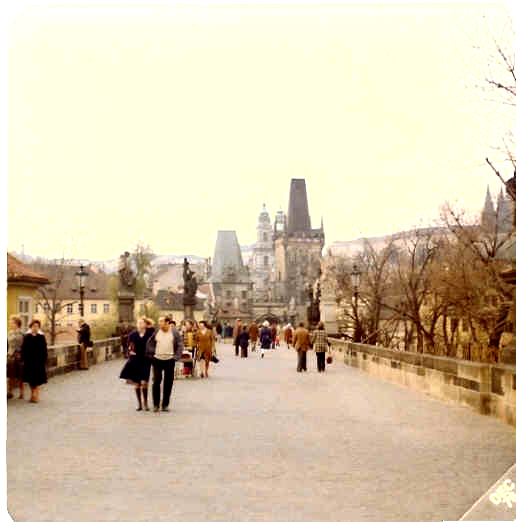
Charles Bridge, Prague (© 1976 David T. Koyzis)
In late 1976 I visited Prague (right), the capital of what was then still called Czechoslovakia. Immediately I fell in love with this perfect jewel of a city, with many of its buildings dating back to the 14th century when the Emperor Charles IV made it his capital. Because it was spared the destruction of the two world wars, it still retained its character — at least at its centre. Of course, three decades ago the country was under the communists, whose rule affected the architecture constructed between 1948 and 1989. Prague thus offered a fascinating contrast within its own borders. On the one hand was the old city, constructed in grand style befitting the seat of an emperor.

On the other hand, the periphery of the city suffered from the blight of a dour stalinist architectural style imported from the Soviet Union. For communists any human touches to our homes, schools, workplaces and public buildings are deemed remnants of a decadent capitalism, to be replaced eventually by a sternly proletarian functionalism divorced from the realities of human communities and the relationships nurtured therein.

We can be grateful that the communists saw fit to retain the late mediaeval heart of Prague, rather than effacing it altogether as they did the former East Prussian city of Königsberg, now known as Kaliningrad. This suggests that, despite the depredations of a destructive worldview, the rulers of Czechoslovakia recognized the treasures they had inherited from their precommunist predecessors and rightly sought to preserve them for future generations.

Chicago Skyline (© 1976 David T. Koyzis)
Yet there are places in the noncommunist western world where the architectural legacy of previous generations is too easily cast aside when economic imperatives dictate. For example, my home city of Chicago (above left in 1976) boasts some of the best known cutting-edge architecture in the world. However, in my personal library I have a nostalgic volume titled, Lost Chicago, by David Lowe, filled with more than 200 pages of photographs telling the sad story of a city's vanished heritage. Of course, some of this perished in the Great Fire of 1871, but most of it was deliberately destroyed to make way for something newer and ostensibly better.

Back in 1984, when the decision was made to demolish the old Chicago & Northwestern terminal on Madison and Canal Streets, and build in its place a metal and glass skyscraper to be called the Northwestern Atrium Center, I wrote a letter of protest to the Chicago Tribune, subsequently published in the 23 June issue of that year. Here is the letter, with which, apart from a few rhetorical flourishes, I still agree:

It saddens me to see the stately old Chicago & Northwestern terminal about to be demolished. To try to soften the blow, the railroad has put up signs and banners cheerily proclaiming, "We're on our way up," meaning, of course, that where the old station now stands will soon be erected yet another of those characterless glass office buildings with an enclosed shopping court at its base. One more link with the city's past will have been sacrificed barbarously at the altar of progress and the almighty dollar.

Chicago is rather like a vain movie star, afraid to let the world see the signs of its age and refusing to grow old gracefully. Every generation the city seems compelled to undergo a facelift, allowing itself to live on an illusion of perpetual youth while eradicating any continuity with its own past. Not every building should be preserved merely because it is old, of course, but the reckless compulsion to destroy and rebuild is not healthy either. Not only has such a city lost touch with its own soul, but it is hardly acting as a fit caretaker and steward of the valuable resources and treasures bequeathed by past generations. When will Chicago learn to value its own heritage instead of glorifying its rootlessness?

More than two decades later, as I look back on what I wrote then, it occurs to me that we need to address an important question: Given that we cannot and should not save every building that has ever been constructed, what criteria should we use to decide which to preserve and which to replace? I'd love to hear some discussion of this.

20 August 2005

Chicago and back again

Earlier in the week we returned from a visit to the Chicago area and Michigan where we visited family on both sides. Here are some highlights and observations:

  • The Chicago area contains some 9 million people as compared to the 12 million living in Ontario, Canada’s largest province. Consequently, the 10-county metropolitan area is a huge sprawling mass of urban-suburban settlement, with not enough open spaces in between. One of these spaces is the Morton Arboretum, which is not dissimilar to Hamilton’s Royal Botanical Gardens. We didn’t get there this time, but perhaps we will during our next visit.

  • The Chicago area is crisscrossed with wide thoroughfares with sometimes as many as 20 lanes pouring into a single intersection. Now imagine a power outage in which an absence of traffic lights turns such an intersection into an impromptu four-way stop. Yes, we did find ourselves at one of these.

  • Everything in the Chicago area seems to have two-tier pricing, with lower prices for locals and higher for outsiders. This includes the supermarkets and the toll roads.

  • A highlight of our trip was a visit to the Field Museum of Natural History, downtown Chicago. With Theresa’s recent interest in dinosaurs, we decided to indulge this with a tour through its special exhibit, Dinosaur Dynasty: Discoveries from China. A permanent part of the museum’s collection is a complete tyrannosaurus rex (or perhaps tyrannosaura regina) skeleton called Sue.

  • Michigan’s unofficial motto is “Great lakes, bad roads.” Detroit, in particular, appears to be exceedingly poorly run in this respect. For those attempting to cross the Ambassador Bridge into Canada, Interstate 94 is currently closed for construction at the exit to Interstate 96, with “helpful” signs vaguely advising drivers to “Use alternate route.” Strangers are left to figure out for themselves what such a route might be. (How many returning Canadians have met a cruel fate wandering through the side streets of this dangerous city?) We decided to get off at Livernois Avenue (also in poor shape) and head north to 96. Yet the entrance to 96 is not clearly marked either, so we nearly missed it. Then there was the driver who kept running red lights in front of us. And the car which cut us off in full sight of one of Detroit’s finest, who did absolutely nothing. And. . . well, you get the picture.

  • Next time maybe we’ll try the Blue Water Bridge at Sarnia-Port Huron.

  • In the US a pocket full of change is likely to add up to a dollar or two and includes lots and lots of pennies. In Canada a pocket full of change could total ten dollars or more, but with fewer pennies. American bills are harder to tell apart. You need to keep alert to be sure you’re receiving the correct denominations.

  • If you’re ever in Hillsdale, Michigan, a quite pleasant place to stay is the Dow Center on the Hillsdale College campus. Very impressive. Nicely run with friendly staff. The walls are covered with pictures of eagles, to which people there seem to have a curious devotion.

  • Hillsdale, Michigan’s motto: “It’s the people.” To which one is tempted to respond: What’s the people?

  • Two more weeks before classes start. Back to work.
  • 11 May 2005

    The Encyclopedia of Chicago

    Having lived in Canada for two decades, I can testify that Americans rather easily assimilate into this country, due to the considerable cultural similarities between the two countries, including (for the most part) a common language. If there were such a thing as an ex-pat American club in Toronto, I would not join, as I do not see myself having much in common with people from, say, New York, California or Texas.

    However, if there were a Chicago club in our vicinity, I would seriously think of joining. After all, I was born just outside the "Windy City" in Oak Park, Illinois, home of such luminaries as Frank Lloyd Wright and Ernest Hemingway, and grew up in Wheaton, 25 miles west of the Loop, as the downtown core is popularly known. Like General Robert E. Lee of Virginia or Québécois nationalists (with whom I otherwise disagree politically), I can identify more easily with the local homeland of my birth than with the United States as a whole, which to me feels somewhat abstract.

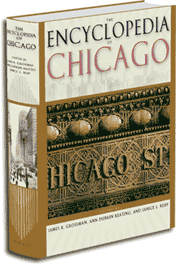
    For those of us with roots in Chicagoland, the University of Chicago Press has published a massive one-volume Encyclopedia of Chicago, which I just received as a gift from my exceedingly thoughtful sister-in-law and her husband, residents of one of the western suburbs of the great metropolis. It is the product of a co-operative effort between the Chicago Historical Society and the Newberry Library, and is edited by James R. Grossman, Ann Durkin Keating and Janice L. Reiff.


    It contains more than a thousand pages of entries covering everything from the city's individual neighbourhoods to virtually every one of the hundreds of suburbs in the ten-county region comprising the Chicago metropolitan area. There is an index of prominent persons in Chicago's history, as well as one listing the major economic enterprises operating in the vicinity, from the long gone Elgin National Watch Company to Marshall Field and Company, until recently the region's major department store chain. Favourite television programmes, such as Garfield Goose and Friends and Bozo's Circus, have entries. The area's colleges and universities also have their own entries, including Wheaton College and, of course, the University of Chicago. Then there are the maps, which are a treat for the cartophile. And of course no book about Chicago would be complete without material devoted to its colourful political and criminal history as well as to its rail transportation.

    I have located only a few errors of fact thus far, e.g., Pope Leo XIII's Rerum Novarum was published in 1891, not 1893. (This is in the entry on Roman Catholics.) My principal criticism is that some items are classified under titles that wouldn't immediately come to mind. For example, in looking for an article on Chicago neighbourhoods, I found them classified under community areas. All the same, the book is a pleasure to peruse — at least for those of us with origins there.

    As of today the Encyclopedia of Chicago has gone on-line. Its website is a little clunky and appears still to be under construction. The search function in particular seems not to have been enabled. Once it is fully operational, however, it will likely prove to be an invaluable resource for those interested in the past and present of America's second city. We owe a debt of gratitude to the many people who devoted such loving attention to this volume and its associated website.

    01 October 2004

    The all-American sport

    For someone who is not a baseball fan, I've been to more professional games than I can count. The earliest was in the old Comiskey Park, home of the Chicago White Sox, sometime in the early 1960s. The most recent was probably close to two decades ago, but in between times I attended scores of games in different cities. Usually this was with family members who were fonder of the game than I. To be sure, I will admit to having enjoyed these times, but I generally paid little attention to what was going on down on the field, content instead either to converse with the people I was with or simply to soak up the quintessential American cultural experience.

    All the same, it's difficult not to get caught up in something of the romance of the sport. Back in the middle years of the last century, pro baseball was exclusively a northeastern and middle-western sport. A list of the teams in 1932 illustrates this: in the National League were the Chicago Cubs, Pittsburgh Pirates, Brooklyn Dodgers, Philadelphia Phillies, Boston Braves, New York Giants, St. Louis Cardinals and Cincinnati Reds; in the American League, the New York Yankees, the Philadelphia Athletics, Washington Senators, Cleveland Indians, Detroit Tigers, St. Louis Browns, Chicago White Sox and the Boston Red Sox. Chicago, Boston, Philadelphia and St. Louis each had two teams, and New York had three. This was before a series of moves in the 1950s and later sent a number of teams south and west. As a result of this and of the creation of new teams, baseball became even more all-American than it had been before, since it was more widely dispersed across the country. It eventually moved north of the border, with the Blue Jays and Expos. There was even a musical play and subsequent movie, Damn Yankees, about the obsessiveness of a Senators fan who sells his soul to the devil to see his favourite team win the World Series.

    When I was around 17 years old our family became friends with a Cubs pitcher and his family who lived down the street from us. For the next year or so our two families spent a fair amount of time at the venerable Wrigley Field, sitting down in the section closest to the game with the other players' families while he was out on the field. We even had Ernie Banks and his ex-wife at our house once. As a result of this some of my younger siblings became ardent baseball fans. As for me, I was by then a little too old for all this to have had too great an impact. I hadn't been a fan up to that point and I wasn't all that interested in becoming one, though I was content to attend the games.


    Keiichiro

    Wrigley Field, Chicago


    I can't say I've thought too long and hard about baseball since those days of my youth. But the news that Canada will now have only one baseball team brought some of this back to mind.

    One final thought in this rather stream-of-consciousness reflection on a game on which I am not all that keen. My hometown of Chicago is reputed to have the teams with the worst records in baseball. I have in my drawer a t-shirt which is entirely too small for me now but which I sometimes wear when gardening. On the front is emblazoned the proud words: "CHICAGO WHITE SOX, WORLD CHAMPIONS, 1918." I suppose that says it all.

    21 March 2004

    The human side of railways

    Much as I am finding MS Train Simulator fascinating, and as realistic as its virtual world appears to be, it is missing something rather crucial: people! Although I myself am the supposed driver of the locomotive, the passenger cars are empty, and the automobiles buzzing by on adjacent roadways are curiously bereft of drivers. This virtual world is, in short, an eerily lifeless world, perhaps rather like that left by the detonation of a neutron bomb: it kills people but leaves buildings standing. This is not to say Train Simulator is not enjoyable; it is indeed. It is hard to equal the vivid sensation of moving from one point to another at high speeds.

    Yet many railfans focus rather excessively on equipment. Much as the readers of Playboy or Penthouse (sorry, guys, no links!) focus narrowly on the physical characteristics of the undressed females on their pages, those collecting books and magazines about trains tend to neglect the human side of the railways. Even those working for the railways developed an entire industrial subculture that became the stuff of legends and folk songs. (Think of "Casey Jones" or "I've Been Working on the Railroad.") The early history of post-confederation Canada itself was to no small extent the story of the building of the Canadian Pacific Railway.

    For those old enough to remember, there was a palpable excitement in the air at a big-city railway terminal such as New York's Grand Central Station or Pennsylvania Station. The Chicago of my childhood had its Union Station, Northwestern Station, LaSalle Street Station, Dearborn Station, Grand Central Station and Central Station, all within a few city blocks of each other, with railways fanning out in all directions linking America's second city to the rest of the country and beyond. As children, two or three times a year my siblings and I would accompany my mother (and sometimes my father) to the LaSalle Street Station, famously overshadowed by the Chicago Board of Trade Building, where we would board a New York Central diesel-electric streamliner to Ann Arbor, Michigan, to visit my grandmother and other relatives. Everyone hurrying through these downtown terminal stations would have a story to tell: travelling to California on holiday, going to visit friends or relatives, picking up a loved one after a business trip, and so on. During the Second World War the railways were especially busy, with soldiers being transported to various and sundry places for purposes of national defence. How many couples would have kissed goodbye in those palatial and cavernous buildings, not knowing whether they would ever see each other again? These are poignant moments that I have come to attach to the last golden age of the railways, which extended into my own childhood, but not much beyond.

    Grand Central Station, New York
    Grand Central Station, New York


    Airports are simply not the same. Air travel takes one to his or her destination fairly quickly. One hardly has time actually to settle into an airline trip, unless one is flying overseas. But part of the excitement of long distance rail travel comes from the sense of anticipation of a long journey, and hours ahead to fill with reading, eating in the dining car, enjoying a drink or two in the club car, taking in the scenery, and possibly retiring to sleeping quarters in a Pullman car. A transcontinental train was like a hotel or resort on wheels, where one could get a haircut or a three-course meal, enjoy conversation with newly-found friends, or even, like Cary Grant and Eva Marie Saint in North by Northwest, find romance.

    There is, of course, no way a computer simulation could possibly replicate such an experience. So I'll enjoy it for what it is, despite its limitations, and be content to remember the real thing.

    23 July 2003

    Visit to the States

    Nancy and Theresa and I just got back from our annual visit to family in Michigan and Illinois. We had a great time. I will not bore readers with every little thing we did. But there were a few highlights worth mentioning:

    - A personal tour of my uncle's collection of antique tractors at his farm near Dundee, Michigan.

    - A visit to the recently refurbished Museum of Science and Industry in Chicago. My favourite exhibits here were the Great Train Story and the Pioneer Zephyr. (I am a railfan, after all.) Theresa liked Colleen Moore's Fairy Castle and the Idea Factory.

    - A visit to the Fox River Trolley Museum, where they've extended their trackage south to the Blackhawk Forest Preserve. Afterwards we stopped for Tastee Freez ice cream, something I remember fondly from my childhood.

    - A big fat Greek dinner at my aunt and uncle's house, including two kinds of souvlakia, string beans and kolokithia (zuchini), kidney bean salad, tsatsiki, and what is arguably the world's greatest beer, Pilsner Urquell, brewed in the Czech Republic. The highlight of the evening had us all dancing to nostalgic Greek songs I had last listened to some 30 or 35 years ago. (Theresa loved this part. "I'm having a wonderful time," she beamed to her great aunt in the middle of a two-step.)

    - Several violent storms passing through the area, making for heavy downpours, high standing water, downed tree branches, but cooler than normal temperatures.

    - Patio seating at a restaurant, which we enjoyed due to the mild temperature.

    - Arriving back home again after ten days on the road.

    Followers

    Blog Archive

    About Me

    My photo
    Contact at: dtkoyzis at gmail dot com