Mark these in your calendar, and be sure to order your greeting cards early to avoid the rush.
Showing posts with label anniversaries. Show all posts
Showing posts with label anniversaries. Show all posts
08 November 2010
Upcoming anniversaries
Here is an incomplete list of some of the significant anniversaries taking place over the next several years.
2011 — 400th anniversary of the King James Version Bible
2012 — 450th anniversary of the completion of the Genevan Psalter
2013 — 450th anniversary of the Heidelberg Catechism
2014 — 450th anniversary of John Calvin’s death
2015 — 800th anniversary of Magna Carta
2016 — 500th anniversary of the publication of Erasmus’ Greek New Testament
2017 — Martin Luther’s Reformation
Mark these in your calendar, and be sure to order your greeting cards early to avoid the rush.
Mark these in your calendar, and be sure to order your greeting cards early to avoid the rush.


09 November 2009
The fall of the wall, plus 20

The autumn of 1989 was an exciting time to be teaching political science, due to the extraordinary events occurring in the former east European Soviet bloc. The culmination was, of course, the dramatic opening of the Berlin Wall on 9 November. A political illusion that had seemed so immovable for four decades collapsed with unprecedented swiftness over the course of a very few weeks. By Christmas it was all over, and a new era had begun. To my current students, of course, this is all ancient history, of which they have no memory.
I might add that, in 1993, one of my former students travelled through Europe and brought back for me two pieces of the wall, which I have on a book shelf in my campus office.
Later: The New York Times carries some wonderful before and after photographs of the Berlin Wall: A Division Through Time. They’re definitely worth a look.
19 July 2008
A grim anniversary
On the 90th anniversary of the murder of Nicholas II and his family by the bolsheviks, Thousands honour last tsar at mineshaft burial site. But was Nicholas really the last tsar? Some think not: The Last Tsar Was Michael, Not Nicholas.

The Last Tsar?
On the 90th anniversary of the murder of Nicholas II and his family by the bolsheviks, Thousands honour last tsar at mineshaft burial site. But was Nicholas really the last tsar? Some think not: The Last Tsar Was Michael, Not Nicholas.

29 May 2008
A day to remember
Today marks the 555th anniversary of the fall of Constantinople to the Ottoman Turks.
Today marks the 555th anniversary of the fall of Constantinople to the Ottoman Turks.
04 April 2008
A sad anniversary
Forty years ago today the Rev. Dr. Martin Luther King, Jr., fell to a gunman's bullet. I grew up during this tumultuous era in the United States, and I recall hearing of King's assassination on the car radio as our family was on its way to a church supper. Here is an excerpt from his prophetic final speech, delivered 3 April 1968:
Forty years ago today the Rev. Dr. Martin Luther King, Jr., fell to a gunman's bullet. I grew up during this tumultuous era in the United States, and I recall hearing of King's assassination on the car radio as our family was on its way to a church supper. Here is an excerpt from his prophetic final speech, delivered 3 April 1968:
13 November 2007

St. John Chrysostom
Today marks the 1,600th anniversary of the death of St. John Chrysostom, the "golden tongued" (Χρυσόστομος) Archbishop of Constantinople who lived from c. 349 to 407. A native of Antioch, John was educated by the pagan Libanius and went on to study theology under Diodoros of Tarsus. He was an ascetic who disliked the conspicuous consumption of the wealthy classes. When he was appointed Archbishop of Constantinople, the imperial capital, he reluctantly became an official of the highest rank, with privileges approaching those of royalty. Nevertheless, he opposed the lavish lifestyles of the city's élite and spoke with courage against abuses in high places. He preached regularly on the duty to care for the poor, among whom he was well-loved.
He is known as the greatest preacher of the early church. The Orthodox Church's Divine Liturgy is named for him, in recognition of his contribution to the liturgy by revising its prayers and rubrics. His famous paschal homily is often read in churches on Easter, as it has been in our church. St. John is honoured by both eastern and western churches, including those of the Reformation. For example, John Calvin admired his straightforward interpretation of scripture, as opposed to Augustine's more allegorical approach. St. John died in exile in the Caucasus, with these words on his lips: "Glory be to God for all things!"
Here is a final word for us from St. John Chrysostom:
Even if we have thousands of acts of great virtue to our credit, our confidence in being heard must be based on God's mercy and His love for men. Even if we stand at the very summit of virtue, it is by mercy that we shall be saved.
Later: Coinciding with the anniversary comes this story out of Cyprus: Thousands queue outside Cyprus church after reports of miracle-working relic. St. John Chrysostom's skull is in the island and two miracles are being attributed to its presence.
03 July 2007
Another 50th anniversary

A half century ago today my favourite interurban railway abruptly ceased passenger service after 55 years of business. The Chicago Aurora & Elgin Railway began in 1902 when the original line was built between Chicago and Aurora, powered by electric third rail. In the next few years lines were extended to Elgin, Batavia, Geneva and St. Charles, all communities located along the Fox River. The lines branched out at my home town of Wheaton, the centre of operations and the location of the shops. Though most interurban railways were little more than trolley lines running alongside rural roads between towns, the CA&E was built to the standards of the steam lines and could thus attain higher speeds. While most interurbans flourished in the first two decades of the 20th century, only to founder after the Great War with the advent of the automobile, the CA&E, along with two other Chicago area interurbans, survived much longer, effectively becoming a suburban commuter line.

The CA&E was a precarious enterprise from the 1920s on, and it went through more than one receivership and reorganization over the decades. The Second World War years saw an increase in ridership, but ten years later it was struggling to remain afloat. In 1953 its entrance into Chicago over the Garfield Park elevated line was terminated to make way for the construction of the Congress (later Eisenhower) Expressway. Passengers from the Fox Valley suburbs had to get off at suburban Forest Park and transfer to the "L" for the remainder of the trip to Chicago. This was the final blow to the CA&E. Ridership plummeted and management petitioned to abandon passenger service. Permission finally came in the late morning of wednesday, 3 July 1957. Service was suspended a few minutes after noon, stranding passengers in the Loop, forcing them to find other ways home that evening. Freight service limped along for another two years. I recall seeing a CA&E freight train crossing Roosevelt Road in Wheaton when I was quite small. The railway was abandoned altogether in 1961.
A few CA&E cars are still operating at various railway museums around the United States, most notably the Fox River Trolley Museum and the Illinois Railway Museum (IRM). The CA&E right-of-way is now the Illinois Prairie Path, a recreational trail for jogging, hiking and bicycling. Here is a look at restored CA&E cars in action at the IRM:
Incidentally, the cessation of passenger service on the CA&E occurred only three days after my baptism.
Five years ago, to mark the occasion of the CA&E's centenary, I composed a song, titled The Great Third Rail Rag, after one of the railway's many nicknames. It is written in the style of Scott Joplin's rags, which were popular in the first years of the 20th century.

A half century ago today my favourite interurban railway abruptly ceased passenger service after 55 years of business. The Chicago Aurora & Elgin Railway began in 1902 when the original line was built between Chicago and Aurora, powered by electric third rail. In the next few years lines were extended to Elgin, Batavia, Geneva and St. Charles, all communities located along the Fox River. The lines branched out at my home town of Wheaton, the centre of operations and the location of the shops. Though most interurban railways were little more than trolley lines running alongside rural roads between towns, the CA&E was built to the standards of the steam lines and could thus attain higher speeds. While most interurbans flourished in the first two decades of the 20th century, only to founder after the Great War with the advent of the automobile, the CA&E, along with two other Chicago area interurbans, survived much longer, effectively becoming a suburban commuter line.

The CA&E was a precarious enterprise from the 1920s on, and it went through more than one receivership and reorganization over the decades. The Second World War years saw an increase in ridership, but ten years later it was struggling to remain afloat. In 1953 its entrance into Chicago over the Garfield Park elevated line was terminated to make way for the construction of the Congress (later Eisenhower) Expressway. Passengers from the Fox Valley suburbs had to get off at suburban Forest Park and transfer to the "L" for the remainder of the trip to Chicago. This was the final blow to the CA&E. Ridership plummeted and management petitioned to abandon passenger service. Permission finally came in the late morning of wednesday, 3 July 1957. Service was suspended a few minutes after noon, stranding passengers in the Loop, forcing them to find other ways home that evening. Freight service limped along for another two years. I recall seeing a CA&E freight train crossing Roosevelt Road in Wheaton when I was quite small. The railway was abandoned altogether in 1961.
A few CA&E cars are still operating at various railway museums around the United States, most notably the Fox River Trolley Museum and the Illinois Railway Museum (IRM). The CA&E right-of-way is now the Illinois Prairie Path, a recreational trail for jogging, hiking and bicycling. Here is a look at restored CA&E cars in action at the IRM:
Incidentally, the cessation of passenger service on the CA&E occurred only three days after my baptism.
Five years ago, to mark the occasion of the CA&E's centenary, I composed a song, titled The Great Third Rail Rag, after one of the railway's many nicknames. It is written in the style of Scott Joplin's rags, which were popular in the first years of the 20th century.
30 June 2007
Baptism and the christian life
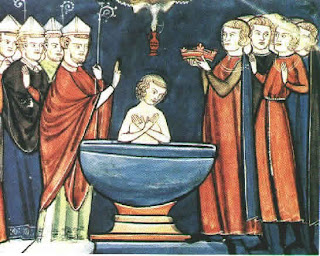
Today marks the 50th anniversary of my baptism. Through this sacrament I was received into the body of Christ at Westminster Orthodox Presbyterian Church, then in Westchester, Illinois, but now located in nearby Indian Head Park.
When I was younger I did not treasure this day as I do now. In fact, in my teens I worshipped, along with my family, in a baptist church that did not recognize the validity of my baptism at all. Nevertheless I have come to follow Calvin in believing that our baptism, far from being diminished or invalidated by our inability to remember it, is a sign of our union with Christ for the whole of life into eternity. This union is effected entirely by the grace of God, which comes to us even before we are aware of it.
As always, the Heidelberg Catechism puts it very nicely indeed:
Four years ago, at my request, the members of the session of Westminster Church were kind enough to make up and send me a baptismal certificate, based on their minutes from 1957.

Today marks the 50th anniversary of my baptism. Through this sacrament I was received into the body of Christ at Westminster Orthodox Presbyterian Church, then in Westchester, Illinois, but now located in nearby Indian Head Park.
When I was younger I did not treasure this day as I do now. In fact, in my teens I worshipped, along with my family, in a baptist church that did not recognize the validity of my baptism at all. Nevertheless I have come to follow Calvin in believing that our baptism, far from being diminished or invalidated by our inability to remember it, is a sign of our union with Christ for the whole of life into eternity. This union is effected entirely by the grace of God, which comes to us even before we are aware of it.
As always, the Heidelberg Catechism puts it very nicely indeed:
Q. How does baptism remind you and assure you that Christ's one sacrifice on the cross is for you personally?
A. In this way: Christ instituted this outward washing and with it gave the promise that, as surely as water washes away the dirt from the body, so certainly his blood and his Spirit wash away my soul's impurity, in other words, all my sins.
Four years ago, at my request, the members of the session of Westminster Church were kind enough to make up and send me a baptismal certificate, based on their minutes from 1957.
Do you not know that all of us who have been baptized into Christ Jesus were baptized into his death? We were buried therefore with him by baptism into death, so that as Christ was raised from the dead by the glory of the Father, we too might walk in newness of life (Romans 6:3-4).
Subscribe to:
Posts (Atom)