Showing posts with label barack obama. Show all posts

02 February 2012

Obama and religious freedom

I have thus far largely refrained from criticizing President Obama on this blog, even as I was put off by the messianic expectations he encouraged during his first presidential campaign four years ago and have been uneasy about his performance since then. But his attack on the religious freedom of overtly confessional institutions requires comment, which Michael Gerson ably provides here: Obama plays his Catholic allies for fools.
The implications of Obama’s power grab go further than contraception and will provoke opposition beyond Catholicism. Christian colleges and universities of various denominations will resist providing insurance coverage for abortifacients. And the astounding ambition of this federal precedent will soon be apparent to every religious institution. Obama is claiming the executive authority to determine which missions of believers are religious and which are not — and then to aggressively regulate institutions the government declares to be secular. It is a view of religious liberty so narrow and privatized that it barely covers the space between a believer’s ears.

Obama’s decision also reflects a certain view of liberalism. Classical liberalism was concerned with the freedom to hold and practice beliefs at odds with a public consensus. Modern liberalism uses the power of the state to impose liberal values on institutions it regards as backward. It is the difference between pluralism and anti-­clericalism.

I am not an enthusiast for the betrayal of liberalism thesis to which Gerson appeals, because I believe the contempt for nonvoluntary institutions is implicit in liberalism's logic from the outset. Nevertheless, Gerson persuasively points to the link between liberalism's claim to defend liberty and its narrowly individualistic interpretation of that liberty. Let us hope and pray that the policy will be changed before it is implemented.

09 October 2009

Nobel surprise

This is unexpected and almost certainly premature: Obama 'humbled' by Nobel Peace Prize win. Surely it would have been better to wait until the man had some concrete achievements to show in this area? On the other hand, it may be that the Nobel committee is elated at the passing of the Bush presidency and simply overreacted.

20 August 2009

Abortion reduction

Last year around this time, when a number of prominent evangelicals were claiming to have toned down the Democratic Party's pro-choice policy, I expressed scepticism and wondered whether they had allowed themselves to be taken advantage of with nothing to show in return. My genial, if curmudgeonly, friend Keith Pavlischek says yes and cites concrete evidence that the Obama administration has no intention of pursuing an abortion-reduction strategy, despite the claims of Jim Wallis and others to the contrary: Ceding the Common Ground on Abortion.

It is one thing to recognize that politics is the art of the possible, as Bismarck is reputed to have said. Like it or not, involvement in the political process necessarily entails accepting compromise and settling for what one observer has called proximate justice. It is quite another, however, to yield ground so totally on an issue of importance, to receive nothing in the exchange, and then to claim the opposite. This comes close, if not to outright deception (I prefer to be charitable here), then to something approaching acute political ineptitude.

18 May 2009

Obama at Notre Dame

Whether or not it can justly be called America's premier Catholic university, Notre Dame has nevertheless made a unique place for itself in the country's educational landscape. Unlike many vestigially Catholic institutions, Notre Dame prides itself on its Catholic identity and commendably seeks to maintain it. This is what I found during my years there as a graduate student in the early 1980s. What happens at Notre Dame is often a bellwether for American Catholic culture at large.

Nevertheless, a quarter century ago my impression of the university's administration, then headed by its long-serving president, Fr. Theodore Hesburgh, was that, while it tried its best to hold the line on its Catholic identity, it did so with some embarrassment, seeking respectability with the larger educational establishment and even with the popular media. Against the background of an establishment that traditionally viewed Roman Catholics as un-American, Notre Dame has coveted a place for itself as a genuinely American university. Of course, sport has played a big role in this, as any collegiate football fan knows.

As part of its persistent effort to fit in, Notre Dame has invited six US presidents to speak at commencement and has conferred honorary degrees on nine. During my time there Ronald Reagan spoke in 1981, his first public appearance after the attempt on his life nearly two months earlier. In 1984 New York Governor Mario Cuomo, then a presidential aspirant, spoke at Notre Dame, making his notorious "I'm personally opposed, but. . ." speech with respect to abortion, thus antagonizing serious Catholics but receiving Fr. Hesburgh's blessing.
Obama at Notre Dame
It is thus not surprising that Hesburgh's successor, Fr. John Jenkins, would invite the newly-elected president Barack Obama to speak at commencement this year. What he did not foresee is the controversy this would engender, thus bringing unwelcome negative publicity to the university and to him personally. Initially the Bishop of Fort Wayne and South Bend, John D'Arcy, signalled his disapproval and his intention to absent himself from the event, due to Obama's personal and political support for the pro-choice position on abortion. Many, if not most, of the other American bishops followed suit. Most dramatically, Harvard Law Professor Mary Ann Glendon, former US Ambassador to the Vatican, refused the Laetare Medal which she had been offered by the university.

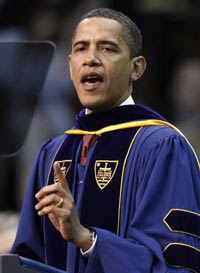
Obama's address can be seen here in full at Notre Dame's website. To those watching it, the audience's excitement at his presence was obvious. Some 54 percent of Catholics seem to have voted for Obama, and this is reflected in the enthusiastic reception he received. As is his wont, Obama gave a great speech and, knowing his audience, mentioned the 91-year-old Fr. Hesburgh's role in President Eisenhower's Civil Rights Commission and in the eventual passage of the 1964 Civil Rights Act. This magnificent gesture could only endear him to the Notre Dame community, which responded with applause throughout. As for the pro-life protesters who disrupted the event, they came off looking very rude indeed.

The controversy raises at least three issues worth addressing here.

First — and I say this as a Reformed Christian — it is not especially healthy for a university's decisions to be subject to a bishop's veto. A university, even an overtly confessional university, has its own authoritative sphere that ought not to be confused with that of the institutional church. I am with Abraham Kuyper in believing that a christian university best functions free from the unwarranted interference of church and state alike. That said, in this case the diocesan bishop made no pretence of vetoing Jenkins' decision; he simply elected to stay away.

Second, at one time Notre Dame was controlled by an otherwise little known order, the Congregation of the Holy Cross (CSC). Although the university is now governed by a lay board, its self-definition as a Catholic university implies a fidelity to the teachings of Rome. Up to now the president has always been a CSC priest. The very nature of Roman Catholicism implies, not just a confessional orientation, but fidelity to the claims of a particular institutional manifestation of the church. That church has made clear its teachings on the sanctity of human life, and thus the university is presumably bound by them. At the very least, Fr. Jenkins put the American Catholic bishops in a difficult position and forced them to respond in some fashion. Had he invited Obama to speak without offering him an honorary degree, he might have avoided the fuss.

Third and finally, in trying to solidify its place as an American university at home with the larger educational establishment, is Notre Dame in danger of losing its soul, if I may be permitted that overused cliché? Might its quest for respectability come at the expense of its Catholic identity? Of course, Notre Dame is not alone in this, as there are many christian universities in North America, some church-related and some not, that must daily confront this very issue. Shall such universities, for example, simply accept the larger definitions of the academic disciplines, their subject matter, their preferred methods, their general orientations, and so forth? Or are they obligated to subject even these to a biblically-shaped worldview? From my own experience at Notre Dame, it's not clear to me that this way of phrasing the issue would make much sense to people there. In a Catholic milieu the question would once again revolve around church teachings, which, as noted above, are clear on this particular issue while remaining silent on much else.

University of Notre Dame

Whither Notre Dame? I think we can safely say that it will continue to be a force to contend with in the world of football. It is also likely to keep the undying loyalty of Domers past and present, who give generously to their alma mater. But it's an open question whether Notre Dame will survive over the long term as a genuinely Catholic university or, in the short term, whether Fr. Jenkins will keep his job after his inept handling of this fiasco.

06 April 2009

Tax deductions and the public good

As the United States is now officially in recession, could one of Barack Obama's proposals have the unintended consequence of obstructing efforts to help the poor, who will suffer most from its effects? Ryan Messmore argues, with some plausibility, that this could be the case: Obama's Proposal to Reduce Charitable Deductions Would Hurt Civil Society, Expand Government. According to Messmore:
The President claims that his tax plan will only have a small negative effect on charitable giving. Percentage-wise, this may be true, but the estimated reduction in giving means billions of dollars less each year for charities, especially if weak economic conditions continue.

Scholars at the Center on Philanthropy at Indiana University estimated that, had Obama's proposed changes been in place in 2006, total itemized contributions from wealthy households would have dropped almost $4 billion.

While this amount is only a small percentage of total charitable donations given each year, it represents more than the annual operating budgets of the American Cancer Society, World Vision, St. Jude's Children's Hospital, Habitat for Humanity, and the American Heart Association combined. Moreover, other scholars estimate that under Obama's proposal charitable organizations would see donations drop possibly by as much as $9 billion every year.

In addition to receiving less money from wealthy donors, charitable organizations under Obama's plan could face a more subtle yet significant challenge: government crowding them out of social welfare provision. This phenomenon occurs when government claims increasing responsibility for tasks once performed by civil society, absorbing a larger percentage of the resources dedicated to carrying out those tasks.
There is another important factor that Messmore does not mention. If the reigning ideological perspective holds that government is intrinsically secular and that whatever government funds must be free from the taint of "sectarian" religion, then the expansion of the public sector must necessarily come at the expense of those initiatives with an overt confessional basis. The result might be what the late Richard John Neuhaus famously called the naked public square, except that in reality it is nothing of the sort, because it is inevitably infused with religious conviction of some sort, even if the latter amounts to the belief that the cosmos can be understood without reference to God.

This secular religion comes now to be given a privileged status and a continually growing political and economic space, before which all the particular beliefs held by flesh and blood people — including Christians, Jews and other adherents of traditional revealed religions — must give way. That this effectively erodes religious freedom would seem evident, but many are ready to acquiesce in this for the apparent pragmatic benefits associated with government action. Yet if Messmore is correct, the expected benefits will prove illusory: little will be gained, but much will be lost.

If anything, the administration should be moving in the opposite direction. Recognizing that government cannot bear the entire burden of ameliorating the effects of a sluggish economy, it should instead be raising the charitable deduction rate for taxpayers to encourage a multiplicity of efforts at seeking the public good, leaving ample space for believers to put their faith into action in concrete ways that accord with their own traditions.

19 March 2009

Second thoughts

During last year's presidential election a number of prominent evangelicals openly aligned themselves with Barack Obama's campaign, claiming, somewhat implausibly, to have succeeded in toning down the Democratic Party's pro-abortion position and to have moved the future president towards an abortion reduction strategy — all of this while claiming the prophetic mantle. As readers of this blog know, I myself was sceptical of these claims, persuaded that these well-intended Christians had allowed themselves to be used for partisan political purposes while receiving little if anything of substance in the exchange.

One of these pro-Obama leaders, ethicist David P. Gushee, is now having second thoughts, as expressed here: Mr. President, we need more than lip service. Gushee writes:

Mexico City, conscience clause, Sebelius, embryonic stem cells. In each case, I have been asked by friends at Democratic or progressive-leaning think tanks not just to refrain from opposing these moves, but instead to support them in the name of a broader understanding of what it means to be pro-life. I mainly refused.

But I do confess that my desire to retain good relationships with the Obama team has tempted me to give what was asked in return for the big payoff of a serious abortion-reduction initiative that I could wholeheartedly support.

But this kind of calculation is precisely what has gotten Christian political activists in trouble in the past, not just for 40 years but for 1,600 years. We gain access to Caesar in order to affect policy; we hold onto access even if it involves compromising some of what we want in policy; in the end, we can easily forget what policies we were after in the first place. I think this definitely happened to the Christian right. It doesn't need to be repeated by the Christian center or left.

Once again, the danger is that, in our efforts to transform the world, we ourselves will be remade into its image. Gushee is perhaps more clear-seeing about this than some of his associates surrounding the new president who have refrained from criticizing him, even when this is obviously called for. Let us hope Obama will read and heed Gushee's frustrated plea for action.

27 January 2009

Pledging allegiance

When I first encountered the following video on Rod Dreher's Crunchy Con blog, two things struck me. The second and less significant one first: (2) I didn't recognize a single one of these "instantly recognizable faces" until I read this article in TIME: Celebs Pledge Allegiance. I know, of course, that I'm not exactly immersed in popular culture, but I hadn't expected to learn that I am that out of touch. Oh, well.


Now back to the first: (1) The iconography of this video seems eerily reminiscent of the sorts of posters associated with the cult of personality in more than one mid-20th-century state. Furthermore, hearing people pledge their allegiance to one man, however well intended they and he may be, I cannot help but find a little chilling.

Oh, and my pledge? To keep tabs on this unsettling phenomenon and to alert others if it threatens to get out of hand.

Followers

Blog Archive

About Me

My photo
Contact at: dtkoyzis at gmail dot com