Showing posts with label education. Show all posts

08 March 2012

Religious freedom in Canada

Fr. Raymond J. de Souza writes in Canada's National Post: Bringing soft totalitarianism into the classroom. An excerpt:
Ill winds are blowing across the land when it comes to parental rights, religious liberty and education policy.

Quebec's new "ethics and religious culture" curriculum aims to promote religious tolerance by teaching that religious differences don't matter. If you are a Muslim parent who wants to teach your child that Islam is superior to being an atheist or being a witch, the education system will be undermining that view in class. Quebec will brook no exceptions to the new groupthink: No child is permitted to be exempt from class when the teacher instructs her that her pious parents are teaching her falsehoods. The Supreme Court of Canada affirmed this soft totalitarianism last month, saying in effect that parents ought to get with the program and get over their religious, moral and cultural obligations to instruct their children. That is the narrowing of liberty to the point of eliminating it; everyone is free to teach his kids what he wants at home, just as long as the state gets to teach the little ones the opposite at school.

After reading Fr. de Souza, I am reminded of this quotation from the great christian statesman Abraham Kuyper with more than a little relevance for current developments on both sides of the 49th parallel:
When principles that run against your deepest convictions begin to win the day, then battle is your calling, and peace has become sin; you must, at the price of dearest peace, lay your convictions bare before friend and enemy, with all the fire of your faith.

17 November 2011

Choice in education?

An educational policy for the 21st century? Might be worth a try here as well.

15 July 2010

Victory for religious freedom in Québec

It is difficult to recall that, prior to half a century ago, Québec’s French-speaking population was almost entirely Roman Catholic, with high rates of church attendance and a high birth rate. Its intellectual élite, typified by Fr. Lionel Groulx, saw Québec as having a mission to advance the cause of true Christianity in a largely anglophone and protestant North America. All of this changed with startling swiftness beginning in 1960 with the onset of the province’s Révolution tranquille, or Quiet Revolution. Within a very few years church attendance and birthrate alike plummeted, leaving a radically secularized society in its wake. Today Roman Catholicism is a marginalized minority viewpoint.

Given this history, the Québec Superior Court’s recent decision in favour of Montréal’s Loyola High School comes as a surprise, albeit an encouraging one. The provincial government had mandated all schools to teach a religion and ethics course which, the private school argues, conflicts with its own Catholic principles. Justice Gérard Dugré agreed with the school, charging that the law violates the freedom of religion guaranteed in Québec’s Charter of Rights. The National Post reports:

“In these times of respect of fundamental rights, of tolerance, of reasonable accommodations and of multiculturalism, the attitude adopted by the [Education] Department in the current matter is surprising,” Judge Dugré wrote. He added that forcing Loyola to teach the course in a secular way “assumes a totalitarian quality essentially equivalent to the order given to Galileo by the Inquisition to renounce Copernican cosmology.” . . .

Education Minister Michelle Courchesne yesterday called the ruling “excessive” and Premier Jean Charest said the need to appeal the decision is clear. . . . The course, Ethics and Religious Culture, is mandatory for all children in Grades 1 though 11. Its introduction followed a 1997 constitutional amendment replacing the province’s denominational school boards with linguistic ones and a 2005 law that removed parents’ right to choose a course in Catholic, Protestant or moral instruction.

The course covers the full spectrum of world religions and belief systems, with an emphasis on Christianity, Judaism and aboriginal spirituality. Critics have said it promotes a moral relativism, in which all belief systems are of equal value. In its pleadings before the court, Loyola argued that this relativism trivializes the religious experience promoted in all facets of the school’s teachings.

“Faith is omnipresent in this institution,” Loyola’s lawyer, Jacques Darche, said following a news conference at the school yesterday. “Before football games, they pray. Before a press conference, they pray. It’s quite bizarre that in the one course that you would expect to be a part of a Catholic Jesuit school, the religion program, you’re not allowed to talk about God, you’re not allowed to pray.”

Unfortunately, the Quiet Revolution led, not to a recognition of the need to protect religious freedom, but to the establishment of a new religion of secularism, coupled with a barely disguised hostility to traditional Christianity. There is reason to hope that the current controversy will help to expose the true nature of this establishment, particularly in the all-important realm of education.

27 April 2010

Making adolescence obsolescent

Chuck Colson recently published two BreakPoint commentaries that have a bearing on secondary education: South Hadley Hellions: The Fruit of Sin and Savagery in South Hadley: Where Are the Adults? The event that prompted these commentaries was the tragic bullying and suicide of Phoebe Prince in a west Massachusetts community. I was struck by Colson’s words here:

American teenagers operate in what has been called a “parallel culture” that operates free of adult interference. American high schools have been described as places where “individuals of the same age group define each other’s world.” As we saw in South Hadley, instead of challenging these definitions, or even the kind of cruelty endured by kids like Phoebe Prince, teachers and administrators often adopt a hands-off approach. This is politically correct, to respect personal autonomy. Look what it leads to. Every once in a while, events like those in South Hadley or the school shootings a decade ago cause us to examine some aspect of this “parallel culture,” but the “parallel culture” remains.

25 January 2010

Academic responsibility

During my first years teaching at Redeemer University College, I quickly discovered the impact I was having on students and initially found it a somewhat jarring experience. I had recently gone from being a lowly graduate student at Notre Dame’s Department of Government and International Studies to being a not-quite-so-lowly (but not terribly exalted either) assistant professor of political science at one of Canada’s few Christian universities. This commanded the respect of the students, most of whom had grown up in the Christian Reformed Church and similar bodies and had been educated in the day schools connected with Christian Schools International. The Dutch Reformed tradition in particular has long had a strong educational tradition, beginning at least with Abraham Kuyper’s Free University of Amsterdam in 1880 and extending to Calvin College and other institutions in North America. One need only think of Alvin Plantinga’s and Nicholas Wolterstorff’s works as premier examples of scholarship in this tradition, to which Redeemer is heir.

One day while I was sitting in the cafeteria around a table with some of my students, one of them turned to me and repeated something I had said in class as though it were gospel truth. Still being quite green, I was startled at this. That night I had difficulty sleeping and James 3:1 kept running through my mind: “Not many of you should become teachers, my brothers, for you know that we who teach will be judged with greater strictness.” To say that this scared the hell out of me would be something of an overstatement, yet I had come to understand something of the awesome responsibility of a teacher, even at the post-secondary level.

Not too long ago I posted something on Academic freedom and the faith-based university in response to John Stackhouse’s defence of Trinity Western and other confessional universities in Canada’s University Affairs. I return to the topic here.

As I see it, there are two sides to this: teaching and research, each of which must be handled somewhat differently, even if they are interconnected in numerous ways. Ideally each should support the other, which is why universities try to provide sufficient time and monetary resources for research, even if some overburden their faculty with teaching responsibilities. Many of the smaller Christian universities tend to have their faculty teaching as many as eight courses per year under nine-month contracts, thereby making it difficult for them to pursue a scholarly agenda in any serious way. This is an issue for another time.

The crucial concern for present purposes is that Christian universities often require of their employees adherence to a particular confessional statement, sometimes associated with the supporting denomination. It is not unusual for a Presbyterian university to hire only those agreeing with the Westminster standards. Calvin College itself requires its faculty to attend Christian Reformed Church congregations or those of other denominations with which it is in ecclesiastical fellowship. It also requires adherence to the Three Forms of Unity. Do such requirements constitute undue limitations on academic freedom? Not necessarily, though they can do so, depending on the content of the prescribed statements.

The stereotypical case has a professor of, say, biology coming to believe that the bulk of the evidence points to macro-evolution, including the descent of human beings and the higher primates from a common prehistoric ancestor. However, because she has signed a statement supporting fiat creationism at the time she was hired, her findings threaten her continued employment. Or what of the professor of biblical studies who has come to conclude, based on literary evidence, that Isaiah 40-66 were written centuries after the first 39 chapters, or that Daniel was probably written in the second century BC? If this conflicts with the official understanding of biblical authorship supported by the institution, this puts him in a tough position and could result in the loss of his job.

These are the sorts of scenarios of which faculty at christian universities ostensibly live in constant fear. To be sure, I think it is unwise to prescribe a statement of faith in effect prohibiting faculty from exploring human origins and other fields of legitimate human endeavour. In short, it ought not to tell scholars what they can and cannot learn about God’s creation or what sort of evidence they are allowed to uncover. But that the world is God’s creation should obviously not be called into question.

Does this limit academic freedom? In one sense, yes, it does. Christian believers are not free to accept the sort of dualism that assumes that our ultimate convictions can be safely sequestered from pedagogical and scholarly pursuits. Nor should we embrace the various reductionisms that plague the secular academy in so many ways. We are not free to ignore the many idolatrous worldviews that vie for our loyalty or to pretend that they have no impact on the life of the mind. Any effort to rehabilitate, say, the Marxian project without noticing its reduction of the full complexity of human motivations to material productive forces falls well short of the spiritual discernment sorely needed in academia.

Furthermore, there is no such thing as a university without some form of undergirding faith commitment, even if it is only implicit. In a public university, which is supposedly neutral with respect to various religious commitments, there are certain academic activities that are at least unofficially out of bounds. J. Philippe Rushton’s controversial investigations into intelligence and racial differences have skirted the edges of these boundaries for obvious reasons. One suspects the same would be true of those exploring gender differences. Even if the latter were permitted by one’s academic peers, one would have to tread very carefully to avoid causing offence to the easily offended. Yet, ironically, questioning Darwin’s theory, which would appear to imply at least the possibility of biological inequalities, is also beyond the pale. It overstates the case to conclude that a common commitment to methodological atheism is required for teaching at a public university. All the same, one could not simply assume that, say, God created the heaven and earth and redeemed it from sin through Jesus Christ, and then proceed to conduct one’s academic inquiries on the assumption that this is true.

Yet this is exactly what scholars at a Christian university are privileged to do. There is no doubt that, given my own faith commitment and how I understand it to impact my field of political science, I am freer at Redeemer to follow my own interests in teaching and research than I would be elsewhere. Academic freedom? Yes, but I prefer to speak of academic responsibility, recognizing that true freedom is not mere licence, as many seem to think, but always functions within a larger communal context wherein we exercise a fearful responsibility, not only for the young lives God has put in our care, but for the larger world of scholarship.

22 July 2009

Catholicism and international relations

For educators attempting to engage their students to think christianly in their respective academic endeavours, Daniel Philpott's essay is a welcome and inspirational effort rooted in the Roman Catholic tradition of political reflection: One Professor’s Guide To Studying International Relations and Peace Studies From a Catholic Perspective. From the introductory paragraph:

Whatever else this passage [Colossians 1:15-20] means, it seems to say that all things, including thrones, powers, rulers, and authorities — that is, politics — were created and redeemed by Christ. There is nothing in the universe which escapes this fact, this logic. Does not this then imply that political pursuits are to be oriented towards Christ and his creative and redeeming work? This may seem like a difficult thing to imagine in a world where Stalin’s logic — or at least the logic of power and interest — seems again and again to prevail, tempting us to conclude that what the Church professes only has a limited and circumscribed significance. But if we believe what the Church professes, then this is not the case. The victorious resurrection of Christ is a total victory, applying to all things, even if it is not yet consummated. And if we believe what the Church professes, then we are called to participate ourselves in this victory.

14 June 2009

Becoming adult

Writing for Breakpoint's Worldview Magazine, John Stonestreet explores Our Adolescent Culture. Taking as his springboard Diana West's The Death of the Grown-Up: How America’s Arrested Development Threatens Western Civilization, he suggests that, whereas adolescence as a distinct stage of development was unknown before the mid-20th century, what was originally seen as a transitional phenomenon has overtaken the entire culture such that our social and political institutions nurture a kind of permanent immaturity. Take note of Stonestreet's six marks of an adolescent culture, which seem all too evidently applicable to North America.

I have little to add to his analysis. Nevertheless, as an instructor at a post-secondary institution, I have sometimes wondered whether universities really help young people move into adulthood, or whether they inadvertently prolong adolescence beyond what is healthy for the student and the society at large. I ask this as someone who was not fully self-supporting until well beyond 18 years of age, due entirely to my pursuit of graduate studies towards a PhD.

But there's another factor. Forty years ago my own baby-boomer generation, under the cover of a radical critique of society, coined such terms as "the establishment" and "the system," and put retreads on "status quo," "capitalism," "patriarchy" and "military-industrial complex," all terms of opprobrium describing forms of society to be opposed. To be sure, there was an element of truth behind these labels, though they were too easily tossed about as means of discrediting a complex network of social patterns which such simplistic terms could never hope to capture in their entirety.

Could the use of such language have been the first signs of a society refusing to grow up? If one can blame "the system" for every personal failure, one is perhaps implicitly absolved from having to take responsibility for rectifying it. Far from empowering the young, as some would have it, such an attitude is more likely to nurture resentment and stifle initiative, the very things we expect adolescents to outgrow. Perhaps it's time, if not to abolish adolescence, at least to recover its original meaning: becoming adult!

18 May 2009

Obama at Notre Dame

Whether or not it can justly be called America's premier Catholic university, Notre Dame has nevertheless made a unique place for itself in the country's educational landscape. Unlike many vestigially Catholic institutions, Notre Dame prides itself on its Catholic identity and commendably seeks to maintain it. This is what I found during my years there as a graduate student in the early 1980s. What happens at Notre Dame is often a bellwether for American Catholic culture at large.

Nevertheless, a quarter century ago my impression of the university's administration, then headed by its long-serving president, Fr. Theodore Hesburgh, was that, while it tried its best to hold the line on its Catholic identity, it did so with some embarrassment, seeking respectability with the larger educational establishment and even with the popular media. Against the background of an establishment that traditionally viewed Roman Catholics as un-American, Notre Dame has coveted a place for itself as a genuinely American university. Of course, sport has played a big role in this, as any collegiate football fan knows.

As part of its persistent effort to fit in, Notre Dame has invited six US presidents to speak at commencement and has conferred honorary degrees on nine. During my time there Ronald Reagan spoke in 1981, his first public appearance after the attempt on his life nearly two months earlier. In 1984 New York Governor Mario Cuomo, then a presidential aspirant, spoke at Notre Dame, making his notorious "I'm personally opposed, but. . ." speech with respect to abortion, thus antagonizing serious Catholics but receiving Fr. Hesburgh's blessing.
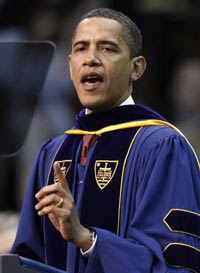
Obama at Notre Dame
It is thus not surprising that Hesburgh's successor, Fr. John Jenkins, would invite the newly-elected president Barack Obama to speak at commencement this year. What he did not foresee is the controversy this would engender, thus bringing unwelcome negative publicity to the university and to him personally. Initially the Bishop of Fort Wayne and South Bend, John D'Arcy, signalled his disapproval and his intention to absent himself from the event, due to Obama's personal and political support for the pro-choice position on abortion. Many, if not most, of the other American bishops followed suit. Most dramatically, Harvard Law Professor Mary Ann Glendon, former US Ambassador to the Vatican, refused the Laetare Medal which she had been offered by the university.

Obama's address can be seen here in full at Notre Dame's website. To those watching it, the audience's excitement at his presence was obvious. Some 54 percent of Catholics seem to have voted for Obama, and this is reflected in the enthusiastic reception he received. As is his wont, Obama gave a great speech and, knowing his audience, mentioned the 91-year-old Fr. Hesburgh's role in President Eisenhower's Civil Rights Commission and in the eventual passage of the 1964 Civil Rights Act. This magnificent gesture could only endear him to the Notre Dame community, which responded with applause throughout. As for the pro-life protesters who disrupted the event, they came off looking very rude indeed.

The controversy raises at least three issues worth addressing here.

First — and I say this as a Reformed Christian — it is not especially healthy for a university's decisions to be subject to a bishop's veto. A university, even an overtly confessional university, has its own authoritative sphere that ought not to be confused with that of the institutional church. I am with Abraham Kuyper in believing that a christian university best functions free from the unwarranted interference of church and state alike. That said, in this case the diocesan bishop made no pretence of vetoing Jenkins' decision; he simply elected to stay away.

Second, at one time Notre Dame was controlled by an otherwise little known order, the Congregation of the Holy Cross (CSC). Although the university is now governed by a lay board, its self-definition as a Catholic university implies a fidelity to the teachings of Rome. Up to now the president has always been a CSC priest. The very nature of Roman Catholicism implies, not just a confessional orientation, but fidelity to the claims of a particular institutional manifestation of the church. That church has made clear its teachings on the sanctity of human life, and thus the university is presumably bound by them. At the very least, Fr. Jenkins put the American Catholic bishops in a difficult position and forced them to respond in some fashion. Had he invited Obama to speak without offering him an honorary degree, he might have avoided the fuss.

Third and finally, in trying to solidify its place as an American university at home with the larger educational establishment, is Notre Dame in danger of losing its soul, if I may be permitted that overused cliché? Might its quest for respectability come at the expense of its Catholic identity? Of course, Notre Dame is not alone in this, as there are many christian universities in North America, some church-related and some not, that must daily confront this very issue. Shall such universities, for example, simply accept the larger definitions of the academic disciplines, their subject matter, their preferred methods, their general orientations, and so forth? Or are they obligated to subject even these to a biblically-shaped worldview? From my own experience at Notre Dame, it's not clear to me that this way of phrasing the issue would make much sense to people there. In a Catholic milieu the question would once again revolve around church teachings, which, as noted above, are clear on this particular issue while remaining silent on much else.

University of Notre Dame

Whither Notre Dame? I think we can safely say that it will continue to be a force to contend with in the world of football. It is also likely to keep the undying loyalty of Domers past and present, who give generously to their alma mater. But it's an open question whether Notre Dame will survive over the long term as a genuinely Catholic university or, in the short term, whether Fr. Jenkins will keep his job after his inept handling of this fiasco.

15 April 2009

Redeemer in the Post

One of my colleagues has merited mention in yesterday's edition of the National Post: Private school loyalty defies poor economy.

04 September 2008

Can parents be trusted?

This video has more than a little relevance for us here in North America. It's a pity no one made use of this during last year's provincial election campaign.

03 February 2008

Midwinter snippets

  • Some weeks ago, during our family's evening prayer service, we read Luke 4:1-13, about Jesus' temptation in the wilderness. Afterwards our Theresa spoke up, noting that in Luke's account the last two temptations are in a different order than in Matthew's account. I guess nine years old is not too young to discover the Synoptic Problem.

  • Today at evening prayer we continued our lectio continua reading through the gospel of Luke, reading the account of the Transfiguration in chapter 9:28-36. Coincidentally we read of this event in church this morning, as the Transfiguration is traditionally remembered in the western church on the last sunday before Lent.

  • My wife broke her arm two weeks ago in an ice skating accident. Today was the first time all three of us were in church together since then. Her arm is in a sling, though not in a cast. Coincidences seemed to abound today, for as we were singing the final hymn, Stand Up, Stand Up for Jesus, we both chuckled when we came to these lines: "The arm of flesh will fail you,/ ye dare not trust your own."

  • This afternoon the three of us watched Disney's High School Musical, mostly of course for Theresa's benefit. After this I am now inspired to write and score my own production, provisionally titled Graduate School Musical. It should be a big hit. In certain crowds, that is.

  • I've recently learnt of a christian university located in, of all places, the Empire State Building in midtown Manhattan. The King's College was founded in 1999, reviving an earlier institution located up the Hudson River in Briarcliff Manor prior to 1994. In 2005 a member of the New York State Board of Regents objected to its using Columbia University's original name. However, because Columbia relinquished this name in 1784, I doubt very much that anyone is still around who will confuse the two.

  • Thanks are due to Steve Pypker, Willem de Ruijter and Matthew Vandervecht for digging us out from under the accumulation of friday's snow storm. May God bless them for their kind beneficence.

  • It seems evangelicals are rediscovering monasticism: The unexpected monks. Could this be a case of trying to reinvent the wheel? I think others got there first.

11 November 2007

A Byzantine Catholic university?

Because I teach at a university with a distinctive confessional identity, I am always interested to learn of new educational ventures that claim a foundation in a christian tradition. There are, of course, any number of Catholic universities in North America, one of which I myself attended more than two decades ago. But as far as I know Transfiguration College may be the only fledgling university in the Byzantine Catholic tradition. Gestating in Aurora, Illinois, it styles itself a Byzantine Catholic Great Books College, taking its curricular cues from Mortimer Adler and Robert Maynard Hutchins' 54-volume Great Books of the Western World.

Two observations are in order. First, it is somewhat surprising for an institution that claims to be in the Byzantine tradition to be touting a western-oriented great books programme. To be sure, they do have St. John Chrysostom, Basil the Great and Fyodor Dostoevsky. But where are Gregory of Nyssa, the Philokalia and Nikos Kazantzakis? Second, because its website appears to have been updated last in 2005, it's not clear whether Transfiguration College is still in the planning stages or effectively dormant. If the former, then I wish them God's blessing in this new venture.

29 September 2007

Anglican views on faith-based schools

I imagine I'm not the only one to find reading the Niagara Anglican a singularly unpleasant experience. Two articles in the current issue are typical in this regard: "Religion in Ontario public schools," by retired Archbishop John Bothwell, and "A religious education," by Peter Wall, Rector of Christ's Church Cathedral here in Hamilton. Both Bothwell and Wall oppose the funding of faith-based schools for all the predictable reasons, favouring instead "religious education," i.e., education about the world's religions, in the public schools. Here is Wall:

[John] Tory's suggestion is that faith based schools are just that — faith based, so we have, rather than religious education, religious indoctrination — potentially narrow and exclusive curricula which promote one religion over another. To my way of thinking, it leads to narrowness, intolerance, a lack of breadth of knowledge and awareness, and a preponderance of religious myopia which has in the past and continues today to cause problems between peoples and groups.

The solution? Keep religious instruction in the churches and religious education in the schools. Notably absent from their remarks is any vision for reclaiming education for the cause of Christ, for bringing the gospel to bear on the whole of life, or witnessing to the coming of God's kingdom. We had best keep our private faith in our churches and out of our schools — "our" evidently referring to Canadians, not Christians. Absent as well is an understanding of the reality that someone's worldview, whether or not overtly expressed, will infuse such teaching about religion.

Sadly, Bothwell and Wall appear to have accepted uncritically the secularizing worldview of the larger society. Accordingly, the church functions as little more than chaplain to that society, affirming it in its prejudices and keeping itself respectable within the eyes of its self-proclaimed opinion-moulders. It shies away from all perceptions of divisiveness, narrowness and intolerance, seemingly vindicating the outsider's cynical assessment of Anglicanism as an establishmentarian church founded to sanction a king's divorce. The offence of the gospel and the exclusive claims of Christ over our lives are obviously not primary considerations.

It is far from coincidental that the same issue of the Niagara Anglican contains this sad article: "Why did St. Philip's close its doors?" A church unable to distinguish itself from the larger culture will eventually become superfluous, as it seems bent on becoming in the Niagara diocese.

25 September 2007

How's that again?

The Canadian Civil Liberties Association appears to believe that allowing parents to determine their own children's education is a violation of their civil liberties: Civil Rights Group Opposes Tory Faith-Based Schools. A number of high-profile people are willing to accept this rather odd reasoning.

There is, however, high-profile support on the other side as well. Canada's newsweekly Macleans has published an editorial arguing that Choice is good, and more choice is better. Bravo, Macleans!

20 September 2007

Faith-based schools

Education seems to be the number one issue in the Ontario election campaign, somewhat surprisingly. The two major parties are divided over whether to provide provincial funding for faith-based schools, with John Tory's Conservatives in favour of bringing them into the public system while permitting them (for now) their distinctiveness, and Dalton McGuinty's Liberals favouring an homogenized public system, with grudging acceptance of funding for Catholic schools. Howard Hampton's New Democrats have chosen to sit this one out, labelling it a smokescreen. The Greens favour a completely homogenized system, with no funding for the Catholic schools. (How this will protect the environment is anyone's guess!)

The CBC has posted a brief but informative historical account of the issue, as well as a survey of the differing approaches to education taken by each province: Faith-based schools.

The central issue, as I see it, is whether it is the proper task of government to socialize the young and to create a society based on "tolerance" of differences while at the same time doing everything possible to minimize or trivialize those differences. Or does this go well beyond the normative task of government to do justice? Many of us believe government should play at most an ancillary role to the overriding parental task of educating one's own children.

Unfortunately, despite Canada's multicultural character, the province of Ontario is heir to an establishmentarian mentality that views homogeneity as the norm. At one time this meant a generic protestantism, but for the last 40 years secularism has been the established religion, with the rest of us viewed condescendingly as bothersome dissidents at best. Add a bit of Rousseau's civil religion, courtesy of Québec's Quiet Revolution next door, and you have a pretty toxic mix. Perhaps it's time for another William Lyon Mackenzie to take on this new Family Compact.

28 July 2007

The eros of teaching

Drawing on personal experience and on Plato's portrayal of Socrates in the Symposium, William Deresiewicz writes about Love on campus in The American Scholar, the quarterly journal of the ΦΒΚ Society. The love of which he speaks is not precisely erotic love or familial affection, but the "eros of souls" that draws students and professors to each other in the joy of shared intellectual pursuits. This is something I have experienced for myself over the past two decades of teaching. There is a poignancy to the author's observations here:

Socrates says in the Symposium that the hardest thing about being ignorant is that you’re content with yourself, but for many kids when they get to college, this is not yet true. They recognize themselves as incomplete, and they recognize, if only intuitively, that completion comes through eros. So they seek out professors with whom to have relationships, and we seek them out in turn. Teaching, finally, is about relationships. It is mentorship, not instruction. Socrates also says that the bond between teacher and student lasts a lifetime, even when the two are no longer together. And so it is. Student succeeds student, and I know that even the ones I’m closest to now will soon become names in my address book and then just distant memories. But the feelings we have for the teachers or students who have meant the most to us, like those we have for long-lost friends, never go away. They are part of us, and the briefest thought revives them, and we know that in some heaven we will all meet again.

I discovered all this early in my career, and it is one of the things that makes what I do more than just another job. I expect that many of my colleagues will agree with me that loving students and then letting them go is a source at once of great satisfaction and, to be quite honest, of at least some heartache as well.

04 June 2007

Preparing for leadership

The Work Research Foundation's Comment is beginning its second annual series aimed at university-bound young people with an article by yours truly, titled: Making the most of college: Preparing for leadership. A brief selection:

If you are at a university where the larger questions of right and justice are posed, and where discussion of them is encouraged, throw yourself into the dialogue. Ask your own questions and consider thoughtfully the questions of others. Be daring and don't be afraid to put forward your own ideas. That's what you're there for. From my own time at Redeemer, I've discovered that a Christian university can provide an especially fertile ground for nurturing such discussions. This is because students are often given the tools to see through reductionist explanations — say, Marxism, Freudianism and Darwinism — for the complex phenomena of God's world. But it may also be that Christians are more aware than others of participating in an ancient tradition of reflection and a larger conversation that started long before they were born and will continue long after they are gone.

On the other hand, if you are at a university where the study of politics is narrowed to what can be addressed by the scientific method, then discussion of the larger questions is not likely to be encouraged. In fact, it might be actively discouraged, and you may find yourself being advised to switch to the study of philosophy or religion rather than politics. If this is your situation, it will be up to you to round up like-minded fellow students and to jump start the conversation with them on your own time. I know from personal experience that sometimes meeting regularly with an extracurricular discussion group, especially when accompanied by a shared meal, can be more life-changing than the formal courses offered by the university.

02 October 2006

Tuesdays with Morrie

I somehow managed to miss this book when it first came out nearly a decade ago: Mitch Albom's Tuesdays with Morrie. Morrie Schwartz was Mitch's sociology professor at Brandeis University in the late 1970s, and the two of them grew close during that time, meeting on tuesdays to discuss the great issues of life. When Mitch graduated, he left his mentor behind to pursue fame and fortune as a sport writer for the Detroit Free Press, seemingly forgetting what he was taught: that relationships are more important than worldy success.

Years later, as Mitch was watching television, he learned from a Nightline report that Morrie was terminally ill with ALS. Regretting his own failure to maintain contact over the years, Mitch made a belated effort to renew his friendship with Morrie, going so far as to spend 14 successive tuesdays with him as his body gradually deteriorated. In the process he learned one last lesson from his old mentor: what it means to die, as well as how to live well in the love of friends and family in the meantime. Here's Morrie himself:

[G]iving to other people is what makes me feel alive. Not my car or my house. Not what I look like in the mirror. When I give my time, when I can make someone smile after they were feeling sad, it's as close to healthy as I ever feel. Do the kinds of things that come from the heart. When you do, you won't be dissatisfied, you won't be envious, you won't be longing for somebody else's things. On the contrary, you'll be overwhelmed with what comes back (p. 128).

This book was commended to me by one of my own former students whom I am blessed to call a great friend. The relationship depicted in it felt familiar to him, and he thought I should read it too. I am glad I did. Even more than the contents of Morrie's last lessons, I was moved by the evident affection that grew once more between him and Mitch in his final weeks.

When I first started teaching just under two decades ago, I was surprised at how much I would come to love my students and how much more they would return to me in loyalty and affection. Indeed I can easily say that if I had to give up all but one thing of my academic career, that one thing would be the ongoing relationships with my students and former students which I've found so enormously gratifying. I think Morrie would have said the same thing.

For anyone who has loved a former teacher or for any teachers who have loved their students, this is a must read.

22 May 2006

Another acquisition

Congratulate me. I am now the proud owner of a nearly complete set of Encyclopædia Britannica's Great Books of the Western World, first edition.

Britannica Great Books

01 September 2005

Cinematic teachers

Perhaps no one will be surprised to know that I'm a sucker for films about teachers and students. Among the films in this genre I have seen over the decades are Goodbye, Mr. Chips (the 1969 musical version), Dead Poets Society (1989), Mr. Holland's Opus (1995), and the magnificent television series, To Serve Them All My Days (1980), based on R. F. Delderfield's novel of the same name. Most such films recount the lives of inspirational teachers and the positive effects they had on their students. Those of us in the teaching profession would like to think that we too fall into this category and that we'll be similarly remembered by our students when we are gone.

Last week I watched The Emperor's Club (2002), which for the first half hour looked to be little more than another film in this genre. (NOTE: There are possible spoilers here.) It looked set to follow something of the plotline of Good Will Hunting (1997), in which an older mentor helps a young and brilliant incorrigible get his act and his life together. One would ordinarily expect that Kevin Kline, a revered teacher of ancient history at an élite boys' preparatory school, would have this impact on Emile Hirsh's character. One might expect Hirsch to go on to make his contribution to society, having Kline to thank for this.

But no, it doesn't quite work out that way. Kline makes a serious error in judgement and ultimately fails in his effort. Hirsch's character remains a narcissistic, deceptive person who, by film's end (and now played by Joel Gretch), is about to launch a political career. Kline is still revered by his colleagues and students, but he has to live with the fact that he misjudged the potential of one of these students to live a virtuous life. The larger society is about to pay for his mistake.

It's not a particularly pleasant way to end a film. But it provides a touch of realism to the paedagogical enterprise, which is as affected by sin as any other human activity. It certainly underscores the fearful responsibility of a teacher. But it also points to the limitations of the teacher himself, whose efforts might not always bear fruit in quite the way to which he aspires.

By the way, why is it that cinematic teachers always lecture in English or history or music? Why not politics? Perhaps someone will one day make a film about Woodrow Wilson's academic career at Princeton.

Followers

Blog Archive

About Me

My photo
Contact at: dtkoyzis at gmail dot com