16 May 2006

Marshall on Wallis

I have just received via conventional mail the spring 2006 issue of The Review of Faith & International Affairs, formerly known as The Brandywine Review. Although its full contents are not yet on-line, I will nevertheless call attention to an excellent and hard-hitting review by Paul Marshall of Jim Wallis' best-selling God's Politics: "God's Politics — Or Lack Thereof." Marshall's review is paired with a more positive one by Richard Pierard. One point Marshall makes is worthy of note. Citing Wallis' contention that the place to start is with the biblical prophets, Marshall correctly notes that, historically, christian attempts to understand the place of politics in God's world have begun with Genesis and the Law:
[Wallis] never carefully relates what the prophets say to the Torah, hence acknowledging that they challenge their rulers on the basis of God's law, not on their own feelings of injustice.

It is telling that those Christians and church institutions that speak most readily of being prophetic almost never call those to whom they presume to prophesy back to a normative order distinct from their own preferences. In fact, they frequently appear to eschew normativity altogether, championing what might be called a quasi-Kantian notion of personal autonomy — quasi, because it is shorn of Kant's countervailing sense of duty. Ironically, doing "justice" thus becomes a matter of refraining from judging and instead simply affirming people's autonomous choices inclusively. Yet as a recipe for genuine justice this amounts to pretty thin gruel.
Dan Brown and Mary Magdalene

Many books and articles have been written skewering the pretensions of Dan Brown's best-selling novel, The Da Vinci Code. Now a well-known (at least to some of us) biblical scholar takes on Brown's treatment of Mary Magdalene: Re-sexualizing the Magdalene: Dan Brown’s Misuse of Early Christian Documents in The Da Vinci Code, in the Journal of Religion and Popular Culture.

While you're at it, look at the last-but-one article on the left sidebar. The author, Greg Linnell, is a graduate of Redeemer. In fact, he took my Introduction to Political Science way back in 1987, during my first semester of teaching.

15 May 2006

Jaroslav Pelikan: 1923-2006

The prolific church historian is dead at age 82. Oddly enough, a blog search brings up tonnes, while a Google news search brings up nothing as yet.
Return of the Latin-rite Calvinist

A warm welcome is extended to Mr. Rob Joustra, political science graduate and winner of last year's Faculty Award at Redeemer, after a lengthy east Asian sojourn. Good to have him back in the Steel City.
'Big Daddy' Harper

Is Stephen Harper a "control freak"? So argues The Globe and Mail's Ian Brown: In Harper's regime, Big Daddy knows best.

14 May 2006

Anniversary

As of today, my darling Nancy and I have been married for a full decade — ten years of wedded bliss to the most wonderful woman in the world. Ask me again sometime, and I'll tell you about our two weddings. It's a long story.
Academy needs principal

I have just been contacted by Mr. Adamos Mastris of Larnaca, Cyprus, who has asked me to circulate the following urgent announcement. Anyone who is interested in this opportunity or knows of a good candidate for the position is welcome to contact the party below.

American Academy, Nicosia
CYPRUS

Required for August 15th, 2006 (or nearest time after this date)


PRINCIPAL


The American Academy (established 1922) is a private, selective co-educational 6-18 school of over 300 students, with English as the medium of instruction. Courses offered lead to a recognized High School Diploma, IGCSE, O, AS and A levels.

The Principal is responsible for the curricular and administrative organization of the whole school, strategic planning and implementation and the maintenance of the Evangelical Christian philosophy of the school.

We are looking for a well-qualified professional educator, conversant with and committed to Christian Education, with proven management experience at secondary level, good interpersonal and communication skills and the vision to further develop and strengthen the school as a Christian witness.

The initial contract is for 3 years, renewable. Benefits include salary and allowances, some of which are taxable (including subsidized pension/medical scheme, accommodation, transport, return annual flight to country of origin), equivalent to Cy£40000 which is, approximately, £47,000 sterling (or US$85,000) at current exchange rates plus relocation expenses at commencement and termination of the contract.

Further details from:

The Chairman
Governing Council
The American Academy (Nicosia) Ltd
3A Michael Parides Street,
Nicosia
CYPRUS
Tel.: +357 22 66 42 66, Fax.: +357 22 66 92 90
Email: aacademy[at]spidernet[dot]com[dot]cy
Web.: www.aacademynicosia.ac.cy

13 May 2006

A new political party?

Is this a genuine political party with an organization and membership, or is it little more than a website: Christian Democratic Union? On the surface at least, it sounds like my kind of party.
Movers and shakers


ROCOR to return to fold

The Russian Orthodox Church Outside Russia (ROCOR), which broke with the Moscow Patriarchate after the Bolshevik Revolution, has provisionally agreed to reunite with the patriarchal see. ROCOR has millions of dollars of assets, including the Toronto church building used in the film, My Big Fat Greek Wedding.
Lords kill assisted death bill

In a rare move by the House of Lords, the British Parliament's upper chamber has effectively killed a private member's bill that would have legalized assisted suicide for the terminally ill. Here is Rowan Williams, Archbishop of Canterbury, on the bill:

Opposition to the principle of this Bill is not confined to people of religious conviction. It would be a lazy counter-argument to suggest that such opposition can be written off because it comes only from those committed to a world view not universally shared.

It remains true that to specify even in the fairly broad terms of this Bill conditions under which it would be both reasonable and legal to end your life, is to say that certain kinds of life are not worth living. We would jeopardise the security of the vulnerable in another way by radically changing the relationship between patient and physician.

Williams is correct, but there's one thing no one seems to mention in such debates: only in a society that has lost sight of sin and salvation can it be assumed that death ends suffering.

12 May 2006

Now, where to put him. . .

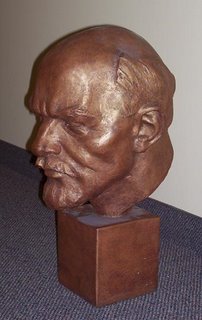
Congratulate me. As of today I am the proud owner of this relic of a moribund political illusion:

Lenin

10 May 2006

Civitas 2006

The Peace Tower
Two months ago I received an unexpected invitation from Lorne Gunter, a columnist for the National Post and the Edmonton Journal, to speak at the 10th annual conference of the Civitas Society, which styles itself "A society where ideas meet." This was based on his reading of an article I wrote for Comment last year, titled, The city and its renewal, which recently came out in the periodical's print edition. I hadn't known much about Civitas other than in the pages of Lloyd Mackey's The Pilgrimage of Stephen Harper, which I had read not too long before. From this I knew that Civitas was a small-c conservative think tank bringing together a number of prominent politicians, political staffers, academics and journalists of a generally "right-wing" persuasion. The invitation came as something of a surprise, because my cities article did not seem obviously to fit into a right-wing mould, as that is usually understood nowadays. Yet I was pleased to accept.

The Senate Chamber
I arrived in Ottawa thursday afternoon after a 6-hour drive from Hamilton. I had a wonderful dinner with my friends Eric and Bertina Hogeterp and their two boys. We were joined by another Redeemer political science graduate, Derek Miedema, who works for the EFC. The following morning Eric and I attended Question Period in the House of Commons, which occurs at 11.15 on fridays. Afterwards I was honoured to have David Sweet, the new Member of Parliament for Ancaster-Dundas-Flamborough-Westdale, come down to greet me in the hallway near the Peace Tower. I myself do not live in his riding, but Redeemer is located there. During Members' Statements at 11, Sweet mentioned Hamilton's "two universities, McMaster and Redeemer." Of course, cameras and other electronic devices are not allowed in the Commons chamber, but because the Senate was not in session, I was able to photograph the impressive interior of the Red Chamber (above left), as well as the gallery of portraits of Canada's monarchs just outside.

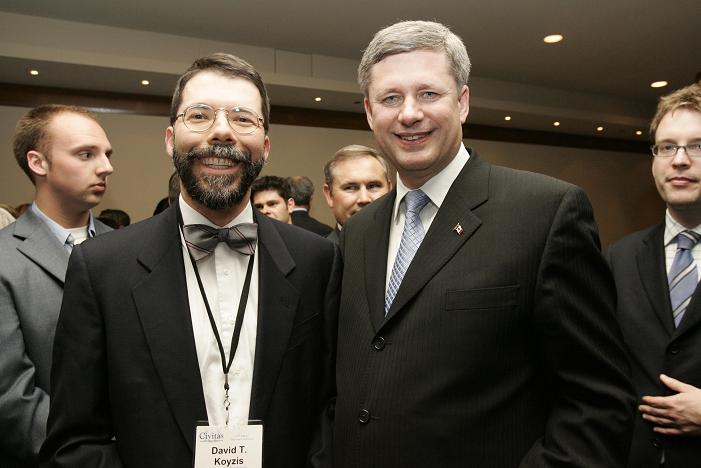
After this I made the 20-minute drive to the Brookstreet Hotel in Kanata, where the Civitas conference was taking place. During the reception that evening, Prime Minister Stephen Harper made an unscheduled appearance. I cannot recall how long he stayed, but it took some time for everyone who wished to meet him to do so. I myself was privileged to talk with him briefly and shake his hand. (If Harper had been aware of my track record, he might have declined the honour. After all, like his ill-fated predecessor, he is a Conservative with a precarious minority government!) After Harper and his entourage left, John Baird, the President of the Treasury Board, made an exceedingly partisan speech, filled with barbed humour at the expense of the various Liberal leadership hopefuls.

Saturday morning saw the first of the sessions, devoted to "Property Rights: the most fundamental freedom," followed by a session on a topic that at first blush might not seem to be related to the previous one: "Euthanasia: the next battle in the culture wars." In fact, however, both sessions brought out the barely latent tensions between two principal factions in the conservative coalition, the libertarians and what might be called the social or traditional conservatives. The former are individualists to the core, preferring to minimize government control to the greatest extent possible. As such, they enthusiastically champion the free market and are usually willing to tolerate abortion, euthanasia and other activities on which the social conservatives deem it necessary to legislate. After all, if we have property rights over our own bodies, then why not allow euthanasia? As one participant put it, if our bodies are not ours to do with as we see fit, then they belong to the state. Yet I heard no one make a case for allowing individuals to sell themselves into slavery, which indicates that even libertarians are not willing to follow all of their own ideas to their logical conclusion.
Koyzis and Harper
The luncheon remarks by Frank Luntz, a Republican Party strategist from south of the border, were certainly the most controversial. This was the part of the weekend picked up by the domestic media, and Harper's meeting with Luntz a day earlier was the subject of opposition criticism during monday's Question Period. The title of Luntz' talk, "Massaging the Conservative Message for Voters," carried all the flavour of a proposal for an ad campaign. Subtleties and nuances may be the mark of academic discourse, but they can only cloud an election campaign. Luntz' basic message? Keep it simple, hammer the opposition, and hire me next time. Incidentally, Luntz' appearance was arranged by the Manning Centre for Building Democracy, a partisan think tank associated with the Conservative Party of Canada.

The other four sessions dealt with the role of the courts in democracies, foreign and defence policies, electoral reform, and the future of Canadian cities. The schedule was tightly packed, leaving little time to catch one's breath. I missed George Jonas' speech saturday evening, due to fatigue. I would also like to have heard more on electoral reform the following morning, since I myself have written popular pieces on the subject. But I thought it best to cut out a little early to prepare for the final session on cities, in which I myself was participating. In fact, I was the very last speaker at the conference. Knowing this in advance, I feared I would be addressing a vastly reduced assembly, as some were present only for saturday. Yet this was not the case: even the final session drew a fairly large turnout.

I shall resist the temptation to engage in name-dropping, though it would be easy to do for such an event. Suffice it to say that there were a large number of well-known people — scarcely less well known than the Prime Minister himself. Representatives of a number of vaguely kindred organizations were also present, including one from the Association of Women Shooters of Canada! I myself spent much of the time with WRF people. Perhaps not surprisingly, I felt most comfortable with the traditional conservatives, even if I myself am loath to wear that label. I found myself least in agreement with the positions of the libertarians, though I found a number of these to be quite likable as persons.

At the end of the day, I found myself wondering whether everyone present really had all that much in common. Thomists, neocalvinists and traditionalists who speak the language of natural law, creation order and moral order respectively would not seem immediately to share much with those who view the state as little more than a constant threat to their own individual autonomy. In fact, there are professed socialists with whom at least this neocalvinst would have more in common. In my Political Visions and Illusions I point out the protean character of conservatism, especially the desire of different professed adherents to conserve a variety of perceived goods. This is particularly notable with respect to a view of the state. Unlike liberalism with its contractarian notion of the state, there is no single, philosophically coherent account of political order that can obviously claim the conservative label. If there was a common definition of conservatism at Civitas, it seemed to revolve around, not so much the respect for tradition and the accumulated wisdom of the ages, as smaller government and lower taxes — a somewhat deracinated agenda that would be largely incomprehensible to European conservatives of, say, the 19th and early 20th centuries, and even to Canadian conservatives of an earlier generation. In short, Civitas illustrates both the virtues and defects of the conservative movement(s) in this country. In this it is no different from the partisans of the rival political perspectives.

I was told that this particular Civitas conference was more evidently partisan than its predecessors. For the first time since Civitas was founded there is a large-C Conservative government in office. Even the taste of power can be a heady experience. How long will it all last? Luntz held out the possibility of keeping power for 20 years. My admittedly unprofessional advice? Don't put away your coat and hat too soon. After all, this is only a minority government.

08 May 2006

Ankara protests

From a story in today's Globe and Mail:

Turkey has recalled its ambassadors to Canada and France for “a short time” to protest moves in both countries that recognize the mass killings of Armenians as genocide, the Foreign Ministry announced Monday. The announcement was Turkey's latest salvo against increasing international pressure on Ankara to recognize the killings of Armenians at the time of the First World War as genocide.

If Turkey continues to refuse to recognize its culpability in the genocide, could its membership in the European Union be blocked? Could the prospect of such membership persuade Turkey to own up to its past?
Civitas conference

I have just returned from Ottawa, where I was a speaker at the annual Civitas conference. I will be writing more about this event and how I came to be involved in it. In the meantime here are two articles about some of the highlights of the conference. And, yes, I did meet the Prime Minister when he showed up unexpectedly friday evening.


Source: David T. Koyzis


Stephen Harper at Civitas

05 May 2006

Unexpected origins

I have long suspected that Cyprus' ethnic Turkish community is descended, not so much from the invading Anatolian Turks after 1571, but from those who converted to Islam in the generations thereafter. My assumption was that the forebears of today's Turkish Cypriots spoke Greek and were Orthodox. However, Alkan Chaglar has uncovered evidence that his community is descended from Cyprus' formerly more numerous Latin and Maronite Christians, associated with the centuries of Frankish and Venetian rule between 1192 and 1571.

03 May 2006

Egypt's beleaguered Christians

David Warren calls our attention to an anti-christian pogrom that occurred in Alexandria, Egypt, last month — an event reminiscent of something that occurred just over 50 years ago in Istanbul against the City's Greek population. Given that Egypt is a US ally, the UK Coptic Association and Freedom House are suggesting that the West might do more in behalf of that country's large christian community. Ordinarily one is tempted to assume that the mainstream media have been slow to cover the incident, but a Google search indicates otherwise. I myself visited Egypt in 1995 and heard first-hand of the difficulties Christians experience trying to live faithful lives in the midst of such hostility. They definitely need our prayers: Κύριε ελέησον!
Neocalvinism, encore une fois

How might neocalvinism assist a geographer in her ongoing efforts to make sense of God's creation and humanity's place within it? Calvin College Professor Jan Curry gives us a glimpse of this in last week's Comment article: Neocalvinism . . . Yes, but . . . Incidentally, Jan and I knew each other back in the dark ages when we were both undergraduate students at Bethel College in St. Paul, Minnesota. Good to hear from her again.

02 May 2006

C'est tout, c'est fini

Exams are done, the students have spread to the four winds, and my marks are in. Thus endeth my 19th year of teaching at Redeemer.

30 April 2006

Obituaries

Two 20th-century giants are gone, one a Canadian by birth: John Kenneth Galbraith dies at 97; the other a Canadian by adoption: Renowned urban writer Jane Jacobs dies. Here's more on the latter from a New York perspective: Jane Jacobs, 1916–2006.

27 April 2006

26 April 2006

Garden of Eden in Cyprus region?

When my father was a small child, he used to think that the biblical Garden of Eden was located in his grandfather's orchard in their village in the Karpass peninsula of Cyprus. As it turns out, there is an obscure religious cult of American origin that appears to believe something strikingly similar: Science and Evolution in the Urantia Book: Locating the Garden of Eden.

Incidentally, I have recently revised and upgraded my Cyprus page, adding information about its long and fascinating history, as well as the governments in the divided island state. I will likely be making further incremental changes with time.
Pantagruellian puerility

Curious, isn't it, that attempting to dialogue with Pantagruellians is rather akin to arguing with a 13-year-old. Well, all right. Let's give it a try: So's your old man! Your mother wears army boots! Ah, that felt good. Nice to get that off my chest. Now back to marking exams.

23 April 2006

Pascha, encore une fois

Χριστός ανέστη! Αληθώς ανέστη! Orthodox celebrate Easter.

21 April 2006

Trouble down the road

This local story has hit the national and international news: Standoff at Caledonia. Though this is only half an hour away from us, the one side-effect we've experienced in Hamilton is heavier traffic, as vehicles appear to be making a detour north to avoid the trouble spot. Now the protest is spreading to other parts of the country. Pray for a peaceful resolution and a restoration of order.

Later: Robert Sheppard offers analysis for the CBC: Inside native politics: the dispute within the dispute in the Six Nations standoff.

20 April 2006

Healthy eating

It seems that the Orthodox diet is better than the Calvinist diet for keeping one's wits. I might also add that it tastes better. Concerning the Reformation's generally deleterious impact on cuisine, see this: Koyzis' Law: 'Eet smakelijk'.

19 April 2006

Why I am not. . . a 'pantagruellian'

Bertrand Russell once told the world why he was not a Christian. Now Daniel Knauss tells us why he is not a neocalvinist. Knauss is one of the angry young men at the New Pantagruel, a two-year-old web journal dedicated to the proposition that one can find one's place in the public square simply by moving to Kansas. As I understand it, Knauss' objection is twofold: (1) that neocalvinists from Dooyeweerd to Francis Schaeffer to Nancy Pearcey have mounted "facile critiques" of "various -isms, whole groups of people, historical eras, key figures and bodies of thought"; and (2) that neocalvinsts have unduly neglected ecclesiology, including the sacraments and catechizing of the young. Both points are worthy of response.

First things first. When I first came into contact with Dooyeweerd's thought some three decades ago, I did not initially see an obvious connection with Schaeffer, who appeared to have a marked predilection for making sweeping judgements in precisely the manner Knauss criticizes. Years later I became aware that there was indeed a connection, but an indirect one at best via Hans Rookmaaker, the art historian at the Free University of Amsterdam. As far as I can tell, Schaeffer did not bother to delve beneath Rookmaaker to grapple directly with Dooyeweerd's or even Kuyper's writings. Pearcey, on the other hand, does know Kuyper and Dooyeweerd, in addition to Schaeffer, to whose legacy she is unswervingly loyal. The difficulty with Pearcey is that, following Schaeffer, she tries to bring together two mutually incompatible apologetics. I will admit, of course, that neocalvinism is as diverse a movement as any other (including perhaps "pantagruellianism"), but I doubt anyone would view either Schaeffer or Pearcey as the most obvious exemplars, given their admitted eclecticism.

As for Knauss himself, I do not know to what extent he is behind the shape-shifting Fr. Gassalasca Jape, the collective personification of tNP. But given the protean priest's unsophisticated understanding of liberalism and his tendency to throw the oxymoron "liberal order" indiscriminately at whatever he dislikes in the larger society, Knauss might wish to rethink who is doing the facile critiquing. Then again, Knauss could be playing his part in the ongoing animation of Fr. Jape while not necessarily accepting japian views for himself. And, if so, then he deserves accolades for play-acting, if nothing else.

Concerning Knauss' second point, he is definitely on to something and I can agree with him up to a point. I recall in the late 1970s knowing a young married couple in Toronto both of whom had studied at the Institute for Christian Studies. Neither was attending church at that point and, furthermore, didn't really see why doing so was all that important. If all of life is religion, then won't the living of all of life religiously suffice in itself? I disagreed with them privately, but was reluctant to speak my mind for fear of endangering our friendship.

However, my own experience was quite the opposite of this couple. In fact, a reading of Dooyeweerd opened up to me the question of ecclesiology in a way that it had not been before. Prior to that point, I was largely content to locate myself within free-church/parachurch evangelicalism, even if I was uneasy with many of its manifestations. Yet, though I came to recognize and accept the legitimacy of the distinction between the church as an institution and the church as corpus Christi, which is manifested in a variety of institutions, this did not by any means lead me to deprecate the former. Far from it. In fact, there were four consequences for me:

(1) As I came to understand the Kuyperian notion of sphere sovereignty, or what I call the pluriformity of authority in my forthcoming book, I came to embrace a strong conception of the authority of the institutional church, as opposed to the voluntaristic notion current in much of contemporary evangelicalism.

(2) This moved me away from a congregational church polity, whose proponents too easily touted its "democratic" character, towards embracing what might be called a "thicker" ecclesiology. (At the same time, I could not bring myself to reject my fellow Christians who could not embrace a thick ecclesiology yet were taken with the christian worldview propounded by Kuyper and his followers. If Knauss wishes to fault me for this, he is welcome to do so.)

(3) An understanding of the importance of the institutional church moved me to look at some of the earliest postbiblical christian writings, including that little collection known as the Apostolic Fathers, as well as the writings of Augustine and others.

(4) It prompted in me an ongoing sense of pain over the fragmentation of the institutional church, something which Herman Bavinck, for example, too easily accepted as an example of legitimate pluriformity. So, yes, neocalvinism has something of a mixed record in the area of ecclesiology. Here is where Knauss is correct, in my view.

Yet this is hardly a reason to reject neocalvinism, any more than the mixed record of Christians in general is reason to reject Christianity. Perhaps my colleague and co-conspirator, Gideon Strauss, should consider devoting an issue of Comment to precisely this question: What is to be done . . . about ecclesiology? After that, I might reorient the topic slightly to ask the following: What is to be done . . . about the church's liturgy? I will return to the latter question at some point, because I believe it's more important than many Christians — especially evangelicals — seem to think.

17 April 2006

Easter: what's in a name?

My friend John Loukidelis' comment on yesterday's post prompted me to recall something I wrote back around 1990 but never published. Here it is immediately below:

In most western languages the word for the day which we English-speakers know as Easter derives from the Hebrew pesach, or passover, usually by way of its Aramaic equivalent, pascha. Only in German (which calls it Ostern) and English is the Paschal feast called by a name sounding more like a direction on a compass than a christian holiday. Where does our word Easter come from?

When I first planned to write on this subject, I intended to argue that we Anglo-Saxons should adopt "Pascha" in place of "Easter." I still think it would not be a bad idea. In fact in some nonstandard English dialects it is already known as Pace or Pasch, and in Old Scots (the language of Robert Burns and Auld Lang Syne) as Pasche or Pash.

At first glance the origin of "Easter" looks suspect. There is a long tradition, going back to the early English church historian, the Venerable Bede (673-735), that "Easter" derives from Eastre, pagan goddess of spring and of the dawn. Although most Christians are probably aware that many of the days and seasons of the church calendar were taken over and adapted by the early Christians from their pagan neighbours, many will find it offensive to think that the day itself could still bear the name of a false deity. English-speaking Christians might well look with some envy on their fellow believers whose languages give the day of Christ's victory over death a name with more obviously biblical and christian roots.

For example, in most of the Romance and Germanic languages, as well as in Greek, the name for this day is some variation of pascha. Many of the Slavic and Baltic languages appropriately call it the Great Day or Great Night. And some of the Finno-Ugric languages (for example, Estonian and Hungarian) call it the Feast of Meat, a reference to the end of the long Lenten fast. (Perhaps it also refers to the tradition that at least on Easter all Christians were expected to receive the elements of the Lord's Supper — that is, the body and blood of Christ — even if they had abstained during the rest of the year.)

In English we are stuck with the apparently tainted "Easter." But twentieth-century scholarship has called into question Bede's interpretation. There is still no general agreement on the origin of the word, but it has been suggested that it may come, not from the name of a goddess, but from eostarun, the Old High German word for the dawn itself. (Our word "east" obviously has similar origins.) In fact there are some remarkable similarities between the words for "resurrection", "Easter" and "dawn" in several Indo-European languages. The common meaning underlying these words is a "rising" of some sort.

If our own word Easter originally meant sunrise, then perhaps it was fittingly applied to the Rising of the Son of God from the dead by our Teutonic forebears. And if this is so, then it seems that we English-speakers do after all have a most appropriate name for the feast of Christ's Resurrection.
Sex and housing costs

Is there a causal connection between zoning and environmental regulations on the one hand and late marriages and sexual immorality on the other? Jennifer Roback Morse thinks so and offers a policy alternative. If we really do have to choose between saving the earth and encouraging chastity in the young, then I somehow doubt that Morse will succeed in bringing many people on side of her agenda.

16 April 2006

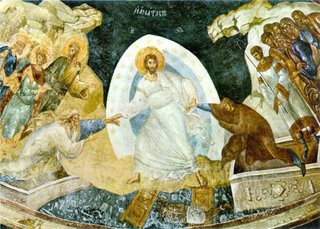
Pascha


Monastery of Chora,
Constantinople


IF CHRIST AROSE

If Christ arose and put an end
To evil's sway, can I depend
On Love's true life to set aright
A life once lived by human might,
Or must I yet alone contend?

But if he did indeed ascend
From hellish depths, I cannot rend
Myself from him, nor quench the light,
If Christ arose.

I could not on my own intend
To live anew, or hope to mend
My errant ways; but in my plight
His life will shine amid the night,
And darkness shall no more impend,
If Christ arose.

© David T. Koyzis 1990

12 April 2006

Europe's future

I have recently read George Weigel's The Cube and the Cathedral: Europe, America, and Politics Without God, which is something of a meditation on the future of the old Continent in the wake of the secularizing trends of the past two centuries. Although its format — excessively short chapters in which ideas are introduced but not adequately explored in depth — is mildly off-putting, it is a good read for a rainy sunday afternoon at home. I would thus recommend it as such. For a review of Weigel's book, read Brian M. Carney's article in Opinion Journal. Then, after you've read Weigel's somewhat bleak portrait, read this article by Matthew W. Maguire: Is Paris Turning? Some Unexpected Signs of Christian Vitality in Post-Christian Europe. Europe may no longer be wholly christian — or even very christian — but the gospel's witness is still present, thanks be to God.

11 April 2006

Refusing half a loaf

I know little of Mr. Nicos Rolandis, who was once Minister of Commerce, Industry and Tourism in the government of Cyprus, but I am coming to respect his opinions. Unlike many of his compatriots, he seems to understand that politics is the art of the possible and that, in the interest of conciliating diversity, as Bernard Crick famously described the political art, it may be necessary to scale back one's claims on the political authorities. Here Rolandis recites a litany of missed opportunities to return Varoshia to its inhabitants: The sad lady of the sea. And here he argues that history may one day judge Greek Cypriots to have "used improvement after improvement to destroy their cause": The twilight zone. Too bad Rolandis is not president of the republic.

Varoshia, Famagusta
Koyzis family archives

The abandoned city of Varoshia,
a ghost town since 1974,
as seen from the north
God's politics down under

Jim Wallis is in Australia to spread the message of his book, God's Politics. For an assessment of this book, read this.

10 April 2006

Russian church takes on liberalism

Igor Torbakov reports on the Tenth World Council of Russian People, and particularly on the role of the Russian Orthodox Church: RUSSIAN ORTHODOX CHURCH CHALLENGES "WESTERN" CONCEPT OF HUMAN RIGHTS. Torbakov charges the church with reviving the old threefold creed of Tsar Nicholas I: Orthodoxy, Autocracy, Nationality. This is from his report:

The Council's participants forcefully denounced a "distorted vision of human rights" that they claim has become prevalent in the West. Two aspects of the Western liberal concept seem to be particularly alien to Orthodox beliefs. First, the Council blasted the idea of "moral autonomy." The modern understanding of human rights postulates that an individual's moral autonomy can be limited only by the autonomy of other individuals: there is no supreme authority that can help distinguish between good and evil. Such a vision is unacceptable to the Russian Orthodox Church, which holds that turning the sovereignty and rights of a separate individual into an absolute value without the counterbalance of moral responsibility will lead to the demise of modern civilization.

The second controversial aspect of the European liberal model, according to Russian Orthodoxy, is its assertion that an individual's rights are superior to the interests of any collectivity. "There are values that are no less important than human rights," defiantly declares the statement adopted by the Council. "These are faith, ethics, [national] sacraments, Fatherland."

Not having seen a translation of the new Declaration of Human Dignity and Rights adopted by the Council, I cannot say whether Torbakov's fears are justified. However, if this report is at all accurate in its account of the two points mentioned above, then I admit to agreeing with these points, at least on the surface. On "moral autonomy," there are plenty of westerners who would resonate with the Council's expressed opposition, including Christians, observant Jews and professed communitarians. Neocalvinists would be numbered amongst the Christians in this group.

As for the second point, I too would oppose the notion that individual rights automatically trump the rights of communities. This is the crux of my disagreement with Michael Ignatieff's professed individualism. However, I would want to know whether the Declaration understands that in a healthy society the responsible agents, including communities, are always pluriform and ought not to be viewed as so many arms of the "Fatherland" or the national state. I would also wish to determine whether it makes a place for a legitimate sphere of individual responsibility. If it does not, then it may be guilty of tossing out the good with the bad in its efforts to combat liberalism.

Indeed, because the Russian Orthodox Church is well known to favour official restrictions on the work of Catholic and protestant churches within its "canonical territory," there is reason to suspect that the Declaration does not make a ringing endorsement of religious freedom. But until an English translation is published, we will not know this for certain.

09 April 2006

Palm Sunday


Theresa Koyzis


"Blessed is he who comes in the
name of the Lord.
Hosanna in the highest"
(Matthew 21:9).

07 April 2006

Michael-mania kicks into high gear

It's official: Ignatieff announces leadership bid.

06 April 2006

An interview

Peter C. Newman interviews Michael Ignatieff for Macleans. Thanks to Eric Hogeterp for calling attention to this.
Peter and the Wolf


Theresa Koyzis


Ever since her elementary school put on a production of Peter and the Wolf last spring, Theresa has enjoyed listening to Sergei Prokofiev's famous musical children's story. Here is her rendition of the characters, listed clockwise from the centre: the wolf, the hunters, Grandfather, Peter (with rope for capturing the wolf), the cat, the bird, the duck and the narrator.
Call off the hounds

University of Texas zoologist Eric Pianka does not want to see 90 percent of humanity wiped out by the ebola virus. Oh good. I guess that means that the late Pope John Paul II's warnings about a culture of death were an example of, um, overkill. Thanks to the Acton Institute for alerting us to this.

05 April 2006

Cere on Ignatieff

It seems McGill University's Daniel Cere has come to the same conclusion about Michael Ignatieff as yours truly, as indicated here: Not much new in Ignatieff's vision of liberalism, which is in fact virtually identical to that of the late Pierre Trudeau. Cere writes:

[F]or Mr. Ignatieff the basic institutions of civil society - family and religion - present serious threats to human freedom. His brand of liberalism tears down the firewall between the state and civil society. "Rights," Mr. Ignatieff argues, "are meaningful only if they confer entitlements and immunities on individuals; they are worth having only if they can be enforced against institutions like the family, the state and the church." Rights are to be used as swords against core spheres of civil society, not shields to protect them.

But here's the rub. Who gets to wield this powerful sword of rights against family and religion? Who else, but the righteous Liberal state through its courts and legislatures? In short, individuals are to be liberated by the coercive power of the state. The aggressive implications of this approach are outlined in Mr. Ignatieff's discussion of family culture in "The Rights Revolution," part of the Massey Lectures series. Mr. Ignatieff argues that we need to bring "rights talk" into the bedrooms of the nation. Rights, he insists, must be used to re-engineer society's most basic social relationships between women and men, parents and children.

This brand of liberalism wants to use the state to impose its own social vision on society: to create a society composed of autonomous individuals, freely forging, dissolving and reforging their relationships. In this view, the state must be constantly working to weaken those civil society institutions that get in the way of this free-wheeling individualism.

Although I cannot share Cere's apparent enthusiasm for John Locke and John Rawls, I believe he is correct to alert Canadians to the possible negative ramifications of an Ignatieff premiership.
Throne Speech

The 39th Parliament was convened monday and yesterday Governor General Michaëlle Jean read the Speech from the Throne, a transcript of which can be found here. Peter Milliken is once again Speaker of the House of Commons.

04 April 2006

Ignatieff on the French Revolution

The following is taken from Michael Ignatieff's The Rights Revolution (p. 127):

The elements that hold a country like Canada together run deeper than rights: the land, shared memory, shared opportunity, and shared hope. Yet [Edmund] Burke and his fellow conservatives underestimated the power of rights as a source of legitimacy and cohesion in modern societies, just as they sentimentalized the legitimacy of the ancien régime. The ancient and immemorial tissue of connections was insufficient to keep the France of the ancien régime together, and the democratic republic that succeeded it, which was based on consent and contract, has endured for two hundred years.

House of Anansi has a reputation for rushing into print the CBC Massey Lectures before the authors have had sufficient opportunity to rethink what they've said. One hopes that, if he had had more time to revise his own lectures, Ignatieff would have seen the absurdity of that last sentence and deleted it. Far from having a two-centuries-old democratic republic, France in the wake of the French Revolution experienced five republics, a reign of terror, two empires, two restored monarchies, the Paris Commune and the pro-nazi Vichy régime. If Ignatieff wants to defend a contractarian account of political authority, he needs to come up with a better example than France.

03 April 2006

Lapin on authority

Does the tendency to obey authority make people prey to totalitarian misrule? Many believe this to be the case, and Stanley Milgram's Yale University experiments nearly half a century ago have reinforced this notion. However, Rabbi Daniel Lapin makes an intriguing argument that the Nuremberg Trials, which were undertaken to bring Germany's nazi rulers to justice, had the unintended consequence of eroding respect for authority throughout the western world: Purim 2006 -- Not All Authority is Bad.
Tooley on 'peacemaking'

Here is Mark Tooley on the Christian Peacemaking Teams (CPT), three of whose members were recently rescued after months in captivity: "Christian" Group Bites the Hand that Rescues It. Of particular interest is Tooley's analysis of the difference between the historic peace churches, including the Mennonites, Brethren and Quakers, all of whom recognized the "civil state’s responsibility for military defense," and the contemporary disciples of John Howard Yoder and Stanley Hauerwas, who are less willing to admit the legitimacy of the state's possession of the coercive power of the sword.
Today's Byzcal Canadian challenge

The challenge is to come up with a story, book or magazine title with political significance. Here are three:

  • Little Red Riding Association - girl saves grandmother from wolf, runs for Liberal nomination in her constituency.

  • Jack and the (Has-)Beens Talk - NDP leader Layton converses with McDonough and McLaughlin.

  • Harper's Bizarre - monthly publication of opposition parties


  • Go ahead. Give it a try.

    02 April 2006

    Refugees' plight ignored by world

    At least since my own relatives became refugees in 1974, I have had considerable sympathy with Palestinians who lost their homes and homeland with the birth of Israel in the former British mandate. However, there is little global awareness of the nearly one million middle eastern Jews, who were forced to leave their own countries behind after 1948. Now these below-the-radar-screen refugees are taking their case to the European Union. Will EU pressure force Arab governments to reinstate their citizenships and return their properties to them? I wouldn't count on it.
    Academic revival?

    In 1995, while my then future wife was teaching at Wheaton College near Chicago, a revival occurred amongst the student body. In the online edition of Comment, Geneva College graduate Keith Martel examines the Marks of academic revival. Writes Martel:

    If, as [Charles Grandison] Finney asserts, revival is obedience unto God, then campus revival would be composed of the renewed pursuit of traditional disciplines. But the primary thrust should be distinctly marked by a passionate pursuit of living fully in the roles and vocations to which we are called—as students, as professors, and as staff workers. To truly "wake up and live" on the college campus would see Christian students, faculty and staff chasing after university life, together. It would consist of students taking their studies seriously in a transformational way, and faculty members seeing their teaching as a holy calling from the Lord of education Himself. These things would be pursued as spiritual disciplines. Instead of skipping classes to take part in prayer meetings, students might even skip their fellowship groups to create and craft serious scholarly work that exemplified and added to the Kingdom of God.

    Very nice indeed. Pray that such academic revival might come to Redeemer University College and similar institutions.

    01 April 2006

    An ancient heritage desecrated

    For anyone with roots in the northern part of Cyprus, the following article from the Assyrian International News Agency makes for depressing reading: Cyprus: Portrait of a Christianity Obliterated.


    Koyzis family archives

    A once predominantly
    Greek Orthodox village in north Cyprus

    31 March 2006

    Yet another red letter day

    Today marks the first anniversary of the last post on the winsome Mr. Brian Dijkema's exceedingly sporadic blog.
    Ignatieff in the race

    We've all seen it coming: Ignatieff all but declares leadership bid. Here is his speech, Canada and the World, delivered yesterday at the University of Ottawa. In light of Michael Ignatieff's unofficial bid for the leadership of the Liberal Party, this seems a good time to republish immediately below a column I wrote for Christian Courier, in the issue dated 23 January, the very day of the federal election:

    Although at one point in his life the Greek philosopher Plato thought that philosophers should become kings, in the real world few intellectuals gravitate towards the life of practical politics. To be sure, during his tenure as prime minister, Pierre Trudeau was often called a philosopher-king – a label as often as not used in disparaging fashion. Yet few political leaders come to their offices from the academy. Thus I was somewhat surprised to hear that Prof. Michael Ignatieff would be standing in today’s election for the Liberals in Toronto’s Etobicoke-Lakeshore riding, with his eye eventually on Paul Martin’s job.

    Ignatieff was born into an old Russian aristocratic family, which fled the Bolshevik Revolution and settled in Canada. Michael’s father George (1913-1989) was a respected diplomat, Chancellor of the University of Toronto and recipient of the Order of Canada. Michael’s maternal cousin was the late George Parkin Grant (1918-1988), whose conservative vision of Canadian nationhood was deeply antipathetic to the liberal individualism Michael has come to champion. Much of his life has been spent in Britain and the United States, and he most recently taught human rights at Harvard.

    Now he has returned to take up a position at the University of Toronto and has seized the opportunity presented by the defeat of Martin’s government to make a bid for a seat in the Commons. What sort of political leader would he be?

    While I found much to like in his 1984 book, The Needs of Strangers, in which he qualified his liberal individualism with an appreciation for community, his more recent works show him to have made a potentially troubling change in direction. The turning point seems to have been his work on the television series and companion volume, both titled Blood and Belonging: Journeys into the New Nationalism. His recognition of the dangers of nationalism appears to have made him wary of the claims of community in general.

    Thus in his Human Rights as Politics and Idolatry, Ignatieff argues that “Rights are meaningful only if they confer entitlements and immunities on individuals; they are worth having only if they can be enforced against institutions like the family, the state, and the church.” Furthermore, in The Rights Revolution, presented as the 2000 CBC Massey Lectures, he asserts that communities have value only insofar as they help individuals to achieve their own goals and aspirations.

    So what happens if the claims of individual and community come into conflict? What if, say, a church institution disciplines one of its members for being unfaithful to her husband or one of its clergy for preaching heresy from the pulpit? What if the Salvation Army “discriminates” against an otherwise qualified unbelieving prospective employee and hires a confessing Christian more obviously agreeing with the organization’s vision? Where does justice lie in these potential disputes?

    For Ignatieff the answer is simple: “Group rights – to language, culture, religious expression, and land – are valuable to the degree that they enhance the freedom of individuals. This suggests that when group rights and individual rights conflict, individual rights should prevail.” Period.

    While Ignatieff manifests a proper concern for individual liberties, it would be difficult to imagine an approach less conducive to the doing of justice to the full complexity of human social life in God's world. Rather than hearing and weighing carefully the conflicting claims in the political arena, Ignatieff has already made up his mind before the claims have even been made. Someone less charitable than I might well see fit to label this prejudice.

    Prime Minister Ignatieff? We’ll pass on that, thank you.

    30 March 2006

    Many happy returns of the day

    Birthday greetings are due to my good friend Eric Hogeterp of Ottawa. May God bless him and his family today and always. Incidentally, Eric shares his birthday with a certain obscure Upper Canadian professor of politics who has known him for just short of 18 years.

    29 March 2006

    Seasonal music

    On the first nice spring day I love to listen to Maurice Ravel's Piano Concerto in G Major, a personal favourite. I've observed this ritual virtually every year since 1973, when I was in my final year of high school, and I did so again today. This is one of two piano concertos created by the great French composer (1875-1937), the other being the single-movement Concerto for the Left Hand. Although they were written virtually simultaneously in 1929-31, their respective moods could hardly be more contrasting. Given that it was written for Paul Wittgenstein (philosopher Ludwig's brother), who had lost his right arm in the Great War, the Left Hand Concerto is sombre and dramatic.

    By contrast, the G Major Concerto is lively and even daring. The first movement, Allegramente, opens with what sounds like the crack of a whip and the release of horses onto a parade ground. The middle movement, Adagio assai, is quiet and reflective, bearing some resemblance to Erik Satie's Gymnopédies. The final movement, Presto, is frenetic in its pace, with obvious jazz influence. This time the horses appear to be in a race, slowing not in the least even to show off for the crowds, as they did in the first movement.

    The G Major Concerto is a wonderful piece richly deserving repeated listenings — and not only in spring.
    An 'oily' conservative?

    What is a "crunchy" conservative? Whatever it is, it seems to have warranted someone writing a book, as well as the creation of at least two blogs, devoted to it. If I were a conservative — which I'm not — I suppose I would be an olive oil and halloumi conservative.

    27 March 2006

    Canada's (third-)world-class postal system

    Sending a package from Chicago to Hamilton via Priority Mail seems to be the kiss of death, judging from Canada Post's performance. Today I finally received something sent in this way from the Windy City on tuesday, 14 March — two weeks ago tomorrow! Imagine if it had been sent by conventional mail. It might have been months. This is not the first time either. If I lodge a complaint from my end, I am told that only the sender can do this. But if the sender does so, the US Postal Service employee tells him it will do no good. The complaint will drop into an abyss on this side of the border and never see the light of day. It seems I'm not the only one to experience frustrations with Canada Post. This country deserves better.
    Maltese tribute to unborn

    Here's an uplifting report on a beautiful spring morning: Malta President unveils National Pro-Life monument. It's difficult to imagine this taking place here in Canada. Good for Malta.

    26 March 2006

    Religious freedom and Islam

    Western pressure has apparently succeeded in persuading Afghanistan to free Abdul Rahman, who had been under a death sentence for converting to Christianity. But what of future such converts? Will religious freedom take hold in that troubled country or is the very notion incompatible with Islam? Here is one analysis of the situation: Facing down a culture where they talk like crazies. As usual, Mark Steyn does not mince words, saying openly what others are thinking.

    25 March 2006

    Divorce at last?

    After being together for 45 years, the Canadian Auto Workers and the New Democratic Party are ending their partnership. This follows the latter's shattering discovery that the former was exchanging flirtatious glances with Canada's natural governing party. Perhaps a marriage counsellor is in order.
    Peacemakers' rescue: aftermath

    There is perhaps some irony in the three peacemakers having been liberated by soldiers fighting a war that they oppose. Are they ungrateful to their rescuers? Their sponsoring organization says no.
    And when she's not critiquing my wardrobe. . .

    Dragon and 'dragontologist'
    Source: Theresa Koyzis


    Daddy: What is it?

    Theresa: A dragon.

    Daddy: And who is that with the dragon?

    Theresa: A dragontologist.
    Russia aided Saddam?

    If the following story is true, it does not bode well for Russian-American relations, including US support for fighting terrorism on Russian soil: Russians Told Iraqi Regime of U.S. Troop Movements. Moscow is denying the charges.

    24 March 2006

    Tim's conquers North America

    Quick, call your broker — and then order a double-double: Tim Hortons shares begin trading with big gains.
    Misnomer?

    Why is this contraption I'm typing on known as a computer? I do very little computing on it, except for occasionally pulling up the calculator listed under accessories. Perhaps it's time for a global campaign to rename it a communicator, which seems to be a more accurate description of its primary use for most people.
    Catholic Democrats' statement flawed

    Fr. Thomas Williams does not think much of the Statement of Principles By Fifty-Five Catholic Democrats in the U.S. House of Representatives. Although it claims to express a commitment to the dignity of life and the belief that government has a moral purpose, Fr. Williams finds it to be weak in defending the unborn. According the statement's authors, "In all these issues, we seek the Church's guidance and assistance but believe also in the primacy of conscience."

    A comment and a question are in order. First, the primacy of conscience sounds more Quaker than Catholic to me. I doubt that the signatories ran this by their bishops to see whether it passed doctrinal muster. Second, to whom is this statement addressed and why? Catholic voters? Fellow members of Congress? The Catholic Church? Are they presuming to set themselves up as an alternative magisterium? Just curious.
    Princeton Seminary opening

    Now that Max Stackhouse is retiring as the de Vries Professor of Reformed Theology and Public Life at Princeton Seminary, the position is now being advertised. Off hand, while I can immediately call to mind dozens of neocalvinist scholars in the social sciences, humanities and even the natural sciences, I am hard pressed to think of many neocalvinist theologians who would appropriately fill such a vacancy. Have we been neglecting this discipline?

    23 March 2006

    Miraculous deliverance

    Thank God for answering the prayers of so many: Canadian hostages in Iraq rescued.

    22 March 2006

    Visions and Illusions in Illinois

    Scroll down the webpage of this young undergraduate and see which book he is currently reading. My guess is that David Van Heemst is assigning it to his students at Olivet Nazarene University south of Chicago.
    Perhaps Theresa was right

    Daddy's dreaded vest

    Daddy's dreaded vest
    Defending 'justice' in Afghanistan?

    Could Canadian and American troops really be defending a régime in which this could happen: Christian convert faces execution in Afghanistan? Now prosecutors think Abdul Rahman must be mad: "He is not a normal person. He doesn't talk like a normal person." Scripture concurs: "For the word of the cross is folly to those who are perishing, but to us who are being saved it is the power of God" (I Corinthians 1:18).

    20 March 2006

    The last Soviet stronghold

    What? We are shocked! shocked! that anyone would dare question the fairness of yesterday's presidential election in Belarus.


    Source: Pravda

    Alexander Lukashenko
    Cyclone Larry

    If you're visiting Australia, here's a good reason to be in Victoria or New South Wales rather than Queensland.
    From my severest fashion critic

    To Dad: Do not wear that vest again
    Source: Theresa Koyzis

    19 March 2006

    Domain change

    Some readers may have noticed from the sidebar that Redeemer University College has changed its domain name from redeemer{dot}on{dot}ca to the simpler redeemer{dot}ca. This is effective immediately and impacts both the web address and email addresses. However, for the time being the earlier address will continue to take one to the right place.
    Demography and 'patriarchy'

    My good friend Richard Greydanus draws our attention to Phillip Longman's Foreign Policy article, The Return of Patriarchy. Longman argues that, in a society which spurns patriarchy, the birthrate inevitably declines. On the other hand, those conservative subcultures affirming patriarchy continue to have children and over the long term will overtake the ostensibly progressive people who are procreating at below replacement level. Greydanus is critical of this thesis, arguing that Longman has made population stability a golden calf. I doubt that's an entirely justified critique, and I suspect that the term patriarchy is posing something of an obstacle to a fair reading of Longman.

    Jennifer Roback Morse makes an argument similar to Longman's but avoids this hot-button word. Her focus is the failure of the European welfare state, which, despite providing "economic subsidies to child-bearing", has been unsuccessful in pushing up the birthrate because it is "attempting to replace the father." If one focusses, not on patriarchy with its connotations of male domination, but on the crucial role of fathers in society, then Longman's thesis might be more easily heard.

    While the welfare state need not be intrinsically anti-family, most of the existing models are indeed predicated on the assumption that individuals should be able to make choices in a variety of settings irrespective of familial and marital obligations. This corresponds to what I have elsewhere called the choice-enhancement state, the fifth stage in the historic development of liberalism. While the socialist welfare state is communitarian in focus, undertaking to protect the working class, as a class, from the abuses of the market, the late liberal welfare state tries to cushion individuals, irrespective of their lifestyle choices, from their destructive consequences. Thus the state is free to redefine even the most central of institutions, such as marriage and family, because it is naïvely assumed that the largesse of the welfare state will compensate for the inevitable social fallout of such redefinitions.

    Yet in subverting family and marriage, the late liberal welfare state appears to be eroding its own undergirding foundations. Demographic collapse is one consequence of this, and a notable one at that. Others have noted the decline south of the border in support for abortion on demand, as the pro-choice segment of the citizenry steadily declines due to a failure to bring forth a generation to which to bequeath the pro-choice vision. One need hardly be guilty of making an idol of population stability for merely pointing out that a healthy civilization depends upon the existence of sufficient numbers of people to keep it going.

    Although I am not a nostalgist for a premodern past, I sometimes wonder whether western societies went wrong in leaving marriage and family up to the devices of individuals. I myself am only two generations removed from arranged marriage. While I do not favour bringing this back, it is far from evident that the love match is a better basis for a healthy marriage. Over the long term can a civilization survive that leaves an institution so crucial to its perpetuation to the vagaries of individuals falling in and out of love? Does marriage become just one more lifestyle choice amongst others? And if so, does childbearing take on a similar status?

    Perhaps it's time for Christians in particular to be more proactive in encouraging their young people to marry and in readying them for the responsibilities of marriage. Might a christian university such as Redeemer have a role to play in this? What about churches? In the past I might have played down such a possibility, but now I'm not so sure.

    15 March 2006

    Alumni news

    I am pleased to announce that three alumni of Redeemer's political science programme have recently taken on new employment opportunities.

    Last week Eric T. Hogeterp (graduated 1993), who is a faithful reader of this blog, assumed the position of Special Assistant: Policy for the Honourable Maxime Bernier, Member of Parliament for Beauce (Québec) and Minister of Industry in the new Conservative government of Prime Minister Stephen Harper.

    In September Dr. Paul A. Brink (1993) will become Associate Professor of Political Studies at Gordon College, Wenham, Massachusetts. I myself have a number of personal connections with Gordon, as two sisters, a brother-in-law, a niece and a nephew-in-law all graduated from there. Moreover, my first trip to Europe back in 1975 was with Gordon's European Seminar. It was on the plane that summer between Amsterdam and Boston that I first met Dr. William A. Harper, who was teaching political studies at Gordon. Brink will be replacing Harper on his retirement. One more connection: James W. Skillen, of the Center for Public Justice, taught at Gordon in the late 1970s before moving to Dordt College and eventually to the Center.

    Finally, Derek Miedema (1995), formerly pastor of the Christian Reformed Church in Dresden, Ontario, has taken a position as Researcher at the Centre for Faith and Public Life with the Evangelical Fellowship of Canada.

    Congratulations and may God bless them as they serve in their new positions.

    13 March 2006

    The Crown and the constitution

    The Queen is in Australia this week where, among other things, she will open the Commonwealth Games in Melbourne.

    Coincidentally, I have been reading Edward McWhinney's The Governor General and the Prime Ministers: The Making and Unmaking of Governments. Now that Canada is in a second minority government situation in nearly as many years, McWhinney's book is especially timely. His treatments of the King-Byng constitutional crisis of 1926, the Whitlam Dismissal of 1975, the defeat of Joe Clark's government in 1979 and other events of constitutional import are readable and informative. (On the other hand, the book appears to have been rushed into print. There are errors in his account, most notably in his treatment of the changes of government in Ontario between 1985 and 1990.)

    Because I came of age in the US at precisely the moment when a presidency had become incapacitated, I can appreciate the value of a division of labour between head of state and head of government characteristic of many polities, including Canada. At the same time, I do tend to wonder whether the governor general's office here constitutes a sufficient check on the vast powers of the prime minister. It would not be a bad thing to see a governor general act somewhat more resolutely to keep the PM in line. However, as long as she or he is effectively appointed by the PM himself, this is not likely to occur.
    Loving ordinately

    Speaking of John Buchan, Gideon Strauss is trying to decide whether he agrees with one of the Scottish author's characters, Janet Raden, when she says, "... all wisdom consists in caring immensely for the few right things and not caring a straw about the rest." I find it surprising that someone who delights in drawing up interminable lists of things loved would have difficulty seeing the flaw in this statement. Here's Augustine on the subject:

    When the miser prefers his gold to justice, it is through no fault of the gold, but of the man; and so with every created thing. For though it be good, it may be loved with an evil as well as with a good love: it is loved rightly when it is loved ordinately; evilly, when inordinately. It is this which some one has briefly said in these verses in praise of the Creator: "These are Thine, they are good, because Thou art good who didst create them. There is in them nothing of ours, unless the sin we commit when we forget the order of things, and instead of Thee love that which Thou hast made."

    But if the Creator is truly loved, that is, if He Himself is loved and not another thing in His stead, He cannot be evilly loved; for love itself is to be ordinately loved, because we do well to love that which, when we love it, makes us live well and virtuously. So that it seems to me that it is a brief but true definition of virtue to say, it is the order of love. . . .

    Unless I am misreading it, it seems to me that the Buchan quote is a recipe for idolatry, which consists in esteeming a very few things inordinately at the expense of everything else. This is sure to make for an imbalanced life.

    12 March 2006

    I wonder. . .

    . . . whether James W. Skillen and Ed Grootenboer were responsible for choosing the title of their respective books. And, if so, did they compare notes first?
    Liberties threatened

    Constitutional guarantees are only as good as the determination of political leaders to honour them. Unfortunately, despite the First Amendment's claim to protect religious freedom in the United States, such freedom is nevertheless being attenuated in two New England states.
    Roe v. Wade plus 33

    Amherst College Professor Hadley Arkes sets out a plausible scenario whereby the US Supreme Court's controversial 1973 decision, Roe v. Wade, might suffer death by a thousand qualifications without being explicitly overturned.

    11 March 2006

    Nassif on Orthodoxy

    Bradley Nassif teaches theology at North Park University in Chicago. Amongst his more scholarly writings, this popular article stands out as a gem: Reclaiming the Gospel. Here's Nassif:

    I am convinced that the Orthodox Church preserves the fullness of God's truth, but I am equally persuaded that we have not made that truth meaningful and accessible to our own Church members. The most urgent need in the Orthodox world today is the need for an aggressive "internal mission" of (re)converting our people to Jesus Christ. The gospel of Christ and our life in Him need to be reclaimed as the very centerpiece of Church life.

    This is enough to warm the heart of even a Byzantine-rite Calvinist. It confirms my longstanding global impression that, amongst the various Orthodox jurisdictions in North America, the Antiochian Orthodox are the best of the lot. Worthy of note is Nassif's repudiation of the dark influence of nationalism — something which sadly afflicts the Greeks and Russians and contributed to the partition of Cyprus, among other things.

    08 March 2006

    Famagusta

    Someone has posted video footage of a visit last year to Famagusta, Cyprus, including the old walled city, which is still inhabited, and the Varosia neighbourhood to the south, which is a ghost town. Extraordinary.

    06 March 2006

    Yum, good

    I sometimes wonder whether, some four decades ago, I might have been the only boy in North America to consider lima beans, black-eyed peas and spinach turnovers comfort food. I think it's entirely possible.

    spinach turnovers
    Spinach turnovers
    We have a winner

    The only real reason to pay attention to the Academy Awards: 'Wallace & Gromit' wins Best Animation Oscar.

    05 March 2006

    Speaking of . . .

    . . . Notre Dame, a well-known evangelical university is losing its star professor to a better-known Catholic university in northern Indiana: Mark Noll Leaving Wheaton for Notre Dame. He will be a tough act to follow. But Wheaton's loss is . . . well, you complete the sentence.

    And speaking of Wheaton College, on friday Redeemer was privileged to host Dr. Vincent Bacote, an evangelical convert to the neocalvinist vision of Abraham Kuyper. He is a lively speaker and we were pleased to have him among us for a time. I have recently acquired a copy of his book, The Spirit In Public Theology: Appropriating The Legacy Of Abraham Kuyper, and look forward to reading it.

    And finally, speaking of conversions to neocalvinism, what could have prompted someone ordained to the ministry of the most liberal protestant denomination in the US to take an interest in Kuyper's vision of cultural engagement — and to bring that vision to a known bastion of Barthianism at that? Read about his pilgrimage here: On Being Reformed: An Interview with Max Stackhouse.

    03 March 2006

    Prophetic Politics Goes to Washington?

    Timothy Sherratt's Capital Commentary, dated 6 March, is excellent and worth reproducing in full:

    When Jim Wallis speaks at Christian colleges, as he did at Gordon College last week, his message is clear and concise: evangelical Christians engage in selective moral crusades, he says. On life and sexuality issues, they take strong orthodox stances. Then Wallis pauses, looks out at his evangelical audience, and declares that these are indeed serious moral issues. But why, he protests, do Evangelicals overlook the Bible's 2,000 references to the poor and fail to mount moral campaigns to end poverty?

    Wallis's model for Christian action is the Civil Rights Movement. His heroes are prominent private citizens, not public officials. This is a formula that resonates with American culture.

    To his credit, Wallis wants Christians to embrace a comprehensive social ethic. He does not seek to exchange conservative moral issues for liberal moral issues. The Christian ethic he advocates penetrates the boardroom and the budget, as well as the bedroom.

    As the 2006 midterm elections loom, could evangelical politics achieve the synthesis Wallis seeks, marrying traditional positions on personal moral questions to moral commitments to end poverty?

    In class last week, a student remarked, light dawning and penny dropping, how evangelical the left-wing Wallis is. What did he mean? I asked. Well, he went on, Wallis does not show much patience with the governing process itself. Instead, he wants partisan differences and expedient politicians to be swept up in an irresistible wind of change. These instincts, if not Wallis's policy preferences, are shared by most Evangelicals. His religious convictions bring ends into focus, but not means. He calls for an end to poverty but not for reform of the electoral system, or a curb on executive power, or the launch of a new political party. Politics is part of the problem, never the solution. The solution can only come from the outside, from The Movement.

    Wallis's impatience with politics rallies the faithful, but it cannot make for good government.

    There is ample evidence of a shift among Evangelicals towards the comprehensive morality Wallis calls for. It was palpable in his audience last week. And it was evident in the recent launch of the Evangelical Climate Initiative.

    This shift is taking shape through the doctrine of stewardship, which has brought a fresh understanding of our obligation to care for the environment. Stewardship is just one doctrine that branches out from the root that is the biblical view of the human being, however. There are many such branches. In the Catholic tradition, one of the more vigorous obliges society to show solidarity with its weakest members; while another helps us recognize the responsibility of the family to raise children, and the state to do justice, and commerce to serve the common good. Moral crusades conflate these distinctive and irreplaceable responsibilities.

    Prophets are equally irreplaceable, however. They rebuke the corruption of the powerful and call them to resume their true offices, as Nathan rebuked King David. Evangelicalism's prophetic politics does the first but overlooks the second. The omission is fatal. We will not recognize that a clean environment, responsible sexuality, and protection of society's weakest members are values that flow together rather than against one another if we remain outside the political process.

    For a quarter century, Republicans and Democrats have pitted these values against one another. To reject this contradiction and take the moral synthesis into the public square, a new commitment to politics and government, perhaps even a new political organization, will be necessary. If Evangelicalism's prophetic politics were, in this fashion, to break the mold of American politics, it would at last have come of age.

    -Timothy Sherratt, Political Studies, Gordon College

    02 March 2006

    Monaghan's city on a hill

    Pizza magnate Tom Monaghan is well known in conservative Catholic circles for having begun a Catholic university in Ypsilanti, Michigan, which he is in the process of moving to Naples, Florida. To further advance the vision of his university, he has now begun building an entire city, as indicated in this Toronto Star article: On a mission from God. Given that I teach at a similar christian university started from scratch scarcely 25 years ago, I naturally find the project of creating a Catholic university appealing. Nevertheless, I find myself wondering whether it is run by a board of governors sufficiently distant from its principal (or only?) donor. If not, then it may not have staying power over the long term.

    As for the city of Ave Maria, this seems like an enterprise more typically associated with protestants, ranging from the New England Puritans to the Rev. John Alexander Dowie's Zion City on the shores of Lake Michigan north of Chicago. My hometown of Wheaton, Illinois, some 40 km west of Chicago, had some of the features of a confessionally-based city, with its prohibition of the sale of alcoholic beverages within the city limits well into my adulthood.

    As for precedents on the Catholic side, Monaghan's lawyers might wish to look at the University of Notre Dame, which is its own municipality – Notre Dame, Indiana – complete with its own post office and postal code.

    Followers

    Blog Archive

    About Me

    My photo
    Contact at: dtkoyzis at gmail dot com