Ledra Street to remain closed
As usual, the government of Cyprus appears determined to forgo another opportunity: Greek Cypriots reject new crossing point to the north.
29 November 2005


28 November 2005
Government falls
It's off to the polls for Canadians, after the Martin government is defeated in the Commons. Few people may be aware of this fact: "The Liberal defeat marks the first time a government has fallen on a straight motion of no-confidence in Parliament."
In other news, Prince Edward Islanders overwhelmingly rejected electoral reform, sad to say.
Electoral reform in PEI?
Prince Edward Islanders vote today on whether to adopt a mixed-member-proportional electoral system, which just happens to be my personal favourite. Let's hope the measure will win at least "60 per cent of the votes, and majority support in at least 16 of the island's 27 electoral districts."
Prince Edward Islanders vote today on whether to adopt a mixed-member-proportional electoral system, which just happens to be my personal favourite. Let's hope the measure will win at least "60 per cent of the votes, and majority support in at least 16 of the island's 27 electoral districts."
Blood and belonging to the Liberals
Ukrainian-Canadians do not want Michael Ignatieff running for the Liberal Party in the forthcoming winter election. Neither do I.
Ukrainian-Canadians do not want Michael Ignatieff running for the Liberal Party in the forthcoming winter election. Neither do I.
27 November 2005
Cyprus: unilateral reunification?
This is a rather extraordinary development, coming as it does on top of last week's news: TRNC launches one-sided initiative towards reunification of divided Cyprus. Ten years ago this past summer, Nancy and I stood at the barricade at the north end of Ledra Street in Nicosia, saddened at our inability to walk any further into the occupied zone. And now it's being opened.
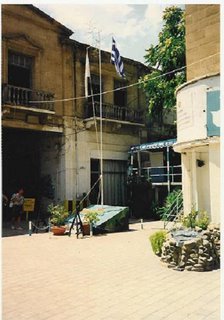

Could this be the beginning of the end of Cyprus' division? Perhaps, but there are possible complications: Greek side raises concerns over Ledra crossing. Nevertheless, this Cyprus Mail editorial holds out hope: Ledra crossing a step in the right direction.
This is a rather extraordinary development, coming as it does on top of last week's news: TRNC launches one-sided initiative towards reunification of divided Cyprus. Ten years ago this past summer, Nancy and I stood at the barricade at the north end of Ledra Street in Nicosia, saddened at our inability to walk any further into the occupied zone. And now it's being opened.
Could this be the beginning of the end of Cyprus' division? Perhaps, but there are possible complications: Greek side raises concerns over Ledra crossing. Nevertheless, this Cyprus Mail editorial holds out hope: Ledra crossing a step in the right direction.
26 November 2005
Conservatives. . . and conservatives
There are conservatives. And then there are conservatives. In the latest entry in the WRF's Comment series, Russ Kuykendall reviews Adam Daifallah and Tasha Kheiriddin's Rescuing Canada's Right: Blueprint for a Conservative Revolution. Although Kuykendall (aka Burkean Canuck) and I undoubtedly share much in terms of political perspective, I have never been enthusiastic about wearing the conservative label, whether begun with an upper- or lower-case C. I will not go into detail explaining this reluctance, because anyone can easily discover this in chapter 3 of my book.
That said, however, I will be the first to admit that, if the secular media were to pay any attention to me, they would almost certainly peg me as some sort of conservative, mostly because I oppose legalized abortion on demand, support a stable definition of marriage and family, and believe that government is under no obligation to manifest a supposedly benign neutrality towards a variety of personal lifestyle choices, much less to subsidize them.
All the same, the variety of conservatism I dislike most is the libertarian variety, exemplified by the likes of Ayn Rand and Friedrich von Hayek. Conrad Black is a caricature of the libertarian conservative, in which the common good or the public interest is ancillary to the ego of the sovereign individual — especially the individual with the economic means to have his own way. As I've written before, a government content only to protect a free economic marketplace falls short of doing public justice. It should encourage the wealthy to use their resources for the public benefit, probably through a careful design of the tax code. Those conservatives who can recognize this are worth co-operating with. By contrast, those claiming the conservative label, but who, following Marx's stereotype, do no more than to try to conserve their own spending power, are definitely not worth the time of day.
Arguing About a War In Question
Here is the latest Capital Commentary from the Center for Public Justice, by Center president James W. Skillen:
Here is the latest Capital Commentary from the Center for Public Justice, by Center president James W. Skillen:
Ask yourself just one question. During all the argument over the past three weeks about whether U.S. forces should leave Iraq quickly or stay the course, why was there so little reference to the upcoming Iraqi elections on December 15?
President Bush says American troops will stand down when Iraqi forces are ready to stand up. But what is the relation between military forces (whether theirs or ours) and the future Iraqi government? Can Iraqi forces be made ready to take over even if a stable Iraqi government doesn't materialize after December 15? On the other hand, if Iraqis do elect a government on December 15, will it really be governing Iraq if American forces, under U.S. command, are still required for many more years?
At the beginning, the American military intervention in Iraq aimed to overcome Saddam Hussein's imminent threat to the security of the United States and Iraq's neighbors. Then it became a war to liberate the Iraqi people from an oppressive dictator. And then it became a war to bring democracy to Iraq and the wider region. Yet on those terms, once Hussein was gone and a new constitution and transition government were in place, what enemy was left for the American military to fight?
The enemy that still exists, we hear, is the Sunni terrorist insurgency within Iraq itself, along with some anti-American jihadists coming in from outside Iraq. However, as even Secretary of Defense Donald Rumsfeld and American commanders now state publicly, that enemy cannot be defeated by American military forces. But then the question again: what "war" is the American military now fighting?
This is where the remaining words and phrases we have grown so accustomed to using over the past three years become more and more slippery. The so-called "Iraqi forces" in the now "liberated" Iraq, which is about to certify its "democracy" with elections on December 15, may be a mirage. The military and police forces that the American military is trying to train in Iraq come from, and are primarily dedicated to, Shiite, Kurdish, and Sunni communities. Many, in fact, are tied to, if not directly representative of, militias in those regions. In that respect, there is not an independent "Iraqi force," like our American military, under the firm control of a national government and independent of all local governments.
Furthermore, those diverse forces in Iraq closely align with the new constitutional order of the country, an order that, above all, solidifies the independence and autonomy of Shiite and Kurdish regions. The Iraqi constitution is far weaker than the American Articles of Confederation that failed our culturally homogeneous colonies after 1776.
This is why the "war" in Iraq is so disconnected from the upcoming elections and vice versa. If the elections are successful, in the same way that the passage of the constitution was successful, the not-yet-unified country of Iraq will be dominated by a Shiite majority. That majority will respect and largely ignore the Kurds, who will govern themselves. And it will either succeed in putting the Sunni minority in its place or will have to fight that minority if enough Sunni factions continue their terrorist insurgency. If the elections are unsuccessful, it will simply mean that the civil war has already begun.
This is why the main planning now being done in Washington is for the exit of American forces rather than for an expanded program of nation building. Within the framework of American policy our military no longer faces an enemy it can defeat, and nation building was never part of our plan. I just hope that the sad moment will never come when Americans are willing to accept the post-exit explanation that after our forces "liberated" and brought "democracy" to Iraq, the "Iraqi people" apparently did not want to keep it.
— James W. Skillen, President
25 November 2005
Black wants back
This request might be just a trifle opportunistic: Black wants citizenship back. And just what does Canada have to gain from this? Someone badly needs to tell Lord Black that citizenship is not a consumer item, to be removed and put on again at whim — like one of his wife's pair of shoes.
This request might be just a trifle opportunistic: Black wants citizenship back. And just what does Canada have to gain from this? Someone badly needs to tell Lord Black that citizenship is not a consumer item, to be removed and put on again at whim — like one of his wife's pair of shoes.
24 November 2005
Hope for Cyprus?
The British think-tank Chatham House has expressed doubts that Cyprus' reunification could ever be made to work, as indicated in this Cyprus Mail report and in the Chatham House press release. However, the Financial Mirror reports an intriguing development: Is Turkey imposing a legal solution on Cyprus? According to the report:
It remains to be seen how Papadopoulos and the Greek Cypriot government will respond to this initiative.
The British think-tank Chatham House has expressed doubts that Cyprus' reunification could ever be made to work, as indicated in this Cyprus Mail report and in the Chatham House press release. However, the Financial Mirror reports an intriguing development: Is Turkey imposing a legal solution on Cyprus? According to the report:
Reports that the Turkish government is pushing the Turkish Cypriot administration to change its constitution so that Greek Cypriots can be allowed to return to the property from which they fled during the invasion in 1974 has taken the (Greek Cypriot) Republic of Cyprus government in the south completely by surprise. However, if reports are true, it could a sign that, in the absence of agreement with all parties, Turkey will follow in the footsteps of Israel’s Ariel Sharon and implement its own solution.
It remains to be seen how Papadopoulos and the Greek Cypriot government will respond to this initiative.
23 November 2005
A new cause célèbre?
For those of us non-coffee drinkers, is there such a thing as fair-trade Postum?
For those of us non-coffee drinkers, is there such a thing as fair-trade Postum?
21 November 2005
Danish for breakfast?
After decades of gutting Canada's military capacity, the federal government finds another way to assert sovereignty in the arctic.
After decades of gutting Canada's military capacity, the federal government finds another way to assert sovereignty in the arctic.
19 November 2005
Neuhaus on American ecclesiology
One hates to lift a single sentence out of its larger context, but what Fr. Richard John Neuhaus says here has a certain aphoristic quality and is definitely worth repeating: "In the absence of a strong and deep ecclesiology, American Protestantism has always been prone to embrace America as its church, and to react with angry disillusionment when America fails to live up to that role." Coming from someone who so often seems to ascribe redemptive significance to what he insists on calling the American experiment, such a statement is striking. It also bears no small resemblance to what was written here: A mixed legacy: evangelicalism's puritan roots.
One hates to lift a single sentence out of its larger context, but what Fr. Richard John Neuhaus says here has a certain aphoristic quality and is definitely worth repeating: "In the absence of a strong and deep ecclesiology, American Protestantism has always been prone to embrace America as its church, and to react with angry disillusionment when America fails to live up to that role." Coming from someone who so often seems to ascribe redemptive significance to what he insists on calling the American experiment, such a statement is striking. It also bears no small resemblance to what was written here: A mixed legacy: evangelicalism's puritan roots.
Beignets du monde
If the Dutch have their oliebollen and the Greeks their loukoumadhes, what do Canadians have? Timbits!
If the Dutch have their oliebollen and the Greeks their loukoumadhes, what do Canadians have? Timbits!
18 November 2005
Expats' extravagance exposed
How the mighty are fallen: Rise and fall of the doyen of decadence. There's more here: Black's career takes a further step into darkness.
Later: Some of the very wealthy are keenly aware of their responsibility to use their wealth for the benefit of others. Lord Black appears not to have been among those, as indicated in this episode related by Iain Benson of the Centre for Cultural Renewal. Black apparently once asked, "since when is greed a crime?" I guess he's finding out for himself.
16 November 2005
'Fair-trade' coffee?
One of my colleagues sells fair-trade coffee. But John Larrivee, an economist at Mount St. Mary’s University, argues that the notion of fair-trade coffee is flawed, citing analogies to other products: Why Not Fair-Trade Beer and Cakes? Is Prof. Larrivee wrong or right in his analysis? If the former, where does he go wrong?
One of my colleagues sells fair-trade coffee. But John Larrivee, an economist at Mount St. Mary’s University, argues that the notion of fair-trade coffee is flawed, citing analogies to other products: Why Not Fair-Trade Beer and Cakes? Is Prof. Larrivee wrong or right in his analysis? If the former, where does he go wrong?
Try these with your waffles
For the second morning in a row our Theresa has requested kalamata olives for breakfast. Yesterday she ate these for all three meals. Typical second-generation Byzantine-rite Calvinist, I suppose.
For the second morning in a row our Theresa has requested kalamata olives for breakfast. Yesterday she ate these for all three meals. Typical second-generation Byzantine-rite Calvinist, I suppose.
Putin's Russia
Last week one of my colleagues called my attention to this fascinating article: Reading Russia Right, by Dmitri Trenin. Here is the abstract:
In my Russian politics class this semester, we have discussed the constitution of the Russian Federation, including both the written document and the "unwritten" constitution as it actually functions. Here is Trenin's verdict on the latter: "[Vladimir] Putin’s regime is openly czarist. Its defining element is that the presidency is the only functioning institution." This underscores my own thesis that constitutional democracy presupposes supportive political traditions, the development of which takes time.
Last week one of my colleagues called my attention to this fascinating article: Reading Russia Right, by Dmitri Trenin. Here is the abstract:
After the fall of Communism, Russia reverted to czarism. But more importantly, Russia embraced capitalism. Although not democratic, Russia is largely free. Property rights are more deeply anchored than they were five years ago, and the once-collectivist society is going private. Indeed, private consumption is the main driver of economic growth. Russia’s future now depends heavily on how fast a middle class — a self-identified group with personal stakes in having a law-based government accountable to tax payers — can be created. The West needs to take the long view, stay engaged, and maximize contacts, especially with younger Russians.
In my Russian politics class this semester, we have discussed the constitution of the Russian Federation, including both the written document and the "unwritten" constitution as it actually functions. Here is Trenin's verdict on the latter: "[Vladimir] Putin’s regime is openly czarist. Its defining element is that the presidency is the only functioning institution." This underscores my own thesis that constitutional democracy presupposes supportive political traditions, the development of which takes time.
14 November 2005
'I told you so'
Science has proved what mothers have known for ages: Cold weather may help cause colds. Of course some of us have been wearing hats all along. Watch for my salute to hats coming soon in this space.
Science has proved what mothers have known for ages: Cold weather may help cause colds. Of course some of us have been wearing hats all along. Watch for my salute to hats coming soon in this space.
12 November 2005
The Whitlam dismissal, plus 30
Yesterday marked the 30th anniversary of a constitutional crisis that can still get Australians hot under the collar.
Yesterday marked the 30th anniversary of a constitutional crisis that can still get Australians hot under the collar.
Just out from Comment
Here, as promised, is my contribution to the debate raging on the virtual pages of Comment: The city and its renewal.
Here, as promised, is my contribution to the debate raging on the virtual pages of Comment: The city and its renewal.
Subscribe to:
Posts (Atom)