Showing posts with label courts. Show all posts

07 September 2010

Juristocracy versus democracy

Under its late founding editor, Fr. Richard John Neuhaus, First Things made its reputation in part by its opposition to the judicial usurpation of democracy, culminating in its controversial 1996 symposium under that title. Those interested in the topic would do well to read James Grant's fascinating article, The Scourge of Juristocracy, published in the spring 2010 issue of The Wilson Quarterly. In the United States, and increasingly in Canada, opposition to an apparent judicial supremacy comes in conservative guise. The courts are presumed to be imposing progressive values on a recalcitrant public in the habit of maintaining older institutions and mores. In this respect First Things has tended towards what I would call a highbrow populism, based on the (not altogether incontestable) assumption that the people possess an innate wisdom superior to the political illusions of their élites.

However, by Grant's account, the historical development of juristocracy is more complicated than this: in the first years of the last century American courts were often seen as obstructing the progressive will of elected legislatures, culminating in the Supreme Court's early opposition to Franklin Roosevelt's New Deal legislation. Grant traces the diverging paths of Britain and the US in their respective attitudes to the role of judges and courts in the political process, with Britain embracing parliamentary supremacy after 1688 and the United States adopting Blackstone's more conservative respect for the judge-made English common law. In the latter a political role for the courts could be seen as a concession to the classical mixed constitution:
Modern judicial activism is in many ways an expression of the old belief that democracy must be tempered by aristocracy—an idea that was prevalent in the late 18th century and now masquerades in democratic garb. The main vehicle by which judicial activism has been brought about is, of course, the language of rights. Coinciding with the articulation of the secular, anti-religious feelings of the Enlightenment, the flourishing of constitutional debate in the 18th century witnessed regular appeals to the idea of inalienable natural rights, which took on a sacred role. But it was only in the latter half of the 20th century that the idea (now described as human rights) became an intrinsic part of legal and political discourse. For many today, a world without rights enforced by a judiciary is unthinkable. Especially in undemocratic regimes and in new or unstable democracies beset by deep corruption and other ills, rights-based judicial review is a necessary protection against arbitrary government. But in ostensibly healthier democracies, it inevitably comes at a cost.

For the most part I find Grant persuasive. However, conspicuously absent from his analysis is a recognition of the important role of political culture in the protection of rights and in the smooth functioning of a constitution. A political culture includes a variety of attitudes, usages and mores that condition the ways people act politically. Respect for the rule of law, for example, cannot be legislated into existence where it does not already enjoy longstanding support in the culture of a particular body politic.

Americans have long esteemed their 18th-century founders as near geniuses who crafted a carefully balanced system of government that has proved durable over the course of more than two centuries. However, from the standpoint of the student of political culture, this esteem, while not altogether misplaced, somewhat misses the point. Without a supportive culture of respect for constitutional government, no political framework, however well-thought-out, could have survived for long.

This has implications for the functioning of courts as well. Here's Grant once again: "Especially in undemocratic regimes and in new or unstable democracies beset by deep corruption and other ills, rights-based judicial review is a necessary protection against arbitrary government." This conclusion is open to question at the very least. If corruption is as deep-seated as it is in many countries, it is a rather tall order to expect the courts to function in a way that places them above such ingrained patterns of public life. Moreover, even if the courts somehow manage to free themselves from the taint of corruption and tyranny, there is no inevitability that the governments at issue will heed their rulings, especially if the citizenry is accustomed to such governmental arbitrariness.

It would be interesting to see how a recognition of the pivotal role of political culture might change the debate surrounding the role of the courts in a political system.

Crossposted at First Things: Evangel

22 May 2010

Canadian court defends religious freedom . . . or does it?

The Charter of Rights and Freedoms claims to guarantee all Canadians certain fundamental freedoms, including “freedom of conscience and religion” and “freedom of association.” However, following American precedent this country’s courts have tended to interpret religious freedom rather narrowly, viz., as the right of individual citizens to worship freely. Whether communities are recognized to possess religious freedom is unclear in contemporary jurisprudence, given the dominating influence of liberalism.

Take the recent case of Heintz v. Christian Horizons. Christian Horizons is a more than 40-year-old organization dedicated to the care of mentally handicapped persons. Like many confessional organizations, it has a faith and lifestyle statement which employees are required to sign. Ten years ago an employee was dismissed for not living up to this statement. She filed a complaint with the Ontario Human Rights Tribunal, which ruled in her favour two years ago, holding that a Christian ministry could not impose such requirements on its own employees if it served the larger community rather than its own members. On appeal, however, the Ontario Divisional Court in Toronto upheld the right of Christian Horizons to adopt such a statement. Or did it?

The Evangelical Fellowship of Canada immediately claimed victory for charities across the country. Others were not so sure: Faith-based charity ruling too murky, experts say. Even the EFC’s general legal counsel Don Hutchinson, writing in the National Post, was less than favourably impressed by the ruling: Heintz v Christian Horizons: Solomon would not approve. So is religious freedom in Canada secure? Despite the Charter guarantees that appear to say yes, court interpretations leave the matter open.

While we are on the subject of religious freedom, I will take the opportunity to call American readers’ attention once more to the important work being done by my friend Stanley Carlson-Thies and the Institutional Religious Freedom Alliance in Washington, DC, which “works to safeguard the religious identity and faith-shaped standards and services of faith-based organizations, enabling them to make their distinctive and best contributions to the common good.” Given the high stakes involved, it deserves the moral, financial and prayer support of the larger Christian community. Right now we could use such an effort in the True North Strong and Free.

21 October 2008

The abortion debate

Here in Canada abortion appears to be on the radar screen of no major political party or politician. After Brian Mulroney's failed attempt to enact a law regulating abortion more than a decade and a half ago, it was dropped from the national agenda, a political hot potato that no one wanted to touch. We Canadians are largely a quiescent lot, unwilling to rock the boat on the most divisive of issues, seemingly content to allow our élites to act on our behalf.

Our cousins to the south have no such qualms about raising and tackling difficult issues. This was exhibited in the third presidential debate last week between John McCain and Barack Obama, where Bob Schieffer brought up the issue. Although views on abortion once crossed party lines some three decades ago, they no longer do. The Republican Party platform is now definitively on the pro-life side, even if not all Republicans necessarily agree with this position. Similarly, the Democratic Party is now solidly on the pro-choice side, with dissidents increasingly relegated to the margins of, if not completely excluded from, the party. Democrats who were once pro-life have gradually been brow-beaten into going along with their party's mainstream.

In the wake of the debate, it would be difficult to imagine two more contrasting responses by fellow Christians than these: At Long Last: Obama, Abortion, and the Courts, by Fr. Neuhaus; and A New Conversation on Abortion, by Jim Wallis.

First, Neuhaus. My perceptions of how the two candidates comported themselves are at such variance with Neuhaus' that I find myself wondering whether we were watching the same debate. I thought Obama came across as cool and composed — even presidential — while McCain looked distinctly ill-at-ease with a smirk pasted across his face. Admittedly, this is only to focus on the images projected by the two gentlemen, which leaves McCain at a disadvantage.

I am also wary of Neuhaus' description of the "two nations" (shades of Lord Durham!) uneasily co-existing in the United States today, which is a little overwrought. I think Jim Skillen is closer to the mark in discussing the two exodus stories that divide Americans. Nevertheless, I share Neuhaus' concern over Obama being put in a position to change the composition of the US Supreme Court in the direction of greater judicial activism. I have little sympathy with Colin Powell's "difficulty with two more conservative appointments to the Supreme Court" as his reason for endorsing Obama, "conservative" in this case referring to someone unwilling to legislate from the bench.

Now to Wallis. It seems to me that his above-cited piece definitely reflects his pragmatist rather than prophetic side. Wallis appears to believe that, in the interest of bipartisanship, the issue of the justice of abortion can be set aside, as long as both parties can be brought to agree on the need to reduce the number of abortions. As noted before, Wallis portrays himself as an agent of reconciliation on this issue, although he admits ultimately to being pro-choice. The notion that innocent life might deserve legal protection he describes as a mere posture.

In the comments to a recent post, "gerard" asks: "Hasn't [Wallis] a point that every step into the right direction is one to appreciate?" Certainly, provided we have correctly discerned which direction is really being taken. Politics has been famously described as the art of the possible. It may be necessary to settle for less than one would like out of the political process. I have little sympathy with those pro-lifers who would sooner bring down the entire political order than tolerate a single abortion.

That said, Wallis' effort to play the political game, if I may be permitted that metaphor, lacks the sort of savvy needed to assess where his own political party is actually headed. Despite his claim to have influenced the Democratic Party's platform (see p. 45.18-31), its policy statement on abortion appears to have hardened in its support for Roe vs. Wade ("strongly and unequivocally"), dropping the old language of wanting to make abortion "rare," consenting only to expand the number of choices available to pregnant women who might decide against abortion. Such language not only makes no dent in the party's pro-choice position; it is entirely consistent with it. In short, there is good reason to think that Wallis and company allowed themselves to be used for partisan purposes while gaining nothing of significance in the exchange. In this respect, his claim to have moved the party in a better direction rings hollow.

What would real progress on abortion look like? I disagree on prudential grounds with those who would begin and end their efforts by working to ban it altogether. However, an expressed commitment to a supposed right to abortion is not even a place to start. In the real world we may have to accept some regulation that falls short of full protection of the unborn from conception onwards, while doing everything within our power to nurture a public consensus in favour of legally defending life in the womb. I suspect that Wallis' functional pacifism prevents him acknowledging the need for the law, with its coercive sanctions, to speak to this, which further suggests a defective understanding of justice.

03 June 2008

Second-guessing America's founders

This is not officially part of my series on authority, but I thought I should take this opportunity to mention a book I've been reading, titled Civilizing Authority: Society, State, and Church, edited by Patrick McKinley Brennan. It contains a number of essays worth noting, especially "Society, Subsidiarity, and Authority in Catholic Social Thought," by Russell Hittinger, who defines subsidiarity in a remarkably (but, one assumes, inadvertently) Kuyperian direction; and "A Rock on Which One Can Build: Friendship, Solidarity, and the Notion of Authority," by Thomas Kohler, who comes strikingly close to Dooyeweerd's modal analysis. But the most intriguing essay comes from J. Budziszewski, who writes on "How a Constitution May Undermine Constitutionalism."

Two years ago in Ottawa I met a scholar who has spent much of his career analyzing the growing power of Canada's courts since patriation and its impact on our political system as a whole. Having recently visited Australia, I had noticed that something similar has occurred in that country, despite the absence of a justiciable bill or charter of rights. I asked this scholar why the expansion of judicial power appears to be so universal in western, and particularly English-speaking, democracies. His answer didn't stick with me, but I seem to recall that he was as puzzled as I at the underlying reasons for this phenomenon.
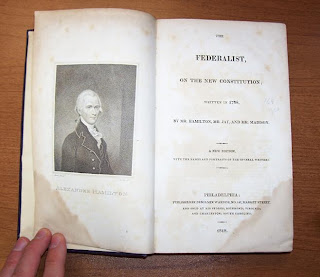
The Federalist, a New Edition, 1818
Budziszewski has now offered a compelling response, with a focus, to be sure, on the American context, but with implications for other federal systems as well, including those of Australia and Canada. Students of American government are generally familiar with the Federalist Papers, or The Federalist, a series of essays written, under the pseudonym Publius, in defence of the new federal constitution by James Madison, Alexander Hamilton and John Jay. The best known of these are numbers 10 and 51, the latter of which defends the internal checks and balances within the federal government itself.

By contrast, few Americans are aware of the Anti-Federalist Papers, written pseudonymously by opponents of the new constitution, one of whom took the name Brutus. Budziszewski focusses on numbers 11 and 12, where the author sets forth his reservations over the expansion of judicial power and its concomitant tendency to expand the legislative power as well. In particular, Brutus

recognizes that a written constitution is not merely a statement of political ideals, but a legal instrument. It is all well and good to say that the three branches [legislative, executive and judicial] shall be coequal, but the courts normally interpret legal instruments. A differently drafted legal instrument might have distributed the power of interpretation among all three branches. It might have identified particular respects in which the legislature, the executive, and the judiciary are each interpreters of the constitution. What the Constitution actually does, argues Brutus, is just the opposite. Rather than distributing the power of interpretation, it concentrates it in the courts. To make matters worse, he holds, the language by which this is done encourages judges to exercise this concentrated power of interpretation in extravagant ways that bear but a distant relation to what the Constitution actually says (p. 148).

It is a truism that the American founders fragmented government and distributed sovereignty among the three branches to prevent any one of them becoming tyrannical. This is what Americans have been taught for generations, the assumption being that the founders had a solid grasp of human nature and the tendency of people to compete with each other for various social and political goods. From my own American upbringing, I recall that Christians in particular viewed the founders as fellow believers who understood the sinfulness of man and thus placed checks in their proposed constitution to counteract its effects. This sounded good in theory. The founders were apparent realists in their estimation of human nature, while liberals and socialists of various stripes had an overly rosy view of man's potential.

Yet what if the founders too were working with a defective anthropology? Could they have imbibed a modified Hobbesian anthropology, perhaps by way of John Locke? Hobbes holds that human beings are creatures of restless desires and, left to their own devices, ruthless competitors for the means of survival. Hobbes famously argued that the prepolitical state of nature is characterized by a war of all against all. Locke, of course, could not bring himself to follow Hobbes' logic in its entirety, admitting only that the state of nature could degenerate into warfare if conditions were favourable. Hence the need for civil government to preside over this competition and to make it more manageable and less potentially deadly. As for government itself, its members are as prone as everyone else to compete for valued goods. Hence, following Montesquieu, the founders adopted a constitutional framework that would divide sovereignty amongst the three branches and between federal and state governments.

So many Americans have accepted this reasoning that they have difficulty imagining an alternative. Here is where, taking Brutus and Budziszewski as a springboard, I would make the following argument, which I believe is more congruent with a biblical worldview: the line between good and evil does not run between co-operation and competition, as so many have believed, but through each. Our own socialist New Democratic Party began life as the Co-operative Commonwealth Federation, on the assumption that economic co-operation is better than the competition characteristic of capitalism. Yet those exalting solidarity over individuality ignore the fact that even organized crime is characterized by a certain solidarity amongst its perpetrators.

I would argue instead that both competition and co-operation have their legitimate places in human life. Competition can aim at narrow self-interest, but it can also be an incentive to service to others, as, e.g., in a charitable fund-raising marathon or even a large manufacturing enterprise supplying a needed good to the public. Similarly co-operation may be for the good of all, as socialists assume. But it can also be a means of collusion for purposes of price-fixing and other forms of corruption. Might the American founders have missed this element of human nature in their ostensibly "realistic" view?

Thus it may be that the expanding power of the courts has come with the blessing of the legislative branch. Here's Budziszewski again:

Another fact bolstering Brutus's case is that whereas federal legislators periodically face the electorate, federal judges don't. This makes Congress much more risk-averse than courts are. Rather than resenting the judiciary for taking hot-button issues out of its hands, the legislature may be relieved and grateful that someone else has made the decision for them (p. 153).

This is a conclusion I came to some time ago with respect to Canada. Since 1982 our courts have been making decisions that are increasingly imaginative and even in open conflict with the intentions of the drafters of the Constitution Act, 1982. We know this because, unlike the American founders, most of the players in the patriation drama are still very much alive! Given our convention of responsible government, a sitting government is reluctant to make decisions of a controversial nature. It is easier to leave such decisions up to the courts, who do not have to face the people. The Supreme Court's Reference re Québec secession is in many respects an ingenious decision that gave something to both sides and helped to prop up the federalist cause in Québec. Nevertheless, one would be hard put to demonstrate that the ruling was based on a close reading of our Constitution Acts, which nowhere mention secession.

Here in Canada we have Section 33, the Notwithstanding Clause, that legislators can invoke to override judicial decisions based on Sections 2 and 7-15 of the Charter of Rights and Freedoms. Yet over the past quarter century few legislatures, with the exception of Québec's National Assembly, have been willing to invoke it. I believe Budziszewski, drawing on Brutus, has now given us a credible explanation for this reluctance.

Incidentally, the copy of The Federalist shown above is from my personal library. It is a rebound edition dating from 1818, when two of the authors, James Madison and John Jay, were still alive.

01 August 2007

Judicial overreach. . . yet again

First a Turkish court claims the authority to strip the Ecumenical Patriarch of his ecclesiastical title. Now a Malaysian court is claiming to judge who is and is not a Muslim, over against the plaintiff's own claim to be a Christian. What next?

14 May 2007

The Judicial Committee of the Privy Council

For the first years following Confederation in 1867, Canada had no federal supreme court, though it had the right to establish one under section 101 of what was then called the British North America Act. Not until 1875 was the Supreme Court of Canada set up, and even then it was not technically supreme. Those dissatisfied with rulings of this court could appeal one more level to the Judicial Committee of the Privy Council in London. After the Statute of Westminster of 1931, however, Canada was authorized to abolish such appeals which it did in 1949. Probably the most famous Privy Council ruling for this country was the 1929 "Persons" case, which established that women are persons under the law and thus eligible for Senate appointments.

Gradually most Commonwealth countries have abolished appeals to the Privy Council, including New Zealand as recently as 2004. However, appeals of cases decided before then have continued to make their way across two oceans to London for final decision. In what is apparently its last decision relevant to New Zealand, the Judicial Committee of the Privy Council has thrown out the murder convictions of David Bain, thereby calling into question the justice system of that country. Many New Zealanders see merit in cutting one more tie to the United Kingdom. However, the Campaign for the Privy Council is not persuaded, as indicated in the group's press release: Bain Decision Vindicates Privy Council Appeals. Supporters argue that "however good the New Zealand judiciary might be, there is nothing to equal an independent outside body to ensure quality control." Prime Minister Helen Clark defends the decision to abolish appeals and believes that access to a local Supreme Court may actually facilitate the appeal process.

17 December 2004

Judicial review comes to Britain

The United Kingdom is often, and somewhat misleadingly, said to have an unwritten constitution. What is meant by this is that that country, like New Zealand and Israel but unlike virtually every other country, does not have an entrenched constitutional document possessing superior status to ordinary statutes. The absence of such a document means that Britain's courts, unlike those of Canada and the US, do not possess the right to rule whether or not a law is constitutional. Parliament is legally sovereign and cannot be second-guessed by the judiciary.

Up until 1982 Canada had a similarly "unwritten" constitution, our principal constitutional document, the British North America Act of 1867, being no more than an act of the British Parliament. We never had parliamentary sovereignty in quite the same way as it could be said to exist across the pond, but only because this sovereignty was shared among federal and provincial legislative bodies in a federal system. However, for the last nearly 23 years our courts have become increasingly active interveners in the political process, most recently handing down a reference decision on Ottawa's proposed marriage-revision legislation. This empowerment of the courts has its positive and negative features. The positive side can be seen when a government is forced to justify its treatment of citizens protected under an entrenched bill of rights, provided the court is not in the business of inventing new rights or unilaterally changing the constitution. The negative consequences are spelled out in F. L. Morton and Rainer Knopff's The Charter Revolution & the Court Party, as well as in numerous articles in First Things and elsewhere.

Despite the absence of an entrenched British constitutional document, the courts are nevertheless finding a way to review acts of parliament. This is reflected in yesterday's important decision by the nine law lords, who are the active members of the House of Lords in its capacity as the country's highest court of appeal, declaring that the Blair government's anti-terrorism law is incompatible with the European Convention on Human Rights. Although the law lords cannot invalidate a law as such, they can at least put the government of the day in an uncomfortable position. Because Britain is an adherent of the treaties of the European Union, a judicial ruling that it is not living up to these treaties inevitably carries a great deal of weight. Because of Britain's membership in the EU something like an entrenched constitutional document is coming in through the back door, along with the judicial review which it implies.

Is this a good thing? Yes and no. In theory it makes sense to empower the judiciary to check both cabinet and parliament, particularly with respect to protecting the rights of citizens. However, given that constitutional documents spell out those rights in necessarily general terms, they may leave too much room for the courts to fill in the blanks, as it were, and to find rights that were never intended by the drafters. Given, furthermore, that such rights tend to be articulated in narrowly individualistic terms, the courts can rule in ways that subvert basic social institutions, such as marriage, by reducing them to mere contractual relationships. I am inclined to think that one of the failings of the drafters of most constitutional documents, including our own Constitution Acts and the United States Constitution, is that they have imposed insufficient checks on the judiciary itself.

At some point I may post my Christian Courier column from nearly a year ago concerning the courts and the constitution.

09 December 2004

Supreme Court reference

In most other countries a court cannot rule on an issue unless it hears a relevant case which has made its way through the judicial hierarchy. However, Canada is unusual in permitting its governments to refer a question to the Supreme Court for a ruling in the abstract. Two famous reference decisions were (1) the Patriation Reference of 1981 respecting the legality of Pierre Trudeau's effort to patriate the constitution without the backing of the provinces; and (2) the 1998 Reference re Secession of Quebec, in which the right of a province to secede unilaterally from confederation was at issue. Reference decisions are not strictly legally binding, but they are usually treated as if they were.

Today the Supreme Court handed down its long awaited reference decision on the federal government's same-sex marriage legislation. Here is the high court's decision in response to the federal government's four questions:

First question: Does Parliament have the exclusive legislative authority to change the legal definition of marriage?

Supreme Court's answer: Yes

Second question: Is extending the capacity to marry persons of the same sex consistent with the Charter of Rights and Freedoms?

Supreme Court's answer: Yes

Third question: Are religious leaders protected under the Charter of Rights from having to marry same-sex couples?

Supreme Court's answer: Yes

Fourth question: Is the traditional definition of marriage between a man and a woman constitutional?

Supreme Court's answer: The Court exercises its discretion not to answer this question.

From the court's ruling: "Several centuries ago, it would have been understood that marriage be available only to opposite-sex couples." Several centuries ago? Judging from this statement, the justices on the court must be very, very young indeed. I myself remember this ostensibly long-ago era, and I'm not quite at the half-century mark.

The issue will continue to be debated, most notably in the House of Commons itself.

14 November 2004

Judicial overreach, yet again


OTTAWA, 2011 - The Supreme Court of Canada today ruled unanimously that all legal definitions of everything are unconstitutional. Because they discriminate against whoever and whatever does not conform to them, such definitions violate the equality provisions of the Charter of Rights and Freedoms. Parliament has been given 60 days to rewrite all laws to conform to this decision.

Unthinkable? Would that it were so.

04 May 2004

Reining in the courts

Larry Kramer puts a different twist on the usual arguments in favour of a "living constitution," which is generally supposed to entail something approaching judicial supremacy. He argues instead, in "We the People: Who has the last word on the Constitution?", for something he calls popular constitutionalism, in which the courts would defer to the judgements of the electorate on issues of constitutional significance. Writes Kramer:

Making this shift would not entail major changes in the day-to-day business of deciding cases. There would still be briefs and oral arguments and precedents and opinions, and the job of being a Supreme Court justice would look pretty much the same as before. What presumably would change is the justices' attitudes and self-conceptions as they went about their routines. In effect -- though the analogy is more suggestive than literal -- Supreme Court justices would come to see themselves in relation to the public somewhat as lower-court judges now see themselves in relation to the Supreme Court: responsible for interpreting the Constitution according to their best judgment, but with an awareness that there is a higher authority out there with power to overturn their decisions -- an actual authority, too, not some abstract "people" who spoke once, two hundred years ago, and then disappeared.

One could, of course, argue that this popular supremacy is already enshrined in the formal amendment process, yet amending an entrenched constitutional document, in both the US and Canada, is "practically impossible." What is required instead is a sense of restraint on the part of judges themselves.

17 December 2003

Judicial overreach revisited yet again

The following report may or may not have been carried by the Canadian press:

Ottawa - Today the Supreme Court of Canada ruled 5 to 4 that the monarchy is unconstitutional insofar as it conflicts with the equality rights in section 15 of the Charter of Rights and Freedoms. Because the position of head of state is hereditary, passing from the current occupant of the throne to the eldest son, the high court ruled that monarchy violates constitutional guarantees against age and gender discrimination. The Court has given the federal government six months to change the country's form of government; otherwise it will consider Canada to have become a republic by default.

Far-fetched? Perhaps. But not by much.

19 November 2003

Judicial overreach revisited

My thanks to James Brink for alerting us to the following editorial in the saturday edition of the National Post: "Judicial rule." An overreaching judiciary has been a problem south of the border for decades. Now we are similarly afflicted here in Canada:

Not content merely with their recent, self-granted role as lawmakers, Canada's judges have now also appropriated to themselves the authority to supervise the performance of Cabinet ministers and elected governments, and even to micromanage public projects they feel run contrary to their judicial rulings. Thursday, the Supreme Court of Canada declared that judges need not limit themselves to declaring laws constitutional, or not, and prescribing remedies for the victims of unconstitutional ones. Henceforth, judges may also compel governments to report periodically on the actions they are taking to comply with constitutional rulings and to order changes in those actions when the judges are dissatisfied. The ruling clearly oversteps the bounds of judicial authority by trampling the ancient rule that a judge's interest in a case ends with his or her ruling -- if there are issues about one party's or the other's compliance with that ruling, those are to be brought back to court in a separate action. As such, the court's ruling in Doucet-Boudreau v. Nova Scotia (Minister of Education) violates the separation of powers between the judicial, legislative and executive branches of government, marks a dangerous intrusion into the political sphere and potentially imperils our traditions of responsible government.

The majority decision in the 5-4 ruling is bizarrely argued. The five Justices who voted in favour -- including Chief Justice Beverly McLachlin -- insisted that to not give judges these new powers was to invite the "seeds of tyranny to take root." They meant that when governments fail to comply with ordered remedies, governments are behaving tyrannically by flouting the rule of law. Yet there is a much greater danger of tyranny when judges impose themselves in the administration of public programs. Unlike legislators and Cabinet ministers, judges are unelected. They rule by decree, not by public debate, and their decisions are not subject to review by electors. It is topsy-turvy logic to argue that this decision, somehow, will lead to less tyranny rather than more.

At one time I thought that judges in this country were likely to be more restrained than their American counterparts, despite the Charter investing them with new powers. Recent years have demonstrated that, if anything, the opposite is the case. Whether our governments have the will to do anything about this remains to be seen.

04 October 2003

Fr. Neuhaus and First Things

On friday I received in my campus mail box the latest issue of my favourite periodical, First Things, which is published by the Institute on Religion and Public Life in New York and edited by the redoubtable Fr. Richard John Neuhaus. I suppose one might describe it as a largely Catholic journal, with significant confessional protestant and observant Jewish contributions as well. Its tone is probably best described as neoconservative. While I myself cannot in good conscience call myself a neoconservative as such, I am quite happy to admit that thoughtful articles of substance appear in every issue making it well worth reading. Some of these I have discussed in previous entries in this weblog.

Fr. Neuhaus himself is a Canadian-born former Lutheran pastor who has now become a Catholic priest, an ardent proponent of what he calls the American experiment and an insightful commentator on the larger developments in the culture war in that country. His monthly Public Square is, I suppose, the print equivalent of a weblog, drawing readers’ attention to commentaries and articles in other sources and, of course, adding his own assessments, complete with his well-known sense of irony.

Neuhaus’ journey to Catholicism is recounted in “How I Became the Catholic I Was.” Raised within the Lutheran Church - Missouri Synod, one of the more confessional of Lutheran bodies in North America, he eventually found his way into the Evangelical Lutheran Church in America, which he soon judged to be losing its confessional moorings. In 1990, the same year he founded First Things, he became a Roman Catholic. Since he had never married, being re-ordained as a priest posed no obstacle. Pastor Neuhaus thus became Father Neuhaus. It is evident from his writings that he is devoted to the cause of Christ and that his priestly identity is central to his sense of personal calling.

At his best when he is skewering the pretensions of late liberalism in the public square, Neuhaus is a contemporary master of English style and has a keen eye for the absurdities of this ideology, which he treats in his own inimitably witty fashion. He was an early proponent of what would later come to be called civil society, namely, those communal formations and initiatives springing from the initiative of the people themselves, and not from the direction of the state. The essay he co-authored nearly three decades ago with Peter Berger, To Empower People, was an eloquent statement in favour of protecting civil society in all its variety.

One of the enduring themes in Neuhaus’ writings is the rather enlarged role the American judiciary has unilaterally assumed in decreeing sweeping social changes in the face of recalcitrant legislatures. This concern led to the publication of a controversial symposium in the November 1996 issue of FT under the general title, “The End of Democracy: The Judicial Usurpation of Politics.” Among those contributing to this special issue were Robert Bork, who had been Ronald Reagan’s unsuccessful nominee for a Supreme Court vacancy in 1987, Princeton University’s Robert George, and Charles Colson, founder of Prison Fellowship and the Wilberforce Forum. This led to several resignations from the FT editorial board by those who found this issue too inflammatory.

Despite my being a professed fan of Neuhaus’ writings, I cannot call myself an unqualified proponent of his overall approach, which is deficient in a rather basic way.

To begin with, his support for the “American experiment” and its constitutional democracy sometimes appears to outweigh his consciousness of the jural task of the state, which normatively holds for every political community everywhere. Whether or not a state is democratic, it nevertheless carries a divine mandate to do justice to all individuals and communities within its territory. St. Paul could write of even the Roman state possessing a divinely-given task of punishing evil and rewarding good in Romans 13. By concentrating so heavily on the American polity and its particular political traditions, including the liberalism of John Locke and the founders, Neuhaus risks minimizing the universality of this task.

Along with this affection for the American experiment comes what I would label a sort of highbrow populism. In his Public Square pieces in particular one can read, on the one hand, a diatribe against the debased character of contemporary popular culture, and, on the other hand, an invective against the political and cultural élites of his adopted country for pushing secularizing reforms against the presumably less corrupt mores of a confusedly “christian America.” If at some point America ceases to be christian and takes on the more overt secular identity of a France or a post-1960s Québec, Neuhaus will be hard pressed to continue with his present approach if he intends to retain his fidelity to the Christian gospel. I am confident Neuhaus does indeed believe in a transcendent standard of justice, but his principal method of argumentation here is basically historicist.

Moreover, while Neuhaus’ barbs at contemporary liberalism are always well aimed, he must finally be considered a liberal critic of liberalism. That is, he critiques late liberalism – or the advocates of what I call the choice-enhancement state in my book – but without actually repudiating liberal first principles. This becomes clear in his on-going debate with the likes of David L. Schindler and Fr. Michael Baxter in, e.g., “The Liberalism of John Paul II.” Here Neuhaus revealingly writes:

As sympathetic as we may be to some of the determined critics of liberalism, we do well to remind ourselves that all temporal orders short of the Kingdom of God are profoundly unsatisfactory. When we survey the depredations and ravages of our social, political, and religious circumstance, it is tempting to look for someone or something to blame. It is easy to say, "Liberalism made us do it." But liberalism is freedom, and what we do with freedom is charged to our account.

This statement provides a handy means for Neuhaus to avert the attacks of those who properly see liberalism as a larger ideology with its own spiritual underpinnings. But it fundamentally misconstrues the nature of liberalism. Or, as my friend and colleague Al Wolters would put it, it confuses creational structure with spiritual direction. Liberalism is not identical to freedom per se. It is, rather, based on a certain inordinate, and thus idolatrous, love of freedom, with its tendency to reduce the complexity of communal formations to mere voluntary associations.

Unfortunately Neuhaus has not entirely avoided this tendency even in himself. In arguing against US support for the International Criminal Court, he writes: "As stated in the Declaration of Independence, just government is derived from the consent of the governed." This is certainly in accordance with the Lockean tradition as mediated by Thomas Jefferson to the Americans, but one would be hard pressed to find a foundation for this belief in scripture. To be sure, consent is almost certainly a necessary precondition for just government, but it does not stand at its origin. To hold that it does is to risk making the political community into one more voluntary association whose purpose and task are determined by the possibly shifting whims of its members.

This said, I will continue to read Neuhaus and First Things, which have much to offer the discerning christian reader.

14 July 2003

Judicial overreach

Here is the latest Capital Commentary by Jim Skillen of the Center for Public Justice: "From Legal Judgment to Political Approbation." Writes Skillen:

The U.S. Supreme Court was established to make one kind of judgment: to decide whether laws passed by state and federal governments square with the requirements of the Constitution. The court is increasingly becoming something else: a committee that gives the final stamp of approbation to laws that its majority believes best fit our changing society.

The court, it seems, has abandoned any pretence to be judging in accordance with the text of the Constitution. This was first seen in the Roe v. Wade decision of 1973 and it's become increasingly evident in more recent cases.

At one time I thought our own courts in Canada would act in a more restrained way after patriation of the constitution in 1982. But this has turned out to be far from the case. Here there is no confirmation process to scrutinize appointees to the Supreme Court. Appointment lies in the hands of the Prime Minister alone, albeit with the presumed input of the Minister of Justice, so a crucial check on the court is missing here. The Court has often been in the position of having to make controversial political decisions that the government of the day prefers not to have to make for fear of alienating voters. This has encouraged a certain irresponsibility in our elected officeholders, who are tempted to pass the buck to an unelected tribunal which need not worry about suffering defeat at the polls. Trudeau's patriation has thus made our political system markedly less democratic.

Perhaps it is finally time to consider ways to rein in the courts in both countries.

Followers

Blog Archive

About Me

My photo
Contact at: dtkoyzis at gmail dot com