In 1989 the United Nations General Assembly adopted the Convention on the Rights of the Child (CRC), which was subsequently signed by representatives of 140 countries and ratified or accepted by 193, with the notable exceptions of Somalia and the United States. This was not the first time that obligations towards children had been expressed in terms of rights; an earlier Geneva Declaration of the Rights of the Child had been adopted by the League of Nations in 1924, although in its five brief points it never once used the word “rights,” speaking instead the language of duty: the child “must be fed,” “must be sheltered and succored,” “must be protected against every form of exploitation,” &c. The 1959 UN Declaration of the Rights of the Child is similarly spare in using the language of rights, mentioning them twice under Principle 1 and not at all in Principles 2 through 10. By contrast, the CRC consists of 54 articles in which “rights” are referred to 26 times and the obligations of “States Parties” mentioned 110 times.
These differences between the CRC and the two earlier documents are significant in that they represent an historic shift which Michael Ignatieff has described as the Rights Revolution, Francis Fukuyama as the Great Disruption, and what I have elsewhere referred to as the dawn of the choice-enhancement state.
It is worth noting that, especially in the US, the CRC is controversial because it would seem to bring the state too deeply into the legitimate sphere of family intimacy. Such reservations have thus far successfully prevented the US from ratifying the Convention. Even among the signatories, several states, including the Vatican, have explicitly qualified their acceptance for various reasons. Indeed it is not altogether clear that recasting parental or societal obligations towards children as rights represents genuine progress in ensuring the latter's well-being, especially if we do not curtail the tendency to view all rights as policed by the courts.
In one sense, of course, no one can doubt that children have the right to be loved and cared for by their parents. Yet the primary agents for fulfilling this responsibility are the parents themselves, and not the “states parties” which have signed the document, though the latter certainly have an obligation towards both parents and their children under their general mandate to do public justice. It is worth noting that the word authority appears only three times in the text of the 1989 Convention and each time refers to legal or judicial authority. When used in the plural form, authorities always denotes political authorities. Noticeably absent from all three documents is a recognition of the primacy of parental authority in nurturing the child towards maturity.
I have just completed the first draft of a manuscript on the subject of authority, office and the image of God. In the course of researching and writing this, I have become convinced that we need to reconfigure the ongoing conversation surrounding authority so as to recognize that it resides in an office – or, better, offices – given us by the God who has created us in his image. Accordingly we would be better served, in speaking of parental obligations towards their children, to focus on the authoritative offices borne by each, namely, father, mother, son and daughter.
What will a shift to the language of authority gain for us? I believe it will enable us better to account for the full complexity of the relationship between parents and minor children – necessarily an ever-changing relationship as the children grow to maturity. It will also help us to distinguish between the legitimate authoritative offices of parents and government, recognizing that, while both presumably intend the child's best interest, the secondary authority of government is necessarily limited by the primary authority of parents. It is thus not a matter of opposing freedom, say, of parents to the authority of the state but of recognizing that different agents possess authoritative offices whose demands are different yet, properly understood, mutually supportive and equally worthy of respect.
Showing posts with label authority. Show all posts
Showing posts with label authority. Show all posts
15 November 2011


09 February 2010
Questioning authority

Six decades ago the thomistic philosopher Yves René Simon observed that, since the French Revolution, authority has had something of a bad reputation. More than any other act of rebellion, the Revolution effectively solidified in western consciousness something of the mythology of heroic popular revolt against oppressive authority. Now many are inclined to identify authority per se with at least potential oppression, irrespective of what it actually does and how it functions.
At one time it was generally assumed that those defying authority were committing a grave sin imperiling their eternal salvation. They were acting so as to overturn a God-given social and political order, and were little better than common criminals.
Nowadays it is often, if not always, assumed that legitimate complaints undergird an insurrection, however violent its effects, and that governmental efforts to quell a rebellion are almost intrinsically repressive. During a church service near Toronto in early 1994, shortly after the Chiapas revolt broke out in southern Mexico, prayer requests were invited from the front. A parishioner stood up and asked that prayers be offered for the people of Chiapas, that they might receive justice and no longer find it necessary to rise up against the government to advance their cause. The request was duly noted and it was included in the subsequent prayer.
What is striking in this incident is that no one in the congregation found the request at all unusual or out of line. Of course, one would not wish to deny the likelihood of legitimate grievances underlying such an uprising, particularly as it follows upon centuries of oppression of the indigenous peoples of the region.
All the same, a few hundred years ago, if a popular revolt broke out against a sitting government, one might have heard a clergyman pray that God would bring down his righteous wrath on the rebels and that the governing authorities, whom he calls to defend justice and punish lawbreakers, might be instruments of that wrath. So thoroughly have attitudes changed that now, if someone were to stand up and request a prayer along these lines, she would likely raise eyebrows and cause discomfort in the pews.
Why have authority and its exercise acquired such a bad name? Simon gives four reasons. First, it would seem to stand in conflict with justice. If a government reflexively cracks down on malcontents, it may be guilty of overlooking the justice of their cause. Second, it appears to conflict with the spontaneity and vitality of human life by artificially inhibiting it. How many beneficial inventions might have been stillborn if a government had placed too many constraints on personal innovation?
Third, the imposition of authority is reputed to curtail the search for truth, a contention which John Stuart Mill advances in On Liberty. Fourth, authority seems often to be connected with human arbitrariness and thus opposed to the universality and stability of law. Indeed, whenever authority is abused, it inevitably reflects poorly on the authoritative office itself.
To Simon's reasons I add numbers five through seven. Fifth, there is a persistent tendency to play off authority against personal freedom. Forty years ago, secondary school dress codes in North America were largely abandoned on the grounds that they impaired the freedom of the adolescent students to dress as they pleased. Especially in the United States, where the attainment of freedom has a strong place in the national civil religious narrative, this argument resonated with many, and those few defending the codes lost ground nearly everywhere. In such a context, if freedom and authority are conceived as polar opposites, then, whenever they are seen to come into conflict, freedom must necessarily triumph over the long term.
Sixth, there is a strong presumption on moral grounds against authority by the heirs of Immanual Kant, including the likes of Stanley Milgram, Lawrence Kohlberg and John Rawls. Kantians believe that being subject to authority is a sign of ethical immaturity and that progress towards full adult autonomy requires that a form of moral reasoning known as the categorical imperative be applied to every human action.
Seventh and finally, there is another school, including Marx and his heirs, as well as the more recent postmodern deconstructionists, which sees all authority as little more than self-interested (or, perhaps more accurately, class- or group-interested) domination by one set of people over another. Within this conception, any claim that an authoritative officeholder is acting in the interest of those under her authority cannot be believed. An hermeneutic of suspicion must therefore be applied to such claims in an effort to unmask the collective self-interested will behind what is essentially only an exercise of raw power. In this perspective, the classic writings of Plato, Aristotle, Cicero, Augustine and Thomas Aquinas are nothing more than the ruminations of those notorious dead, white European males attempting to protect their own material interests against everyone else.
For all these reasons and more young people sometimes wear t-shirts emblazoned with these powerful words: QUESTION AUTHORITY. However, it's never been entirely clear to me why, in so doing, they should defer to the authority of a clothing manufacturer, whose very ability to produce these shirts depends on an authoritative structure co-ordinating the process as a whole. Much as the statement, "All truth is relative," is self-referentially incoherent, so is the imperative statement, "Question authority"! Yet this will likely have little effect on those to whom such a slogan appears to give the moral high ground.
Yet what if that which we call freedom is just one more type of authority among many? If so, there is little reason to view freedom as consistently trumping these other kinds of authority where the two come into opposition. If freedom be defined as personal authority, then when it conflicts with another form of authority, the claims of both must be taken into account and adjudicated carefully and justly. In the case of the dress codes, the issue should have been conceived, not as authority against freedom, which prejudices the case in favour of the latter, but as one between the authority of the school and administration on the one hand and the authority of the adolescent student on the other. If it is framed in this way, its resolution becomes less obvious and its full complexity more so. Legitimate interests on both sides must be taken into account. A balanced approach, and hence justice, becomes more likely.
That such an approach would necessitate a break with historic liberalism, with its commitment to the primacy of the individual, is beyond doubt. Yet if we can bring ourselves to relinquish the hold of this tenacious political ideology, we will be better able to do justice to the legitimate pluriformity of authority in God's world.
27 January 2010
Authority and the pretence of autonomy
You may not immediately recognize the name, but you will likely recall the famous experiments he conducted at Yale half a century ago. In 1961, a junior professor in psychology, Stanley Milgram, placed an advertisement in a local New Haven newspaper soliciting participants in what was claimed to be a study of memory and learning. The rest of the story is familiar to anyone with an undergraduate introductory psychology course under her belt:
As a respondent to the ad, John Doe is ushered by a white-coated experimenter into a room where another person is seated. Both are told the nature of the experiment about to take place. Having drawn straws, Doe becomes the “teacher,” and the other man the “learner.”

Both are taken to an adjacent room where the learner is subsequently seated at a table. A strap attached to an electrode is placed around his arm, with the teacher looking on. The experimenter explains that the teacher will read through a list of word pairs, which the learner must then read back to the teacher in the correct order. If he misses one of the pairs, the teacher, seated in the other room, will administer an electric shock, beginning at 15 volts, increasing the voltage with each successive error up to a high of 450. The experimenter assures the teacher that the shocks are not dangerous to the learner.
As a respondent to the ad, John Doe is ushered by a white-coated experimenter into a room where another person is seated. Both are told the nature of the experiment about to take place. Having drawn straws, Doe becomes the “teacher,” and the other man the “learner.”

Both are taken to an adjacent room where the learner is subsequently seated at a table. A strap attached to an electrode is placed around his arm, with the teacher looking on. The experimenter explains that the teacher will read through a list of word pairs, which the learner must then read back to the teacher in the correct order. If he misses one of the pairs, the teacher, seated in the other room, will administer an electric shock, beginning at 15 volts, increasing the voltage with each successive error up to a high of 450. The experimenter assures the teacher that the shocks are not dangerous to the learner.
The experiment proceeds with the teacher reading the first pair of words. At the first mistake Doe administers the initial shock to the learner, who is behind a closed door in the adjacent room. At some point, after a few more errors, the teacher hears the first audible, if somewhat muffled, indication of discomfort from the learner. The teacher looks hesitantly at the experimenter, expecting some guidance. The experimenter tells him to continue, which he does obediently. After more errors what started out as grunts from the learner become increasingly urgent cries of pain, coupled with a protest that he has a heart condition and wishes to end the experiment. Increasingly agitated, Doe fully expects the experimenter to intervene and put a halt to the ordeal. But the experimenter remains calm, assuring him that he himself assumes all responsibility for what happens, instructing him to continue.
At this point Doe is confronted with an ethical dilemma. Indeed the experiment is not about memory and learning at all; it is intended rather to gauge the extent to which an ordinary person, commanded to inflict pain on someone else, will do so in deference to authority, even under conditions that appear to compromise his moral commitments.
The entire situation is a set-up. The “learner” is in reality an actor hired to play the part. The drawing of straws is fixed, with “teacher” written on both slips of paper. The “teacher” is given a mild shock before the start of the experiment to give him a sense of what the learner will be experiencing, but, apart from that, the elaborate console in front of him is a façade. The switches he throws do not shock the “learner” at all. The sounds emitted from the other room come from a tape recorder, timed to run after each “shock” is delivered.
How far would the “teacher” go in carrying out orders? Would the subject break off the experiment, thereby defying authority, because he believed he was being commanded to do something wrong? Or would the subject, upon being assured by the white-coated experimenter that he assumed full responsibility, continue to administer “shocks” even up to the “dangerous” level of 450 volts?
Milgram had gone into the experiment believing that virtually all decent people would at some point refuse to go further, because their moral convictions would not allow them to do so. However, the reality was that many people continued to obey the experimenter despite the verbal indications of pain on the part of the learner. “It is the extreme willingness of adults to go to almost any lengths on the command of an authority that constitutes the chief finding of the study and the fact most urgently demanding explanation.”
Milgram concluded that, for people to be brought to the point of performing such an action, they must first abandon their autonomy and enter into what he calls an agentic state, in which they see themselves as no longer responsible for their own actions and as nothing more than agents for carrying out someone else’s instructions. Thus authority, so necessary for human survival, manifests a dark side by facilitating the rise of tyrannies and totalitarian régimes, which rely for their very existence on the obedience of vast numbers of citizens.
Like many people who had lived through the horrors of the Second World War, Milgram was appalled that so many ordinary Germans played their part in the nazi death machine in obedience to orders issued by higher ups. Hannah Arendt’s coverage of Adolf Eichmann’s trial in Jerusalem seemed to confirm that, far from being cruel or sadistic, many nazi officials were mere bureaucrats functioning within an extensive chain of command.
How is it possible that otherwise ordinary, decent people can be brought to the point of doing harm to their fellow human beings? They do so, according to Milgram, by subordinating their own wills to those of others, thereby becoming mere agents of the latter. Their ability to reason morally is thus impaired by the felt need to defer to authority. In the case of these experiments, the presence of authority was conveyed by the white lab coat of the experimenter, by the official-looking venue and by the prestige of the university under whose auspices they were conducted. All of these elements combined to induce the unwitting subjects to give up their freedom and to commit acts they would otherwise not do.
Nevertheless, there are good reasons to question whether Milgram’s dichotomy between autonomy and the agentic state is warranted. Milgram himself admits that, as the child matures, she is subject to various socializing agents, from family and school to workplace and government, all of which aim at the “internalization of the social order.” In this way, the person’s conscience is formed by the very structures of authority with which it may eventually come to stand in tension. In other words, the individual’s internal inhibitory mechanisms are shaped from the outset by various external inhibitors, all of which can be grouped under the broad heading of authority. Even when people believe they are acting autonomously, each decision they make is conditioned, either directly or indirectly, by numerous authorities, the most significant of which have made their impact long before.
This is illustrated by two subjects whose actions and responses Milgram himself mentions, while nevertheless failing to draw out their full implications. The first subject is the pseudonymous “Jan Rensaleer,” an industrial engineer who was born in the Netherlands and immigrated to the United States after the war. Rensaleer stops the experiment after 255 volts, refusing to go on. He expresses regret that he has gone as far as he has in response to authority, assuming full responsibility for his own actions and refusing to blame the experimenter. Yet, having lived through the nazi occupation of his native country, he is not surprised by the level of obedience in the other subjects of the experiment. Rensaleer reports that he is “a member of the Dutch Reformed Church.”
The second subject is the “Professor of Old Testament,” who discontinues the experiment after 150 volts, surprisingly asserting that “I’m taking orders from him,” that is, the protesting “learner.” Milgram notes that the Professor does not precisely claim to be disobeying as much as shifting his allegiance – from the experimenter, whom he appears to view as merely a “dull technician” of limited intelligence and imagination, to the learner/victim. Moreover, when later asked the best means of fortifying resistance to unjust authority, the Professor replies, “If one had as one’s ultimate authority God, then it trivializes human authority.” Milgram’s response to this claim is remarkable, both for what it indicates about the nature of authority and for his failure to make any more of it: “Again, the answer for this man lies not in the repudiation of authority but in the substitution of good – that is, divine – authority for bad.” This observation could have summed up his analysis of the experiments as a whole, had Milgram treated it as more than just the comment of yet another subject of the experiment.
Both “Rensaleer” and the “Professor of Old Testament” are evidently Christians, having been raised to distinguish between right and wrong. Their claim to selfhood thus lies, not in pretending to act autonomously, but in acting according to principles taught by another authority, or a series of authorities, whose presence is felt more vividly than that of the experimenter.
Milgram’s claimed mental shift from autonomy to the agentic state may not, after all, be an accurate way of accounting for what occurs in the person, either in the laboratory or in ordinary life. Our consciences are formed in such a way as to recognize and obey legitimate authority. Our very selfhood is fashioned in large measure by others, including our parents, schools, churches, peers and, for better or worse, the media.
To be sure, we are not simply the products of our environment, as argued by such radical behaviourists as B. F. Skinner. We grow into and retain our responsibility at every stage of the process of growth. When we come to see ourselves as part of a larger communal whole, we do not so much suppress our selfhood as adjust it to the realities of living among our fellow human beings. Indeed the recognition that we are not alone in the world and must therefore subordinate our wills to others’ for the sake of justice and the common good is integral to the development of the mature self, notwithstanding the views to the contrary of Milgram and his fellow heirs of the Kantian legacy, who persist in portraying deference to authority as a sign of moral juvenility.
23 August 2008
Authority and power, I
Authority and power are not the same thing, a statement that comes close to being a truism. Nevertheless, so many people still manage to confuse these concepts, even when they profess to understand that they are different. This is due to a general tendency to assume that power manifests itself primarily as coercive force. Thomas Hobbes famously reduced right to might, assuming that the only source of effective political authority is the sovereign's monopoly over coercive force. Few nowadays would go along with this, believing that the exercise of power must be authorized in some fashion, either by a higher authority or by the democratically-expressed will of the citizens.
Nevertheless, when challenged to define authority and to set out its parameters, many observers still manage to identify it with some capacity at its disposal. When I first began researching my book on authority, I was quite surprised at the sheer number of people who do this. One example will suffice for now, and I will post more later.
In his 1980 book, Authority, Richard Sennett argues that authority is an interpretive process which undertakes to give meaning to the conditions of power, "to give the conditions of control and influence a meaning by defining an image of strength." This image of strength is very much a subjective one resident in the minds both of those wielding authority and of those under it. For Sennett then authority is reducible to a kind of psychological power that some exercise over others who are psychologically dependent on it. One of Sennett's case studies will serve to illustrate his approach.
Pierre Monteux and Arturo Toscanini conducted a number of orchestras in Europe and North America during their long careers. Though both enjoyed the same official position relative to these orchestras, each had a quite different personal style. Toscanini inspired terror in his players, going so far as to scream, stamp his feet and even throw his baton at them. He kept the orchestra in line largely through provoking fear of his anger.
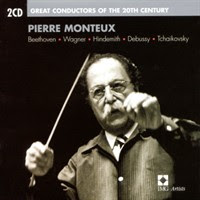
By contrast, Monteux had a quieter way of relating to his ensemble, conveying a more relaxed sense of self-mastery and a calm assurance of being in control, a style which Sennett obviously prefers to Toscanini's. Each conductor asserted his authority, albeit in different ways. The phrases Sennett uses to describe this "authority" are telling: "relaxed, complete control of himself," "ease at being in control," "easy assurance," "inspiring terror," "aura," "strength," "superior judgment" and so forth. All of these have to do with the mental states of the people involved. What is missing is any reference to the concrete office of conductor without which an orchestra could not produce a pleasing sound.
To be sure, a conductor who is unable for whatever reason to relate successfully to his players and to command their confidence will fill the office inadequately despite his formally occupying it. This will inevitably have an impact on, among other things, the quality of the music the group as a whole is able to produce under his direction. He may acquire a reputation for being difficult to work under, and his players may put forth only a cursory effort in his behalf.
Yet at most the psychological ability to command the confidence of those under oneself must be seen as a form of power ancillary to authority, and not as the basis of authority itself. Sennett seems to have missed this. Having a commanding presence may indeed contribute to the smooth functioning of authority, yet by itself it can hardly confer that authority. The fact of the first violinist having such a presence cannot ipso facto make of her a conductor. At some point, after the departure of the current conductor, the orchestra’s board might decide to recognize her gifts and confer the baton upon her. She may end up performing more skilfully than her immediate predecessor, but her authority to do so will not have come until the board has made its authorizing decision.
Authority may be accompanied by any number of capacities ancillary to its exercise, including a commanding presence and the abilities to listen, to make sound judgements, and to persuade others of the merits of one's position. All of these enrich and enhance authority. Yet authority cannot be reduced to them. Authority is better understood as rooted in office — which is in turn rooted in the reality of our creation in God's image, as manifested in the differentiated responsibilities we bear throughout the range of life's activities.
Authority and power are not the same thing, a statement that comes close to being a truism. Nevertheless, so many people still manage to confuse these concepts, even when they profess to understand that they are different. This is due to a general tendency to assume that power manifests itself primarily as coercive force. Thomas Hobbes famously reduced right to might, assuming that the only source of effective political authority is the sovereign's monopoly over coercive force. Few nowadays would go along with this, believing that the exercise of power must be authorized in some fashion, either by a higher authority or by the democratically-expressed will of the citizens.
Nevertheless, when challenged to define authority and to set out its parameters, many observers still manage to identify it with some capacity at its disposal. When I first began researching my book on authority, I was quite surprised at the sheer number of people who do this. One example will suffice for now, and I will post more later.
In his 1980 book, Authority, Richard Sennett argues that authority is an interpretive process which undertakes to give meaning to the conditions of power, "to give the conditions of control and influence a meaning by defining an image of strength." This image of strength is very much a subjective one resident in the minds both of those wielding authority and of those under it. For Sennett then authority is reducible to a kind of psychological power that some exercise over others who are psychologically dependent on it. One of Sennett's case studies will serve to illustrate his approach.
Pierre Monteux and Arturo Toscanini conducted a number of orchestras in Europe and North America during their long careers. Though both enjoyed the same official position relative to these orchestras, each had a quite different personal style. Toscanini inspired terror in his players, going so far as to scream, stamp his feet and even throw his baton at them. He kept the orchestra in line largely through provoking fear of his anger.

By contrast, Monteux had a quieter way of relating to his ensemble, conveying a more relaxed sense of self-mastery and a calm assurance of being in control, a style which Sennett obviously prefers to Toscanini's. Each conductor asserted his authority, albeit in different ways. The phrases Sennett uses to describe this "authority" are telling: "relaxed, complete control of himself," "ease at being in control," "easy assurance," "inspiring terror," "aura," "strength," "superior judgment" and so forth. All of these have to do with the mental states of the people involved. What is missing is any reference to the concrete office of conductor without which an orchestra could not produce a pleasing sound.
To be sure, a conductor who is unable for whatever reason to relate successfully to his players and to command their confidence will fill the office inadequately despite his formally occupying it. This will inevitably have an impact on, among other things, the quality of the music the group as a whole is able to produce under his direction. He may acquire a reputation for being difficult to work under, and his players may put forth only a cursory effort in his behalf.
Yet at most the psychological ability to command the confidence of those under oneself must be seen as a form of power ancillary to authority, and not as the basis of authority itself. Sennett seems to have missed this. Having a commanding presence may indeed contribute to the smooth functioning of authority, yet by itself it can hardly confer that authority. The fact of the first violinist having such a presence cannot ipso facto make of her a conductor. At some point, after the departure of the current conductor, the orchestra’s board might decide to recognize her gifts and confer the baton upon her. She may end up performing more skilfully than her immediate predecessor, but her authority to do so will not have come until the board has made its authorizing decision.
Authority may be accompanied by any number of capacities ancillary to its exercise, including a commanding presence and the abilities to listen, to make sound judgements, and to persuade others of the merits of one's position. All of these enrich and enhance authority. Yet authority cannot be reduced to them. Authority is better understood as rooted in office — which is in turn rooted in the reality of our creation in God's image, as manifested in the differentiated responsibilities we bear throughout the range of life's activities.
26 July 2008
Authority and hierarchy, II
This is a follow-up to my post of last month and an effort to respond to some of the points made by Tony Esolen and Daniel D. De Haan in the comments. De Haan asks: "But do you mean to say then, in agreement with Esolen, 'that obedience and genuine authority are inseparable' yet require qualifications as diverse modes of authority are commensurate to diverse modes of obedience and/or obligation?"

All authority implies obligation, but just as the various manifestations of authority differ, so do the reciprocal obligations. Imperative authority, i.e., the authority to issue commands, entails an obligation to obey. Cognitive or epistemic authority entails an obligation to listen and learn from the person possessing such authority, but it does not imply obedience as such unless it is connected to a specific office requiring this. This again points to the difference between the expert in a particular field of study, e.g., psychology, and the professor of psychology who holds an office in a university. Exemplary authority entails an obligation to watch, learn and imitate. Richard De George's taxonomy of authority (above left; click to see a larger version) is helpful in enabling us to differentiate amongst the obligations entailed by the presence of authority. In general, the nonexecutive manifestations of authority do not require obedience as a reciprocal obligation.
Some of De Haan's other comments are relevant to the finer points of theology, a field that, admittedly, is not my own. However, I will focus on two issues. First:
The entire paragraph in which this appears strikes me as a case, not only of subjecting God to the laws he has posited for his creatures, but of claiming to know God's essence, which goes well beyond what he has chosen to reveal to us in Scripture. To be sure, God has accommodated himself to us, communicating in creaturely ways we can understand. However, for a mere human being to assert what God "must possess" in himself seems rather presumptuous. At the very least one ought to be careful in making such assertions in recognition that there are limits to what God has chosen to reveal about himself to us.
Second, there is this from David Deavel: "But there are various other views of ontological hierarchy that are compatible with a Christian doctrine of creation." This is De Haan's view as well.
My response begins with acknowledging that God's creation is complex, containing an amazing diversity of things, each with its own proper place in the whole. One of the characteristic errors of modern thought is reductionism, i.e., the tendency to reduce this complexity to one or two elements. For example, Darwin believes he can account for biological complexity (and perhaps the rich variety of human cultures?) in terms of the single mechanism of natural selection. Similarly, Marx reduces the fulness of history to an economically-based class struggle.
By contrast, I would argue, following Dooyeweerd and others, that no aspect of created reality can be elevated to primary status. Rather each aspect has its own appointed place and cannot be reduced to another. The aesthetic cannot be reduced to the economic (contra Marx) or to the biological (contra Darwin). Similarly the political cannot be reduced to the economic, a point made by Sheldon S. Wolin, Hannah Arendt, Sir Bernard Crick and others. The only sense in which these aspects might be seen as hierarchical is that the "earlier" aspects are foundational for the "later" ones. Biological life is necessary for sensation, which is in turn a precondition for thinking logically, itself a precondition for making aesthetic judgements.
My questions to De Haan and Deavel are as follows: Why would they deem it necessary to envision this diversity of created reality as hierarchical? What would it mean for a thing to be higher or lower on the ontological ladder relative to something else? Is their conception of hierarchy different from mine and Dooyeweerd's, as indicated in the previous paragraph? Or do they envision something else? Does diversity itself imply hierarchy?
This is a follow-up to my post of last month and an effort to respond to some of the points made by Tony Esolen and Daniel D. De Haan in the comments. De Haan asks: "But do you mean to say then, in agreement with Esolen, 'that obedience and genuine authority are inseparable' yet require qualifications as diverse modes of authority are commensurate to diverse modes of obedience and/or obligation?"

All authority implies obligation, but just as the various manifestations of authority differ, so do the reciprocal obligations. Imperative authority, i.e., the authority to issue commands, entails an obligation to obey. Cognitive or epistemic authority entails an obligation to listen and learn from the person possessing such authority, but it does not imply obedience as such unless it is connected to a specific office requiring this. This again points to the difference between the expert in a particular field of study, e.g., psychology, and the professor of psychology who holds an office in a university. Exemplary authority entails an obligation to watch, learn and imitate. Richard De George's taxonomy of authority (above left; click to see a larger version) is helpful in enabling us to differentiate amongst the obligations entailed by the presence of authority. In general, the nonexecutive manifestations of authority do not require obedience as a reciprocal obligation.
Some of De Haan's other comments are relevant to the finer points of theology, a field that, admittedly, is not my own. However, I will focus on two issues. First:
The Creator God, as the sole Creative Cause, must possess in perfect simple identity the vast array of contingent perfections found throughout creation. If not we must ask who created them if not the Creator? And how could He Create such created perfections if they were not already entitative perfections of Himself.
The entire paragraph in which this appears strikes me as a case, not only of subjecting God to the laws he has posited for his creatures, but of claiming to know God's essence, which goes well beyond what he has chosen to reveal to us in Scripture. To be sure, God has accommodated himself to us, communicating in creaturely ways we can understand. However, for a mere human being to assert what God "must possess" in himself seems rather presumptuous. At the very least one ought to be careful in making such assertions in recognition that there are limits to what God has chosen to reveal about himself to us.
Second, there is this from David Deavel: "But there are various other views of ontological hierarchy that are compatible with a Christian doctrine of creation." This is De Haan's view as well.
My response begins with acknowledging that God's creation is complex, containing an amazing diversity of things, each with its own proper place in the whole. One of the characteristic errors of modern thought is reductionism, i.e., the tendency to reduce this complexity to one or two elements. For example, Darwin believes he can account for biological complexity (and perhaps the rich variety of human cultures?) in terms of the single mechanism of natural selection. Similarly, Marx reduces the fulness of history to an economically-based class struggle.
By contrast, I would argue, following Dooyeweerd and others, that no aspect of created reality can be elevated to primary status. Rather each aspect has its own appointed place and cannot be reduced to another. The aesthetic cannot be reduced to the economic (contra Marx) or to the biological (contra Darwin). Similarly the political cannot be reduced to the economic, a point made by Sheldon S. Wolin, Hannah Arendt, Sir Bernard Crick and others. The only sense in which these aspects might be seen as hierarchical is that the "earlier" aspects are foundational for the "later" ones. Biological life is necessary for sensation, which is in turn a precondition for thinking logically, itself a precondition for making aesthetic judgements.
My questions to De Haan and Deavel are as follows: Why would they deem it necessary to envision this diversity of created reality as hierarchical? What would it mean for a thing to be higher or lower on the ontological ladder relative to something else? Is their conception of hierarchy different from mine and Dooyeweerd's, as indicated in the previous paragraph? Or do they envision something else? Does diversity itself imply hierarchy?
26 June 2008
Authority and hierarchy
Anthony Esolen at Mere Comments speaks his mind in Between Obedience and Obedience. His remarks are relevant, of course, to my ongoing project on authority. I especially like his concluding paragraph:
That said, I myself would rephrase what comes before this, which is a defence of hierarchy against its detractors. Yes, hierarchical thinking, in the sense of making distinctions and ordering them mentally, is inevitable. So are hierarchies of authority, which no society can live without. History is littered with failed anarchist experiments in which a self-chosen few end up calling the shots at the expense of everyone else, despite the fact that mutuality was supposed to govern their relationships and activities. To deny hierarchies of authority is to open the door to would-be messiahs taking advantage of the lack of formal structures and procedures.
Nevertheless, Esolen's defence of hierarchy needs to be qualified in two ways.
In the first place, authority itself is something possessed by all human beings. This authority manifests itself most basically in the office of image-bearer of God, which entails a general call to exercise responsibility within and over his world (Genesis 1:28-30; Psalm 8). Beyond that, authority manifests itself in pluriform ways dispersed amongst persons in their multiple offices in the communities in which they are embedded.
Take the university community as an example. The professor obviously has magisterial authority over the class, setting its agenda, choosing the books to be read, scheduling the examinations and so forth. Yet even within the class students themselves possess the authority of students, which the professor is obliged to respect. Professors and students do not possess the same authority, but it is authority all the same. These two types of authority relate asymmetrically to each other, but they do not set up a permanent relationship of authority and subordination between the professor and students, either as persons or in their respective offices. To emphasize this, I insist that my own students, upon graduation, call me by my first name. We remain the same persons, but our professional relationship has changed for good: in their case the office of student has come to an end. My office of professor continues, but not with respect to the graduated alumni.
Furthermore, if one of my current students is a part-time traffic cop, then I am subject to her authority when I enter her intersection. She and I simultaneously bear several offices that relate to each other in different ways depending on context.

In the second place, a defence of hierarchy should not be taken to include ontological hierarchy, or the so-called Great Chain of Being of Plato, Aristotle and the neoplatonists. This conception is in stark contrast to the biblical worldview in two ways.
First and most fundamentally, it effaces the distinction between Creator and creation. If God is simply the ens perfectissimum, he is less than fully God. He may be seen to partake of something larger than himself, or the whole itself might be identified with God and its other components simply emanations from his own divinity. The resemblance to pantheism is obvious.
Second, the ontological hierarchy assumes that the lower levels of the chain differ from the higher levels in so far as the former partake more than the latter of evil, or nonbeing. As the Encyclopædia Britannica concisely puts it,
Here the legitimate diversity of God's creation is identified with the proliferation of multiple evils, even if they are ordered to a higher good. The beasts of the field are less perfect versions of us. We ourselves are imperfect versions of God himself.
This simply will not do. Scripture affirms that God created the diversity of the cosmos and pronounced it good. There is no hint that creation is an emanation from God himself or partakes of his essence. Moreover, sin is not nonbeing; it is living outside of communion with God and in defiance of his word. Sin has marred this communion. Salvation consists, not in our becoming God, but in receiving from him the restored wholeness proper to his image-bearing creatures.
Therefore we need not fear hierarchies of thought or hierarchies of authority, which are inevitable in any and every social context. These are best formalized and regularized than denied or dismissed. But we should certainly repudiate any hint of ontological hierarchy, which is a distortion of our relationship with God, each other and the rest of his creation.
Anthony Esolen at Mere Comments speaks his mind in Between Obedience and Obedience. His remarks are relevant, of course, to my ongoing project on authority. I especially like his concluding paragraph:
You obey, or you obey. On earth there is no third choice. The only question, ultimately, is whom. Christians are called to obey the God whose very commands set us free. The alternative is to heed somebody else, enjoy a petty and temporary license, and clap yourself in irons.
That said, I myself would rephrase what comes before this, which is a defence of hierarchy against its detractors. Yes, hierarchical thinking, in the sense of making distinctions and ordering them mentally, is inevitable. So are hierarchies of authority, which no society can live without. History is littered with failed anarchist experiments in which a self-chosen few end up calling the shots at the expense of everyone else, despite the fact that mutuality was supposed to govern their relationships and activities. To deny hierarchies of authority is to open the door to would-be messiahs taking advantage of the lack of formal structures and procedures.
Nevertheless, Esolen's defence of hierarchy needs to be qualified in two ways.
In the first place, authority itself is something possessed by all human beings. This authority manifests itself most basically in the office of image-bearer of God, which entails a general call to exercise responsibility within and over his world (Genesis 1:28-30; Psalm 8). Beyond that, authority manifests itself in pluriform ways dispersed amongst persons in their multiple offices in the communities in which they are embedded.
Take the university community as an example. The professor obviously has magisterial authority over the class, setting its agenda, choosing the books to be read, scheduling the examinations and so forth. Yet even within the class students themselves possess the authority of students, which the professor is obliged to respect. Professors and students do not possess the same authority, but it is authority all the same. These two types of authority relate asymmetrically to each other, but they do not set up a permanent relationship of authority and subordination between the professor and students, either as persons or in their respective offices. To emphasize this, I insist that my own students, upon graduation, call me by my first name. We remain the same persons, but our professional relationship has changed for good: in their case the office of student has come to an end. My office of professor continues, but not with respect to the graduated alumni.
Furthermore, if one of my current students is a part-time traffic cop, then I am subject to her authority when I enter her intersection. She and I simultaneously bear several offices that relate to each other in different ways depending on context.

In the second place, a defence of hierarchy should not be taken to include ontological hierarchy, or the so-called Great Chain of Being of Plato, Aristotle and the neoplatonists. This conception is in stark contrast to the biblical worldview in two ways.
First and most fundamentally, it effaces the distinction between Creator and creation. If God is simply the ens perfectissimum, he is less than fully God. He may be seen to partake of something larger than himself, or the whole itself might be identified with God and its other components simply emanations from his own divinity. The resemblance to pantheism is obvious.
Second, the ontological hierarchy assumes that the lower levels of the chain differ from the higher levels in so far as the former partake more than the latter of evil, or nonbeing. As the Encyclopædia Britannica concisely puts it,
The scale of being served Plotinus and many later writers as an explanation of the existence of evil in the sense of lack of some good. It also offered an argument for optimism; since all beings other than the ens perfectissimum are to some degree imperfect or evil, and since the goodness of the universe as a whole consists in its fullness, the best possible world will be one that contains the greatest possible variety of beings and so all possible evils.
Here the legitimate diversity of God's creation is identified with the proliferation of multiple evils, even if they are ordered to a higher good. The beasts of the field are less perfect versions of us. We ourselves are imperfect versions of God himself.
This simply will not do. Scripture affirms that God created the diversity of the cosmos and pronounced it good. There is no hint that creation is an emanation from God himself or partakes of his essence. Moreover, sin is not nonbeing; it is living outside of communion with God and in defiance of his word. Sin has marred this communion. Salvation consists, not in our becoming God, but in receiving from him the restored wholeness proper to his image-bearing creatures.
Therefore we need not fear hierarchies of thought or hierarchies of authority, which are inevitable in any and every social context. These are best formalized and regularized than denied or dismissed. But we should certainly repudiate any hint of ontological hierarchy, which is a distortion of our relationship with God, each other and the rest of his creation.
03 June 2008
Second-guessing America's founders
This is not officially part of my series on authority, but I thought I should take this opportunity to mention a book I've been reading, titled Civilizing Authority: Society, State, and Church, edited by Patrick McKinley Brennan. It contains a number of essays worth noting, especially "Society, Subsidiarity, and Authority in Catholic Social Thought," by Russell Hittinger, who defines subsidiarity in a remarkably (but, one assumes, inadvertently) Kuyperian direction; and "A Rock on Which One Can Build: Friendship, Solidarity, and the Notion of Authority," by Thomas Kohler, who comes strikingly close to Dooyeweerd's modal analysis. But the most intriguing essay comes from J. Budziszewski, who writes on "How a Constitution May Undermine Constitutionalism."
Two years ago in Ottawa I met a scholar who has spent much of his career analyzing the growing power of Canada's courts since patriation and its impact on our political system as a whole. Having recently visited Australia, I had noticed that something similar has occurred in that country, despite the absence of a justiciable bill or charter of rights. I asked this scholar why the expansion of judicial power appears to be so universal in western, and particularly English-speaking, democracies. His answer didn't stick with me, but I seem to recall that he was as puzzled as I at the underlying reasons for this phenomenon.
Budziszewski has now offered a compelling response, with a focus, to be sure, on the American context, but with implications for other federal systems as well, including those of Australia and Canada. Students of American government are generally familiar with the Federalist Papers, or The Federalist, a series of essays written, under the pseudonym Publius, in defence of the new federal constitution by James Madison, Alexander Hamilton and John Jay. The best known of these are numbers 10 and 51, the latter of which defends the internal checks and balances within the federal government itself.
By contrast, few Americans are aware of the Anti-Federalist Papers, written pseudonymously by opponents of the new constitution, one of whom took the name Brutus. Budziszewski focusses on numbers 11 and 12, where the author sets forth his reservations over the expansion of judicial power and its concomitant tendency to expand the legislative power as well. In particular, Brutus
It is a truism that the American founders fragmented government and distributed sovereignty among the three branches to prevent any one of them becoming tyrannical. This is what Americans have been taught for generations, the assumption being that the founders had a solid grasp of human nature and the tendency of people to compete with each other for various social and political goods. From my own American upbringing, I recall that Christians in particular viewed the founders as fellow believers who understood the sinfulness of man and thus placed checks in their proposed constitution to counteract its effects. This sounded good in theory. The founders were apparent realists in their estimation of human nature, while liberals and socialists of various stripes had an overly rosy view of man's potential.
Yet what if the founders too were working with a defective anthropology? Could they have imbibed a modified Hobbesian anthropology, perhaps by way of John Locke? Hobbes holds that human beings are creatures of restless desires and, left to their own devices, ruthless competitors for the means of survival. Hobbes famously argued that the prepolitical state of nature is characterized by a war of all against all. Locke, of course, could not bring himself to follow Hobbes' logic in its entirety, admitting only that the state of nature could degenerate into warfare if conditions were favourable. Hence the need for civil government to preside over this competition and to make it more manageable and less potentially deadly. As for government itself, its members are as prone as everyone else to compete for valued goods. Hence, following Montesquieu, the founders adopted a constitutional framework that would divide sovereignty amongst the three branches and between federal and state governments.
So many Americans have accepted this reasoning that they have difficulty imagining an alternative. Here is where, taking Brutus and Budziszewski as a springboard, I would make the following argument, which I believe is more congruent with a biblical worldview: the line between good and evil does not run between co-operation and competition, as so many have believed, but through each. Our own socialist New Democratic Party began life as the Co-operative Commonwealth Federation, on the assumption that economic co-operation is better than the competition characteristic of capitalism. Yet those exalting solidarity over individuality ignore the fact that even organized crime is characterized by a certain solidarity amongst its perpetrators.
I would argue instead that both competition and co-operation have their legitimate places in human life. Competition can aim at narrow self-interest, but it can also be an incentive to service to others, as, e.g., in a charitable fund-raising marathon or even a large manufacturing enterprise supplying a needed good to the public. Similarly co-operation may be for the good of all, as socialists assume. But it can also be a means of collusion for purposes of price-fixing and other forms of corruption. Might the American founders have missed this element of human nature in their ostensibly "realistic" view?
Thus it may be that the expanding power of the courts has come with the blessing of the legislative branch. Here's Budziszewski again:
This is a conclusion I came to some time ago with respect to Canada. Since 1982 our courts have been making decisions that are increasingly imaginative and even in open conflict with the intentions of the drafters of the Constitution Act, 1982. We know this because, unlike the American founders, most of the players in the patriation drama are still very much alive! Given our convention of responsible government, a sitting government is reluctant to make decisions of a controversial nature. It is easier to leave such decisions up to the courts, who do not have to face the people. The Supreme Court's Reference re Québec secession is in many respects an ingenious decision that gave something to both sides and helped to prop up the federalist cause in Québec. Nevertheless, one would be hard put to demonstrate that the ruling was based on a close reading of our Constitution Acts, which nowhere mention secession.
Here in Canada we have Section 33, the Notwithstanding Clause, that legislators can invoke to override judicial decisions based on Sections 2 and 7-15 of the Charter of Rights and Freedoms. Yet over the past quarter century few legislatures, with the exception of Québec's National Assembly, have been willing to invoke it. I believe Budziszewski, drawing on Brutus, has now given us a credible explanation for this reluctance.
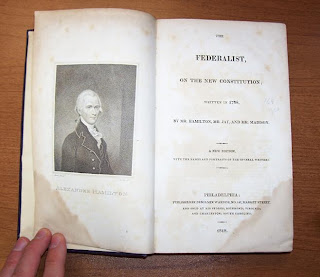
Incidentally, the copy of The Federalist shown above is from my personal library. It is a rebound edition dating from 1818, when two of the authors, James Madison and John Jay, were still alive.
This is not officially part of my series on authority, but I thought I should take this opportunity to mention a book I've been reading, titled Civilizing Authority: Society, State, and Church, edited by Patrick McKinley Brennan. It contains a number of essays worth noting, especially "Society, Subsidiarity, and Authority in Catholic Social Thought," by Russell Hittinger, who defines subsidiarity in a remarkably (but, one assumes, inadvertently) Kuyperian direction; and "A Rock on Which One Can Build: Friendship, Solidarity, and the Notion of Authority," by Thomas Kohler, who comes strikingly close to Dooyeweerd's modal analysis. But the most intriguing essay comes from J. Budziszewski, who writes on "How a Constitution May Undermine Constitutionalism."
Two years ago in Ottawa I met a scholar who has spent much of his career analyzing the growing power of Canada's courts since patriation and its impact on our political system as a whole. Having recently visited Australia, I had noticed that something similar has occurred in that country, despite the absence of a justiciable bill or charter of rights. I asked this scholar why the expansion of judicial power appears to be so universal in western, and particularly English-speaking, democracies. His answer didn't stick with me, but I seem to recall that he was as puzzled as I at the underlying reasons for this phenomenon.

Budziszewski has now offered a compelling response, with a focus, to be sure, on the American context, but with implications for other federal systems as well, including those of Australia and Canada. Students of American government are generally familiar with the Federalist Papers, or The Federalist, a series of essays written, under the pseudonym Publius, in defence of the new federal constitution by James Madison, Alexander Hamilton and John Jay. The best known of these are numbers 10 and 51, the latter of which defends the internal checks and balances within the federal government itself.
By contrast, few Americans are aware of the Anti-Federalist Papers, written pseudonymously by opponents of the new constitution, one of whom took the name Brutus. Budziszewski focusses on numbers 11 and 12, where the author sets forth his reservations over the expansion of judicial power and its concomitant tendency to expand the legislative power as well. In particular, Brutus
recognizes that a written constitution is not merely a statement of political ideals, but a legal instrument. It is all well and good to say that the three branches [legislative, executive and judicial] shall be coequal, but the courts normally interpret legal instruments. A differently drafted legal instrument might have distributed the power of interpretation among all three branches. It might have identified particular respects in which the legislature, the executive, and the judiciary are each interpreters of the constitution. What the Constitution actually does, argues Brutus, is just the opposite. Rather than distributing the power of interpretation, it concentrates it in the courts. To make matters worse, he holds, the language by which this is done encourages judges to exercise this concentrated power of interpretation in extravagant ways that bear but a distant relation to what the Constitution actually says (p. 148).
It is a truism that the American founders fragmented government and distributed sovereignty among the three branches to prevent any one of them becoming tyrannical. This is what Americans have been taught for generations, the assumption being that the founders had a solid grasp of human nature and the tendency of people to compete with each other for various social and political goods. From my own American upbringing, I recall that Christians in particular viewed the founders as fellow believers who understood the sinfulness of man and thus placed checks in their proposed constitution to counteract its effects. This sounded good in theory. The founders were apparent realists in their estimation of human nature, while liberals and socialists of various stripes had an overly rosy view of man's potential.
Yet what if the founders too were working with a defective anthropology? Could they have imbibed a modified Hobbesian anthropology, perhaps by way of John Locke? Hobbes holds that human beings are creatures of restless desires and, left to their own devices, ruthless competitors for the means of survival. Hobbes famously argued that the prepolitical state of nature is characterized by a war of all against all. Locke, of course, could not bring himself to follow Hobbes' logic in its entirety, admitting only that the state of nature could degenerate into warfare if conditions were favourable. Hence the need for civil government to preside over this competition and to make it more manageable and less potentially deadly. As for government itself, its members are as prone as everyone else to compete for valued goods. Hence, following Montesquieu, the founders adopted a constitutional framework that would divide sovereignty amongst the three branches and between federal and state governments.
So many Americans have accepted this reasoning that they have difficulty imagining an alternative. Here is where, taking Brutus and Budziszewski as a springboard, I would make the following argument, which I believe is more congruent with a biblical worldview: the line between good and evil does not run between co-operation and competition, as so many have believed, but through each. Our own socialist New Democratic Party began life as the Co-operative Commonwealth Federation, on the assumption that economic co-operation is better than the competition characteristic of capitalism. Yet those exalting solidarity over individuality ignore the fact that even organized crime is characterized by a certain solidarity amongst its perpetrators.
I would argue instead that both competition and co-operation have their legitimate places in human life. Competition can aim at narrow self-interest, but it can also be an incentive to service to others, as, e.g., in a charitable fund-raising marathon or even a large manufacturing enterprise supplying a needed good to the public. Similarly co-operation may be for the good of all, as socialists assume. But it can also be a means of collusion for purposes of price-fixing and other forms of corruption. Might the American founders have missed this element of human nature in their ostensibly "realistic" view?
Thus it may be that the expanding power of the courts has come with the blessing of the legislative branch. Here's Budziszewski again:
Another fact bolstering Brutus's case is that whereas federal legislators periodically face the electorate, federal judges don't. This makes Congress much more risk-averse than courts are. Rather than resenting the judiciary for taking hot-button issues out of its hands, the legislature may be relieved and grateful that someone else has made the decision for them (p. 153).
This is a conclusion I came to some time ago with respect to Canada. Since 1982 our courts have been making decisions that are increasingly imaginative and even in open conflict with the intentions of the drafters of the Constitution Act, 1982. We know this because, unlike the American founders, most of the players in the patriation drama are still very much alive! Given our convention of responsible government, a sitting government is reluctant to make decisions of a controversial nature. It is easier to leave such decisions up to the courts, who do not have to face the people. The Supreme Court's Reference re Québec secession is in many respects an ingenious decision that gave something to both sides and helped to prop up the federalist cause in Québec. Nevertheless, one would be hard put to demonstrate that the ruling was based on a close reading of our Constitution Acts, which nowhere mention secession.
Here in Canada we have Section 33, the Notwithstanding Clause, that legislators can invoke to override judicial decisions based on Sections 2 and 7-15 of the Charter of Rights and Freedoms. Yet over the past quarter century few legislatures, with the exception of Québec's National Assembly, have been willing to invoke it. I believe Budziszewski, drawing on Brutus, has now given us a credible explanation for this reluctance.
Incidentally, the copy of The Federalist shown above is from my personal library. It is a rebound edition dating from 1818, when two of the authors, James Madison and John Jay, were still alive.
27 May 2008
Authority and servanthood, II
Young people typically experiment with their own identities, trying on different personae and worldviews to see how well they make sense of the new experiences they are confronting on a daily basis. The university undergraduate years see this sort of quest occurring at a high level of intensity, hopefully under the guidance of older mentors capable of bringing some order to this search. My own undergraduate years were a time of tremendous intellectual and spiritual growth.
To begin with, though I entered university a music major, intending to focus on vocal performance and composition, two related events pushed me towards a focussed study of politics: Watergate and the Cyprus crisis of 1974, the latter of which made refugees of my close relatives. Though the church of my youth (for all its considerable virtues) had given me little guidance on how to relate my faith in Jesus Christ to the great political events of the day, assuming that concern for politics might deflect one from the ostensibly higher calling of evangelizing the lost, I was becoming aware that there was a long tradition of Christian reflection on social and political life. Indeed there was more than one such tradition. The first of these was a variant of the Anabaptist vision, which was the initial influence on me around 19 years of age.
Accordingly, I flirted with the brand of Anabaptism associated with the Sojourners community, whose flagship periodical was then known as the Post-American. This is because, first, it resonated strongly with my burgeoning commitment to social justice, especially as manifested in public efforts to alleviate poverty. Second, at 19 I considered myself a pacifist and was briefly persuaded that Christians ought not to fight in wars — for any reason.
Founded by Jim Wallis and others, Sojourners grew out of the student movement of the late 1960s and early 1970s. Vietnam was the issue of the day, and many young people were disillusioned by the foreign and defence policies of the US government. The Christians among them were especially cynical about the role of churches in supporting these policies. Seeing evangelist Billy Graham fraternizing with the discredited President Richard Nixon in the White House was a continuing irritant. As a youthful baby-boomer with a developing social conscience, Sojourners touched a chord with me.
Nevertheless, it didn't take me long to run up against the limitations of their approach. In particular it seemed unable to envision a positive role for the state as a truly political community called by God to do public justice in his world. The ultimate solution to the power of sin on earth was to be found in the church as an alternative community, while earthly communities such as state and government belonged only to the order of providence. This order of providence was, to be sure, under God’s control, but it could never be a suitable venue for living the Christian life in an actively obedient way.
The Sojourners community had been influenced by the writings of Mennonite theologian John Howard Yoder, who would later come to influence the theological ethicist Stanley Hauerwas. (Both of them were at Notre Dame in the early 1980s, while I was a graduate student there.) Yoder in turn had been a student of Karl Barth at Basel.
Yoder is perhaps best known for his book, The Politics of Jesus, which I read and reviewed for a course I was taking in the autumn of 1975. My undertaking of this project turned out to be a watershed experience for me, as it planted doubts in my mind as to the validity of his approach. Here are two typical passages from Yoder’s book:
What then is the political task of the Christian? Can the believing Christian, faithful to the gospel and obedient to the will of God, ever become a civil magistrate, seeking to do justice within the context of political community? Here is Yoder's answer, which comes in the midst of a discussion of the relationship between the 12th and 13th chapters of Romans:
This, it seemed to me, failed to do justice to St. Paul's reference in Romans 13 to political authority as precisely God's servant. In the course of writing my review, I discovered that the Greek word the Apostle uses for servant, viz., διάκονος, is the same one used for a deacon in the church community. Romans 12:19 was thus not a prohibition against taking up the office of civil magistrate; it was rather a warning not to take personal vengeance.
This suggested to me that political authority, normatively speaking, is in principle more than an inadvertent doer of God’s will, along the lines of the Persian King Cyrus, but is called, like David and Solomon and their successors, to respond actively to God’s summons to do justice. A king now converted to faith in Christ does not cease to be a king; rather he now rules justly according to God's commands. He exercises the responsibilities of his office as an active doer of God's will. After making this discovery, I could no longer call myself an Anabaptist in any meaningful sense and began to look increasingly to the Reformed tradition in which I had been raised.
Because at least this particular strain of Anabaptism lacks a normative conception of political authority within God's world, it is difficult to find good reason for mounting a trenchant critique of the various secular ideologies that have infused its exercise over the past two to three centuries. If politics falls at best within the realm of God's providential sovereignty, and if one should focus one's redemptive efforts only on building up the institutional church, then the need for discerning the spirits (which was the title I had originally chosen for my first book) within the political realm becomes less significant.
This does not mean that Anabaptists will then become enthusiasts for, say, liberalism or socialism. Instead, following Yoder, Hendrik Berkhof, and ultimately Barth himself, there is a tendency to lump state authorities as such together with various spiritual forces into the catch-all category of "principalities and powers." There is, in other words, a tendency to conflate creational structure with spiritual direction. The net result is a tendency to truncate the full scope of Christ's redemption, which now involves breaking the sovereignty of the powers but not reclaiming them as such by reorienting their foundational religious direction.
Next: Authority and power.
Young people typically experiment with their own identities, trying on different personae and worldviews to see how well they make sense of the new experiences they are confronting on a daily basis. The university undergraduate years see this sort of quest occurring at a high level of intensity, hopefully under the guidance of older mentors capable of bringing some order to this search. My own undergraduate years were a time of tremendous intellectual and spiritual growth.
To begin with, though I entered university a music major, intending to focus on vocal performance and composition, two related events pushed me towards a focussed study of politics: Watergate and the Cyprus crisis of 1974, the latter of which made refugees of my close relatives. Though the church of my youth (for all its considerable virtues) had given me little guidance on how to relate my faith in Jesus Christ to the great political events of the day, assuming that concern for politics might deflect one from the ostensibly higher calling of evangelizing the lost, I was becoming aware that there was a long tradition of Christian reflection on social and political life. Indeed there was more than one such tradition. The first of these was a variant of the Anabaptist vision, which was the initial influence on me around 19 years of age.
Accordingly, I flirted with the brand of Anabaptism associated with the Sojourners community, whose flagship periodical was then known as the Post-American. This is because, first, it resonated strongly with my burgeoning commitment to social justice, especially as manifested in public efforts to alleviate poverty. Second, at 19 I considered myself a pacifist and was briefly persuaded that Christians ought not to fight in wars — for any reason.
Founded by Jim Wallis and others, Sojourners grew out of the student movement of the late 1960s and early 1970s. Vietnam was the issue of the day, and many young people were disillusioned by the foreign and defence policies of the US government. The Christians among them were especially cynical about the role of churches in supporting these policies. Seeing evangelist Billy Graham fraternizing with the discredited President Richard Nixon in the White House was a continuing irritant. As a youthful baby-boomer with a developing social conscience, Sojourners touched a chord with me.
Nevertheless, it didn't take me long to run up against the limitations of their approach. In particular it seemed unable to envision a positive role for the state as a truly political community called by God to do public justice in his world. The ultimate solution to the power of sin on earth was to be found in the church as an alternative community, while earthly communities such as state and government belonged only to the order of providence. This order of providence was, to be sure, under God’s control, but it could never be a suitable venue for living the Christian life in an actively obedient way.
The Sojourners community had been influenced by the writings of Mennonite theologian John Howard Yoder, who would later come to influence the theological ethicist Stanley Hauerwas. (Both of them were at Notre Dame in the early 1980s, while I was a graduate student there.) Yoder in turn had been a student of Karl Barth at Basel.
Yoder is perhaps best known for his book, The Politics of Jesus, which I read and reviewed for a course I was taking in the autumn of 1975. My undertaking of this project turned out to be a watershed experience for me, as it planted doubts in my mind as to the validity of his approach. Here are two typical passages from Yoder’s book:
God can in his own way, in his sovereign permissive providence, “use” idolatrous Assyria (Isa. 10) or Rome. This takes place, however, without his declaring that such action which he thus uses is morally good or that participation in it is incumbent upon his covenant people (1st ed., p. 199).
God is not said to create or institute or ordain the powers that be, but only to order them, to put them in order, sovereignly to tell them where they belong, what is their place. It is not as if there was a time when there was no government and then God made government through a new creative intervention; there has been hierarchy and authority and power since human society existed. Its exercise has involved domination, disrespect for human dignity, and real or potential violence ever since sin has existed. Nor is it that in his ordering of it he specifically, morally approves of what government does. The sergeant does not produce the soldiers he drills, the librarian does not create nor approve of the book he catalogs and shelves. Likewise God does not take the responsibility for the existence of the rebellious “powers that be” or for their shape or identity; they already are. What the text says is that he orders them, brings them into line, that by his permissive government he lines them up with his purpose (p. 203).
What then is the political task of the Christian? Can the believing Christian, faithful to the gospel and obedient to the will of God, ever become a civil magistrate, seeking to do justice within the context of political community? Here is Yoder's answer, which comes in the midst of a discussion of the relationship between the 12th and 13th chapters of Romans:
There is a most specific dialectical interplay around the concepts of vengeance and wrath. Christians are told (12:19) never to exercise vengeance but to leave it to God and to wrath. Then the authorities are recognized (13:4) as executing the particular function which the Christian was to leave to God. It is inconceivable that these two verses, using such similar language, should be meant to be read independently of one another. This makes it clear that the function exercised by government is not the function to be exercised by Christians (p. 199, emphasis mine).
This, it seemed to me, failed to do justice to St. Paul's reference in Romans 13 to political authority as precisely God's servant. In the course of writing my review, I discovered that the Greek word the Apostle uses for servant, viz., διάκονος, is the same one used for a deacon in the church community. Romans 12:19 was thus not a prohibition against taking up the office of civil magistrate; it was rather a warning not to take personal vengeance.
This suggested to me that political authority, normatively speaking, is in principle more than an inadvertent doer of God’s will, along the lines of the Persian King Cyrus, but is called, like David and Solomon and their successors, to respond actively to God’s summons to do justice. A king now converted to faith in Christ does not cease to be a king; rather he now rules justly according to God's commands. He exercises the responsibilities of his office as an active doer of God's will. After making this discovery, I could no longer call myself an Anabaptist in any meaningful sense and began to look increasingly to the Reformed tradition in which I had been raised.
Because at least this particular strain of Anabaptism lacks a normative conception of political authority within God's world, it is difficult to find good reason for mounting a trenchant critique of the various secular ideologies that have infused its exercise over the past two to three centuries. If politics falls at best within the realm of God's providential sovereignty, and if one should focus one's redemptive efforts only on building up the institutional church, then the need for discerning the spirits (which was the title I had originally chosen for my first book) within the political realm becomes less significant.
This does not mean that Anabaptists will then become enthusiasts for, say, liberalism or socialism. Instead, following Yoder, Hendrik Berkhof, and ultimately Barth himself, there is a tendency to lump state authorities as such together with various spiritual forces into the catch-all category of "principalities and powers." There is, in other words, a tendency to conflate creational structure with spiritual direction. The net result is a tendency to truncate the full scope of Christ's redemption, which now involves breaking the sovereignty of the powers but not reclaiming them as such by reorienting their foundational religious direction.
Next: Authority and power.
08 May 2008
Authority and servanthood
During the final meeting of the semester in my introductory-level courses I always read aloud Matthew 20:20-28, which tells of the outrageous request made by the mother of James and John to Jesus that he give her two sons the highest places of honour in his kingdom. This, of course, elicits protests from the other disciples, while Jesus himself indicates that his kingdom is about, not achieving human greatness, but practising servanthood.
One element of this passage puzzled me until recently. The New International Version renders verses 25-28 as follows:
Could it really be that Jesus is deprecating authority and thus commanding his followers to refrain from exercising it so they can be servants instead? How can we square this with Peter and Paul's words in I Peter 2:13-17 and Romans 13:1-7 respectively? Might it be an example of semitic hyperbole along the lines of Luke 14:25-27? That was my conclusion.
Recently, however, I had the opportunity to sound out my esteemed friend and (soon to be emeritus) colleague, Al Wolters, about this passage, and especially the Greek word, κατεξουσιάζουσιν (κατεξουσιάζω), which is translated here as "exercise authority." (Thayer's Greek Lexicon agrees with the NIV's translation.) He pointed out that the word is rare, occurring only here and in the parallel passage in Mark 10:35-45. Apart from these, the word hardly occurs at all even outside the New Testament.
The construction of the word, however, may provide a clue to its meaning. The prefix κατα- is added to εξουσιάζω, the latter of which means simply to exercise authority. The use of this prefix, especially when the object of the verb is rendered in the genitive case (αὐτων), may imply that the compound verb has a negative connotation. This is certainly true of the immediately preceding verb, κατακυριεύουσιν (κατακυριεύω), which the NIV translates as "lord it over" and which is followed again by the genitive pronoun αὐτων. Thus it may be that the New Revised Standard Version best translates the passage as follows:
Servanthood does not stand in contrast to authority, as some believe. One need not relinquish authority to be a servant. (In fact, I would argue that it is impossible for human beings created in God's image not to have authority.) Those in authority, including kings, emperors, prime ministers, presidents and parliamentarians, are mandated by God to exercise their authority precisely as servants of God and neighbour. If they do not, then they abuse authority.
This is the first instalment in a series I will be posting in the coming weeks and months on the subject of authority, on which I am (all too slowly!) writing a book. Stay tuned for more.
Next: How at age 20 a reading of Romans 13 in the original Greek convinced me that I was not an anabaptist after all.
During the final meeting of the semester in my introductory-level courses I always read aloud Matthew 20:20-28, which tells of the outrageous request made by the mother of James and John to Jesus that he give her two sons the highest places of honour in his kingdom. This, of course, elicits protests from the other disciples, while Jesus himself indicates that his kingdom is about, not achieving human greatness, but practising servanthood.
One element of this passage puzzled me until recently. The New International Version renders verses 25-28 as follows:
Jesus called them together and said, "You know that the rulers of the Gentiles lord it over them, and their high officials exercise authority over them. Not so with you. Instead, whoever wants to become great among you must be your servant, and whoever wants to be first must be your slave — just as the Son of Man did not come to be served, but to serve, and to give his life as a ransom for many" (emphasis mine).
Could it really be that Jesus is deprecating authority and thus commanding his followers to refrain from exercising it so they can be servants instead? How can we square this with Peter and Paul's words in I Peter 2:13-17 and Romans 13:1-7 respectively? Might it be an example of semitic hyperbole along the lines of Luke 14:25-27? That was my conclusion.
Recently, however, I had the opportunity to sound out my esteemed friend and (soon to be emeritus) colleague, Al Wolters, about this passage, and especially the Greek word, κατεξουσιάζουσιν (κατεξουσιάζω), which is translated here as "exercise authority." (Thayer's Greek Lexicon agrees with the NIV's translation.) He pointed out that the word is rare, occurring only here and in the parallel passage in Mark 10:35-45. Apart from these, the word hardly occurs at all even outside the New Testament.
The construction of the word, however, may provide a clue to its meaning. The prefix κατα- is added to εξουσιάζω, the latter of which means simply to exercise authority. The use of this prefix, especially when the object of the verb is rendered in the genitive case (αὐτων), may imply that the compound verb has a negative connotation. This is certainly true of the immediately preceding verb, κατακυριεύουσιν (κατακυριεύω), which the NIV translates as "lord it over" and which is followed again by the genitive pronoun αὐτων. Thus it may be that the New Revised Standard Version best translates the passage as follows:
‘You know that the rulers of the Gentiles lord it over them, and their great ones are tyrants over them. It will not be so among you; but whoever wishes to be great among you must be your servant, and whoever wishes to be first among you must be your slave; just as the Son of Man came not to be served but to serve, and to give his life a ransom for many.’ (emphasis mine)
Servanthood does not stand in contrast to authority, as some believe. One need not relinquish authority to be a servant. (In fact, I would argue that it is impossible for human beings created in God's image not to have authority.) Those in authority, including kings, emperors, prime ministers, presidents and parliamentarians, are mandated by God to exercise their authority precisely as servants of God and neighbour. If they do not, then they abuse authority.
This is the first instalment in a series I will be posting in the coming weeks and months on the subject of authority, on which I am (all too slowly!) writing a book. Stay tuned for more.
Next: How at age 20 a reading of Romans 13 in the original Greek convinced me that I was not an anabaptist after all.
08 June 2007
Power intrinsically corrupt?
Lord Acton famously wrote that "power tends to corrupt, and absolute power corrupts absolutely," a statement frequently quoted and all too often accepted at face value. I like Mark Earley's clarification:
I would expand on this, because it has relevance beyond political life. All of us, as God's image-bearers, are gifted with various capacities (i.e., power) enabling us to fulfil the responsibilities of the authoritative offices in which God has placed us. These capacities are not in themselves corrupting. However, like everything else in God's good creation, they are capable of being misused by sinful human beings. It's not the power as such that corrupts; it's our own rebellious nature that does so. Acton's saying might be closer to the truth if turned around: Human sin corrupts the otherwise legitimate use of power.
Lord Acton famously wrote that "power tends to corrupt, and absolute power corrupts absolutely," a statement frequently quoted and all too often accepted at face value. I like Mark Earley's clarification:
But remember this: power corrupts, but power itself is not necessarily corrupt. God has given power to the state to be used to restrain evil and maintain order. It is the use of power, whether for personal gain or for the state’s ordained function, that is really at issue.
I would expand on this, because it has relevance beyond political life. All of us, as God's image-bearers, are gifted with various capacities (i.e., power) enabling us to fulfil the responsibilities of the authoritative offices in which God has placed us. These capacities are not in themselves corrupting. However, like everything else in God's good creation, they are capable of being misused by sinful human beings. It's not the power as such that corrupts; it's our own rebellious nature that does so. Acton's saying might be closer to the truth if turned around: Human sin corrupts the otherwise legitimate use of power.
12 September 2004
Authority, office and uniform
In my recent readings on authority, I have come to believe that key to understanding the concept is office, something which the majority of writers on the subject appear to have missed entirely. As authoritative office has come to be derogated, there has been a concomitant tendency to disparage the distinctive garb associated with it. Beginning some four decades ago, coincident with the various cultural shifts of the 1960s, people began to jettison office-specific uniforms in favour of "ordinary" clothing -- a trend which, with its universaling of blue jeans, ironically put everyone into a new, more monochrome uniform. Nuns took off their habits. Professors dressed like their students. School dress codes went by the boards.
Of course, not every authoritative office was or could be affected by this. Police officers still have to wear uniforms, a tacit concession that they fulfil a crucial social function. Letter carriers still dress in postal garb, if only to alert the suspicious family dog to their presence!
Here are the reflections of one person who well understands the connection between dress and office: "Clothes Make the Office." Writes the author:
There is a distinctive academic garb that is nevertheless worn only on special occasions, such as opening and closing convocations. I suppose my own distinctive academic "uniform", which I wear while teaching, is the bow tie. Of course, I would never wear it while gardening or exercising or doing the laundry. Even on campus, on days when I am not teaching, I generally do not wear it. I claim no great significance for this sartorial signature, but it does serve to mark the office in some measure. And given that it is rarely in style at all, it is not generally subject to the whims of fashion.
In my recent readings on authority, I have come to believe that key to understanding the concept is office, something which the majority of writers on the subject appear to have missed entirely. As authoritative office has come to be derogated, there has been a concomitant tendency to disparage the distinctive garb associated with it. Beginning some four decades ago, coincident with the various cultural shifts of the 1960s, people began to jettison office-specific uniforms in favour of "ordinary" clothing -- a trend which, with its universaling of blue jeans, ironically put everyone into a new, more monochrome uniform. Nuns took off their habits. Professors dressed like their students. School dress codes went by the boards.
Of course, not every authoritative office was or could be affected by this. Police officers still have to wear uniforms, a tacit concession that they fulfil a crucial social function. Letter carriers still dress in postal garb, if only to alert the suspicious family dog to their presence!
Here are the reflections of one person who well understands the connection between dress and office: "Clothes Make the Office." Writes the author:
For almost the entirety of the church’s history (both biblical and ecclesial), ministers of the gospel have worn a robe in the service of worship. This continued until the last century and then the clerical garments started to disappear in various settings. . . .
I used to think that robes were some high-minded way of calling attention to the man. There was, of course, a great irony in my church tradition. Though the minister would never dare wear a robe so he wouldn’t be considered pompous or Popish, the choir was always robed behind him! Then I read defenders of ministerial dress who said the clothing is intended to hide the man behind the symbolic cloth of Jesus Christ. The church’s worship is about the ministry of Jesus Christ, giving us His Word and feeding us His meal.
There is a distinctive academic garb that is nevertheless worn only on special occasions, such as opening and closing convocations. I suppose my own distinctive academic "uniform", which I wear while teaching, is the bow tie. Of course, I would never wear it while gardening or exercising or doing the laundry. Even on campus, on days when I am not teaching, I generally do not wear it. I claim no great significance for this sartorial signature, but it does serve to mark the office in some measure. And given that it is rarely in style at all, it is not generally subject to the whims of fashion.
Subscribe to:
Posts (Atom)