22 June 2003

Abraham in Arabia

My remarks on Kamal Salibi two days ago may need to be put in context. A story on Abraham in the December 2001 issue of National Geographic reminded me that the Koran itself places Abraham in Arabia. According to author Tad Szulc,

The Koran reports that Abraham and Isma’il raised the foundations of the House. The “house” is the Kaaba in Mecca, Islam’s holiest shrine. One of the four corners of this small rectangular structure is a sacred black stone that is a remnant of the original building. The annual pilgrimage to Mecca, the hajj, when Muslims from all over the world circle the Kaaba, reinforces the central role of Abraham and Ishmael in the Islamic faith.

Given that the Koran is revered by Muslims as divinely inspired scripture, the notion of southern Arabia being the promised land may not be so far fetched from their perspective. Still Salibi's theory faces a number of obstacles, the most obvious of which are geographical and archaeological.
"Christ is made the sure foundation"

How wonderful! This morning in church the first hymn we sang was "Christ Is Made the Sure Foundation," set to Henry Purcell's tune, Westminster Abbey. This is a 7th-century Latin hymn translated by John Mason Neale in the middle of the 19th century. I'm quite certain it had been more than two decades since I had sung this in church. It had been far too long.
The Heidelberg Catechism

Easily the jewel of the 16th-century Reformation confessions is the Heidelberg Catechism of 1563. It was composed by Zacharias Ursinus (Baer) and Caspar Olevianus (Olewig) under the sponsorship of Elector Frederick III, "the Pious," of the Palatinate. Unlike many of the confessions and catechisms which have a somewhat dry and scholastic tone, the Heidelberg is warm and personal, beginning with the famous first question and answer:

Q. What is your only comfort in life and in death?

A. That I am not my own, but belong — body and soul, in life and in death — to my faithful Savior Jesus Christ. He has fully paid for all my sins with his precious blood, and has set me free from the tyranny of the devil. He also watches over me in such a way that not a hair can fall from my head without the will of my Father in heaven: in fact, all things must work together for my salvation. Because I belong to him, Christ, by his Holy Spirit, assures me of eternal life and makes me wholeheartedly willing and ready from now on to live for him.

One would be hard pressed to come up with a better summary of the church's faith.

21 June 2003

Trip to Paris

We just returned from a trip to Paris. Paris, Ontario, that is. It's a lovely little community just west of Brantford and about half an hour away from where we live here in Hamilton. Theresa especially enjoys Lions Park, where there is a variety of playground equipment ideal for small children. It's well worth visiting.
Rivalry between Powell and Rice?

This report from CNN, "Powell and Rice: Opposites, but Not Opponents," speculates on a possible rivalry between Colin Powell and Condoleeza Rice for control over the Bush administration's foreign policy. Both deny this, but it would hardly be the first time. Many of us recall the competition between Secretary of State William Rogers and National Security Advisor Henry Kissinger under President Nixon, and between Cyrus Vance and Zbigniew Brzezinski under Carter. It's easier for a president to listen to advice coming to him from the White House Office than from the entrenched bureaucracy in the State Department. The rivalry between Secretary of State and National Security Advisor seems built into the very structure of these two somewhat redundant offices.
A top seller?

This may not mean a thing, but I was surprised at this all the same. According to the most recent information from amazon.com, Political Visions and Illusions stands at number 7 out of its 20 top-selling books in the "church and state" category, just ahead of Charles Colson's 1989 book, Kingdoms in Conflict. At number one is J. Budziszewski's What We Can't Not Know, which has recently been plugged in Colson's Breakpoint commentaries. But as I said, this may not mean a thing.

20 June 2003

Rewriting history for political purposes

I recall hearing about this book when it came out, but at that time I didn't quite pick up on its political implications: Kamal Salibi's Did the Bible Come from Arabia?, published in 1984. Salibi argues that the original promised land to which Moses led the children of Israel was in Asir in southern Arabia. He derived his theory by matching biblical place names with the names of known cities in Asir. Apparently the Jews did not go to Palestine until after the Babylonian exile. It's all very clever and it seems to be one of a number of Bible conspiracy theories. The positive references to Immanuel Velikovsky do not exactly help its claim to credibility.

Lest we dismiss it too quickly, however, we should note that this theory seems to be part of mainstream history as taught in schools in the Arab world. All of this is part of an obvious effort to discount the Jewish/Israeli claim to Palestine. Yet if this is so, then the theory's proponents have missed its obvious political implication: Israel should relocate to southern Arabia! It seems that someone has yet to connect the dots.
Wilhelm Roepke's humane economic vision

I cannot call myself an unadulterated conservative for reasons given at some length in my book. But I must admit that, among the varieties of professed conservatives in North America, I have some sympathy for Russell Kirk -- certainly more than for the libertarians who are such a major part of the conservative movement in the US. Kirk recounts an incident related to him by his favourite economist, Wilhelm Roepke, in 1957:

During the Second World War the city of Geneva [Switzerland] had allocated garden plots along the line of the vanished city walls to citizens wishing to grow their own vegetables in a time of food shortages. This use of public land turned out to be popular; the city continued the allocation of plots after the war.

Roepke heartily approved of this undertaking, which both enabled people to obtain independently part of their own sustenance and provided the satisfaction of healthy achievement outside factory walls. When [libertarian economist] Ludwig von Mises came to visit Roepke at Geneva, Roepke took his guest to inspect those garden plots.

Mises sadly shook his head: "A very inefficient way of producing foodstuffs!"

"But perhaps a very efficient way of producing human happiness," Roepke told him (Kirk, The Sword of Imagination, pp. 204-205).

Roepke's economic priorities were similar to those of the English distributists, such as G. K. Chesterton and Hilaire Belloc. All were united in championing small property-holders and opposing both bureaucratic socialism and the corporate economy.

Belloc's The Servile State is definitely worth reading.
Liturgical yodelling?

For some years now I have wondered whether the next big battle to be fought in the worship wars will be over liturgical yodelling. Thus far I have failed to find an entire website devoted to this new genre, but I did find the following via Fr. Bryce Sibley's weblog: "I Wanna Yodel for the Lord." It's not Palestrina, but it certainly ranks right up there with the polka masses one sometimes hears about.

19 June 2003

Photographs of England still on the web

Rich Greydanus took some wonderful photographs during his trip to England last month -- mostly of churches. Unfortunately he does not archive his weblog entries, but his trip journal and photos can now be found at this website.

As a schoolboy I had thought to be an architect, and I still love the cityscapes created by the buildings people have erected in which to live, work, play and worship. I must admit, however, that I tend towards the stable cityscapes of the old European cities rather than the constantly changing skylines of the huge North American urban centres. I suppose that's why I find Rich's photographs so appealing.
More radio interviews

I have two more radio interviews coming up: one tomorrow with Jay Bryant of XM Satellite Radio and another at the beginning of next month with David Vaughan of KSIV in St. Louis. Because these are taped interviews, I do not know when they will actually be aired. If I am given this information, I will post it here.
Rainy days in Virginia

If John Bell's magnificent photographs are any indication, Virginia's scenic beauty is undimmed even by the rain. One doesn't like to second guess God, of course, but I find myself wondering why he didn't have Moses lead the children of Israel to the lush land of Virginia rather than to the relatively arid land of Canaan.
Same-sex marriages in Canada?

Andrew Sullivan applauds Ottawa's decision to support same-sex marriage and not to contest the ruling of an Ontario court. By contrast, David Frum believes that the government's proposed exemption for religious groups will not be allowed to stand over the long term.

18 June 2003

Ravel's piano concertos

Ever since I was in my teens I've loved the music of Marice Ravel (1875-1937). Born in France, his father's origins were Swiss and his mother's Basque. Ravel is all too often compared to Claude Debussy, with whose music his own compositions bear some resemblance. Both composers are often referred to as "impressionists," inviting comparison with the paintings of Renoir or Monet. Yet Ravel is by no means a lesser Debussy. His own music is a studied combination of high imagination and disciplined form. In this respect he seems uniquely to cut through the dichotomy between classicism and romanticism.

For example, his "Le Tombeau de Couperin" is more than an homage to the great baroque composer, Francois Couperin. It is a highly sophisticated piece, built on the dance forms of the 18th century. As one observer puts it:

There's a sense of polish and wit, of elegance and craft so typical of French music. But there are also less obvious undertones of profundity. Ravel wrote the piece during the Great War, during which he was an ambulance driver, and each movement is dedicated to one of his friends who died.

The piece was originally written for piano in six movements. But later Ravel orchestrated four of the movements, which he subsequently rearranged. He thus gave his piece a new life in a different, but just as pleasing, form.

My favourite pieces of Ravel's are his two piano concertos, the Piano Concerto in G Major and the Piano Concerto for the Left Hand, written almost simultaneously in 1930-1931. The first concerto is a brilliant and energetic work, filled with dazzling musical phrases, dissonances, and even some surprising allusions to that still young genre of jazz, which was having an influence on his side of the Atlantic, as well as in North America. The second concerto has only a single movement and is really more of a tone poem. It was written for pianist Paul Wittgenstein (the brother of philosopher Ludwig), who had lost his right arm in the Great War. Not surprisingly, its tone is sombre and foreboding.

Tragically, Ravel's last years were spent with a debilitating illness that left him unable to write or even communicate any further musical compositions. This was the result of a taxi cab accident suffered in 1928. Yet the music was still inside him until the end, with no way to get out. This would be nothing less than a personal hell for anyone with creative abilities.

Ravel claimed to have no religion, and he took his inspiration from nature more than anything else.

I've often wondered what he could have done if he had not been in the accident and had lived to age 90 and died in 1965. The world would have been blessed with an additional 33 years of great music from the pen of this man.

17 June 2003

Europe's loss of homelands

In general I count myself a qualified supporter of the movement towards European integration. In principle, the creation of a European Union is not essentially different from the earlier efforts to create federations in the United States, Canada and Australia. I am pleased that Cyprus, Malta, Poland and a number of other countries will shortly be admitted to the EU. In fact, the EU stands possibly the best chance of bringing an end to the protracted division of Cyprus.

At the same time, I cannot help wondering whether a united Europe will produce the sort of rootlessness and excessive mobility characteristic of North America. It is difficult to imagine a continental patriotism taking hold in Europe. Europeans are unlikely to become dewey eyed when they hear Beethoven's "Ode to Joy" (the EU anthem) or see the 12-star EU flag raised on the staff. Europe is too much of an abstraction to command this sort of loyalty.

Yet the process of European integration is inevitably eroding the more local loyalties that have characterized Europeans for generations, without providing an adequate substitute. Elections for the European Parliament usually garner considerably lower voter turnout than do national elections. Much of this may have to do with the relative powerlessness of that body, but it may also have to do with a lack of feeling towards this nebulous entity called Europe.

Europeans may now be able to move from country to country as the job market beckons. They will be surrounded by the cultural artefacts of a rich heritage, for example, Chartres Cathedral, the Colosseum, and the Parthenon. But they may no longer identify with any particular local manifestation of this heritage. The dechristianization of Europe had already produced something of a deracinated culture in the post-war era. The EU may only hasten the process.

On the other hand, it is also true that, despite the movement for integration, there is a plethora of autonomist and separatist movements dotting the old continent. Scottish nationalism, Corsican separatism, Basque and Catalonian regionalisms are all part of this counter tendency. Perhaps the assertion of these local loyalties is indicative of the tendency of the human spirit to identify with those loyalties that are more proximate and less abstract. And it may offer hope that European integration will not lead inexorably towards what Alexandre Kojève once called the universal and homogeneous state.
No American Idol

I've been informed by a former student of mine that, even if I tried to enter the American Idol competition, I would definitely be disqualified because of age. It seems I am approximately two decades too old.

Isn't there a Canadian version of this show? Perhaps they would accept me. After all, our population seems to be ageing faster than that of the United States, which means there would be a smaller pool of young people to draw from. They might be forced to dip into the vast reservoir of those of us who are, shall we say, chronologically challenged.
Homeland and rootedness

I have recently finished writing an encyclopaedia article on the late Russell Kirk (1918-1994), one of the intellectual progenitors of the post-war American conservative movement.

Although he was born in the Detroit suburb of Plymouth, he would come to make his home in the little village of Mecosta in the northern part of Michigan, where he spent the remainder of his life. Here had lived several of his ancestors, and he sought to reclaim a sense of rootedness in a particular homeland. This sense of rootedness is difficult to maintain in highly mobile North America, where people move from one place to another at the behest of the market.

My own hometown is Wheaton, Illinois. To be sure, I was not born there, since there was (and is) no hospital in that community. But that's where I spent my first eighteen years.


Wheaton, Illinois, during my childhood
(well, maybe a bit before that)


The year I was born, Wheaton had a population of 16,001. (That's what my 1955 atlas says. Perhaps I was the one to put it over the 16,000 mark!) As of 2000 there were 55,416 people living there. I enjoy visiting the town, although it has largely lost the small town flavour it still had while I was growing up.

Yet my own roots there do not extend much before my own birth, as my parents were both born elsewhere. Like Kirk, I probably have more generations of ancestors who lived in Michigan. My grandfather was born in Oskar, in the beautiful "Copper Country" of the upper peninsula. His mother was not born there, but she was brought there by her parents as an infant in 1882. My grandmother was born in Big Stone Gap, Virginia, another beautiful part of the world. Her parents brought her and her siblings to Adrian, Michigan, in 1914. Finally, my mother was born in Jackson and grew up south of Ann Arbor.

I still have relatives living in southeast Michigan, as well as a brother-in-law living in Hillsdale with his family. So despite my birth in Illinois (of which I've not seen much outside the Chicago area) and my current home in Ontario, I have a special place in my heart for Michigan, where I spent so much of my childhood visiting relatives.

At some point I will write more on patriotism and rootedness. I tend to the view that a genuine patriotism is more likely to be local than national in its focus.

16 June 2003

Missed allusion

Well, it took me a while, but I finally figured out that the title of David Neff's Editor's Bookshelf column, "American (and Un-American) Idols," is an oblique allusion to the "American Idol" television programme. I myself have not actually seen it, but I assume it is a twenty-first century version of the old "Ted Mack's Original Amateur Hour." Perhaps I should enter. I could sing some of my psalm arrangements. I'm sure there must be a huge market for that sort of thing.
Property settlements in Cyprus

With the historic opening of the green line in Cyprus two months ago, its citizens are now moving back and forth between the two sides of the island with relative ease. With this new freedom of movement has come a general recognition that disputes over property rights must be resolved in some equitable fashion. Surprisingly, this appears to be recognized by both governments in the island, even that of the unrecognized Turkish-Cypriot state in the north. To be sure, the disputes are not nearly as intractable as those between Israelis and Palestinians, where the displacement of peoples has been large in comparison. The following article by Michele Kambas and Gokhan Tezgor, "Cyprus land ownership still controversial," indicates how such disputes are being handled, particularly by the European Court of Human Rights.

In the Greek Cypriot south there has been a concerted attempt to maintain abandoned property in trust for its owners:

Turkish Cypriot estates in the south come under a government-appointed Trustee, which leases to Greek Cypriot refugees. They have to give them back if there is a settlement.

"Nobody can usurp another person's property," said Andreas Christou, Interior Minister in the internationally-recognised government of the south."Everything is documented, down to the last square foot."

The Turkish Cypriot government is attempting to play catch-up:

Legislation now being prepared in northern Cyprus would call for the establishment of an independent property commission to deal with Greek Cypriot claims.

Even so, people are unlikely to give up their property easily and the Cypriot's love for their land is well documented. People shun rents, work a lifetime to pay for a home or a field, and throw in a house when the daughter of the family gets married. [Remember "My Big Fat Greek Wedding"?] "Have you met a Cypriot who does not want their property? I haven't," said [human rights lawyer Achilleas] Demetriades.

At one time I was fairly pessimistic over the prospects of a permanent settlement to the Cyprus issue. But given the tremendous outpouring of good will among both Greek and Turkish Cypriots since the breach of the barrier, it is hard to imagine that disputes over property would be allowed to stand in the way over the long term. It may be necessary for Cyprus' ageing leadership to pass from the scene first. A new generation with no memories of the Emergency of 1955-1960, or the troubles of 1963, 1967 and 1974 should be allowed to take responsibility for the island's future.

One such person is Serdar Denktash, son of the Turkish Cypriot leader, Rauf Denktash, and a rising star in his own right. He may be the one finally to bring about a settlement, as told in this article from TIME Magazine's European edition: "End Of The Line."
Article and interview

Christianity Today has just posted an article about Political Visions and Illusions at its website: "American (and Un-American) Idols," along with an interview: "Avoiding Rights Talk." This is part of the Editor's Bookshelf column written by David Neff. These will appear in print in the July issue of CT.

The Redeemer Campus Bookstore has now sold out of its stock of this book. A fresh order has been placed, but it's on two-week backorder at the distributor.

15 June 2003

From Luther's Deutsche Messe

At the time of the Reformation of the 16th century, Martin Luther translated the hymns of the mass into the German language and generally put them in metrical form. For the Latin Sanctus, he expanded the text to encompass more of the passage in Isaiah 6 from which it is taken. This was the result: "Isaiah, Mighty Seer, in Days of Old." Nancy and I heard this sung by a wonderful church choir this morning, as part of the celebration of Trinity Sunday. Generations of Lutherans are familiar with this hymn; it deserves to be known more widely in the rest of the body of Christ.
Sudan's civil war near an end?

Could the nearly two-decade-old civil war in Sudan be coming to an end? Like the war in Congo, this one too has not exactly been at the top of the headlines in the western press, but it has killed nearly 2 million people, particularly in the predominantly christian and animist south. However, this report in today's Telegraph offers some hope: "End of 19-year Sudan civil war in sight." Here are the terms of the deal between the two sides:

The breakthrough came after five weeks of talks in Kenya, in which the government and the Sudan People's Liberation Movement agreed to a six-year transition period culminating in a referendum offering Christians and animists in the south independence from the Muslim-dominated north.

Khartoum abandoned its stance on imposing universal sharia law, promising to guarantee southerners freedom of religion. "The two sticking issues to be resolved, the main causes of this war, have been addressed," said Samson Qwaje, the SPLM spokesman.

Because most southerners in that country are fellow believers in Christ, most of the publicity concerning the conflict has come from christian organizations, such as the Religious Liberty Commission of the World Evangelical Alliance and Voice of the Martyrs. Pray that peace -- a just peace -- will at last return to this troubled land.
Trinity Sunday


In the western church the sunday after Pentecost is Trinity Sunday. In the eastern church the Trinity is often represented as the so-called "Old Testament Trinity," that is, as the three angels who visited Abraham in Genesis 18. This is portrayed in the famous icon shown above, painted by Andrey Rublev in the 15th century.

Today is also Pentecost in the eastern church.

14 June 2003

Historical atlases

I neglected to mention the presence in my personal library of a number of atlases and historical atlases. I have always loved maps and atlases, ever since my parents bought me a set of geographic flash cards at age 4. (Does that make me a "cartophile"? I'm not sure.) I have several antique atlases, dating from 1890, 1901, 1907 and 1923. I also have one published on the occasion of the Century of Progress world's fair in Chicago in 1933. Many years ago, in Milan, Italy, I purchased a copy of the Atlante geographico universale in 26 carte, published in 1902. I have always been fascinated by the shifting international boundaries in Europe, despite the fact that so much bloodshed and suffering accompanied these historic shifts.
Father's Day

Tomorrow will be the fifth Father's Day I've spent since becoming a father myself. In that time I've become aware of the importance of fathers in the upbringing of children and, along with this, the significance of the absence of fathers from their children's lives. This is from the National Fatherhood Initiative:

Fathers who live with their children are more likely to have a close, enduring relationship with their children than those who do not. The best predictor of father presence is marital status. Compared to children born within marriage, children born to cohabiting parents are three times as likely to experience father absence, and children born to unmarried, non-cohabiting parents are four times as likely to live in a father-absent home.

Children who live absent their biological fathers are, on average, at least two to three times more likely to be poor, to use drugs, to experience educational, health, emotional and behavioral problems, to be victims of child abuse, and to engage in criminal behavior than their peers who live with their married, biological (or adoptive) parents.

From 1960 to 1995, the proportion of children living in single-parent homes tripled, from 9 percent to 27 percent, and the proportion of children living with married parents declined. However, from 1995 to 2000, the proportion of children living in single-parent homes slightly declined, while the proportion of children living with two married parents remained stable.

Children with involved, loving fathers are significantly more likely to do well in school, have healthy self-esteem, exhibit empathy and pro-social behavior, and avoid high-risk behaviors such as drug use, truancy, and criminal activity compared to children who have uninvolved fathers.

It seems parenthood is not simply about sharing the burden of child rearing. It seems that fathers and mothers actually contribute significantly different elements to this task, even when they are in many respects doing the same things, such as changing diapers, preparing food, laundering clothing, and so forth. Those who have spent their first two decades without a father or mother, or with something lacking in their relationship with one of these, tend to spend the remainder of their lives trying to fill the void in some fashion.

This places a rather large and fearful burden on us parents to do right by our children. Unfortunately, we will never attain perfection in the parenting task, however hard we try. We thus have good reason to pray that God will forgive us our deficiencies as parents and that our children will not suffer unduly because of them. At the same time, I am discovering that the joys of being a father have thus far considerably outweighed the trials. Thanks be to God.
Personal library: home branch

Perhaps not suprisingly, the bulk of my personal library is in my campus office. There the books are largely academic and scholarly books, whose subjects fall into the categories of politics (the vast majority), philosophy, economics, education, history, sociology and religion.

My library in my home office tends to encompass Russian and other novels, some poetry, books on railways and trolleys (one of my longstanding hobbies, about which I will undoubtedly be writing), Cyprus, the Byzantine world, Chicago and local northern Illinois history (my homeland, if you will), art and architecture (including Byzantine icons), religion (including numerous bible translations in English and a few other languages), liturgy and hymnody, and foreign language dictionaries. Among all these are more than a number of beautifully-illustrated, oversized coffee table books. Then there are the photo albums....

13 June 2003

Notes From a Hillside Farm

One of the most visually arresting blogs around has to belong to John Bell, an Orthodox Christian living in Virginia. He does not update his Notes From a Hillside Farm very frequently. But this allows us to linger over his breathtakingly beautiful photographs of the Virginia countryside uploaded into his site. I must admit to some envy at his being constantly surrounded by such beauty -- both in the weekly celebration of the Divine Liturgy of St. John Chrysostom and in the lush landscape of his home state.
Civil war in Congo

Here is just one of many stories to be found on this subject on the web: "Thousands flee new wave of Congo fighting." A couple of paragraphs from this report from CTV:

It's been called the deadliest conflict since the Second World War. Fighting between rival governments, militias and gangs of armed thugs has been raging for six years in the Democratic Republic of Congo (DRC) with no end in sight....

Aid organizations estimate that anywhere between 3.5 to 5 million people have died in Congo's civil war.

For those of us in the west who take stable, functioning government for granted, the following is sobering:

"What we need is to have this area under control of government, under a government. Because there is no government here," says Brig. General Kale Kaihura of the Ugandan army. "It's a free-fire zone."

And now the UN says tribal leaders are pushing the Congo towards genocide, pitting tribal militias against one another by using the political vacuum to whip up old ethnic fears.

More than one observer has likened the scale of the Congolese civil war to the two world wars. Add to this the on-going civil wars in Sudan, west Africa and elsewhere, and it seems incomprehensible that the tragic bloodshed in Africa should be eclipsed night after night by Iraq and the Israeli-Palestinian dispute in the evening news broadcasts.
Radio interviews

I have recently learnt that I am to be interviewed live by phone on WMUZ (103.5 FM), a christian radio station in Detroit. This is part of Bob Dutko's programme, "Flashpoint: News, Politics and the Bible." My interview will air at 11.30 am EDT on wednesday, 18 June. This is in connection with the release of my book.

Also at 10.05 am PDT (or 1.05 pm EDT), on wednesday, 25 June, Pat Daly will be interviewing me live over KDOV (91.7 FM) in Medford, Oregon.

12 June 2003

New Cyprus talks?

It looks as if the US is getting involved in pushing for a solution to the long Cyprus stalemate, as reported here: "Cyprus Says U.S. Agrees to Press Turkey on Settlement," and "Bush Seeks to Cultivate New Cyprus Talks." The Bush administration would appear to have some leverage in its dealings with Turkey, given that the latter is anxious to mend fences over its parliamentary vote against allowing US forces to use Turkish territory in its war in Iraq.
The present and future of blogging

Since blogging is such a new phenomenon, its future is uncertain. I myself have been at it for less than two months, but it is difficult to imagine that someone who started blogging a year or so ago would still be doing it in 2050. Any readers would have long ago tired of constantly being exposed to whatever was coming out of that someone's mind on a daily, or even weekly, basis.

The typical blogger of whom I spoke a couple of weeks ago would have long ago reconciled with her parents, whose foibles would seem far less weighty than the joys and adversities she would have suffered in subsequent years. She would furthermore likely be embarrassed at the things she wrote for the world's benefit in her youth, which she could, of course, easily delete. By then she would herself be a mother of children, who might be less than fully tolerant of her own imperfections. They might see fit to blog about them, assuming that blogging is still around by then.

I should probably ask myself for whom I am writing. In the absence of comments (which I and everyone else seem unable to install here) this is a bit like talking into a brick wall. I know that Gideon Strauss is one reader. I am also aware of some of my own students and former students reading this. So I suppose I am primarily writing for them. Relatives? I don't know that they are even aware of my blogging. Even if they were, they might not care. (I wouldn't blame them, believe me!) InterVarsity Press has a link from the Political Visions and Illusions webpages in their on-line catalogue to my professional website, which is in turn linked to my personal page, which is in turn linked to this blog. So it is conceivable that a reader of my book might eventually find this.

Once the academic year starts up again in September, I may use this to alert my students to stories in the press about important political developments in Canada and the world. In this respect my blogging might be seen to flow out of my role as a professional educator.
Peace-keeping extended in Cyprus

According to an Associated Press report, the UN's peacekeeping role in Cyprus has been extended for another six months. Moreover, 34 police have been added to handle the extra traffic between the two sides of the island since the green line was opened in April. Canadians were part of the United Nations Forces in Cyprus (UNFICYP) until ten years ago when they were brought back home.

11 June 2003

Feast of St. Barnabas

Today is the feast day of St. Barnabas, one of the earliest of the apostles and a friend and colleague of Paul. Barnabas was a native of Cyprus, and he is considered the patron saint of the island and its church.


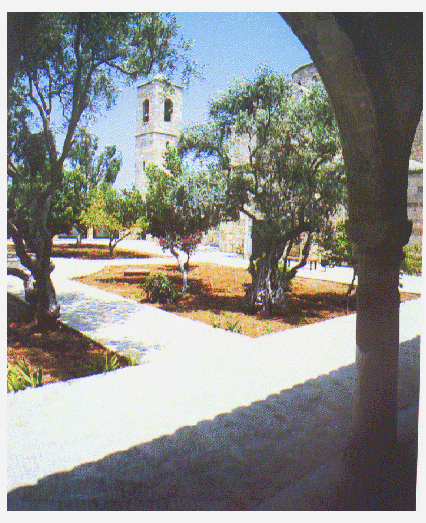
St. Barnabas Monastery, in the occupied north part of Cyprus
Controversy at Princeton

This article in the National Review by Anne Morse, "They Call It Art: The last acceptable prejudice?", came to my attention through Charles Colson's daily Breakpoint commentaries. It seems that, despite a code of conduct "requiring respect for the rights and sensibilities of all members of the campus community," Princeton's Woodrow Wilson School of Public and International Affairs is sponsoring an art exhibit containing works offensive to Roman Catholic sensibilities. In a forum with Catholic students, Dean Anne-Marie Slaughter all but admitted to a double standard when she acknowledged that they would not permit a similar exhibit offensive to Jewish or Muslim sensibilities. Writes Morse:

One of the canons of liberal orthodoxy is that the world is divided up between the powerful and the powerless, oppressor, and oppressed. Once assigned oppressor status, you're not allowed to claim oppression at someone else's hands. The Catholic Church has long been labeled an oppressor — which is why professors who would instantly notice and (rightly) condemn artistic prejudice against Muslims, Jews, gays, women, or blacks cannot see anti-Catholic bigotry even when egregious examples of it hang on the wall in front of them.

I would be inclined to change her use of the word liberal to post-modern, as the liberal label encompasses too much ground to be meaningful in such a context. Yet her point is well taken. Those speaking too glibly of oppressors and oppressed risk miscarrying justice by losing sight of its requirement of equitable treatment for all.

10 June 2003

Book has arrived

A limited number of copies of Political Visions and Illusions have now arrived at the Redeemer Campus Bookstore.
Radical Orthodoxy and Neo-Calvinism

Is there an affinity between the social visions of the Radical Orthodoxy of John Milbank and of the neo-Calvinism of Kuyper and Dooyeweerd? A paper I heard this past weekend from Wheaton College's Ashley Woodiwiss leads me to wonder whether there might not be. Moreover, Calvin College will be hosting a conference from 11 to 13 September to explore "Creation, Covenant, and Participation: Radical Orthodoxy and the Reformed Tradition." It looks worthwhile.
Yves R. Simon's defence of democracy

Another important book published in 1951 was Yves R. Simon's Philosophy of Democratic Government. Like the other books I've discussed from that pivotal year, this one was also very much a product of the tumultuous middle years of the last century. In particular Simon undertook to defend democracy as a mere form of government without buying into what I would call the democratic creed of popular sovereignty.


Yves René Marie Simon was born in Cherbourg, France, one-hundred years ago in 1903. He died in South Bend, Indiana, U.S.A., in 1961, after having enjoyed a distinguished career as an academic philosopher in the neo-Thomist tradition of Jacques Maritain. His first years in academia were spent in his native France. In 1938 he went to the United States to take up a visiting professorship at University of Notre Dame, intending to spend only a year there. But by 1939 the war clouds were looming over Europe and he decided to stay at Notre Dame. He continued to teach at Notre Dame until 1948 when he accepted a position at University of Chicago. He continued to teach there until his untimely death in 1961.

In his native France support for democracy was almost always tied to support for the Revolution of 1789, with its overtly secular underpinnings. Thus believing Catholic Christians usually opposed democracy because of its historic connection to unbelief. In his Philosophy of Democratic Government Simon sought to make an argument from the tradition of Aristotle and Thomas Aquinas in defence of democracy as a mere form of government. The reader can judge for him- or herself whether he is successful in this.

Two features of this book stand out for me. First, Simon began to work out here a comprehensive theory of authority and its functions that would come to fruition in his posthumously published book, A General Theory of Authority. Second, he affirmed that it is important that a democratic régime also be a political régime, i.e., one which “gives the governed a legal power of resistance” (p. 74). A political régime allows for freedom; a despotic one does not. This amounts to an affirmation of what in recent years has come to be called civil society, i.e., those independent communities and initiatives whose integrity the state is obligated to respect and protect.

Simon's career was all too brief. But it may fairly be said that the majority of his books were published after his death, some edited by his students from his lecture notes. (To be honest, I am not sure I'd want my own students doing this with my notes after I'm gone!)

09 June 2003

A weekend in Minnesota

This past weekend I spent at Bethel College in Minnesota to attend the biennial meeting of Christians in Political Science. There I presented a paper titled, "Culture War or Intramural Rivalry? Beyond a liberal approach to politics," largely drawn from the second chapter of my book.

As I am an alumnus of Bethel, I was particularly happy to be back at my alma mater after an absence of a quarter century. Much has changed, of course, but much is still the same. It seemed odd to be walking the same corridors I had last walked at age 22. I am quite sure people tired of me telling them that I had once had a class in the very room where we were meeting or that I had sung at such and such a spot with the College Choir thirty years ago. (I even found the window to the dorm room I lived in my first year there.) I was pleased to see that the Bethel bookstore had copies of my book available for sale to the conference participants.
Proportional representation for Canada?

Many of us have long been working for and speaking out in favour of electoral reform in this country. Like many Anglo-Saxon democracies, Canada operates with what is variously known as a single-member-plurality system, or first-past-the-post, or winner-take-all. This means that the country is divided up into so-many electoral districts -- or ridings, as we call them here -- each of which elects a single member of parliament to represent it. The winning candidate need not have the support of a majority of voters in the riding. In fact, in many ridings this outcome is highly unlikely. In a closely matched four-way race, for example, the winning candidate could obtain the seat over the opposition of slightly less than three-quarters of the voters. That this is not very democratic is becoming obvious to increasing numbers of Canadians.

Here then is some exceedingly cheerful news from The Globe and Mail's John Ibbitson, writing in saturday's edition: "A balanced act for voters." Writes Ibbitson:

It is now almost inevitable that many -- perhaps even most -- Canadians will soon experience a reconstruction of their political system more radical than anything envisioned by the failed Meech Lake and Charlottetown accords.

Three of the larger and two of the smaller provinces are, to varying degrees, progressing toward some form of proportional representation as a means of electing legislatures, displacing the "first past the post" method we have known since Confederation. The federal government is awaiting a report on whether it should follow suit.

Most Canadians don't seem to know this internal revolution is under way. But once the process is complete -- and it could be complete within a very few years -- most of us may be governed in a way very different from the way we are governed now.

Under proportional representation (PR), most governments in Canada will be coalitions of several parties working together more or less in concert. The advantage will be a more consensual form of decision-making. The disadvantage could be chronic instability. Regardless, PR is almost certainly on the way.

The author also makes the connection, noted by a number of scholars and observers, between electoral reform and voter turnout:

Chronic misrepresentation of voter support in legislatures may be one contributing factor to the steady decline in voter turnout, which, at the federal level, has fallen from 70 per cent in 1980 to 61 per cent in 2000. Tuesday's Manitoba election had the worst turnout for the province in half a century: an appalling 53.9 per cent.

In today's edition of The Globe and Mail, Ibbitson continues his exploration of electoral reform by describing a forthcoming citizens' assembly (or what might be called a constituent assembly) in British Columbia to address electoral reform in that province: "Citizens' assembly: Handle with care." Perhaps Canada's current one-party-dominant semi-democracy will be running its course soon. Ibbitson's columns offer some hope for this.

Incidentally, Canada's other national newspaper, The National Post, generally opposes a move to proportional representation (PR), despite its tireless advocacy of various other political reforms, particularly those that would rein in the powers of the prime minister. I am mystified by this. They too would like to bolster democratic accountability in this country, but they cannot bring themselves to support one of the principal reforms likely to bring this about.

By contrast, in past editorials The Globe and Mail has come out in favour of a German-style mixed-member form of PR for this country. I myself agree with this, as it would be the least disruptive to our current way of doing things, while promising to compensate those political parties handicapped by a first-past-the-post system.

08 June 2003

Friendships

Given that so many in today's world live and die in places other than where they were born and grew up, it would seem that one of the principal casualties of this incessant mobility is friendship. In a more agrarian past our ancestors were far more likely to enjoy, besides the geographic proximity of extended family, lifelong friendships ending only with the death of one of the friends. Perhaps they were drawn to each other as children, and subsequently played, were educated, worked and attended church side by side. After their marriages their respective families would be close, and, quite naturally, friendships -- and possibly even marriages -- would form among the offspring of these two families.

A lifelong friendship is far more difficult to carry off today. Now we are more likely to have what are effectively, if not intentionally, temporary friendships associated with various periods in our lives, but which we literally have left behind when we have moved away to take another job or to go to graduate school. These friendships have not exactly ended; they might properly be said to have gone into a state of dormancy.

At next meeting, possibly years later, what appeared to have been dormant may prove to have faded altogether, sad to say. People grow apart, their interests change, their views of life diverge, or they may simply have nothing to talk about after so much time apart.

However, a friendship may slumber for decades, only to be reawakened in all its fulness at a single future meeting. Remarkably and unexpectedly, nothing appears to have changed. The friends pick up where they left off much earlier; it is as if the years had not passed at all and the geographic distance was insignificant. Such friendships are to be treasured. They don't come often. Thank God for such friends.
Pentecost


Today is the feast of Pentecost in the western church. One of the more famous Pentecost hymns is the "Veni Creator Spiritus," which was translated into English as "Creator, Spirit, by whose aid" by John Dryden in 1693.

06 June 2003

Theresa's glasses

Yesterday Theresa's mother took her to get her first pair of glasses. She had been squinting quite a bit recently, especially when looking outside through the front picture window at meal times. Now she can see much better and seems more confident as she moves through the world around her. Theresa is three years younger than I was when I started wearing glasses.

05 June 2003

Mother Teresa's dark night of the soul

The late Mother Teresa (1910-1997) seems a likely candidate for sainthood in the Roman Catholic Church, and indeed the first steps in this official recognition have been taken. The vast majority of Christians the world over could hardly help but admire a woman who devoted her life to the service of God in ministering to the poor, the sick and the dying in the slums of Calcutta. Thus the following article is all the more astonishing and even disturbing: "The Dark Night of Mother Teresa." According to author Carol Zaleski:

Throughout 1946 and 1947, Mother Teresa experienced a profound union with Christ. But soon after she left the convent and began her work among the destitute and dying on the street, the visions and locutions ceased, and she experienced a spiritual darkness that would remain with her until her death.

It seems Mother Teresa, who had quite literally seen Jesus and heard his call to her to serve him in this unique way, was thereafter deprived of the sense of his presence for the remaining half century of her life. Yet so confident was she of his call that she persevered and became a shining model of God's grace in a life lived in his service. God's grace was there, as was his strength, but the sensible, emotional sense of his presence was gone. The remainder of her life was nothing less than a trial of faith. Zaleski again:

The dark night of Mother Teresa presents us with an even greater interpretive challenge than her [earlier] visions and locutions. It means that the missionary foundress who called herself “God’s pencil” was not the God-intoxicated saint many of us had assumed her to be. We may prefer to think that she spent her days in a state of ecstatic mystical union with God, because that would get us ordinary worldlings off the hook. How else could this unremarkable woman, no different from the rest of us, bear to throw her lot in with the poorest of the poor, sharing their meager diet and rough clothing, wiping leprous sores and enduring the agonies of the dying, for so many years without respite, unless she were somehow lifted above it all, shielded by spiritual endorphins? Yet we have her own testimony that what made her self-negating work possible was not a subjective experience of ecstasy but an objective relationship to God shorn of the sensible awareness of God’s presence.

This is perhaps a reminder to all of us believers that God's grace does not always have a sensible side to it. We do not always feel God's presence, but he is with us all the same. The assurance of salvation in Jesus Christ and his call to us comes from scripture, as proclaimed in the church and celebrated in the sacraments. All of this may be accompanied by a "subjective experience of ecstasy," but not necessarily. In fact, this is almost certainly the exception rather than the rule for most of us. Yet the call to serve God remains and the strength he gives us comes amidst the (mostly) ordinary trials of an ordinary life.

04 June 2003

Parenting a special-needs child

Last sunday, while Nancy was in Halifax at the annual meeting of the Canadian Society for Biblical Studies, our daughter Theresa and I attended a different church, of which three of my colleagues are members. There the children go directly to sunday school and are then brought up by the adults to join their parents for communion.

When the time came for this, I went to the back of the sanctuary, waiting somewhat anxiously for Theresa's appearance. The other children scrambled up the stairs, and I kept expecting to see her face. But she kept on not coming. Finally, there she was, making her way to the top of the stairs with some difficulty, being helped by one of the grownups.

It was suddenly brought home to me as never before that she is physically handicapped. Her premature birth at 26 weeks left her with remarkably few after effects. But she does lag behind her peers physically, and that was painfully apparent to her father last sunday. Theresa is aware of her own physical limitations, and this sometimes makes her wary of playing around other, especially older, children.

Nancy and I would be grateful for the prayers of God's people as we cope with being good parents to a special-needs child. Kyrie eleison!
The advertisements at the top

It seems that my mention of my 6th great-grandfather, Gotthard Witzell, has prompted the advertisement at the top of this blog to hawk a book on Bill Gothard, the evangelical guru of "basic youth conflicts" whom I remember from the 1970s. At least the blogger software has finally picked up on the fact that I'm not Roman Catholic. The advertisements now seem to alternate largely between icons from Greece and Reformed/Presbyterian items. I suppose that makes sense -- as much as any of it makes sense, that is.
US intelligence failure in Iraq?

It is possible that American forces could still come up with evidence of an Iraqi programme for developing weapons of mass destruction. But thus far there have been no smoking guns. This is causing some in the US to wonder whether the CIA's national intelligence estimate, released last October, might have overestimated the Iraqi threat. Might there have been pressure put on the intelligence community to produce a report conforming to the Bush administration's preconceived view of Iraq's military potential? Many think so, as reported in the San Francisco Chronicle: "Spy report on Iraq's weapons questioned: Intelligence estimate may have been wrong."

If it was indeed wrong, this would put the US/British action in Iraq in further doubt under international law, apparently vindicating those nations taking a more cautious approach to that country.

On the other hand, it is difficult to argue in retrospect that Iraq would have been better off if Saddam Hussein had been left in place. Perhaps the old adage applies to the American and British venture there: it is easier to ask forgiveness than permission.

03 June 2003

Introducing the family: Gotthard Witzell

Over the past two or so years I have been doing a fair bit of genealogical research into my ancestry on the maternal side. With the advent of the internet this has become remarkably easy to do. In the course of this I, along with many others, have made the startling discovery of the familial interconnectedness of virtually everyone on earth. I will write more about this in the future.

Among my Finnish ancestors is a particularly interesting man, my 6th great grandfather, named Gotthard Witzell (1694-1756). Witzell was an inhabitant of Livonia, now the northern part of Latvia, but then part of Sweden. The inhabitants at that time spoke the old Livonian language, a Finno-Ugric language now close to extinction. At the age of about eighteen he joined the army of King Charles XII of Sweden at Hämeenlinna, Finland (better known as the birthplace of composer Jean Sibelius), in 1712 and remained there until 18 October 1728 with the rank of sergeant-major.

His brother Ernest Witzell was also in the army, achieving the same rank, until 1761, after which time he lived in the Finnish village of Kalajoki. Gotthard and Ernest were on the battlefield in Norway in 1718 and managed to survive, while many of their colleagues froze to death. Their father may have been Lieutenant Daniel Johan Witzell, who fell to the Russians at the Battle of Lesnaya in 1708. But there is no hard evidence of this.

The period coinciding with the Witzells' military service saw the Great Northern War between Sweden and Peter the Great's Russia. Russia won a decisive victory at the Battle of Poltava in 1709. Finland was occupied by Russia from 1714 to 1721 in a time known to Finns as the "Great Wrath." In 1714 Russian soldiers occupied the village of Alavieska and reputedly treated the inhabitants badly, going so far as to subject the mistress of the Tanhuala farm, Anna Nilsdotter (Anna Niilontytär), to a beating so severe as to send her to bed. Sweden lost the war to Russia, which gained considerable territory in the Baltic region, including the land on which St. Petersburg was built. (This year marks the 300th anniversary of that city's founding.) But most of Finland remained in Swedish hands for another century.

At the time he resigned from the army, Gotthard Witzell was fortifying the new, less favourable border with Russia. After his resignation, he retired to Tanhuala, near Alavieska, where he married. Judging from his surname, Witzell's ancestors may have been Baltic Germans, possibly arriving with the Teutonic Knights in the 13th century, but this is of course merely speculative. However, he himself likely spoke old Livonian.

The Lutheran Church of Finland kept meticulous parish records from the beginning of the 17th century, which makes genealogical research in that part of the world remarkably easy. Many of these are now being posted at internet sites.

02 June 2003

Is worldview a workable concept?

This past academic year the faculty of Redeemer University College read and discussed David Naugle's Worldview: The History of a Concept. My colleague Theodore Plantinga, who has had a longstanding argument with the notion of worldview, wrote a response to Naugle's book, "David Naugle and the Quest for a Theory of Everything," in his web journal (a blog in all but name), Myodicy. Now Naugle has written a response to Plantinga's response: "In Defense of the Concept of Worldview."

As I myself employ the term worldview in my own writings, it might be in order for me to answer at least some of Plantinga's objections. How, he asks, can one possibly see the whole world? And why reduce one's experience of the world to the visual? Perhaps there is something to these objections, but they seem to come from taking too literally the spatial and visual metaphors in the term worldview. Every metaphor has its limits, but that is hardly an argument for avoiding metaphors, which is altogether impossible. Thomas Hobbes famously fulminates against metaphors in his Leviathan, yet he himself employs them constantly, even in that same book. Should one avoid the term sunset, simply because we know scientifically that the earth actually rotates on its axis relative to the sun?

Furthermore, although Plantinga is correct to note that the relationship between worldview and one's experience of the world is a reciprocal one, he seems here to be knocking down a straw man. Only the most hardened ideologues exempt their first principles from the data of human experience. I am unaware of anyone -- at least in the christian community -- making an argument for the imperviousness of his or her own worldview to the world itself.

I look forward to reading Plantinga's rejoinder to Naugle.

01 June 2003

Lectionaries in the Reformed churches?

Reformed Christians generally do not like lectionaries. A lectionary might be described as a kind of schedule of scripture lessons to be read in the course of the liturgy over a period of one or more years. Its origins can be found already in rabbinic Judaism, which prescribes the public reading of the entire Torah in the course of the liturgical year.

Within Christianity the Eastern Orthodox churches follow a one-year lectionary that prescribes one lesson each from the New Testament epistles and gospels for each sunday. So much is this part of the Orthodox tradition that the liturgical year consists of so many sundays of Matthew, Luke and so forth. The western churches, including the Roman Catholic, Lutheran and Anglican, used to follow a similar one-year lectionary, whose origin appears to go back at least a millennium.

The problem is that, contrary to Judaism, which is easily able to cover the entire Torah in a single year, the complete christian Bible, including Old and New Testaments (and sometimes what protestants term the Apocrypha), is far too long to cover in so short a time. Thus virtually any lectionary can consist of only snippets of scripture, the vast majority of which is bypassed in the liturgy. Conspicuous by its absence in the one-year lectionaries of both east and west is the Old Testament, except for the Psalms.

One of the things that the non-Lutheran reformers sought to do was to recover a positive place for the Old Testament in the life of the church. But rather than reforming the lectionary, they replaced it altogether with a lectio continua, which would see entire books of the Bible read and preached on over the course of many months. Thus it would be theoretically possible for a church congregation to hear the entire Bible over the duration of the pastor's career. But it was up to the individual pastor to determine the content and order of the lectio continua, which would inevitably differ from one congregation to another.

Unfortunately, most Reformed churches, and, following them, the various baptistic and free churches, have all but abandoned the lectio continua for topical or thematic preaching. This means that the congregation still hears only snippets of scripture, but as determined by the idiosyncratic predilections of the individual pastor rather than by the church as a whole.

Perhaps now is the time for the Reformed churches either to adopt the ecumenical three-year lectionary, which includes generous portions of scripture from both testaments, or to recover the lectio continua. Either would be a considerable improvement over the topical preaching ubiquitous in so many contemporary churches.

The Te Deum

Certainly the greatest of the early Latin hymns is the Te Deum, the title of which comes from the first words of the hymn itself. It was once attributed to St. Ambrose of Milan and his young protégé, St. Augustine of Hippo, who together reputedly composed it quite spontaneously and antiphonally on the occasion of the latter's baptism. However, it is now generally thought to have originated with Nikitas of Remesiana in the 4th century. Here is a standard English translation for liturgical use:

The Te Deum


WE praise thee, O God,
we acknowledge thee to be the Lord.
All the earth doth worship thee, the Father everlasting.
To thee all Angels cry aloud:
the Heavens, and all the Powers therein.
To thee Churubim and Seraphim continually do cry,
Holy, Holy, Holy, Lord God of Sabaoth;
Heaven and earth are full of the Majesty of thy Glory.
The glorious company of the Apostles praise thee.
The goodly fellowship of the Prophets praise thee.
The noble army of Martyrs praise thee.
The holy Church throughout all the world doth acknowledge thee;
The Father, of an infinite Majesty;
Thine adorable, true, and only Son;
Also the Holy Ghost, the Comforter.
Thou art the King of Glory, O Christ!
Thou art the everlasting Son of the Father.
When thou tookest upon thee to deliver man,
thou didst humble thyself to be born of a Virgin.
When thou hadst overcome the sharpness of death,
thou didst open the Kingdom of Heaven to all believers.
Thou sittest at the right hand of God in the Glory of the Father.
We believe that thou shalt come to be our Judge.
We therefore pray thee,
help thy servants whom thou hast redeemed with thy precious blood.
Make them to be numbered with thy Saints in glory everlasting.

For a metrical version of the Te Deum which can be sung to any double common metre tune, click here.

31 May 2003

Turkey, Europe and the US

The Bush administration in the US has made clear its aspiration to encourage democracy in the Middle East, a region which is almost certainly the least democratic in the world. However, if there is a conflict between democracy and US interests, the latter will be pursued by Washington. From Lebanon's Daily Star comes the following remarks by Ed Blanche in "Troubled Turkey, at odds with US and Europe, lurches toward crisis again":

On May 6, [Deputy Defense Secretary Paul] Wolfowitz echoed the resentment felt throughout the Bush administration for Turkey’s refusal to allow US troops to deploy on its soil to invade Iraq. Speaking on CNN-Turk television, he singled out the [Turkish] military for not taking “the strong leadership role” on Iraq that Washington “would have expected” by pressing Parliament to cooperate with the US. That was interpreted in many quarters as a thinly veiled call for a coup and has led to demands in Congress that Wolfowitz resign for “undermining democracy in Turkey.”

It is ironic indeed, that the Bush administration, which has embarked so high mindedly on a crusade of “regime change” in the region to encourage democratic reform, should carp so bitterly when a Parliament elected by all accounts fairly and properly voted against US wishes. The administration’s sullen resentment at Turkey’s decision to stay out of the war, reflecting the sentiment of the overwhelming majority of its people, is unlikely to convince others in the region that US intentions are wholly honorable.

There is a certain naïveté in the current administration's assumption that a world full of democracies will inevitably lead to a world more conducive to America's self-defined interests.

On the other hand, it may be that, with the addition of ten new members to the European Union, Europe will become considerably more pro-American than it is now. From The Boston Globe: "10 EU candidates expected to alter alliance and continent."

30 May 2003

The average blogger?

I have no idea whether anyone has ever attempted to compile a portrait of the average blogger, but I will hazard an admittedly unscientific guess, judging from the most recent blogs listed at the left of the blogger.com homepage. The average blogger appears to be a young lady in her late teens or early twenties, whom blogging permits to vent her fury at her parents' foibles for the edification of the entire globe. I imagine the producers of mood enhancing medications will figure out a way to tap into this vast potential market before too long.
Dr. Seuss again

There is something mildly deflating about assuming one has discovered a fresh insight, only to find that huge numbers of people have got there first. I did a Google search and quickly learned that lots and lots of people have seen the connection between Dr. Seuss' Horton Hears a Who and the abortion issue. It seems I am a late-comer.
Jacques Maritain

As I mentioned a few weeks ago in this space, 1951 saw the publication of some rather significant books, including Hannah Arendt's The Origins of Totalitarianism and H. Richard Niebuhr's Christ and Culture. Another book released the same year is Jacques Maritain's Man and the State originally published by the University of Chicago Press. More than any other single person in the 20th century, Maritain (1882-1973) was associated with the neo-Thomist revival launched at the end of the 19th century by Pope Leo XIII. Although he was brought up in a nominally protestant home in his native France, he converted to Roman Catholicism in 1906, along with his wife Raïssa. In 1910 he began reading the works of Thomas Aquinas, and these would have a profound influence on his subsequent thinking.


Maritain authored many books and articles on a wide variety of subjects, but he is best known for those touching on politics and society. Man and the State is especially important insofar as we see in its pages the broad contours of his political thought in its mature form, after his earlier flirtation with and subsequent opposition to European fascism.

In this book Maritain is careful to distinguish among the concepts of nation, body politic or political society, and state. The state, as he sees it, is superior to other parts of the body politic, but it is inferior to the whole body politic itself. Where the state comes to see itself as identical with the whole body politic, then we find the seeds of abuse of power and even totalitarianism.

The State is only that part of the body politic especially concerned with the maintenance of law, the promotion of the common welfare and public order, and the administration of public affairs. The State is a part which specializes in the interests of the whole (p. 12).

Maritain is similarly opposed to the ascription of sovereignty, with its connotations of absolute power and final authority, to the state, or indeed to any merely human institution.

One can, of course, easily disagree with his definitions (as do I), but they ought to be understood within the context of the Catholic principle of subsidiarity, which presupposes a hierarchical order of society. Subsidiarity is a means of limiting the state so that it does not overwhelm the array of nonstate communities necessary for a healthy society. Writes Maritain:

But the body politic also contains in its superior unity the family units, whose essential rights and freedoms are anterior to itself, and a multiplicity of other particular societies which proceed from the free initiative of citizens and should be as autonomous as possible.

Thus Maritain's thought, like Arendt's, can be seen as another contribution to the intellectual struggle against totalitarianism in the middle of the past century.

29 May 2003

Ascension Day

Today is the feast of the Ascension, when Christians throughout the world celebrate the ascension and reign of Jesus Christ prior to his return. The appointed Psalm for the day is Psalm 47, which follows in versified form as set to the proper Genevan tune:

    Clap your hands, all you peoples of the earth,
    shout to God with a song of joyful mirth!
    Hold the Most High our Lord in reverent awe.
    Our great King rules the peoples with his law;
    he has put all the nations in their place;
    he has chosen us, Jacob, in his grace.

    God ascends amid great resounding cries,
    with the blast of the trumpet see him rise!
    Sing to God, all your praises to him sing,
    let your praises be rendered to our King!
    For our God is the Ruler of the earth;
    sing his praise, sing to him with psalms of mirth!

    God reigns over the nations here below,
    from his throne his decrees down to them flow.
    Princes gather from earth's remote extent
    with God's people of Abraham's descent.
    All the shields of the earth to God belong;
    let us highly exalt him with our song!

      Versification and musical arrangement © David T. Koyzis
The "strange" phenomenon of fundamentalism

The other day I received in my campus mail box an announcement from the British publisher Routledge for several encyclopedias, including their Encyclopedia of Fundamentalism. Not having seen the volume, I do not know how they are defining fundamentalism, which is almost always used as a term of derision in the media and the academy. The cover bears photographs of, among other things, Billy Graham and the Mormon Temple in Salt Lake City, Utah. My guess is that fundamentalist for them covers anyone who actually believes what his or her confession of faith claims to be true. Which includes yours truly.
Fall of Constantinople: a grim anniversary

Today is the 550th anniversary of the fall of Constantinople to the Ottoman Turks. Although most westerners think of this as the end of the "Byzantine" Empire, it was really the end of the last vestige of the Roman Empire, which had been contracting in fits and starts for nearly a millennium. The Empire's people called themselves Romans, and so did their conquerors, even after the empire had been extinguished. The emperors were officially titled "Emperor of the Romans" and saw themselves as the genuine heirs of the Caesars, albeit christian and not pagan.

Constantinople was built by and named for the Emperor Constantine, who transferred his capital here from Rome in AD 330. It was ideally situated for defensive purposes, and indeed the city was successfully conquered only twice: in 1204 by the Crusaders and in 1453 by the Ottomans.

Throughout much of what we call the middle ages, Constantinople was the largest city in the known world. It was the centre of Christendom at a time when western Europe was still sparsely populated. The City was dominated by the magnificent dome of the Church of the Holy Wisdom, or Aghia Sophia, an architectural wonder built between 532 and 537 by Justinian I. This was the mother church (metropolis) of Orthodox Christianity and the seat of the Ecumenical Patriarch.


Aghia Sophia


The fall of the City came after a lengthy siege on tuesday, 29 May 1453. It was renamed Istanbul by Mustafa Kemal, founder of the modern Turkish republic. But Istanbul is not actually a Turkish name; it comes from the Greek "eis ten polin," meaning "to the City." For all Greeks, well into the 20th century, Constantinople was quite simply "The City."


The siege of Constantinople,
Moldovita Monastery, Roumania


A sizeable Greek Orthodox community remained in Constantinople up until September 1955, when a series of pogroms prompted most to leave. At present the Greek-speaking community numbers a few thousand elderly people at most. Aghia Sophia is now a museum.


Alexios I Comnenos, Emperor 1081-1118

28 May 2003

A pro-life parable from Dr. Seuss?

I have no idea whether the late Theodore S. Geisel, better known to one and all as Dr. Seuss, was pro-life on the abortion issue. But as I was reading his Horton Hears a Who to Theresa this evening, it struck me that it could be interpreted as a pro-life parable: "A person's a person, no matter how small!" Surely I am not the only one to have noticed this? However, given that it was written 19 years before the infamous Roe v. Wade decision by the United States Supreme Court, and 34 years before Canada's Morgenthaler v. the Queen, the connection is almost certainly inadvertent.

Whenever I read this story, I almost always hear as the voice of Horton the elephant that of the late character actor, Edward Everett Horton. I think it's more than just the similarity of name.
Emil Brunner's political and social ethics

Although I have been rather throroughly influenced by the neo-Calvinism of Kuyper and Dooyeweerd, near the end of my book, when I look for examples of ways to flesh out the principle of sphere sovereignty, or differentiated responsibility, I found myself looking to the writings of Swiss theologian Emil Brunner. Two books are especially significant: The Divine Imperative and Justice and the Social Order.

In the latter book he has chapters on, not only "Justice in the Political Order," but justice in marriage and family, in the economic order, and in the international order. This is in recognition that, although the jural aspect is not the decisive aspect in, say, marriage and family, nevertheless it does play a significant role in these institutions. Unlike his colleague Karl Barth, who attempted to make all ethics christological, Brunner affirms an ethic rooted in creation. Of marriage he writes:

Marriage is an order of creation, that is, man is so created that, his personality being embedded in a sexual nature, he can only fulfil his double purpose as a sexual being and a person in a union which is monogamous and lifelong.... Justice appears in marriage as the prohibition of adultery in any form (Justice and the Social Order, pp. 142-143).

Brunner may not be a neo-Calvinist as such, but he is certainly Reformed in the larger sense, and his writings on ethics affirm differentiated responsibility in all but name.

27 May 2003

No unpublished thought

One of my professors at Notre Dame once said of a certain well-known dissident Roman Catholic scholar and publicist that he had never had an unpublished thought. And this was in the days before blogging.
I have been telling my students that since 1993 this country has become a Mexican-style one-party-dominant semi-democracy. Jeffrey Simpson of The Globe and Mail seems to agree with me: "Waiting for 'regime change' in Canada."
The open barrier: a month later

The people of Cyprus have had just over a month to adjust to the opening of the green line between the Greek and Turkish communities in the island. Here is an article from the Boston Globe: "Open-door policy seeks to mend Cyprus." From the article:

In the month since the Turkish Cypriot leader, Rauf Denktash, ordered the barricades to come down, about 267,000 Greek Cypriots and 111,000 Turkish Cypriots have crossed the cease-fire line, according to the republic's Interior Ministry. The volume of the exchange -- at least 5,000 people cross, in either direction on most days -- and the good climate have taken everyone by surprise.

''No one expected it,'' Cyprus's former president, George Vasilliou, said in a recent interview. ''The hunger for friendship and cooperation disproves, beyond any doubt, all that silly talk about the two communities not being able to coexist.''

Yet while many have likened the collapse of the dead zone to the fall of the Berlin Wall, it is far from the solution that mediators have spent years trying to forge. The US State Department's coordinator for Cyprus, Thomas Weston, said that while the incident-free movement of Greeks and Turks was ''good news,'' some basic -- and prickly -- issues still divide them: property, security, and governance.

Then there's this article from The Guardian's Observer magazine: "Home sweet homeland," about the exiled residents of the northern Cypriot town of Morphou, including its former mayor, Charlambos Pittas. It ends on a melancholy note:

One day Mayor Pittas and some of his people will go back to Morphou not just as tourists but as residents. Maybe he, and some fellow Greek- Cypriots, will be there in the spring to smell the orange blossom in the streets. As they walk through those streets some of the houses, some of the buildings, will be familiar. But it will never be the return they have dreamed of. The war of 1974 and their exile has changed them for ever. They will not be going home but returning as foreigners to another country.

26 May 2003

Which Bible translation?

When InterVarsity Press announced that it would be publishing my book, the people there sent me a fairly large amount of material about the publication process. Among other things, this material indicated that they preferred their authors of popular books to draw biblical citations from the New International Version (NIV) and authors of scholarly works the Revised Standard Version (RSV) or New Revised Standard Version (NRSV). I opted for the RSV. Here is why.

English-speaking Christians are singularly blessed with a large number of excellent translations of the Bible among which they may choose. Thus the choice is a matter of choosing, not good over bad versions, but one among many fine versions. Why then the RSV, and not, say, the NRSV, the NIV, the Revised English Bible (REB), or the New Jerusalem Bible (NJB)? I have personally used each of these at various times for personal daily prayer. There is much to commend in all of them.

Yet the REB and the NJB have two primary flaws, in my view. First, they are too paraphrastic for my purposes. I prefer to have a version that stays fairly close to the text. In one case, however, I do cite the REB (Matthew 5:6) where the translation of dikaiosyne as right draws a meaning out of the text that the word righteousness does not carry so well.

Second, both attempt to reconstruct the presumed original text, often in the absence of manuscript testimony and solely on the basis of apparent literary evidence. This is seen most clearly in the transposition of verses or parts of verses (e.g., Job 24, which both the NJB and REB reorder but in different ways). Not surprisingly they frequently come to divergent conclusions, which is inevitable in such a speculative venture. (Their predecessor versions, the Jerusalem Bible and the New English Bible routinely transposed entire sections, most notoriously for the JB in Hosea, but the NJB and REB have commendably pulled back from many, if not most, of these.)

The NIV, by far the most popular English version of the Bible in use today, is a monumental achievement undertaken against considerable obstacles and motivated by an admirable belief in the fundamental unity of Scripture. However, for all its virtues, the NIV tends to harmonize across texts in what seems to me to be an unwarranted fashion. For example, the translators change the tense of the Hebrew verb in Genesis 12:1 to make it agree with Acts 7:2 on when Abraham received God’s call to the promised land. They similarly revocalize the Hebrew in Gen 47:31, so that the dying Jacob leans on his "staff" instead of his "bed," to make it agree with Heb 11:21. In attempting to smooth over the rough edges of the biblical text, it sometimes takes the reader in misleading directions from a textual perspective.

The NRSV is in many respects a considerable achievement in its own right, and the vast majority of changes it makes to the RSV are salutary. Where the RSV is stilted the NRSV reads more smoothly. It also properly eliminates the old second-person-singular forms ("thou," "thee," "thine," &c) in addressing God, a now obsolete liturgical usage of an earlier generation that never reflected anything in the original languages in which the Bible was written. Moreover, it eliminates generic masculine forms that have fallen out of use over the centuries, particularly the use of "men" for "human beings" or "people." In more than one place I do indeed quote the NRSV.

However, the translators' single-minded commitment to gender-inclusive language comes at the expense of other valid considerations. Others have taken note of the large number of odd or misleading renderings that have resulted from this single-mindedness. A few examples will suffice here: (1) the revival of the archaic and virtually obsolete "mortal" for anthropos or ben adam; (2) the obviously inappropriate use of "mortals" in Revelation 21:3 to describe those who have experienced the resurrection to eternal life and are thus no longer subject to mortality; (3) the seeming ascription in Psalm 19:12 of "errors" to the "ordinances of the LORD;" (4) the implication of immaturity in the "child" who gathers in the harvest in Proverbs 10:5; and (5) the anachronistic reference to "human rights" in Lamentations 3:35. One could go on in this vein, which I shall not do here.

But suffice it to say that, if one of the characteristics of an ideology is to follow rigidly the inexorable logic of a single abstract principle, e.g., the abolition of the division of labour or the freedom of the market, to the exclusion of other legitimate concerns, then the NRSV has by no means avoided this in its otherwise laudable use of inclusive language. To show that they affirm the equality of men and women, the translators have not only masked the highly gendered character of the original cultures -- itself problematic in the translation of an ancient text -- but, more seriously, have created difficulties of their own in the English text which would not have occurred had they been less single-minded. It thus seemed inadvisable to use this translation as, shall we say, the "default" version in a book arguing for a christian challenge to the ideologies. Consequently, for all its stiltedness and sometimes graceless prose, I have opted for the RSV in those passages for which no specific version is indicated, while continuing to draw on the NRSV and other versions in individual cases where it seemed appropriate to do so.

As my book was in the process of being published, another version of the Bible came out, the English Standard Version, which is an exceedingly light revision of the RSV. The ESV eliminates archaic pronominal and verbal forms, adopts a moderate approach to gendered language (e.g., "people" for "men"), and generally tries to remain as literal a translation as possible while cautiously rewording for clarity in English. However, this translation is not without difficulties either. To begin with, a perusal of its website reveals that its list of endorsements overlaps rather considerably with the list of those who helped to produce it. (Of what possible value could it be for me to write a review of my own book?!)

As for the translators, they go to great lengths to replace what they view as misleading theological terms with their older and ostensibly more correct counterparts. For example, expiation (RSV) is replaced by propitiation (e.g., Hebrews 2:17). This is a questionable improvement, given that the vast majority of readers do not grasp the nuances of either term. Moreover, in those passages that would seem to indicate women holding positions of authority in the early church (e.g., Roman 16:1,7) the translators have invariably chosen to obscure such a reading. This smacks of the same sort of tendentiousness characterizing both the NIV and NRSV. It is too soon to say how the ESV will be accepted. My guess is that it will catch on in certain circles but that it will not replace the NIV as the number one Bible translation in the English-speaking world.

25 May 2003

Incidentally, I do have a personal homepage, as well as a professional site. Just in case anyone's interested.
Hearing Nicholas Wolterstorff this weekend has reminded me once again why I am happy to be identified as a Reformed Christian.
The comics page

Ever since Gary Larson stopped drawing "The Far Side," I've had no real reason to turn to the comics page of the local newspaper. But now Theresa has taken an interest in the colour comics in the saturday edition. I don't know whether it's my imagination, but they don't seem as humorous as they did when I was growing up. Perhaps there are only so many gags in the world, and the creators of the various comic strips have simply run out of material. Or it may be that I am simply older and not as easily amused by them.

Of course, Dick Tracy, Li'l Abner, Smokey Stover and Pogo are long gone. But I am amazed at the number of strips that keep going even after their originators have passed from the scene. Dennis the Menace and Blondie come to mind.

Then there is the late Charles M. Schulz's beloved Peanuts, which is now in "reruns."
The tragedy of protestant liturgy: a cri de coeur

Too many Christians sit through the liturgy each sunday, going for weeks without singing a metrical psalm from, say, the Genevan or Scottish Psalters; one of the German chorales by Martin Luther, Paul Gerhardt or Johan Crüger; one of the English hymns of Isaac Watts or the Wesleys; one of John Mason Neale’s translations of the ancient Greek and Latin hymns; or even one of the more recent contributions of Fred Pratt Green or Erik Routley. These same Christians can go for years – even decades – and never hear the music of Palestrina, Tallis, Gibbons, Bach or Vaughan Williams in the course of a church service. Kyrie eleison!

Followers

Blog Archive

About Me

My photo
Contact at: dtkoyzis at gmail dot com