On Sunday scholars and clergy at the orthodox Christian Studies Center of Fordham University and the Volos Academy for Theological Studies published a scathing “Declaration on the ‘Russian World’ Teaching.” This ideology is, they write, “a false teaching which is attracting many in the Orthodox Church and has even been taken up by the Far Right and Catholic and Protestant fundamentalists.”
The “Russian World” ideology has been cited by both Vladimir Putin and Russian Orthodox Patriarch Kirill over the past two decades. It asserts, the theologians write, that “there is a transnational Russian sphere or civilization, called Holy Russia or Holy Rus’, which includes Russia, Ukraine and Belarus (and sometimes Moldova and Kazakhstan), as well as ethnic Russians and Russian-speaking people throughout the world.”
31 March 2022
The Moscow Times reports truth
Bate-papo with Brazilian youth
28 March 2022
The Liberal-New Democrat pact
24 March 2022
Russia: political culture and the weakness of institutions
![]() |
| Arms of the Russian Federation |
For many Americans, their 18th-century founding era is surrounded by a reverential glow similar to the halos around the heads of the holy men and women in Byzantine iconography. Americans revere their Founding Fathers, the constitutional document they produced in 1787, and the political system it established. Here in Canada we are perhaps less in awe of our own Fathers of Confederation, one of whom, Sir John A. Macdonald, had an alcohol problem and pursued a less than fully just policy towards our aboriginal peoples. Nevertheless, both countries have inherited a tradition of respect for the rule of law from the mother country, and this is why they have been so successful in maintaining their respective political institutions for so long. Indeed, such a tradition ought not to be taken for granted, because it is absent in many places around the world.
23 March 2022
How to Deal with Political Ideologies in the Face of the Biblical Worldview
Interviewer: What do you think motivated a more recent phenomenon of strong polarized discussions, especially in the environment of digital social networks, about partisan and political aspects?
Koyzis: I think the polarization arises in part because we make different prudential judgments about which political group or party comes closest to seeking public justice. But I think there's more. Even when we claim to belong to Christ, we inevitably become captivated by the stories these ideologies tell us. Our hearts are divided when they should be united in loyalty to the kingdom of God. The only effective way to break through this polarization is to look into our own hearts and determine whether our loyalty to God's kingdom is genuinely sincere or whether we place our faith in something in His creation.
A entrevista original em português pode ser encontrada aqui.
22 March 2022
Interview with George Demacopoulos
Instead of strongly condemning Russian President Putin’s invasion of Ukraine, Russian Patriarch Kirill has given his full-throated support to the Kremlin. This support stems from an ideology supported by both Putin and Kirill known as "Russian World", which links faith with Russia’s nationalist aims. This support has resulted in a splintering within the Orthodox world, and is in clear contrast to Ecumenical Patriarch Bartholomew’s condemnation of Putin and the invasion of Ukraine. In the meantime, leading Orthodox theologians around the world issued a joint statement denouncing the “Russian world” ideology and the invasion of Ukraine. George Demacopoulos, the co-director of the Orthodox Christian Studies Center at Fordham University, joins our host Thanos Davelis to discuss the “Russian World” ideology pushed by the Kremlin and Patriarch Kirill, and look at how the war in Ukraine is impacting the Orthodox world.
Demacopoulos is co-director of the Orthodox Christian Studies Center at Fordham University, New York City.
21 March 2022
Gerrymandering injustice
Christian Courier has posted my March column: Gerrymandering injustice, with an accompanying question: "How can states like Alabama pursue fairer representation?" An excerpt:
The states [of the United States] are responsible for redrawing the new districts within their own borders. Each district is supposed to have roughly equal population so that no group of people is over- or underrepresented. Sad to say, corruption and conflict-of-interest are at the very heart of the process. Because they are dominated by one of the two parties, a Republican state house, for example, will draw the boundaries to ensure that Republicans dominate the state’s congressional delegation, thereby badly skewing election results. Democrats quite happily do the same in the states they dominate.
This is known as gerrymandering, after Massachusetts Governor Elbridge Gerry, who signed a bill in 1812 creating a bizarrely-shaped district wrapping around Boston which, on the map, resembled a salamander. More recently, the Illinois General Assembly created a district encompassing two distant neighbourhoods in Chicago connected only by a thin line running down Interstate 294.
Every Square Inch lecture: Ukraine
Here is a screen shot of our group:
18 March 2022
March newsletter posted
I have now posted my latest Global Scholars newsletter: MARCH 2022 newsletter.
Debunking russophilia and russophobia
Russia is no “Christian powerhouse.” That narrative is little more than an easily falsifiable propaganda campaign by its kleptocratic governing class. Russia struggles not only to preserve its ancient faith tradition—in spite of significant government expenditures to the Orthodox Church—but also to protect and preserve its families in the face of substance abuse, domestic violence, and unmitigated cronyism.
16 March 2022
Adventist interview
In your book Political Visions & Illusions: A Survey & Christian Critique of Contemporary Ideologies, you talk about political ideologies and show weaknesses in these systems, especially in comparison with the biblical worldview. What do you highlight, for those who have not read your book, as the main shortcomings of ideologies that are very much defended today, even by Christians?
Well, the principal shortcoming is that the ideologies make too much of a good thing. That fits with a general human tendency to esteem the creature more than the Creator. Liberalism properly values the rights and freedoms of the individual, but it makes the individual will the origin of all other social phenomena, including the basic institutions needed for a society to remain healthy and to flourish. It tries to make of every community a mere voluntary association, thereby erasing the distinctions among these communities. Various forms of collectivism from socialism to nationalism to democratism properly value community, but in so doing they tend to neglect the legitimate interests of individuals and of other communities. For example, socialism pretends that only one form of community can monopolize ownership, and this usually turns out to be the state. But a society dominated by a single community will be an artificially constrained society, where everyone follows orders rather than initiating a variety of activities.
14 March 2022
A Declaration on the “Russian World” (Russkii mir) Teaching
Yesterday, on the Sunday of Orthodoxy, a group of Orthodox clergy and laity published A Declaration on the “Russian World” (Русский мир) Teaching, which is obviously modelled on Barmen. This is a powerful statement which all Christians of every tradition should read and ponder. An excerpt:
The COVID blues
Christian Courier has posted my monthly column, titled, The covid blues: The pros and cons of a Zoom world. An excerpt:
I am hesitant to make predictions in uncertain times, but I can foresee some permanent shifts in the way we live. For example, I expect that the Zoom meeting will become a permanent fixture in the work landscape. Had the pandemic come at the turn of the millennium, we would have had more difficulty coping, as the internet was still in its infancy. But with so many means of online communication now available to us, shifting to at-home work – for many of us at least – has been far less difficult than it would have been then.
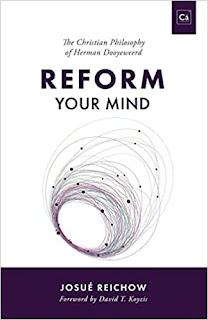
Josué Reichow: Reform Your Mind: The Philosophy of Herman Dooyeweerd
This book will be released at the end of the month. Here is the foreword that I wrote for it:
I first discovered the writings of Dutch Christian philosopher Herman Dooyeweerd in the mid 1970s when I was an undergraduate student. I quickly discovered that he was not easy to read, as his ideas seemed buried in a turgid prose style. Nevertheless, the hard work I put into understanding his philosophy more than paid off with respect to the use to which I discovered I could put it. My chosen academic field was political science, and I found that his nonreductionist approach to public life simply made sense. It better accounted for the realities of political life than, for example, so-called realists or behaviourists who could make sense of only a particular facet of reality. A decade later I would go on to write a dissertation on Dooyeweerd at the University of Notre Dame, a process that thoroughly grounded me in his magnum opus, A New Critique of Theoretical Thought. Because his Philosophy of the Law-Idea so well accounts for the fulness of God’s world, it became a primary influence on my own writings, including Political Visions and Illusions (Downers Grove, IL: IVP Academic, 2019).
11 March 2022
Ukraine: Eastern Europe's 'Bible Belt'
From an outsider's vantage point, the Greek Catholic Church looks like a hybrid of two traditions. It is one of 23 eastern-rite or Byzantine-rite churches in communion with Rome. These churches appear eastern in most respects, celebrating the Divine Liturgy of St. John Chrysostom or something similar, and reciting the Creed without the contested filioque clause. Its priests wear distinctive Byzantine garb. Like their Orthodox brethren--or perhaps rivals--the clergy are married and have families. Their buildings conform more to eastern architectural patterns than to western gothic or romanesque patterns. Nevertheless, these churches pray for the Pope and recognize him to be the head of the universal church. They are largely self-governing, unlike the churches of the Roman rite, which are directly under the Pope. Each represents a distinctive ecclesiastical and liturgical tradition.
09 March 2022
Jurisdictional jealousies: the ecclesiastical factor in the Russo-Ukrainian war
Unlike Roman Catholicism, which constitutes a single global organization under a spiritual CEO known as the Pope, Orthodox Christianity has always had something of a fractious character. In the old world, the Orthodox are organized into self-governing autocephalous churches covering limited territories, often but not always corresponding to the boundaries of a particular state. All of these churches are united in a single faith, reading a Bible somewhat larger than those of Protestants and Catholics (although Russians and Greeks differ here), and recognizing the Patriarch of Constantinople as Ecumenical Patriarch, the first among equals of the church's hierarchs. Each church is in communion with the others, accepting as normative the decisions of the Seven Ecumenical Councils of the first millennium.
As a result of the missionary activities of the apostles and their successors, the church grew phenomenally in the first centuries, expanding to the borders of the Roman Empire and beyond. Five patriarchs were set over the church, as shown in this map:
08 March 2022
A Prayer for Russia and Ukraine
Almighty God and Father, you have created us in your image to live in peace with our fellow human beings. But we confess that we have so often failed to live in obedience to your will, to the detriment of our neighbours, both near and far. And now the world is seeing a brutal war of aggression launched by one state against another, with attacks made on civilians who are suffering greatly as a result. Thousands of refugees are fleeing their cities and pouring over the borders of neighbouring countries. We feel helpless to relieve their plight, but we are angry and thirst for justice.
We acknowledge, O Lord, that the people of Russia and Ukraine do not want this war, which has been foisted on them by a corrupt and tyrannical leader in Moscow. Many of your servants are making their voices heard at great risk to their lives and livelihoods. We pray, Lord, that you would encircle them with your protection: that you would cover them with your pinions, that under your wings they would find refuge.
Assessing the Ukraine Crisis
Last week my fellow Greek-Cypriot Canadian, Angelos Kyriakides, interviewed me on the subject of the current crisis in Russia and Ukraine for his podcast The Bullseye.
07 March 2022
'Wars and rumors of wars'
The American Commons recently posted an interview with me conducted by Ryan Ellington: “Wars and Rumors of Wars”: A Conversation With David Koyzis About the Ukraine-Russia Conflict. An excerpt:
The American Commons: From your vantage point, how do you anticipate the sudden onset of war between Russia and Ukraine to affect life for North Americans?
Koyzis: Well, I think the most immediate consequence will be a spike in the rate of inflation, which was already higher than we’ve seen in recent years because of the pandemic. The price of oil has risen, and with the resulting increase in transportation costs, the prices of food will rise too, especially of imported goods.
To dampen inflation, our central banks will be raising interest rates, which will make it more difficult for people to buy such “big-ticket” items as houses and automobiles.
But I think there will be a psychological effect as well. Many of us have relatives in Europe, some of whom may be in Ukraine or nearby. During time of war there is a different feel to ordinary life. Suddenly life feels much more precarious. We go about our daily business but with a vague sense of anxiety constantly following us. Watching footage on television and hearing people’s stories bring tears to our eyes. I find myself praying constantly for those caught up in this conflict and that God would bring it to an end.
Putin's recklessness
Christian Courier has posted my article, Putin's recklessness, with this subtitle: "Historic parallels to Putin’s unjust aggression." An excerpt:
Putin has now moved into cliché territory: he has put all his cards on the table, shown his true colours, upended the apple cart. Making comparisons to Adolf Hitler generally elicits finger-wagging because it is done too often by people trying to score political points against opponents. Nevertheless, it is difficult to avoid the parallels with the Nazi dictator’s dismemberment of Czechoslovakia over German-speaking Sudetenland and his pretext for invading Poland the following year.
But we should note the differences too. This war is not popular with ordinary Russians, as massive demonstrations in Moscow, St. Petersburg and elsewhere are indicating. Younger Russians with dim or no memories of the Soviet era will not be wearing “Make Russia Great Again” hats any time soon. Nineteenth-century nationalist dreams of glory are the delusions of an ageing despot living in the past.
04 March 2022
The courageous witness of evangelical pastors
The open letter is available on the website of Mirt Publishing House, a small evangelical publisher in St. Petersburg, and is signed by mostly Russian Baptists and Pentecostals affiliated with churches or seminaries in Moscow, St. Petersburg, and more than 40 other cities.
03 March 2022
The tepid witness of an insular prelate
On the day that hostilities began between Russia and Ukraine, the Patriarch issued a pastoral letter to the hierarchs, clergy, monastics, and all faithful of the Russian Orthodox Church. This would presumably include Russian President Vladimir Putin, of whom he is a close ally.
01 March 2022
Global Scholars Canada: special wartime edition posted
It's a little early for my regular March newsletter, but I've now posted an early update: 1 MARCH 2022 - SPECIAL WARTIME EDITION. The outbreak of war in Ukraine last week seemed to me to warrant a special newsletter. Please do pray for the people of Ukraine and an end to hostilities.
Merkel saw it coming
A poignant alarm had been recently raised for Merkel in a newly published, nearly thousand-page tome, The Thirty Years War: European Catastrophe, German Trauma, 1618-1648, by German historian Herfried Münkler. The work, which she devoured, reconstructs the savege seventeenth-century war that eventually engulfed most of Europe, from Spain to Sweden, and decimated the continent's population. Merkel invited its author to the chancellery, where, for two hours, she and the historian discussed how war again erupted seventy years after the Peace of Augsburg had ended Europe's bloody religious wars in 1555. After seventy years of peace, few people with personal memories of the atrocities of the earlier war survived. Thus, Europe stumbled blindly into another round of mindless and savage fighting.
Gathara begs to differ
28 February 2022
Kenya's progressive outlook: a lesson for Russia
Just before Russia's invasion of Ukraine, Kenya's ambassador to the United Nations, Martin Kimani, delivered a momentous speech that demonstrates the stark contrast between a progressive nation looking to the future and an ageing one stuck in a faded imperial past.
Here is a transcript of the most significant part of the address:
25 February 2022
Putin's gamble
24 February 2022
The Psalms in wartime
Nearly four decades ago, I visited Prague, the capital of what was still communist-ruled Czechoslovakia and, before the First World War, part of Austria-Hungary. During my time there, I purchased in an antiquarian bookshop a Czech-language New Testament and Psalms published in 1845 for “Evangelical Christians of the Augsburg and Helvetic Confessions,” that is, for Lutheran and Reformed Christians. The print was in the old German black letter font, and even some of the spelling was obsolete.
Naked aggression: Putin finally moves
17 February 2022
February newsletter posted
SBNE lecture series
This week I was privileged to deliver three lectures to the community at Seminário Bíblico do Nordeste (Northeastern Biblical Seminary) in Carpina, Pernambuco, Brazil, not far from the major coastal city of Recife. The first lecture was titled "Ideology, Religion, and Idolatry," delivered on monday evening. The second was "The Redemptive Stories of the Ideologies," given on tuesday. And the third was "Towards a Non-Ideological Alternative: Two Approaches," on wednesday. The occasion was the opening week of the new semester. The lectures have been posted below:
My translator for the three evenings was a young man named Carlos Augusto. As someone with only a passing knowledge of Portuguese but with a general interest in languages, I was fascinated by the distinctive Nordestino accent, which hardens the či sound to ti and softens the final s to š.
14 February 2022
Not our own: Noble's critique of self-belonging
From social media profiles to our in-person interactions with others, we try to appear distinctive and important, while the world continues to treat us in increasingly standardizing ways. The numerous paradoxes flowing out of this constant quest for authenticity leave us perplexed and even angry at times. We want to define ourselves by ourselves, no matter the consequences for others, and yet we crave those others’ recognition of that identity. Thus, we are left feeling insecure and anxious as we seek to belong while keeping our communities at an ostensibly safe distance to protect our increasingly fragile sense of self.
04 February 2022
The synthetic gospel of Liberation Theology
27 January 2022
Putin's destabilizing ambitions
26 January 2022
Ukraine's impossible dream
Yesterday I posted my thoughts on the fraught relationship between Russia and Ukraine. Then last evening on the PBS Newshour, Nick Schifrin interviewed Oksana Markarova, Ukraine's ambassador to the United States. You can watch the interview below:
While one would not wish to excuse Russian aggression towards her country, Markarova's comments reveal the unrealistic aspirations of the current Volodymyr Zelensky administration in Kiev. This is why NATO would be unwise to take on Ukraine as a full member.
25 January 2022
Russia and Ukraine: a fraught relationship
18 January 2022
City on a Hill podcast interview
17 January 2022
January newsletter posted
Incidentally, I have recently discovered that I had not been monitoring the comments on my blog for quite some time. I have now changed the settings to insure that I am informed by email when a comment is posted. My apologies for this oversight and for any frustrations it may have caused.
13 January 2022
You Should Know 'Creation Regained'
The Layman's Lounge has published my tribute to Al Wolters' greatest of worldview books: You Should Know "Creation Regained". An excerpt:
Wolters sees worldview playing a central role in the lives, not only of Christians, but of all human beings created in God’s image. A worldview provides orientation and guidance as we live our lives. It is foundational for everything else. Indeed, it is impossible to exist without one. “We need some creed to live by, some map by which to chart our course. The need for a guiding perspective is basic to human life, perhaps more basic than food or sex” (5). Synonyms include “life perspective,” “confessional vision,” “principles,” “ideals,” and “system of values” (2). Another possibility, which I favour, is basic heart orientation in that it describes the centring of our heart on something to which we ascribe ultimacy. For Christians our worldviews must constantly be tested by the Scriptures, lest we unknowingly absorb the basic beliefs and faux-redemptive narratives of the surrounding culture and thereby live divided lives.
07 January 2022
How Marxism 'Won' the War of Ideas
23 December 2021
Year-end appeal
Dear faithful supporter:
Thank you for your financial contribution over the past year. I am deeply grateful for your concrete expression of support for my work with Global Scholars Canada. More than that, I appreciate your prayers for my international academic ministry.
Please consider making a donation at year's end so that I may continue this work. Your contribution provides:
a small salary to top up my private and public pensions,
equipment and incidentals related to my work, and
funding for travel, which I hope will resume once the pandemic is over.
Canadians and others may donate here: http://www.globalscholarscanada.ca/give/.
Once you are in this webpage, please scroll down to the purple bar labelled DONATION DETAILS. Under “Fund” find the name of the scholar you wish to support.
Americans can donate via this site: https://global-scholars.org/donations/give-to-a-fellow/.
Under “Select a Professor” you may “- Select a Professor-” from the list provided.
Up until 31 December 2021, an anonymous donor will match every dollar raised over and above last year's funds up to $8,000. If a particular donor gave $200 last year, what counts this year for purposes of matching is what he or she gives above the $200 amount. All new donations from people who have not previously given count towards the total. This means that if someone gave $500 last year and gives $800 this year, $300 of that will be matched by the donor. A new donor who gives $1,000 this year will in effect be giving $2,000 in total.
Thank you once again for your support, and may God bless you.
Yours,
David Koyzis
21 December 2021
Gnosticism and the human body
I’m just going through our CC website stats to gather a list of our top 10 articles from 2021 and I found a surprise near the top of the list. It’s not an article from this year at all, it’s from 2018! Your column “Gnosticism and the Human Body” was viewed 1176 times this past year putting it at #7 most viewed article of the year.
I can’t include it in our top 10 list since it wasn’t published in 2021, but I figured you should know about it’s popularity.
I am glad she included a link to the article, which I had forgotten I had written. Here is an excerpt:
17 December 2021
Ukraine: Church and civil society
Recently I received a copy of the journal, Християнська думка (Christian Opinion), whose current issue (no. 3(12), 2020) is devoted to "Church and Civil Society" and carries an article of mine, "Recovering Civil Society: Two Traditions." This journal is published by the Ukrainian Evangelical Theological Seminary in the capital city of Kiev.
In the same issue Jonathan Chaplin has contributed two articles and James W. Skillen one article.
16 December 2021
The coming kingdom
Christian Courier has published my December column, which can be accessed here: The coming kingdom. An excerpt:
While our churches look back to what Christ accomplished for our salvation in the past, we also look ahead during these first two seasons in the church calendar – ahead to the Messiah’s second advent. At his expected return, all human history will be wrapped up, with God’s kingdom finally triumphing over each of its rivals. These rivals include the various political ideologies, each of which tells a redemptive story promising salvation to its followers. But they also include the more subtle desires of our hearts – desires for good things created by a good God but made too much of: career success, sexual satisfaction, fame, fortune and so forth.
14 December 2021
December newsletter posted
I have posted my latest Global Scholars Canada newsletter here: DECEMBER 2021 newsletter. As we are in the final weeks of the year, please consider making a financial contribution to my work. Thank you!
13 December 2021
The Illusion of Power & Choices
10 December 2021
What is a worldview? Video lectures
My lectures to Brazil were indeed recorded, I am happy to say. Here they are:
09 December 2021
What is a worldview? Salvador, Brazil
On 7 and 8 December I addressed the members of the Igreja Batista Vilas do Atlântico in Salvador, Bahia, Brazil on the subject of "What is a worldview?" The first evening I spoke on "A Christian Worldview and Political Ideologies," based on my first book, and the second evening I lectured on "A Christian Worldview and Authority," based on my second. This was part of the church's annual Bible Celebration Week. My host was Roger Freitas, and my translator was Felipe Leite. I do not believe the event was recorded, but if I find that it was, I will link to the posted video here.
Nos dias 7 e 8 de dezembro, falei aos membros da Igreja Batista Vilas do Atlântico em Salvador, Bahia, sobre o tema "O que é uma cosmovisão?" Na primeira noite, falei sobre "Uma cosmovisão cristã e ideologias políticas", com base no meu primeiro livro, e na segunda noite dei uma palestra sobre "Uma cosmovisão cristã e autoridade", com base no segundo. Isso fazia parte da Semana de Celebração Bíblica anual da igreja. Meu anfitrião foi Roger Freitas e meu tradutor foi Felipe Leite. Não acredito que o evento tenha sido gravado, mas se eu descobrir que foi, farei o link para o vídeo postado aqui.
03 December 2021
CARE conversation
Today I was pleased to talk remotely with the latest cohort of young people in the CARE Leadership Programme in the United Kingdom. CARE stands for Christian Action, Research, and Education, and its website tells us what it is all about:
For over 20 years CARE has been equipping a generation of Christians to be salt and light in our culture. This 12 month graduate programme gives a unique insight into Parliament, political advocacy and Christian leadership.
22 November 2021
The True Nature of Freedom
Since at least the French Revolution of 1789, authority has acquired a bad reputation, something that French American philosopher Yves R. Simon (1903-1961) explores in his writings. By contrast, I would like to argue that, far from being polar opposites, freedom and authority are integrally connected to each other. Moreover, what we think of as personal freedom is a type of authority. In the real world we are embedded in a network of authorities, all of which work together to enrich our lives. This network provides the backdrop to our lives, and without it we ourselves would scarcely be able to exercise authority.
Watch the lecture and conversation here:
19 November 2021
Christianity and Ideologies
Comment magazine has posted my article on Christianity and Ideologies, with the subtitle, "Embracing the rich diversity of God's world helps us resist distorting it." An excerpt:
Christians, like all of us, are prone to succumb to the temptation to embrace another such story—something that promises earthly salvation on human terms. As such we are not so much living out God’s kingdom in our daily lives as undertaking to build an approximation of that kingdom in our own societies. It is tempting to ascribe redemptive significance to our own fallible goals and policy proposals. Because the regnant ideologies have formulated their own solutions to social ills, and because one cannot simply draw a program of cultural or political renewal straight from the Scriptures, Christians too easily latch onto a ready-made agenda offered by the ideologies, bypassing the hard work of fleshing out the implications of the biblical narrative for our shared life as citizens of a political community. Hence the proliferation of Christian nationalists, Christian socialists, and even Christian Marxists.
17 November 2021
Política (SBNE) conversation
Last evening I was privileged to participate in a conversation with Prof. Marcio Ribeiro of Seminário Bíblico do Nordeste (SBNE) in Carpina, Pernambuco, Brazil, which is about an hour or so from the coastal city of Recife. Click below to watch the discussion.
Na noite passada, tive o privilégio de participar de uma conversa com o Prof. Marcio Ribeiro, do Seminário Bíblico do Nordeste, em Carpina, Pernambuco, Brasil, que fica a cerca de uma hora da cidade costeira de Recife. Clique abaixo para assistir a discussão.
A propósito, eu poderia facilmente pegar o sotaque nordestino em sua fala. A maioria das minhas conversas é com pessoas das regiões do centro e do sul do Brasil.
15 November 2021
Global Scholars newsletter posted
I have posted my latest Global Scholars Canada newsletter here: NOVEMBER 2021 newsletter. As we approach year's end, please consider making a financial contribution to my work. Thank you!
Face to Face and Side by Side: A Pluriformity of Friendships
Then we have the “deep” friendships that approach Lewis’s “face-to-face” orientation yet do not quite conform to his understanding of eros. Here the two people take delight not just in their common interests but in each other, bound by a strong mutual affection and care transcending the pub and the sporting arena.
State and Non-state Communities: How Civil Society Contributes to Constitutional Government
On friday, 12 November, I was privileged to address an online gathering sponsored by ReMind Centro de Estudos, hosted by my friend Arthur Loureiro with Vinicius Pimentel serving as translator. The title of my lecture is "State and Non-state Communities: How Civil Society Contributes to Constitutional Government." Clicking on the link will enable you to see the lecture and ensuing conversation.
12 November 2021
Needed reforms
Christian Courier has just posted my monthly column which has a longer title online than in the print edition: Canada’s political institutions need reforms. Subtitle: "Three reforms Canada could make to restore a responsible government." An excerpt:
Efforts to democratize the leader selection process more thoroughly have not really empowered the grassroots, as many would like to see. Instead, they have disempowered the parliamentary caucus, increasing the dominance of the prime minister. The People (with an upper-case P) are too nebulous an entity to exercise effective control over an executive, but a party’s parliamentary caucus is small enough and more intimately associated with its leader to keep him or her in check.
This reality has led to a paradox: an effort to extend the validity of democracy throughout a political system inadvertently contributes to a rise of Napoleonic leadership and an erosion of democracy.
11 November 2021
Brazil update: Oak Centre conversation
One item of which few may be aware: some contrarians and historical revisionists believe that Christopher Columbus was actually Portuguese and not Genoese. Interesting notion, to be sure.
'Bible Belt' religion
Some time ago, one leading evangelical influencer rejoiced over the decline of “Bible Belt Religion,” commenting that it “made bad people worse.” More recently, another Christian pundit took another swing at the cultural Christianity of the South, one of his favorite punching bags, calling it a form of “toxic religion” that is, at best, an expression of the Faith to be “survived.”
02 November 2021
Keller on justice
29 October 2021
A novel conversion
While not great literature, Yonge’s best-selling novel is nevertheless compelling in that it is suffused with faith in Jesus Christ as mediated by the institutional church. Even as the characters navigate the intricate proprieties of Victorian England and incur guilt through various sins of commission and omission, the church is there for them, making up the mostly implicit backdrop for all their activities.
While Christendom has fallen into disrepute in recent decades, there can be no doubt that something has been lost in its decline. We can no longer hold our neighbours to the standards of a gospel to which they do not adhere, except in so far as its teachings continue to exert a vestigial influence on them. Our society validates the authentic self and the personal quest to find it, irrespective of the damage it may inflict on our communities and interpersonal relationships. If Christendom has declined, it has not made our society any less religious. Instead, it remains deeply religious, with its allegiance now focussed on the socially fragmenting idol of the ego and its desires.
28 October 2021
Taking the Bible Seriously in Scholarship
The typical research university today is a multiversity that sees scholars virtually imprisoned within the confines of their respective disciplines and methods, incapable of understanding the larger reality of which these are part except in terms of that discipline. Not only is cross-disciplinary dialogue not encouraged at such institutions; it may be implicitly discouraged as scholars keep ploughing within their respective ruts, unaware of what their colleagues are doing elsewhere. As such, it is not surprising that an entire discipline may be captured by an ideological vision while other disciplines remain blithely unaware of it. The humanities may be in the grip of a postmodern historicism, while the social sciences may pay homage to behaviourism.
A biblically Christian worldview is well positioned to compensate for the compartmentalization we see in the secular academy. After all, our most basic confession as Christians is that our world belongs to God, which has huge ramifications for our task as academics. If God has brought into being an orderly creation subject to his laws and norms, we can come to our respective fields of scholarly endeavour confident that they find their place within an integral whole sustained by God himself through Jesus Christ.
26 October 2021
Friendship, the University, and Politics
Last week I was privileged to be a part of an online Global Scholars conference, "Friendship That Makes a World of Difference - A Cross-Canada Virtual Conference", subtitled, "Exploring Faith and Friendship in the Academy." My colleague at the University of Lethbridge, John von Heyking, presented a keynote address, titled, "Christian Faith and Friendship in the Academy." John's address and my response have now been posted below: