25 July 2006

Artists' take on Vézelay

Vézelay is a delightful village in east-central France whose chief claim to fame is the romanesque Basilique de Marie Madeleine, which claims to house the remains of Mary Magdalene, the "apostle to the apostles," as she was called by some of the early church fathers. I visited this village back in 1975 and quickly fell in love with it. The following summer I painted one of the streets I had photographed. Here is a recent photograph of the street:


Immediately below is the oil painting I did of the same scene in the summer of 1976, when I was 21 years of age. It now hangs in the dining room of our home. It is obviously taken from a different angle and slightly farther away from the arch.


But it seems I was not the only one to find the scene worth committing to canvas. Here is Émile Wegel's rendition, which appears to be a water colour:


And here, finally, is Thérèse Verbery's oil on canvas version, which bears a certain likeness to my own, including the long shadows:


The principal difference between our two efforts is that mine makes the village appear somewhat hot and arid, while Verbery's brims with life and seems somehow more inviting. By contrast, though Wegel's painting may look brighter, with more vivid colours, it is just as lifeless as mine and no less forbidding. Looking at my own work from the vantage point of three decades later, I can't help but wonder whether I was influenced in some fashion by Edward Hopper. If I had to do it again, I'd try my best to communicate something of the warmth and hospitality of Vézelay, something I seem not to have successfully captured.

Incidentally, three days ago was the feast day of Mary Magdalene.

24 July 2006

Still more posted on psalter website

I have posted quite a lot more on my Genevan Psalter website in recent days, including the following:

1. Psalms 50 and 117, the latter of which is, of course, the shortest psalm. This I versified and arranged as recently as yesterday.

2. Six non-Genevan psalms written just over 20 years ago in the style of the English and Scottish psalters, with their regular metres. I wrote these prior to discovering the Genevan tunes, and they are posted for purposes of comparison with the more lively, and less regular metres of those tunes. Included are Psalms 25, 51, 95, 98, 130 and 137.

Psalms 51, 95 and 137 are set to original melodies composed especially for these texts. The tunes are titled MISERERE, VENITE and HICKORY ROAD respectively. I set Psalm 25 to Thomas Tallis' surprisingly haunting THIRD MODE MELODY, for which I composed transitional music between the stanzas. I say "surprisingly," because one wouldn't expect a tune with so little movement in the melody line to be as compelling as it is. The tune was further immortalized in 1910 by Ralph Vaughan Williams in his magnificent Fantasia on a Theme by Thomas Tallis, one of my all time favourites.

Psalm 98 is one of the earliest metrical psalms I wrote and it is set here to my own arrangement of KINGSFOLD, which I composed three years ago. Most of these six metrical psalms could easily be matched to another tune in common metre double (CMD) or long metre double (LMD).

3. Two more biblical canticles: the First Song of the Servant of the Lord from Isaiah 42:1,3b-7 (quoted by Jesus in Matthew 12); and the Magnificat of the Virgin Mary from Luke 1:47-55. The former is set to another tune by Orlando Gibbons, SONG 22. For the latter I composed a tune especially for the text which I named SOUTH BEND, after the city where I was living at the time. Last week I finally composed a descant for the last stanza.

4. Two extrabiblical hymns: my Credo in Septuple Metre, a metrical version of the Apostles' Creed; and I Belong, a versified paraphrase of Question and Answer 1 of the Heidelberg Catechism, easily the jewel of the 16th-century Reformation confessions. Both are set to original tunes. The Credo is set to a tune, LUSIGNAN, which I composed five years ago. It is written with a 7/8 time signature, unusual in western music but common in Greek music. I Belong was originally written some two decades ago to be sung to Jean Sibelius' beloved FINLANDIA, and I actually sang it with this tune as a solo at the South Bend Christian Reformed Church. However, five years ago I composed another tune for this, which I named simply HEIDELBERG. I hope it conveys something of the feel of the text.

19 July 2006

Copycats

Do Stephen Harper and John Howard have the same speech writers? Harper touts Canada as 'energy superpower'; PM's vision of Australia as energy superpower.

18 July 2006

A Hamilton landmark


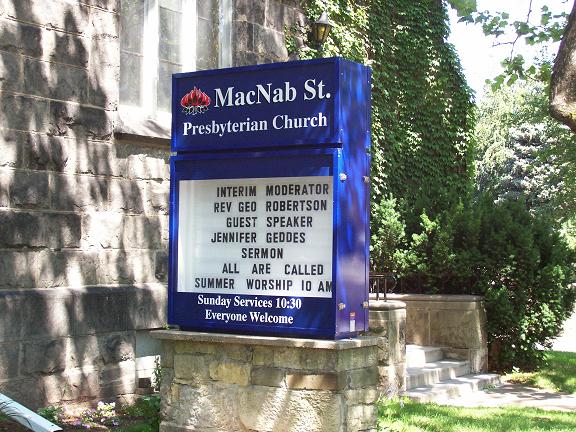
Here is the façade of the historic MacNab Street Presbyterian Church here in Hamilton, whose building dates from before Confederation.


Until yesterday the church's sign carried an intriguing sermon title, SINGING THE PSALMS, which must have been preached two days ago. I'm sorry to have missed it.
Tuesday notes

Our pumpkin plant is in flower, as seen below, though in the intense sun and heat of recent days the flowers close in mid-day. This was taken early yesterday morning.

pumpkin flowers

That's our tomato right behind, and behind that is our less-than-thriving roquette (arugula) plant.

One more thing: I have now posted Psalm 50 on my website.

15 July 2006

'Out of the mouths. . .'

Although I had said I would not be writing at length about my struggle with depression, this is too wonderful to keep to myself.

There have been a very few occasions when I knew that God was speaking to me plainly, for example, in a small, seemingly insignificant healing at age 5, in the words of a guest preacher whom I usually found difficult to listen to, in the scripture passages prescribed by the Daily Office Lectionary, in the prayers of a friend and — twice in my life — in dreams I knew to be visions from God. This time he spoke words of comfort to me through the lips of a seven-year-old.

The other evening, as we were sitting at our dining room table after family prayers, Theresa looked up at me and said something quite unexpected and uncharacteristic that elicited from me first a gasp, then tears, then a hug: "Daddy, God will give you healing in the name of Jesus Christ."

13 July 2006

More additions to psalter

I have added three more pieces to my Genevan Psalter website: the canticle from Jonah 2:2-9, and the two Pauline hymns from Philippians 2:6-11 and Colossians 1:15-20.

My versification for the Song of Jonah I wrote back in 1982, before I was acquainted with the tunes of the Genevan Psalter. Accordingly it is written in the double common metre (DCM) ubiquitous in the English psalters and hymnals of the 16th and 17th centuries. The tune is OLD 18TH from the English Psalter of 1561, with a slight altering of the arrangement from the Scottish Psalter of 1929.

The versification of the Philippians hymn I wrote around 1984 and it was subsequently published in the grey Psalter Hymnal of the Christian Reformed Church. I had chosen Orlando Gibbons' SONG 34 as the tune to which it should be set, but I was overruled by the committee, which chose Joseph P. Holbrook's rather pedestrian tune, BISHOP, instead. However, when the Mennonites republished my text a few years later, they did indeed use the Gibbons tune, to my delight.

My versification for the Colossians hymn I wrote in 1992 and sang with guitar accompaniment along with my sister at a church event near Boston that summer. I chose another Gibbons tune, SONG 1, for this text. It has thus far not been published in any hymnals, but it is meant as a complement to the Philippians hymn.
Protestants and natural law theory

The Acton Institute's Stephen J. Grabill has been posting a series on Why Protestants Don’t Like Natural Law, which is crossposted here. Grabill is a Reformed theological ethicist and author of the forthcoming book, Rediscovering the Natural Law in Reformed Theological Ethics, whose thesis should be evident from the title. Grabill writes:
For much of Christian history, some type of natural-law theory has been used as a bridge to connect the Christian faith and culture, the church and the world. But in recent times, Protestant churches and theologians have rejected natural law as a way of showing their differences with the tradition of Roman Catholic moral theology.

I've not read Grabill extensively on the topic, but from these brief posts it looks to me as though he may be conflating two related, though by no means identical, issues: (1) the protestant rejection of natural law theory, and (2) the protestant rejection of the reality which natural law theory purports to explain, viz., God's creation as a normative order. If the central issue is the latter, then there's a genuine problem that he is right to address — and one contributing to the antinomian tendencies we see in much of contemporary mainline protestantism. Grabill quotes Karl Barth, arguably the greatest protestant theologian of the 20th century:

Barth’s prefered idea based ethics directly on the command of the living God, which as he said “is always an individual command for the conduct of this man, at this moment and in this situation; a prescription for this case of his; a prescription for the choice of a definite possibility of human intention, decision, and action.” Herein lies the root of Protestant situation ethics, popularized in the 1960s by Joseph Fletcher, and criticized by Paul Ramsey as a “wasteland of utility.”

However, it is possible to agree with the church of the ages that God's creation is an orderly, lawful one, without necessarily accepting natural law theory's account of this. As I see it, there are at least five reasons for rejecting the natural law as a theory, four of which I find persuasive in varying degrees:

(1) It assumes a kind of religious neutrality in which thinking occurs independently of one’s ultimate commitments. I wouldn't wish to wield this objection as a blunt instrument, as some might be inclined to do. Yet this inevitably raises the issue of Thomas Aquinas' use of Aristotle and the Stoics in articulating his own natural law theory. To what extent can one draw on the insights of unbelievers without buying into at least fragments of their religious worldview? This does not have a simple answer, and indeed it lies at the heart of the ancient Athens and Jerusalem question posed by Tertullian in the patristic era. Without going into a detailed treatise here, I will indicate that the tendency for Christians to embrace composite worldviews joining biblical Christianity with other, incompatible worldviews is ubiquitous. I myself do not think that Thomas and his followers were entirely free of this tendency.

(2) It does not take seriously enough the fall into sin and its effects on the epistemic faculties. This is the objection one is most likely to hear from traditional protestants, i.e., from those heirs of the Reformation who are true to their own confessions. Such Christians would not, of course, be at all sympathetic to the antinomian tendencies of so-called mainline protestants. If anything, they might tend to err in the direction of a biblicism that does not take into account the reality of what Abraham Kuyper and his followers labelled common grace.

(3) It presupposes a kind of two realm conception of the cosmos in which the natural possesses a certain autonomy vis-à-vis God himself. This is most evident in Thomas' account of the virtues, in which four cardinal virtues — prudence, justice, fortitude and temperance — are deemed capable of being attained "according to the capacity of human nature," while the three theological virtues — faith, hope and charity — must be infused in us by God "supernaturally."

(4) Within the field of jurisprudence it has difficulty accounting for the status of an unjust law as a genuine law. Thomas Aquinas quotes Augustine to the effect that a human law that does not conform to the natural law is not a genuine law. In his famous Letter from Birmingham Jail, Dr. Martin Luther King quoted this to defend his and his followers' disobedience of the segregationist laws of Alabama. Yet as a defence of an act of civil disobedience, this is not fully adequate, because civil disobedience can only be to something possessing a lawful character requiring obedience. It would make better sense to recognize that the laws in question were unjust, viz., that they got the balance wrong, but that this did not diminish the character of these laws as genuine laws. Here the legal positivists, for all their considerable flaws, have a valid point.

(5) Within the realm of theology, it assumes that one can know God apart from his revelation in Jesus Christ, which is the basis of Barth’s objection to so-called natural theology. I think Grabill's objection to Barth is on solid ground, because Barth appears to be rejecting, not simply natural law as a theory, but the very reality of which it is an account. When I was researching my book, I took the opportunity to read relevant sections of Barth's massive Church Dogmatics, and it struck me that the specifics of his ostensibly christological ethics could hardly be based on christology alone but inevitably presupposed the creation order even as he denied it.

Has Grabill read Dooyeweerd? I should think that, as a Reformed ethicist, he would at least know the name. Dooyeweerd himself came to reject natural law theory after initially embracing it, yet, unlike Barth and other 20th-century protestants, he strongly affirmed the reality of God's normative creation order.

I look forwarding to reading Grabill's book when it comes out.

11 July 2006

On holiday in 'the Boston States'

This is not my promised post on rest and leisure; these are more photos from our recent holiday in what (especially Atlantic) Canadians used to call "the Boston States." After Janine and Anthony's wedding, the three of us took a brief holiday to nearby Gloucester.


We stayed at the Bass Rocks Ocean Inn . . .


. . . which overlooks the Atlantic Ocean.


New Englanders chronically underestimate times and distances. We were told that the beach was a six-minute walk from the hotel. It was actually closer to 15 minutes — 25 minutes with a seven-year-old.


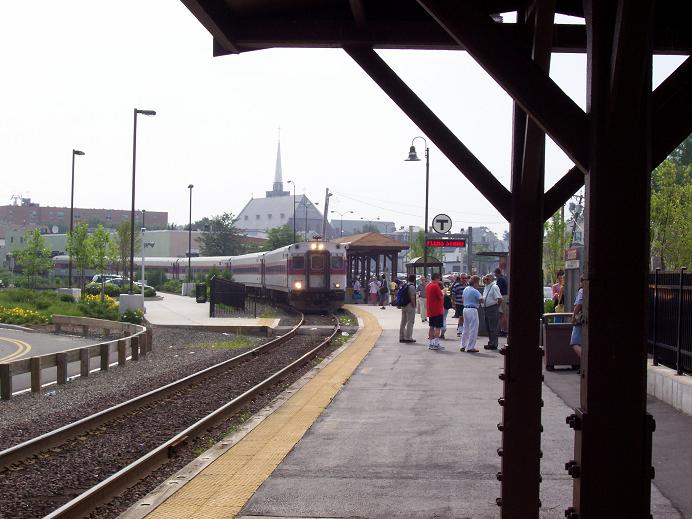
On wednesday we took the train into Boston. . .


. . . to visit the New England Aquarium, a special treat for our Theresa.


On thursday we visited Hammond Castle, Gloucester, where Nancy once had a graduation party after receiving her degree from. . .


. . . Gordon-Conwell Seminary.


This is Salem, where Nancy lived during one of her seminary years.


This has to be one of the most photographed buildings in the world. It's called Motif Number 1 and it's in Rockport. One of my sisters lived here during her studies at nearby Gordon College. Incidentally, Rockport is the basis for my notional cinematic horror sensation, Attack of the Killer Giftshops. I'm still trying to sell Hollywood on the idea.

10 July 2006

Monday notes

Last evening we ate spaghetti for supper in inadvertent honour of Italy's victory in the World Cup. As we ate we were treated to scores of honking vehicles flying the green, white and red tricolour, parading down our street.

I have now posted three more Genevan Psalm versifications on my website: Psalms 27, 84 and 93. These are in addition to Psalm 77, which I posted before we took our holiday. For Psalm 27 I have posted only a text, as the tune is proving a bit trickier to harmonize than I had anticipated. The text and harmonization of Psalm 93 came quickly to me as recently as yesterday.

At some point I will be posting a more substantial piece on leisure and rest, something which has pulled more into focus for me since sliding into depression two months ago. Although the "labour, leisure and liturgy" in the sidebar to the right suggests a balanced life, I've come to see that my own life has been rather less than exemplary in this respect.

As part of this effort to find balance, I have paid rather less attention to politics than is my wont in recent weeks. Posts addressing political and cultural issues will return in the near future.

Oh, and I am feeling much better these days. Thanks for your prayers, which are much appreciated.

Later: I have now posted my musical arrangement of Psalm 27.

09 July 2006

What God has joined together. . .


Congratulations are due to Anthony and Janine Givens-Belsley, who were joined in matrimony in Andover, Massachusetts, on 1 July. Our family was privileged to be present at the marriage of my beautiful and gifted niece to the love of her life. May God bless their journey together.


The Givens family home, where the reception was held. A good time was had by all.


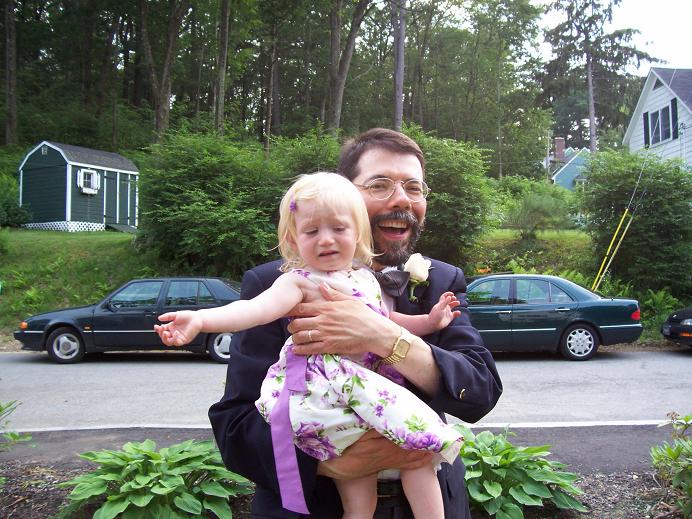
Here am I with my recalcitrant grandniece, Ingrid, who is enjoying the reception somewhat less than everyone else.

I composed this piece just over two years ago, Dancing Day (Copyright © 2004, David T. Koyzis), which was inspired by the dancing at the end of My Big Fat Greek Wedding. Though it wasn't played at the reception, it could have been. There are lyrics. Perhaps I'll post them at some point.

03 July 2006

Yet another psalm versification. . .

. . . is now complete in a first draft. This time it's Psalm 84, and I'll be posting it on my website as soon as I come up with an arrangement for the tune — possibly next week.

28 June 2006

Genevan psalms

During a previous bout with depression five years ago, I was afflicted by a compulsion to paraphrase biblical psalms and arrange their proper Genevan melodies so they could be easily sung. I then posted a website devoted to the Genevan Psalter. Nothing seemed to be effective in curing this compulsion, even that class of medications known as VRIs (versification reuptake inhibitors). Now it appears the compulsion has returned. The local medical community is stumped. Here is the first symptom:


Psalm 77

(8.8.7.7.8.8.7.7)

I cried out for God to help me,
cried aloud that God might hear me.
When I languished in distress,
then I sought God’s faithfulness.
Through the night I reached for healing,
yet my heart refused consoling.
Thinking of my God, I sigh,
faint while pond’ring God on high.

You have kept my eyes from sleeping,
too distraught was I for speaking.
I remembered times of old,
former days have I recalled.
In the darkness do I ponder,
in my heart I can’t but wonder:
will God cast away at last?
is his love for ever past?

Have God’s mercies fled for ever?
Will his promise grace us never?
Shall we bear his wrath alone?
Is his steadfast love now gone?
This, I said, is why I’m grieving
and my happiness is leaving:
for the arm of the Most High
has abandoned us to die.

I recalled the deeds of our Lord,
marvels brought about by his word.
I reflect through all my days
on the wonders of your ways.
God, your paths are our savation,
you subdue the pagan nation.
You redeem us with your arm —
Jacob, Joseph — from all harm.

When the waters saw your power,
depths of sea before you cowered.
Torrents poured out from the sky;
arrows flashed from side to side.
Heaven shook with thunder crashes,
earth was lit by lightning flashes;
Your way led us through the sea,
where your footsteps were unseen.

Like a flock you led your people
in the midst of the upheaval,
by your servants' willing hand,
Moses, Aaron, through the land.

Text and arrangement copyright © 2006 by David T. Koyzis

24 June 2006

Cuban awareness event

Sharon Boase of The Hamilton Spectator interviewed me last week for this story: Singing for Cuban prisoners: Christian union offers free concert to build support. Don't forget to be at FRWY Cafe, 333 King St. E., this evening at 7.

23 June 2006

Terror averted in Windy City

For a native of the Chicago area, this is a scary story: Seven Are Charged With Plot to Blow Up Sears Tower. And this so soon after a similar terrorist plot was foiled here in Canada.
Liturgical language revised. . . again

The United States Conference of Catholic Bishops has made a number of adjustments to the language of the mass in order more faithfully to conform to the original Latin. This latest revision is thus a conservative revision. Reactions in the pews? Some people don't like it, while others think it no big deal. This raises at least two questions: First, will the Canadian Conference do the same? Second, will other denominations, e.g., Anglicans and Lutherans, who use the earlier and apparently less accurate translations produced by the International Commission on English in the Liturgy, follow the Catholic lead?

21 June 2006

Allergies and depression

This is old news, but it's recently become relevant to me: The 'Bless You' Blues: A surprising relationship between allergies and depression. For me the link seems to work thus: allergies disturb my sleep patterns, which in turn induce depression. I am coming to see that I need to address my allergies, which have been worse in recent months, if I hope to find healing for depression, which is the source of the "difficult few weeks" of which I wrote earlier. I will not be writing at length about this, except to ask for prayers for healing as I attempt to rebalance my life and address what I now believe to be the proximate biological cause of this condition. In the meantime postings in this space are likely to be fewer than in the past.

18 June 2006

A dirty joke?

It seems cleanliness may not after all be next to godliness, at least for those of us suffering from allergies and other autoimmune diseases: Dirty rats healthier than clean ones: Study.
World Cup fever


Flags are selling on the street corners and flying from passing automobiles, as everyone supports their favourite World Cup team. This year I'm rooting for Australia.
Reformed Worship articles

I have recently discovered that four articles I wrote some 15 years ago have been posted at the Reformed Worship website: Restoring Psalms to Worship, Straight from Scripture, The Lord's Supper: How Often? and Sursum Corda: Lift Up Your Hearts. The first two articles are actually two parts of a single essay published in successive issues.

15 June 2006

A union's future

The United Auto Workers is in trouble, according to this article: UAW to Begin Drive to Recruit New Workers. The statistics are grim: "UAW membership peaked in 1979 at 1.5 million, but it dropped to 676,000 in 2002 and now stands at just less than 599,000, according to the union." Perhaps it's time for the union's leadership to look north of the border and to learn something from the CLAC's successful model. As the latter continues to grow, it seems likely to pass the UAW in size at some point, in which case the UAW will have no choice but to take notice.

12 June 2006

Hillsdale Holiday

We took a brief holiday in Hillsdale, Michigan, this past weekend, visiting family. Here are some of the highlights:


A walk along a not-quite-country road


Some flowers along the road


Picnic at Baw Beese Lake


Hillsdale College


Hillsdale Academy,
where my brother-in-law is headmaster


Remember Mail Pouch Tobacco?

09 June 2006

Max Lucado

I've seen Max Lucado's books around for years, but until recently I had never actually read one. A few weeks ago Theresa brought home several of his children's books from school, and we read them together. These were about the Wemmicks and their various foibles. The Wemmicks are wooden creatures fashioned by Eli, the Woodcarver, who is obviously intended to represent God in his relationship with his human image-bearers. The Wemmicks are constantly engaging in oneupsmanship and status-seeking, and Eli has to keep reminding them they needn't do this and that he loves them as they are.

The stories are innocuous enough and reaffirming of children's self-esteem, but given that they were written by a professed christian author, one would expect to see more evident references to sin and redemption, which are conspicuous by their absence — at least from the Wemmick books. Others can perhaps tell me whether he rectifies this defect in his other books. I hope so.

05 June 2006

The sixties and the evolution of liberalism

Two years ago I came across this fascinating article by Bruce Bawer in The Wilson Quarterly: The Other Sixties, about that brief era wedged between the ostensibly mindless conformity of the 1950s and the turbulent "Sixties", with its drug culture, angry anti-war protests, and aggressive student rebellion against authority. The early 1960s roughly corresponds to the John F. Kennedy administration in the United States and its immediate aftermath, a time of idealism, a sophisticated blend of high and middle-brow culture, and widespread expectations for the efficacy of a variety of liberal reforms. It was the era of Kennedy's New Frontier, the Peace Corps, the New Math, and the quests to reach (literally) for the moon, to combat poverty and to end racial discrimination. Pope John XXIII headed the Roman Catholic Church, and the Second Vatican Council was bringing the winds of change into an ancient institution. Almost simultaneously European colonialism in Africa and elsewhere was being wound down, with high hopes expressed for these newly liberated nation-states. Setting the tone for the arts and entertainment were Jack Paar and The Dick Van Dyke Show on that still new medium of television; Leonard Bernstein's classic musical play, West Side Story; Julia Child's popularization of continental cuisine in a meat-and-potatoes culinary culture; and the fashionable Kennedies themselves. Films like The Apartment and Breakfast at Tiffany's began quietly to break sexual taboos, and Alfred Hitchcock's deliberately shocking Psycho marked a departure from his string of suspense hits of the previous decade.

The Dick Van Dyke Show
Bawer's essay is less an analysis than a compelling evocation of an era marked at once by innocence and sophistication. As someone whose elementary school years coincided with this period, I believe he has done a good job of conveying to a contemporary audience something of its feel. Indeed Dick Van Dyke was (and remains) one of my favourite television shows, even if my juvenile mind did not quite grasp all of its humour at the time. I well recall the arrival of the New Math and other innovations in my own educational experience. Long before PowerPoint, overhead projectors were a fresh and exciting way to communicate knowledge to youngsters. Then there were Dr. Martin Luther King and the civil rights movement. Although my parents were moderately conservative Republicans — this was, after all, DuPage County, Illinois — I recall being told by them that those seeking equal rights for black Americans were unequivocally in the right. I have few memories of the Cuban Missile Crisis as such, but I do recall the global tensions characterizing the Cold War era and wondering whether my siblings and I would live to see adulthood. The idealism of the era was thus tempered by a vague and unprecedented fear for the future — a fear that at any moment our whole world might evaporate in a terrifying flash.

All of this began to change with Kennedy's assassination on friday, 22 November 1963, an event that marked a watershed for our generation. After that things were never quite the same. As I reached puberty a few years later, race riots were marring the landscapes of the major urban centres, and university students were protesting an Asian war that dragged on with no evident larger purpose. The sexual revolution unnervingly coincided with my own attainment of sexual maturity, and the entire culture seemed to be conspiring against the virtue of chastity, especially in the young. Rock music took on an increasingly hard edge, hair grew longer, and school dress codes went out the window as "nonconformist" young people donned the ubiquitous and standardizing blue jeans. The idealistic world in which I had been raised had been quickly supplanted by one where, despite the hope that "peace will guide the planets and love will steer the stars," a bohemian ethos of "do your own thing" made the defenders of social institutions and their larger public purposes appear hopelessly "square." Bawer ends his article with the summer of 1967 and the hippies in Tompkins Square Park in New York — a poignant glimpse into the next era.


While Bawer's portrait of the early 1960s is unabashedly nostalgic, James Piereson has a much less rosy portrait of the period and its immediate aftermath: Lee Harvey Oswald and the Liberal Crack-Up. Oswald was, of course, Kennedy's assassin, and Piereson argues that this professed communist and Castro sympathizer did more than anything else to discredit the moderate liberal reformism characterizing what would shortly come to be called "Camelot." The irony for Piereson is that many of the young who had been so enthralled by Kennedy's vision of a New Frontier would come a few years later to espouse doctrines not dissimilar to those animating his murderer under the guise of the New Left. Furthermore, while prior to 1963 liberalism in some fashion seemed to be in the ascendancy in the United States, with conservatism being relegated to the cranky right, the distortions of the late sixties and early seventies produced a reactive response that led to the rise of a new conservatism, initially under President Richard Nixon with his famous "silent majority," and eventually under Ronald Reagan after 1980. By the 1990s and into the first years of the 21st century the United States appeared to be permanently divided in a culture war between "red states" and "blue states," thus mirroring a much earlier development in the European continent following the French Revolution. The seeming liberal consensus of the early sixties had been replaced by hardened divisions over a host of issues, including abortion, marriage and homosexuality.

None of this could have been predicted in 1960. At that time the old New Deal coalition was still largely intact, although southern whites' loyalty to the Democratic Party was definitely eroding over racial segregation and civil rights. This coalition revolved largely around concrete economic issues — the very issues that had served to define the political landscape since the onset of the Great Depression a generation earlier. By this time the Republican Party had gained its reputation as the party of the "haves" and the Democratic Party was perceived to champion the "have nots." The industrial economy that had begun after the Civil War still characterized much of American life. A few miles from where I grew up the Elgin National Watch Company's factory was still standing and producing watches, as it had for nearly a century. In nearby Villa Park, the Ovaltine Company's plant was still producing its famous egg and malt-based beverage for the country. And the Union Stock Yard on the southwest side of Chicago continued to supply much of the meat that fed the region. Moreover, the country's transportation infrastructure still revolved around the railways, which fanned out in all directions from America's Second City. Famous passenger trains such as the Twentieth Century Limited and the Super Chief still rolled down the tracks towards their destinations.


By the middle of the decade all this was clearly changing. The Elgin Watch factory closed in 1965. Rail passenger service was mostly discontinued by the end of the decade, until Amtrak picked up the remnants in 1971. By the 1970s much of the old industrial infrastructure was, if not entirely gone, at least fading in significance for the larger economy, as increasing numbers of Americans found themselves employed in the growing service industries. So-called post-material values took over the two major political parties, especially the Democrats. By 1972 the transition was nearly complete. Once I had reached high school I was aware of living in a different world than the one I was born into. So much had things changed that the 1973 film American Graffiti could wax nostalgic about an era only a decade in the past. What had happened and why?

Francis Fukuyama argues, in The Great Disruption, that there is a causal connection between the changing economy and the changing social mores, with the former mostly effecting the latter. While this may not be precisely a marxist argument, it certainly shares with Marx the conviction that man is homo faber, man the producer, with concrete productive forces fuelling social and political change. In this account the shift from the industrial to the service economy in the 1960s disrupted the social mores that had held sway from the middle of the 19th century, leading in the short run to higher rates of out-of-wedlock births, higher crime rates and drug abuse, on the negative side, but at the same time expanded opportunities for minorities and women, and an increasing environmental awareness, on the positive side. Fukuyama's undergirding argument is historicistic in that it assumes that social mores are dependent on and appropriate to a particular stage in the productive process.

While I would not deny the material motives that Fukuyama points to, I myself have come to think that what happened four decades ago was in large measure due to the arrival of a crucial moment in the development of the liberal project that had begun in the 17th and 18th centuries. In my Political Visions and Illusions I trace the development of liberalism through five stages, beginning with the Hobbesian commonwealth, through the night watchman state, the regulatory state and the equal-opportunity state and finally to the choice-enhancement state. My argument is that the cultural shifts of the 1960s marked the transition between the fourth and fifth stages — from a focus on the expansion of material opportunities through state intervention to an emphasis on expanding the human capacity to choose, period. In the choice-enhancement state, government undertakes to maintain a benign neutrality towards a variety of personal lifestyle choices, ostensibly on the grounds of freeing individuals from oppressive constraints on their freedom. Hence Pierre Trudeau could claim that the state has no business in the bedrooms of the nation, a conclusion difficult to contest on the surface. Yet personal choices are not without consequences, not only for the individuals themselves but also for their immediate and extended communities. These consequences are by no means equal in their impact on the larger society, with some more evidently diminishing of human flourishing than others. Therefore, in order to maintain the illusion of equality of lifestyle choices, the state is called upon to compensate for these unequal consequences by means of the very welfare state programmes established during the previous stage of liberalism for different reasons.

Could Bawer's "other sixties" simply have been the high water mark, not of liberalism per se, but of liberalism's fourth stage, in which adherents believed it possible to bring its larger project to culmination while limiting the full working out of its inner logic? If so, then what happened in the mid to late sixties represented not really an abandonment of liberalism but the opening of a cleavage between those who wanted to push its logic further still (the radicals, hippies, &c.) and those who sought to return to an earlier stage of liberalism (the so-called conservatives). Because the conservatives were merely reactive and sought to turn back the clock on the liberal project rather than to posit a genuine alternative, they could never manage to secure a victory against a liberalism whose undergirding assumptions they themselves in large measure shared. Bawer's nostalgia notwithstanding, the "other sixties" could never have been but one brief, shining moment.

03 June 2006

June flowers

Our rhododendrons are blooming for the first time in years, perhaps due to the mild winter we had here in southern Ontario.

Rhododendrons


Rhododendrons - detail

Incidentally, I am taking a badly needed break after a difficult few weeks. Please remember me in your prayers. I will be posting something more substantive on monday, but subsequent postings are likely to be fewer in number than in the past.

27 May 2006

Australia's new role and just interventions

Australia's new role in East Timor raises more than one question. Does international public justice permit a regional power with a stable constitutional government to assist a neighbouring state in maintaining the order that the latter's de jure government is unable to secure on its own? Might justice even require such intervention? The Westphalian principle of state sovereignty calls for each state to mind its own business. Yet in an increasingly interdependent world it is difficult to argue that the chaos unleashed by a failed state will have no repercussions for its neighbours, especially since at the very least the latter will likely be called upon to receive its refugees. Similar issues are raised for Australia by the troubles in the Indonesian province of West Papua, and perhaps even in Iraq, where Australian troops serve along side American and British forces. I myself have few answers here, but it might be helpful to formulate some general questions to spur reflection and discussion:

1. Who has the authority to decide when a state has failed? What criteria should be brought to bear? Should it be a single regional power making such decisions or should other states be brought into the process as well? Does the mere possession of power by countries such as the United States and Australia automatically carry with it authority? Or might their domestic stability confer such authority?

2. When does the perpetration of domestic injustice in a failed state become so egregious as to warrant outside intervention? Who should be authorized to decide on the propriety of such intervention?

3. If much of the earth's surface is covered by moderately to severely dysfunctional states — which would appear to be the case — how would such an authorized agent go about determining which require intervention and which do not?

4. What role should existing international institutions, such as the United Nations or, more locally, the European Union or the Commonwealth of Nations, play in initiating such corrective action in the interest of doing international public justice?

5. Is it possible to establish a global régime of justice in which such cases might be addressed in a more regularized fashion?
Needed constitutional reform initiated

Good for Stephen Harper: Canadian government looks to fixed election dates. It's about time.

26 May 2006

Long lost relatives?

Why is it that, if you do a Google image search for "Koyzis," the 10th picture to come up is this and the 8th to come up is this? Does Google know something that I don't?

25 May 2006

More ancient music to perform?

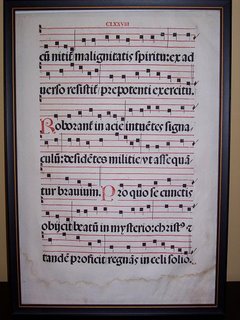
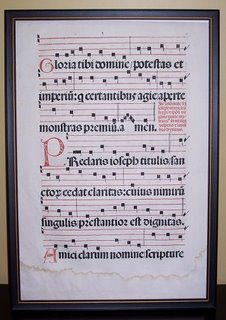
Here are two sides of a page from a 503-year-old Venetian antiphonal. I purchased this in Toronto some 20 years ago. Unfortunately, the original volume was sliced into more easily saleable pages, so the complete collection is no longer intact.

  Gloria tibi Domine


ANTIPHONARIU hmnorem sancte
Romane ecclesie copletu. . . .
Impressum Venetijs cu
priuilegio. . . .M.d.iij
(Venice 1503)

24 May 2006

Chaplin returning to UK

This is an announcement I link to with some ambivalence: Jonathan Chaplin Appointed Director of the Institute for Christian Ethics at Tyndale House in Cambridge, England. Of course, I extend to Dr. Chaplin my heartiest congratulations at his new appointment, but his leave-taking will be a definite loss for the Institute for Christian Studies and for Canada. We will miss him on this side of the pond.
Barricades are down

This is good news indeed: Aboriginal protesters remove Caledonia blockade. We should be happy, of course, that this was settled mostly — but not entirely — without violence. All the same, one questions whether this is a victory for the rule of law. I am not competent to judge the validity of the Six Nations land claim. Yet even if it is valid, the fact that this disruptive act was tolerated by the authorities for so long, to the detriment of the common weal, and that a court order against the protesters was ignored with impunity makes a travesty of the law. If the land claim is legitimate, it should be heard and negotiated in good faith by both sides. But taking matters into one's own hands is an obvious violation of public justice and inconsistent with the respect for the law from which we all benefit.

22 May 2006

Another acquisition

Congratulate me. I am now the proud owner of a nearly complete set of Encyclopædia Britannica's Great Books of the Western World, first edition.

Britannica Great Books
Cyprus unity defeated . . . as usual

This is not a good omen for efforts to reunify the troubled island state: Cyprus voters back hardline Papadopoulos.
Independence for Montenegro?

The last shreds of what was once Yugoslavia look set to be torn asunder: Balkan state votes for independence.

21 May 2006

Rehearing the past

What would it be like to be the first person in half a millennium to perform a piece of music? Chant from rare manuscript to be heard after 500 years. I would love to be present at the choral performance of this work. Let's hope a recording will be made.

Salzinnes Antiphonal
CBC

Salzinnes Antiphonal

19 May 2006

Hitler in Teheran?

Could the radical islamist régime in Iran really be on the verge of mimicking nazi Germany's treatment of the Jews? Yes, according to Amir Taheri, but today's National Post indicates that it may not be so.
Atomic bombing just?

Ernest W. Lefever reviews A. C. Grayling's Among the Dead Cities: The History and Moral Legacy of WWII Bombing of Civilians in Germany and Japan. Noting that traditional just war principles protect civilians from deliberate attack, Lefever asks whether the carpet-bombing of German and Japanese cities in the closing months of the Second World War violated these principles. Grayling says yes, and for the most part Lefever agrees. But he disagrees on the atomic bombing of Hiroshima:
Hiroshima was a tragedy, but it was also a necessary and prudent act in an eminently just cause. We Americans can regret the wrenching necessity for the atomic bombing, but we should not feel guilty about it.

Since Lefever stops short of saying the attack was just, is he then implicitly arguing that it may be prudent to commit unjust acts in the interest of pursuing a just cause? Can it ever be right to target defenceless women and children in order to conclude a war effort? And if so, how does this differ from contemporary islamist terrorists who see the 9/11 attacks as legitimate warfare against the dar al-Harb?
'Hobbit' a mere dwarf?

Remember Homo floresiensis, the diminutive human being whose remains were discovered in the Indonesian island of Flores? Now primatologists at Chicago's Field Museum have concluded that it is not a new hominid species after all, but a Homo sapiens suffering from a genetic illness causing dwarfism.

In a related story, researchers have concluded that "[e]arly human ancestors interbred with chimpanzees after the two species split." If nothing else, it would certainly put a different spin on those proverbially fraught in-law relationships.

17 May 2006

Hamilton Hoax

The international wire services are picking up this local story: Anthrax hoax letters sent to Ontario banks. My own theory is that these letters were actually sent out in late 2001, during the last anthrax scare, but Canada Post has only now got round to delivering them.
'Severe doctrinal oversights'?

Mr. Joustra defends himself against his would-be detractors.
May flowers

Lilacs in bloom in our back garden

Lilacs in bloom in our back garden

16 May 2006

Storing the fedora

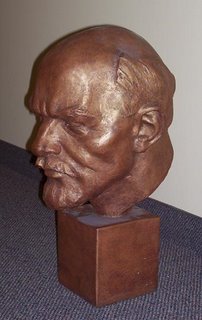
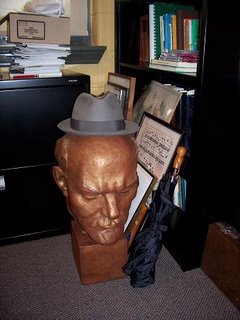
With so few men wearing hats anymore, most public facilities lack places to put them when not in use. A solution for my campus office:

Lenin with fedora
Marshall on Wallis

I have just received via conventional mail the spring 2006 issue of The Review of Faith & International Affairs, formerly known as The Brandywine Review. Although its full contents are not yet on-line, I will nevertheless call attention to an excellent and hard-hitting review by Paul Marshall of Jim Wallis' best-selling God's Politics: "God's Politics — Or Lack Thereof." Marshall's review is paired with a more positive one by Richard Pierard. One point Marshall makes is worthy of note. Citing Wallis' contention that the place to start is with the biblical prophets, Marshall correctly notes that, historically, christian attempts to understand the place of politics in God's world have begun with Genesis and the Law:
[Wallis] never carefully relates what the prophets say to the Torah, hence acknowledging that they challenge their rulers on the basis of God's law, not on their own feelings of injustice.

It is telling that those Christians and church institutions that speak most readily of being prophetic almost never call those to whom they presume to prophesy back to a normative order distinct from their own preferences. In fact, they frequently appear to eschew normativity altogether, championing what might be called a quasi-Kantian notion of personal autonomy — quasi, because it is shorn of Kant's countervailing sense of duty. Ironically, doing "justice" thus becomes a matter of refraining from judging and instead simply affirming people's autonomous choices inclusively. Yet as a recipe for genuine justice this amounts to pretty thin gruel.
Dan Brown and Mary Magdalene

Many books and articles have been written skewering the pretensions of Dan Brown's best-selling novel, The Da Vinci Code. Now a well-known (at least to some of us) biblical scholar takes on Brown's treatment of Mary Magdalene: Re-sexualizing the Magdalene: Dan Brown’s Misuse of Early Christian Documents in The Da Vinci Code, in the Journal of Religion and Popular Culture.

While you're at it, look at the last-but-one article on the left sidebar. The author, Greg Linnell, is a graduate of Redeemer. In fact, he took my Introduction to Political Science way back in 1987, during my first semester of teaching.

15 May 2006

Jaroslav Pelikan: 1923-2006

The prolific church historian is dead at age 82. Oddly enough, a blog search brings up tonnes, while a Google news search brings up nothing as yet.
Return of the Latin-rite Calvinist

A warm welcome is extended to Mr. Rob Joustra, political science graduate and winner of last year's Faculty Award at Redeemer, after a lengthy east Asian sojourn. Good to have him back in the Steel City.
'Big Daddy' Harper

Is Stephen Harper a "control freak"? So argues The Globe and Mail's Ian Brown: In Harper's regime, Big Daddy knows best.

14 May 2006

Anniversary

As of today, my darling Nancy and I have been married for a full decade — ten years of wedded bliss to the most wonderful woman in the world. Ask me again sometime, and I'll tell you about our two weddings. It's a long story.
Academy needs principal

I have just been contacted by Mr. Adamos Mastris of Larnaca, Cyprus, who has asked me to circulate the following urgent announcement. Anyone who is interested in this opportunity or knows of a good candidate for the position is welcome to contact the party below.

American Academy, Nicosia
CYPRUS

Required for August 15th, 2006 (or nearest time after this date)


PRINCIPAL


The American Academy (established 1922) is a private, selective co-educational 6-18 school of over 300 students, with English as the medium of instruction. Courses offered lead to a recognized High School Diploma, IGCSE, O, AS and A levels.

The Principal is responsible for the curricular and administrative organization of the whole school, strategic planning and implementation and the maintenance of the Evangelical Christian philosophy of the school.

We are looking for a well-qualified professional educator, conversant with and committed to Christian Education, with proven management experience at secondary level, good interpersonal and communication skills and the vision to further develop and strengthen the school as a Christian witness.

The initial contract is for 3 years, renewable. Benefits include salary and allowances, some of which are taxable (including subsidized pension/medical scheme, accommodation, transport, return annual flight to country of origin), equivalent to Cy£40000 which is, approximately, £47,000 sterling (or US$85,000) at current exchange rates plus relocation expenses at commencement and termination of the contract.

Further details from:

The Chairman
Governing Council
The American Academy (Nicosia) Ltd
3A Michael Parides Street,
Nicosia
CYPRUS
Tel.: +357 22 66 42 66, Fax.: +357 22 66 92 90
Email: aacademy[at]spidernet[dot]com[dot]cy
Web.: www.aacademynicosia.ac.cy

13 May 2006

A new political party?

Is this a genuine political party with an organization and membership, or is it little more than a website: Christian Democratic Union? On the surface at least, it sounds like my kind of party.
Movers and shakers


ROCOR to return to fold

The Russian Orthodox Church Outside Russia (ROCOR), which broke with the Moscow Patriarchate after the Bolshevik Revolution, has provisionally agreed to reunite with the patriarchal see. ROCOR has millions of dollars of assets, including the Toronto church building used in the film, My Big Fat Greek Wedding.
Lords kill assisted death bill

In a rare move by the House of Lords, the British Parliament's upper chamber has effectively killed a private member's bill that would have legalized assisted suicide for the terminally ill. Here is Rowan Williams, Archbishop of Canterbury, on the bill:

Opposition to the principle of this Bill is not confined to people of religious conviction. It would be a lazy counter-argument to suggest that such opposition can be written off because it comes only from those committed to a world view not universally shared.

It remains true that to specify even in the fairly broad terms of this Bill conditions under which it would be both reasonable and legal to end your life, is to say that certain kinds of life are not worth living. We would jeopardise the security of the vulnerable in another way by radically changing the relationship between patient and physician.

Williams is correct, but there's one thing no one seems to mention in such debates: only in a society that has lost sight of sin and salvation can it be assumed that death ends suffering.

12 May 2006

Now, where to put him. . .

Congratulate me. As of today I am the proud owner of this relic of a moribund political illusion:

Lenin

10 May 2006

Civitas 2006

The Peace Tower
Two months ago I received an unexpected invitation from Lorne Gunter, a columnist for the National Post and the Edmonton Journal, to speak at the 10th annual conference of the Civitas Society, which styles itself "A society where ideas meet." This was based on his reading of an article I wrote for Comment last year, titled, The city and its renewal, which recently came out in the periodical's print edition. I hadn't known much about Civitas other than in the pages of Lloyd Mackey's The Pilgrimage of Stephen Harper, which I had read not too long before. From this I knew that Civitas was a small-c conservative think tank bringing together a number of prominent politicians, political staffers, academics and journalists of a generally "right-wing" persuasion. The invitation came as something of a surprise, because my cities article did not seem obviously to fit into a right-wing mould, as that is usually understood nowadays. Yet I was pleased to accept.

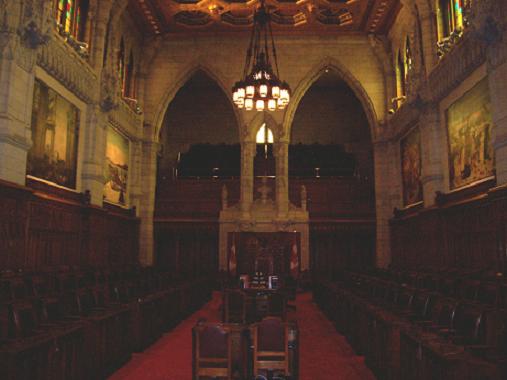
The Senate Chamber
I arrived in Ottawa thursday afternoon after a 6-hour drive from Hamilton. I had a wonderful dinner with my friends Eric and Bertina Hogeterp and their two boys. We were joined by another Redeemer political science graduate, Derek Miedema, who works for the EFC. The following morning Eric and I attended Question Period in the House of Commons, which occurs at 11.15 on fridays. Afterwards I was honoured to have David Sweet, the new Member of Parliament for Ancaster-Dundas-Flamborough-Westdale, come down to greet me in the hallway near the Peace Tower. I myself do not live in his riding, but Redeemer is located there. During Members' Statements at 11, Sweet mentioned Hamilton's "two universities, McMaster and Redeemer." Of course, cameras and other electronic devices are not allowed in the Commons chamber, but because the Senate was not in session, I was able to photograph the impressive interior of the Red Chamber (above left), as well as the gallery of portraits of Canada's monarchs just outside.

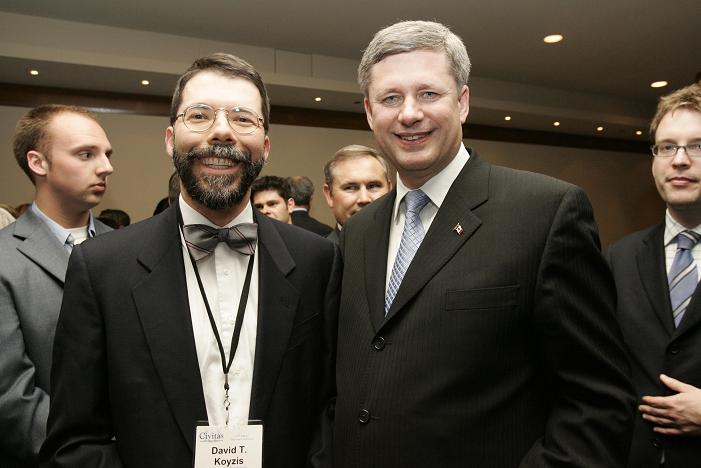
After this I made the 20-minute drive to the Brookstreet Hotel in Kanata, where the Civitas conference was taking place. During the reception that evening, Prime Minister Stephen Harper made an unscheduled appearance. I cannot recall how long he stayed, but it took some time for everyone who wished to meet him to do so. I myself was privileged to talk with him briefly and shake his hand. (If Harper had been aware of my track record, he might have declined the honour. After all, like his ill-fated predecessor, he is a Conservative with a precarious minority government!) After Harper and his entourage left, John Baird, the President of the Treasury Board, made an exceedingly partisan speech, filled with barbed humour at the expense of the various Liberal leadership hopefuls.

Saturday morning saw the first of the sessions, devoted to "Property Rights: the most fundamental freedom," followed by a session on a topic that at first blush might not seem to be related to the previous one: "Euthanasia: the next battle in the culture wars." In fact, however, both sessions brought out the barely latent tensions between two principal factions in the conservative coalition, the libertarians and what might be called the social or traditional conservatives. The former are individualists to the core, preferring to minimize government control to the greatest extent possible. As such, they enthusiastically champion the free market and are usually willing to tolerate abortion, euthanasia and other activities on which the social conservatives deem it necessary to legislate. After all, if we have property rights over our own bodies, then why not allow euthanasia? As one participant put it, if our bodies are not ours to do with as we see fit, then they belong to the state. Yet I heard no one make a case for allowing individuals to sell themselves into slavery, which indicates that even libertarians are not willing to follow all of their own ideas to their logical conclusion.

Koyzis and Harper
The luncheon remarks by Frank Luntz, a Republican Party strategist from south of the border, were certainly the most controversial. This was the part of the weekend picked up by the domestic media, and Harper's meeting with Luntz a day earlier was the subject of opposition criticism during monday's Question Period. The title of Luntz' talk, "Massaging the Conservative Message for Voters," carried all the flavour of a proposal for an ad campaign. Subtleties and nuances may be the mark of academic discourse, but they can only cloud an election campaign. Luntz' basic message? Keep it simple, hammer the opposition, and hire me next time. Incidentally, Luntz' appearance was arranged by the Manning Centre for Building Democracy, a partisan think tank associated with the Conservative Party of Canada.

The other four sessions dealt with the role of the courts in democracies, foreign and defence policies, electoral reform, and the future of Canadian cities. The schedule was tightly packed, leaving little time to catch one's breath. I missed George Jonas' speech saturday evening, due to fatigue. I would also like to have heard more on electoral reform the following morning, since I myself have written popular pieces on the subject. But I thought it best to cut out a little early to prepare for the final session on cities, in which I myself was participating. In fact, I was the very last speaker at the conference. Knowing this in advance, I feared I would be addressing a vastly reduced assembly, as some were present only for saturday. Yet this was not the case: even the final session drew a fairly large turnout.

I shall resist the temptation to engage in name-dropping, though it would be easy to do for such an event. Suffice it to say that there were a large number of well-known people — scarcely less well known than the Prime Minister himself. Representatives of a number of vaguely kindred organizations were also present, including one from the Association of Women Shooters of Canada! I myself spent much of the time with WRF people. Perhaps not surprisingly, I felt most comfortable with the traditional conservatives, even if I myself am loath to wear that label. I found myself least in agreement with the positions of the libertarians, though I found a number of these to be quite likable as persons.

At the end of the day, I found myself wondering whether everyone present really had all that much in common. Thomists, neocalvinists and traditionalists who speak the language of natural law, creation order and moral order respectively would not seem immediately to share much with those who view the state as little more than a constant threat to their own individual autonomy. In fact, there are professed socialists with whom at least this neocalvinst would have more in common. In my Political Visions and Illusions I point out the protean character of conservatism, especially the desire of different professed adherents to conserve a variety of perceived goods. This is particularly notable with respect to a view of the state. Unlike liberalism with its contractarian notion of the state, there is no single, philosophically coherent account of political order that can obviously claim the conservative label. If there was a common definition of conservatism at Civitas, it seemed to revolve around, not so much the respect for tradition and the accumulated wisdom of the ages, as smaller government and lower taxes — a somewhat deracinated agenda that would be largely incomprehensible to European conservatives of, say, the 19th and early 20th centuries, and even to Canadian conservatives of an earlier generation. In short, Civitas illustrates both the virtues and defects of the conservative movement(s) in this country. In this it is no different from the partisans of the rival political perspectives.

I was told that this particular Civitas conference was more evidently partisan than its predecessors. For the first time since Civitas was founded there is a large-C Conservative government in office. Even the taste of power can be a heady experience. How long will it all last? Luntz held out the possibility of keeping power for 20 years. My admittedly unprofessional advice? Don't put away your coat and hat too soon. After all, this is only a minority government.

08 May 2006

Ankara protests

From a story in today's Globe and Mail:

Turkey has recalled its ambassadors to Canada and France for “a short time” to protest moves in both countries that recognize the mass killings of Armenians as genocide, the Foreign Ministry announced Monday. The announcement was Turkey's latest salvo against increasing international pressure on Ankara to recognize the killings of Armenians at the time of the First World War as genocide.

If Turkey continues to refuse to recognize its culpability in the genocide, could its membership in the European Union be blocked? Could the prospect of such membership persuade Turkey to own up to its past?
Civitas conference

I have just returned from Ottawa, where I was a speaker at the annual Civitas conference. I will be writing more about this event and how I came to be involved in it. In the meantime here are two articles about some of the highlights of the conference. And, yes, I did meet the Prime Minister when he showed up unexpectedly friday evening.

Source: David T. Koyzis


Stephen Harper at Civitas

05 May 2006

Unexpected origins

I have long suspected that Cyprus' ethnic Turkish community is descended, not so much from the invading Anatolian Turks after 1571, but from those who converted to Islam in the generations thereafter. My assumption was that the forebears of today's Turkish Cypriots spoke Greek and were Orthodox. However, Alkan Chaglar has uncovered evidence that his community is descended from Cyprus' formerly more numerous Latin and Maronite Christians, associated with the centuries of Frankish and Venetian rule between 1192 and 1571.

03 May 2006

Egypt's beleaguered Christians

David Warren calls our attention to an anti-christian pogrom that occurred in Alexandria, Egypt, last month — an event reminiscent of something that occurred just over 50 years ago in Istanbul against the City's Greek population. Given that Egypt is a US ally, the UK Coptic Association and Freedom House are suggesting that the West might do more in behalf of that country's large christian community. Ordinarily one is tempted to assume that the mainstream media have been slow to cover the incident, but a Google search indicates otherwise. I myself visited Egypt in 1995 and heard first-hand of the difficulties Christians experience trying to live faithful lives in the midst of such hostility. They definitely need our prayers: Κύριε ελέησον!
Neocalvinism, encore une fois

How might neocalvinism assist a geographer in her ongoing efforts to make sense of God's creation and humanity's place within it? Calvin College Professor Jan Curry gives us a glimpse of this in last week's Comment article: Neocalvinism . . . Yes, but . . . Incidentally, Jan and I knew each other back in the dark ages when we were both undergraduate students at Bethel College in St. Paul, Minnesota. Good to hear from her again.

02 May 2006

C'est tout, c'est fini

Exams are done, the students have spread to the four winds, and my marks are in. Thus endeth my 19th year of teaching at Redeemer.

Followers

Blog Archive

About Me

My photo
Contact at: dtkoyzis at gmail dot com