06 November 2006

Which PR? Part II

In my previous post on this topic, I argued for adopting a mixed-member proportional (MMP) electoral system for Canada, and offered two reasons. More reasons follow below.

You have two votes
Third, although it is not necessarily an intrinsic part of MMP, the German variety provides for a 5 percent exclusion clause. German citizens have two votes, one for a local candidate representing a single-member constituency and another for a party list, as shown at right. Although many Germans split their votes, casting one for a deputy representing one party while voting for another party's list, they tend to cast both votes for the same party. If a party wins fewer than 3 single-member seats and less than 5 percent of the vote on the list side, it will receive no party-list seats at all. If, however, the party receives 3 or more single-member seats or succeeds in getting more than 5 percent of the list seats, it will receive the full number of seats to which it is entitled on the list side. The end result is a parliament that is roughly proportional, though not precisely so.

The reason for the exclusion clause is to prevent splinter parties and extremists from cluttering up the Bundestag. In the aftermath of the Second World War, when Germany had suffered through a dozen years of nazi misrule, a mechanism seemed necessary to prevent a resurgent national socialist party from entering parliament, as well as to put a premium on co-operation amongst would-be partisan groupings within the context of larger and more broad-based parties. This, it was hoped, would prevent the sort of cabinet instability plaguing the Weimar Republic between 1919 and 1933. More than half a century later, we can judge that MMP in Germany has been a success.

Admittedly, it has not succeeded everywhere. The Russian Federation has used a form of MMP since 1993, along with an exclusion clause. Unfortunately, because most political parties there tend to revolve around the personalities of local figures rather than around a programme commanding a nationwide following, up to half the electorate has gone unrepresented because their parties have not succeeded in surmounting the hurdle posed by the exclusion clause. As a consequence, next year's parliamentary elections will be contested on a straight party list system, which is almost certainly not appropriate for a country as large and diverse as Russia. We'll see how it works when the time comes.

Fourth and finally, MMP is more likely to be accepted within the North American context than, say, STV or a provincial/state party list system, as favoured by Skillen. Because single-member seats would continue to be contested, it would be less disruptive of something with which voters are by now thoroughly familiar. At this point, I would tend to favour dispensing with a party-list vote altogether and simply compensating with additional seats those parties with fewer seats than would be justified by their proportion of the popular vote. The end result would be not precisely proportional, but certainly more proportional than is currently the case. Little would change for the voters themselves, but they would know that, with their "losing" votes being combined to create extra seats, they would not be wasting their votes, as they effectively do now. This would almost certainly boost voter turnout in the two countries.

I might add that past editorials in The Globe and Mail have been on-side of adopting MMP here in Canada. Here in Ontario a Citizens' Assembly on Electoral Reform is getting off the ground, and public consultations are to be held. British Columbia went through a similar exercise, and a referendum last year came close to mandating the adoption of STV, largely through Nick Loenen's efforts.

I wonder, however, if it might be better for Ontario citizens to vote initially on the principle of PR versus FPTP, and then, if the former is approved, hold a second preferential ballot on the form of PR to be adopted. Some of the no votes in BC might have come from people who liked PR but disliked STV. Let's not make the same mistake here.

There is, of course, a possible drawback in adopting PR within the Canadian context, where we are accustomed to single-party "majority" governments that generally have the support of only between 38 and 43 percent of the electorate. Our last two governments have been single-party minority governments. If PR were adopted, we would probably never have another majority government again. Yet we could not keep having elections every year or so. This is where we reach the limits of institutional reform and where our developing unwritten constitution would have to fill in. Though we Canadians have had little experience with multiparty coalition governments, we would have to overcome our reluctance to see one party consorting with the "enemy" and consider this possibility. In fact, such coalition governments would be necessary if the political system as a whole is to continue functioning properly.

In the meantime, I plan to follow the work of the Ontario Citizens Assembly on Electoral Reform, and I may even make a submission.

05 November 2006

Why are there wars?

At the Locke Street Festival some weeks ago, the Church of St. John the Evangelist invited passers-by to write on a flip chart any question they might wish to ask God. One of these was "Why are there wars?" Noting that I would be participating in a workshop on war and peace at the upcoming ICS Worldview Conference, David Anderson, the rector, asked whether I would address this question in a sermon on sunday, 12 November, the day after Remembrance Day. I agreed to do so and will thus preach at next sunday's 9.30 am service. All are welcome to attend. The church is located at the northwest corner of Locke Street and Charlton Avenue here in Hamilton.

02 November 2006

Dijkema doings

I am pleased to announce that Mr. Brian M. K. Dijkema will be teaching Canadian Foreign Policy (POL 308) at Redeemer University College during the winter term of 2007. Mr. Dijkema is a graduate of Redeemer's political science programme and is currently working for the Christian Labour Association of Canada. He will shortly be receiving a master's degree from the Institute for Christian Studies in Toronto.

If you have a paper copy of today's National Post, please see page A-21 where Dijkema has published an opinion piece titled, Cheering on a Dictator. Here is the summary: "Cuban workers have no rights. So why does the communist regime enjoy the support of the Canadian Labour Congress?"

Congratulations are due to Mr. Dijkema for both of the above items.

31 October 2006

30 October 2006

Ignatieff puts his foot in it

Given his professed liberal individualism, Liberal leadership hopeful Michael Ignatieff has surprised me and troubled many others by proposing that Québec be declared a nation within Canada. Anyone who had spent more than a few years of his adult life in this country would have known better than to reopen the thorny constitutional question gratuitously for partisan political purposes. Historically, Québec has always been treated as une province pas comme les autres, but recent efforts to entrench this status in our constitution acts have come to nothing and have only inflamed tempers. Then again, Ignatieff might not have known this. He was away at the time, wasn't he?

29 October 2006

Dominion Christian Centre

Our family almost never watches television, but last evening we did watch W-Five on CTV, a disturbing look at The Pied Piper of Hamilton. A number of local families, one of which is known to us, are experiencing considerable heartache over loved ones who are members of this cult and have cut off all ties with them. It's a familiar pattern we've seen elsewhere over the decades. Everyone involved needs our prayers. Κύριε ελέησον!

27 October 2006

Sunrise


This was the view from the east window of my campus office shortly after 7 this morning. After the weekend, when we return to standard time, it will no longer be possible to witness the dawn at that hour.

24 October 2006

David T. Welldigger?

Here is one more possibility with respect to the origin of our family's surname. It may come from the Turkish word, kuyu, meaning well, and could thus refer to an ancestor's occupation. In the absence of birth records, or at least access to such records if they exist, this can only be speculation.

23 October 2006

Which PR?

The current issue of the Public Justice Report carries an article by James W. Skillen, Election Hype and Political Stagnation. Writing within the American context, Skillen notes that his fellow citizens are increasingly disaffected from electoral politics and especially the two major parties. This shows up in an increasing number of professed independent voters and in low voter turnout. Why bother to vote when one's own vote for a losing candidate is effectively a wasted vote?

In response Skillen proposes the adoption of proportional representation (PR) for elections to the House of Representatives. Of course there are different forms of PR. The one Skillen favours is a state-by-state party list system in which voters would vote, not for an individual candidate, but for a party and its programme. This would eliminate the need for the periodic redrawing of electoral boundaries, along with the dangers of gerrymandering for partisan purposes.

I am pleased to count Skillen as something of a mentor, as I acknowledge in the preface to my Political Visions and Illusions. I agree with him wholeheartedly on the need for a more proportional electoral system in those countries, such as the US and Canada, where it is lacking. However, I disagree with his proposed form of PR, namely, the party list system. Why does he favour this particular reform? Skillen isolates a key problem:

Our system, after all, is one that was designed from the start to frustrate the power of the national government. Only one national official is elected by American voters as a whole, and that is the president. In November, all those running for Congress—both House and Senate—will be elected by the voters in single districts or within a single state's borders. The priority of each representative who is elected will be to function in a way that benefits his or her district or state. Senator Lieberman (D-Conn.), who argued on the one hand for lobbying reforms and election-finance reform, nonetheless made clear during his losing primary race against Ned Lamont, that the bacon he has brought back to Connecticut from Washington is great for Connecticut. My point is that we do not have national parties with an ability to govern for the national good in the United States. Voters, therefore, have little if any control over what Congress does as a body of interest-group brokers, each of whom is conscious of the need to serve his or her home district or state. All that voters can do in the few districts and states where competitive races will be held this year is to throw out one interest-group broker for another and wait to see how he or she will play the same game in Washington.

There can be no doubt that logrolling is a significant obstacle to doing public justice through the legislative process in the US. We in Canada are not as prone to this notable defect, primarily because of our more disciplined political parties and the Westminster system that places a premium on party solidarity. Garth Turner's recent expulsion from the Conservative Party's parliamentary caucus is a case in point and would be unlikely to occur south of the border.

Of course, not everyone is keen on giving more power to political parties, and it might be that, if Skillen were living and working in Canada, he might come to a different conclusion. For example, Nick Loenen, who comes out of the same Reformed tradition as Skillen and myself, favours the single transferable vote (STV), because it empowers ordinary citizens rather than party élites. Too many Canadians believe that their local member of parliament, far from representing their interests in Ottawa, does little more than to represent Ottawa back to them, as if he or she were a mere satrap of a distant imperial government.

I myself could live with either STV or a party list system, but I would much prefer a German-style mixed-member-proportional (MMP) system. Why?

In the first place, it potentially combines the best features of our current single-member system and PR. The mere fact of local, rather than fully national, representation in a parliamentary body will not necessarily lead to logrolling, if the institutional machinery, both within the party and within the legislature, is in place to facilitate a more expansive deliberation on the substantive public interest. Perhaps even more significant than institutional factors is a supportive political culture recognizing, along with Edmund Burke, that a representative is a trustee of the public interest and not merely an agent of a particular territorially-defined group of citizens. But institutional reform of any kind will not necessarily bring about this change of attitude.

Second, it recognizes that one cannot so easily cordon off local from national interests in the way that supporters of the party list system appear to assume. Again, a Canadian example should suffice to illustrate this. In 1980 Prime Minister Pierre Trudeau firmly believed that enacting his National Energy Programme was in the interest of the Canadian polity as a whole. Yet Albertans disagreed and came to be persuaded that it lopsidedly benefitted the more populous provinces of Ontario and Québec at the expense of their own economic interests. A party list system would have done little if anything to ensure that the less populous provinces were not left out in the cold. Pursuing the national interest cannot mean ignoring local needs and aspirations, which must be taken into account by policy-makers. Skillen appears tacitly to acknowledge this by allowing for a state-by-state list system rather than a nationwide list system, as in Israel and the Netherlands. Yet, with Skillen, I heartily agree that the national interest cannot be reduced to a mere aggregate of local interests.

Next: More reasons to favour MMP.

20 October 2006

Communists woo Garth Turner

Well, that may be a bit of a stretch, but Turner is thinking of joining the Greens.

17 October 2006

Nature and grace

In music could the concept of the grace note be rooted in a semi-pelagian worldview?
I'll stay in Hamilton, thank you

I can't count the number of people I've heard say this in recent days: "Thank goodness we don't live in Buffalo!" And we're not yet a month away from summer.

16 October 2006

Schuurman at Redeemer

I have been asked to post the following announcement:

Dr. Egbert Schuurman will be visiting Redeemer University College and will give a public lecture entitled "Christian Life in a Technological Culture". Dr. Schuurman is a professor of Reformational philosophy in the University of Wageningen, the Netherlands. He holds degrees in engineering (Delft) and philosophy of technology (Free University, Amsterdam). He is a member of the Dutch Senate for the Christian Union party. Dr. Egbert Schuurman has published many books, among others Perspectives on Technology and Culture (1995), Technology and the Future (1980), and Faith and Hope in Technology (2003).

During his time at Redeemer, the public is invited to hear him speak on the following occasions:

-Tuesday 24 October, Redeemer Room #214 at 7 pm: Public Lecture on "Christian Life in a Technological Culture" (open to the general public)

-Wednesday 25 October, in the auditorium at 11 am: message in the Redeemer chapel service (open to the general public)

Depression and medication

Following my own experience with depression in the late spring and early summer, I was interested to read this article by Fr. George Morelli, Overcoming Depression: Cognitive Scientific Psychology and the Church Fathers. There are good things in the article, including the isolation of the eight cognitive distortions occurring in the mind of someone suffering from depression. Fr. Morelli suggests cognitive therapy and spiritual intervention as means of trying to alter these distortions. 

Yet something is missing. Apart from the author's single reference to the possible need for "psychopharmacological treatment" in some cases, nothing more is said of the role of medication in the treatment of depression, anxiety disorder and similar conditions. This is not an inconsequential omission. Why might Fr. Morelli see fit not to discuss this element? The obvious answer is that he is merely a psychologist and not a psychiatrist, with the medical component thus lying outside his field of competence. 

Nevertheless, I wonder whether there is not more at work here. Could the inattention to medication be rooted in a defective anthropology playing up the cognitive at the expense of the corporeal? I have heard of more than one case in which well-meaning Christians have advised those suffering depression to wean themselves off medication on the assumption that "dependence" on it is the sign of a defective spiritual condition. However, I doubt very much they would extend this same counsel to a heart patient needing medication to survive. 

When I was going through the worst moments in May and June, I found it difficult to feel gratitude to God for his blessings to me, because everything appeared in such a negative light. I had to struggle to thank God on a cognitive level while feeling exactly opposite. This was the most vexing element of my depression. Was I undergoing an internal spiritual struggle? Most certainly, yes. However, once I was on a high enough dose of the medication, I began to feel dramatically better, freshly aware of the joys of life and the grace of God. I could then much more easily feel grateful to him for all his gifts, including my wife and daughter, my work at Redeemer, and faithful friends and family who prayed for me during those dark weeks. 

Did the medication tip the balance in the spiritual struggle? Did it help to bring my emotions into line with my cognitive grasp of the world? It certainly seems to have done so, yes. I find Dooyeweerd's philosophy especially helpful here, because, rather than assuming that spiritual struggles take place in a creational vacuum, he recognizes the different levels in which everything functions. According to his modal analysis, the biotic is foundational for the affective/psychic mode, which is in turn foundational for the logical/analytical mode. This suggests to me that in my case the medication altered the biological component by raising the levels of serotonin in the brain, making it possible for my emotions to return to normal, which then brought my thought processes back into line. 

Could it work the other way round, namely, attempting to change one's emotions, and ultimately one's physical health, by addressing the thought processes? That's what cognitive therapy is all about, and I understand that it can be effective. Nevertheless, in my case healing worked upwards from the more basic level rather than working downwards, as it seems to do in some cases. This would appear to indicate that spiritual battles do not occur in a platonic realm of ideas separate from the tangible world as we experience it. 

As in Job's case, physical infirmity can be the occasion for the afflicted to doubt God's love for them, thus precipitating a crisis of faith. Conversely, addressing such infirmity may help to resolve such a crisis, though I, along with many others, can testify that the grace of God does come even in the absence of good health and a receptive emotional state. Is this analysis less spiritual than one relying on, say, the power of prayer alone? I don't think so. Nevertheless the complex interconnections between the various aspects of the human person raise issues that would seem, at the very least, to require further reflection.

Zoologists of the world, rejoice

This is good news: New mouse found in Cyprus. The report fails to indicate whether this newly discovered species is a Greek Cypriot or Turkish Cypriot rodent.

14 October 2006

Singing styles

Three decades ago I took voice lessons while a student at Bethel College in Minnesota. I thus learned to sing in the bel canto style associated with classical western music. Of course, bel canto is hardly the only vocal technique in existence. For example, the singers of Greek folk music, or δημοτικά τραγούδια, generally have raspy voices that seem to have been filtered through the rocky soil of the Peloponnese. Most, if not all, folk singing is far removed from a style more suited to the Italian opera house than to the village.

Commercial popular singing differs from one place to the next as well. In North America I have noticed over the years that male singers tend to sing loudly and at the top of their range, thereby seeming to suppress the masculine character of their voices. (The Bee Gees are perhaps an extreme example!) This I have never been able to understand, but it seems to have begun just over half a century ago with the birth (or perhaps the mainstreaming) of rock and roll.

By contrast Brazilian singers take an entirely different approach, as heard in this video of João Gilberto's exquisite rendering of Ary Barroso's classic Aquarela do Brasil and in this one of Antonio Carlos Jobim singing his own Desafinado. Both sing softly and very nearly at the bottom of their range. Of course these are men of an earlier generation. Has the Brazilian popular singing style come to mimic the North American in the intervening decades? Someone closer to the genre may be able to answer this better than I.

10 October 2006

Onze Cabeças

Though I do not know nearly as much as I would like about the subject, I have long had an affinity for Brazilian music, both classical and popular. Now from that largest South American country comes an excellent jazz band, called 11 Cabeças (Eleven Heads), which deserves to be better known in North America.


Fantástico! If you liked this piece, click here for more. I understand that 11 Cabeças recordings are not yet available in the northern hemisphere, but let's hope that they will be soon.
Holiday hike

What better way to spend Thanksgiving Day than by hiking through the Dundas Valley Conservation Area. The autumn leaves appear to have peaked early this year, so we decided to take advantage of yesterday's lovely weather by trekking through the woods. Here are some photos of our adventure. I was particularly pleased by the second.

© 2006 David T. Koyzis

© 2006 David T. Koyzis

© 2006 David T. Koyzis

© 2006 David T. Koyzis

© 2006 David T. Koyzis

09 October 2006

Thanksgiving

You crown our year with rich abundance
and grant prosperity.
Even the grasslands yield a harvest
and grow luxuriantly.
The hills adorn themselves with gladness,
the meadows with their herds.
The valleys with their grain are covered;
they sing with joyful words.

Psalm 65:11-13

06 October 2006

A positive turn for Acton

Ever since I came into contact with the Acton Institute of Grand Rapids, Michigan, I have been disturbed by its apparent tendency to view the free market as a panacea and to overextend its validity beyond its proper sphere, especially in its approach to education and the environment. However, this recent commentary by Kevin Schmiesing represents an encouraging development and could prompt a rethink on my part: The Baby Market. Writes Schmiesing:

The market is a wondrous thing. There is no better instrument for the calibration of human productivity and ingenuity to human needs and wants. But its advantages turn pernicious when it encompasses human goods that should never be reduced to monetary values.

Excellent. I hope Acton as a whole will follow Schmiesing's line of argument as it tackles other issues as well.

03 October 2006

Church immobilized

On the face of it, this is a bewildering report: WCC asks Israel to recognize head of Orthodox Church of Jerusalem. These lines jump out at the reader: "Under long-standing agreements, the election of the patriarch of Jerusalem, the oldest and largest church in the Holy Land, is endorsed by the Israeli, Jordanian and Palestinian authorities." Um, isn't it about time to change these longstanding agreements? The notion that an entire church body would allow itself to become paralyzed by the failure of a government to act seems ludicrous.
Take the Anglican challenge

This one is for Anglicans and Episcopalians: count the number of sundays that pass before you hear a sermon lacking the words inclusive or inclusivity.

02 October 2006

Tuesdays with Morrie

I somehow managed to miss this book when it first came out nearly a decade ago: Mitch Albom's Tuesdays with Morrie. Morrie Schwartz was Mitch's sociology professor at Brandeis University in the late 1970s, and the two of them grew close during that time, meeting on tuesdays to discuss the great issues of life. When Mitch graduated, he left his mentor behind to pursue fame and fortune as a sport writer for the Detroit Free Press, seemingly forgetting what he was taught: that relationships are more important than worldy success.

Years later, as Mitch was watching television, he learned from a Nightline report that Morrie was terminally ill with ALS. Regretting his own failure to maintain contact over the years, Mitch made a belated effort to renew his friendship with Morrie, going so far as to spend 14 successive tuesdays with him as his body gradually deteriorated. In the process he learned one last lesson from his old mentor: what it means to die, as well as how to live well in the love of friends and family in the meantime. Here's Morrie himself:

[G]iving to other people is what makes me feel alive. Not my car or my house. Not what I look like in the mirror. When I give my time, when I can make someone smile after they were feeling sad, it's as close to healthy as I ever feel. Do the kinds of things that come from the heart. When you do, you won't be dissatisfied, you won't be envious, you won't be longing for somebody else's things. On the contrary, you'll be overwhelmed with what comes back (p. 128).

This book was commended to me by one of my own former students whom I am blessed to call a great friend. The relationship depicted in it felt familiar to him, and he thought I should read it too. I am glad I did. Even more than the contents of Morrie's last lessons, I was moved by the evident affection that grew once more between him and Mitch in his final weeks.

When I first started teaching just under two decades ago, I was surprised at how much I would come to love my students and how much more they would return to me in loyalty and affection. Indeed I can easily say that if I had to give up all but one thing of my academic career, that one thing would be the ongoing relationships with my students and former students which I've found so enormously gratifying. I think Morrie would have said the same thing.

For anyone who has loved a former teacher or for any teachers who have loved their students, this is a must read.

28 September 2006

The Pope was wrong

What better way to demonstrate to Benedict XVI that Islam is not, after all, a religion of violence: Greek Orthodox Church Attacked With Pipe Bombs In Gaza.
Baptists becoming Reformed?

More than two decades ago, while living in South Bend, Indiana, a young couple showed up at the South Bend Christian Reformed Church, of which I was a member, insisting that they were "Reformed Baptists." They had decided to worship at SBCRC, because its Reformed confessional stance outweighed for them their differences in understanding the sacraments. They brought with them numerous stories of fellow Baptists who were converted to Calvinism. I recall expressing puzzlement as to which element of Calvin's teachings had worked such a change in these Christians. Their response? TULIP.

This attachment to the doctrines represented by the famous floral acronym seems also to be behind the stories recounted here: Young, Restless, Reformed. It should be noted that virtually everyone in these stories is a Baptist of some sort. Given this fact, three groups of questions would appear to merit consideration.

(1) If so many Baptists, especially in the Southern Baptist Convention, are coming to embrace Reformed Christianity, will they not eventually have to confront — and perhaps even embrace — Calvin's teachings on the sacraments and ecclesiology, from which they still evidently dissent? If salvation comes, not from our decision for Christ, but from his choosing us, then wouldn't it be more appropriate to adopt a view of baptism as a sign of God's grace rather than one reflecting a voluntary profession of belief?

(2) The early Reformers recovered the Psalms in the liturgy and commissioned poets and musicians to render them in a form easily singable by an ordinary congregation. Why then does the article fail to mention an increased appreciation for and use of the Psalms in public worship? Has this not been part of the experience of these converts? If not, why not?

(3) Will these Reformed Baptists not also have to think through, along with Abraham Kuyper, the implications of God's sovereignty for every area of life? Will they come to have an appreciation for the larger implications of the cultural mandate (Genesis 1:28)? Or is this ostensibly "enlarged view of God's authority" applicable only to "evangelism, worship, and relationships"?

I suppose I'm ultimately asking this: As these Baptists become more Reformed, will they eventually cease to be Baptist in any meaningful sense? That, of course, cannot be predicted in advance. However, what appears to be lacking in these zealous converts is a sense of the catholicity of the church and of the faith. We do not yet see in them an enlarged sense of the body of Christ, which might make for a more ecumenical emphasis. Nor do they appear to recognize that the church did not disappear between the 1st and 16th centuries. They have adopted a narrowly theological approach to Calvin's teachings, without, as far as I can tell, having a real burden for the institutional church, the sacraments, and a world and life view that touches, well, the whole world and all of life.

25 September 2006

A Tory on fraternity

Hegel's ideas are alive and well in the person of Danny Kruger, who applies the German philosopher's dialectic to British politics in The right dialectic. Kruger argues that the revolutionary triad of liberty, equality and fraternity well represents the ongoing quarrel between left and right, with the former focussing on equality and the latter on liberty. Both groups value fraternity, even if they interpret it differently. At base it is

the sphere of belonging, of membership, the sphere of identity and particularity. It exists in civil society, in the arena of commercial and social enterprise, of family and nation. It concerns neighbourhood, voluntary association, faith, and all the other elements of identity that relate us to some and distinguish us from others. It concerns culture.

Kruger's essay is helpful in giving us a sense of the direction of the Conservative Party under its current leader David Cameron. What Kruger appears to misunderstand is the origin of the terms left and right in the horseshoe-shaped parliaments he erroneously views as attempts to overcome them. They certainly did not originate at Westminster, as he seems to imply.

Thanks to Paul Bowman for alerting us to this article. Bowman has asked me whether Kruger's musings represent a movement within the Conservative Party in a christian democratic direction. Possibly, but these ideas are by no means new within the Party. Former leader William Hague (who bears an uncanny resemblance to Kelsey Grammer of Frasier fame) set them forth in a speech titled, "Identity and the British Way," since removed from the Conservative Party website but which I mention in my book.

24 September 2006

Church notes

This morning our family was privileged to attend Divine Liturgy at All Saints of North America Orthodox Church in Hamilton's east end, courtesy of our friend, John Loukidelis, a reader of this blog. The congregation is quite small, but extremely friendly. Thanks are due them for their generous hospitality. The Priest-in-Charge, Fr. Geoffrey Korz, preached a sermon urging his hearers to recognize that love of God is not just something to be cordoned off from daily living but must extend to the whole of life.

On another note, the Church of St. Mary the Virgin, in Berry Pomeroy, Devon, England, sang one of my versifications of Psalm 95 at Morning Prayer today. It will be sung again at the 11.15 am service on sunday, 23 October. I'd love to be there myself to hear it. I understand that the St. Mary's building was the setting for the final wedding scene in Ang Lee's cinematic version of Sense and Sensibility.

22 September 2006

God and the welfare state

Remember Lew Daly's Compassion Capital, on which I blogged here? Well, now it's in book form, titled God and the Welfare State, to be released next month. Daly has offered to have a copy sent to me by the publisher once it's out. I look forward to reading it.
What? No more ad hominem?

Can it be true? The New Pantagruel is closing shop. And so soon after this. I don't think we're in Kansas anymore, Toto.

21 September 2006

Artificial happiness?

I must admit to being ambivalent about Richard John Neuhaus' comments on Ronald Dworkin's Artificial Happiness: The Dark Side of the New Happy Class. Although I usually agree more than I disagree with Neuhaus — at least on specific issues — in this case I fear he is labouring under a misunderstanding of the nature of the illnesses that prompt people to take antidepressants such as Prozac or Zoloft. Though I've not read the book at issue, I suspect that neither Dworkin nor Neuhaus has ever suffered from depression, which is considerably more than just unhappiness. When properly used, these medications help to free the mind, not just from unhappiness, but from anxieties gone into overdrive, which can adversely affect how one approaches one's work, relates to other people, and views past and future.

I find myself wondering whether Dworkin and Neuhaus would make the same judgements on people suffering from, say, diabetes or hypothyroidism who need insulin or a hormone supplement to keep themselves alive and functioning. Or even those who take Tylenol for a headache. Are these people to be labelled artificially healthy or pain-free? We all know, of course, that pain helps to alert us to potentially deeper health issues needing attention, and a painkiller may lull us into ignoring the root causes of a malady. I have no doubt that psychoactive medications can be abused. They certainly should not be used to make "people feel good about their disordered selves and their disordered lives." (However, I'm not sure they are even capable of this — of soothing the consciences of people unhappy with their own sins. I doubt any medication can do so.) Yet I believe we are justified in thanking God for the medications that have been developed over the decades to ease pain and cure illness. This includes psychoactive drugs.

18 September 2006

Architecture

From ages 6 to 14 I aspired to become an architect. As a child I used to spend hours drawing floor plans of homes, fancying myself the heir of the great Frank Lloyd Wright, who once lived in the city of my birth, Oak Park, Illinois. Taking a drafting course in high school convinced me that architecture was not for me after all. Nevertheless, I still have an interest in the subject. When my niece married a Chicago architect a few months ago, he and I discovered we had much to talk about. Moreover, when some friends visited my home many years ago, they noticed that much of the art on my walls consisted of cityscapes and buildings. I hadn't put two and two together before that, but I realized then that I still care about the buildings where we live our lives from day to day. A week ago last friday Comment published a thoughtful article by David Greusel, Why architecture matters. It's a great piece and I can easily resonate with the concerns expressed therein.

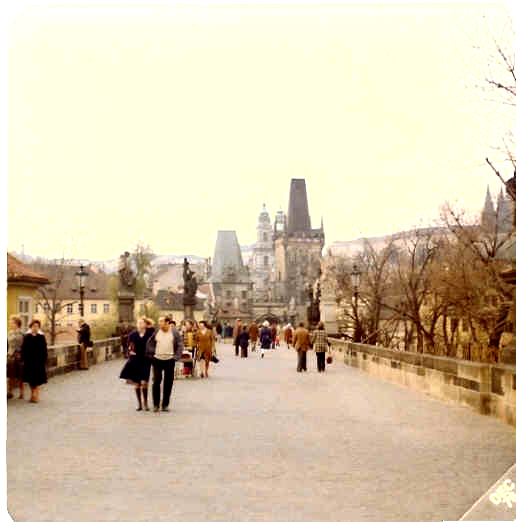
Charles Bridge, Prague (© 1976 David T. Koyzis)
In late 1976 I visited Prague (right), the capital of what was then still called Czechoslovakia. Immediately I fell in love with this perfect jewel of a city, with many of its buildings dating back to the 14th century when the Emperor Charles IV made it his capital. Because it was spared the destruction of the two world wars, it still retained its character — at least at its centre. Of course, three decades ago the country was under the communists, whose rule affected the architecture constructed between 1948 and 1989. Prague thus offered a fascinating contrast within its own borders. On the one hand was the old city, constructed in grand style befitting the seat of an emperor.

On the other hand, the periphery of the city suffered from the blight of a dour stalinist architectural style imported from the Soviet Union. For communists any human touches to our homes, schools, workplaces and public buildings are deemed remnants of a decadent capitalism, to be replaced eventually by a sternly proletarian functionalism divorced from the realities of human communities and the relationships nurtured therein.

We can be grateful that the communists saw fit to retain the late mediaeval heart of Prague, rather than effacing it altogether as they did the former East Prussian city of Königsberg, now known as Kaliningrad. This suggests that, despite the depredations of a destructive worldview, the rulers of Czechoslovakia recognized the treasures they had inherited from their precommunist predecessors and rightly sought to preserve them for future generations.

Chicago Skyline (© 1976 David T. Koyzis)
Yet there are places in the noncommunist western world where the architectural legacy of previous generations is too easily cast aside when economic imperatives dictate. For example, my home city of Chicago (above left in 1976) boasts some of the best known cutting-edge architecture in the world. However, in my personal library I have a nostalgic volume titled, Lost Chicago, by David Lowe, filled with more than 200 pages of photographs telling the sad story of a city's vanished heritage. Of course, some of this perished in the Great Fire of 1871, but most of it was deliberately destroyed to make way for something newer and ostensibly better.

Back in 1984, when the decision was made to demolish the old Chicago & Northwestern terminal on Madison and Canal Streets, and build in its place a metal and glass skyscraper to be called the Northwestern Atrium Center, I wrote a letter of protest to the Chicago Tribune, subsequently published in the 23 June issue of that year. Here is the letter, with which, apart from a few rhetorical flourishes, I still agree:

It saddens me to see the stately old Chicago & Northwestern terminal about to be demolished. To try to soften the blow, the railroad has put up signs and banners cheerily proclaiming, "We're on our way up," meaning, of course, that where the old station now stands will soon be erected yet another of those characterless glass office buildings with an enclosed shopping court at its base. One more link with the city's past will have been sacrificed barbarously at the altar of progress and the almighty dollar.

Chicago is rather like a vain movie star, afraid to let the world see the signs of its age and refusing to grow old gracefully. Every generation the city seems compelled to undergo a facelift, allowing itself to live on an illusion of perpetual youth while eradicating any continuity with its own past. Not every building should be preserved merely because it is old, of course, but the reckless compulsion to destroy and rebuild is not healthy either. Not only has such a city lost touch with its own soul, but it is hardly acting as a fit caretaker and steward of the valuable resources and treasures bequeathed by past generations. When will Chicago learn to value its own heritage instead of glorifying its rootlessness?

More than two decades later, as I look back on what I wrote then, it occurs to me that we need to address an important question: Given that we cannot and should not save every building that has ever been constructed, what criteria should we use to decide which to preserve and which to replace? I'd love to hear some discussion of this.

17 September 2006

At the edge of the solar system

It's official: Dwarf planet gets new name. The distant world temporarily nicknamed "Xena" is now called Eris, after the Greek goddess of discord. In the meantime Pluto has been further downgraded by being assigned a number: 134340. I guess Pluto and Eris can keep each other company out there in the Kuyper Kuiper Belt.
Reaction to Pope's speech

Pope Benedict XVI was unwise to quote Byzantine Emperor Manoel II Palaeologos, who had the temerity to criticize efforts to spread faith at the point of a sword. Just because Constantinople was at the time under siege by the Ottoman Turks was no excuse for the Emperor to let his prejudices get the better of him. As for the Pope, he should definitely make a clearer apology.
Marketing the church

What happens when worship becomes a mere tool for evangelism and outreach? Fr. John Parker takes a hard-hitting look at efforts to market the church in Guide for the Cineplexed. Writes Parker:

The marketed church offers just what everyone wants: the music I want (or don’t), the time I want, the length of service I want, the type of language I want, the style of music I want, the amount of intimacy and responsibility I want, and in some cases, even the pastor I want. But is the gospel a message about the satisfaction of wants?

The marketed church confuses Sunday worship and catechism with evangelism and outreach. What is the difference? Mere Christian Sunday worship has always been for the Christian community (the baptized) to offer thanks to God, to sing his praise, and to feed on the Word. Evangelism has been done by conversation in the marketplace, preaching in the public square, but even more, simply by the witness of increasingly holy lives.

14 September 2006

Marshall on evangelical activism

My friend Paul Marshall has an article worth reading in this month's Christianity Today: The Problem with Prophets. I would love to see him develop his thoughts further in a longer essay or even a book on the subject.

12 September 2006

Lessons from the Antipodes

Do we Canucks have something to learn from the Aussies? Mark Steyn clearly thinks so.
A word to the wise

If any of my students dares to wear something made of this material in the classroom, I will make them take it off then and there.

11 September 2006

Five years later

11 September 2001
University of Florida


Lest we forget. . . .


10 September 2006

Crossing the Tiber

Prof. Ian Hunter, who has spoken at Redeemer in the past, has left the Anglican Church for Rome. My question for him is: why not Constantinople?
A budding musician in our household?

Is it unusual for a 7-year-old to be humming Dave Brubeck's Blue Rondo à la Turk and Take Five at the breakfast table? The remarkable thing is that I was easily able to recognize them.

Here is my own homage to Brubeck, titled Rondo Rouge à la Grec (© 2002 David T. Koyzis).

08 September 2006

Gilead
Gilead

Last week I read Marilynne Robinson's Pulitzer Prize winning Gilead on the recommendation of a friend. Gilead is a small town in western Iowa, just over the border from Kansas. (In reality, of course, Iowa does not share a border with Kansas, but this geographical fiction is no less plausible than Gilead itself.) Not a conventional novel with a clear plotline and an obvious ending, it instead takes the form of a journal kept by a dying minister of the gospel written for his 7-year-old son whom he will not live to see grow up.

The Rev. John Ames is the third generation of men by that name to have pastored the local Congregational church. Born two decades before the end of the 19th century, he is married briefly in the first years of the 20th. Alas his first wife dies in childbirth, as does the infant daughter. Only when he is in his 60s does he remarry a woman much younger than he and, as he approaches his three-score-years-and-ten, experience the unexpected grace of fatherhood once again.

The beauty of the book lies not in its plot, but in the portrayal of its characters. Robinson flawlessly assumes the voice of an elderly man, persuading the reader that, among other things, the writer really did accompany his father on a journey to Kansas in 1892 to find his grandfather's grave. The most complex character is his namesake, John Ames "Jack" Boughton, the son of his lifelong friend, "old Boughton." Having disgraced the family in his youth and moved away from Gilead, he has now returned to town 20 years later, with unknown motives. Ames fears Jack's influence on his wife and son after he has passed on. Much of the latter part of the book finds him preoccupied with Jack's sudden and unnerving presence in his family's life and his interior struggle over whether he should warn his wife about him.

Oddly enough, however, Ames' second wife, Lila, along with the other women in the book, is not as vivid a character as one would expect from a husband's diary. It may not be fair to call her one-dimensional, yet we know little of her motives and what makes her tick. That's the one thing that does not ring true in an otherwise compelling narrative. On the other hand, given that it is written for his son, who when he reads it will already have known his own mother, Ames might well deem it unnecessary to delve too deeply into her character for his benefit.

There is much to love in this book.

First, although I have never lived in a small town, I was taken with the setting and the relationships nurtured by it. Imagine living in one place one's whole life and enjoying the proximity of lifelong friendships. In a mobile society friendships are generally cultivated for a time and then have to be maintained in attenuated form over a distance as someone moves away. (I have never entirely reconciled myself to this fact of contemporary life.) But Ames and old Boughton — best friends from childhood — grow old together and seemingly face death at nearly the same moment.

Second, I was moved by the father-son relationships portrayed. With remarkable insight, Robinson accurately depicts the love and loyalty, as well as the tensions and conflict, between the generations of a family. Again this rings true.

Finally, Robinson perceptively explores the unfathomable mystery of divine election in the lives of her characters, especially the wayward Jack and Ames' disbelieving brother Edward. Why does God's grace seem to bypass those who, try as they might, cannot bring themselves to believe? Why do others, such as Lila, come to the faith in so ordinary a fashion after sitting through successive weeks of less-than-riveting sermons? The author asks and considers these questions but wisely refrains from trying to answer them.

Robinson's last (and first) novel, Housekeeping, was written a quarter of a century ago. Let's hope she doesn't wait as long to publish a third.
Needed reform on the way

This is good news: Harper promises bill to elect senators.

06 September 2006

What if they gave a world and nobody came?

Given the already falling birthrate in Europe, this award-winning advertisement from Belgium would seem to be counterproductive, even from a marketing standpoint. After all, if everyone took its message seriously there would be no one left in another 25 years to purchase the featured product.
The europeanization of American politics?

Is the political debate in the United States taking on the character of post-revolutionary politics in 19th- and 20th-century Europe with the two major parties polarizing along religious lines? Joseph Bottum considers this possibility and is most uncomfortable with it:

I wrote, as though it were perfectly self-evident, “We cannot—we should not—have a party so strongly identified with opposition to religious believers.” And a Europeanized friend emailed to call me on my over-easy assumption: “Why shouldn’t we have one party that is friendly to religion and one unfriendly? That is the pattern in most developed countries, and surely, as the Republican party increasingly takes on the attributes of a European-style Christian Democratic party, it is logical that their opponents take the other position.”

The attribution of cause here is a little one-sided, as though the poor liberals were forced into their un- and anti-religious positions entirely by the conservatives’ donning of the religious mantle. Even the good Democrat Amy Sullivan blames some of this on the way the Democratic party has behaved. Still, my friend’s general point is a good one: The First World pattern has been a Social Democratic party versus a Christian Democratic party, an anti-religious party versus a religious party, and if politics in the United States is starting to match that pattern, why is this surprising or undesirable?

My first answer was that the idea makes my skin crawl—which is just another way of saying I had been assuming that American exceptionalism lets us sidestep this whole wars-of-religion, Westphalia, philosophes, French Revolution, last-king-strangled-with-the-guts-of-the-last-priest European thing.

In a way, I still think that my original assumption is the answer. A developed argument about American exceptionalism and the nature of the American Founding would take us a long way toward understanding why we don’t want religion to be pushed from the shared mainstream over to one side’s shore.

Although I am to some extent sympathetic with Bottum's skin-crawling reaction, I doubt that his protest will win out at the end of the day. As for American exceptionalism, it is certainly true that the settlements that would form the United States at the end of the 18th century were largely spared the political turbulence that plagued the old continent between 1789 and 1815, with the partial exception of the last three years of this period. The American colonies were in many cases founded by devout Christians seeking the freedom to follow their ultimate beliefs.

That said, during the so-called founding era between 1776 and 1800, the political élites were largely nominal Christians at best, imbued with Enlightenment ideals and holding to a vague deism. Thomas Jefferson was the paradigmatic figure of this period. However, at the turn of the new century a series of religious revivals swept through the new republic, significantly altering the face of its public life. After this point evangelical protestantism dominated the expanding nation up until the cultural changes following the Great War.

What makes the United States exceptional, then, is not so much the bundle of ideals said to constitute the American enterprise; it is rather the historic vacillation between the dominance of christian and secular forces, with one in the ascendancy at one time and the other temporarily supplanting it. This is in contrast to Europe where the long range trend has been in one direction: secularization. Is the US finally conforming to this European pattern?

Having been born and brought up in the US, my own sense is that the larger trend, at least at present, is towards a more overt public presence of the traditionally religious. Jimmy Carter was the first presidential candidate to label himself openly as a "born-again Christian" back in 1976. Prior to that time, explicit claims to a particular confessional identity were all but unknown amongst national political leaders. Since that time, such claims appear almost to be the rule rather than the exception. That such claims find a home more naturally within the Republican than the Democratic Party goes some way in explaining the former's dominance in recent years.

That said, the Republican Party is far from being a European-style christian democratic party, especially considering the presence within its fold of libertarians and free-marketeers. President Bush's "compassionate conservatism" marks, at least in part, a departure from this anti-government support base. But this hardly guarantees the GOP's transformation into a christian democratic party. If anything, Bush, with the best of intentions, has engaged in dangerous overreach, overestimating the power of government in general and the US government in particular, much as Lyndon Johnson did four decades ago.

This suggests to me that, after Bush's departure in 2009, the libertarians may once again find themselves in the ascendancy within their party, as Americans react against the "big-government" conservatism of the younger Bush. This could give the Democrats a window of opportunity, if they are willing to abandon their stance on abortion and reach out to the followers of traditional Christianity and Judaism. If they are not, then the Republicans will likely remain dominant, with frustrated evangelicals and Catholics having no choice but to remain within a party where their influence is less than what it once was but more than in the opposing party. Of course, this may be a blessing in disguise as it could force Christians to grapple with the larger issue of formulating a coherent political philosophy rather than settling for a piecemeal gut response to issues such as abortion, marriage and the like.

What about Canada? That's for a future post.

04 September 2006

Warren on 'chestlessness'

Canada's own David Warren is hardly a stranger to controversy. A recent column of his, Chestlessness, has engendered no small amount of discussion in the blogosphere, because in it he excoriates the two captured Fox News journalists who went along with their captors even to the extent of "converting" to Islam. Warren, who is an adult convert to Catholicism, responds to his critics here.

Although I am sympathetic with Warren's critique, I do wonder whether one can realistically expect someone who is not a Christian to display the same courage in the face of martyrdom that so many followers of Jesus Christ have manifested over the centuries. To die for something as abstract as "the West" while lacking an ultimate hope in redemption is almost certainly more than one can demand from a journalist steeped in a secular worldview.
Confessing 'sin'?

Last week I worshipped at a local Presbyterian church. In the course of the liturgy, the congregation recited a general confession of sin that contained this line: "When we exclude others with our theology, language, traditions, and practices, gracious God, forgive us." This could be interpreted in one of two ways. First: "when we put up unnecessary and unbiblical barriers to fellowship, gracious God, forgive us." Or second: "when we claim that only those in Christ are saved, gracious God, forgive us." I will not attempt to speculate as to which meaning was intended.

30 August 2006

The Koyzis bowtie collection

Koyzis bowtie collection

Count them — there are 36 in all

28 August 2006

Fauré's Pavane

Many years ago I purchased a vinyl recording of Barbra Streisand singing a number of pieces conventionally styled as classical. This is when I first came into contact with Gabriel Fauré's Pavane, which she sang as a vocalise. The idea behind it is fairly simple: mostly parallel thirds, which are the basis of conventional western harmonization. Yet there is something about this piece that vindicates that otherwise overused word, haunting. Here it is performed by Hiromi Okada at the piano.
A Prairie Home Companion

One evening back in 1978, at the end of my undergraduate education in Minnesota, I went with a good friend and his family to a theatre in St. Paul where, for nearly four years, a storyteller and a group of musicians had performed a live radio show with something of a down home feel. Broadcast over Minnesota Public Radio, it had become a regional fixture, drawing listening audiences from around the state. On the stage that evening was a man in his mid-thirties, one Garrison Keillor, who delighted those present with his stories of the fictional Lake Wobegon, "where all the women are strong, all the men good-looking and all the children above-average."

A few years later, A Prairie Home Companion began to be syndicated across the United States, and Keillor became a household name. I cannot claim to have been a regular listener to the programme, but if I had nothing better to do on a saturday evening, I would tune it in for some light, homespun entertainment with gentle humour and a human touch. This was during my graduate student days in South Bend, Indiana.

Although it is still on the air, I've not listened to it in nearly two decades. However, at the weekend my wife and I decided to see Robert Altman's new cinematic version of A Prairie Home Companion at the Westdale Theatre near McMaster University. Because it's been so long since I last heard PHC on the radio, I cannot say how well the movie captures the current atmosphere of its namesake. That said, we could not unequivocally say that we liked what we saw. The film seemed to be something of a bizarre combination of the original PHC and an Ingmar Bergman film, with Nikos Kazantzakis providing the unsatisfying ending. Death was an overriding theme — something that seemed out of character with the PHC I remember from the 1970s and '80s. Oddly enough, Lake Wobegon was not even mentioned. There was no storytelling, only music with various morbid themes, including murder and suicide. There were some pleasant surprises, such as the discovery that Lily Tomlin and Meryl Streep can sing. All in all, however, it is a shame to see Keillor, whom I recall to speak with such affection for the ordinary Lutheran and Catholic folk of his fictional hometown, peddling even a tongue-in-cheek nihilistic vision. Perhaps those Norwegian bachelor farmers can set him straight.

25 August 2006

To stir the patriotic heart. . .

Three years ago, when the Kofi Annan Plan to unify Cyprus was still alive and a year before the island state's entry into the European Union, a competition was held to come up with a new national anthem. I decided to submit a song, but it lost out to a mediocre (to put it charitably) tune boasting basic harmonization errors. In any event, when the Annan Plan died, so did the quest for an anthem. When I initially learned of the competition, I had considered entering this. I should have done so. I think it would have been a winner.
Hola de Señorita Yolisa

I have just received word from the globetrotting Yolisa de Jager, easily my most peripatetic protégée. She is studying at the University for Peace in San José, Costa Rica. I trust she will be updating her blog accordingly to fill us in on her experiences there. Let's hope she posts photographs as well.
Pluto demoted

It's official: Astronomers strip Pluto of planetary status. I guess Gustav Holst was right after all.

23 August 2006

Christians on the front lines

Thanks to Michael Van Pelt for pointing me to this wonderful address delivered by Brian Stewart two years ago at Knox College in Toronto: On the Front Lines. This encouraging word to the christian community is all the more remarkable for coming from a veteran CBC journalist.

22 August 2006

Visiting the WRF

Monday afternoon I was privileged to spend some time at the palatial offices of the Work Research Foundation here in Hamilton, meeting with Michael Van Pelt and looking in on two of my protégés who work there. Here is a visual record of the event.


The front gate


The stone wall surrounding
the central courtyard


In the outer lobby beneath
the rotunda


Um, let's stick with the fedora, shall we?

21 August 2006

The 'anklebiter', Ellul and neocalvinism

Brian Janaszek has written a response to my article on Jacques Ellul that merits a further response. Janaszek argues that neocalvinists do not take seriously enough the critiques of Ellul and Ivan Illich of institutions. He further charges that neocalvinists are guilty of triumphalism. I will not try to speak for all neocalvinists on this latter point. I know that some have indeed entertained what might be called postmillennial enthusiasms in assuming that the christian way will score a decisive victory in the present age.

But this is not what my critique of Ellul is all about. I make no claim that well-meaning Christians will inevitably succeed in reforming all the institutions in which they find themselves. Like every human effort, there will be successes and failures. Moreover the successes will always be tainted by the effects of sin, while the failures will never entirely efface the creational goodness that God in his mercy upholds through his common grace. Janaszek writes that

technology can bring about good, as can a government, or a school, but we cannot expect that these things will be completely turned back to God until this world passes away. To expect anything else would be an attempt to immanentize the eschaton. And while technology has in some ways made our lives better, this is a doubled-edged sword, as such progress often reduces the quality of our lives in other, less obvious ways.

Off hand I cannot think of a neocalvinist who would disagree with this. Kuyper and Dooyeweerd would certainly affirm this augustinian insight. In a fallen world it could hardly be otherwise.

My own critique of Ellul (leaving out Illich, whom I do not know at all well) is that, while he correctly pinpoints the destructive potential of modern technology under the guise of an autonomous Technique, he is wrong to view it as uniquely destructive or as a source of evil in the world. Janaszek again:

Ellul was, much as his contemporary Ivan Illich, distrustful of institutions (schools and governments, for example) as vehicles for the work of Christ. Institutions would simply become corrupt over time (as a result of sin), and while there is also the possibility for reform, the cycle would repeat itself. Illich, more than Ellul, saw this clearly, even at work within the family. Relying on the State, or a school system, to change culture [is] at best wishful thinking, and at worst rather dangerous.

Yet surely we must admit that institutions are not the unique repositories of sin? Sin is located in the human heart's rebellion against God's ways. Disobedience cuts through every human endeavour and relationship, whether these take the form of abstract institutions in a national capital city or of face-to-face friendships within the context of the rural village. Why be distrustful of institutions and not of the next-door neighbour? Why distrust technology and not one's own motives in desiring to fulfil one's life aspirations? To be sure, institutions are capable of being abused, but so is everything for which human beings are responsible before God. Institutions are no more caught up in sin than any other element of human life. If Ellul did indeed recognize this in his voluminous writings, then I will be pleased to have it pointed out to me.

If there is a moment of truth in Ellul's argument, it is perhaps in recognizing that, because of their impact on such large numbers of people, institutions may be more quantitatively destructive than a simple friendship going awry in a small town. Similarly, nuclear energy's destructive potential is greater than that of the simple act of whittling a piece of wood, however much both are caught up in human sin. Yet I believe Ellul is saying much more than this. Hence my critique.

Again here's Janaszek:

For both Ellul and Illich (and this is most visible in Ellul's Presence of the Kingdom, true Christian action was the act of rolling up one's sleeves and doing the dirty work of meeting the needs of your fellow man. For Ellul, this meant working with "troubled" youth and fighting for the preservation of the [French] sea coast. Christian action begins with a supple heart, listening for God's call, and more often than not, when this call comes, the Christian is simply asked to act. Ellul offers no specifics, no policies, no programs (in fact, he says [specifically] such things can be antithetical to real Christian action)--simply the exhortation that the Church (that is, the body of believers) help those that need it. For the Neocalvinist, however, Christian action often takes the form of [policy] and program. Government can be reformed (in the Christian sense) and used for the work of Christ. And (to get back to the point of Ellul's essay) Technique, being a part of the created order, should be molded by Christian hands.

Meeting immediate human needs and formulating policies and programmes are by no means antithetical; each has its proper context. If a friend comes to your door in the middle of the night indicating that he and his family have been flooded out of their house, it's not necessary to call a committee to come up with a general policy for dealing with domestic deluges. On the other hand, in the context of the state, or political community, the lack of carefully researched and worked out policies can be fatal to the public interest. Recent history is littered with failed christian attempts to enter the political arena armed with good intentions and little else. This is not responsible political action.

I am grateful that during his life Ellul was involved in concrete efforts to help his fellow human beings in obedience to the gospel. But as a political scientist looking for policies serviceable to doing justice within the larger institution of the state, I simply do not find Ellul all that useful. Distrust of the state may be warranted in specific circumstances, but as a general principle it will leave us high and dry. This is why I believe that the neocalvinist vision behind the WRF, the Center for Public Justice and other likeminded organizations makes for a far better alternative. It recognizes that there is no substitute for doing one's homework in thinking through, to begin with, the normative task of the state and, subsequently, the policies and programmes serviceable to doing justice in a world caught up in the drama of creation, fall and redemption in Jesus Christ.

17 August 2006

A musical favourite

I love virtually everything composed by Maurice Ravel (1875-1937), with the single exception of his monotonous Boléro, a piece he never expected — or wished — to reach such heights of popularity. One of my perennial favourites is his Tombeau de Couperin, originally written for piano in six movements. Ravel subsequently orchestrated and rearranged four of its movements, leaving out the Fugue and Toccata. Now guitarist Lee Zimmer has arranged three movements for guitar duo. Zimmer and Eric Brenton perform the opening movement, Prélude, here. Anyone with an affection for the guitar and for Ravel's music will applaud. Ravel himself would likely have approved.

Next day: Zimmer and Brenton have now posted the Minuet and Rigaudon from Ravel's Tombeau. The applause at the end of the Rigaudon suggests that the guitarists have taken the order of the movements from the orchestrated version rather than the piano version.
For all the saints. . .

Centuries from now, when the church is remembering the great deeds of its saints and martyrs of the 21st century, this will rank near the top: United Church considers boycott of bottled water.

14 August 2006

Night comes to the city

Night comes to the city
© 2006, Theresa D. C. Koyzis

12 August 2006

Why is it. . .

. . . that, when North American Anglophiles seek to emulate English manners and mores, they rarely take as their model the soccer hooligan?
Ellul's influence

This week's Comment piece is written by yours truly and is titled, Jacques Ellul: creation, fall and cultural engagement. Take a look.
The future of air travel?

In the wake of the recent abortive terror plots, tough new airline rules could get tougher, suggests air security boss. If current trends continue, all air travellers will eventually be required to board nude, picking up their clothes again when they arrive at their destination.

Or is that a slippery-slope argument?

10 August 2006

Eye-poppin' dance scene

Gideon Strauss claims an affection for this cinematic dance sequence — since removed from Youtube at the request of Warner Brothers. However, this scene by Whitey's Lindy Hoppers has to be seen to be believed. How the dancers could do what they did without broken bones and torn ligaments is a mystery to me.
New address for website

There is now a new, greatly simplified address for my Genevan Psalter website: http://genevanpsalter.redeemer.ca/. However, the old address still works and will take you to the same place.
Whither the rule of law in Ontario?

As the Caledonia standoff heats up again, Premier Dalton McGuinty's talk of appealing Justice David Marshall's ruling is hardly a victory for the rule of law in this province. On tuesday Marshall ruled that negotiations over the disputed land be halted until the protesters leave the site. In allowing the blockade to continue, the Ontario government and the OPP are in effect tolerating the protesters' implicit threat of violence against anyone attempting to venture beyond the barricades. In other words, they are abandoning their duty to protect the public from illegal uses of coercive power.

As I wrote three months ago, if the land claim has any legitimacy, then the province should negotiate in good faith — but not under threat of violence.

08 August 2006

Janine Jansen in concert

I would love to have been present at this concert on the Prinsengracht in Amsterdam last August featuring violinist Janine Jansen. I especially love Béla Bartók's Romanian Dances. Jansen's visual style may be somewhat overdramatic, but her performance is otherwise compelling.
A call to the priesthood?

Given that I am writing a book on authority, I find this story especially interesting for the issues it raises: Female priest has first Mass. Has Eileen DiFranco really received a call to the Catholic priesthood? In his followup analysis, Richard K. Taylor asks: Is church's code just or unjust? Whatever one thinks of the rightness of ordaining women to the presbyterate, I cannot help but conclude that both DiFranco and Taylor misunderstand the nature of the claimed teaching authority of the Roman Catholic Church, which holds that it lacks the authority to ordain women.

Therefore, if DiFranco believes that she has genuinely been called to be a Catholic priest in the face of Rome's assertion otherwise, the burden is on her to demonstrate the authenticity of her call, which must be based on more than subjective feeling. It seems to me that the honest route for her would be to seek ordination in a denomination willing to extend such a call, such as the Episcopal or Presbyterian churches. If she protests that she is not a protestant and cannot bring herself to abandon her Catholic faith, then she needs further to explain why she so willingly holds on to some of her Church's teachings while rejecting others.

07 August 2006

Polyamorous 'marriage'?

Those who argue that changing the legal definition of marriage will eventually open the floodgates have frequently been scoffed at. Now it seems that "eventually" has come sooner than expected, as Robert George reports here.

04 August 2006

Another of those (*sigh*) internet quizzes

I generally dislike these sorts of quizzes and tend to ignore them when tagged, but I prefer to remain in Gideon Strauss's good graces, so here's my 2 cents worth — and a bit more than was asked:

1. One book that changed your life: H. Evan Runner, Scriptural Religion and Political Task.

2. One book that you’ve read more than once: H. Richard Niebuhr, Christ and Culture.

3. One book you’d want on a desert island: Um, Political Visions and Illusions? (My wife knows the author personally.)

4. One book that made you laugh: Does a book of the Bible count? I've always thought Jonah reads like an elaborate practical joke.

5. One book that made you cry: Well, I didn't exactly cry, but this is difficult reading for someone with Greek roots: Marjorie Housepian, The Smyrna Affair, later retitled, Smyrna 1922: The Destruction of a City. Nevertheless, this book brought me even closer to tears: Ruth A. Tucker, Walking Away from Faith: Unravelling the Mystery of Belief & Unbelief.

6. One book that you wish had been written: The Greek Evangelical Church and How it Helped to Bring Peace between Greece and Turkey.

7. One book that you wish had never been written: Dan Brown, The Da Vinci Code. Also virtually everything by Nietzsche.

8. One book you’re currently reading: Oliver O'Donovan, The Ways of Judgment.

9. One book you’ve been meaning to read: Um, Ed Grootenboer, In Pursuit of Justice? (Hear that, Gideon?) Actually I've been meaning to read Alan Storkey, Jesus and Politics: Confronting the Powers. The title makes me uneasy, and I'm hoping the book's contents will allay my fears.

10. One book you've been meaning to write: A first-person account of our daughter's premature birth and her lengthy hospital stay in the ensuing weeks. Two things hold me back: (1) it's still painful for me to read my journals and email posts from that difficult time; and (2) will Theresa be embarrassed by such a book when she gets older? Perhaps I should write under a pseudonym and change her name.

11. One book you are currently writing: It's provisionally titled, We Answer to Another: Authority, Human Personhood and the Imago Dei. Authority has got a bad rap over the past two or three centuries. My argument is that, far from being antithetical to authority, freedom is simply another kind of authority.

12. Now tag five people: Listed in order from most likely to least likely to respond: Al Wolters, Justin Cooper, George W. Bush, Kim Jong Il, Brian Dijkema.

Oh, can I change my answer to number 9? I really should read Paul, Monotheism and the People of God: The Significance of Abraham Traditions for Early Judaism and Christianity. My wife knows the author better than herself.

02 August 2006

A familiar suburb and memory lane

Jordan J. Ballor links to this article by Joel Kotkin: The New Suburbanism. In addition to the substantive analysis in Kotkin's article, the following jumped out at me:

Chicago-area developer David Fanagel . . . calls Naperville, a vibrant community of 138,000 some 30 miles southwest of Chicago, “a slam dunk” for suburban-village development because of its surviving cluster of historic buildings and surrounding expanse of single-family homes. Largely populated by white-collar families, the city has worked assiduously to develop its old downtown, adding new apartments and stores and creating an attractive esplanade called Riverwalk along the winding west branch of the DuPage River adjacent to its center.

Ah, the sweet memory this brings back. The Naperville Riverwalk is where I proposed to my wife just over 11 years ago — next to a tree with seven trunks.

Followers

Blog Archive

About Me

My photo
Contact at: dtkoyzis at gmail dot com