Trudeau's Catholic influences
Last autumn I was invited by the Canadian Journal of Political Science to review a book by Max and Monique Nemni, Young Trudeau: Son of Quebec, Father of Canada, 1919-1944. This is the first of a projected three-volume biography of the late prime minister by the authors, who were given unprecedented access to Trudeau's personal papers. I didn't at first know why I was selected to review this book, since I am hardly an expert on Trudeau. But as I began reading, it became clear: the biographers touch on Catholic social and political principles, as they developed from the time of Pope Leo XIII into the 20th century. This is a topic with which I am indeed familiar.
The surprise in this book is that, far from the antinationalist contrarian he portrayed himself to be in the context of interwar Québec, Trudeau was very much a product of the political climate of the times. Like many of his compatriots and coreligionists, he distrusted democracy and embraced the corporatism of Franco's Spain, Salazar's Portugal and Mussolini's Italy. And, yes, he was a separatist. The review should be out shortly, but one of the things for which I take the authors to task is in drawing a more or less straight line from Catholic social teachings to the antidemocratic corporatism of the 1930s.
However, it looks as though the Nemnis are having second thoughts about this assessment as they research the second volume, which one assumes will cover the years 1944-1968. Indeed Jacques Maritain's personalism apparently had a major impact on Trudeau as he matured. This can be seen in a new article by Max Nemni: La Charte canadienne des droits et libertés : reflet d'un humanisme chrétien, an abbreviated English translation of which appeared in The National Post a few weeks ago: The Charter's Christian roots. Nemni appears to have changed his tune from Young Trudeau, where Maritain is little mentioned and Trudeau's Jesuit education at Collège Jean de Brébeuf is credited only with moving him towards fascism. Now Nemni argues that it was Maritain's emphasis, unusual amongst Catholic intellectuals of his era, on the rights of man that eventually moved Trudeau to adopt a Charter of Rights and Freedoms when he patriated the constitution 25 years ago. Indeed, as Nemni sees it, the one value he retained from his theology courses at Brébeuf is the primacy of the human person.
Is Nemni persuasive? Is the Charter less influenced by liberal individualism than by a christian humanism? I myself doubt it, except in so far as individualism represents a secularization of a certain strand of Christianity. (The translator of the English abstract of the article incorrectly renders personnaliste as "individualist.") A perusal of the key guarantees of the Charter reveals a preponderance of expressions such as "everyone," "every citizen," "every person," "every individual" and "any member of the public." Conspicuously absent are any references to the integral place of communities in any society, except for the mention of the French and English communities of New Brunswick in section 16.1.(1). By contrast, the German Basic Law contains this provision: "Marriage and the family shall enjoy the special protection of the state" (article 6[1]), something which would certainly conform to Maritain's notion of subsidiarity. By contrast, Trudeau himself was a centralizing federalist championing an expanded state to advance individual autonomy in the face of a variety of institutions and traditions inhospitable to this vision. (See, for example, Daniel Cere's comparison of Michael Ignatieff and Trudeau in this respect.) Maritain would not have approved.
01 March 2007


Third month; fourth snowday
March comes in like a lion: Freezing rain warning for City of Hamilton continued. For the fourth time this semester classes have been cancelled. Spring arrives in 20 days.
March comes in like a lion: Freezing rain warning for City of Hamilton continued. For the fourth time this semester classes have been cancelled. Spring arrives in 20 days.
St. David's Day
In the Greek-speaking world people do not generally celebrate their own birthdays; instead they observe the feast day of the saint for whom they were named. We do not follow this custom in our own family, but if we did, today would be my day. St. David is the patron of Wales. I have Welsh ancestry on my mother's side, going back several centuries to the early pre-English princes of Wales. (Then again, so do most, if not all, the readers of this blog.) There are a few other saints named David in especially the eastern church calendar, and these are mostly associated with the ancient kingdom of Georgia. Happy St. David's Day, everyone.
In the Greek-speaking world people do not generally celebrate their own birthdays; instead they observe the feast day of the saint for whom they were named. We do not follow this custom in our own family, but if we did, today would be my day. St. David is the patron of Wales. I have Welsh ancestry on my mother's side, going back several centuries to the early pre-English princes of Wales. (Then again, so do most, if not all, the readers of this blog.) There are a few other saints named David in especially the eastern church calendar, and these are mostly associated with the ancient kingdom of Georgia. Happy St. David's Day, everyone.
26 February 2007
Local ecclesiastical architecture
An informative article was posted today by York University's Prof. Malcolm Thurlby: 19th-Century Churches in Hamilton: Barton Stone United Church and St Paul's Anglican Church, Glanford. These buildings are familiar to those living in Hamilton above the Niagara Escarpment, and Barton Stone Church is very close to our home.

This is a photograph of Stone Church taken by my mother back in the autumn of 1993 — probably Thanksgiving weekend. The vines on the outside were the most colourful I have seen them either before or since. This is one of our landmarks and possibly the oldest building on Hamilton Mountain.
An informative article was posted today by York University's Prof. Malcolm Thurlby: 19th-Century Churches in Hamilton: Barton Stone United Church and St Paul's Anglican Church, Glanford. These buildings are familiar to those living in Hamilton above the Niagara Escarpment, and Barton Stone Church is very close to our home.

This is a photograph of Stone Church taken by my mother back in the autumn of 1993 — probably Thanksgiving weekend. The vines on the outside were the most colourful I have seen them either before or since. This is one of our landmarks and possibly the oldest building on Hamilton Mountain.
Celebrating word and sacrament
When I published this article, The Lord's Supper: How Often?, more than 15 years ago, I hoped that it might influence Reformed churches to celebrate the Supper on a weekly basis, as Calvin had wished. It seems that my hopes have been realized in at least one congregation in Traverse City, Michigan. Δόξα τω Θεώ. Thanks be to God.
When I published this article, The Lord's Supper: How Often?, more than 15 years ago, I hoped that it might influence Reformed churches to celebrate the Supper on a weekly basis, as Calvin had wished. It seems that my hopes have been realized in at least one congregation in Traverse City, Michigan. Δόξα τω Θεώ. Thanks be to God.
24 February 2007
Giulimania
And south of the border we may see a President Giuliani in two years if the latest Angus Reid poll is any indication: Giuliani Leads Three Democrats in U.S.
And south of the border we may see a President Giuliani in two years if the latest Angus Reid poll is any indication: Giuliani Leads Three Democrats in U.S.
Justinmania
Admirers of the late Prime Minister Pierre Trudeau may cheer at this news: Trudeau's Son to Run for Office.
Admirers of the late Prime Minister Pierre Trudeau may cheer at this news: Trudeau's Son to Run for Office.
22 February 2007
Did you know . . .
. . . that, prior to 1955, the Latin hymn, Exsultet, which is sung at the Easter Vigil in the western church, contained a prayer for the Holy Roman Emperor, whose office had ceased to exist 149 years earlier?
. . . that, prior to 1955, the Latin hymn, Exsultet, which is sung at the Easter Vigil in the western church, contained a prayer for the Holy Roman Emperor, whose office had ceased to exist 149 years earlier?
Bruce Metzger, 1914-2007
A giant in the world of biblical scholarship has been gathered to his ancestors: New Testament Scholar Bruce Metzger Dies at 93. Ben Witherington III expresses appreciation for his mentor: Revisiting a Non-Standard Scholar.
A giant in the world of biblical scholarship has been gathered to his ancestors: New Testament Scholar Bruce Metzger Dies at 93. Ben Witherington III expresses appreciation for his mentor: Revisiting a Non-Standard Scholar.
20 February 2007
Ecclesial unity in the air?
Are the Anglican and Roman Catholic Churches on the verge of burying the hatchet and cementing reunion? So reports The Times of London: Churches back plan to unite under Pope. Not so fast, say leaders of both churches who caution that The Times seems to have jumped the gun a bit. Indeed, given that the Anglican Communion looks set to suffer a major schism in the near future, it would hardly seem a propitious time to consider a groundbreaking initiative on behalf of the entire communion.
Are the Anglican and Roman Catholic Churches on the verge of burying the hatchet and cementing reunion? So reports The Times of London: Churches back plan to unite under Pope. Not so fast, say leaders of both churches who caution that The Times seems to have jumped the gun a bit. Indeed, given that the Anglican Communion looks set to suffer a major schism in the near future, it would hardly seem a propitious time to consider a groundbreaking initiative on behalf of the entire communion.
Grabill on Althusius again
I must correct what I wrote in my last-but-one entry. The complete text of Althusius' Dicaeologicae is indeed available in PDF format, as I discovered by perusing the current issue of M&M. Of particular interest in Grabill's introductory essay is his attribution of the origin of the principle of subsidiarity, not to Catholic social teachings, but to Althusius himself and the tradition of Reformed Christian thought:
I must correct what I wrote in my last-but-one entry. The complete text of Althusius' Dicaeologicae is indeed available in PDF format, as I discovered by perusing the current issue of M&M. Of particular interest in Grabill's introductory essay is his attribution of the origin of the principle of subsidiarity, not to Catholic social teachings, but to Althusius himself and the tradition of Reformed Christian thought:
The research team of Jacques Delors, president of the European Commission during the long and difficult gestation period of the Maastricht Treaty in the European Union, thinks the modern beginning of subsidiarity as a guiding principle of power allocation in plural systems of governance is to be found in a 1571 resolution passed by the Synod of Emden to govern the relationship between parishes and general synods. The researchers attribute the genesis of this political principle to Calvinist “federal theology, Emden and Althusius,” which predates Pope Pius XI’s famous description of the doctrine of subsidiarity in the 1931 encyclical Quadragesimo Anno (nos. 79–80) by nearly three and one-half centuries.
16 February 2007
Bernard Herrmann's movie music
Easily my favourite film score composer is the great Bernard Herrmann (1911-1975), who scored films from Citizen Kane to Taxi Driver. The scores he wrote for Alfred Hitchcock between 1955 and 1966 are especially memorable. Two documentaries on Herrmann's contribution have recently been posted on youtube: Music for the Movies: Bernard Herrmann and Howard Goodall's 20th Century Greats on Herrmann. The former looks at Herrmann from a cinematic perspective, featuring the murder sequence in Torn Curtain with the composer's rejected score added. There can be no doubt that this would have been a chilling scene if Herrmann's music had been used. The second documentary looks at Herrmann's work from a musicological standpoint. Both are definitely worth seeing.
Easily my favourite film score composer is the great Bernard Herrmann (1911-1975), who scored films from Citizen Kane to Taxi Driver. The scores he wrote for Alfred Hitchcock between 1955 and 1966 are especially memorable. Two documentaries on Herrmann's contribution have recently been posted on youtube: Music for the Movies: Bernard Herrmann and Howard Goodall's 20th Century Greats on Herrmann. The former looks at Herrmann from a cinematic perspective, featuring the murder sequence in Torn Curtain with the composer's rejected score added. There can be no doubt that this would have been a chilling scene if Herrmann's music had been used. The second documentary looks at Herrmann's work from a musicological standpoint. Both are definitely worth seeing.
Althusius in English
The new issue of the Acton Institute's Journal of Markets & Morality carries selections from Johannes Althusius' Dicaeologicae, translated into English for the first time by Jeffrey J. Veenstra. The text of this work is not yet fully available on the M&M website except to subscribers, but an excellent biographical sketch by Stephen J. Grabill can be read now. Note that Grabill takes on James W. Skillen's interpretation, following Dooyeweerd, of Althusius' relationship to Aristotle.
I have two unsolicited pieces of advice for the good people at Acton.
First, they would do well to change the somewhat off-putting title of their journal to Acton Journal of Political Economy, or simply Acton Journal. To be sure, the alliteration would be gone, but it would less likely be dismissed out of hand by those with a jaundiced view of the market.
Second, they should compile the newly translated 16th- and 17th-century texts appearing in the Scholia section of successive issues into a single volume, comparable to the O'Donovans' political philosophy reader, From Irenaeus to Grotius.
The new issue of the Acton Institute's Journal of Markets & Morality carries selections from Johannes Althusius' Dicaeologicae, translated into English for the first time by Jeffrey J. Veenstra. The text of this work is not yet fully available on the M&M website except to subscribers, but an excellent biographical sketch by Stephen J. Grabill can be read now. Note that Grabill takes on James W. Skillen's interpretation, following Dooyeweerd, of Althusius' relationship to Aristotle.
I have two unsolicited pieces of advice for the good people at Acton.
First, they would do well to change the somewhat off-putting title of their journal to Acton Journal of Political Economy, or simply Acton Journal. To be sure, the alliteration would be gone, but it would less likely be dismissed out of hand by those with a jaundiced view of the market.
Second, they should compile the newly translated 16th- and 17th-century texts appearing in the Scholia section of successive issues into a single volume, comparable to the O'Donovans' political philosophy reader, From Irenaeus to Grotius.
14 February 2007
Cabin fever
For a second day we are stuck at home: Lake effect wallops Hamilton. I guess we're finally getting paid back for looking down our noses at Buffalo.
For a second day we are stuck at home: Lake effect wallops Hamilton. I guess we're finally getting paid back for looking down our noses at Buffalo.
13 February 2007
Nap for your life
There's a reason why people have been taking siestas for millennia: it's good for your health.
This may explain why my grandfather lived into his 90s and why his father lived past 100. Now if only Redeemer's registrar can be persuaded to factor this into next year's academic schedule.
There's a reason why people have been taking siestas for millennia: it's good for your health.
In the largest study to date on the health effects of napping, researchers tracked 23,681 healthy Greek adults for an average of about six years. Those who napped at least three times weekly for about half an hour had a 37 percent lower risk of dying from heart attacks or other heart problems than those who did not nap.
This may explain why my grandfather lived into his 90s and why his father lived past 100. Now if only Redeemer's registrar can be persuaded to factor this into next year's academic schedule.
Paganini's 24th Caprice
The melody in Niccolò Paganini's 24th Caprice is one of the best-known melodies of all time, with many subsequent composers writing variations on it. Paganini (1782-1840) was the preeminent violinist of his era and perhaps any era, popularizing innovative techniques for the instrument that have now become standard. His 24 Caprices for Solo Violin are legendary for their difficulty, but Jascha Heifetz appears to play the final Caprice with ease:
Perhaps the most famous set of variations on this theme was composed by Sergei Rachmaninov in his Rhapsody on a Theme by Paganini, one of my personal favourites:
A more recent interpretation of the 24th Caprice is by Turkish composer and pianist Fazil Say, who brilliantly puts a jazz spin on it. Very impressive!
Did Paganini originate this famous tune? I don't know. Some 30 years ago I heard a set of Paganini variations played on the radio, and the announcer insisted that it was based on a Franconian folk song. I've never come across this attribution since, so I have reason to doubt its veracity. Nevertheless, whoever first came up with it wrote an enduring melody that has fascinated composers and musicians for nearly two centuries.
One final thing: A few years ago I began composing my own variations on Paganini, using some of the asymmetrical metres found in Balkan folk music. I cannot claim this unfinished work will ever be the equal of those of Paganini himself, Rachmaninov or Say, but it does provide a bit of harmless diversion on a slow day.
The melody in Niccolò Paganini's 24th Caprice is one of the best-known melodies of all time, with many subsequent composers writing variations on it. Paganini (1782-1840) was the preeminent violinist of his era and perhaps any era, popularizing innovative techniques for the instrument that have now become standard. His 24 Caprices for Solo Violin are legendary for their difficulty, but Jascha Heifetz appears to play the final Caprice with ease:
Perhaps the most famous set of variations on this theme was composed by Sergei Rachmaninov in his Rhapsody on a Theme by Paganini, one of my personal favourites:
A more recent interpretation of the 24th Caprice is by Turkish composer and pianist Fazil Say, who brilliantly puts a jazz spin on it. Very impressive!
Did Paganini originate this famous tune? I don't know. Some 30 years ago I heard a set of Paganini variations played on the radio, and the announcer insisted that it was based on a Franconian folk song. I've never come across this attribution since, so I have reason to doubt its veracity. Nevertheless, whoever first came up with it wrote an enduring melody that has fascinated composers and musicians for nearly two centuries.
One final thing: A few years ago I began composing my own variations on Paganini, using some of the asymmetrical metres found in Balkan folk music. I cannot claim this unfinished work will ever be the equal of those of Paganini himself, Rachmaninov or Say, but it does provide a bit of harmless diversion on a slow day.
12 February 2007
Obama for president? continued
President Barack Hussein Obama? No thanks, says Australia's Prime Minister John Howard.
Later: Here is a link to Obama's church community, Trinity United Church of Christ in Chicago.
President Barack Hussein Obama? No thanks, says Australia's Prime Minister John Howard.
Later: Here is a link to Obama's church community, Trinity United Church of Christ in Chicago.
09 February 2007
Probing our thoughts
This puts a new spin on mental telepathy: Brain scan can read your intentions: study.
This puts a new spin on mental telepathy: Brain scan can read your intentions: study.
The funny side of Islam?
The other evening my wife and I finally got round to viewing CBC's new sitcom, Little Mosque on the Prairie, whose story line has a group of muslim immigrants living in the little town of Mercy, a fictional community apparently located in Saskatchewan. After seeing one episode I cannot quite decide whether the show is offensive or merely vapid.
The other evening my wife and I finally got round to viewing CBC's new sitcom, Little Mosque on the Prairie, whose story line has a group of muslim immigrants living in the little town of Mercy, a fictional community apparently located in Saskatchewan. After seeing one episode I cannot quite decide whether the show is offensive or merely vapid.
Friendships and gender differences
This is a subject on which I've been reflecting recently, and I would be interested in hearing what others think about it.
Granted, of course, that everyone needs friends. Yet friendships are different from each other, with varying degrees of intimacy. North Americans have a tendency to call virtually anyone they know a friend, though they might better label most of these as mere acquaintances or perhaps something in between. Friends are drawn together by similar personalities, values, interests and life goals. It is not easy to analyze rationally why certain people become friends to each other. They just do.
What I find intriguing is the different ways that friendships develop between women and between men. We're probably familiar with the pattern pointed out by Rannveig Traustadottir in Gender Patterns in Friendship:
Women, it is said, conduct their friendships "face-to-face" by sharing thoughts and feelings with each other. Men, on the other hand, do so "side-by-side" by, for example, watching a televised football game or sharing some other activity. Women's friendships are about each other, whereas men's friendships are about a shared something outside themselves.
To be sure, even watching sporting events can be a bonding experience. Yet I wonder whether men — especially of my generation and older — are not missing out by failing to seek out friends who will become confidants and with whom they share mutual affection. Or is this expecting too much? Are men of the younger generation better at this than older men?
Just curious.
This is a subject on which I've been reflecting recently, and I would be interested in hearing what others think about it.
Granted, of course, that everyone needs friends. Yet friendships are different from each other, with varying degrees of intimacy. North Americans have a tendency to call virtually anyone they know a friend, though they might better label most of these as mere acquaintances or perhaps something in between. Friends are drawn together by similar personalities, values, interests and life goals. It is not easy to analyze rationally why certain people become friends to each other. They just do.
What I find intriguing is the different ways that friendships develop between women and between men. We're probably familiar with the pattern pointed out by Rannveig Traustadottir in Gender Patterns in Friendship:
Despite this historical romanticization of the male friendship, researchers have found that men have significantly fewer friends than women, especially close friendships or best friends (Bell, 1981; Block, 1980; Fasteau, 1991; Smith, 1983). Although the majority of men may not have close friends they do not conduct their lives in isolation. Block (1980) found that most of the men in his study had a variety of same-sex relationships. These include what Block calls "activity friends," such as a weekly tennis partner or drinking buddies; "convenience friends" where the relationship is based on the exchange of favors; and "mentor friends" typically between a younger and an older man. While women's friendships are usually defined as self-revealing, accepting, and intimate, men usually shy away from intimacy and closeness.
Women, it is said, conduct their friendships "face-to-face" by sharing thoughts and feelings with each other. Men, on the other hand, do so "side-by-side" by, for example, watching a televised football game or sharing some other activity. Women's friendships are about each other, whereas men's friendships are about a shared something outside themselves.
To be sure, even watching sporting events can be a bonding experience. Yet I wonder whether men — especially of my generation and older — are not missing out by failing to seek out friends who will become confidants and with whom they share mutual affection. Or is this expecting too much? Are men of the younger generation better at this than older men?
Just curious.
05 February 2007
Slogans and politics
In arguing for Congress to raise the minimum wage, Jim Wallis asserts that God hates inequality. Here's Wallis:
There can be no doubt that God cares for the poor and vulnerable, and that we have a responsibility to care for them as well. Granted, too, that the prophets, pointing the people back to God's law, communicated his command to do justice. Yet is inequality the same as injustice? I cannot help wondering how Wallis would interpret Jesus' Parable of the Talents.
There may be much to be said for raising the minimum wage. But there are others who, while genuinely wishing to help the poor, fear that raising the minimum wage could be counterproductive, leading to higher unemployment. While I tend towards the former view, I readily admit that there can be legitimate disagreement on the issue among those genuinely seeking the welfare of the poor. Throwing biblical prooftexts or pithy slogans at the issue will hardly be sufficient to settle it.
In arguing for Congress to raise the minimum wage, Jim Wallis asserts that God hates inequality. Here's Wallis:
When the gulf widened and injustice deepened, the prophets rose up to thunder the judgment and justice of God. Their words reveal that God hates inequality. That's our theological foundation – God hates inequality.
There can be no doubt that God cares for the poor and vulnerable, and that we have a responsibility to care for them as well. Granted, too, that the prophets, pointing the people back to God's law, communicated his command to do justice. Yet is inequality the same as injustice? I cannot help wondering how Wallis would interpret Jesus' Parable of the Talents.
There may be much to be said for raising the minimum wage. But there are others who, while genuinely wishing to help the poor, fear that raising the minimum wage could be counterproductive, leading to higher unemployment. While I tend towards the former view, I readily admit that there can be legitimate disagreement on the issue among those genuinely seeking the welfare of the poor. Throwing biblical prooftexts or pithy slogans at the issue will hardly be sufficient to settle it.
How cold is it?
It's been so cold recently that we've been huddling around our refrigerator's freezer just to keep warm. It's so cold that zero degrees Kelvin doesn't sound so bad after all.
Later: I don't know which is worse: suffering through the cold here or knowing that it's actually warmer up in Iqaluit.
It's been so cold recently that we've been huddling around our refrigerator's freezer just to keep warm. It's so cold that zero degrees Kelvin doesn't sound so bad after all.
Later: I don't know which is worse: suffering through the cold here or knowing that it's actually warmer up in Iqaluit.
03 February 2007
The labour scene, continued
"Well within the law"? Perhaps not. This story by John Barber appears in today's Globe and Mail: Working-class HERO? Note in particular the following paragraphs:
Glockner is a good friend of mine and a graduate of Redeemer's political science programme — one of many now working for the CLAC. Someone obviously feels threatened by its ongoing efforts to bring justice and reconciliation, rather than strife, to the workplace. And by the way, this "obscure" organization just happens to be the fastest growing union in Canada.
"Well within the law"? Perhaps not. This story by John Barber appears in today's Globe and Mail: Working-class HERO? Note in particular the following paragraphs:
Friends and colleagues are suing and being sued as the battle flares, while bizarre incidents erupt on the ground. On Thursday, a group of rowdy workers burst into the Mississauga headquarters of the Christian Labour Association of Canada, an obscure [sic] organization with no stake in the 183 fight, chanting obscenities and "Tony says hi." Nobody knows — or admits — who they were.
"There is a lot to be lost in this," said CLAC official Michael Glockner, calling the incident a form of intimidation. "There's already a lot that has been lost."
Glockner is a good friend of mine and a graduate of Redeemer's political science programme — one of many now working for the CLAC. Someone obviously feels threatened by its ongoing efforts to bring justice and reconciliation, rather than strife, to the workplace. And by the way, this "obscure" organization just happens to be the fastest growing union in Canada.
02 February 2007
The labour scene
From Toronto we have this report: It's open season for union raids. "With the three year collective agreement terms expiring April 30, the law allows for a three month 'open season' starting today, concurrent with negotiations during which time a union may apply to represent workers." Ah yes, the law allows. Of course, we have every confidence that such activity will indeed remain well within the law.
From Toronto we have this report: It's open season for union raids. "With the three year collective agreement terms expiring April 30, the law allows for a three month 'open season' starting today, concurrent with negotiations during which time a union may apply to represent workers." Ah yes, the law allows. Of course, we have every confidence that such activity will indeed remain well within the law.
30 January 2007
The politics of earth-keeping
The environment is taking centre stage in the new session of Parliament: Questions swirl as Canada's environment commissioner replaced. In the meantime, this report from south of the border will not exactly bolster public support for President Bush's approach to the issue: Climate scientists say White House pressured them. And while we're at it: Lights across Ontario blink after fire hits power station. We definitely experienced this at our house this morning, along with a brief decrease in water pressure.
The environment is taking centre stage in the new session of Parliament: Questions swirl as Canada's environment commissioner replaced. In the meantime, this report from south of the border will not exactly bolster public support for President Bush's approach to the issue: Climate scientists say White House pressured them. And while we're at it: Lights across Ontario blink after fire hits power station. We definitely experienced this at our house this morning, along with a brief decrease in water pressure.
29 January 2007
And now to Ottawa. . .
. . . where our MPs get back to work today: Parliament expected to focus on Tory green plan.
. . . where our MPs get back to work today: Parliament expected to focus on Tory green plan.
Children as lifestyle accessories
The media have been playing up this story in recent weeks: Spaniard, 67, becomes oldest new mother with birth of twins. And now this: World's Oldest Mother Lied to Fertility Clinic, telling them she was only 55. Why did she feel compelled to do this? "Clinics in the UK and many other countries will not help women conceive after a certain age in the belief that it is unfair to the child." But the new mother justifies her deception: "I think everyone should become a mother at the right time for them." That last pronoun does not, of course, refer to the children.
The media have been playing up this story in recent weeks: Spaniard, 67, becomes oldest new mother with birth of twins. And now this: World's Oldest Mother Lied to Fertility Clinic, telling them she was only 55. Why did she feel compelled to do this? "Clinics in the UK and many other countries will not help women conceive after a certain age in the belief that it is unfair to the child." But the new mother justifies her deception: "I think everyone should become a mother at the right time for them." That last pronoun does not, of course, refer to the children.
27 January 2007
Milgram's experiments
Since I first learned about them as an undergrad, I have long been fascinated by Stanley Milgram's experiments conducted 45 years ago at Yale University. Twenty years ago, in my last year at Notre Dame, I had the students in my classes reading and discussing Milgram's Obedience to Authority.
Now one of my colleagues has alerted me to a website where a filmed documentary of Milgram's experiments can be found and downloaded for free. It's definitely worth seeing, and I plan to use it in at least one of my classes.
Since I first learned about them as an undergrad, I have long been fascinated by Stanley Milgram's experiments conducted 45 years ago at Yale University. Twenty years ago, in my last year at Notre Dame, I had the students in my classes reading and discussing Milgram's Obedience to Authority.
Now one of my colleagues has alerted me to a website where a filmed documentary of Milgram's experiments can be found and downloaded for free. It's definitely worth seeing, and I plan to use it in at least one of my classes.
26 January 2007
A single state in Israel/Palestine?
Could a proposed two-state solution to the festering standoff between Israel and the Palestinians be needlessly prolonging the crisis? That's what Ali Abunimah argues in One Country: A Bold Proposal to End the Israeli-Palestinian Impasse, which is reviewed by Remi Kanazi in An Alternative Approach to the Israeli-Palestinian Conflict. Here's Kanazi:
I myself have long thought that a single state within this small ancient territory between the Jordan River and the Mediterranean Sea would be the best solution in the best of all possible worlds. Given my own family's experience in Cyprus, I intuitively shrink from the prospect of partition leaving people on the wrong side of an arbitrary boundary or, worse, separating them from their homes. Any effort to create a Palestinian state will inevitably call for the drawing of such a boundary.
Nevertheless, I do wonder how feasible a single state would be, given the history of the last nearly 60 years. What are the prospects of Israel giving up its self-identity as a Jewish state? Or of setting up a constitutional democracy in the midst of, not merely quarrelling ethnicities, but of contrasting political cultures with differing conceptions of the nature of political authority? In Lebanon the National Pact held for only 32 years. How long would a similar power-sharing arrangement endure in Israel/Palestine, especially considering that the Palestinian birthrate is higher than that of Israeli Jews?
Still, it does appear that the two-state solution has run into a dead end. In my more revisionist moments I find myself wondering whether it might not have been better, back in 1917, to leave the Ottoman Empire in charge of the middle east. The division of this territory into separate states has been little short of calamitous over the past 9 decades, effectively sowing, or at least exacerbating, intractable discord in the region.
Could a proposed two-state solution to the festering standoff between Israel and the Palestinians be needlessly prolonging the crisis? That's what Ali Abunimah argues in One Country: A Bold Proposal to End the Israeli-Palestinian Impasse, which is reviewed by Remi Kanazi in An Alternative Approach to the Israeli-Palestinian Conflict. Here's Kanazi:
Abunimah's comprehensive criticism of the two-state solution is an insightful, well-founded argument that is essential for any reader looking for an alternative approach to resolve the conflict. Abunimah proposes that: "Creating a single state for Israeli Jews and Palestinians could in theory resolve the most intractable issues — the fate of Israeli settlements built since 1967, the rights of Palestinian refugees, and the status of Jerusalem." The alternative: perpetual conflict, [absence] of security for Jews or Palestinians, coupled with regional turmoil and the continuation of a biased American foreign policy that stands to benefit no one except a select few in Israel, America, and a handful of quislings in the Palestinian Authority.
Over time most Israelis and Palestinians have come to the realization that no matter the settlement, the Jews and Palestinians of Israel will remain living together and the Palestinians of the occupied territories will stay on their land. Abunimah presents a solution that meets the geographical needs of both peoples. He argues, "The main attraction of a single-state democracy is that it allows all the people to live in and enjoy the entire country while preserving their distinctive communities and addressing their particular needs. It offers the potential to de-territorialize the conflict and neutralize demography and ethnicity as a source of political power and legitimacy."
I myself have long thought that a single state within this small ancient territory between the Jordan River and the Mediterranean Sea would be the best solution in the best of all possible worlds. Given my own family's experience in Cyprus, I intuitively shrink from the prospect of partition leaving people on the wrong side of an arbitrary boundary or, worse, separating them from their homes. Any effort to create a Palestinian state will inevitably call for the drawing of such a boundary.
Nevertheless, I do wonder how feasible a single state would be, given the history of the last nearly 60 years. What are the prospects of Israel giving up its self-identity as a Jewish state? Or of setting up a constitutional democracy in the midst of, not merely quarrelling ethnicities, but of contrasting political cultures with differing conceptions of the nature of political authority? In Lebanon the National Pact held for only 32 years. How long would a similar power-sharing arrangement endure in Israel/Palestine, especially considering that the Palestinian birthrate is higher than that of Israeli Jews?
Still, it does appear that the two-state solution has run into a dead end. In my more revisionist moments I find myself wondering whether it might not have been better, back in 1917, to leave the Ottoman Empire in charge of the middle east. The division of this territory into separate states has been little short of calamitous over the past 9 decades, effectively sowing, or at least exacerbating, intractable discord in the region.
21 January 2007
More on the growth of Orthodoxy
The American media of late have been making much of the increasing number of conversions to Orthodox Christianity. Here's another article on the subject from The Detroit Free Press: Ancient ways entice Detroit Christians.
The American media of late have been making much of the increasing number of conversions to Orthodox Christianity. Here's another article on the subject from The Detroit Free Press: Ancient ways entice Detroit Christians.
Growing into faith
Because Nancy and I are older parents, we know of a number of people who are ill with cancer and other life-threatening diseases, and we pray for them regularly during our daily evening prayer. These illnesses seem to weigh on Theresa, who tends too readily to take on other people's burdens. She is blessed with a generous and compassionate heart, but we have to keep reminding her that such-and-such is not really her responsibility and she should just be a little girl. This is not an easy thing to do for someone who tries to solve her parents' problems, even to the extent of giving us medical advice! Recently something happened to relieve some of her burden.
On the last day of the year our family was observing evening prayer. Following the readings from the Daily Office Lectionary, I read Revelation 21:1-6. After reading scripture, the three of us usually say the Lord's Prayer and then proceed to petitions and thanksgivings. However, before we were able to do this, Theresa stopped us and asked a question. She was intrigued at hearing of the new heaven and new earth and wanted to know what it was all about. So I explained to her about the second coming of Christ, the resurrection of the dead and the renewal of God's creation. A look of great relief came over her face and she gave her mother a hug. Smiling, she said that that was really great. She then mentioned the people we knew who have died, including one of the pillars of our church whose daughter had taught her in sunday school. After this she was not quite so worried about them, as she had been before.
This was one of those moments that brings tears to a parent's eyes. It is inspiring to see our daughter take one more of those precious steps in growing into the faith and making it her own.
Because Nancy and I are older parents, we know of a number of people who are ill with cancer and other life-threatening diseases, and we pray for them regularly during our daily evening prayer. These illnesses seem to weigh on Theresa, who tends too readily to take on other people's burdens. She is blessed with a generous and compassionate heart, but we have to keep reminding her that such-and-such is not really her responsibility and she should just be a little girl. This is not an easy thing to do for someone who tries to solve her parents' problems, even to the extent of giving us medical advice! Recently something happened to relieve some of her burden.
On the last day of the year our family was observing evening prayer. Following the readings from the Daily Office Lectionary, I read Revelation 21:1-6. After reading scripture, the three of us usually say the Lord's Prayer and then proceed to petitions and thanksgivings. However, before we were able to do this, Theresa stopped us and asked a question. She was intrigued at hearing of the new heaven and new earth and wanted to know what it was all about. So I explained to her about the second coming of Christ, the resurrection of the dead and the renewal of God's creation. A look of great relief came over her face and she gave her mother a hug. Smiling, she said that that was really great. She then mentioned the people we knew who have died, including one of the pillars of our church whose daughter had taught her in sunday school. After this she was not quite so worried about them, as she had been before.
This was one of those moments that brings tears to a parent's eyes. It is inspiring to see our daughter take one more of those precious steps in growing into the faith and making it her own.
And God shall wipe away all tears from their eyes; and there shall be no more death, neither sorrow, nor crying, neither shall there be any more pain: for the former things are passed away.
19 January 2007

17 January 2007
Principal required in Cyprus
I have been requested to post the following announcement:
I have been requested to post the following announcement:
American Academy, Nicosia
CYPRUS
Required for August 15th, 2007 (or nearest time after this date)
PRINCIPAL
The American Academy (established 1922 by the Reformed Presbyterian Church of North America) is a private, selective co-educational 6-18 school of over 300 students, with English as the medium of instruction. Courses offered lead to a recognized High School Diploma, IGCSE, O, AS and A levels.
The Principal is responsible for the curricular and administrative organization of the whole school, strategic planning and implementation and the maintenance of the Reformed Christian philosophy of the school.
We are looking for a well-qualified professional educator, conversant with and committed to Christian Education, with proven management experience at secondary level, good interpersonal and communication skills and the vision to further develop and strengthen the school as a Christian witness.
The initial contract is for 3 years, renewable. Benefits include salary and allowances, some of which are taxable (including subsidized pension/medical scheme, accommodation, transport, return annual flight to country of origin), equivalent to Cy£40,000 which is, approximately, US$ 88,000 at current exchange rates plus relocation expenses at commencement and termination of the contract.
Further details from:
Chairman of Search Committee of Governing Council
The American Academy (Nicosia) Ltd
3A Michael Parides Street,
Nicosia
CYPRUS
Tel.: +357 99 63 06 83, Fax.: +357 24 53 15 94
Email: mastronet@logos.cy.net
Web.: www.aacademynicosia.ac.cy
16 January 2007


15 January 2007
US holiday observed in southern Ontario?
This is the first time in my memory that we in Hamilton have been able to take the day off for Martin Luther King's birthday.
This is the first time in my memory that we in Hamilton have been able to take the day off for Martin Luther King's birthday.
Trudeau was right after all
Here's another benefit for Canadians knowing both official languages: Bilingualism may delay onset of dementia: study.
Here's another benefit for Canadians knowing both official languages: Bilingualism may delay onset of dementia: study.
14 January 2007
The growth of Christianity: two contrasting tales
Could secularization in the Netherlands be running its course? That's what Joshua Livestro reports in Holland's Post-Secular Future. (Hat tip to Paul Bowman.) Despite recent predictions to the contrary, the future of that country may belong to . . . yes, Christianity! The Rev. Stanley Hofwijks pastors a fast-growing charismatic congregation in Amsterdam. The key to its success? Here's Hofwijks:
Perhaps. But here's another article on the growth of the Orthodox Church in the United States that suggests that not all conversions are fuelled by such an instrumental approach to liturgy: Orthodox appeal: More Americans are being drawn by liturgy, theology. Why?
Could secularization in the Netherlands be running its course? That's what Joshua Livestro reports in Holland's Post-Secular Future. (Hat tip to Paul Bowman.) Despite recent predictions to the contrary, the future of that country may belong to . . . yes, Christianity! The Rev. Stanley Hofwijks pastors a fast-growing charismatic congregation in Amsterdam. The key to its success? Here's Hofwijks:
"If you look closely, you'll see that only the traditional churches are affected by secularization. Almost all nontraditional churches are growing, and growing strongly. The reason is simple: While the message stays the same, the methods change to suit the times. If people want it, we'll have flags, loud music, people jumping up and down in the pews, even hip-hop. But Jesus remains the same as he was 2,000 years ago. The Word never changes."
Perhaps. But here's another article on the growth of the Orthodox Church in the United States that suggests that not all conversions are fuelled by such an instrumental approach to liturgy: Orthodox appeal: More Americans are being drawn by liturgy, theology. Why?
Many converts credit the beauty of the liturgy and the durability of the theology, which can be a comfort to those seeking shelter from divisive battles over biblical interpretation in other Christian traditions.
[The Rev. John] Dixon, who was raised an Old Regular Baptist, an austere faith of the Southern Appalachians, said his conversion grew from his studies about the origins of Christianity as an undergraduate at Marshall University. The turning point came when he first attended services at an Orthodox church.
"As soon as I came in that day," he says, "I knew I was home."
11 January 2007
And while we're on the subject. . .
Here is a transcript of President Bush's address to the American people last evening.
Here is a transcript of President Bush's address to the American people last evening.
10 January 2007
Bush’s dilemma
The following piece appears as my monthly column in the 8 January issue of Christian Courier:
President George W. Bush appears to have painted himself into a corner with respect to his middle eastern and central Asian policies. In 2001, within weeks of the 9/11 attacks, he sent American troops to Afghanistan to capture Osama bin Laden, who has nevertheless successfully eluded his would-be captors for half a decade. The US, with the help of Canadians and others, easily toppled the Taliban régime in Kabul, thus bolstering American confidence in its own ability to transform countries in the grip of tyrannical governments.
On an apparent roll, the US and its “coalition of the willing” attacked Iraq – once again quickly toppling Saddam Hussein’s oppressive Baath régime, and this time without overt Canadian assistance. From the outset this venture was fraught with risk, with a strong probability of it going wrong. Though Bush and his advisors may have had the best of intentions – with which, the old cliché assures us, the road to perdition is paved – they were gambling on a policy predicated on the successful confluence of at least five factors: (1) the presence or development of a cohesive sense of Iraqi identity, (2) the general applicability of democratic principles and institutions across cultural boundaries, (3) the willingness of Shiite and Sunni Muslims and Kurds to co-operate for political purposes, (4) the willingness of the American people to stay the course over the long term, and (5) the willingness of Bush’s successor to continue his policies.
Though Bush is often accused by his critics of being “too conservative,” he has in fact taken actions that many professed conservatives would judge entirely too incautious. There may be no such thing as a coherent conservative political philosophy, yet most conservatives share at least three things: the awareness (1) that well-meaning efforts at abrupt change are likely to make matters worse, (2) that institutions working well in one cultural context may not work in another, and (3) that policies lacking clear and feasible goals will almost certainly go awry. These principles were better understood by the elder Bush, who calmly presided over the end of the Cold War and skilfully cultivated a broad international consensus for the limited goal of expelling Hussein’s Iraq from Kuwait.
However, with the US bogged down in Iraq and Afghanistan, it is painfully obvious that toppling a régime does not guarantee that a just and workable government will replace it, especially if the country lacks a mature sense of common citizenship in a shared political enterprise. Like it or not, the US now has responsibility for these countries’ welfare. Quitting too precipitously will leave them to civil war and, in Iraq’s case, to a possible partition of its territory among Turkey, Syria and Iran, a disastrous development for an already unstable region of the world.
Bush is correct, of course, to argue that setting a date for American withdrawal would only strengthen the hands of the terrorists. Yet this is precisely what made his policy so risky to begin with. No democracy, in which government is necessarily responsive to its citizens, is in a position to fight a hundred-years war, whatever the apparent justice of the cause.
What now? None of the alternatives is obviously better than the others. One possible short-term option would be to bring in a larger multinational force to replace the Americans, providing that other nations, who after all opposed the initial attack in the first place, are willing to take on this responsibility. Over the longer term the US will have to abandon its current unilateral approach and return to acting in concert, where possible, with its historic allies.
The following piece appears as my monthly column in the 8 January issue of Christian Courier:
President George W. Bush appears to have painted himself into a corner with respect to his middle eastern and central Asian policies. In 2001, within weeks of the 9/11 attacks, he sent American troops to Afghanistan to capture Osama bin Laden, who has nevertheless successfully eluded his would-be captors for half a decade. The US, with the help of Canadians and others, easily toppled the Taliban régime in Kabul, thus bolstering American confidence in its own ability to transform countries in the grip of tyrannical governments.
On an apparent roll, the US and its “coalition of the willing” attacked Iraq – once again quickly toppling Saddam Hussein’s oppressive Baath régime, and this time without overt Canadian assistance. From the outset this venture was fraught with risk, with a strong probability of it going wrong. Though Bush and his advisors may have had the best of intentions – with which, the old cliché assures us, the road to perdition is paved – they were gambling on a policy predicated on the successful confluence of at least five factors: (1) the presence or development of a cohesive sense of Iraqi identity, (2) the general applicability of democratic principles and institutions across cultural boundaries, (3) the willingness of Shiite and Sunni Muslims and Kurds to co-operate for political purposes, (4) the willingness of the American people to stay the course over the long term, and (5) the willingness of Bush’s successor to continue his policies.
Though Bush is often accused by his critics of being “too conservative,” he has in fact taken actions that many professed conservatives would judge entirely too incautious. There may be no such thing as a coherent conservative political philosophy, yet most conservatives share at least three things: the awareness (1) that well-meaning efforts at abrupt change are likely to make matters worse, (2) that institutions working well in one cultural context may not work in another, and (3) that policies lacking clear and feasible goals will almost certainly go awry. These principles were better understood by the elder Bush, who calmly presided over the end of the Cold War and skilfully cultivated a broad international consensus for the limited goal of expelling Hussein’s Iraq from Kuwait.
However, with the US bogged down in Iraq and Afghanistan, it is painfully obvious that toppling a régime does not guarantee that a just and workable government will replace it, especially if the country lacks a mature sense of common citizenship in a shared political enterprise. Like it or not, the US now has responsibility for these countries’ welfare. Quitting too precipitously will leave them to civil war and, in Iraq’s case, to a possible partition of its territory among Turkey, Syria and Iran, a disastrous development for an already unstable region of the world.
Bush is correct, of course, to argue that setting a date for American withdrawal would only strengthen the hands of the terrorists. Yet this is precisely what made his policy so risky to begin with. No democracy, in which government is necessarily responsive to its citizens, is in a position to fight a hundred-years war, whatever the apparent justice of the cause.
What now? None of the alternatives is obviously better than the others. One possible short-term option would be to bring in a larger multinational force to replace the Americans, providing that other nations, who after all opposed the initial attack in the first place, are willing to take on this responsibility. Over the longer term the US will have to abandon its current unilateral approach and return to acting in concert, where possible, with its historic allies.
07 January 2007
War on disabled heats up
This unsettling development highlights a conspicuous tension in the current mindset of the larger society:
One of the aims of this measure is to test for Down's Syndrome in unborn infants to allow expectant parents a choice whether or not to abort. The National Post article on the subject quotes Dr. André Lalonde, executive vice president of the society, as follows:
Lalonde would do well to unpack his concept of fairness for the rest of us who may not be inclined to follow his reasoning. A child is not a consumer item with a manufacturer's guarantee attached, as most parents intuitively understand. Pandering to such an immature notion of fairness can only confirm some people in the belief that quality of life — understood as a lack of hardship or even inconvenience — trumps life itself.
Prof. Joseph Boyle, an ethicist at the University of Toronto, is pro-life but admits that, if the Society's recommendation is implemented, even prospective parents opposed to abortion could be seduced into acting against their own convictions:
As for the tension mentioned above, some would have us suppress any awareness of the distinction between normal and abnormal by urging the use of such euphemisms as "differently abled", "mentally challenged" and the like. At the same time, much of the medical profession would have us rid ourselves of such persons before they reach the birth canal, thereby tacitly identifying such "differences" as, if not abnormalities, at least inconveniences that we cannot reasonably expect others to bear.
Yet living the good life does not consist in minimizing hardship and maximizing comfort. To live well means to take up the ordinary and extraordinary challenges that everyone encounters sooner or later and to act responsibly in the face of these. It means to "do justice, love kindness and walk humbly with [our] God" (Micah 6:8), recognizing that the blessings of this life are not rights to be grasped tenaciously for our own purposes, but gifts of God's grace to be enjoyed and shared with others. Furthermore, as many of us know from hard experience, even our adversities can become blessings, both to us and to others, as we try to live in ways manifesting this grace through the power of the Holy Spirit.
This unsettling development highlights a conspicuous tension in the current mindset of the larger society:
The Society of Obstetricians and Gynaecologists of Canada will recommend next month that all expectant mothers undergo screening for fetal abnormalities such as Down's syndrome — not just those over the age of 35, as is the practice.
One of the aims of this measure is to test for Down's Syndrome in unborn infants to allow expectant parents a choice whether or not to abort. The National Post article on the subject quotes Dr. André Lalonde, executive vice president of the society, as follows:
"Yes, it's going to lead to more termination [of pregnancy], but it's going to be fair to these women who are 24 who say, 'How come I have to raise an infant with Down's syndrome, whereas my cousin who was 35 didn't have to?'" Dr. Lalonde said. "We have to be fair to give women a choice."
Lalonde would do well to unpack his concept of fairness for the rest of us who may not be inclined to follow his reasoning. A child is not a consumer item with a manufacturer's guarantee attached, as most parents intuitively understand. Pandering to such an immature notion of fairness can only confirm some people in the belief that quality of life — understood as a lack of hardship or even inconvenience — trumps life itself.
Prof. Joseph Boyle, an ethicist at the University of Toronto, is pro-life but admits that, if the Society's recommendation is implemented, even prospective parents opposed to abortion could be seduced into acting against their own convictions:
"From the point of view of a lot of people, even people who are pretty stoutly resolved not to get abortions, it might be pretty tempting," he said. "And, of course, you don't put yourself into temptation's way without a very good reason. My wife and I are long past having to deal with an issue like that, but I don't know what we'd do."
As for the tension mentioned above, some would have us suppress any awareness of the distinction between normal and abnormal by urging the use of such euphemisms as "differently abled", "mentally challenged" and the like. At the same time, much of the medical profession would have us rid ourselves of such persons before they reach the birth canal, thereby tacitly identifying such "differences" as, if not abnormalities, at least inconveniences that we cannot reasonably expect others to bear.
Yet living the good life does not consist in minimizing hardship and maximizing comfort. To live well means to take up the ordinary and extraordinary challenges that everyone encounters sooner or later and to act responsibly in the face of these. It means to "do justice, love kindness and walk humbly with [our] God" (Micah 6:8), recognizing that the blessings of this life are not rights to be grasped tenaciously for our own purposes, but gifts of God's grace to be enjoyed and shared with others. Furthermore, as many of us know from hard experience, even our adversities can become blessings, both to us and to others, as we try to live in ways manifesting this grace through the power of the Holy Spirit.
04 January 2007
Abortion and partisan politics
In the January issue of First Things (not yet on-line), Fr. Neuhaus recounts at some length the argument of a recent Human Life Review article by George McKenna, Criss-Cross: Democrats, Republicans, and Abortion. Some 40 years ago it looked likely that the Republican Party in the US could become the pro-abortion party and the Democrats pro-life. At that time the old New Deal coalition remained at least partially intact, with four major groups constituting the Democratic Party's support base: southern whites, black (or African) Americans, liberal intellectuals and Roman Catholics. The Catholic bishops themselves were closely aligned with the party, perceiving its ongoing efforts to champion the cause of the "little guy" to be in keeping with the church's social and political teachings, as found in the encyclicals of Popes Leo XIII and Pius XI.
Given the significance of these ties, it would have been unthinkable, even as late as the early 1970s for the Democratic Party to thumb its nose at one of its largest constituencies by embracing the abortion licence, particularly since the party had been compelled to do precisely that to southern whites by embracing civil rights for blacks. Indeed, given the Republican Party's libertarian and free-market orientation, an educated guess made in, say, 1965 would have seen that party the more likely to allow freedom of choice on the issue and to spurn efforts to involve government in so personal a matter.
Yet by 1980 the two parties had polarized on abortion, with the Republicans pro-life and the Democrats definitely pro-choice. Although there are pro-life Democrats and pro-choice Republicans, they are increasingly marginalized within their own parties. Few recall anymore that Ted Kennedy, Jesse Jackson, Bill Clinton and Al Gore once opposed the abortion licence, only to embrace it as a right when the party began to make it a test of political orthodoxy. What had happened in the meantime? That's the story McKenna tells in what Fr. Neuhaus effusively labels "a remarkable article."
Though I largely agree with Neuhaus' assessment, something is conspicuously lacking in both McKenna and Neuhaus: a recognition of the historic trajectory of liberalism as it developed and worked out the logic of its own tenets in the public square. Their focus is almost entirely on policy programmes, issues and coalition groups, not on the spiritual underpinnings of the larger liberal project as manifested in different ways in the two American parties. My own view is that, because the Republicans and Democrats represented earlier and later stages respectively in the development of liberalism, it should not be surprising that the latter should take the side of the issue that would expand human choice virtually for its own sake. True, there was nothing inevitable in this and it's easy to be a retrospective prognosticator, but it shouldn't have been altogether unexpected.
On the other hand, perhaps no one should be surprised that Neuhaus at least should neglect the undergirding spiritual foundations of liberalism. As I have written before, Neuhaus is a liberal critic of liberalism who persists in believing that liberalism is basically a good thing that some have nevertheless merely distorted. All the same, I firmly believe that, as long as the debate over abortion remains within the parameters of an individualistic focus on rights, it will be difficult, if not impossible, to make any headway on the issue.
In the January issue of First Things (not yet on-line), Fr. Neuhaus recounts at some length the argument of a recent Human Life Review article by George McKenna, Criss-Cross: Democrats, Republicans, and Abortion. Some 40 years ago it looked likely that the Republican Party in the US could become the pro-abortion party and the Democrats pro-life. At that time the old New Deal coalition remained at least partially intact, with four major groups constituting the Democratic Party's support base: southern whites, black (or African) Americans, liberal intellectuals and Roman Catholics. The Catholic bishops themselves were closely aligned with the party, perceiving its ongoing efforts to champion the cause of the "little guy" to be in keeping with the church's social and political teachings, as found in the encyclicals of Popes Leo XIII and Pius XI.
Given the significance of these ties, it would have been unthinkable, even as late as the early 1970s for the Democratic Party to thumb its nose at one of its largest constituencies by embracing the abortion licence, particularly since the party had been compelled to do precisely that to southern whites by embracing civil rights for blacks. Indeed, given the Republican Party's libertarian and free-market orientation, an educated guess made in, say, 1965 would have seen that party the more likely to allow freedom of choice on the issue and to spurn efforts to involve government in so personal a matter.
Yet by 1980 the two parties had polarized on abortion, with the Republicans pro-life and the Democrats definitely pro-choice. Although there are pro-life Democrats and pro-choice Republicans, they are increasingly marginalized within their own parties. Few recall anymore that Ted Kennedy, Jesse Jackson, Bill Clinton and Al Gore once opposed the abortion licence, only to embrace it as a right when the party began to make it a test of political orthodoxy. What had happened in the meantime? That's the story McKenna tells in what Fr. Neuhaus effusively labels "a remarkable article."
Though I largely agree with Neuhaus' assessment, something is conspicuously lacking in both McKenna and Neuhaus: a recognition of the historic trajectory of liberalism as it developed and worked out the logic of its own tenets in the public square. Their focus is almost entirely on policy programmes, issues and coalition groups, not on the spiritual underpinnings of the larger liberal project as manifested in different ways in the two American parties. My own view is that, because the Republicans and Democrats represented earlier and later stages respectively in the development of liberalism, it should not be surprising that the latter should take the side of the issue that would expand human choice virtually for its own sake. True, there was nothing inevitable in this and it's easy to be a retrospective prognosticator, but it shouldn't have been altogether unexpected.
On the other hand, perhaps no one should be surprised that Neuhaus at least should neglect the undergirding spiritual foundations of liberalism. As I have written before, Neuhaus is a liberal critic of liberalism who persists in believing that liberalism is basically a good thing that some have nevertheless merely distorted. All the same, I firmly believe that, as long as the debate over abortion remains within the parameters of an individualistic focus on rights, it will be difficult, if not impossible, to make any headway on the issue.
02 January 2007
Sidebar update
I have added two new blogs to my sidebar. One is that of my good friend, William G. Witt, an Anglican Christian and nonordained theologian whom I know from our graduate student days at Notre Dame.
The second is that of one Rick Moran, called Right Wing Nut House. Though I do not know Mr. Moran personally, he is first cousin to my wife's sister's husband, as well as brother to ABC News Nightline co-anchor Terry Moran.
I am also pleased with the name change to Steve Pypker's blog, A Closer Walk, which is far better than the old name.
I have added two new blogs to my sidebar. One is that of my good friend, William G. Witt, an Anglican Christian and nonordained theologian whom I know from our graduate student days at Notre Dame.
The second is that of one Rick Moran, called Right Wing Nut House. Though I do not know Mr. Moran personally, he is first cousin to my wife's sister's husband, as well as brother to ABC News Nightline co-anchor Terry Moran.
I am also pleased with the name change to Steve Pypker's blog, A Closer Walk, which is far better than the old name.
25 December 2006
19 December 2006
Stéphane versus Stephen
What will Canada's next election be like? The Economist thinks that Dion has a chance against Harper:
Read more here: The geek shall inherit.
What will Canada's next election be like? The Economist thinks that Dion has a chance against Harper:
[Dion] is indeed bookish and lacking in charisma. But so is Mr Harper, and that did not stop him from turfing the Liberals out of office in last January's election. Mr Dion, said one commentator, is Mr Harper with a French accent. In an era when politics has degenerated into tawdry glitz, Canada seems to have bucked the trend. The next election campaign promises to be a real thumb-sucker.
Read more here: The geek shall inherit.
14 December 2006
Religion and politics down under
Does the Australian Labor Party's selection of Kevin Rudd as its leader mark the desecularization of Australian politics? Paul Kelly considers this possibility: God at the heart of ALP's new strategy.
Does the Australian Labor Party's selection of Kevin Rudd as its leader mark the desecularization of Australian politics? Paul Kelly considers this possibility: God at the heart of ALP's new strategy.
12 December 2006
Paul said it first
My employer, Redeemer University College, really ought to consider adopting this Latin phrase as its new motto: Omnia in Christo constant. Or might that be too similar to that of a neighbouring institution?
My employer, Redeemer University College, really ought to consider adopting this Latin phrase as its new motto: Omnia in Christo constant. Or might that be too similar to that of a neighbouring institution?
Mrs. Methuselah passes on
What would it be like to live to see the 7th generation of one's descendants? This woman knew: Woman listed as world's oldest person dies at 116 in Memphis nursing home. And I'm sure she must have sent every one of them a birthday card each year.
What would it be like to live to see the 7th generation of one's descendants? This woman knew: Woman listed as world's oldest person dies at 116 in Memphis nursing home. And I'm sure she must have sent every one of them a birthday card each year.
08 December 2006
'Beautiful British Columbia'
That's what's written on the licence plates in this western-most province, and it's an accurate description. I just came back from nearly a week there, as the guest of Trinity Western University, where my former colleague Mike Goheen currently teaches. I had the honour to deliver the Lamblight Lecture, titled "Globalization: Where are We Headed?," as part of a series sponsored by the Geneva Society. Everyone there was most hospitable, even going out of their way to ensure that the ground was covered with snow to make me feel more at home. What more could I ask?
Here are some photos of my time there:


This was one view of the mountains as seen through the trees of the TWU campus.

On tuesday Mike and Marnie and I had lunch at a restaurant in the coastal town of White Rock, not far from the border with Washington state. White Rock is a heavily touristed town during the summer months, but less so during the winter.

Here I am on the boardwalk at White Rock, with the inlet between BC and the US in the background.

I was fortunate to take this lovely shot of the sun setting over the Pacific.

It is claimed that Fort Langley is the oldest town in BC. It is another tourist town rather similar to Niagara-on-the-Lake, Ontario, but a bit less upscale.

I don't know whether this is in Fort Langley or not, but this is the lovely view from the Glover Road bridge over the Bedford Channel.

I took this photo from the gate at the Abbotsford Airport yesterday while waiting for the plane to return to Hamilton. This was my first visit to BC, which means that I have been to exactly half of Canada's provinces.
This evening Nancy and I had the pleasure of sampling a bottle of homemade mead, a gift from our good friend, Sir Bruce. What a nice way to spend a wintery evening with the family. It's good to be home again.
That's what's written on the licence plates in this western-most province, and it's an accurate description. I just came back from nearly a week there, as the guest of Trinity Western University, where my former colleague Mike Goheen currently teaches. I had the honour to deliver the Lamblight Lecture, titled "Globalization: Where are We Headed?," as part of a series sponsored by the Geneva Society. Everyone there was most hospitable, even going out of their way to ensure that the ground was covered with snow to make me feel more at home. What more could I ask?
Here are some photos of my time there:


This was one view of the mountains as seen through the trees of the TWU campus.

On tuesday Mike and Marnie and I had lunch at a restaurant in the coastal town of White Rock, not far from the border with Washington state. White Rock is a heavily touristed town during the summer months, but less so during the winter.

Here I am on the boardwalk at White Rock, with the inlet between BC and the US in the background.

I was fortunate to take this lovely shot of the sun setting over the Pacific.

It is claimed that Fort Langley is the oldest town in BC. It is another tourist town rather similar to Niagara-on-the-Lake, Ontario, but a bit less upscale.

I don't know whether this is in Fort Langley or not, but this is the lovely view from the Glover Road bridge over the Bedford Channel.

I took this photo from the gate at the Abbotsford Airport yesterday while waiting for the plane to return to Hamilton. This was my first visit to BC, which means that I have been to exactly half of Canada's provinces.
This evening Nancy and I had the pleasure of sampling a bottle of homemade mead, a gift from our good friend, Sir Bruce. What a nice way to spend a wintery evening with the family. It's good to be home again.
05 December 2006
A true innovation
This should be good news for Venezuela's poor: Chavez Promises to Eradicate Poverty Through Socialism. One wonders why nobody thought of this until now.
This should be good news for Venezuela's poor: Chavez Promises to Eradicate Poverty Through Socialism. One wonders why nobody thought of this until now.
03 December 2006
Liberal leadership race over
In a stunning upset over previous frontrunner Michael Ignatieff, Stéphane Dion is the new leader of the Liberal Party. Thus the historic pattern continues since 1887 (except for a few months in 1919) of alternating party leadership between an anglophone and a francophone. We shall see whether Ignatieff remains in politics or returns to academia. And we shall see how Dion stacks up against Harper.
In a stunning upset over previous frontrunner Michael Ignatieff, Stéphane Dion is the new leader of the Liberal Party. Thus the historic pattern continues since 1887 (except for a few months in 1919) of alternating party leadership between an anglophone and a francophone. We shall see whether Ignatieff remains in politics or returns to academia. And we shall see how Dion stacks up against Harper.
01 December 2006
The latest from Comment
Check out today's article in Comment, Living with Liberalism: six strategies for faithfulness, co-authored by a certain obscure Upper Canadian political scientist and his part-time colleague. Here's a brief snippet to whet the reader's appetite:
Check out today's article in Comment, Living with Liberalism: six strategies for faithfulness, co-authored by a certain obscure Upper Canadian political scientist and his part-time colleague. Here's a brief snippet to whet the reader's appetite:
For Christians living in North America, the notion of being in exile may not seem immediately relevant. To be sure, we are still a covenant people, but we are not defined by ethnicity or attachment to a particular piece of land. Nevertheless, Augustine's recognition that we are severed from the tranquility of order—and even our own recognition of the brokenness of our communities—should confirm the continuing reality of exile. The need to pray continually to the LORD for the larger communities in which we find ourselves—as well as acting on their behalf—is at the heart of living as a Christian in a society dominated by any secular ideology, including liberalism.
The Greeks were there first
Here is a story that would warm the heart of Gus Portokalos and confirm his every prejudice: Ancient Greeks charted skies with mechanical calculator. Opaaaa!
Here is a story that would warm the heart of Gus Portokalos and confirm his every prejudice: Ancient Greeks charted skies with mechanical calculator. Opaaaa!
30 November 2006
An African prelate for England?
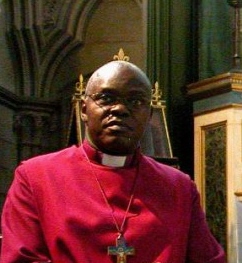
Dr. Rowan Williams may well be remembered one day as the Archbishop of Canterbury who was unable to prevent the Anglican Communion splintering. His probable successor, Ugandan-born Dr John Sentamu, currently Archbishop of York, could go down in history as the man who infused a sorely-needed gospel message into a dying Church of England. Damian Thompson has published a fascinating analysis of the relationship among three prelates here: The archbishop's days are numbered. Much as the Irish reputedly re-evangelized Europe after the fall of the western Roman Empire, so might Africans come to re-evangelize a secularized Europe. Pray God this might come to pass.
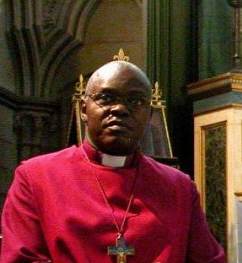
Dr. Rowan Williams may well be remembered one day as the Archbishop of Canterbury who was unable to prevent the Anglican Communion splintering. His probable successor, Ugandan-born Dr John Sentamu, currently Archbishop of York, could go down in history as the man who infused a sorely-needed gospel message into a dying Church of England. Damian Thompson has published a fascinating analysis of the relationship among three prelates here: The archbishop's days are numbered. Much as the Irish reputedly re-evangelized Europe after the fall of the western Roman Empire, so might Africans come to re-evangelize a secularized Europe. Pray God this might come to pass.
Defending Cuban labour leaders
Earlier this month two Redeemer alumni testified before a House of Commons subcommittee on human rights concerning the plight of imprisoned leaders of a suppressed independent trade union in Cuba. For those interested, a transcript of their testimony has been posted here.
Earlier this month two Redeemer alumni testified before a House of Commons subcommittee on human rights concerning the plight of imprisoned leaders of a suppressed independent trade union in Cuba. For those interested, a transcript of their testimony has been posted here.
I spoke too soon. . .
Perhaps Turkey, with its poor record on religious freedom, would fit into Europe after all, if this story is any indication: Court upholds Nazi-era ban on homeschooling.
Perhaps Turkey, with its poor record on religious freedom, would fit into Europe after all, if this story is any indication: Court upholds Nazi-era ban on homeschooling.
27 November 2006
Turkish protest
Some 25 thousand Turkish citizens spent yesterday strengthening their country's case for admission to the European Union.
Some 25 thousand Turkish citizens spent yesterday strengthening their country's case for admission to the European Union.
25 November 2006
Harper puts his foot in it too
The Conservatives have long had a reputation for being also-rans to the dominant Liberal Party. Now Prime Minister Stephen Harper appears bent on following in Liberal leadership-hopeful Michael Ignatieff's footsteps by moving to recognize "Quebeckers" (not Québec!) as a nation. Historian Michael Bliss believes that this constitutes nothing less than an attack on Canada. Although I disagree with Bliss's vilification of asymmetrical federalism, I believe his analysis of the implications of the different uses of nation in the Canadian context is worthy of note.
Later: Theresa was a bit alarmed reading the National Post's headline: "Canada under attack." This set the stage for Daddy to teach her two lessons: (1) the persistence of Québec separatism; and (2) the reality of editors using deliberate overstatement to sell newspapers. This conversation will surely make our eventual talk about the facts of life seem dull by comparison.
The Conservatives have long had a reputation for being also-rans to the dominant Liberal Party. Now Prime Minister Stephen Harper appears bent on following in Liberal leadership-hopeful Michael Ignatieff's footsteps by moving to recognize "Quebeckers" (not Québec!) as a nation. Historian Michael Bliss believes that this constitutes nothing less than an attack on Canada. Although I disagree with Bliss's vilification of asymmetrical federalism, I believe his analysis of the implications of the different uses of nation in the Canadian context is worthy of note.
Later: Theresa was a bit alarmed reading the National Post's headline: "Canada under attack." This set the stage for Daddy to teach her two lessons: (1) the persistence of Québec separatism; and (2) the reality of editors using deliberate overstatement to sell newspapers. This conversation will surely make our eventual talk about the facts of life seem dull by comparison.
23 November 2006
Global solidarity expanded
On the first of this month, two umbrella labour organizations, the International Confederation of Free Trade Unions (ICFTU) and the World Confederation of Labour (WCL), disbanded to form a single body, the International Trade Union Confederation (ITUC). Because the Christian Labour Association of Canada was a member of the WCL, which had christian and pluralist roots, it is now de facto a member of ITUC, something which it shares, ironically, with those unions affiliated with the Canadian Labour Congress (CLC).
On the first of this month, two umbrella labour organizations, the International Confederation of Free Trade Unions (ICFTU) and the World Confederation of Labour (WCL), disbanded to form a single body, the International Trade Union Confederation (ITUC). Because the Christian Labour Association of Canada was a member of the WCL, which had christian and pluralist roots, it is now de facto a member of ITUC, something which it shares, ironically, with those unions affiliated with the Canadian Labour Congress (CLC).
Norge-Bulgaria 10/11
Given my ethnic Greek background, I am thoroughly accustomed to asymmetrical metres such as 5/4 and 7/8 time. All the same, I found that the rhythm of this delightful piece, composed by a Norwegian in the Bulgarian style, didn't come easily and took some time to pick up on. It alternates measures in 10/8 and 11/8 time.
Given my ethnic Greek background, I am thoroughly accustomed to asymmetrical metres such as 5/4 and 7/8 time. All the same, I found that the rhythm of this delightful piece, composed by a Norwegian in the Bulgarian style, didn't come easily and took some time to pick up on. It alternates measures in 10/8 and 11/8 time.
Recent publications
For those interested, here are four articles of mine that have recently come out:
For those interested, here are four articles of mine that have recently come out:
- "Socialism," in the New Dictionary of Christian Apologetics;
- "Center for Public Justice" and "Russell Amos Kirk," in the Encyclopedia of Modern Christian Politics; and
- "Persuaded, Not Commanded: Neo-Calvinism, Dignitatis Humanae, and Religious Freedom," in Catholicism and Religious Freedom.
21 November 2006
Vexillologist honoured by Queen's representative

The Right Rev. Ralph Spence, Bishop of the Anglican Diocese of Niagara, has been awarded the title of Herald Extraordinary by Her Excellency the Right Honourable Michaëlle Jean, Governor General of Canada. Bishop Spence thereby becomes a member of her household. Whether he will actually be moving in to Rideau Hall remains unclear.
Incidentally, Spence designed the crest for Redeemer University College (shown at left) some 25 years ago.
The Right Rev. Ralph Spence, Bishop of the Anglican Diocese of Niagara, has been awarded the title of Herald Extraordinary by Her Excellency the Right Honourable Michaëlle Jean, Governor General of Canada. Bishop Spence thereby becomes a member of her household. Whether he will actually be moving in to Rideau Hall remains unclear.
Incidentally, Spence designed the crest for Redeemer University College (shown at left) some 25 years ago.
20 November 2006
Wallis on religion and democracy
This is from last friday's entry by Jim Wallis on the God's Politics blog:
For a brief moment some thirty years ago, I was an enthusiast for Wallis' approach. This was long before he published a best-seller, and it was just before his flagship magazine, the Post-American, changed its name to Sojourners. I was enamoured by its vaunted radicalism and prophetic tone at a time when I was becoming disillusioned with the American civil religion so many Christians in that country accepted at face value.
Now I freely admit that I have changed in the ensuing decades (albeit not on civil religion), but I find myself wondering whether Wallis himself has modified his message since then. Perhaps I'm reading too much into it, but to argue that "religion must be disciplined by democracy" simply does not sound all that prophetic to me. Of course I understand what he's trying to get at with the above-quoted paragraph. Nevertheless, he seems to be making democracy the grand arbiter of what sorts of claims by people of faith are acceptable in the public square.
Furthermore, he ignores a long tradition that sees democracy in some sense as part of the problem. One thinks in this respect of the warnings of Alexis de Tocqueville and John Stuart Mill against the dangers of majoritarian tyranny. Indeed it would seem more "prophetic" (if I may be permitted that word) to recognize that a democracy undisciplined by a christian worldview is itself a potential danger to the common weal, as Robert Kraynak argues in the first part of his Christian Faith and Modern Democracy.
In his recent review of God's Politics, Paul Marshall points out that the Old Testament prophets called God's people back to obedience to his law. By contrast, contemporary Christians claiming the prophetic mantle are usually not similarly focussed. Wallis in particular is hardly proclaiming "thus saith the Lord" to his compatriots. Quite the contrary, he is urging people of faith to temper their claims for the sake of the common good, whatever he might mean by this.
Yet if all people are in the grip of some faith, whether or not it is conventionally labelled religious, why then would Wallis' warning not also extend to the followers of secularizing political ideologies claiming for themselves hegemony over the public square? Should liberalism and socialism also be "disciplined by democracy"? Or is the problem only with those who believe in a transcendent God with the temerity to tell his image-bearing creatures how they ought to live? If Wallis holds to the latter position, then one wonders what exactly he is calling people back to and in what sense he might still profess to be engaging in prophetic activity.
This is from last friday's entry by Jim Wallis on the God's Politics blog:
I believe that religion does indeed have a great contribution to the nation’s moral discourse on public life, but religion must be disciplined by democracy. That means that we don’t claim that our religious authority must be everyone’s or dictate their moral or political fate. Rather, religious people must win the debate, just like everybody else, about what is best—not for the religious community or only faith-inspired citizens—but for the common good [emphasis mine].
For a brief moment some thirty years ago, I was an enthusiast for Wallis' approach. This was long before he published a best-seller, and it was just before his flagship magazine, the Post-American, changed its name to Sojourners. I was enamoured by its vaunted radicalism and prophetic tone at a time when I was becoming disillusioned with the American civil religion so many Christians in that country accepted at face value.
Now I freely admit that I have changed in the ensuing decades (albeit not on civil religion), but I find myself wondering whether Wallis himself has modified his message since then. Perhaps I'm reading too much into it, but to argue that "religion must be disciplined by democracy" simply does not sound all that prophetic to me. Of course I understand what he's trying to get at with the above-quoted paragraph. Nevertheless, he seems to be making democracy the grand arbiter of what sorts of claims by people of faith are acceptable in the public square.
Furthermore, he ignores a long tradition that sees democracy in some sense as part of the problem. One thinks in this respect of the warnings of Alexis de Tocqueville and John Stuart Mill against the dangers of majoritarian tyranny. Indeed it would seem more "prophetic" (if I may be permitted that word) to recognize that a democracy undisciplined by a christian worldview is itself a potential danger to the common weal, as Robert Kraynak argues in the first part of his Christian Faith and Modern Democracy.
In his recent review of God's Politics, Paul Marshall points out that the Old Testament prophets called God's people back to obedience to his law. By contrast, contemporary Christians claiming the prophetic mantle are usually not similarly focussed. Wallis in particular is hardly proclaiming "thus saith the Lord" to his compatriots. Quite the contrary, he is urging people of faith to temper their claims for the sake of the common good, whatever he might mean by this.
Yet if all people are in the grip of some faith, whether or not it is conventionally labelled religious, why then would Wallis' warning not also extend to the followers of secularizing political ideologies claiming for themselves hegemony over the public square? Should liberalism and socialism also be "disciplined by democracy"? Or is the problem only with those who believe in a transcendent God with the temerity to tell his image-bearing creatures how they ought to live? If Wallis holds to the latter position, then one wonders what exactly he is calling people back to and in what sense he might still profess to be engaging in prophetic activity.
A change of heart?
Rumour has it that my friend Gideon Strauss will shortly be posting this sign in his office:

Next thing you know he'll be wearing overalls and a straw hat to work.
Rumour has it that my friend Gideon Strauss will shortly be posting this sign in his office:
Next thing you know he'll be wearing overalls and a straw hat to work.
18 November 2006
The lost art of cursive handwriting
I was recently astonished to discover that many of my students appear not to be able to write in cursive. This hampers them during examinations when time is of the essence and they need to write quickly. When I was an undergraduate back in the dark ages, we wrote out, not only our exams, but our term papers in longhand, typing them up only when we had them completed and properly edited. Nowadays it seems that everyone composes on the computer keyboard, as, admittedly, do I myself. This article confirms my impression that Cursive [is] nearly a lost art. I would be interested to know how many readers of this blog, especially the younger ones, actually write in cursive.
I was recently astonished to discover that many of my students appear not to be able to write in cursive. This hampers them during examinations when time is of the essence and they need to write quickly. When I was an undergraduate back in the dark ages, we wrote out, not only our exams, but our term papers in longhand, typing them up only when we had them completed and properly edited. Nowadays it seems that everyone composes on the computer keyboard, as, admittedly, do I myself. This article confirms my impression that Cursive [is] nearly a lost art. I would be interested to know how many readers of this blog, especially the younger ones, actually write in cursive.
15 November 2006
On hypocrisy . . . again
From Robert T. Miller:
From Robert T. Miller:
A man is not a hypocrite because he violates a moral norm in which he sincerely believes. President Clinton, I am sure, believes that adultery is wrong, and he violated the norm against it in his dalliance with that woman, Ms. Lewinsky; but this made him an adulterer, not a hypocrite. Similarly, decent parents think they ought to be patient with their children, but an overworked mother who snaps at her child at the end of a long day is guilty of impatience, not hypocrisy. Violating norms we sincerely accept does not make us hypocrites. If it did, hypocrisy would not be a peculiar kind of wrongdoing but a concomitant of all wrongdoing.
13 November 2006
Big breakthrough
This might well be more significant than the development of the personal computer or the blackberry: CSIRO develops air guitar t-shirt. And just in time for Christmas when we're all puzzling over what to give our young male friends and relatives. Here's the company's podcast describing this groundbreaking invention.
This might well be more significant than the development of the personal computer or the blackberry: CSIRO develops air guitar t-shirt. And just in time for Christmas when we're all puzzling over what to give our young male friends and relatives. Here's the company's podcast describing this groundbreaking invention.
10 November 2006
Ecclesial oversight . . . or the lack thereof
The Ted Haggard case calls attention to an important issue addressed in this Associated Press article: US evangelist sex scandal raises questions about 'superstar' megachurch pastors. I myself have never been an enthusiast for independent church congregations, especially of the "megachurch" variety. There is something unhealthy about a huge congregation revolving so heavily around one person's ministry. There is often little oversight, and certainly not from outside the congregation, since there is no denominational machinery that might provide it. At its worst this sort of arrangement can produce a cult of personality. However, I think the second statement below is not entirely accurate:
I do not know what the word errant is intended to convey here, but the larger protestant denominations have mostly given up on the idea of doctrinal error, even in their own leadership. The Anglican Church of Canada, as just one example, has no means of reining in a rogue bishop. The irony is compounded when one considers that the Greek word επίσκοπος (bishop) literally means overseer, thus raising that ancient question of who will oversee the overseers. Unfortunately the Anglican Church has not answered this adequately in its own ecclesiastical polity.
The Ted Haggard case calls attention to an important issue addressed in this Associated Press article: US evangelist sex scandal raises questions about 'superstar' megachurch pastors. I myself have never been an enthusiast for independent church congregations, especially of the "megachurch" variety. There is something unhealthy about a huge congregation revolving so heavily around one person's ministry. There is often little oversight, and certainly not from outside the congregation, since there is no denominational machinery that might provide it. At its worst this sort of arrangement can produce a cult of personality. However, I think the second statement below is not entirely accurate:
Nearly all megachurches are independent from a denomination — an asset for their flexibility, but a liability when it comes to checks on power. By contrast, mainline Protestant denominations vet clergy credentials and have elaborate systems of church tribunals, similar to civil courts, that discipline errant ministers.
I do not know what the word errant is intended to convey here, but the larger protestant denominations have mostly given up on the idea of doctrinal error, even in their own leadership. The Anglican Church of Canada, as just one example, has no means of reining in a rogue bishop. The irony is compounded when one considers that the Greek word επίσκοπος (bishop) literally means overseer, thus raising that ancient question of who will oversee the overseers. Unfortunately the Anglican Church has not answered this adequately in its own ecclesiastical polity.
09 November 2006
In Canadian terms. . .
George W. Bush now has a minority government and is in the process of shuffling his cabinet.
George W. Bush now has a minority government and is in the process of shuffling his cabinet.
08 November 2006
Hypocrisy: the unforgivable sin?
To be honest, I had not heard of the Rev. Ted Haggard until his name made it into the news a few days ago. The one-time pastor of New Life Church and the president of the National Association of Evangelicals has resigned both positions, admitting to having committed sexual indiscretions. By now this is an old story and very nearly a cliché: the publicly visible evangelical leader who is brought down amidst charges of hypocrisy, an occasion for schadenfreude amongst those who dislike the man's message and now apparently have further reason to ignore it.
Three years ago in this space I asked: "Have you ever noticed that when charges of hypocrisy are levelled against someone, it is almost always in the interest of loosening standards rather than tightening them?" Indeed I quite like what Francis J. Beckwith has to say in The Case of Ted Haggard, an article worth reading in full:
A sinner has fallen, and for that we should mourn. It is certainly not a cause for smugness or superiority in those so eager to condemn. Contrary to popular opinion, hypocrisy is not the unforgivable sin. Nor is sexual sin. With repentance of both comes forgiveness in Jesus Christ, which should be our prayer for Haggard.
Later: I had not seen these videos when I wrote the above entry. Admittedly, these make it difficult not to conclude that Haggard is guilty of wilful deception more than mere hypocrisy. Still, my prayer is for his repentance and restoration.
To be honest, I had not heard of the Rev. Ted Haggard until his name made it into the news a few days ago. The one-time pastor of New Life Church and the president of the National Association of Evangelicals has resigned both positions, admitting to having committed sexual indiscretions. By now this is an old story and very nearly a cliché: the publicly visible evangelical leader who is brought down amidst charges of hypocrisy, an occasion for schadenfreude amongst those who dislike the man's message and now apparently have further reason to ignore it.
Three years ago in this space I asked: "Have you ever noticed that when charges of hypocrisy are levelled against someone, it is almost always in the interest of loosening standards rather than tightening them?" Indeed I quite like what Francis J. Beckwith has to say in The Case of Ted Haggard, an article worth reading in full:
For Jesus, hypocrisy is clearly wrong, but it is a wrong intimately tied to a type of moral and spiritual triumphalism, just the sort that one finds in the writings of those who gleefully celebrate the moral failings of Pastor Haggard. Those who think of the detecting and condemnation of hypocrisy as sport, which is the dominant understanding of the liberal-secular chattering class, are not serious about the wrongness of hypocrisy. For such seriousness requires a tragic understanding of the human condition, that one is just as susceptible to sin's temptation as any other, and that it is only by God's grace and the support of the church that we can find forgiveness, redemption, and the strength to carry our cross. But the liberal-secular chattering class does not believe any of this. So, their detection and condemnation of hypocrisy is disingenuous at best and mean-spirited at worst.
A sinner has fallen, and for that we should mourn. It is certainly not a cause for smugness or superiority in those so eager to condemn. Contrary to popular opinion, hypocrisy is not the unforgivable sin. Nor is sexual sin. With repentance of both comes forgiveness in Jesus Christ, which should be our prayer for Haggard.
Later: I had not seen these videos when I wrote the above entry. Admittedly, these make it difficult not to conclude that Haggard is guilty of wilful deception more than mere hypocrisy. Still, my prayer is for his repentance and restoration.
06 November 2006
Which PR? Part II
In my previous post on this topic, I argued for adopting a mixed-member proportional (MMP) electoral system for Canada, and offered two reasons. More reasons follow below.

Third, although it is not necessarily an intrinsic part of MMP, the German variety provides for a 5 percent exclusion clause. German citizens have two votes, one for a local candidate representing a single-member constituency and another for a party list, as shown at right. Although many Germans split their votes, casting one for a deputy representing one party while voting for another party's list, they tend to cast both votes for the same party. If a party wins fewer than 3 single-member seats and less than 5 percent of the vote on the list side, it will receive no party-list seats at all. If, however, the party receives 3 or more single-member seats or succeeds in getting more than 5 percent of the list seats, it will receive the full number of seats to which it is entitled on the list side. The end result is a parliament that is roughly proportional, though not precisely so.
The reason for the exclusion clause is to prevent splinter parties and extremists from cluttering up the Bundestag. In the aftermath of the Second World War, when Germany had suffered through a dozen years of nazi misrule, a mechanism seemed necessary to prevent a resurgent national socialist party from entering parliament, as well as to put a premium on co-operation amongst would-be partisan groupings within the context of larger and more broad-based parties. This, it was hoped, would prevent the sort of cabinet instability plaguing the Weimar Republic between 1919 and 1933. More than half a century later, we can judge that MMP in Germany has been a success.
Admittedly, it has not succeeded everywhere. The Russian Federation has used a form of MMP since 1993, along with an exclusion clause. Unfortunately, because most political parties there tend to revolve around the personalities of local figures rather than around a programme commanding a nationwide following, up to half the electorate has gone unrepresented because their parties have not succeeded in surmounting the hurdle posed by the exclusion clause. As a consequence, next year's parliamentary elections will be contested on a straight party list system, which is almost certainly not appropriate for a country as large and diverse as Russia. We'll see how it works when the time comes.
Fourth and finally, MMP is more likely to be accepted within the North American context than, say, STV or a provincial/state party list system, as favoured by Skillen. Because single-member seats would continue to be contested, it would be less disruptive of something with which voters are by now thoroughly familiar. At this point, I would tend to favour dispensing with a party-list vote altogether and simply compensating with additional seats those parties with fewer seats than would be justified by their proportion of the popular vote. The end result would be not precisely proportional, but certainly more proportional than is currently the case. Little would change for the voters themselves, but they would know that, with their "losing" votes being combined to create extra seats, they would not be wasting their votes, as they effectively do now. This would almost certainly boost voter turnout in the two countries.
I might add that past editorials in The Globe and Mail have been on-side of adopting MMP here in Canada. Here in Ontario a Citizens' Assembly on Electoral Reform is getting off the ground, and public consultations are to be held. British Columbia went through a similar exercise, and a referendum last year came close to mandating the adoption of STV, largely through Nick Loenen's efforts.
I wonder, however, if it might be better for Ontario citizens to vote initially on the principle of PR versus FPTP, and then, if the former is approved, hold a second preferential ballot on the form of PR to be adopted. Some of the no votes in BC might have come from people who liked PR but disliked STV. Let's not make the same mistake here.
There is, of course, a possible drawback in adopting PR within the Canadian context, where we are accustomed to single-party "majority" governments that generally have the support of only between 38 and 43 percent of the electorate. Our last two governments have been single-party minority governments. If PR were adopted, we would probably never have another majority government again. Yet we could not keep having elections every year or so. This is where we reach the limits of institutional reform and where our developing unwritten constitution would have to fill in. Though we Canadians have had little experience with multiparty coalition governments, we would have to overcome our reluctance to see one party consorting with the "enemy" and consider this possibility. In fact, such coalition governments would be necessary if the political system as a whole is to continue functioning properly.
In the meantime, I plan to follow the work of the Ontario Citizens Assembly on Electoral Reform, and I may even make a submission.
In my previous post on this topic, I argued for adopting a mixed-member proportional (MMP) electoral system for Canada, and offered two reasons. More reasons follow below.
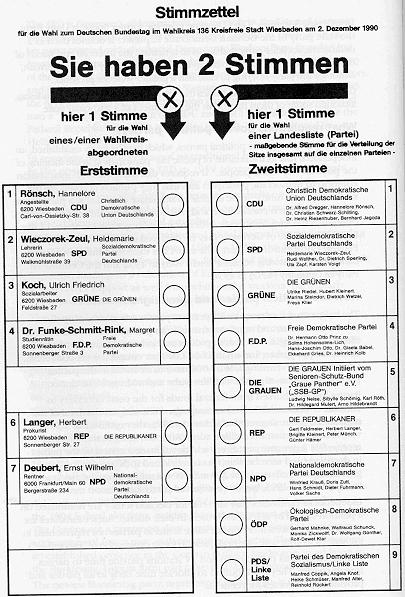
Third, although it is not necessarily an intrinsic part of MMP, the German variety provides for a 5 percent exclusion clause. German citizens have two votes, one for a local candidate representing a single-member constituency and another for a party list, as shown at right. Although many Germans split their votes, casting one for a deputy representing one party while voting for another party's list, they tend to cast both votes for the same party. If a party wins fewer than 3 single-member seats and less than 5 percent of the vote on the list side, it will receive no party-list seats at all. If, however, the party receives 3 or more single-member seats or succeeds in getting more than 5 percent of the list seats, it will receive the full number of seats to which it is entitled on the list side. The end result is a parliament that is roughly proportional, though not precisely so.
The reason for the exclusion clause is to prevent splinter parties and extremists from cluttering up the Bundestag. In the aftermath of the Second World War, when Germany had suffered through a dozen years of nazi misrule, a mechanism seemed necessary to prevent a resurgent national socialist party from entering parliament, as well as to put a premium on co-operation amongst would-be partisan groupings within the context of larger and more broad-based parties. This, it was hoped, would prevent the sort of cabinet instability plaguing the Weimar Republic between 1919 and 1933. More than half a century later, we can judge that MMP in Germany has been a success.
Admittedly, it has not succeeded everywhere. The Russian Federation has used a form of MMP since 1993, along with an exclusion clause. Unfortunately, because most political parties there tend to revolve around the personalities of local figures rather than around a programme commanding a nationwide following, up to half the electorate has gone unrepresented because their parties have not succeeded in surmounting the hurdle posed by the exclusion clause. As a consequence, next year's parliamentary elections will be contested on a straight party list system, which is almost certainly not appropriate for a country as large and diverse as Russia. We'll see how it works when the time comes.
Fourth and finally, MMP is more likely to be accepted within the North American context than, say, STV or a provincial/state party list system, as favoured by Skillen. Because single-member seats would continue to be contested, it would be less disruptive of something with which voters are by now thoroughly familiar. At this point, I would tend to favour dispensing with a party-list vote altogether and simply compensating with additional seats those parties with fewer seats than would be justified by their proportion of the popular vote. The end result would be not precisely proportional, but certainly more proportional than is currently the case. Little would change for the voters themselves, but they would know that, with their "losing" votes being combined to create extra seats, they would not be wasting their votes, as they effectively do now. This would almost certainly boost voter turnout in the two countries.
I might add that past editorials in The Globe and Mail have been on-side of adopting MMP here in Canada. Here in Ontario a Citizens' Assembly on Electoral Reform is getting off the ground, and public consultations are to be held. British Columbia went through a similar exercise, and a referendum last year came close to mandating the adoption of STV, largely through Nick Loenen's efforts.
I wonder, however, if it might be better for Ontario citizens to vote initially on the principle of PR versus FPTP, and then, if the former is approved, hold a second preferential ballot on the form of PR to be adopted. Some of the no votes in BC might have come from people who liked PR but disliked STV. Let's not make the same mistake here.
There is, of course, a possible drawback in adopting PR within the Canadian context, where we are accustomed to single-party "majority" governments that generally have the support of only between 38 and 43 percent of the electorate. Our last two governments have been single-party minority governments. If PR were adopted, we would probably never have another majority government again. Yet we could not keep having elections every year or so. This is where we reach the limits of institutional reform and where our developing unwritten constitution would have to fill in. Though we Canadians have had little experience with multiparty coalition governments, we would have to overcome our reluctance to see one party consorting with the "enemy" and consider this possibility. In fact, such coalition governments would be necessary if the political system as a whole is to continue functioning properly.
In the meantime, I plan to follow the work of the Ontario Citizens Assembly on Electoral Reform, and I may even make a submission.
05 November 2006
Why are there wars?
At the Locke Street Festival some weeks ago, the Church of St. John the Evangelist invited passers-by to write on a flip chart any question they might wish to ask God. One of these was "Why are there wars?" Noting that I would be participating in a workshop on war and peace at the upcoming ICS Worldview Conference, David Anderson, the rector, asked whether I would address this question in a sermon on sunday, 12 November, the day after Remembrance Day. I agreed to do so and will thus preach at next sunday's 9.30 am service. All are welcome to attend. The church is located at the northwest corner of Locke Street and Charlton Avenue here in Hamilton.
At the Locke Street Festival some weeks ago, the Church of St. John the Evangelist invited passers-by to write on a flip chart any question they might wish to ask God. One of these was "Why are there wars?" Noting that I would be participating in a workshop on war and peace at the upcoming ICS Worldview Conference, David Anderson, the rector, asked whether I would address this question in a sermon on sunday, 12 November, the day after Remembrance Day. I agreed to do so and will thus preach at next sunday's 9.30 am service. All are welcome to attend. The church is located at the northwest corner of Locke Street and Charlton Avenue here in Hamilton.
02 November 2006
Dijkema doings
I am pleased to announce that Mr. Brian M. K. Dijkema will be teaching Canadian Foreign Policy (POL 308) at Redeemer University College during the winter term of 2007. Mr. Dijkema is a graduate of Redeemer's political science programme and is currently working for the Christian Labour Association of Canada. He will shortly be receiving a master's degree from the Institute for Christian Studies in Toronto.
If you have a paper copy of today's National Post, please see page A-21 where Dijkema has published an opinion piece titled, Cheering on a Dictator. Here is the summary: "Cuban workers have no rights. So why does the communist regime enjoy the support of the Canadian Labour Congress?"
Congratulations are due to Mr. Dijkema for both of the above items.
I am pleased to announce that Mr. Brian M. K. Dijkema will be teaching Canadian Foreign Policy (POL 308) at Redeemer University College during the winter term of 2007. Mr. Dijkema is a graduate of Redeemer's political science programme and is currently working for the Christian Labour Association of Canada. He will shortly be receiving a master's degree from the Institute for Christian Studies in Toronto.
If you have a paper copy of today's National Post, please see page A-21 where Dijkema has published an opinion piece titled, Cheering on a Dictator. Here is the summary: "Cuban workers have no rights. So why does the communist regime enjoy the support of the Canadian Labour Congress?"
Congratulations are due to Mr. Dijkema for both of the above items.
Subscribe to:
Posts (Atom)