Age's debt to youth
Many thanks to Rob Joustra for showing me how to put sidebar items in my blog template. He is a kind and beneficent person.
16 September 2003


The limits of compassion in politics
Public appeals to compassion have become ubiquitous at the beginning of a new century. A few years ago one of Canada's major daily newspapers carried a photograph of quadriplegic actor Christopher Reeve, who was paralyzed as a result of an accident in 1995. As is well known, Reeve has been working tirelessly in the cause of research into spinal cord injuries. The photo was captioned with the plea that fetal tissue research is the only hope for Reeve to regain the use of his limbs. Naturally the reader was expected to sympathize with Reeve’s predicament, the solution to which is blocked only by the apparently irrational – and uncompassionate – objections of anti-abortionists.
About a decade ago an opinion piece appeared in a christian periodical arguing that the legalization of abortion in the United States was a genuinely progressive development favourable to the well being of women everywhere. Those opposed to the abortion licence were guilty, in the author's estimation, of erecting barriers to compassion for women.
The electronic media often feature reports of someone adversely affected by some policy pursued by some government somewhere. Clearly we are expected to oppose such a policy, ignoring the fact that, if another policy had been pursued, someone else would have suffered from its consequences. Clearly, appeals to compassion are not enough to bring about justice.
There is no doubt, of course, that we are called to have compassion for others. Many of us were initially drawn to politics out of a concern for those suffering from unjust policies. The fact that so many of my relatives became refugees in Cyprus in 1974 was a strong motivation to understand the political process and the roots of such injustices. It also gave me compassion for others in a similar predicament, especially Palestinian refugees who are treated as strangers in their own land.
All the same, in recent years I’ve come to understand the limits of compassion in politics. I’ve grown suspicious of politicians who claim to be able to feel our pain.
To begin with, if compassion is the desire to alleviate people’s suffering, then this mere desire is not sufficient grounds for assessing the justice of a proposed action. An unmitigated compassion may prompt us to forego punishment because it inevitably causes suffering. But if the punishment is deserved, then to refrain from imposing it would be unjust.
Second, compassion by itself tends to lead, not to justice, but to favouritism and one-sided advocacy. Compassion is necessarily selective. Our ability to enter into the suffering of others cannot be stretched indefinitely. Parents naturally feel for their own children more than they do for others'. We suffer along with our friends in adversity more than with mere acquaintances, or with the faceless names we read about in the papers. There is nothing wrong in this; it is simply part and parcel of our created limitations.
Only God himself is capable of entering into the suffering of all, as he did in the person of Jesus Christ. I may be touched by the plight of the Palestinians, but my compassion for them may blind me to the legitimacy of claims made by Israelis – especially of "sabras" who were born, grew up there and know nothing else – to the same land and resources. In the politics of compassion one helps only those with whom one is able to feel suffering. The suffering of others further removed from oneself is somehow deemed less valid.
Thus Marxists are moved to action by compassion for the proletariat, but in attempting to emancipate oppressed workers, they are unmoved by the suffering they may cause those getting in the way of their agenda. The irony is that appeals to compassion can be a cover for acts of genuine cruelty, scores of millions of which were committed by the heirs of Marx and Lenin in the former Soviet Union and China.
Finally, arguments from compassion are often a way of shortcircuiting the deliberative process – of keeping some arguments from being heard. If politics necessarily entails conciliating diverse interests in accordance with public justice, then arguments need to be heard from all sides before a decision is made. Ruling an argument out of court too soon on the grounds that it is not compassionate is a recipe, not only for less than peaceful politics, but for outright injustice.
Praying the rosary
It seems that Anglicans are discovering the rosary, or prayer beads, as indicated here: "Anglican rosary changes the way some people pray." Given that prayer beads are used in a number of christian traditions, I cannot help but wonder whether there is anything comparable within the Reformed tradition.
It seems that Anglicans are discovering the rosary, or prayer beads, as indicated here: "Anglican rosary changes the way some people pray." Given that prayer beads are used in a number of christian traditions, I cannot help but wonder whether there is anything comparable within the Reformed tradition.
Cyprus and Malta and the EU
On 1 September a meeting was held in Prague of representatives of the smaller states in or shortly to become part of the European Union. But Cyprus and Malta were not invited. Now the Czech government is claiming that this was due to an oversight. Czech foreign minister Cyril Svoboda has issued a formal apology and has promised that the mistake will not be repeated.
On 1 September a meeting was held in Prague of representatives of the smaller states in or shortly to become part of the European Union. But Cyprus and Malta were not invited. Now the Czech government is claiming that this was due to an oversight. Czech foreign minister Cyril Svoboda has issued a formal apology and has promised that the mistake will not be repeated.
15 September 2003
Isabel headed this way?
Well, isn't this nice. The latest maps from the National Weather Service's Tropical Prediction Center show the centre of Hurricane Isabel heading straight for southern Ontario -- the Niagara Peninsula and Toronto, to be exact. Let's hope we don't see a repeat of Hurricane Hazel.
Well, isn't this nice. The latest maps from the National Weather Service's Tropical Prediction Center show the centre of Hurricane Isabel heading straight for southern Ontario -- the Niagara Peninsula and Toronto, to be exact. Let's hope we don't see a repeat of Hurricane Hazel.
Student post boxes at Redeemer
For some odd reason, this year the student post boxes at Redeemer are alphabetized from right to left rather than from left to right, as they had always been in the past. Perhaps this is part of an effort on the part of our front office to recover Christianity's Hebraic roots.
For some odd reason, this year the student post boxes at Redeemer are alphabetized from right to left rather than from left to right, as they had always been in the past. Perhaps this is part of an effort on the part of our front office to recover Christianity's Hebraic roots.
Tallis' theme again
Yesterday morning at church the choir sang Horatius Bonar's familiar "I Heard the Voice of Jesus Say," set to Thomas Tallis' haunting Third Mode Melody, made famous by Ralph Vaughan Williams in his Fantasia on a Theme by Thomas Tallis.
Yesterday morning at church the choir sang Horatius Bonar's familiar "I Heard the Voice of Jesus Say," set to Thomas Tallis' haunting Third Mode Melody, made famous by Ralph Vaughan Williams in his Fantasia on a Theme by Thomas Tallis.
Metrical psalters and the Book of Common Prayer
Although it is not very well known today, for the first two centuries or so after the Reformation, Anglicans used to sing metrical psalms, along with their Scottish Presbyterian and continental Reformed fellow believers. In fact, the various editions of the Book of Common Prayer generally included, in addition to Miles Coverdale's magnificent translation of the 150 Psalms, a full metrical psalter, often that of Sternhold and Hopkins or, later, Tate and Brady's "New Version" within the same cover.
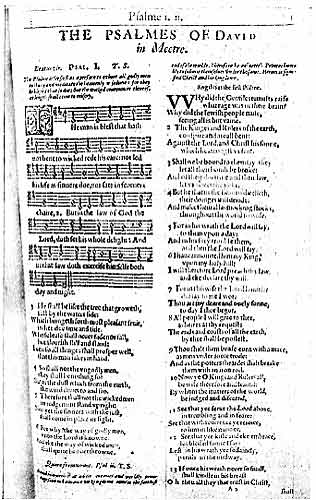
Many years ago I found an ancient copy of the BCP and metrical psalter in one volume at a used bookstore in Toronto. Alas it was too expensive.
Some thirty years ago there was a revival of metrical psalmody in the Church of England with the publication of Psalm Praise (London: Church Pastoral Aid Society, 1973). One of this collection, Psalm 30, made it into the latest edition of the Christian Reformed Church's Psalter Hymnal. This has to be one of the more moving renditions of this psalm in any collection.
Although it is not very well known today, for the first two centuries or so after the Reformation, Anglicans used to sing metrical psalms, along with their Scottish Presbyterian and continental Reformed fellow believers. In fact, the various editions of the Book of Common Prayer generally included, in addition to Miles Coverdale's magnificent translation of the 150 Psalms, a full metrical psalter, often that of Sternhold and Hopkins or, later, Tate and Brady's "New Version" within the same cover.
Many years ago I found an ancient copy of the BCP and metrical psalter in one volume at a used bookstore in Toronto. Alas it was too expensive.
Some thirty years ago there was a revival of metrical psalmody in the Church of England with the publication of Psalm Praise (London: Church Pastoral Aid Society, 1973). One of this collection, Psalm 30, made it into the latest edition of the Christian Reformed Church's Psalter Hymnal. This has to be one of the more moving renditions of this psalm in any collection.
14 September 2003
A new blog
One of my students, Rob Joustra, has just started his own weblog. The subject matter? "Reflections on history, mythology, politics... 'life, the universe, and everything'." Well, that narrows things down, doesn't it?
Welcome aboard, Rob!
One of my students, Rob Joustra, has just started his own weblog. The subject matter? "Reflections on history, mythology, politics... 'life, the universe, and everything'." Well, that narrows things down, doesn't it?
Welcome aboard, Rob!
The Hungarian Reformed
Here in North America we know little about the Reformed Church in Hungary. Although the Roman Catholic Church is the largest of the ecclesial bodies in that country, the Reformed have a substantial presence. The number of Hungarian Reformed Christians, including those in the diaspora, is some 3 1/2 million. In east central Europe they live primarily in five countries: Hungary itself, Romania, Slovakia, Serbia and western Ukraine.
The Reformed Church in Hungary adheres to two confessions, the Second Helvetic Confession and the Heidelberg Catechism. The church is distinctive in that it is the only one of the Reformed churches to have bishops, who are nevertheless little more than district superintendents. Its members sing from the Genevan Psalter, as translated by Albert Szenczi Molnár in the 16th century.
Throughout the centuries there were close relationships between the Hungarian Reformed and the Dutch Reformed. These were lost during the four decades of communist rule in Hungary, but they are being re-established in the years since 1989. The Christian Reformed Church conducts its own Hungarian Ministries in an effort to assist the witness of its sister church in that part of the world.
More ancestors: Vladimir I of Kiev
I am teaching Russian politics this semester, which necessarily involves acquainting my students with the highlights of Russian history. Indeed I have long had a fascination for Russian history, ever since taking an undergraduate course in the subject nearly three decades ago.
Last year, during my genealogical researches, I discovered that among my direct ancestors is included Prince Vladimir I (also known as St. Vladimir, or, in Ukrainian, Volodymyr) of Kiev, who converted the people of Rus to Orthodox Christianity in 988.

He is variously my 30th through 37th great-grandfather, and I am descended from him in scores of ways, through two of my ancestors, David and Nancy Elkins Wells, my maternal 3rd great-grandparents. Of course, as I've written before, virtually anyone of European ancestry who might be reading this is similarly descended from him.
I have long admired the Russians. Is this descent enough to make of me a Russian? Can I truthfully call myself a Russian-Canadian? Perhaps, but then again so can virtually any reader of this blog. Furthermore, I might just as well call myself a Phoenician-Canadian, because Phoenicians settled my ancestral island of Cyprus close to three millennia ago. The farther back one is able to trace one's ancestry, the less statistically significant it is to claim to be descended from any one person living then. Scores of millions of others are similarly descended.
I am teaching Russian politics this semester, which necessarily involves acquainting my students with the highlights of Russian history. Indeed I have long had a fascination for Russian history, ever since taking an undergraduate course in the subject nearly three decades ago.
Last year, during my genealogical researches, I discovered that among my direct ancestors is included Prince Vladimir I (also known as St. Vladimir, or, in Ukrainian, Volodymyr) of Kiev, who converted the people of Rus to Orthodox Christianity in 988.
He is variously my 30th through 37th great-grandfather, and I am descended from him in scores of ways, through two of my ancestors, David and Nancy Elkins Wells, my maternal 3rd great-grandparents. Of course, as I've written before, virtually anyone of European ancestry who might be reading this is similarly descended from him.
I have long admired the Russians. Is this descent enough to make of me a Russian? Can I truthfully call myself a Russian-Canadian? Perhaps, but then again so can virtually any reader of this blog. Furthermore, I might just as well call myself a Phoenician-Canadian, because Phoenicians settled my ancestral island of Cyprus close to three millennia ago. The farther back one is able to trace one's ancestry, the less statistically significant it is to claim to be descended from any one person living then. Scores of millions of others are similarly descended.
13 September 2003
Toronto versus Hamilton
Last evening I was in Toronto representing Redeemer University College at a banquet celebrating the 40th anniversary of Citizens for Public Justice. The event took place on the campus of the University of St. Michael's College.
I do not get to Toronto at all often these days, although I lived there for the two years I was studying at the Institute for Christian Studies. I loved living in Toronto, which is, as many Torontonians love to boast, a world class city. It is Canada's largest city and boasts a number of attractions, including the Art Gallery of Ontario, the Royal Ontario Museum, St. Lawrence Market, Kensington Market, Greektown, Chinatown, High Park, Queen's Park, and of course such popular tourist destinations as the Sky Dome and the CN Tower.
Toronto is filled with myriad ethnic neighbourhoods, along with the restaurants featuring their distinctive cuisines. There are lots of used book stores, and the University of Toronto Bookstore, right across the street from the ICS. And of course I love the public transportation system. At one time it could be said that Toronto was one of a very few North American urban centres featuring a more-or-less complete streetcar system. Now other cities have gotten back on the bandwagon with what they call light rail transit.
Then there's Hamilton, which is often thought to be Toronto's lesser, blue collar counterpart at the western end of Lake Ontario. I have lived in Hamilton for 16 years, and I do not believe this city has anything to feel inferior about. To begin with, Hamilton has more natural scenic beauty than Toronto. Most spectacularly we have the Royal Botanical Gardens, which I first visited way back in 1971. (I nearly lost my glasses at the Rock Garden!) Much of the scenery revolves around the Niagara Escarpment, a clifflike geological structure that cuts through the city on its journey from Niagara Falls to the Bruce Peninsula on Lake Huron. This makes for a large number of waterfalls located at various spots along the escarpment, including Websters Falls, Spencer Gorge and Sherman Falls.
Hamilton boasts a number of rail trails cutting through the Dundas Valley Conservation Area. These are ideal for walking and bicycling. Then there are the historic sites, such as Dundurn Castle and the Battlefield House Museum in Stoney Creek.
One can hardly beat the view from Highway 403 as one enters Hamilton from the direction of Toronto: Cootes Paradise is at the right, the escarpment is in the distance, and the neogothic spires of the Cathedral of Christ the King are at the left. Very impressive indeed.
Finally, Hamilton is a much more affordable place to live. Housing prices in Toronto are sky high, making it difficult for people from the outside to move in unless they have an exceedingly well-paying job. When all is said and done, Hamilton is a fine place to live.
12 September 2003
9/11 two years later: Modernity and its discontents
Prof. Mackubin Thomas Owens of the Naval War College in Newport, RI, undertakes to analyze the animosity between the west and the islamic world in "The End of the 'End of History'". He properly skewers the "end of history" crowd, that is, those, such as Francis Fukuyama, who believe that the spread of liberal democracy and free trade will make war obsolete. This was precisely the misconception of the naive optimists of the late 19th and early 20th centuries. Their illusions were shattered in August 1914.
Nevertheless, I wonder whether his own prescription for international order is really all that different, except that for him democracy and capitalism do not spread peacefully, but are imposed by a global superpower. Drawing on an article by his colleague, Tom Barnett, Owen writes:
The assumption is that the acceptance of secular modernity, in its various manifestations, is the solution to the problems of the "Gap." Osama bin Laden and his ilk see their premodern worldview threatened by the liberal democracy and capitalism emanating from the United States. They must be confronted and, it seems, eliminated, not simply managed. Over the past two years American policy has had to change:
This is, of course, a variation of the secularization thesis and is not really all that different from the views of Fukuyama, Alexandre Kojève and even, paradoxically, Canada's own George Parkin Grant. It views modernization as a single unidirectional movement sweeping up in its homogenizing path all of the particular cultures of the world. But now it is backed by the coercive force of the state.
That the world might be moving in a desecularizing direction, as observed by Samuel Huntington, Philip Jenkins, Paul Marshall and many others, appears to have escaped Owens' notice. If, as Owens urges, the US turns towards the imposition of a global hegemony by the "Core" over the "Gap" to protect its own vision of modernity, it will be engaging in a fruitless effort to fill the spiritual vacuum in the nonwestern heart with something that will ultimately fail to satisfy.
"Thou hast made us for thyself, and our hearts are restless until they find their rest in thee." Augustine, The Confessions.
Prof. Mackubin Thomas Owens of the Naval War College in Newport, RI, undertakes to analyze the animosity between the west and the islamic world in "The End of the 'End of History'". He properly skewers the "end of history" crowd, that is, those, such as Francis Fukuyama, who believe that the spread of liberal democracy and free trade will make war obsolete. This was precisely the misconception of the naive optimists of the late 19th and early 20th centuries. Their illusions were shattered in August 1914.
Nevertheless, I wonder whether his own prescription for international order is really all that different, except that for him democracy and capitalism do not spread peacefully, but are imposed by a global superpower. Drawing on an article by his colleague, Tom Barnett, Owen writes:
9/11 revealed an emerging geopolitical reality: that the world's most important fault line is not between the rich and the poor, but between those who accept modernity and those who reject it. In a controversial article for Esquire (entitled "The Pentagon's New Map") and a series of briefings, my colleague at the Naval War College, Tom Barnett, has described a world divided between a "Functioning Core" and a "Non-Integrating Gap." The former, where "globalization is thick with network connectivity, financial transactions, liberal media flows, and collective security," is characterized by "stable governments, rising standards of living, and more deaths by suicide than murder." The latter, where "globalization is thinning or just plain absent" is "plagued by politically repressive regimes, widespread poverty and disease, routine mass murder, and — most important — the chronic conflicts that incubate the next generation of global terrorists."
The assumption is that the acceptance of secular modernity, in its various manifestations, is the solution to the problems of the "Gap." Osama bin Laden and his ilk see their premodern worldview threatened by the liberal democracy and capitalism emanating from the United States. They must be confronted and, it seems, eliminated, not simply managed. Over the past two years American policy has had to change:
The post-9/11 strategy is based on the idea that the only way to effectively deal with the dangers arising from the Gap is for the countries of the Core to intervene in the Gap with the goal of reducing it. The president seems to accept [the] contention that ignoring the Gap or, at most, seeking to "manage" it merely reduces further what little connectivity the Gap has with the Core and renders it more dangerous to the Core over the long haul.
This is, of course, a variation of the secularization thesis and is not really all that different from the views of Fukuyama, Alexandre Kojève and even, paradoxically, Canada's own George Parkin Grant. It views modernization as a single unidirectional movement sweeping up in its homogenizing path all of the particular cultures of the world. But now it is backed by the coercive force of the state.
That the world might be moving in a desecularizing direction, as observed by Samuel Huntington, Philip Jenkins, Paul Marshall and many others, appears to have escaped Owens' notice. If, as Owens urges, the US turns towards the imposition of a global hegemony by the "Core" over the "Gap" to protect its own vision of modernity, it will be engaging in a fruitless effort to fill the spiritual vacuum in the nonwestern heart with something that will ultimately fail to satisfy.
"Thou hast made us for thyself, and our hearts are restless until they find their rest in thee." Augustine, The Confessions.
The importance of being Ernie
I decided to attend the rally at Hamilton District Christian High School last evening, which was graced by the presence of our premier, Ernie Eves. The Reformed Christian community turned out in good numbers, and I saw quite a few people I hadn't seen in a very long time.
The event was billed as a tax credit rally, referring to the tax credit for parents of students in independent schools enacted by the Conservatives under their previous leader, Mike Harris, which is opposed by the other two parties. It was carefully staged, with people urging us to get up out of the bleachers and crowd around the podium so that Eves would be surrounded by supporters on camera. And clearly there were many supporters there. I couldn't help but notice some sign-bearing high schoolers at the front who were eating up his every word.
However, more than one person present expressed to me the concern that we were all being co-opted into throwing our support behind the governing party over this single issue when we might have reason to approach the Eves government with more caution. I could not disagree with this assessment.
This is one of the ironies that I experience as an academic political scientist. I love the study of politics, but I find voting a deeply unsatisfying act. Inevitably one is forced to choose a candidate and party on the basis of a few issues close to the heart while swallowing a lot of other unpalatable stuff in the process. If I were to vote for the Progressive Conservatives this time around, I would be doing so in part because I am a strong supporter of parental choice in education. Yet I dislike the party's reflexive deregulating and privatizing economic policies which assume that there is no genuine public interest, but only the sum total of private interests.
This is one of the reasons why I support the adoption of proportional representation. It is much more likely than our current first-past-the-post system to bring to the fore principled parties based on a coherent view of the place of politics in the world. Short of this we are saddled with pragmatic parties that try to galvanize popular support over discrete issues with no clear basis in political principles. This makes for less than fully responsible politics.
11 September 2003
Evidence of al Qaeda-Iraq link?
Could Stephen Hayes be correct about "Saddam's al Qaeda Connection"? Hayes writes in The Weekly Standard of the growing evidence of such a connection, which, if fully publicized, would silence the critics of the US President. Yet if this is so, then it is difficult to understand why he would keep quiet about so much of this information.
Why? If such evidence actually exists, then revealing it would get Bush off the hook with his partisan critics, as well as rescue the political career of his friend Tony Blair. And, most significant of all, it would put the attack on Iraq in an entirely different light, especially in those countries that were most sceptical about it to begin with.
Could Stephen Hayes be correct about "Saddam's al Qaeda Connection"? Hayes writes in The Weekly Standard of the growing evidence of such a connection, which, if fully publicized, would silence the critics of the US President. Yet if this is so, then it is difficult to understand why he would keep quiet about so much of this information.
The Bush administration has thus far chosen to keep the results of its postwar findings to itself; much of the information presented here comes from public sources. The administration, spooked by the media feeding frenzy surrounding yellowcake from Niger, is exercising extreme caution in rolling out the growing evidence of collaboration between al Qaeda and Baathist Iraq. As the critics continue their assault on a prewar "pattern of deception," the administration remains silent.
Why? If such evidence actually exists, then revealing it would get Bush off the hook with his partisan critics, as well as rescue the political career of his friend Tony Blair. And, most significant of all, it would put the attack on Iraq in an entirely different light, especially in those countries that were most sceptical about it to begin with.
The Russian cultural achievement
One of the ironies of history, which I am at a loss to explain, is that there frequently seems to be an inverse relationship between political stability on the one hand and literary and artistic achievement on the other. Take the Russians as just one example. I have long been an admirer of the Russian cultural achievement. It would be difficult for any people to surpass in greatness a civilization that has produced the calibre of music, novels, plays, and paintings created by the Russians. It is all the more remarkable that such accomplishments have taken root and grown in mostly hostile political soil.
For example, it was during the reactionary reign of Nicholas I that Russia entered what might be called its golden age of literary and artistic endeavour. Alexander Pushkin (1799-1837) was certainly the greatest of the literary figures of this era, his works eventually to attain for Russians something of the status of Shakespeare's for the English-speaking peoples. In music Mikhail Glinka (1804-1857) would have a similar stature. The brilliance of the Russian contribution in these fields can hardly be overestimated. The novels of Nikolai Gogol (1809-1852), Fyodor Dostoyevsky (1821-1881), Leo Tolstoy (1828-1910) and Ivan Turgenev (1818-1883) are justly celebrated, both inside and outside Russia. The music of Piotr I. Tchaikovsky (1840-1893), Modest Musorgsky (1839-1881) and Nikolai Rimsky-Korsakov (1844-1908) has become familiar to everyone. Then there are the plays of Anton Chekhov (1860-1904).
Remarkably, the 20th century did not dim but only increased the Russian cultural achievement, even after the Bolsheviks came to power. Once more the tremendous creativity of the people seemed almost to thrive under adversity, both at home and in exile. Some of the key figures were: Sergei Rachmaninov (of whom I wrote the other day), Sergei Prokofiev (1891-1953), Dmitri Shostakovich (1906-1975), Igor Stravinsky (1882-1971), Aram Khatchaturian (1903-1978), Sergei Diaghilev (1872-1929), Kazimir Malevich (1878-1935), Maksim Gorky (1868-1936), Sergei Eisenstein (1898-1948), and many, many more. Again it would be difficult to overstate the sheer magnitude of the Russian cultural achievement.
This presents something of a dilemma for me, as both a political scientist and a lover of the arts. I would personally prefer to live in an Anglo-Saxon democracy, with its deeply rooted sense of fair play and attention to procedure. I admit to being an admirer of the ancient English constitution (albeit with important qualifications), as bequeathed in some form to such countries as Canada, the United States, Australia and New Zealand. I would much rather live in a country where particular governments come and go peacefully but where the business of government goes on minus the threat of periodic coups d'état or political assassinations.
At the same time, I am inexplicably drawn to a people that manifests such creativity under what would seem to be the most inhospitable conditions. I myself have found that I am most creative when I am suffering from one of my periodic bouts of depression. I wonder whether there is something similar at work in the Russian people. For centuries their rulers have been corrupt, autocratic, sometimes even murderous, yet the Russians themselves have managed to contribute hugely to what might be called world civilization. This gives the rest of us a large number of fine works of art to enjoy while we are living under the benefits of a more stable constitution.
10 September 2003
Children and nightmares
Like most small children, Theresa occasionally wakes up crying from nightmares. We are told that these are perfectly normal between the ages of 2 and 6. Indeed when she was only two she woke up in the middle of the night and, to our surprise, was able to tell us what she had dreamt: that someone was putting her in too hot bath water. Since then she has recounted to us the content of other dreams. Initially they revolved around garbage trucks, of which she had a mild phobia. Recently they have involved being washed down the bathtub drain or being eaten by a shark.
I used to wonder at what age we should tell Theresa about the reality of death. To be sure, there will still come a time when we will have to answer her questions about it. But I now believe that a child old enough to experience the possibility of personal harm in a nightmare already has a pretty good sense of what death is about.
I recall the nightmares I myself had as a preschooler. The most vivid involved being a Jack-like person (of beanstalk fame) in the giant's castle and having my head dashed against the floor by the giant. This one isn't all that difficult to figure out. It is simply scary to be so small and vulnerable in an adult world, having your every decision made for you, and having so little control over yourself, much less over the world around you.
In later years I would still have unpleasant dreams, but they did not compare to the sheer terror I experienced in my dreams back then.
However, after Theresa's premature birth dreams approaching the status of nightmares returned in a new guise. While she was in hospital during those first ten weeks in 1998 and '99, Nancy was plagued by nightmares, while I was not. After Theresa came home from hospital, Nancy's nightmares stopped and mine began. One particularly distressing one had someone dangling a baby upside down by his feet out the window of an airborne plane. I've had other dreams that I am reluctant even to call to the surface of consciousness, much less to blog about.
What this all adds up to is that many, if not most, nightmares seem to revolve around childhood vulnerability. When you are a small child, you have nightmares. When you have a small child of your own, you have nightmares.
Almighty God and Father, protect the small children you have given us. Keep them in your loving embrace, that we, their parents, may be to them the vessels of your protection and care. Through Jesus Christ, your Son, our Lord, who lives and reigns with you and the Holy Spirit, one God, now and for ever. Amen.
Unborn victims of violence
One of the characteristics of an ideology is that it attempts to reduce the fulness of our experience of reality to a single facet. In so doing it effectively falsifies reality. Moreover, when its followers gain control of the political realm, they attempt to force this reduced conception of reality on everyone else, pressuring them to deny the obvious. In the words of Vaclav Havel, an ideology "is a world of appearances trying to pass for reality." It forces people to "live within a lie."
In today's Breakpoint commentary, Chuck Colson addresses the opposition to the Unborn Victims of Violence Act being considered by the US Congress. Opponents are forced by their pro-choice ideology to deny that a violent crime committed against a pregnant woman has two victims. Writes Colson:
The Unborn Victims of Violence Act will allow prosecutors to go after those who injure or kill an unborn child while committing a violent federal crime. The bill would not affect abortion laws, and yet the abortion lobby is trying frantically to kill it. Why?
It’s because they know that a law protecting a Conner or Zachariah [two such unborn victims] changes the entire abortion debate.
Up until now, abortion zealots have successfully portrayed abortion as a hard choice women make only in desperate circumstances. They say the fetus is not really a “person,” that a woman’s “choice” is nobody else’s business.
But who could see pictures of Zachariah and still believe the fetus is less than a human person? Who could witness the agony of Conner Peterson’s grandparents and still believe that the death of an unborn child affects no one but the mother?
Most dangerous of all, for the abortion lobby, the Unborn Victims of Violence Act portrays the baby as a victim, which sets up an unpleasant conflict in the hearts and minds of Americans. If the fetus is a person, how can we take his life indiscriminately? And if it’s illegal for fathers to bludgeon unborn babies to death, why are we letting mothers hire an abortionist to do the same thing?
09 September 2003
Rooted in Christ
I've always rather liked the way the Jerusalem Bible renders Colossians 2:6-8:
This passage sums up rather nicely what I have sought to do in my book, Political Visions and Illusions. Perhaps I ought to have put it on a page between the table of contents and the preface. Maybe in the second edition.
I've always rather liked the way the Jerusalem Bible renders Colossians 2:6-8:
You must live your whole life according to the Christ you have received -- Jesus the Lord; you must be rooted in Him and built on Him and held firm by the faith you have been taught, and full of thanksgiving. Make sure that no one traps you and deprives you of your freedom by some secondhand, empty, rational philosophy based on the principles of this world instead of on Christ.
This passage sums up rather nicely what I have sought to do in my book, Political Visions and Illusions. Perhaps I ought to have put it on a page between the table of contents and the preface. Maybe in the second edition.
Tax credit rallies in Ontario
I have just received the following from Herman Proper of the Ontario Alliance of Christian Schools:
At present the Progressive Conservative Party, for all its deficiencies, is the only one of the three major provincial parties in favour of tax credits for students attending independent schools.
I have just received the following from Herman Proper of the Ontario Alliance of Christian Schools:
This Thursday, September 11, the Progressive Conservative Party will focus on the Tax Credit for parents who send their children to independent schools. Keeping the tax credit is an important issue for all Christian school supporters to communicate to the media and the public.
You can show your support by attending one or both of these events on Thursday, September 11 at which the Premier will speak about the Tax Credit.
11:15 a.m. Smithville Covenant and District Christian High. The Premier will address a large gathering. All are welcome to join. A light lunch will be provided following this event. Address is 6470 Smithville Road (formerly known as Regional Road 14).
7:00 p.m. Hamilton District Christian High School. The Premier will address a large crowd at 7:00 p.m. You are advised to come early. The school is at the corner of Garner Road (former Highway 53) and Glancaster Road (the boundary between Ancaster and Hamilton).
It is important to show support for the tax credit initiative and get the news of its support in the media. Come and show your support.
At present the Progressive Conservative Party, for all its deficiencies, is the only one of the three major provincial parties in favour of tax credits for students attending independent schools.
Subscribe to:
Posts (Atom)
