A Christmas election?
Is the end near for Paul Martin's minority Liberal government? Perhaps.
07 November 2005


La crise française — encore une fois
The continuing violence in France threatens President Jacques Chirac and the government of Prime Minister Dominique de Villepin. Could it bring down the Fifth Republic after nearly half a century? There are precedents. Four, to be exact. My prediction? Assuming the régime survives, the Front National will improve its showing in the next elections.
The continuing violence in France threatens President Jacques Chirac and the government of Prime Minister Dominique de Villepin. Could it bring down the Fifth Republic after nearly half a century? There are precedents. Four, to be exact. My prediction? Assuming the régime survives, the Front National will improve its showing in the next elections.
05 November 2005
Organizing ecclesiastical labour
Time to send in the CLAC? CAW fails in bid to unionize United Church. Of course, as the Globe article points out, it is difficult to distiguish management from labour in such an organization. Given the polity of the United Church, might the congregations themselves be considered management?
Time to send in the CLAC? CAW fails in bid to unionize United Church. Of course, as the Globe article points out, it is difficult to distiguish management from labour in such an organization. Given the polity of the United Church, might the congregations themselves be considered management?
La crise française
Paris is burning and France is in turmoil. What next for Chirac and Villepin? Could last year's headscarf ban have been a contributing factor to the current troubles?
Paris is burning and France is in turmoil. What next for Chirac and Villepin? Could last year's headscarf ban have been a contributing factor to the current troubles?
04 November 2005
Another birthday
Seven years ago yesterday our daughter Theresa was born unexpectedly 14 weeks early. Her original due date had been set for 10 February 1999, but she came into the world more than three months before then. Thank God she was born in a hospital with a level-3 neonatal intensive care unit (NICU). There she remained for the first three and a half weeks of her life until she was out of danger, after which she was transferred to a hospital across town with a level-2 unit. Altogether she was in hospital for over 10 weeks. When she finally came home, she was still very small, weighing less than 5 pounds. It was a scary time for us, and I kept a huge number of people informed of her progress over email, asking for their prayers. At some point I intend to turn our experience into a book, but it is still not emotionally easy for me to reread those emails and my own personal journal entries from then.
Two sundays ago Nancy was in church talking with Susan, the director of the junior choir with which Theresa sang for just over a year. Nancy mentioned to her the upcoming birthday, and something clicked in Susan's head at hearing this information. It seems Susan was part of a Bible study back in 1998, and the group was asked to pray for a little girl who had been born early to a Redeemer professor and his wife. Only now was she putting two and two together.
Nancy told me about this when we were home, and I was deeply moved — as well as humbled at the ways of God — to learn that a woman we didn't even know at the time was among the many people praying for Theresa throughout those trying early weeks of her life.
03 November 2005
Letting go of the past
The following is my column for the 24 October issue of Christian Courier:
A few weeks ago I became aware of a campaign to have the fabled Aghia Sophia, the Church of the Holy Wisdom, in Istanbul returned to the Ecumenical Patriarch of Constantinople. HagiaSophiaBlog.com is trying to collect at least one million signatures on a petition to convince the European Union (EU) to make return of this architectural wonder a condition for Turkey’s membership in that organization.
As a Christian with Orthodox roots on the paternal side, I must admit that this initially struck a chord with me. The Patriarchate has never relinquished its claim on the building, which the Ottoman Turks turned into a mosque after they conquered the city in 1453. As recently as the end of the Great War, many Greeks hoped that the defeat of the Ottoman Empire and the occupation of Constantinople by the victorious allies would lead to the Divine Liturgy once again being celebrated beneath the dome of the church built by the Emperor Justinian in 537.
Indeed, Aghia Sophia contains some of the most beautiful mosaics in the world, including this haunting icon of Christ (see the third image in the sidebar under "Web pages"), thought to have been fashioned shortly after the Byzantine Greeks recovered Constantinople from the Crusaders in 1261. These were covered over by the Muslims after the conquest, but in the early 1930s, shortly after the secularizing government of Mustafa Kemal had made the historic building into a museum, restoration of the mosaics was permitted. It continues as a museum to this day, despite the competing claims of two religious communities.
When I learned of the petition for its return, my first inclination was to sign. After all, the seizure of this historic place of worship was an obvious injustice. Shouldn’t it be rectified after all these centuries?
The answer to this question is not as obvious as some might think. If we say yes, we risk opening a pandora’s box in which long dormant injustices come pouring out, awaiting a resolution that may be impossible to achieve without unleashing further injustice. Should the two American continents be returned to the aboriginal peoples? If so, what do we do with the scores of millions of people of nonaboriginal descent? Should Israel be returned to the Palestinians, who were displaced from their homes nearly 60 years ago? If so, what do we do with the sabras, the generations of Israelis who were born there and know no other home?
In common law jurisdictions there is a concept known as the statute of limitations, which imposes time limits on the opportunity for injured parties to redress grievances. Why? Because in its absence injustices would continue to multiply until they overwhelmed the mundane concerns of ordinary people, who would be unable to get on with their lives because they were so consumed with the desire to right the wrongs of an increasingly remote past. Eventually, their descendants would be stewing over crimes committed against forebears generations earlier, thereby poisoning lives that might be better lived if they could manage – as the cliché puts it – to forgive and forget.
It is precisely in those parts of the world where people have allowed the wounds of the past to fester that establishing and maintaining political community is such a precarious venture. The Middle East, the Caucasus and the Balkans come immediately to mind.
Aghia Sophia is unlikely to be returned to the Orthodox Church and will almost certainly remain a museum. However, there is ample reason for the EU to raise the issue of Turkey’s current treatment of its religious minorities, including the Patriarchate, while letting the past be the past.
Orthodoxy and original sin
The remarkable Mr. Rob Joustra, from his base in Japan, writes on why Orthodox theologians object to the western church's notion of original sin as inherited guilt. Something to ponder over a plate of sushi.
The remarkable Mr. Rob Joustra, from his base in Japan, writes on why Orthodox theologians object to the western church's notion of original sin as inherited guilt. Something to ponder over a plate of sushi.
Corruption in Russia
Has Russia become more corrupt under Vladimir Putin? Yes, says a recently released report from a Russian thinktank. However, after reading the report more carefully, Peter Lavelle concludes that the level of corruption has actually decreased, even if the amounts of money involved have gone up.
Has Russia become more corrupt under Vladimir Putin? Yes, says a recently released report from a Russian thinktank. However, after reading the report more carefully, Peter Lavelle concludes that the level of corruption has actually decreased, even if the amounts of money involved have gone up.
01 November 2005
Istanbul protest
This story will cause those who remember the events of 6-7 September 1955 to shudder: Nationalists demonstrate against Greek Orthodox patriarch. Someone needs to remind these "Turkish nationalists" that the Patriarchate was there first.
This story will cause those who remember the events of 6-7 September 1955 to shudder: Nationalists demonstrate against Greek Orthodox patriarch. Someone needs to remind these "Turkish nationalists" that the Patriarchate was there first.
New rules from Brussels
What? This sounds like a joke: European Union lowercases 'Christ': Brussels' grammar rule says title to be spelled with small 'c' in future. Who could possibly take this seriously? One can more easily believe that Pluto's "new" moons will be named Goofy and Mickey.
What? This sounds like a joke: European Union lowercases 'Christ': Brussels' grammar rule says title to be spelled with small 'c' in future. Who could possibly take this seriously? One can more easily believe that Pluto's "new" moons will be named Goofy and Mickey.
De Souza on Neuhaus
Fr. Raymond J. de Souza profiles Fr. Richard John Neuhaus for The National Post. My question: Although Fr. Neuhaus may have been born in this country, can he really be called a Canadian public intellectual? That seems to be stretching the definition a bit.
Fr. Raymond J. de Souza profiles Fr. Richard John Neuhaus for The National Post. My question: Although Fr. Neuhaus may have been born in this country, can he really be called a Canadian public intellectual? That seems to be stretching the definition a bit.

30 October 2005
Time for a snack
We know that our Theresa's blood sugar levels are too low when, while listening to Gustav Holst's The Planets, she becomes overly upset at the fact that the composer didn't put the corresponding movements in the same order in which the namesake planets actually occur in the solar system and, as if that weren't enough, had the temerity to leave out earth.
We know that our Theresa's blood sugar levels are too low when, while listening to Gustav Holst's The Planets, she becomes overly upset at the fact that the composer didn't put the corresponding movements in the same order in which the namesake planets actually occur in the solar system and, as if that weren't enough, had the temerity to leave out earth.
Iran contra mundum. . . again
Iran's president Mahmoud Ahmadinejad has called for Israel to be "wiped off the map." In response, New Zealand's foreign minister has helpfully called these remarks "unhelpful." Strong words, but the circumstances call for them.
Iran's president Mahmoud Ahmadinejad has called for Israel to be "wiped off the map." In response, New Zealand's foreign minister has helpfully called these remarks "unhelpful." Strong words, but the circumstances call for them.
28 October 2005
Religious staffing, reforming the tax code
Is the Salvation Army engaging in a "most reprehensible form of discrimination" by employing only those who agree with its mission? The ACLU has joined one member of Congress in saying yes, but a federal district judge in the United States has ruled otherwise. Writing for the Center for Public Justice's Capital Commentary series, Stanley Carlson-Thies analyzes the controversy in Religious Staffing-2, Opponents-0. (Check out the pious-looking box on "Freedom, Belief and Religious Liberty" on the ACLU's front page!)
In the most recent Capital Commentary, Center president James W. Skillen looks at A Good Tax-Reform Proposal for the US. A presidential advisory panel is urging that the mortgage-interest deduction on federal income tax be limited to $312,000 and be eliminated entirely for second homes and home equity loans. Skillen agrees. Of course, this issue means little to Canadians, who receive no such tax break at all. However, it may be that both countries' governments need a more radical reconfiguration of public policy to recognize that homeownership is not merely about purchasing a consumer good but about having a stake in one's local community.
27 October 2005
Sox are tops
Sporting fans, especially those with Windy City roots, will appreciate this: SOX SWEEP AWAY PAST: Chicago wins 1st title since 1917, erases scandal of 1919 team. At this rate, White Sox fans can look forward to celebrating another victory in 2093.
Sporting fans, especially those with Windy City roots, will appreciate this: SOX SWEEP AWAY PAST: Chicago wins 1st title since 1917, erases scandal of 1919 team. At this rate, White Sox fans can look forward to celebrating another victory in 2093.
26 October 2005
A peeping Thomist?
Ryan Miller, a disciple of Bernard Lonergan, has made the wonderful discovery that one of my colleagues is now a Thomist: A Reply to Al Wolters: What is Christian Philosophy? I'm certain Wolters himself will be thrilled to hear the news.
Ryan Miller, a disciple of Bernard Lonergan, has made the wonderful discovery that one of my colleagues is now a Thomist: A Reply to Al Wolters: What is Christian Philosophy? I'm certain Wolters himself will be thrilled to hear the news.
25 October 2005
Rosa Parks (1913-2005)
For those of us who grew up during the civil rights struggle in the US nearly half a century ago, this report recalls to mind a time when malicious racial discrimination was an ugly fact of life: US Civil Rights Icon Dies at Age 92.
For those of us who grew up during the civil rights struggle in the US nearly half a century ago, this report recalls to mind a time when malicious racial discrimination was an ugly fact of life: US Civil Rights Icon Dies at Age 92.
Scandal in the Antipodes
Have the recent troubles surrounding New Zealand's Maxim Institute effectively rendered the organization unable to exercise a positive influence on its own country? Time will tell.
Have the recent troubles surrounding New Zealand's Maxim Institute effectively rendered the organization unable to exercise a positive influence on its own country? Time will tell.
Naming the tenth planet
Although my childhood fascination for astronomy has waned over the decades, I have a moderate interest in proposals for naming the tenth planet, 2003 UB313 , which is larger than the ninth planet, Pluto. My own suggestion is that asteroid 399 be renamed and Persephone be given to this "new" body in the solar system. Think of what this will do for the field of pop psychology: "Men are from Pluto, women are from Persephone." It has a nice ring to it, don't you think?
Although my childhood fascination for astronomy has waned over the decades, I have a moderate interest in proposals for naming the tenth planet, 2003 UB
24 October 2005
Russia in decline
What can the future hold for a country that loses half a million people in the short space of 12 months? Господи Помилуй!
What can the future hold for a country that loses half a million people in the short space of 12 months? Господи Помилуй!
The nanocar
Researcher Develops World's Smallest Car. Given the rise in gas prices, this may be all we can afford next time around.
Researcher Develops World's Smallest Car. Given the rise in gas prices, this may be all we can afford next time around.
Priestly celibacy
From Rome: Vatican synod rules out married priests. This admittedly comes from an outsider, but it is not at all clear to me why the Roman Catholic Church could not extend the precedent of the Eastern-Rite churches, which allow marriage before ordination, to the Latin Church.
From Rome: Vatican synod rules out married priests. This admittedly comes from an outsider, but it is not at all clear to me why the Roman Catholic Church could not extend the precedent of the Eastern-Rite churches, which allow marriage before ordination, to the Latin Church.
22 October 2005
Slogans supplant virtue
This looks like a book worth reading: Decadence: The Passing of Personal Virtue and Its Replacement by Political and Psychological Slogans, edited by Digby Anderson. The book is a collection of essays pointing to the loss of a traditional virtue-based ethic and its replacement by a new morality centred on the self. Here is Zenit's account of the Rev. Peter Mullen's argument in one of the essays:
Another of the contributors to this anthology will be familiar to some neocalvinists. Theodore Malloch was last year's Bernard Zylstra Lecturer at Redeemer University College. He writes with typical calvinist enthusiasm on – what else? – the virtue of thrift.
This looks like a book worth reading: Decadence: The Passing of Personal Virtue and Its Replacement by Political and Psychological Slogans, edited by Digby Anderson. The book is a collection of essays pointing to the loss of a traditional virtue-based ethic and its replacement by a new morality centred on the self. Here is Zenit's account of the Rev. Peter Mullen's argument in one of the essays:
The old religious idea of acting virtuously for its own sake, or for God's sake, has been replaced by the psychotherapeutic notion of virtue for our own well-being. Self-respect has been replaced by self-esteem. Self-respect used to come from the peace of trying to live a virtuous life and having a clear conscience. Now it means just feeling good about ourselves and lacks any moral content.
Another of the contributors to this anthology will be familiar to some neocalvinists. Theodore Malloch was last year's Bernard Zylstra Lecturer at Redeemer University College. He writes with typical calvinist enthusiasm on – what else? – the virtue of thrift.
Christians assailed in Egypt
Alexandria once housed substantial numbers of Jews and Christians prior to half a century ago. Those Christians remaining undoubtedly fear this sort of thing on a regular basis: Muslims riot outside church in Egypt. Fortunately the police intervened to protect against the rioters. In Egypt as a whole Coptic Christians are thought to make up between 5 and 10 percent of the total population of 70 million. We should not only keep them in our prayers, but do what we can to draw the western public's attention to their plight.
Alexandria once housed substantial numbers of Jews and Christians prior to half a century ago. Those Christians remaining undoubtedly fear this sort of thing on a regular basis: Muslims riot outside church in Egypt. Fortunately the police intervened to protect against the rioters. In Egypt as a whole Coptic Christians are thought to make up between 5 and 10 percent of the total population of 70 million. We should not only keep them in our prayers, but do what we can to draw the western public's attention to their plight.
Songs of Syon
One of my all-time favourite hymnals is Songs of Syon, subtitled “A Collection of Psalms, Hymns, & Spiritual Songs set, for the most part, to their ANCIENT PROPER TUNES,” edited by the Rev. George Ratcliffe Woodward, M.A. My copy, purchased in 1989 (probably in Toronto), is the 4th edition, published in London in 1923, the original edition having come out in 1904. It is an exceedingly comprehensive collection, containing plainsong melodies, metrical melodies of the 13th to 16th centuries, Lutheran chorales, “Old English and Scotch psalm-tunes” and old French psalms and canticles. It is based on the earlier work of Robert Bridges' Yattendon Hymnal.
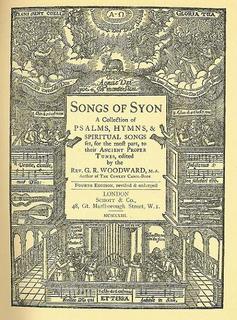
The plainsong texts are generally John Mason Neale’s famous 19th-century translations of the ancient Greek and Latin hymns. These are often rendered in mediaeval musical notation, which, with a little practice, is fairly easily sight-read. The titles of the German hymns are set in blackletter font, perhaps making them appear exotic to an early 20th-century English readership – or should I say “singership”? In his preface to the 4th edition, the Rev. Mr. Woodward felt it necessary to say the following:
The material is organized at the outset in fairly typical manner, i.e., according to the church calendar. Hence Advent hymns come first, followed by Christmas-even, Christmas-tide, &c. Then come Holy Eucharist, Sundays and Week-days, Evensong, Mattins, Common of Our Lady, Common of Saints, Proper of Saints, &c. Then come sections devoted respectively to Psalms, Hymns and Spiritual Songs.
The Psalms section is of particular interest to me, because the editor put some effort into recovering for the English-speaking church the tunes of the Genevan Psalter, which, apart from a very few, are generally unknown to Anglo-Saxon Christians. Some of the translated texts are by Woodward himself. Here is the first stanza of his rendition of Psalm 150:
Eight decades later, Woodward’s effort to recover the Genevan tradition appears largely to have fallen short. But his Songs of Syon stands as a monument to the rich liturgical heritage of both eastern and western Christendom. It deserves to be better known than it is.
Unfortunately I myself do not use this volume as often as I would like. My copy is redolent of mildew to which I am, sadly, allergic. Should I attempt to sing directly out of this book, I would have to stop every few bars to blow my nose. I would love to find a much newer reprint with which to replace this.
One of my all-time favourite hymnals is Songs of Syon, subtitled “A Collection of Psalms, Hymns, & Spiritual Songs set, for the most part, to their ANCIENT PROPER TUNES,” edited by the Rev. George Ratcliffe Woodward, M.A. My copy, purchased in 1989 (probably in Toronto), is the 4th edition, published in London in 1923, the original edition having come out in 1904. It is an exceedingly comprehensive collection, containing plainsong melodies, metrical melodies of the 13th to 16th centuries, Lutheran chorales, “Old English and Scotch psalm-tunes” and old French psalms and canticles. It is based on the earlier work of Robert Bridges' Yattendon Hymnal.
The plainsong texts are generally John Mason Neale’s famous 19th-century translations of the ancient Greek and Latin hymns. These are often rendered in mediaeval musical notation, which, with a little practice, is fairly easily sight-read. The titles of the German hymns are set in blackletter font, perhaps making them appear exotic to an early 20th-century English readership – or should I say “singership”? In his preface to the 4th edition, the Rev. Mr. Woodward felt it necessary to say the following:
If objection be taken to the number of foreign tunes which appear in this Edition, be it remembered that many of our favourite Hymn-tunes. E.g., The Old Hundredth, Luther’s Hymn, Adeste fideles, O Sacred Head surrounded, Now thank we all our God, Sing praise to God who reigns above, are not of English origin. It is confidently believed that many other exotics need only to be transplanted, and they will take equally deep root in the hearts of English-speaking people.
The material is organized at the outset in fairly typical manner, i.e., according to the church calendar. Hence Advent hymns come first, followed by Christmas-even, Christmas-tide, &c. Then come Holy Eucharist, Sundays and Week-days, Evensong, Mattins, Common of Our Lady, Common of Saints, Proper of Saints, &c. Then come sections devoted respectively to Psalms, Hymns and Spiritual Songs.
The Psalms section is of particular interest to me, because the editor put some effort into recovering for the English-speaking church the tunes of the Genevan Psalter, which, apart from a very few, are generally unknown to Anglo-Saxon Christians. Some of the translated texts are by Woodward himself. Here is the first stanza of his rendition of Psalm 150:
Alleluya. Praise the Lord;
Be his holy Name ador’d:
Praise him in the firmament,
Mighty, great and excellent:
In his noble acts revere him:
Praise him on the harp and lute,
Praise him with the trump and flute;
Love, adore, and greatly fear him.
Eight decades later, Woodward’s effort to recover the Genevan tradition appears largely to have fallen short. But his Songs of Syon stands as a monument to the rich liturgical heritage of both eastern and western Christendom. It deserves to be better known than it is.
Unfortunately I myself do not use this volume as often as I would like. My copy is redolent of mildew to which I am, sadly, allergic. Should I attempt to sing directly out of this book, I would have to stop every few bars to blow my nose. I would love to find a much newer reprint with which to replace this.
21 October 2005
'Inciting hatred'
If Mark Morford were living in Canada and published this detestable article in one of our periodicals, would he be charged under section 319 of the Criminal Code for wilfully inciting hatred against an identifiable group?
If Mark Morford were living in Canada and published this detestable article in one of our periodicals, would he be charged under section 319 of the Criminal Code for wilfully inciting hatred against an identifiable group?
20 October 2005
On this date in history
The Free University of Amsterdam opened its doors 125 years ago today. Its founder, Dr. Abraham Kuyper, marked the occasion with an address on "Souvereiniteit in eigen kring", or Sphere sovereignty.
The Free University of Amsterdam opened its doors 125 years ago today. Its founder, Dr. Abraham Kuyper, marked the occasion with an address on "Souvereiniteit in eigen kring", or Sphere sovereignty.
McKendree Langley (1945-2005)
The Westminster Theological Seminary website carries an obituary of McKendree Langley, who died last week of a heart attack at age 60:
I first came to know of Langley through his 1984 book, as I was researching my dissertation. I met him only once, in 1998 at an international conference on Abraham Kuyper at Princeton Seminary.
The Westminster Theological Seminary website carries an obituary of McKendree Langley, who died last week of a heart attack at age 60:
Langley taught history for 35 years at the high school, college, and seminary levels. He was associate professor of history at Dordt College (Sioux Center, Iowa); history teacher at Phil-Mont Christian Academy (Erdenheim, Pa.); and chair of the history department at City Center Academy (Philadelphia, Pa.). Since 1989, he was an adjunct faculty member at Westminster, and throughout his career lectured at Barrington College (R.I.); Free University (Amsterdam); Gordon College (Wenham, Mass.); Reformed Theological Seminary (Jackson, Miss.); Delaware County Community College (Media, Pa.); and Eastern University (St. Davids, Pa.). For five years, he worked as a journalist for Eternity magazine, New England Church Life, and The News (Southbridge, Mass.).
He was considered an expert in Christian democracy and the theology of Dutch statesman Abraham Kuyper. A graduate of Gordon College (B.A.), Northeastern University (M.A.), and Westminster Theological Seminary (M.Div., Ph.D.), his P.D. dissertation was entitled “Emancipation and Apologetics: The Formation of Abraham Kuyper’s Anti-Revolutionary Party in the Netherlands, 1872-1880.” In 1984, he published the book The Practice of Political Spirituality. He also wrote numerous articles on U.S. and Eastern European worldview politics.
I first came to know of Langley through his 1984 book, as I was researching my dissertation. I met him only once, in 1998 at an international conference on Abraham Kuyper at Princeton Seminary.
19 October 2005
Corruption
What is the least corrupt country in the world? Iceland, according to Transparency International's newly released Corruption Perceptions Index survey, closely followed by Finland and New Zealand, which tie for second place. Which is the most corrupt? Chad and Bangladesh tie for this coveted spot at number 158. Canada comes in at number 14 and the United States at 17. It's no surprise to me that Cyprus comes ahead of Greece at 37 and 47 respectively. What I would not have expected to see is the Kingdom of Jordan tie Cyprus for 37th place. Nor would I have anticipated Singapore's rank at number 5, ahead of Australia and the Netherlands.


Canada's record is better than that of most countries. Nevertheless, the report has the following to say:
One assumes Adscam has played a role in depressing Canada's rating. Yet if so, it appears not to have adversely affected the popularity of the governing Liberal Party, if recent opinion polls are any indication. What does this say about Canadians? I hope it doesn't mean we are becoming more accustomed, and thus more numbed, to corruption in high places.
What is the least corrupt country in the world? Iceland, according to Transparency International's newly released Corruption Perceptions Index survey, closely followed by Finland and New Zealand, which tie for second place. Which is the most corrupt? Chad and Bangladesh tie for this coveted spot at number 158. Canada comes in at number 14 and the United States at 17. It's no surprise to me that Cyprus comes ahead of Greece at 37 and 47 respectively. What I would not have expected to see is the Kingdom of Jordan tie Cyprus for 37th place. Nor would I have anticipated Singapore's rank at number 5, ahead of Australia and the Netherlands.
Canada's record is better than that of most countries. Nevertheless, the report has the following to say:
Wealth is not a prerequisite for successful control of corruption. New long-term analysis of the CPI carried out by Prof. Dr. Johann Graf Lambsdorff shows that the perception of corruption has decreased significantly in lower-income countries such as Estonia, Colombia and Bulgaria over the past decade.
In the case of higher-income countries such as Canada and Ireland, however, there has been a marked increase in the perception of corruption over the past ten years, showing that even wealthy, high-scoring countries must work to maintain a climate of integrity.
One assumes Adscam has played a role in depressing Canada's rating. Yet if so, it appears not to have adversely affected the popularity of the governing Liberal Party, if recent opinion polls are any indication. What does this say about Canadians? I hope it doesn't mean we are becoming more accustomed, and thus more numbed, to corruption in high places.
18 October 2005
Genovese reviews Noll
Here is something I missed two years ago. I found it while looking for that Niebuhr quote I mentioned yesterday. Eugene Genovese reviews Mark Noll's America's God: From Jonathan Edwards to Abraham Lincoln in, of all places, this New Republic article: God of Thunder. There is something intriguing in seeing an ex-Marxist, Catholic convert with an affinity for the southern agrarians take on a Reformed Christian for not being confessionally Reformed enough, as well as for mischaracterizing the southern Presbyterian tradition. I can't imagine what the stereotypical TNR reader would make of this.
Here is something I missed two years ago. I found it while looking for that Niebuhr quote I mentioned yesterday. Eugene Genovese reviews Mark Noll's America's God: From Jonathan Edwards to Abraham Lincoln in, of all places, this New Republic article: God of Thunder. There is something intriguing in seeing an ex-Marxist, Catholic convert with an affinity for the southern agrarians take on a Reformed Christian for not being confessionally Reformed enough, as well as for mischaracterizing the southern Presbyterian tradition. I can't imagine what the stereotypical TNR reader would make of this.
Paying the price
A member of parliament from northern Manitoba is now being made to pay the price for defying her own party and voting to uphold justice. When the election call comes, may her constituents do the honourable thing and return her as an independent.
A member of parliament from northern Manitoba is now being made to pay the price for defying her own party and voting to uphold justice. When the election call comes, may her constituents do the honourable thing and return her as an independent.
17 October 2005
Neuhaus joins the blogosphere
This month I received the new issue of First Things somewhat later than usual. (Canada Post is a tempting scapegoat.) Turning to the FT website, we see that Fr. Richard John Neuhaus, who has long had the print equivalent of a blog in his monthly Public Square columns, is now doing the real thing.
This month I received the new issue of First Things somewhat later than usual. (Canada Post is a tempting scapegoat.) Turning to the FT website, we see that Fr. Richard John Neuhaus, who has long had the print equivalent of a blog in his monthly Public Square columns, is now doing the real thing.
An apt and much quoted description
Here is H. Richard Niebuhr on liberal protestantism, as it developed in the United States a century ago: "A God without wrath brought people without sin into a kingdom without judgment through the ministrations of a Christ without a cross." It comes from his book, The Kingdom of God in America. A quick Google search reveals that some people ascribe this to the author's better known brother, Reinhold.
Here is H. Richard Niebuhr on liberal protestantism, as it developed in the United States a century ago: "A God without wrath brought people without sin into a kingdom without judgment through the ministrations of a Christ without a cross." It comes from his book, The Kingdom of God in America. A quick Google search reveals that some people ascribe this to the author's better known brother, Reinhold.
Iraqi democracy?
As Iraqi citizens go to the polls to vote on a new constitution, it is worth taking a look at James L. Payne's survey of cases in which an American or British military occupation led to the establishment of democracy in the occupied country. In general the results have not been good. Let's hope and pray that Iraq will be an exception to this historical record.
By the way, am I the only one to have noticed possible tensions within article 2 of the proposed constitutional document?
Which of the above provisions will be held to take priority when they come into conflict, as they inevitably will?
As Iraqi citizens go to the polls to vote on a new constitution, it is worth taking a look at James L. Payne's survey of cases in which an American or British military occupation led to the establishment of democracy in the occupied country. In general the results have not been good. Let's hope and pray that Iraq will be an exception to this historical record.
By the way, am I the only one to have noticed possible tensions within article 2 of the proposed constitutional document?
First: Islam is the official religion of the State and it is a fundamental source of legislation:
A. No law that contradicts the established provisions of Islam may be established.
B. No law that contradicts the principles of democracy may be established.
C. No law that contradicts the rights and basic freedoms stipulated in this constitution may be established.
Second: This Constitution guarantees the Islamic identity of the majority of the Iraqi people and guarantees the full religious rights of all individuals to freedom of religious belief and practice such as Christians, Yazedis, and Mandi Sabeans.
Which of the above provisions will be held to take priority when they come into conflict, as they inevitably will?
16 October 2005
An anniversary
On this day 450 years ago Bishops Hugh Latimer and Nicholas Ridley were martyred for the cause of the Reformation in England.
On this day 450 years ago Bishops Hugh Latimer and Nicholas Ridley were martyred for the cause of the Reformation in England.
More from Comment
The Work Research Foundation continues to publish thoughtful Comment articles on a weekly basis. Three recent ones are especially noteworthy. First, Ray Pennings writes on What is to be done… in the public square? For many years I have known Pennings to be an activist, both in his several political campaigns and in his work for the CLAC. Thus he is well situated to be writing on this topic. Pennings argues that "the battle for public square influence is not dependent on any one policy initiative, election, or campaign. Results will only be measured over decades, and we need to develop the persistence and perseverance to keep at it." This suggests that a future Comment article might appropriately deal with the virtue of patience.
Then we return to the longrunning debate on agrarianism, which sees Richard Greydanus replying to Wilma Van der Leek's take on Wendell Berry's thought. While admitting the historical priority of the agrarian way of life, Greydanus believes that God's cultural mandate requires "the care and cultivation of both localizing and globalizing potentialities."
Finally, my revered friend and colleague, Dr. Al Wolters, has written a thoughtful — and I'm tempted to say moving — analysis of the neocalvinist/reformational movement, identifying its promise and dangers alike: What is to be done... toward a neocalvinist agenda? Wolters frankly discusses the cleavages within the movement, as some adherents have embraced one emphasis at the expense of others, thus making for an imbalanced appropriation of the true fulness of the life in Christ. Among other things, Wolters asserts that neocalvinists need (1) to recover a "robust and straightforward notion of Scriptural authority," which can hardly be argued with; (2) to immerse themselves in a genuine piety conversant with the spiritual disciplines of other christian traditions, such as Ignatian spirituality and the pentecostal/charismatic movements, as well as with Reformed Christianity; (3) to cultivate an ecumenicity rooted, not in a lowest common denominator, but in the particularities of the calvinist tradition; and (4) to recognize that the only way to the restored creation is by way of the cross of Jesus Christ. There is much more to grapple with here. I hope Wolters' brief, but rich, article provokes a larger conversation about the issues he raises.
14 October 2005
A tragic loss
I have just received word of the sudden death yesterday of Dr. McKendree Langley, author, teacher, and expert on the life and career of Abraham Kuyper. Here is an announcement of his death. When I learn more, I will post it. May God grant comfort to those he left behind.
I have just received word of the sudden death yesterday of Dr. McKendree Langley, author, teacher, and expert on the life and career of Abraham Kuyper. Here is an announcement of his death. When I learn more, I will post it. May God grant comfort to those he left behind.
13 October 2005
Vanished bloggers
Where did Rob Joustra and Dan Postma go? Perhaps it's time for them to switch to a non-German server.
Where did Rob Joustra and Dan Postma go? Perhaps it's time for them to switch to a non-German server.
Aussies and Kiwis going separate ways?
Former New Zealand Prime Minister Mike Moore has written an article that is making waves in the Antipodes: A tale of two countries. His comparison to Canada's relationship with the United States is especially instructive.
Former New Zealand Prime Minister Mike Moore has written an article that is making waves in the Antipodes: A tale of two countries. His comparison to Canada's relationship with the United States is especially instructive.
12 October 2005
New PJR issue
The fourth quarter issue of The Public Justice Report, published by the Center for Public Justice, is now out. In the lead article, Center President James W. Skillen undertakes to assess the United States' policy in Iraq according to traditional just war criteria and finds it wanting on several counts. Professor Prabhu Guptara writes on Facing the Challenge of Globalization, acknowledging the dangers of this phenomenon while setting out steps towards a healthy globalization. Skillen reviews Judith M. Dean, & al., Attacking Poverty in the Developing World. My friend and colleague John Hiemstra questions efforts in his own province of Alberta to develop oil sands while ignoring the need to conserve energy use and adopt a more stewardly economic practice. This issue also carries highlights of Dr. Stanley Carlson-Thies' testimony before a congressional subcommittee on Making the Faith-Based Initiative Permanent, a review of the second edition of Roy Clouser's Myth of Religious Neutrality, and a final commentary to mark the 40th anniversary of the Voting Rights Act.
The fourth quarter issue of The Public Justice Report, published by the Center for Public Justice, is now out. In the lead article, Center President James W. Skillen undertakes to assess the United States' policy in Iraq according to traditional just war criteria and finds it wanting on several counts. Professor Prabhu Guptara writes on Facing the Challenge of Globalization, acknowledging the dangers of this phenomenon while setting out steps towards a healthy globalization. Skillen reviews Judith M. Dean, & al., Attacking Poverty in the Developing World. My friend and colleague John Hiemstra questions efforts in his own province of Alberta to develop oil sands while ignoring the need to conserve energy use and adopt a more stewardly economic practice. This issue also carries highlights of Dr. Stanley Carlson-Thies' testimony before a congressional subcommittee on Making the Faith-Based Initiative Permanent, a review of the second edition of Roy Clouser's Myth of Religious Neutrality, and a final commentary to mark the 40th anniversary of the Voting Rights Act.
11 October 2005
PR for Canada?
Here is an event I would love to attend if I lived in Ottawa: Carleton University to host debate on political hot potato — Would Proportional Representation be Good for Canada?
Here is an event I would love to attend if I lived in Ottawa: Carleton University to host debate on political hot potato — Would Proportional Representation be Good for Canada?
Should sovereignty be downgraded?
If Amitai Etzioni has his way, the traditional understanding of state sovereignty would be modified from a right to a responsibility.
Would this be practicable? More to the point, is the UN up to taking on this responsibility? Perhaps this is where Russ Kuykendall's proposed Community of Democracies has a role to play.
If Amitai Etzioni has his way, the traditional understanding of state sovereignty would be modified from a right to a responsibility.
Thus a government that does not protect its people from ethnic cleansing, of the kind that occurred in Kosovo and Rwanda, or from mass starvation as found in Niger, would be considered a government that has forfeited its right to independence. The UN would be fully entitled to authorize an intervention in the internal affairs of that nation, a major departure from the Charter of the UN, which declares, “Nothing contained in the present Charter shall authorize the United Nations to intervene in matters which are essentially within the jurisdiction of any state.”
Would this be practicable? More to the point, is the UN up to taking on this responsibility? Perhaps this is where Russ Kuykendall's proposed Community of Democracies has a role to play.
09 October 2005
Music of the spheres
Our Theresa has been combining her interest in the sciences with her inherited interest in music. Two famous compositions lend themselves especially well to this: Antonio Vivaldi’s The Four Seasons and Gustav Holst’s The Planets. The two of us have been arguing over whose interpretation of the former is the better. She prefers Hermann Scherchen and the Vienna State Opera Orchestra’s rendition (1973), while I much prefer that of Stanislav Gorkovenko and the St. Petersburg RSO (1997). (At least we're not arguing over hip-hop!) As for Holst’s piece, it was composed in 1916, 14 years before Clyde Tombaugh discovered Pluto. If Holst had known of Pluto — as well as “Xena” and all of the other quasi-planetary objects in theKuyper Kuiper Belt — might he have composed additional movements for these as well? Perhaps I’ll address this in a possible second blog devoted to music appreciation, to be titled Notes from a Coloratura Accordionist.
Our Theresa has been combining her interest in the sciences with her inherited interest in music. Two famous compositions lend themselves especially well to this: Antonio Vivaldi’s The Four Seasons and Gustav Holst’s The Planets. The two of us have been arguing over whose interpretation of the former is the better. She prefers Hermann Scherchen and the Vienna State Opera Orchestra’s rendition (1973), while I much prefer that of Stanislav Gorkovenko and the St. Petersburg RSO (1997). (At least we're not arguing over hip-hop!) As for Holst’s piece, it was composed in 1916, 14 years before Clyde Tombaugh discovered Pluto. If Holst had known of Pluto — as well as “Xena” and all of the other quasi-planetary objects in the
05 October 2005
Catholic bishops' change of heart
Could this be true: Catholic Church no longer swears by truth of the Bible?
Could this be true: Catholic Church no longer swears by truth of the Bible?
04 October 2005
Capitalism, civil society and the Calgary School
In response to my Comment article, “The Calgary School and the Future of Canada,” Jonathan Weverink writes:
These are good questions worthy of thoughtful response. Let’s start with capitalism, a term I use in my book as little as I possibly can. Over the decades I’ve come to think that it’s not a particularly useful term — in the hands of either its detractors or its proponents. When I do use it, I tend to identify it with the economic side of individualistic liberalism, with its tendency to reduce the variety of social formations to voluntary associations. One might speak here of the commodification of life, in which every cultural artefact, institution, custom, tradition, way of life and livelihood becomes an economic product to be purchased on the open market. My colleague Craig Bartholomew has written on consumerism, a term which may be somewhat more descriptive and less freighted with obvious ideological baggage. To be sure, there is nothing intrinsically evil about the market, which must be seen as a structural component of human life in community, as created by God. But in our society there is a tendency in some circles to advance so-called “market solutions” to this, that and everything, including environmental degradation and a plethora of social ills. This is naïve. The market is the market. Nothing more, nothing less.
Furthermore, capitalism’s Marxian connotations make it a less than helpful term. For Marx, capitalism is not so much the economic counterpart of liberalism as a concrete system characterizing a particular stage in the historical process – a process determined and moved by class struggle. It’s not clear to me that one can so easily detach a notion of capitalism from this Marxian context, with its defective anthropology and reductive understanding of history. Then, of course, there is Catholic theologian Michael Novak, who writes favourably, and entirely too glibly, of “democratic capitalism,” which is a hopelessly reductionist way of understanding our complex society. (On this point I am closer to the late Russell Kirk than to Novak.)
To my mind, the issue of the respective sizes of public and private sectors (themselves problematic terms, but we’ll let that go for now) must be treated as something distinct from the important issues Weverink raises above. He claims to balk at my proposal to limit the public sector and to place more resources in the hands of the private sector. Yet he also professes to dislike the “glowing endorsement of rampant greed we see coming from our elected officials.” One could add to this problem the corruption and other forms of malfeasance within the ranks of government itself. Clearly, greed is not peculiar to private entrepreneurs. Placing too much of our wealth in the hands of government officials is a recipe for abuse, especially if there are insufficient checks on political power itself — a situation characterizing Canada at the moment, I'm sorry to say. Adscam is the predictable outcome of this.
It is probably true that the Calgary School is insufficiently attentive to the problems of consumerism — or capitalism, if you prefer — to which Weverink refers. This is why I emphasize at the end of my article the need to have the return of resources to the private sector coupled with a concerted effort to encourage their use for the public benefit. I might add here that the criteria for this ought to be flexible enough to accommodate a diversity of worldviews and agendas. This, of course, presupposes that our policy-makers are motivated by a genuine concern for the betterment of the larger society, including the most vulnerable, and not simply in shifting economic power from one self-aggrandizing sector to another. Unfortunately there is no guarantee that this will be the case. One hopes that enhanced democratic and constitutional mechanisms might serve to facilitate this.
I might point out something else. As I noted above, if economic resources are concentrated in the hands of government, their abuse is more likely than if they are widely distributed amongst a variety of governmental and nongovernmental agents. This argues against an excessively statist economy, at least on the domestic front. On the other hand, the economic power of some of the largest transnational corporations dwarfs that of many, if not most, of the smaller countries in especially the two-thirds world. In such a context, offering the free market as a solution is likely to ring hollow. Yet statism is not an obviously better solution either, as seen over the decades since decolonization in Africa and Asia, where corrupt governments have not been obviously virtuous counterweights to the transnationals. Here is where I run up against the limits of my own expertise, since I’m not an economist.
However, I do believe that any emphasis on the market needs to be balanced with (1) a counter-emphasis on strong labour unions to protect employees (here is where the CLAC and its overseas affiliates have a role to play), and (2) a strong legal and political framework that not only protects the diverse forms of property existing within a complex differentiated society, but is capable of upholding legitimate constraints on economic activity, including, above all, protecting the physical environment — perhaps the most basic manifestation of the commons there is. With respect to transnationals, these might well be regulated by multilateral treaty arrangements amongst the smaller, less developed countries — not to treat such corporations punitively in advance, as if they were evil by definition, but to ensure at least that, in their quest for profit, they do not run roughshod over the legitimate interests of these countries’ social fabrics. At most it might even persuade such corporate entities to view their own activities as manifestations of responsible economic stewardship.
None of this will necessarily be easy to bring about, but we certainly have good reason to work for it. For our purposes here, it need not entail a dirigiste economy, but ought to enhance the balanced development of a pluriform society, in which state and economic enterprise play their respective complementary roles in seeking shalom.
In response to my Comment article, “The Calgary School and the Future of Canada,” Jonathan Weverink writes:
i balk at your suggestion about limiting the public sector, and putting more into the hands of private enterprise.
even so, i am in total agreement of your point about the diversity that the private sector could bring to many aspects of what typically resides in the public sector. especially in the face of cold secularism.
i think my original "gut" reaction stems from my deep, deep suspicion of capitalism -- and the glowing endorsement of rampant greed we see coming from our elected officials, in regard to corporate entities.
i wonder if you have anything to say about the very real danger of capitalism, and the corporate tyranny that is slowly growing in the face of disappearing public goods? do you have a solution to offer, where private interests are not necessarily equated with plunder?
These are good questions worthy of thoughtful response. Let’s start with capitalism, a term I use in my book as little as I possibly can. Over the decades I’ve come to think that it’s not a particularly useful term — in the hands of either its detractors or its proponents. When I do use it, I tend to identify it with the economic side of individualistic liberalism, with its tendency to reduce the variety of social formations to voluntary associations. One might speak here of the commodification of life, in which every cultural artefact, institution, custom, tradition, way of life and livelihood becomes an economic product to be purchased on the open market. My colleague Craig Bartholomew has written on consumerism, a term which may be somewhat more descriptive and less freighted with obvious ideological baggage. To be sure, there is nothing intrinsically evil about the market, which must be seen as a structural component of human life in community, as created by God. But in our society there is a tendency in some circles to advance so-called “market solutions” to this, that and everything, including environmental degradation and a plethora of social ills. This is naïve. The market is the market. Nothing more, nothing less.
Furthermore, capitalism’s Marxian connotations make it a less than helpful term. For Marx, capitalism is not so much the economic counterpart of liberalism as a concrete system characterizing a particular stage in the historical process – a process determined and moved by class struggle. It’s not clear to me that one can so easily detach a notion of capitalism from this Marxian context, with its defective anthropology and reductive understanding of history. Then, of course, there is Catholic theologian Michael Novak, who writes favourably, and entirely too glibly, of “democratic capitalism,” which is a hopelessly reductionist way of understanding our complex society. (On this point I am closer to the late Russell Kirk than to Novak.)
To my mind, the issue of the respective sizes of public and private sectors (themselves problematic terms, but we’ll let that go for now) must be treated as something distinct from the important issues Weverink raises above. He claims to balk at my proposal to limit the public sector and to place more resources in the hands of the private sector. Yet he also professes to dislike the “glowing endorsement of rampant greed we see coming from our elected officials.” One could add to this problem the corruption and other forms of malfeasance within the ranks of government itself. Clearly, greed is not peculiar to private entrepreneurs. Placing too much of our wealth in the hands of government officials is a recipe for abuse, especially if there are insufficient checks on political power itself — a situation characterizing Canada at the moment, I'm sorry to say. Adscam is the predictable outcome of this.
It is probably true that the Calgary School is insufficiently attentive to the problems of consumerism — or capitalism, if you prefer — to which Weverink refers. This is why I emphasize at the end of my article the need to have the return of resources to the private sector coupled with a concerted effort to encourage their use for the public benefit. I might add here that the criteria for this ought to be flexible enough to accommodate a diversity of worldviews and agendas. This, of course, presupposes that our policy-makers are motivated by a genuine concern for the betterment of the larger society, including the most vulnerable, and not simply in shifting economic power from one self-aggrandizing sector to another. Unfortunately there is no guarantee that this will be the case. One hopes that enhanced democratic and constitutional mechanisms might serve to facilitate this.
I might point out something else. As I noted above, if economic resources are concentrated in the hands of government, their abuse is more likely than if they are widely distributed amongst a variety of governmental and nongovernmental agents. This argues against an excessively statist economy, at least on the domestic front. On the other hand, the economic power of some of the largest transnational corporations dwarfs that of many, if not most, of the smaller countries in especially the two-thirds world. In such a context, offering the free market as a solution is likely to ring hollow. Yet statism is not an obviously better solution either, as seen over the decades since decolonization in Africa and Asia, where corrupt governments have not been obviously virtuous counterweights to the transnationals. Here is where I run up against the limits of my own expertise, since I’m not an economist.
However, I do believe that any emphasis on the market needs to be balanced with (1) a counter-emphasis on strong labour unions to protect employees (here is where the CLAC and its overseas affiliates have a role to play), and (2) a strong legal and political framework that not only protects the diverse forms of property existing within a complex differentiated society, but is capable of upholding legitimate constraints on economic activity, including, above all, protecting the physical environment — perhaps the most basic manifestation of the commons there is. With respect to transnationals, these might well be regulated by multilateral treaty arrangements amongst the smaller, less developed countries — not to treat such corporations punitively in advance, as if they were evil by definition, but to ensure at least that, in their quest for profit, they do not run roughshod over the legitimate interests of these countries’ social fabrics. At most it might even persuade such corporate entities to view their own activities as manifestations of responsible economic stewardship.
None of this will necessarily be easy to bring about, but we certainly have good reason to work for it. For our purposes here, it need not entail a dirigiste economy, but ought to enhance the balanced development of a pluriform society, in which state and economic enterprise play their respective complementary roles in seeking shalom.
02 October 2005
Wordiness in the liturgy
Over the decades it has struck me that there is a tendency in many protestant churches to try to turn as much of the liturgy as possible into a sermon. I've noticed this especially in the Christian Reformed Church, where many pastors simply talk too much, ostensibly on the pretext of guiding congregants through a liturgy with which they are surely already familiar. If Alvin Kimel's remarks are any indication, then it seems that Catholic priests are not exempt from this tendency. I reproduce below his advice, which, with the proper adjustments in vocabulary, might well be heeded by Reformed "priests" as well.
Over the decades it has struck me that there is a tendency in many protestant churches to try to turn as much of the liturgy as possible into a sermon. I've noticed this especially in the Christian Reformed Church, where many pastors simply talk too much, ostensibly on the pretext of guiding congregants through a liturgy with which they are surely already familiar. If Alvin Kimel's remarks are any indication, then it seems that Catholic priests are not exempt from this tendency. I reproduce below his advice, which, with the proper adjustments in vocabulary, might well be heeded by Reformed "priests" as well.
Stick to the script! I doubt that you have the authority to ad lib at the liturgy. . . but few priests have the gift to do it well anyway. Say the words that are given to you, exactly as they are given to you. Don’t add, don’t subtract. Please don’t start the liturgy by saying “Good morning.” Please don’t tell us in your own words why we have gathered together for Mass. Just start the Mass and get on with it. The liturgy has its own logic, its own rhythm and cadence. It is one musical composition in the Spirit. Every time you depart from the rite, you disrupt the flow of the liturgy and simply draw attention to yourself and away from the Lord. Preach away at the sermon, with as much enthusiasm and energy you can muster. That is your time. But for the rest of the liturgy, slip back into the role and hide behind your chasuble. The liturgy will carry itself, especially if it is conducted reverently, graciously, prayerfully, beautifully.
Communion with Rome
Redeemer alumnus Michael Trolly left a Haloscan comment to my post, Another Catholic Rite?, that I found sufficiently intriguing to warrant reproducing immediately below, with responses:
One wonders whether the coming reconfiguration of Anglicanism may end up sending a much larger contingent of would-be "Anglican-rite" Christians to Rome or Constantinople than just the few who have been lapping at the banks of the Tiber in recent years. I am struck by how infinitessimally small the various eastern-rite churches are. An Anglican-rite church in communion with Rome could conceivably number in the millions after the coming crack-up.
Here is an interview in Touchstone with Roald Flemestad about the formation of the Nordic Catholic Church: Out on a Limb in Norway. As institutions, the European Old Catholics are not in communion with Rome, so it's not clear that moving towards the PNCC will bring these dissident Norwegians there either, at least formally speaking. But if the "back door" route Trolly mentions really does exist, then that might provide an avenue for others as well. My understanding is that Orthodox Christians as individuals are also understood by Rome already to be in communion, even if their churches are not.
I must admit to having made this suggestion mostly tongue in cheek. My sense of the matter is that the establishment of intercommunion between Rome and individual eastern-rite churches was not preceded by intersynodical study committees bent on sorting out myriad doctrinal issues that might stand in the way of reunion. It was effected simply by the eastern-rite churches recognizing the jurisdiction of the Pope, along with acceptance of the filioque clause in the Creed. Was there agreement in all details concerning, say, purgatory and the Marian doctrines? I frankly doubt it.
Yet the Reformed Churches — or at least the more confessional of these — have largely defined themselves over against Rome, for better or worse. Simply establishing intercommunion with the Pope would leave unanswered any number of issues, the least of which would be the extent of the Old Testament canon. (It is striking that some of the eastern-rite Catholic churches accept a larger OT canon than even that established by the Council of Trent. Is Trent normative only within the Latin rite?) It is difficult to imagine a Genevan-rite Catholic church which would not entail an outright repudiation of the very reason for the existence of the Reformed churches, namely, the Reformation itself! Any move towards Rome will be a matter of individual conversions to the Latin rite, and not a Genevan-rite church in communion with Rome.
The CRC used to use a liturgy with 16th-century origins that was excessively didactic and contained little that was recognizable in the larger liturgical tradition of the church catholic. This despite the claim in the fronticepiece of the Genevan church's La Forme des Prieres et chantz ecclesiastiques that its liturgy was "selon la coustume de l'Église ancienne." In 1968 the CRC moved to adopt what in other traditions would be called a eucharistic liturgy more in conformity with this catholic tradition, including the sursum corda, &c. My own adaptation is intended to follow in this path, but with the selected metrical psalms "plugged" into the liturgy in the appropriate places. As to how this looks in practice, it depends on the individual congregation.
Two decades ago I composed settings for part of the "ordinary of the mass", including a Sanctus and Memorial Acclamation. These were sung at South Bend (Indiana) Christian Reformed Church, as well as at two Presbyterian (USA) churches in Indiana and Michigan, for several years. By now I probably have settings for a complete mass, although they still need a lot of work to bring some coherence to the whole.
Redeemer alumnus Michael Trolly left a Haloscan comment to my post, Another Catholic Rite?, that I found sufficiently intriguing to warrant reproducing immediately below, with responses:
Yurkus' description of variations within the Latin Church could have added that an Anglican Use within the Latin Rite has been approved in the US; this preserves elements of the Book of Common Prayer within the Latin-rite mass. (There is some hope in the future of an Anglican Rite as a self governing church in communion with the Vatican, on the same basis as the Eastern Catholic Churches.)
One wonders whether the coming reconfiguration of Anglicanism may end up sending a much larger contingent of would-be "Anglican-rite" Christians to Rome or Constantinople than just the few who have been lapping at the banks of the Tiber in recent years. I am struck by how infinitessimally small the various eastern-rite churches are. An Anglican-rite church in communion with Rome could conceivably number in the millions after the coming crack-up.
Also, a group calling itself the "Nordic Catholic Church" has recently been established by Lutherans with help from the Polish National Catholic Church (they also have connections with some traditional Anglican churches.) They might potentially seek some sort of recognition from Rome; the PNCC has had an ongoing dialogue with Rome for a number of years now, and PNCC members are allowed to receive communion in Catholic (i.e. "Roman" Catholic) churches.
Here is an interview in Touchstone with Roald Flemestad about the formation of the Nordic Catholic Church: Out on a Limb in Norway. As institutions, the European Old Catholics are not in communion with Rome, so it's not clear that moving towards the PNCC will bring these dissident Norwegians there either, at least formally speaking. But if the "back door" route Trolly mentions really does exist, then that might provide an avenue for others as well. My understanding is that Orthodox Christians as individuals are also understood by Rome already to be in communion, even if their churches are not.
I mention all of this because it suggests that a "Genevan" rite or use (i.e. permitted variation from another rite) might be a realistic ecumenical hope, if a group of Reformed Christians wanted to go down that route.
I must admit to having made this suggestion mostly tongue in cheek. My sense of the matter is that the establishment of intercommunion between Rome and individual eastern-rite churches was not preceded by intersynodical study committees bent on sorting out myriad doctrinal issues that might stand in the way of reunion. It was effected simply by the eastern-rite churches recognizing the jurisdiction of the Pope, along with acceptance of the filioque clause in the Creed. Was there agreement in all details concerning, say, purgatory and the Marian doctrines? I frankly doubt it.
Yet the Reformed Churches — or at least the more confessional of these — have largely defined themselves over against Rome, for better or worse. Simply establishing intercommunion with the Pope would leave unanswered any number of issues, the least of which would be the extent of the Old Testament canon. (It is striking that some of the eastern-rite Catholic churches accept a larger OT canon than even that established by the Council of Trent. Is Trent normative only within the Latin rite?) It is difficult to imagine a Genevan-rite Catholic church which would not entail an outright repudiation of the very reason for the existence of the Reformed churches, namely, the Reformation itself! Any move towards Rome will be a matter of individual conversions to the Latin rite, and not a Genevan-rite church in communion with Rome.
Your (Dr. Koyzis') adaptation of the CRC eucharistic liturgy does strike a certain chord with me... since the first time I read the text for the "Service of Word and Sacrament" in the CRC hymnal, I've wanted to see a Reformed eucharist celebrated this way. To be "as close as possible" to the universal worship tradition of the church while properly expressing distinctives of a particular tradition or denomination is a tremendous way for protestants to contribute to ecumenical dialogue. I would love to see this idea put into practice.
The CRC used to use a liturgy with 16th-century origins that was excessively didactic and contained little that was recognizable in the larger liturgical tradition of the church catholic. This despite the claim in the fronticepiece of the Genevan church's La Forme des Prieres et chantz ecclesiastiques that its liturgy was "selon la coustume de l'Église ancienne." In 1968 the CRC moved to adopt what in other traditions would be called a eucharistic liturgy more in conformity with this catholic tradition, including the sursum corda, &c. My own adaptation is intended to follow in this path, but with the selected metrical psalms "plugged" into the liturgy in the appropriate places. As to how this looks in practice, it depends on the individual congregation.
Two decades ago I composed settings for part of the "ordinary of the mass", including a Sanctus and Memorial Acclamation. These were sung at South Bend (Indiana) Christian Reformed Church, as well as at two Presbyterian (USA) churches in Indiana and Michigan, for several years. By now I probably have settings for a complete mass, although they still need a lot of work to bring some coherence to the whole.
01 October 2005
30 September 2005
The Calgary School, &c.
Many Canadians may not even be aware of its existence, but there is such a thing as the Calgary School, which a certain obscure south central Upper Canadian political scientist undertakes to analyze in today's issue of Comment. As for the recent debate on Comment's pages on agrarianism, I already had my say on this topic some months ago.
Many Canadians may not even be aware of its existence, but there is such a thing as the Calgary School, which a certain obscure south central Upper Canadian political scientist undertakes to analyze in today's issue of Comment. As for the recent debate on Comment's pages on agrarianism, I already had my say on this topic some months ago.
29 September 2005
A favourable review
Chris Smith of Bethany University reviews Dr. Nancy Calvert-Koyzis, Paul, Monotheism and the People of God: The Significance of Abraham Traditions for Early Judaism and Christianity, in the Review of Biblical Literature. Makes you want to go out and buy a copy for yourself, eh? And don't forget that hard-to-buy-for friend at Christmas.
Chris Smith of Bethany University reviews Dr. Nancy Calvert-Koyzis, Paul, Monotheism and the People of God: The Significance of Abraham Traditions for Early Judaism and Christianity, in the Review of Biblical Literature. Makes you want to go out and buy a copy for yourself, eh? And don't forget that hard-to-buy-for friend at Christmas.
'Vladimir Ilyich' Bush?
Is the Bush foreign policy team taking its cues from Lenin's Bolsheviks? So argues a group of conservative political analysts in Russia. Even if they do overstate their case, I would argue that those in the grip of an ideology, whether it aims at global communist revolution or the export of democracy, will tend to think in similar ways and follow similar patterns of action.
Is the Bush foreign policy team taking its cues from Lenin's Bolsheviks? So argues a group of conservative political analysts in Russia. Even if they do overstate their case, I would argue that those in the grip of an ideology, whether it aims at global communist revolution or the export of democracy, will tend to think in similar ways and follow similar patterns of action.
28 September 2005
Turkey and the EU: the ongoing drama
The European Parliament has placed an unanticipated hurdle in the way of Turkey's membership in the European Union, just days before accession talks are to begin next monday. The sticking points? Cyprus, of course. But also recognition of the Armenian genocide of 1915, which Turkey has thus far refused to own up to.
Later: This is even more intriguing: Swiss scholars want famous church returned before Turkey joins EU.
Given that Aghia Sophia was turned into a mosque by the Ottoman Turks way back in 1453, I rather think the statute of limitations has run out on this one. The likelihood of Turkey returning the building is only slightly less than that of the EU making it a condition for that country's membership. The old cliché about an infernal snowball would seem to have some relevance here.
Here is the HagiaSophiaBlog, which is spearheading a petition to "force the European Union to consider" their proposal "that Turkey should not be admitted to the EU before restoring justice to Hagia Sophia."
The European Parliament has placed an unanticipated hurdle in the way of Turkey's membership in the European Union, just days before accession talks are to begin next monday. The sticking points? Cyprus, of course. But also recognition of the Armenian genocide of 1915, which Turkey has thus far refused to own up to.
Later: This is even more intriguing: Swiss scholars want famous church returned before Turkey joins EU.
Swiss scholars have petitioned the European Parliament to ask that Istanbul's sixth-century Church of Hagia Sophia, now a museum, be restored for Christian worship before Turkey joins the European Union. . . .
"Turkey has long severed its ties with darker aspects of its Ottoman past. It aspires to join the European Union. The time has come to restore Hagia Sophia's spirituality as a place of Christian worship," the Swiss scholars said.
Given that Aghia Sophia was turned into a mosque by the Ottoman Turks way back in 1453, I rather think the statute of limitations has run out on this one. The likelihood of Turkey returning the building is only slightly less than that of the EU making it a condition for that country's membership. The old cliché about an infernal snowball would seem to have some relevance here.
Here is the HagiaSophiaBlog, which is spearheading a petition to "force the European Union to consider" their proposal "that Turkey should not be admitted to the EU before restoring justice to Hagia Sophia."
Tragedy in Kosovo
Has the western world been turning a blind eye to the destruction of churches in Kosovo? According to this Interfax report, the answer is yes.
Has the western world been turning a blind eye to the destruction of churches in Kosovo? According to this Interfax report, the answer is yes.
27 September 2005
The Queen's new representative
Today Her Excellency, Mme. Michaëlle Jean, was sworn in as 27th Governor General of Canada in the Senate chamber. In 1952 Vincent Massey became the first Canadian-born governor general, thereby establishing a convention governing future vice-regal appointments — one that would endure to the end of the century. In 1999 a new convention was established whereby all future governors general must be foreign-born female CBC journalists. If Barbara Frum had lived longer, she'd have been a shoo-in.
Today Her Excellency, Mme. Michaëlle Jean, was sworn in as 27th Governor General of Canada in the Senate chamber. In 1952 Vincent Massey became the first Canadian-born governor general, thereby establishing a convention governing future vice-regal appointments — one that would endure to the end of the century. In 1999 a new convention was established whereby all future governors general must be foreign-born female CBC journalists. If Barbara Frum had lived longer, she'd have been a shoo-in.
Sancte Fyodor, ora pro nobis
Russian nuclear bombers now have their own patron saint, courtesy of the Moscow patriarchate.
Russian nuclear bombers now have their own patron saint, courtesy of the Moscow patriarchate.
26 September 2005
The 'religious right' in Canada
The National Post continues its series on conservatism in Canada with an essay by Lorne Gunter on Fighting Canada's secularist tide. It seems Christians in Canada are 20 years behind their counterparts south of the border in trying to influence the political process. Might they have something to learn from their American brothers and sisters in the faith? Gunter thinks so. On the other hand, our Westminster parliamentary/cabinet system may not offer an hospitable institutional setting for such activities. Adopting PR might be a place to start in rectifying this. The Globe and Mail is already in favour, though, last I heard, the Post is not.
The National Post continues its series on conservatism in Canada with an essay by Lorne Gunter on Fighting Canada's secularist tide. It seems Christians in Canada are 20 years behind their counterparts south of the border in trying to influence the political process. Might they have something to learn from their American brothers and sisters in the faith? Gunter thinks so. On the other hand, our Westminster parliamentary/cabinet system may not offer an hospitable institutional setting for such activities. Adopting PR might be a place to start in rectifying this. The Globe and Mail is already in favour, though, last I heard, the Post is not.
Spanish sojourn
The latest Redeemer alumna to report from overseas is future prime minister Yolisa de Jager, who is studying at the University of Salamanca in Spain. May God bless her time there, and may she become as fluent in español as she is in French. And let's hope she gets her visa problems straightened out soon.
The latest Redeemer alumna to report from overseas is future prime minister Yolisa de Jager, who is studying at the University of Salamanca in Spain. May God bless her time there, and may she become as fluent in español as she is in French. And let's hope she gets her visa problems straightened out soon.
25 September 2005
Evangelicals in the media
Remember Alan Wolfe's Atlantic Monthly article, "The Opening of the Evangelical Mind," which appeared in the October 2000 issue? Our faculty had a round-table discussion of this essay in August of the following year, and it was much talked about in evangelical circles for a time. Five years later, Christopher Hayes may have produced a similarly provocative article: Student Body Right, which touches on the christian universities dotting the educational landscape of North America. The usual persons are cited here, including Mark Noll and James Davison Hunter. Now Nancy Pearcey merits mention as well, mostly because of her Total Truth, with its treatment of the concept of worldview.
When all is said and done, could it be possible that the net effect of all these christian universities is to make their graduates into good Republican Party activists? That, at least, seems to be Hayes' conclusion.
Conservatism in Canada
Yesterday the National Post began a series on the state of conservatism in Canada, beginning with this article by Robert Fulford: The values battle. (Would-be readers of the other articles will have to pay for them.) How does the Post define conservatism? In two words: less government — which appeals to Americans but has always been a tough sell in this country. Working with this definition, it turns out that Canada's first prime minister, Sir John A. Macdonald, was not much of a conservative, despite his party label.
Yesterday the National Post began a series on the state of conservatism in Canada, beginning with this article by Robert Fulford: The values battle. (Would-be readers of the other articles will have to pay for them.) How does the Post define conservatism? In two words: less government — which appeals to Americans but has always been a tough sell in this country. Working with this definition, it turns out that Canada's first prime minister, Sir John A. Macdonald, was not much of a conservative, despite his party label.
24 September 2005
Education, economics and (yes, once again) agrarianism
In this week's edition of Comment, three articles are on offer. First, Aaron Belz asks: What is to be done. . . about schooling? The author argues that the modern classroom can be a deadening environment, with energetic young people subjected to an artificial regimen more likely to kill than to encourage the joy of learning. What to do? Belz offers a five-fold strategy for reform. Remarkably, he neglects to mention an alternative gaining in popularity with especially christian parents: homeschooling.
Next, the formidable Mr. James Brink gives us his ideas on economics: Squares or Triangles? Cutting up the Market. Brink points out that the dominant neoclassical model of economics is based on a faulty anthropology — one unable to account for the relational character of the human person. With Gordon Bigelow, he argues for a "post-autistic economics" that refrains from reducing flesh and blood human beings to self-interested rational calculators.
Finally, if I had read Peter Scholtens' Agrarianism is misguided: another reply before I had written my book, I might have seen fit to include agrarianism (as distinct from the more modest affirmation of the agricultural calling) among the ideologies I treated. Scholtens critiques the notion that the agrarian way of life is any less subject to sin than other human pursuits. Following the biblical logic of Augustine and Calvin, Scholtens writes:
Is that the end of the dialogue? Probably not, but Scholtens has definitely raised the bar. Any future respondent will have to meet the challenge of defending Wendell Berry's agrarian vision in such a way as to avoid the gnostic deprecation of one part of God's good creation while exalting (idolizing?) another.
In this week's edition of Comment, three articles are on offer. First, Aaron Belz asks: What is to be done. . . about schooling? The author argues that the modern classroom can be a deadening environment, with energetic young people subjected to an artificial regimen more likely to kill than to encourage the joy of learning. What to do? Belz offers a five-fold strategy for reform. Remarkably, he neglects to mention an alternative gaining in popularity with especially christian parents: homeschooling.
Next, the formidable Mr. James Brink gives us his ideas on economics: Squares or Triangles? Cutting up the Market. Brink points out that the dominant neoclassical model of economics is based on a faulty anthropology — one unable to account for the relational character of the human person. With Gordon Bigelow, he argues for a "post-autistic economics" that refrains from reducing flesh and blood human beings to self-interested rational calculators.
Finally, if I had read Peter Scholtens' Agrarianism is misguided: another reply before I had written my book, I might have seen fit to include agrarianism (as distinct from the more modest affirmation of the agricultural calling) among the ideologies I treated. Scholtens critiques the notion that the agrarian way of life is any less subject to sin than other human pursuits. Following the biblical logic of Augustine and Calvin, Scholtens writes:
Farming is no more blessed than any other vocation, and the farming community is no more hallowed than any other community. The agrarian community is not a model society for mankind, for it is infected by the same evil that all other communities are infected with. Like every other vocation, farming must seek redemption outside itself.
Is that the end of the dialogue? Probably not, but Scholtens has definitely raised the bar. Any future respondent will have to meet the challenge of defending Wendell Berry's agrarian vision in such a way as to avoid the gnostic deprecation of one part of God's good creation while exalting (idolizing?) another.
Turkey's embarrassing situation
This cannot help Turkey's bid to join the European Union: Ban on genocide talks earns rebuke from EU. To his credit, Turkish Foreign Minister Abdullah Gül has denounced the court decision, admitting that his country has put itself in a difficult position: "There is no one better than us when it comes to harming ourselves." The conference on the Armenian genocide will evidently be held elsewhere today to circumvent the ban. Now if only Gül can be persuaded to budge on Cyprus.
This cannot help Turkey's bid to join the European Union: Ban on genocide talks earns rebuke from EU. To his credit, Turkish Foreign Minister Abdullah Gül has denounced the court decision, admitting that his country has put itself in a difficult position: "There is no one better than us when it comes to harming ourselves." The conference on the Armenian genocide will evidently be held elsewhere today to circumvent the ban. Now if only Gül can be persuaded to budge on Cyprus.
22 September 2005
Visitors welcomed
Yesterday Redeemer University College was pleased to welcome visiting faculty and students of Our Lady Seat of Wisdom Academy, some of whom sat in on my Ancient and Mediaeval Political Theory class, in which we discussed books II and III of Plato's Republic. Our guests assured me that there is indeed a course in political philosophy taught there and that their website is simply out of date. That's good to hear. We hope and pray that they enjoyed their stay with us.
Yesterday Redeemer University College was pleased to welcome visiting faculty and students of Our Lady Seat of Wisdom Academy, some of whom sat in on my Ancient and Mediaeval Political Theory class, in which we discussed books II and III of Plato's Republic. Our guests assured me that there is indeed a course in political philosophy taught there and that their website is simply out of date. That's good to hear. We hope and pray that they enjoyed their stay with us.
21 September 2005
The future legacy of the current pope
Pope John Paul II is remembered for having played a large role in bringing down communism, though he did not live quite long enough to witness the 25th anniversary of Solidarity, which his own efforts did so much to encourage in his homeland. If the initial months of Pope Benedict XVI's papacy are any indication, he could be remembered for three contributions: (1) building bridges to fellow Christians not in communion with Rome, especially the Orthodox, (2) insisting on the protection of religious freedom, and (3) breaking the hold of post-christian secularism in Europe and elsewhere. If he succeeds in any one of these, he will have earned his place in history.
Pope John Paul II is remembered for having played a large role in bringing down communism, though he did not live quite long enough to witness the 25th anniversary of Solidarity, which his own efforts did so much to encourage in his homeland. If the initial months of Pope Benedict XVI's papacy are any indication, he could be remembered for three contributions: (1) building bridges to fellow Christians not in communion with Rome, especially the Orthodox, (2) insisting on the protection of religious freedom, and (3) breaking the hold of post-christian secularism in Europe and elsewhere. If he succeeds in any one of these, he will have earned his place in history.
19 September 2005
Don't leave home without it
If you were stranded on a desert island and could take with you only one book, which would it be? To help readers decide, I've added to my sidebar a review of Political Visions and Illusions, which appeared last month in the Fiji Post.
If you were stranded on a desert island and could take with you only one book, which would it be? To help readers decide, I've added to my sidebar a review of Political Visions and Illusions, which appeared last month in the Fiji Post.
Another Catholic rite?
After reading Kevin R. Yurkus' thorough taxonomy of the 24 distinct churches in communion with Rome, I find myself wondering whether there could ever be such a thing as a Genevan-rite Catholic church. Just curious.
After reading Kevin R. Yurkus' thorough taxonomy of the 24 distinct churches in communion with Rome, I find myself wondering whether there could ever be such a thing as a Genevan-rite Catholic church. Just curious.
A favourite film and a familiar location
At the weekend my wife and I saw for the umpteenth time My Big Fat Greek Wedding. I don't think it's possible to see that film too many times. There's something in it for everyone, including Michael Constantine telling one and all that every English word has a Greek root (I didn't know my father was a consultant for the film!), a slightly daft γιαγιά (grandmother), an unlikely cross-cultural romance, and familiar shooting locations in Chicago and Toronto. One such location I easily recognized the first time I saw the film. It's the church where Ian was baptized and where he and Toula were subsequently married.

Holy Trinity ROCOR
In real life it's Holy Trinity Russian Orthodox Church, and it's located on Henry Street in Toronto. If you walk north on Spadina Avenue towards College Street, you will see this church at the end of Cecil Street to your right. I used to walk that way every day in 1978 and '79, when I was living near Queen and Spadina. The building caught my eye, and one sunday I decided to satisfy my curiosity by dropping in during the celebration of the liturgy. Aware that I was a stranger, I did not remain very long, hovering close to the door. But I recall the all-male choir blending perfectly as it sang in what I assume was Old Church Slavonic. Of course, there were no pews or instruments, only the haunting beauty of men's voices joined in praising the Lord. I am told that the building was once a synagogue. Incidentally, the congregation itself is part of the Russian Orthodox Church Outside Russia, which broke with the Moscow Patriarchate at the time of the Bolshevik Revolution but is on the verge of re-establishing communion. Next time you see the film, look for this church.
At the weekend my wife and I saw for the umpteenth time My Big Fat Greek Wedding. I don't think it's possible to see that film too many times. There's something in it for everyone, including Michael Constantine telling one and all that every English word has a Greek root (I didn't know my father was a consultant for the film!), a slightly daft γιαγιά (grandmother), an unlikely cross-cultural romance, and familiar shooting locations in Chicago and Toronto. One such location I easily recognized the first time I saw the film. It's the church where Ian was baptized and where he and Toula were subsequently married.
Holy Trinity ROCOR
In real life it's Holy Trinity Russian Orthodox Church, and it's located on Henry Street in Toronto. If you walk north on Spadina Avenue towards College Street, you will see this church at the end of Cecil Street to your right. I used to walk that way every day in 1978 and '79, when I was living near Queen and Spadina. The building caught my eye, and one sunday I decided to satisfy my curiosity by dropping in during the celebration of the liturgy. Aware that I was a stranger, I did not remain very long, hovering close to the door. But I recall the all-male choir blending perfectly as it sang in what I assume was Old Church Slavonic. Of course, there were no pews or instruments, only the haunting beauty of men's voices joined in praising the Lord. I am told that the building was once a synagogue. Incidentally, the congregation itself is part of the Russian Orthodox Church Outside Russia, which broke with the Moscow Patriarchate at the time of the Bolshevik Revolution but is on the verge of re-establishing communion. Next time you see the film, look for this church.
17 September 2005
A field guide to our fellow believers
For the uninitiated but interested, Crisis magazine has provided an invaluable guide to those Christians in communion with Rome but following non-Latin rites: The Other Catholics: A Short Guide to the Eastern Catholic Churches.
For the uninitiated but interested, Crisis magazine has provided an invaluable guide to those Christians in communion with Rome but following non-Latin rites: The Other Catholics: A Short Guide to the Eastern Catholic Churches.
Weekend reading
If you're looking for something to fill your spare time this weekend, here are some recommendations. The most recent Comment articles are certainly worth your while. Dr. Vincent "Abraham" Bacote addresses the question: What is to be done in Theology?, and suggests four areas needing work: the doctrines of creation, the church, the Spirit, and race and ethnicity. Aunt Wilma sets her nephew straight with respect to Wendell Berry's agrarian vision. Writes Ms. van der Leek: "Berry's concern is with long-term sustainability of the earth so that it can continue to feed cities, not kill them." Then we turn south of the border to the Center for Public Justice's regular Capital Commentary. This week Stephen Lazarus, whose very name suggests resurrection hope, writes on First Amendment Amnesia as the US Senate begins to consider the nomination of John Roberts as Chief Justice of the Supreme Court.
If you're looking for something to fill your spare time this weekend, here are some recommendations. The most recent Comment articles are certainly worth your while. Dr. Vincent "Abraham" Bacote addresses the question: What is to be done in Theology?, and suggests four areas needing work: the doctrines of creation, the church, the Spirit, and race and ethnicity. Aunt Wilma sets her nephew straight with respect to Wendell Berry's agrarian vision. Writes Ms. van der Leek: "Berry's concern is with long-term sustainability of the earth so that it can continue to feed cities, not kill them." Then we turn south of the border to the Center for Public Justice's regular Capital Commentary. This week Stephen Lazarus, whose very name suggests resurrection hope, writes on First Amendment Amnesia as the US Senate begins to consider the nomination of John Roberts as Chief Justice of the Supreme Court.
16 September 2005
Turkey and the EU: still no breakthrough
The European Union is still deadlocked over how to respond to Turkey's prospective accession. According to this BBC report, "Turkey is angered at the latest developments and says it has already met all the conditions for membership." Really? Ankara shouldn't be too surprised if some Europeans consider the illegal occupation of the territory of a current EU member state something more than an embarrassing situation. The wonder is that not all do so.
The European Union is still deadlocked over how to respond to Turkey's prospective accession. According to this BBC report, "Turkey is angered at the latest developments and says it has already met all the conditions for membership." Really? Ankara shouldn't be too surprised if some Europeans consider the illegal occupation of the territory of a current EU member state something more than an embarrassing situation. The wonder is that not all do so.
Breaking the provincial education monopoly
Don't let the name fool you. Our Lady Seat of Wisdom Academy is a nascent Catholic post-secondary university located way up in Barry's Bay, near Algonquin Park. We wish this new institution well as it attempts to educate its students in the classical liberal arts "with a special emphasis on the Tradition of the Catholic Church." One observation and one question are in order. First, I note an absence of courses in politics. One hopes these will be added as the institution grows. Second, is the Michael O'Brien listed as adjunct faculty the same Michael O'Brien who authored the Father Elijah books? Combermere's proximity to Barry's Bay makes this seem likely.
Don't let the name fool you. Our Lady Seat of Wisdom Academy is a nascent Catholic post-secondary university located way up in Barry's Bay, near Algonquin Park. We wish this new institution well as it attempts to educate its students in the classical liberal arts "with a special emphasis on the Tradition of the Catholic Church." One observation and one question are in order. First, I note an absence of courses in politics. One hopes these will be added as the institution grows. Second, is the Michael O'Brien listed as adjunct faculty the same Michael O'Brien who authored the Father Elijah books? Combermere's proximity to Barry's Bay makes this seem likely.
Sayonara, Mr. Joustra
Recent Redeemer alumnus Rob Joustra reports from Japan, and we look forward to rousing accounts of his adventures there. May God keep watch over him and his friends during their sojourn. In the meantime, we'll miss them over here.
Recent Redeemer alumnus Rob Joustra reports from Japan, and we look forward to rousing accounts of his adventures there. May God keep watch over him and his friends during their sojourn. In the meantime, we'll miss them over here.
14 September 2005
Pharmacists to violate Charter guarantee?
Could the Ontario College of Pharmacists seriously be thinking of adopting a code of ethics that would have personal "autonomy" trumping religious freedom? It seems so. On the face of it, this would appear to violate section 2 of the Charter of Rights and Freedoms.
Could the Ontario College of Pharmacists seriously be thinking of adopting a code of ethics that would have personal "autonomy" trumping religious freedom? It seems so. On the face of it, this would appear to violate section 2 of the Charter of Rights and Freedoms.
13 September 2005
Renewing Canada's foreign and defence policies
Russ Kuykendall asks: What would Pearson do?, the reference, of course, being to the late Prime Minister Lester B. Pearson, who won the Nobel Peace Prize in 1957 and sought to see Canada live up to its international obligations, including those to its much larger neighbour to the south. Might hope for the future be found in a Community of Democracies functioning as either a caucus within the United Nations or independently? Kuykendall thinks so, and I'm inclined to agree that it's worth taking a look at. Incidentally, Kuykendall's proposal appears to be compatible with one made two years ago by James W. Skillen in Iraq, Terrorism, and the New American Security Strategy, as well as in his recent book, With or Against the World? America's Role Among the Nations.
Russ Kuykendall asks: What would Pearson do?, the reference, of course, being to the late Prime Minister Lester B. Pearson, who won the Nobel Peace Prize in 1957 and sought to see Canada live up to its international obligations, including those to its much larger neighbour to the south. Might hope for the future be found in a Community of Democracies functioning as either a caucus within the United Nations or independently? Kuykendall thinks so, and I'm inclined to agree that it's worth taking a look at. Incidentally, Kuykendall's proposal appears to be compatible with one made two years ago by James W. Skillen in Iraq, Terrorism, and the New American Security Strategy, as well as in his recent book, With or Against the World? America's Role Among the Nations.
McGuinty has spoken
Reuters reports: Ontario rejects sharia, faith-based arbitration. Jewish groups are not happy, as Premier McGuinty's decision would affect them as well. Says the premier: there must be "one law for all Ontarians." To be sure, there must be one public law. Yet not all law can be reduced to the public law of the state. Were McGuinty to recognize what might be called the pluriformity of laws, he might come to a different and more nuanced decision. Remarkably, the opposition Conservative and New Democratic Parties have chosen not to take issue with the governing Liberals on this matter.
Reuters reports: Ontario rejects sharia, faith-based arbitration. Jewish groups are not happy, as Premier McGuinty's decision would affect them as well. Says the premier: there must be "one law for all Ontarians." To be sure, there must be one public law. Yet not all law can be reduced to the public law of the state. Were McGuinty to recognize what might be called the pluriformity of laws, he might come to a different and more nuanced decision. Remarkably, the opposition Conservative and New Democratic Parties have chosen not to take issue with the governing Liberals on this matter.
12 September 2005
People and Russia's future
Moscow News carries an analysis by Otto Latsis of an issue badly needing further discussion and action: Russia Faces Demographic Disaster.
Moscow News carries an analysis by Otto Latsis of an issue badly needing further discussion and action: Russia Faces Demographic Disaster.
Wendell Berry and the agrarian vision
Two recent Comment articles address the ideas of the American farmer-writer, Wendell Berry: Life in a Machine The Crisis of Modern Agriculture, by Wilma van der Leek; and The Cultural Mandate and the Spirit of Agrarianism, by our own Richard Greydanus. Ms. van der Leek argues, with Berry, that agriculture needs to be undertaken on a more human scale, based on "sustainable, stable, locally-adapted, land-based economies." While affirming much of this vision, Mr. Greydanus argues, by contrast, that there are blessings to be found in trans-local phenomena, citing the historical examples of empires which built roads and successfully kept the peace within a large geographical area. Could it be, recognizing the cultural mandate given to human beings at their creation, that trans-local political and economic phenomena are indeed already human scale?
Two recent Comment articles address the ideas of the American farmer-writer, Wendell Berry: Life in a Machine The Crisis of Modern Agriculture, by Wilma van der Leek; and The Cultural Mandate and the Spirit of Agrarianism, by our own Richard Greydanus. Ms. van der Leek argues, with Berry, that agriculture needs to be undertaken on a more human scale, based on "sustainable, stable, locally-adapted, land-based economies." While affirming much of this vision, Mr. Greydanus argues, by contrast, that there are blessings to be found in trans-local phenomena, citing the historical examples of empires which built roads and successfully kept the peace within a large geographical area. Could it be, recognizing the cultural mandate given to human beings at their creation, that trans-local political and economic phenomena are indeed already human scale?
Fr. Schall on Catholic political philosophy
Zenit carries a two-part interview with Fr. James Schall, a professor in the department of government at Georgetown University, on the occasion of the release of his latest book, Roman Catholic Political Philosophy. So what is distinctive about Catholic political philosophy? Schall answers:
This, of course, is hardly limited to politics, but extends to anything in God’s good creation capable of being deified, that is, virtually everything. I’ve not yet seen Schall’s book, so he may rectify this omission in its pages, but one cannot help noting that justice makes no appearance in the interview. Justice is, of course, of more than incidental significance to a normative understanding of politics and its place in God’s world.
By contrast, if this address by Cardinal Renato Martino is any indication, the Compendium of the Social Doctrine of the Church released last year is filled with references to justice. One wonders what this says about the distinction Fr. Schall draws between Catholic political philosophy and Catholic social thought.
Zenit carries a two-part interview with Fr. James Schall, a professor in the department of government at Georgetown University, on the occasion of the release of his latest book, Roman Catholic Political Philosophy. So what is distinctive about Catholic political philosophy? Schall answers:
Since Catholicism is not a political movement, it frees political things to be political things. It does not encourage them, as so often happens in modernity, to be confused with religion or metaphysics, or become, in effect, substitutes for them. . . . If politics is not limited to what it is, it tends to claim to be itself the highest thing. It finds itself claiming to define and to establish the whole of the human good on its own terms.
This, of course, is hardly limited to politics, but extends to anything in God’s good creation capable of being deified, that is, virtually everything. I’ve not yet seen Schall’s book, so he may rectify this omission in its pages, but one cannot help noting that justice makes no appearance in the interview. Justice is, of course, of more than incidental significance to a normative understanding of politics and its place in God’s world.
By contrast, if this address by Cardinal Renato Martino is any indication, the Compendium of the Social Doctrine of the Church released last year is filled with references to justice. One wonders what this says about the distinction Fr. Schall draws between Catholic political philosophy and Catholic social thought.
Félicitations à leurs altesses royales
Congratulations are due to John den Boer and Laurianne Munezero, who were married 30 July. John is one of my protégés, who recently graduated from Redeemer in political science and who, rumour has it, is now a prince by marriage.
Congratulations are due to John den Boer and Laurianne Munezero, who were married 30 July. John is one of my protégés, who recently graduated from Redeemer in political science and who, rumour has it, is now a prince by marriage.
09 September 2005
Straw on Turkey's EU candidacy
Britain's Foreign Secretary Jack Straw believes that Europe needs Turkey. Why?
This strikes me as a bit rash. It makes little sense to push for the membership of one country — especially one with Turkey's record — in the European Union just to disprove Samuel Huntington's now famous theory. If Straw can think of no better reason than this, then it would seem unwise to move forward on something with possible negative ramifications for scores of millions of people. Surely there are other, less risky ways to test an hypothesis? Presenting a paper at an academic conference comes to mind as a way to begin.
Britain's Foreign Secretary Jack Straw believes that Europe needs Turkey. Why?
Mr Straw believes its entry into the union would be a blow to those who say there is a "clash of civilisations" between the Muslim world and the West. "It will prove that a secular democracy which shows respect for Islam can live comfortably in Europe," he said. . . .
"Turkey is a secular nation with a majority Muslim population. By welcoming Turkey we will demonstrate that Western and Islamic cultures can thrive together as partners in the modern world - the alternative is too terrible to contemplate."
This strikes me as a bit rash. It makes little sense to push for the membership of one country — especially one with Turkey's record — in the European Union just to disprove Samuel Huntington's now famous theory. If Straw can think of no better reason than this, then it would seem unwise to move forward on something with possible negative ramifications for scores of millions of people. Surely there are other, less risky ways to test an hypothesis? Presenting a paper at an academic conference comes to mind as a way to begin.
Declining voter turnout
Russ Kuykendall notes that voter turnout in this country has fallen since 1993 and wonders whether the end of door-to-door enumeration since 1997 has something to do with it. He futher wonders whether we ought to follow Australia and institute compulsory voting. Perhaps there is something to be said for this.
However, there is another possibility, which I addressed here a few years ago: Voter Turnout and Competitive Politics. If an electoral system wastes votes massively and keeps producing the same single-party government time and again, the incentive to vote declines. It is no coincidence that 1993, which saw the decimation of one of our historic parties and the beginning of dominance by another that has yet to end, also saw the start of a decline in voter turnout.
08 September 2005
A new PhD
Congratulations are due to Dr. Benita Wolters-Fredlund, who successfully defended her dissertation at the University of Toronto yesterday morning. Benita is the daughter of my esteemed friend and colleague, Dr. Al Wolters, and has a sessional appointment at Redeemer this year in music. Δόξα τω Θεώ!
Congratulations are due to Dr. Benita Wolters-Fredlund, who successfully defended her dissertation at the University of Toronto yesterday morning. Benita is the daughter of my esteemed friend and colleague, Dr. Al Wolters, and has a sessional appointment at Redeemer this year in music. Δόξα τω Θεώ!
Cyprus, Turkey and the EU
Can a prospective member of the European Union gain entry without recognizing another member and closing its seaports and airports to the latter's ships and planes? Turkey thinks it can. Incredibly, with accession talks only weeks away, the EU cannot come to agreement on a response. Yet it seems evident that the very point of entertaining Turkey's membership in the EU is to encourage it to clean up its act. Removing such conditions makes it look as if the EU is desparate for Ankara to join, which it has no reason to be.
Can a prospective member of the European Union gain entry without recognizing another member and closing its seaports and airports to the latter's ships and planes? Turkey thinks it can. Incredibly, with accession talks only weeks away, the EU cannot come to agreement on a response. Yet it seems evident that the very point of entertaining Turkey's membership in the EU is to encourage it to clean up its act. Removing such conditions makes it look as if the EU is desparate for Ankara to join, which it has no reason to be.
07 September 2005
Gnostic governance and the New Orleans tragedy
Überblogger Joe Carter cites my discussion of idolatry and gnosticism in Political Visions and Illusions to support his warning against finger-pointing in the wake of Hurricane Katrina. To be sure, one needs to be exceedingly careful in assessing responsibility for what looks likely to be a loss of lives numbering in the thousands. Some are already blaming the US federal government, and, at least in part, this may indeed be motivated by a "gnostic deification of governance," although this is not an expression I myself would use.
It is true, of course, that we do not have it within our power to ensure absolute security against natural or human-made disasters. We will never ultimately succeed in ending violence against women, smoking, shoplifting, volcanoes, earthquakes, the common cold, or a host of other evils that might beset us. Yet when efforts to address a tragedy everyone knew would come sooner or later are so spectacularly mishandled, it is only natural that people in general, and especially those most immediately affected, should ask why. Is it reasonable to expect some co-ordinative rescue effort from our governments (note the plural form here), even if we recognize that they cannot by themselves altogether prevent or resolve such a tragedy? Is this part of their task of doing public justice? I think so, yes. Contrast the efforts of New York Mayor Rudolph Giuliani and the city's fire and police departments four years ago to the catastrophic ineffectiveness of the municipal government of New Orleans. Lives were lost in both cities, but the crisis was handled more skilfully by the former than by the latter.
My own sense of the matter is that contingency planning for such an eventuality should have been spearheaded by the state of Louisiana, with the co-operation of the other affected governments. Because local government in the United States is such a fractious affair, the state government is simply in a better position to co-ordinate an emergency response for a disaster crossing municipal boundaries. As for the federal government in Washington, DC, it certainly has an interest in ensuring that a seaport crucial to the inflow of the nation's energy resources remain open and functioning, and that, if this should become impossible, alternatives be put in place. Yet in my view Washington should probably be limited to a supportive role. None of this is a matter of seeking salvation in an ultimate sense. It's simply a matter of good planning, which in this case seems not to have been undertaken.
By the way, Carter's quotation of my description of gnosticism is not precisely my own view of this phenomenon; it's my account of Eric Voegelin's description of gnosticism. I think there's much to be said for Voegelin's view, but it's too heavily coloured by his platonic predispositions to be an entirely useful guide to an ancient heresy. In fact, as I indicate in my book (pp. 29-31), due to this platonic influence, even Voegelin has not entirely succeeded in eluding the grasp of gnosticism.
06 September 2005
A bitter anniversary
Fifty years ago tonight the Greek Orthodox community in Istanbul, which had lived there since ancient times, was subject to an orchestrated series of attacks by Turkish mobs, who vandalized Greek-owned homes, stores, schools, churches and cemeteries. The event has been likened to the infamous and better known Kristallnacht, which saw nazi thugs loot Jewish-owned establishments in Germany in 1938. The 1955 attacks led to the mass emigration of ethnic Greeks from Istanbul, where they then numbered close to 100,000 but now number fewer than two thousand, mostly elderly persons. Read the story here: Turkey's Forgotten Islamist Pogrom.

ΕΛΛΑΣ
Patriarch Athenagoras
in the rubble of the
Church of Sts. Constantine and Helen,
September 1955
The events of 6-7 September 1955 spilled over from the Cyprus crisis, which had broken out five months earlier as a guerrilla war and had poisoned relations between the two ethnic communities in the island and elsewhere. What if, as a condition for membership in the European Union, Turkey were made to agree to take back and compensate its Constantinopolitan Greeks, much as Croatia is being encouraged to allow its ethnic Serbs to return to that country after ten years?
Later: Here's an article from Wikipedia on the Istanbul Pogrom.
Fifty years ago tonight the Greek Orthodox community in Istanbul, which had lived there since ancient times, was subject to an orchestrated series of attacks by Turkish mobs, who vandalized Greek-owned homes, stores, schools, churches and cemeteries. The event has been likened to the infamous and better known Kristallnacht, which saw nazi thugs loot Jewish-owned establishments in Germany in 1938. The 1955 attacks led to the mass emigration of ethnic Greeks from Istanbul, where they then numbered close to 100,000 but now number fewer than two thousand, mostly elderly persons. Read the story here: Turkey's Forgotten Islamist Pogrom.
ΕΛΛΑΣ
Patriarch Athenagoras
in the rubble of the
Church of Sts. Constantine and Helen,
September 1955
The events of 6-7 September 1955 spilled over from the Cyprus crisis, which had broken out five months earlier as a guerrilla war and had poisoned relations between the two ethnic communities in the island and elsewhere. What if, as a condition for membership in the European Union, Turkey were made to agree to take back and compensate its Constantinopolitan Greeks, much as Croatia is being encouraged to allow its ethnic Serbs to return to that country after ten years?
Later: Here's an article from Wikipedia on the Istanbul Pogrom.
05 September 2005
A scenic upper-peninsular Michigan drive
On this Labour Day a trip along Brockway Mountain Drive, in the Keweenaw Peninsula of Michigan, would be a beautiful way to pass the time. Take the Brockway Mountain Drive Web Tour and see for yourself. My maternal grandfather, who was born not too far from there, took two of my sisters, a cousin and me to see it four decades ago. I was back in Copper Country with another sister 16 years ago, but for some reason we managed to miss this sight, which I forgot about until recently. At some point I may write in more detail about this lovely part of the world, nestled between the shores of Lake Superior.

Anam Cara at Spruce Lake, Michigan
Brockway Mountain Drive
On this Labour Day a trip along Brockway Mountain Drive, in the Keweenaw Peninsula of Michigan, would be a beautiful way to pass the time. Take the Brockway Mountain Drive Web Tour and see for yourself. My maternal grandfather, who was born not too far from there, took two of my sisters, a cousin and me to see it four decades ago. I was back in Copper Country with another sister 16 years ago, but for some reason we managed to miss this sight, which I forgot about until recently. At some point I may write in more detail about this lovely part of the world, nestled between the shores of Lake Superior.
Anam Cara at Spruce Lake, Michigan
Brockway Mountain Drive
Dinosaur species and six-year-old humour
Like many children nowadays, our Theresa grew up watching Barney and Friends on video and television. Given that preschoolers are the targeted demographic of this programme, Theresa hasn't watched it for some time. However, yesterday she tried, with only partial success, to identify which species of dinosaur three of the characters might be. She postulated that Barney is a tyrannosaurus rex, which is confirmed here. She couldn't quite manage to identify BJ and Baby Bop, although BJ is generally said to be a protoceratops. Baby Bop is variously identified as a protoceratops or a triceratops (even though she is ostensibly sister to BJ).
By the way, what was the ugliest dinosaur of all?
Answer: The eyesaur.
04 September 2005
Prayer request
Please pray for little Dylan Alexander Glasbergen, who was born last week 10 weeks premature at McMaster University Medical Centre here in Hamilton. Because our Theresa was also a "premie", Nancy and I well understand what his parents, Rodney (who studied political science at Redeemer) and Kirsten, are going through. Κύριε ελέησον!
Please pray for little Dylan Alexander Glasbergen, who was born last week 10 weeks premature at McMaster University Medical Centre here in Hamilton. Because our Theresa was also a "premie", Nancy and I well understand what his parents, Rodney (who studied political science at Redeemer) and Kirsten, are going through. Κύριε ελέησον!
03 September 2005
A denominational anniversary
This year marks the 80th anniversary of the United Church of Canada, which in 1925 brought together the Methodist, Congregational and most of the Presbyterian churches into a single denomination. Since then it has followed a social and religious agenda making it virtually indistinguishable from the attitudes of the larger secular society. Why then is it gradually fading? Sociologist Rodney Stark offers an assessment, as recounted in this report:
Perhaps this explains why Pope Benedict XVI, when he was still Cardinal Ratzinger, could so easily assert that "there exists a single Church of Christ, which subsists in the Catholic Church, governed by the Successor of Peter and by the Bishops in communion with him." Though he took heat at the time for affirming this, he would hardly have reason to remain a Catholic if he didn't believe it to be true. Ironically, the United Church, by failing to distinguish itself from any other organization, much less from other churches, appears bent on making itself redundant.
This year marks the 80th anniversary of the United Church of Canada, which in 1925 brought together the Methodist, Congregational and most of the Presbyterian churches into a single denomination. Since then it has followed a social and religious agenda making it virtually indistinguishable from the attitudes of the larger secular society. Why then is it gradually fading? Sociologist Rodney Stark offers an assessment, as recounted in this report:
Stark says when a faith group like the United Church proclaims that it is just one path among many that a spiritual seeker might choose to wander down, it's shooting itself in the foot. It's akin to the makers of one product saying in their advertisements: "Go ahead and buy our competitor's model. It's just as good."
Perhaps this explains why Pope Benedict XVI, when he was still Cardinal Ratzinger, could so easily assert that "there exists a single Church of Christ, which subsists in the Catholic Church, governed by the Successor of Peter and by the Bishops in communion with him." Though he took heat at the time for affirming this, he would hardly have reason to remain a Catholic if he didn't believe it to be true. Ironically, the United Church, by failing to distinguish itself from any other organization, much less from other churches, appears bent on making itself redundant.
01 September 2005
Cinematic teachers
Perhaps no one will be surprised to know that I'm a sucker for films about teachers and students. Among the films in this genre I have seen over the decades are Goodbye, Mr. Chips (the 1969 musical version), Dead Poets Society (1989), Mr. Holland's Opus (1995), and the magnificent television series, To Serve Them All My Days (1980), based on R. F. Delderfield's novel of the same name. Most such films recount the lives of inspirational teachers and the positive effects they had on their students. Those of us in the teaching profession would like to think that we too fall into this category and that we'll be similarly remembered by our students when we are gone.
Last week I watched The Emperor's Club (2002), which for the first half hour looked to be little more than another film in this genre. (NOTE: There are possible spoilers here.) It looked set to follow something of the plotline of Good Will Hunting (1997), in which an older mentor helps a young and brilliant incorrigible get his act and his life together. One would ordinarily expect that Kevin Kline, a revered teacher of ancient history at an élite boys' preparatory school, would have this impact on Emile Hirsh's character. One might expect Hirsch to go on to make his contribution to society, having Kline to thank for this.
But no, it doesn't quite work out that way. Kline makes a serious error in judgement and ultimately fails in his effort. Hirsch's character remains a narcissistic, deceptive person who, by film's end (and now played by Joel Gretch), is about to launch a political career. Kline is still revered by his colleagues and students, but he has to live with the fact that he misjudged the potential of one of these students to live a virtuous life. The larger society is about to pay for his mistake.
It's not a particularly pleasant way to end a film. But it provides a touch of realism to the paedagogical enterprise, which is as affected by sin as any other human activity. It certainly underscores the fearful responsibility of a teacher. But it also points to the limitations of the teacher himself, whose efforts might not always bear fruit in quite the way to which he aspires.
By the way, why is it that cinematic teachers always lecture in English or history or music? Why not politics? Perhaps someone will one day make a film about Woodrow Wilson's academic career at Princeton.
Katrina aftermath
Please continue to pray for the people of New Orleans, who are suffering through appalling conditions. Pray for the success of the ongoing efforts to rescue those left behind, as well as to stem epidemics.
Please continue to pray for the people of New Orleans, who are suffering through appalling conditions. Pray for the success of the ongoing efforts to rescue those left behind, as well as to stem epidemics.
Subscribe to:
Posts (Atom)

