17 November 2009

Confessions of a progressive Christian

My recent reading of the Progressive Revival blog provides a good opportunity to explain my own identity as a progressive Christian. Of course I must immediately point out that what the larger society deems progress may not necessarily be genuinely progressive, which raises the central issue of what makes for progress. How do we know it when we see it? How do we know what to work for?

The followers of the various ideologies have their own definitions. Marx famously believed in the inevitability of a global movement towards the classless society. History moves in a single direction through the mechanism of the class struggle.

Nationalism believes that the liberation of the nation from foreign control (however the words nation and foreign be defined) is a progressive development.

Liberalism has moved through more than one stage beginning with Thomas Hobbes and culminating in its most recent manifestation in North America. The eschatological vision of liberalism may be less obvious than in Marxism, but it can be said to consist of a society in which everyone acquires equally a maximum degree of personal autonomy, by means of either a small government getting out of the way or, more recently, an expansive government actively intervening to increase the range of personal options available to all.

From a Christian perspective, all three approaches are fundamentally flawed because they fail to account for the givenness and stability of human nature, and because they at least tacitly assume that all obligations not incurred voluntarily are intrinsically alienating and oppressive. Progress is mistakenly deemed to entail ever greater degrees of human autonomy over against such “oppression.”

Although this is a vast topic requiring considerably more than I can give it in this space, I believe that there are two basic ways of measuring progress. The first of these is rooted in the biblical motive of creation, fall and redemption. The second is based on what Reformed Christians call the cultural mandate, as found in Genesis 1:28 and following. There is a tendency in some circles to conflate the two, as found in this wikipedia article, where the human task of developing creation is erroneously identified with “redeeming the culture.”

First, all Christians are aware of the ways in which our culture falls short of God’s intentions. Here genuine progress would entail God’s image-bearers increasingly living up to their pluriform responsibilities in the various spheres of life: husbands and wives remain faithful to each other; parents do not abuse their children; governments refrain from oppressing their citizens; church attendance goes up; the gospel is preached; governments stop pursuing policies that, while pretending to enhance individual freedom, actually contribute to social anomie; political corruption decreases; people use technical developments for good rather than for ill.

Many Christians properly focus on the above, because they know that the proliferation of evil has deleterious effects on the social order. Christians on both right and left try to bring the larger society into conformity with the expressed will of God in, e.g., the Decalogue or the Sermon on the Mount, by focussing on such issues as abortion, euthanasia, alcoholic beverages (a century ago), or poverty.

Second, I would argue for a reading of the cultural mandate that recognizes that the divine call to form culture exists even apart from the post-fall realities of sin and salvation. We image-bearers are not called to redeem our cultures. Only God in Christ can do that. But we are called to develop culture. Here I would strongly recommend a reading of Andy Crouch’s excellent book, Culture Making: Recovering Our Creative Calling. While Jacques Ellul, George Grant and others view technology as nearly a fall from grace, I am persuaded that we should view our cultural creativity as rooted in our God-given nature. Certainly such developments are subject to abuse, given our sinfulness, but this cannot discredit the developments themselves.

Some possible examples of such progress include representative government, constitutional federalism, modern banking systems, the market, the limited liability corporation, improvements in transportation and communication, refrigeration, improved agricultural methods, international organizations, mass literacy and education, the welfare state (but not an omnicompetent one) and even the softening (though not the elimination) of gender roles. All of these arguably, if not incontestably, can be said represent positive developments of general benefit to humanity. Their absence centuries ago did not represent evils from which our ostensibly more enlightened contemporaries have recently liberated us. Their presence now simply represents legitimate uses and improvements of what God gave us from the outset.

However — and this must never be forgotten — the legitimate development of God’s creation is not itself redemptive. This is where both Social Gospellers and “Save America” types often go wrong. The invention of time-saving devices has freed both men and women to pursue life paths not open to their forebears. Yet this greater range of options in no way brings people closer to living obediently in the light of God’s word. In fact, it may tempt us to assume that we can easily cushion ourselves from the destructive consequences of living as we please. This points to the grain of truth in the negative assessment of technology in Ellul and Grant. We cannot redeem ourselves and we are guilty of overweening pride and idolatry if we assume otherwise.

To call ourselves genuinely progressive requires no small measure of discernment. We cannot afford to bypass this discernment process by assuming that we can accept the larger culture’s definition of progress and go from there. This is the error of many of our self-proclaimed progressive Christians. So, yes, with all these qualifications in mind, I am pleased to call myself a progressive Christian.

09 November 2009

The fall of the wall, plus 20

Berlin Wall, 9 November 1989

The autumn of 1989 was an exciting time to be teaching political science, due to the extraordinary events occurring in the former east European Soviet bloc. The culmination was, of course, the dramatic opening of the Berlin Wall on 9 November. A political illusion that had seemed so immovable for four decades collapsed with unprecedented swiftness over the course of a very few weeks. By Christmas it was all over, and a new era had begun. To my current students, of course, this is all ancient history, of which they have no memory.

I might add that, in 1993, one of my former students travelled through Europe and brought back for me two pieces of the wall, which I have on a book shelf in my campus office.

Later: The New York Times carries some wonderful before and after photographs of the Berlin Wall: A Division Through Time. They’re definitely worth a look.

05 November 2009

Is the end near?

Christians have been engaging sporadically in eschatological speculation for most of the last two millennia, but a lot of people these days seem to be focussing on 21 May 2011 as the predicted Day of Judgement. Could this be part of an effort to preempt the Mayan calendar? In any event, final exams should be over and my grades turned in by then.

02 November 2009

Baptist preachers related?

I may be the first person to have noticed the uncanny physical (though by no means ideological) resemblance between these two Baptist preachers, John Piper, of Desiring God Ministries, and the late Tommy Douglas, the father of Canadian medicare. See for yourself.

John Piper
Rev. John Piper


Tommy Douglas
Rev. Tommy Douglas

01 November 2009

31 October 2009

22 October 2009

Late October snippets

  • The first and last President of the Soviet Union has spoken out on the poor health of Russian democracy: Kremlin rigged Russia’s regional elections, says Mikhail Gorbachev. He's not the only one: "The leader of the opposition liberal Yabloko party, which failed to win any seats, complained that even his own vote had been stolen. Sergei Mitrokhin voted for his party at his Moscow polling station — but Yabloko had, apparently, received no votes when the district election committee published the station’s results."

  • My employer, Redeemer University College, has once again earned high marks in The Globe and Mail's annual university report card. Surprisingly, Redeemer was given a D for campus pubs/bars, when we certainly should have got an F. One of my colleagues came up with a plausible explanation: "the students who hide 6 packs of beer in their dorm toilet tanks saved us from the F rating (as well as the faculty and staff who keep a bottle for medicinal purposes in their bottom desk drawer)." Great. Now I'll have to move mine to the top drawer.

  • This will anger many Quebeckers including the province's government: Top court strikes down Quebec English school law. Premier Jean Charest might have liked to invoke section 33 of the Charter of Rights and Freedoms, the so-called Notwithstanding Clause, to get around this ruling and to placate francophone opinion, but the clause does not apply to section 23, which covers minority language educational rights. Could this boost the popularity of the separatist Parti québécois and its leader Pauline Marois? The quietly simmering national unity issue looks set to heat up to a boil once again.

  • A group of former evangelicals who became Orthodox more than two decades ago appear to have started a trend, if this report is any indication: More Protestants Find a Home in the Orthodox Antioch Church. Many will be startled to learn that "some 70 percent of Antiochian Orthodox priests in the United States are converts." This may make the Antiochian Church the least ethnocentric of the several overlapping Orthodox jurisdictions in North America.

  • In addition to the several eastern-rite Catholic Churches in full communion with Rome, Pope Benedict XVI appears to have opened the door to the formation of an Anglican-rite Catholic church. Fr. Raymond de Souza is pleased. Yet not everyone is keen on the offer: Ottawa Anglicans reject Pope's offer. From what I know of it, St. George's Church is probably closer to the evangelical than to the anglo-catholic wing of Anglicanism. Yet one group that will almost certainly take advantage of the Pope's offer is the Traditional Anglican Communion.

  • The defective theology in this song would appear to prove conclusively what many of us long suspected: that lyricist Hal David is at least a semi-pelagian, if not a full pelagian:

  • Nurtured on the Word

    This is crossposted with First Things' Evangel blog:

    Some Christians accept without reservation the teachings of their church, including the status of Scripture as the Word of God, but they nevertheless seldom read it and consequently do not know it very well. This is definitely not true of most evangelicals, who from an early age are taught to read and love the Bible. And even to collect bibles! As an adolescent I once went through our family home and counted all the bibles I could manage to locate, including those in Greek. (My parents had had a bible school education and my father had grown up speaking modern Greek.) When I had finished counting, I was astonished to discover that among the eight of us we owned more than 80 copies of the Bible! Our own experience was obviously quite different from those households that may own but a single copy gathering dust on one of the upper shelves of the home library.

    I am part of the last generation to grow up with the King James version, although other translations were beginning to be published at the time. I recall with special fondness my mother reading to us from J. B. Phillips’ paraphrase of the New Testament, whose fresh and colloquial renderings made God’s Word come alive for us children. Nevertheless, when we undertook to memorize passages from the Bible, as we were taught to do in sunday school, the KJV still held sway.

    It was in sunday school and church that we learned that the Bible is not merely a collection of legal codes, genealogies, moral advice and wise observations about life. Nor is it a series of episodic vignettes from the national experience of a people distant from us in both time and place. Rather, the Bible is a grand story covering the entirety of history from beginning to end, from creation through the fall into sin, to redemption in Jesus Christ, up to the final consummation of his everlasting kingdom, as recounted in the Revelation. This was our own story, and we identified with the foibles and struggles of persons who lived long ago, but whose lives and actions vividly manifested God’s mighty acts in history, culminating in the sending of Jesus into the world.

    The late Bishop Lesslie Newbigin writes that Christians are those who indwell the biblical narrative, who make it their own and find their place within it. This indwelling conditions everything they do, in the full array of their life’s responsibilities. Furthermore, it is incompatible with finding one’s place in another pseudo-redemptive narrative, whether it be the liberal expectation of a progressive expansion of freedom or the Marxian expectation of a classless society. No one can serve two masters (Matthew 6:24).

    Those of us who grew up steeped in Scripture early came to love it. Its world is intimately familiar to us and its worldview is not the least foreign to our apparently modern sensibilities. For myself this love has worked itself out in my praying a simple form of the Daily Office throughout the past 30 years and in singing the Psalms, about which I will have more to say in the near future.

    20 October 2009

    Political science?

    This question is being asked of my own academic discipline: Field Study: Just How Relevant Is Political Science? The issues raised in the linked article are familiar to insiders, of course, but it's good that others become aware of them as well. I have one quibble with the University of Michigan's Arthur Lupia, whom author Patricia Cohen cites: "Political science can also help determine what institutions and arrangements are needed to help a dictatorship make the transition to a democracy . . . ." There is some truth to this, of course, but it raises a further question: Which deep-seated traditions are needed to support such proposed institutions and arrangements? Political science may be competent to propose favourable institutional arrangements, but it is utterly unable to establish pre-existing cultural mores capable of supporting them.

    19 October 2009

    First Things: Evangel

    As of this week I am one of the bloggers at First Things' new blog, Evangel. My first contribution was posted this morning: A confessional core versus pragmatism. Feel free to join the conversation.

    17 October 2009

    Autumn

    I must admit that autumn is my least favourite season, primarily because the daylight hours are noticeably shortening and the nighttime lengthening. However, listening to this great song by the incomparable Nat King Cole makes the season almost bearable.


    More: As most of my readers are on the younger side, they likely do not remember the old 45-RPM vinyl records, which had a hit song on one side and another, less popular song by the same artist on the other. Yet my generation grew up with these. The very first one I owned was of Nat King Cole singing Those Lazy Hazy Crazy Days of Summer. To be sure, it's not one of his better pieces, but it was cheerful and catchy enough to appeal to a 6-year-old. He died – a few weeks short of my tenth birthday – of the lung cancer that came from years of smoking. He was only 45. I recall a feeling of sadness at hearing the news.

    Here is the great jazz musician once more with another song devoted to the season:

    14 October 2009

    Worshipping together

    In the churches in which I grew up sunday school for every age always preceded the church service proper. The small children continued with a separate children's church up to the beginning of school age, at which point they joined their families for "big people's church." However, since coming to Canada I have not seen this pattern, which seems unfamiliar to the people I know. Generally adults and children worship separately, sometimes even into adolescence when they ought to be assuming their places in an adult world.

    Betsy Hart addresses this issue in an article very much worth reading and pondering: Why send young away during church services? Here's Hart:

    [T]he belief seems to be that it’s more likely kids will stick with church over their lifetime if it’s more geared to them when they are young. But the evidence is that this isn’t what happens.

    Two decades ago, Christian education expert James W. Write showed in his book, Intergenerational Religious Education (Religious Education Press), that studies reveal that children who worship regularly with their parents are more likely to consistently worship as adults than children who grow up primarily attending “children’s church.”

    I have not infrequently wondered whether the lower rate of church attendance in this country relative to that in the US might have something to do with breaking up families on sunday mornings rather than keeping them together, which is the pattern I grew up with. There is undoubtedly more than one causal factor at work here, but keeping our older children in church with us has to be a step in the right direction.

    13 October 2009

    Back to the future?

    Is the troubled Large Hadron Collider in Switzerland being sabotaged from the future? Strange to say, but some in the know are taking this possibility seriously: The Collider, the Particle and a Theory About Fate.

    12 October 2009

    Drakensberg Boys Choir

    On this Thanksgiving Day there is much for which to give thanks, but I would like to offer special thanks for the remarkable Drakensberg Boys Choir from South Africa, whose repertoire runs the gamut from western classical to African traditional. Here are two fine performances below:


    10 October 2009

    Unexpected climate change

    This BBC report on the global cooling trend since 1998 is likely to add more heat to the arguments on climate change: What happened to global warming? Nevertheless, even if the sceptics are correct, this should never be used as an excuse to relax our ongoing efforts to protect the physical environment. As for the proponents of the global warming thesis, they would be unwise to hang their efforts at reducing the production of greenhouse gases on this theory alone. Should they do so, they risk incurring a backlash from the public, which could set back the cause of environmental protection.

    09 October 2009

    Nobel surprise

    This is unexpected and almost certainly premature: Obama 'humbled' by Nobel Peace Prize win. Surely it would have been better to wait until the man had some concrete achievements to show in this area? On the other hand, it may be that the Nobel committee is elated at the passing of the Bush presidency and simply overreacted.

    01 October 2009

    October snippets

  • Three decades later George Perlin's Tory Syndrome has become the "Grit Syndrome" as Canada's Liberal Party continues to implode under Michael Ignatieff's leadership: Liberal rift hurting party, insiders say. Ignatieff's threats to pull the plug on Stephen Harper's minority Conservative government suddenly look less formidable than before. Next election? My guess is 2010 or later, unless Ignatieff has a death wish.

  • Joseph Farah comments on Obama's Judenrein speech. By opposing Israeli settlements in the occupied territories, Obama is advocating "ethnic cleansing," as Farah sees it. Here's Farah: "I believe Israel – all of Israel – belongs to the Jews. By definition, it is a Jewish homeland. Unlike its enemies, Israel has always embraced non-Jews within its borders – extending to them full citizenship rights including representation in its legislature." How does this differ from the proposed solution of many Palestinians that the territory between the Jordan and the Mediterranean should be a multi-ethnic democracy? Would Farah agree with Jimmy Carter's proposal? Would not a greater Israel in which all residents had rights of citizenship not eventually lead to Jews becoming a minority in their own state? Someone needs to connect the dots for Farah.

  • Almost 25 years ago I subscribed briefly to the journal of the Mercersburg Society, to which I have paid insufficient attention since. The Mercersburg movement was named for Mercersburg, Pennsylvania, where the German Reformed Church in the United States had its seminary in the middle of the 19th century. Two of its faculty, John Williamson Nevin and church historian Philip Schaff, spearheaded an effort within that denomination to recover something of the catholic roots of the Reformed churches, emphasizing, among other things, the place of the institutional church and its means of grace in the lives of believers, the "mystical presence" of Christ in the Lord's Supper, and the need for a prescribed liturgy rooted in the ancient patterns of worship. Contemporary evangelicals need to familiarize themselves with Mercersburg, a school that stands in contrast to the revivalist strain that has dominated their movement since the turn of the 19th century.

  • The health care debate south of the border is bringing out ugly rhetoric on both sides of the partisan aisle. A Democratic Congressman is charging Republicans with wanting Americans to "die quickly" should they become ill. Republican Sarah Palin recently accused Democrats of wishing to set up "death panels" in connection with the President's proposed health care plan. When in doubt about such claims, it it is always best to seek out one of the many websites devoted to determining the truth, such as factcheck.org. It usually turns out that neither side cringes at creatively crafting its own credibility construct.

  • Canada's most prominent imprisoned expat recounts his faith pilgrimage: How I woke up from spiritual slumber and inched at a snail’s pace to Rome, which is excerpted in the National Post. A few surprises are to be found here: First, Lord Black was attracted by the impressive but now vastly diminished edifice of Québec Catholicism, that "endearing blend of idealism and cynicism." Second, John Wesley would be bemused to learn that he was a follower of John Calvin. Third and finally, despite Black's confession, Christians believe considerably more than that "Christ was divinely inspired." There are those little matters of the Incarnation and the Trinity which seem to have escaped him.

  • This is an intriguing development that bears watching: The steady rise of Islamic finance. My question is: what is the difference between rent and interest? Is the islamic mortgage really all that different from its western counterpart?
  • 28 September 2009

    CDU victory

    German Chancellor Angela Merkel has scored a victory for her CDU-CSU coalition over the Social Democrats, which were part of a grand coalition government for the past four years. It looks as though the old Christian Democratic alliance with the Free Democrats will return to form a new centre-right government.

    21 September 2009

    15 September 2009

    Why abortion is different

    The following is this month's instalment of my regular column, "Principalities & Powers," for Christian Courier, dated 14 September. Isn't it time you subscribed to Christian Courier today?

    Over the years in this space I have been critical of those pro-life Christians who cast their votes solely on the abortion issue. After all, governments have a full array of duties to perform in fulfilling their central task of doing public justice. Even if a government fails in one area, it may discharge its other responsibilities conscientiously, thus earning the support of its citizens. On the other hand, a given leader may claim the pro-life label and yet demonstrate incompetence in governing. This ought not to be taken lightly.

    However, those claiming that abortion is just another issue are themselves on shaky ground. In the current policy debates in the United States, a number of activists are claiming that health care too is a moral issue, as are the environment and the minimum wage. It would not do to belittle such claims, because there is a large measure of truth in them.

    Yes, health care is important. It is only just that all people have access to the best medical attention possible so they can fulfil their life callings. Similarly, it matters that we protect the environment, because we owe it to future generations whose lives will depend on it. Christians in particular are aware that, as God’s image-bearers, we have been given a stewardship over his earth, which we are to use wisely and carefully. It is indeed necessary that we ensure that all workers be able to feed and clothe their families and to keep a roof over their heads.

    Nevertheless, not all issues necessarily have the same import or significance – something the language of morality may mask. In fact, there is a qualitative difference between abortion and the cluster of issues touched on above. In the case of the latter, no one disputes that the environment must be protected; the current debate revolves around how best to do so. Some favour a market-oriented approach, while others are convinced that government must play a central role. Again no one denies the desirability of furnishing the best health care to all citizens. Disagreement arises over whether this is best done through private or public insurance plans. Though Canadians and Americans have taken different paths on the issue, both approaches have their flaws – serious flaws, as it turns out, which illustrates that calling health care a moral issue cannot itself resolve the political debate.

    Abortion is different. Here the quarrel is not over the best way to protect the unborn; it is precisely over whether to do so at all. Those believing women should have the right to terminate a pregnancy hold this position despite the presence of the vulnerable child. Those who believe that the unborn deserve protection do so because of the child’s presence. This fundamental disagreement over what is at stake is what sets the abortion issue apart from most others. Proponents of the so-called consistent life ethic generally fail to comprehend this. Such bishops as Denver’s Charles Chaput are right to make a fuss over Catholic politicians who support abortion rights. Abortion is not merely a private opinion; it is a clear matter of justice that needs to be addressed head on.

    This does not mean there is no room for compromise. It would be politically foolish for pro-lifers to push for a total ban on abortion and refuse to accept half measures that would fall short of this lofty goal. Yet it is quite another thing to deny, as some Christians do, that abortion is a justice issue at all and to equate it with, say, health care, where the overall policy goal, if not the means of getting there, commands general agreement.

    08 September 2009

    September snippets

  • As election fever grips Ottawa, Democracy Watch is questioning the validity of last year's vote: Harper's 2008 election call challenged in court. Yet the relevant section of the Canada Elections Act, on which the challenge is based, explicitly states: "Nothing in this section affects the powers of the Governor General, including the power to dissolve Parliament at the Governor General’s discretion." Thus the Federal Court will almost certainly rule against Democracy Watch.

  • Could the Anglican Church in North America enter into fraternal relations with the OCA? Metropolitan Jonah calls for Full Communion With New Anglican Province. Although some with anglo-catholic leanings in the ACNA might be tempted by such an offer, the evangelicals will not be. For them the 39 Articles constitute a rather significant obstacle to reunion with the Orthodox. I somehow doubt that Metropolitan Jonah seriously expects his offer to be accepted.

  • Doing the Truth in Love has caught the attention of Zenit, the semi-official Vatican news agency: 68 Protestant Leaders Applaud Encyclical. Of course, not all evangelicals are enthusiastic about the statement, including some names familiar to readers of this blog. First: Caritas in Flagrande, written by our friend Darryl Hart, who has taken upon himself the hard task of disagreeing with anything produced by neocalvinists. (It's tough work, but someone's got to do it.) Second: How Many Evangelicals Does it Take to Comment on an Encyclical?, penned by the pugnaciously entertaining Caleb Stegall, who continues to work out his salvation in the plains of Kansas. One assumes that at least these two gentlemen will not be signing any time soon. Nevertheless, we'll keep a pen handy in case they change their mind.

  • All said, Doing the Truth in Love appears to be prompting discussion of Pope Benedict's encyclical, Caritas in Veritate. Which, as I recall, is exactly what it was intended to do.

  • In the wake of the murder of abortionist Dr. George Tiller, one person who was nowhere near the scene of the crime has surprisingly admitted his own guilt. Fellow Orthodox Christian layman George C Michalopulos is having none of this: The State of Kansas vs Frank Schaeffer in the Murder of Dr. George Tiller.

  • The President of the United States addressed his nation's school children on what is the first day of school for many of them. Although I have been from the start an Obama sceptic and although I am not a fan of nationwide presidential addresses when and where they are not obviously needed, I cannot help thinking that the hysterical reaction of some to this speech will do a lot to discredit those with legitimate reasons for scepticism. It should be possible to disagree with the current occupant of the presidency while continuing to respect the office. Too many are losing sight of this.
  • 04 September 2009

    Chanting the Psalms

    Imagine, if you will, what it would be like if Christians were to hold competitions in chanting the Psalms similar to what we see below.


    If Suzanne Haïk-Vantoura (1912-2000) is correct (which is disputed), it is possible that the entire Old Testament was once chanted. Listen to this NPR report below:


    Here is Haïk-Vantoura's rendition of Psalm 23. Is her thesis plausible? I wouldn't presume to judge, but it is intriguing, if nothing else.

    01 September 2009

    Another pro-life Kennedy?

    Although the recently deceased Senator Edward M. Kennedy was far from being a pro-lifer towards the end of his life, this was not always the case, as indicated in this remarkable 1971 letter, which can be enlarged by clicking on the image below:


    A more readable transcript of the letter can be found here.

    27 August 2009

    Seeking the good of marriage

    At the beginning of the year I wrote a short series of posts on friendship, intending to cover the topic more extensively than I ended up doing. However, I did promise to come back to the subject of marriage, and I think now is a good time for that. My doing so was inspired by reading these two, seemingly contrasting, articles: The Case for Early Marriage, by Mark Regnerus, and On Christian Singleness and Secular Sexuality, by Joi Weaver.

    From the beginning the church has made place for both marriage and the single state, in many cases esteeming celibacy above ordinary marital relations, as Weaver indicates. Indeed virtually the entire Roman Catholic clergy is celibate and the upper echelons of the Orthodox clergy are as well. Since the 16th century, however, celibacy has generally not been favoured by evangelicals and in some cases it has been positively discouraged. Some are indeed called to a life of celibacy, but these will always be exceptional. The vast majority of God's image-bearers will marry and have children, a necessary reality of life if a given society is to survive from one generation to the next.

    Sad to say, this diversity of callings with respect to marriage has come to be viewed by the larger society as a mere choice amongst alternative sexual lifestyles, of which so-called traditional marriage is only one. If we respect the person's right to choose, then it is expected that we will maintain a benign equal regard for every such choice. It is a small step beyond this to the assumption that we have the right to redefine marriage itself, an action taken by a number of jurisdictions, including Canada, in recent years.


    However, if marriage is an institution, possessing its own nature and whose contours are set, not by the marrying couple, but by God himself, then we must necessarily take a fundamentally different attitude towards it. I myself am only two generations removed from arranged marriage, as my paternal grandparents were betrothed to each other at the initiative of my grandmother's older brother, who had become responsible for his younger siblings after their parents died. Although I am not in favour of reviving this custom, I have sometimes wondered whether arranged marriage does not better communicate its true nature than the more recent love match. Some 40 years ago popular musician Sergio Mendes put this lyric into his cheerful song, Pretty World: "We'll hang a little sign that just says, 'Paradise, Population two.'" Yet real marriage is not just the private preserve of two people; it occurs within the context of community and, given the intrinsic fertility of the marital act, it has the potential to create community as well.

    Is marriage itself a community that needs to be nurtured by husband and wife, as well as by the neighbouring communities of extended family, church, state, workplace and so forth? Is marriage more than the sum of two persons? Though the larger society may have lost sight of this, it is nevertheless true. This is the clear teaching of scripture as well, from Genesis 2:24 to Matthew 19:5, Mark 10:7-8, 1 Corinthians 6:16 and Ephesians 5:31. In marriage husband and wife become one flesh.

    And what of the age of marriage? Is it better to marry young or to wait until one is better established and more mature? There is no single right answer to this. I myself married late, while my sister married at just under 21 years of age. There is something to be said for both paths into matrimony. However, it now seems to me, despite my own example, that the bulk of the arguments fall on the side of young marriage, albeit not too young. Late marriers have fewer children, due to decreasing levels of fertility, possible health complications and the simple fatigue that comes with age. Too many people taking this path will result in a below-replacement birthrate, which is unsustainable over the long term. That's the negative reason. A positive reason is that, when a man and a woman marry young, because they are still finding their way into adulthood, they are more likely to grow into it together, shaping each other's attitudes, values and commitments as they do so. They are better able to realize the "one flesh" union spiritually than those who have already lived much of their adult lives single, with attitudes already well-formed and commitments in place.

    There are, of course, exceptions to this. Yet whichever path is taken, we must remind ourselves that marriage is not just another lifestyle choice. Nurturing marriage is hard work. Giving ourselves unreservedly to another is not easy, especially in the context of a society that glorifies personal autonomy and independence. Yet this is exactly what we must do if we are to seek and achieve the good of our marriages.

    24 August 2009

    Reforming the Roman missal

    Well over a generation ago, in response to Vatican II, the Roman Catholic Church in the English-speaking world formulated vernacular liturgical texts that would come to influence many, if not most, other christian denominations as they undertook their own liturgical reforms. Now the Roman Church is undertaking to replace them with more accurate translations from the Latin texts. Zenit carries this report: Bishops Present Coming Missal Changes. The US Conference of Catholic Bishops has posted a website explaining this "reform of the reform", along with examples of textual alterations.

    My question is whether the other denominations, e.g., Lutherans, Anglicans, Presbyterians, &c., that adopted the earlier texts will now follow suit. Because ecumenical relations have been soured by a number of unilateral moves by some of the major denominations, and because some of these have given up the pretence of liturgical unity within even their own ranks, my own guess is that they will not. With no king in Israel, everyone will do what is right in his own eyes.

    20 August 2009

    Abortion reduction

    Last year around this time, when a number of prominent evangelicals were claiming to have toned down the Democratic Party's pro-choice policy, I expressed scepticism and wondered whether they had allowed themselves to be taken advantage of with nothing to show in return. My genial, if curmudgeonly, friend Keith Pavlischek says yes and cites concrete evidence that the Obama administration has no intention of pursuing an abortion-reduction strategy, despite the claims of Jim Wallis and others to the contrary: Ceding the Common Ground on Abortion.

    It is one thing to recognize that politics is the art of the possible, as Bismarck is reputed to have said. Like it or not, involvement in the political process necessarily entails accepting compromise and settling for what one observer has called proximate justice. It is quite another, however, to yield ground so totally on an issue of importance, to receive nothing in the exchange, and then to claim the opposite. This comes close, if not to outright deception (I prefer to be charitable here), then to something approaching acute political ineptitude.

    19 August 2009

    The Shweeb

    Could the Shweeb prove to be more than an amusement park ride? Might a network of these covering (and hovering over) a major city help to ease traffic congestion on the streets, as well as present opportunities for commuters to increase their physical stamina? It's worth considering.

    18 August 2009

    Long live the kaiser?

    Was iconic German theologian and martyr Dietrich Bonhoeffer really an antifeminist conservative monarchist? He was indeed, according to Georg Huntemann, writing in the Dutch periodical Reformatorisch Dagblad: Bonhoeffer, overtuigd monarchist. To learn more we should perhaps check out the author's The Other Bonhoeffer: An Evangelical Reassessment of Dietrich Bonhoeffer.

    Caritas in Veritate: a response

    I was pleased to play a very small role in the drafting of this statement: Doing The Truth In Love: An Evangelical Call for Response to Caritas In Veritate, which was initiated by a group of people connected in some way with Cardus, including three of my protégés. The statement is posted at the First Things website and at that of the Center for Public Justice.

    Worship music

    I am cross-posting this with my Genevan Psalter blog. It follows upon an earlier post there titled, Worship wars, but its subject matter is, I believe, of more general interest.

    It is not difficult to find Christian theologians and liturgical scholars commenting on what makes for a good hymn text. For example, I recently read J. Gresham Machen's Christianity and Liberalism, in the course of which he discusses the merits of three familiar hymns, Nearer, My God, to Thee, In the Cross of Christ I Glory and When I Survey the Wondrous Cross, the last of which he judges superior to the other two, due to its obvious grasp of the place of the cross in the economy of salvation. Similarly, following the church fathers, the reformers and many others, I myself am persuaded that the psalms must have a pre-eminent place in the church's liturgy. So much for texts.

    But what of the church's music? Is there better or worse music by which to worship the Triune God? Are some genres better suited than others to the liturgical assembly? Does it really matter whether we use organs, unaccompanied voices or electric guitars? Isn't it all finally a mere matter of personal taste? That's what many would argue. I strongly disagree. Although one could write an entire treatise on the subject, I will limit myself to putting forth a few principles for consideration.

    1. The tune must fit the text. Even if their metres are identical, not every text necessarily goes with every tune. A particularly egregious violation of this principle is found in the 1957 edition of the Christian Reformed Church's Psalter Hymnal. Number 158 is a metrical versification of Psalm 83 set to FOREST GREEN. The text is one of the imprecatory psalms, calling down God's wrath on his enemies, which would seem to require something less obviously cheerful than FOREST GREEN. (Happily, this unfortunate pairing of text and tune did not make it into the 1987 edition.)

    2. Avoid pairing texts with a tune too obviously associated in the popular mind with another text or occasion. The Scottish Psalter's The Lord's My Shepherd, I'll Not Want could conceivably be sung to Lowell Mason's ANTIOCH, but given that the latter is a familiar Christmas tune, it is probably not wise to do so. It may also be illegal in some cases. About three decades ago, some churches were singing a liturgical benediction to Richard Rodger's tune for Edelweiss, from The Sound of Music. Rodgers himself and, later, the executors of his estate were definitely not amused.

    3. The music should not overwhelm the text but ought to be ancillary to it. There is something to be said for unaccompanied unison singing, as found in, e.g., the Orthodox Churches and 16th-century Geneva. Reformed Presbyterians allow for part-singing but without musical instruments. While most Christians do not see fit to embrace such seemingly austere practices (and for good biblical reasons; see Psalm 150), it is nevertheless true that excessively flashy organ-playing or loud guitars and drums come dangerously close to violating this principle. Instruments should precisely accompany singing, not dominate it.

    4. Music for the congregation must be fairly simple in structure, both rhythmically and musically. It certainly should not distract from the text being sung. Here a distinction must be made between those tunes meant for congregational singing, on the one hand, and solo and choral singing, on the other. I leave aside the latter for now, except to note that choirs and soloists generally take on more challenging music than the typical congregation can be expected to.

    Several years ago I wrote a metrical version of the Apostles' Creed, which I titled, Credo in Septuple Metre. The tune I came up with, LUSIGNAN, is actually a fairly simple one, but the time signature, 7/8, may make it unsingable by an ordinary congregation, except perhaps by one belonging to the Greek Evangelical Church, where such rhythms would be familiar. It would thus probably make a better solo piece. On the other hand, the moving hymn, Gift of Finest Wheat, is included in many hymnals and is beautifully sung by congregations, despite its alternating 4/4 and 3/4 time signatures. This demonstrates that the musical ability of many congregations should not necessarily be underestimated.

    5. While the melody should be simple, it must also be memorable, which is to say, distinctive enough to stick with people. This implies a certain degree of movement in the tune. For example, Lowell Mason's HAMBURG is well-known and easily sung, though in my view it is not an especially strong melody, consisting entirely of a series of ascending and descending partial scales. Ascents and descents invariably move one step at a time, and the entire tune spans only five notes. This gives it the undoubted virtue of not unduly taxing the singer, but leaves it with the corresponding defect of not being very interesting.

    By contrast, Edward Miller's ROCKINGHAM, which has the same metrical structure, is a much stronger melody, spanning a whole octave, with the movement reaching two obvious climaxes in lines 2 and 3. The motion of the tune sometimes moves by thirds and fourths, and even drops by a sixth after the second high note. ROCKINGHAM is simply a more dramatic tune and better communicates the story of redemption.

    When I was a graduate student at Notre Dame in the early 1980s, I wrote a versification of Psalm 137 and came up with this tune. When I showed it to a professional musician who was a member of my church congregation, he told me there wasn't enough movement in the melody. I took his critique to heart, scrapped that tune and came up with this one instead: HICKORY ROAD, which many would likely judge superior to my initial effort.

    There is more to be said on this topic, so I shall return to it later and explore specific genres of liturgical music in light of the above, including traditional chant and contemporary christian music.

    14 August 2009

    Les Paul (1915-2009)

    Eunice Kennedy Shriver (1921-2009)

    With gratitude, we celebrate the life of a gracious and kindhearted woman, Eunice Kennedy Shriver, whose compassion for the mentally disabled led her to found the Special Olympics. What is less known, and what the media, with some exceptions, are generally neglecting to tell us, is that she was also very much pro-life, thus making her one of a very few prominent Democrats left to hold this position, as reported here: NBC Notes Eunice Kennedy Shriver Was 'Lifelong Opponent of Abortion'.

    Canada's own Fr. Raymond J. de Souza puts this stance within the context of her Catholic faith with this piece in the National Post: A tale of two Kennedys.

    The Shrivers represented the old Democratic Party -- economically liberal and culturally conservative. . . . Eunice was the ideal of the Catholic in public life -- passionately committed to the poor, defender of the weak, pro-life, morally upright and a woman of faith and family.

    May she rest in peace until the resurrection.

    12 August 2009

    John M. Lyle: architect

    A Progressive Traditionalist
    Glenn McArthur. A Progressive Traditionalist: John M. Lyle, Architect. Toronto: Coach House Books, 2009. 220 pp.

    I admit it. One of my guilty pleasures is the handsomely-illustrated coffee table book, and the current offering under review fulfils that role very nicely indeed. Glenn McArthur’s new book is a delight to page through for anyone possessing an interest in the arts and especially architecture.

    John McIntosh Lyle (1872-1945) was one of the great architects of his day, and he had a strong connection with Hamilton, responsible for a number of familiar structures gracing our city.

    Lyle was born in County Antrim, Ireland, in 1872. When his father, the Rev. Samuel Lyle, was called to the pastorate of Central Presbyterian Church in 1878, the family immigrated to Canada. The Rev. Dr. Lyle led the congregation for more than three decades, retiring in 1911. His son John studied at the Hamilton Art School, briefly at Cornell University, and at the Yale School of Art. In New York City he apprenticed at the office of Hamilton architect Frank Freeman before heading to Paris to enrol at the prestigious École des Beaux-Arts for further studies.

    Once these were completed in 1896, Lyle returned to North America, settling in New York and eventually finding work in the firm of Howard & Cauldwell. Only three years earlier, the World’s Columbian Exposition in Chicago had changed the course of the continent’s architecture, securing the place of the distinctive Beaux-Arts neoclassical style, especially in public buildings. Lyle himself would design two bandstands for the 1901 Pan-American Exposition in Buffalo.

    In 1905 Lyle returned to Canada, taking up residence in Toronto, where an extensive fire a year earlier seemed to promise opportunities to contribute to the vast rebuilding project. Although this promise did not pan out immediately, he did design the Royal Alexandra Theatre, built between 1905 and 1907, which was named for Edward VII’s queen consort.

    Central Presbyterian Church, Hamilton
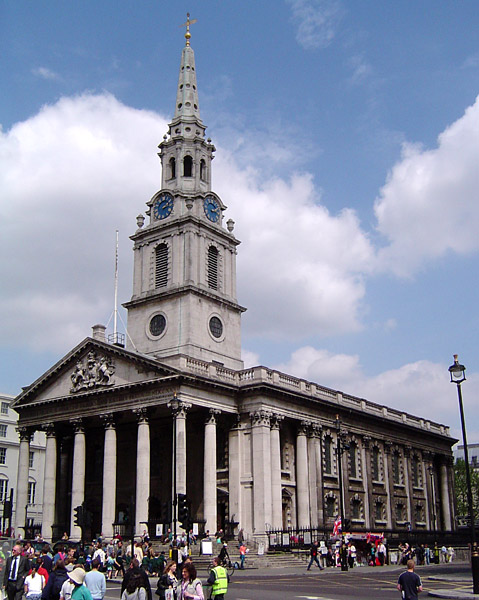
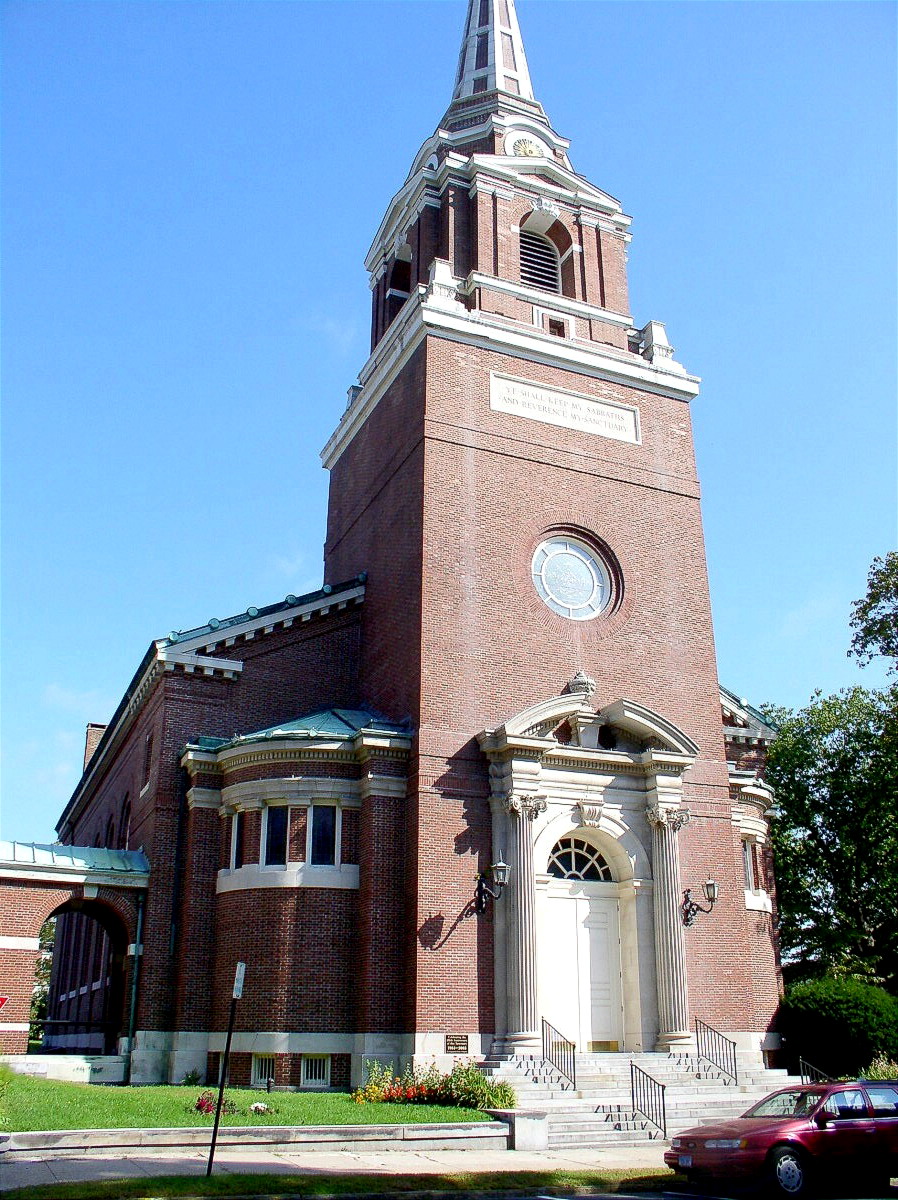
    A fire in 1906 destroyed his father’s church, Central Presbyterian, which had occupied a quasi-gothic building constructed in 1858 at Jackson and MacNab Streets. The congregation decided to relocate a bit farther south of the city’s centre to Caroline and Charlton Streets. The completed structure borrows from a number of influences, including the Church of St. Martin-in-the-Fields in London and the Congregational Church of Naugatuck, Connecticut. One of its more unusual features is that it has a flat roof, thereby resembling more the public edifices favoured by the Beaux-Arts school than the traditional European church. Nevertheless, the church’s interior is dominated by a series of traditional stained-glass windows portraying stories from the Bible. This juxtaposition of the modern and the traditional appears to vindicate McArthur’s choice of title for his book. So satisfied was Lyle with the outcome of his efforts that he incorporated a black silhouette of the building into his personal bookplates. The spire of Central is a distinctive landmark visible throughout the surrounding neighbourhoods.

    From here Lyle would go on in 1913 to design the Great Hall of Toronto’s Union Station (see book cover above), familiar to generations of commuters who have passed through it twice daily. While other urban railway terminals have seen the wrecker’s ball in recent decades, this building continues to serve the travelling public much as it did when it first opened.

    Throughout his career, Lyle was much in demand by the nation’s banks, where the neoclassical style was favoured in the early years of the 20th century, perhaps as a way of impressing would-be depositors with the imposing nature of their own financial solidity.

    Among the Hamilton landmarks for which Lyle was responsible are the palatial home Wynnstay, now Mount Mary Immaculate, in Ancaster (1925); the Gage Memorial Fountain in Gage Park (1926); and the Hamilton High Level Bridge, where York Boulevard passes over the Desjardins Canal (1932). Other well-known Lyle designs include the Memorial Arch at Kingston’s Royal Military College (1921); and the Runnymede branch of the Toronto Public Library (1929), which incorporated English, French Canadian and aboriginal elements. I myself used to live near that branch three decades ago and visited it on occasion.

    Also notable are the designs Lyle submitted for projects later awarded to others. Two examples are worth mentioning. In 1907 his proposal for the buildings of the Justice Department would have altered the landscape of the federal government’s public architecture by making it more resemble that of Washington, DC. When in 1922 The Chicago Tribune sought designs for its new building, Lyle’s unsuccessful effort featured neoclassical columns and, of all things, a spire reminiscent of the one he had placed atop Central Presbyterian Church!

    Incidentally, Lyle's grandson recently donated a copy of this book to that church's library, where I came across it a few weeks ago after sunday worship. The family is to be commended for helping to disseminate knowledge of their forebear's contribution to Canadian architecture.

    06 August 2009

    August snippets

  • Fr. Raymond J. De Souza fears for the future of religious liberty in Canada, and with some justification: The unnecessary defeat of the Hutterites. Fr. De Souza:

    My late mentor, Father Richard John Neuhaus, used to argue that if the state is secular and small, the danger to religious liberty can be contained. But if the state is large, and everywhere the state goes religion must retreat, then religious liberty is imperilled.

  • Two more posts have gone up on my Genevan Psalter blog: Song of Hannah and Singing the Psalms: Presbyterian Church in Canada.

  • The Hungarian media have picked up on a recent article I published in Comment: Demokrácia vallás nélkül? I can make out my name and the links to my book and blog, but that's about it. Hungarian is a Finno-Ugric language distantly related to Estonian, Sami and the Finnish language spoken by my maternal forebears. I'd love to know what the article says, as well as more about the periodical Népszabadság that carries the article. Any Hungarian speakers out there who might lend a hand?

  • Nearly fifty years after the old Co-operative Commonwealth Federation struck an alliance with the labour unions and rechristened itself the New Democratic Party, some members of the latter are toying with the possibility of another name change: What's in a name? The NDP mulls a change in moniker, and Putting 'new' back in the NDP. My suggestion? The Social Democratic Party of Canada, thus emphasizing its connection with similar, more successful parties elsewhere, e.g., the British Labour Party, the Australian Labor Party and Germany's Social Democratic Party. Might as well give it a try. After all, given that its federal record rivals that of the Chicago Cubs, it's not as though it has anything more to lose.

  • I have recently come across a marvellous book, A Progressive Traditionalist: John M. Lyle, Architect. Lyle designed the building that houses our family's congregation, Central Presbyterian Church, here in Hamilton, as well as Toronto's Union Station and many more structures. Given my longstanding interest in architecture and urban planning, I will be posting more on this book in the near future.

  • Did you know that Baron Georges-Eugène Haussmann, Napoleon III's Prefect of the Seine and designer of the new Paris, influenced Daniel Burnham's Plan of Chicago? This year marks the 200th anniversary of Haussmann's birth and the 100th anniversary of Burnham's Plan. And did you know further that Abraham Kuyper was an outspoken critic of Haussmann's efforts? This is the subject of another forthcoming post. Stay tuned.

  • Life on Mars unlikely, methane mystery suggests. The phenomenon described sounds vaguely familiar to this earthling. Indeed is it possible that the red planet itself might occasionally "break wind"?

  • I have just received word that my book, Political Visions and Illusions, has gone into a third printing almost two years to the day after it went into a second. I am, of course, grateful that it continues to be read and valued.
  • 28 July 2009

    'World-and-life-viewitis' revisited: a response to Hart

    Now that we have returned from our holiday on the balmy shores of the Huron Sea, it is time to respond to Darryl Hart's Losing the Keys and Finding a World View and to one of the comments he left in my original post on the subject.

    Let me begin by observing that, because Hart has not offered a point-by-point rebuttal to my arguments, I am unable to respond on that level. What he has done is to employ a form of argument which, if it is not precisely ad hominem in character, certainly skirts at its edges. Says Hart:
    But we are befuddled that folks like Koyzis do not seem to notice that most of the places where neo-Calvinism has tried to remedy secularism have also brought liberal Protestantism (or at least a movement away from Reformed Christianity) with it.

    If a colleague gives me a paper he has written for my critique, it would generally not do for me to tell him in response that he has ugly circles under his eyes. To be sure, he may have been up late any number of nights working on this essay, and I may judge that he was unwise to do so at the expense of his health and alertness. In fact, his lack of sleep may have affected the quality of his paper. But to comment on his altered appearance does not in itself address the flaws in his argument.

    Similarly, there may be all sorts of problems within the neocalvinist fold. Given that neocalvinists, like other Christians, are sinners saved by grace, it should not be unexpected that there will be failings — perhaps even spectacular failings — amongst them. To pretend otherwise would be naïve. Yet what is lacking in Hart's critique is a persuasive argument as to why the neocalvinist position logically leads in a liberalizing direction. Instead his argument is an appeal to fear: we don't want to end up like. . . [fill in the blank]. I might also point out that many of the older Reformed and Presbyterian bodies in Europe and North America experienced the effects of liberalism well before the arrival of neocalvinism on the scene.

    Now it is true that neocalvinists have generally sought to build bridges to their fellow Christians in other traditions. They are not to be found in any single denomination, although their ecclesial roots are generally in Dutch Calvinism, and especially the Christian Reformed Church in North America. While many if not most of us, contrary to Hart's accusation, greatly appreciate the importance of the institutional church, we will not turn aside those evangelicals with more voluntaristic/baptistic views of the church. If Hart objects to this ecumenical focus in neocalvinism, then I suppose I would have to admit, for myself at least, to being guilty as charged. I will leave him to come up with the appropriate penalty for the likes of me.

    One last point on the institutional church: I might indicate, to extend an olive branch, that I find much to like in many of the essays collected in Hart's Recovering Mother Kirk. His analysis and critique of evangelicalism with respect to ecclesiology and liturgy are dead-on. As someone with a special love for the biblical Psalms, I particularly applaud his endorsement of their use in the church's liturgy and hope his efforts at recovering sung psalmody bear fruit amongst his students and readers. I have listed his book in the bibliographic page of my own Genevan Psalter website. I would love to keep our conversation going on this topic at least.

    Let us now turn to the rest of life outside the formal context of the worshipping community. Here once again is where Hart's position is weakest, and thus far he has said nothing to persuade me otherwise. Decades ago philosopher Herman Dooyeweerd showed the connection between the pretended autonomy of theoretical thought, as manifested in the special sciences, and the secularizing direction of western civilization. Hart again: "Many two-kingdom advocates [in whose company he counts himself] are not pleased with the way the West is going, or the state of higher learning in North America." Yet it is not at all clear how a solution will be found in re-emphasizing the neutrality of human reason in the face of the manifold ideological distortions it has facilitated and then tried to disguise. If there's a logical connection, he had best explain it, because his approach looks to me like an effort to turn back the clock to an earlier stage in the progression of the disease, rather than an attempt to remedy the disease itself.

    But then there's this:
    One point that neo-Calvinists don’t seem to understand about two-kingdom thought is that the two-kingdom view is not a solution to this world’s problems; two-kingdom folk actually don’t believe solutions will come in this fallen world until the consummation.

    Whether or not Hart means this to apply to problems in the academy is unclear. If so, it appears to allow him an out with respect to the point I made in the previous paragraph. If we Christians must await the arrival of the eschaton to address the problems of this world, then perhaps it doesn't matter ultimately what we do with our schools, universities, businesses, labour unions, &c. And if this is true, then my objection that his commitment to neutral reason will inevitably secularize the university is perhaps beside the point, which I suppose leaves us nothing left to discuss.

    Finally there's this curious remark from the comments to my first post. Hart again:
    If I accept the liberal [political] order it is simply because it is a historical reality that makes pining for the Netherlands circa 1901 or the Holy Roman Empire around 1400 unbecoming.

    So neocalvinists are reactionaries? I thought we were liberalizers. Which is it? This smacks of going after the beast with whatever weapon is at hand, appropriate or not. If a spear doesn't do the trick, try poison. If poison fails, there's always a pistol. Something's bound to work eventually.

    I will reiterate something I hinted at in my first post. The validity of a particular school of thought can be assessed by how well it accounts for the fulness of created reality. In this case there is simply too much of life that Hart's worldview — and yes, he does have one! — cannot take into account.

    24 July 2009

    Piper on Kuyper

    I do not know John Piper's works at all well, though I had some contact with him personally during his stint teaching at my undergraduate alma mater, Bethel College (now University), some 35 years ago. I do know any number of people who have benefited from reading his many books. Up to now, however, I have not usually associated cultural critique with Piper and his followers. This could be changing, if the following is any indication: America's debt to John Calvin. Where he might go from here I don't know, but it is encouraging to see him recommend Abraham Kuyper's Lectures on Calvinism. Might this form the basis for a fruitful dialogue between Kuyperians and Piperians?

    22 July 2009

    Catholicism and international relations

    For educators attempting to engage their students to think christianly in their respective academic endeavours, Daniel Philpott's essay is a welcome and inspirational effort rooted in the Roman Catholic tradition of political reflection: One Professor’s Guide To Studying International Relations and Peace Studies From a Catholic Perspective. From the introductory paragraph:

    Whatever else this passage [Colossians 1:15-20] means, it seems to say that all things, including thrones, powers, rulers, and authorities — that is, politics — were created and redeemed by Christ. There is nothing in the universe which escapes this fact, this logic. Does not this then imply that political pursuits are to be oriented towards Christ and his creative and redeeming work? This may seem like a difficult thing to imagine in a world where Stalin’s logic — or at least the logic of power and interest — seems again and again to prevail, tempting us to conclude that what the Church professes only has a limited and circumscribed significance. But if we believe what the Church professes, then this is not the case. The victorious resurrection of Christ is a total victory, applying to all things, even if it is not yet consummated. And if we believe what the Church professes, then we are called to participate ourselves in this victory.

    18 July 2009

    Last of Great War survivors

    We will not be seeing many more reports like this: Oldest WW1 veteran dies aged 113.

    14 July 2009

    July snippets

  • Since Pope Leo XIII published Rerum Novarum in 1891, he and his successors have on occasion seen fit to publish social encyclicals on topics related to political, economic and social issues. Now Benedict XVI has released the most recent such document, Caritas in Veritate, on which I will undoubtedly be commenting at some point. The current Pope's third encyclical is written against the backdrop of the current economic crisis and, apparently, in somewhat tardy observance of the 40th anniversary of Paul VI's Populorum Progressio.

  • Historical-critical approaches to the Bible attempt to determine the various layers of sources seemingly interwoven in a single canonical book or group of books, such as the Pentateuch and Samuel/Kings. Such efforts can be speculative at best and not infrequently based on the highly contestable undergirding assumptions of the critic him- or herself. Papal biographer George Weigel appears to be employing something of this method in analyzing Benedict's new encyclical: Caritas in Veritate in Gold and Red. Could it be that Weigel's own convictions influence where he sees Benedict's hand (good) and the Pontifical Council for Justice and Peace's hand (bad)?

  • Despite pleas from the Archbishop of Canterbury, the (American) Episcopal Church has now effectively broken with the larger Anglican Communion. Where it will go from here remains to be seen, but it will have difficulty maintaining any pretence to catholicity, and perhaps even to Christianity, if current signs are any indication.

  • On this 220th anniversary of Bastille Day, I shall celebrate the occasion by citing Edmund Burke's sage advice to the French Revolutionaries:
    You would not cure the evil by resolving that there should be no more monarchs, nor ministers of state, nor of the gospel; no interpreters of law; no general officers; no public councils. You might change the names. The things in some shape must remain. A certain quantum of power must always exist in the community in some hands and under some appellation. Wise men will apply their remedies to vices, not to names; to the causes of evil which are permanent, not to the occasional organs by which they act, and the transitory modes in which they appear. Otherwise you will be wise historically, a fool in practice.

  • My recent post, D. G. Hart and 'world-and-life-viewitis', has stimulated considerable debate in the comments window and a response from Hart himself: Losing the Keys and Finding a World View. Rather than add to the comments, I shall post a fuller counter-response on the blog itself. Stay tuned.
  • 10 July 2009

    Bon anniversaire, M. Calvin


    Still looking good after five centuries

    01 July 2009

    True north


    And while we're at it, see here for a powerpoint history of Canada's flag.

    29 June 2009

    An important debate

    Comment has just published my article, titled: Religion and democracy: Habermas vs. Flores d'Arcais. From the first paragraph:
    Few issues ruffle more feathers, more frequently, than the place of religion in the political realm. According to the reigning modernist framework, rooted either in liberal individualism or in some form of secular collectivism, the state is neutral territory. Here neutrality is defined, not merely as formal indifference to what John Rawls labels the comprehensive doctrines that divide the particular communities comprising the state or nation, but as emptying the public square of every value-laden worldview that resists rational discussion and therefore threatens to divide a polity.

    Feel free to read the rest if you are so inclined.

    25 June 2009

    D. G. Hart and 'world-and-life-viewitis'

    Darryl G. Hart has fought hard to make himself the bête noir of the christian university community in North America and, truth to tell, he has largely succeeded. This is a typical entry from his blog: If the Bible Speaks to All of Life, Why Not the Confession? Here's Hart in his own words:

    [A] recent speaking engagement at Grove City College . . . got me thinking about the world-and-life-viewitis that has reached epidemic proportions among Protestants. Most evangelical Protestant colleges these days are justifying their existence and identity by saying they provide a wholistic [sic] vision on learning that is grounded in the Christian faith. The Lordship of Christ, the authority of Scripture, even the cultural mandate come in for aid and comfort.

    This ideal is an honorable one and springs from generally wholesome motives. Who would not want to see Christ honored in all aspects of the created order, and who would want to be unfaithful where Scripture has revealed God’s holy will?

    There’s just one problem: the Bible doesn’t speak to all the arts and sciences, let alone whether incoming freshmen should receive a laptop or whether it should be an Apple or an IBM machine. In fact, the one place where Christ is revealed, the Bible, has very little to say about the curriculum of an undergraduate education. If we say that it does, we are in danger of putting the imaginations of men above the Word of God — that is, making the Bible say what we want it to say.

    This point becomes pretty plausible if we consider that the Reformed creeds and catechisms have nothing to say about rhetoric, logic, grammar, music — the list could go on but not much longer for the medieval university’s curriculum. It has even less to say about quantum physics or critical theory and the vast range of subjects offered by today’s universities. But if the Bible speaks to all of these areas of human endeavor and inquiry, don’t we need to revise the confessions so that the church may rightly speak on what God has revealed?

    Or could it be that what the creeds and confessions teach is pretty much the sum of what the Bible reveals? In which case, for the other areas of life we are left to our reasonable ability to make sense of God’s created order, thus leaving the church jurisdiction over divinity and the university faculty authority over the arts and sciences.

    Hart represents a particular school of Reformed Christians who not only put great emphasis on the confessions of the 16th and 17th centuries, but also put something of a lutheranizing two-kingdoms spin on these confessions and on the Scripture on which they are based. This school is primarily associated with Westminster Seminary California, Hart's former employer. The expanding influence of Abraham Kuyper's worldviewish Christianity comes in for special criticism from this group.

    In response three points can be made here.

    First, Hart is correct to observe that the Bible has nothing to say about quantum physics and a host of other issues. He is also right to assert that we should not try to make it say what it doesn't say. My friend Roy Clouser has addressed this error in speaking of the encyclopedic assumption, i.e., the belief that the Bible is a kind of encyclopedia giving us scientific data about human origins, astronomy and, well, even political science.

    However, Hart is missing something of the all-embracing character of the life in Christ as understood in Scripture as a whole. One need hardly accept the encyclopedic assumption to recognize that biblical religion has implications for how we live all of life, not just what we do in church on sundays: "So, whether you eat or drink, or whatever you do, do all to the glory of God" (I Corinthians 10:31). Or this, also from St. Paul: "So then, just as you received Christ Jesus as Lord, continue to live in him, rooted and built up in him, strengthened in the faith as you were taught, and overflowing with thankfulness. See to it that no one takes you captive through hollow and deceptive philosophy, which depends on human tradition and the basic principles of this world rather than on Christ" (Colossians 2:6-8).

    Second, and perhaps more seriously, Hart's approach to Scripture is based on an inadequate epistemology. The Bible, it seems, is filled with a number of propositions, which have relevance to some of our activities in God's world, but not to most. In this huge swath of territory we simply rely on our own native reason, which we share with all human beings, whatever their religious commitments. Scripture informs our spiritual life, but not much beyond that. If Hart is correct about this, then it is little short of amazing that so many people emphasizing the need for a consistent christian worldview have found so much to write about. Are the issues to which they draw attention not genuine issues? Can their concerns be dismissed so easily?

    In my own Political Visions and Illusions I undertake to explore the five political ideologies of liberalism, conservatism, nationalism, democratism and socialism. Despite their respective followers having access to reason, they nevertheless manage to embrace quite different visions of politics and indeed of reality as a whole. It is not too difficult to see the impact of more than one mutually incompatible worldview at play. It is also evident that these are a matter of adherents making entirely too much of a good thing, which is what Scripture calls idolatry. If Scripture is silent on a lot of particular things, it speaks clearly on idolatry, which inevitably affects the whole of life, including those academic disciplines left up to "our reasonable ability."

    Third, Hart's approach must be viewed against an historical trajectory that has seen the secularization of any number of universities over the centuries, despite their christian origins. Here's Hart once more: "Or could it be that what the creeds and confessions teach is pretty much the sum of what the Bible reveals? In which case, for the other areas of life we are left to our reasonable ability to make sense of God’s created order, thus leaving the church jurisdiction over divinity and the university faculty authority over the arts and sciences." I agree that the church as institution should not attempt to pronounce in the arts and sciences. But Hart appears to be saying more than this. If we read this in light of what he's said above, we are left with a pretty toxic mix, and one that has led to the erosion of the christian character of countless universities in the past, from Harvard and Yale to Hamilton's own McMaster University, whose Divinity College sits with increasing unease on its campus among the other faculties of arts and sciences.

    Disparage as he might the supposed pandemic of world-and-life-viewitis amongst evangelical Christians, Hart's approach does not represent a workable alternative. There is simply too much that it does not take into account, and for that reason it is unlikely to gain a foothold in the christian universities of North America. Though he undoubtedly has much to offer in the fields of "divinity" and liturgy, if we seek discernment with respect to the idolatries afoot in "secular" areas of life, we had best turn elsewhere.

    24 June 2009

    Wills on Buckley

    Half a century later it is difficult to recall that William F. Buckley and Garry Wills were once friends and colleagues at the former's National Review. This was before they parted on less than amicable terms. Given this longstanding rivalry, ending with apparent reconciliation a few years before Buckley's death, some of us may not know quite how to read Will's testimonial to one of the leading lights of American conservatism: Daredevil. On the surface it reads like an affectionate tribute, but then there's this:

    Bill was not, and did not pretend to be, a real intellectual. He gave up on the “big book” that his father and others were urging him to write. For years he tried to do a continuation of José Ortega y Gasset’s The Revolt of the Masses. This had been a sacred text for his father’s guru, Albert Jay Nock. Bill took intellectual comrades like Hugh Kenner with him for his winter break in Switzerland, to help him get a grip on this ambitious project. But he told me he realized in time this was not his métier. He was not a reflective thinker. He was a quick responder. He wrote rapidly because he was quickly bored. His gifts were facility, flash, and charm, not depth or prolonged wrestling with a problem.

    Bill needed people around him all the time. Frequently, when he told me he had to write a column, I would offer to withdraw from the boat cabin or hotel room where we were. He urged me not to, and as he typed (with great speed and accuracy) he would keep talking off and on, reading a sentence to me, trying out a word, saying that something he was writing would annoy old So-and-So. When I appeared on his TV show to discuss a new book of mine, it was clear to me that he had not read the book—he was given notes on each author he interviewed. Once he asked me if I had read all of Adam Smith’s Wealth of Nations. I said yes. “Haven’t you?” He had not. I suspect that was true of the other capitalist classics he referred to, by Ludwig von Mises, Wilhelm Roepke, and others. He could defend them with great panache. But he did not want to sit all by himself for a long time reading them. One of his teachers at Yale, the philosopher Paul Weiss, told me that Bill was very good at discussing books he had not read.

    That doesn't even measure up to damning with faint praise. But Wills is kind enough to show us the salutary influence he himself had on his former mentor, successfully breaking him of his racism, antisemitism and, eventually, even his war-hawkishness. It's nice to know that Wills was in the right all along and that Buckley might even admit it if he were still around. Of course we'll have to take Wills' word for it, won't we?

    Followers

    Blog Archive

    About Me

    My photo
    Contact at: dtkoyzis at gmail dot com