20 September 2003

The Apocrypha

Since I was in my early teens I have occasionally wondered about those many writings from two or more millennia ago that are not part of the Bible as recognized by the Christian Church. I was especially fascinated by that collection of "borderline" books known by protestants as the Apocrypha and by Catholics as the deuterocanonical books. Why, I wondered, were these accepted by Catholics as part of the Old Testament and not by protestants? What criteria were used by the Reformers to reject and by their opponents to accept them? After reading them through, it was not immediately obvious to me that the canonical books of, say, Esther or Song of Songs were superior to the apocryphal books of I Maccabees or Ecclesiasticus. In fact, as I've written before, I rather like the Canticle of the Three Holy Children in chapter 3 of the long version of Daniel, which is often sung in the service of Morning Prayer in the Book of Common Prayer. Moreover, while the shorter Hebrew version of Esther deliberately avoids any reference to God, the extended Greek version not only adds such references but even includes some prayers, most notably Esther's prayer before entering the king's presence to request his protection of her people.

Augustine quotes from these books, along with the undisputed books of the Old Testament, without making a distinction between them. But Jerome, who translated the Latin Vulgate, distinguished between the narrower Hebrew canon and the additional books found in the Septuagint, preferring the former to the latter.

Of course, in effect, every ecclesiastical communion has defined the extent of the canon of Scripture, and fortunately the areas of agreement are much larger than the areas of disagreement. All agree on the books of the New Testament. And all agree on the thirty-nine books of the Hebrew Old Testament. But the Roman Church includes the so-called deuterocanonicals, while the Orthodox Churches recognize even more books such as III and IV Esdras, the so-called supernumerary Psalm (sometimes called Psalm 151 in some English translations), the Prayer of Manasseh and III Maccabees. Moreover, the Russians and Greeks are not even in precise agreement with each other on which of these to include. The Russians seem to prefer the narrower Hebrew canon, judging from a Russian Bible in my personal library published by the Patriarchate of Moscow. (The additional books are included, but they are clearly marked as "noncanonical.")

So who is right? Who decides who is right and on what basis? Here the traditional protestant sola scriptura is no help to us. Do we Reformed Christians accept the narrower Hebrew canon because the Belgic Confession tells us to? I doubt it, because the Reformed confessions themselves admit that the church can err. Yet in so defining the canon we are at least ratifying an earlier decision of the church made prior to the schisms of the past millennium. How indeed do we know that the church was not in error at that time?

The Belgic Confession has this to say concerning the canonical books of the Bible:

And we believe without a doubt all things contained in them -- not so much because the church receives and approves them as such but above all because the Holy Spirit testifies in our hearts that they are from God, and also because they prove themselves to be from God (Article 5).

This seems to me rather neatly to sidestep the question of how we know the limits of the canon. The Spirit may indeed testify in our hearts, but as individuals or as a body? And if the latter, then are we not back to church authority? And if the former, then how do we account for disagreements? And how do we know that we, whether as individuals or as a body, are accurately (infallibly?) discerning the testimony of the Spirit in our hearts?

After all is said and done, however, I am not inclined to advocate wholesale acceptance of the Apocrypha as canonical, so I am probably closer to the Reformed tradition anyway, for whatever reason. Many of these books are much too hellenistic in their worldviews. The Book of Wisdom is distressingly platonic when it says: "a perishable body weighs down the soul, and this earthly tent burdens the thoughtful mind" (Wisdom 9:15). And 8:19-20 seems to presuppose the pre-existence of the soul before birth -- something obviously fitting in with a more platonic anthropology.

I suppose I take comfort in the fact that the various churches agree more than they disagree on the canon. Everyone reads Isaiah, whose divinely inspired status is evident to all. We all read and sing the 150 Psalms, something that unites church and synagogue in praising God, reciting his great deeds, and lamenting adversity. When all is said and done, I tend to take the approach of the Thirty-Nine Articles of the Church of England, which state:

And the other books (as Hierome [Jerome] saith) the Church doth read for example of life and instruction of manners; but yet doth it not apply them to establish any doctrine.

19 September 2003

Hurricane Isabel, at last

The tail end of Isabel passed through southern Ontario this morning around 8 o'clock. We received quite a bit of rain. There's standing water everywhere. It was also pretty windy at one point. But by late morning the worst of it was over, and really it was not all that bad, considering what our neighbours to the south received. I look forward to hearing from friends and family in Virginia, Washington and southern Pennsylvania to see how they (unmetaphorically-speaking) weathered the storm.
So who's right on Iraq?

Although no one accuses Chicago's Fr. Andrew Greeley of being an expert on middle eastern affairs, he claims to know enough to judge that President Bush is lying about Iraq's significance in the war on terrorism. Writes Greeley in a Chicago Sun-Times opinion piece:

There is not and never has been any evidence that Iraq was involved in the 9/11 attack. None. The implication of such involvement was an attempt to deceive, a successful attempt at the big lie.

I'm not sure that the president knows it is a lie, however.

Also, the weapons of mass destruction story was never true. It now appears that Saddam panicked in 1995 when his sons-in-law defected to Jordan and revealed the truth about his weapons development. He immediately ordered the destruction of all the evidence. The U.N. team before the war would have no more found any weapons than the Americans after the war.

One wishes that Greeley and Stephen Hayes could be brought together in the same room to hash out what the truth of the matter is. Either the evidence is there or it's not. The rest of us would like to know for sure.

18 September 2003

Latinized surnames

Centuries ago, when Latin was the lingua franca of Europe, educated people used to adopt latinized forms of their own surnames. Thus the Dutchman Huig de Groot became Hugo Grotius (1583-1645), author of On the Law of War and Peace and father of international law. Similarly Johann Althaus, became Johannes Althusius (1557-1638), the father of modern federalism and a precursor to neocalvinism. Moreover, the authors of the Heidelberg Catechism, Zacharias Baer (or Bär) and Caspar Olewig, became Zacharias Ursinus and Caspar Olevianus respectively. In Sweden and Finland members of the clergy often had latinized names, like Lars Laestadius, who brought revival to northern Scandinavia in the 19th century.

I wonder what sorts of names we would choose if we were to latinize our own surnames?
Hurricane Isabel

It is still looking very likely that the remnants of Hurricane Isabel will be passing through the region tomorrow, carrying heavy rains and high winds. We had planned to go to the Ancaster Fair on saturday, but this may alter our plans.
Dawson, liberalism and Christianity

The Catholic news service Zenit carries an interview with Gerald Russello on the place of Christianity in the old and new Europe. Here he suggests, following historian Christopher Dawson, that liberalism has effectively dechristianized Europe more easily than communism was able to do. Asked to compare the thought of the current pope with Dawson, Russello answers as follows:

Dawson shares with John Paul II an appreciation of some achievements of modernity, as well as its limitations. Dawson wrote: "The liberal movement in the wider sense transformed the world by an immense liberation of human energies, but liberalism in the narrower sense proved incapable of guiding the forces it had released."

Dawson devoted much of his work to trying to reintegrate the achievements of modern society with its religious and spiritual foundations, in an effort to protect and further the spiritual dimension of human life. I believe Pope John Paul II, in encyclicals such as "Centesimus Annus," expresses a similar point.

Both saw in the rise of the consumer culture a strong challenge to traditional Christian morals. What John Paul II has called "the culture of death" was very much in Dawson's mind as he wrote in the 1950s and 1960s when the totalitarian threat of Nazi Germany had passed.

Although Communism remained a threat, Dawson was convinced that the internal dissolution of Christian culture from the pressures of economic and moral liberalism was a graver threat. Because liberalism dispenses with acknowledging spiritual values, it becomes vulnerable to appeals to economic utility or political power.

Both Dawson and Pope John Paul would agree, I think, that these cannot substitute for a religious faith that expresses eternal truths and a rich spiritual life.

Perhaps this goes some way in explaining why post-communist Poland is still a more Catholic country than either France or Italy.

17 September 2003

Radio interviews

On monday morning I had the most recent in a series of radio interviews arranged by my publisher. Most of these have been with christian stations of some sort in the US. But this one was for a programme on a secular network, albeit with a christian host. More such interviews are being scheduled, especially for next year, which will see a presidential election south of the border.

By now I am getting a pretty good sense of what makes a good interview and, indeed, a good interviewer. One can expect, of course, that guests on such shows will have varying public speaking skills. Thus a good interviewer will try to make his guest feel as comfortable as possible and to draw out the best from him. Much as a good choral conductor can get a wonderful sound out of mediocre voices, a good interviewer can make a guest who is a relative neophyte sound like an experienced radio personality. This he does simply by asking the right questions -- questions that do not have monosyllabic yes or no answers but lead to further reflection and conversation of interest to the listening audience. He will not shy away from humour and will refrain from taking himself too seriously. And, needless to say, it helps enormously if he has actually read the book the guest has written.

I can tell you that being interviewed by such a person is a great experience. I hope to have more interviews like this in the coming year.

16 September 2003

Age's quest for puerility

Today's Breakpoint commentary by Chuck Colson is titled "My Own Private Neverland: A Culture of Lost Boys." It concerns the trend, especially amongst my own baby boomer generation, to cultivate deliberately juvenile tastes and to spurn adulthood. Writes Colson:

A surprisingly large part of the audience for children’s television shows like the Teletubbies are “young adults.” And more people between the ages of 18 and 49 watch the Cartoon Network than watch CNN. And I’m not making that up.

He doesn't say whether these "young adults" might themselves be parents of small children, which would explain their viewing habits. But let's assume he has picked up on a genuine trend. I personally believe he's on to something.

Could this grasping for childish things be one of the ripe fruits of the liberal emphasis on the self and on individual rights? The demand for rights without the countervailing recognition of responsibilities is, after all, exactly the sort of thing one expects from children, apart from the restraining influence of parental discipline. Now it increasingly receives the sanction of the courts, as well as of the larger popular culture.
Age's debt to youth

Many thanks to Rob Joustra for showing me how to put sidebar items in my blog template. He is a kind and beneficent person.

The limits of compassion in politics

Public appeals to compassion have become ubiquitous at the beginning of a new century. A few years ago one of Canada's major daily newspapers carried a photograph of quadriplegic actor Christopher Reeve, who was paralyzed as a result of an accident in 1995. As is well known, Reeve has been working tirelessly in the cause of research into spinal cord injuries. The photo was captioned with the plea that fetal tissue research is the only hope for Reeve to regain the use of his limbs. Naturally the reader was expected to sympathize with Reeve’s predicament, the solution to which is blocked only by the apparently irrational – and uncompassionate – objections of anti-abortionists.

About a decade ago an opinion piece appeared in a christian periodical arguing that the legalization of abortion in the United States was a genuinely progressive development favourable to the well being of women everywhere. Those opposed to the abortion licence were guilty, in the author's estimation, of erecting barriers to compassion for women.

The electronic media often feature reports of someone adversely affected by some policy pursued by some government somewhere. Clearly we are expected to oppose such a policy, ignoring the fact that, if another policy had been pursued, someone else would have suffered from its consequences. Clearly, appeals to compassion are not enough to bring about justice.

There is no doubt, of course, that we are called to have compassion for others. Many of us were initially drawn to politics out of a concern for those suffering from unjust policies. The fact that so many of my relatives became refugees in Cyprus in 1974 was a strong motivation to understand the political process and the roots of such injustices. It also gave me compassion for others in a similar predicament, especially Palestinian refugees who are treated as strangers in their own land.

All the same, in recent years I’ve come to understand the limits of compassion in politics. I’ve grown suspicious of politicians who claim to be able to feel our pain.

To begin with, if compassion is the desire to alleviate people’s suffering, then this mere desire is not sufficient grounds for assessing the justice of a proposed action. An unmitigated compassion may prompt us to forego punishment because it inevitably causes suffering. But if the punishment is deserved, then to refrain from imposing it would be unjust.

Second, compassion by itself tends to lead, not to justice, but to favouritism and one-sided advocacy. Compassion is necessarily selective. Our ability to enter into the suffering of others cannot be stretched indefinitely. Parents naturally feel for their own children more than they do for others'. We suffer along with our friends in adversity more than with mere acquaintances, or with the faceless names we read about in the papers. There is nothing wrong in this; it is simply part and parcel of our created limitations.

Only God himself is capable of entering into the suffering of all, as he did in the person of Jesus Christ. I may be touched by the plight of the Palestinians, but my compassion for them may blind me to the legitimacy of claims made by Israelis – especially of "sabras" who were born, grew up there and know nothing else – to the same land and resources. In the politics of compassion one helps only those with whom one is able to feel suffering. The suffering of others further removed from oneself is somehow deemed less valid.

Thus Marxists are moved to action by compassion for the proletariat, but in attempting to emancipate oppressed workers, they are unmoved by the suffering they may cause those getting in the way of their agenda. The irony is that appeals to compassion can be a cover for acts of genuine cruelty, scores of millions of which were committed by the heirs of Marx and Lenin in the former Soviet Union and China.

Finally, arguments from compassion are often a way of shortcircuiting the deliberative process – of keeping some arguments from being heard. If politics necessarily entails conciliating diverse interests in accordance with public justice, then arguments need to be heard from all sides before a decision is made. Ruling an argument out of court too soon on the grounds that it is not compassionate is a recipe, not only for less than peaceful politics, but for outright injustice.
Praying the rosary

It seems that Anglicans are discovering the rosary, or prayer beads, as indicated here: "Anglican rosary changes the way some people pray." Given that prayer beads are used in a number of christian traditions, I cannot help but wonder whether there is anything comparable within the Reformed tradition.
Cyprus and Malta and the EU

On 1 September a meeting was held in Prague of representatives of the smaller states in or shortly to become part of the European Union. But Cyprus and Malta were not invited. Now the Czech government is claiming that this was due to an oversight. Czech foreign minister Cyril Svoboda has issued a formal apology and has promised that the mistake will not be repeated.

15 September 2003

Isabel headed this way?

Well, isn't this nice. The latest maps from the National Weather Service's Tropical Prediction Center show the centre of Hurricane Isabel heading straight for southern Ontario -- the Niagara Peninsula and Toronto, to be exact. Let's hope we don't see a repeat of Hurricane Hazel.
Student post boxes at Redeemer

For some odd reason, this year the student post boxes at Redeemer are alphabetized from right to left rather than from left to right, as they had always been in the past. Perhaps this is part of an effort on the part of our front office to recover Christianity's Hebraic roots.
Tallis' theme again

Yesterday morning at church the choir sang Horatius Bonar's familiar "I Heard the Voice of Jesus Say," set to Thomas Tallis' haunting Third Mode Melody, made famous by Ralph Vaughan Williams in his Fantasia on a Theme by Thomas Tallis.
Metrical psalters and the Book of Common Prayer

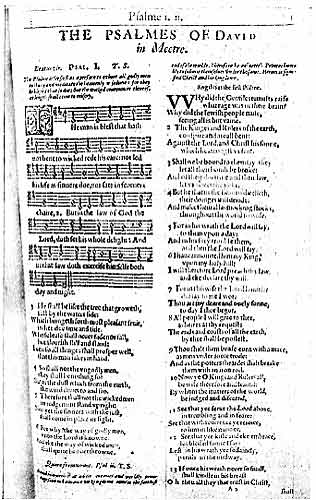
Although it is not very well known today, for the first two centuries or so after the Reformation, Anglicans used to sing metrical psalms, along with their Scottish Presbyterian and continental Reformed fellow believers. In fact, the various editions of the Book of Common Prayer generally included, in addition to Miles Coverdale's magnificent translation of the 150 Psalms, a full metrical psalter, often that of Sternhold and Hopkins or, later, Tate and Brady's "New Version" within the same cover.


Many years ago I found an ancient copy of the BCP and metrical psalter in one volume at a used bookstore in Toronto. Alas it was too expensive.

Some thirty years ago there was a revival of metrical psalmody in the Church of England with the publication of Psalm Praise (London: Church Pastoral Aid Society, 1973). One of this collection, Psalm 30, made it into the latest edition of the Christian Reformed Church's Psalter Hymnal. This has to be one of the more moving renditions of this psalm in any collection.

14 September 2003

A new blog

One of my students, Rob Joustra, has just started his own weblog. The subject matter? "Reflections on history, mythology, politics... 'life, the universe, and everything'." Well, that narrows things down, doesn't it?

Welcome aboard, Rob!

The Hungarian Reformed

Here in North America we know little about the Reformed Church in Hungary. Although the Roman Catholic Church is the largest of the ecclesial bodies in that country, the Reformed have a substantial presence. The number of Hungarian Reformed Christians, including those in the diaspora, is some 3 1/2 million. In east central Europe they live primarily in five countries: Hungary itself, Romania, Slovakia, Serbia and western Ukraine.

The Reformed Church in Hungary adheres to two confessions, the Second Helvetic Confession and the Heidelberg Catechism. The church is distinctive in that it is the only one of the Reformed churches to have bishops, who are nevertheless little more than district superintendents. Its members sing from the Genevan Psalter, as translated by Albert Szenczi Molnár in the 16th century.

Throughout the centuries there were close relationships between the Hungarian Reformed and the Dutch Reformed. These were lost during the four decades of communist rule in Hungary, but they are being re-established in the years since 1989. The Christian Reformed Church conducts its own Hungarian Ministries in an effort to assist the witness of its sister church in that part of the world.
More ancestors: Vladimir I of Kiev

I am teaching Russian politics this semester, which necessarily involves acquainting my students with the highlights of Russian history. Indeed I have long had a fascination for Russian history, ever since taking an undergraduate course in the subject nearly three decades ago.

Last year, during my genealogical researches, I discovered that among my direct ancestors is included Prince Vladimir I (also known as St. Vladimir, or, in Ukrainian, Volodymyr) of Kiev, who converted the people of Rus to Orthodox Christianity in 988.


He is variously my 30th through 37th great-grandfather, and I am descended from him in scores of ways, through two of my ancestors, David and Nancy Elkins Wells, my maternal 3rd great-grandparents. Of course, as I've written before, virtually anyone of European ancestry who might be reading this is similarly descended from him.

I have long admired the Russians. Is this descent enough to make of me a Russian? Can I truthfully call myself a Russian-Canadian? Perhaps, but then again so can virtually any reader of this blog. Furthermore, I might just as well call myself a Phoenician-Canadian, because Phoenicians settled my ancestral island of Cyprus close to three millennia ago. The farther back one is able to trace one's ancestry, the less statistically significant it is to claim to be descended from any one person living then. Scores of millions of others are similarly descended.

13 September 2003

Toronto versus Hamilton

Last evening I was in Toronto representing Redeemer University College at a banquet celebrating the 40th anniversary of Citizens for Public Justice. The event took place on the campus of the University of St. Michael's College.

I do not get to Toronto at all often these days, although I lived there for the two years I was studying at the Institute for Christian Studies. I loved living in Toronto, which is, as many Torontonians love to boast, a world class city. It is Canada's largest city and boasts a number of attractions, including the Art Gallery of Ontario, the Royal Ontario Museum, St. Lawrence Market, Kensington Market, Greektown, Chinatown, High Park, Queen's Park, and of course such popular tourist destinations as the Sky Dome and the CN Tower.

Toronto is filled with myriad ethnic neighbourhoods, along with the restaurants featuring their distinctive cuisines. There are lots of used book stores, and the University of Toronto Bookstore, right across the street from the ICS. And of course I love the public transportation system. At one time it could be said that Toronto was one of a very few North American urban centres featuring a more-or-less complete streetcar system. Now other cities have gotten back on the bandwagon with what they call light rail transit.

Then there's Hamilton, which is often thought to be Toronto's lesser, blue collar counterpart at the western end of Lake Ontario. I have lived in Hamilton for 16 years, and I do not believe this city has anything to feel inferior about. To begin with, Hamilton has more natural scenic beauty than Toronto. Most spectacularly we have the Royal Botanical Gardens, which I first visited way back in 1971. (I nearly lost my glasses at the Rock Garden!) Much of the scenery revolves around the Niagara Escarpment, a clifflike geological structure that cuts through the city on its journey from Niagara Falls to the Bruce Peninsula on Lake Huron. This makes for a large number of waterfalls located at various spots along the escarpment, including Websters Falls, Spencer Gorge and Sherman Falls.

Hamilton boasts a number of rail trails cutting through the Dundas Valley Conservation Area. These are ideal for walking and bicycling. Then there are the historic sites, such as Dundurn Castle and the Battlefield House Museum in Stoney Creek.

One can hardly beat the view from Highway 403 as one enters Hamilton from the direction of Toronto: Cootes Paradise is at the right, the escarpment is in the distance, and the neogothic spires of the Cathedral of Christ the King are at the left. Very impressive indeed.

Finally, Hamilton is a much more affordable place to live. Housing prices in Toronto are sky high, making it difficult for people from the outside to move in unless they have an exceedingly well-paying job. When all is said and done, Hamilton is a fine place to live.

12 September 2003

9/11 two years later: Modernity and its discontents

Prof. Mackubin Thomas Owens of the Naval War College in Newport, RI, undertakes to analyze the animosity between the west and the islamic world in "The End of the 'End of History'". He properly skewers the "end of history" crowd, that is, those, such as Francis Fukuyama, who believe that the spread of liberal democracy and free trade will make war obsolete. This was precisely the misconception of the naive optimists of the late 19th and early 20th centuries. Their illusions were shattered in August 1914.

Nevertheless, I wonder whether his own prescription for international order is really all that different, except that for him democracy and capitalism do not spread peacefully, but are imposed by a global superpower. Drawing on an article by his colleague, Tom Barnett, Owen writes:

9/11 revealed an emerging geopolitical reality: that the world's most important fault line is not between the rich and the poor, but between those who accept modernity and those who reject it. In a controversial article for Esquire (entitled "The Pentagon's New Map") and a series of briefings, my colleague at the Naval War College, Tom Barnett, has described a world divided between a "Functioning Core" and a "Non-Integrating Gap." The former, where "globalization is thick with network connectivity, financial transactions, liberal media flows, and collective security," is characterized by "stable governments, rising standards of living, and more deaths by suicide than murder." The latter, where "globalization is thinning or just plain absent" is "plagued by politically repressive regimes, widespread poverty and disease, routine mass murder, and — most important — the chronic conflicts that incubate the next generation of global terrorists."

The assumption is that the acceptance of secular modernity, in its various manifestations, is the solution to the problems of the "Gap." Osama bin Laden and his ilk see their premodern worldview threatened by the liberal democracy and capitalism emanating from the United States. They must be confronted and, it seems, eliminated, not simply managed. Over the past two years American policy has had to change:

The post-9/11 strategy is based on the idea that the only way to effectively deal with the dangers arising from the Gap is for the countries of the Core to intervene in the Gap with the goal of reducing it. The president seems to accept [the] contention that ignoring the Gap or, at most, seeking to "manage" it merely reduces further what little connectivity the Gap has with the Core and renders it more dangerous to the Core over the long haul.

This is, of course, a variation of the secularization thesis and is not really all that different from the views of Fukuyama, Alexandre Kojève and even, paradoxically, Canada's own George Parkin Grant. It views modernization as a single unidirectional movement sweeping up in its homogenizing path all of the particular cultures of the world. But now it is backed by the coercive force of the state.

That the world might be moving in a desecularizing direction, as observed by Samuel Huntington, Philip Jenkins, Paul Marshall and many others, appears to have escaped Owens' notice. If, as Owens urges, the US turns towards the imposition of a global hegemony by the "Core" over the "Gap" to protect its own vision of modernity, it will be engaging in a fruitless effort to fill the spiritual vacuum in the nonwestern heart with something that will ultimately fail to satisfy.

"Thou hast made us for thyself, and our hearts are restless until they find their rest in thee." Augustine, The Confessions.
The importance of being Ernie

I decided to attend the rally at Hamilton District Christian High School last evening, which was graced by the presence of our premier, Ernie Eves. The Reformed Christian community turned out in good numbers, and I saw quite a few people I hadn't seen in a very long time.

The event was billed as a tax credit rally, referring to the tax credit for parents of students in independent schools enacted by the Conservatives under their previous leader, Mike Harris, which is opposed by the other two parties. It was carefully staged, with people urging us to get up out of the bleachers and crowd around the podium so that Eves would be surrounded by supporters on camera. And clearly there were many supporters there. I couldn't help but notice some sign-bearing high schoolers at the front who were eating up his every word.

However, more than one person present expressed to me the concern that we were all being co-opted into throwing our support behind the governing party over this single issue when we might have reason to approach the Eves government with more caution. I could not disagree with this assessment.

This is one of the ironies that I experience as an academic political scientist. I love the study of politics, but I find voting a deeply unsatisfying act. Inevitably one is forced to choose a candidate and party on the basis of a few issues close to the heart while swallowing a lot of other unpalatable stuff in the process. If I were to vote for the Progressive Conservatives this time around, I would be doing so in part because I am a strong supporter of parental choice in education. Yet I dislike the party's reflexive deregulating and privatizing economic policies which assume that there is no genuine public interest, but only the sum total of private interests.

This is one of the reasons why I support the adoption of proportional representation. It is much more likely than our current first-past-the-post system to bring to the fore principled parties based on a coherent view of the place of politics in the world. Short of this we are saddled with pragmatic parties that try to galvanize popular support over discrete issues with no clear basis in political principles. This makes for less than fully responsible politics.

11 September 2003

Evidence of al Qaeda-Iraq link?

Could Stephen Hayes be correct about "Saddam's al Qaeda Connection"? Hayes writes in The Weekly Standard of the growing evidence of such a connection, which, if fully publicized, would silence the critics of the US President. Yet if this is so, then it is difficult to understand why he would keep quiet about so much of this information.

The Bush administration has thus far chosen to keep the results of its postwar findings to itself; much of the information presented here comes from public sources. The administration, spooked by the media feeding frenzy surrounding yellowcake from Niger, is exercising extreme caution in rolling out the growing evidence of collaboration between al Qaeda and Baathist Iraq. As the critics continue their assault on a prewar "pattern of deception," the administration remains silent.

Why? If such evidence actually exists, then revealing it would get Bush off the hook with his partisan critics, as well as rescue the political career of his friend Tony Blair. And, most significant of all, it would put the attack on Iraq in an entirely different light, especially in those countries that were most sceptical about it to begin with.
The Russian cultural achievement

One of the ironies of history, which I am at a loss to explain, is that there frequently seems to be an inverse relationship between political stability on the one hand and literary and artistic achievement on the other. Take the Russians as just one example. I have long been an admirer of the Russian cultural achievement. It would be difficult for any people to surpass in greatness a civilization that has produced the calibre of music, novels, plays, and paintings created by the Russians. It is all the more remarkable that such accomplishments have taken root and grown in mostly hostile political soil.

For example, it was during the reactionary reign of Nicholas I that Russia entered what might be called its golden age of literary and artistic endeavour. Alexander Pushkin (1799-1837) was certainly the greatest of the literary figures of this era, his works eventually to attain for Russians something of the status of Shakespeare's for the English-speaking peoples. In music Mikhail Glinka (1804-1857) would have a similar stature. The brilliance of the Russian contribution in these fields can hardly be overestimated. The novels of Nikolai Gogol (1809-1852), Fyodor Dostoyevsky (1821-1881), Leo Tolstoy (1828-1910) and Ivan Turgenev (1818-1883) are justly celebrated, both inside and outside Russia. The music of Piotr I. Tchaikovsky (1840-1893), Modest Musorgsky (1839-1881) and Nikolai Rimsky-Korsakov (1844-1908) has become familiar to everyone. Then there are the plays of Anton Chekhov (1860-1904).

Remarkably, the 20th century did not dim but only increased the Russian cultural achievement, even after the Bolsheviks came to power. Once more the tremendous creativity of the people seemed almost to thrive under adversity, both at home and in exile. Some of the key figures were: Sergei Rachmaninov (of whom I wrote the other day), Sergei Prokofiev (1891-1953), Dmitri Shostakovich (1906-1975), Igor Stravinsky (1882-1971), Aram Khatchaturian (1903-1978), Sergei Diaghilev (1872-1929), Kazimir Malevich (1878-1935), Maksim Gorky (1868-1936), Sergei Eisenstein (1898-1948), and many, many more. Again it would be difficult to overstate the sheer magnitude of the Russian cultural achievement.

This presents something of a dilemma for me, as both a political scientist and a lover of the arts. I would personally prefer to live in an Anglo-Saxon democracy, with its deeply rooted sense of fair play and attention to procedure. I admit to being an admirer of the ancient English constitution (albeit with important qualifications), as bequeathed in some form to such countries as Canada, the United States, Australia and New Zealand. I would much rather live in a country where particular governments come and go peacefully but where the business of government goes on minus the threat of periodic coups d'état or political assassinations.

At the same time, I am inexplicably drawn to a people that manifests such creativity under what would seem to be the most inhospitable conditions. I myself have found that I am most creative when I am suffering from one of my periodic bouts of depression. I wonder whether there is something similar at work in the Russian people. For centuries their rulers have been corrupt, autocratic, sometimes even murderous, yet the Russians themselves have managed to contribute hugely to what might be called world civilization. This gives the rest of us a large number of fine works of art to enjoy while we are living under the benefits of a more stable constitution.

10 September 2003

Children and nightmares

Like most small children, Theresa occasionally wakes up crying from nightmares. We are told that these are perfectly normal between the ages of 2 and 6. Indeed when she was only two she woke up in the middle of the night and, to our surprise, was able to tell us what she had dreamt: that someone was putting her in too hot bath water. Since then she has recounted to us the content of other dreams. Initially they revolved around garbage trucks, of which she had a mild phobia. Recently they have involved being washed down the bathtub drain or being eaten by a shark.

I used to wonder at what age we should tell Theresa about the reality of death. To be sure, there will still come a time when we will have to answer her questions about it. But I now believe that a child old enough to experience the possibility of personal harm in a nightmare already has a pretty good sense of what death is about.

I recall the nightmares I myself had as a preschooler. The most vivid involved being a Jack-like person (of beanstalk fame) in the giant's castle and having my head dashed against the floor by the giant. This one isn't all that difficult to figure out. It is simply scary to be so small and vulnerable in an adult world, having your every decision made for you, and having so little control over yourself, much less over the world around you.

In later years I would still have unpleasant dreams, but they did not compare to the sheer terror I experienced in my dreams back then.

However, after Theresa's premature birth dreams approaching the status of nightmares returned in a new guise. While she was in hospital during those first ten weeks in 1998 and '99, Nancy was plagued by nightmares, while I was not. After Theresa came home from hospital, Nancy's nightmares stopped and mine began. One particularly distressing one had someone dangling a baby upside down by his feet out the window of an airborne plane. I've had other dreams that I am reluctant even to call to the surface of consciousness, much less to blog about.

What this all adds up to is that many, if not most, nightmares seem to revolve around childhood vulnerability. When you are a small child, you have nightmares. When you have a small child of your own, you have nightmares.

Almighty God and Father, protect the small children you have given us. Keep them in your loving embrace, that we, their parents, may be to them the vessels of your protection and care. Through Jesus Christ, your Son, our Lord, who lives and reigns with you and the Holy Spirit, one God, now and for ever. Amen.
Unborn victims of violence

One of the characteristics of an ideology is that it attempts to reduce the fulness of our experience of reality to a single facet. In so doing it effectively falsifies reality. Moreover, when its followers gain control of the political realm, they attempt to force this reduced conception of reality on everyone else, pressuring them to deny the obvious. In the words of Vaclav Havel, an ideology "is a world of appearances trying to pass for reality." It forces people to "live within a lie."

In today's Breakpoint commentary, Chuck Colson addresses the opposition to the Unborn Victims of Violence Act being considered by the US Congress. Opponents are forced by their pro-choice ideology to deny that a violent crime committed against a pregnant woman has two victims. Writes Colson:

The Unborn Victims of Violence Act will allow prosecutors to go after those who injure or kill an unborn child while committing a violent federal crime. The bill would not affect abortion laws, and yet the abortion lobby is trying frantically to kill it. Why?

It’s because they know that a law protecting a Conner or Zachariah [two such unborn victims] changes the entire abortion debate.

Up until now, abortion zealots have successfully portrayed abortion as a hard choice women make only in desperate circumstances. They say the fetus is not really a “person,” that a woman’s “choice” is nobody else’s business.

But who could see pictures of Zachariah and still believe the fetus is less than a human person? Who could witness the agony of Conner Peterson’s grandparents and still believe that the death of an unborn child affects no one but the mother?

Most dangerous of all, for the abortion lobby, the Unborn Victims of Violence Act portrays the baby as a victim, which sets up an unpleasant conflict in the hearts and minds of Americans. If the fetus is a person, how can we take his life indiscriminately? And if it’s illegal for fathers to bludgeon unborn babies to death, why are we letting mothers hire an abortionist to do the same thing?

09 September 2003

Rooted in Christ

I've always rather liked the way the Jerusalem Bible renders Colossians 2:6-8:

You must live your whole life according to the Christ you have received -- Jesus the Lord; you must be rooted in Him and built on Him and held firm by the faith you have been taught, and full of thanksgiving. Make sure that no one traps you and deprives you of your freedom by some secondhand, empty, rational philosophy based on the principles of this world instead of on Christ.

This passage sums up rather nicely what I have sought to do in my book, Political Visions and Illusions. Perhaps I ought to have put it on a page between the table of contents and the preface. Maybe in the second edition.
Tax credit rallies in Ontario

I have just received the following from Herman Proper of the Ontario Alliance of Christian Schools:

This Thursday, September 11, the Progressive Conservative Party will focus on the Tax Credit for parents who send their children to independent schools. Keeping the tax credit is an important issue for all Christian school supporters to communicate to the media and the public.

You can show your support by attending one or both of these events on Thursday, September 11 at which the Premier will speak about the Tax Credit.

11:15 a.m. Smithville Covenant and District Christian High. The Premier will address a large gathering. All are welcome to join. A light lunch will be provided following this event. Address is 6470 Smithville Road (formerly known as Regional Road 14).

7:00 p.m. Hamilton District Christian High School. The Premier will address a large crowd at 7:00 p.m. You are advised to come early. The school is at the corner of Garner Road (former Highway 53) and Glancaster Road (the boundary between Ancaster and Hamilton).

It is important to show support for the tax credit initiative and get the news of its support in the media. Come and show your support.

At present the Progressive Conservative Party, for all its deficiencies, is the only one of the three major provincial parties in favour of tax credits for students attending independent schools.

08 September 2003

Variations on a theme

Unlike so many composers, I myself have yet to compose my own variations on Paganini. However, I have written a Variations on "This is the way the ladies ride" (© David T. Koyzis, 2000), primarily for my daughter's amusement.
Rachmaninov: serious composer with popular influence

Another of my favourite composers is Sergei Rachmaninov (1873-1943), the Russian expatriate composer whose music breathes the spirit of his native land and retains the unique power, decades after his death, to influence the popular culture.

Rachmaninov is often viewed as a romantic composer, along the lines of his compatriot, Pyotr I. Tchaikovsky (1840-1893). However, because the romantic era is associated with the 19th century and Rachmaninov is for the most part a 20th-century composer, he is sometimes thought to be harking back to an obsolescent style of music. It is true, of course, that Rachmaninov was a master at creating tuneful music, while many of his contemporaries, such as Igor Stravinsky (1882-1971), were fashioning more impressionistic or abstract pieces. Indeed, Arnold Schoenberg (1874-1951) and Anton Webern (1883-1945) were experimenting at the very fringes of tonality itself.

Yet Rachmaninov’s romanticism, if it can be called such, is far from the bourgeois optimism of the 19th century. It is characteristically Russian and thus bears something of the character of a dark and brooding people who are nevertheless seized by occasions of genuine delight and abandon.

One of the features of Rachmaninov’s music is that it is immediately recognizable, even to people who don’t know classical music. The most famous of his pieces are the Piano Concerto No. 2 in C Minor and his Rhapsody on a Theme by Paganini. The 2nd Piano Concerto was written in 1901 after something of a dry spell induced by the critical failure of his Symphony No. 1 in D Minor in 1897. So successful was this work that it has been mined for popular songs ever since. Two of these include “Full Moon and Empty Arms,” which topped the charts in the 1940s, and “All By Myself,” sung by Eric Carmen in the mid-1970s. Moreover, Carmen’s “Never Gonna Fall in Love Again” uses a theme borrowed from the Symphony No. 2 in E Minor (1907).

As for the Rhapsody (1934), it is a series of variations on Niccolo Paganini’s 24th Caprice for Solo Violin, possibly the most famous tune ever composed by anyone. It is certainly the tune most quoted by other composers. Among those writing variations on it are Brahms, Liszt, Szymanowski, Lutoslawski, and Andrew Lloyd Webber. Rachmaninov’s 18th variation is the best known within this larger work and was the basis for another popular song.

One of my personal favourites out of the corpus of Rachmaninov’s works is his Symphonic Dances, written in 1943 just before his death in Beverly Hills, California. Whether he sensed his own impending demise is unknown, but the piece itself bears all the marks of being written as a protest against death and as an affirmation of life and youth. The fact that he quotes the Dies Irae, from the Latin Requiem Mass, might be taken as one indication of the accuracy of this interpretation, except for the fact that the Dies Irae appears in a number of works composed throughout his life.

As a Russian, Rachmaninov was of course brought up with the Orthodox liturgy, echoes of which appear in several of his works, including the Symphonic Dances. He was active in the effort to renew Russian church music and to rid it of western influence. Accordingly he composed complete settings of the Liturgy of St. John Chrysostom in 1910 and The Vespers in 1915.

Although Rachmaninov transliterated his own name as “Rachmaninoff,” musicologists nowadays tend to prefer “Rachmaninov” in accordance with more conventional transliterations.

07 September 2003

Preventing another blackout

Could that half-eaten box of stale cookies in the back of your cupboard be used to power up your laptop? Read this and find out: "Bacteria-powered battery runs on a sweet tooth."
The western rite, the Decalogue and Reformed influence

Although western Christians are generally aware of the several eastern- or Byzantine-rite churches in communion with Rome, far fewer know of the existence of western-rite Orthodox churches in communion with Constantinople and Moscow. From the website of St. Peter's Orthodox Christian Church in Fort Worth, Texas, we recognize a number of distinctive western elements: (1) the term Mass, rather than the Divine Liturgy; (2) a worship space that is spare by eastern standards and lacks an iconostasis; and (3) the appearance of typical western features in the liturgy itself, including the Kyrie, the Gloria and the Sanctus. The liturgy is actually a bit of an amalgam, including some typical Catholic hymns, such as the Angelus and the Regina Caeli, as well as some traditional Anglican elements such as the General Confession of sin, and even the Prayer of Humble Access.

What I find most surprising, however, is the appearance of the Decalogue, or Ten Commandments, near the beginning of the service, which is taken directly from the Book of Common Prayer. In the service of Holy Communion the BCP moved the Gloria to the end of the service where it functioned as something of a post-communion hymn, and in its place it inserted the Decalogue. This occurred under the influence of the continental reformers.

Indeed in most Reformed liturgies the reading of the law comes at the beginning of every sunday morning worship service. This comes after the confession of sin and assurance of pardon, which illustrates that for Reformed Christians the Law functions, not only to convict them of their sins, but as genuine instruction for living the new life. The BCP has the congregation respond after the recitation of each commandment: "Lord, have mercy upon us, and incline our hearts to keep this law."

The eclectic liturgy used by this particular community of western-rite Orthodox Christians thus bears the unmistakable imprint of the Reformed tradition, by way of the BCP. I cannot help wondering whether its members are aware of this.
Hubris curtailed in Washington

Whatever the wisdom of invading Iraq, many of us believed that the US President was not wise to snub so many allies and friends in the runup to war. No state, not even a superpower, is omnipotent, which the Bush administration is finally learning. Here is an editorial in the St. Petersburg Times (the one in Florida, not the one in Russia) which makes a good deal of sense: "Hat in Hand." Let's hope Bush reads it.

There is something in it that America's snubbed allies should read as well. They need to swallow their pride and move quickly to offer help to the people of Iraq, who desperately need it.
Blackout hoax

It's as predictable as the hands of a clock. Almost immediately after an historic event someone somewhere will manufacture a hoax related to it. Remember the photograph of the man on top of the World Trade Centre with the plane in the background heading straight for him?

Now, so soon after the Great Blackout of 14-15 August 2003, this photograph is being circulated on the internet. It purports to be a satellite photo of North America showing the blacked out portion of the continent. I received this from a family member via e-mail.

Well, it's a hoax, as indicated at this urban legends and folklore website. The blacked out area is just a little too dark -- darker even than the oceans and our own northern territories.

06 September 2003

Ganging up on Denktash

The Turkish newspaper Zaman reports some encouraging news for the future of a united Cyprus: "Three Party Protocol Opposes Denktas in TRNC" [Turkish Republic of Northern Cyprus]. The three opposition parties are the Peace and Democracy Movement (BDH), the Republican Turkish Party-United Forces (CTP), and the Solution and EU Party (CABP). On thursday the three parties agreed to co-operate in the December election in a bid to unseat Turkish-Cypriot leader Rauf Denktash, who is generally recognized to be the primary obstacle to the island's reunification. To these parties I can only say best wishes and Godspeed.
Liturgy and archaic language

One of my esteemed colleagues, whenever he is responsible for leading faculty in prayer, almost invariably goes to the Book of Common Prayer as his primary resource. This is not at all a bad thing to do, as the BCP is filled with the vast liturgical riches of western Christendom, as well as with a few gems from the east.

But of course the BCP is 450 years old and its language is that of Elizabethan England, much of which is largely incomprehensible today. We are no longer accustomed to addressing each other as thou and thee. We speak of the living rather than the quick. “Who for us men and for our salvation” presupposes a generic usage of men that has not been current for quite some time, even before the latest wave of feminism. But what I personally find most jarring is the use of “Holy Ghost” for the “Holy Spirit,” the word ghost having long come to be associated with Halloween and the occult. However, far from finding this language jarring, my colleague positively glories in the archaic language of the BCP, much more than I, and probably most of the rest of my colleagues, could manage to do.

At the same time, it must be admitted that liturgical language tends almost everywhere to lag behind ordinary usage. In short, my colleague’s affection for the BCP is by no means unusual or extraordinary within the christian tradition. (Judaism and Islam have their own versions of this phenomenon.) Up until the 1960s the vast majority of Roman Catholic churches worshipped in Latin. The reforms of Vatican II brought in vernacular liturgies, but there are many Catholics who continue to regret this and seek out churches where the Latin mass is celebrated. Several years ago Nancy and I visited a church in a Polish neighbourhood on the northwest side of Chicago where a Latin mass was celebrated, complete with breathtakingly beautiful choral settings by Palestrina and other renaissance composers. (My sister, a professional musician, was one of the sopranos in the choir.) The occasion was the Feast of the Assumption, on 15 August. Devout Catholics had come from miles around, including some of the farther suburbs, to attend. Why would they travel so far to worship in a language few understand and none speak?

In the Orthodox churches, which have historically recognized the legitimacy of vernacular worship, the same phenomenon is nevertheless present. In the Greek churches the Divine Liturgy is sung in the koine Greek used in the New Testament. This is true, not only in the old country, but here in North America as well, where the Greeks have been less willing than, say, Russians and Ukrainians, to embrace English in the liturgy. Orthodox liturgies in the Slavic-speaking countries are historically sung in Old Church Slavonic, an archaic tongue once spoken in the Macedonian region around the now Greek city of Thessaloniki. (It is thus much closer to modern Bulgarian than to Russian.)

In the Middle East Christians continue to worship in the languages of their ancestors, even where they themselves grew up with Arabic as their mother tongue. The 8 million Egyptian Christians are a good example of this, as they worship in the Coptic of their pharaonic forebears. Similarly, the Maronite Christians in Lebanon and elsewhere chant the liturgy in the Aramaic dialect that was once the lingua franca of the region.

To be honest, I am of two minds about updating liturgical language. As a general rule I believe it is best for Christians to worship in a language they themselves can easily understand. Even the most conservative protestant congregations have largely abandoned the King James Version of the Bible, substituting instead the New King James Version or possibly the recently published English Standard Version. Most other churches now use the NIV or the NRSV. There is good reason for this, since we should all wish to see God’s word proclaimed in comprehensible form.

At the same time, it would be a pity if English-speakers were to lose their grasp of the Elizabethan forms altogether. Who would the Copts be if they were to lose their ancestral Coptic language? Or the Maronites without Aramaic? Without Church Slavonic would Russians be forced to change, say, the cities of Volgograd and Kaliningrad to Volgogorod and Kaliningorod, just so people could continue to understand their meaning? To be sure, this is not an argument with an explicitly biblical basis. Yet to lose altogether the language of their ancestors could only be interpreted as a loss for the communion of saints understood as extending throughout time. Just as Christians strive to learn other living languages so they can preach the gospel to distant corners of the earth, there is something to be said for maintaining (or, if they have been lost, relearning) the languages of our fathers and mothers in the faith – precisely so we can receive something of the gospel from them.

05 September 2003

An endangered species: the evening newspaper

When I was growing up Chicago had four major daily newspapers: the Tribune, the Sun-Times, Chicago's American (after 1969, Chicago Today) and the Daily News. The first two were morning papers, while the last two were afternoon or evening papers. Those taking the train into the city would see their fellow passengers with their heads in the "Trib" or the Sun-Times, while those on the train back to the suburbs would see people poring over the American or the Daily News. Our family read the Daily News more than any of the other papers, while my aunt and uncle in the city tended to read the American.

However, evening newspapers have not fared very well over the decades, as indicated in this report:

Investment bank Morgan Stanley's June 2002 report on the media industry in North America shows morning newspapers have doubled their circulation from 24 million copies in the 1960s to 47 million copies in 2000, while evening papers have crashed from 35 million to only nine million in circulation, in the same period.

Indeed Chicago Today, which was published by the Tribune, closed in 1974, and the Daily News, published by the Sun-Times, folded in 1978. Similar closures (or consolidations with a more prosperous morning paper) have taken place, not only elsewhere in the US, but virtually everywhere in the developed world.

Why do people no longer read evening papers? The above-mentioned report offers two possible reasons:

Television has had a role to play, with evening bulletins eating into circulation. The other big reason is the decline of the manufacturing sector, a development that's considerably altered commuter schedules.

Furthermore, fewer people are commuting from so-called bedroom communities into the urban centres, as more companies move their operations into outlying regions. This means more cars on the roads and fewer people on the trains, which translates into no time to read on the way home.

What of the future? Could the internet spell the demise of newspapers altogether? Most newspapers have their own websites, though not all of their contents are accessible electronically. And some charge a small fee for accessing articles in their archives. However, one of the interesting features of these websites is that they are usually updated much more frequently than the number of print editions would ordinarily enable them to do. Breaking stories appear almost immediately on these sites. This would tend to make the very notion of a morning or evening edition nearly obsolete, as anyone with a computer can find an up-to-the-minute account of the day's news at any time of the day.
American women increasingly pro-life

Contrary to the view disseminated in the popular media, increasing numbers of people, including women, are questioning the current three-decade-old abortion licence in the US. This according to the following report from Lifenews.com: "Another Poll Shows Majority of Women Pro-Life." The statistical breakdown is interesting:

Hispanic women were more likely to be pro-life, and some 63 percent said they opposed all or most abortions. Married women (59%) were also more likely to be pro-life.

Women's views on abortions also varied by region.

The New England and Pacific regions emerged as the least pro-life (33% and 41% respectively), whereas the Mountain and East South Central regions (65% and 71% pro-life, respectively) were most opposed to abortion.

Remarkably, 18-24 year olds (63%) were the most pro-life of any age group other than 65-74 year olds (65% pro-life), and 25-34 year olds were the only group that was not a majority pro-life.

It would be interesting to see whether a similar poll in Canada would reveal the same trend.

Although I have always considered myself pro-life, the issue is now closer to my heart than it once was. Why? Read and find out: "A Smile from the Womb."
Bush wants help

This was fairly predictable: "Bush now wants UN's help in Iraq." Even the world's only superpower cannot do everything by itself.

04 September 2003

The meaning of "liturgy"

Over the years I've discovered that different Christians mean different things by the word liturgy. Some use it to describe words printed on a page to be recited in the course of worship -- either by the clergy or by the congregation or by both. Others use it as synonymous with worship in general. But the Orthodox have a quite specific meaning for it. Liturgy for them is virtually synonymous with the Divine Liturgy as a whole.

While in Toronto I once walked into a Ukrainian bookstore on Queen Street and asked whether they had any recordings of "liturgical music." I had a vinyl record of Slavonic chant at home, and I assumed I might be presented with something similar. Sort of a "best of" album. But no. The woman behind the counter brought out two cassettes (this was in the days before the wide availability of CDs) each of which contained a choral rendition of the entire Divine Liturgy of St. John Chrysostom, sung, I would assume, in Church Slavonic. That, for her, was liturgical music.

For the Orthodox, it seems, liturgy is not snippets of chant lifted from their context to provide background music for the cosmopolitan westerner. It is the complete drama of redemption celebrated every week in word and sacrament. Anything less than this is something other than liturgy.
Rights talk, again

A few weeks ago I wrote critically of the tendency to turn every claim on the public realm into a right. Here is an article by Ted Morton, one of the fiercest critics of the judicial politics that has arisen under Canada's Charter of Rights and Freedoms: "The new game of Charter politics." Morton writes:

This is the new game of Charter politics: Take your favourite policy issue, dress it up as a human right, and take it to court -- preferably with taxpayers' money from the federal Court Challenges Program. Not only has this trivialized the whole notion of rights (is there anything left that isn't a right?), but it has also dealt a severe blow to democracy. The moment something is declared a fundamental human right, any opposition to it is stigmatized.

As Mary Ann Glendon rightly observes, "rights talk" is a poor substitute for genuine political deliberation.

03 September 2003

It's here at last!

Today was the first day of classes at Redeemer University College. I met with one class today and I'll meet with two more tomorrow morning. This term I am teaching Introduction to Political Science, Russian Government and Politics, and Ancient and Mediaeval Political Theory. I have slightly updated my Guidelines for Writing Papers, which I distribute to my students with their course syllabuses.

There is always a feeling of exhilaration in the air at the beginning of a new academic year. It's good to be back in the classroom again after the summer months.
Withdrawing from a federation

Modern constitutional federations usually trace their beginnings to the activities of the American founders at Philadelphia in 1787. The founders established a federal system dividing power between the individual states, of which there were 13 at the time, and the new federal government, soon to reside in the planned capital city of Washington, DC. What the founders did not do, however, was to provide for the possible withdrawal of a state from what was essentially a voluntary union. This omission would come back to haunt their descendants in 1861, when the secession of the southern states sparked a civil war costing more than half a million lives and more than a million additional injuries.

Unfortunately, virtually all modern federal states, following the American example, have replicated this shortcoming in their own constitutional documents. There are, however, three notable exceptions.

First, the old Soviet constitution of 1977 provided that "Each Union Republic shall retain the right freely to secede from the USSR" (article 72), but without providing any mechanism whereby this might happen.

Second, although Canada's Constitution Acts make no provision for the separation of a province from what Canadians persist in calling "Confederation," the Supreme Court issued a reference decision in 1998 concerning the right of a province (read: Quebec!) to do precisely that. It vindicated this right, but not without qualifications. In effect the court decreed a new law in what was otherwise a constitutional and legal vacuum. This prompted the federal government to propose the Clarity Act (2000), setting forth the conditions under which it would negotiate separation.

Third and finally, in its recent Draft Treaty concerning a constitution for Europe, the European Convention has commendably (albeit belatedly) established the right of a member state of the European Union to withdraw voluntarily (Part I, article 59):

1) Any member state may decide to withdraw from the European Union in accordance with its own constitutional requirements.

2) A member state which decides to withdraw shall notify the European Council of its intention; the European Council shall examine that notification. In the light of the guidelines provided by the European Council, the Union shall negotiate and conclude an agreement with that state, setting out the arrangements for its withdrawal, taking account of the framework for its future relationship with the Union. That agreement on behalf of the Union shall be concluded by the Council, acting by a qualified majority, after obtaining the consent of the European parliament. The representative of the withdrawing member state shall not participate in Council or European Council decisions or discussions concerning it.

3) This Constitution shall cease to apply to the state in question from the date of entry into force of the withdrawal agreement or, failing that, two years after the notification referred to in paragraph 2, unless the European Council, in agreement with the member state concerned, decides to extend this period.

4) If a state which has withdrawn from the Union asks to rejoin, that request shall be subject to the procedure referred to in Article 1/57.

This is a highly unusual provision for a modern constitutional federation, but it makes good sense.

I am not ordinarily an enthusiast for separatist movements, which tend to cause unnecessary pain for people on the wrong side of what are often arbitrary boundaries. Many of us remember only too well the suffering of millions after the partitions of the Ottoman Empire in 1923, of India in 1947, of Palestine in 1948, and of Cyprus in 1974.

At the same time, federal systems presuppose the existence of stable territorial boundaries around the provinces or states. If something approaching a consensus emerges within one of these that membership in the larger union no longer secures justice for its people, then it would be unwise for the rest of the union to refuse secession outright. That's why it's best to anticipate the possibility of the issue arising and to set out terms at the very outset. This the Europeans have quite sensibly decided to do. Good for them.
A Ukrainian church in Canada

Here is a church I would love to visit one day: St. Elias Ukrainian Catholic Church, Brampton, Ontario.
Communitarians

Recently I've been receiving in my campus mail box information from The Communitarian Network, founded by Amitai Etzioni and others. Who are the communitarians? The following is from their website:

In the late 1980s, a growing number of academicians and social commentators began to notice a breakdown in the moral fabric of society. Attributing this condition to an excessive emphasis on individualism in the public sphere, they recognized the need for a social philosophy that at once protected individual rights and attended to corresponding responsibilities to the community. Transcending the stalemate between left and right, this new "responsive communitarian" philosophy articulated a middle way between the politics of radical individualism and excessive statism.

Its founding document is the Responsive Communitarian Platform, which emphasizes, among other things, the following:

A communitarian perspective recognizes that the preservation of individual liberty depends on the active maintenance of the institutions of civil society where citizens learn respect for others as well as self-respect; where we acquire a lively sense of our personal and civic responsibilities, along with an appreciation of our own rights and the rights of others; where we develop the skills of self-government as well as the habit of governing ourselves, and learn to serve others -- not just self.

The primary argument of the communitarians is against a fragmenting individualism that too easily emphasizes rights at the expense of responsibilities. Their quarterly journal is, appropriately enough, called The Responsive Community: Rights and Responsibilities.

Etzioni runs his own weblog, which tackles some of the more weighty issues of the day, including the same-sex marriage controversy.

The communitarians bear watching. I find myself in considerable sympathy with their aims. Yet I wonder whether their approach really constitutes a genuine alternative to the predominant liberalism of North America or whether it represents little more than a modification of liberalism while maintaining liberal first principles. It is not immediately apparent that they are working with a normative approach that is sufficiently different from the liberalism whose effects they wish to combat.
Election in Ontario

The people of this province will be going to the polls on 2 October, as Premier Ernie Eves seeks his first mandate but his Progressive Conservative Party seeks its third mandate in a row. The contest is primarily against the Liberal Party led by Dalton McGuinty. Howard Hampton's New Democrats do not look set to repeat Bob Rae's unexpected upset victory in 1990.

I believe it's time for Canada and its provinces finally to adopt fixed election dates. It is rather ludicrous that a sitting government has the power to time an election according to its own perceived standings in the public opinion polls. In another context this would rightly be labelled conflict of interest.

01 September 2003

Growing pains: EU expansion

What will Europe become after the addition of ten new members to the European Union next year? The smaller members quite naturally do not wish to see it become a Franco-German empire, as indicated in the following article: "Small EU states prepare for new constitution." The dilemma is a difficult one. The larger states prefer to continue down the path of streamlined decision-making, which would seem to be key to making a united Europe work, particularly one with 25 members. But the smaller states fear having their interests overlooked in EU institutions dominated by the larger states. Thus the smaller states are seeking a common strategy to advance their own interests. Surprisingly, however, Cyprus and Malta were not invited to a meeting of 15 smaller EU and future EU states in Prague.

As for Cyprus itself, the republic's president, Tassos Papadopoulos, expresses the hope that Turkish-Cypriot voters will repudiate Rauf Denktash at the polls in December. Most observers believe Denktash is the primary obstacle to the island nation's reunification. The EU remains a potent force for settlement of the nearly 3-decade-old stalemate.
Labour Day (Canada) versus Labor Day (US)

Having lived in Canada for 18 years, I have come to the conclusion that Canadians make more of Labour Day than do their American neighbours. Virtually everything is closed today in this country. Even newspapers do not generally publish, and no one would think of starting school or university classes the week before. By contrast, in the US schools regularly begin the last week or two of August. Why the difference? I don't know.
An oblique reference

Charles Colson has a daily radio commentary called Breakpoint, which undertakes to give "a christian perspective on today's news and trends." Today's commentary, "In celebration of labor," makes the following claim:

Here in America we’ve lost the Christian connection with the labor movement. But in many countries — from Canada to Poland — that tradition still remains.

Could this be an oblique reference to the Christian Labour Association of Canada, the union with a difference?

31 August 2003

The Meyers-Briggs categories

Is there anyone alive who has not taken a Meyers-Briggs personality inventory test? My wife and I both took one of these during our engagement period to determine the extent to which we were compatible. I am an INTJ, a type apparently common to academics. I wonder whether these have not become the equivalent of signs of the zodiac in some circles: What's your Meyers-Briggs type? Do these categories have any legitimacy? Perhaps, but like everything else in life they have their limitations.
Lift up your hearts

The historic liturgies of the church have a number of common features, including the sursum corda, or the bidding of worshippers to lift up their hearts to the Lord. We see this as early as the 3rd century Apostolic Tradition of Hippolytus in the liturgy of the Lord's Supper:

Bishop: Lift up your hearts.
People: We have them with the Lord.
B: Let us give thanks unto the Lord.
P: It is meet and right.

The Latin Mass continues in this vein:

Celebrant: Dominus vobiscum.
Response: Et cum spiritu tuo.
C: Sursum corda.
R: Habemus ad Dominum.
C: Gratias agamus Domino Deo nostro.
R: Dignum et justum est.

In the Eastern Orthodox Church the Divine Liturgy of St. John Chrysostom expands on the opening benediction:

Celebrant: The grace of our Lord Jesus Christ and the love of God the Father and the communion of the Holy Spirit be with you all.
Response: And with your spirit.
C: Up with our hearts.
R: We have them with the Lord.
C: Let us thank the Lord.
R: It is worthy and right.

Characteristically, Calvin's liturgy is wordy and didactic, aimed at combatting any superstitions attached by worshippers to the presence of Christ in the eucharist. Moreover, the antiphonal character is gone:

Let us lift our spirits and hearts on high where Jesus Christ is in the glory of his Father, whence we expect him at our redemption. Let us not be fascinated by these earthly and corruptible elements which we see with our eyes and touch with our hands, seeking him there as though he were enclosed in the bread and wine. Then only shall our souls be disposed to be nourished and vivified by his substance when they are lifted up above all earthly things, attaining even to heaven, and entering the Kingdom of God where he dwells. Therefore let us be content to have the bread and wine as signs and witnesses, seeking the truth spiritually where the Word of God promises that we shall find it.

The Book of Common Prayer is basically a straight translation from the Latin:

Priest: Lift up your hearts.
Answer: We lift them up unto the Lord.
Priest: Let us give thanks unto our Lord God.
Answer: It is meet and right so to do.

Here is the comparable section from the Christian Reformed Church's 1964 form, which draws on Calvin's approach by way of the Netherlands and the Palatinate. The warnings against adoration of the sacrament are evidently deemed unnecessary at this late date:

That we may be nourished with Christ, the true bread from heaven, let us lift up our hearts to Christ Jesus, our advocate, at the right hand of his heavenly Father. Let us firmly believe all his promises, not doubting that as surely as we receive the bread and wine in remembrance of him we shall be nourished and refreshed with his body and blood through the working of the Holy Spirit (PH, p. 986).

In the Christian Reformed Church's 1981 form ("Service of Word and Sacrament") the antiphonal character of the liturgy is restored:

Minister: Lift up your hearts.
People: We lift them up to the Lord.
M: Let us give thanks to the Lord our God.
P: It is right for us to give thanks (PH, p. 973).

In recent decades there has been an extraordinary convergence of the churches on a number of elements in the liturgy, including the sursum corda. The restoration of this part of the liturgy in those traditions where it had been lost has served to demonstrate our common roots in the early church of nearly two millennia ago.

30 August 2003

Obsolescent technology

I have long had a certain affection for obsolescent technology, particularly those implements that so marked the industrial age of the 19th and into the late 20th centuries.

First and foremost, this has made me a railfan. I like all trains but particularly the electric railways that crisscrossed much of North America during the first quarter of the 20th century. Today our family made the annual pilgrimage to the Halton County Radial Railway, located nearly an hour from here south of Guelph. It's a wonderful place to spend a summer saturday, and it's ideal for picnic lunches.

This is the second such trolley museum we managed to visit this summer, the first being the Fox River Trolley Museum in South Elgin (pronounced "EL-jin" by the locals), Illinois. Both are tributes to an era when a clean and efficient form of public transportation had not yet been overtaken by the now ubiquitous (and air-polluting) internal combustion engine.

In Canada these railways were called "radials," because they radiated out of Toronto in several directions. In the States they were called "interurbans," and they often connected small towns in addition to the large urban centres. Most of these railways went under in the years immediately following the Great War, when the automobile was becoming more affordable for ordinary people.

However, some held on for much longer if they connected with a large city, such as Chicago. For example, the Chicago North Shore and Milwaukee (the North Shore Line), the Chicago Aurora and Elgin, and the Chicago South Shore and South Bend (the South Shore Line) lasted into the post-World War II era and were able to take advantage of the population shift into the suburbs. The North Shore Line ceased operating in 1963. The CA&E suspended passenger service in 1957 and folded completely in 1961. Only the South Shore is still running today. I used to ride it on occasion between South Bend, Indiana, and Chicago while a grad student at Notre Dame.

Second, I have long liked to listen to shortwave radio, by which one can hear distant programmes broadcast from all over the world. I began listening to shortwave when I was around 12 years old. This hobby became a near obsession around 1989 when communism was in the process of collapsing. Listening to Radio Moscow during the attempted coup d'état in August 1991 gave one an early sense that it was not going as its plotters intended. I even brought in a radio for my students to listen to on more than one occasion.

Needless to say, as a means of keeping up with developments around the globe, shortwave radio has been far outpaced by the internet, where information is available instantaneously and where one needn't wait until 2 hours UTC for, say, Radio Deutsche Welle to begin its nightly broadcast in English.

Third, there are the old watches. Nearly 20 years ago I became fascinated by the old Elgin National Watch Company, which made watches for a full century between the 1860s and the 1960s in their factory on the banks of the Fox River on National Street in Elgin, Illinois. I especially like the pocket watches with their beautifully crafted movements. To be sure, quartz watches are more accurate, but the old Elgin pocket watches have an enduring quality that keeps them running, often more than a century after their production.

Fourth and finally, I still have an old phonograph, along with my collection of vinyl records that it took me so many years to acquire. (I sometimes wonder whether younger people still understand what it means if someone tells them they sound like a "broken record." Somehow "defective CD" just doesn't cut it as a colourful metaphor.)

Do bow ties qualify as obsolescent technology? A piece of cloth around the neck probably doesn't fit anyone's definition of technology. It certainly isn't a time-saving device, particularly if you use the tie-it-yourself variety. Nor is it exactly on the cutting edge of fashion. But it is a personal idiosyncracy, so in that respect it would probably go along with some of the other items listed above.
EU flexes muscles on food labels

If the European Union has its way, we will no longer be able to buy champagne from California, or feta cheese from Canada, or sherry from Chile or Australia. On thursday the EU released a list of 41 products whose geographically-specific names it wants protected. If it gets its way, in future the only products labelled champagne or cognac will come from France, the only scotch whiskey from Scotland, &c. Generic imitations from elsewhere will have to adopt different names.

Perhaps we should force Americans to quit selling what they persist in calling Canadian bacon. And perhaps the United Kingdom will force us to change the name of British Columbia.

29 August 2003

Check-in day

Many of our students were back on campus today checking in. There is already a sense of anticipation and excitement in the air.

I spent the morning working through the piles on my desk, which my wife will also be using on monday, wednesday and friday afternoons when she's teaching. Some of these piles contain work to be left for my TA next week. Let's hope he's off his crutches by then. Otherwise I may have to request a second student worker to wheel him around.
George Gershwin

One of my all time favourite composers is George Gershwin (1898-1937), the American composer whose music shaped the popular culture of the interwar era.


In fact, Gershwin is known for his popular songs, his concert music and for his one opera, "Porgy and Bess." Born in Brooklyn, New York, just before the end of the 19th century, George broke into the big time in 1919 with his song, "Swanee," which singer Al Jolson made famous. From then until his untimely death at 38 from a brain tumour, Gershwin churned out one song after another, many for stage musicals on Broadway which have attained the status of classics. Many, if not most, of these were done in collaboration with his lyricist brother, Ira (1896-1983).

One of the Gershwins' most famous songs, "Our Love is Here to Stay," is one which I find myself singing almost unconsciously while doing things around the house. Consequently Theresa knows it and can sing it through quite easily. (By the time she's reached her three score years and ten, that song will be about 150 years old.)

My favourite Gershwin music, however, is his concert works, of which there are not nearly enough. The best known of these are his "Rhapsody in Blue" (1924), the "Concerto in F" (1925), and "An American in Paris" (1928). These are brilliant works, filled with all the nervous energy of the jazz age. The "Concerto in F," in particular, breathes something of the spirit of a busy urban centre in the post-World War I era, when the automobile was quickening the pace of life.

Lesser known concert works include the "Second Rhapsody" (1932) and the "Cuban Overture" (1932).

George Gershwin died far too young. It is remarkable that his achievements were made in his 20s and 30s when most other people are just getting started.
Radical Islamism in Nigeria

Here is an article by my friend Paul Marshall on the growth of radical Islamism in the most populous west African state: "Sirens over Africa." He persuasively shows how islamist efforts to enforce Sharya law in Nigera are blatantly destructive ("discriminatory" is too mild a word) of women. The long-range danger is that Nigeria could become one more seed bed for terrorism.

I did not include a chapter on Islamism in my book on ideologies, but others have written on it elsewhere, including Marshall. Islamism is clearly subject to all the distortions characteristic of other ideologies. Its unjust treatment of women is only one indication of this.

28 August 2003

Just can't wait

Six more days until classes begin at Redeemer University College. Time to get my bow ties out of summer storage.

Followers

Blog Archive

About Me

My photo
Contact at: dtkoyzis at gmail dot com