28 July 2009

'World-and-life-viewitis' revisited: a response to Hart

Now that we have returned from our holiday on the balmy shores of the Huron Sea, it is time to respond to Darryl Hart's Losing the Keys and Finding a World View and to one of the comments he left in my original post on the subject.

Let me begin by observing that, because Hart has not offered a point-by-point rebuttal to my arguments, I am unable to respond on that level. What he has done is to employ a form of argument which, if it is not precisely ad hominem in character, certainly skirts at its edges. Says Hart:
But we are befuddled that folks like Koyzis do not seem to notice that most of the places where neo-Calvinism has tried to remedy secularism have also brought liberal Protestantism (or at least a movement away from Reformed Christianity) with it.

If a colleague gives me a paper he has written for my critique, it would generally not do for me to tell him in response that he has ugly circles under his eyes. To be sure, he may have been up late any number of nights working on this essay, and I may judge that he was unwise to do so at the expense of his health and alertness. In fact, his lack of sleep may have affected the quality of his paper. But to comment on his altered appearance does not in itself address the flaws in his argument.

Similarly, there may be all sorts of problems within the neocalvinist fold. Given that neocalvinists, like other Christians, are sinners saved by grace, it should not be unexpected that there will be failings — perhaps even spectacular failings — amongst them. To pretend otherwise would be naïve. Yet what is lacking in Hart's critique is a persuasive argument as to why the neocalvinist position logically leads in a liberalizing direction. Instead his argument is an appeal to fear: we don't want to end up like. . . [fill in the blank]. I might also point out that many of the older Reformed and Presbyterian bodies in Europe and North America experienced the effects of liberalism well before the arrival of neocalvinism on the scene.

Now it is true that neocalvinists have generally sought to build bridges to their fellow Christians in other traditions. They are not to be found in any single denomination, although their ecclesial roots are generally in Dutch Calvinism, and especially the Christian Reformed Church in North America. While many if not most of us, contrary to Hart's accusation, greatly appreciate the importance of the institutional church, we will not turn aside those evangelicals with more voluntaristic/baptistic views of the church. If Hart objects to this ecumenical focus in neocalvinism, then I suppose I would have to admit, for myself at least, to being guilty as charged. I will leave him to come up with the appropriate penalty for the likes of me.

One last point on the institutional church: I might indicate, to extend an olive branch, that I find much to like in many of the essays collected in Hart's Recovering Mother Kirk. His analysis and critique of evangelicalism with respect to ecclesiology and liturgy are dead-on. As someone with a special love for the biblical Psalms, I particularly applaud his endorsement of their use in the church's liturgy and hope his efforts at recovering sung psalmody bear fruit amongst his students and readers. I have listed his book in the bibliographic page of my own Genevan Psalter website. I would love to keep our conversation going on this topic at least.

Let us now turn to the rest of life outside the formal context of the worshipping community. Here once again is where Hart's position is weakest, and thus far he has said nothing to persuade me otherwise. Decades ago philosopher Herman Dooyeweerd showed the connection between the pretended autonomy of theoretical thought, as manifested in the special sciences, and the secularizing direction of western civilization. Hart again: "Many two-kingdom advocates [in whose company he counts himself] are not pleased with the way the West is going, or the state of higher learning in North America." Yet it is not at all clear how a solution will be found in re-emphasizing the neutrality of human reason in the face of the manifold ideological distortions it has facilitated and then tried to disguise. If there's a logical connection, he had best explain it, because his approach looks to me like an effort to turn back the clock to an earlier stage in the progression of the disease, rather than an attempt to remedy the disease itself.

But then there's this:
One point that neo-Calvinists don’t seem to understand about two-kingdom thought is that the two-kingdom view is not a solution to this world’s problems; two-kingdom folk actually don’t believe solutions will come in this fallen world until the consummation.

Whether or not Hart means this to apply to problems in the academy is unclear. If so, it appears to allow him an out with respect to the point I made in the previous paragraph. If we Christians must await the arrival of the eschaton to address the problems of this world, then perhaps it doesn't matter ultimately what we do with our schools, universities, businesses, labour unions, &c. And if this is true, then my objection that his commitment to neutral reason will inevitably secularize the university is perhaps beside the point, which I suppose leaves us nothing left to discuss.

Finally there's this curious remark from the comments to my first post. Hart again:
If I accept the liberal [political] order it is simply because it is a historical reality that makes pining for the Netherlands circa 1901 or the Holy Roman Empire around 1400 unbecoming.

So neocalvinists are reactionaries? I thought we were liberalizers. Which is it? This smacks of going after the beast with whatever weapon is at hand, appropriate or not. If a spear doesn't do the trick, try poison. If poison fails, there's always a pistol. Something's bound to work eventually.

I will reiterate something I hinted at in my first post. The validity of a particular school of thought can be assessed by how well it accounts for the fulness of created reality. In this case there is simply too much of life that Hart's worldview — and yes, he does have one! — cannot take into account.

24 July 2009

Piper on Kuyper

I do not know John Piper's works at all well, though I had some contact with him personally during his stint teaching at my undergraduate alma mater, Bethel College (now University), some 35 years ago. I do know any number of people who have benefited from reading his many books. Up to now, however, I have not usually associated cultural critique with Piper and his followers. This could be changing, if the following is any indication: America's debt to John Calvin. Where he might go from here I don't know, but it is encouraging to see him recommend Abraham Kuyper's Lectures on Calvinism. Might this form the basis for a fruitful dialogue between Kuyperians and Piperians?

22 July 2009

Catholicism and international relations

For educators attempting to engage their students to think christianly in their respective academic endeavours, Daniel Philpott's essay is a welcome and inspirational effort rooted in the Roman Catholic tradition of political reflection: One Professor’s Guide To Studying International Relations and Peace Studies From a Catholic Perspective. From the introductory paragraph:

Whatever else this passage [Colossians 1:15-20] means, it seems to say that all things, including thrones, powers, rulers, and authorities — that is, politics — were created and redeemed by Christ. There is nothing in the universe which escapes this fact, this logic. Does not this then imply that political pursuits are to be oriented towards Christ and his creative and redeeming work? This may seem like a difficult thing to imagine in a world where Stalin’s logic — or at least the logic of power and interest — seems again and again to prevail, tempting us to conclude that what the Church professes only has a limited and circumscribed significance. But if we believe what the Church professes, then this is not the case. The victorious resurrection of Christ is a total victory, applying to all things, even if it is not yet consummated. And if we believe what the Church professes, then we are called to participate ourselves in this victory.

18 July 2009

Last of Great War survivors

We will not be seeing many more reports like this: Oldest WW1 veteran dies aged 113.

14 July 2009

July snippets

  • Since Pope Leo XIII published Rerum Novarum in 1891, he and his successors have on occasion seen fit to publish social encyclicals on topics related to political, economic and social issues. Now Benedict XVI has released the most recent such document, Caritas in Veritate, on which I will undoubtedly be commenting at some point. The current Pope's third encyclical is written against the backdrop of the current economic crisis and, apparently, in somewhat tardy observance of the 40th anniversary of Paul VI's Populorum Progressio.

  • Historical-critical approaches to the Bible attempt to determine the various layers of sources seemingly interwoven in a single canonical book or group of books, such as the Pentateuch and Samuel/Kings. Such efforts can be speculative at best and not infrequently based on the highly contestable undergirding assumptions of the critic him- or herself. Papal biographer George Weigel appears to be employing something of this method in analyzing Benedict's new encyclical: Caritas in Veritate in Gold and Red. Could it be that Weigel's own convictions influence where he sees Benedict's hand (good) and the Pontifical Council for Justice and Peace's hand (bad)?

  • Despite pleas from the Archbishop of Canterbury, the (American) Episcopal Church has now effectively broken with the larger Anglican Communion. Where it will go from here remains to be seen, but it will have difficulty maintaining any pretence to catholicity, and perhaps even to Christianity, if current signs are any indication.

  • On this 220th anniversary of Bastille Day, I shall celebrate the occasion by citing Edmund Burke's sage advice to the French Revolutionaries:
    You would not cure the evil by resolving that there should be no more monarchs, nor ministers of state, nor of the gospel; no interpreters of law; no general officers; no public councils. You might change the names. The things in some shape must remain. A certain quantum of power must always exist in the community in some hands and under some appellation. Wise men will apply their remedies to vices, not to names; to the causes of evil which are permanent, not to the occasional organs by which they act, and the transitory modes in which they appear. Otherwise you will be wise historically, a fool in practice.

  • My recent post, D. G. Hart and 'world-and-life-viewitis', has stimulated considerable debate in the comments window and a response from Hart himself: Losing the Keys and Finding a World View. Rather than add to the comments, I shall post a fuller counter-response on the blog itself. Stay tuned.
  • 10 July 2009

    Bon anniversaire, M. Calvin


    Still looking good after five centuries

    01 July 2009

    True north


    And while we're at it, see here for a powerpoint history of Canada's flag.

    29 June 2009

    An important debate

    Comment has just published my article, titled: Religion and democracy: Habermas vs. Flores d'Arcais. From the first paragraph:
    Few issues ruffle more feathers, more frequently, than the place of religion in the political realm. According to the reigning modernist framework, rooted either in liberal individualism or in some form of secular collectivism, the state is neutral territory. Here neutrality is defined, not merely as formal indifference to what John Rawls labels the comprehensive doctrines that divide the particular communities comprising the state or nation, but as emptying the public square of every value-laden worldview that resists rational discussion and therefore threatens to divide a polity.

    Feel free to read the rest if you are so inclined.

    25 June 2009

    D. G. Hart and 'world-and-life-viewitis'

    Darryl G. Hart has fought hard to make himself the bête noir of the christian university community in North America and, truth to tell, he has largely succeeded. This is a typical entry from his blog: If the Bible Speaks to All of Life, Why Not the Confession? Here's Hart in his own words:

    [A] recent speaking engagement at Grove City College . . . got me thinking about the world-and-life-viewitis that has reached epidemic proportions among Protestants. Most evangelical Protestant colleges these days are justifying their existence and identity by saying they provide a wholistic [sic] vision on learning that is grounded in the Christian faith. The Lordship of Christ, the authority of Scripture, even the cultural mandate come in for aid and comfort.

    This ideal is an honorable one and springs from generally wholesome motives. Who would not want to see Christ honored in all aspects of the created order, and who would want to be unfaithful where Scripture has revealed God’s holy will?

    There’s just one problem: the Bible doesn’t speak to all the arts and sciences, let alone whether incoming freshmen should receive a laptop or whether it should be an Apple or an IBM machine. In fact, the one place where Christ is revealed, the Bible, has very little to say about the curriculum of an undergraduate education. If we say that it does, we are in danger of putting the imaginations of men above the Word of God — that is, making the Bible say what we want it to say.

    This point becomes pretty plausible if we consider that the Reformed creeds and catechisms have nothing to say about rhetoric, logic, grammar, music — the list could go on but not much longer for the medieval university’s curriculum. It has even less to say about quantum physics or critical theory and the vast range of subjects offered by today’s universities. But if the Bible speaks to all of these areas of human endeavor and inquiry, don’t we need to revise the confessions so that the church may rightly speak on what God has revealed?

    Or could it be that what the creeds and confessions teach is pretty much the sum of what the Bible reveals? In which case, for the other areas of life we are left to our reasonable ability to make sense of God’s created order, thus leaving the church jurisdiction over divinity and the university faculty authority over the arts and sciences.

    Hart represents a particular school of Reformed Christians who not only put great emphasis on the confessions of the 16th and 17th centuries, but also put something of a lutheranizing two-kingdoms spin on these confessions and on the Scripture on which they are based. This school is primarily associated with Westminster Seminary California, Hart's former employer. The expanding influence of Abraham Kuyper's worldviewish Christianity comes in for special criticism from this group.

    In response three points can be made here.

    First, Hart is correct to observe that the Bible has nothing to say about quantum physics and a host of other issues. He is also right to assert that we should not try to make it say what it doesn't say. My friend Roy Clouser has addressed this error in speaking of the encyclopedic assumption, i.e., the belief that the Bible is a kind of encyclopedia giving us scientific data about human origins, astronomy and, well, even political science.

    However, Hart is missing something of the all-embracing character of the life in Christ as understood in Scripture as a whole. One need hardly accept the encyclopedic assumption to recognize that biblical religion has implications for how we live all of life, not just what we do in church on sundays: "So, whether you eat or drink, or whatever you do, do all to the glory of God" (I Corinthians 10:31). Or this, also from St. Paul: "So then, just as you received Christ Jesus as Lord, continue to live in him, rooted and built up in him, strengthened in the faith as you were taught, and overflowing with thankfulness. See to it that no one takes you captive through hollow and deceptive philosophy, which depends on human tradition and the basic principles of this world rather than on Christ" (Colossians 2:6-8).

    Second, and perhaps more seriously, Hart's approach to Scripture is based on an inadequate epistemology. The Bible, it seems, is filled with a number of propositions, which have relevance to some of our activities in God's world, but not to most. In this huge swath of territory we simply rely on our own native reason, which we share with all human beings, whatever their religious commitments. Scripture informs our spiritual life, but not much beyond that. If Hart is correct about this, then it is little short of amazing that so many people emphasizing the need for a consistent christian worldview have found so much to write about. Are the issues to which they draw attention not genuine issues? Can their concerns be dismissed so easily?

    In my own Political Visions and Illusions I undertake to explore the five political ideologies of liberalism, conservatism, nationalism, democratism and socialism. Despite their respective followers having access to reason, they nevertheless manage to embrace quite different visions of politics and indeed of reality as a whole. It is not too difficult to see the impact of more than one mutually incompatible worldview at play. It is also evident that these are a matter of adherents making entirely too much of a good thing, which is what Scripture calls idolatry. If Scripture is silent on a lot of particular things, it speaks clearly on idolatry, which inevitably affects the whole of life, including those academic disciplines left up to "our reasonable ability."

    Third, Hart's approach must be viewed against an historical trajectory that has seen the secularization of any number of universities over the centuries, despite their christian origins. Here's Hart once more: "Or could it be that what the creeds and confessions teach is pretty much the sum of what the Bible reveals? In which case, for the other areas of life we are left to our reasonable ability to make sense of God’s created order, thus leaving the church jurisdiction over divinity and the university faculty authority over the arts and sciences." I agree that the church as institution should not attempt to pronounce in the arts and sciences. But Hart appears to be saying more than this. If we read this in light of what he's said above, we are left with a pretty toxic mix, and one that has led to the erosion of the christian character of countless universities in the past, from Harvard and Yale to Hamilton's own McMaster University, whose Divinity College sits with increasing unease on its campus among the other faculties of arts and sciences.

    Disparage as he might the supposed pandemic of world-and-life-viewitis amongst evangelical Christians, Hart's approach does not represent a workable alternative. There is simply too much that it does not take into account, and for that reason it is unlikely to gain a foothold in the christian universities of North America. Though he undoubtedly has much to offer in the fields of "divinity" and liturgy, if we seek discernment with respect to the idolatries afoot in "secular" areas of life, we had best turn elsewhere.

    24 June 2009

    Wills on Buckley

    Half a century later it is difficult to recall that William F. Buckley and Garry Wills were once friends and colleagues at the former's National Review. This was before they parted on less than amicable terms. Given this longstanding rivalry, ending with apparent reconciliation a few years before Buckley's death, some of us may not know quite how to read Will's testimonial to one of the leading lights of American conservatism: Daredevil. On the surface it reads like an affectionate tribute, but then there's this:

    Bill was not, and did not pretend to be, a real intellectual. He gave up on the “big book” that his father and others were urging him to write. For years he tried to do a continuation of José Ortega y Gasset’s The Revolt of the Masses. This had been a sacred text for his father’s guru, Albert Jay Nock. Bill took intellectual comrades like Hugh Kenner with him for his winter break in Switzerland, to help him get a grip on this ambitious project. But he told me he realized in time this was not his métier. He was not a reflective thinker. He was a quick responder. He wrote rapidly because he was quickly bored. His gifts were facility, flash, and charm, not depth or prolonged wrestling with a problem.

    Bill needed people around him all the time. Frequently, when he told me he had to write a column, I would offer to withdraw from the boat cabin or hotel room where we were. He urged me not to, and as he typed (with great speed and accuracy) he would keep talking off and on, reading a sentence to me, trying out a word, saying that something he was writing would annoy old So-and-So. When I appeared on his TV show to discuss a new book of mine, it was clear to me that he had not read the book—he was given notes on each author he interviewed. Once he asked me if I had read all of Adam Smith’s Wealth of Nations. I said yes. “Haven’t you?” He had not. I suspect that was true of the other capitalist classics he referred to, by Ludwig von Mises, Wilhelm Roepke, and others. He could defend them with great panache. But he did not want to sit all by himself for a long time reading them. One of his teachers at Yale, the philosopher Paul Weiss, told me that Bill was very good at discussing books he had not read.

    That doesn't even measure up to damning with faint praise. But Wills is kind enough to show us the salutary influence he himself had on his former mentor, successfully breaking him of his racism, antisemitism and, eventually, even his war-hawkishness. It's nice to know that Wills was in the right all along and that Buckley might even admit it if he were still around. Of course we'll have to take Wills' word for it, won't we?

    The Burning (Unburnt) Bush

    I have in my personal library two liturgical books issued by the Church of Scotland. One is The Scottish Psalter of 1929, a thin volume whose split pages, coupled with the regular metres of the versifications, enable a congregation to mix and match texts and tunes in the course of worship. The second is The Psalms and Church Hymnary: Revised Edition, containing only texts (with very small print!) and no music. Both are printed by Oxford University Press. On the front is a shield carrying the ancient symbol of the Reformed Churches, the Burning Bush. Here is the version used by the Church of Scotland, overlaid against the diagonal Cross of St. Andrew:


    The motto, "Nec tamen consumebatur," is Latin for "And it was not consumed." Some versions of this shield, most notably that of the Presbyterian Church in Ireland, carry an alternative motto: "Ardens sed virens," meaning "burning but flourishing." The symbolism of the burning bush originates with the 12th national synod of 1583 of l'Église réformée de France, which now uses an updated version, overlaid with the Huguenot Cross:


    Why the burning bush? The biblical allusion is, of course, to Exodus 3, especially verse 2: "And the angel of the LORD appeared to [Moses] in a flame of fire out of the midst of a bush; and he looked, and lo, the bush was burning, yet it was not consumed." Here's a rough translation from the website of l'Église réformée:
    This burning bush, in addition to signifying the mysterious and unseen presence of the Lord, is also the symbol of the decisive meeting between Moses and God, that is to say, the call of God (who calls him by his first name) and the former's response to that call. . . . The logo thus indicates that each of us is personally called by God.

    The Reformed Presbyterian Church, Hanover Presbytery, in the United States, uses a modified version of the burning bush:


    while the Presbyterian Church in Canada currently uses this stylized version:


    As far as I know the Presbyterian Church (USA) makes no use of this symbol, except for a possible allusion to it in the two small flames at either side of the cross below:


    I have seen no evidence that either the Reformed Church in America or the Christian Reformed Church makes use of it. If anyone knows differently, please let me know.

    Incidentally, in Orthodox usage the burning bush is referred to as the Unburnt Bush (perhaps a more accurate name), which is strongly associated with the virginity of Mary.

    16 June 2009

    Mid-June snippets

  • While the explosive growth of Christianity in sub-saharan Africa is a fairly new development, there is one country in that continent boasting ancient christian roots, as reported in this fascinating article: Living history in Ethiopia. An intriguing excerpt:

    The 11 rock-hewn churches in the town of Lalibela have often been called the "Eighth Wonder of the World." Like the monoliths at Axum, they are a UNESCO World Heritage Site. And, according to legend, they were each carved out of a single piece of rock at record speed, "as angels worked on them during the night." The churches, many carved in deep trenches with only their roofs exposed, others cut directly into the rocks of caves, are all connected by a labyrinthine series of tunnels, paths and steep steps. Each has been used continuously since the beginning of the 13th century. Most are decorated with a Star of David, underscoring the church's close kinship with King Solomon. One displays a very old painting of a black Jesus.

  • This is a grizzly story that I would not otherwise flag, save for its legal ramifications: London autopsies reveal 3 babies may not have been full-term. A woman has been arrested in this case, but if it turns out the infants were aborted before birth, will they drop the charges and let her go?

  • While we're on the subject, it is helpful to remind ourselves occasionally that the early Christians, contrary to their pagan neighbours, strongly disapproved of exposure of infants and abortion. David W. T. Brattston gives us a summary of ancient sources on the subject: Early Christians and Abortion.

  • I recently discovered, much to my surprise, that the tune to Go Tell Aunt Rodie, played by every young violin student of the Suzuki method, was composed by none other than Jean-Jacques Rousseau. In the Presbyterian hymnal the tune is called ROUSSEAU, while Cyberhymnal calls it GREENVILLE. Sensing a paedagogical opportunity here, I have set the opening words of Rousseau's Social Contract to this tune, which is available here exclusively and for the first time.

  • What? I'm shocked, shocked! at the vicious rumours that the Iranian president might have rigged his country's recent election: Iran protest cancelled as leaked election results show Mahmoud Ahmadinejad came third.

  • Could Canada's foremost cranky conservative really be flirting with the likes of Noam Chomsky? Read it here: Popular theatre.

  • Happy 794th birthday to Magna Carta. I hope a big celebration will be planned for six years hence.
  • Twilight Zone: The After Hours

    Nancy and I have recently been watching old episodes of The Twilight Zone on youtube. We were reminded that there was more than one series with this title on television, the first running from 1959 to 1964, the second from 1985 to 1989, and the third in the 2002-2003 season. Here are two versions of the same episode, The After Hours, the first of which aired in 1960 and the second of which was first broadcast in 1986. Watch both and see which you think is the better version. I have my own preference, and you may be able to guess which it is.


    Incidentally, while viewing the first version, pay attention to the music, which was scored by the incomparable Bernard Herrmann, who was in the middle of his famous cinematic collaboration with Alfred Hitchcock. Everyone knows the theme that the programme eventually settled on (listen to the arrangement of it in the colour episode above), which has become a musical cliché. But Herrmann scored the theme for the first season and, as expected, did a terrific job.

    15 June 2009

    Managing decline

    Though we North Americans tend to think of cities as permanent and expanding features on our landscape, it is a fact of life that, like everything else in the world, they wax and wane and may even die. Timbuktu was once a great centre of culture and learning, but is now a shadow of what it was half a millennium ago. There is no reason to think that our own cities are exempt from this process.

    Indeed there are a number of American cities that have not fared well with the shift from an industrial to a service economy. The one with which I am most familiar is just over the border: Detroit. Now there is a co-operative effort by more than one level of government to manage the decline of such urban centres: US cities may have to be bulldozed in order to survive. Given my deep familial roots in southeastern Michigan, I am saddened at the decline of urban life in the region.

    Yet all periods of mourning must end, and life must go on. For the city of Flint, Michigan, 60 miles north of Detroit, this means effectively abandoning up to 40 percent of the city's built-up land in a necessary downsizing effort.

    Flint, sixty miles north of Detroit, was the original home of General Motors. The car giant once employed 79,000 local people but that figure has shrunk to around 8,000. Unemployment is now approaching 20 per cent and the total population has almost halved to 110,000. The exodus – particularly of young people – coupled with the consequent collapse in property prices, has left street after street in sections of the city almost entirely abandoned.

    Durant Hotel, Flint, Michigan
    Durant Hotel

    In the city centre, the once grand Durant Hotel – named after William Durant, GM's founder – is a symbol of the city's decline, said Mr [Dan] Kildee [Genesee County Treasurer]. The large building has been empty since 1973, roughly when Flint's decline began. Regarded as a model city in the motor industry's boom years, Flint may once again be emulated, though for very different reasons.

    But Mr Kildee, who has lived there nearly all his life, said he had first to overcome a deeply ingrained American cultural mindset that "big is good" and that cities should sprawl – Flint covers 34 square miles. . . . But some Flint dustcarts are collecting just one rubbish bag a week, roads are decaying, police are very understaffed and there were simply too few people to pay for services, he said. If the city didn't downsize it will eventually go bankrupt, he added. . . .

    The local authority has restored the city's attractive but formerly deserted centre but has pulled down 1,100 abandoned homes in outlying areas. Mr Kildee estimated another 3,000 needed to be demolished, although the city boundaries will remain the same. Already, some streets peter out into woods or meadows, no trace remaining of the homes that once stood there.

    Choosing which areas to knock down will be delicate but many of them were already obvious, he said. The city is buying up houses in more affluent areas to offer people in neighbourhoods it wants to demolish. Nobody will be forced to move, said Mr Kildee. "Much of the land will be given back to nature. People will enjoy living near a forest or meadow," he said.

    Mr Kildee acknowledged that some fellow Americans considered his solution "defeatist" but he insisted it was "no more defeatist than pruning an overgrown tree so it can bear fruit again".

    Given that growth and decline are facts of life, and given that political authorities are under a divine mandate to do public justice, how do they manage decline in a just fashion? It is easy to distribute the pieces of an ever-expanding pie, but what happens when the pie is contracting? The corporate private sector has had to face these sorts of issues for decades, but now municipal governments are having to make similar tough decisions. Are there equitable ways to do so?

    14 June 2009

    King of glory


    Seven whole days, not one in seven,
    I will praise thee;
    in my heart, though not in heaven,
    I can raise thee.
    Small it is, in this poor sort
    to enrol thee:
    e'en eternity's too short
    to extol thee.

    George Herbert, 1633

    Becoming adult

    Writing for Breakpoint's Worldview Magazine, John Stonestreet explores Our Adolescent Culture. Taking as his springboard Diana West's The Death of the Grown-Up: How America’s Arrested Development Threatens Western Civilization, he suggests that, whereas adolescence as a distinct stage of development was unknown before the mid-20th century, what was originally seen as a transitional phenomenon has overtaken the entire culture such that our social and political institutions nurture a kind of permanent immaturity. Take note of Stonestreet's six marks of an adolescent culture, which seem all too evidently applicable to North America.

    I have little to add to his analysis. Nevertheless, as an instructor at a post-secondary institution, I have sometimes wondered whether universities really help young people move into adulthood, or whether they inadvertently prolong adolescence beyond what is healthy for the student and the society at large. I ask this as someone who was not fully self-supporting until well beyond 18 years of age, due entirely to my pursuit of graduate studies towards a PhD.

    But there's another factor. Forty years ago my own baby-boomer generation, under the cover of a radical critique of society, coined such terms as "the establishment" and "the system," and put retreads on "status quo," "capitalism," "patriarchy" and "military-industrial complex," all terms of opprobrium describing forms of society to be opposed. To be sure, there was an element of truth behind these labels, though they were too easily tossed about as means of discrediting a complex network of social patterns which such simplistic terms could never hope to capture in their entirety.

    Could the use of such language have been the first signs of a society refusing to grow up? If one can blame "the system" for every personal failure, one is perhaps implicitly absolved from having to take responsibility for rectifying it. Far from empowering the young, as some would have it, such an attitude is more likely to nurture resentment and stifle initiative, the very things we expect adolescents to outgrow. Perhaps it's time, if not to abolish adolescence, at least to recover its original meaning: becoming adult!

    12 June 2009

    Thomas Nelson's bad idea

    Americans have the reputation of being one of the most bible-reading nations on earth. There is a huge market in that country for specialty or niche bibles, which cater to certain sectors of the reading public. Some months ago I wrote of The Green Bible, which prints in green letters passages having to do with creation. Now Thomas Nelson has published The American Patriot’s Bible, something which, admittedly, makes my skin crawl:


    One could pinpoint numerous errors and one-sided assertions in such a project, for example, the facile overstating of the christian beliefs of the founders. (The inclusion of Thomas Paine here is little short of ludicrous.)

    But the principal reason this is such a misguided project is that it is based on a severe misunderstanding of the biblical covenant. In the Old Testament God entered into a special relationship with the children of Israel, promising them a homeland at the crossroads of three continents and giving them a law by which to order their lives as his peculiar people. When the psalmist says: "Blessed is the nation whose God is the LORD, the people whom he has chosen as his heritage!" (Psalm 33:12), he obviously has Israel in mind.

    In the New Testament God continues to choose a people for himself, but on a different basis: the shed blood of Christ and his victory over death for their sins. The Apostle Peter says: "But you are a chosen race, a royal priesthood, a holy nation, a people for his own possession, that you may proclaim the excellencies of him who called you out of darkness into his marvelous light" (I Peter 2:9). The holy nation is not ethnic Israel, but the church, the Body of Christ, whose members are drawn from every nation on earth. One tires of having to remind people of this.

    Perhaps it's time for a moratorium on niche bibles of all kinds. From now on there should be the biblical text only, bound in a plain black cover.

    10 June 2009

    Torture and the rule of law

    The following is my regular Christian Courier column dated 8 June 2009:

    At one time it was a commonplace occurrence to see convicted criminals treated in painful and humiliating ways. Grisly penalties were applied to murderers, pickpockets and heretics, and ordinary people turned out in large numbers to witness these spectacles, apparently learning the hard lesson that, to coin a cliché, crime does not pay. However the English Bill of Rights of 1689, adopted after the previous year’s ouster of King James II, prohibited the application of “cruel and unusual punishments,” in language that would eventually find its way into the US Bill of Rights and our own Charter of Rights and Freedoms, where the word “treatment” was notably added.

    What then of pre-trial treatment? What means are permitted in questioning a suspected criminal, that is, someone who has not yet been found guilty of a punishable crime? Since ancient times brutal means have often been employed to elicit a confession or incriminating information from a defendant. Such means are still used throughout the globe, despite the existence, among other similar treaties, of the 1985 United Nations Convention Against Torture, of which Canada and the United States are signatories.

    Arguments against torture are based on two types of reasoning, principled and pragmatic. On the principled side, it is argued that human beings have an intrinsic dignity that ought not to be violated through mistreatment, even if it is in the interest of a larger good, for example national security. An argument can also be made that those who engage in torture must suppress their own humanity to bring themselves to commit such an act. In short, torture is unjust.

    Those of a more pragmatic bent insist that, even if torture were not morally wrong, its use is not effective, as the victim could easily confess to something he did not do in order to end the ordeal. Even if the suspect is guilty of harbouring information about fellow conspirators that might be crucial to stopping a terrorist act, he could just as easily give false or misleading information to his interrogators, who would not necessarily know the difference.

    Nevertheless, the temptation to torture is one that many officials find irresistible when confronted with a threat to the lives of innocent people, much as in wartime a country’s government will be tempted to retaliate in kind against an attack on civilians. There can be no doubt that al Qaeda and similar organizations have employed unjust means, precisely to entice their opponents to respond in illegal ways and thereby discredit themselves.

    Admittedly the United States was in a difficult international position as it sought an effective response to the 9/11 attacks. The Bush administration severely botched the public relations side of this as it needlessly alienated otherwise friendly governments needed to mount an effective multilateral defence.

    Moreover, the fact that Washington claimed to be waging a war on terror was, from the outset, deeply misguided. It is precisely because this “war” has such a nebulous and unattainable aim that the government prosecuting it will tend to lose sight of which means are appropriate in its pursuit. If our aim is to eradicate terror, residual bourgeois sympathies, schoolyard bullying or something similarly unrealistic, any effort to do so will almost inevitably tempt us, in our choice of means, to flirt with the edges of legality and rectitude. Why? Simply because no means whatever will enable us to reach a goal so vague as to lack a reasonable chance of success.

    Better to keep a feasible goal before us and to choose methods proper to its accomplishment, avoiding those that corrupt us and transgress the norms of justice.

    09 June 2009

    Cardus' coursepack

    My good friends at Cardus have come up with something that looks like an invaluable resource for teachers, students and other Christians wishing to know how their faith impacts life. I've not yet seen a copy, but judging from their past work, I hope this gets wide circulation.


    We also take note in passing that Cardus is now on youtube. I must admit to being puzzled at some of the so-called related videos shown at the lower right of the screen. Exactly how "Hitler Finds Out Canucks Sign Sundin" and "Original Alex Rios Video 'You are a bum!'" relate to the new Cardus video is not altogether clear.

    01 June 2009

    More resignations from Order

    The fallout continues from last year's controversial award of this country's highest honour to abortion doctor Henry Morgentaler: Resignations from the Order of Canada. One of those whose resignation the Governor General accepted is Jean-Claude Cardinal Turcotte, Archbishop of Montreal.

    June snippets

  • I am a bit late with this, but congratulations are due to Redeemer's class of 2009, which graduated a week ago saturday. May the Lord guide them as they seek to serve God and neighbour to his glory. Congratulations are also due to Redeemer itself, as indicated in this news item, dated friday, 29 May:
    In a joyous ceremony in Redeemer’s Commons, David Sweet, Member of Parliament for Ancaster-Dundas-Flamborough-Westdale announced today that Redeemer University College will be receiving a $2.9 million investment from the federal government’s Knowledge Infrastructure Program (KIP).
    Unfortunately, plans for the construction of a new political science building were not included in the grant.

  • Mixolydian Knight has caught the Associated Press in a rather careless error: AP misinformed. The Church of Scotland will be surprised — not to mention disconcerted — to hear that it is part of the Anglican Communion.

  • The lituus? What's that? The BBC's Pallab Ghosh tells us: 'Lost' music instrument recreated.
    The 2.4m (8ft) long trumpet-like instrument was played in Ancient Rome but fell out of use some 300 years ago. Bach's motet (a choral musical composition) "O Jesu Christ, meins lebens licht" was one of the last pieces of music written for the Lituus. Now, for the first time, this 18th Century composition has been played as it should have been heard.
    Listen for yourself here. This would seem to put to rest the urban legend that the lituus fell out of use due to parents' inability to fit it in the family car when driving the children to their music lessons.

  • More often than not my home state of Illinois makes headlines due to some questionable activity on the part of its politicians. Now we learn, courtesy of the Chicago Tribune, that admissions staff have been pressured by trustees, state legislators and other powerful people to admit specific academically unqualified students to the state's best-known public university: University of Illinois admits it bowed to clout on admissions. Perhaps it's time to admit that, after nearly two centuries, Illinois is a failed experiment and that its territory and people should be distributed among the surrounding states.

  • Just when it seemed that there was nothing left to discover, meteorologists are reporting the discovery of a new type of cloud. It's being called the asperatus, and it's the first new cloud to be named since the well-known argentonimbus, which is distinguished from other clouds by its conspicuous silver lining.
  • 31 May 2009

    Psalm scores posted

    Ten years after I posted my Genevan Psalter website, I have now uploaded printable scores in PDF format for virtually all of the psalms, canticles and hymns I have written or arranged. In some cases these may not be precisely the same arrangements as the midi files. It will take me some time to go through these one by one to bring some consistency to them, which is a project for another day. For those wishing to sing them in formal or informal settings, I have posted at the bottom of the front page of this site my terms of use, along with the copyright information.

    23 May 2009

    Michigan Central Station

    When driving into Detroit from Windsor over the Ambassador Bridge we have often puzzled at the identity of the abandoned multi-storey building off to the right, which seems to embody the sorry state of the once thriving Motor City. I have recently learnt that it's the shell of the Michigan Central Station, an architectural landmark built in 1913 and closed in 1987. Efforts to refurbish the old station have thus far been unsuccessful, stymied by the lack of available funds.


    Here is a tour of the building made the year it closed:


    I am not at all keen on the casino idea mentioned in the first video, but perhaps the example of LIUNA Station here in Hamilton offers some promise for MCS. This was the old Canadian National station on James Street north, which operated between 1931 and 1993. In 2000 it was reopened as a banquet hall by the Labourers' International Union of North America. Trains may once again use the station as part of a long-term transportation plan for Ontario's Golden Horseshoe, and a platform is being built to accommodate them. Detroiters should take note.

    18 May 2009

    Obama at Notre Dame

    Whether or not it can justly be called America's premier Catholic university, Notre Dame has nevertheless made a unique place for itself in the country's educational landscape. Unlike many vestigially Catholic institutions, Notre Dame prides itself on its Catholic identity and commendably seeks to maintain it. This is what I found during my years there as a graduate student in the early 1980s. What happens at Notre Dame is often a bellwether for American Catholic culture at large.

    Nevertheless, a quarter century ago my impression of the university's administration, then headed by its long-serving president, Fr. Theodore Hesburgh, was that, while it tried its best to hold the line on its Catholic identity, it did so with some embarrassment, seeking respectability with the larger educational establishment and even with the popular media. Against the background of an establishment that traditionally viewed Roman Catholics as un-American, Notre Dame has coveted a place for itself as a genuinely American university. Of course, sport has played a big role in this, as any collegiate football fan knows.

    As part of its persistent effort to fit in, Notre Dame has invited six US presidents to speak at commencement and has conferred honorary degrees on nine. During my time there Ronald Reagan spoke in 1981, his first public appearance after the attempt on his life nearly two months earlier. In 1984 New York Governor Mario Cuomo, then a presidential aspirant, spoke at Notre Dame, making his notorious "I'm personally opposed, but. . ." speech with respect to abortion, thus antagonizing serious Catholics but receiving Fr. Hesburgh's blessing.

    Obama at Notre Dame
    It is thus not surprising that Hesburgh's successor, Fr. John Jenkins, would invite the newly-elected president Barack Obama to speak at commencement this year. What he did not foresee is the controversy this would engender, thus bringing unwelcome negative publicity to the university and to him personally. Initially the Bishop of Fort Wayne and South Bend, John D'Arcy, signalled his disapproval and his intention to absent himself from the event, due to Obama's personal and political support for the pro-choice position on abortion. Many, if not most, of the other American bishops followed suit. Most dramatically, Harvard Law Professor Mary Ann Glendon, former US Ambassador to the Vatican, refused the Laetare Medal which she had been offered by the university.

    Obama's address can be seen here in full at Notre Dame's website. To those watching it, the audience's excitement at his presence was obvious. Some 54 percent of Catholics seem to have voted for Obama, and this is reflected in the enthusiastic reception he received. As is his wont, Obama gave a great speech and, knowing his audience, mentioned the 91-year-old Fr. Hesburgh's role in President Eisenhower's Civil Rights Commission and in the eventual passage of the 1964 Civil Rights Act. This magnificent gesture could only endear him to the Notre Dame community, which responded with applause throughout. As for the pro-life protesters who disrupted the event, they came off looking very rude indeed.

    The controversy raises at least three issues worth addressing here.

    First — and I say this as a Reformed Christian — it is not especially healthy for a university's decisions to be subject to a bishop's veto. A university, even an overtly confessional university, has its own authoritative sphere that ought not to be confused with that of the institutional church. I am with Abraham Kuyper in believing that a christian university best functions free from the unwarranted interference of church and state alike. That said, in this case the diocesan bishop made no pretence of vetoing Jenkins' decision; he simply elected to stay away.

    Second, at one time Notre Dame was controlled by an otherwise little known order, the Congregation of the Holy Cross (CSC). Although the university is now governed by a lay board, its self-definition as a Catholic university implies a fidelity to the teachings of Rome. Up to now the president has always been a CSC priest. The very nature of Roman Catholicism implies, not just a confessional orientation, but fidelity to the claims of a particular institutional manifestation of the church. That church has made clear its teachings on the sanctity of human life, and thus the university is presumably bound by them. At the very least, Fr. Jenkins put the American Catholic bishops in a difficult position and forced them to respond in some fashion. Had he invited Obama to speak without offering him an honorary degree, he might have avoided the fuss.

    Third and finally, in trying to solidify its place as an American university at home with the larger educational establishment, is Notre Dame in danger of losing its soul, if I may be permitted that overused cliché? Might its quest for respectability come at the expense of its Catholic identity? Of course, Notre Dame is not alone in this, as there are many christian universities in North America, some church-related and some not, that must daily confront this very issue. Shall such universities, for example, simply accept the larger definitions of the academic disciplines, their subject matter, their preferred methods, their general orientations, and so forth? Or are they obligated to subject even these to a biblically-shaped worldview? From my own experience at Notre Dame, it's not clear to me that this way of phrasing the issue would make much sense to people there. In a Catholic milieu the question would once again revolve around church teachings, which, as noted above, are clear on this particular issue while remaining silent on much else.

    University of Notre Dame

    Whither Notre Dame? I think we can safely say that it will continue to be a force to contend with in the world of football. It is also likely to keep the undying loyalty of Domers past and present, who give generously to their alma mater. But it's an open question whether Notre Dame will survive over the long term as a genuinely Catholic university or, in the short term, whether Fr. Jenkins will keep his job after his inept handling of this fiasco.

    15 May 2009

    Desktop publishing?

    Here is something that could conceivably remake academia as we know it and much else as well: Fit to print: Will the Espresso book machine revolutionize the publishing industry?

    Kuyper and the psalms

    The famous Dutch polymath stands corrected: Kuyper on the Genevan melodies

    14 May 2009

    Electoral reform failure

    Efforts at electoral reform in British Columbia have received a severe setback as residents of that province decisively defeated proportional representation in yesterday's referendum: B.C. voters turn thumbs down on STV. It may take a political crisis similar to the one in New Zealand to galvanize the electorate to do something about our current first-past-the-post system.

    13 May 2009

    From CLAC to CPJ

    Here is the official announcement from the Center for Public Justice on the appointment of its new head: Gideon Strauss Appointed New CPJ President. In anticipation of assuming these responsibilities, Strauss has begun a new blog: http://cpjustice.org/gideonstrauss/. Although we will certainly miss his presence with us here in southern Ontario, we wish him the best as he takes up this fresh challenge south of the border. May God grant him wisdom and courage.

    12 May 2009

    May snippets

  • Our family recently heard the wonderful jazz guitar music of Michael Maguire, who plays on a seven-string guitar. He's definitely worth listening to. I especially appreciated his renderings of Antonio Carlos Jobim's music.

  • The next stage in the deconstruction of marriage has come a little sooner than some might have expected, but it cannot be doubted that it's the logical outcome of recent trends: Threesome Marriages. The time may not be long in coming when the Toronto Symphony Orchestra will show up at city hall to apply for a collective marriage licence. Couldn't happen, you say? Don't be too sure.

  • Some months ago I reviewed Philip Jenkins' Lost History of Christianity for Christian History. Now my friend Paul Marshall has reviewed the same book for the Assyrian International News Agency: The Disappearance of Christianity in Its Homeland. While we're on the subject, Random House has just published the newly translated 1922 first-person account of the Armenian genocide by Grigoris Balakian, Armenian Golgotha, which is reviewed here by Andrew G. Bostom. We should remember to pray for our brothers and sisters in that troubled part of the world.

  • When I was a young man I experienced something of a second conversion in the form of a renewed awareness of the comprehensive claims of the gospel. This led me towards the Reformed tradition, especially as mediated by Abraham Kuyper and his successors. However, I can well understand that someone reading this inspiring address by Archbishop Charles J. Chaput might be attracted to Rome: New Life in Christ: What it Looks Like, What it Demands. Catholics and protestants alike should read it and take it to heart.

  • What would it be like to live in a city without vehicles? I'd love to find out for myself. There is at least one place in the western world where this is a lived experience: In German Suburb, Life Goes On Without Cars. Now if only we could do something like this in Hamilton.

  • Congratulations are due to my sometime co-conspirator Gideon Strauss, who has just been appointed president of the Center for Public Justice in Annapolis, Maryland, succeeding the retiring James W. Skillen. We are happy for the Center but sad for the CLAC and Cardus, where he has made such a profound impact. Strauss will continue to edit Cardus' journal, Comment, after he takes up his duties with the Center in October.
  • 07 May 2009

    Spengler emerges

    The man who has written for the Asia Times under the pseudonym "Spengler" for the past dozen years has dropped his persona: Confessions of a Coward. And what a colourful past he has had!

    28 April 2009

    Late April snippets

  • The reverberations from Notre Dame's decision to award Barack Obama an honourary degree continue, as Mary Ann Glendon, one time US Ambassador to the Vatican, has written a public letter to Fr. John Jenkins declining the university's award to her of the Laetare Medal.

  • In my Canadian government course I always ask my students when Canada became independent. It's a trick question really, and one that does not admit of a simple answer. The truth of the matter is that there were a number of stages along Canada's path to nationhood, the most recent of which was patriation of the constitution in 1982. Yet my friend and colleague, Janet Ajzenstat believes that, as each British North American territory received responsible government, it ceased to be a dependency and effectively became self-governing, i.e., independent. This occurred as early as 1848 in Nova Scotia and the united Province of Canada. There is undoubtedly some validity to Ajzenstat's argument, though when Britain committed Canada to war in 1899 and 1914, Her/His Majesty's Canadian subjects may not have felt particularly independent.

  • It is a mark of our times that someone could cause controversy by claiming that the sky is blue when, of course, everyone knows that the very concept of blue is a social construction. Miss USA contestant Carrie Prejean found this out to her own disadvantage. The Mixolydian Knight wonders whether one of her First Amendment rights is not at stake: Religious freedom at risk? I suppose a case could be made for it, except that the American founders probably never intended it to apply to beauty contests.

  • Did American interrogators really torture suspected terrorists? Russell E. Saltzman is appalled by the Red Cross reports on the subject, which suggest that, yes, they did indeed: The Mental Murder of Torture. Saltzman:

    By any standard, the treatment reported amounted to torture—strenuous enough, brutal enough, as to require medical personnel in attendance as the suspects were subjected to it. . . . Most people should be able to figure it out: If a doctor is needed during questioning, the means used in the questioning is morally suspect. The use of medical personnel reminds us of how susceptible medicine is to the contortions of nationalism, ideology, national security, even popular demand, and how difficult it may be for people of ordinary moral impulse to resist pressure from superiors.

    If perpetrators are brought to trial, one suspects that we will hear what we heard sixty years ago at Nürnberg: "I was following orders."

  • Columbia University's Mark C. Taylor argues that we should End the University as We Know It. While he may be guilty of a certain degree of rhetorical overkill, I heartily approve of his emphasis on what might be called interdisciplinary renewal within the university:

    There can be no adequate understanding of the most important issues we face when disciplines are cloistered from one another and operate on their own premises. It would be far more effective to bring together people working on questions of religion, politics, history, economics, anthropology, sociology, literature, art, religion and philosophy to engage in comparative analysis of common problems. As the curriculum is restructured, fields of inquiry and methods of investigation will be transformed.

    It seems we need more institutions like Redeemer University College and fewer like . . . well, I won't name names.

  • Comment has recently posted on its website Susan Boyle and YouTube: A Symposium. Scroll down to the bottom to read my own contribution.
  • 25 April 2009

    Smetana's inspiration?

    While we're on the subject of Czech musicians, Bedřich Smetana is well known at home and abroad as the composer of Má vlast (My Fatherland), the most famous movement of which has to be Vltava, or Die Moldau, as it is better known elsewhere. This movement is often recorded and performed alone, which is how I remember hearing it as a child, when it became one of my favourites. In general, I'm not a fan of the romantic era, but Smetana's piece deserves a place in anyone's repertoire. Here it is performed by the legendary Arturo Toscanini and the NBC Symphony Orchestra.


    The Vltava flows through the Czech capital Prague, easily the most beautiful city in Europe. I was privileged to visit this remarkable place in 1976 and thus saw for myself the river celebrated in Smetana's piece. From Prague it flows into the Elbe and eventually into the Baltic Sea.

    According to a humorous Czech television advertisement, Smetana may have been inspired to write Vltava by the bubbles in a glass of the country's most famous beer, Pilsner Urquell. If only Canadian beer commercials featured such fine music!

    24 April 2009

    Janáček and Dvořák

    Last week, while driving to and from Grand Rapids, Michigan, I listened to a CD containing the music of the great Czech composer, Leoš Janáček. My favourite of his pieces is easily the rousing Sinfonietta, the first movement of which I linked to on the first day of the year. This time I listened to his Lachian Dances, which he published shortly before his death in 1928 but began working on as early as 1888. Though I've heard them many times over the past three decades, it was only during my recent automobile trip that it finally dawned on me that they are obviously inspired by Antonín Dvořák's better known Slavonic Dances. I was surprised that I hadn't before noticed this.

    While I appreciate the Lachian Dances, they are not amongst Janáček's better compositions, in my opinion, and they certainly cannot compare with Dvořák's Slavonic Dances. Listen and decide for yourself. Immediately below is the second movement of the former, titled Pozehnany ("Blessed"), followed by Slavonic Dance number 5, my personal favourite:


    American Babylon

    Philip Marchand reviews the final instalment in an extensive corpus: Richard John Neuhaus’s last sermon.

    Prosecuting torture?

    It is difficult to imagine two articles more opposed to each other than these: Prosecuting Bush: On Second Thought...., by Ben Johnson (no, not that Ben Johnson), and Steve Chapman's Waking up to torture truths. Did the Bush administration sanction torture of prisoners in violation of both domestic and international law? If so, why should those responsible be exempt from prosecution? Even if it did produce "high value information" (which Chapman doubts), is torture ever justified? Johnson's case would be more persuasive if he would move beyond charging his opponents with weakness and "Carterism" and clearly address the justice of such tactics as waterboarding and sleep deprivation.

    21 April 2009

    Canada's Grant family

    Yes, after more than two decades, I still have my Canadian politics students reading George Parkin Grant's Lament for a Nation. It's not that I agree entirely with his argument. In fact, I think he severely shortchanges Canada's political institutions, as I wrote here five years ago: George Grant and the Primacy of Economics. Nevertheless, his views are worth taking seriously and grappling with.

    It just so happens that Grant's nephew is the leader of the federal Liberal Party, a certain Michael Ignatieff, who has just published a book on his maternal ancestors, True Patriot Love: Four Generations in Search of Canada, an excerpt of which is published in Maclean's: Nation in progress. Robert Fulford thinks, not unreasonably, that Ignatieff is repackaging himself for the voters in this book: Ignatieff gives a shake to the family tree. Writing for Maclean's, John Geddes praises the book, perhaps too obsequiously: Michael Ignatieff’s ‘True Patriot Love’. In the Financial Post, Terence Corcoran claims that neither Ignatieff nor his late uncle had a real grasp of economics and markets: A true patriot of megaprojects.

    Will this latest book endear Ignatieff to the Canadian public? Will he successfully convince them that his days as a rootless cosmopolitan are over and that he's finally returned to his roots? Or will they see this as a cynical ploy to gain political power in a country that has not been his for most of his nearly 62 years? Time will tell.

    15 April 2009

    Redeemer in the Post

    One of my colleagues has merited mention in yesterday's edition of the National Post: Private school loyalty defies poor economy.

    12 April 2009

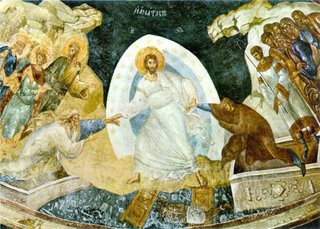
    Easter's origin


    Monastery of Chora,
    Constantinople


    Anthony McRoy asks: Was Easter Borrowed from a Pagan Holiday? That's what the Venerable Bede thought, but McRoy adduces evidence to the contrary.

    This provides a good occasion for me to republish something I wrote nearly two decades ago and published here for the first time three years ago, titled, Easter: What's in a Name?

    In most western languages the word for the day which we English-speakers know as Easter derives from the Hebrew pesach, or passover, usually by way of its Aramaic equivalent, pascha. Only in German (which calls it Ostern) and English is the Paschal feast called by a name sounding more like a direction on a compass than a christian holiday. Where does our word Easter come from?

    When I first planned to write on this subject, I intended to argue that we Anglo-Saxons should adopt "Pascha" in place of "Easter." I still think it would not be a bad idea. In fact in some nonstandard English dialects it is already known as Pace or Pasch, and in Old Scots (the language of Robert Burns and Auld Lang Syne) as Pasche or Pash.

    At first glance the origin of "Easter" looks suspect. There is a long tradition, going back to the early English church historian, the Venerable Bede (673-735), that "Easter" derives from Eastre, pagan goddess of spring and of the dawn. Although most Christians are probably aware that many of the days and seasons of the church calendar were taken over and adapted by the early Christians from their pagan neighbours, many will find it offensive to think that the day itself could still bear the name of a false deity. English-speaking Christians might well look with some envy on their fellow believers whose languages give the day of Christ's victory over death a name with more obviously biblical and christian roots.

    For example, in most of the Romance and Germanic languages, as well as in Greek, the name for this day is some variation of pascha. Many of the Slavic and Baltic languages appropriately call it the Great Day or Great Night. And some of the Finno-Ugric languages (for example, Estonian and Hungarian) call it the Feast of Meat, a reference to the end of the long Lenten fast. (Perhaps it also refers to the tradition that at least on Easter all Christians were expected to receive the elements of the Lord's Supper — that is, the body and blood of Christ — even if they had abstained during the rest of the year.)

    In English we are stuck with the apparently tainted "Easter." But twentieth-century scholarship has called into question Bede's interpretation. There is still no general agreement on the origin of the word, but it has been suggested that it may come, not from the name of a goddess, but from eostarun, the Old High German word for the dawn itself. (Our word "east" obviously has similar origins.) In fact there are some remarkable similarities between the words for "resurrection", "Easter" and "dawn" in several Indo-European languages. The common meaning underlying these words is a "rising" of some sort.

    If our own word Easter originally meant sunrise, then perhaps it was fittingly applied to the Rising of the Son of God from the dead by our Teutonic forebears. And if this is so, then it seems that we English-speakers do after all have a most appropriate name for the feast of Christ's Resurrection.

    07 April 2009

    From Geneva to Constantinople, continued

    Here's an additional post from my Genevan Psalter blog on the subject: More psalms of Ali Ufki.

    Redeemer on Spec's front page

    Redeemer University College made the front page of the Hamilton Spectator after yesterday's visit from Canadian singer Chantal Kreviazuk: Redeemer students meet Kreviazuk's challenge for kids.
    When Timothy Epp sent an e-mail inviting Chantal Kreviazuk to come to Redeemer University College to speak to his sociology class about her charity work, he knew it was a long shot. But to Epp's surprise, the popular Canadian singer-songwriter responded with a challenge -- raise $2,500 to help children in war-torn countries and she'd come.

    Epp, a professor of sociology and pop culture, passed the challenge along to his students and they got to work. They held loose-change drives, offered fellow students discount haircuts and gave faculty members cut-rate pedicures. Some even shaved their heads. Yesterday, their efforts paid off when Kreviazuk stood on the stage of Redeemer auditorium and accepted a cheque for $5,056.01.

    06 April 2009

    Tax deductions and the public good

    As the United States is now officially in recession, could one of Barack Obama's proposals have the unintended consequence of obstructing efforts to help the poor, who will suffer most from its effects? Ryan Messmore argues, with some plausibility, that this could be the case: Obama's Proposal to Reduce Charitable Deductions Would Hurt Civil Society, Expand Government. According to Messmore:
    The President claims that his tax plan will only have a small negative effect on charitable giving. Percentage-wise, this may be true, but the estimated reduction in giving means billions of dollars less each year for charities, especially if weak economic conditions continue.

    Scholars at the Center on Philanthropy at Indiana University estimated that, had Obama's proposed changes been in place in 2006, total itemized contributions from wealthy households would have dropped almost $4 billion.

    While this amount is only a small percentage of total charitable donations given each year, it represents more than the annual operating budgets of the American Cancer Society, World Vision, St. Jude's Children's Hospital, Habitat for Humanity, and the American Heart Association combined. Moreover, other scholars estimate that under Obama's proposal charitable organizations would see donations drop possibly by as much as $9 billion every year.

    In addition to receiving less money from wealthy donors, charitable organizations under Obama's plan could face a more subtle yet significant challenge: government crowding them out of social welfare provision. This phenomenon occurs when government claims increasing responsibility for tasks once performed by civil society, absorbing a larger percentage of the resources dedicated to carrying out those tasks.
    There is another important factor that Messmore does not mention. If the reigning ideological perspective holds that government is intrinsically secular and that whatever government funds must be free from the taint of "sectarian" religion, then the expansion of the public sector must necessarily come at the expense of those initiatives with an overt confessional basis. The result might be what the late Richard John Neuhaus famously called the naked public square, except that in reality it is nothing of the sort, because it is inevitably infused with religious conviction of some sort, even if the latter amounts to the belief that the cosmos can be understood without reference to God.

    This secular religion comes now to be given a privileged status and a continually growing political and economic space, before which all the particular beliefs held by flesh and blood people — including Christians, Jews and other adherents of traditional revealed religions — must give way. That this effectively erodes religious freedom would seem evident, but many are ready to acquiesce in this for the apparent pragmatic benefits associated with government action. Yet if Messmore is correct, the expected benefits will prove illusory: little will be gained, but much will be lost.

    If anything, the administration should be moving in the opposite direction. Recognizing that government cannot bear the entire burden of ameliorating the effects of a sluggish economy, it should instead be raising the charitable deduction rate for taxpayers to encourage a multiplicity of efforts at seeking the public good, leaving ample space for believers to put their faith into action in concrete ways that accord with their own traditions.

    03 April 2009

    Niebuhr revisited

    As promised, I am linking to my review of Donald A. Carson's recent book, Christ and Culture Revisited, which appears in Comment today: Christ, culture and Carson. Here's an excerpt:
    Without a solid creational and biblical foundation for our efforts, any attempt to transform culture will amount to little more than trying to impose our own subjective aspirations on everyone else, whether or not they are willing, or—more significantly—whether or not those aspirations conform to the normative order of creation as understood in the light of Scripture. Moreover, given the encompassing presence and sheer power of the cultures of which we ourselves are part, there is every possibility that they will transform us first, even as we claim the opposite. If we should become comfortable with our surrounding culture, it may be because, by God's grace, the latter will have responded to our successful efforts and become more congenial to true faith. Yet it is just as likely that we will have been unknowingly co-opted by the culture. How can we tell the difference? It will not be easy, but the place to start is by immersing ourselves in God's written word and indwelling its story, as Lesslie Newbigin puts it. In any event, we should make every effort to remain vigilant and to keep our eyes continually on the cross of Jesus Christ.

    01 April 2009

    April snippets

  • Reports like this used to appear more frequently some decades ago, but they continue to pop up occasionally as we near the end of the first decade of the century: Earth population 'exceeds limits'. This is from Dr. Nina Fedoroff, science and technology advisor to US Secretary of State Hillary Clinton. One wonders whether she has read this: Age-Quake: Say Hello to Under-population. Of course, policy-makers will have to decide which scenario for the future they find more credible.

  • My alma mater, the University of Notre Dame, has been embroiled in controversy since it was announced last week that President Barack Obama will be speaking at commencement next month and will be awarded an honorary doctorate of laws. Here Stephen Barr comments on Notre Dame’s Faustian Bargain, while Francis Beckwith, himself a subject of controversy a few years ago, writes on Barack Obama and Notre Dame: Juris Doctor Honoris Causa? How, they ask, can a Catholic university honour someone who has openly worked to remove the few legal protections the unborn still enjoy?

  • Not surprisingly, Jim Wallis approves of Notre Dame's invitation to Obama, going so far as to mobilize support for it: Obama at Notre Dame: Continuing a Tradition of Dialogue. César Baldelomar, also writing for God's Politics, agrees: The Obama Notre Dame Controversy. Wallis and Baldelomar believe that the likes of Barr and Beckwith (and perhaps even Bishop John D'Arcy) are being divisive and disruptive. Wallis' blog didn't exist back in 2005, when President George W. Bush spoke at Calvin College's commencement, though Wallis himself was at Calvin a few weeks earlier. One wonders whether he thought Bush's presence would continue a tradition of dialogue or whether Wallis might have expressed support for those members of the Calvin community protesting the visit.

  • While we're on the topic of abortion, the Rev. Katherine Hancock Ragsdale, who has been appointed president and dean of Episcopal Divinity School, preached this sermon nearly two years ago: Our Work is Not Done:

    And when a woman becomes pregnant within a loving, supportive, respectful relationship; has every option open to her; decides she does not wish to bear a child; and has access to a safe, affordable abortion – there is not a tragedy in sight – only blessing. The ability to enjoy God’s good gift of sexuality without compromising one’s education, life’s work, or ability to put to use God’s gifts and call is simply blessing. These are the two things I want you, please, to remember – abortion is a blessing and our work is not done.

    There is little to add to this, except to say that, where a church has lost its way in so fundamental a fashion, people will seek the light of the gospel elsewhere. (Hat tip: Rod Dreher)

  • Cousin Obama? "On Facebook, various applications posted joke alerts like 'Barack Obama confirmed you as a cousin'." I was one of those who received this message today. Or perhaps the President read my 6-year-old post on statistical genealogy?

  • Speaking of April Fools Day, this is a rather elaborate prank that I would love to have seen in person:

  • Followers

    Blog Archive

    About Me

    My photo
    Contact at: dtkoyzis at gmail dot com