22 March 2010

The Senate: better than we think?

It often seems that Canadians generally dislike the Senate but cannot agree on what should be done with it. It is an appointive body, intended by the Fathers of Confederation to be a "chamber of sober second thought." Westerners would like to see an elected upper chamber, while Québécois and New Democrats generally prefer to see it abolished, much as the provinces abolished their own upper chambers decades ago. Alan Broadbent, Chairman and CEO of the Avana Capital Corporation, disagrees: The Better Chamber: A Defence of the Senate. Here's an excerpt:
The Senate record of useful investigations is impressive. Senator David Croll chaired two critical investigations, on Aging in 1966 and on Poverty in Canada in 1971. The Poverty report became a signal document internationally. In 1970, Senator Keith Davey chaired an investigation on concentration in the media, which has been revisited by the Senate several times since. The Standing Committee on Banking, Trade, and Commerce has studied Canada’s financial institutions regularly since the 1980s, contributing much to the stability of our banking system, which has stood out in the last two years. . . . Almost all of these reports have been of high quality, and their recommendations have often created key building blocks for Canada. In this regard, the Senate has completely outperformed the House of Commons for decades.

Broadbent may not persuade the sceptics, but I personally hope it takes some of the steam out of the efforts of the abolitionists.

Today's history lesson

In 1927 the Judicial Committee of the Privy Council in London settled in Newfoundland's favour the longstanding dispute between that dominion and Québec over this piece of the mainland. Thereafter the Québec government appointed a special minister-without-portfolio to attempt to undo this highly unpopular decision. This official became known to history as. . . (drum roll please and then click on comments)

20 March 2010

Koyzis' top ten (plus)

At First Things: Evangel web editor Joe Carter challenged us to come up with a list of top ten books that have had an influence on us. Here is my list:

1. Abraham Kuyper, Lectures on Calvinism. This is the place to start for anyone interested in cultivating a christian worldview. Kuyper delivered these lectures in 1898 as part of the ongoing Stone Lectures at Princeton Seminary, then the bastion of Reformed orthodoxy. Kuyper (1837-1920) was the towering figure in the Netherlands of his generation, founding the Free University of Amsterdam (1880) and the Anti-Revolutionary Party (1879), and serving as Prime Minister between 1901 and 1905. This book is not without defects (e.g., he misunderstands the origin of the Genevan Psalter melodies), but it is groundbreaking in alerting Christians in North America to the all-encompassing character of Christ’s claim on our lives.

2. Al Wolters, Creation Regained. Long before the recent spate of worldview books for Christians, there was this book, which has become a minor classic. I was privileged to sit under the author, now a personal friend and colleague, when he taught the material in its pages at Toronto’s Institute for Christian Studies in the late 1970s. You had to be there.

3. Bob Goudzwaard, Idols of Our Time. Without this book and its perceptive linking of ideology with that ancient phenomenon of idolatry, I would not have written my own Political Visions and Illusions, which applies Goudzwaard’s interpretation to the classic modern political ideologies. Recently Goudzwaard, a retired Free University economist and former Dutch member of parliament, was on the campus of Redeemer University College, where I teach, and he was kind enough to sign my copy of this book.

4. James W. Skillen, The Scattered Voice: Christians At Odds In The Public Square. For some odd reason Zondervan allowed this gem of a book to go out of print. It was subsequently picked up by an obscure outfit, the Canadian Institute for Law, Theology & Public Policy, Inc. Here the author surveys the variety of alternative approaches to political life taken by American Christians. Some of the material is by now dated, but it is essential reading for anyone trying to understand the influences that fragment the Christian witness in the public square.

5. Herman Dooyeweerd, In the Twilight of Western Thought. Dooyeweerd (1894-1977) was a philosopher in the tradition of Kuyper who taught legal philosophy at the Free University. He founded a school of philosophical thought known in Dutch as De Wijsbegeerte der Wetsidee, or the Philosophy of the Cosmonomic Idea, as it has been inelegantly translated into English. Here he tackles the typically modern notion of the autonomy of human thought and the religious neutrality of reason. Dooyeweerd’s prose is not readily accessible to most readers, but his central insights into the orderly character of God’s creation richly repay any effort at comprehending his thought. Read more about his political theory here.

6. H. Richard Niebuhr, Christ and Culture. What more could possibly be said about this 1951 book? It’s the one book, after the Bible, which I’ve read the most number of times. I can more easily see its flaws than when I first read it 35 years ago, yet Niebuhr’s five typologies – Christ against culture, Christ of culture, Christ above culture, Christ and culture in paradox, and Christ transforming culture – have served to shape a conversation that has been going on for nearly six decades.

7. Yves René Simon, A General Theory of Authority. This is one of two essential books on the subject of authority. Simon (1903-1961) was a French neothomist philosopher who taught at the University of Notre Dame for ten years before taking a position at the University of Chicago. In this book the author attempts to rescue authority from its “bad name” by distinguishing amongst several functions of authority, the most essential of which are necessary, not because of human defect, but because of the very nature of life in community.

8. Richard De George, The Nature and Limits of Authority. This is the second must-read book on authority, in which the author carefully sets out a persuasive taxonomy of authority, distinguishing between, e.g., executive and nonexecutive, epistemic and exemplary, imperative and performatory manifestations of authority. Both De George and Simon have had an impact on the current book I am writing on authority and the imago Dei. The last sentence alone of this book is worth its price: “The enemy, however, is not authority but the abuse of authority” (p. 291). Exactly right.

9. David L. Schindler, Heart of the World, Center of the Church: Communio Ecclesiology, Liberalism, and Liberation. Schindler has to be my favourite Catholic philosopher, and this one book is more than enough to support my assessment. Schindler’s critique of liberalism is a radical one in that it gets to the root of this ideology rather than trying to defend it against its supposed latter-day distortions. After reading it, I found myself wondering whether the author had read Kuyper or Dooyeweerd, who would understand exactly what Schindler is doing here.

10. Herbert Lindemann, The Daily Office. I wrote last month of this book, which, more than anything else, reshaped my practice of daily prayer.

11. Ivan Sergeyevich Turgenev, Fathers and Sons. Yes, I know there are supposed to be only ten, but I couldn’t resist sneaking in one more. This 1861 book is one of those great Russian novels that have taken their place within the canon of world literature. But, unlike Tolstoy’s War and Peace, which is on everyone’s shelf but which few have actually read, Turgenev’s book is comparatively short and easily digested. The author’s portrait of Bazarov, the young “nihilist” (a word which seems to have originated here), is little short of prophetic in that it anticipates the generation of revolutionaries who would remake Russia and the world half a century later.

15 March 2010

March snippets

  • Here is one more contribution to the health care debate south of the border: Universal health care tends to cut the abortion rate. How so? Britain's former Catholic archbishop, Basil Cardinal Hume explains:
    "If that frightened, unemployed 19-year-old knows that she and her child will have access to medical care whenever it's needed," Hume explained, "she's more likely to carry the baby to term. Isn't it obvious?" . . . For various reasons, then, expanding health-care coverage reduces the rate of abortion. All the other industrialized democracies figured that out years ago.

    The question remains, of course, as to the best way to extend such coverage.

  • Greece is in deep financial trouble, as indicated in these reports: Fears of a Greek bank run, Strike-hit Greece awaits EU budget verdict, and Timeline: Greece's economic crisis. If there's an up side to all this, it's that it has likely killed off whatever residual sympathies Greek-Cypriots might once have had for enosis.

  • British Conservative leader David Cameron is taking lessons from Canada by way of Phillip Blond: Painting Britain's Tories Red.
    Mr. Blond is on a single-handed mission to resurrect the Red Tory, a familiar figure in Canadian politics but one that has virtually vanished from Britain. He tells me he was inspired by Canadian nationalist thinker George Grant, whose 1965 book Lament for a Nation bears a strong resemblance to Mr. Blond's current thinking about “broken Britain.”

    The Tories, who are baffled to find themselves only barely ahead of Gordon Brown's Labour Party in the polls, have seized upon Red Toryism as an ideological lifebuoy. Mr. Blond emerged from small-university obscurity last year, briefly ran something called the Progressive Conservatism Project, then launched a Red Tory think tank called ResPublica, raising $5-million from wealthy Tory donors in two weeks.

    Who would have guessed? Nearly seven years after our own federal Progressive Conservative Party bit the dust after limping along for the previous decade, it's being revived across the pond. Perhaps they'll have better luck with it than we did.

  • Despite Cameron's efforts to infuse the Tories with new life, the man who is currently campaigning to unseat Prime Minister Gordon Brown appears to have miscalculated, according to Stephen Murgatroyd. Not only is he drawing on Canadian political experience, but also on American:
    David Cameron, the Conservative Party leader, modelled a lot of his campaign strategy on Barack Obama’s successful bid for the US Presidency. Outlining the need for change, being general about what change meant and decrying the failures of the party in power were, he thought, enough to unseat an unpopular Labour government. What he failed to notice, until recently, was that the disappointment with Obama’s performance and the emptiness of the mantra “yes we can” is palpable. Over a year after starting health reform, Obama is still stuck in the mud. Climate change and energy security has not even started the torturous [sic] journey through the Senate. The US economy is still not mending. People demand more than a mantra. They want specifics. Cameron has to start talking action plans and detail.


  • Using the Wayback Machine Internet Archive I have located what my Genevan Psalter website looked like a decade ago, when it was no more than a single page with links to a few midi files. This is how it looked on 9 October 1999. And this is it a year later on 27 October 2000. Needless to say, the site grew considerably over the next few years.

    By the way, I have a short piece, Metrical psalmody: singing God's word, which was recently posted at The Worldview Church, which bills itself as "Resources for Pastors from the Chuck Colson Center for Christian Worldview."
  • 12 March 2010

    God and serotonin levels

    It turns out Karl Marx was wrong: religion is not the opiate of the people; it’s the Prozac of the people. So says the man who originated the concept of male bonding in this fascinating article in Canada’s foremost English-language newsweekly: Macleans interview: Lionel Tiger. Here’s a brief sample:

    Q: That’s why you call churches “serotonin factories.” You hint about possibly developing the brain equivalent of bodily exercise. Serotonin pills as a religion replacement?
    A: I’m not sure we’ll ever learn to manage brain secretions in any manner, and it may be that we don’t want to, but at least we now know that the feeling of oceanic identification with others in an assembly—a church assembly or whenever—is not magical, it’s neurophysiological. We can identify the juices. I think that’s fantastic, actually. And Mike [McGuire]’s work on serotonin did generate Prozac and a whole array of medications.

    Q: Despite increasing secularization, especially in the West, most people have not become flat-out rationalists. Do you think that for many environmentalism is a religion?
    A: That’s absolutely right, and that’s interesting because it is finally the fruit of pantheism, a very, very old religious idea. For many people, not using more than four sheets of toilet paper is an act of moral purification.

    In addition to illuminating the roots of environmentalism, Tiger’s analysis further clears up an ancient and vexing mystery: why did so many saints willingly suffer a martyr’s death for the cause of Christ? It seems they just wanted to feel good.

    06 March 2010

    Making too much of a good thing

    One of the characteristics of an ideology is that it takes a genuine good and makes too much of it, that is, it effectively makes it into an idol. Thus it becomes difficult for those liberals emphasizing the validity of free markets to resist the temptation to claim a near universal efficacy for them. Case in point: Murray Rothbard, in For A New Liberty: The Libertarian Manifesto, where we find this revealing remark:

    05 March 2010

    Right and left

    One of my pet peeves is the use of the left-right spectrum to categorize the diversity of political visions. There are three reasons for my dislike. First, the terms left and right have no enduring meaning, which has shifted with time. Second, they are frequently used as terms of derision against an opponent, to whom, once we have assigned the label, we have decided we no longer have to listen. Third, they obscure the genuine religious character of the ideologies so categorized.

    25 February 2010

    Canada and the US

    This has to be the best video ever made on the Canada-US relationship and ought to be widely distributed. It should also be viewed full screen.

    24 February 2010

    February snippets

  • The Chicago Council on Global Affairs believes there is a "God gap" in American foreign policy, as reported in today's Washington Post.
    American foreign policy is handicapped by a narrow, ill-informed and "uncompromising Western secularism" that feeds religious extremism, threatens traditional cultures and fails to encourage religious groups that promote peace and human rights, according to a two-year study by the Chicago Council on Global Affairs.

    The council's 32-member task force, which included former government officials and scholars representing all major faiths, delivered its report to the White House on Tuesday. The report warns of a serious "capabilities gap" and recommends that President Obama make religion "an integral part of our foreign policy."

    The Council's report is available here.

  • Painstaking efforts continue to alleviate the suffering of the people of Haiti after last month's deadly earthquake. The father of one of Redeemer's recent alumni is at the forefront of this, as reported in yesterday's Hamilton Spectator: City MD returns to aid his Haitian homeland. May God bless and strengthen Dr. Alezandre Dauphin as he continues this important work.

  • Today's Spec carries this report on Redeemer's new president, Dr. Hubert Krygsman: He's out to build bridges.

  • Change is in the air elsewhere. Three other christian institutions of higher learning have chosen new presidents as well. Baylor University in Waco, Texas, has appointed Judge Kenneth Starr as its new head. Starr is best known to the American public as the Independent Counsel for the Whitewater investigation from 1994 to 1998.

    A few days later Wheaton College announced its new president, Dr. Philip Graham Ryken, Pastor of historic Tenth Presbyterian Church in Philadelphia. This brings to the 150-year-old evangelical university a leader who stands squarely in the Reformed tradition.

    Finally, Reformed Theological Seminary's Orlando campus has just appointed a new president, Dr. Don Sweeting, senior pastor of Cherry Creek Presbyterian Church in Englewood, Colorado. I keep up with the goings-on there through my friend, Jake Belder, who is currently an RTS student.

  • Over now to my Genevan Psalter blog where I have put up two recent posts: Psalm 95 - T'ai Giorkou, and Updates: Sweelinck arrangements. Below is a performance of the ancient Cypriot folk song, T'ai Giorkou (Τ'αη Γιωρκού), which is an epic poem about St. George and the dragon. It's a typically Cypriot song sung in the local Τζιυπριώτικα dialect.

  • 23 February 2010

    A new president for Redeemer


    It is evidently the season for institutions of higher learning to select new presidents. We have recently heard announcements from Baylor University and Wheaton College. Now my own employer, Redeemer University College, one of a very few Christian universities in Canada, has just announced the appointment of a new president, Dr. Hubert Krygsman. This is from Redeemer’s website:

    “Dr. Hubert R. Krygsman, currently the Associate Provost and Director of the Andreas Center for Reformed Scholarship and Service at Dordt College in Iowa, has been appointed to become the third President of Redeemer University College. This five-year appointment will take effect on June 14, 2010 following the retirement of Dr. Justin Cooper, who has served as Redeemer’s President for sixteen years.

    “Krysgman obtained a B.A. in History and Philosophy from Calvin College in 1984. He completed a M.A. in History from the University of Calgary with a thesis on the theology of George Grant. His Ph.D. is from Carleton University in Ottawa with a dissertation on “Freedom and Grace: Protestant Thought in Canada 1920-1960.” His research and publication record includes a focus on modern Protestant Canadian history, on academic structures and curricular design, and on the relationship between Islam and Christianity.”

    Redeemer University College was established in 1982 and stands in the Reformed tradition of Christianity. I myself have been privileged to teach there for all but five years of its existence. On behalf of my colleagues, I wish Krygsman God’s richest blessings and assure him that we will uphold him in prayer as he takes up this important office.

    12 February 2010

    Obama the king

    Barack Obama has been president for just over twelve months and in his recent state of the union address he set out his priorities for his second year in office. It is no surprise that many observers are now questioning Obama’s overall effectiveness in the presidency as unemployment remains high and the effects of the recession continue to be felt by many. This points to a central difficulty in the organization of the executive branch: in effect, President Obama must function as both king and prime minister.

    Read more at the Center for Public Justice website.

    (Re)Discovering the evangelical mind

    Every so often someone in the popular press will make the apparently earth-shattering discovery that evangelical Christians can actually think and are not, after all, "poor, uneducated and easy to command," as journalist Michael Weisskopf notoriously put it nearly two decades ago. The latest example of this discovery appeared in a recent Wall Street Journal op-ed by Jonathan Fitzgerald called "Winning Not Just Hearts but Minds." The subtitle does more than hint at where the article will go: "Evangelicals move, slowly, toward the intellectual life."

    Read more at Comment’s website.

    09 February 2010

    Questioning authority


    Six decades ago the thomistic philosopher Yves René Simon observed that, since the French Revolution, authority has had something of a bad reputation. More than any other act of rebellion, the Revolution effectively solidified in western consciousness something of the mythology of heroic popular revolt against oppressive authority. Now many are inclined to identify authority per se with at least potential oppression, irrespective of what it actually does and how it functions.

    At one time it was generally assumed that those defying authority were committing a grave sin imperiling their eternal salvation. They were acting so as to overturn a God-given social and political order, and were little better than common criminals.

    Nowadays it is often, if not always, assumed that legitimate complaints undergird an insurrection, however violent its effects, and that governmental efforts to quell a rebellion are almost intrinsically repressive. During a church service near Toronto in early 1994, shortly after the Chiapas revolt broke out in southern Mexico, prayer requests were invited from the front. A parishioner stood up and asked that prayers be offered for the people of Chiapas, that they might receive justice and no longer find it necessary to rise up against the government to advance their cause. The request was duly noted and it was included in the subsequent prayer.

    What is striking in this incident is that no one in the congregation found the request at all unusual or out of line. Of course, one would not wish to deny the likelihood of legitimate grievances underlying such an uprising, particularly as it follows upon centuries of oppression of the indigenous peoples of the region.

    All the same, a few hundred years ago, if a popular revolt broke out against a sitting government, one might have heard a clergyman pray that God would bring down his righteous wrath on the rebels and that the governing authorities, whom he calls to defend justice and punish lawbreakers, might be instruments of that wrath. So thoroughly have attitudes changed that now, if someone were to stand up and request a prayer along these lines, she would likely raise eyebrows and cause discomfort in the pews.

    Why have authority and its exercise acquired such a bad name? Simon gives four reasons. First, it would seem to stand in conflict with justice. If a government reflexively cracks down on malcontents, it may be guilty of overlooking the justice of their cause. Second, it appears to conflict with the spontaneity and vitality of human life by artificially inhibiting it. How many beneficial inventions might have been stillborn if a government had placed too many constraints on personal innovation?

    Third, the imposition of authority is reputed to curtail the search for truth, a contention which John Stuart Mill advances in On Liberty. Fourth, authority seems often to be connected with human arbitrariness and thus opposed to the universality and stability of law. Indeed, whenever authority is abused, it inevitably reflects poorly on the authoritative office itself.

    To Simon's reasons I add numbers five through seven. Fifth, there is a persistent tendency to play off authority against personal freedom. Forty years ago, secondary school dress codes in North America were largely abandoned on the grounds that they impaired the freedom of the adolescent students to dress as they pleased. Especially in the United States, where the attainment of freedom has a strong place in the national civil religious narrative, this argument resonated with many, and those few defending the codes lost ground nearly everywhere. In such a context, if freedom and authority are conceived as polar opposites, then, whenever they are seen to come into conflict, freedom must necessarily triumph over the long term.

    Sixth, there is a strong presumption on moral grounds against authority by the heirs of Immanual Kant, including the likes of Stanley Milgram, Lawrence Kohlberg and John Rawls. Kantians believe that being subject to authority is a sign of ethical immaturity and that progress towards full adult autonomy requires that a form of moral reasoning known as the categorical imperative be applied to every human action.


    Seventh and finally, there is another school, including Marx and his heirs, as well as the more recent postmodern deconstructionists, which sees all authority as little more than self-interested (or, perhaps more accurately, class- or group-interested) domination by one set of people over another. Within this conception, any claim that an authoritative officeholder is acting in the interest of those under her authority cannot be believed. An hermeneutic of suspicion must therefore be applied to such claims in an effort to unmask the collective self-interested will behind what is essentially only an exercise of raw power. In this perspective, the classic writings of Plato, Aristotle, Cicero, Augustine and Thomas Aquinas are nothing more than the ruminations of those notorious dead, white European males attempting to protect their own material interests against everyone else.

    For all these reasons and more young people sometimes wear t-shirts emblazoned with these powerful words: QUESTION AUTHORITY. However, it's never been entirely clear to me why, in so doing, they should defer to the authority of a clothing manufacturer, whose very ability to produce these shirts depends on an authoritative structure co-ordinating the process as a whole. Much as the statement, "All truth is relative," is self-referentially incoherent, so is the imperative statement, "Question authority"! Yet this will likely have little effect on those to whom such a slogan appears to give the moral high ground.

    Yet what if that which we call freedom is just one more type of authority among many? If so, there is little reason to view freedom as consistently trumping these other kinds of authority where the two come into opposition. If freedom be defined as personal authority, then when it conflicts with another form of authority, the claims of both must be taken into account and adjudicated carefully and justly. In the case of the dress codes, the issue should have been conceived, not as authority against freedom, which prejudices the case in favour of the latter, but as one between the authority of the school and administration on the one hand and the authority of the adolescent student on the other. If it is framed in this way, its resolution becomes less obvious and its full complexity more so. Legitimate interests on both sides must be taken into account. A balanced approach, and hence justice, becomes more likely.

    That such an approach would necessitate a break with historic liberalism, with its commitment to the primacy of the individual, is beyond doubt. Yet if we can bring ourselves to relinquish the hold of this tenacious political ideology, we will be better able to do justice to the legitimate pluriformity of authority in God's world.

    08 February 2010

    Cat Stevens, ex-Greek singer

    While we're on the subject of Greek music, remember Ruby Love by sixties great Cat Stevens? Some of the lyrics are even in Greek, while the bouzouki adds a distinctive hellenic flavour to what is in effect a kalamatianos. More than three decades ago Stevens, who was born in England to a Greek Cypriot father, converted to Islam and changed his name to Yusuf Islam.

    06 February 2010

    Οι 'Ελληνες της Μικράς Ασίας — The Greeks of Asia Minor

    A decade ago I was reading everything I could on the fate of the Greeks of Asia Minor, including Marjorie Housepian Dobkin's Smyrna 1922: The Destruction of a City. Greeks had inhabited this region for nearly three millennia until the 1923 Treaty of Lausanne mandated the exchange of populations between Greece and the new Turkish Republic, uprooting hundreds of thousands of refugees from their homes and sending them to countries that were not their own. A grand effort to secure ethnic uniformity wreaked havoc on deeply rooted communities, something my own relatives experienced in Cyprus half a century later.

    In memory of the Greeks of Asia Minor, I link to the following folk song, Γιαννούλα Τσανακαλιώτισσα (Giannoula Tsanakaliotissa), whose title refers to a girl from what in Turkish is called Çanakkale (Τσανάκκαλε) and in Greek Δαρδανέλλια (Dardanellia). This town is located on the northwest coast of Asia Minor immediately across from the Gallipoli Peninsula. I had been looking for this song for ten years and finally found it a few days ago.

    01 February 2010

    Farrow's trenchant critique

    Douglas Farrow
    The province of Québec is possibly the most secularized jurisdiction in North America, yet Montreal's McGill University boasts a dissident from the apparent post-christian consensus that took over that province during the Révolution tranquille of half a century ago. He is Douglas Farrow, Professor of Christian Thought in the Faculty of Religious Studies at one of Canada's premier universities.

    The January-February issue of Touchstone carries an important article by Farrow, The Audacity of the State, whose title is an allusion to Barack Obama's book and his former pastor's similarly named sermon. Unlike many of today's opponents of the most recent stage of liberalism, which I have elsewhere labelled the "choice-enhancement state," Farrow is unwilling simply to fall back on an earlier, libertarian form of the ideology. This can be seen most clearly in his critique of John Stuart Mill's harm principle:
    The power of On Liberty to overturn social and moral and religious conventions arises from Mill’s exciting and flattering suggestion that freedom will lead you into the truth. That iconoclastic gospel from the Romantic period still competes very successfully, tractable as it is to post-modern cynicism, with the older idol-smashing gospel of Jesus, that “the truth will set you free.”

    Mill’s gospel takes no account of the creator/creature distinction, or of the fallenness of man. It takes no account of a freedom higher than freedom of choice, and gives no thought to how the truth of our own good will be recognized, or how that good will prove commensurate with the good of others. It is incurably romantic and naively optimistic. Most significantly, it fails to reckon with the fact that, in the absence of an overarching common good, based on a prior truth to which both the individual and the state are subject, the state must become the arbiter of all the competing goods of “free” individuals. It is not the individual who triumphs, then, in the appeal to a freedom that is prior to truth, but the state.

    Behind Mill stands Rousseau, of course, whose rather more obvious statism Mill hoped to avoid. The basic premise of On Liberty is drawn from the Declaration of the Rights of Man and of the Citizen, that “liberty consists in being able to do anything that does not injure another.” And that dictum is in turn drawn from Rousseau, who got it from the Marquis d’Argenson, to whom we actually owe the harm principle: “In the Republic each man is perfectly free in all things that do no harm to others.” Rousseau’s intention in popularizing it was to downplay the obligations imposed by civil society, which he regarded as a corrupting more than a civilizing influence, especially in the form of family and church [emphasis mine].

    One’s primary obligations would hereafter be understood as obligations chiefly to oneself, on the one hand, and to the state on the other. That is what the harm principle is really all about—the elimination of the oppressive middle term between the individual and the state. This begs the question, however, as to what does or does not harm another, and who will decide that. Both Mill and Rousseau have ideas about that, and one gets glimpses of Mill’s ideas in the final chapters of On Liberty. Only glimpses, mind you, because Mill’s ideas aren’t really very libertarian after all.

    Farrow's astute analysis should be taken to heart by libertarians who think they are critiquing late liberal statism but in reality are doing no more than to facilitate its agenda over the long term.

    While we're on the subject, you might wish to read Farrow's analysis of the latest chilling action of the government of his home province: The Government of Québec Declares War.

    27 January 2010

    Authority and the pretence of autonomy

    You may not immediately recognize the name, but you will likely recall the famous experiments he conducted at Yale half a century ago. In 1961, a junior professor in psychology, Stanley Milgram, placed an advertisement in a local New Haven newspaper soliciting participants in what was claimed to be a study of memory and learning. The rest of the story is familiar to anyone with an undergraduate introductory psychology course under her belt:

    As a respondent to the ad, John Doe is ushered by a white-coated experimenter into a room where another person is seated. Both are told the nature of the experiment about to take place. Having drawn straws, Doe becomes the “teacher,” and the other man the “learner.”

    Stanley Milgram, Obedience to Authority
    Both are taken to an adjacent room where the learner is subsequently seated at a table. A strap attached to an electrode is placed around his arm, with the teacher looking on. The experimenter explains that the teacher will read through a list of word pairs, which the learner must then read back to the teacher in the correct order. If he misses one of the pairs, the teacher, seated in the other room, will administer an electric shock, beginning at 15 volts, increasing the voltage with each successive error up to a high of 450. The experimenter assures the teacher that the shocks are not dangerous to the learner.

    The experiment proceeds with the teacher reading the first pair of words. At the first mistake Doe administers the initial shock to the learner, who is behind a closed door in the adjacent room. At some point, after a few more errors, the teacher hears the first audible, if somewhat muffled, indication of discomfort from the learner. The teacher looks hesitantly at the experimenter, expecting some guidance. The experimenter tells him to continue, which he does obediently. After more errors what started out as grunts from the learner become increasingly urgent cries of pain, coupled with a protest that he has a heart condition and wishes to end the experiment. Increasingly agitated, Doe fully expects the experimenter to intervene and put a halt to the ordeal. But the experimenter remains calm, assuring him that he himself assumes all responsibility for what happens, instructing him to continue.

    At this point Doe is confronted with an ethical dilemma. Indeed the experiment is not about memory and learning at all; it is intended rather to gauge the extent to which an ordinary person, commanded to inflict pain on someone else, will do so in deference to authority, even under conditions that appear to compromise his moral commitments.

    The entire situation is a set-up. The “learner” is in reality an actor hired to play the part. The drawing of straws is fixed, with “teacher” written on both slips of paper. The “teacher” is given a mild shock before the start of the experiment to give him a sense of what the learner will be experiencing, but, apart from that, the elaborate console in front of him is a façade. The switches he throws do not shock the “learner” at all. The sounds emitted from the other room come from a tape recorder, timed to run after each “shock” is delivered.

    How far would the “teacher” go in carrying out orders? Would the subject break off the experiment, thereby defying authority, because he believed he was being commanded to do something wrong? Or would the subject, upon being assured by the white-coated experimenter that he assumed full responsibility, continue to administer “shocks” even up to the “dangerous” level of 450 volts?

    Milgram had gone into the experiment believing that virtually all decent people would at some point refuse to go further, because their moral convictions would not allow them to do so. However, the reality was that many people continued to obey the experimenter despite the verbal indications of pain on the part of the learner. “It is the extreme willingness of adults to go to almost any lengths on the command of an authority that constitutes the chief finding of the study and the fact most urgently demanding explanation.”

    Milgram concluded that, for people to be brought to the point of performing such an action, they must first abandon their autonomy and enter into what he calls an agentic state, in which they see themselves as no longer responsible for their own actions and as nothing more than agents for carrying out someone else’s instructions. Thus authority, so necessary for human survival, manifests a dark side by facilitating the rise of tyrannies and totalitarian régimes, which rely for their very existence on the obedience of vast numbers of citizens.

    Like many people who had lived through the horrors of the Second World War, Milgram was appalled that so many ordinary Germans played their part in the nazi death machine in obedience to orders issued by higher ups. Hannah Arendt’s coverage of Adolf Eichmann’s trial in Jerusalem seemed to confirm that, far from being cruel or sadistic, many nazi officials were mere bureaucrats functioning within an extensive chain of command.

    How is it possible that otherwise ordinary, decent people can be brought to the point of doing harm to their fellow human beings? They do so, according to Milgram, by subordinating their own wills to those of others, thereby becoming mere agents of the latter. Their ability to reason morally is thus impaired by the felt need to defer to authority. In the case of these experiments, the presence of authority was conveyed by the white lab coat of the experimenter, by the official-looking venue and by the prestige of the university under whose auspices they were conducted. All of these elements combined to induce the unwitting subjects to give up their freedom and to commit acts they would otherwise not do.

    Nevertheless, there are good reasons to question whether Milgram’s dichotomy between autonomy and the agentic state is warranted. Milgram himself admits that, as the child matures, she is subject to various socializing agents, from family and school to workplace and government, all of which aim at the “internalization of the social order.” In this way, the person’s conscience is formed by the very structures of authority with which it may eventually come to stand in tension. In other words, the individual’s internal inhibitory mechanisms are shaped from the outset by various external inhibitors, all of which can be grouped under the broad heading of authority. Even when people believe they are acting autonomously, each decision they make is conditioned, either directly or indirectly, by numerous authorities, the most significant of which have made their impact long before.

    Wiring up the 'learner' for the experiment
    This is illustrated by two subjects whose actions and responses Milgram himself mentions, while nevertheless failing to draw out their full implications. The first subject is the pseudonymous “Jan Rensaleer,” an industrial engineer who was born in the Netherlands and immigrated to the United States after the war. Rensaleer stops the experiment after 255 volts, refusing to go on. He expresses regret that he has gone as far as he has in response to authority, assuming full responsibility for his own actions and refusing to blame the experimenter. Yet, having lived through the nazi occupation of his native country, he is not surprised by the level of obedience in the other subjects of the experiment. Rensaleer reports that he is “a member of the Dutch Reformed Church.”

    The second subject is the “Professor of Old Testament,” who discontinues the experiment after 150 volts, surprisingly asserting that “I’m taking orders from him,” that is, the protesting “learner.” Milgram notes that the Professor does not precisely claim to be disobeying as much as shifting his allegiance – from the experimenter, whom he appears to view as merely a “dull technician” of limited intelligence and imagination, to the learner/victim. Moreover, when later asked the best means of fortifying resistance to unjust authority, the Professor replies, “If one had as one’s ultimate authority God, then it trivializes human authority.” Milgram’s response to this claim is remarkable, both for what it indicates about the nature of authority and for his failure to make any more of it: “Again, the answer for this man lies not in the repudiation of authority but in the substitution of good – that is, divine – authority for bad.” This observation could have summed up his analysis of the experiments as a whole, had Milgram treated it as more than just the comment of yet another subject of the experiment.

    Both “Rensaleer” and the “Professor of Old Testament” are evidently Christians, having been raised to distinguish between right and wrong. Their claim to selfhood thus lies, not in pretending to act autonomously, but in acting according to principles taught by another authority, or a series of authorities, whose presence is felt more vividly than that of the experimenter.

    Milgram’s claimed mental shift from autonomy to the agentic state may not, after all, be an accurate way of accounting for what occurs in the person, either in the laboratory or in ordinary life. Our consciences are formed in such a way as to recognize and obey legitimate authority. Our very selfhood is fashioned in large measure by others, including our parents, schools, churches, peers and, for better or worse, the media.

    To be sure, we are not simply the products of our environment, as argued by such radical behaviourists as B. F. Skinner. We grow into and retain our responsibility at every stage of the process of growth. When we come to see ourselves as part of a larger communal whole, we do not so much suppress our selfhood as adjust it to the realities of living among our fellow human beings. Indeed the recognition that we are not alone in the world and must therefore subordinate our wills to others’ for the sake of justice and the common good is integral to the development of the mature self, notwithstanding the views to the contrary of Milgram and his fellow heirs of the Kantian legacy, who persist in portraying deference to authority as a sign of moral juvenility.

    25 January 2010

    Academic responsibility

    During my first years teaching at Redeemer University College, I quickly discovered the impact I was having on students and initially found it a somewhat jarring experience. I had recently gone from being a lowly graduate student at Notre Dame’s Department of Government and International Studies to being a not-quite-so-lowly (but not terribly exalted either) assistant professor of political science at one of Canada’s few Christian universities. This commanded the respect of the students, most of whom had grown up in the Christian Reformed Church and similar bodies and had been educated in the day schools connected with Christian Schools International. The Dutch Reformed tradition in particular has long had a strong educational tradition, beginning at least with Abraham Kuyper’s Free University of Amsterdam in 1880 and extending to Calvin College and other institutions in North America. One need only think of Alvin Plantinga’s and Nicholas Wolterstorff’s works as premier examples of scholarship in this tradition, to which Redeemer is heir.

    One day while I was sitting in the cafeteria around a table with some of my students, one of them turned to me and repeated something I had said in class as though it were gospel truth. Still being quite green, I was startled at this. That night I had difficulty sleeping and James 3:1 kept running through my mind: “Not many of you should become teachers, my brothers, for you know that we who teach will be judged with greater strictness.” To say that this scared the hell out of me would be something of an overstatement, yet I had come to understand something of the awesome responsibility of a teacher, even at the post-secondary level.

    Not too long ago I posted something on Academic freedom and the faith-based university in response to John Stackhouse’s defence of Trinity Western and other confessional universities in Canada’s University Affairs. I return to the topic here.

    As I see it, there are two sides to this: teaching and research, each of which must be handled somewhat differently, even if they are interconnected in numerous ways. Ideally each should support the other, which is why universities try to provide sufficient time and monetary resources for research, even if some overburden their faculty with teaching responsibilities. Many of the smaller Christian universities tend to have their faculty teaching as many as eight courses per year under nine-month contracts, thereby making it difficult for them to pursue a scholarly agenda in any serious way. This is an issue for another time.

    The crucial concern for present purposes is that Christian universities often require of their employees adherence to a particular confessional statement, sometimes associated with the supporting denomination. It is not unusual for a Presbyterian university to hire only those agreeing with the Westminster standards. Calvin College itself requires its faculty to attend Christian Reformed Church congregations or those of other denominations with which it is in ecclesiastical fellowship. It also requires adherence to the Three Forms of Unity. Do such requirements constitute undue limitations on academic freedom? Not necessarily, though they can do so, depending on the content of the prescribed statements.

    The stereotypical case has a professor of, say, biology coming to believe that the bulk of the evidence points to macro-evolution, including the descent of human beings and the higher primates from a common prehistoric ancestor. However, because she has signed a statement supporting fiat creationism at the time she was hired, her findings threaten her continued employment. Or what of the professor of biblical studies who has come to conclude, based on literary evidence, that Isaiah 40-66 were written centuries after the first 39 chapters, or that Daniel was probably written in the second century BC? If this conflicts with the official understanding of biblical authorship supported by the institution, this puts him in a tough position and could result in the loss of his job.

    These are the sorts of scenarios of which faculty at christian universities ostensibly live in constant fear. To be sure, I think it is unwise to prescribe a statement of faith in effect prohibiting faculty from exploring human origins and other fields of legitimate human endeavour. In short, it ought not to tell scholars what they can and cannot learn about God’s creation or what sort of evidence they are allowed to uncover. But that the world is God’s creation should obviously not be called into question.

    Does this limit academic freedom? In one sense, yes, it does. Christian believers are not free to accept the sort of dualism that assumes that our ultimate convictions can be safely sequestered from pedagogical and scholarly pursuits. Nor should we embrace the various reductionisms that plague the secular academy in so many ways. We are not free to ignore the many idolatrous worldviews that vie for our loyalty or to pretend that they have no impact on the life of the mind. Any effort to rehabilitate, say, the Marxian project without noticing its reduction of the full complexity of human motivations to material productive forces falls well short of the spiritual discernment sorely needed in academia.

    Furthermore, there is no such thing as a university without some form of undergirding faith commitment, even if it is only implicit. In a public university, which is supposedly neutral with respect to various religious commitments, there are certain academic activities that are at least unofficially out of bounds. J. Philippe Rushton’s controversial investigations into intelligence and racial differences have skirted the edges of these boundaries for obvious reasons. One suspects the same would be true of those exploring gender differences. Even if the latter were permitted by one’s academic peers, one would have to tread very carefully to avoid causing offence to the easily offended. Yet, ironically, questioning Darwin’s theory, which would appear to imply at least the possibility of biological inequalities, is also beyond the pale. It overstates the case to conclude that a common commitment to methodological atheism is required for teaching at a public university. All the same, one could not simply assume that, say, God created the heaven and earth and redeemed it from sin through Jesus Christ, and then proceed to conduct one’s academic inquiries on the assumption that this is true.

    Yet this is exactly what scholars at a Christian university are privileged to do. There is no doubt that, given my own faith commitment and how I understand it to impact my field of political science, I am freer at Redeemer to follow my own interests in teaching and research than I would be elsewhere. Academic freedom? Yes, but I prefer to speak of academic responsibility, recognizing that true freedom is not mere licence, as many seem to think, but always functions within a larger communal context wherein we exercise a fearful responsibility, not only for the young lives God has put in our care, but for the larger world of scholarship.

    23 January 2010

    Bradley on liberalism

    Anthony Bradley pays me the compliment of appealing to my Political Visions and Illusions in this post on the WORLDMag blog: Conservative vs. liberal. Here's Bradley:
    Koyzis rightly points out that we all tend to waffle between idolatry and gnosticism in our political alignment. We are idolatrous when we believe that our political preference is the remedy for the world’s problems, and we are gnostic when we believe that competing ideologies are inherently evil. In an honest moment, I would confess that I do believe that my political ideology is right and all others are wrong because, at the end of the day, I think I’m always right. This is why I struggle with whether I am liberal or conservative. . . .

    Liberalism starts with the fundamental belief in human autonomy, which means being self-directed and free to govern oneself in accordance with rules in which one willingly submits. The most basic principles of liberalism, according to Koyzis, is that everyone possesses property in their own person and must therefore be free to govern themselves in accordance with their own choices provided that those choices do not infringe on the equal right of others to pursue the same. Human persons should be free from coercion that favors one person or group’s preferences for another. As such, true liberals have a consistent aversion to government coercion in ways that conservatives do not.

    I am pleased, of course, that Bradley appreciates my book. In response I would indicate that I am less concerned with what separates liberals and conservatives than I am with probing the spiritual roots of a number of ideologies, of which these are only two. In reality, liberalism and conservatism are not the opponents people generally think them to be. Liberalism is predicated on the assumption that all communities, including such basic institutions as state, church, marriage and family, are reducible to voluntary associations. Because conservatism is merely a tendency and, unlike liberalism, lacks a distinctive account of state and society, there is much overlap between the two. One can easily claim the conservative label and at the same time accept the contractarian account of the state. American conservatives, with their affection for their own founding documents, especially the Declaration of Independence, are practically obligated to do so.

    And, no, true liberals do not "have a consistent aversion to government coercion in ways that conservatives do not." At least not all of them do. This is the upshot of my tracing the development of liberalism through five stages beginning with the Hobbesian commonwealth, followed by the night-watchman state, the regulatory state, the equal-opportunity state and, finally, the choice-enhancement state. Because it is up to the parties to the contract to decide exactly what government should do, they are within their right to demand a full-blown welfare state, if they so desire. Yet they remain "true liberals," who simply take the logic of this position further than many professed liberals are willing to.

    Bradley might wish to consider dropping altogether both conservative and liberal labels. If he admits that "there are some American conservative cultural traditions that America has benefited by extinguishing," then he may not be a conservative at all — at least not in the sense in which it is used on this side of the pond. Yet if he is willing to recognize, as I hope he is, that not all communities can be reduced to voluntary associations, he is almost certainly not a liberal either. At this point I refer him to the last three chapters of my book where I attempt to point to a way beyond the distortions of ideological thinking.

    18 January 2010

    Chesterton on checks and balances

    The whole modern world has divided itself into Conservatives and Progressives. The business of Progressives is to go on making mistakes. The business of Conservatives is to prevent mistakes from being corrected. Even when the revolutionist might himself repent of his revolution, the traditionalist is already defending it as part of his tradition. Thus we have two great types — the advanced person who rushes us into ruin, and the retrospective person who admires the ruins. He admires them especially by moonlight, not to say moonshine. Each new blunder of the progressive or prig becomes instantly a legend of immemorial antiquity for the snob. This is called the balance, or mutual check, in our Constitution.

    G. K. Chesterton, Illustrated London News, 19 April 1924.

    16 January 2010

    January snippets

  • It seems some television viewers were disconcerted by Brit Hume's comments shown in this segment below:


    Writing for The New York Times, Ross Douthat thinks that differences amongst religions should be openly discussed and not hushed up as if such conversations were intrinsically subversive of democracy: Let's talk about faith.

  • This finding can hardly be surprising: Eating junk food can lead to depression. Our physical well-being and mental health are so thoroughly interconnected that what we eat will inevitably have ramifications for both. I would add from personal experience that caffeine is no help either.

  • Notes from a Byzantine-rite Calvinist's annual Award for Political Education (APE) goes to Prime Minister Stephen Harper for single-handedly bringing prorogation back into the vocabulary of ordinary Canadians. Now if only he could do the same for responsible government.

  • Are faith-based universities intrinsically incompatible with the hallowed principle of academic freedom? The Canadian Association of University Teachers thinks so: CAUT versus Trinity Western. John Stackhouse mounts a somewhat weak defence of BC's Trinity Western University and similar institutions. Read more here: Academic freedom and the faith-based university.

  • Because these sorts of stories are not given the attention they deserve in the mainstream western media, those of us in what might be called the informal media have a special responsibility to alert our own readers to them: Muslims Slaughter Christians in Egypt. Fortunately, Egyptian authorities are doing something about it: Egypt security court to try suspects in Copt killings. While Chuck Colson's charge that Christians in muslim countries are Unprotected and unnoticed may be something of an overstatement, he is right to raise awareness of their plight amongst Christians in this part of the world.

  • Pakistan is another country in which Christians are routinely subjected to violence by members of the muslim majority. How many Christians live in that country? Two decades ago Gene R. Preston wrote: "The most recent census — conducted in 1981 — gave a rough count of 84 million people of whom not quite a million were Christian. The unofficial 1990 estimate is 108 million, with an explosive birthrate of nearly 4 percent. That could soon mean up to 2 million Christians in this land of Islam." Wikipedia gives a figure of "2,800,000 in 2008, or 1.6% of the population." However, Nazir S. Bhatti, President of the Pakistan Christian Congress, asserts that Christians make up fully 13 percent of the population of Pakistan, which the country's government deliberately underestimates for its own purposes.
  • 15 January 2010

    Haitian tragedy

    The earthquake in Haiti is shaping up to be a disaster of apocalyptic proportions, as tens of thousands are thought to have died and the capital city of Port-au-Prince is in ruins. Joel Dreyfuss dares to use a word that is in short supply at the moment: Saving Haiti: Seeking hope for my native land. For those wishing to donate to rescue efforts, here are four possibilities: Christian Reformed World Relief Committee, Presbyterian World Service & Development, World Vision Canada and World Vision US. Please pray for the people of that suffering land.

    12 January 2010

    Timbuktu

    We know that Timbuktu, whose name has long since become a byword for the middle of nowhere, was once a thriving centre of learning and culture and an important commercial hub in west Africa. What some of us did not know is that many of the centuries-old volumes that made up the city's libraries are still in existence and held in private hands, where they are deteriorating. The Washington Post reports: Interest in ancient books could restore Timbuktu. Here is a similar article: Ancient Books Reveal Timbuktu’s Former Glory, Illustrate Need for Libraries. It staggers the imagination to think what literary treasures might be found in these ancient volumes. Is there any way to scan them and post them online without contributing further to their deterioration? Let us hope so.

    10 January 2010

    Epiphanytide

    It is appropriate on this first Sunday after Epiphany to join with the congregation of St. Peter's Church in Bremerhaven, Germany, in singing Philipp Nicolai's immortal chorale, How Brightly Shines the Morning Star, or in the Plattdeutsch native to this particular community, Wo hell schient us de nee'e Steern. So frequently do we hear this chorale in the forms given us by such baroque composers as Bach that we tend to forget what it sounds like in its pre-baroque form. This is a good reminder.

    Psalter updates

    I have posted New year updates, 2010 on my Genevan Psalter blog, primarily describing the latest additions to the website.

    04 January 2010

    Court off to bad start

    For centuries the House of Lords was the highest court of appeal in England, although more recently the full Lords did not actually hear cases, which in 1876 were delegated to the Lords of Appeal in Ordinary, or the Law Lords. As of 1 October, however, this body's jurisdiction was turned over to a new Supreme Court of the United Kingdom, the membership of the former becoming the first justices of the latter, thereafter losing their right to vote in the upper chamber of Britain's Parliament.

    Right off the mark the court has created controversy in ruling against London's JFS school, which had declined to enrol a certain "M" whom it judged to be further down the waiting list with respect to eligibility for admission.
    The 12-year-old boy was refused a place at the JFS (formerly known as the Jews' Free School) in Brent, north London, despite regularly attending a Progressive synagogue. While his father is Jewish by birth, his mother is Jewish by conversion. However, the conversion ceremony was conducted by a Progressive rather than an Orthodox synagogue, which is not recognised by the Office of the Chief Rabbi. The children of atheists, and practising Christians, were allowed to attend the school as long as their mothers were considered Jewish.

    For those of us who remember the civil rights struggles of the 1950s and '60s in the US, the school's action sounds like a clear case of racial discrimination which the Court rightly prohibited. Yet all communities set boundaries around themselves, necessarily including some people and excluding everyone else. Sometimes biology sets the boundaries, as the female half of humanity obviously excludes men. Similarly, marriage is an intrinsically exclusive institution anchored in sexual complementarity between a man and a women, who, as the marriage vows put it, forsake all others for each other alone.

    Religious communities generally find their identity in shared ultimate convictions about God, the world and our place in that world. Sometimes, but not always, these convictions are summarized in a binding confessional document such as the Augsburg Confession or the Heidelberg Catechism. Christianity is deliberately multiethnic, embracing a huge variety of peoples and cultures around the globe, as indicated at the very outset of the christian era in Galatians 3:28.

    Judaism has always been different. To be sure, Judaism consists of certain tenets embodied in the Tanakh and such ancillary writings as the Talmud, which suggests a common confessional identity. Yet one of these beliefs is that God made his covenant with the biological descendants of Abraham more than three and a half millennia ago. God has a unique and exclusive relationship with these descendants whom he freely chose for his own out of all the other nations on earth. He gave them his Torah, or teachings, and commanded them to follow its precepts. God designated circumcision as the mark of the covenant, and this mark was often an offence to conquering nations, such as the Greeks in the 2nd century BC, who ruthlessly persecuted the Jews for not conforming to hellenistic ways (2 Maccabees 6-7).

    This scandal of particularity continues to be an offence to non-Jews, as is evident in this recent court case. I must say that my heart is with the boy's parents, who desire a Jewish education for him. For the school to exclude him because it doubts his mother's conversion seems unfair. That the school doubts further, not the sincerity of this conversion, but merely the procedure compounds the sense of injustice that many of us feel. Nevertheless, our feelings are not the only things at stake, nor are they the most crucial issue, especially as far as the law is concerned. The central issue is whether a public court of law has the authority to decide who is a Jew and who is not. That the new Supreme Court is claiming this authority has negative implications for other religious communities as well.

    The predominant liberalism of the English-speaking democracies would reduce all communities to mere voluntary associations. Of course, there are groups of Christians, especially those in the baptistic and free church traditions, that see their own churches precisely as democratically-governed voluntary communities of believers. However, the vast majority of Christians do not do so, recognizing their eccesial communities as authoritative institutions anchored in God's grace, as manifested in preaching the Word and administering the sacraments. (This roughly corresponds, though not entirely, to the difference between Ernst Tröltsch's sect and church.) Yet even those Christians embracing a voluntaristic ecclesiology should not wish to see the state, through its judicial arm, impose this on all religious groups, as that would see the state overextending its proper sphere of competence to the detriment of everyone, as David Goldman warns.

    Because Britain does not have a written constitution, its Parliament has the authority to curtail the new court's jurisdiction, as it deems necessary. Whether it will have the will to do so is another matter. Given the reluctance of Canada's legislatures to invoke Section 33 of the Charter of Rights and Freedoms against questionable judicial decisions, it seems unlikely that Britain's Parliament will intervene, especially as the Court's decision appears to accord so well with current individualist understandings of equality and nondiscrimination.

    30 December 2009

    O Kerstnacht

    Some two decades ago one of my colleagues gave me a copy of his own nonmetrical English translation of the Dutch Christmas hymn, O Kerstnacht, Schoner dan de Dagen. The text was written by the Dutch poet and playwright Joost van den Vondel in 1637. The melody is attributed to Cornelis Padbrué and is performed below by Harald Koll on a most unusual instrument known as a kontra guitarre. I recently found that I had versified this text for two of the stanzas some time ago, but not for the third. My discovery today of this performance perhaps provides an occasion to complete the job so that it can finally be sung in English.

    25 December 2009

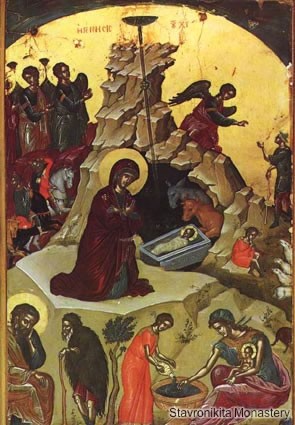
    The child born in Bethlehem

    Canada's National Post published an unexpected and rather extraordinary editorial yesterday: The child born in Bethlehem. Here's an excerpt:
    In Christ all things hold together. All things, Christians believe, not just their own spiritual things. In Jesus Christ, to look at man is to look at God. In Jesus Christ, the God who lovingly and freely created the mighty galaxies and the lilies of the field now comes as man to redeem and to save that very same creation. The Christian good news is that in coming as man, all that man touches is now touched by God.

    To use the Greek again, at Christmas what is anthropocentric now becomes theophanous -- to see man is to see God. The human and the divine are now united. All that man needs is now in contact with the divine. Man never loses his freedom to do evil, but he gains the capacity to build up what needs to be restored-- that all things might hold together again. For the Christian concerned about the environment, Bethlehem remains more important than Copenhagen.

    Indeed, for the Christian, Bethlehem remains always more important; more important than Rome and Athens and Kyoto and Ottawa and New York and London, and other capitals ancient and modern. Those latter places provide the stories we have the privilege to report. On this day when many of our readers turn their attention to those Bethlehem nativity scenes, we acknowledge that there are stories greater still.

    It's difficult to imagine The New York Times publishing something similar.

    Unto us a Son is born


    The nativity of our Lord

    18 December 2009

    WSJ mention

    My friends and protégés at Cardus have been mentioned in an article by Jonathan Fitzgerald in today's Wall Street Journal: Winning Not Just Hearts but Minds: "And Comment, a publication of the Canadian Christian think tank Cardus, recently considered Christian perspectives on psychology." This particular issue was put together by my beloved friend and colleague, Russell Kosits, whose office is two doors down from mine at Redeemer. Also mentioned: ". . . and First Things—a traditionally ecumenical publication that recently launched a new section dedicated to evangelicalism." I myself have been privileged to write for the latter since its inauguration a few weeks ago.

    09 December 2009

    Wake, Awake, for Night Is Flying

    I would love for our churches to sing Advent hymns all year round. Why? Because they convey the aching sense of longing that all of us Christians have as we continue to live between the times. As Dietrich Bonhoeffer put it,

    Advent is a time of waiting. Our whole life, however, is Advent — that is, a time of waiting for the ultimate, for the time when there will be a new heaven and a new earth, when all people are brothers and sisters and one rejoices in the words of the angels: “On earth peace to those on whom God’s favor rests.” Learn to wait, because he has promised to come. “I stand at the door?” We however call to him: “Yes, come soon, Lord Jesus!” Amen.

    Another of my favourite hymns nicely communicates this sense of anticipation of Jesus’ second Advent: Philipp Nicolai’s immortal 1599 text: Wachet Auf, Ruft Uns die Stimme, translated into English in the mid-19th century by Catherine Winkworth as Wake, Awake, for Night Is Flying. Inspired by Jesus’ parable of the wise and foolish virgins in Matthew 25: 1-13, it describes the coming nuptial feast in which the Bridegroom arrives to receive his bride, summoning the wise virgins who have been ready and waiting for this moment:

    “Wake, awake, for night is flying,”
    The watchmen on the heights are crying;
    “Awake, Jerusalem, arise!”
    Midnight hears the welcome voices
    And at the thrilling cry rejoices:
    “Oh, where are ye, ye virgins wise?
    The Bridegroom comes, awake!
    Your lamps with gladness take!
    Hallelujah!
    With bridal care
    Yourselves prepare
    To meet the Bridegroom, who is near.”

    I had some difficulty locating a video performance of Wachet Auf that was not from J. S. Bach’s eponymous cantata, numbered BWV 140. I finally found this organ performance at the Friedenskirche in the north German city of Fedderwardergroden. This arrangement is closer to the original rhythm of Nicolai’s tune and is suitable for congregational singing.


    06 December 2009

    Veni Redemptor Gentium

    Some of my favourite hymns are Advent hymns. No, not the Christmas songs that fill the malls and airwaves around this time of year, but the Advent hymns that fill us with a sense of expectation at both comings of the Messiah. One of the very best has to be Saviour of the Nations, Come. The Latin text, Veni, Redemptor gentium, is attributed to St. Ambrose of Milan, famed mentor to the even more famous St. Augustine of Hippo. It was translated into German as Nun Komm, Der Heiden Heiland by Martin Luther in 1523. The tune was adapted from a 12th-century gregorian chant by Johann Walther the following year.

    As great as J.S. Bach, Buxtehude and others are, I much prefer the old German chorales before the baroque composers got their hands on them and so heavily ornamented them. Accordingly, here below the hymn is sung in Latin by the Schola Cantorum Riga in Latvia. Simple is better.


    Here is a version of the same tune beautifully performed by lute and descant viol. (I make no apologies for the busy visuals at the edges!)


    Finally here is an intriguing jazz rendition of the hymn as arranged by Christian Steyer for piano and choir, performed a year ago in Berlin:

    05 December 2009

    December snippets

  • More than a quarter of a million people thus far have signed The Manhattan Declaration since it was first released late last month. Drafted by Dr. Robert George, Dr. Timothy George and Chuck Colson, it covers three topics: abortion, marriage and religious freedom. It claims the support of Catholic, Orthodox and evangelical Christians, mostly in the United States but elsewhere as well. Dr. Paul Brink of Gordon College, who is a Redeemer grad and one of my protégés, discusses the document here: The (Unfinished) Manhattan Declaration. Brink's conclusion:
    Particularly in its concluding statements on religious liberty, the careful tone of the earlier discussions is overtaken by a competing rights-based spirit of “Here, I’ll take my stand.” The result may impress politicians that these Christian voters are determined to protect their views, but it can’t really be described as calling the state to its biblical task. In terms of articulating that clear vision of state responsibility, considering, for example, why certain Christian truths should be entrenched into law and not others, the Declaration is at best incomplete.

  • The historian in me is definitely intrigued: A Lost European Culture, Pulled From Obscurity. Long before the civilizations of Mesopotamia and Egypt, beginning seven millennia ago, a sophisticated civilization developed along the lower Danube River. This was an urban culture that had mastered copper smelting and produced stunning works of art. Yet, because it was a preliterate culture, we know little about these people, including what they called themselves. To learn more visit this exhibition at New York University: The Lost World of Old Europe: the Danube Valley, 5000-3500 B.C. Is it a travelling exhibition? I'd love to see it come to the Royal Ontario Museum.

  • Over the decades I have found it difficult to summon up much sympathy for libertarians, whether they be the lifestyle libertarians of the "left" or the economic libertarians of the "right." Both believe that the unfettered individual will inevitably bring in the eschaton, or something close to it. Here is a good example of the utopian thinking of the latter: Rockwell's Thirty-Day Plan. Government is the problem. The less there is, the better off we will all become. Ah, if only it were that easy. Those in the grip of an ideology are most likely to embrace the promise of quick solutions to complex problems.

  • So is the earth warming or not? I am one of those agnostics who find arguments on both sides persuasive, depending on whom I am reading at the moment. That said, what is now being called Climategate will not make life any easier for those who believe the evidence is strong for anthropogenic global warming. Then again, reading this gives me pause: I wish that the climate change deniers were right.

  • Readers would do well to look at this article by our own Rob Joustra, researcher for Cardus and a part-time Redeemer colleague: Fair Trade and Dead Aid: "My Voice Can't Compete with an Electric Guitar." The Acton Institute's Jordan Ballor likes what Joustra has to say: Critiquing Fair Trade and Dead Aid, yet he questions what he might mean by an architectonic critique of global capitalism. Joustra responds here: Fair Trade and Dead Aid, Responses. Whatever one think of the notion of fair trade, I make no apologies for having recently purchased at 10,000 Villages a bottle of extra virgin olive oil from Palestine, which I hope to taste soon.

    Later: I have now imbibed some of the Palestinian olive oil on bread. It has a fruity flavour very much reminiscent of the Italian variety. I still prefer the Greek.
  • Followers

    Blog Archive

    About Me

    My photo
    Contact at: dtkoyzis at gmail dot com