05 March 2008

Birks Building, Hamilton, Ontario, Canada
Hamilton streets

Which encyclopaedia carries articles on individual streets in Hamilton, Ontario? Wikipedia, of course. Read here about James Street, Locke Street, Dundurn Street, and even Concession Street and Mohawk Road on the "Mountain."

By the way, speaking of James Street, why was the old Birks Building, located at the corner of James and King and once described by Oscar Wilde as "the most beautiful building in all of North America," demolished back in 1972? It was a distinctive piece of Victorian architecture and a Hamilton landmark. It ought to have been preserved.
'Albertocracy' reaffirmed

The votes are in and, surprise, Premier Ed Stelmach's Progressive Conservatives were re-elected, the 11th Conservative government in a row. This comes as no surprise in a province that has known only three changes of government since 1905. What is surprising is that anyone should wonder why only 41 percent of eligible voters bothered to turn out in such a noncompetitive political environment. There has to be a better way.

03 March 2008

Rev. Dr. Stanley Robertson Hall
Stanley Robertson Hall (1949-2008)

I have recently learnt of the death of a friend whom I knew during our graduate studies at Notre Dame in the 1980s. I no longer recall exactly how Stan Hall (shown at left in his Notre Dame regalia) and I met, but I believe it was through a mutual friend who was studying in the same theology department at the university. Stan was an ordained Presbyterian minister, and we quickly discovered we had a common love of Reformed liturgy, which, while merely an avocation for me, was precisely what he was preparing to teach professionally. We further had similar convictions that contemporary efforts at "dressing up" the liturgy and livening worship missed the point. His convictions are well summed up in the eulogy delivered by David W. Johnson:

He was convinced that worship should honor and express the Godness of God, and that anything called “worship” which allowed the fads of the moment or the clichés of the crowd to obscure the Godness of God was a perverse travesty of what worship ought to be. He was also convinced that a congregation is not an audience but a community, and therefore worship should be a community act and not a performance. His whole outlook on worship and ministry flowed, I think, from these two convictions. . . .

These two convictions do not isolate the church from the world. But they do require that the church be the church in the world, the church that is apt to offend even while it invites, because it tells the truth and exposes the sham. And these convictions insist that the movement of the Spirit, and therefore of the church, starts with the word, the font, and the table, and then goes out into the world equipped with grace, truth, and love. Those who plan worship around marketing surveys and trend analysis found Stan to be a very frustrating person, for he thought that such things did not honor the priority of Spirit, Word, font, and table.

He expressed great interest in my own versifications of the biblical psalms and canticles and used liturgical responses I composed at the congregation he was pastoring in Granger, Indiana. My own versification of the Song of Jonah became the seventh "reading" at an Easter Vigil service he led at that church.

I have been moved to read the reminiscences left by his colleagues and students at the memorial website at Austin Presbyterian Seminary, where he was the Jean Brown Associate Professor of Liturgics and Homiletics. It is rather remarkable to see the positive impact he had on so many people during his not quite twenty years there, especially given that I knew him before any of this had yet occurred. Nevertheless, everything said about him, e.g., his no-nonsense lack of sentimentality and his curmudgeonly manner, was true of him even then.

The most memorable thing Stan told me was that he thought most protestant liturgy could be summed up as "one damn thing after another." I have another memory of sitting with him and other theology grad students in the public cafeteria at Notre Dame. He delighted in telling them he was a "fundamentalist" and watching their discomfort. On yet another occasion in one of the student cafeterias, I saw him crush a bothersome fly with his thumb and then go back to eating as if nothing had happened.

Stan was unsentimental even about his own impending death, according to his friend, the Rev. Scott Black Johnston:

Knowing that the disease he had would one day claim his life, Stan went online a few years ago and located a group of Trappist monks with whom he was familiar in South Bend, Indiana—monks who support their Abby by selling simple caskets built out of pine and oak. Stan submitted his measurements to the monks, and within a couple of weeks UPS delivered a custom-made, pine box to the seminary. Unwrapping it, my friend set it up in the corner. As you might guess, most people who walked unprepared into his office felt pretty uncomfortable. First year students often left shaking their heads. Why would a person, even a person who is dying, want to spend every day working in the presence of a coffin? Stan, however, seemed genuinely amused by the students’ fretfulness.

Almost exactly a year ago, in a coffee shop in Austin, I asked my friend what the pine coffin was all about. Instead of speaking in maudlin terms about his illness, Stan began to describe for me the tradition (passed down through the centuries) whereby Trappist monks construct their own coffins, their own wooden boxes for burial. They do so, Stan said, as a prayer to God. “What sort of prayer?” I asked. Oh, he said, the monk prays that he not be tempted to live in fear for his mortal life, but that he be given the strength [to] live each day as grace—as if he had been granted a precious gift from God. His words reminded me of a prayer that Presbyterians often say at funerals. “Help us to live as those who are prepared to die. And when our days here are ended, enable us to die as those who go forth to live, so that living or dying, our life may be in Jesus Christ our risen Lord.”

We will miss Stan and look forward to seeing him again at the resurrection. In the meantime something of him will continue to live through the many people he influenced during the time God gave him in this life.

02 March 2008

Democracy at work

The suspense is over: Election in Russia confirms Putin's chosen successor.
Planet X, again?

Is it true: Japanese find mysterious 'Planet X'? Well, that's a little premature. In any event, it's been done before.
Acceptance versus redemption

This article by Philip Turner is about the Episcopal Church in the US, but it might just as well be about the Anglican Church in Canada: An Unworkable Theology. Especially relevant is the tendency of those favouring controversial innovations in the church's faith and life to invoke the Holy Spirit as a way of stifling opposition:

Indeed, it is important to note when examining the working theology of the Episcopal Church that changes in belief and practice within the church are not made after prolonged investigation and theological debate. Rather, they are made by “prophetic actions” that give expression to the doctrine of radical inclusion. Such actions have become common partly because they carry no cost. Since the struggle over the ordination of women, the Episcopal Church’s House of Bishops has given up any attempt to act as a unified body or to discipline its membership. Within a given diocese, almost any change in belief and practice can occur without penalty.

Certain justifications are commonly named for such failure of discipline. The first is the claim of the prophet’s mantle by the innovators—often quickly followed by an assertion that the Holy Spirit Itself is doing this new thing, which need have no perceivable link to the past practice of the church. Backed by claims of prophetic and Spirit-filled insight, each diocese can then justify its action as a “local option,” which is the claimed right of each diocese or parish to go its own way if there seem to be strong enough internal reasons to do so.

According to Turner, the Episcopal Church is divided by a theological chasm, "one that separates those who hold a theology of divine acceptance from those who hold a theology of divine redemption." In such a context it is not surprising that those unequivocally standing for the latter are being vilified as "fundamentalists" by the former.

01 March 2008

Russian election

The world is awaiting with bated breath the results of tomorrow's exciting conclusion to Russia's presidential cliffhanger. The odds makers must be out in full force.
New Anglican catechism

The Global South Primates of the Anglican communion have been busy: New Anglican Catechism in the works. Here is the interim report released two months ago on the feast of Epiphany: Anglican Catechism in Outline. It is not clear what status this catechism will have in the Anglican communion, but as much as I've read of it thus far looks good.
Recognizing Kosovo

The CIA's World Fact Book now contains a page devoted to Kosovo as a separate state. Now that we have it on such unimpeachable authority, I guess that makes it so. If a future PQ government in Québec should pass a unilateral declaration of independence, I assume that means the rest of us should check with the CIA to see whether it really has taken effect.
William F. Buckley (1925-2008)

The death of William F. Buckley, the last true conservative, is prompting numerous appraisals of the movement he helped found and of his own legacy for that movement and beyond. Among the tributes is this one by Robert McDougall, which is noteworthy for unintentionally illustrating the ambiguity behind the conservative label. According to McDougall, Buckley promoted "individualism and its democratic benefits," was a free spirit, respecting anyone "who strove to live life on his own terms," and "called for the decriminalization of drugs."

In short, Buckley's conservatism was of the libertarian variety and, in this respect, quintessentially American. As it turns out, "the scourge of American liberalism," as the late Arthur Schlesinger dubbed him, was as much indebted to the broader liberal tradition as his "leftist" compatriots. This explains in large measure why a movement with so little substantive content has had such difficulty defeating an opponent with which it has so much in common.

29 February 2008

Memory quiz

Do you recall what you were doing a year ago on this date?

28 February 2008

Orthodox Study Bible, first edition

The first Orthodox Study Bible was published fifteen years ago and included only the New Testament and the Psalms. Though a colourful volume with a number of helpful features, it is not without its flaws as noted in these two reviews by Archimandrite Ephrem and Priest Seraphim Johnson. One assumes these have been addressed and rectified in the new edition, though the editors appear not to have shaken off their fixation with the New King James Version.
Conflicting narratives

Here are a couple of pointed passages co-written by my friends and colleagues, Al Wolters and Mike Goheen, in the second edition of Creation Regained. Biblical scholars, preachers and others would do well to read it and take it to heart:

To miss the grand narrative of Scripture is a serious matter; it [is] not simply a matter of misinterpreting parts of Scripture. It is a matter of being oblivious to which story is shaping our lives. Some story will shape our lives. When the Bible is broken up into little bits and chunks — theological, devotional, spiritual, moral, or worldview bits and chunks — then these bits can be nicely fitted into the reigning story of our own culture with all its idols! One can be theologically orthodox, devotionally pious, morally upright, or maybe even have one's worldview categories straight, and yet be significantly shaped by the idolatrous Western story. The Bible loses its forceful and formative power by being absorbed into a more encompassing secular story. . . .

[F]aithfulness to the gospel of the kingdom will mean a missionary encounter with the idolatrous powers of our own culture. Loyal allegiance to our kingdom mission will mean a clash of comprehensive stories. The gospel makes an absolute claim on the whole of our lives. The story that shapes our Western culture is likewise a comprehensive story which makes totalitarian claims. There is an incompatibility between the gospel and the story of our culture.

27 February 2008

An erastian reformation?

Since its establishment in 1923 by Mustafa Kemal "Atatürk," the Republic of Turkey has had two distinctive characteristics: (1) French-style official secularism, and (2) top-down reform instigated by a westernized élite backed by the military. The following story seems to portend an unprecedented radical change in the first approach while definitely maintaining the tradition of the second: Turkey in radical revision of Islamic texts. This sounds rather like a muslim version of the notorious Jesus Seminar applied to the reputed sayings of Muhammad. Sceptics may be forgiven for thinking this could (perhaps literally) blow up in Ankara's face.

25 February 2008

Good night to knight

Fra Andrew Bertie, Prince and Grand Master of the Sovereign Military Hospitaller Order of St John of Jerusalem, of Rhodes and of Malta, Most Humble Guardian of the Poor of Jesus Christ, has died at age 78. The Knights of Malta, or Order of Malta, is nearly a thousand years old and is recognized as a sovereign entity in international law. As such, it enjoys diplomatic relations with a number of mostly, but not exclusively, Catholic states.

Although it is a Catholic order, the Order of Malta recognizes four protestant offshoots, encompassing the Brandenburg Bailiwick of the Knights' Order of the Hospital of St John in Jerusalem (Germany), the Johanniter Orde in Nederland, the Johanniterorden i Sverige (Sweden) and the British Order of St. John. Other claimants to the legacy of the Knights of Malta are regarded as illegitimate.

There is a Cyprus connection to the Knights, who once had their commanderie at Kolossi Castle in Limassol, where they produced the oldest named wine still in existence, Commandaria, a dessert wine for which the island is famous.

James-Charles Noonan, Jr., in The Church Visible: The Ceremonial Life and Protocol of the Roman Catholic Church, devotes several pages to the Death and Burial of the Grand Master and to the Conclave and Election, which are now taking place at the Order's headquarters in Rome. Here is a brief report from the Catholic News Agency about Bertie and the Order of Malta:

Warren in the right

Canada's own David Warren can be a bit strident at times. Nevertheless he and I are in agreement on Kosovo.
Colson on Williams

Chuck Colson, who should know better, is too facilely accepting the scaremongering of the media in his response to the Archbishop of Canterbury: The Archbishop and Sharia: What Empty Churches Are Made of. Colson, or rather his writers, would do well to dig beneath the surface and read Goddard and Chaplin on the subject.

24 February 2008

New Cyprus president

Today's runoff election is over and the results are in: Communist wins Cyprus presidential vote.
Communist party leader Demetris Christofias won the presidential election in Cyprus on Sunday and immediately pledged to work to reunify the island after 34 years of division. Greek Cypriot parliament speaker Christofias, 61, garnered 53.36 percent of the vote against 46.64 percent for conservative former foreign minister Ioannis Kasoulides, according to final results of an election billed by the local media as one of the most crucial in the history of Cyprus.

"Tomorrow is a new day and there will be many difficulties before us, we need to gather our strength to achieve the reunification of our homeland," said Christofias, who is due to be sworn in on Friday. He has pledged to renew contacts with the rival Turkish Cypriots in a bid to end the partition of the strategic eastern Mediterranean island after negotiations stalled under outgoing president Tassos Papadopoulos.

Christofias's victory makes him the European Union's sole communist head of state and makes Cyprus the only European country with a communist president apart from ex-Soviet Moldova — over 16 years after the Soviet Union collapsed.

23 February 2008

Europe's tinderbox: Kosovo

It is rare that Russian officials show more political sense than their American counterparts, but I agree, for once, with Vladimir Putin, as well as with our own former prime minister Jean Chrétien, as reported here:

On Friday, Russian President Vladimir Putin issued a sharp warning to the West about recognizing Kosovo's independence. He said the decision would have dire consequences.

"In the end, this is a stick with two ends and that other end will come back to knock them on the head someday," he said in a televised statement. "The Kosovo precedent is a terrifying precedent," he added. "It in essence is breaking open the entire system of international relations that have prevailed not just for decades but for centuries."

In Canada, former prime minister Jean Chrétien said Canada should proceed with caution as it decides whether to recognize Kosovo's independence or not. Chrétien, who described the situation as a political powder keg with far-reaching implications, appeared to back the go-slow approach of the Harper government.

"Canada has to be careful because we have people who want to separate from Canada," he said in Ottawa, where he was receiving the Order of Canada.

But in Washington, U.S. Secretary of State Condoleezza Rice said it was time for Serbs to accept that Kosovo is no longer theirs. She also suggested it was time to drop centuries of grievance and sentimentality in the Balkans.

"We believe that the resolution of Kosovo's status will really, finally, let the Balkans begin to put its terrible history behind it," Rice said Friday. "It's time to move forward."

Needless to say, Rice's statement is naïve in the extreme, amounting to little more than wishful thinking. To expect that Serbs will simply forget their troubled past and give up their own territory because she says so is not a credible policy. In fact, it will only solidify the Serb tendency to focus on past wrongs by adding one more to the litany of grievances. Perhaps it's time for the US to move forward and put aside the notion that it has the authority to act as arbiter over other, much smaller states' territorial integrity.

21 February 2008

Orthodox Study Bible

Orthodox Study Bible

I am eager to see a copy of this volume, which claims to be the "first ever full-length Orthodox Study Bible in English. . . . It uses the New King James Version of the Bible as the basis for a fresh translation of the Septuagint text" of the Old Testament. Perhaps I have missed it from the website, but is the New Testament an adaptation of the NKJV or is it the NKJV itself? Or something else altogether?

By the way, it is well known that the Septuagint (LXX), the 3rd-century BC Greek translation of the Hebrew Bible, assiduously avoids employing the metaphor of rock as a description of God. The biblical scholars I have asked about this tell me there is no general agreement as to why this is. However, when several years ago I asked my father, who was raised Orthodox, he replied, without missing a beat, that it was to avoid associations with the pagans who made idols of stone. Whether or not this is true I cannot say, but it seems to indicate that this view was current amongst Orthodox priests and theologians when he was growing up in Cyprus. I would be interested to know whether others, especially Orthodox believers, have heard this explanation.

19 February 2008

Adios, Fidel

Fidel Castro, 1960

Castro steps down as Cuba's leader after 49 years. Let's hope and pray this will lead to greater justice in that country.
A plurality of laws, II

My friend Jonathan Chaplin himself has now weighed in on Rowan Williams' address in an analysis very much worth reading and pondering: Law, Faith and Freedom: a critical appreciation of Archbishop Williams’s lecture. According to Chaplin,

granting ‘legal accommodations’ like this to religious convictions is not at all a breach of the mantra, invoked frequently in responses to the lecture, that there should be ‘one law for all’. That is an affirmation of the principle of equality before the law, and the Archbishop not only affirmed that principle but went further and hinted that it actually had religious origins. Granting legal accommodations to religious conviction is not a departure from the principle of equality before the law, but rather a specification of how it might apply to a diverse citizenry with intensely-held religious loyalties. Legal equality has never meant that every individual must be treated in identical ways by every legal rule, but rather that whatever laws exist should apply to all whom they intend to regulate and that there should be no arbitrary discrimination in the application of the law. The Archbishop himself alludes to this theme in proposing that the point of a regime of universal rights is to ‘underpin’ not to ‘supersede’ our plural identities.

Note further that the principle of equality before the law is not at all compromised by recognising the independent jurisdictions (i.e. spheres of authority) of non-governmental institutions, such as churches, universities, trades unions, etc. Each of these institutions possesses a sphere of internal ‘law-making’ (in the case of bodies like universities and trades unions this is called ‘rule-making’) which is not within the purview of the state. It is an essential feature of a free society that there should be many such self-governing institutions able to resist the tendency of states to exceed their mandate. Of course, the state may and does regulate these institutions where necessary in the public interest but the onus is (or should be) on the state to justify its interventions and not on the institutions themselves to justify their freedom to the state. This is a quite different sense of ‘legal pluralism’ to that mentioned above, and it is not only consistent with the principle of equality before the law but a necessary prop for it. Andrew Goddard is right to observe in the Archbishop’s lecture an ‘anti-statist pluralist social vision’ – one which I think Christians should strongly endorse.

18 February 2008

Recognizing Kosovo

The US President once again displays his lack of foreign policy acumen with this precipitous action: 'Kosovars are now independent': Bush. The United States may have begun with a unilateral declaration of independence back in 1776, but when faced with its own separatist movement in the form of the Confederate States of America, it changed its tune pretty quickly. Bush might wish to inquire why Spain, Greece, Romania, Cyprus and Slovakia are uneasy over the precedent this recognition of Kosovo might establish elsewhere.

17 February 2008

Mid-February snippets

  • It's finally happened: Kosovo Declares Its Independence From Serbia. A lot of people will not be pleased over this, especially ethnic Serbs living in the province, but also a number of European Union members with their own separatist movements.

  • Here is very good news indeed: Cyprus vote goes to runoff, Papadopoulos out. Tassos Papadopoulos has obstructed a settlement in the island since attaining the presidency five years ago. I would still prefer Nicos Rolandis in office, but either Kassoulides or Christofias will be an improvement over Papadopoulos.

  • This makes little sense to me: 5 Anglican primates to boycott Lambeth. Ten years ago it became evident that there is a small-o orthodox majority in the Anglican communion. Why boycott the next Lambeth Conference where orthodox provinces would otherwise carry the day once again?

  • This I can understand more easily, given the current confessional disarray in the Anglican Church of Canada: Five Anglican parishes set to separate from Church. Archbishop Fred Hiltz is, of course, appealing selectively to the Windsor Report, thereby demonstrating, once more, that bishops are quite willing to defy any authority except their own.

  • The WRF's Comment runs an interview with a south central Upper Canadian political scientist of minor renown. It might be worth taking a peek at.

  • Tomorrow is the new provincial holiday, Family Day, instituted by Ontario Premier Dalton McGuinty upon being returned to office last autumn. My wife pointed out to me that it just happens to fall on what in the US is called Presidents' Day. Our holidays tend uncannily to coincide with American ones. Or are we simply copy cats?

13 February 2008

A plurality of laws

The Archbishop of Canterbury has been under a lot of pressure lately, mostly over his handling of the imminent breakup of the Anglican communion. Most recently, however, he has come under fire for suggesting that the coming of Sharia to the United Kingdom is inevitable. However, the Rev. Dr. Andrew Goddard believes that Rowan Williams' remarks have not only been taken out of context, but reduced to a few controversial sound bytes that do not come close to doing justice to his views: Prudence and Jurisprudence: Reflections on the Archbishop's interview and lecture. Though I have not followed this story closely, I find persuasive Goddard's analysis, in which he even cites my friend and colleague, Jonathan Chaplin, as a "leading evangelical political theorist."

Here in Ontario we had a similar controversy in 2005 when Premier Dalton McGuinty ruled out the use of "faith-based arbitrations," proclaiming that "There will be one law for all Ontarians." Yet this is not an adequate account of the plurality of laws governing our lives in their diverse realms. If a child disobeys her parents, the latter do not call the police in to punish the child under the public law of the state. Rather they themselves mete out an appropriate punishment within the context of the particular norms governing that family itself. Similarly, a faculty member is subject to rules internal to the university, while a church institution is governed by canon law or church order. McGuinty must surely recognize this?

To his credit, Williams appears to understand the reality of multiple and overlapping allegiances in a complex, differentiated society better than many of his compatriots, who are echoing McGuinty's somewhat panicked response of two years ago. I understand, of course, that anything having to do with Islam and Sharia in western societies is a touchy subject these days. Yet the full import of Williams' argument is being lost. Here is Williams:

I think at the moment there's a great deal of confusion about this; a lot of what's been written whether it was about the Catholic church adoptions agencies last year, sometimes what's written about Jewish or Muslim communities; a lot of what's written suggests that the ideal situation is one in which there is one law and only one law for everybody; now that principle that there's one law for everybody is an important pillar of our social identity as a Western liberal democracy, but I think it's a misunderstanding to suppose that that means people don't have other affiliations, other loyalties which shape and dictate how they behave in society and the law needs to take some account of that, so an approach to law which simply said, 'There is one law for everybody and that is all there is to be said, and anything else that commands your loyalty or your allegiance is completely irrelevant in the processes of the courts'. I think that's a bit of a danger. . . .

It would be a pity if the immense advances in the recognition of human rights led, because of a misconception about legal universality, to a situation where a person was defined primarily as the possessor of a set of abstract liberties and the law's function was accordingly seen as nothing but the securing of those liberties irrespective of the custom and conscience of those groups which concretely compose a plural modern society.

Of course, there is a difference between what I call the pluriformity of authority and the sort of pluralism rooted in divergent spiritual commitments. Yet these two intersect in so far as one can expect particular religious norms to impact the internal ordering of, say, marriage and family life. To reduce all legality to the public law of the state tends in a totalitarian direction. Fortunately our political leaders, including McGuinty, formulate policies that are better than their expressed commitments might suggest.

While you're reading Goddard's article, you might also read this post by the winsome — and sorely missed — Mr. Brian Dijkema, who alerted me to it.

10 February 2008

Wright right about last things

The eminent Bishop of Durham, N. T. "Tom" Wright, has just written a new book, Surprised by Hope: Rethinking Heaven, the Resurrection, and the Mission of the Church, the publication of which provided an occasion for an interview in TIME Magazine, of all places: Christians Wrong About Heaven, Says Bishop. Over against those Christians who speak of their souls "going to heaven" when they die, Wright, by contrast, affirms the biblical emphasis on bodily resurrection in a new heaven and new earth. Here's Wright:

Our culture is very interested in life after death, but the New Testament is much more interested in what I've called the life after life after death — in the ultimate resurrection into the new heavens and the new Earth. Jesus' resurrection marks the beginning of a restoration that he will complete upon his return. Part of this will be the resurrection of all the dead, who will "awake," be embodied and participate in the renewal. . . . Never at any point do the Gospels or Paul say Jesus has been raised, therefore we are we are all going to heaven. They all say, Jesus is raised, therefore the new creation has begun, and we have a job to do. . . . In Revelation and Paul's letters we are told that God's people will actually be running the new world on God's behalf. The idea of our participation in the new creation goes back to Genesis, when humans are supposed to be running the Garden and looking after the animals. If you transpose that all the way through, it's a picture like the one that you get at the end of Revelation. . . . God wants you to be a renewed human being helping him to renew his creation, and his resurrection was the opening bell. And when he returns to fulfil the plan, you won't be going up there to him, he'll be coming down here.

06 February 2008

Choosing a president

Because there is little overlap between my blog readership and my Christian Courier readership, I am taking the liberty of posting below my next column, to appear in the 18 February issue of the latter. This is to follow up yesterday's Super Tuesday elections in the US:

When I was growing up near Chicago, I used to get caught up, along with my fellow citizens, in the excitement of the quadrennial presidential race. The first such campaign I remember was in 1960, when Senator John Kennedy ran against Vice-President Richard Nixon. Although I did not see the first televised presidential debate, Kennedy did score a victory over Nixon by speaking to the American people rather than to his opponent. Thus image seemingly triumphed over substance.

Nearly half a century later, I must admit to finding the entire exercise off-putting. Since the “reforms” of 35 years ago, selection of a presidential candidate no longer belongs to party regulars at the convention, but to the people in the series of state party caucuses and primary elections that are increasingly being pushed to the start of the calendar year. Although this appears to be more democratic, it has actually gone a considerable way towards eroding just governance in the US. Why?

First, it has encouraged Americans to view a prospective president as an heroic, napoleonic figure who will sweep into office and shake things up in the stale corridors of political power. The candidate promises “change” without going into too much detail as to what this implies. Because no one person can ever fulfil such exaggerated expectations, the public quickly sours on him or her, waiting for the next candidate to come along making similar promises.

Yet this scenario fails to do justice to the complexities of a real-life political system, where getting things done demands, not a well-intended Jimmy Stuart going to Washington in the style of a Frank Capra film, but genuine teamwork painstakingly cultivated by a president and like-minded members of Congress for the sake of doing public justice. It would be far better to hear from a candidate, not what she will do as president, as if she had no one else to answer to, but how she and like-minded Senators and Representatives would go about meeting the ordinary challenges of governing a country.

Take the Ron Paul phenomenon as an example. Paul has acquired a small but dedicated following, capturing the imaginations of libertarians favouring a restricted reading of the Constitution. Paul favours eliminating the federal income tax, and opposes US participation in the United Nations and even NATO. He advocates abolition of many federal departments and the Federal Reserve Board, the American counterpart to the Bank of Canada. That these positions are out of the mainstream is beside the point. The fact is that Paul does not command even a modest base of support in Congress and thus has next to no chance of accomplishing his goals even if he should become president. Yet this in no way fazes him or his dedicated supporters.

Second, the current process does little in the way to eliminate candidates who are unqualified for the chief executive office. All that is necessary for a would-be candidate to win his or her party’s nomination is to appeal successfully to as many people in as many states as he can, especially the most populous ones. At present there is no means of filtering out incompetents. A party is obligated to go with a candidate who has cultivated the best image in what is essentially a series of beauty contests.

In 1986, for example, in my home state of Illinois two disciples of the political extremist Lyndon Larouche won the Democratic nomination for two state offices, mostly because their names (Janice Hart and Mark Fairchild) sounded safe. Party officials were powerless to remove them from the ballot. One-time presidential candidate Al Smith was wrong when he said in 1933 that the cure for the ills of democracy is more democracy. Instead, democracy’s flaws must be addressed by recognizing that it cannot be extended limitlessly.

Given what is at stake, the two American political parties would do well to rectify these defects, principally by giving primary elections an advisory status at most and by encouraging aspirants to the presidency to build a strong base of support in Congress.

05 February 2008

Scorsese does Hitchcock

Anyone who knows Alfred Hitchcock's classic suspense films will love this wonderfully creative film short, The Key to Reserva, directed by Martin Scorsese. The major reference is, of course, to North by Northwest, including the haunting score composed by the great Bernard Herrmann, but see if you can detect allusions to some of Hitch's other films.


David Cornelius has written an illuminating review of this film. Might the Academy Awards have a category for it?

03 February 2008

Midwinter snippets

  • Some weeks ago, during our family's evening prayer service, we read Luke 4:1-13, about Jesus' temptation in the wilderness. Afterwards our Theresa spoke up, noting that in Luke's account the last two temptations are in a different order than in Matthew's account. I guess nine years old is not too young to discover the Synoptic Problem.

  • Today at evening prayer we continued our lectio continua reading through the gospel of Luke, reading the account of the Transfiguration in chapter 9:28-36. Coincidentally we read of this event in church this morning, as the Transfiguration is traditionally remembered in the western church on the last sunday before Lent.

  • My wife broke her arm two weeks ago in an ice skating accident. Today was the first time all three of us were in church together since then. Her arm is in a sling, though not in a cast. Coincidences seemed to abound today, for as we were singing the final hymn, Stand Up, Stand Up for Jesus, we both chuckled when we came to these lines: "The arm of flesh will fail you,/ ye dare not trust your own."

  • This afternoon the three of us watched Disney's High School Musical, mostly of course for Theresa's benefit. After this I am now inspired to write and score my own production, provisionally titled Graduate School Musical. It should be a big hit. In certain crowds, that is.

  • I've recently learnt of a christian university located in, of all places, the Empire State Building in midtown Manhattan. The King's College was founded in 1999, reviving an earlier institution located up the Hudson River in Briarcliff Manor prior to 1994. In 2005 a member of the New York State Board of Regents objected to its using Columbia University's original name. However, because Columbia relinquished this name in 1784, I doubt very much that anyone is still around who will confuse the two.

  • Thanks are due to Steve Pypker, Willem de Ruijter and Matthew Vandervecht for digging us out from under the accumulation of friday's snow storm. May God bless them for their kind beneficence.

  • It seems evangelicals are rediscovering monasticism: The unexpected monks. Could this be a case of trying to reinvent the wheel? I think others got there first.

01 February 2008

Theodorakis' paper kites

This piece has to be my all-time favourite of the large corpus of works by composer Mikis Theodorakis. It's called Χαρταετοί, or Paper Kites, and it is here performed ably by the students of the Mousiko Skholeio Alimou in Greece:

31 January 2008

Climate change

I am old enough to remember reading this article when it was first published in Newsweek: The Cooling World. More than a generation later, it is evident that the apocalyptic projections therein were not borne out. Yet the author of this next article argues that average global temperatures did indeed drop between 1998 and 2005: Global Cooling? So who's right in all this? Is the earth heating up or cooling down?
Singing God's psalms

Around the time of my trip to Australia two years ago, I learned of the existence of this musical group founded by Matthew Jacoby: Sons of Korah, who specialize in singing the biblical Psalms. Here they are performing Psalm 125:

30 January 2008

Church 'shopping'

I am entirely with Anthony Sacramone in his struggle with the extreme fissiparous character of North American protestantism: My Church, My Strip Mall. The necessity of having to wade through the competing fragments of the church catholic is certainly not something to be celebrated or defended.
Antipodean Anglican angst

The Anglican Diocese of Sydney in Australia has a rather unique character within the larger Anglican communion in so far as it is almost wholly low-church and evangelical. Its archbishop, Peter Jensen, typically eschews the external trappings of his office, even the clerical collar. Jensen has been vocal in the current controversies dividing the communion, openly supporting the conservative side. Oddly enough, however, on liturgical matters he and his diocese appear to be much less conservative. And this has brought criticism from no less than Peter Philips, Director of the Tallis Scholars, some of whose exquisite recordings grace our own CD library: Archbishop of Sydney 'vandalising' Anglican culture. Jensen apparently has not responded to Philips' charge.

28 January 2008

'Traditional urbanism' and neighbourhoods

As an alumnus of the University of Notre Dame, I receive gratis Notre Dame Magazine, a glossy periodical that is usually not near the top of my "to read" pile. Nevertheless, the winter 2007-08 issue carries an article by John Nagy, The Once and Future Neighborhood, that is definitely worth reading. It features the ideas of Philip Bess, professor at the Notre Dame School of Architecture, who is described as a "traditional urbanist." Bess's academic interests frequently take him and his students to Cooperstown, New York, once an ordinary village, but now reshaped by the presence of the National Baseball Hall of Fame.

Bess makes urbanism relatable by talking about pizza, an analogy he borrows from the influential European architect and urban designer Leon Krier. A traditional neighborhood, Bess explains, is to a traditional city what a slice of pizza is to the whole pie, "because a slice of pizza has on it all the ingredients of the entire city." Residents can walk to schools, parks, the family doctor and the grocery store, their church and, ideally, their work: in short, the places that supply their lives with health and meaning.

Suburban development leaves us with separate piles of ingredients. Homes for the poor are in one pile; homes for the well-off somewhere else. Clusters of office buildings, public services and retail stores surrounded by oceanic parking lots crop up along congested connector roads paved at taxpayers' expense. We drive everywhere because we have no choice. As Bess says, "you can't just have a pizza; you've got to go get each little ingredient by itself."

We tagged this form of suburbia "sprawl" in the 1960s while our cities and towns hemorrhaged into never-ending subdivisions. In 1982, developed land in the United States covered 72.9 million acres. By 2003, federal data show, new construction left an Iowa-sized footprint of 35.2 million more acres -- a rate nearly double that of the growth of the population.

The problem at its deepest level is one of human nature. But it's also a byproduct of the postwar economic boom and faulty public policy. You may know the story: Public health concerns about industry set a precedent for single-use zoning codes that extend to everything, including housing by income level. Cheap, government-backed mortgages, nothing short of miraculous to a generation that had grown up in depression and war, favored new construction over renovation. Interstate highways promised swift commutes and an escape from polluted, crime-ridden cities and their failing schools. Developers, their crews and their corporate financiers benefitted from building plentifully and at low cost. They still do.

The impact on Americans and our communities, even idyllic and isolated ones like Cooperstown, has been palpable. We've lost apartments above stores and backyard coach houses -- the kind of affordable housing that doesn't come in menacing, publicly funded, cinder-block rectangles. Our streets have emptied of pedestrians as cars have become appendages rather than conveniences. In some areas, teachers, nurses and police officers can't afford to live in the communities they serve. Property taxes spike to cover the rising costs of infrastructure and basic services in far-flung areas. Children and the elderly who can't drive themselves to parks and shops have lost independence. Obesity has become a public health crisis.

While finding solutions is not a simple matter, Professor Bess does offer Ten Principles of Good Neighborhood Design. A good neighbourhood:

• Has a discernible center: for example, a public square or main street bordered by civic buildings, shops and/or residences

• Has a more or less discernible edge where it ends and another neighborhood or natural feature begins

• Is pedestrian friendly, accommodating cars as well as those who want or need to walk

• Consists of a variety of dwelling types: for example, single-family homes, apartments above stores and coach houses, which together encourage a healthy economic diversity

• Has stores and offices located at and/or near its centers with enough variety of retail goods to meet weekly household needs

• Has an elementary school and parks to which most young children can walk

• Has small blocks with a network of through-streets (as opposed to feeder roads and cul-de-sacs), generous sidewalks and broad planter strips for trees

• Places its buildings close to the street to create a stronger sense of place

• Utilizes its streets for parking, rather than building lots and garages visible from the street

• Reserves prominent sites for community monuments and civic buildings for education, religion, culture, sport and government, that front on public squares or terminate the ends of streets.

The presidential campaign

No, this is not about the excessively lengthy campaign south of the border, but that exciting and unpredictable presidential race shaping up in the Russian Federation. Here is the list of contenders: Candidates in Russia's presidential election. Conspicuously absent is the name of former prime minister Mikhail Kasyanov, who was disqualified from running by Russia's Central Election Commission. One relative unknown remains in the race: the Democratic Party's Andrei Bogdanov (yes, Andrei, not Vladimir, as indicated in the Reuters report). The outcome of the 2 March poll is now as unpredictable as the likelihood of the temperature dipping below freezing during a southern Ontario January.

24 January 2008

Joustra in the news

My good friend and highly esteemed part-time colleague, Mr. Robert Joustra, BA, MA, has merited mention in The Toronto Star: Summit urged for Toronto church and civic leaders. Congratulations to Mr. Joustra, from whom we can expect to hear more in the coming years.

Robert Putnam and social capital

Robert Putnam is a well-known Harvard political scientist about whom I have written before. For several years now I have used his Making Democracy Work: Civic Traditions in Modern Italy in my European politics course at Redeemer. It is an excellent study of the effects of longstanding regional political cultures on political institutions in that country, with broader applicability elsewhere as well.

With a hat tip to bookforum.com, here is an interview with Putnam in The American Interest Online: Bowling with Robert Putnam. Putnam's stock in trade is something called "social capital," a broad concept encompassing virtually anything people do co-operatively, including the formation of political parties and related groups, but also choral societies, garden clubs, private philanthropic foundations and business enterprises, among many other communal formations. Social capital can be good or bad, as Putnam indicates in this article. Hamas and al Qaeda are certainly manifestations of bonding social capital among its membership, but few outside of these terrorist organizations would argue that their influence is particularly beneficent.

Though Putnam's views mostly coincide with those championing what has come to be known as civil society, there is a pronounced difference, as seen in Putnam's expressed desire to establish mandatory national service as a means of fostering "bridging," as opposed to "bonding," social capital. Here he is reminiscent of those championing public education as a means of bringing together children and young people from diverse ethnic, religious and economic backgrounds. Contrary to Putnam, whom I otherwise appreciate, I question whether it is the state's normative task actively to build this bridging capital. With the proponents of civil society, I believe it is better to leave this primarily to the nonstate communities themselves, with the state limiting itself to supporting such efforts indirectly.

20 January 2008

Faith in action, public worship

Faith in Action is an outreach initiative cosponsored by Zondervan, Outreach and World Vision, taking the form of "a 4-week, church-wide campaign that creates in your congregation an outward focus and a heart to serve." This appears to be a worthwhile effort, except for one thing: "Faith in Action culminates in a Sunday where regular services are cancelled and the entire congregation engages in service projects in, and with, the community" (emphasis mine). Here is an explanation from the FAQ page:

It’s a radical, unique idea - canceling a church’s weekend services in order to “turn the church inside out” and serve the community. While your church may have some hesitations, remember that you are not canceling worship, you are just redefining it.

There was a time when such a proposal would have caused scandal in the churches. Even now confessional Reformed and Presbyterian churches will be put off by the entire project because of this "radical, unique idea" to replace public worship with what is essentially labour on the sabbath.

Yet even for those Christians with less sabbatarian tendencies, there is something profoundly amiss in the notion that public worship can simply be replaced by another activity. This has everything to do with living the obedient, balanced life of labour, leisure and liturgy before the face of God. Living in such a way entails responding to God's call in every field of human endeavour, recognizing that each has a legitimate claim to our attentions in various places and at different moments. When I am teaching, my primary focus is on my students and on the subject matter of the course. I should not be daydreaming about my wife and daughter. Similarly, when I am with my wife and daughter, I would not be fair to them if I were to allow myself to be distracted by work-related matters.

When we are in church for public worship, we open our hearts to praise God, hear the Word and receive the sacraments. To be sure, we normatively do everything to the glory of God. Indeed the focus of our entire life should be his glory. Yet in the gathering of believers as the institutional church, we properly receive Christ in a special way. We replenish our spiritual resources for the coming week. We hear the story of our redemption in Christ in the reading of and preaching from the scriptures. We are nourished by the body and blood of Christ in the Eucharist. We open our hearts in adoration and thanksgiving for our salvation.

Serving our neighbour with good works is a form of service to God. But it should never, ever be seen as a substitute for the Lord's Day liturgy. If anything, Faith in Action should find its culmination in a sunday that sees the congregation going out into the community and summoning it to the public worship of God in Christ. Now there's a radical idea.

18 January 2008

Averting more Balkan turmoil

At the end of the Great War, US President Woodrow Wilson was certain he knew how to bring lasting peace to Europe: by advancing the apparently democratic right of national self-determination. Unfortunately he neglected adequately to explain what precisely a nation is and who could be said to possess this right. Two short decades later Europe and much of the rest of the world were at war again.

This unworkable principle is about to be invoked again with the probable recognition by the US and the EU of the independence of the breakaway Serb province of Kosovo. Here, with hat tip to bookforum.com, are two articles alerting us to the folly of such a policy: Gary J. Bass, Independence Daze; and Raju G. C. Thomas, The Case against Kosovo Independence. Thomas paints a chilling scenario for the future:

More broadly, to allow Kosovo’s independence would demonstrate that violent secessionism works. In that case, the world ought to get used to seeing the Kosovo “strategy” applied elsewhere. First, faceless ethnic secessionists attack civilians and police. Not knowing where the enemy is hidden within the civilian population, security forces retaliate indiscriminately. Human rights violations elicit an international outcry and condemnation, followed by intervention and occupation by foreign military forces. And, in the denouement, the state loses control of its province as the secessionists declare independence.

Such fragmentation is a recipe, not for justice for discontented minorities, but for massive injustice as political authorities lose the capacity to enforce the rule of law within their own territorial jurisdictions. There is still time to avoid a potentially dangerous error of judgement. As readers well know, I am no fan of Vladimir "Stalin Lite" Putin. However, in this case the soon-to-be Russian Prime Minister would do well to make clear to the west that Serbia's territorial integrity cannot up for grabs.

16 January 2008

Protecting "rights", miscarrying justice

Like the bills of rights of many constitutional democracies, Canada's Charter of Rights and Freedoms claims to protect "freedom of conscience and religion" and "freedom of thought, belief, opinion and expression, including freedom of the press and other media of communication." That would seem straightforward enough. However, Canada's human rights tribunals are encroaching on these liberties in the name, ironically, of protecting human rights. Here are a few of the cases:

  • Three complaints have been filed with the Canadian Human Rights Commission against Ron Gray and the Christian Heritage Party, accusing them of fomenting hatred of and contempt for homosexuals.

  • A complaint has been made against the journal Catholic Insight on charges similar to those of which Gray and the CHP are accused.

  • Ezra Levant has been brought before the Alberta Human Rights and Citizenship Commission for republishing those infamous Danish cartoons of the prophet Muhammad in the Western Standard.

  • The Canadian Islamic Congress has complained to two human rights tribunals that Columnist Mark Steyn and that venerable Canadian institution, Macleans, are guilty of publishing an article that "subjects Canadian Muslims to hatred and contempt" and is "islamophobic." The article, The future belongs to Islam, is excerpted from Steyn's controversial book, America Alone: The End of the World as We Know It.


  • Not surprisingly, while the first two cases were largely ignored by the press, the latter two have been given considerable publicity for reasons not too difficult to figure out. Even Alan Borovoy, general counsel for the Canadian Civil Liberties Association is not pleased with this development. Borovoy has said that he and others helped to create the human rights commissions "to deal with discriminatory deeds ... not discriminatory words. Nobody thought it would be used to censure freedom of expression." Canada's opinion moulders were apparently unwilling to come to the defence of Gray and Catholic Insight, perhaps because they were disseminating opinions that are deemed to be out of the mainstream. But of course the real test for freedom of speech is the toleration and protection of unpopular opinions.

    We Canadians have a reputation for being bland and inoffensive. But we risk tyranny when we permit quasi-judicial tribunals, with few if any constitutional constraints, to enforce with coercive power this blandness and inoffensiveness to the detriment of healthy public debate. It is time to limit the jurisdiction of these tribunals or perhaps to abolish them altogether.

    Short of these outcomes, I have another idea. What if Gray, Steyn, Levant, & al., were to file a counter-complaint against the complainants, charging that the latter are attempting to infringe on their human right of free speech under the Charter? Would it go anywhere? If nothing else, it would certainly test the commissions' creativity. It might be worth a try.

    Later: You will have to register to see this, but here is Levant's appearance before the Alberta Human Rights Commission. It's quite a performance.

    14 January 2008

    PDQ Bach

    I discovered Peter Schickele's inimitable musical humour as a young man, and now my daughter loves it too. We both laugh uproariously at the antics of the fabled PDQ Bach, the last and certainly the least of old Johan's many children. Here are some excerpts from Schickele and company's recent Jekyll & Hyde tour:

    07 January 2008

    January thaw

    January Thaw, © Theresa D. C. Koyzis
    Theresa D. C. Koyzis

    04 January 2008

    Polar political illusions

    For some quirky reason this story appeals to me: Soviet icon surprises polar scientists. The accompanying photo is just crying out for a humorous caption. Feel free to leave yours in the Comments.

    Lenin of the Antarctic

    02 January 2008

    Urban transport and urban decay

    Longtime residents of Toronto will recall the controversy over the abortive Spadina Expressway, as recounted in this article in the past weekend's National Post: Expressways Went Nowhere. I myself lived a stone's throw away from Spadina Avenue in 1978-79 and quickly learned that, had things gone differently a few years earlier, that unique neighbourhood, at the edges of Chinatown with a few Jewish textile vendors left over from earlier days, might not have been there at all. Had it succeeded, more would have come, making Toronto similar to comparably-sized American cities, crisscrossed with expressways bisecting urban neighbourhoods and destroying others. Plans for the Spadina ignited grassroots protest that eventually brought a halt to the project:

    In 1971, new Ontario premier William Davis, facing a looming election, stood in the [Ontario] Legislature and announced the expressway would not be completed, declaring: "Cities were built for people and not cars."

    [Adam] Vaughan says the decision had huge ramifications for the city. "Look at the American cities that built these huge expressways," he says. "They carved up their downtown neighbourhoods and those neighbourhoods died. The Spadina would've killed half a dozen neighbourhoods in this city -- the Annex, Cabbagetown, the Beaches. All these now vibrant, viable neighbourhoods would've just withered and died."

    Queen Street, Toronto
    Queen Street, Toronto
    Mid-1980s

    Half a century ago my hometown of Chicago began building the first of the great expressways towards the west of the city's centre, initially named the Congress Expressway, subsequently to be called the Eisenhower Expressway. This massive public works project ostensibly followed one of the recommendations of Daniel Burnham's 1909 Plan of Chicago. The construction of the Congress necessitated razing the existing structures in its way, including the Garfield Park elevated train line. Among other things, this led to the death of a very fine electric interurban railway line, the Chicago Aurora & Elgin, that had run over the Garfield Park tracks towards the communities of the Fox River Valley. In short, the city's commitment to the expressways spelled a commitment to the automobile as a primary mode of transportation, at the expense of mass rail transit.

    It may not be incidental that, at the very moment American cities were being paved over with expressways, these same cities began their inexorable decline. I have friends who grew up in the Englewood and the once heavily Dutch-American Roseland neighbourhoods on the south side of Chicago. These neighbourhoods are now given over to gangs and crack houses, and are no longer safe to live in. Whether the expressways were the cause is difficult to say, but they certainly did not help, as they made it easier for one-time residents to move to the suburbs and commute, taking their tax base with them. The city was effectively remade for the convenience of the suburbs.

    Is Toronto a model of how to do things right? Not entirely. To be sure, when I lived there between 1978 and 1980, I could happily live without a car, relying on the subways, buses and streetcars — and, of course, my own feet — to get me where I wanted to go. Toronto had much less crime than Chicago and still does, though there is more now than when I lived there. Yet I am happy that the Spadina Expressway failed. The city would have been a different place if it had not, and I doubt it would have been for the better.

    Still I could wish for more focus on mass transit for the entire Golden Horseshoe region. Especially if one lives outside Toronto in one of the "905" cities, it is next to impossible to get along without a motorized vehicle. Ontario's Liberal government has promised more funds to upgrade mass transit in this urban belt around Lake Ontario. We shall see what comes of this.

    Here in Hamilton we have recently observed the tenth anniversary of the opening of the Lincoln Alexander Parkway (the "Linc"), which runs across Hamilton Mountain. Just six weeks ago the Red Hill Valley Parkway opened to connect the Linc to the Queen Elizabeth Way to the east of Hamilton. No neighbourhoods were destroyed to build the Linc, as the right of way was already vacant and apparently reserved for it for quite a number of years beforehand. The Red Hill, by contrast, was built through the Red Hill Creek Valley and thus came under fire from environmentalists. Given our admitted dependence on the automobile in Hamilton, both thoroughfares make sense. Yet I wish alternatives could have been found to enable people to travel without the ubiquitous and polluting internal combustion engine. This would require the expansion of GO train and bus service in and out of Hamilton, as well as more frequent buses from the inaptly-named Hamilton Street Railway. I am under no illusion that such measures would build Jerusalem in Ontario's green and pleasant land. Yet it might make for a more livable urban environment, from which we would all benefit.

    By the way, a colleague of mine has alerted me to an apparent urban success story south of the equator: Curitiba. I may come back to the subject and post something more specific about this Brazilian city.

    01 January 2008


    St. Basil the Great

    Today is the feast day of St. Basil the Great, who lived from approximately 330 to 379 and was bishop of Caesarea. In the Orthodox tradition he is grouped with Gregory the Theologian (Nazianzus) and St. John Chrysostom as the Three Holy Hierarchs, and with Gregory the Theologian and St. Gregory of Nyssa as one of the Cappadocian Fathers.

    Among other things he is known for his battles against the Arian heresy and his defence of the divinity of the Holy Spirit. The Divine Liturgy of St. Basil the Great, in use during Great Lent in the Orthodox Church, is named for him, in recognition of his activities "in formularizing liturgical prayers and promoting church-song."

    Amongst the Greeks, St. Basil brings gifts to children on 1 January, in a tradition mirroring that of St. Nicholas in the west. In fact, a Google image search of Άγιος Βασίλης brings up surprisingly familiar images.

    27 December 2007

    St. Stephen the Protomartyr
    St. Stephen the Protomartyr

    Today is the feast of St. Stephen the Protomartyr in the eastern church. The western churches celebrated his feast day yesterday. His story is told in Acts 6-8:1. One element of this episode has always puzzled me. Verses 2-4 of Acts 7 tells us:

    And the twelve summoned the full number of the disciples and said, "It is not right that we should give up preaching the word of God to serve tables. Therefore, brothers, pick out from among you seven men of good repute, full of the Spirit and of wisdom, whom we will appoint to this duty."

    However, there is no further mention of Stephen "serving tables." In fact, "Stephen, full of grace and power, [performed] great wonders and signs among the people" and spoke to the people with wisdom through the Holy Spirit (7:8,10). It is highly unlikely that Stephen would have been stoned to death if he had stuck to his original job description. The Spirit seems to have had other plans for him.
    The future of Pakistan

    Benazir Bhutto killed in attack. Perhaps it's time to admit that the 60-year-old partition of India has been unsuccessful and that Pakistan is a failed, dysfunctional state. Anyone for reviving the concept of the United Nations Trust Territory?

    25 December 2007

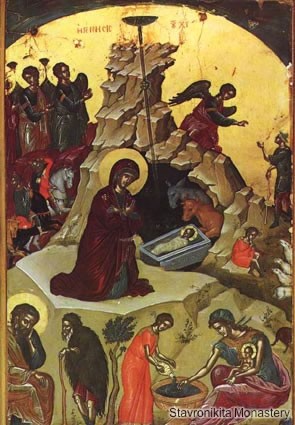
    The nativity of our Lord


    The nativity of our Lord

    23 December 2007

    Vlad the Emperor

    The saga of Vladimir Putin continues, with what may be an attempt either to restore St. Petersburg to its former imperial glory or to gain control over the decisions of the Constitutional Court: Putin moves Russia's highest court to home town. After next May our maps and globes could well record that Russia now has two capital cities.

    20 December 2007

    The Jerusalem Patriarchate: the drama continues

    It seems we assumed too quickly that the status of Theophilos as Patriarch of Jerusalem had been definitively settled. A new difficulty has now arisen: Court freezes recognition of Greek Patriarch. If the achilles' heel of Anglicanism has long been its establishmentarian tendency to affirm the spiritual direction of the larger society, that of Orthodoxy is its historic proclivity for too easily accepting government interference in what should be internal ecclesiastical affairs. Orthodox leaders, including the beleaguered Ecumenical Patriarch whose very title Turkey is attempting to extinguish, would do well to read Abraham Kuyper and his followers on what the Dutch call soevereiniteit in eigen kring (sovereignty in its own sphere) and I myself label the pluriformity of authority. It might not keep governments out of their affairs, but it would give them a weapon with which to fight back.
    Man of the year


    TIME has made its selection this year: Vladimir Putin! Russians are not surprised, but not everyone agrees with the choice: Putin: Odd Choice as Person of the Year. David Stokes goes so far as to analyze Putin's leadership in light of Jesus' counter-emphasis on servanthood: Gore, Putin... and Jesus. Stokes notes that TIME has also picked Hitler, Stalin and Ayatollah Khomeini as men of the year. Whether Putin deserves to be in such august company remains to be seen.
    Russian Ark

    I hope to see this cinematic marvel one day soon:

    19 December 2007

    Cooper in The Spec

    Dr. Justin Cooper, President of Redeemer University College, is interviewed in The Hamilton Spectator today: What should Hamilton aspire to be?
    Dismembering Serbia, again

    Like Canada, Cyprus too is opposed to the West's plans for this Balkan province: Cyprus will not consent to Kosovo's secession. With some justification, the island nation fears that it could suffer the same fate as Serbia.

    In the meantime, the Russian news service Interfax keeps tabs on the destruction of Orthodox churches in Kosovo, the traditional heartland of Serbia: The Kosovo Tragedy.

    While we're at it, could this mark the beginning of another European Union: Alexy II urges Orthodox [governments] to develop relations based on common spiritual tradition.

    18 December 2007

    Patriarch at last

    This story is a bit late in coming: Two years later, Israel confirms appointment of Greek Orthodox Patriarch:

    Theofilos petitioned Israel's Supreme Court to get the state to recognize him, since under church rules he must be approved by all governments in the areas where his flock lives — Israel, Jordan and the Palestinian Authority. The latter two immediately approved, but Israel deferred, awaiting word from a committee it established to examine the appointment.

    I've said it before, but perhaps it's finally time to change these "church rules" so that the church will no longer be held hostage by the capricious governments of the region.
    The play continues

    The actors and the scriptwriter alike are following their cues precisely: Putin Will Be Medvedev's Premier. Thus far the plot lacks suspense. By now the audience must be dozing.

    17 December 2007

    Thomas Torrance (1913-2007)

    Tributes are pouring in for one of the 20th century's great theologians: A tribute to Thomas Torrance, By Gerrit Dawson; Presbyterians Pro-Life honors Thomas F. Torrance. Here is more about his life and work from The Telegraph: The Very Rev Professor Thomas Torrance.
    Dismembering Serbia

    Despite western pressure on Serbia to accept an independent Kosovo, Canada is not enthusiastic about the precedent it would set: Kosovo independence could encourage Quebec separatists. Serbia itself is rejecting a European Union offer to fast-track its membership in the organization in exchange for Kosovo. Perhaps Serbia needs its own Clarity Act.

    15 December 2007

    Urban planning: lessons from Thailand

    Might this marketplace in Bangkok offer a good example of multiple-use zoning?

    12 December 2007

    Peculiar 'penalty' no penalty at all

    This item caught my eye: Chilean judge sentences Catholic priest to recite psalms for traffic violation. "A judge in southern Chile has sentenced a Catholic priest to recite seven psalms daily for three months as punishment for illegal parking." I'm sorry, but this is no punishment. Indeed it amounts to a "lite" version of the Liturgy of the Hours, which has been practised in the monasteries for the better part of two millennia. Many nonmonastic priests observe this anyway. By God's grace, it's just possible that, at the end of the three months, he will decide to continue a discipline that will have become part of him.

    11 December 2007

    O Canada, eh?

    Today may be Canada's real independence day: The Statute of Westminster, 1931.
    Putin's next moves

    It's all falling into place: Putin Names A Successor: 42-year-old Dmitri Medvedev, who appears to be doing as he was told in this speech:

    In order to stay on this path, it is not enough to elect a new president who shares this ideology. It is not less important to maintain the efficiency of the team formed by the incumbent president. That is why I find it extremely important for our country to keep Vladimir Vladimirovich Putin at the most important position in the executive power, at the post of the chairman of the government.

    He led the list of the biggest party, United Russia, which won an impressive victory at the elections to the State Duma and only with this composition, will the new legislative and executive power be able to work efficiently.

    Expressing preparedness to run for the post of president of Russia, I appeal to him with a request to give a principled consent to head the government of Russia after the election of a new president of our country.

    President Medvedev and Prime Minister Putin. Soon the only title Putin will not have worn is that of tsar.

    08 December 2007

    † R.I.P. ECUSA

    Now it's our southern neighbours' turn: U.S. diocese votes to secede from Episcopal Church.

    Followers

    Blog Archive

    About Me

    My photo
    Contact at: dtkoyzis at gmail dot com