European Texas?
The prospect of membership in the European Union has to some extent motivated Turkey to try to clean up its act, especially with respect to human rights abuses. If so, then the EU may be taking the wrong approach here: EU urges Texas governor to halt executions in America's busiest death penalty state. Perhaps the EU should actually offer to admit the Lone Star State as a full member on condition that it abolish capital punishment. I can't think of a reason why Texans wouldn't jump at such an opportunity.
21 August 2007


17 August 2007
Cabinet shuffle
Here is Prime Minister Stephen Harper's new cabinet. Three notable changes: Peter MacKay has been moved from Foreign Affairs to National Defence, Maxime Bernier from Industry to Foreign Affairs, and Jim Prentice from Indian Affairs and Northern Development to Industry.
Here is Prime Minister Stephen Harper's new cabinet. Three notable changes: Peter MacKay has been moved from Foreign Affairs to National Defence, Maxime Bernier from Industry to Foreign Affairs, and Jim Prentice from Indian Affairs and Northern Development to Industry.
13 August 2007
Nunavik
In 1999 Nunavut was carved out of the Northwest Territories and given separate territorial status within Canada. Now we are told that regional government will be granted to a largely Inuit-inhabited territory in northern Québec, to be called Nunavik. Is this the beginning of a separate province, a separate territory or a tertium quid? How might this affect a future referendum on sovereignty should the PQ return to power? Might Nunavik decide to opt out of a sovereign Québec? Stay tuned.

In 1999 Nunavut was carved out of the Northwest Territories and given separate territorial status within Canada. Now we are told that regional government will be granted to a largely Inuit-inhabited territory in northern Québec, to be called Nunavik. Is this the beginning of a separate province, a separate territory or a tertium quid? How might this affect a future referendum on sovereignty should the PQ return to power? Might Nunavik decide to opt out of a sovereign Québec? Stay tuned.
Les Paul
Les Paul was one of the giants of mid-20th-century popular music, pioneering the development of the solid-body electric guitar and virtually inventing multitrack recording. Here is one of the string of hits he recorded with his wife Mary Ford in the early 1950s:
Multitrack recording has been used by generations of musicians over the past more than half a century, including this obscure Upper Canadian vocal quartet singing Psalm 95 (Text and music copyright © 1986, 1999 by David T. Koyzis).
Jenkins on the christian global south
Five years ago Philip Jenkins of Penn State University published The Next Christendom: The Coming of Global Christianity, one of the more significant books of that year. In May of this year the Pew Forum convened its twice-yearly Faith Angle Conference on religion, politics and public life in Key West, Florida, with Professor Jenkins as principal speaker. Michael Cromartie of the Ethics & Public Policy Center was the moderator of the discussion, a transcript of which can be read here: Global Schism: Is the Anglican Communion Rift the First Stage in a Wider Christian Split? Among other things Jenkins argues that the world of the Bible is more immediately comprehensible to African Christians than to westerners living in post-industrial societies.
Five years ago Philip Jenkins of Penn State University published The Next Christendom: The Coming of Global Christianity, one of the more significant books of that year. In May of this year the Pew Forum convened its twice-yearly Faith Angle Conference on religion, politics and public life in Key West, Florida, with Professor Jenkins as principal speaker. Michael Cromartie of the Ethics & Public Policy Center was the moderator of the discussion, a transcript of which can be read here: Global Schism: Is the Anglican Communion Rift the First Stage in a Wider Christian Split? Among other things Jenkins argues that the world of the Bible is more immediately comprehensible to African Christians than to westerners living in post-industrial societies.
I was once talking to some West Africans about the bits of the Bible that made sense to them in ways that could not make sense to Westerners. They said, "We live in agricultural societies, so things like the Parable of the Sower made great sense." Just talking about it, they started getting teary eyed. Then they mentioned Psalm 126. Psalm 126 is a psalm that is widely quoted, and it goes like this: "The man who goes forth into the fields in tears weeping to sow the seed will bring the sheaves again in joy." You understand perfectly well why a farmer would bring the sheaves again in joy; he's celebrating harvest time.
But why do you weep while you're sowing? "It's obvious," they said to me. "Whoever wrote this psalm was writing at a time of famine, like we had a couple of years ago. You've got the corn that's left, and you can do one of two things with it. You can feed your family with it, but if you do that, you're not a farmer anymore [because you have no seeds left] and you have to migrate to the city and become a beggar, and what's going to happen to your children and so on. Or you can take the corn literally out of the hands of your hungry children and use it as seed corn and sow it. That's why a farmer weeps while sowing the corn. It's obvious."
As I said, it wasn't obvious to me, but there are any number of examples like that where the Bible describes a world that makes immediate, intuitive, documentary sense in a way it can't for us.
08 August 2007
Russian novelist on democracy
The German weekly Der Spiegel carries an interview with Aleksandr Solzhenitsyn that is worth reading. Here is the famed Russian novelist on the role of parties in the political process:
Loyalists of the old Reform Party here in Canada appear to have a kindred spirit from across the pond.
The German weekly Der Spiegel carries an interview with Aleksandr Solzhenitsyn that is worth reading. Here is the famed Russian novelist on the role of parties in the political process:
I am a convinced and consistent critic of "party-parliamentarism." I am for non-partisan elections of true people's representatives who are accountable to their regions and districts; and who in case of unsatisfactory work can be recalled. I do understand and respect the formation of groups on economical, cooperative, territorial, educational, professional and industrial principles, but I see nothing organic in political parties. Politically motivated ties can be unstable and quite often they have selfish ulterior motives. Leon Trotsky said it accurately during the October Revolution: "A party that does not strive for the seizure of power is worth nothing." We are talking about seeking benefit for the party itself at the expense of the rest of the people. This can happen whether the takeover is peaceful or not. Voting for impersonal parties and their programs is a false substitute for the only true way to elect people's representatives: voting by an actual person for an actual candidate. This is the whole point behind popular representation.
Loyalists of the old Reform Party here in Canada appear to have a kindred spirit from across the pond.
Unrepentant 'murderer' behind pulpit
I somehow managed to miss this story when it first hit the blogs last year, but an editorial in the July/August issue of Touchstone brought it to my attention: Alma’s Mater: The Violent Hypocrisy of Some Peace & Justice Christians. The Rev. Dr. Donna Schaper is pastor of Judson Memorial Baptist Church in New York. Last year she wrote an article in Tikkun titled My Choice, in which she confessed to having aborted her fourth child, whom she named Alma. Unlike most people styling themselves pro-choice on the abortion issue, Schaper freely admits to having murdered her child:
She claims to have made this difficult choice "as a mature sexual being" who believes that "birth control and abortion are positive moral forces in history." For her the recommendation of abstinence as an alternative is "immoral to its core." The incoherence of her ethical reasoning is too obvious to warrant further comment.
However, it is worth noting that Schaper recently contributed to Jim Wallis's God's Politics blog, where she commented on the Virginia Tech shootings last April: Worship in a Time of Catastrophe. Someone unacquainted with the complexities of a consistent life ethic might be forgiven for wondering on what basis she would object to the murders committed on that campus (though, perhaps tellingly, she never once uses that word). After all, was not the killer simply exercising his freedom of choice as a mature adult?
I somehow managed to miss this story when it first hit the blogs last year, but an editorial in the July/August issue of Touchstone brought it to my attention: Alma’s Mater: The Violent Hypocrisy of Some Peace & Justice Christians. The Rev. Dr. Donna Schaper is pastor of Judson Memorial Baptist Church in New York. Last year she wrote an article in Tikkun titled My Choice, in which she confessed to having aborted her fourth child, whom she named Alma. Unlike most people styling themselves pro-choice on the abortion issue, Schaper freely admits to having murdered her child:
I happen to agree that abortion is a form of murder. I think the quarrel about when life begins is disrespectful to the fetus. I know I murdered the life within me. I could have loved that life but chose not to.
She claims to have made this difficult choice "as a mature sexual being" who believes that "birth control and abortion are positive moral forces in history." For her the recommendation of abstinence as an alternative is "immoral to its core." The incoherence of her ethical reasoning is too obvious to warrant further comment.
However, it is worth noting that Schaper recently contributed to Jim Wallis's God's Politics blog, where she commented on the Virginia Tech shootings last April: Worship in a Time of Catastrophe. Someone unacquainted with the complexities of a consistent life ethic might be forgiven for wondering on what basis she would object to the murders committed on that campus (though, perhaps tellingly, she never once uses that word). After all, was not the killer simply exercising his freedom of choice as a mature adult?
03 August 2007

02 August 2007
Bridge collapse
During my years in Minnesota three decades ago I drove on the I-35W bridge over the Mississippi any number of times. Thus the venue for this disaster is familiar to me. The story can be followed live over local television station WCCO. Footage of the bridge can be seen here. Please pray for the survivors and others affected by this tragedy.
During my years in Minnesota three decades ago I drove on the I-35W bridge over the Mississippi any number of times. Thus the venue for this disaster is familiar to me. The story can be followed live over local television station WCCO. Footage of the bridge can be seen here. Please pray for the survivors and others affected by this tragedy.
01 August 2007
No revising the BCP
The recent General Synod of the Anglican Church has decided not to revise or scrap the Book of Common Prayer — yet. However, the 27-year-old Book of Alternative Services will be altered at some point.
Prayer Book conservatives in this country might do well to remind themselves that the 1962 edition of the BCP, for all its undoubted virtues, abridged the Psalter to leave out the more imprecatory sentiments, e.g., the end of Psalm 137 and the entirety of Psalm 58! Whatever one thinks of the BAS, its creators at least saw fit to include all of the Psalms, even the ones that offend modern sensibilities.
Judicial overreach. . . yet again
First a Turkish court claims the authority to strip the Ecumenical Patriarch of his ecclesiastical title. Now a Malaysian court is claiming to judge who is and is not a Muslim, over against the plaintiff's own claim to be a Christian. What next?
First a Turkish court claims the authority to strip the Ecumenical Patriarch of his ecclesiastical title. Now a Malaysian court is claiming to judge who is and is not a Muslim, over against the plaintiff's own claim to be a Christian. What next?
31 July 2007
Guest appearance announced
One of Redeemer's alumni, Derek Miedema (1995), will appear on 100 Huntley Street on Thursday, 2 August, along with his mother and handicapped twin brother. Derek was a political science student and is now a researcher at the Centre for Faith and Public Life for the Evangelical Fellowship of Canada. His family has had to battle a number of medical adversities over the years. I expect their appearance on television will be a powerful testimony to Godʼs grace in hardship. The programme airs at 9 am and 9 pm EDT on CTS. (Check local listings outside of southern Ontario/western New York.) I assume it will be posted on the CTS website shortly thereafter for online viewing.
One of Redeemer's alumni, Derek Miedema (1995), will appear on 100 Huntley Street on Thursday, 2 August, along with his mother and handicapped twin brother. Derek was a political science student and is now a researcher at the Centre for Faith and Public Life for the Evangelical Fellowship of Canada. His family has had to battle a number of medical adversities over the years. I expect their appearance on television will be a powerful testimony to Godʼs grace in hardship. The programme airs at 9 am and 9 pm EDT on CTS. (Check local listings outside of southern Ontario/western New York.) I assume it will be posted on the CTS website shortly thereafter for online viewing.
30 July 2007
Surnames
Here is a list of the most common surnames in Canada as a whole and in the country's five largest cities. According to this CBC report, University of Toronto Prof. Jack Chambers argues that
Well, not exactly. I don't think he's taken into account cultures where surnames are a quite new phenomenon. When I was growing up I had a lot of relatives whose surnames I didn't even know, and it never occurred to any of us in my immediate family to ask. Surnames were simply not all that important on that side of the family. Many had been taken on only with immigration to the US and elsewhere.
My father was born with a patronymic only. When he went to school the authorities wanted every student to have a first, middle and last name, so he took on his grandfather's surname, which may have had French or Turkish origins, and grecianized it to Κοϊζής, later anglicizing it to Koyzis. This means that my own surname is only about ten years older than I am.
In the Dutch-Canadian community with whom I work, I have long heard that Dutch surnames were chosen only about two centuries ago when Napoleon forced them to take them on. The Dutch often chose humorous or tongue-in-cheek names, assuming this was a passing fad and would never stick. Two-hundred years later their descendants are still saddled with them.
As for the Koyzis name, due to the paucity of married males to pass it on to future generations, it may end up dying out altogether. So perhaps Chambers is right after all.
Here is a list of the most common surnames in Canada as a whole and in the country's five largest cities. According to this CBC report, University of Toronto Prof. Jack Chambers argues that
Over time, the number of surnames has actually not increased with the population, which has made many of them even more common. Says Chambers: "We've got just exactly the same resources now as we had a thousand years ago in Europe, and 3,000 years ago in China when surnaming began."
Well, not exactly. I don't think he's taken into account cultures where surnames are a quite new phenomenon. When I was growing up I had a lot of relatives whose surnames I didn't even know, and it never occurred to any of us in my immediate family to ask. Surnames were simply not all that important on that side of the family. Many had been taken on only with immigration to the US and elsewhere.
My father was born with a patronymic only. When he went to school the authorities wanted every student to have a first, middle and last name, so he took on his grandfather's surname, which may have had French or Turkish origins, and grecianized it to Κοϊζής, later anglicizing it to Koyzis. This means that my own surname is only about ten years older than I am.
In the Dutch-Canadian community with whom I work, I have long heard that Dutch surnames were chosen only about two centuries ago when Napoleon forced them to take them on. The Dutch often chose humorous or tongue-in-cheek names, assuming this was a passing fad and would never stick. Two-hundred years later their descendants are still saddled with them.
As for the Koyzis name, due to the paucity of married males to pass it on to future generations, it may end up dying out altogether. So perhaps Chambers is right after all.
28 July 2007
The eros of teaching
Drawing on personal experience and on Plato's portrayal of Socrates in the Symposium, William Deresiewicz writes about Love on campus in The American Scholar, the quarterly journal of the ΦΒΚ Society. The love of which he speaks is not precisely erotic love or familial affection, but the "eros of souls" that draws students and professors to each other in the joy of shared intellectual pursuits. This is something I have experienced for myself over the past two decades of teaching. There is a poignancy to the author's observations here:
I discovered all this early in my career, and it is one of the things that makes what I do more than just another job. I expect that many of my colleagues will agree with me that loving students and then letting them go is a source at once of great satisfaction and, to be quite honest, of at least some heartache as well.
Drawing on personal experience and on Plato's portrayal of Socrates in the Symposium, William Deresiewicz writes about Love on campus in The American Scholar, the quarterly journal of the ΦΒΚ Society. The love of which he speaks is not precisely erotic love or familial affection, but the "eros of souls" that draws students and professors to each other in the joy of shared intellectual pursuits. This is something I have experienced for myself over the past two decades of teaching. There is a poignancy to the author's observations here:
Socrates says in the Symposium that the hardest thing about being ignorant is that you’re content with yourself, but for many kids when they get to college, this is not yet true. They recognize themselves as incomplete, and they recognize, if only intuitively, that completion comes through eros. So they seek out professors with whom to have relationships, and we seek them out in turn. Teaching, finally, is about relationships. It is mentorship, not instruction. Socrates also says that the bond between teacher and student lasts a lifetime, even when the two are no longer together. And so it is. Student succeeds student, and I know that even the ones I’m closest to now will soon become names in my address book and then just distant memories. But the feelings we have for the teachers or students who have meant the most to us, like those we have for long-lost friends, never go away. They are part of us, and the briefest thought revives them, and we know that in some heaven we will all meet again.
I discovered all this early in my career, and it is one of the things that makes what I do more than just another job. I expect that many of my colleagues will agree with me that loving students and then letting them go is a source at once of great satisfaction and, to be quite honest, of at least some heartache as well.
26 July 2007
ECP Centre
Although he's not far down the QEW from us, I somehow managed to overlook this man, who has begun to write a regular column for WorldNetDaily. Tristan Emmanuel established and leads the Equipping Christians for the Public-square Centre, located in nearby Jordan Station on the Niagara Peninsula. He obviously bears watching.
Although he's not far down the QEW from us, I somehow managed to overlook this man, who has begun to write a regular column for WorldNetDaily. Tristan Emmanuel established and leads the Equipping Christians for the Public-square Centre, located in nearby Jordan Station on the Niagara Peninsula. He obviously bears watching.
25 July 2007
To be Anglican means. . . what?
The Archbishop of Canterbury insists that to be Anglican means to be in communion with the Archbishop of Canterbury. However, my good friend William G. Witt argues that there is little historical support for such a purely formal and institutional definition: Is it Necessary to be in Communion With Canterbury to be Anglican? Witt instead argues for a biblical, confessional identity for the Anglican Communion, a position he obviously shares with Archbishop Orombi and many others:
The Archbishop of Canterbury insists that to be Anglican means to be in communion with the Archbishop of Canterbury. However, my good friend William G. Witt argues that there is little historical support for such a purely formal and institutional definition: Is it Necessary to be in Communion With Canterbury to be Anglican? Witt instead argues for a biblical, confessional identity for the Anglican Communion, a position he obviously shares with Archbishop Orombi and many others:
If one actually reads [Thomas] Cranmer or [John] Jewel or [Richard] Hooker et al, it becomes quite clear that, as they broke with Rome, they would have had no hesitation to break with Canterbury should Canterbury break with the doctrines and practices which encapsulate the gospel--because the identity of Anglicanism does not lie in communion with an historic see, but in doctrines and practices that adhere to the gospel. . . . If Canterbury's dallying leads to the split of the Communion, and Canterbury aligns itself with those who have abandoned historic Anglican doctrines and practices (and Christian faith), then necessarily, but paradoxically, in order to remain Christian, Anglicanism will mean being in communion with those provinces that continue historic Anglican doctrines and practices and not with Canterbury.
From Rome to Constantinople
Earlier this year Francis Beckwith left evangelicalism to return to Rome, thus adding to the number of recent medium-to-high-profile converts, such as Sheldon Vanauken, Thomas Howard, Luis Logo and Fr. Richard John Neuhaus. Others, such as Peter Gillquist, have left protestantism to become Orthodox.
There are, however, people who have converted from Orthodoxy to Catholicism and vice versa. One of the latter is "Crunchy Con" Rod Dreher, who tells the sad tale of his own pilgrimage — one that he never intended to make and would prefer not to have had to make. It's strong stuff and a reminder that many converts, far from joyfully following the truth as they see it into a new home, feel driven out of their former communions and suffer accordingly.
Later: Could another conversion be in the works for Dreher? He now appears to be bolstering the presbyterian argument against episcopacy: Faraway, so close.
22 July 2007
The desecularization of Holland
Here is one more indication that the notoriously secularized Kingdom of the Netherlands may have turned the corner: Changing Patterns in Social Fabric Test Netherlands' Liberal Identity. Note the mention of the Christen Unie, which the author describes as an "orthodox Christian political party."
Incidentally, when The Hamilton Spectator carried this article in yesterday's edition, it capitalized every occurrence of "orthodox." Thus the Netherlands ostensibly has an Orthodox Christian political party, something that might surprise immigrants from Greece and the Balkans. Someone needs to set straight The Spec's editors.
20 July 2007
Fair trade clothing
While on the plane a few weeks ago I was intrigued by this article by Margaret Littman in the airline magazine, American Way: Fair Deal. It's the story of Bill Bass's effort to expand the notion of fair trade beyond the coffee market and into the apparel industry. His company, Fair Indigo, has a laudable aim:
How does it work?
Fair trade is apparently not an easy concept to implement within the fashion industry, as Littman indicates:
Does fair trade represent a trend that could make its way into the production and sale of other goods? Time will tell.
While on the plane a few weeks ago I was intrigued by this article by Margaret Littman in the airline magazine, American Way: Fair Deal. It's the story of Bill Bass's effort to expand the notion of fair trade beyond the coffee market and into the apparel industry. His company, Fair Indigo, has a laudable aim:
We create fashionable, high-quality clothing and accessories while paying a fair wage to the people who produce them. It's a concept known as fair trade and it means we put people first.
How does it work?
Fair Indigo now works with 25 factories across the globe; some specialize in skirts, others in sweaters. Bass says Fair Indigo’s business model of selling directly to customers, through catalogs, the Internet, and its own boutiques, as opposed to selling through national retailers, keeps overhead low enough that it can afford to pay workers at its factories more. Because Fair Indigo is a private firm, Bass will not release sales figures, but he says the company is on track to turn a profit within four years, a time frame analysts say is in line for new apparel companies, fair trade or not.
Fair trade is apparently not an easy concept to implement within the fashion industry, as Littman indicates:
Defining fair trade has been one of the challenges for companies like Fair Indigo that want to go mainstream with a concept many still see as existing only in the margins. At its most basic, the term indicates that the people who create the product are paid a living wage and have decent working conditions. Some expand that definition to include having the right to unionize and access to health care. Others, including the Fair Trade Federation in Washington, D.C., limit it to apply only to workers in developing nations. Often those who support fair trade also support the use of organics and other green initiatives, concerns that are tangential to fair trade, which is all about the labor practices.
Does fair trade represent a trend that could make its way into the production and sale of other goods? Time will tell.
Thanks, Joe
I am honoured that überblogger Joe Carter at the evangelical outpost has seen fit to include this blog as one of "The EO 100," along with such others as On the Square, Mere Comments, Crunchy Con and that of my friend and sometime co-conspirator Gideon Strauss. Now should I be expecting to receive a framed certificate or something in the mail?
I am honoured that überblogger Joe Carter at the evangelical outpost has seen fit to include this blog as one of "The EO 100," along with such others as On the Square, Mere Comments, Crunchy Con and that of my friend and sometime co-conspirator Gideon Strauss. Now should I be expecting to receive a framed certificate or something in the mail?
17 July 2007
Patriarch no longer ecumenical?
The Turkish press are now labelling Bartholomeos the "Fener Patriarch," after the neighbourhood where he resides in Istanbul — a rather drastic demotion from his claimed position as Ecumenical Patriarch. Someone needs to tell them that a government acts beyond its competence in pretending to determine the validity of ecclesiastical titles. Unfortunately the Orthodox themselves have too often helped to exacerbate this confusion.
The Turkish press are now labelling Bartholomeos the "Fener Patriarch," after the neighbourhood where he resides in Istanbul — a rather drastic demotion from his claimed position as Ecumenical Patriarch. Someone needs to tell them that a government acts beyond its competence in pretending to determine the validity of ecclesiastical titles. Unfortunately the Orthodox themselves have too often helped to exacerbate this confusion.
Washington, DC: Taxation with representation?
In a previous post I pointed out that Washington, DC, licence plates carry the words, TAXATION WITHOUT REPRESENTATION. There have long been efforts to do something about the anomalous status of the District of Columbia, including a failed 20-year-old attempt to make it the 51st state. Now there is a bill before the United States Senate to add two representatives to the House of Representatives, including one for DC. TIME Magazine reports: Will D.C. Finally Get a Vote? The original District of Columbia was established in 1790 on land ceded by Maryland and Virginia. (The region south of the Potomac River was returned to Virginia in 1847.) The reason for establishing a federal capital on "neutral" territory was to avoid favouring or empowering one state over the others, an idea borrowed for other planned federal capitals, such as Canberra and Brasilia. The difficulty with the American version of this is that it effectively disenfranchised the residents of Washington, who could not even vote for the president until the 23rd Amendment was ratified in 1961. Obviously something must be done to regularize the status of US citizens who pay taxes but are not fully represented in the centres of decision-making power.
Yet it's not clear that the current legislation is constitutional, which is animating the opposition. Not so incidentally, Republicans oppose the measure, as enfranchising heavily Democratic DC residents would almost certainly strengthen the latter party's presence in Congress. Accordingly President Bush may veto the bill.

Here in Canada we have a National Capital Region, but it does not have a distinct political status like federal capital districts elsewhere. Encompassing the cities of Ottawa, Ontario, and Gatineau, Québec, residents vote in the elections of their respective provinces, in addition to casting ballots in federal elections for a member of parliament. I cannot honestly say that this arrangement has avoided antagonizing the other provinces, mostly because the capital's location only underscores further the reality of central Canada's dominance over the country's political life.
I personally favour granting DC residents congressional representation. Nevertheless, it might be wise for American policy-makers to look into how other federal systems, such as Australia, Germany and Brazil, have addressed the need for representation in their own capital cities. Americans can rightly be said to have invented modern constitutional federalism, but it may be that others have solved dilemmas that the founding fathers did not anticipate more than two centuries ago.
16 July 2007
Shedding pounds . . . the hard way
My body weight appears to have stabilized at two pounds less than it was before my recent surgery. Which leads me to conclude that my appendix must have weighed two pounds.
My body weight appears to have stabilized at two pounds less than it was before my recent surgery. Which leads me to conclude that my appendix must have weighed two pounds.
Miss Potter
Our daughter Theresa was raised on two fat collections of the fanciful stories of Beatrix Potter, whose Peter Rabbit catapulted her to fame in 1902. Although the new Harry Potter film is getting huge publicity, I would enthusiastically recommend a similarly-surnamed film, Miss Potter, released late last year and now out on DVD. It's a charming cinematic treatment of Beatrix Potter's life, with all its joys and heartaches, that can be enjoyed by the entire family. The fact that Theresa rarely puts down pencil and paper may explain why I am drawn to the portrayal of a little girl constantly painting and developing her gifts for the benefit of the world. Here is the trailer:
Among the high points of the film is the cinematography, especially of the Lake District in the north of England. Renée Zellweger plays the title role beautifully, though she is made to look a little too frumpy. Ewan McGregor (no relation to Farmer McGregor!) winsomely plays Potter's publisher and early love interest, Norman Warne. Miss Potter is definitely worth seeing.
13 July 2007
Christ transforming Uganda
Christians in a number of traditions pay lip service to an expression borrowed from H. Richard Niebuhr more than half a century ago: Christ transforming culture. But what does this mean in practice for specific contexts, e.g., subsaharan Africa? Archbishop Henry Luke Orombi of Uganda gives us some concrete examples in this inspiring piece appearing in the upcoming issue of First Things: What Is Anglicanism? Orombi affirms that it is the Bible itself that has transformed his country and its people, and he highlights the treatment of women, clan revenge, and the worship of nature and ancestral spirits as examples.
I am struck by the role martyrdom has played in the revival and growth of the Church of Uganda. Many of us remember the death of Archbishop Janani Luwum at the hands of Idi Amin in 1977. Ten years ago my friend Paul Marshall brought the plight of persecuted believers before a complacent west. At one time the heirs of the English Reformation read Foxe's Book of Martyrs, a collection that has fallen out of favour in an ecumenical age but that served for generations to confirm Tertullian's ancient maxim that “The blood of the martyrs is the seed of the church.” I can testify from experience that martyrdom is not much mentioned today in the Anglican Church of Canada, which may go some way in explaining its current state.
Orombi's piece should be required reading for every Anglican and Episcopal bishop in North America. Imagine how the ACC and TEC would grow and flourish if they could manage to catch Orombi's vision. Pray God that by his grace this might happen.
Christians in a number of traditions pay lip service to an expression borrowed from H. Richard Niebuhr more than half a century ago: Christ transforming culture. But what does this mean in practice for specific contexts, e.g., subsaharan Africa? Archbishop Henry Luke Orombi of Uganda gives us some concrete examples in this inspiring piece appearing in the upcoming issue of First Things: What Is Anglicanism? Orombi affirms that it is the Bible itself that has transformed his country and its people, and he highlights the treatment of women, clan revenge, and the worship of nature and ancestral spirits as examples.
The gospel of Jesus Christ as revealed to us through the Word of God enables warring tribes to begin to coexist and to embrace neighborliness. Indeed, the Word of God opened the way for the nation of Uganda to be forged. When evangelists from Buganda (in central Uganda) traveled to tribes in the east, west, and north, a new day dawned in our country. Instead of being armed with spears, they came armed only with the Word of God. Instead of a message of war and destruction, they delivered a message of Good News from the God and Father of our Lord Jesus Christ.
As the Bible came with the authority of Christ, it revealed a God that is greater than the evil spirits and the kingdom of darkness that controlled so many people’s lives. In Uganda, the Bible has grown into a cherished source of authority that is central to Christian faith, practice, and mission. For all God’s people, obedience to this Bible is the source of confidence, abundant life, and joy. It is an absolute treasure that no one can take away. Isaiah, later quoted by Peter, wrote, “The grass withers and the flowers fall, but the word of our God stands forever” (Isa. 40:8; 1 Pet. 1:24-25). The grass on which our cattle feed, the grass from which our roofs are thatched—all this withers. But the Word of God has withstood the test of time. The Bible is at the heart of our Anglican identity, and we Ugandan Anglicans joyfully submit to its life-giving and transforming authority.
With this knowledge of the centrality of the authority of Scripture in Anglicanism, therefore, we understand ourselves to be in the mainstream of Anglicanism—from Thomas Cranmer to John Stott. The evangelical tradition in the Church of England produced William Wilberforce, whose lifelong mission to eradicate slavery and the slave trade liberated our people. It produced Charles Simeon, who inspired the beginning of mission societies that shared the gospel of Jesus Christ with us and many others. It produced Bishop Tucker and other missionaries, who risked their lives to come to Uganda. These and many more Anglican evangelicals brought us the legacy of the Protestant Reformation in England. Their commitment to salvation through faith in Jesus Christ as revealed in Scripture has continued among us to this day.
I am struck by the role martyrdom has played in the revival and growth of the Church of Uganda. Many of us remember the death of Archbishop Janani Luwum at the hands of Idi Amin in 1977. Ten years ago my friend Paul Marshall brought the plight of persecuted believers before a complacent west. At one time the heirs of the English Reformation read Foxe's Book of Martyrs, a collection that has fallen out of favour in an ecumenical age but that served for generations to confirm Tertullian's ancient maxim that “The blood of the martyrs is the seed of the church.” I can testify from experience that martyrdom is not much mentioned today in the Anglican Church of Canada, which may go some way in explaining its current state.
Orombi's piece should be required reading for every Anglican and Episcopal bishop in North America. Imagine how the ACC and TEC would grow and flourish if they could manage to catch Orombi's vision. Pray God that by his grace this might happen.
12 July 2007
Irene Keesmaat
This is rather short notice, I recognize, but I have just learnt that area artist Irene Keesmaat, a former colleague of mine at Redeemer, will be exhibiting her works at the Edinburgh Square Heritage and Cultural Centre in Caledonia, Ontario, beginning this evening with an opening reception from 7 to 9. I have linked to Irene's website in my sidebar.
This is rather short notice, I recognize, but I have just learnt that area artist Irene Keesmaat, a former colleague of mine at Redeemer, will be exhibiting her works at the Edinburgh Square Heritage and Cultural Centre in Caledonia, Ontario, beginning this evening with an opening reception from 7 to 9. I have linked to Irene's website in my sidebar.
A working holiday
Our family just returned from travels to the US, where I managed to visit 5 states, one territory and three airports in the space of slightly more than a week. Two weekends ago we drove from Hamilton to Chicago, passing through Michigan and Indiana on the way. We visited family on both sides. On monday, 2 July, we visited the Brookfield Zoo with my sister-in-law and her young family. I had not been there since 1983. It's definitely worth a visit if you are ever in the Windy City.
On tuesday through thursday I was in Washington, DC, to speak to the annual Civitas Summer Leadership Seminar, sponsored by the Center for Public Justice. The title of my talk was "Beyond Ideological Thinking," in which I spoke about liberalism and its alternatives. It was an enjoyable and stimulating event.

The following day our group was privileged to tour the White House, which I found to be far smaller and less impressive than I had long envisioned it in my mind. Nevertheless, it's a fascinating place, with portraits of various presidents and first ladies covering the 2-century-old walls. There were portraits of both Bill and Hillary Clinton, prompting me to wonder whether these would have to trade places if the latter becomes president.

I did not visit the Capitol building, home of the United States Congress, but I was able to photograph it from a distance. This was taken from the roof of the building housing the CCCU's American Studies Program.

Wednesday was, of course, the Independence Day holiday, so in the evening our group walked down to a spot where we were able to view the fireworks on the National Mall, which had been temporarily evacuated earlier in the evening due to a tornado warning.
Licence plates typically carry a state motto, such as New Hampshire's notorious LIVE FREE OR DIE. The District of Columbia is not a state, and as such it has no voting representatives in Congress. Thus the DC plates carry this slogan in protest:

When I first told Theresa I would be going to Washington, DC, she heard Washington, BC, assuming I was travelling once again to Canada's westernmost province. When I corrected her and she asked what the DC stands for, I responded: "the District of Columbia," to which she retorted knowingly: "I thought the C must stand for Columbia!"
Thursday afternoon I returned to Chicago and family. While in the air, my plane grazed the top of a terrific storm, which we saw from above. The thunder clouds were impressive, but the turbulence was a bit unnerving.

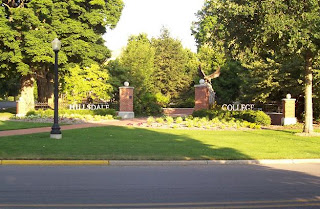
At the weekend we drove to Hillsdale, Michigan, home of Hillsdale College, a small undergraduate university well known in politically conservative circles in the US.
Hillsdale sells bricks to alumni, parents and supporters for $150 each to be placed in its Alumni Walk, which extends through the centre of the campus. Here are some typical examples:


Outside the Dow Center on the Hillsdale campus is a plaque containing a selection from Thomas Paine's Dissertation on First Principles of Government. Paine was anything but a conservative, but he somehow managed to slip by Hillsdale's gatekeepers with an extremely unBurkean sentiment:

We arrived home to Hamilton on monday. As usual, it's good to be back.
Our family just returned from travels to the US, where I managed to visit 5 states, one territory and three airports in the space of slightly more than a week. Two weekends ago we drove from Hamilton to Chicago, passing through Michigan and Indiana on the way. We visited family on both sides. On monday, 2 July, we visited the Brookfield Zoo with my sister-in-law and her young family. I had not been there since 1983. It's definitely worth a visit if you are ever in the Windy City.
On tuesday through thursday I was in Washington, DC, to speak to the annual Civitas Summer Leadership Seminar, sponsored by the Center for Public Justice. The title of my talk was "Beyond Ideological Thinking," in which I spoke about liberalism and its alternatives. It was an enjoyable and stimulating event.

The following day our group was privileged to tour the White House, which I found to be far smaller and less impressive than I had long envisioned it in my mind. Nevertheless, it's a fascinating place, with portraits of various presidents and first ladies covering the 2-century-old walls. There were portraits of both Bill and Hillary Clinton, prompting me to wonder whether these would have to trade places if the latter becomes president.

I did not visit the Capitol building, home of the United States Congress, but I was able to photograph it from a distance. This was taken from the roof of the building housing the CCCU's American Studies Program.

Wednesday was, of course, the Independence Day holiday, so in the evening our group walked down to a spot where we were able to view the fireworks on the National Mall, which had been temporarily evacuated earlier in the evening due to a tornado warning.
Licence plates typically carry a state motto, such as New Hampshire's notorious LIVE FREE OR DIE. The District of Columbia is not a state, and as such it has no voting representatives in Congress. Thus the DC plates carry this slogan in protest:

When I first told Theresa I would be going to Washington, DC, she heard Washington, BC, assuming I was travelling once again to Canada's westernmost province. When I corrected her and she asked what the DC stands for, I responded: "the District of Columbia," to which she retorted knowingly: "I thought the C must stand for Columbia!"
Thursday afternoon I returned to Chicago and family. While in the air, my plane grazed the top of a terrific storm, which we saw from above. The thunder clouds were impressive, but the turbulence was a bit unnerving.

At the weekend we drove to Hillsdale, Michigan, home of Hillsdale College, a small undergraduate university well known in politically conservative circles in the US.

Hillsdale sells bricks to alumni, parents and supporters for $150 each to be placed in its Alumni Walk, which extends through the centre of the campus. Here are some typical examples:


Outside the Dow Center on the Hillsdale campus is a plaque containing a selection from Thomas Paine's Dissertation on First Principles of Government. Paine was anything but a conservative, but he somehow managed to slip by Hillsdale's gatekeepers with an extremely unBurkean sentiment:

We arrived home to Hamilton on monday. As usual, it's good to be back.
11 July 2007
Redeeming time
Chuck Colson writes about time here: A New Perspective on Time, and here: How Big is Your God? Reading these so soon after the "untimely" death of one of my students prompts me to publish my own reflections on the subject.
When I was a child I developed a strong sense of the irreversibility of time's passage. Although one genre of science fiction is preoccupied with the notion of time travel, and though there seems to be something, if Einstein is to be believed, to the possibility of accelerating or slowing the passage of time, it remains impossible to reverse the process. This is perhaps why we are so fascinated by the likes of Back to the Future, the cinematic tale of an adolescent who returns to the days of his parents' youth and manages to rewrite the history of his own family.
When we regularly visited my grandmother's house in Milan, Michigan, nearly half a century ago, I recall seeing there a photographic portrait of my great-grandmother. She had died seven years before my birth, and I regretted that I had no memories of her, as did my mother and grandmother. I wished that I had known something of the world before I came along and would love to have experienced backwards time travel. My early fascination with the Chicago Aurora & Elgin Railroad — revived during my second year at Notre Dame — was also rooted in the desire to experience a defunct interurban railway that had come to an end before conscious memory. In short, backwards time travel, if it were possible, held out the tantalizing possibility of reversing death and recovering something long gone.
Those who are in Christ are promised eternal or everlasting life. We human beings cannot begin to comprehend what this will mean. Scripture speaks in metaphors and highly symbolic language, especially in the apocalyptic books. There are, however, many Christians who, following Augustine, assume that eternity is a state somehow outside of time. Remember the lyrics of the old gospel hymn:
Will time really cease to exist? Is eternity a static, timeless condition, as popular theology would have us believe? I will not speculate as to God's relationship to and experience of time, since that falls outside of what he has revealed to us. Yet with respect to his image-bearers I believe this can be affirmed: if time is the good creation of God, then it makes more biblical sense to confess that in the new heaven and new earth being prepared for those who trust in Jesus Christ's salvation, time will be redeemed, not abolished. Eternity is thus not stasis on the ancient Greek model, but an everlasting age to which we will be summoned at Christ's return either from the grave or from our earthly, albeit mortal, lives.
Chuck Colson writes about time here: A New Perspective on Time, and here: How Big is Your God? Reading these so soon after the "untimely" death of one of my students prompts me to publish my own reflections on the subject.
When I was a child I developed a strong sense of the irreversibility of time's passage. Although one genre of science fiction is preoccupied with the notion of time travel, and though there seems to be something, if Einstein is to be believed, to the possibility of accelerating or slowing the passage of time, it remains impossible to reverse the process. This is perhaps why we are so fascinated by the likes of Back to the Future, the cinematic tale of an adolescent who returns to the days of his parents' youth and manages to rewrite the history of his own family.
When we regularly visited my grandmother's house in Milan, Michigan, nearly half a century ago, I recall seeing there a photographic portrait of my great-grandmother. She had died seven years before my birth, and I regretted that I had no memories of her, as did my mother and grandmother. I wished that I had known something of the world before I came along and would love to have experienced backwards time travel. My early fascination with the Chicago Aurora & Elgin Railroad — revived during my second year at Notre Dame — was also rooted in the desire to experience a defunct interurban railway that had come to an end before conscious memory. In short, backwards time travel, if it were possible, held out the tantalizing possibility of reversing death and recovering something long gone.
Those who are in Christ are promised eternal or everlasting life. We human beings cannot begin to comprehend what this will mean. Scripture speaks in metaphors and highly symbolic language, especially in the apocalyptic books. There are, however, many Christians who, following Augustine, assume that eternity is a state somehow outside of time. Remember the lyrics of the old gospel hymn:
When the trumpet of the Lord shall sound,
and time shall be no more. . . .
Will time really cease to exist? Is eternity a static, timeless condition, as popular theology would have us believe? I will not speculate as to God's relationship to and experience of time, since that falls outside of what he has revealed to us. Yet with respect to his image-bearers I believe this can be affirmed: if time is the good creation of God, then it makes more biblical sense to confess that in the new heaven and new earth being prepared for those who trust in Jesus Christ's salvation, time will be redeemed, not abolished. Eternity is thus not stasis on the ancient Greek model, but an everlasting age to which we will be summoned at Christ's return either from the grave or from our earthly, albeit mortal, lives.
07 July 2007
Summorum Pontificum
It's finally happened: Pope approves wider use of Latin Mass. Here is the text of the Pope's letter.
It's finally happened: Pope approves wider use of Latin Mass. Here is the text of the Pope's letter.
03 July 2007
Another 50th anniversary

A half century ago today my favourite interurban railway abruptly ceased passenger service after 55 years of business. The Chicago Aurora & Elgin Railway began in 1902 when the original line was built between Chicago and Aurora, powered by electric third rail. In the next few years lines were extended to Elgin, Batavia, Geneva and St. Charles, all communities located along the Fox River. The lines branched out at my home town of Wheaton, the centre of operations and the location of the shops. Though most interurban railways were little more than trolley lines running alongside rural roads between towns, the CA&E was built to the standards of the steam lines and could thus attain higher speeds. While most interurbans flourished in the first two decades of the 20th century, only to founder after the Great War with the advent of the automobile, the CA&E, along with two other Chicago area interurbans, survived much longer, effectively becoming a suburban commuter line.

The CA&E was a precarious enterprise from the 1920s on, and it went through more than one receivership and reorganization over the decades. The Second World War years saw an increase in ridership, but ten years later it was struggling to remain afloat. In 1953 its entrance into Chicago over the Garfield Park elevated line was terminated to make way for the construction of the Congress (later Eisenhower) Expressway. Passengers from the Fox Valley suburbs had to get off at suburban Forest Park and transfer to the "L" for the remainder of the trip to Chicago. This was the final blow to the CA&E. Ridership plummeted and management petitioned to abandon passenger service. Permission finally came in the late morning of wednesday, 3 July 1957. Service was suspended a few minutes after noon, stranding passengers in the Loop, forcing them to find other ways home that evening. Freight service limped along for another two years. I recall seeing a CA&E freight train crossing Roosevelt Road in Wheaton when I was quite small. The railway was abandoned altogether in 1961.
A few CA&E cars are still operating at various railway museums around the United States, most notably the Fox River Trolley Museum and the Illinois Railway Museum (IRM). The CA&E right-of-way is now the Illinois Prairie Path, a recreational trail for jogging, hiking and bicycling. Here is a look at restored CA&E cars in action at the IRM:
Incidentally, the cessation of passenger service on the CA&E occurred only three days after my baptism.
Five years ago, to mark the occasion of the CA&E's centenary, I composed a song, titled The Great Third Rail Rag, after one of the railway's many nicknames. It is written in the style of Scott Joplin's rags, which were popular in the first years of the 20th century.
30 June 2007
Baptism and the christian life
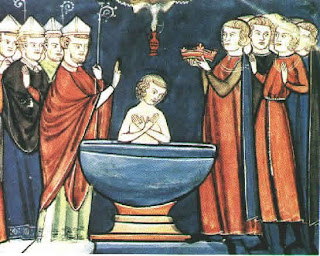
Today marks the 50th anniversary of my baptism. Through this sacrament I was received into the body of Christ at Westminster Orthodox Presbyterian Church, then in Westchester, Illinois, but now located in nearby Indian Head Park.
When I was younger I did not treasure this day as I do now. In fact, in my teens I worshipped, along with my family, in a baptist church that did not recognize the validity of my baptism at all. Nevertheless I have come to follow Calvin in believing that our baptism, far from being diminished or invalidated by our inability to remember it, is a sign of our union with Christ for the whole of life into eternity. This union is effected entirely by the grace of God, which comes to us even before we are aware of it.
As always, the Heidelberg Catechism puts it very nicely indeed:
Four years ago, at my request, the members of the session of Westminster Church were kind enough to make up and send me a baptismal certificate, based on their minutes from 1957.

Today marks the 50th anniversary of my baptism. Through this sacrament I was received into the body of Christ at Westminster Orthodox Presbyterian Church, then in Westchester, Illinois, but now located in nearby Indian Head Park.
When I was younger I did not treasure this day as I do now. In fact, in my teens I worshipped, along with my family, in a baptist church that did not recognize the validity of my baptism at all. Nevertheless I have come to follow Calvin in believing that our baptism, far from being diminished or invalidated by our inability to remember it, is a sign of our union with Christ for the whole of life into eternity. This union is effected entirely by the grace of God, which comes to us even before we are aware of it.
As always, the Heidelberg Catechism puts it very nicely indeed:
Q. How does baptism remind you and assure you that Christ's one sacrifice on the cross is for you personally?
A. In this way: Christ instituted this outward washing and with it gave the promise that, as surely as water washes away the dirt from the body, so certainly his blood and his Spirit wash away my soul's impurity, in other words, all my sins.
Four years ago, at my request, the members of the session of Westminster Church were kind enough to make up and send me a baptismal certificate, based on their minutes from 1957.
Do you not know that all of us who have been baptized into Christ Jesus were baptized into his death? We were buried therefore with him by baptism into death, so that as Christ was raised from the dead by the glory of the Father, we too might walk in newness of life (Romans 6:3-4).
29 June 2007
"Craig Vanderveen is home! boo-yah."
With great shock and sadness I post the following announcement from the President of Redeemer University College, Dr. Justin Cooper:
Craig was a double major in political science and business at Redeemer, and he managed to take every course I teach. He was a bright student with a promising future ahead of him. He had planned to graduate in December and thus had one more semester to go. He was president of Student Senate this past year, past managing editor of the Crown, and was involved in a variety of other activities. He was respected by his peers and his professors, and he would have been a strong contender for next year's Faculty Award.
He was working at Redeemer over the summer months. The last time I saw him was around two weeks ago when we passed in the hall. He recently returned to his home province of Manitoba, where last evening's accident occurred. The heading for this post is taken from the last thing he wrote in his facebook profile on sunday.
We will miss you, Craig. We look forward, by God's grace, to seeing you again at the resurrection.
Addendum: Craig's funeral will be 10 am, Wednesday, July 4, at the Carman Canadian Reformed Church, Carman, Manitoba. No visitation is planned.
With great shock and sadness I post the following announcement from the President of Redeemer University College, Dr. Justin Cooper:
We are saddened by the tragic news of the death of Craig Vanderveen on Thursday evening, June 28. While visiting his family in Manitoba, he and a friend were killed in a car accident while traveling to Winnipeg to see his grandfather. Further details of the funeral and any contact information will be provided when it becomes available. In the meantime, please pray for the Lord's grace and comfort for family and friends, particularly those in the Redeemer community who knew and worked with Craig.
With resurrection hope,
President Cooper
Craig was a double major in political science and business at Redeemer, and he managed to take every course I teach. He was a bright student with a promising future ahead of him. He had planned to graduate in December and thus had one more semester to go. He was president of Student Senate this past year, past managing editor of the Crown, and was involved in a variety of other activities. He was respected by his peers and his professors, and he would have been a strong contender for next year's Faculty Award.
He was working at Redeemer over the summer months. The last time I saw him was around two weeks ago when we passed in the hall. He recently returned to his home province of Manitoba, where last evening's accident occurred. The heading for this post is taken from the last thing he wrote in his facebook profile on sunday.
We will miss you, Craig. We look forward, by God's grace, to seeing you again at the resurrection.
Addendum: Craig's funeral will be 10 am, Wednesday, July 4, at the Carman Canadian Reformed Church, Carman, Manitoba. No visitation is planned.
28 June 2007
Another Byzantine-rite Calvinist?
Judging from her comments on the OrthodoxyToday.org Blog, I think "Nancy L" may have fallen under the influence of the 17th-century Ecumenical Patriarch Cyril Lucaris. Moreover, it seems we are both alumni of the same undergraduate institution.
Judging from her comments on the OrthodoxyToday.org Blog, I think "Nancy L" may have fallen under the influence of the 17th-century Ecumenical Patriarch Cyril Lucaris. Moreover, it seems we are both alumni of the same undergraduate institution.
27 June 2007
Patriarch still 'Ecumenical'?
A few years ago an Ontario provincial court claimed the competence to judge what is and is not Catholic doctrine. Now a top Turkish court has ruled that the Ecumenical Patriarch's use of the title ecumenical has no legal standing. Will the Patriarchate now follow the unwelcome precedent of its Jerusalem counterpart and allow itself to be hamstrung by the country's political rulers? Or will it defy precedent and declare that a government has no jurisdiction over ecclesiastical titles?
A few years ago an Ontario provincial court claimed the competence to judge what is and is not Catholic doctrine. Now a top Turkish court has ruled that the Ecumenical Patriarch's use of the title ecumenical has no legal standing. Will the Patriarchate now follow the unwelcome precedent of its Jerusalem counterpart and allow itself to be hamstrung by the country's political rulers? Or will it defy precedent and declare that a government has no jurisdiction over ecclesiastical titles?
Conservative environmentalists
For some odd reason concern for the environment has come to be associated with those conventionally styled "leftists." Here's evidence that not all professed conservatives are willing to concede such concern to their opponents: Conservative Principles and the Environment. Author John R. E. Bliese writes:
For some odd reason concern for the environment has come to be associated with those conventionally styled "leftists." Here's evidence that not all professed conservatives are willing to concede such concern to their opponents: Conservative Principles and the Environment. Author John R. E. Bliese writes:
In the often quoted words of Edmund Burke, society is "a partnership between those who are living, those who are dead, and those who are to be born." Therefore, we have obligations and duties to future generations. We have no right to trash the earth in an orgy of consumption and leave our children and grandchildren a polluted and depleted planet. The idea of "sustainable development" is a perfectly conservative one. We have a moral obligation to design our economy in such a way that we can produce our goods without reducing the ability of the planet to support future generations.
Anglican news
Although this story has received the lion's share of the press coverage of the Anglican Church of Canada's General Synod, a more basic problem faces this historic church body: Anglican Church 'fiddling away while Rome is burning'. Though some media reports give the church a membership of 2 million, thus making it one of Canada's largest denominations, the reality on the ground is much different:
What is the cause of this haemorrhaging of the church's lifeblood? If a church has a weak grasp of the saving power of the gospel, people eventually will no longer bother with it. If it can manage only to become "ever more welcoming and inclusive" without calling members to live biblically faithful lives, it should not be surprised if many parishioners find little reason to tear themselves away from their newspapers or golf games on sunday mornings. One is struck by the irony of a church trying to be all things to all people while effectively alienating increasing numbers by failing to make any significant demands on them.
Although this story has received the lion's share of the press coverage of the Anglican Church of Canada's General Synod, a more basic problem faces this historic church body: Anglican Church 'fiddling away while Rome is burning'. Though some media reports give the church a membership of 2 million, thus making it one of Canada's largest denominations, the reality on the ground is much different:
In 2005 the Anglican Church of Canada's House of Bishops was handed an internal study that said the church was losing 13,000 members a year, and that membership lists had shrunk by 53 per cent from 1961 to 2001.
Although several million Canadians identify themselves as Anglican on census questionnaires, the number of active Anglicans is far fewer and falling. Between 1961 and 2001, Anglican parish lists plunged from 1.36-million members to 642,000.
What is the cause of this haemorrhaging of the church's lifeblood? If a church has a weak grasp of the saving power of the gospel, people eventually will no longer bother with it. If it can manage only to become "ever more welcoming and inclusive" without calling members to live biblically faithful lives, it should not be surprised if many parishioners find little reason to tear themselves away from their newspapers or golf games on sunday mornings. One is struck by the irony of a church trying to be all things to all people while effectively alienating increasing numbers by failing to make any significant demands on them.
25 June 2007
The Martyr of Mosul
Three weeks ago yesterday a 35-year-old Chaldean priest, Fr. Ragheed Ganni, was martyred in Mosul, an ancient city with historic christian roots in northern Iraq. Once numbering between 1.5 and 2 million, Iraq's Assyrian Christians have declined dramatically in numbers since 2003 to only around 500,000, most apparently having fled the country. Patrick Buchanan reports on The Martyr of Mosul. Sandro Magister has further details on this young servant of Christ and his courageous dedication to his parishioners: The Last Mass of Father Ragheed, a Martyr of the Chaldean Church.
The notoriously truculent Buchanan draws political implications from this martyrdom, holding responsible "the men who conceived this misbegotten war." Although I am sympathetic with Buchanan's point, I believe that Magister's response of gratitude is more in keeping with that of the historic church for the past two millennia:
Dearest Ragheed, together with a heart which cries in pain, you leave us your hope and your certainty. By taking you, they aimed to wipe out the hope of Iraq’s Christians. Instead, your martyrdom nourishes and gives new life to your community, to the Iraqi Church and the Church throughout the world. Thank you, Ragheed!
Going fishing
On saturday I joined my good friend Michael Glockner for a fishing excursion to a pond up in Milton. Michael is an avid fisherman, and he was kind enough to provide the gear. This was the first time I had been fishing for probably more than four decades, and I found it quite enjoyable.

Michael and me at the trout pond
I used to go fishing with my father as a boy, but I didn't remember ever having caught any fish, so when I caught one this past weekend, I naturally assumed that it was the first time ever. It wasn't. Talking to my parents later in the day, I learned that my childhood fishing ability was apparently better than my current capacity to remember it. In fact, my dad reminded me that on one occasion I caught three fish. I was so proud of them that I didn't want to eat them. Once they were cooked and on the table for supper that evening, he had to tell me they were market-purchased fish so I wouldn't go hungry. I don't recall this episode myself, but then again I have had a lot on my mind since 1965!

Struggling to hold aloft
my catch of the day
Saturday evening I grilled two rainbow trout on the outdoor grill, and Nancy and Theresa and I had a nourishing picnic dinner. The following day Theresa came up with her own rendition of her daddy's excursion:

Daddy and 'Uncle' Michael fishing for
rainbow trout
On saturday I joined my good friend Michael Glockner for a fishing excursion to a pond up in Milton. Michael is an avid fisherman, and he was kind enough to provide the gear. This was the first time I had been fishing for probably more than four decades, and I found it quite enjoyable.

I used to go fishing with my father as a boy, but I didn't remember ever having caught any fish, so when I caught one this past weekend, I naturally assumed that it was the first time ever. It wasn't. Talking to my parents later in the day, I learned that my childhood fishing ability was apparently better than my current capacity to remember it. In fact, my dad reminded me that on one occasion I caught three fish. I was so proud of them that I didn't want to eat them. Once they were cooked and on the table for supper that evening, he had to tell me they were market-purchased fish so I wouldn't go hungry. I don't recall this episode myself, but then again I have had a lot on my mind since 1965!

my catch of the day
Saturday evening I grilled two rainbow trout on the outdoor grill, and Nancy and Theresa and I had a nourishing picnic dinner. The following day Theresa came up with her own rendition of her daddy's excursion:

rainbow trout
22 June 2007
Song of the Three Youths

I have posted on my Genevan Psalter website my most recent song, a metrical versification of the Song of the Three Youths, variously known also as the Song of the Three Holy Children or simply the Song of the Three. This marvellous hymn of praise is traditionally ascribed to Daniel's three companions from within the fiery furnace after they had been cast there by the Babylonian King Nebuchadnezzar. It does not appear in the Hebrew canon, but it is found in the Septuagint and later translations based on it, where it is inserted into the third chapter of Daniel. Though not strictly regarded as canonical by Christians of the Reformation, it has nevertheless found its way into the church's sung canticles, as found in the Book of Common Prayer and the Lutheran liturgy. Both text and tune I wrote earlier this week. The tune I have titled BENEDICITE, after the Latin name for the canticle, Benedicite Omnia Opera.
This morning I was privileged to examine an ancient edition of the Geneva Bible published in England towards the end of the 16th century. Following the text of the Scriptures itself is a section with liturgical resources, in which the Benedicite finds an honoured place. Indeed it deserves to be known and sung widely by all Christians of every tradition.

21 June 2007
Victims of Communism
Chuck Colson reports on the dedication of the Victims of Communism Memorial Park in Washington, DC, dedicated to the one-hundred million victims of this failed political illusion: The Utopian Nightmare. Here is a prototype of the statue rising above the park, which is apparently modelled after the goddess of democracy built by the Tiananmen demonstrators in 1989:

To my mind this statue perhaps too closely resembles Vera Mukhina's overwrought monument to socialist realism, Worker and Kolkhoz Woman:

On the other hand, I am inclined to think that the monument unveiled in Prague five years ago to commemorate communism's victims is more appropriate, evoking the sheer terror of the régimes it spawned. Click on the photo below, look at it carefully and see what you think:

20 June 2007
Free Aghia Sophia

This remarkable report comes from Greek News:
What are the chances of Turkey taking action on this issue? Slightly worse, I would judge, than the chances of the proverbial snowball in the infernal regions. Spirou's efforts might be put to better use if he were to focus instead on persuading Ankara to permit the reopening of the Ecumenical Patriarchate's Theological School of Halki, the success of which is considerably more likely.

This remarkable report comes from Greek News:
Athens - A nascent international initiative to restore the Hagia Sophia Cathedral in Istanbul as a place of worship for all the world's Christians was outlined here on Thursday by veteran Greek-American political leader Chris Spirou, less than a week before a public hearing is scheduled on the religious monument's condition at the US Congress.
Spirou, a noted New Hampshire Democratic leader and long-time activist for Greek national issues in the United States, said the organisation he heads up (Free Agia Sophia Council of America) will present evidence showing the "violation" of Eastern Orthodoxy's most renowned basilica over the past 554 years. . . .
The hearing, to be held by the joint Congressional Human Rights Caucus (CHRC), marks the first time that Congress will hear testimony on the situation concerning Hagia Sophia.
What are the chances of Turkey taking action on this issue? Slightly worse, I would judge, than the chances of the proverbial snowball in the infernal regions. Spirou's efforts might be put to better use if he were to focus instead on persuading Ankara to permit the reopening of the Ecumenical Patriarchate's Theological School of Halki, the success of which is considerably more likely.
19 June 2007
Seeking unity
Could the head of the Church of Cyprus help to bring reconciliation between the Papacy and the Moscow Patriarchate? His Beatitude, Archbishop Chrysostomos II of New Justiniana and All Cyprus thinks so and has offered his services in a visit to Rome last saturday.
Could the head of the Church of Cyprus help to bring reconciliation between the Papacy and the Moscow Patriarchate? His Beatitude, Archbishop Chrysostomos II of New Justiniana and All Cyprus thinks so and has offered his services in a visit to Rome last saturday.
16 June 2007
Praying through the psalms: translations
In recent days I've been reading through Miles Coverdale's translations of the Psalms according to the schedule prescribed in the Book of Common Prayer. I am just old enough to have grown up with the King James Version (KJV) of the Bible, so the Elizabethan English is not altogether foreign to me. When I do run into something incomprehensible, I am sufficiently familiar with the psalms to know what is being said in most cases. From a literary standpoint, Coverdale's translations seem somewhat less polished than the KJV's, including such redundant constructions as "Most Highest," which would be regarded as grammatically incorrect nowadays.
We English-speakers are, of course, blessed — or perhaps cursed? — with a plethora of translations of the Bible. The downside to this is that, lacking a standard translation comparable to the old KJV, scripture memorization has taken a beating over the past generation or two. The advantage is that reading different translations of the same passage can give one an insight into its meaning. However, what do we do when two translations obviously conflict? Here's Psalm 7:4-5 from the Revised Standard Version:
Here, however, is the same passage from the New Jerusalem Bible:
Nearly every other English translation follows the RSV's interpretation, but the NJB footnote says this:
Someone versed in Hebrew would be better able than I to determine which is the correct rendition.
In recent days I've been reading through Miles Coverdale's translations of the Psalms according to the schedule prescribed in the Book of Common Prayer. I am just old enough to have grown up with the King James Version (KJV) of the Bible, so the Elizabethan English is not altogether foreign to me. When I do run into something incomprehensible, I am sufficiently familiar with the psalms to know what is being said in most cases. From a literary standpoint, Coverdale's translations seem somewhat less polished than the KJV's, including such redundant constructions as "Most Highest," which would be regarded as grammatically incorrect nowadays.
We English-speakers are, of course, blessed — or perhaps cursed? — with a plethora of translations of the Bible. The downside to this is that, lacking a standard translation comparable to the old KJV, scripture memorization has taken a beating over the past generation or two. The advantage is that reading different translations of the same passage can give one an insight into its meaning. However, what do we do when two translations obviously conflict? Here's Psalm 7:4-5 from the Revised Standard Version:
if I have requited my friend with evil or plundered my enemy without cause,
let the enemy pursue me and overtake me. . . .
Here, however, is the same passage from the New Jerusalem Bible:
if I have repaid my ally with treachery or spared one who attacked me unprovoked,
may an enemy hunt me down and catch me
Nearly every other English translation follows the RSV's interpretation, but the NJB footnote says this:
The text must not be watered down as in the versions. . . ; the morality of the Gospel is yet to come.
Someone versed in Hebrew would be better able than I to determine which is the correct rendition.
All in the family
Blood is thicker than water — even for plants, who, it seems, may fall prey to aphids, but not to sibling rivalry.
Blood is thicker than water — even for plants, who, it seems, may fall prey to aphids, but not to sibling rivalry.
10 June 2007
More Greek dancing
Riverdance has nothing on these young men performing the Cretan pentozali and thereby demonstrating that, if sport builds camaraderie in North America, dancing does so amongst the Greeks:
Bravo, λεβέντες μου! And here is that famous scene from the 1964 film, Alexis Zorbas, or Zorba the Greek, in which Anthony Quinn teaches Alan Bates to dance the hasaposerviko to Mikis Theodorakis' electrifying music. As a child, I must have heard this, including the dialogue at the beginning, countless times on our family's LP soundtrack of the film.
This afternoon Theresa and I were dancing and, after watching the above footage a few times, she did a pretty good approximation of Zorba's dance. Opaaa!
08 June 2007
Power intrinsically corrupt?
Lord Acton famously wrote that "power tends to corrupt, and absolute power corrupts absolutely," a statement frequently quoted and all too often accepted at face value. I like Mark Earley's clarification:
I would expand on this, because it has relevance beyond political life. All of us, as God's image-bearers, are gifted with various capacities (i.e., power) enabling us to fulfil the responsibilities of the authoritative offices in which God has placed us. These capacities are not in themselves corrupting. However, like everything else in God's good creation, they are capable of being misused by sinful human beings. It's not the power as such that corrupts; it's our own rebellious nature that does so. Acton's saying might be closer to the truth if turned around: Human sin corrupts the otherwise legitimate use of power.
Lord Acton famously wrote that "power tends to corrupt, and absolute power corrupts absolutely," a statement frequently quoted and all too often accepted at face value. I like Mark Earley's clarification:
But remember this: power corrupts, but power itself is not necessarily corrupt. God has given power to the state to be used to restrain evil and maintain order. It is the use of power, whether for personal gain or for the state’s ordained function, that is really at issue.
I would expand on this, because it has relevance beyond political life. All of us, as God's image-bearers, are gifted with various capacities (i.e., power) enabling us to fulfil the responsibilities of the authoritative offices in which God has placed us. These capacities are not in themselves corrupting. However, like everything else in God's good creation, they are capable of being misused by sinful human beings. It's not the power as such that corrupts; it's our own rebellious nature that does so. Acton's saying might be closer to the truth if turned around: Human sin corrupts the otherwise legitimate use of power.
Pontic music
Three years ago I wrote of The fate of the Pontic Greeks, that is, those Greek Orthodox Christians who inhabited the southern shores of the Black Sea for nearly 2 thousand years prior to their treaty-mandated expulsion after 1923. Although I grew up hearing and singing Greek music, especially δημοτικά τραγούδια (folk songs) familiar to generations, it was less than a decade ago that I encountered the distinctive Pontic Greek music via this page maintained by Leigh Cline of Toronto.
As a child I learned to dance the καλαματιανό (kalamatiano), with its distinctive 7/8 time signature. Typical examples follow immediately below:
These are familiar to anyone attending one of the numerous Greek Orthodox church festivals held throughout North America during the summer months. However, one is less likely to see something like this at one of those festivals:
The music of the Pontic region boasts such distinctive instruments as the 3-stringed kemenche, played much like a western viol. It has a close relationship to the music of the surrounding cultures, especially that of the Caucasus, Iran and central Asia, and it may even have ancient Celtic roots. The Pontic Greeks are one of any number of displaced communities around the world who have brought their culture, including their music, with them in an attempt to maintain their distinctiveness in exile.
06 June 2007

05 June 2007
Lukashenka lauded
The man known as Europe's last dictator is being honoured by the Orthodox Church with its highest award for laymen, the Order of St. Grand Prince Vladimir Equal-to-Apostles. This is the second such ecclesiastical award conferred upon the saintly Alyaksandr Lukashenka, the President of Belarus. Why this award now? It seems Lukashenka has made a "considerable contribution" to the development of interchurch and interstate relations. Might this include a certain charism for quashing domestic political opposition and antagonizing neighbours?
The man known as Europe's last dictator is being honoured by the Orthodox Church with its highest award for laymen, the Order of St. Grand Prince Vladimir Equal-to-Apostles. This is the second such ecclesiastical award conferred upon the saintly Alyaksandr Lukashenka, the President of Belarus. Why this award now? It seems Lukashenka has made a "considerable contribution" to the development of interchurch and interstate relations. Might this include a certain charism for quashing domestic political opposition and antagonizing neighbours?
04 June 2007
Anglican identity
The bishops of the Church of England are making a long overdue proposal to secure for itself and for the other churches in communion with it a stronger confessional identity: Anglican 'rule book' proposed. At first glance it sounds good, but the old cliché about closing the barn door after the horses have left would seem to have some relevance here. My question is this: Why not simply reaffirm the Thirty-Nine Articles of Religion?
The bishops of the Church of England are making a long overdue proposal to secure for itself and for the other churches in communion with it a stronger confessional identity: Anglican 'rule book' proposed. At first glance it sounds good, but the old cliché about closing the barn door after the horses have left would seem to have some relevance here. My question is this: Why not simply reaffirm the Thirty-Nine Articles of Religion?
Putin speaks
This interview with President Vladimir Putin is must reading for anyone with an interest in the politics of the Russian Federation and its relations with its foreign "partners." It will also likely be required reading for my students in POL 265 this autumn. An excerpt:
Well, that is reassuring. It seems I've been too hasty in labelling poor Volodya "Stalin Lite."
This interview with President Vladimir Putin is must reading for anyone with an interest in the politics of the Russian Federation and its relations with its foreign "partners." It will also likely be required reading for my students in POL 265 this autumn. An excerpt:
Of course, I am a pure and absolute democrat. But you know what the problem is? Not the problem, a tragedy, a real tragedy. The tragedy is that I am alone. I am the only such pure democrat. There are no such other democrats in the world. . . . After the death of Mahatma Ghandi, I have nobody to talk to.
Well, that is reassuring. It seems I've been too hasty in labelling poor Volodya "Stalin Lite."
Preparing for leadership
The Work Research Foundation's Comment is beginning its second annual series aimed at university-bound young people with an article by yours truly, titled: Making the most of college: Preparing for leadership. A brief selection:
The Work Research Foundation's Comment is beginning its second annual series aimed at university-bound young people with an article by yours truly, titled: Making the most of college: Preparing for leadership. A brief selection:
If you are at a university where the larger questions of right and justice are posed, and where discussion of them is encouraged, throw yourself into the dialogue. Ask your own questions and consider thoughtfully the questions of others. Be daring and don't be afraid to put forward your own ideas. That's what you're there for. From my own time at Redeemer, I've discovered that a Christian university can provide an especially fertile ground for nurturing such discussions. This is because students are often given the tools to see through reductionist explanations — say, Marxism, Freudianism and Darwinism — for the complex phenomena of God's world. But it may also be that Christians are more aware than others of participating in an ancient tradition of reflection and a larger conversation that started long before they were born and will continue long after they are gone.
On the other hand, if you are at a university where the study of politics is narrowed to what can be addressed by the scientific method, then discussion of the larger questions is not likely to be encouraged. In fact, it might be actively discouraged, and you may find yourself being advised to switch to the study of philosophy or religion rather than politics. If this is your situation, it will be up to you to round up like-minded fellow students and to jump start the conversation with them on your own time. I know from personal experience that sometimes meeting regularly with an extracurricular discussion group, especially when accompanied by a shared meal, can be more life-changing than the formal courses offered by the university.
Subscribe to:
Posts (Atom)