REAL Women needs to get real
Gwen Landolt, National Vice President of REAL Women of Canada, has issued a statement opposing the mixed-member-proportional (MMP) system that Ontarians will be voting on a month from today, as reported here: REAL Women of Canada Warns Against Ontario Proportional Representation Voting Change. Landolt claims that "it will undermine our democratic system of government." Admitting that under MMP parties will have to form coalition governments, she raises the spectre of short-lived Italian-style governments plaguing Canada's political process. Landolt also fears that feminist influence within the major parties will increase as a consequence of MMP.
Her objections need to be addressed and put to rest. First, MMP will produce a legislature more, not less, representative of the political opinions of ordinary voters. Under our current first-past-the-post (FPTP) system, a single party takes all the effective power over the opposition of most voters. Why Landolt would find this democratic is a mystery.
Second, Germany and New Zealand, both of which use MMP, are stable democracies with governments generally lasting as long as they are expected to. The Netherlands uses a straight party list system with no single-member constituencies, and its governments are also durable. Electoral reform and multiparty coalition governments do not by themselves foment political instability.
Finally, Landolt fears that the major parties would pander to special interests, including feminists, in allocating list seats. This misses the point. Under MMP the "major" parties would no longer be as strong as they are now, with other parties, along with the viewpoints they represent, gaining seats in the legislature, provided they receive at least 3 percent of the vote. This could include a party more in keeping with the convictions of Landolt and REAL Women — one that is currently handicapped by FPTP. The Family Coalition Party (FCP) comes to mind here.
Incidentally the FCP favours MMP. Landolt's group should rethink its opposition and consider the possible advantages of MMP to its own cause.
10 September 2007


Political leanings hardwired?
This study might encourage those who would reduce political differences to biology: Homo politicus: brain function of liberals, conservatives differs. On the other hand, it could simply be seen as one more piece of evidence that the operations of the mind are dependent on the brain. Now, after reading this article, I can't help wondering what sort of neural patterns would show up in a fanatical moderate.
This study might encourage those who would reduce political differences to biology: Homo politicus: brain function of liberals, conservatives differs. On the other hand, it could simply be seen as one more piece of evidence that the operations of the mind are dependent on the brain. Now, after reading this article, I can't help wondering what sort of neural patterns would show up in a fanatical moderate.
06 September 2007
MMP in Ontario?
In a few short weeks the citizens of Ontario will be voting, not only for a new provincial government, but in a referendum on whether to adopt a mixed-member-proportional (MMP) electoral system. Readers of this blog will know that I am in favour of adopting this form of proportional representation, having contributed a submission to the Ontario Citizens Assembly on Electoral Reform earlier this year. Two days ago The Globe and Mail's Chris Selley wrote an article drawing on New Zealand's experience with MMP: Wake up and smell the kiwi: What New Zealand can teach us about proportional representation and electoral reform.
Unfortunately, and as far as I can tell, there has been next to no publicity about the referendum either by opponents or proponents. My fear is that the proposal may die for lack of awareness on the part of voters, who will not know what's at stake. Another opportunity like this may not arise, and thus far it's being squandered. Let's hope that changes between now and next month.
Another Byzantine-Rite Calvinist
I am pleased to announce the publication by InterVarsity Press (US) of Light from the Christian East: An Introduction to the Orthodox Tradition, written by my esteemed colleague, Dr. James R. Payton, Jr. I have recently acquired a copy of this book and look forward to reading it.
I am pleased to announce the publication by InterVarsity Press (US) of Light from the Christian East: An Introduction to the Orthodox Tradition, written by my esteemed colleague, Dr. James R. Payton, Jr. I have recently acquired a copy of this book and look forward to reading it.
Town fairs and world's fairs

Our family spent much of this past saturday at the 149th annual Paris Fair, a local event held in the lovely town of Paris, half an hour to the west of Hamilton at the confluence of the Grand and Nith Rivers. It is basically an ordinary town fair, like many occurring across North America during the summer months. With her zoological proclivities, our Theresa loved seeing the animals, especially the poultry. We were all amused at Clarol the Clown's antics. We saw a pony show. And, of course, what fair would be complete without a midway, boasting various rides and amusements.
Although most such fairs tend to reflect local agrarian pursuits, with their horse and cattle shows and the like, world's fairs have highlighted industrial and technological accomplishments. In fact, the very label "midway" originated in one of the most famous of world's fairs: the World's Columbian Exposition of 1893 in Chicago, which I mentioned in passing in a recent post on Daniel Burnham's Plan for remaking that city. The fair was located in Jackson Park, on the south side of the city along the shores of Lake Michigan. Extending west from the Park was the Midway Plaisance, whose other end connected to Washington Park. This was the first "midway," boasting amusements from all over the world, including a gigantic wheel created by George Ferris for the occasion — one that would dwarf most future Ferris wheels.

Although world's fairs are still held, the heyday of world's fairs extended from the mid-19th to the mid-20th centuries, beginning with London's Crystal Palace Exhibition of 1851, showcasing the achievements of the British Empire, and ending (for all practical purposes) with Montreal's Expo 67, coinciding with Canada's centennial celebrations and marking my own introduction to this country. During this period fairs were held in, among many other places, Paris in 1889, St. Louis in 1904, again in Chicago in 1933-4, New York in 1939 and Seattle in 1962.
Incidentally one assumes that the Rockton World's Fair, in Rockton, Ontario, does not have the official sanction of the Bureau International des Expositions to call itself such.
04 September 2007
Learning on the prairies
Judging by the last photograph on this page, Dordt College in Iowa appears to be giving its students a good undergraduate education — at least in one field.
Judging by the last photograph on this page, Dordt College in Iowa appears to be giving its students a good undergraduate education — at least in one field.
31 August 2007
Understanding worldviews
Of the making of worldview books there is no end, to paraphrase Qoheleth. A new one has just been published by Anglican Youthworks in Sydney, NSW, Australia: A Spectator’s Guide to Worldviews: 10 Ways of Understanding Life, edited by Simon Smart. The book as a whole is aimed at the late secondary or early tertiary (post-secondary in North America) student. Each chapter is devoted to a major worldview, including Christianity, modernism, postmodernism, utilitarianism, humanism, liberalism, feminism, relativism, new age spirituality and consumerism. Although I am less than happy with the use of "spectator" in the title (I would prefer something along the lines of "participant"), I am pleased to have written the chapter on liberalism, at the invitation of the editor.
Of the making of worldview books there is no end, to paraphrase Qoheleth. A new one has just been published by Anglican Youthworks in Sydney, NSW, Australia: A Spectator’s Guide to Worldviews: 10 Ways of Understanding Life, edited by Simon Smart. The book as a whole is aimed at the late secondary or early tertiary (post-secondary in North America) student. Each chapter is devoted to a major worldview, including Christianity, modernism, postmodernism, utilitarianism, humanism, liberalism, feminism, relativism, new age spirituality and consumerism. Although I am less than happy with the use of "spectator" in the title (I would prefer something along the lines of "participant"), I am pleased to have written the chapter on liberalism, at the invitation of the editor.
30 August 2007
28 August 2007
Urban planning in the 'Windy City'

Although I am not quite a native of Chicago, I was born just outside the city limits in Oak Park and grew up in suburban Wheaton, about 40 km west of the Loop. I've not lived in the vicinity for decades now, but Chicagoland still holds a place in my heart, especially the city itself, with its unique neighbourhoods, lakefront parks, architecture, world class museums, railways, and even the perpetually disappointing Chicago Cubs baseball team.
In the space of barely two generations Chicago grew from a small village on the southwest shores of Lake Michigan in the 1830s to a huge metropolis of more than a million people by the 1890s. With such explosive growth the city had put down few roots and commanded little loyalty from its residents, the vast majority of whom had come from elsewhere in the US and, increasingly, from Europe. It was merely a place to make one's fortune with the ever-present possibility of pulling up stakes and moving on. Chicago grew in chaotic and haphazard fashion with little, if any, attention to the provision of basic urban amenities that might have a civilizing and humanizing effect on its people.
This began to change towards the end of the 19th century, starting with the 1893 World's Columbian Exposition, the great world's fair planned by Chicago architect Daniel Burnham. Thereafter Burnham and the Commercial Club of Chicago came to recognize the need for a comprehensive plan for developing and improving the entire urban environment for the sake of its people. The fascinating story of this plan — its development, reception and implementation — is told in Carl Smith's The Plan of Chicago: Daniel Burnham and the Remaking of the American City (above right).

The Plan of Chicago, often called the Burnham Plan after its principal author, was published in 1909 and was visionary in its proposals for improving and beautifying the city. It took as its model Napoleon III's Paris, as redesigned by Georges-Eugène Haussmann, the emperor's prefect of the Seine. The Plan envisioned a system of public parks throughout the city; straightening the south branch of the Chicago River; building a major bridge over the river to connect Michigan Avenue to Pine Street, making a single continuous boulevard connecting the north and south sides; filling land into the lake to create an extensive public park from Lake Park (later Grant Park) to Jackson Park (site of the 1893 fair); widening Congress Street to create the city's major east-west boulevard; and, most important of all, building a domed civic centre at a central place in the Congress Street boulevard (above left).
All of this was set forth in an aesthetically pleasing volume adorned with beautiful illustrations by Jules Guerin and Fernand Janin, thereby making the book itself a visual feast to savour at leisure. A limited number of copies were published and sent to the movers and shakers of industry, commerce and government, and even to the new US President William Howard Taft. (The complete volume can be perused on the Encyclopedia of Chicago's website, albeit not in the most readable format.)
The Plan was remarkable in a number of ways. To begin with, it was spearheaded by a group of self-appointed men prominent in their respective fields. They were idealistic and public-spirited, genuinely believing they had the best interests at heart of all Chicago's people, and not just the city's entrepreneurs. Although they disliked the corrupt municipal government of the day, they placed considerable confidence in government in general to effect change — in a "democratic enlightened collectivism coming in to repair the damage caused by exaggerated democratic individualism," as Harvard President Charles W. Eliot expressed it. In this they were typical men of the Progressive Era, believing in their own superior ability to undertake such a project and assuming that, with the proper public relations techniques, others could be persuaded to come on side of their agenda.

At least some of the Plan was eventually implemented, though not always as conceived by Burnham and his associates, who lived just prior to the proliferation of automobile ownership. Congress Street was indeed expanded and extended as a great east-west corridor through the city, but it took the form of the first of the great expressways to connect the city's heart to its suburbs in the 1950s and '60s. The Civic Center never materialized, and its proposed location is now the site of the Circle Interchange connecting four major expressways. The Michigan Avenue Bridge (above right) was built in 1920. A lakefront park system was indeed built on landfill, though Grant Park did not become quite the cultural centre foreseen by the Plan. Nor does Chicago boast the neoclassical architecture shown in Guerin's and Janin's illustrations. Nevertheless, municipal zoning certainly caught on and is nowadays simply taken for granted in North American towns and cities.
The Commercial Club was, of course, an élite group, making bold plans for grand public spaces, monuments, boulevards and buildings. Smith notes that the late Jane Jacobs opposed Burnham's approach to urban planning:
When I was growing up, efforts at urban renewal often came at the expense of distinctive neighbourhoods, such as the old Greektown on the west side, which was razed to make way for the campus of the University of Illinois at Chicago. While I do not deny the need for urban planning, I would reiterate something I wrote three years ago about Planned cities and new beginnings: "justice is more likely to be found in the ordinary activities of a government conciliating diverse interests than in a government bent on capturing its citizens' imaginations and mobilizing them for flashy, expensive projects not immediately related to their genuine needs." Moreover, real renewal of a city requires co-ordinated efforts from multiple agents, including churches, neighbourhood associations, ethnic organizations, and civic societies, in addition to municipal governments.

Although I am not quite a native of Chicago, I was born just outside the city limits in Oak Park and grew up in suburban Wheaton, about 40 km west of the Loop. I've not lived in the vicinity for decades now, but Chicagoland still holds a place in my heart, especially the city itself, with its unique neighbourhoods, lakefront parks, architecture, world class museums, railways, and even the perpetually disappointing Chicago Cubs baseball team.
In the space of barely two generations Chicago grew from a small village on the southwest shores of Lake Michigan in the 1830s to a huge metropolis of more than a million people by the 1890s. With such explosive growth the city had put down few roots and commanded little loyalty from its residents, the vast majority of whom had come from elsewhere in the US and, increasingly, from Europe. It was merely a place to make one's fortune with the ever-present possibility of pulling up stakes and moving on. Chicago grew in chaotic and haphazard fashion with little, if any, attention to the provision of basic urban amenities that might have a civilizing and humanizing effect on its people.
This began to change towards the end of the 19th century, starting with the 1893 World's Columbian Exposition, the great world's fair planned by Chicago architect Daniel Burnham. Thereafter Burnham and the Commercial Club of Chicago came to recognize the need for a comprehensive plan for developing and improving the entire urban environment for the sake of its people. The fascinating story of this plan — its development, reception and implementation — is told in Carl Smith's The Plan of Chicago: Daniel Burnham and the Remaking of the American City (above right).

The Plan of Chicago, often called the Burnham Plan after its principal author, was published in 1909 and was visionary in its proposals for improving and beautifying the city. It took as its model Napoleon III's Paris, as redesigned by Georges-Eugène Haussmann, the emperor's prefect of the Seine. The Plan envisioned a system of public parks throughout the city; straightening the south branch of the Chicago River; building a major bridge over the river to connect Michigan Avenue to Pine Street, making a single continuous boulevard connecting the north and south sides; filling land into the lake to create an extensive public park from Lake Park (later Grant Park) to Jackson Park (site of the 1893 fair); widening Congress Street to create the city's major east-west boulevard; and, most important of all, building a domed civic centre at a central place in the Congress Street boulevard (above left).
All of this was set forth in an aesthetically pleasing volume adorned with beautiful illustrations by Jules Guerin and Fernand Janin, thereby making the book itself a visual feast to savour at leisure. A limited number of copies were published and sent to the movers and shakers of industry, commerce and government, and even to the new US President William Howard Taft. (The complete volume can be perused on the Encyclopedia of Chicago's website, albeit not in the most readable format.)
The Plan was remarkable in a number of ways. To begin with, it was spearheaded by a group of self-appointed men prominent in their respective fields. They were idealistic and public-spirited, genuinely believing they had the best interests at heart of all Chicago's people, and not just the city's entrepreneurs. Although they disliked the corrupt municipal government of the day, they placed considerable confidence in government in general to effect change — in a "democratic enlightened collectivism coming in to repair the damage caused by exaggerated democratic individualism," as Harvard President Charles W. Eliot expressed it. In this they were typical men of the Progressive Era, believing in their own superior ability to undertake such a project and assuming that, with the proper public relations techniques, others could be persuaded to come on side of their agenda.

At least some of the Plan was eventually implemented, though not always as conceived by Burnham and his associates, who lived just prior to the proliferation of automobile ownership. Congress Street was indeed expanded and extended as a great east-west corridor through the city, but it took the form of the first of the great expressways to connect the city's heart to its suburbs in the 1950s and '60s. The Civic Center never materialized, and its proposed location is now the site of the Circle Interchange connecting four major expressways. The Michigan Avenue Bridge (above right) was built in 1920. A lakefront park system was indeed built on landfill, though Grant Park did not become quite the cultural centre foreseen by the Plan. Nor does Chicago boast the neoclassical architecture shown in Guerin's and Janin's illustrations. Nevertheless, municipal zoning certainly caught on and is nowadays simply taken for granted in North American towns and cities.
The Commercial Club was, of course, an élite group, making bold plans for grand public spaces, monuments, boulevards and buildings. Smith notes that the late Jane Jacobs opposed Burnham's approach to urban planning:
In the introduction to her best known work, The Death and Life of Great American Cities (1961), Jacobs is particularly disparaging of Burnham's emphasis on civic centers and monumental designs, which, she contends, have degraded rather than improved the neighborhoods around them. It is true that neither the text nor the illustrations of the Plan pay much attention to the quality of the urban street life on which Jacobs focuses so much concern or to how the individual actually experiences the city, other than as a grid to move across as efficiently as possible. With few exceptions, people are either entirely missing from Guerin's and Janin's drawings or completely overwhelmed by the massive scale of the buildings (pp. 156-7).
When I was growing up, efforts at urban renewal often came at the expense of distinctive neighbourhoods, such as the old Greektown on the west side, which was razed to make way for the campus of the University of Illinois at Chicago. While I do not deny the need for urban planning, I would reiterate something I wrote three years ago about Planned cities and new beginnings: "justice is more likely to be found in the ordinary activities of a government conciliating diverse interests than in a government bent on capturing its citizens' imaginations and mobilizing them for flashy, expensive projects not immediately related to their genuine needs." Moreover, real renewal of a city requires co-ordinated efforts from multiple agents, including churches, neighbourhood associations, ethnic organizations, and civic societies, in addition to municipal governments.
26 August 2007
A national disgrace
There are always casualties in wartime, but this is particularly disturbing because it shows our lack of commitment of adequate resources to support our troops in Afghanistan: Canadians dying three times as fast as their allies.
Successive governments have been quick to respond when called upon to supply peacekeeping troops in trouble spots around the globe, following the precedent established by Lester Pearson half a century ago. In this way they are anxious to maintain Canada's reputation as a good international citizen. During this same time, however, they have continually cut our military budgets, thereby all but decimating our capacity to field a credible presence in these spots. Our troops are thus scarcely able to protect their own lives, much less the lives of others. One might be forgiven for calling this a national disgrace.
There are always casualties in wartime, but this is particularly disturbing because it shows our lack of commitment of adequate resources to support our troops in Afghanistan: Canadians dying three times as fast as their allies.
Canadian soldiers are getting killed in Afghanistan at more than three times the rate of troops from other nations, including those from Britain and the United States also in the thick of the fighting against the resurgent Taliban.
The heavy losses – another three soldiers and an Afghan interpreter were killed in two blasts in the past week – come mostly from massive roadside blasts, which now pose the gravest threat to the Canadian mission in strife-torn Kandahar province.
“We have suffered no casualties – wounded or killed – in firefights,” said Lieutenant-Colonel Rob Walker, commander of the Canadian battle group just finishing its six-month tour. “The KIAs [killed in action] we have suffered were almost all from IEDs [improvised explosive devices].”
The threat from improvised explosive devices is heightened by the fact that Canadian troops have yet to receive the latest anti-IED technology and lack helicopters to avoid the perils of land transport. . . .
Like other successful insurgencies in Afghanistan's long and bloody history of driving invaders and occupiers out, the Taliban don't need to defeat foreign troops in firefights. They only need to kill enough Canadians to bleed away public support and sap the political will in Ottawa. . . .
Canada is the only major fighting force in Afghanistan with no helicopters.
Other countries make heavy use of them to transport troops and supplies to and from forward operating bases. Canada must instead rely on regular ground convoys travelling predictable routes. Although efforts are made to vary timings, the regular flow of Canadian military vehicles on some roads makes them easy targets.
Successive governments have been quick to respond when called upon to supply peacekeeping troops in trouble spots around the globe, following the precedent established by Lester Pearson half a century ago. In this way they are anxious to maintain Canada's reputation as a good international citizen. During this same time, however, they have continually cut our military budgets, thereby all but decimating our capacity to field a credible presence in these spots. Our troops are thus scarcely able to protect their own lives, much less the lives of others. One might be forgiven for calling this a national disgrace.
22 August 2007
Michiana holiday
Last week Nancy and I took a brief holiday in southwestern Michigan and northern Indiana. I spent nearly 7 years in the Michiana region while a graduate student at Notre Dame, so this was a return to familiar territory. Moreover I have deep familial roots in both peninsulas of Michigan, the one state in the US with which I tend most to identify.
The two of us had a wonderfully restful time in this quiet part of the world. We stayed at a bed and breakfast near Jones, Michigan, called the Sanctuary at Wildwood, which I would enthusiastically recommend as a vacation spot for anyone, especially first or second honeymooners. It's set on a large, forested property with hiking trails and a stocked pond for fishing, among other things. Here are some photographs of our stay:

This is the main house, where the owners live and where we were served breakfast:

We tried our hand at rowing. (Well, I'm the one who did the actual rowing!) This was the first time I had done so, and I caught on fairly quickly. Nevertheless, in trying to photograph some turtles sitting on the water lilies, I managed to frighten them into diving back into the water.

On wednesday we drove to Three Rivers, where we discovered a marvellous used bookstore called Lowry's Books. It's definitely worth a visit if you're in the vicinity. It's located on Main Street, which can be seen below:

On thursday we drove to Shipshewana, in the middle of the northern Indiana Amish country. It's a tourist town, not unlike St. Jacob's, Ontario. But rather than hitting the shops, Nancy and I visited Menno-hof, an information centre and museum devoted to Anabaptist history. Anyone with an interest in Mennonites, Amish and Hutterites, or who claim this heritage as their own, will find Menno-hof fascinating. I had heard about Shipshewana while living in South Bend, but I never got round to visiting it until now.


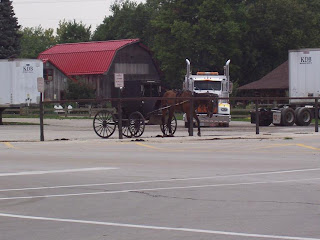
We saw a lot of these during our visit. Special lanes are reserved for horse-drawn buggies along the roads, but in my estimation they are not sufficiently removed from the danger of fast-moving automobiles, which should be required to drive much more slowly while passing through these communities.
On friday we drove back east towards Ontario and found "the longest of Michigan's few remaining covered bridges." It's located north of Centreville and it spans the St. Joseph River.


We're home again. Back to preparing for the coming academic year.
Last week Nancy and I took a brief holiday in southwestern Michigan and northern Indiana. I spent nearly 7 years in the Michiana region while a graduate student at Notre Dame, so this was a return to familiar territory. Moreover I have deep familial roots in both peninsulas of Michigan, the one state in the US with which I tend most to identify.
The two of us had a wonderfully restful time in this quiet part of the world. We stayed at a bed and breakfast near Jones, Michigan, called the Sanctuary at Wildwood, which I would enthusiastically recommend as a vacation spot for anyone, especially first or second honeymooners. It's set on a large, forested property with hiking trails and a stocked pond for fishing, among other things. Here are some photographs of our stay:

This is the main house, where the owners live and where we were served breakfast:

We tried our hand at rowing. (Well, I'm the one who did the actual rowing!) This was the first time I had done so, and I caught on fairly quickly. Nevertheless, in trying to photograph some turtles sitting on the water lilies, I managed to frighten them into diving back into the water.

On wednesday we drove to Three Rivers, where we discovered a marvellous used bookstore called Lowry's Books. It's definitely worth a visit if you're in the vicinity. It's located on Main Street, which can be seen below:

On thursday we drove to Shipshewana, in the middle of the northern Indiana Amish country. It's a tourist town, not unlike St. Jacob's, Ontario. But rather than hitting the shops, Nancy and I visited Menno-hof, an information centre and museum devoted to Anabaptist history. Anyone with an interest in Mennonites, Amish and Hutterites, or who claim this heritage as their own, will find Menno-hof fascinating. I had heard about Shipshewana while living in South Bend, but I never got round to visiting it until now.


We saw a lot of these during our visit. Special lanes are reserved for horse-drawn buggies along the roads, but in my estimation they are not sufficiently removed from the danger of fast-moving automobiles, which should be required to drive much more slowly while passing through these communities.

On friday we drove back east towards Ontario and found "the longest of Michigan's few remaining covered bridges." It's located north of Centreville and it spans the St. Joseph River.


We're home again. Back to preparing for the coming academic year.
21 August 2007
European Texas?
The prospect of membership in the European Union has to some extent motivated Turkey to try to clean up its act, especially with respect to human rights abuses. If so, then the EU may be taking the wrong approach here: EU urges Texas governor to halt executions in America's busiest death penalty state. Perhaps the EU should actually offer to admit the Lone Star State as a full member on condition that it abolish capital punishment. I can't think of a reason why Texans wouldn't jump at such an opportunity.
The prospect of membership in the European Union has to some extent motivated Turkey to try to clean up its act, especially with respect to human rights abuses. If so, then the EU may be taking the wrong approach here: EU urges Texas governor to halt executions in America's busiest death penalty state. Perhaps the EU should actually offer to admit the Lone Star State as a full member on condition that it abolish capital punishment. I can't think of a reason why Texans wouldn't jump at such an opportunity.
17 August 2007
Cabinet shuffle
Here is Prime Minister Stephen Harper's new cabinet. Three notable changes: Peter MacKay has been moved from Foreign Affairs to National Defence, Maxime Bernier from Industry to Foreign Affairs, and Jim Prentice from Indian Affairs and Northern Development to Industry.
Here is Prime Minister Stephen Harper's new cabinet. Three notable changes: Peter MacKay has been moved from Foreign Affairs to National Defence, Maxime Bernier from Industry to Foreign Affairs, and Jim Prentice from Indian Affairs and Northern Development to Industry.
13 August 2007
Nunavik
In 1999 Nunavut was carved out of the Northwest Territories and given separate territorial status within Canada. Now we are told that regional government will be granted to a largely Inuit-inhabited territory in northern Québec, to be called Nunavik. Is this the beginning of a separate province, a separate territory or a tertium quid? How might this affect a future referendum on sovereignty should the PQ return to power? Might Nunavik decide to opt out of a sovereign Québec? Stay tuned.

In 1999 Nunavut was carved out of the Northwest Territories and given separate territorial status within Canada. Now we are told that regional government will be granted to a largely Inuit-inhabited territory in northern Québec, to be called Nunavik. Is this the beginning of a separate province, a separate territory or a tertium quid? How might this affect a future referendum on sovereignty should the PQ return to power? Might Nunavik decide to opt out of a sovereign Québec? Stay tuned.
Les Paul
Les Paul was one of the giants of mid-20th-century popular music, pioneering the development of the solid-body electric guitar and virtually inventing multitrack recording. Here is one of the string of hits he recorded with his wife Mary Ford in the early 1950s:
Multitrack recording has been used by generations of musicians over the past more than half a century, including this obscure Upper Canadian vocal quartet singing Psalm 95 (Text and music copyright © 1986, 1999 by David T. Koyzis).
Jenkins on the christian global south
Five years ago Philip Jenkins of Penn State University published The Next Christendom: The Coming of Global Christianity, one of the more significant books of that year. In May of this year the Pew Forum convened its twice-yearly Faith Angle Conference on religion, politics and public life in Key West, Florida, with Professor Jenkins as principal speaker. Michael Cromartie of the Ethics & Public Policy Center was the moderator of the discussion, a transcript of which can be read here: Global Schism: Is the Anglican Communion Rift the First Stage in a Wider Christian Split? Among other things Jenkins argues that the world of the Bible is more immediately comprehensible to African Christians than to westerners living in post-industrial societies.
Five years ago Philip Jenkins of Penn State University published The Next Christendom: The Coming of Global Christianity, one of the more significant books of that year. In May of this year the Pew Forum convened its twice-yearly Faith Angle Conference on religion, politics and public life in Key West, Florida, with Professor Jenkins as principal speaker. Michael Cromartie of the Ethics & Public Policy Center was the moderator of the discussion, a transcript of which can be read here: Global Schism: Is the Anglican Communion Rift the First Stage in a Wider Christian Split? Among other things Jenkins argues that the world of the Bible is more immediately comprehensible to African Christians than to westerners living in post-industrial societies.
I was once talking to some West Africans about the bits of the Bible that made sense to them in ways that could not make sense to Westerners. They said, "We live in agricultural societies, so things like the Parable of the Sower made great sense." Just talking about it, they started getting teary eyed. Then they mentioned Psalm 126. Psalm 126 is a psalm that is widely quoted, and it goes like this: "The man who goes forth into the fields in tears weeping to sow the seed will bring the sheaves again in joy." You understand perfectly well why a farmer would bring the sheaves again in joy; he's celebrating harvest time.
But why do you weep while you're sowing? "It's obvious," they said to me. "Whoever wrote this psalm was writing at a time of famine, like we had a couple of years ago. You've got the corn that's left, and you can do one of two things with it. You can feed your family with it, but if you do that, you're not a farmer anymore [because you have no seeds left] and you have to migrate to the city and become a beggar, and what's going to happen to your children and so on. Or you can take the corn literally out of the hands of your hungry children and use it as seed corn and sow it. That's why a farmer weeps while sowing the corn. It's obvious."
As I said, it wasn't obvious to me, but there are any number of examples like that where the Bible describes a world that makes immediate, intuitive, documentary sense in a way it can't for us.
08 August 2007
Russian novelist on democracy
The German weekly Der Spiegel carries an interview with Aleksandr Solzhenitsyn that is worth reading. Here is the famed Russian novelist on the role of parties in the political process:
Loyalists of the old Reform Party here in Canada appear to have a kindred spirit from across the pond.
The German weekly Der Spiegel carries an interview with Aleksandr Solzhenitsyn that is worth reading. Here is the famed Russian novelist on the role of parties in the political process:
I am a convinced and consistent critic of "party-parliamentarism." I am for non-partisan elections of true people's representatives who are accountable to their regions and districts; and who in case of unsatisfactory work can be recalled. I do understand and respect the formation of groups on economical, cooperative, territorial, educational, professional and industrial principles, but I see nothing organic in political parties. Politically motivated ties can be unstable and quite often they have selfish ulterior motives. Leon Trotsky said it accurately during the October Revolution: "A party that does not strive for the seizure of power is worth nothing." We are talking about seeking benefit for the party itself at the expense of the rest of the people. This can happen whether the takeover is peaceful or not. Voting for impersonal parties and their programs is a false substitute for the only true way to elect people's representatives: voting by an actual person for an actual candidate. This is the whole point behind popular representation.
Loyalists of the old Reform Party here in Canada appear to have a kindred spirit from across the pond.
Unrepentant 'murderer' behind pulpit
I somehow managed to miss this story when it first hit the blogs last year, but an editorial in the July/August issue of Touchstone brought it to my attention: Alma’s Mater: The Violent Hypocrisy of Some Peace & Justice Christians. The Rev. Dr. Donna Schaper is pastor of Judson Memorial Baptist Church in New York. Last year she wrote an article in Tikkun titled My Choice, in which she confessed to having aborted her fourth child, whom she named Alma. Unlike most people styling themselves pro-choice on the abortion issue, Schaper freely admits to having murdered her child:
She claims to have made this difficult choice "as a mature sexual being" who believes that "birth control and abortion are positive moral forces in history." For her the recommendation of abstinence as an alternative is "immoral to its core." The incoherence of her ethical reasoning is too obvious to warrant further comment.
However, it is worth noting that Schaper recently contributed to Jim Wallis's God's Politics blog, where she commented on the Virginia Tech shootings last April: Worship in a Time of Catastrophe. Someone unacquainted with the complexities of a consistent life ethic might be forgiven for wondering on what basis she would object to the murders committed on that campus (though, perhaps tellingly, she never once uses that word). After all, was not the killer simply exercising his freedom of choice as a mature adult?
I somehow managed to miss this story when it first hit the blogs last year, but an editorial in the July/August issue of Touchstone brought it to my attention: Alma’s Mater: The Violent Hypocrisy of Some Peace & Justice Christians. The Rev. Dr. Donna Schaper is pastor of Judson Memorial Baptist Church in New York. Last year she wrote an article in Tikkun titled My Choice, in which she confessed to having aborted her fourth child, whom she named Alma. Unlike most people styling themselves pro-choice on the abortion issue, Schaper freely admits to having murdered her child:
I happen to agree that abortion is a form of murder. I think the quarrel about when life begins is disrespectful to the fetus. I know I murdered the life within me. I could have loved that life but chose not to.
She claims to have made this difficult choice "as a mature sexual being" who believes that "birth control and abortion are positive moral forces in history." For her the recommendation of abstinence as an alternative is "immoral to its core." The incoherence of her ethical reasoning is too obvious to warrant further comment.
However, it is worth noting that Schaper recently contributed to Jim Wallis's God's Politics blog, where she commented on the Virginia Tech shootings last April: Worship in a Time of Catastrophe. Someone unacquainted with the complexities of a consistent life ethic might be forgiven for wondering on what basis she would object to the murders committed on that campus (though, perhaps tellingly, she never once uses that word). After all, was not the killer simply exercising his freedom of choice as a mature adult?
03 August 2007

02 August 2007
Bridge collapse
During my years in Minnesota three decades ago I drove on the I-35W bridge over the Mississippi any number of times. Thus the venue for this disaster is familiar to me. The story can be followed live over local television station WCCO. Footage of the bridge can be seen here. Please pray for the survivors and others affected by this tragedy.
During my years in Minnesota three decades ago I drove on the I-35W bridge over the Mississippi any number of times. Thus the venue for this disaster is familiar to me. The story can be followed live over local television station WCCO. Footage of the bridge can be seen here. Please pray for the survivors and others affected by this tragedy.
01 August 2007
No revising the BCP
The recent General Synod of the Anglican Church has decided not to revise or scrap the Book of Common Prayer — yet. However, the 27-year-old Book of Alternative Services will be altered at some point.
Prayer Book conservatives in this country might do well to remind themselves that the 1962 edition of the BCP, for all its undoubted virtues, abridged the Psalter to leave out the more imprecatory sentiments, e.g., the end of Psalm 137 and the entirety of Psalm 58! Whatever one thinks of the BAS, its creators at least saw fit to include all of the Psalms, even the ones that offend modern sensibilities.
Judicial overreach. . . yet again
First a Turkish court claims the authority to strip the Ecumenical Patriarch of his ecclesiastical title. Now a Malaysian court is claiming to judge who is and is not a Muslim, over against the plaintiff's own claim to be a Christian. What next?
First a Turkish court claims the authority to strip the Ecumenical Patriarch of his ecclesiastical title. Now a Malaysian court is claiming to judge who is and is not a Muslim, over against the plaintiff's own claim to be a Christian. What next?
31 July 2007
Guest appearance announced
One of Redeemer's alumni, Derek Miedema (1995), will appear on 100 Huntley Street on Thursday, 2 August, along with his mother and handicapped twin brother. Derek was a political science student and is now a researcher at the Centre for Faith and Public Life for the Evangelical Fellowship of Canada. His family has had to battle a number of medical adversities over the years. I expect their appearance on television will be a powerful testimony to Godʼs grace in hardship. The programme airs at 9 am and 9 pm EDT on CTS. (Check local listings outside of southern Ontario/western New York.) I assume it will be posted on the CTS website shortly thereafter for online viewing.
One of Redeemer's alumni, Derek Miedema (1995), will appear on 100 Huntley Street on Thursday, 2 August, along with his mother and handicapped twin brother. Derek was a political science student and is now a researcher at the Centre for Faith and Public Life for the Evangelical Fellowship of Canada. His family has had to battle a number of medical adversities over the years. I expect their appearance on television will be a powerful testimony to Godʼs grace in hardship. The programme airs at 9 am and 9 pm EDT on CTS. (Check local listings outside of southern Ontario/western New York.) I assume it will be posted on the CTS website shortly thereafter for online viewing.
30 July 2007
Surnames
Here is a list of the most common surnames in Canada as a whole and in the country's five largest cities. According to this CBC report, University of Toronto Prof. Jack Chambers argues that
Well, not exactly. I don't think he's taken into account cultures where surnames are a quite new phenomenon. When I was growing up I had a lot of relatives whose surnames I didn't even know, and it never occurred to any of us in my immediate family to ask. Surnames were simply not all that important on that side of the family. Many had been taken on only with immigration to the US and elsewhere.
My father was born with a patronymic only. When he went to school the authorities wanted every student to have a first, middle and last name, so he took on his grandfather's surname, which may have had French or Turkish origins, and grecianized it to Κοϊζής, later anglicizing it to Koyzis. This means that my own surname is only about ten years older than I am.
In the Dutch-Canadian community with whom I work, I have long heard that Dutch surnames were chosen only about two centuries ago when Napoleon forced them to take them on. The Dutch often chose humorous or tongue-in-cheek names, assuming this was a passing fad and would never stick. Two-hundred years later their descendants are still saddled with them.
As for the Koyzis name, due to the paucity of married males to pass it on to future generations, it may end up dying out altogether. So perhaps Chambers is right after all.
Here is a list of the most common surnames in Canada as a whole and in the country's five largest cities. According to this CBC report, University of Toronto Prof. Jack Chambers argues that
Over time, the number of surnames has actually not increased with the population, which has made many of them even more common. Says Chambers: "We've got just exactly the same resources now as we had a thousand years ago in Europe, and 3,000 years ago in China when surnaming began."
Well, not exactly. I don't think he's taken into account cultures where surnames are a quite new phenomenon. When I was growing up I had a lot of relatives whose surnames I didn't even know, and it never occurred to any of us in my immediate family to ask. Surnames were simply not all that important on that side of the family. Many had been taken on only with immigration to the US and elsewhere.
My father was born with a patronymic only. When he went to school the authorities wanted every student to have a first, middle and last name, so he took on his grandfather's surname, which may have had French or Turkish origins, and grecianized it to Κοϊζής, later anglicizing it to Koyzis. This means that my own surname is only about ten years older than I am.
In the Dutch-Canadian community with whom I work, I have long heard that Dutch surnames were chosen only about two centuries ago when Napoleon forced them to take them on. The Dutch often chose humorous or tongue-in-cheek names, assuming this was a passing fad and would never stick. Two-hundred years later their descendants are still saddled with them.
As for the Koyzis name, due to the paucity of married males to pass it on to future generations, it may end up dying out altogether. So perhaps Chambers is right after all.
28 July 2007
The eros of teaching
Drawing on personal experience and on Plato's portrayal of Socrates in the Symposium, William Deresiewicz writes about Love on campus in The American Scholar, the quarterly journal of the ΦΒΚ Society. The love of which he speaks is not precisely erotic love or familial affection, but the "eros of souls" that draws students and professors to each other in the joy of shared intellectual pursuits. This is something I have experienced for myself over the past two decades of teaching. There is a poignancy to the author's observations here:
I discovered all this early in my career, and it is one of the things that makes what I do more than just another job. I expect that many of my colleagues will agree with me that loving students and then letting them go is a source at once of great satisfaction and, to be quite honest, of at least some heartache as well.
Drawing on personal experience and on Plato's portrayal of Socrates in the Symposium, William Deresiewicz writes about Love on campus in The American Scholar, the quarterly journal of the ΦΒΚ Society. The love of which he speaks is not precisely erotic love or familial affection, but the "eros of souls" that draws students and professors to each other in the joy of shared intellectual pursuits. This is something I have experienced for myself over the past two decades of teaching. There is a poignancy to the author's observations here:
Socrates says in the Symposium that the hardest thing about being ignorant is that you’re content with yourself, but for many kids when they get to college, this is not yet true. They recognize themselves as incomplete, and they recognize, if only intuitively, that completion comes through eros. So they seek out professors with whom to have relationships, and we seek them out in turn. Teaching, finally, is about relationships. It is mentorship, not instruction. Socrates also says that the bond between teacher and student lasts a lifetime, even when the two are no longer together. And so it is. Student succeeds student, and I know that even the ones I’m closest to now will soon become names in my address book and then just distant memories. But the feelings we have for the teachers or students who have meant the most to us, like those we have for long-lost friends, never go away. They are part of us, and the briefest thought revives them, and we know that in some heaven we will all meet again.
I discovered all this early in my career, and it is one of the things that makes what I do more than just another job. I expect that many of my colleagues will agree with me that loving students and then letting them go is a source at once of great satisfaction and, to be quite honest, of at least some heartache as well.
26 July 2007
ECP Centre
Although he's not far down the QEW from us, I somehow managed to overlook this man, who has begun to write a regular column for WorldNetDaily. Tristan Emmanuel established and leads the Equipping Christians for the Public-square Centre, located in nearby Jordan Station on the Niagara Peninsula. He obviously bears watching.
Although he's not far down the QEW from us, I somehow managed to overlook this man, who has begun to write a regular column for WorldNetDaily. Tristan Emmanuel established and leads the Equipping Christians for the Public-square Centre, located in nearby Jordan Station on the Niagara Peninsula. He obviously bears watching.
25 July 2007
To be Anglican means. . . what?
The Archbishop of Canterbury insists that to be Anglican means to be in communion with the Archbishop of Canterbury. However, my good friend William G. Witt argues that there is little historical support for such a purely formal and institutional definition: Is it Necessary to be in Communion With Canterbury to be Anglican? Witt instead argues for a biblical, confessional identity for the Anglican Communion, a position he obviously shares with Archbishop Orombi and many others:
The Archbishop of Canterbury insists that to be Anglican means to be in communion with the Archbishop of Canterbury. However, my good friend William G. Witt argues that there is little historical support for such a purely formal and institutional definition: Is it Necessary to be in Communion With Canterbury to be Anglican? Witt instead argues for a biblical, confessional identity for the Anglican Communion, a position he obviously shares with Archbishop Orombi and many others:
If one actually reads [Thomas] Cranmer or [John] Jewel or [Richard] Hooker et al, it becomes quite clear that, as they broke with Rome, they would have had no hesitation to break with Canterbury should Canterbury break with the doctrines and practices which encapsulate the gospel--because the identity of Anglicanism does not lie in communion with an historic see, but in doctrines and practices that adhere to the gospel. . . . If Canterbury's dallying leads to the split of the Communion, and Canterbury aligns itself with those who have abandoned historic Anglican doctrines and practices (and Christian faith), then necessarily, but paradoxically, in order to remain Christian, Anglicanism will mean being in communion with those provinces that continue historic Anglican doctrines and practices and not with Canterbury.
From Rome to Constantinople
Earlier this year Francis Beckwith left evangelicalism to return to Rome, thus adding to the number of recent medium-to-high-profile converts, such as Sheldon Vanauken, Thomas Howard, Luis Logo and Fr. Richard John Neuhaus. Others, such as Peter Gillquist, have left protestantism to become Orthodox.
There are, however, people who have converted from Orthodoxy to Catholicism and vice versa. One of the latter is "Crunchy Con" Rod Dreher, who tells the sad tale of his own pilgrimage — one that he never intended to make and would prefer not to have had to make. It's strong stuff and a reminder that many converts, far from joyfully following the truth as they see it into a new home, feel driven out of their former communions and suffer accordingly.
Later: Could another conversion be in the works for Dreher? He now appears to be bolstering the presbyterian argument against episcopacy: Faraway, so close.
22 July 2007
The desecularization of Holland
Here is one more indication that the notoriously secularized Kingdom of the Netherlands may have turned the corner: Changing Patterns in Social Fabric Test Netherlands' Liberal Identity. Note the mention of the Christen Unie, which the author describes as an "orthodox Christian political party."
Incidentally, when The Hamilton Spectator carried this article in yesterday's edition, it capitalized every occurrence of "orthodox." Thus the Netherlands ostensibly has an Orthodox Christian political party, something that might surprise immigrants from Greece and the Balkans. Someone needs to set straight The Spec's editors.
20 July 2007
Fair trade clothing
While on the plane a few weeks ago I was intrigued by this article by Margaret Littman in the airline magazine, American Way: Fair Deal. It's the story of Bill Bass's effort to expand the notion of fair trade beyond the coffee market and into the apparel industry. His company, Fair Indigo, has a laudable aim:
How does it work?
Fair trade is apparently not an easy concept to implement within the fashion industry, as Littman indicates:
Does fair trade represent a trend that could make its way into the production and sale of other goods? Time will tell.
While on the plane a few weeks ago I was intrigued by this article by Margaret Littman in the airline magazine, American Way: Fair Deal. It's the story of Bill Bass's effort to expand the notion of fair trade beyond the coffee market and into the apparel industry. His company, Fair Indigo, has a laudable aim:
We create fashionable, high-quality clothing and accessories while paying a fair wage to the people who produce them. It's a concept known as fair trade and it means we put people first.
How does it work?
Fair Indigo now works with 25 factories across the globe; some specialize in skirts, others in sweaters. Bass says Fair Indigo’s business model of selling directly to customers, through catalogs, the Internet, and its own boutiques, as opposed to selling through national retailers, keeps overhead low enough that it can afford to pay workers at its factories more. Because Fair Indigo is a private firm, Bass will not release sales figures, but he says the company is on track to turn a profit within four years, a time frame analysts say is in line for new apparel companies, fair trade or not.
Fair trade is apparently not an easy concept to implement within the fashion industry, as Littman indicates:
Defining fair trade has been one of the challenges for companies like Fair Indigo that want to go mainstream with a concept many still see as existing only in the margins. At its most basic, the term indicates that the people who create the product are paid a living wage and have decent working conditions. Some expand that definition to include having the right to unionize and access to health care. Others, including the Fair Trade Federation in Washington, D.C., limit it to apply only to workers in developing nations. Often those who support fair trade also support the use of organics and other green initiatives, concerns that are tangential to fair trade, which is all about the labor practices.
Does fair trade represent a trend that could make its way into the production and sale of other goods? Time will tell.
Thanks, Joe
I am honoured that überblogger Joe Carter at the evangelical outpost has seen fit to include this blog as one of "The EO 100," along with such others as On the Square, Mere Comments, Crunchy Con and that of my friend and sometime co-conspirator Gideon Strauss. Now should I be expecting to receive a framed certificate or something in the mail?
I am honoured that überblogger Joe Carter at the evangelical outpost has seen fit to include this blog as one of "The EO 100," along with such others as On the Square, Mere Comments, Crunchy Con and that of my friend and sometime co-conspirator Gideon Strauss. Now should I be expecting to receive a framed certificate or something in the mail?
17 July 2007
Patriarch no longer ecumenical?
The Turkish press are now labelling Bartholomeos the "Fener Patriarch," after the neighbourhood where he resides in Istanbul — a rather drastic demotion from his claimed position as Ecumenical Patriarch. Someone needs to tell them that a government acts beyond its competence in pretending to determine the validity of ecclesiastical titles. Unfortunately the Orthodox themselves have too often helped to exacerbate this confusion.
The Turkish press are now labelling Bartholomeos the "Fener Patriarch," after the neighbourhood where he resides in Istanbul — a rather drastic demotion from his claimed position as Ecumenical Patriarch. Someone needs to tell them that a government acts beyond its competence in pretending to determine the validity of ecclesiastical titles. Unfortunately the Orthodox themselves have too often helped to exacerbate this confusion.
Washington, DC: Taxation with representation?
In a previous post I pointed out that Washington, DC, licence plates carry the words, TAXATION WITHOUT REPRESENTATION. There have long been efforts to do something about the anomalous status of the District of Columbia, including a failed 20-year-old attempt to make it the 51st state. Now there is a bill before the United States Senate to add two representatives to the House of Representatives, including one for DC. TIME Magazine reports: Will D.C. Finally Get a Vote? The original District of Columbia was established in 1790 on land ceded by Maryland and Virginia. (The region south of the Potomac River was returned to Virginia in 1847.) The reason for establishing a federal capital on "neutral" territory was to avoid favouring or empowering one state over the others, an idea borrowed for other planned federal capitals, such as Canberra and Brasilia. The difficulty with the American version of this is that it effectively disenfranchised the residents of Washington, who could not even vote for the president until the 23rd Amendment was ratified in 1961. Obviously something must be done to regularize the status of US citizens who pay taxes but are not fully represented in the centres of decision-making power.
Yet it's not clear that the current legislation is constitutional, which is animating the opposition. Not so incidentally, Republicans oppose the measure, as enfranchising heavily Democratic DC residents would almost certainly strengthen the latter party's presence in Congress. Accordingly President Bush may veto the bill.

Here in Canada we have a National Capital Region, but it does not have a distinct political status like federal capital districts elsewhere. Encompassing the cities of Ottawa, Ontario, and Gatineau, Québec, residents vote in the elections of their respective provinces, in addition to casting ballots in federal elections for a member of parliament. I cannot honestly say that this arrangement has avoided antagonizing the other provinces, mostly because the capital's location only underscores further the reality of central Canada's dominance over the country's political life.
I personally favour granting DC residents congressional representation. Nevertheless, it might be wise for American policy-makers to look into how other federal systems, such as Australia, Germany and Brazil, have addressed the need for representation in their own capital cities. Americans can rightly be said to have invented modern constitutional federalism, but it may be that others have solved dilemmas that the founding fathers did not anticipate more than two centuries ago.
16 July 2007
Shedding pounds . . . the hard way
My body weight appears to have stabilized at two pounds less than it was before my recent surgery. Which leads me to conclude that my appendix must have weighed two pounds.
My body weight appears to have stabilized at two pounds less than it was before my recent surgery. Which leads me to conclude that my appendix must have weighed two pounds.
Miss Potter
Our daughter Theresa was raised on two fat collections of the fanciful stories of Beatrix Potter, whose Peter Rabbit catapulted her to fame in 1902. Although the new Harry Potter film is getting huge publicity, I would enthusiastically recommend a similarly-surnamed film, Miss Potter, released late last year and now out on DVD. It's a charming cinematic treatment of Beatrix Potter's life, with all its joys and heartaches, that can be enjoyed by the entire family. The fact that Theresa rarely puts down pencil and paper may explain why I am drawn to the portrayal of a little girl constantly painting and developing her gifts for the benefit of the world. Here is the trailer:
Among the high points of the film is the cinematography, especially of the Lake District in the north of England. Renée Zellweger plays the title role beautifully, though she is made to look a little too frumpy. Ewan McGregor (no relation to Farmer McGregor!) winsomely plays Potter's publisher and early love interest, Norman Warne. Miss Potter is definitely worth seeing.
13 July 2007
Christ transforming Uganda
Christians in a number of traditions pay lip service to an expression borrowed from H. Richard Niebuhr more than half a century ago: Christ transforming culture. But what does this mean in practice for specific contexts, e.g., subsaharan Africa? Archbishop Henry Luke Orombi of Uganda gives us some concrete examples in this inspiring piece appearing in the upcoming issue of First Things: What Is Anglicanism? Orombi affirms that it is the Bible itself that has transformed his country and its people, and he highlights the treatment of women, clan revenge, and the worship of nature and ancestral spirits as examples.
I am struck by the role martyrdom has played in the revival and growth of the Church of Uganda. Many of us remember the death of Archbishop Janani Luwum at the hands of Idi Amin in 1977. Ten years ago my friend Paul Marshall brought the plight of persecuted believers before a complacent west. At one time the heirs of the English Reformation read Foxe's Book of Martyrs, a collection that has fallen out of favour in an ecumenical age but that served for generations to confirm Tertullian's ancient maxim that “The blood of the martyrs is the seed of the church.” I can testify from experience that martyrdom is not much mentioned today in the Anglican Church of Canada, which may go some way in explaining its current state.
Orombi's piece should be required reading for every Anglican and Episcopal bishop in North America. Imagine how the ACC and TEC would grow and flourish if they could manage to catch Orombi's vision. Pray God that by his grace this might happen.
Christians in a number of traditions pay lip service to an expression borrowed from H. Richard Niebuhr more than half a century ago: Christ transforming culture. But what does this mean in practice for specific contexts, e.g., subsaharan Africa? Archbishop Henry Luke Orombi of Uganda gives us some concrete examples in this inspiring piece appearing in the upcoming issue of First Things: What Is Anglicanism? Orombi affirms that it is the Bible itself that has transformed his country and its people, and he highlights the treatment of women, clan revenge, and the worship of nature and ancestral spirits as examples.
The gospel of Jesus Christ as revealed to us through the Word of God enables warring tribes to begin to coexist and to embrace neighborliness. Indeed, the Word of God opened the way for the nation of Uganda to be forged. When evangelists from Buganda (in central Uganda) traveled to tribes in the east, west, and north, a new day dawned in our country. Instead of being armed with spears, they came armed only with the Word of God. Instead of a message of war and destruction, they delivered a message of Good News from the God and Father of our Lord Jesus Christ.
As the Bible came with the authority of Christ, it revealed a God that is greater than the evil spirits and the kingdom of darkness that controlled so many people’s lives. In Uganda, the Bible has grown into a cherished source of authority that is central to Christian faith, practice, and mission. For all God’s people, obedience to this Bible is the source of confidence, abundant life, and joy. It is an absolute treasure that no one can take away. Isaiah, later quoted by Peter, wrote, “The grass withers and the flowers fall, but the word of our God stands forever” (Isa. 40:8; 1 Pet. 1:24-25). The grass on which our cattle feed, the grass from which our roofs are thatched—all this withers. But the Word of God has withstood the test of time. The Bible is at the heart of our Anglican identity, and we Ugandan Anglicans joyfully submit to its life-giving and transforming authority.
With this knowledge of the centrality of the authority of Scripture in Anglicanism, therefore, we understand ourselves to be in the mainstream of Anglicanism—from Thomas Cranmer to John Stott. The evangelical tradition in the Church of England produced William Wilberforce, whose lifelong mission to eradicate slavery and the slave trade liberated our people. It produced Charles Simeon, who inspired the beginning of mission societies that shared the gospel of Jesus Christ with us and many others. It produced Bishop Tucker and other missionaries, who risked their lives to come to Uganda. These and many more Anglican evangelicals brought us the legacy of the Protestant Reformation in England. Their commitment to salvation through faith in Jesus Christ as revealed in Scripture has continued among us to this day.
I am struck by the role martyrdom has played in the revival and growth of the Church of Uganda. Many of us remember the death of Archbishop Janani Luwum at the hands of Idi Amin in 1977. Ten years ago my friend Paul Marshall brought the plight of persecuted believers before a complacent west. At one time the heirs of the English Reformation read Foxe's Book of Martyrs, a collection that has fallen out of favour in an ecumenical age but that served for generations to confirm Tertullian's ancient maxim that “The blood of the martyrs is the seed of the church.” I can testify from experience that martyrdom is not much mentioned today in the Anglican Church of Canada, which may go some way in explaining its current state.
Orombi's piece should be required reading for every Anglican and Episcopal bishop in North America. Imagine how the ACC and TEC would grow and flourish if they could manage to catch Orombi's vision. Pray God that by his grace this might happen.
12 July 2007
Irene Keesmaat
This is rather short notice, I recognize, but I have just learnt that area artist Irene Keesmaat, a former colleague of mine at Redeemer, will be exhibiting her works at the Edinburgh Square Heritage and Cultural Centre in Caledonia, Ontario, beginning this evening with an opening reception from 7 to 9. I have linked to Irene's website in my sidebar.
This is rather short notice, I recognize, but I have just learnt that area artist Irene Keesmaat, a former colleague of mine at Redeemer, will be exhibiting her works at the Edinburgh Square Heritage and Cultural Centre in Caledonia, Ontario, beginning this evening with an opening reception from 7 to 9. I have linked to Irene's website in my sidebar.
A working holiday
Our family just returned from travels to the US, where I managed to visit 5 states, one territory and three airports in the space of slightly more than a week. Two weekends ago we drove from Hamilton to Chicago, passing through Michigan and Indiana on the way. We visited family on both sides. On monday, 2 July, we visited the Brookfield Zoo with my sister-in-law and her young family. I had not been there since 1983. It's definitely worth a visit if you are ever in the Windy City.
On tuesday through thursday I was in Washington, DC, to speak to the annual Civitas Summer Leadership Seminar, sponsored by the Center for Public Justice. The title of my talk was "Beyond Ideological Thinking," in which I spoke about liberalism and its alternatives. It was an enjoyable and stimulating event.

The following day our group was privileged to tour the White House, which I found to be far smaller and less impressive than I had long envisioned it in my mind. Nevertheless, it's a fascinating place, with portraits of various presidents and first ladies covering the 2-century-old walls. There were portraits of both Bill and Hillary Clinton, prompting me to wonder whether these would have to trade places if the latter becomes president.

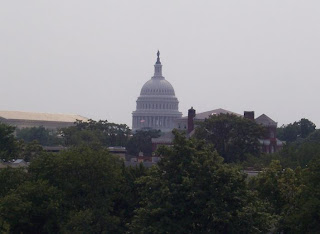
I did not visit the Capitol building, home of the United States Congress, but I was able to photograph it from a distance. This was taken from the roof of the building housing the CCCU's American Studies Program.
Wednesday was, of course, the Independence Day holiday, so in the evening our group walked down to a spot where we were able to view the fireworks on the National Mall, which had been temporarily evacuated earlier in the evening due to a tornado warning.
Licence plates typically carry a state motto, such as New Hampshire's notorious LIVE FREE OR DIE. The District of Columbia is not a state, and as such it has no voting representatives in Congress. Thus the DC plates carry this slogan in protest:

When I first told Theresa I would be going to Washington, DC, she heard Washington, BC, assuming I was travelling once again to Canada's westernmost province. When I corrected her and she asked what the DC stands for, I responded: "the District of Columbia," to which she retorted knowingly: "I thought the C must stand for Columbia!"
Thursday afternoon I returned to Chicago and family. While in the air, my plane grazed the top of a terrific storm, which we saw from above. The thunder clouds were impressive, but the turbulence was a bit unnerving.

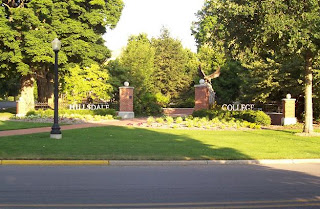
At the weekend we drove to Hillsdale, Michigan, home of Hillsdale College, a small undergraduate university well known in politically conservative circles in the US.
Hillsdale sells bricks to alumni, parents and supporters for $150 each to be placed in its Alumni Walk, which extends through the centre of the campus. Here are some typical examples:


Outside the Dow Center on the Hillsdale campus is a plaque containing a selection from Thomas Paine's Dissertation on First Principles of Government. Paine was anything but a conservative, but he somehow managed to slip by Hillsdale's gatekeepers with an extremely unBurkean sentiment:

We arrived home to Hamilton on monday. As usual, it's good to be back.
Our family just returned from travels to the US, where I managed to visit 5 states, one territory and three airports in the space of slightly more than a week. Two weekends ago we drove from Hamilton to Chicago, passing through Michigan and Indiana on the way. We visited family on both sides. On monday, 2 July, we visited the Brookfield Zoo with my sister-in-law and her young family. I had not been there since 1983. It's definitely worth a visit if you are ever in the Windy City.
On tuesday through thursday I was in Washington, DC, to speak to the annual Civitas Summer Leadership Seminar, sponsored by the Center for Public Justice. The title of my talk was "Beyond Ideological Thinking," in which I spoke about liberalism and its alternatives. It was an enjoyable and stimulating event.

The following day our group was privileged to tour the White House, which I found to be far smaller and less impressive than I had long envisioned it in my mind. Nevertheless, it's a fascinating place, with portraits of various presidents and first ladies covering the 2-century-old walls. There were portraits of both Bill and Hillary Clinton, prompting me to wonder whether these would have to trade places if the latter becomes president.

I did not visit the Capitol building, home of the United States Congress, but I was able to photograph it from a distance. This was taken from the roof of the building housing the CCCU's American Studies Program.

Wednesday was, of course, the Independence Day holiday, so in the evening our group walked down to a spot where we were able to view the fireworks on the National Mall, which had been temporarily evacuated earlier in the evening due to a tornado warning.
Licence plates typically carry a state motto, such as New Hampshire's notorious LIVE FREE OR DIE. The District of Columbia is not a state, and as such it has no voting representatives in Congress. Thus the DC plates carry this slogan in protest:

When I first told Theresa I would be going to Washington, DC, she heard Washington, BC, assuming I was travelling once again to Canada's westernmost province. When I corrected her and she asked what the DC stands for, I responded: "the District of Columbia," to which she retorted knowingly: "I thought the C must stand for Columbia!"
Thursday afternoon I returned to Chicago and family. While in the air, my plane grazed the top of a terrific storm, which we saw from above. The thunder clouds were impressive, but the turbulence was a bit unnerving.

At the weekend we drove to Hillsdale, Michigan, home of Hillsdale College, a small undergraduate university well known in politically conservative circles in the US.

Hillsdale sells bricks to alumni, parents and supporters for $150 each to be placed in its Alumni Walk, which extends through the centre of the campus. Here are some typical examples:


Outside the Dow Center on the Hillsdale campus is a plaque containing a selection from Thomas Paine's Dissertation on First Principles of Government. Paine was anything but a conservative, but he somehow managed to slip by Hillsdale's gatekeepers with an extremely unBurkean sentiment:

We arrived home to Hamilton on monday. As usual, it's good to be back.
11 July 2007
Redeeming time
Chuck Colson writes about time here: A New Perspective on Time, and here: How Big is Your God? Reading these so soon after the "untimely" death of one of my students prompts me to publish my own reflections on the subject.
When I was a child I developed a strong sense of the irreversibility of time's passage. Although one genre of science fiction is preoccupied with the notion of time travel, and though there seems to be something, if Einstein is to be believed, to the possibility of accelerating or slowing the passage of time, it remains impossible to reverse the process. This is perhaps why we are so fascinated by the likes of Back to the Future, the cinematic tale of an adolescent who returns to the days of his parents' youth and manages to rewrite the history of his own family.
When we regularly visited my grandmother's house in Milan, Michigan, nearly half a century ago, I recall seeing there a photographic portrait of my great-grandmother. She had died seven years before my birth, and I regretted that I had no memories of her, as did my mother and grandmother. I wished that I had known something of the world before I came along and would love to have experienced backwards time travel. My early fascination with the Chicago Aurora & Elgin Railroad — revived during my second year at Notre Dame — was also rooted in the desire to experience a defunct interurban railway that had come to an end before conscious memory. In short, backwards time travel, if it were possible, held out the tantalizing possibility of reversing death and recovering something long gone.
Those who are in Christ are promised eternal or everlasting life. We human beings cannot begin to comprehend what this will mean. Scripture speaks in metaphors and highly symbolic language, especially in the apocalyptic books. There are, however, many Christians who, following Augustine, assume that eternity is a state somehow outside of time. Remember the lyrics of the old gospel hymn:
Will time really cease to exist? Is eternity a static, timeless condition, as popular theology would have us believe? I will not speculate as to God's relationship to and experience of time, since that falls outside of what he has revealed to us. Yet with respect to his image-bearers I believe this can be affirmed: if time is the good creation of God, then it makes more biblical sense to confess that in the new heaven and new earth being prepared for those who trust in Jesus Christ's salvation, time will be redeemed, not abolished. Eternity is thus not stasis on the ancient Greek model, but an everlasting age to which we will be summoned at Christ's return either from the grave or from our earthly, albeit mortal, lives.
Chuck Colson writes about time here: A New Perspective on Time, and here: How Big is Your God? Reading these so soon after the "untimely" death of one of my students prompts me to publish my own reflections on the subject.
When I was a child I developed a strong sense of the irreversibility of time's passage. Although one genre of science fiction is preoccupied with the notion of time travel, and though there seems to be something, if Einstein is to be believed, to the possibility of accelerating or slowing the passage of time, it remains impossible to reverse the process. This is perhaps why we are so fascinated by the likes of Back to the Future, the cinematic tale of an adolescent who returns to the days of his parents' youth and manages to rewrite the history of his own family.
When we regularly visited my grandmother's house in Milan, Michigan, nearly half a century ago, I recall seeing there a photographic portrait of my great-grandmother. She had died seven years before my birth, and I regretted that I had no memories of her, as did my mother and grandmother. I wished that I had known something of the world before I came along and would love to have experienced backwards time travel. My early fascination with the Chicago Aurora & Elgin Railroad — revived during my second year at Notre Dame — was also rooted in the desire to experience a defunct interurban railway that had come to an end before conscious memory. In short, backwards time travel, if it were possible, held out the tantalizing possibility of reversing death and recovering something long gone.
Those who are in Christ are promised eternal or everlasting life. We human beings cannot begin to comprehend what this will mean. Scripture speaks in metaphors and highly symbolic language, especially in the apocalyptic books. There are, however, many Christians who, following Augustine, assume that eternity is a state somehow outside of time. Remember the lyrics of the old gospel hymn:
When the trumpet of the Lord shall sound,
and time shall be no more. . . .
Will time really cease to exist? Is eternity a static, timeless condition, as popular theology would have us believe? I will not speculate as to God's relationship to and experience of time, since that falls outside of what he has revealed to us. Yet with respect to his image-bearers I believe this can be affirmed: if time is the good creation of God, then it makes more biblical sense to confess that in the new heaven and new earth being prepared for those who trust in Jesus Christ's salvation, time will be redeemed, not abolished. Eternity is thus not stasis on the ancient Greek model, but an everlasting age to which we will be summoned at Christ's return either from the grave or from our earthly, albeit mortal, lives.
07 July 2007
Summorum Pontificum
It's finally happened: Pope approves wider use of Latin Mass. Here is the text of the Pope's letter.
It's finally happened: Pope approves wider use of Latin Mass. Here is the text of the Pope's letter.
03 July 2007
Another 50th anniversary

A half century ago today my favourite interurban railway abruptly ceased passenger service after 55 years of business. The Chicago Aurora & Elgin Railway began in 1902 when the original line was built between Chicago and Aurora, powered by electric third rail. In the next few years lines were extended to Elgin, Batavia, Geneva and St. Charles, all communities located along the Fox River. The lines branched out at my home town of Wheaton, the centre of operations and the location of the shops. Though most interurban railways were little more than trolley lines running alongside rural roads between towns, the CA&E was built to the standards of the steam lines and could thus attain higher speeds. While most interurbans flourished in the first two decades of the 20th century, only to founder after the Great War with the advent of the automobile, the CA&E, along with two other Chicago area interurbans, survived much longer, effectively becoming a suburban commuter line.

The CA&E was a precarious enterprise from the 1920s on, and it went through more than one receivership and reorganization over the decades. The Second World War years saw an increase in ridership, but ten years later it was struggling to remain afloat. In 1953 its entrance into Chicago over the Garfield Park elevated line was terminated to make way for the construction of the Congress (later Eisenhower) Expressway. Passengers from the Fox Valley suburbs had to get off at suburban Forest Park and transfer to the "L" for the remainder of the trip to Chicago. This was the final blow to the CA&E. Ridership plummeted and management petitioned to abandon passenger service. Permission finally came in the late morning of wednesday, 3 July 1957. Service was suspended a few minutes after noon, stranding passengers in the Loop, forcing them to find other ways home that evening. Freight service limped along for another two years. I recall seeing a CA&E freight train crossing Roosevelt Road in Wheaton when I was quite small. The railway was abandoned altogether in 1961.
A few CA&E cars are still operating at various railway museums around the United States, most notably the Fox River Trolley Museum and the Illinois Railway Museum (IRM). The CA&E right-of-way is now the Illinois Prairie Path, a recreational trail for jogging, hiking and bicycling. Here is a look at restored CA&E cars in action at the IRM:
Incidentally, the cessation of passenger service on the CA&E occurred only three days after my baptism.
Five years ago, to mark the occasion of the CA&E's centenary, I composed a song, titled The Great Third Rail Rag, after one of the railway's many nicknames. It is written in the style of Scott Joplin's rags, which were popular in the first years of the 20th century.
30 June 2007
Baptism and the christian life
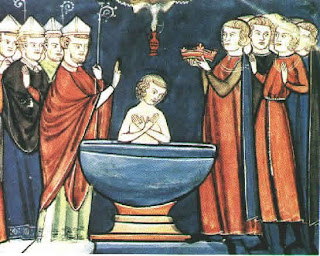
Today marks the 50th anniversary of my baptism. Through this sacrament I was received into the body of Christ at Westminster Orthodox Presbyterian Church, then in Westchester, Illinois, but now located in nearby Indian Head Park.
When I was younger I did not treasure this day as I do now. In fact, in my teens I worshipped, along with my family, in a baptist church that did not recognize the validity of my baptism at all. Nevertheless I have come to follow Calvin in believing that our baptism, far from being diminished or invalidated by our inability to remember it, is a sign of our union with Christ for the whole of life into eternity. This union is effected entirely by the grace of God, which comes to us even before we are aware of it.
As always, the Heidelberg Catechism puts it very nicely indeed:
Four years ago, at my request, the members of the session of Westminster Church were kind enough to make up and send me a baptismal certificate, based on their minutes from 1957.

Today marks the 50th anniversary of my baptism. Through this sacrament I was received into the body of Christ at Westminster Orthodox Presbyterian Church, then in Westchester, Illinois, but now located in nearby Indian Head Park.
When I was younger I did not treasure this day as I do now. In fact, in my teens I worshipped, along with my family, in a baptist church that did not recognize the validity of my baptism at all. Nevertheless I have come to follow Calvin in believing that our baptism, far from being diminished or invalidated by our inability to remember it, is a sign of our union with Christ for the whole of life into eternity. This union is effected entirely by the grace of God, which comes to us even before we are aware of it.
As always, the Heidelberg Catechism puts it very nicely indeed:
Q. How does baptism remind you and assure you that Christ's one sacrifice on the cross is for you personally?
A. In this way: Christ instituted this outward washing and with it gave the promise that, as surely as water washes away the dirt from the body, so certainly his blood and his Spirit wash away my soul's impurity, in other words, all my sins.
Four years ago, at my request, the members of the session of Westminster Church were kind enough to make up and send me a baptismal certificate, based on their minutes from 1957.
Do you not know that all of us who have been baptized into Christ Jesus were baptized into his death? We were buried therefore with him by baptism into death, so that as Christ was raised from the dead by the glory of the Father, we too might walk in newness of life (Romans 6:3-4).
29 June 2007
"Craig Vanderveen is home! boo-yah."
With great shock and sadness I post the following announcement from the President of Redeemer University College, Dr. Justin Cooper:
Craig was a double major in political science and business at Redeemer, and he managed to take every course I teach. He was a bright student with a promising future ahead of him. He had planned to graduate in December and thus had one more semester to go. He was president of Student Senate this past year, past managing editor of the Crown, and was involved in a variety of other activities. He was respected by his peers and his professors, and he would have been a strong contender for next year's Faculty Award.
He was working at Redeemer over the summer months. The last time I saw him was around two weeks ago when we passed in the hall. He recently returned to his home province of Manitoba, where last evening's accident occurred. The heading for this post is taken from the last thing he wrote in his facebook profile on sunday.
We will miss you, Craig. We look forward, by God's grace, to seeing you again at the resurrection.
Addendum: Craig's funeral will be 10 am, Wednesday, July 4, at the Carman Canadian Reformed Church, Carman, Manitoba. No visitation is planned.
With great shock and sadness I post the following announcement from the President of Redeemer University College, Dr. Justin Cooper:
We are saddened by the tragic news of the death of Craig Vanderveen on Thursday evening, June 28. While visiting his family in Manitoba, he and a friend were killed in a car accident while traveling to Winnipeg to see his grandfather. Further details of the funeral and any contact information will be provided when it becomes available. In the meantime, please pray for the Lord's grace and comfort for family and friends, particularly those in the Redeemer community who knew and worked with Craig.
With resurrection hope,
President Cooper
Craig was a double major in political science and business at Redeemer, and he managed to take every course I teach. He was a bright student with a promising future ahead of him. He had planned to graduate in December and thus had one more semester to go. He was president of Student Senate this past year, past managing editor of the Crown, and was involved in a variety of other activities. He was respected by his peers and his professors, and he would have been a strong contender for next year's Faculty Award.
He was working at Redeemer over the summer months. The last time I saw him was around two weeks ago when we passed in the hall. He recently returned to his home province of Manitoba, where last evening's accident occurred. The heading for this post is taken from the last thing he wrote in his facebook profile on sunday.
We will miss you, Craig. We look forward, by God's grace, to seeing you again at the resurrection.
Addendum: Craig's funeral will be 10 am, Wednesday, July 4, at the Carman Canadian Reformed Church, Carman, Manitoba. No visitation is planned.
28 June 2007
Another Byzantine-rite Calvinist?
Judging from her comments on the OrthodoxyToday.org Blog, I think "Nancy L" may have fallen under the influence of the 17th-century Ecumenical Patriarch Cyril Lucaris. Moreover, it seems we are both alumni of the same undergraduate institution.
Judging from her comments on the OrthodoxyToday.org Blog, I think "Nancy L" may have fallen under the influence of the 17th-century Ecumenical Patriarch Cyril Lucaris. Moreover, it seems we are both alumni of the same undergraduate institution.
27 June 2007
Patriarch still 'Ecumenical'?
A few years ago an Ontario provincial court claimed the competence to judge what is and is not Catholic doctrine. Now a top Turkish court has ruled that the Ecumenical Patriarch's use of the title ecumenical has no legal standing. Will the Patriarchate now follow the unwelcome precedent of its Jerusalem counterpart and allow itself to be hamstrung by the country's political rulers? Or will it defy precedent and declare that a government has no jurisdiction over ecclesiastical titles?
A few years ago an Ontario provincial court claimed the competence to judge what is and is not Catholic doctrine. Now a top Turkish court has ruled that the Ecumenical Patriarch's use of the title ecumenical has no legal standing. Will the Patriarchate now follow the unwelcome precedent of its Jerusalem counterpart and allow itself to be hamstrung by the country's political rulers? Or will it defy precedent and declare that a government has no jurisdiction over ecclesiastical titles?
Subscribe to:
Posts (Atom)

