Showing posts with label canticles. Show all posts

22 June 2007

Song of the Three Youths


I have posted on my Genevan Psalter website my most recent song, a metrical versification of the Song of the Three Youths, variously known also as the Song of the Three Holy Children or simply the Song of the Three. This marvellous hymn of praise is traditionally ascribed to Daniel's three companions from within the fiery furnace after they had been cast there by the Babylonian King Nebuchadnezzar. It does not appear in the Hebrew canon, but it is found in the Septuagint and later translations based on it, where it is inserted into the third chapter of Daniel. Though not strictly regarded as canonical by Christians of the Reformation, it has nevertheless found its way into the church's sung canticles, as found in the Book of Common Prayer and the Lutheran liturgy. Both text and tune I wrote earlier this week. The tune I have titled BENEDICITE, after the Latin name for the canticle, Benedicite Omnia Opera.

This morning I was privileged to examine an ancient edition of the Geneva Bible published in England towards the end of the 16th century. Following the text of the Scriptures itself is a section with liturgical resources, in which the Benedicite finds an honoured place. Indeed it deserves to be known and sung widely by all Christians of every tradition.

24 July 2006

Still more posted on psalter website

I have posted quite a lot more on my Genevan Psalter website in recent days, including the following:

1. Psalms 50 and 117, the latter of which is, of course, the shortest psalm. This I versified and arranged as recently as yesterday.

2. Six non-Genevan psalms written just over 20 years ago in the style of the English and Scottish psalters, with their regular metres. I wrote these prior to discovering the Genevan tunes, and they are posted for purposes of comparison with the more lively, and less regular metres of those tunes. Included are Psalms 25, 51, 95, 98, 130 and 137.

Psalms 51, 95 and 137 are set to original melodies composed especially for these texts. The tunes are titled MISERERE, VENITE and HICKORY ROAD respectively. I set Psalm 25 to Thomas Tallis' surprisingly haunting THIRD MODE MELODY, for which I composed transitional music between the stanzas. I say "surprisingly," because one wouldn't expect a tune with so little movement in the melody line to be as compelling as it is. The tune was further immortalized in 1910 by Ralph Vaughan Williams in his magnificent Fantasia on a Theme by Thomas Tallis, one of my all time favourites.

Psalm 98 is one of the earliest metrical psalms I wrote and it is set here to my own arrangement of KINGSFOLD, which I composed three years ago. Most of these six metrical psalms could easily be matched to another tune in common metre double (CMD) or long metre double (LMD).

3. Two more biblical canticles: the First Song of the Servant of the Lord from Isaiah 42:1,3b-7 (quoted by Jesus in Matthew 12); and the Magnificat of the Virgin Mary from Luke 1:47-55. The former is set to another tune by Orlando Gibbons, SONG 22. For the latter I composed a tune especially for the text which I named SOUTH BEND, after the city where I was living at the time. Last week I finally composed a descant for the last stanza.

4. Two extrabiblical hymns: my Credo in Septuple Metre, a metrical version of the Apostles' Creed; and I Belong, a versified paraphrase of Question and Answer 1 of the Heidelberg Catechism, easily the jewel of the 16th-century Reformation confessions. Both are set to original tunes. The Credo is set to a tune, LUSIGNAN, which I composed five years ago. It is written with a 7/8 time signature, unusual in western music but common in Greek music. I Belong was originally written some two decades ago to be sung to Jean Sibelius' beloved FINLANDIA, and I actually sang it with this tune as a solo at the South Bend Christian Reformed Church. However, five years ago I composed another tune for this, which I named simply HEIDELBERG. I hope it conveys something of the feel of the text.

22 October 2005

Songs of Syon

One of my all-time favourite hymnals is Songs of Syon, subtitled “A Collection of Psalms, Hymns, & Spiritual Songs set, for the most part, to their ANCIENT PROPER TUNES,” edited by the Rev. George Ratcliffe Woodward, M.A. My copy, purchased in 1989 (probably in Toronto), is the 4th edition, published in London in 1923, the original edition having come out in 1904. It is an exceedingly comprehensive collection, containing plainsong melodies, metrical melodies of the 13th to 16th centuries, Lutheran chorales, “Old English and Scotch psalm-tunes” and old French psalms and canticles. It is based on the earlier work of Robert Bridges' Yattendon Hymnal.
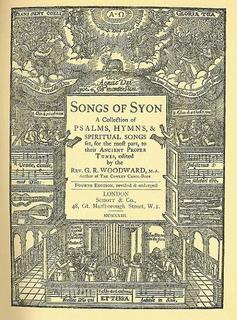


The plainsong texts are generally John Mason Neale’s famous 19th-century translations of the ancient Greek and Latin hymns. These are often rendered in mediaeval musical notation, which, with a little practice, is fairly easily sight-read. The titles of the German hymns are set in blackletter font, perhaps making them appear exotic to an early 20th-century English readership – or should I say “singership”? In his preface to the 4th edition, the Rev. Mr. Woodward felt it necessary to say the following:

If objection be taken to the number of foreign tunes which appear in this Edition, be it remembered that many of our favourite Hymn-tunes. E.g., The Old Hundredth, Luther’s Hymn, Adeste fideles, O Sacred Head surrounded, Now thank we all our God, Sing praise to God who reigns above, are not of English origin. It is confidently believed that many other exotics need only to be transplanted, and they will take equally deep root in the hearts of English-speaking people.

The material is organized at the outset in fairly typical manner, i.e., according to the church calendar. Hence Advent hymns come first, followed by Christmas-even, Christmas-tide, &c. Then come Holy Eucharist, Sundays and Week-days, Evensong, Mattins, Common of Our Lady, Common of Saints, Proper of Saints, &c. Then come sections devoted respectively to Psalms, Hymns and Spiritual Songs.

The Psalms section is of particular interest to me, because the editor put some effort into recovering for the English-speaking church the tunes of the Genevan Psalter, which, apart from a very few, are generally unknown to Anglo-Saxon Christians. Some of the translated texts are by Woodward himself. Here is the first stanza of his rendition of Psalm 150:

Alleluya. Praise the Lord;
Be his holy Name ador’d:
Praise him in the firmament,
Mighty, great and excellent:
In his noble acts revere him:
Praise him on the harp and lute,
Praise him with the trump and flute;
Love, adore, and greatly fear him.

Eight decades later, Woodward’s effort to recover the Genevan tradition appears largely to have fallen short. But his Songs of Syon stands as a monument to the rich liturgical heritage of both eastern and western Christendom. It deserves to be better known than it is.

Unfortunately I myself do not use this volume as often as I would like. My copy is redolent of mildew to which I am, sadly, allergic. Should I attempt to sing directly out of this book, I would have to stop every few bars to blow my nose. I would love to find a much newer reprint with which to replace this.

19 February 2004

The Daily Office

Some 25 years ago I discovered a form of prayer that has its origins in the monastic communities of the early christian centuries, particularly in the west. It is various called the Daily Office, or Divine Office, or Liturgy of the Hours. My initial introduction to this came in the form of a little volume purchased at the bookstore of Luther Theological Seminary in St. Paul, Minnesota: Herbert Lindemann, ed., The Daily Office: Matins and Vespers, Based on Traditional Liturgical Patterns, with Scripture Readings, Hymns, Canticles, Litanies, Collects, and the Psalter, Designed for Private Devotion or Group Worship (St. Louis: Concordia, 1965). Although its language is somewhat dated, it's a marvellous book, filled with all the riches of the Christian ages, some of which were familiar to me but much of which were not.

The daily office is a form of prayer growing out of the canonical hours observed in the monasteries. These are spaced about three hours apart and, in the western tradition, include Matins, Lauds, Prime, Terce, Sext, None, Vespers and Compline. Hence the name Liturgy of the Hours. Each of these offices consists of the following items more or less in order: opening versicle (e.g., Psalm 51:15 or 70:1); followed by Psalm 95 (for Matins) or another canticle; one or more additional psalms; readings from Old Testament, Epistles and Gospels; another canticle (e.g., the Te Deum, the Benedictus or Magnificat); the Kyrie ("Lord have mercy!"); petitions; the Our Father; collects; and a closing doxology or benediction. The prayers and readings are structured according to the traditional church calendar.

Outside the monasteries the canonical hours have been abbreviated into two or three daily prayer offices, usually Matins and Vespers, and sometimes Compline as well. In the Book of Common Prayer two daily prayer offices are prescribed: Morning Prayer, which combines Matins and Lauds, and Evening Prayer, a combination of Vespers and Compline.

What if we lived in communities where morning, evening and night prayer were prayed on a daily basis? Muslims pray five times a day of course. There is something rather awe-inspiring in seeing such huge numbers of people prostrating themselves before God so often. I have posted a pdf document devoted to the Daily Office, which includes the two rites of Matins and Vespers, a table for reading the Psalms, and the two-year Daily Office lectionary. The lectionary was probably put together some 30 years ago or so and is found in the liturgical books of several denominations. For other resources, look here and here.

At some point I may post something I wrote a decade ago about daily prayer.

29 June 2003

Benedicite, omnia opera

Outside the biblical Psalter there are numerous canticles similar to the psalms which the church has sung for two millennia. This includes those in the books that protestants label apocrypha and Roman Catholics call deuterocanonical.

One of my favourite such canticles is found in the expanded Greek version of Daniel. It is sometimes titled, "Song of the Three Holy Children," or "Song of the Three Jews." It is inserted into the story in chapter 3 of Nebuchadnessar throwing Azariah, Hananiah and Mishael into the fiery furnace for refusing to worship the gold image. In the midst of the flames they sing a song that begins "Benedicite, omnia opera" in the Vulgate, and in English:

O all ye Works of the Lord, bless ye the Lord : praise him, and magnify him for ever.

In the Book of Common Prayer this is one of several canticles appointed to be said or sung at Morning Prayer. We used to sing this at Little Trinity Church in Toronto, which I attended more than two decades ago. This is where I learned to love it. It is similar in flavour to Psalms 136 and 148.

It's a shame that the metrical psalters of the Reformation and post-Reformation eras did not include this canticle in versified form.

Followers

Blog Archive

About Me

My photo
Contact at: dtkoyzis at gmail dot com