Showing posts with label conservatism. Show all posts

23 January 2010

Bradley on liberalism

Anthony Bradley pays me the compliment of appealing to my Political Visions and Illusions in this post on the WORLDMag blog: Conservative vs. liberal. Here's Bradley:
Koyzis rightly points out that we all tend to waffle between idolatry and gnosticism in our political alignment. We are idolatrous when we believe that our political preference is the remedy for the world’s problems, and we are gnostic when we believe that competing ideologies are inherently evil. In an honest moment, I would confess that I do believe that my political ideology is right and all others are wrong because, at the end of the day, I think I’m always right. This is why I struggle with whether I am liberal or conservative. . . .

Liberalism starts with the fundamental belief in human autonomy, which means being self-directed and free to govern oneself in accordance with rules in which one willingly submits. The most basic principles of liberalism, according to Koyzis, is that everyone possesses property in their own person and must therefore be free to govern themselves in accordance with their own choices provided that those choices do not infringe on the equal right of others to pursue the same. Human persons should be free from coercion that favors one person or group’s preferences for another. As such, true liberals have a consistent aversion to government coercion in ways that conservatives do not.

I am pleased, of course, that Bradley appreciates my book. In response I would indicate that I am less concerned with what separates liberals and conservatives than I am with probing the spiritual roots of a number of ideologies, of which these are only two. In reality, liberalism and conservatism are not the opponents people generally think them to be. Liberalism is predicated on the assumption that all communities, including such basic institutions as state, church, marriage and family, are reducible to voluntary associations. Because conservatism is merely a tendency and, unlike liberalism, lacks a distinctive account of state and society, there is much overlap between the two. One can easily claim the conservative label and at the same time accept the contractarian account of the state. American conservatives, with their affection for their own founding documents, especially the Declaration of Independence, are practically obligated to do so.

And, no, true liberals do not "have a consistent aversion to government coercion in ways that conservatives do not." At least not all of them do. This is the upshot of my tracing the development of liberalism through five stages beginning with the Hobbesian commonwealth, followed by the night-watchman state, the regulatory state, the equal-opportunity state and, finally, the choice-enhancement state. Because it is up to the parties to the contract to decide exactly what government should do, they are within their right to demand a full-blown welfare state, if they so desire. Yet they remain "true liberals," who simply take the logic of this position further than many professed liberals are willing to.

Bradley might wish to consider dropping altogether both conservative and liberal labels. If he admits that "there are some American conservative cultural traditions that America has benefited by extinguishing," then he may not be a conservative at all — at least not in the sense in which it is used on this side of the pond. Yet if he is willing to recognize, as I hope he is, that not all communities can be reduced to voluntary associations, he is almost certainly not a liberal either. At this point I refer him to the last three chapters of my book where I attempt to point to a way beyond the distortions of ideological thinking.

18 January 2010

Chesterton on checks and balances

The whole modern world has divided itself into Conservatives and Progressives. The business of Progressives is to go on making mistakes. The business of Conservatives is to prevent mistakes from being corrected. Even when the revolutionist might himself repent of his revolution, the traditionalist is already defending it as part of his tradition. Thus we have two great types — the advanced person who rushes us into ruin, and the retrospective person who admires the ruins. He admires them especially by moonlight, not to say moonshine. Each new blunder of the progressive or prig becomes instantly a legend of immemorial antiquity for the snob. This is called the balance, or mutual check, in our Constitution.

G. K. Chesterton, Illustrated London News, 19 April 1924.

24 June 2009

Wills on Buckley

Half a century later it is difficult to recall that William F. Buckley and Garry Wills were once friends and colleagues at the former's National Review. This was before they parted on less than amicable terms. Given this longstanding rivalry, ending with apparent reconciliation a few years before Buckley's death, some of us may not know quite how to read Will's testimonial to one of the leading lights of American conservatism: Daredevil. On the surface it reads like an affectionate tribute, but then there's this:

Bill was not, and did not pretend to be, a real intellectual. He gave up on the “big book” that his father and others were urging him to write. For years he tried to do a continuation of José Ortega y Gasset’s The Revolt of the Masses. This had been a sacred text for his father’s guru, Albert Jay Nock. Bill took intellectual comrades like Hugh Kenner with him for his winter break in Switzerland, to help him get a grip on this ambitious project. But he told me he realized in time this was not his métier. He was not a reflective thinker. He was a quick responder. He wrote rapidly because he was quickly bored. His gifts were facility, flash, and charm, not depth or prolonged wrestling with a problem.

Bill needed people around him all the time. Frequently, when he told me he had to write a column, I would offer to withdraw from the boat cabin or hotel room where we were. He urged me not to, and as he typed (with great speed and accuracy) he would keep talking off and on, reading a sentence to me, trying out a word, saying that something he was writing would annoy old So-and-So. When I appeared on his TV show to discuss a new book of mine, it was clear to me that he had not read the book—he was given notes on each author he interviewed. Once he asked me if I had read all of Adam Smith’s Wealth of Nations. I said yes. “Haven’t you?” He had not. I suspect that was true of the other capitalist classics he referred to, by Ludwig von Mises, Wilhelm Roepke, and others. He could defend them with great panache. But he did not want to sit all by himself for a long time reading them. One of his teachers at Yale, the philosopher Paul Weiss, told me that Bill was very good at discussing books he had not read.

That doesn't even measure up to damning with faint praise. But Wills is kind enough to show us the salutary influence he himself had on his former mentor, successfully breaking him of his racism, antisemitism and, eventually, even his war-hawkishness. It's nice to know that Wills was in the right all along and that Buckley might even admit it if he were still around. Of course we'll have to take Wills' word for it, won't we?

21 April 2009

Canada's Grant family

Yes, after more than two decades, I still have my Canadian politics students reading George Parkin Grant's Lament for a Nation. It's not that I agree entirely with his argument. In fact, I think he severely shortchanges Canada's political institutions, as I wrote here five years ago: George Grant and the Primacy of Economics. Nevertheless, his views are worth taking seriously and grappling with.

It just so happens that Grant's nephew is the leader of the federal Liberal Party, a certain Michael Ignatieff, who has just published a book on his maternal ancestors, True Patriot Love: Four Generations in Search of Canada, an excerpt of which is published in Maclean's: Nation in progress. Robert Fulford thinks, not unreasonably, that Ignatieff is repackaging himself for the voters in this book: Ignatieff gives a shake to the family tree. Writing for Maclean's, John Geddes praises the book, perhaps too obsequiously: Michael Ignatieff’s ‘True Patriot Love’. In the Financial Post, Terence Corcoran claims that neither Ignatieff nor his late uncle had a real grasp of economics and markets: A true patriot of megaprojects.

Will this latest book endear Ignatieff to the Canadian public? Will he successfully convince them that his days as a rootless cosmopolitan are over and that he's finally returned to his roots? Or will they see this as a cynical ploy to gain political power in a country that has not been his for most of his nearly 62 years? Time will tell.

01 March 2008

William F. Buckley (1925-2008)

The death of William F. Buckley, the last true conservative, is prompting numerous appraisals of the movement he helped found and of his own legacy for that movement and beyond. Among the tributes is this one by Robert McDougall, which is noteworthy for unintentionally illustrating the ambiguity behind the conservative label. According to McDougall, Buckley promoted "individualism and its democratic benefits," was a free spirit, respecting anyone "who strove to live life on his own terms," and "called for the decriminalization of drugs."

In short, Buckley's conservatism was of the libertarian variety and, in this respect, quintessentially American. As it turns out, "the scourge of American liberalism," as the late Arthur Schlesinger dubbed him, was as much indebted to the broader liberal tradition as his "leftist" compatriots. This explains in large measure why a movement with so little substantive content has had such difficulty defeating an opponent with which it has so much in common.

27 June 2007

Conservative environmentalists

For some odd reason concern for the environment has come to be associated with those conventionally styled "leftists." Here's evidence that not all professed conservatives are willing to concede such concern to their opponents: Conservative Principles and the Environment. Author John R. E. Bliese writes:

In the often quoted words of Edmund Burke, society is "a partnership between those who are living, those who are dead, and those who are to be born." Therefore, we have obligations and duties to future generations. We have no right to trash the earth in an orgy of consumption and leave our children and grandchildren a polluted and depleted planet. The idea of "sustainable development" is a perfectly conservative one. We have a moral obligation to design our economy in such a way that we can produce our goods without reducing the ability of the planet to support future generations.

25 September 2006

A Tory on fraternity

Hegel's ideas are alive and well in the person of Danny Kruger, who applies the German philosopher's dialectic to British politics in The right dialectic. Kruger argues that the revolutionary triad of liberty, equality and fraternity well represents the ongoing quarrel between left and right, with the former focussing on equality and the latter on liberty. Both groups value fraternity, even if they interpret it differently. At base it is

the sphere of belonging, of membership, the sphere of identity and particularity. It exists in civil society, in the arena of commercial and social enterprise, of family and nation. It concerns neighbourhood, voluntary association, faith, and all the other elements of identity that relate us to some and distinguish us from others. It concerns culture.

Kruger's essay is helpful in giving us a sense of the direction of the Conservative Party under its current leader David Cameron. What Kruger appears to misunderstand is the origin of the terms left and right in the horseshoe-shaped parliaments he erroneously views as attempts to overcome them. They certainly did not originate at Westminster, as he seems to imply.

Thanks to Paul Bowman for alerting us to this article. Bowman has asked me whether Kruger's musings represent a movement within the Conservative Party in a christian democratic direction. Possibly, but these ideas are by no means new within the Party. Former leader William Hague (who bears an uncanny resemblance to Kelsey Grammer of Frasier fame) set them forth in a speech titled, "Identity and the British Way," since removed from the Conservative Party website but which I mention in my book.

10 May 2006

Civitas 2006

The Peace Tower
Two months ago I received an unexpected invitation from Lorne Gunter, a columnist for the National Post and the Edmonton Journal, to speak at the 10th annual conference of the Civitas Society, which styles itself "A society where ideas meet." This was based on his reading of an article I wrote for Comment last year, titled, The city and its renewal, which recently came out in the periodical's print edition. I hadn't known much about Civitas other than in the pages of Lloyd Mackey's The Pilgrimage of Stephen Harper, which I had read not too long before. From this I knew that Civitas was a small-c conservative think tank bringing together a number of prominent politicians, political staffers, academics and journalists of a generally "right-wing" persuasion. The invitation came as something of a surprise, because my cities article did not seem obviously to fit into a right-wing mould, as that is usually understood nowadays. Yet I was pleased to accept.
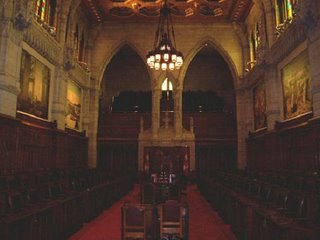
The Senate Chamber
I arrived in Ottawa thursday afternoon after a 6-hour drive from Hamilton. I had a wonderful dinner with my friends Eric and Bertina Hogeterp and their two boys. We were joined by another Redeemer political science graduate, Derek Miedema, who works for the EFC. The following morning Eric and I attended Question Period in the House of Commons, which occurs at 11.15 on fridays. Afterwards I was honoured to have David Sweet, the new Member of Parliament for Ancaster-Dundas-Flamborough-Westdale, come down to greet me in the hallway near the Peace Tower. I myself do not live in his riding, but Redeemer is located there. During Members' Statements at 11, Sweet mentioned Hamilton's "two universities, McMaster and Redeemer." Of course, cameras and other electronic devices are not allowed in the Commons chamber, but because the Senate was not in session, I was able to photograph the impressive interior of the Red Chamber (above left), as well as the gallery of portraits of Canada's monarchs just outside.

After this I made the 20-minute drive to the Brookstreet Hotel in Kanata, where the Civitas conference was taking place. During the reception that evening, Prime Minister Stephen Harper made an unscheduled appearance. I cannot recall how long he stayed, but it took some time for everyone who wished to meet him to do so. I myself was privileged to talk with him briefly and shake his hand. (If Harper had been aware of my track record, he might have declined the honour. After all, like his ill-fated predecessor, he is a Conservative with a precarious minority government!) After Harper and his entourage left, John Baird, the President of the Treasury Board, made an exceedingly partisan speech, filled with barbed humour at the expense of the various Liberal leadership hopefuls.

Saturday morning saw the first of the sessions, devoted to "Property Rights: the most fundamental freedom," followed by a session on a topic that at first blush might not seem to be related to the previous one: "Euthanasia: the next battle in the culture wars." In fact, however, both sessions brought out the barely latent tensions between two principal factions in the conservative coalition, the libertarians and what might be called the social or traditional conservatives. The former are individualists to the core, preferring to minimize government control to the greatest extent possible. As such, they enthusiastically champion the free market and are usually willing to tolerate abortion, euthanasia and other activities on which the social conservatives deem it necessary to legislate. After all, if we have property rights over our own bodies, then why not allow euthanasia? As one participant put it, if our bodies are not ours to do with as we see fit, then they belong to the state. Yet I heard no one make a case for allowing individuals to sell themselves into slavery, which indicates that even libertarians are not willing to follow all of their own ideas to their logical conclusion.
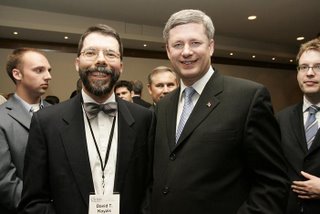
Koyzis and Harper
The luncheon remarks by Frank Luntz, a Republican Party strategist from south of the border, were certainly the most controversial. This was the part of the weekend picked up by the domestic media, and Harper's meeting with Luntz a day earlier was the subject of opposition criticism during monday's Question Period. The title of Luntz' talk, "Massaging the Conservative Message for Voters," carried all the flavour of a proposal for an ad campaign. Subtleties and nuances may be the mark of academic discourse, but they can only cloud an election campaign. Luntz' basic message? Keep it simple, hammer the opposition, and hire me next time. Incidentally, Luntz' appearance was arranged by the Manning Centre for Building Democracy, a partisan think tank associated with the Conservative Party of Canada.

The other four sessions dealt with the role of the courts in democracies, foreign and defence policies, electoral reform, and the future of Canadian cities. The schedule was tightly packed, leaving little time to catch one's breath. I missed George Jonas' speech saturday evening, due to fatigue. I would also like to have heard more on electoral reform the following morning, since I myself have written popular pieces on the subject. But I thought it best to cut out a little early to prepare for the final session on cities, in which I myself was participating. In fact, I was the very last speaker at the conference. Knowing this in advance, I feared I would be addressing a vastly reduced assembly, as some were present only for saturday. Yet this was not the case: even the final session drew a fairly large turnout.

I shall resist the temptation to engage in name-dropping, though it would be easy to do for such an event. Suffice it to say that there were a large number of well-known people — scarcely less well known than the Prime Minister himself. Representatives of a number of vaguely kindred organizations were also present, including one from the Association of Women Shooters of Canada! I myself spent much of the time with WRF people. Perhaps not surprisingly, I felt most comfortable with the traditional conservatives, even if I myself am loath to wear that label. I found myself least in agreement with the positions of the libertarians, though I found a number of these to be quite likable as persons.

At the end of the day, I found myself wondering whether everyone present really had all that much in common. Thomists, neocalvinists and traditionalists who speak the language of natural law, creation order and moral order respectively would not seem immediately to share much with those who view the state as little more than a constant threat to their own individual autonomy. In fact, there are professed socialists with whom at least this neocalvinst would have more in common. In my Political Visions and Illusions I point out the protean character of conservatism, especially the desire of different professed adherents to conserve a variety of perceived goods. This is particularly notable with respect to a view of the state. Unlike liberalism with its contractarian notion of the state, there is no single, philosophically coherent account of political order that can obviously claim the conservative label. If there was a common definition of conservatism at Civitas, it seemed to revolve around, not so much the respect for tradition and the accumulated wisdom of the ages, as smaller government and lower taxes — a somewhat deracinated agenda that would be largely incomprehensible to European conservatives of, say, the 19th and early 20th centuries, and even to Canadian conservatives of an earlier generation. In short, Civitas illustrates both the virtues and defects of the conservative movement(s) in this country. In this it is no different from the partisans of the rival political perspectives.

I was told that this particular Civitas conference was more evidently partisan than its predecessors. For the first time since Civitas was founded there is a large-C Conservative government in office. Even the taste of power can be a heady experience. How long will it all last? Luntz held out the possibility of keeping power for 20 years. My admittedly unprofessional advice? Don't put away your coat and hat too soon. After all, this is only a minority government.

02 February 2006

Leo Strauss in the True North?

With the election of Stephen Harper's Conservative government in last month's federal election, could the conspiratorial Straussian cabal led by the notorious Paul Wolfowitz be extending its reach from Washington to Ottawa? Joseph Knippenberg explores this possibility in The Second Time as Farce. I am, of course, pleased to see Knippenberg cite my own The Calgary School and the Future of Canada, which he deems one of the "more measured accounts" of this school's influence.

One of the articles to which Knippenberg links is written by a certain professed "Red Tory" and aficionado of the late George Parkin Grant. While he charges the Calgarians with taking their cues from, among others, European émigrés such as Leo Strauss, and not from "indigenous Canadian tradition," he appears to have forgotten that Grant himself had considerable respect for Strauss and counted him one of the great influences on his own thought. Nationalist though Grant may have been, he was hardly one to limit his own grazing to native pastures. How else account for the formative influence of Jacques Ellul and Simone Weil, the latter of whom in particular he held in almost childlike awe?

26 November 2005

Conservatives. . . and conservatives

There are conservatives. And then there are conservatives. In the latest entry in the WRF's Comment series, Russ Kuykendall reviews Adam Daifallah and Tasha Kheiriddin's Rescuing Canada's Right: Blueprint for a Conservative Revolution. Although Kuykendall (aka Burkean Canuck) and I undoubtedly share much in terms of political perspective, I have never been enthusiastic about wearing the conservative label, whether begun with an upper- or lower-case C. I will not go into detail explaining this reluctance, because anyone can easily discover this in chapter 3 of my book.

That said, however, I will be the first to admit that, if the secular media were to pay any attention to me, they would almost certainly peg me as some sort of conservative, mostly because I oppose legalized abortion on demand, support a stable definition of marriage and family, and believe that government is under no obligation to manifest a supposedly benign neutrality towards a variety of personal lifestyle choices, much less to subsidize them.

All the same, the variety of conservatism I dislike most is the libertarian variety, exemplified by the likes of Ayn Rand and Friedrich von Hayek. Conrad Black is a caricature of the libertarian conservative, in which the common good or the public interest is ancillary to the ego of the sovereign individual — especially the individual with the economic means to have his own way. As I've written before, a government content only to protect a free economic marketplace falls short of doing public justice. It should encourage the wealthy to use their resources for the public benefit, probably through a careful design of the tax code. Those conservatives who can recognize this are worth co-operating with. By contrast, those claiming the conservative label, but who, following Marx's stereotype, do no more than to try to conserve their own spending power, are definitely not worth the time of day.

25 September 2005

Conservatism in Canada

Yesterday the National Post began a series on the state of conservatism in Canada, beginning with this article by Robert Fulford: The values battle. (Would-be readers of the other articles will have to pay for them.) How does the Post define conservatism? In two words: less government — which appeals to Americans but has always been a tough sell in this country. Working with this definition, it turns out that Canada's first prime minister, Sir John A. Macdonald, was not much of a conservative, despite his party label.

02 June 2005

A Red Tory

While looking for an explanation of the Hartz-Horowitz thesis the other day, I came across a series of webpages belonging to one Ron Dart, who teaches politics and religion at the University College of the Fraser Valley in BC and is a self-described Red Tory. In fact, he even publishes a journal called The Friend: The Red Tory Review. Among other things, he is an aficionado of the late George Grant and looks to be a high-church Anglican to boot. Interesting fellow.

When I saw his name, I thought it looked familiar. Then I recalled he had written a severely critical review of Paul Marshall's Their Blood Cries Out in Sojourners, to which Marshall himself responded a few months later. Something of Dart's approach can be seen in this article, "Clark Pinnock: Canadian Theologian of the Empire." Pinnock is, of course, the controversial theologian now retired from McMaster Divinity College, just down the hill from Redeemer here in Hamilton. Dart argues that, although Pinnock's Wesleyanism is poles apart theologically from J. I. Packer's Calvinism, both are apologists for the American empire and have effectively betrayed "the Canadian High Tory and Conservative way." As such they are "theological compradors."

Of course, the defence of one's own is certainly a hallmark of virtually any conservatism worth its salt. On the other hand, simply to argue that Pinnock and Packer are flirting with American "republican" ideas ostensibly foreign to Canada does nothing in itself to tell us whether they are right or wrong in so doing. Yet if Dart were to attempt to address this issue, he would have to reach beyond his vaunted high tory conservatism and embrace some sort of general normative framework in which questions of right and wrong could more easily find a context. Perhaps it's time for him to investigate neothomism or neocalvinism, both of which claim to offer such a framework.

01 June 2005

Looking back

A couple of weeks ago I was going through the files in my home office, attempting to reorganize them and to weed out items no longer of interest to me. As I was doing this, I discovered a typed essay I wrote some 25 years ago, titled "A Brief Evaluation of American Conservatism." I can no longer say for certain the circumstances of my writing this, but I imagine it was written either when I was still in Toronto at the Institute for Christian Studies, or perhaps a little later when I had begun my PhD studies at Notre Dame. The outer limits would be from 1979 to 1981, so I am placing it in the middle: 1980, the year I moved from Toronto to South Bend. In any event, I was in my mid-20s. What struck me about this essay, reading it a generation later, is that I still agree with most of what I wrote then. In fact, I was pleasantly surprised to discover that it anticipates much of the analysis in chapter 3 of my book, even if the latter is more nuanced and careful than the former.

To begin with, I noted that "there is no such thing as a single 'conservatism'; there are, in fact, many 'conservatisms.'" The American variety is an uneasy coalition between libertarian conservatism, or classical liberalism, and traditional or organic conservatism. The former is concerned with the size of government and the maintenance of free markets, while the latter is preoccupied with the erosion of the traditional values undergirding society and with such issues as abortion, "experimental social relationships and any change that would contribute to the breakdown of society." At the time I judged that in North America "the dominant form of conservatism is classical liberalism tempered by traditional conservatism. The former cannot strictly be called conservative at all, because genuine hierarchical or authoritarian traditions were largely left behind by those who settled this continent." This second sentence would seem to be evidence that I had already come into contact, via George Parkin Grant, with the Hartz-Horowitz thesis, the truth of which I am not altogether persuaded of now, even if I still find it intriguing.

Of course, the notion that North American conservatism consists of two or more quarrelsome factions is generally recognized today. In 1980 Robert Nisbet wrote a now classic essay in Modern Age titled "Conservatives and Libertarians: Uneasy Cousins." I do not know whether or not my own essay preceded Nisbet's. I am fairly certain I did not read the latter until a few years after its publication. In any event, the analysis of conservative factionalism has become something of a cottage industry since then. In fact, the new issue of First Things carries an article by Joseph Bottum on the subject, "The New Fusionism." And of course there is that article by Andrew Sullivan, on which I recently commented. I suppose what I was coming to see at the time is that liberalism and conservatism are not the polar opposites they are popularly thought to be and that it is possible to adhere to liberal contractarianism while respecting historical continuity and remaining sceptical of all but incremental change.

Here are a few paragraphs from my conclusion:

First of all, conservation does not necessarily exclude progression. We cannot ignore the movement of history when we analyze society and the political realm. Any conservatism which attempts to return to an earlier period of history is naive and irresponsible. Nor can one halt the flow of history at a certain moment of time. In other words, a Christian political option must be at once conservative and progressive.

Secondly, as Christians we urgently need to examine in a radical way the spiritual direction and foundation of our government and its activities. In other words, we need a new criterion by which to judge that which should be conserved and that to which we must progress. We cannot allow ourselves to fall into the trap of absolutizing conservation or progression. We must not put an idolatrous faith in conservatism or progressivism. Neither of these “-isms” is a complete world-view in itself. Both agree on the same liberal principles which have had almost universal acceptance throughout the history of the American republic. Conservatism and progressivism are merely two different emphases within the same ideology, which has its roots in the secular Enlightenment.

What sort of criterion is need for a radically Christian political option? It is, I would contend, nothing less than the biblical norm of “justice.” A true sense of justice will provide a norm for the two-fold task of conservation and progression within a radically Christian world-view. Certainly, “freedom” and “stability” are important concepts and should not be lost sight of. But they fall far short of providing a normative insight into the structure of the state. . . . Since the state is, by definition, a juridical institution (in distinction from other institutions with a differing structure), the norm for this institution must be some conception of justice.

While I would express all this somewhat differently a quarter of a century later, and while my understanding at the time lacked a certain philosophical sophistication, I am pleased to recognize that I still agree with the substance of what I wrote then. Of course, someone less charitable could argue that I haven't had a fresh insight in 25 years, at least not on this subject. Perhaps there is something to be said for such a charge. On the other hand, there is some comfort in knowing that I have been following the same direction for some time. I like to think that my trust in an utterly faithful God has had something to do with it.

02 May 2005

Faith and doubt in Andrew Sullivan

If Lew Daly is cautiously sympathetic with the European christian democratic influence on the Bush administration's faith-based initiative, Andrew Sullivan has a rather different assessment of this policy in his New Republic article, "Crisis of Faith: How Fundamentalism is Splitting the GOP." Sullivan argues that two different versions of conservatism are vying for control of the Republican Party: a conservatism of faith and a conservatism of doubt.

Currently in the ascendancy, conservatives of faith see government as a vehicle for implementing an ambitious agenda of social reform, not all of which would necessarily claim the conservative label. This includes the pursuit of policies intended to uphold virtue and the good life in a variety of areas. It is seized by a crusading spirit which would oppose abortion, same-sex marriage and "indecent television," which are typical conservative causes, while also undertaking to eradicate slavery in Sudan, sexual trafficking and AIDS in Africa, which might be viewed as progressive causes. Conservatives of faith, who dominate the Bush administration, see "nothing wrong with channeling $2 billion of public money to religious charities," as Sullivan tendentiously describes the faith-based initiative. Far from the classical liberal night watchman state of John Locke and Adam Smith, conservatives of faith follow Otto von Bismarck and Benjamin Disraeli in championing a particular version of the welfare state:

What matters to conservatives of faith is therefore less the size of government than its meaning and structure. If it is harnessed to uphold their definition of the good life — protecting a stable family structure, upholding Biblical morality, protecting the vulnerable — then its size is irrelevant, as long as it doesn't overwhelm civil society. . . . This is what remains of conservatism's old belief in individual freedom. The new conservatism of faith has substituted real choice in a free market for regulated choice within an ever-expanding welfare state.

Here one is reminded of Wilfred McClay's analysis in his recent lecture, "American Culture and the Presidency," on which I commented two months ago in "Bush's conservative reformism." There are also parallels in the administration's foreign and defence policies, which are animated by what James W. Skillen calls "freedom-idealism."

Then there is the conservatism of doubt, with which Sullivan is clearly more sympathetic. Conservatives of doubt are deeply suspicious of crusades and reform efforts of any kind. They are the heirs of Thomas Hobbes, Locke and even Edmund Burke, and they are sceptical of the use of moralistic arguments in the policy process. They prefer not to exacerbate social and especially religious cleavages and to maintain government's neutrality on those issues which are especially divisive within the body politic as a whole. They favour divided government, judicial checks on democratic majorities, and protecting the prerogatives of state and local governments against unwarranted federal encroachment.

Conservatives of doubt do not feel the need to ground the defence of freedom in overt religious principles; they are quite content with the Enlightenment principles embodied in the US Constitution and the Declaration of Independence. They are aware that politics is the art of the possible, a pragmatic effort to secure peace and stability amidst potential social conflict. For this reason, conservatives of doubt, insofar as they seek principles for their activities, look for those most likely to command the widest possible support among the citizenry, eschewing those which are obviously sectarian. They will have none of this business about a transcendent source of positive law.

To be sure, Sullivan is not the first observer to notice that the current conservative movement in North America consists of different strains at considerable variance with each other. In many respects, this diversity within the conservative fold is what kept the former Progressive Conservative and Canadian Alliance Parties divided for a decade and a half here in Canada. In my own Political Visions and Illusions, I spend the third chapter emphasizing the fact that the conservative vision — if it can be called such — encompasses such variable content as to render it nearly incapable of addressing so central a question as: What is the nature and task of the state?

What is striking about Sullivan's simple taxonomy, however, is the way he draws his boundary. Some have seen contemporary conservatism as an uneasy amalgam of Burkean conservatism and classical liberalism, of social conservatism and economic libertarianism, or perhaps of traditional conservatism and market capitalism. Sullivan, however, divides his parties along a line separating crusading zeal from cautious, conciliatory governance. Depending on which taxonomy one accepts, President Bush is likely to be categorized in different ways. According to the first scheme, Bush would have to be judged a classical liberal, while according to the second he might be viewed as a social conservative. Under the third conception, Bush might fall into either category, while Sullivan would definitely see him as a crusader and his father as a more cautious type. Furthermore, and somewhat ironically, Sullivan would appear to disagree with Daly's assessment that Bush has not increased social spending. To the contrary, Sullivan argues, Bush has increased spending at all levels, while lowering taxes and generally putting his country's finances deeply into the red. This removes him even further from the conservatism of doubt.

If Sullivan were to analyse neocalvinism, where would he place it? There are, after all, some commonalities between Bush's faith-based initiative and the Center for Public Justice's christian democratic approach, as Daly has pointed out. Because neocalvinism is definitely a confessionally explicit movement eschewing the pseudo-neutrality of Enlightenment secularism, I am reasonably confident Sullivan would identify it with the conservatism of faith. He is, of course, welcome to categorize the world as he pleases. Yet to be charitable, he might wish at least to hear out those of us unable to accept his categories.

Most basically, many of us simply find Sullivan's vaunted contrast between truth and doubt, between coercion and persuasion, to be unconvincing. I myself will not defend much of the Bush agenda, which I would agree with Sullivan to be an exercise in dangerous overreach — both domestically and internationally — with precious little awareness of the practical and fiscal limitations under which any government must operate. Furthermore, Sullivan's positive portrait of the conservatism of doubt has a definite affinity with Bernard Crick's classic defence of politics and Jean Bethke Elshtain's celebration of democracy as a rather untidy, non-utopian means of enabling citizens to live together despite their differences. Over the years I have come to appreciate both Crick and Elshtain, whose constrained vision of politics constitutes a valuable corrective to those attaching near redemptive expectations to government.

Yet does it not seem odd that many of those most vocally advocating what Amy Gutmann and Dennis Thompson call deliberative democracy, i.e., the on-going process of talking out our differences within the public square, do not shrink from telling the rest of us what the final results of such deliberation should be on the most divisive of issues, if only we would exercise cool reason and leave our ultimate commitments behind? As just one example, Sullivan's description of what is at stake in the marriage issue invites readers to take his part — if, that is, they expect to be treated as rational partners in the deliberative process. That there might be another side to the issue — that some might deem it dangerously intrusive for a government to assume the right to redefine an institution anterior to itself — does not occur to Sullivan. If he can portray such a position as the product of special pleading and of sectarian crusading, then he is free to dismiss it. Something similar can be said of his treatment of abortion and the other end-of-life issues.

It must finally be said that Sullivan's article is a worthwhile reminder to us that those who manage successfully to set the terms of a debate can often influence its outcome as well. This is good reason for us to enter it early enough to ensure that the right questions are posed and the terms properly defined.

15 October 2004

Religiously Political Conservatism

In the latest Capital Commentary from the Center for Public Justice, James W. Skillen weighs in on the tendency of American Christians to combine their religious faith with the peculiar national brand of political conservatism.

George F. Will, drawing from what he considers "the best political book in years" (John Micklethwait and Adrian Wooldridge's The Right Nation), writes in a recent column that "the emotions underlying conservatism's long rise [in America] include a visceral individualism with religious roots and anti-statist consequences" (Washington Post, 10/10/04). According to Micklethwait and Wooldridge, religiosity is what "predisposes Americans to see the world in terms of individual virtue" and to be skeptical of government.

This is why American Christians ought to be conservatives, right? And doesn't it also mean that in today's culture Christians should vote for the evangelical and politically conservative George W. Bush rather than for the politically liberal John Kerry, who happens to be Catholic?

Regardless of how you choose to cast your vote on November 2, to presume that religiously political conservatism harmonizes with Christianity is a serious mistake. Nancy Pearcey exposes the error of this presumption in her new, and now best-selling, book, Total Truth: Liberating Christianity from Its Cultural Captivity. Political conservatives should read it closely and carefully.

The individualism to which Will refers grows from what Pearcey exposes as the unbiblical modern assumption that individuals are autonomous creators of their social relationships. That belief in autonomous individualism is the root of the social-contract theory of government that Americans have thoroughly absorbed. Too many Bible-believing Christians have mistakenly identified true faith with individual conversion and personal piety often in opposition to both ecclesiastical and governmental institutions.

When evangelical Christians identify their faith only with heart, soul, and church experience, they allow the rest of life--"secular life"--to be located outside the realm of personally authentic religion. This mind-set, writes Pearcey, constitutes the now-familiar "two-story" concept of truth. Christian truth belongs in the upper story of private piety oriented toward salvation beyond this world, while secular, scientific "truth" holds for the lower story of public life.

"Perhaps the greatest tragedy," writes Pearcey, "is that many evangelicals in the eighteenth and nineteenth century failed to recognize what was happening. Having embraced a two-story concept of truth, they assumed that political philosophy was a lower-story 'science' that could be pursued apart from any distinctively Christian perspective."

The mystery, however, is how these pious evangelical Christians, with a two-story concept of truth, came to believe so strongly that a secular, "lower-story," individualistic, contract-theory of government is compatible with Christianity. Pearcey highlights part of the answer, which is that evangelical Christians baptized "visceral individualism" (Will's words) as part of true Christianity.

Another part of the story is that a vast majority of American Christians adopted as part of the true faith that God had superintended the creation of the American republic as a new Israel--God's chosen nation. Soul salvation might be individualistic and oriented toward heaven beyond, but social-contract individualism with anti-statist consequences was baptized into the civil religion of Americanism. In other words, American evangelicals may have locked their individual piety in a private upper story, but they also sacralized lower-story Americanism as the civil-religious truth that fits hand in glove with their piety and trust in Christ's heavenly salvation.

On both counts this two-story view of life distorts biblical Christianity, which is neither individualistic nor civil-religious. It allows for neither a social-contract view of government nor the identification of America as God's chosen nation.

--"James Skillen" President

This commentary whets our appetite for Skillen's next book, With or Against the World?: America's Role Among the Nations (which, contrary to amazon.com's notice, will be released much later than "December 31, 1969"). I read a draft of one of the chapters this past summer, and it promises to be well worth reading. My guess is that this book will bring Skillen more attention than his other books have done thus far, and that it will furthermore occasion some controversy. Yet if it forces American Christians to rethink some of the less healthy ways in which they identify with the national political ethos, it will have done a considerable service.

08 September 2004

The 'betrayal of liberalism' thesis again

Susan P. Jacobse is an Orthodox Christian who has changed her mind over the past two decades, as recounted here: "Why I Am a Conservative." Writes Jacobse:

I discovered that the founding fathers [of the United States] were classical liberals. Their legacy is not the moral equivalency and moral relativism that are the hallmarks of modern liberalism. Rather, the rightful heirs of the classical liberalism of the founders are the moral and social conservatives of today.

This assessment is widely held by many people, particularly Americans, whether they call themselves liberals or conservatives. But what if it's not true? What if the followers of the latest, most decadent form of liberalism -- the adherents of what I call the choice-enhancement state -- really are the true heirs of the liberal legacy? What if there's a spiritual link between Jefferson's "life, liberty and the pursuit of happiness" and the US Supreme Court's "right to define one's own concept of existence, of meaning, of the universe, and of the mystery of human life"? Then what?

18 July 2004

Whither conservatism?
 
Caleb Stegall has alerted us to this article from The New York Times by David D. Kirkpatrick: "Young Right Tries to Define Post-Buckley Future." Kirkpatrick quotes Stegall:

"Conservative is a word that is almost meaningless these days," said Caleb Stegall, 32, a lawyer in Topeka, Kan., and a founder of The New Pantagruel, newpantagruel.com, an irreverent Web site about religion and politics named for the jovial drunkard created by [François] Rabelais. "It tells you almost nothing about where a person stands on a lot of questions," he said, like gay marriage, stem cell research, the environment and Iraq.

To which I would say yes, but there's much more to it than this. Because conservatism consists merely of a cluster of attitudes supportive of existing institutions and sceptical towards change, it lacks a solid theoretical and spiritual base. Is Christianity true? is generally not the question conservatives would ask themselves. Rather they would ask: Has it been useful in maintaining social order? As for a theoretical articulation of the nature and task of the state, different conservatives will tell us different things. But of course I've said all this before.
 
Stegall's parents once taught at the American Academy in Larnaca, Cyprus, where my father was educated some sixty years ago.

16 June 2004

Lack of content in conservative vision

National Review Online has been carrying selections from John Micklethwait and Adrian Wooldridge, The Right Nation. I was struck by these revealing remarks by the authors in "A Different Conservatism":

[T]he fact that the Right is such a broad church — that it includes a hefty dose of liberal heresy along with the traditionalism — yields both weaknesses and strengths. On the positive side, it helps to explain why it is such a big and vibrant movement. American conservatism cannot help but contain contradictions because it contains so many vital elements. There are thousands of conservative activists, hundreds of conservative think tanks, a small army of conservative intellectuals. One useful book of conservative experts, published by the Heritage Foundation, the movement's biggest think tank, is as thick as a telephone directory. Yet the broad church also means that people are often worshipping different gods.

Look at Colorado Springs and you'll find at least three competing forms of conservatism — the laissez-faire individualism of the tax cutters and the gun owners, the Christian moralism of Focus on the Family and the militaristic nationalism, represented by the neighboring Air Force Academy and the bumper stickers laughing at Saddam Hussein. But how can you trumpet a strong military and a vigorous foreign policy and then insist on small government? How can you celebrate individualism but then try to subject those individuals to the rule of God? Wherever you go in the Right Nation, you discover similar contradictions.

Note the references to "broad church" and "worshipping different gods." These overtly confessional metaphors seem particularly appropriate and would appear to vindicate my own thesis that ideologies are fundamentally religious. As for these "different gods" themselves, could this very diversity within conservatism be indicative of its lack of coherence as a political vision? Liberalism at least is based on a commitment to individual autonomy and the voluntary character of all communities. Liberal principles are much more easily identifiable than those of, say, conservatism or nationalism. Hobbes' and Locke's political philosophies have a certain intellectual rigour lacking in much of conservatism.

This is not to say, of course, that conservatives are "the stupid party," as John Stuart Mill famously put it. There are many intelligent and eloquent conservatives who stand on definite political principles. Some of these, such as Edmund Burke, Russell Kirk, Aleksandr Solzhenitsyn, and Canada's own George Grant, I appreciate a great deal. At the same time, their vaunted principles do not necessarily have a causal connection to their conservatism. One looks in vain, for example, for a distinctively conservative view of the state or any other human institution. Some conservatives, such as Friedrich A. von Hayek and Ayn Rand, have to look to liberal principles to flesh out their conservatism. Conservatism is simply a collection of attitudes towards change and existing institutions. Providing they do not become ideologized and thus distorted, such attitudes are undoubtedly a necessary corrective to those whose zeal for reform might upset the ship of state. Yet attempting to derive a full-fledged political theory from them is an unpromising effort unlikely over the long term to yield fruit.

This means that conservatism will always be handicapped in the larger political debate. Lacking a substantive vision of their own concerning the place of politics within life as a whole, conservatives will be able effectively to challenge their opponents only insofar as they embrace principles drawn from elsewhere, e.g., Catholic social teachings, neo-Calvinism or another of the traditional religious faiths.

03 April 2004

Conservatism

In the new issue of Comment, Mark Cameron writes perceptively on "The Meaning of Conservatism" in Canada. Noting that conservatives are a diverse and quarrelsome lot, encompassing "democratic populists from Preston Manning's Reform, economic nationalists led by David Orchard, social conservatives allied with Stockwell Day, Red Tories in the mould of Joe Clark, and tax and budget cutters associated with the Harris and Klein governments," he observes that all of these are now having to get along under the organizational umbrella of the new Conservative Party of Canada. It is by no means a foregone conclusion that they will succeed in this.

Could it be that conservatism is fractious and fatally weak because it has so little substantive content and no real vision of its own to bring to the political process? A mere defence of existing institutions and a general scepticism towards proposed reform efforts is all well and good, insofar as it offers a cautionary note to those whose dreams would have them overturning a reasonably good social order because it is not perfect. Yet lacking a solid understanding of the world as God's world, it inevitably tends towards pragmatic rather than principled action, it applies the brakes more easily than it steers the vehicle, and it too easily acquiesces in injustices hallowed by longstanding tradition. Perhaps it's time to abandon the conservative label and move towards a principled affirmation of pluriformity in God's world, including the jural mandate he has given the political authorites to protect this pluriformity.

29 October 2003

To be or not to be conservative

Gideon Strauss writes that he wishes he were a conservative, but, alas, he is not. He comes up with some good reasons, most of which I can agree with. But I think he's missed the most important one: there simply is not enough substantive content in the conservative vision.

There are several varieties of conservatives, and their beliefs may or may not be mutually compatible. In my book, Political Visions and Illusions, I treat conservatism as a political ideology in the third chapter. My biggest beef with conservatism in this sense is that it has no real doctrine of the state and its irreducible task in God's world. This is primarily because conservatism tends to defer to tradition, and, since traditions are multiple and dependent on time and place, they inevitably teach us different things.

Unlike liberalism, whose doctrine of the state is quite clear and revolves around a supposed social contract amongst sovereign, self-interested individuals, conservatism in its several forms is compatible with more than one view of the place of the state. This is why the tendency, especially in North America, to contrast liberalism and conservatism is not altogether adequate. After all, one can claim the conservative label and hold to an essentially liberal view of the state. Conservatives here do it all the time.

Now I recognize, of course, that conservatism needn't be reduced to a political ideology. One sometimes hears of people being described as conservative for whom politics may be of secondary interest. Conservatism in this sense is an overarching attitude towards life predisposing the person to hold on to cherished customs, institutions, symbols and beliefs. Some of these may be political, but most are not. This kind of conservative will value the long-established over the ephemeral, the classic over the trendy, in a variety of areas, for example, literature, music, the visual arts, the cinema. She will be exceedingly wary of current efforts to redefine foundational social institutions such as marriage and family in the interest of implementing abstract egalitarian principles. She will generally be cautious towards proposed reforms and tend to stick with the tried and true.

To some extent we could all do well to be conservative in this sense, although every society needs bold innovators and risk takers as well. Yet the defect of such a conservative approach is that in and of itself it lacks an animating vision of life. It lacks a set of normative criteria permitting us to sort out good and bad traditions. It can't tell us why, say, racial segregation in the American south ought not to have been defended or why absolute monarchy, where it still exists, might not be a good thing to maintain. If some conservatives can defend capitalism and others just as easily decry it, then we should probably be reticent in claiming the conservative label for ourselves without considerable qualification.

Followers

Blog Archive

About Me

My photo
Contact at: dtkoyzis at gmail dot com