Tooley on 'peacemaking'
Here is Mark Tooley on the Christian Peacemaking Teams (CPT), three of whose members were recently rescued after months in captivity: "Christian" Group Bites the Hand that Rescues It. Of particular interest is Tooley's analysis of the difference between the historic peace churches, including the Mennonites, Brethren and Quakers, all of whom recognized the "civil state’s responsibility for military defense," and the contemporary disciples of John Howard Yoder and Stanley Hauerwas, who are less willing to admit the legitimacy of the state's possession of the coercive power of the sword.
03 April 2006


Today's Byzcal Canadian challenge
The challenge is to come up with a story, book or magazine title with political significance. Here are three:
Little Red Riding Association - girl saves grandmother from wolf, runs for Liberal nomination in her constituency.
Jack and the (Has-)Beens Talk - NDP leader Layton converses with McDonough and McLaughlin.
Harper's Bizarre - monthly publication of opposition parties
Go ahead. Give it a try.
The challenge is to come up with a story, book or magazine title with political significance. Here are three:
Go ahead. Give it a try.
02 April 2006
Refugees' plight ignored by world
At least since my own relatives became refugees in 1974, I have had considerable sympathy with Palestinians who lost their homes and homeland with the birth of Israel in the former British mandate. However, there is little global awareness of the nearly one million middle eastern Jews, who were forced to leave their own countries behind after 1948. Now these below-the-radar-screen refugees are taking their case to the European Union. Will EU pressure force Arab governments to reinstate their citizenships and return their properties to them? I wouldn't count on it.
At least since my own relatives became refugees in 1974, I have had considerable sympathy with Palestinians who lost their homes and homeland with the birth of Israel in the former British mandate. However, there is little global awareness of the nearly one million middle eastern Jews, who were forced to leave their own countries behind after 1948. Now these below-the-radar-screen refugees are taking their case to the European Union. Will EU pressure force Arab governments to reinstate their citizenships and return their properties to them? I wouldn't count on it.
Academic revival?
In 1995, while my then future wife was teaching at Wheaton College near Chicago, a revival occurred amongst the student body. In the online edition of Comment, Geneva College graduate Keith Martel examines the Marks of academic revival. Writes Martel:
Very nice indeed. Pray that such academic revival might come to Redeemer University College and similar institutions.
In 1995, while my then future wife was teaching at Wheaton College near Chicago, a revival occurred amongst the student body. In the online edition of Comment, Geneva College graduate Keith Martel examines the Marks of academic revival. Writes Martel:
If, as [Charles Grandison] Finney asserts, revival is obedience unto God, then campus revival would be composed of the renewed pursuit of traditional disciplines. But the primary thrust should be distinctly marked by a passionate pursuit of living fully in the roles and vocations to which we are called—as students, as professors, and as staff workers. To truly "wake up and live" on the college campus would see Christian students, faculty and staff chasing after university life, together. It would consist of students taking their studies seriously in a transformational way, and faculty members seeing their teaching as a holy calling from the Lord of education Himself. These things would be pursued as spiritual disciplines. Instead of skipping classes to take part in prayer meetings, students might even skip their fellowship groups to create and craft serious scholarly work that exemplified and added to the Kingdom of God.
Very nice indeed. Pray that such academic revival might come to Redeemer University College and similar institutions.
01 April 2006
An ancient heritage desecrated
For anyone with roots in the northern part of Cyprus, the following article from the Assyrian International News Agency makes for depressing reading: Cyprus: Portrait of a Christianity Obliterated.

Koyzis family archives
A once predominantly
Greek Orthodox village in north Cyprus
For anyone with roots in the northern part of Cyprus, the following article from the Assyrian International News Agency makes for depressing reading: Cyprus: Portrait of a Christianity Obliterated.

A once predominantly
Greek Orthodox village in north Cyprus
31 March 2006
Ignatieff in the race
We've all seen it coming: Ignatieff all but declares leadership bid. Here is his speech, Canada and the World, delivered yesterday at the University of Ottawa. In light of Michael Ignatieff's unofficial bid for the leadership of the Liberal Party, this seems a good time to republish immediately below a column I wrote for Christian Courier, in the issue dated 23 January, the very day of the federal election:
Although at one point in his life the Greek philosopher Plato thought that philosophers should become kings, in the real world few intellectuals gravitate towards the life of practical politics. To be sure, during his tenure as prime minister, Pierre Trudeau was often called a philosopher-king – a label as often as not used in disparaging fashion. Yet few political leaders come to their offices from the academy. Thus I was somewhat surprised to hear that Prof. Michael Ignatieff would be standing in today’s election for the Liberals in Toronto’s Etobicoke-Lakeshore riding, with his eye eventually on Paul Martin’s job.
Ignatieff was born into an old Russian aristocratic family, which fled the Bolshevik Revolution and settled in Canada. Michael’s father George (1913-1989) was a respected diplomat, Chancellor of the University of Toronto and recipient of the Order of Canada. Michael’s maternal cousin was the late George Parkin Grant (1918-1988), whose conservative vision of Canadian nationhood was deeply antipathetic to the liberal individualism Michael has come to champion. Much of his life has been spent in Britain and the United States, and he most recently taught human rights at Harvard.
Now he has returned to take up a position at the University of Toronto and has seized the opportunity presented by the defeat of Martin’s government to make a bid for a seat in the Commons. What sort of political leader would he be?
While I found much to like in his 1984 book, The Needs of Strangers, in which he qualified his liberal individualism with an appreciation for community, his more recent works show him to have made a potentially troubling change in direction. The turning point seems to have been his work on the television series and companion volume, both titled Blood and Belonging: Journeys into the New Nationalism. His recognition of the dangers of nationalism appears to have made him wary of the claims of community in general.
Thus in his Human Rights as Politics and Idolatry, Ignatieff argues that “Rights are meaningful only if they confer entitlements and immunities on individuals; they are worth having only if they can be enforced against institutions like the family, the state, and the church.” Furthermore, in The Rights Revolution, presented as the 2000 CBC Massey Lectures, he asserts that communities have value only insofar as they help individuals to achieve their own goals and aspirations.
So what happens if the claims of individual and community come into conflict? What if, say, a church institution disciplines one of its members for being unfaithful to her husband or one of its clergy for preaching heresy from the pulpit? What if the Salvation Army “discriminates” against an otherwise qualified unbelieving prospective employee and hires a confessing Christian more obviously agreeing with the organization’s vision? Where does justice lie in these potential disputes?
For Ignatieff the answer is simple: “Group rights – to language, culture, religious expression, and land – are valuable to the degree that they enhance the freedom of individuals. This suggests that when group rights and individual rights conflict, individual rights should prevail.” Period.
While Ignatieff manifests a proper concern for individual liberties, it would be difficult to imagine an approach less conducive to the doing of justice to the full complexity of human social life in God's world. Rather than hearing and weighing carefully the conflicting claims in the political arena, Ignatieff has already made up his mind before the claims have even been made. Someone less charitable than I might well see fit to label this prejudice.
Prime Minister Ignatieff? We’ll pass on that, thank you.
30 March 2006
Many happy returns of the day
Birthday greetings are due to my good friend Eric Hogeterp of Ottawa. May God bless him and his family today and always. Incidentally, Eric shares his birthday with a certain obscure Upper Canadian professor of politics who has known him for just short of 18 years.
Birthday greetings are due to my good friend Eric Hogeterp of Ottawa. May God bless him and his family today and always. Incidentally, Eric shares his birthday with a certain obscure Upper Canadian professor of politics who has known him for just short of 18 years.
29 March 2006
Seasonal music
On the first nice spring day I love to listen to Maurice Ravel's Piano Concerto in G Major, a personal favourite. I've observed this ritual virtually every year since 1973, when I was in my final year of high school, and I did so again today. This is one of two piano concertos created by the great French composer (1875-1937), the other being the single-movement Concerto for the Left Hand. Although they were written virtually simultaneously in 1929-31, their respective moods could hardly be more contrasting. Given that it was written for Paul Wittgenstein (philosopher Ludwig's brother), who had lost his right arm in the Great War, the Left Hand Concerto is sombre and dramatic.
By contrast, the G Major Concerto is lively and even daring. The first movement, Allegramente, opens with what sounds like the crack of a whip and the release of horses onto a parade ground. The middle movement, Adagio assai, is quiet and reflective, bearing some resemblance to Erik Satie's Gymnopédies. The final movement, Presto, is frenetic in its pace, with obvious jazz influence. This time the horses appear to be in a race, slowing not in the least even to show off for the crowds, as they did in the first movement.
The G Major Concerto is a wonderful piece richly deserving repeated listenings — and not only in spring.
27 March 2006
Canada's (third-)world-class postal system
Sending a package from Chicago to Hamilton via Priority Mail seems to be the kiss of death, judging from Canada Post's performance. Today I finally received something sent in this way from the Windy City on tuesday, 14 March — two weeks ago tomorrow! Imagine if it had been sent by conventional mail. It might have been months. This is not the first time either. If I lodge a complaint from my end, I am told that only the sender can do this. But if the sender does so, the US Postal Service employee tells him it will do no good. The complaint will drop into an abyss on this side of the border and never see the light of day. It seems I'm not the only one to experience frustrations with Canada Post. This country deserves better.
Sending a package from Chicago to Hamilton via Priority Mail seems to be the kiss of death, judging from Canada Post's performance. Today I finally received something sent in this way from the Windy City on tuesday, 14 March — two weeks ago tomorrow! Imagine if it had been sent by conventional mail. It might have been months. This is not the first time either. If I lodge a complaint from my end, I am told that only the sender can do this. But if the sender does so, the US Postal Service employee tells him it will do no good. The complaint will drop into an abyss on this side of the border and never see the light of day. It seems I'm not the only one to experience frustrations with Canada Post. This country deserves better.
Maltese tribute to unborn
Here's an uplifting report on a beautiful spring morning: Malta President unveils National Pro-Life monument. It's difficult to imagine this taking place here in Canada. Good for Malta.
Here's an uplifting report on a beautiful spring morning: Malta President unveils National Pro-Life monument. It's difficult to imagine this taking place here in Canada. Good for Malta.
26 March 2006
Religious freedom and Islam
Western pressure has apparently succeeded in persuading Afghanistan to free Abdul Rahman, who had been under a death sentence for converting to Christianity. But what of future such converts? Will religious freedom take hold in that troubled country or is the very notion incompatible with Islam? Here is one analysis of the situation: Facing down a culture where they talk like crazies. As usual, Mark Steyn does not mince words, saying openly what others are thinking.
Western pressure has apparently succeeded in persuading Afghanistan to free Abdul Rahman, who had been under a death sentence for converting to Christianity. But what of future such converts? Will religious freedom take hold in that troubled country or is the very notion incompatible with Islam? Here is one analysis of the situation: Facing down a culture where they talk like crazies. As usual, Mark Steyn does not mince words, saying openly what others are thinking.
25 March 2006
Divorce at last?
After being together for 45 years, the Canadian Auto Workers and the New Democratic Party are ending their partnership. This follows the latter's shattering discovery that the former was exchanging flirtatious glances with Canada's natural governing party. Perhaps a marriage counsellor is in order.
After being together for 45 years, the Canadian Auto Workers and the New Democratic Party are ending their partnership. This follows the latter's shattering discovery that the former was exchanging flirtatious glances with Canada's natural governing party. Perhaps a marriage counsellor is in order.
Peacemakers' rescue: aftermath
There is perhaps some irony in the three peacemakers having been liberated by soldiers fighting a war that they oppose. Are they ungrateful to their rescuers? Their sponsoring organization says no.
There is perhaps some irony in the three peacemakers having been liberated by soldiers fighting a war that they oppose. Are they ungrateful to their rescuers? Their sponsoring organization says no.

Russia aided Saddam?
If the following story is true, it does not bode well for Russian-American relations, including US support for fighting terrorism on Russian soil: Russians Told Iraqi Regime of U.S. Troop Movements. Moscow is denying the charges.
If the following story is true, it does not bode well for Russian-American relations, including US support for fighting terrorism on Russian soil: Russians Told Iraqi Regime of U.S. Troop Movements. Moscow is denying the charges.
24 March 2006
Tim's conquers North America
Quick, call your broker — and then order a double-double: Tim Hortons shares begin trading with big gains.
Quick, call your broker — and then order a double-double: Tim Hortons shares begin trading with big gains.
Misnomer?
Why is this contraption I'm typing on known as a computer? I do very little computing on it, except for occasionally pulling up the calculator listed under accessories. Perhaps it's time for a global campaign to rename it a communicator, which seems to be a more accurate description of its primary use for most people.
Why is this contraption I'm typing on known as a computer? I do very little computing on it, except for occasionally pulling up the calculator listed under accessories. Perhaps it's time for a global campaign to rename it a communicator, which seems to be a more accurate description of its primary use for most people.
Catholic Democrats' statement flawed
Fr. Thomas Williams does not think much of the Statement of Principles By Fifty-Five Catholic Democrats in the U.S. House of Representatives. Although it claims to express a commitment to the dignity of life and the belief that government has a moral purpose, Fr. Williams finds it to be weak in defending the unborn. According the statement's authors, "In all these issues, we seek the Church's guidance and assistance but believe also in the primacy of conscience."
A comment and a question are in order. First, the primacy of conscience sounds more Quaker than Catholic to me. I doubt that the signatories ran this by their bishops to see whether it passed doctrinal muster. Second, to whom is this statement addressed and why? Catholic voters? Fellow members of Congress? The Catholic Church? Are they presuming to set themselves up as an alternative magisterium? Just curious.
Princeton Seminary opening
Now that Max Stackhouse is retiring as the de Vries Professor of Reformed Theology and Public Life at Princeton Seminary, the position is now being advertised. Off hand, while I can immediately call to mind dozens of neocalvinist scholars in the social sciences, humanities and even the natural sciences, I am hard pressed to think of many neocalvinist theologians who would appropriately fill such a vacancy. Have we been neglecting this discipline?
Now that Max Stackhouse is retiring as the de Vries Professor of Reformed Theology and Public Life at Princeton Seminary, the position is now being advertised. Off hand, while I can immediately call to mind dozens of neocalvinist scholars in the social sciences, humanities and even the natural sciences, I am hard pressed to think of many neocalvinist theologians who would appropriately fill such a vacancy. Have we been neglecting this discipline?
23 March 2006
Miraculous deliverance
Thank God for answering the prayers of so many: Canadian hostages in Iraq rescued.
Thank God for answering the prayers of so many: Canadian hostages in Iraq rescued.
22 March 2006
Visions and Illusions in Illinois
Scroll down the webpage of this young undergraduate and see which book he is currently reading. My guess is that David Van Heemst is assigning it to his students at Olivet Nazarene University south of Chicago.
Scroll down the webpage of this young undergraduate and see which book he is currently reading. My guess is that David Van Heemst is assigning it to his students at Olivet Nazarene University south of Chicago.

Defending 'justice' in Afghanistan?
Could Canadian and American troops really be defending a régime in which this could happen: Christian convert faces execution in Afghanistan? Now prosecutors think Abdul Rahman must be mad: "He is not a normal person. He doesn't talk like a normal person." Scripture concurs: "For the word of the cross is folly to those who are perishing, but to us who are being saved it is the power of God" (I Corinthians 1:18).
Could Canadian and American troops really be defending a régime in which this could happen: Christian convert faces execution in Afghanistan? Now prosecutors think Abdul Rahman must be mad: "He is not a normal person. He doesn't talk like a normal person." Scripture concurs: "For the word of the cross is folly to those who are perishing, but to us who are being saved it is the power of God" (I Corinthians 1:18).
20 March 2006
The last Soviet stronghold
What? We are shocked! shocked! that anyone would dare question the fairness of yesterday's presidential election in Belarus.

Source: Pravda
Alexander Lukashenko
What? We are shocked! shocked! that anyone would dare question the fairness of yesterday's presidential election in Belarus.
Source: Pravda
Alexander Lukashenko
Cyclone Larry
If you're visiting Australia, here's a good reason to be in Victoria or New South Wales rather than Queensland.
If you're visiting Australia, here's a good reason to be in Victoria or New South Wales rather than Queensland.

19 March 2006
Domain change
Some readers may have noticed from the sidebar that Redeemer University College has changed its domain name from redeemer{dot}on{dot}ca to the simpler redeemer{dot}ca. This is effective immediately and impacts both the web address and email addresses. However, for the time being the earlier address will continue to take one to the right place.
Some readers may have noticed from the sidebar that Redeemer University College has changed its domain name from redeemer{dot}on{dot}ca to the simpler redeemer{dot}ca. This is effective immediately and impacts both the web address and email addresses. However, for the time being the earlier address will continue to take one to the right place.
Demography and 'patriarchy'
My good friend Richard Greydanus draws our attention to Phillip Longman's Foreign Policy article, The Return of Patriarchy. Longman argues that, in a society which spurns patriarchy, the birthrate inevitably declines. On the other hand, those conservative subcultures affirming patriarchy continue to have children and over the long term will overtake the ostensibly progressive people who are procreating at below replacement level. Greydanus is critical of this thesis, arguing that Longman has made population stability a golden calf. I doubt that's an entirely justified critique, and I suspect that the term patriarchy is posing something of an obstacle to a fair reading of Longman.
Jennifer Roback Morse makes an argument similar to Longman's but avoids this hot-button word. Her focus is the failure of the European welfare state, which, despite providing "economic subsidies to child-bearing", has been unsuccessful in pushing up the birthrate because it is "attempting to replace the father." If one focusses, not on patriarchy with its connotations of male domination, but on the crucial role of fathers in society, then Longman's thesis might be more easily heard.
While the welfare state need not be intrinsically anti-family, most of the existing models are indeed predicated on the assumption that individuals should be able to make choices in a variety of settings irrespective of familial and marital obligations. This corresponds to what I have elsewhere called the choice-enhancement state, the fifth stage in the historic development of liberalism. While the socialist welfare state is communitarian in focus, undertaking to protect the working class, as a class, from the abuses of the market, the late liberal welfare state tries to cushion individuals, irrespective of their lifestyle choices, from their destructive consequences. Thus the state is free to redefine even the most central of institutions, such as marriage and family, because it is naïvely assumed that the largesse of the welfare state will compensate for the inevitable social fallout of such redefinitions.
Yet in subverting family and marriage, the late liberal welfare state appears to be eroding its own undergirding foundations. Demographic collapse is one consequence of this, and a notable one at that. Others have noted the decline south of the border in support for abortion on demand, as the pro-choice segment of the citizenry steadily declines due to a failure to bring forth a generation to which to bequeath the pro-choice vision. One need hardly be guilty of making an idol of population stability for merely pointing out that a healthy civilization depends upon the existence of sufficient numbers of people to keep it going.
Although I am not a nostalgist for a premodern past, I sometimes wonder whether western societies went wrong in leaving marriage and family up to the devices of individuals. I myself am only two generations removed from arranged marriage. While I do not favour bringing this back, it is far from evident that the love match is a better basis for a healthy marriage. Over the long term can a civilization survive that leaves an institution so crucial to its perpetuation to the vagaries of individuals falling in and out of love? Does marriage become just one more lifestyle choice amongst others? And if so, does childbearing take on a similar status?
Perhaps it's time for Christians in particular to be more proactive in encouraging their young people to marry and in readying them for the responsibilities of marriage. Might a christian university such as Redeemer have a role to play in this? What about churches? In the past I might have played down such a possibility, but now I'm not so sure.
15 March 2006
Alumni news
I am pleased to announce that three alumni of Redeemer's political science programme have recently taken on new employment opportunities.
Last week Eric T. Hogeterp (graduated 1993), who is a faithful reader of this blog, assumed the position of Special Assistant: Policy for the Honourable Maxime Bernier, Member of Parliament for Beauce (Québec) and Minister of Industry in the new Conservative government of Prime Minister Stephen Harper.
In September Dr. Paul A. Brink (1993) will become Associate Professor of Political Studies at Gordon College, Wenham, Massachusetts. I myself have a number of personal connections with Gordon, as two sisters, a brother-in-law, a niece and a nephew-in-law all graduated from there. Moreover, my first trip to Europe back in 1975 was with Gordon's European Seminar. It was on the plane that summer between Amsterdam and Boston that I first met Dr. William A. Harper, who was teaching political studies at Gordon. Brink will be replacing Harper on his retirement. One more connection: James W. Skillen, of the Center for Public Justice, taught at Gordon in the late 1970s before moving to Dordt College and eventually to the Center.
Finally, Derek Miedema (1995), formerly pastor of the Christian Reformed Church in Dresden, Ontario, has taken a position as Researcher at the Centre for Faith and Public Life with the Evangelical Fellowship of Canada.
Congratulations and may God bless them as they serve in their new positions.
13 March 2006
The Crown and the constitution
The Queen is in Australia this week where, among other things, she will open the Commonwealth Games in Melbourne.
Coincidentally, I have been reading Edward McWhinney's The Governor General and the Prime Ministers: The Making and Unmaking of Governments. Now that Canada is in a second minority government situation in nearly as many years, McWhinney's book is especially timely. His treatments of the King-Byng constitutional crisis of 1926, the Whitlam Dismissal of 1975, the defeat of Joe Clark's government in 1979 and other events of constitutional import are readable and informative. (On the other hand, the book appears to have been rushed into print. There are errors in his account, most notably in his treatment of the changes of government in Ontario between 1985 and 1990.)
Because I came of age in the US at precisely the moment when a presidency had become incapacitated, I can appreciate the value of a division of labour between head of state and head of government characteristic of many polities, including Canada. At the same time, I do tend to wonder whether the governor general's office here constitutes a sufficient check on the vast powers of the prime minister. It would not be a bad thing to see a governor general act somewhat more resolutely to keep the PM in line. However, as long as she or he is effectively appointed by the PM himself, this is not likely to occur.
Loving ordinately
Speaking of John Buchan, Gideon Strauss is trying to decide whether he agrees with one of the Scottish author's characters, Janet Raden, when she says, "... all wisdom consists in caring immensely for the few right things and not caring a straw about the rest." I find it surprising that someone who delights in drawing up interminable lists of things loved would have difficulty seeing the flaw in this statement. Here's Augustine on the subject:
Unless I am misreading it, it seems to me that the Buchan quote is a recipe for idolatry, which consists in esteeming a very few things inordinately at the expense of everything else. This is sure to make for an imbalanced life.
Speaking of John Buchan, Gideon Strauss is trying to decide whether he agrees with one of the Scottish author's characters, Janet Raden, when she says, "... all wisdom consists in caring immensely for the few right things and not caring a straw about the rest." I find it surprising that someone who delights in drawing up interminable lists of things loved would have difficulty seeing the flaw in this statement. Here's Augustine on the subject:
When the miser prefers his gold to justice, it is through no fault of the gold, but of the man; and so with every created thing. For though it be good, it may be loved with an evil as well as with a good love: it is loved rightly when it is loved ordinately; evilly, when inordinately. It is this which some one has briefly said in these verses in praise of the Creator: "These are Thine, they are good, because Thou art good who didst create them. There is in them nothing of ours, unless the sin we commit when we forget the order of things, and instead of Thee love that which Thou hast made."
But if the Creator is truly loved, that is, if He Himself is loved and not another thing in His stead, He cannot be evilly loved; for love itself is to be ordinately loved, because we do well to love that which, when we love it, makes us live well and virtuously. So that it seems to me that it is a brief but true definition of virtue to say, it is the order of love. . . .
Unless I am misreading it, it seems to me that the Buchan quote is a recipe for idolatry, which consists in esteeming a very few things inordinately at the expense of everything else. This is sure to make for an imbalanced life.
12 March 2006
I wonder. . .
. . . whether James W. Skillen and Ed Grootenboer were responsible for choosing the title of their respective books. And, if so, did they compare notes first?
. . . whether James W. Skillen and Ed Grootenboer were responsible for choosing the title of their respective books. And, if so, did they compare notes first?
Liberties threatened
Constitutional guarantees are only as good as the determination of political leaders to honour them. Unfortunately, despite the First Amendment's claim to protect religious freedom in the United States, such freedom is nevertheless being attenuated in two New England states.
Constitutional guarantees are only as good as the determination of political leaders to honour them. Unfortunately, despite the First Amendment's claim to protect religious freedom in the United States, such freedom is nevertheless being attenuated in two New England states.
Roe v. Wade plus 33
Amherst College Professor Hadley Arkes sets out a plausible scenario whereby the US Supreme Court's controversial 1973 decision, Roe v. Wade, might suffer death by a thousand qualifications without being explicitly overturned.
Amherst College Professor Hadley Arkes sets out a plausible scenario whereby the US Supreme Court's controversial 1973 decision, Roe v. Wade, might suffer death by a thousand qualifications without being explicitly overturned.
11 March 2006
Nassif on Orthodoxy
Bradley Nassif teaches theology at North Park University in Chicago. Amongst his more scholarly writings, this popular article stands out as a gem: Reclaiming the Gospel. Here's Nassif:
This is enough to warm the heart of even a Byzantine-rite Calvinist. It confirms my longstanding global impression that, amongst the various Orthodox jurisdictions in North America, the Antiochian Orthodox are the best of the lot. Worthy of note is Nassif's repudiation of the dark influence of nationalism — something which sadly afflicts the Greeks and Russians and contributed to the partition of Cyprus, among other things.
Bradley Nassif teaches theology at North Park University in Chicago. Amongst his more scholarly writings, this popular article stands out as a gem: Reclaiming the Gospel. Here's Nassif:
I am convinced that the Orthodox Church preserves the fullness of God's truth, but I am equally persuaded that we have not made that truth meaningful and accessible to our own Church members. The most urgent need in the Orthodox world today is the need for an aggressive "internal mission" of (re)converting our people to Jesus Christ. The gospel of Christ and our life in Him need to be reclaimed as the very centerpiece of Church life.
This is enough to warm the heart of even a Byzantine-rite Calvinist. It confirms my longstanding global impression that, amongst the various Orthodox jurisdictions in North America, the Antiochian Orthodox are the best of the lot. Worthy of note is Nassif's repudiation of the dark influence of nationalism — something which sadly afflicts the Greeks and Russians and contributed to the partition of Cyprus, among other things.
08 March 2006
Famagusta
Someone has posted video footage of a visit last year to Famagusta, Cyprus, including the old walled city, which is still inhabited, and the Varosia neighbourhood to the south, which is a ghost town. Extraordinary.
Someone has posted video footage of a visit last year to Famagusta, Cyprus, including the old walled city, which is still inhabited, and the Varosia neighbourhood to the south, which is a ghost town. Extraordinary.
06 March 2006
Yum, good
I sometimes wonder whether, some four decades ago, I might have been the only boy in North America to consider lima beans, black-eyed peas and spinach turnovers comfort food. I think it's entirely possible.

Spinach turnovers
I sometimes wonder whether, some four decades ago, I might have been the only boy in North America to consider lima beans, black-eyed peas and spinach turnovers comfort food. I think it's entirely possible.

We have a winner
The only real reason to pay attention to the Academy Awards: 'Wallace & Gromit' wins Best Animation Oscar.
The only real reason to pay attention to the Academy Awards: 'Wallace & Gromit' wins Best Animation Oscar.
05 March 2006
Speaking of . . .
. . . Notre Dame, a well-known evangelical university is losing its star professor to a better-known Catholic university in northern Indiana: Mark Noll Leaving Wheaton for Notre Dame. He will be a tough act to follow. But Wheaton's loss is . . . well, you complete the sentence.
And speaking of Wheaton College, on friday Redeemer was privileged to host Dr. Vincent Bacote, an evangelical convert to the neocalvinist vision of Abraham Kuyper. He is a lively speaker and we were pleased to have him among us for a time. I have recently acquired a copy of his book, The Spirit In Public Theology: Appropriating The Legacy Of Abraham Kuyper, and look forward to reading it.
And finally, speaking of conversions to neocalvinism, what could have prompted someone ordained to the ministry of the most liberal protestant denomination in the US to take an interest in Kuyper's vision of cultural engagement — and to bring that vision to a known bastion of Barthianism at that? Read about his pilgrimage here: On Being Reformed: An Interview with Max Stackhouse.
03 March 2006
Prophetic Politics Goes to Washington?
Timothy Sherratt's Capital Commentary, dated 6 March, is excellent and worth reproducing in full:
Timothy Sherratt's Capital Commentary, dated 6 March, is excellent and worth reproducing in full:
When Jim Wallis speaks at Christian colleges, as he did at Gordon College last week, his message is clear and concise: evangelical Christians engage in selective moral crusades, he says. On life and sexuality issues, they take strong orthodox stances. Then Wallis pauses, looks out at his evangelical audience, and declares that these are indeed serious moral issues. But why, he protests, do Evangelicals overlook the Bible's 2,000 references to the poor and fail to mount moral campaigns to end poverty?
Wallis's model for Christian action is the Civil Rights Movement. His heroes are prominent private citizens, not public officials. This is a formula that resonates with American culture.
To his credit, Wallis wants Christians to embrace a comprehensive social ethic. He does not seek to exchange conservative moral issues for liberal moral issues. The Christian ethic he advocates penetrates the boardroom and the budget, as well as the bedroom.
As the 2006 midterm elections loom, could evangelical politics achieve the synthesis Wallis seeks, marrying traditional positions on personal moral questions to moral commitments to end poverty?
In class last week, a student remarked, light dawning and penny dropping, how evangelical the left-wing Wallis is. What did he mean? I asked. Well, he went on, Wallis does not show much patience with the governing process itself. Instead, he wants partisan differences and expedient politicians to be swept up in an irresistible wind of change. These instincts, if not Wallis's policy preferences, are shared by most Evangelicals. His religious convictions bring ends into focus, but not means. He calls for an end to poverty but not for reform of the electoral system, or a curb on executive power, or the launch of a new political party. Politics is part of the problem, never the solution. The solution can only come from the outside, from The Movement.
Wallis's impatience with politics rallies the faithful, but it cannot make for good government.
There is ample evidence of a shift among Evangelicals towards the comprehensive morality Wallis calls for. It was palpable in his audience last week. And it was evident in the recent launch of the Evangelical Climate Initiative.
This shift is taking shape through the doctrine of stewardship, which has brought a fresh understanding of our obligation to care for the environment. Stewardship is just one doctrine that branches out from the root that is the biblical view of the human being, however. There are many such branches. In the Catholic tradition, one of the more vigorous obliges society to show solidarity with its weakest members; while another helps us recognize the responsibility of the family to raise children, and the state to do justice, and commerce to serve the common good. Moral crusades conflate these distinctive and irreplaceable responsibilities.
Prophets are equally irreplaceable, however. They rebuke the corruption of the powerful and call them to resume their true offices, as Nathan rebuked King David. Evangelicalism's prophetic politics does the first but overlooks the second. The omission is fatal. We will not recognize that a clean environment, responsible sexuality, and protection of society's weakest members are values that flow together rather than against one another if we remain outside the political process.
For a quarter century, Republicans and Democrats have pitted these values against one another. To reject this contradiction and take the moral synthesis into the public square, a new commitment to politics and government, perhaps even a new political organization, will be necessary. If Evangelicalism's prophetic politics were, in this fashion, to break the mold of American politics, it would at last have come of age.
-Timothy Sherratt, Political Studies, Gordon College
02 March 2006
Monaghan's city on a hill
Pizza magnate Tom Monaghan is well known in conservative Catholic circles for having begun a Catholic university in Ypsilanti, Michigan, which he is in the process of moving to Naples, Florida. To further advance the vision of his university, he has now begun building an entire city, as indicated in this Toronto Star article: On a mission from God. Given that I teach at a similar christian university started from scratch scarcely 25 years ago, I naturally find the project of creating a Catholic university appealing. Nevertheless, I find myself wondering whether it is run by a board of governors sufficiently distant from its principal (or only?) donor. If not, then it may not have staying power over the long term.
As for the city of Ave Maria, this seems like an enterprise more typically associated with protestants, ranging from the New England Puritans to the Rev. John Alexander Dowie's Zion City on the shores of Lake Michigan north of Chicago. My hometown of Wheaton, Illinois, some 40 km west of Chicago, had some of the features of a confessionally-based city, with its prohibition of the sale of alcoholic beverages within the city limits well into my adulthood.
As for precedents on the Catholic side, Monaghan's lawyers might wish to look at the University of Notre Dame, which is its own municipality – Notre Dame, Indiana – complete with its own post office and postal code.
27 February 2006
Who said this?
"The man who is not a socialist at 20 has no heart, but if he is still a socialist at 40 he has no head."
I recall reading this saying some three decades ago, and for a long time I had thought this was one of Winston Churchill's long list of quotable aphorisms. However, in this article on John Howard's appeal to Australian youth, Caroline Overington ascribes it to former French Prime Minister Aristide Briand, who had once been a socialist himself before being kicked out of the party. However, this website suggests that Briand may have borrowed the saying from an earlier French statesman, François Guizot, who had phrased it this way: "Not to be a republican at twenty is proof of want of heart; to be one at thirty is proof of want of head." I suppose it's still possible Churchill could have said some variant of this at some point, but this site indicates the lack of documented evidence for him having done so publicly.
26 February 2006
Marriage as public good
Here is a book that looks to be worth reading: The Meaning of Marriage: Family, State, Market, and Morals, edited by Robert P. George and Jean Bethke Elshtain. Jennifer Roback Morse's essay looks especially good, as she argues that the weakening of marriage to a mere private contract began already some 40 years ago with the advent of no-fault divorce. Her analysis of how the attenuation of so basic an institution has led to an expansion of the welfare state accords rather well with my own diagnosis of the choice enhancement state, the 5th historic stage in the development of liberalism.
Here is a book that looks to be worth reading: The Meaning of Marriage: Family, State, Market, and Morals, edited by Robert P. George and Jean Bethke Elshtain. Jennifer Roback Morse's essay looks especially good, as she argues that the weakening of marriage to a mere private contract began already some 40 years ago with the advent of no-fault divorce. Her analysis of how the attenuation of so basic an institution has led to an expansion of the welfare state accords rather well with my own diagnosis of the choice enhancement state, the 5th historic stage in the development of liberalism.
Missed opportunities
It seems I'm not the only person to think that Greek Cypriots have been squandering opportunities repeatedly over the decades. Former government minister Nicos A. Rolandis agrees with me in this op-ed piece for the Cyprus Mail: King Jigme and floundering Cyprus. My only disagreement with Rolandis is that I would trace this pattern back to 1948, when Greek Cypriots rejected Lord Winster's proposal to institute a self-government that fell short of ending colonial status outright. Then again I've written before about refusing half a loaf and ending up with none.
It seems I'm not the only person to think that Greek Cypriots have been squandering opportunities repeatedly over the decades. Former government minister Nicos A. Rolandis agrees with me in this op-ed piece for the Cyprus Mail: King Jigme and floundering Cyprus. My only disagreement with Rolandis is that I would trace this pattern back to 1948, when Greek Cypriots rejected Lord Winster's proposal to institute a self-government that fell short of ending colonial status outright. Then again I've written before about refusing half a loaf and ending up with none.
25 February 2006
Muzzling bizarre viewpoints
Rabbi Daniel Lapin, of Toward Tradition, would not approve of section 181 of Canada's Criminal Code, which somewhat vaguely prohibits spreading false news: What's Next — Jailing Flat Earth Fans? Much of his argument draws on John Stuart Mill's reasoning in his classic On Liberty. Indeed, it is unlikely that the Crown would ever lay charges against someone denying God's existence, even if large numbers of Canadians believe such a denial to be false.
Incidentally, whatever the virtues of Lapin's Thou Shall Prosper, the book is evidently not a guide to proper Elizabethan English verb conjugation.
24 February 2006
A Hitchcock film 7 decades later
Mark Steyn reflects on a favourite early Hitchcock film, The 39 Steps, on the occasion of the centenary of the birth of its female lead, Madeleine Carroll. I myself reviewed the film on the IMDB website five years ago. I have long been a fan of Hitchcock's films, although I find the ones he directed after 1959 to be markedly inferior to those made prior to that year. Among my personal favourites are The Lady Vanishes (1938), Rebecca (1940), Rear Window (1954) and North by Northwest (1959). The book on which Hitch based his 39 Steps was authored by Scottish novelist John Buchan, who became governor general to Canada the very year the film was made. Buchan was rechristened Lord Tweedsmuir when he took the post and died here before his term had expired.
Mark Steyn reflects on a favourite early Hitchcock film, The 39 Steps, on the occasion of the centenary of the birth of its female lead, Madeleine Carroll. I myself reviewed the film on the IMDB website five years ago. I have long been a fan of Hitchcock's films, although I find the ones he directed after 1959 to be markedly inferior to those made prior to that year. Among my personal favourites are The Lady Vanishes (1938), Rebecca (1940), Rear Window (1954) and North by Northwest (1959). The book on which Hitch based his 39 Steps was authored by Scottish novelist John Buchan, who became governor general to Canada the very year the film was made. Buchan was rechristened Lord Tweedsmuir when he took the post and died here before his term had expired.
23 February 2006
Catholics and the Democratic Party
Given that I've written on Wilfred McClay before (Bush's 'conservative' reformism), I was drawn to something McClay wrote at First Things' On the Square blog a few days ago. Although at present the Democratic Party in the US is more monolithically secular than the Republicans, it was not always so. McClay takes us back:
How the Democratic Party changed is a long story that has been told elsewhere. Yet there can be no doubt that it has indeed changed.
McClay's social and political vision, if I am correctly understanding it from the few things of his I've read, seems not to be entirely congruent with that of Neuhaus, Novak and company, who are much more sanguine than he about the workings of the market. Thus it is a pleasant surprise to see McClay writing for On the Square.
Given that I've written on Wilfred McClay before (Bush's 'conservative' reformism), I was drawn to something McClay wrote at First Things' On the Square blog a few days ago. Although at present the Democratic Party in the US is more monolithically secular than the Republicans, it was not always so. McClay takes us back:
Seventy years ago, when the New Deal coalition was in full flower, Catholics played an absolutely essential role in the Democratic Party. This was not merely because the Democratic Party had always been the party of immigrants. Social philosophers such as Father John Ryan brought into the Democratic Party mainstream a vision of the human person not as an isolated individual, but as part of an organic whole, a vision that dovetailed with many of the more communitarian elements in the New Deal. Notions of a just wage, critique of laissez-faire economics, insistence upon the vital importance of trade unions, and an abiding concern over issues of economic maldistribution—these were part of an already well-established tradition of Catholic social thought, expressed in papal encyclicals such as Rerum Novarum and Quadragesimo Anno. Such political views were further grounded in a particular view of the human person, not as an autonomous and self-determining being, but as a social and communal being, whose life is made meaningful by webs of dependency and mutuality. . . . We often fail to remember what a socially conservative coalition, by our standards today, the New Deal era Democratic Party was, with its essential contingents of Northern Catholics and Southern Protestants.
How the Democratic Party changed is a long story that has been told elsewhere. Yet there can be no doubt that it has indeed changed.
McClay's social and political vision, if I am correctly understanding it from the few things of his I've read, seems not to be entirely congruent with that of Neuhaus, Novak and company, who are much more sanguine than he about the workings of the market. Thus it is a pleasant surprise to see McClay writing for On the Square.
Bush blunder beggars belief
Could it be possible that the security-conscious Bush administration is allowing a company based in the United Arab Emirates to take over the management of such American ports as New York, New Jersey, Baltimore, New Orleans, Miami and Philadelphia? Small wonder that Bush faces a firestorm of opposition in his own Republican party, as well as amongst Democrats in Congress. On the other hand, editorial opinion is mixed. My guess is that he did not seek his father’s advice on this one.
Could it be possible that the security-conscious Bush administration is allowing a company based in the United Arab Emirates to take over the management of such American ports as New York, New Jersey, Baltimore, New Orleans, Miami and Philadelphia? Small wonder that Bush faces a firestorm of opposition in his own Republican party, as well as amongst Democrats in Congress. On the other hand, editorial opinion is mixed. My guess is that he did not seek his father’s advice on this one.
22 February 2006
Spec sceptical of Tory's Tories
John Tory's proposal to bring financial relief to parents with children in faith-based schools is running afoul of The Hamilton Spectator. This is not surprising, given that The Spec is owned by The Toronto Star, whose editors steadfastly refuse to recognize the prior rights of parents in the education of their own children. In the meantime, however, under its current discriminatory policy of funding only Catholic schools, Ontario is running afoul of the United Nations Human Rights Committee. If the province were to cut off funding to the Catholic system, the UN would presumably be satisfied. Tory's alternative is a much better way of rectifying — if only in part — an obvious injustice.
John Tory's proposal to bring financial relief to parents with children in faith-based schools is running afoul of The Hamilton Spectator. This is not surprising, given that The Spec is owned by The Toronto Star, whose editors steadfastly refuse to recognize the prior rights of parents in the education of their own children. In the meantime, however, under its current discriminatory policy of funding only Catholic schools, Ontario is running afoul of the United Nations Human Rights Committee. If the province were to cut off funding to the Catholic system, the UN would presumably be satisfied. Tory's alternative is a much better way of rectifying — if only in part — an obvious injustice.
20 February 2006
Reforming the judicial appointment process
Given the rigidity of our constitution acts, Prime Minister Stephen Harper is promising a more incremental and informal type of constitutional change by permitting a special parliamentary committee to question future Supreme Court appointees. Good move. All the same, given that "the committee will not have the power to confirm or quash the nomination after it questions the prospective judge", this proposal will do nothing to rein in the vast powers of a prime minister. Which only goes to show: however reform-minded a party leader may be in the opposition benches, once he tastes the powers of high office, he becomes reluctant to relinquish any of these to others — even to those to whom he is formally answerable.
Given the rigidity of our constitution acts, Prime Minister Stephen Harper is promising a more incremental and informal type of constitutional change by permitting a special parliamentary committee to question future Supreme Court appointees. Good move. All the same, given that "the committee will not have the power to confirm or quash the nomination after it questions the prospective judge", this proposal will do nothing to rein in the vast powers of a prime minister. Which only goes to show: however reform-minded a party leader may be in the opposition benches, once he tastes the powers of high office, he becomes reluctant to relinquish any of these to others — even to those to whom he is formally answerable.
Tory's Tories committed to justice
Provincial Tory leader John Tory is pledging to restore a measure of educational justice in Ontario: Tory pledges fairness plan for faith schools.
Provincial Tory leader John Tory is pledging to restore a measure of educational justice in Ontario: Tory pledges fairness plan for faith schools.
19 February 2006
Ottawa conference
This looks like a worthwhile event taking place next week: Navigating the Faith/Political Interface. I'd love to be there myself to hear Preston Manning, Bill Blaikie, Bev Desjarlais, John McKay, Brian Stiller, Paul Wilson, Mark Steinacher, Bruce Clemenger and Paul Chamberlain. The three-day seminar/conference is co-sponsored by Trinity Western University, Tyndale University College and Seminary, and the Manning Centre for Building Democracy.
This looks like a worthwhile event taking place next week: Navigating the Faith/Political Interface. I'd love to be there myself to hear Preston Manning, Bill Blaikie, Bev Desjarlais, John McKay, Brian Stiller, Paul Wilson, Mark Steinacher, Bruce Clemenger and Paul Chamberlain. The three-day seminar/conference is co-sponsored by Trinity Western University, Tyndale University College and Seminary, and the Manning Centre for Building Democracy.
18 February 2006
Vale post to no avail
I seem inadvertently to have deleted my earlier post on the controversy over Danna Vale's remarks on the proposed legalization in Australia of RU486, the abortion pill. I had made no attempt at response, but I do wonder whether pulling in the difficult issue of comparative group demographics does not in some fashion cloud the abortion issue, which is about all the unborn, irrespective of their parentage.
I seem inadvertently to have deleted my earlier post on the controversy over Danna Vale's remarks on the proposed legalization in Australia of RU486, the abortion pill. I had made no attempt at response, but I do wonder whether pulling in the difficult issue of comparative group demographics does not in some fashion cloud the abortion issue, which is about all the unborn, irrespective of their parentage.
15 February 2006
What’s five times nothing?
Neither Australia nor New Zealand has a one cent piece, and New Zealand plans to take the 5 cent piece out of circulation as well, leaving 10 cents as the smallest coin. I have often thought that Canada and the US should also withdraw the one cent coin, since such coins only clutter up our change purses and are each worth very little. However, this creates an interesting mathematical dilemma. In the two Antipodean realms there is no such thing as one cent. If so, then the 5 cent coin is worth five times something that does not exist. If 5 x 0 = 0, then are the 5 cent coin and all other sub-dollar coins worthless?
Neither Australia nor New Zealand has a one cent piece, and New Zealand plans to take the 5 cent piece out of circulation as well, leaving 10 cents as the smallest coin. I have often thought that Canada and the US should also withdraw the one cent coin, since such coins only clutter up our change purses and are each worth very little. However, this creates an interesting mathematical dilemma. In the two Antipodean realms there is no such thing as one cent. If so, then the 5 cent coin is worth five times something that does not exist. If 5 x 0 = 0, then are the 5 cent coin and all other sub-dollar coins worthless?
Did you know . . .
. . . that veteran actor Christopher Plummer is great-grandson to Sir John Abbott, Canada's third prime minister? Among his many other roles, Plummer was the only performer in Atom Egoyan's Ararat whose character, in my view, had any depth. As for Abbott, he was the only prime minister to have served in that office while a member of the Senate, which must have made Question Period a bit tricky.
. . . that veteran actor Christopher Plummer is great-grandson to Sir John Abbott, Canada's third prime minister? Among his many other roles, Plummer was the only performer in Atom Egoyan's Ararat whose character, in my view, had any depth. As for Abbott, he was the only prime minister to have served in that office while a member of the Senate, which must have made Question Period a bit tricky.
14 February 2006
Antipodean sojourn VI: tying up loose ends
One month ago today I left for Australia. It thus seems appropriate to wrap up this series with a catch-all post to cover whatever I've not yet mentioned of my trip:
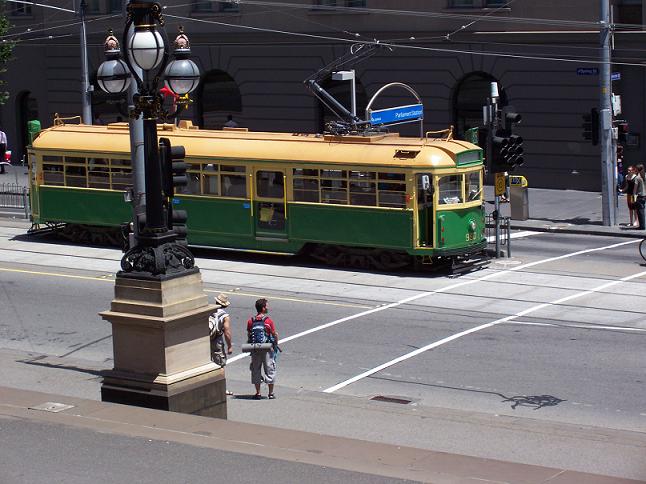
Melbourne is a traction fan's delight. It has a quite complete tram (i.e., streetcar) system covering the city and its surrounding suburbs. I myself have long been a fan of electric rail transportation, ever since as a child I discovered the remnants of one such line that went through my hometown prior to 1961. During our visit to the centre of Melbourne, Ken Dickens and I rode one of these trams twice.
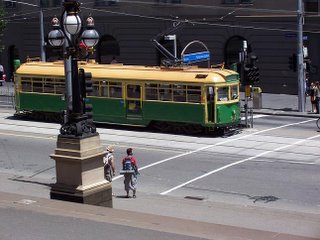
A tram on Spring Street, Melbourne
Melbourne has a huge Greek community — making it by some accounts the largest Greek city outside Greece itself. I rather imagine I have relatives there and would be surprised if I didn't. However, given that our immediate family has not kept up with any of them, I didn't think it proper to dig too deeply into the matter and show up at the door of one of their — well, restaurants, expecting to be fed. At the end of our day in the city centre, Ken Dickens and I ate dinner at Tsindos restaurant.
At La Trobe University I was baffled to see signs for a MUSLIM MALE WASHROOM and a MUSLIM FEMALE WASHROOM. Do the differences between Muslims and nonmuslims really extend even to the processes of elimination?
The restaurant at the Holiday Inn at the airport serves a series of curry dishes, obviously indicating an Indian influence on the country's cuisine. Similarly, McDonalds restaurants in Australia — or at least Melbourne — have a tandoori chicken sandwich on their menu. If McDonalds of Canada served this, it might be enough to get me to eat at one of their establishments.
Between 1910 and 1966 the country's currency was the Australian pound, which was divided into 20 shillings, each of which consisted of 12 pence. Obviously modelled on the British pound sterling, this cumbersome system was replaced by the Australian dollar and a decimalized system of coinage. Today there are no one cent pieces, but there are 5, 10, 20 and 50 cent coins, along with one and two dollar coins.
Tipping for services rendered is not generally practised in Australia. It is expected that those waiting tables, cutting hair, &c., are already being paid adequately for their work. Moreover, sales taxes are not added to the price of something at the till; they are already incorporated into the listed price — something I quite prefer to North American practice.
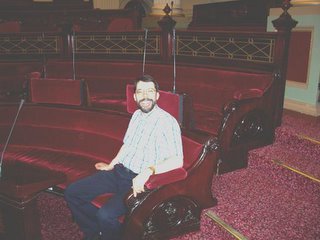
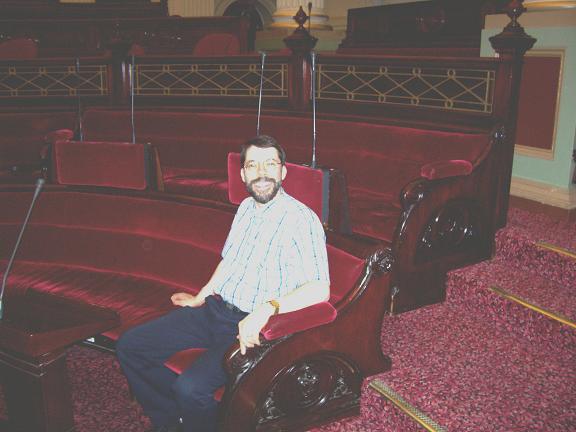
In the Legislative Council chamber,
Melbourne
Thirty-one years ago today the Order of Australia was established to recognize citizens who have distinguished themselves in exemplary service to the larger society. Closely modelled on the Order of Canada, it originally consisted of four grades: Knights/Dames, Companions, Officers and Members. In 1986 the first category was abolished. One assumes this means that there will be no more Australians with "Sir" or "Dame" before their names.
The Australian Labor Party deliberately spells the second name of its title without the "u." Can we assume that this indicates a generally pro-American orientation on its part?
Some of the Transforming Education conferees told me that the federal government has mandated the posting of a brief document, Values for Australian Schooling, in classrooms across the country, including those of independent schools. The precepts contained in the poster seem decent enough, but one might well question whether the entire project is an example of the "unnecessary interference or control" condemned by the document itself.
All Australians of a certain age remember what they were doing when they heard that Governor General Sir John Kerr had dismissed Prime Minister Gough Whitlam on 11 November 1975. The ensuing constitutional crisis served to encourage republican sentiments in Australia. A referendum was held on the issue in 1999, but the motion to replace the Queen and her representative with a president failed at least in part due to disagreement over the means of putting such a president in office.

Trams and Heineken
at Swanston & Lonsdale Streets
Not only did this visit mark the first time I had been to the southern hemisphere; it was also the first time I had crossed the International Date Line. Thus on saturday, the 21st, I left Melbourne early in the afternoon and arrived in Los Angeles in the late morning of the same day. After crossing the Date Line, it was friday again for a few hours, which meant that I had been flying since the following day. This probably isn't what H. G. Wells had in mind with his famous time machine, but it does play tricks with one's head.
One month ago today I left for Australia. It thus seems appropriate to wrap up this series with a catch-all post to cover whatever I've not yet mentioned of my trip:
Melbourne

at Swanston & Lonsdale Streets
13 February 2006
Garbled lyrics
One evening last week I was putting Theresa to bed. Among other things I sang her The Teddy Bears' Picnic. When I got to the part that goes "Watch them, catch them unawares, /And see them picnic on their holiday," she looked up at me incredulously. "Watch them catch their underwear?"
One evening last week I was putting Theresa to bed. Among other things I sang her The Teddy Bears' Picnic. When I got to the part that goes "Watch them, catch them unawares, /And see them picnic on their holiday," she looked up at me incredulously. "Watch them catch their underwear?"
12 February 2006
We'll stick with gregorian chant, thank you
Is this some kind of bad joke: Michael Jackson to pen Roman Catholic Church songs? Or is it penance for past sins?
Is this some kind of bad joke: Michael Jackson to pen Roman Catholic Church songs? Or is it penance for past sins?
Another Conservative misstep?
Ted Menzies, the new parliamentary secretary for La Francophonie, does not speak French.
Ted Menzies, the new parliamentary secretary for La Francophonie, does not speak French.
10 February 2006
Acton ad on target
Although I am not an uncritical supporter of the Acton Institute of Grand Rapids, Michigan, I believe that its current campaign to highlight the harmful side effects of well-intended charity is justified. Charity that creates dependence and stifles initiative is not charitable at all.
Although I am not an uncritical supporter of the Acton Institute of Grand Rapids, Michigan, I believe that its current campaign to highlight the harmful side effects of well-intended charity is justified. Charity that creates dependence and stifles initiative is not charitable at all.
Hail, Britannia?
Mark Steyn lauds the largely salutary influence of the British Empire on many of the key players on the world stage: Pip, pip for the Brits — despite the blips. To which I say, yes, but. . . .
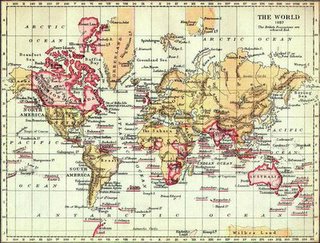
It is difficult nowadays to get people to admit that there might have been something good about the rule of a European colonial power. Ironically, Karl Marx thought that the consolidation of much of the world under a very few imperial powers was a progressive historical development, something almost entirely forgotten by his latter day followers. More than a century later we are wont to associate imperialism with exploitation of peripheral territories to enrich the mother country. In reality, of course, imperialism drained the resources of the metropolitan centre, which explains why Britain, France and others were so anxious to divest themselves of their holdings after the end of the Second World War.
So let's tally up the score. On the plus side, British-derived political institutions have been extraordinarily enduring and have lent to a number of former British territories — though by no means all — an enviable stability not to be taken for granted. I myself was born in such a country, am currently living in another such country, and recently returned from visiting yet a third. To be sure, Anglo-Saxons cannot rival the French or Italians for their cuisine, the Russians for their literature and music, or the Germans for their philosophy. Nevertheless, those of us living in Anglo-Saxon countries are generally able to enjoy all of these imported achievements — plus the rule of law, guaranteed personal liberty, and — to quote the Constitution Act, 1867 — peace, order and good government. This is very nearly the best of all possible worlds.
Steyn could have bolstered his case further by comparing Cyprus, a British possession for 82 years, with Greece, the latter of which has suffered under a series of interfering monarchs, overreaching nationalist governments, military dictatorships, and a weak sense of personal freedoms, including religious liberty. By contrast, Cyprus — at least the southern part of the island under the internationally recognized government — appears clean and efficient, with an excellent transportation and communication infrastructure. The people are unfailingly courteous and helpful. The greater prosperity of the island is achieved by an enterprising populace capable of bouncing back after the tragedy of invasion and partition. In Transparency International's recently released Corruption Perceptions Index Survey, Cyprus outscored Greece by 10 points.
On the minus side, however, Cyprus also weakens Steyn's case to no small degree. For decades Britain refused to reconsider Cyprus' status, deliberately defying the political aspirations of its people. During the emergency of the late 1950s, Britain employed a divide and rule tactic that ended up poisoning relations between the Greek and Turkish communities in the island, leading to the troubles of 1963-4, 1967 and 1974.
At the same time, it is true that Britain's Labour government offered Cyprus self-government short of full independence in 1948 — an offer that Cypriots, encouraged by an Orthodox Church in the dark grip of hellenic nationalism, unwisely declined. Yet in 1960, Britain, along with Greece and Turkey proper, imposed an unwieldy constitutional document on the people of Cyprus that took little account of pre-existing traditions of intercommunal co-operation in the island. And, of course, when Turkey invaded the north in 1974, Britain's presence in the form of its sovereign military bases did nothing to stop this.
If Britain could have bequeathed one more thing to the Greek Cypriot political culture, it should have been this: a willingness to accept the proverbial half a loaf rather than to insist on the whole and end up with nothing. Anglo-Saxons are skilled in the art of compromise. Sad to say, Greek Cypriots are much less so — which explains in no small measure why the political stalemate in the island is currently in its 32nd year.
Mark Steyn lauds the largely salutary influence of the British Empire on many of the key players on the world stage: Pip, pip for the Brits — despite the blips. To which I say, yes, but. . . .

It is difficult nowadays to get people to admit that there might have been something good about the rule of a European colonial power. Ironically, Karl Marx thought that the consolidation of much of the world under a very few imperial powers was a progressive historical development, something almost entirely forgotten by his latter day followers. More than a century later we are wont to associate imperialism with exploitation of peripheral territories to enrich the mother country. In reality, of course, imperialism drained the resources of the metropolitan centre, which explains why Britain, France and others were so anxious to divest themselves of their holdings after the end of the Second World War.
So let's tally up the score. On the plus side, British-derived political institutions have been extraordinarily enduring and have lent to a number of former British territories — though by no means all — an enviable stability not to be taken for granted. I myself was born in such a country, am currently living in another such country, and recently returned from visiting yet a third. To be sure, Anglo-Saxons cannot rival the French or Italians for their cuisine, the Russians for their literature and music, or the Germans for their philosophy. Nevertheless, those of us living in Anglo-Saxon countries are generally able to enjoy all of these imported achievements — plus the rule of law, guaranteed personal liberty, and — to quote the Constitution Act, 1867 — peace, order and good government. This is very nearly the best of all possible worlds.
Steyn could have bolstered his case further by comparing Cyprus, a British possession for 82 years, with Greece, the latter of which has suffered under a series of interfering monarchs, overreaching nationalist governments, military dictatorships, and a weak sense of personal freedoms, including religious liberty. By contrast, Cyprus — at least the southern part of the island under the internationally recognized government — appears clean and efficient, with an excellent transportation and communication infrastructure. The people are unfailingly courteous and helpful. The greater prosperity of the island is achieved by an enterprising populace capable of bouncing back after the tragedy of invasion and partition. In Transparency International's recently released Corruption Perceptions Index Survey, Cyprus outscored Greece by 10 points.
On the minus side, however, Cyprus also weakens Steyn's case to no small degree. For decades Britain refused to reconsider Cyprus' status, deliberately defying the political aspirations of its people. During the emergency of the late 1950s, Britain employed a divide and rule tactic that ended up poisoning relations between the Greek and Turkish communities in the island, leading to the troubles of 1963-4, 1967 and 1974.
At the same time, it is true that Britain's Labour government offered Cyprus self-government short of full independence in 1948 — an offer that Cypriots, encouraged by an Orthodox Church in the dark grip of hellenic nationalism, unwisely declined. Yet in 1960, Britain, along with Greece and Turkey proper, imposed an unwieldy constitutional document on the people of Cyprus that took little account of pre-existing traditions of intercommunal co-operation in the island. And, of course, when Turkey invaded the north in 1974, Britain's presence in the form of its sovereign military bases did nothing to stop this.
If Britain could have bequeathed one more thing to the Greek Cypriot political culture, it should have been this: a willingness to accept the proverbial half a loaf rather than to insist on the whole and end up with nothing. Anglo-Saxons are skilled in the art of compromise. Sad to say, Greek Cypriots are much less so — which explains in no small measure why the political stalemate in the island is currently in its 32nd year.
08 February 2006
Antipodean sojourn V: politics
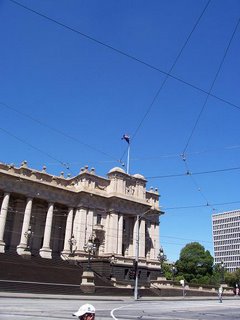
When my trip to Australia was still in the planning stages, I wondered whether I might be able to visit the national capital of Canberra. However, after looking at a map, I quickly realized that distances are as great in Australia as in North America and that it would be 6 hours driving distance from Melbourne. Obviously that would be impossible during such a brief visit. So, knowing that Melbourne is the capital of Victoria, Australia’s second-largest state, I requested of my hosts to be taken to visit the state parliament building in that city. Advance research indicated that parliament would not be sitting in January, when MLAs and MLCs would be on summer holidays. So I would be unable to see question time in the lower chamber. Nevertheless, even a visit to the buildings would be informative and likely to enrich my teaching of Canadian politics, given the similarities between the two countries’ constitutions.
Wednesday afternoon, the 18th, was designated free time for the Transforming Education conferees. Group tours were organized for wine-tasting (which quickly filled up) and riding Puffing Billy, Australia’s oldest functioning steam train. But Stuart Fowler had arranged through his MLA for a private tour for Ken Dickens and me of the Victorian Parliament building, which celebrates its 150th year in 2006. Because Ken lives in Sydney, neither of us knew Melbourne. However, I had purchased a map of the city, which helped us (eventually) to find our way into the central district.
We were a little late arriving at Parliament, mostly because my northern-hemispheric sense of direction didn’t serve me all that well in my unofficial role as Ken’s navigator. All the same, upon arrival, we didn’t have to wait but were greeted immediately by a bright young parliamentary clerk, who looked to be just under 30 years old and reminded me a great deal of one of my former students. Adding to this sense of familiarity, I was favourably impressed that, prior to our visit, he had taken the time to visit my websites to discover my research interests. As it turns out, he himself has a fascination for Canada, so we were able to compare notes between our respective countries’ political systems.
The Victorian Parliament, like those of four other Australian states, is a bicameral body, consisting of an upper chamber, the Legislative Council, and a lower chamber, the Legislative Assembly. Only Queensland has a unicameral parliament. Here in Canada, of course, all ten provincial legislatures are unicameral, Québec being the last to abolish its Conseil législatif in 1968, in an action eerily reminiscent of the opening volley of the French Revolution nearly two centuries earlier. (It even renamed its Legislative Assembly the National Assembly!) But because five of the six state parliaments are bicameral, they preserve more of the Westminster constitutional traditions, including the conventions of reading the Governor’s speech in the upper chamber and introducing money bills into the lower.
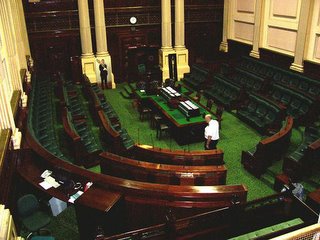
Even the internal layout of the two chambers reflects something of British parliamentary tradition. The Legislative Assembly, like the House of Commons, is predominantly green-coloured, while the Legislative Council, mirroring the House of Lords, is a red chamber. Nevertheless, although most parliamentarians face each other across the floor, the seats form a U at the end, as illustrated at left. Although the bottom of the U is often where members of minor parties sit, in the current parliament, with the Australian Labor Party holding an unprecedented 62 of 88 seats, the government benches extend around the U to the other side as well. The few Liberals and the even fewer Nats are crowded into the seats at the speaker’s immediate left.
I was surprised to learn, however, that, unlike British and Canadian practice, the state premier and the leader of the official opposition do not occupy the front benches of the Legislative Assembly. Rather both sit at a table in the middle of the floor facing each other across a row of law books, an arrangement perhaps intended to symbolize the rule of law in parliamentary government. The traditional Mace, carried by the Serjeant-at-Arms, lies between them at the other end of the table, perhaps as a way of keeping them from coming to metaphorical blows.

Between 1901, when the Commonwealth of Australia came into existence, and 1927, when Canberra became the federal capital, the federal Parliament met in this building, the House of Representatives and Senate occupying the two chambers. During this time the Victoria state parliament met in the Royal Exhibition Building several blocks to the north in Carlton Gardens. So the present parliament building has historic significance for the entire country, and not only for Victoria.
Between the two chambers lies Queen’s Hall. At one end stands a white statue of Queen Victoria, which, our guide informed us, is identical to the statue silently presiding over the interior of the Parliamentary Library in Ottawa. Victoria, of course, lent her name to the state, and references to “the Queen” abound in Australia’s constitution, which came into effect on 1 January 1901, exactly three weeks before her death.

Prior to my arrival in Australia, I discovered a fascinating anomaly in Australia’s relationship to the United Kingdom prior to the Australia Act 1986. When the Statute of Westminster was enacted, effectively recognizing the constitutional equality of the various “dominions” to the UK itself within the Empire/Commonwealth, there were a number of loose ends in these countries that would be tidied up only in the ensuing decades. In Canada, for example, until patriation in 1982, any change to the British North America Act, our chief constitutional document, required an act of the British Parliament, which Ottawa would have to request explicitly. In Australia, 1986 was the watershed year. After 1931 the appointment of a governor general by the reigning monarch would be on the advice of His Majesty’s ministers in Australia and not in Britain. However, due to an apparent oversight, the six Australian states remained in a position of technical subordination to Britain. State governors continued to be recommended by the Secretary of State for Commonwealth Relations in London, albeit with the input of the relevant state ministers. As J. D. B. Miller wrote nearly half a century ago:
This possibility was removed for good 20 years ago, after which time the relevant state ministers would advise the Queen whom to appoint as governor. (In Canada, of course, it is the Governor General in Council, i.e., the federal government, which appoints the provincial lieutenant governors.)
At the La Trobe University bookstore I purchased two books of relevance to the political system. The first is Australian Political Institutions, a standard undergraduate survey text. The second is Haig Patapan, Judging Democracy: The New Politics of the High Court of Australia, an analysis of the increasingly significant role of the High Court in shaping the domestic political process – a tendency very nearly universal in western constitutional democracies but which has nevertheless sparked severe criticism in those same countries.
Next: Antipodean sojourn VI: tying up loose ends.
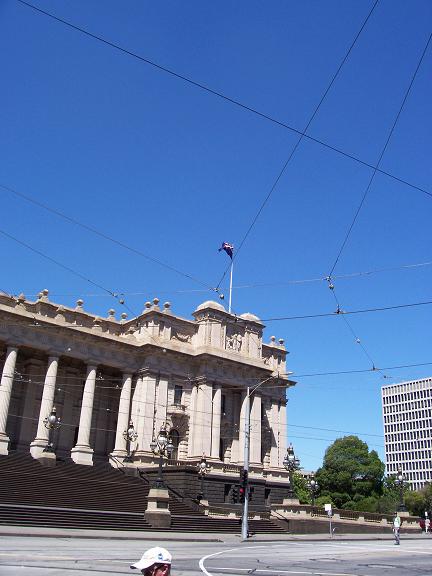
When my trip to Australia was still in the planning stages, I wondered whether I might be able to visit the national capital of Canberra. However, after looking at a map, I quickly realized that distances are as great in Australia as in North America and that it would be 6 hours driving distance from Melbourne. Obviously that would be impossible during such a brief visit. So, knowing that Melbourne is the capital of Victoria, Australia’s second-largest state, I requested of my hosts to be taken to visit the state parliament building in that city. Advance research indicated that parliament would not be sitting in January, when MLAs and MLCs would be on summer holidays. So I would be unable to see question time in the lower chamber. Nevertheless, even a visit to the buildings would be informative and likely to enrich my teaching of Canadian politics, given the similarities between the two countries’ constitutions.
Wednesday afternoon, the 18th, was designated free time for the Transforming Education conferees. Group tours were organized for wine-tasting (which quickly filled up) and riding Puffing Billy, Australia’s oldest functioning steam train. But Stuart Fowler had arranged through his MLA for a private tour for Ken Dickens and me of the Victorian Parliament building, which celebrates its 150th year in 2006. Because Ken lives in Sydney, neither of us knew Melbourne. However, I had purchased a map of the city, which helped us (eventually) to find our way into the central district.
We were a little late arriving at Parliament, mostly because my northern-hemispheric sense of direction didn’t serve me all that well in my unofficial role as Ken’s navigator. All the same, upon arrival, we didn’t have to wait but were greeted immediately by a bright young parliamentary clerk, who looked to be just under 30 years old and reminded me a great deal of one of my former students. Adding to this sense of familiarity, I was favourably impressed that, prior to our visit, he had taken the time to visit my websites to discover my research interests. As it turns out, he himself has a fascination for Canada, so we were able to compare notes between our respective countries’ political systems.
The Victorian Parliament, like those of four other Australian states, is a bicameral body, consisting of an upper chamber, the Legislative Council, and a lower chamber, the Legislative Assembly. Only Queensland has a unicameral parliament. Here in Canada, of course, all ten provincial legislatures are unicameral, Québec being the last to abolish its Conseil législatif in 1968, in an action eerily reminiscent of the opening volley of the French Revolution nearly two centuries earlier. (It even renamed its Legislative Assembly the National Assembly!) But because five of the six state parliaments are bicameral, they preserve more of the Westminster constitutional traditions, including the conventions of reading the Governor’s speech in the upper chamber and introducing money bills into the lower.
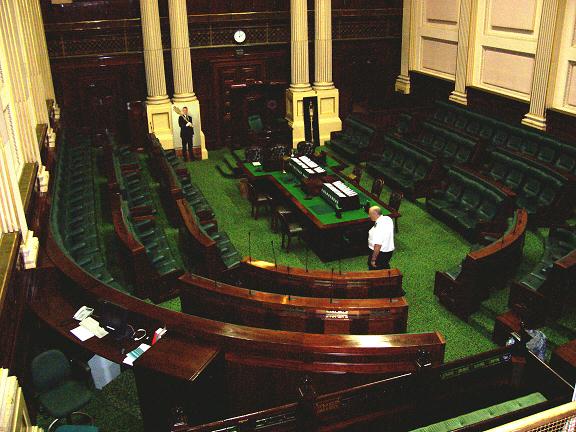
Even the internal layout of the two chambers reflects something of British parliamentary tradition. The Legislative Assembly, like the House of Commons, is predominantly green-coloured, while the Legislative Council, mirroring the House of Lords, is a red chamber. Nevertheless, although most parliamentarians face each other across the floor, the seats form a U at the end, as illustrated at left. Although the bottom of the U is often where members of minor parties sit, in the current parliament, with the Australian Labor Party holding an unprecedented 62 of 88 seats, the government benches extend around the U to the other side as well. The few Liberals and the even fewer Nats are crowded into the seats at the speaker’s immediate left.
I was surprised to learn, however, that, unlike British and Canadian practice, the state premier and the leader of the official opposition do not occupy the front benches of the Legislative Assembly. Rather both sit at a table in the middle of the floor facing each other across a row of law books, an arrangement perhaps intended to symbolize the rule of law in parliamentary government. The traditional Mace, carried by the Serjeant-at-Arms, lies between them at the other end of the table, perhaps as a way of keeping them from coming to metaphorical blows.

Between 1901, when the Commonwealth of Australia came into existence, and 1927, when Canberra became the federal capital, the federal Parliament met in this building, the House of Representatives and Senate occupying the two chambers. During this time the Victoria state parliament met in the Royal Exhibition Building several blocks to the north in Carlton Gardens. So the present parliament building has historic significance for the entire country, and not only for Victoria.
Between the two chambers lies Queen’s Hall. At one end stands a white statue of Queen Victoria, which, our guide informed us, is identical to the statue silently presiding over the interior of the Parliamentary Library in Ottawa. Victoria, of course, lent her name to the state, and references to “the Queen” abound in Australia’s constitution, which came into effect on 1 January 1901, exactly three weeks before her death.
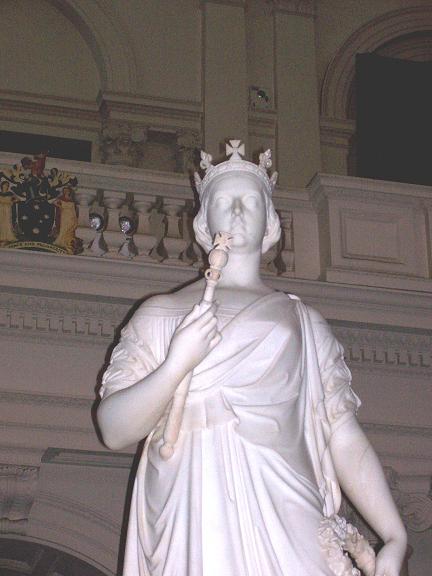
Prior to my arrival in Australia, I discovered a fascinating anomaly in Australia’s relationship to the United Kingdom prior to the Australia Act 1986. When the Statute of Westminster was enacted, effectively recognizing the constitutional equality of the various “dominions” to the UK itself within the Empire/Commonwealth, there were a number of loose ends in these countries that would be tidied up only in the ensuing decades. In Canada, for example, until patriation in 1982, any change to the British North America Act, our chief constitutional document, required an act of the British Parliament, which Ottawa would have to request explicitly. In Australia, 1986 was the watershed year. After 1931 the appointment of a governor general by the reigning monarch would be on the advice of His Majesty’s ministers in Australia and not in Britain. However, due to an apparent oversight, the six Australian states remained in a position of technical subordination to Britain. State governors continued to be recommended by the Secretary of State for Commonwealth Relations in London, albeit with the input of the relevant state ministers. As J. D. B. Miller wrote nearly half a century ago:
In law, a State Governor could be ordered by the Commonwealth Relations Office to dissolve, or not to dissolve, his State parliament, or to refuse assent to a law passed by that parliament. In this sense the paradoxical situation exists of the British government being unable to interfere in the affairs of the Australian Federal government but able to interfere in those of the States.
This possibility was removed for good 20 years ago, after which time the relevant state ministers would advise the Queen whom to appoint as governor. (In Canada, of course, it is the Governor General in Council, i.e., the federal government, which appoints the provincial lieutenant governors.)
At the La Trobe University bookstore I purchased two books of relevance to the political system. The first is Australian Political Institutions, a standard undergraduate survey text. The second is Haig Patapan, Judging Democracy: The New Politics of the High Court of Australia, an analysis of the increasingly significant role of the High Court in shaping the domestic political process – a tendency very nearly universal in western constitutional democracies but which has nevertheless sparked severe criticism in those same countries.
Next: Antipodean sojourn VI: tying up loose ends.
07 February 2006
Conservative misstep and Senate reform
It seems I'm not the only one to think it dishonourable for the Honourable David Emerson to abandon the party under which he was elected only two weeks ago to accept a cabinet portfolio with the party the voters in his riding so recently rejected. In addition to the predictable protests of the opposition parties, the bloggers are getting into the act by urging him to stand down and seek re-election under the new label. Harper should have known better. This doesn't make him look good.
On the other hand, it is much less objectionable to appoint a cabinet minister from the Senate, for which there is ample precedent, even if reversing this order is somewhat unusual. Yet Harper is known to favour an elected Senate, so his appointment of Fortier may not go down well with his own supporters.
If the new Prime Minister is serious about an elected Senate, and if amending our Constitution Acts is impracticable, all he need do is allow a province for which there is a vacancy to put candidates before the voters, after which he would simply appoint their first choice. My understanding is that this is his favoured strategy. However, given that Senators serve until age 75, Harper ought to make the appointment conditional upon the candidate's signing a legal document requiring him or her to stand down after, say, six years. That would bring us into line with Australia and the US, whose Senates are elected. A precedent would be established that future governments would find difficult to break.
This would, of course, empower the Senate, which would then possess democratic legitimacy and could conceivably block legislation already approved by the Commons. Short of legally curtailing the powers of the upper chamber, as Britain has done over the past century, we might do well to look at the Australian Constitution, which makes provisions for resolving a deadlock between the two chambers of that country's parliament. It would not do for the Senate to become a confidence chamber, but it ought to be able to speak up for the West and Atlantic Canada, whose interests are chronically underrepresented in the Commons.
06 February 2006
The new team
The Right Honourable Stephen Joseph Harper is now Canada's 22nd prime minister. Like most new prime ministers, he has downsized his cabinet – from 37 to 27 ministers. Safe bet: the number will creep upwards, if his government lasts long enough. Surprises: David Emerson has pulled a belinda to become minister of International Trade. Michael Fortier, one of Harper's campaign managers, will be Public Works minister, provided, one assumes, that he wins a seat in a by-election.
The Right Honourable Stephen Joseph Harper is now Canada's 22nd prime minister. Like most new prime ministers, he has downsized his cabinet – from 37 to 27 ministers. Safe bet: the number will creep upwards, if his government lasts long enough. Surprises: David Emerson has pulled a belinda to become minister of International Trade. Michael Fortier, one of Harper's campaign managers, will be Public Works minister, provided, one assumes, that he wins a seat in a by-election.
04 February 2006
Will wonders never cease
Even the most hardened sceptic would have to take this as incontrovertible evidence for the miraculous: The Toronto Star, of all places, has published a balanced view of Stephen Harper's religious faith: Stephen Harper just can't quit his inner-Evangelical.
Incidentally, I've just begun reading Lloyd Mackey's The Pilgrimage of Stephen Harper, reviewed here and here. I may have something to say about this book at some point.
03 February 2006
Antipodean sojourn IV: Australians
I’ve discussed earth and sky; now it’s time to look at the people of Australia. Prior to my trip down under, I did some research into the manners and mores of my host country, so as not inadvertently to commit a faux pas and risk offending someone. I understood that there are some countries where, if you do not polish your shoes or if you fail to inquire about the health of a contact’s family, you will be considered a hopeless boor and no one will have anything to do with you. From my research I discovered, among other things, that Australians dress informally and have egalitarian sensibilities. (Okay; so leave the bowtie at home.) Among the things to avoid are: (1) failing to buy the next round of beers, if you are next in line to do so; (2) mentioning your hosts’ convict forebears; (3) assuming that Alice Springs is a suburb of Adelaide; (4) inquiring of a Sydney Anglican whether he believes in the Real Presence or the apostolic succession of bishops, and (5) asking whether your new acquaintances know Paul Hogan or Rupert Murdoch personally. Armed with this information, I figured I couldn’t go wrong.
What I found when I actually arrived was that Australians are a warm and hospitable people, with unfailing good humour and a ready willingness to forgive the missteps of visitors. The first people I met at the Melbourne airport were Richard and Annette Edlin, whom I quickly came to like very much. They are originally from New Zealand but have lived in Australia for some years now. The person with whom I spent the most time was Ken Dickens, who had been designated my host during my visit. Once more, I found him to be an amiable person and enjoyed the times we spent together, including our memorable excursion into the centre of Melbourne wednesday afternoon. Thanks are due him for his generous hospitality. Over the following days I met and talked with scores of people, most of whom were attending the Transforming Education Conference. I was so warmly embraced by them that I immediately felt at home and scarcely thought myself to be a stranger in a new country. It’s difficult to imagine a nation filled with such genuine people having any external enemies.
There are, of course, many similarities between Australia and Canada. (To be sure, climate is not one of them.) Both are immigrant countries with predominantly European roots. Both grew to nationhood within the context of the British Empire/Commonwealth. Both countries’ constitutions combine a Westminster-style parliamentary/cabinet system with American-style federalism. But there are differences as well.
Australians are mad about sport — virtually any sport. But among their favourites are rugby-related Australian-rules football, football proper (formerly called soccer) and cricket, all of which I have reason to think I saw briefly on the television set in my room at the Holiday Inn. (All right, I confess — I'm not much of a sport fan.) Last year the Australian Soccer Association became the Football Federation Australia, which means that there are now at least two games being played under the name “football.” If there is any confusion about this, I didn’t detect it. Back home we have hockey. And then, of course, there’s hockey. Oh, and did I mention hockey? (Oh yes, also CFL football, but who pays attention to that?) The Commonwealth Games will shortly be taking place in Melbourne, and no visitor to that city would ever be allowed to leave without being informed of this repeatedly on every street corner. After returning to Canada, I discovered that a Greek Cypriot, 20-year-old Marcos Baghdatis, has been dazzling the spectators at the Australian Open Tennis Tournament, also in Melbourne. The impressive thing is that, unlike many North Americans, Australians do not seem content to remain spectators. Most everyone I saw during my visit appeared to be fit, suggesting that ordinary Australians themselves participate in sporting events, or at least engage in vigorous physical activity.
Australian humour is unique as well. Canadian humour tends to be self-deprecating. We’re good at poking fun at ourselves, as evidenced by our venerable national institution, the Royal Canadian Air Farce. (I’ll leave out Rick Mercer, who can be somewhat caustic at times.) By contrast, Australians like to give each other a hard time – something that may take some getting used to on the part of outsiders. However, if they give you, the visitor, a hard time, that means they like you and have come to think of you as one of their own. There’s no complaining about that. (Um, let's put aside Dame Edna Everage for now.)
My second evening in Melbourne, Richard and Annette invited me to tea in their rooms at Glenn College, where a number of people had gathered to socialize. That was my first taste of Australian conviviality. I had not yet uttered a word — my first keynote address would come the following morning — yet I was already being made welcome. I even received a gift for my daughter: a set of children’s Hebrew letter flashcards and an accompanying workbook to help children learn and practise writing the shapes of the letters. (With her fascination for foreign languages, our Theresa took to these immediately.) At the end of the conference — after my third keynote — I was presented with two wrapped gifts: Steve Parish's Australia: the journey, a beautiful photographic survey of the country; and Australian Politics and Government: The Commonwealth, the States and the Territories, a useful look at Australian federalism.
Small wonder I fell in love with the country and its people. One day I would love to return and take my wife and daughter with me.
Next: Antipodean sojourn V: politics.
I’ve discussed earth and sky; now it’s time to look at the people of Australia. Prior to my trip down under, I did some research into the manners and mores of my host country, so as not inadvertently to commit a faux pas and risk offending someone. I understood that there are some countries where, if you do not polish your shoes or if you fail to inquire about the health of a contact’s family, you will be considered a hopeless boor and no one will have anything to do with you. From my research I discovered, among other things, that Australians dress informally and have egalitarian sensibilities. (Okay; so leave the bowtie at home.) Among the things to avoid are: (1) failing to buy the next round of beers, if you are next in line to do so; (2) mentioning your hosts’ convict forebears; (3) assuming that Alice Springs is a suburb of Adelaide; (4) inquiring of a Sydney Anglican whether he believes in the Real Presence or the apostolic succession of bishops, and (5) asking whether your new acquaintances know Paul Hogan or Rupert Murdoch personally. Armed with this information, I figured I couldn’t go wrong.

What I found when I actually arrived was that Australians are a warm and hospitable people, with unfailing good humour and a ready willingness to forgive the missteps of visitors. The first people I met at the Melbourne airport were Richard and Annette Edlin, whom I quickly came to like very much. They are originally from New Zealand but have lived in Australia for some years now. The person with whom I spent the most time was Ken Dickens, who had been designated my host during my visit. Once more, I found him to be an amiable person and enjoyed the times we spent together, including our memorable excursion into the centre of Melbourne wednesday afternoon. Thanks are due him for his generous hospitality. Over the following days I met and talked with scores of people, most of whom were attending the Transforming Education Conference. I was so warmly embraced by them that I immediately felt at home and scarcely thought myself to be a stranger in a new country. It’s difficult to imagine a nation filled with such genuine people having any external enemies.
There are, of course, many similarities between Australia and Canada. (To be sure, climate is not one of them.) Both are immigrant countries with predominantly European roots. Both grew to nationhood within the context of the British Empire/Commonwealth. Both countries’ constitutions combine a Westminster-style parliamentary/cabinet system with American-style federalism. But there are differences as well.
Australians are mad about sport — virtually any sport. But among their favourites are rugby-related Australian-rules football, football proper (formerly called soccer) and cricket, all of which I have reason to think I saw briefly on the television set in my room at the Holiday Inn. (All right, I confess — I'm not much of a sport fan.) Last year the Australian Soccer Association became the Football Federation Australia, which means that there are now at least two games being played under the name “football.” If there is any confusion about this, I didn’t detect it. Back home we have hockey. And then, of course, there’s hockey. Oh, and did I mention hockey? (Oh yes, also CFL football, but who pays attention to that?) The Commonwealth Games will shortly be taking place in Melbourne, and no visitor to that city would ever be allowed to leave without being informed of this repeatedly on every street corner. After returning to Canada, I discovered that a Greek Cypriot, 20-year-old Marcos Baghdatis, has been dazzling the spectators at the Australian Open Tennis Tournament, also in Melbourne. The impressive thing is that, unlike many North Americans, Australians do not seem content to remain spectators. Most everyone I saw during my visit appeared to be fit, suggesting that ordinary Australians themselves participate in sporting events, or at least engage in vigorous physical activity.
Australian humour is unique as well. Canadian humour tends to be self-deprecating. We’re good at poking fun at ourselves, as evidenced by our venerable national institution, the Royal Canadian Air Farce. (I’ll leave out Rick Mercer, who can be somewhat caustic at times.) By contrast, Australians like to give each other a hard time – something that may take some getting used to on the part of outsiders. However, if they give you, the visitor, a hard time, that means they like you and have come to think of you as one of their own. There’s no complaining about that. (Um, let's put aside Dame Edna Everage for now.)
My second evening in Melbourne, Richard and Annette invited me to tea in their rooms at Glenn College, where a number of people had gathered to socialize. That was my first taste of Australian conviviality. I had not yet uttered a word — my first keynote address would come the following morning — yet I was already being made welcome. I even received a gift for my daughter: a set of children’s Hebrew letter flashcards and an accompanying workbook to help children learn and practise writing the shapes of the letters. (With her fascination for foreign languages, our Theresa took to these immediately.) At the end of the conference — after my third keynote — I was presented with two wrapped gifts: Steve Parish's Australia: the journey, a beautiful photographic survey of the country; and Australian Politics and Government: The Commonwealth, the States and the Territories, a useful look at Australian federalism.
Small wonder I fell in love with the country and its people. One day I would love to return and take my wife and daughter with me.
Next: Antipodean sojourn V: politics.
02 February 2006
Leo Strauss in the True North?
With the election of Stephen Harper's Conservative government in last month's federal election, could the conspiratorial Straussian cabal led by the notorious Paul Wolfowitz be extending its reach from Washington to Ottawa? Joseph Knippenberg explores this possibility in The Second Time as Farce. I am, of course, pleased to see Knippenberg cite my own The Calgary School and the Future of Canada, which he deems one of the "more measured accounts" of this school's influence.
One of the articles to which Knippenberg links is written by a certain professed "Red Tory" and aficionado of the late George Parkin Grant. While he charges the Calgarians with taking their cues from, among others, European émigrés such as Leo Strauss, and not from "indigenous Canadian tradition," he appears to have forgotten that Grant himself had considerable respect for Strauss and counted him one of the great influences on his own thought. Nationalist though Grant may have been, he was hardly one to limit his own grazing to native pastures. How else account for the formative influence of Jacques Ellul and Simone Weil, the latter of whom in particular he held in almost childlike awe?
01 February 2006
Intelligent design
Given that I am not a biologist, I risk going out on a limb in commenting on the controversy over intelligent design. As I've written before, I tend to be agnostic on the question of whether macroevolution actually occurred, although I strongly disagree with Darwin's assumption that a simple mechanism like natural selection can explain the irreducible complexity of especially human life and the multiple levels of causality operating within God's world. The only defence of intelligent design I've read thus far is that of Nancy Pearcey in Total Truth, and I did not find her altogether presuasive for reasons that I may get into at some point.
As I see it, a key reason why intelligent design cannot function as an alternative to Darwinian evolution is that it does not offer an alternative explanation for the rise of distinct species at particular stages in prehistory and appears to remove the issue from the realm of empirical investigation. After all, creatio ex nihilo occurred "in the beginning" (Gen. 1:1); everything else comes about through the subsequent unfolding of creation. It is the nature of this unfolding that is at issue. If proponents of the "special creation" of human beings and other species are arguing for multiple instances of creatio ex nihilo after God's initial creative act, they are going well beyond the teachings of scripture and, in any case, are arguing for something that cannot be empirically verified.
There's another reason why intelligent design is flawed, and this is picked up by James W. Skillen, commenting on a much longer article by Calvin College Professor Uko Zylstra. Here is where those multiple levels of causality come into play. In Intelligent Design as Science, Skillen writes:
In essence, what Zylstra does is to argue that the whole of reality begs for an answer deeper than science can provide of why anything exists at all and why things exist in the way they do, with millions of kinds of creatures conforming to various kinds of laws-physical, chemical, biotic, psychic, logical, historical, economic, and more. If some theorists hypothesize that everything can be explained in terms physical and chemical processes plus time and chance, their theory is reductionistic. But if intelligent-design theorists simply add the hypothesis that a designer, standing outside the physical and chemical processes, needs to be posited to account for irreducible complexity, they still haven't accounted for the biotic laws that hold for the development of living things. . . .
The key issue in the debate between evolutionary theorists and intelligent-design (ID) theorists, says Zylstra, is that of causality. “The ID theorists want to posit an intelligent cause in addition to 'natural causes.' The difficulty with this, however, is that both evolutionary biologists and ID theorists assume a reductionist ontology with regard to natural causes. Natural causes are seen as physical and chemical causality. . . . I don't believe that positing intelligent design as a causal agent for such irreducible complexity is the appropriate response,” says Zylstra. What hasn't been taken into account is the biotic mode of existence. “Life phenomena are not material in nature. Life is a mode of being, a function of living things. Biology textbooks generally promote this major misconception by the frequent reference to 'living matter'. But the expression 'living matter' is an oxymoron. Matter itself is never alive. . . . We always find whole living organisms. Matter is fundamentally physical and chemical in nature and thus subject to chemical and physical laws.” The inadequacy of ID theory, Zylstra believes, is its “failure to recognize the life function of living things,” which exist in accord with biotic laws and not only physical or chemical laws.
Subscribe to:
Posts (Atom)


