Time for a snack
We know that our Theresa's blood sugar levels are too low when, while listening to Gustav Holst's The Planets, she becomes overly upset at the fact that the composer didn't put the corresponding movements in the same order in which the namesake planets actually occur in the solar system and, as if that weren't enough, had the temerity to leave out earth.
30 October 2005


Iran contra mundum. . . again
Iran's president Mahmoud Ahmadinejad has called for Israel to be "wiped off the map." In response, New Zealand's foreign minister has helpfully called these remarks "unhelpful." Strong words, but the circumstances call for them.
Iran's president Mahmoud Ahmadinejad has called for Israel to be "wiped off the map." In response, New Zealand's foreign minister has helpfully called these remarks "unhelpful." Strong words, but the circumstances call for them.
28 October 2005
Religious staffing, reforming the tax code
Is the Salvation Army engaging in a "most reprehensible form of discrimination" by employing only those who agree with its mission? The ACLU has joined one member of Congress in saying yes, but a federal district judge in the United States has ruled otherwise. Writing for the Center for Public Justice's Capital Commentary series, Stanley Carlson-Thies analyzes the controversy in Religious Staffing-2, Opponents-0. (Check out the pious-looking box on "Freedom, Belief and Religious Liberty" on the ACLU's front page!)
In the most recent Capital Commentary, Center president James W. Skillen looks at A Good Tax-Reform Proposal for the US. A presidential advisory panel is urging that the mortgage-interest deduction on federal income tax be limited to $312,000 and be eliminated entirely for second homes and home equity loans. Skillen agrees. Of course, this issue means little to Canadians, who receive no such tax break at all. However, it may be that both countries' governments need a more radical reconfiguration of public policy to recognize that homeownership is not merely about purchasing a consumer good but about having a stake in one's local community.
Is the Salvation Army engaging in a "most reprehensible form of discrimination" by employing only those who agree with its mission? The ACLU has joined one member of Congress in saying yes, but a federal district judge in the United States has ruled otherwise. Writing for the Center for Public Justice's Capital Commentary series, Stanley Carlson-Thies analyzes the controversy in Religious Staffing-2, Opponents-0. (Check out the pious-looking box on "Freedom, Belief and Religious Liberty" on the ACLU's front page!)
In the most recent Capital Commentary, Center president James W. Skillen looks at A Good Tax-Reform Proposal for the US. A presidential advisory panel is urging that the mortgage-interest deduction on federal income tax be limited to $312,000 and be eliminated entirely for second homes and home equity loans. Skillen agrees. Of course, this issue means little to Canadians, who receive no such tax break at all. However, it may be that both countries' governments need a more radical reconfiguration of public policy to recognize that homeownership is not merely about purchasing a consumer good but about having a stake in one's local community.
27 October 2005
Sox are tops
Sporting fans, especially those with Windy City roots, will appreciate this: SOX SWEEP AWAY PAST: Chicago wins 1st title since 1917, erases scandal of 1919 team. At this rate, White Sox fans can look forward to celebrating another victory in 2093.
Sporting fans, especially those with Windy City roots, will appreciate this: SOX SWEEP AWAY PAST: Chicago wins 1st title since 1917, erases scandal of 1919 team. At this rate, White Sox fans can look forward to celebrating another victory in 2093.
26 October 2005
A peeping Thomist?
Ryan Miller, a disciple of Bernard Lonergan, has made the wonderful discovery that one of my colleagues is now a Thomist: A Reply to Al Wolters: What is Christian Philosophy? I'm certain Wolters himself will be thrilled to hear the news.
Ryan Miller, a disciple of Bernard Lonergan, has made the wonderful discovery that one of my colleagues is now a Thomist: A Reply to Al Wolters: What is Christian Philosophy? I'm certain Wolters himself will be thrilled to hear the news.
25 October 2005
Rosa Parks (1913-2005)
For those of us who grew up during the civil rights struggle in the US nearly half a century ago, this report recalls to mind a time when malicious racial discrimination was an ugly fact of life: US Civil Rights Icon Dies at Age 92.
For those of us who grew up during the civil rights struggle in the US nearly half a century ago, this report recalls to mind a time when malicious racial discrimination was an ugly fact of life: US Civil Rights Icon Dies at Age 92.
Scandal in the Antipodes
Have the recent troubles surrounding New Zealand's Maxim Institute effectively rendered the organization unable to exercise a positive influence on its own country? Time will tell.
Have the recent troubles surrounding New Zealand's Maxim Institute effectively rendered the organization unable to exercise a positive influence on its own country? Time will tell.
Naming the tenth planet
Although my childhood fascination for astronomy has waned over the decades, I have a moderate interest in proposals for naming the tenth planet, 2003 UB313 , which is larger than the ninth planet, Pluto. My own suggestion is that asteroid 399 be renamed and Persephone be given to this "new" body in the solar system. Think of what this will do for the field of pop psychology: "Men are from Pluto, women are from Persephone." It has a nice ring to it, don't you think?
Although my childhood fascination for astronomy has waned over the decades, I have a moderate interest in proposals for naming the tenth planet, 2003 UB
24 October 2005
Russia in decline
What can the future hold for a country that loses half a million people in the short space of 12 months? Господи Помилуй!
What can the future hold for a country that loses half a million people in the short space of 12 months? Господи Помилуй!
The nanocar
Researcher Develops World's Smallest Car. Given the rise in gas prices, this may be all we can afford next time around.
Researcher Develops World's Smallest Car. Given the rise in gas prices, this may be all we can afford next time around.
Priestly celibacy
From Rome: Vatican synod rules out married priests. This admittedly comes from an outsider, but it is not at all clear to me why the Roman Catholic Church could not extend the precedent of the Eastern-Rite churches, which allow marriage before ordination, to the Latin Church.
From Rome: Vatican synod rules out married priests. This admittedly comes from an outsider, but it is not at all clear to me why the Roman Catholic Church could not extend the precedent of the Eastern-Rite churches, which allow marriage before ordination, to the Latin Church.
22 October 2005
Slogans supplant virtue
This looks like a book worth reading: Decadence: The Passing of Personal Virtue and Its Replacement by Political and Psychological Slogans, edited by Digby Anderson. The book is a collection of essays pointing to the loss of a traditional virtue-based ethic and its replacement by a new morality centred on the self. Here is Zenit's account of the Rev. Peter Mullen's argument in one of the essays:
Another of the contributors to this anthology will be familiar to some neocalvinists. Theodore Malloch was last year's Bernard Zylstra Lecturer at Redeemer University College. He writes with typical calvinist enthusiasm on – what else? – the virtue of thrift.
This looks like a book worth reading: Decadence: The Passing of Personal Virtue and Its Replacement by Political and Psychological Slogans, edited by Digby Anderson. The book is a collection of essays pointing to the loss of a traditional virtue-based ethic and its replacement by a new morality centred on the self. Here is Zenit's account of the Rev. Peter Mullen's argument in one of the essays:
The old religious idea of acting virtuously for its own sake, or for God's sake, has been replaced by the psychotherapeutic notion of virtue for our own well-being. Self-respect has been replaced by self-esteem. Self-respect used to come from the peace of trying to live a virtuous life and having a clear conscience. Now it means just feeling good about ourselves and lacks any moral content.
Another of the contributors to this anthology will be familiar to some neocalvinists. Theodore Malloch was last year's Bernard Zylstra Lecturer at Redeemer University College. He writes with typical calvinist enthusiasm on – what else? – the virtue of thrift.
Christians assailed in Egypt
Alexandria once housed substantial numbers of Jews and Christians prior to half a century ago. Those Christians remaining undoubtedly fear this sort of thing on a regular basis: Muslims riot outside church in Egypt. Fortunately the police intervened to protect against the rioters. In Egypt as a whole Coptic Christians are thought to make up between 5 and 10 percent of the total population of 70 million. We should not only keep them in our prayers, but do what we can to draw the western public's attention to their plight.
Alexandria once housed substantial numbers of Jews and Christians prior to half a century ago. Those Christians remaining undoubtedly fear this sort of thing on a regular basis: Muslims riot outside church in Egypt. Fortunately the police intervened to protect against the rioters. In Egypt as a whole Coptic Christians are thought to make up between 5 and 10 percent of the total population of 70 million. We should not only keep them in our prayers, but do what we can to draw the western public's attention to their plight.
Songs of Syon
One of my all-time favourite hymnals is Songs of Syon, subtitled “A Collection of Psalms, Hymns, & Spiritual Songs set, for the most part, to their ANCIENT PROPER TUNES,” edited by the Rev. George Ratcliffe Woodward, M.A. My copy, purchased in 1989 (probably in Toronto), is the 4th edition, published in London in 1923, the original edition having come out in 1904. It is an exceedingly comprehensive collection, containing plainsong melodies, metrical melodies of the 13th to 16th centuries, Lutheran chorales, “Old English and Scotch psalm-tunes” and old French psalms and canticles. It is based on the earlier work of Robert Bridges' Yattendon Hymnal.
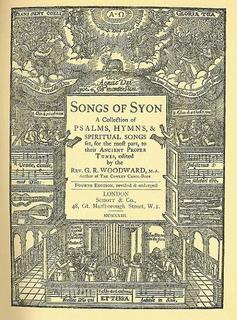
The plainsong texts are generally John Mason Neale’s famous 19th-century translations of the ancient Greek and Latin hymns. These are often rendered in mediaeval musical notation, which, with a little practice, is fairly easily sight-read. The titles of the German hymns are set in blackletter font, perhaps making them appear exotic to an early 20th-century English readership – or should I say “singership”? In his preface to the 4th edition, the Rev. Mr. Woodward felt it necessary to say the following:
The material is organized at the outset in fairly typical manner, i.e., according to the church calendar. Hence Advent hymns come first, followed by Christmas-even, Christmas-tide, &c. Then come Holy Eucharist, Sundays and Week-days, Evensong, Mattins, Common of Our Lady, Common of Saints, Proper of Saints, &c. Then come sections devoted respectively to Psalms, Hymns and Spiritual Songs.
The Psalms section is of particular interest to me, because the editor put some effort into recovering for the English-speaking church the tunes of the Genevan Psalter, which, apart from a very few, are generally unknown to Anglo-Saxon Christians. Some of the translated texts are by Woodward himself. Here is the first stanza of his rendition of Psalm 150:
Eight decades later, Woodward’s effort to recover the Genevan tradition appears largely to have fallen short. But his Songs of Syon stands as a monument to the rich liturgical heritage of both eastern and western Christendom. It deserves to be better known than it is.
Unfortunately I myself do not use this volume as often as I would like. My copy is redolent of mildew to which I am, sadly, allergic. Should I attempt to sing directly out of this book, I would have to stop every few bars to blow my nose. I would love to find a much newer reprint with which to replace this.
One of my all-time favourite hymnals is Songs of Syon, subtitled “A Collection of Psalms, Hymns, & Spiritual Songs set, for the most part, to their ANCIENT PROPER TUNES,” edited by the Rev. George Ratcliffe Woodward, M.A. My copy, purchased in 1989 (probably in Toronto), is the 4th edition, published in London in 1923, the original edition having come out in 1904. It is an exceedingly comprehensive collection, containing plainsong melodies, metrical melodies of the 13th to 16th centuries, Lutheran chorales, “Old English and Scotch psalm-tunes” and old French psalms and canticles. It is based on the earlier work of Robert Bridges' Yattendon Hymnal.
The plainsong texts are generally John Mason Neale’s famous 19th-century translations of the ancient Greek and Latin hymns. These are often rendered in mediaeval musical notation, which, with a little practice, is fairly easily sight-read. The titles of the German hymns are set in blackletter font, perhaps making them appear exotic to an early 20th-century English readership – or should I say “singership”? In his preface to the 4th edition, the Rev. Mr. Woodward felt it necessary to say the following:
If objection be taken to the number of foreign tunes which appear in this Edition, be it remembered that many of our favourite Hymn-tunes. E.g., The Old Hundredth, Luther’s Hymn, Adeste fideles, O Sacred Head surrounded, Now thank we all our God, Sing praise to God who reigns above, are not of English origin. It is confidently believed that many other exotics need only to be transplanted, and they will take equally deep root in the hearts of English-speaking people.
The material is organized at the outset in fairly typical manner, i.e., according to the church calendar. Hence Advent hymns come first, followed by Christmas-even, Christmas-tide, &c. Then come Holy Eucharist, Sundays and Week-days, Evensong, Mattins, Common of Our Lady, Common of Saints, Proper of Saints, &c. Then come sections devoted respectively to Psalms, Hymns and Spiritual Songs.
The Psalms section is of particular interest to me, because the editor put some effort into recovering for the English-speaking church the tunes of the Genevan Psalter, which, apart from a very few, are generally unknown to Anglo-Saxon Christians. Some of the translated texts are by Woodward himself. Here is the first stanza of his rendition of Psalm 150:
Alleluya. Praise the Lord;
Be his holy Name ador’d:
Praise him in the firmament,
Mighty, great and excellent:
In his noble acts revere him:
Praise him on the harp and lute,
Praise him with the trump and flute;
Love, adore, and greatly fear him.
Eight decades later, Woodward’s effort to recover the Genevan tradition appears largely to have fallen short. But his Songs of Syon stands as a monument to the rich liturgical heritage of both eastern and western Christendom. It deserves to be better known than it is.
Unfortunately I myself do not use this volume as often as I would like. My copy is redolent of mildew to which I am, sadly, allergic. Should I attempt to sing directly out of this book, I would have to stop every few bars to blow my nose. I would love to find a much newer reprint with which to replace this.
21 October 2005
'Inciting hatred'
If Mark Morford were living in Canada and published this detestable article in one of our periodicals, would he be charged under section 319 of the Criminal Code for wilfully inciting hatred against an identifiable group?
If Mark Morford were living in Canada and published this detestable article in one of our periodicals, would he be charged under section 319 of the Criminal Code for wilfully inciting hatred against an identifiable group?
20 October 2005
On this date in history
The Free University of Amsterdam opened its doors 125 years ago today. Its founder, Dr. Abraham Kuyper, marked the occasion with an address on "Souvereiniteit in eigen kring", or Sphere sovereignty.
The Free University of Amsterdam opened its doors 125 years ago today. Its founder, Dr. Abraham Kuyper, marked the occasion with an address on "Souvereiniteit in eigen kring", or Sphere sovereignty.
McKendree Langley (1945-2005)
The Westminster Theological Seminary website carries an obituary of McKendree Langley, who died last week of a heart attack at age 60:
I first came to know of Langley through his 1984 book, as I was researching my dissertation. I met him only once, in 1998 at an international conference on Abraham Kuyper at Princeton Seminary.
The Westminster Theological Seminary website carries an obituary of McKendree Langley, who died last week of a heart attack at age 60:
Langley taught history for 35 years at the high school, college, and seminary levels. He was associate professor of history at Dordt College (Sioux Center, Iowa); history teacher at Phil-Mont Christian Academy (Erdenheim, Pa.); and chair of the history department at City Center Academy (Philadelphia, Pa.). Since 1989, he was an adjunct faculty member at Westminster, and throughout his career lectured at Barrington College (R.I.); Free University (Amsterdam); Gordon College (Wenham, Mass.); Reformed Theological Seminary (Jackson, Miss.); Delaware County Community College (Media, Pa.); and Eastern University (St. Davids, Pa.). For five years, he worked as a journalist for Eternity magazine, New England Church Life, and The News (Southbridge, Mass.).
He was considered an expert in Christian democracy and the theology of Dutch statesman Abraham Kuyper. A graduate of Gordon College (B.A.), Northeastern University (M.A.), and Westminster Theological Seminary (M.Div., Ph.D.), his P.D. dissertation was entitled “Emancipation and Apologetics: The Formation of Abraham Kuyper’s Anti-Revolutionary Party in the Netherlands, 1872-1880.” In 1984, he published the book The Practice of Political Spirituality. He also wrote numerous articles on U.S. and Eastern European worldview politics.
I first came to know of Langley through his 1984 book, as I was researching my dissertation. I met him only once, in 1998 at an international conference on Abraham Kuyper at Princeton Seminary.
19 October 2005
Corruption
What is the least corrupt country in the world? Iceland, according to Transparency International's newly released Corruption Perceptions Index survey, closely followed by Finland and New Zealand, which tie for second place. Which is the most corrupt? Chad and Bangladesh tie for this coveted spot at number 158. Canada comes in at number 14 and the United States at 17. It's no surprise to me that Cyprus comes ahead of Greece at 37 and 47 respectively. What I would not have expected to see is the Kingdom of Jordan tie Cyprus for 37th place. Nor would I have anticipated Singapore's rank at number 5, ahead of Australia and the Netherlands.


Canada's record is better than that of most countries. Nevertheless, the report has the following to say:
One assumes Adscam has played a role in depressing Canada's rating. Yet if so, it appears not to have adversely affected the popularity of the governing Liberal Party, if recent opinion polls are any indication. What does this say about Canadians? I hope it doesn't mean we are becoming more accustomed, and thus more numbed, to corruption in high places.
What is the least corrupt country in the world? Iceland, according to Transparency International's newly released Corruption Perceptions Index survey, closely followed by Finland and New Zealand, which tie for second place. Which is the most corrupt? Chad and Bangladesh tie for this coveted spot at number 158. Canada comes in at number 14 and the United States at 17. It's no surprise to me that Cyprus comes ahead of Greece at 37 and 47 respectively. What I would not have expected to see is the Kingdom of Jordan tie Cyprus for 37th place. Nor would I have anticipated Singapore's rank at number 5, ahead of Australia and the Netherlands.
Canada's record is better than that of most countries. Nevertheless, the report has the following to say:
Wealth is not a prerequisite for successful control of corruption. New long-term analysis of the CPI carried out by Prof. Dr. Johann Graf Lambsdorff shows that the perception of corruption has decreased significantly in lower-income countries such as Estonia, Colombia and Bulgaria over the past decade.
In the case of higher-income countries such as Canada and Ireland, however, there has been a marked increase in the perception of corruption over the past ten years, showing that even wealthy, high-scoring countries must work to maintain a climate of integrity.
One assumes Adscam has played a role in depressing Canada's rating. Yet if so, it appears not to have adversely affected the popularity of the governing Liberal Party, if recent opinion polls are any indication. What does this say about Canadians? I hope it doesn't mean we are becoming more accustomed, and thus more numbed, to corruption in high places.
18 October 2005
Genovese reviews Noll
Here is something I missed two years ago. I found it while looking for that Niebuhr quote I mentioned yesterday. Eugene Genovese reviews Mark Noll's America's God: From Jonathan Edwards to Abraham Lincoln in, of all places, this New Republic article: God of Thunder. There is something intriguing in seeing an ex-Marxist, Catholic convert with an affinity for the southern agrarians take on a Reformed Christian for not being confessionally Reformed enough, as well as for mischaracterizing the southern Presbyterian tradition. I can't imagine what the stereotypical TNR reader would make of this.
Here is something I missed two years ago. I found it while looking for that Niebuhr quote I mentioned yesterday. Eugene Genovese reviews Mark Noll's America's God: From Jonathan Edwards to Abraham Lincoln in, of all places, this New Republic article: God of Thunder. There is something intriguing in seeing an ex-Marxist, Catholic convert with an affinity for the southern agrarians take on a Reformed Christian for not being confessionally Reformed enough, as well as for mischaracterizing the southern Presbyterian tradition. I can't imagine what the stereotypical TNR reader would make of this.
Subscribe to:
Posts (Atom)