Suburban air quality
It has long been assumed that people flee to the suburbs to escape the foul air of the city. However, could it be that, because outlying communities are so tied to the automobile, its residents pollute more than those remaining behind in the cities? Ted Mitchell examines the evidence with a look at the Chicago area: Not My Problem: Taking Responsibility for Air Quality.
Showing posts with label Hamilton. Show all posts
Showing posts with label Hamilton. Show all posts
12 July 2008


22 June 2008
It's worth the drive to Hamilton
If you're looking for a place to spend your holiday, try the waterfall capital of the world.
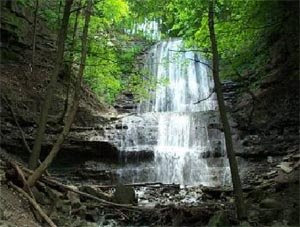
Sherman Falls

Webster's Falls
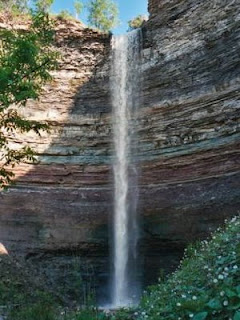
Devil's Punchbowl
If you're looking for a place to spend your holiday, try the waterfall capital of the world.


05 March 2008

Hamilton streets
Which encyclopaedia carries articles on individual streets in Hamilton, Ontario? Wikipedia, of course. Read here about James Street, Locke Street, Dundurn Street, and even Concession Street and Mohawk Road on the "Mountain."
By the way, speaking of James Street, why was the old Birks Building, located at the corner of James and King and once described by Oscar Wilde as "the most beautiful building in all of North America," demolished back in 1972? It was a distinctive piece of Victorian architecture and a Hamilton landmark. It ought to have been preserved.
02 January 2008
Urban transport and urban decay
Longtime residents of Toronto will recall the controversy over the abortive Spadina Expressway, as recounted in this article in the past weekend's National Post: Expressways Went Nowhere. I myself lived a stone's throw away from Spadina Avenue in 1978-79 and quickly learned that, had things gone differently a few years earlier, that unique neighbourhood, at the edges of Chinatown with a few Jewish textile vendors left over from earlier days, might not have been there at all. Had it succeeded, more would have come, making Toronto similar to comparably-sized American cities, crisscrossed with expressways bisecting urban neighbourhoods and destroying others. Plans for the Spadina ignited grassroots protest that eventually brought a halt to the project:

Queen Street, Toronto
Mid-1980s
Half a century ago my hometown of Chicago began building the first of the great expressways towards the west of the city's centre, initially named the Congress Expressway, subsequently to be called the Eisenhower Expressway. This massive public works project ostensibly followed one of the recommendations of Daniel Burnham's 1909 Plan of Chicago. The construction of the Congress necessitated razing the existing structures in its way, including the Garfield Park elevated train line. Among other things, this led to the death of a very fine electric interurban railway line, the Chicago Aurora & Elgin, that had run over the Garfield Park tracks towards the communities of the Fox River Valley. In short, the city's commitment to the expressways spelled a commitment to the automobile as a primary mode of transportation, at the expense of mass rail transit.
It may not be incidental that, at the very moment American cities were being paved over with expressways, these same cities began their inexorable decline. I have friends who grew up in the Englewood and the once heavily Dutch-American Roseland neighbourhoods on the south side of Chicago. These neighbourhoods are now given over to gangs and crack houses, and are no longer safe to live in. Whether the expressways were the cause is difficult to say, but they certainly did not help, as they made it easier for one-time residents to move to the suburbs and commute, taking their tax base with them. The city was effectively remade for the convenience of the suburbs.
Is Toronto a model of how to do things right? Not entirely. To be sure, when I lived there between 1978 and 1980, I could happily live without a car, relying on the subways, buses and streetcars — and, of course, my own feet — to get me where I wanted to go. Toronto had much less crime than Chicago and still does, though there is more now than when I lived there. Yet I am happy that the Spadina Expressway failed. The city would have been a different place if it had not, and I doubt it would have been for the better.
Still I could wish for more focus on mass transit for the entire Golden Horseshoe region. Especially if one lives outside Toronto in one of the "905" cities, it is next to impossible to get along without a motorized vehicle. Ontario's Liberal government has promised more funds to upgrade mass transit in this urban belt around Lake Ontario. We shall see what comes of this.
Here in Hamilton we have recently observed the tenth anniversary of the opening of the Lincoln Alexander Parkway (the "Linc"), which runs across Hamilton Mountain. Just six weeks ago the Red Hill Valley Parkway opened to connect the Linc to the Queen Elizabeth Way to the east of Hamilton. No neighbourhoods were destroyed to build the Linc, as the right of way was already vacant and apparently reserved for it for quite a number of years beforehand. The Red Hill, by contrast, was built through the Red Hill Creek Valley and thus came under fire from environmentalists. Given our admitted dependence on the automobile in Hamilton, both thoroughfares make sense. Yet I wish alternatives could have been found to enable people to travel without the ubiquitous and polluting internal combustion engine. This would require the expansion of GO train and bus service in and out of Hamilton, as well as more frequent buses from the inaptly-named Hamilton Street Railway. I am under no illusion that such measures would build Jerusalem in Ontario's green and pleasant land. Yet it might make for a more livable urban environment, from which we would all benefit.
By the way, a colleague of mine has alerted me to an apparent urban success story south of the equator: Curitiba. I may come back to the subject and post something more specific about this Brazilian city.
Longtime residents of Toronto will recall the controversy over the abortive Spadina Expressway, as recounted in this article in the past weekend's National Post: Expressways Went Nowhere. I myself lived a stone's throw away from Spadina Avenue in 1978-79 and quickly learned that, had things gone differently a few years earlier, that unique neighbourhood, at the edges of Chinatown with a few Jewish textile vendors left over from earlier days, might not have been there at all. Had it succeeded, more would have come, making Toronto similar to comparably-sized American cities, crisscrossed with expressways bisecting urban neighbourhoods and destroying others. Plans for the Spadina ignited grassroots protest that eventually brought a halt to the project:
In 1971, new Ontario premier William Davis, facing a looming election, stood in the [Ontario] Legislature and announced the expressway would not be completed, declaring: "Cities were built for people and not cars."
[Adam] Vaughan says the decision had huge ramifications for the city. "Look at the American cities that built these huge expressways," he says. "They carved up their downtown neighbourhoods and those neighbourhoods died. The Spadina would've killed half a dozen neighbourhoods in this city -- the Annex, Cabbagetown, the Beaches. All these now vibrant, viable neighbourhoods would've just withered and died."

Mid-1980s
Half a century ago my hometown of Chicago began building the first of the great expressways towards the west of the city's centre, initially named the Congress Expressway, subsequently to be called the Eisenhower Expressway. This massive public works project ostensibly followed one of the recommendations of Daniel Burnham's 1909 Plan of Chicago. The construction of the Congress necessitated razing the existing structures in its way, including the Garfield Park elevated train line. Among other things, this led to the death of a very fine electric interurban railway line, the Chicago Aurora & Elgin, that had run over the Garfield Park tracks towards the communities of the Fox River Valley. In short, the city's commitment to the expressways spelled a commitment to the automobile as a primary mode of transportation, at the expense of mass rail transit.
It may not be incidental that, at the very moment American cities were being paved over with expressways, these same cities began their inexorable decline. I have friends who grew up in the Englewood and the once heavily Dutch-American Roseland neighbourhoods on the south side of Chicago. These neighbourhoods are now given over to gangs and crack houses, and are no longer safe to live in. Whether the expressways were the cause is difficult to say, but they certainly did not help, as they made it easier for one-time residents to move to the suburbs and commute, taking their tax base with them. The city was effectively remade for the convenience of the suburbs.
Is Toronto a model of how to do things right? Not entirely. To be sure, when I lived there between 1978 and 1980, I could happily live without a car, relying on the subways, buses and streetcars — and, of course, my own feet — to get me where I wanted to go. Toronto had much less crime than Chicago and still does, though there is more now than when I lived there. Yet I am happy that the Spadina Expressway failed. The city would have been a different place if it had not, and I doubt it would have been for the better.
Still I could wish for more focus on mass transit for the entire Golden Horseshoe region. Especially if one lives outside Toronto in one of the "905" cities, it is next to impossible to get along without a motorized vehicle. Ontario's Liberal government has promised more funds to upgrade mass transit in this urban belt around Lake Ontario. We shall see what comes of this.
Here in Hamilton we have recently observed the tenth anniversary of the opening of the Lincoln Alexander Parkway (the "Linc"), which runs across Hamilton Mountain. Just six weeks ago the Red Hill Valley Parkway opened to connect the Linc to the Queen Elizabeth Way to the east of Hamilton. No neighbourhoods were destroyed to build the Linc, as the right of way was already vacant and apparently reserved for it for quite a number of years beforehand. The Red Hill, by contrast, was built through the Red Hill Creek Valley and thus came under fire from environmentalists. Given our admitted dependence on the automobile in Hamilton, both thoroughfares make sense. Yet I wish alternatives could have been found to enable people to travel without the ubiquitous and polluting internal combustion engine. This would require the expansion of GO train and bus service in and out of Hamilton, as well as more frequent buses from the inaptly-named Hamilton Street Railway. I am under no illusion that such measures would build Jerusalem in Ontario's green and pleasant land. Yet it might make for a more livable urban environment, from which we would all benefit.
By the way, a colleague of mine has alerted me to an apparent urban success story south of the equator: Curitiba. I may come back to the subject and post something more specific about this Brazilian city.
22 June 2007

08 March 2007
Un jet d'eau pour Hamilton?
When in 1975 I visited Geneva, Switzerland, I was charmed by this lovely, clean city at the western end of Lac Léman. One of the city's landmarks is the famous jet d'eau reaching skyward from the placid waters of the lake below.

Now Hamilton city councillor Bob Bratina, of CHML radio fame, thinks we need one of these in our harbour: Giant geyser floated as way to market city. Not everyone is enthusiastic: Readers not gushing over geyser. The new mayor, Fred Eisenberger, is open to exploring the idea. While they're at it, they might do well to look up the word geyser.
When in 1975 I visited Geneva, Switzerland, I was charmed by this lovely, clean city at the western end of Lac Léman. One of the city's landmarks is the famous jet d'eau reaching skyward from the placid waters of the lake below.

Now Hamilton city councillor Bob Bratina, of CHML radio fame, thinks we need one of these in our harbour: Giant geyser floated as way to market city. Not everyone is enthusiastic: Readers not gushing over geyser. The new mayor, Fred Eisenberger, is open to exploring the idea. While they're at it, they might do well to look up the word geyser.
26 February 2007
Local ecclesiastical architecture
An informative article was posted today by York University's Prof. Malcolm Thurlby: 19th-Century Churches in Hamilton: Barton Stone United Church and St Paul's Anglican Church, Glanford. These buildings are familiar to those living in Hamilton above the Niagara Escarpment, and Barton Stone Church is very close to our home.

This is a photograph of Stone Church taken by my mother back in the autumn of 1993 — probably Thanksgiving weekend. The vines on the outside were the most colourful I have seen them either before or since. This is one of our landmarks and possibly the oldest building on Hamilton Mountain.
An informative article was posted today by York University's Prof. Malcolm Thurlby: 19th-Century Churches in Hamilton: Barton Stone United Church and St Paul's Anglican Church, Glanford. These buildings are familiar to those living in Hamilton above the Niagara Escarpment, and Barton Stone Church is very close to our home.

This is a photograph of Stone Church taken by my mother back in the autumn of 1993 — probably Thanksgiving weekend. The vines on the outside were the most colourful I have seen them either before or since. This is one of our landmarks and possibly the oldest building on Hamilton Mountain.
18 July 2006
A Hamilton landmark
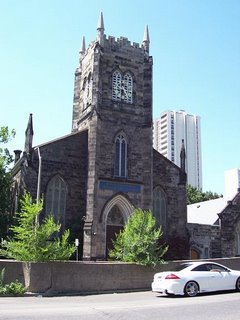
Here is the façade of the historic MacNab Street Presbyterian Church here in Hamilton, whose building dates from before Confederation.
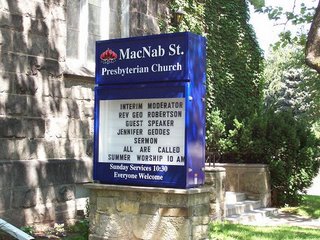
Until yesterday the church's sign carried an intriguing sermon title, SINGING THE PSALMS, which must have been preached two days ago. I'm sorry to have missed it.

Here is the façade of the historic MacNab Street Presbyterian Church here in Hamilton, whose building dates from before Confederation.
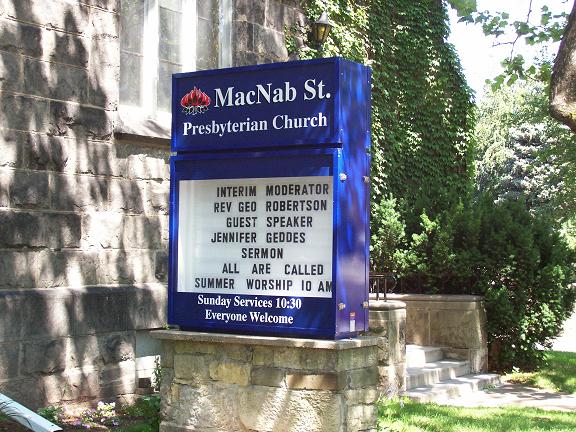
Until yesterday the church's sign carried an intriguing sermon title, SINGING THE PSALMS, which must have been preached two days ago. I'm sorry to have missed it.
13 September 2004
Lost Hamilton
I wonder how many Hamiltonians are aware that there were once two incline railways early last century connecting James and Upper James Streets and Wentworth and Upper Wentworth Streets. This was in the days when the Hamilton Street Railway actually boasted, well, street railways. The Hamilton & Barton Incline Railway operated at James Street between 1892 and 1931 and was briefly revived in 1932 before closing for good.

hamiltonpostcards.com
At the top of the railway stood the old Mountain View Hotel, with its distinctive turret, as shown below.

hamiltonpostcards.com
Farther to the east at Wentworth Street lay the Hamilton Incline Railway, which opened in 1900 and closed in 1936.

Industrial Hamilton
Whether these were funicular railways I cannot say for certain, but, judging from the pictures, I rather imagine they were. I've ridden funicular railways in Niagara Falls, Lugano, Switzerland, Athens, Greece, and at Horseshoe Curve, Pennsylvania. It's a shame Hamilton was unable to make a go of at least one such railway over the long term.
I wonder how many Hamiltonians are aware that there were once two incline railways early last century connecting James and Upper James Streets and Wentworth and Upper Wentworth Streets. This was in the days when the Hamilton Street Railway actually boasted, well, street railways. The Hamilton & Barton Incline Railway operated at James Street between 1892 and 1931 and was briefly revived in 1932 before closing for good.
hamiltonpostcards.com
At the top of the railway stood the old Mountain View Hotel, with its distinctive turret, as shown below.
hamiltonpostcards.com
Farther to the east at Wentworth Street lay the Hamilton Incline Railway, which opened in 1900 and closed in 1936.
Industrial Hamilton
Whether these were funicular railways I cannot say for certain, but, judging from the pictures, I rather imagine they were. I've ridden funicular railways in Niagara Falls, Lugano, Switzerland, Athens, Greece, and at Horseshoe Curve, Pennsylvania. It's a shame Hamilton was unable to make a go of at least one such railway over the long term.
24 February 2004
First time in Hamilton
My first visit to Hamilton was way back in 1971. I was sixteen years old, and our family was visiting our former family physician, who had moved up here to take a position teaching at the McMaster University Medical School, which had only recently opened. I don't remember much about the visit, except that our host family was living in Dundas and we visited Ontario Place and the Royal Botanical Gardens. While at the latter we went to the Rock Garden and I somehow managed to drop my glasses over the edge of the top (it seemed like a precipice at the time). Someone in our group who was about ten years my senior climbed down and retrieved them for me. I was thankful for that. Even then I was blind as a bat without my glasses. Little did I know that I would one day be living in Hamilton and that my daughter would be born at McMaster.
My first visit to Hamilton was way back in 1971. I was sixteen years old, and our family was visiting our former family physician, who had moved up here to take a position teaching at the McMaster University Medical School, which had only recently opened. I don't remember much about the visit, except that our host family was living in Dundas and we visited Ontario Place and the Royal Botanical Gardens. While at the latter we went to the Rock Garden and I somehow managed to drop my glasses over the edge of the top (it seemed like a precipice at the time). Someone in our group who was about ten years my senior climbed down and retrieved them for me. I was thankful for that. Even then I was blind as a bat without my glasses. Little did I know that I would one day be living in Hamilton and that my daughter would be born at McMaster.
13 September 2003
Toronto versus Hamilton
Last evening I was in Toronto representing Redeemer University College at a banquet celebrating the 40th anniversary of Citizens for Public Justice. The event took place on the campus of the University of St. Michael's College.
I do not get to Toronto at all often these days, although I lived there for the two years I was studying at the Institute for Christian Studies. I loved living in Toronto, which is, as many Torontonians love to boast, a world class city. It is Canada's largest city and boasts a number of attractions, including the Art Gallery of Ontario, the Royal Ontario Museum, St. Lawrence Market, Kensington Market, Greektown, Chinatown, High Park, Queen's Park, and of course such popular tourist destinations as the Sky Dome and the CN Tower.
Toronto is filled with myriad ethnic neighbourhoods, along with the restaurants featuring their distinctive cuisines. There are lots of used book stores, and the University of Toronto Bookstore, right across the street from the ICS. And of course I love the public transportation system. At one time it could be said that Toronto was one of a very few North American urban centres featuring a more-or-less complete streetcar system. Now other cities have gotten back on the bandwagon with what they call light rail transit.
Then there's Hamilton, which is often thought to be Toronto's lesser, blue collar counterpart at the western end of Lake Ontario. I have lived in Hamilton for 16 years, and I do not believe this city has anything to feel inferior about. To begin with, Hamilton has more natural scenic beauty than Toronto. Most spectacularly we have the Royal Botanical Gardens, which I first visited way back in 1971. (I nearly lost my glasses at the Rock Garden!) Much of the scenery revolves around the Niagara Escarpment, a clifflike geological structure that cuts through the city on its journey from Niagara Falls to the Bruce Peninsula on Lake Huron. This makes for a large number of waterfalls located at various spots along the escarpment, including Websters Falls, Spencer Gorge and Sherman Falls.
Hamilton boasts a number of rail trails cutting through the Dundas Valley Conservation Area. These are ideal for walking and bicycling. Then there are the historic sites, such as Dundurn Castle and the Battlefield House Museum in Stoney Creek.
One can hardly beat the view from Highway 403 as one enters Hamilton from the direction of Toronto: Cootes Paradise is at the right, the escarpment is in the distance, and the neogothic spires of the Cathedral of Christ the King are at the left. Very impressive indeed.
Finally, Hamilton is a much more affordable place to live. Housing prices in Toronto are sky high, making it difficult for people from the outside to move in unless they have an exceedingly well-paying job. When all is said and done, Hamilton is a fine place to live.
Last evening I was in Toronto representing Redeemer University College at a banquet celebrating the 40th anniversary of Citizens for Public Justice. The event took place on the campus of the University of St. Michael's College.
I do not get to Toronto at all often these days, although I lived there for the two years I was studying at the Institute for Christian Studies. I loved living in Toronto, which is, as many Torontonians love to boast, a world class city. It is Canada's largest city and boasts a number of attractions, including the Art Gallery of Ontario, the Royal Ontario Museum, St. Lawrence Market, Kensington Market, Greektown, Chinatown, High Park, Queen's Park, and of course such popular tourist destinations as the Sky Dome and the CN Tower.
Toronto is filled with myriad ethnic neighbourhoods, along with the restaurants featuring their distinctive cuisines. There are lots of used book stores, and the University of Toronto Bookstore, right across the street from the ICS. And of course I love the public transportation system. At one time it could be said that Toronto was one of a very few North American urban centres featuring a more-or-less complete streetcar system. Now other cities have gotten back on the bandwagon with what they call light rail transit.
Then there's Hamilton, which is often thought to be Toronto's lesser, blue collar counterpart at the western end of Lake Ontario. I have lived in Hamilton for 16 years, and I do not believe this city has anything to feel inferior about. To begin with, Hamilton has more natural scenic beauty than Toronto. Most spectacularly we have the Royal Botanical Gardens, which I first visited way back in 1971. (I nearly lost my glasses at the Rock Garden!) Much of the scenery revolves around the Niagara Escarpment, a clifflike geological structure that cuts through the city on its journey from Niagara Falls to the Bruce Peninsula on Lake Huron. This makes for a large number of waterfalls located at various spots along the escarpment, including Websters Falls, Spencer Gorge and Sherman Falls.
Hamilton boasts a number of rail trails cutting through the Dundas Valley Conservation Area. These are ideal for walking and bicycling. Then there are the historic sites, such as Dundurn Castle and the Battlefield House Museum in Stoney Creek.
One can hardly beat the view from Highway 403 as one enters Hamilton from the direction of Toronto: Cootes Paradise is at the right, the escarpment is in the distance, and the neogothic spires of the Cathedral of Christ the King are at the left. Very impressive indeed.
Finally, Hamilton is a much more affordable place to live. Housing prices in Toronto are sky high, making it difficult for people from the outside to move in unless they have an exceedingly well-paying job. When all is said and done, Hamilton is a fine place to live.
11 May 2003
Our own Berlin Wall in Hamilton?
On friday I wrote:
When I first moved to Hamilton in 1987 from exceedingly flat South Bend, Indiana, I tried to acclimate myself to my new surroundings by familiarizing myself with a map of the city. But something was puzzling me. All of the north-south streets seemed to come to an end at a meandering line running in a generally east-west direction. Why, I asked myself, did they not simply put these streets through so people could more easily travel from one part of the city to the next? Was there something like a Berlin Wall in Hamilton?
It didn't take me that long to figure out that this "meandering line" on the map was the Niagara Escarpment, a lengthy cliff-like geological phenemenon that runs from Niagara Falls all the way to the Bruce Peninsula on Lake Huron. It makes for an almost spectacular visual beauty in this part of the province--at least as compared to South Bend, Indiana.
On friday I wrote:
It's difficult to imagine what it might be like to have one's own city bisected in such a way. I live in Hamilton, Ontario. Imagine a wall topped with barbed wire extending down the middle of, say, James Street, with the city's population forced to remain within their respective zones.
When I first moved to Hamilton in 1987 from exceedingly flat South Bend, Indiana, I tried to acclimate myself to my new surroundings by familiarizing myself with a map of the city. But something was puzzling me. All of the north-south streets seemed to come to an end at a meandering line running in a generally east-west direction. Why, I asked myself, did they not simply put these streets through so people could more easily travel from one part of the city to the next? Was there something like a Berlin Wall in Hamilton?
It didn't take me that long to figure out that this "meandering line" on the map was the Niagara Escarpment, a lengthy cliff-like geological phenemenon that runs from Niagara Falls all the way to the Bruce Peninsula on Lake Huron. It makes for an almost spectacular visual beauty in this part of the province--at least as compared to South Bend, Indiana.
Subscribe to:
Posts (Atom)