Showing posts with label cities. Show all posts
Showing posts with label cities. Show all posts
19 August 2009
The Shweeb
Could the Shweeb prove to be more than an amusement park ride? Might a network of these covering (and hovering over) a major city help to ease traffic congestion on the streets, as well as present opportunities for commuters to increase their physical stamina? It's worth considering.


12 August 2009
John M. Lyle: architect

Glenn McArthur. A Progressive Traditionalist: John M. Lyle, Architect. Toronto: Coach House Books, 2009. 220 pp.
I admit it. One of my guilty pleasures is the handsomely-illustrated coffee table book, and the current offering under review fulfils that role very nicely indeed. Glenn McArthur’s new book is a delight to page through for anyone possessing an interest in the arts and especially architecture.
John McIntosh Lyle (1872-1945) was one of the great architects of his day, and he had a strong connection with Hamilton, responsible for a number of familiar structures gracing our city.
Lyle was born in County Antrim, Ireland, in 1872. When his father, the Rev. Samuel Lyle, was called to the pastorate of Central Presbyterian Church in 1878, the family immigrated to Canada. The Rev. Dr. Lyle led the congregation for more than three decades, retiring in 1911. His son John studied at the Hamilton Art School, briefly at Cornell University, and at the Yale School of Art. In New York City he apprenticed at the office of Hamilton architect Frank Freeman before heading to Paris to enrol at the prestigious École des Beaux-Arts for further studies.
Once these were completed in 1896, Lyle returned to North America, settling in New York and eventually finding work in the firm of Howard & Cauldwell. Only three years earlier, the World’s Columbian Exposition in Chicago had changed the course of the continent’s architecture, securing the place of the distinctive Beaux-Arts neoclassical style, especially in public buildings. Lyle himself would design two bandstands for the 1901 Pan-American Exposition in Buffalo.
In 1905 Lyle returned to Canada, taking up residence in Toronto, where an extensive fire a year earlier seemed to promise opportunities to contribute to the vast rebuilding project. Although this promise did not pan out immediately, he did design the Royal Alexandra Theatre, built between 1905 and 1907, which was named for Edward VII’s queen consort.

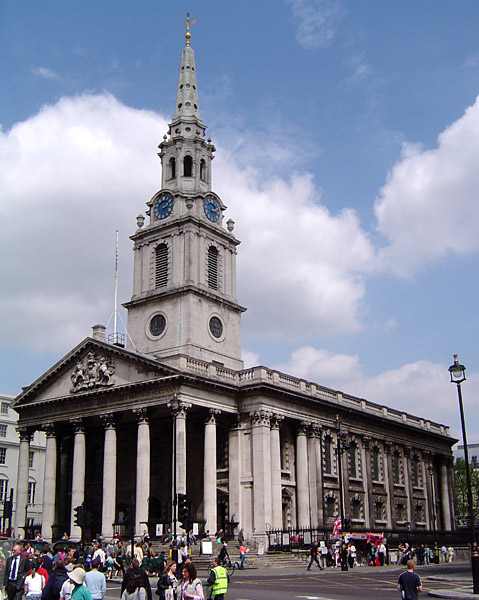
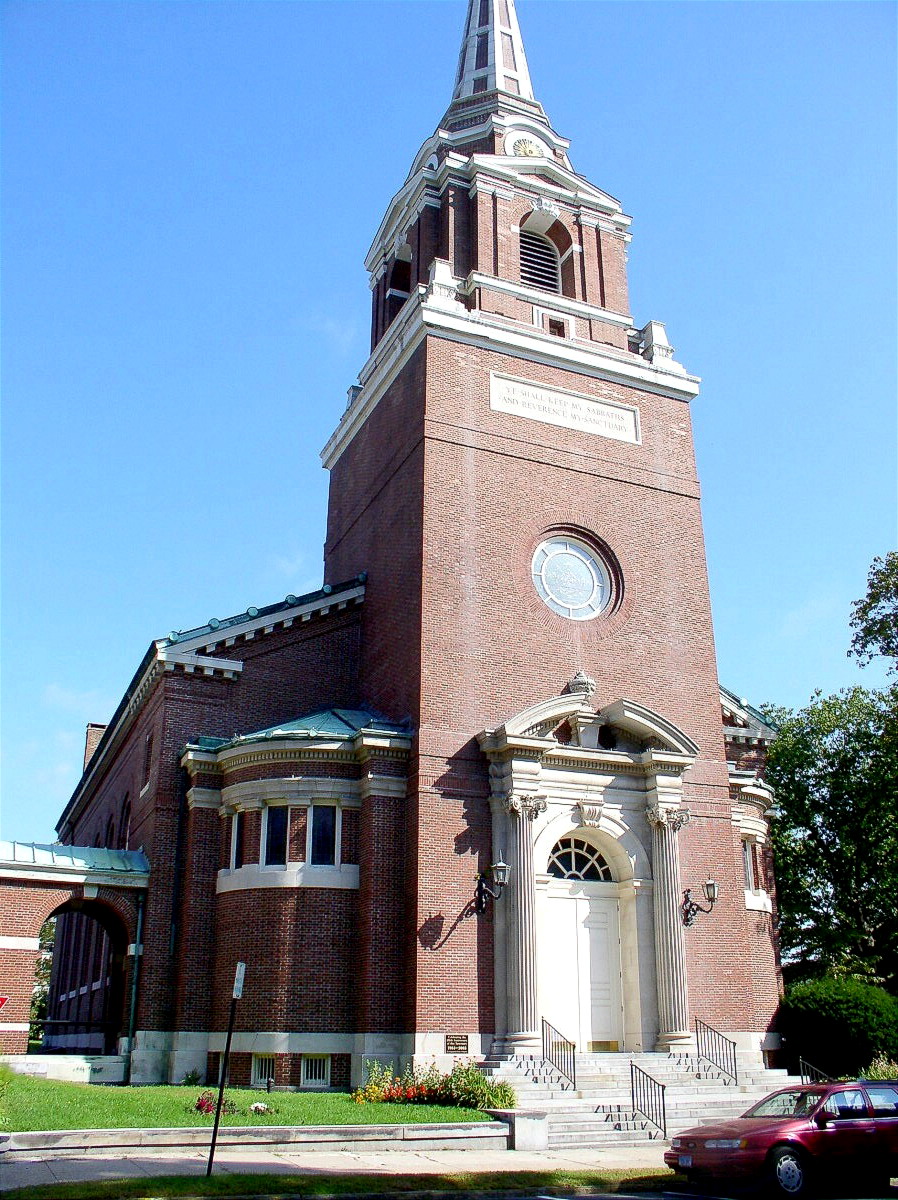
A fire in 1906 destroyed his father’s church, Central Presbyterian, which had occupied a quasi-gothic building constructed in 1858 at Jackson and MacNab Streets. The congregation decided to relocate a bit farther south of the city’s centre to Caroline and Charlton Streets. The completed structure borrows from a number of influences, including the Church of St. Martin-in-the-Fields in London and the Congregational Church of Naugatuck, Connecticut. One of its more unusual features is that it has a flat roof, thereby resembling more the public edifices favoured by the Beaux-Arts school than the traditional European church. Nevertheless, the church’s interior is dominated by a series of traditional stained-glass windows portraying stories from the Bible. This juxtaposition of the modern and the traditional appears to vindicate McArthur’s choice of title for his book. So satisfied was Lyle with the outcome of his efforts that he incorporated a black silhouette of the building into his personal bookplates. The spire of Central is a distinctive landmark visible throughout the surrounding neighbourhoods.
From here Lyle would go on in 1913 to design the Great Hall of Toronto’s Union Station (see book cover above), familiar to generations of commuters who have passed through it twice daily. While other urban railway terminals have seen the wrecker’s ball in recent decades, this building continues to serve the travelling public much as it did when it first opened.
Throughout his career, Lyle was much in demand by the nation’s banks, where the neoclassical style was favoured in the early years of the 20th century, perhaps as a way of impressing would-be depositors with the imposing nature of their own financial solidity.
Among the Hamilton landmarks for which Lyle was responsible are the palatial home Wynnstay, now Mount Mary Immaculate, in Ancaster (1925); the Gage Memorial Fountain in Gage Park (1926); and the Hamilton High Level Bridge, where York Boulevard passes over the Desjardins Canal (1932). Other well-known Lyle designs include the Memorial Arch at Kingston’s Royal Military College (1921); and the Runnymede branch of the Toronto Public Library (1929), which incorporated English, French Canadian and aboriginal elements. I myself used to live near that branch three decades ago and visited it on occasion.
Also notable are the designs Lyle submitted for projects later awarded to others. Two examples are worth mentioning. In 1907 his proposal for the buildings of the Justice Department would have altered the landscape of the federal government’s public architecture by making it more resemble that of Washington, DC. When in 1922 The Chicago Tribune sought designs for its new building, Lyle’s unsuccessful effort featured neoclassical columns and, of all things, a spire reminiscent of the one he had placed atop Central Presbyterian Church!
Incidentally, Lyle's grandson recently donated a copy of this book to that church's library, where I came across it a few weeks ago after sunday worship. The family is to be commended for helping to disseminate knowledge of their forebear's contribution to Canadian architecture.
15 June 2009
Managing decline
Though we North Americans tend to think of cities as permanent and expanding features on our landscape, it is a fact of life that, like everything else in the world, they wax and wane and may even die. Timbuktu was once a great centre of culture and learning, but is now a shadow of what it was half a millennium ago. There is no reason to think that our own cities are exempt from this process.
Indeed there are a number of American cities that have not fared well with the shift from an industrial to a service economy. The one with which I am most familiar is just over the border: Detroit. Now there is a co-operative effort by more than one level of government to manage the decline of such urban centres: US cities may have to be bulldozed in order to survive. Given my deep familial roots in southeastern Michigan, I am saddened at the decline of urban life in the region.
Yet all periods of mourning must end, and life must go on. For the city of Flint, Michigan, 60 miles north of Detroit, this means effectively abandoning up to 40 percent of the city's built-up land in a necessary downsizing effort.
Given that growth and decline are facts of life, and given that political authorities are under a divine mandate to do public justice, how do they manage decline in a just fashion? It is easy to distribute the pieces of an ever-expanding pie, but what happens when the pie is contracting? The corporate private sector has had to face these sorts of issues for decades, but now municipal governments are having to make similar tough decisions. Are there equitable ways to do so?
Indeed there are a number of American cities that have not fared well with the shift from an industrial to a service economy. The one with which I am most familiar is just over the border: Detroit. Now there is a co-operative effort by more than one level of government to manage the decline of such urban centres: US cities may have to be bulldozed in order to survive. Given my deep familial roots in southeastern Michigan, I am saddened at the decline of urban life in the region.
Yet all periods of mourning must end, and life must go on. For the city of Flint, Michigan, 60 miles north of Detroit, this means effectively abandoning up to 40 percent of the city's built-up land in a necessary downsizing effort.
Flint, sixty miles north of Detroit, was the original home of General Motors. The car giant once employed 79,000 local people but that figure has shrunk to around 8,000. Unemployment is now approaching 20 per cent and the total population has almost halved to 110,000. The exodus – particularly of young people – coupled with the consequent collapse in property prices, has left street after street in sections of the city almost entirely abandoned.Durant Hotel
In the city centre, the once grand Durant Hotel – named after William Durant, GM's founder – is a symbol of the city's decline, said Mr [Dan] Kildee [Genesee County Treasurer]. The large building has been empty since 1973, roughly when Flint's decline began. Regarded as a model city in the motor industry's boom years, Flint may once again be emulated, though for very different reasons.
But Mr Kildee, who has lived there nearly all his life, said he had first to overcome a deeply ingrained American cultural mindset that "big is good" and that cities should sprawl – Flint covers 34 square miles. . . . But some Flint dustcarts are collecting just one rubbish bag a week, roads are decaying, police are very understaffed and there were simply too few people to pay for services, he said. If the city didn't downsize it will eventually go bankrupt, he added. . . .
The local authority has restored the city's attractive but formerly deserted centre but has pulled down 1,100 abandoned homes in outlying areas. Mr Kildee estimated another 3,000 needed to be demolished, although the city boundaries will remain the same. Already, some streets peter out into woods or meadows, no trace remaining of the homes that once stood there.
Choosing which areas to knock down will be delicate but many of them were already obvious, he said. The city is buying up houses in more affluent areas to offer people in neighbourhoods it wants to demolish. Nobody will be forced to move, said Mr Kildee. "Much of the land will be given back to nature. People will enjoy living near a forest or meadow," he said.
Mr Kildee acknowledged that some fellow Americans considered his solution "defeatist" but he insisted it was "no more defeatist than pruning an overgrown tree so it can bear fruit again".

Given that growth and decline are facts of life, and given that political authorities are under a divine mandate to do public justice, how do they manage decline in a just fashion? It is easy to distribute the pieces of an ever-expanding pie, but what happens when the pie is contracting? The corporate private sector has had to face these sorts of issues for decades, but now municipal governments are having to make similar tough decisions. Are there equitable ways to do so?
22 October 2008
Neoclassical architecture
Paul M. Weyrich, of the Free Congress Foundation, is a fan, not only of rail transportation, but also of neoclassical architecture, as evidenced here: A Celebration of Railroads and Architecture. I am completely in agreement with him in his advocacy of train travel, which I am convinced needs to be favoured over air travel for short and intermediate distances. I am more ambivalent over his sweeping claim, following Prince Charles, that "classical architecture is a tribute to God Almighty."

I have been to Washington's Union Station at least twice, most recently in July of last year. It was designed by architect Daniel Burnham, well known for his contribution to the World's Columbian Exposition in 1893 and his Plan of Chicago in 1909. I am pleased that this magnificent structure was successfully preserved and restored. Furthermore, I am happy to admit that all architecture is in some fashion a manifestation of God's creative intent that his image-bearing creatures should shape their environments in distinctive ways.
Yet architectural fashions also reflect the religious worldviews of the architects themselves, as well as of the larger culture that nurtures them. One looks in vain for Weyrich to recognize that neoclassicism in art and architecture was motivated by an effort more to recover the vaunted glories of pagan Greece and Rome than to honour God. Weyrich's conservatism could stand to be a bit more nuanced here.
Paul M. Weyrich, of the Free Congress Foundation, is a fan, not only of rail transportation, but also of neoclassical architecture, as evidenced here: A Celebration of Railroads and Architecture. I am completely in agreement with him in his advocacy of train travel, which I am convinced needs to be favoured over air travel for short and intermediate distances. I am more ambivalent over his sweeping claim, following Prince Charles, that "classical architecture is a tribute to God Almighty."

Union Station, Washington, DC
I have been to Washington's Union Station at least twice, most recently in July of last year. It was designed by architect Daniel Burnham, well known for his contribution to the World's Columbian Exposition in 1893 and his Plan of Chicago in 1909. I am pleased that this magnificent structure was successfully preserved and restored. Furthermore, I am happy to admit that all architecture is in some fashion a manifestation of God's creative intent that his image-bearing creatures should shape their environments in distinctive ways.
Yet architectural fashions also reflect the religious worldviews of the architects themselves, as well as of the larger culture that nurtures them. One looks in vain for Weyrich to recognize that neoclassicism in art and architecture was motivated by an effort more to recover the vaunted glories of pagan Greece and Rome than to honour God. Weyrich's conservatism could stand to be a bit more nuanced here.
12 July 2008
Suburban air quality
It has long been assumed that people flee to the suburbs to escape the foul air of the city. However, could it be that, because outlying communities are so tied to the automobile, its residents pollute more than those remaining behind in the cities? Ted Mitchell examines the evidence with a look at the Chicago area: Not My Problem: Taking Responsibility for Air Quality.
It has long been assumed that people flee to the suburbs to escape the foul air of the city. However, could it be that, because outlying communities are so tied to the automobile, its residents pollute more than those remaining behind in the cities? Ted Mitchell examines the evidence with a look at the Chicago area: Not My Problem: Taking Responsibility for Air Quality.
05 March 2008

Hamilton streets
Which encyclopaedia carries articles on individual streets in Hamilton, Ontario? Wikipedia, of course. Read here about James Street, Locke Street, Dundurn Street, and even Concession Street and Mohawk Road on the "Mountain."
By the way, speaking of James Street, why was the old Birks Building, located at the corner of James and King and once described by Oscar Wilde as "the most beautiful building in all of North America," demolished back in 1972? It was a distinctive piece of Victorian architecture and a Hamilton landmark. It ought to have been preserved.
28 January 2008
'Traditional urbanism' and neighbourhoods
As an alumnus of the University of Notre Dame, I receive gratis Notre Dame Magazine, a glossy periodical that is usually not near the top of my "to read" pile. Nevertheless, the winter 2007-08 issue carries an article by John Nagy, The Once and Future Neighborhood, that is definitely worth reading. It features the ideas of Philip Bess, professor at the Notre Dame School of Architecture, who is described as a "traditional urbanist." Bess's academic interests frequently take him and his students to Cooperstown, New York, once an ordinary village, but now reshaped by the presence of the National Baseball Hall of Fame.
While finding solutions is not a simple matter, Professor Bess does offer Ten Principles of Good Neighborhood Design. A good neighbourhood:
As an alumnus of the University of Notre Dame, I receive gratis Notre Dame Magazine, a glossy periodical that is usually not near the top of my "to read" pile. Nevertheless, the winter 2007-08 issue carries an article by John Nagy, The Once and Future Neighborhood, that is definitely worth reading. It features the ideas of Philip Bess, professor at the Notre Dame School of Architecture, who is described as a "traditional urbanist." Bess's academic interests frequently take him and his students to Cooperstown, New York, once an ordinary village, but now reshaped by the presence of the National Baseball Hall of Fame.
Bess makes urbanism relatable by talking about pizza, an analogy he borrows from the influential European architect and urban designer Leon Krier. A traditional neighborhood, Bess explains, is to a traditional city what a slice of pizza is to the whole pie, "because a slice of pizza has on it all the ingredients of the entire city." Residents can walk to schools, parks, the family doctor and the grocery store, their church and, ideally, their work: in short, the places that supply their lives with health and meaning.
Suburban development leaves us with separate piles of ingredients. Homes for the poor are in one pile; homes for the well-off somewhere else. Clusters of office buildings, public services and retail stores surrounded by oceanic parking lots crop up along congested connector roads paved at taxpayers' expense. We drive everywhere because we have no choice. As Bess says, "you can't just have a pizza; you've got to go get each little ingredient by itself."
We tagged this form of suburbia "sprawl" in the 1960s while our cities and towns hemorrhaged into never-ending subdivisions. In 1982, developed land in the United States covered 72.9 million acres. By 2003, federal data show, new construction left an Iowa-sized footprint of 35.2 million more acres -- a rate nearly double that of the growth of the population.
The problem at its deepest level is one of human nature. But it's also a byproduct of the postwar economic boom and faulty public policy. You may know the story: Public health concerns about industry set a precedent for single-use zoning codes that extend to everything, including housing by income level. Cheap, government-backed mortgages, nothing short of miraculous to a generation that had grown up in depression and war, favored new construction over renovation. Interstate highways promised swift commutes and an escape from polluted, crime-ridden cities and their failing schools. Developers, their crews and their corporate financiers benefitted from building plentifully and at low cost. They still do.
The impact on Americans and our communities, even idyllic and isolated ones like Cooperstown, has been palpable. We've lost apartments above stores and backyard coach houses -- the kind of affordable housing that doesn't come in menacing, publicly funded, cinder-block rectangles. Our streets have emptied of pedestrians as cars have become appendages rather than conveniences. In some areas, teachers, nurses and police officers can't afford to live in the communities they serve. Property taxes spike to cover the rising costs of infrastructure and basic services in far-flung areas. Children and the elderly who can't drive themselves to parks and shops have lost independence. Obesity has become a public health crisis.
While finding solutions is not a simple matter, Professor Bess does offer Ten Principles of Good Neighborhood Design. A good neighbourhood:
• Has a discernible center: for example, a public square or main street bordered by civic buildings, shops and/or residences
• Has a more or less discernible edge where it ends and another neighborhood or natural feature begins
• Is pedestrian friendly, accommodating cars as well as those who want or need to walk
• Consists of a variety of dwelling types: for example, single-family homes, apartments above stores and coach houses, which together encourage a healthy economic diversity
• Has stores and offices located at and/or near its centers with enough variety of retail goods to meet weekly household needs
• Has an elementary school and parks to which most young children can walk
• Has small blocks with a network of through-streets (as opposed to feeder roads and cul-de-sacs), generous sidewalks and broad planter strips for trees
• Places its buildings close to the street to create a stronger sense of place
• Utilizes its streets for parking, rather than building lots and garages visible from the street
• Reserves prominent sites for community monuments and civic buildings for education, religion, culture, sport and government, that front on public squares or terminate the ends of streets.
02 January 2008
Urban transport and urban decay
Longtime residents of Toronto will recall the controversy over the abortive Spadina Expressway, as recounted in this article in the past weekend's National Post: Expressways Went Nowhere. I myself lived a stone's throw away from Spadina Avenue in 1978-79 and quickly learned that, had things gone differently a few years earlier, that unique neighbourhood, at the edges of Chinatown with a few Jewish textile vendors left over from earlier days, might not have been there at all. Had it succeeded, more would have come, making Toronto similar to comparably-sized American cities, crisscrossed with expressways bisecting urban neighbourhoods and destroying others. Plans for the Spadina ignited grassroots protest that eventually brought a halt to the project:

Queen Street, Toronto
Mid-1980s
Half a century ago my hometown of Chicago began building the first of the great expressways towards the west of the city's centre, initially named the Congress Expressway, subsequently to be called the Eisenhower Expressway. This massive public works project ostensibly followed one of the recommendations of Daniel Burnham's 1909 Plan of Chicago. The construction of the Congress necessitated razing the existing structures in its way, including the Garfield Park elevated train line. Among other things, this led to the death of a very fine electric interurban railway line, the Chicago Aurora & Elgin, that had run over the Garfield Park tracks towards the communities of the Fox River Valley. In short, the city's commitment to the expressways spelled a commitment to the automobile as a primary mode of transportation, at the expense of mass rail transit.
It may not be incidental that, at the very moment American cities were being paved over with expressways, these same cities began their inexorable decline. I have friends who grew up in the Englewood and the once heavily Dutch-American Roseland neighbourhoods on the south side of Chicago. These neighbourhoods are now given over to gangs and crack houses, and are no longer safe to live in. Whether the expressways were the cause is difficult to say, but they certainly did not help, as they made it easier for one-time residents to move to the suburbs and commute, taking their tax base with them. The city was effectively remade for the convenience of the suburbs.
Is Toronto a model of how to do things right? Not entirely. To be sure, when I lived there between 1978 and 1980, I could happily live without a car, relying on the subways, buses and streetcars — and, of course, my own feet — to get me where I wanted to go. Toronto had much less crime than Chicago and still does, though there is more now than when I lived there. Yet I am happy that the Spadina Expressway failed. The city would have been a different place if it had not, and I doubt it would have been for the better.
Still I could wish for more focus on mass transit for the entire Golden Horseshoe region. Especially if one lives outside Toronto in one of the "905" cities, it is next to impossible to get along without a motorized vehicle. Ontario's Liberal government has promised more funds to upgrade mass transit in this urban belt around Lake Ontario. We shall see what comes of this.
Here in Hamilton we have recently observed the tenth anniversary of the opening of the Lincoln Alexander Parkway (the "Linc"), which runs across Hamilton Mountain. Just six weeks ago the Red Hill Valley Parkway opened to connect the Linc to the Queen Elizabeth Way to the east of Hamilton. No neighbourhoods were destroyed to build the Linc, as the right of way was already vacant and apparently reserved for it for quite a number of years beforehand. The Red Hill, by contrast, was built through the Red Hill Creek Valley and thus came under fire from environmentalists. Given our admitted dependence on the automobile in Hamilton, both thoroughfares make sense. Yet I wish alternatives could have been found to enable people to travel without the ubiquitous and polluting internal combustion engine. This would require the expansion of GO train and bus service in and out of Hamilton, as well as more frequent buses from the inaptly-named Hamilton Street Railway. I am under no illusion that such measures would build Jerusalem in Ontario's green and pleasant land. Yet it might make for a more livable urban environment, from which we would all benefit.
By the way, a colleague of mine has alerted me to an apparent urban success story south of the equator: Curitiba. I may come back to the subject and post something more specific about this Brazilian city.
Longtime residents of Toronto will recall the controversy over the abortive Spadina Expressway, as recounted in this article in the past weekend's National Post: Expressways Went Nowhere. I myself lived a stone's throw away from Spadina Avenue in 1978-79 and quickly learned that, had things gone differently a few years earlier, that unique neighbourhood, at the edges of Chinatown with a few Jewish textile vendors left over from earlier days, might not have been there at all. Had it succeeded, more would have come, making Toronto similar to comparably-sized American cities, crisscrossed with expressways bisecting urban neighbourhoods and destroying others. Plans for the Spadina ignited grassroots protest that eventually brought a halt to the project:
In 1971, new Ontario premier William Davis, facing a looming election, stood in the [Ontario] Legislature and announced the expressway would not be completed, declaring: "Cities were built for people and not cars."
[Adam] Vaughan says the decision had huge ramifications for the city. "Look at the American cities that built these huge expressways," he says. "They carved up their downtown neighbourhoods and those neighbourhoods died. The Spadina would've killed half a dozen neighbourhoods in this city -- the Annex, Cabbagetown, the Beaches. All these now vibrant, viable neighbourhoods would've just withered and died."

Mid-1980s
Half a century ago my hometown of Chicago began building the first of the great expressways towards the west of the city's centre, initially named the Congress Expressway, subsequently to be called the Eisenhower Expressway. This massive public works project ostensibly followed one of the recommendations of Daniel Burnham's 1909 Plan of Chicago. The construction of the Congress necessitated razing the existing structures in its way, including the Garfield Park elevated train line. Among other things, this led to the death of a very fine electric interurban railway line, the Chicago Aurora & Elgin, that had run over the Garfield Park tracks towards the communities of the Fox River Valley. In short, the city's commitment to the expressways spelled a commitment to the automobile as a primary mode of transportation, at the expense of mass rail transit.
It may not be incidental that, at the very moment American cities were being paved over with expressways, these same cities began their inexorable decline. I have friends who grew up in the Englewood and the once heavily Dutch-American Roseland neighbourhoods on the south side of Chicago. These neighbourhoods are now given over to gangs and crack houses, and are no longer safe to live in. Whether the expressways were the cause is difficult to say, but they certainly did not help, as they made it easier for one-time residents to move to the suburbs and commute, taking their tax base with them. The city was effectively remade for the convenience of the suburbs.
Is Toronto a model of how to do things right? Not entirely. To be sure, when I lived there between 1978 and 1980, I could happily live without a car, relying on the subways, buses and streetcars — and, of course, my own feet — to get me where I wanted to go. Toronto had much less crime than Chicago and still does, though there is more now than when I lived there. Yet I am happy that the Spadina Expressway failed. The city would have been a different place if it had not, and I doubt it would have been for the better.
Still I could wish for more focus on mass transit for the entire Golden Horseshoe region. Especially if one lives outside Toronto in one of the "905" cities, it is next to impossible to get along without a motorized vehicle. Ontario's Liberal government has promised more funds to upgrade mass transit in this urban belt around Lake Ontario. We shall see what comes of this.
Here in Hamilton we have recently observed the tenth anniversary of the opening of the Lincoln Alexander Parkway (the "Linc"), which runs across Hamilton Mountain. Just six weeks ago the Red Hill Valley Parkway opened to connect the Linc to the Queen Elizabeth Way to the east of Hamilton. No neighbourhoods were destroyed to build the Linc, as the right of way was already vacant and apparently reserved for it for quite a number of years beforehand. The Red Hill, by contrast, was built through the Red Hill Creek Valley and thus came under fire from environmentalists. Given our admitted dependence on the automobile in Hamilton, both thoroughfares make sense. Yet I wish alternatives could have been found to enable people to travel without the ubiquitous and polluting internal combustion engine. This would require the expansion of GO train and bus service in and out of Hamilton, as well as more frequent buses from the inaptly-named Hamilton Street Railway. I am under no illusion that such measures would build Jerusalem in Ontario's green and pleasant land. Yet it might make for a more livable urban environment, from which we would all benefit.
By the way, a colleague of mine has alerted me to an apparent urban success story south of the equator: Curitiba. I may come back to the subject and post something more specific about this Brazilian city.
15 December 2007
28 August 2007
Urban planning in the 'Windy City'

Although I am not quite a native of Chicago, I was born just outside the city limits in Oak Park and grew up in suburban Wheaton, about 40 km west of the Loop. I've not lived in the vicinity for decades now, but Chicagoland still holds a place in my heart, especially the city itself, with its unique neighbourhoods, lakefront parks, architecture, world class museums, railways, and even the perpetually disappointing Chicago Cubs baseball team.
In the space of barely two generations Chicago grew from a small village on the southwest shores of Lake Michigan in the 1830s to a huge metropolis of more than a million people by the 1890s. With such explosive growth the city had put down few roots and commanded little loyalty from its residents, the vast majority of whom had come from elsewhere in the US and, increasingly, from Europe. It was merely a place to make one's fortune with the ever-present possibility of pulling up stakes and moving on. Chicago grew in chaotic and haphazard fashion with little, if any, attention to the provision of basic urban amenities that might have a civilizing and humanizing effect on its people.
This began to change towards the end of the 19th century, starting with the 1893 World's Columbian Exposition, the great world's fair planned by Chicago architect Daniel Burnham. Thereafter Burnham and the Commercial Club of Chicago came to recognize the need for a comprehensive plan for developing and improving the entire urban environment for the sake of its people. The fascinating story of this plan — its development, reception and implementation — is told in Carl Smith's The Plan of Chicago: Daniel Burnham and the Remaking of the American City (above right).

The Plan of Chicago, often called the Burnham Plan after its principal author, was published in 1909 and was visionary in its proposals for improving and beautifying the city. It took as its model Napoleon III's Paris, as redesigned by Georges-Eugène Haussmann, the emperor's prefect of the Seine. The Plan envisioned a system of public parks throughout the city; straightening the south branch of the Chicago River; building a major bridge over the river to connect Michigan Avenue to Pine Street, making a single continuous boulevard connecting the north and south sides; filling land into the lake to create an extensive public park from Lake Park (later Grant Park) to Jackson Park (site of the 1893 fair); widening Congress Street to create the city's major east-west boulevard; and, most important of all, building a domed civic centre at a central place in the Congress Street boulevard (above left).
All of this was set forth in an aesthetically pleasing volume adorned with beautiful illustrations by Jules Guerin and Fernand Janin, thereby making the book itself a visual feast to savour at leisure. A limited number of copies were published and sent to the movers and shakers of industry, commerce and government, and even to the new US President William Howard Taft. (The complete volume can be perused on the Encyclopedia of Chicago's website, albeit not in the most readable format.)
The Plan was remarkable in a number of ways. To begin with, it was spearheaded by a group of self-appointed men prominent in their respective fields. They were idealistic and public-spirited, genuinely believing they had the best interests at heart of all Chicago's people, and not just the city's entrepreneurs. Although they disliked the corrupt municipal government of the day, they placed considerable confidence in government in general to effect change — in a "democratic enlightened collectivism coming in to repair the damage caused by exaggerated democratic individualism," as Harvard President Charles W. Eliot expressed it. In this they were typical men of the Progressive Era, believing in their own superior ability to undertake such a project and assuming that, with the proper public relations techniques, others could be persuaded to come on side of their agenda.

At least some of the Plan was eventually implemented, though not always as conceived by Burnham and his associates, who lived just prior to the proliferation of automobile ownership. Congress Street was indeed expanded and extended as a great east-west corridor through the city, but it took the form of the first of the great expressways to connect the city's heart to its suburbs in the 1950s and '60s. The Civic Center never materialized, and its proposed location is now the site of the Circle Interchange connecting four major expressways. The Michigan Avenue Bridge (above right) was built in 1920. A lakefront park system was indeed built on landfill, though Grant Park did not become quite the cultural centre foreseen by the Plan. Nor does Chicago boast the neoclassical architecture shown in Guerin's and Janin's illustrations. Nevertheless, municipal zoning certainly caught on and is nowadays simply taken for granted in North American towns and cities.
The Commercial Club was, of course, an élite group, making bold plans for grand public spaces, monuments, boulevards and buildings. Smith notes that the late Jane Jacobs opposed Burnham's approach to urban planning:
When I was growing up, efforts at urban renewal often came at the expense of distinctive neighbourhoods, such as the old Greektown on the west side, which was razed to make way for the campus of the University of Illinois at Chicago. While I do not deny the need for urban planning, I would reiterate something I wrote three years ago about Planned cities and new beginnings: "justice is more likely to be found in the ordinary activities of a government conciliating diverse interests than in a government bent on capturing its citizens' imaginations and mobilizing them for flashy, expensive projects not immediately related to their genuine needs." Moreover, real renewal of a city requires co-ordinated efforts from multiple agents, including churches, neighbourhood associations, ethnic organizations, and civic societies, in addition to municipal governments.

Although I am not quite a native of Chicago, I was born just outside the city limits in Oak Park and grew up in suburban Wheaton, about 40 km west of the Loop. I've not lived in the vicinity for decades now, but Chicagoland still holds a place in my heart, especially the city itself, with its unique neighbourhoods, lakefront parks, architecture, world class museums, railways, and even the perpetually disappointing Chicago Cubs baseball team.
In the space of barely two generations Chicago grew from a small village on the southwest shores of Lake Michigan in the 1830s to a huge metropolis of more than a million people by the 1890s. With such explosive growth the city had put down few roots and commanded little loyalty from its residents, the vast majority of whom had come from elsewhere in the US and, increasingly, from Europe. It was merely a place to make one's fortune with the ever-present possibility of pulling up stakes and moving on. Chicago grew in chaotic and haphazard fashion with little, if any, attention to the provision of basic urban amenities that might have a civilizing and humanizing effect on its people.
This began to change towards the end of the 19th century, starting with the 1893 World's Columbian Exposition, the great world's fair planned by Chicago architect Daniel Burnham. Thereafter Burnham and the Commercial Club of Chicago came to recognize the need for a comprehensive plan for developing and improving the entire urban environment for the sake of its people. The fascinating story of this plan — its development, reception and implementation — is told in Carl Smith's The Plan of Chicago: Daniel Burnham and the Remaking of the American City (above right).

The Plan of Chicago, often called the Burnham Plan after its principal author, was published in 1909 and was visionary in its proposals for improving and beautifying the city. It took as its model Napoleon III's Paris, as redesigned by Georges-Eugène Haussmann, the emperor's prefect of the Seine. The Plan envisioned a system of public parks throughout the city; straightening the south branch of the Chicago River; building a major bridge over the river to connect Michigan Avenue to Pine Street, making a single continuous boulevard connecting the north and south sides; filling land into the lake to create an extensive public park from Lake Park (later Grant Park) to Jackson Park (site of the 1893 fair); widening Congress Street to create the city's major east-west boulevard; and, most important of all, building a domed civic centre at a central place in the Congress Street boulevard (above left).
All of this was set forth in an aesthetically pleasing volume adorned with beautiful illustrations by Jules Guerin and Fernand Janin, thereby making the book itself a visual feast to savour at leisure. A limited number of copies were published and sent to the movers and shakers of industry, commerce and government, and even to the new US President William Howard Taft. (The complete volume can be perused on the Encyclopedia of Chicago's website, albeit not in the most readable format.)
The Plan was remarkable in a number of ways. To begin with, it was spearheaded by a group of self-appointed men prominent in their respective fields. They were idealistic and public-spirited, genuinely believing they had the best interests at heart of all Chicago's people, and not just the city's entrepreneurs. Although they disliked the corrupt municipal government of the day, they placed considerable confidence in government in general to effect change — in a "democratic enlightened collectivism coming in to repair the damage caused by exaggerated democratic individualism," as Harvard President Charles W. Eliot expressed it. In this they were typical men of the Progressive Era, believing in their own superior ability to undertake such a project and assuming that, with the proper public relations techniques, others could be persuaded to come on side of their agenda.

At least some of the Plan was eventually implemented, though not always as conceived by Burnham and his associates, who lived just prior to the proliferation of automobile ownership. Congress Street was indeed expanded and extended as a great east-west corridor through the city, but it took the form of the first of the great expressways to connect the city's heart to its suburbs in the 1950s and '60s. The Civic Center never materialized, and its proposed location is now the site of the Circle Interchange connecting four major expressways. The Michigan Avenue Bridge (above right) was built in 1920. A lakefront park system was indeed built on landfill, though Grant Park did not become quite the cultural centre foreseen by the Plan. Nor does Chicago boast the neoclassical architecture shown in Guerin's and Janin's illustrations. Nevertheless, municipal zoning certainly caught on and is nowadays simply taken for granted in North American towns and cities.
The Commercial Club was, of course, an élite group, making bold plans for grand public spaces, monuments, boulevards and buildings. Smith notes that the late Jane Jacobs opposed Burnham's approach to urban planning:
In the introduction to her best known work, The Death and Life of Great American Cities (1961), Jacobs is particularly disparaging of Burnham's emphasis on civic centers and monumental designs, which, she contends, have degraded rather than improved the neighborhoods around them. It is true that neither the text nor the illustrations of the Plan pay much attention to the quality of the urban street life on which Jacobs focuses so much concern or to how the individual actually experiences the city, other than as a grid to move across as efficiently as possible. With few exceptions, people are either entirely missing from Guerin's and Janin's drawings or completely overwhelmed by the massive scale of the buildings (pp. 156-7).
When I was growing up, efforts at urban renewal often came at the expense of distinctive neighbourhoods, such as the old Greektown on the west side, which was razed to make way for the campus of the University of Illinois at Chicago. While I do not deny the need for urban planning, I would reiterate something I wrote three years ago about Planned cities and new beginnings: "justice is more likely to be found in the ordinary activities of a government conciliating diverse interests than in a government bent on capturing its citizens' imaginations and mobilizing them for flashy, expensive projects not immediately related to their genuine needs." Moreover, real renewal of a city requires co-ordinated efforts from multiple agents, including churches, neighbourhood associations, ethnic organizations, and civic societies, in addition to municipal governments.
05 April 2007
High speed railways
This week France's famous Train à grande vitesse (TGV) set a new speed record for rail transportation, clocking an impressive velocity of 574.8km/h (356mph), as seen immediately below:
As a lifelong railfan, I have a certain affection for trains of all sorts, but especially for electric railways, such as subways, trams and interurbans/radials. Would the Windsor-Québec corridor here in Canada benefit from the kind of high-speed rail service found in France and Japan? It would be expensive, to be sure, and it's possible that numbers of potential riders would not warrant it. But given that airport capacity cannot be expanded indefinitely and that there's only so much air space over a metropolitan urban centre, there is much to be said for at least improving passenger rail travel between cities separated by short or intermediate distances, such as Toronto and Ottawa or Québec and Montréal. Moreover, anything that would decrease the numbers of private automobiles, with their heavy use of nonrenewable energy resources and emission of air pollutants, on our roads is to be welcomed.
This week France's famous Train à grande vitesse (TGV) set a new speed record for rail transportation, clocking an impressive velocity of 574.8km/h (356mph), as seen immediately below:
As a lifelong railfan, I have a certain affection for trains of all sorts, but especially for electric railways, such as subways, trams and interurbans/radials. Would the Windsor-Québec corridor here in Canada benefit from the kind of high-speed rail service found in France and Japan? It would be expensive, to be sure, and it's possible that numbers of potential riders would not warrant it. But given that airport capacity cannot be expanded indefinitely and that there's only so much air space over a metropolitan urban centre, there is much to be said for at least improving passenger rail travel between cities separated by short or intermediate distances, such as Toronto and Ottawa or Québec and Montréal. Moreover, anything that would decrease the numbers of private automobiles, with their heavy use of nonrenewable energy resources and emission of air pollutants, on our roads is to be welcomed.
08 March 2007
Un jet d'eau pour Hamilton?
When in 1975 I visited Geneva, Switzerland, I was charmed by this lovely, clean city at the western end of Lac Léman. One of the city's landmarks is the famous jet d'eau reaching skyward from the placid waters of the lake below.

Now Hamilton city councillor Bob Bratina, of CHML radio fame, thinks we need one of these in our harbour: Giant geyser floated as way to market city. Not everyone is enthusiastic: Readers not gushing over geyser. The new mayor, Fred Eisenberger, is open to exploring the idea. While they're at it, they might do well to look up the word geyser.
When in 1975 I visited Geneva, Switzerland, I was charmed by this lovely, clean city at the western end of Lac Léman. One of the city's landmarks is the famous jet d'eau reaching skyward from the placid waters of the lake below.

Now Hamilton city councillor Bob Bratina, of CHML radio fame, thinks we need one of these in our harbour: Giant geyser floated as way to market city. Not everyone is enthusiastic: Readers not gushing over geyser. The new mayor, Fred Eisenberger, is open to exploring the idea. While they're at it, they might do well to look up the word geyser.
18 September 2006
Architecture
From ages 6 to 14 I aspired to become an architect. As a child I used to spend hours drawing floor plans of homes, fancying myself the heir of the great Frank Lloyd Wright, who once lived in the city of my birth, Oak Park, Illinois. Taking a drafting course in high school convinced me that architecture was not for me after all. Nevertheless, I still have an interest in the subject. When my niece married a Chicago architect a few months ago, he and I discovered we had much to talk about. Moreover, when some friends visited my home many years ago, they noticed that much of the art on my walls consisted of cityscapes and buildings. I hadn't put two and two together before that, but I realized then that I still care about the buildings where we live our lives from day to day. A week ago last friday Comment published a thoughtful article by David Greusel, Why architecture matters. It's a great piece and I can easily resonate with the concerns expressed therein.
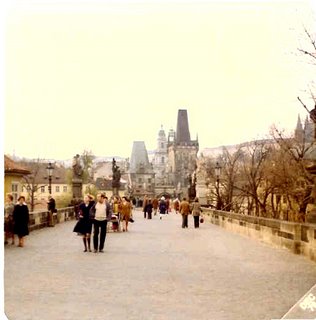
In late 1976 I visited Prague (right), the capital of what was then still called Czechoslovakia. Immediately I fell in love with this perfect jewel of a city, with many of its buildings dating back to the 14th century when the Emperor Charles IV made it his capital. Because it was spared the destruction of the two world wars, it still retained its character — at least at its centre. Of course, three decades ago the country was under the communists, whose rule affected the architecture constructed between 1948 and 1989. Prague thus offered a fascinating contrast within its own borders. On the one hand was the old city, constructed in grand style befitting the seat of an emperor.
On the other hand, the periphery of the city suffered from the blight of a dour stalinist architectural style imported from the Soviet Union. For communists any human touches to our homes, schools, workplaces and public buildings are deemed remnants of a decadent capitalism, to be replaced eventually by a sternly proletarian functionalism divorced from the realities of human communities and the relationships nurtured therein.
We can be grateful that the communists saw fit to retain the late mediaeval heart of Prague, rather than effacing it altogether as they did the former East Prussian city of Königsberg, now known as Kaliningrad. This suggests that, despite the depredations of a destructive worldview, the rulers of Czechoslovakia recognized the treasures they had inherited from their precommunist predecessors and rightly sought to preserve them for future generations.
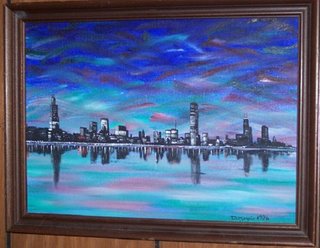
Yet there are places in the noncommunist western world where the architectural legacy of previous generations is too easily cast aside when economic imperatives dictate. For example, my home city of Chicago (above left in 1976) boasts some of the best known cutting-edge architecture in the world. However, in my personal library I have a nostalgic volume titled, Lost Chicago, by David Lowe, filled with more than 200 pages of photographs telling the sad story of a city's vanished heritage. Of course, some of this perished in the Great Fire of 1871, but most of it was deliberately destroyed to make way for something newer and ostensibly better.
Back in 1984, when the decision was made to demolish the old Chicago & Northwestern terminal on Madison and Canal Streets, and build in its place a metal and glass skyscraper to be called the Northwestern Atrium Center, I wrote a letter of protest to the Chicago Tribune, subsequently published in the 23 June issue of that year. Here is the letter, with which, apart from a few rhetorical flourishes, I still agree:
More than two decades later, as I look back on what I wrote then, it occurs to me that we need to address an important question: Given that we cannot and should not save every building that has ever been constructed, what criteria should we use to decide which to preserve and which to replace? I'd love to hear some discussion of this.
From ages 6 to 14 I aspired to become an architect. As a child I used to spend hours drawing floor plans of homes, fancying myself the heir of the great Frank Lloyd Wright, who once lived in the city of my birth, Oak Park, Illinois. Taking a drafting course in high school convinced me that architecture was not for me after all. Nevertheless, I still have an interest in the subject. When my niece married a Chicago architect a few months ago, he and I discovered we had much to talk about. Moreover, when some friends visited my home many years ago, they noticed that much of the art on my walls consisted of cityscapes and buildings. I hadn't put two and two together before that, but I realized then that I still care about the buildings where we live our lives from day to day. A week ago last friday Comment published a thoughtful article by David Greusel, Why architecture matters. It's a great piece and I can easily resonate with the concerns expressed therein.
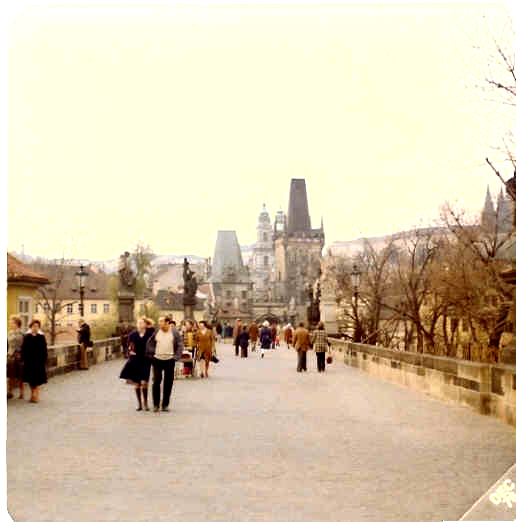
In late 1976 I visited Prague (right), the capital of what was then still called Czechoslovakia. Immediately I fell in love with this perfect jewel of a city, with many of its buildings dating back to the 14th century when the Emperor Charles IV made it his capital. Because it was spared the destruction of the two world wars, it still retained its character — at least at its centre. Of course, three decades ago the country was under the communists, whose rule affected the architecture constructed between 1948 and 1989. Prague thus offered a fascinating contrast within its own borders. On the one hand was the old city, constructed in grand style befitting the seat of an emperor.
On the other hand, the periphery of the city suffered from the blight of a dour stalinist architectural style imported from the Soviet Union. For communists any human touches to our homes, schools, workplaces and public buildings are deemed remnants of a decadent capitalism, to be replaced eventually by a sternly proletarian functionalism divorced from the realities of human communities and the relationships nurtured therein.
We can be grateful that the communists saw fit to retain the late mediaeval heart of Prague, rather than effacing it altogether as they did the former East Prussian city of Königsberg, now known as Kaliningrad. This suggests that, despite the depredations of a destructive worldview, the rulers of Czechoslovakia recognized the treasures they had inherited from their precommunist predecessors and rightly sought to preserve them for future generations.

Yet there are places in the noncommunist western world where the architectural legacy of previous generations is too easily cast aside when economic imperatives dictate. For example, my home city of Chicago (above left in 1976) boasts some of the best known cutting-edge architecture in the world. However, in my personal library I have a nostalgic volume titled, Lost Chicago, by David Lowe, filled with more than 200 pages of photographs telling the sad story of a city's vanished heritage. Of course, some of this perished in the Great Fire of 1871, but most of it was deliberately destroyed to make way for something newer and ostensibly better.
Back in 1984, when the decision was made to demolish the old Chicago & Northwestern terminal on Madison and Canal Streets, and build in its place a metal and glass skyscraper to be called the Northwestern Atrium Center, I wrote a letter of protest to the Chicago Tribune, subsequently published in the 23 June issue of that year. Here is the letter, with which, apart from a few rhetorical flourishes, I still agree:
It saddens me to see the stately old Chicago & Northwestern terminal about to be demolished. To try to soften the blow, the railroad has put up signs and banners cheerily proclaiming, "We're on our way up," meaning, of course, that where the old station now stands will soon be erected yet another of those characterless glass office buildings with an enclosed shopping court at its base. One more link with the city's past will have been sacrificed barbarously at the altar of progress and the almighty dollar.
Chicago is rather like a vain movie star, afraid to let the world see the signs of its age and refusing to grow old gracefully. Every generation the city seems compelled to undergo a facelift, allowing itself to live on an illusion of perpetual youth while eradicating any continuity with its own past. Not every building should be preserved merely because it is old, of course, but the reckless compulsion to destroy and rebuild is not healthy either. Not only has such a city lost touch with its own soul, but it is hardly acting as a fit caretaker and steward of the valuable resources and treasures bequeathed by past generations. When will Chicago learn to value its own heritage instead of glorifying its rootlessness?
More than two decades later, as I look back on what I wrote then, it occurs to me that we need to address an important question: Given that we cannot and should not save every building that has ever been constructed, what criteria should we use to decide which to preserve and which to replace? I'd love to hear some discussion of this.
02 August 2006
A familiar suburb and memory lane
Jordan J. Ballor links to this article by Joel Kotkin: The New Suburbanism. In addition to the substantive analysis in Kotkin's article, the following jumped out at me:
Ah, the sweet memory this brings back. The Naperville Riverwalk is where I proposed to my wife just over 11 years ago — next to a tree with seven trunks.
Jordan J. Ballor links to this article by Joel Kotkin: The New Suburbanism. In addition to the substantive analysis in Kotkin's article, the following jumped out at me:
Chicago-area developer David Fanagel . . . calls Naperville, a vibrant community of 138,000 some 30 miles southwest of Chicago, “a slam dunk” for suburban-village development because of its surviving cluster of historic buildings and surrounding expanse of single-family homes. Largely populated by white-collar families, the city has worked assiduously to develop its old downtown, adding new apartments and stores and creating an attractive esplanade called Riverwalk along the winding west branch of the DuPage River adjacent to its center.
Ah, the sweet memory this brings back. The Naperville Riverwalk is where I proposed to my wife just over 11 years ago — next to a tree with seven trunks.
31 July 2006
Love that sprawl: a (severely) qualified defence of the suburbs
Back in 1962 Malvina Reynolds wrote and sang a song, Little Boxes, that hit the charts that year and was further popularized the next year by Pete Seeger. Its memorable lyrics poked fun at the standardizing conformity of post-war suburban life in the United States:
I was in the lower elementary grades at the time, living — horror of horrors — in one of the western suburbs of Chicago: Wheaton, Illinois. I recall the song, and I can still sing at least some of it from memory, but its biting social commentary largely went over my head at the time.
Reynolds was not the first to look down on the suburbs. Ernest Hemingway is reputed to have said that his native village of Oak Park, just outside Chicago (and where yours truly happens to have been born), was characterized by "broad lawns and narrow minds." Countless books and films have made the suburbs look like fabricated, but fundamentally false, communities, where neighbours live adjacent to each other, but without forming lasting bonds of solidarity. Everyone, as the cliché puts it, tries to "keep up with the Joneses," i.e., to acquire that more expensive gas grill or to join the more exclusive country club.
I was inspired to reflect further on suburbia by this post from our resident Latin-rite Calvinist. As a product of the suburbs, I can attest to both their advantages and drawbacks.
Advantages: (1) As the central cores of American cities deteriorated, the suburbs offered a refuge where a way of life could be started anew. (2) They offered some of the virtues of both urban and rural life. The urban metropolis was never far away, especially if the suburb was served by a rail line or, later, one of the new limited-access highways begun in the 1950s and '60s. Yet there were often open spaces and farms outside of town. This was the case with Wheaton when I was growing up, though it's no longer true four decades later. (3) It seemed to be a good place to raise children. Wheaton had plenty of parks, and the public schools were amongst the best anywhere. (4) Although this was not true everywhere in the US, Wheaton had (and continues to have) thriving churches representing a variety of denominations.
Drawbacks: (1) The suburbs were just a tad too comfortable, especially the more prosperous ones. The social climate encouraged parental indulgence of children, who would grow up into the self-absorbed baby boomers, many of whom thought it their right not to grow up at all, at least with respect to manners, mores and dress. (2) The suburbs often contributed to the deterioration of city centres when those fleeing to the 'burbs took the tax base with them. This led to a situation in which residents of Wheaton, Evanston and Oak Park would commute into Chicago, using its services but contributing nothing to their upkeep, because only those actually living in Chicago were taxed. This has been less of a problem in Ontario, where regional or metropolitan governments are authorized to tax.
So what do we do with the peripheries of metropolitan areas? To begin with, they are not going to go away, the wishes of the Reynoldses, Seegers and Hemingways notwithstanding. As long as there have been cities, there have been people living at their edges. In third-world cities these take the form of shanty towns, inhabited by those who have left the countryside to seek work in the industries often associated with urban centres. But these are the polar opposite of the comfortable suburbs of North America and elsewhere in the western world, and they deserve to be treated as phenomena in their own right.
The place to start is to recognize that human settlement patterns are legitimately diverse, encompassing city centres, other urban neighbourhoods, near suburbs, far suburbs (near and far being relative to the available transportation), rural regions and small towns and villages. Each of these has its own beauty and integrity. Similarly each is in its own way subject to human sinfulness. There is nothing intrinsic to any of these settlement patterns that will insulate residents from the ravages of the fall. Nor should we wish to see any one of these squeeze the others out of existence.
I myself am currently living in a part of Hamilton, Ontario, that is generally considered to be suburban — that is, the part of the city above the escarpment popularly, if misleadingly, known as Hamilton Mountain. However, one of the benefits of living where we do is that we are within walking distance of two pharmacies, a supermarket, a variety store, a dry cleaner, a dollar store and the enormously popular Sweet Paradise Bakery. This is not generally characteristic of suburbia, where one must have an automobile to get anywhere at all.
Indeed, to my mind, the fact that suburbs are built around car ownership is one of the chief drawbacks of these communities. I think I was probably happiest living in the centre of Toronto nearly thirty years ago, where I didn't need a car. I was quite content to ride the trams, buses and subways, which would take me anywhere I wanted to go within the city. I could wish, among other things, that suburban areas would take more seriously the need for public transportation so as to diminish residents' dependence on the automobile.
So what is to be done. . . about the suburbs? Do they need renewal? Definitely. What shape should this take? That's for a future post.
Back in 1962 Malvina Reynolds wrote and sang a song, Little Boxes, that hit the charts that year and was further popularized the next year by Pete Seeger. Its memorable lyrics poked fun at the standardizing conformity of post-war suburban life in the United States:
Little boxes on the hillside,
Little boxes made of ticky tacky,
Little boxes on the hillside,
Little boxes all the same.
There's a green one and a pink one
And a blue one and a yellow one,
And they're all made out of ticky tacky
And they all look just the same.
I was in the lower elementary grades at the time, living — horror of horrors — in one of the western suburbs of Chicago: Wheaton, Illinois. I recall the song, and I can still sing at least some of it from memory, but its biting social commentary largely went over my head at the time.
Reynolds was not the first to look down on the suburbs. Ernest Hemingway is reputed to have said that his native village of Oak Park, just outside Chicago (and where yours truly happens to have been born), was characterized by "broad lawns and narrow minds." Countless books and films have made the suburbs look like fabricated, but fundamentally false, communities, where neighbours live adjacent to each other, but without forming lasting bonds of solidarity. Everyone, as the cliché puts it, tries to "keep up with the Joneses," i.e., to acquire that more expensive gas grill or to join the more exclusive country club.
I was inspired to reflect further on suburbia by this post from our resident Latin-rite Calvinist. As a product of the suburbs, I can attest to both their advantages and drawbacks.
Advantages: (1) As the central cores of American cities deteriorated, the suburbs offered a refuge where a way of life could be started anew. (2) They offered some of the virtues of both urban and rural life. The urban metropolis was never far away, especially if the suburb was served by a rail line or, later, one of the new limited-access highways begun in the 1950s and '60s. Yet there were often open spaces and farms outside of town. This was the case with Wheaton when I was growing up, though it's no longer true four decades later. (3) It seemed to be a good place to raise children. Wheaton had plenty of parks, and the public schools were amongst the best anywhere. (4) Although this was not true everywhere in the US, Wheaton had (and continues to have) thriving churches representing a variety of denominations.
Drawbacks: (1) The suburbs were just a tad too comfortable, especially the more prosperous ones. The social climate encouraged parental indulgence of children, who would grow up into the self-absorbed baby boomers, many of whom thought it their right not to grow up at all, at least with respect to manners, mores and dress. (2) The suburbs often contributed to the deterioration of city centres when those fleeing to the 'burbs took the tax base with them. This led to a situation in which residents of Wheaton, Evanston and Oak Park would commute into Chicago, using its services but contributing nothing to their upkeep, because only those actually living in Chicago were taxed. This has been less of a problem in Ontario, where regional or metropolitan governments are authorized to tax.
So what do we do with the peripheries of metropolitan areas? To begin with, they are not going to go away, the wishes of the Reynoldses, Seegers and Hemingways notwithstanding. As long as there have been cities, there have been people living at their edges. In third-world cities these take the form of shanty towns, inhabited by those who have left the countryside to seek work in the industries often associated with urban centres. But these are the polar opposite of the comfortable suburbs of North America and elsewhere in the western world, and they deserve to be treated as phenomena in their own right.
The place to start is to recognize that human settlement patterns are legitimately diverse, encompassing city centres, other urban neighbourhoods, near suburbs, far suburbs (near and far being relative to the available transportation), rural regions and small towns and villages. Each of these has its own beauty and integrity. Similarly each is in its own way subject to human sinfulness. There is nothing intrinsic to any of these settlement patterns that will insulate residents from the ravages of the fall. Nor should we wish to see any one of these squeeze the others out of existence.
I myself am currently living in a part of Hamilton, Ontario, that is generally considered to be suburban — that is, the part of the city above the escarpment popularly, if misleadingly, known as Hamilton Mountain. However, one of the benefits of living where we do is that we are within walking distance of two pharmacies, a supermarket, a variety store, a dry cleaner, a dollar store and the enormously popular Sweet Paradise Bakery. This is not generally characteristic of suburbia, where one must have an automobile to get anywhere at all.
Indeed, to my mind, the fact that suburbs are built around car ownership is one of the chief drawbacks of these communities. I think I was probably happiest living in the centre of Toronto nearly thirty years ago, where I didn't need a car. I was quite content to ride the trams, buses and subways, which would take me anywhere I wanted to go within the city. I could wish, among other things, that suburban areas would take more seriously the need for public transportation so as to diminish residents' dependence on the automobile.
So what is to be done. . . about the suburbs? Do they need renewal? Definitely. What shape should this take? That's for a future post.
11 May 2005
The Encyclopedia of Chicago
Having lived in Canada for two decades, I can testify that Americans rather easily assimilate into this country, due to the considerable cultural similarities between the two countries, including (for the most part) a common language. If there were such a thing as an ex-pat American club in Toronto, I would not join, as I do not see myself having much in common with people from, say, New York, California or Texas.
However, if there were a Chicago club in our vicinity, I would seriously think of joining. After all, I was born just outside the "Windy City" in Oak Park, Illinois, home of such luminaries as Frank Lloyd Wright and Ernest Hemingway, and grew up in Wheaton, 25 miles west of the Loop, as the downtown core is popularly known. Like General Robert E. Lee of Virginia or Québécois nationalists (with whom I otherwise disagree politically), I can identify more easily with the local homeland of my birth than with the United States as a whole, which to me feels somewhat abstract.
For those of us with roots in Chicagoland, the University of Chicago Press has published a massive one-volume Encyclopedia of Chicago, which I just received as a gift from my exceedingly thoughtful sister-in-law and her husband, residents of one of the western suburbs of the great metropolis. It is the product of a co-operative effort between the Chicago Historical Society and the Newberry Library, and is edited by James R. Grossman, Ann Durkin Keating and Janice L. Reiff.

It contains more than a thousand pages of entries covering everything from the city's individual neighbourhoods to virtually every one of the hundreds of suburbs in the ten-county region comprising the Chicago metropolitan area. There is an index of prominent persons in Chicago's history, as well as one listing the major economic enterprises operating in the vicinity, from the long gone Elgin National Watch Company to Marshall Field and Company, until recently the region's major department store chain. Favourite television programmes, such as Garfield Goose and Friends and Bozo's Circus, have entries. The area's colleges and universities also have their own entries, including Wheaton College and, of course, the University of Chicago. Then there are the maps, which are a treat for the cartophile. And of course no book about Chicago would be complete without material devoted to its colourful political and criminal history as well as to its rail transportation.
I have located only a few errors of fact thus far, e.g., Pope Leo XIII's Rerum Novarum was published in 1891, not 1893. (This is in the entry on Roman Catholics.) My principal criticism is that some items are classified under titles that wouldn't immediately come to mind. For example, in looking for an article on Chicago neighbourhoods, I found them classified under community areas. All the same, the book is a pleasure to peruse — at least for those of us with origins there.
As of today the Encyclopedia of Chicago has gone on-line. Its website is a little clunky and appears still to be under construction. The search function in particular seems not to have been enabled. Once it is fully operational, however, it will likely prove to be an invaluable resource for those interested in the past and present of America's second city. We owe a debt of gratitude to the many people who devoted such loving attention to this volume and its associated website.
Having lived in Canada for two decades, I can testify that Americans rather easily assimilate into this country, due to the considerable cultural similarities between the two countries, including (for the most part) a common language. If there were such a thing as an ex-pat American club in Toronto, I would not join, as I do not see myself having much in common with people from, say, New York, California or Texas.
However, if there were a Chicago club in our vicinity, I would seriously think of joining. After all, I was born just outside the "Windy City" in Oak Park, Illinois, home of such luminaries as Frank Lloyd Wright and Ernest Hemingway, and grew up in Wheaton, 25 miles west of the Loop, as the downtown core is popularly known. Like General Robert E. Lee of Virginia or Québécois nationalists (with whom I otherwise disagree politically), I can identify more easily with the local homeland of my birth than with the United States as a whole, which to me feels somewhat abstract.
For those of us with roots in Chicagoland, the University of Chicago Press has published a massive one-volume Encyclopedia of Chicago, which I just received as a gift from my exceedingly thoughtful sister-in-law and her husband, residents of one of the western suburbs of the great metropolis. It is the product of a co-operative effort between the Chicago Historical Society and the Newberry Library, and is edited by James R. Grossman, Ann Durkin Keating and Janice L. Reiff.
It contains more than a thousand pages of entries covering everything from the city's individual neighbourhoods to virtually every one of the hundreds of suburbs in the ten-county region comprising the Chicago metropolitan area. There is an index of prominent persons in Chicago's history, as well as one listing the major economic enterprises operating in the vicinity, from the long gone Elgin National Watch Company to Marshall Field and Company, until recently the region's major department store chain. Favourite television programmes, such as Garfield Goose and Friends and Bozo's Circus, have entries. The area's colleges and universities also have their own entries, including Wheaton College and, of course, the University of Chicago. Then there are the maps, which are a treat for the cartophile. And of course no book about Chicago would be complete without material devoted to its colourful political and criminal history as well as to its rail transportation.
I have located only a few errors of fact thus far, e.g., Pope Leo XIII's Rerum Novarum was published in 1891, not 1893. (This is in the entry on Roman Catholics.) My principal criticism is that some items are classified under titles that wouldn't immediately come to mind. For example, in looking for an article on Chicago neighbourhoods, I found them classified under community areas. All the same, the book is a pleasure to peruse — at least for those of us with origins there.
As of today the Encyclopedia of Chicago has gone on-line. Its website is a little clunky and appears still to be under construction. The search function in particular seems not to have been enabled. Once it is fully operational, however, it will likely prove to be an invaluable resource for those interested in the past and present of America's second city. We owe a debt of gratitude to the many people who devoted such loving attention to this volume and its associated website.
08 March 2005
Urbanists and agrarians together: time for dialogue?
A few weeks ago my tonge-in-cheek reference to young neocalvinists as "neo-calves" prompted a comment that, since neocalvinists tend to be urbanists, a bovine metaphor might not be appreciated. But is this a fair characterization of the neocalvinist position? Do neocalvinists invariably fall into the urbanist camp in opposition to agrarians? My part-time colleague and co-conspirator, Gideon Strauss, has repeatedly advocated a new urbanism focussing on the health and well-being of our urban centres. Yet it might be more accurate to observe that the neocalvinist vision, with which I have been associated for thirty years, is one which celebrates the balanced and proportionate development of society, including its urban and rural communities. I myself understand the pull of the large city, having lived for two years in Toronto in the late 1970s and having grown up near the fabled "windy city" of Chicago, with its magnificent waterfront, famed architecture and world-class museums.
At the same time it would hardly be right to downplay the significant role played by our small towns and farming communities, without which no society could survive. Two organizations here in Canada, rooted in the neocalvinist vision, have taken up the responsibility for caring for the earth and cultivating an awareness of the farmer's calling to fulfil that part of the cultural mandate known as agriculture. The first of these is the Christian Farmers Federation of Ontario, led by Elbert van Donkersgoed. The second of these used to be known as the Christian Farmers Federation of Alberta, but in 1992 changed its name to Earthkeeping: Food and Agriculture in Christian Perspective. (I was unable to locate a website for this group.) Both have their origins in the neocalvinist movement, as indicated in this historical essay by John L. Paterson, "Institutional Organization, Stewardship, and Religious Resistance to Modern Agricultural Trends: The Christian Farmers’ Movement in the Netherlands and in Canada."
A disporportionate emphasis on either urbanism or agrarianism at the other's expense does so at the risk of failing to recognize the normative complementarity between urban and agrarian communities. The principal issue, as I see it, is how to achieve the proper balance. Over the past century the proportion of the population engaged in agriculture as a livelihood has steadily diminished in most western countries. Is this a good or bad thing? Is it a consequence of normative differentiation or has it dangerously deprived us of the human virtues that accompany hard physical labour and a life close to the soil? What of the steady encroachment of the city on the countryside, poignantly illustrated by Virginia Lee Burton in her classic children's book, The Little House? Is this an inevitable development or ought there to be efforts to guarantee green spaces in perpetuity for the benefit of future generations?
These are the issues we need to grapple with. Too easily identifying ourselves as either urbanists or agrarians would seem to prejudice the discussion before it has even started.
A few weeks ago my tonge-in-cheek reference to young neocalvinists as "neo-calves" prompted a comment that, since neocalvinists tend to be urbanists, a bovine metaphor might not be appreciated. But is this a fair characterization of the neocalvinist position? Do neocalvinists invariably fall into the urbanist camp in opposition to agrarians? My part-time colleague and co-conspirator, Gideon Strauss, has repeatedly advocated a new urbanism focussing on the health and well-being of our urban centres. Yet it might be more accurate to observe that the neocalvinist vision, with which I have been associated for thirty years, is one which celebrates the balanced and proportionate development of society, including its urban and rural communities. I myself understand the pull of the large city, having lived for two years in Toronto in the late 1970s and having grown up near the fabled "windy city" of Chicago, with its magnificent waterfront, famed architecture and world-class museums.
At the same time it would hardly be right to downplay the significant role played by our small towns and farming communities, without which no society could survive. Two organizations here in Canada, rooted in the neocalvinist vision, have taken up the responsibility for caring for the earth and cultivating an awareness of the farmer's calling to fulfil that part of the cultural mandate known as agriculture. The first of these is the Christian Farmers Federation of Ontario, led by Elbert van Donkersgoed. The second of these used to be known as the Christian Farmers Federation of Alberta, but in 1992 changed its name to Earthkeeping: Food and Agriculture in Christian Perspective. (I was unable to locate a website for this group.) Both have their origins in the neocalvinist movement, as indicated in this historical essay by John L. Paterson, "Institutional Organization, Stewardship, and Religious Resistance to Modern Agricultural Trends: The Christian Farmers’ Movement in the Netherlands and in Canada."
A disporportionate emphasis on either urbanism or agrarianism at the other's expense does so at the risk of failing to recognize the normative complementarity between urban and agrarian communities. The principal issue, as I see it, is how to achieve the proper balance. Over the past century the proportion of the population engaged in agriculture as a livelihood has steadily diminished in most western countries. Is this a good or bad thing? Is it a consequence of normative differentiation or has it dangerously deprived us of the human virtues that accompany hard physical labour and a life close to the soil? What of the steady encroachment of the city on the countryside, poignantly illustrated by Virginia Lee Burton in her classic children's book, The Little House? Is this an inevitable development or ought there to be efforts to guarantee green spaces in perpetuity for the benefit of future generations?
These are the issues we need to grapple with. Too easily identifying ourselves as either urbanists or agrarians would seem to prejudice the discussion before it has even started.
01 October 2004
The all-American sport
For someone who is not a baseball fan, I've been to more professional games than I can count. The earliest was in the old Comiskey Park, home of the Chicago White Sox, sometime in the early 1960s. The most recent was probably close to two decades ago, but in between times I attended scores of games in different cities. Usually this was with family members who were fonder of the game than I. To be sure, I will admit to having enjoyed these times, but I generally paid little attention to what was going on down on the field, content instead either to converse with the people I was with or simply to soak up the quintessential American cultural experience.
All the same, it's difficult not to get caught up in something of the romance of the sport. Back in the middle years of the last century, pro baseball was exclusively a northeastern and middle-western sport. A list of the teams in 1932 illustrates this: in the National League were the Chicago Cubs, Pittsburgh Pirates, Brooklyn Dodgers, Philadelphia Phillies, Boston Braves, New York Giants, St. Louis Cardinals and Cincinnati Reds; in the American League, the New York Yankees, the Philadelphia Athletics, Washington Senators, Cleveland Indians, Detroit Tigers, St. Louis Browns, Chicago White Sox and the Boston Red Sox. Chicago, Boston, Philadelphia and St. Louis each had two teams, and New York had three. This was before a series of moves in the 1950s and later sent a number of teams south and west. As a result of this and of the creation of new teams, baseball became even more all-American than it had been before, since it was more widely dispersed across the country. It eventually moved north of the border, with the Blue Jays and Expos. There was even a musical play and subsequent movie, Damn Yankees, about the obsessiveness of a Senators fan who sells his soul to the devil to see his favourite team win the World Series.
When I was around 17 years old our family became friends with a Cubs pitcher and his family who lived down the street from us. For the next year or so our two families spent a fair amount of time at the venerable Wrigley Field, sitting down in the section closest to the game with the other players' families while he was out on the field. We even had Ernie Banks and his ex-wife at our house once. As a result of this some of my younger siblings became ardent baseball fans. As for me, I was by then a little too old for all this to have had too great an impact. I hadn't been a fan up to that point and I wasn't all that interested in becoming one, though I was content to attend the games.

Keiichiro
Wrigley Field, Chicago
I can't say I've thought too long and hard about baseball since those days of my youth. But the news that Canada will now have only one baseball team brought some of this back to mind.
One final thought in this rather stream-of-consciousness reflection on a game on which I am not all that keen. My hometown of Chicago is reputed to have the teams with the worst records in baseball. I have in my drawer a t-shirt which is entirely too small for me now but which I sometimes wear when gardening. On the front is emblazoned the proud words: "CHICAGO WHITE SOX, WORLD CHAMPIONS, 1918." I suppose that says it all.
For someone who is not a baseball fan, I've been to more professional games than I can count. The earliest was in the old Comiskey Park, home of the Chicago White Sox, sometime in the early 1960s. The most recent was probably close to two decades ago, but in between times I attended scores of games in different cities. Usually this was with family members who were fonder of the game than I. To be sure, I will admit to having enjoyed these times, but I generally paid little attention to what was going on down on the field, content instead either to converse with the people I was with or simply to soak up the quintessential American cultural experience.
All the same, it's difficult not to get caught up in something of the romance of the sport. Back in the middle years of the last century, pro baseball was exclusively a northeastern and middle-western sport. A list of the teams in 1932 illustrates this: in the National League were the Chicago Cubs, Pittsburgh Pirates, Brooklyn Dodgers, Philadelphia Phillies, Boston Braves, New York Giants, St. Louis Cardinals and Cincinnati Reds; in the American League, the New York Yankees, the Philadelphia Athletics, Washington Senators, Cleveland Indians, Detroit Tigers, St. Louis Browns, Chicago White Sox and the Boston Red Sox. Chicago, Boston, Philadelphia and St. Louis each had two teams, and New York had three. This was before a series of moves in the 1950s and later sent a number of teams south and west. As a result of this and of the creation of new teams, baseball became even more all-American than it had been before, since it was more widely dispersed across the country. It eventually moved north of the border, with the Blue Jays and Expos. There was even a musical play and subsequent movie, Damn Yankees, about the obsessiveness of a Senators fan who sells his soul to the devil to see his favourite team win the World Series.
When I was around 17 years old our family became friends with a Cubs pitcher and his family who lived down the street from us. For the next year or so our two families spent a fair amount of time at the venerable Wrigley Field, sitting down in the section closest to the game with the other players' families while he was out on the field. We even had Ernie Banks and his ex-wife at our house once. As a result of this some of my younger siblings became ardent baseball fans. As for me, I was by then a little too old for all this to have had too great an impact. I hadn't been a fan up to that point and I wasn't all that interested in becoming one, though I was content to attend the games.
Keiichiro
Wrigley Field, Chicago
I can't say I've thought too long and hard about baseball since those days of my youth. But the news that Canada will now have only one baseball team brought some of this back to mind.
One final thought in this rather stream-of-consciousness reflection on a game on which I am not all that keen. My hometown of Chicago is reputed to have the teams with the worst records in baseball. I have in my drawer a t-shirt which is entirely too small for me now but which I sometimes wear when gardening. On the front is emblazoned the proud words: "CHICAGO WHITE SOX, WORLD CHAMPIONS, 1918." I suppose that says it all.
25 August 2004
Planned cities and new beginnings
As a child I had aspirations to be an architect and perhaps even a city planner. I was particularly enthralled by an article in the May 1960 issue of National Geographic titled, "Metropolis Made to Order: Brasília," about the construction of a new capital city for Brazil. It was filled with photographs and illustrations of half-constructed buildings, including those housing the three branches of government, the various ministries, a cultural centre, commercial and banking establishments, residences, schools, and even a large teepee-like cathedral. Two aerial diagrams showed a symmetrical city spread out along a lake and resembling the torso and wings of a giant bird. Extensive green spaces carved out of the hinterland separated the buildings, undoubtedly making it rather taxing for would-be pedestrians.

John de Garis
Congressional buildings, Brasília
What a fascinating notion: building a city from scratch out of a wilderness! It seemed such a daring and exciting venture. I immediately set about trying to design capital cities of my own for fictitious countries of my devising. None of these boyish designs survive, so I can no longer recall what they looked like. But I rather think they shared many of the qualities of Brasília itself, excepting the huge expense.
I would eventually learn that the notion of a planned capital city was by no means new. It had been done before and it would be attempted again. In one of the earliest efforts the Emperor Constantine the Great moved his capital from Rome to a new Rome built on the foundations of ancient Byzantium, to be rechristened Constantinople. It would serve as a capital of the Roman and Ottoman Empires successively until 1924. In 1703 Russia's Peter the Great built a new capital on the banks of the Neva River and the shores of the Baltic Sea -- on land recently seized from Sweden. St. Petersburg ("Sankt Pieterburg") supplanted old Moscow and the Emperor forced Muscovite nobles to pull up roots and move to his new city. The fact that it was so vulnerable militarily would come back to haunt its residents some 240 years later when the nazis besieged what was then called Leningrad for 900 horrible days.
Two hundred years ago the United States built a new capital on the shores of the Potomac River in land detached from Maryland and Virginia. (The segment from Virginia was later returned to that state.) In the 20th century Australia built Canberra and Pakistan built Islamabad as the centres of their respective governments.

http://www.eryptick.net/
Parliament, Canberra, Australia
Nowadays I am less interested in the physical undertaking of building a new capital city than in what it symbolizes, namely, a new political beginning. Constantine built Constantinople in part to mark the adoption of a new religion for his empire. Old Rome was irretrievably pagan; new Rome was established as a christian city for a christianized empire. Peter the Great founded St. Petersburg as a symbol of a new Russia oriented towards western Europe. That neither imperial Rome nor imperial Russia fully put aside the old ways is immaterial. The very abandonment of the old capital represented an intention to break with tradition as fully as possible.
Rome and Russia were already ancient realms by the time their new capitals were chosen. However, the fledgling United States, formed in 1787 out of the 13 states which had so recently broken with the British Crown, required a new capital to correspond to its own newness. Its very name, honouring the first president, George Washington, carried the hopes and aspirations of the new federal republic. Much as Washington set the tone for his presidential successors, the building of the city of Washington would come to characterize the seemingly limitless possibilities of a country already expanding west beyond the Appalachian frontier.
And what of Brasília? From the time of independence in the 19th century, Brazil's rulers had wanted to settle the vast interior of the country. When republic replaced empire in 1889, an interior location was set aside for a prospective new capital city. However, not until 1956 were concrete steps taken in this direction. In 1960 Brasília replaced Rio de Janeiro as the centre of the federal government. Like all cities, it has never been entirely completed and undoubtedly never will be. Sad to say, however, only four years after Brasília's inauguration, a military coup dislodged the civilian government and misruled Brazil until 1985. Did the grand effort of planning a new city in a relatively poor country impair the political system's functioning, making it ripe for an authoritarian government? Perhaps.
I myself tend to wonder whether such a tangible symbol of breaking with the past might tend to mislead citizens into believing that they really have done so -- that they have succeeded in putting aside their own traditions, good and bad, and embracing entirely new ones created, as it were, ex nihilo. Even revolutions, such as the French and the Russian, change far less in the political culture than their proponents would like to see. The old ways are simply carried into the new capital or the new régime. I also wonder whether the resources employed to build a new capital might have been put to use in less spectacular pursuits that would nevertheless better have served the public interest.
Yes, there is an undeniable excitement in a national effort to build a new capital city from scratch. But justice is more likely to be found in the ordinary activities of a government conciliating diverse interests than in a government bent on capturing its citizens' imaginations and mobilizing them for flashy, expensive projects not immediately related to their genuine needs.
As a child I had aspirations to be an architect and perhaps even a city planner. I was particularly enthralled by an article in the May 1960 issue of National Geographic titled, "Metropolis Made to Order: Brasília," about the construction of a new capital city for Brazil. It was filled with photographs and illustrations of half-constructed buildings, including those housing the three branches of government, the various ministries, a cultural centre, commercial and banking establishments, residences, schools, and even a large teepee-like cathedral. Two aerial diagrams showed a symmetrical city spread out along a lake and resembling the torso and wings of a giant bird. Extensive green spaces carved out of the hinterland separated the buildings, undoubtedly making it rather taxing for would-be pedestrians.
John de Garis
Congressional buildings, Brasília
What a fascinating notion: building a city from scratch out of a wilderness! It seemed such a daring and exciting venture. I immediately set about trying to design capital cities of my own for fictitious countries of my devising. None of these boyish designs survive, so I can no longer recall what they looked like. But I rather think they shared many of the qualities of Brasília itself, excepting the huge expense.
I would eventually learn that the notion of a planned capital city was by no means new. It had been done before and it would be attempted again. In one of the earliest efforts the Emperor Constantine the Great moved his capital from Rome to a new Rome built on the foundations of ancient Byzantium, to be rechristened Constantinople. It would serve as a capital of the Roman and Ottoman Empires successively until 1924. In 1703 Russia's Peter the Great built a new capital on the banks of the Neva River and the shores of the Baltic Sea -- on land recently seized from Sweden. St. Petersburg ("Sankt Pieterburg") supplanted old Moscow and the Emperor forced Muscovite nobles to pull up roots and move to his new city. The fact that it was so vulnerable militarily would come back to haunt its residents some 240 years later when the nazis besieged what was then called Leningrad for 900 horrible days.
Two hundred years ago the United States built a new capital on the shores of the Potomac River in land detached from Maryland and Virginia. (The segment from Virginia was later returned to that state.) In the 20th century Australia built Canberra and Pakistan built Islamabad as the centres of their respective governments.
http://www.eryptick.net/
Parliament, Canberra, Australia
Nowadays I am less interested in the physical undertaking of building a new capital city than in what it symbolizes, namely, a new political beginning. Constantine built Constantinople in part to mark the adoption of a new religion for his empire. Old Rome was irretrievably pagan; new Rome was established as a christian city for a christianized empire. Peter the Great founded St. Petersburg as a symbol of a new Russia oriented towards western Europe. That neither imperial Rome nor imperial Russia fully put aside the old ways is immaterial. The very abandonment of the old capital represented an intention to break with tradition as fully as possible.
Rome and Russia were already ancient realms by the time their new capitals were chosen. However, the fledgling United States, formed in 1787 out of the 13 states which had so recently broken with the British Crown, required a new capital to correspond to its own newness. Its very name, honouring the first president, George Washington, carried the hopes and aspirations of the new federal republic. Much as Washington set the tone for his presidential successors, the building of the city of Washington would come to characterize the seemingly limitless possibilities of a country already expanding west beyond the Appalachian frontier.
And what of Brasília? From the time of independence in the 19th century, Brazil's rulers had wanted to settle the vast interior of the country. When republic replaced empire in 1889, an interior location was set aside for a prospective new capital city. However, not until 1956 were concrete steps taken in this direction. In 1960 Brasília replaced Rio de Janeiro as the centre of the federal government. Like all cities, it has never been entirely completed and undoubtedly never will be. Sad to say, however, only four years after Brasília's inauguration, a military coup dislodged the civilian government and misruled Brazil until 1985. Did the grand effort of planning a new city in a relatively poor country impair the political system's functioning, making it ripe for an authoritarian government? Perhaps.
I myself tend to wonder whether such a tangible symbol of breaking with the past might tend to mislead citizens into believing that they really have done so -- that they have succeeded in putting aside their own traditions, good and bad, and embracing entirely new ones created, as it were, ex nihilo. Even revolutions, such as the French and the Russian, change far less in the political culture than their proponents would like to see. The old ways are simply carried into the new capital or the new régime. I also wonder whether the resources employed to build a new capital might have been put to use in less spectacular pursuits that would nevertheless better have served the public interest.
Yes, there is an undeniable excitement in a national effort to build a new capital city from scratch. But justice is more likely to be found in the ordinary activities of a government conciliating diverse interests than in a government bent on capturing its citizens' imaginations and mobilizing them for flashy, expensive projects not immediately related to their genuine needs.
28 July 2004
Athens, Constantinople and the victory of nationalism
One of the things that struck me when I first visited Athens in 1975 was its sheer newness. Unlike many European cities, which are centuries old and have substantial sections dating back to their earliest days, Athens has the feel of a modern industrial city. This surprised me. After all, Athens was supposed to be an ancient city, whose heritage included Solon, Pericles, Socrates, Plato and Aristotle. It was known to be the birthplace of democracy and the centre of the classical Greek world.
To be sure, all of these elements were there, and Athenians are justifiably proud of the vestiges of this earlier history. However, the city itself could not boast a continuous existence as an urban metropolis. Indeed for long centuries, extending well into the 19th, Athens was a sleepy Turkish village consisting only of the neighbourhood known as the Plaka, nestled at the base of the Acropolis, and the various ancient ruins scattered around the vicinity. The modern Greek capital was "invented" in 1834, the very year Toronto was incorporated as a city and the year after Chicago was started.

Gauntlet
Athens
The Greek revolt against the Ottoman Turks broke out in 1821 and continued throughout the following decade. Nearly ten years later the Greeks had won the support of the European powers, but not for all of their aspirations. The Ottoman Empire would not be supplanted by a revived Byzantine Empire centred in "The City," i.e., Constantinople. Rather a small Kingdom of Greece was created at the very foot of the Balkan Peninsula -- much smaller than today's Greek Republic. The majority of ethnic Greeks remained within the boundaries of the Ottoman Empire, while a minority were left to create a Greek state in land that was largely a rural backwater. The major centres of Greek culture at the time -- Thessaloniki, Constantinople, Smyrna and Alexandria -- remained on the outside. The seaside town of Navplion was chosen as the first capital and a junior member of the Bavarian Wittelsbach dynasty became its first king.
The small territory of this new Greek kingdom just happened to include Athens, an unimposing village long since lapsed into obscurity, but with a luminous history in the distant past. In 1834 the government of the kingdom decided to move the capital from Navplion to this unpromising location in deference to its classical heritage.
Yet well into the 20th century, Constantinople remained The City, the real urban centre of Greek civilization. To be sure, many Greek Orthodox Christians moved to the new Greek kingdom to be free of Turkish rule. But just as often, if not more so, Greeks moved in the other direction: to the more prosperous urban centres within the Ottoman Empire, where they were more likely to be able to make a comfortable living. These cities were Turkish, but not in an ethnic sense. They were in fact polyglot and had been for many centuries. In Constantinople itself one was likely to hear many languages spoken in the street, Greek being especially prominent. Constantinopolitan Greeks saw Athens as an upstart, unlikely to take the place of this ancient second capital of imperial Rome.

Texas Tech University
Constantinople
However, the 20th century saw the beginning of the end for these polyglot cities. The Treaty of Lausanne fixed the boundary between Greece and Turkey. Those on the wrong side of this arbitrary border were sent packing. After Naser had come to power in Egypt in 1952, Greeks were no longer welcome in Alexandria and began to leave. After Turkish authorities stood by and did nothing to stop an anti-Greek pogrom in Istanbul in September 1955, Greeks started to leave The City, moving to Greece or North America or Australia. Istanbul became ethnically Turkish. Thessaloniki had become wholly Greek, although it had boasted a large Jewish population prior to the Second World War. Smyrna was destroyed in 1922, its polyglot character eliminated during the massacre in September of that year.
The old empires are gone. Artificially contrived nation-states have taken their place. Millions of refugees were created in the process. Citizenship has come to be tied to ethnicity and not to territory of birth. Is this progress? Nationalists would say yes. Greater homogeneity has been effected, but at great human cost. My own relatives have been victims. Small wonder then that, while I am able to see the positive contributions of virtually all the ideologies, I have a blind spot where nationalism is concerned. Nationalism may create solidarity serviceable to the creation and maintenance of political community, but it has done so at the expense of legitimate human diversity. The primary casualty has been justice itself.
One of the things that struck me when I first visited Athens in 1975 was its sheer newness. Unlike many European cities, which are centuries old and have substantial sections dating back to their earliest days, Athens has the feel of a modern industrial city. This surprised me. After all, Athens was supposed to be an ancient city, whose heritage included Solon, Pericles, Socrates, Plato and Aristotle. It was known to be the birthplace of democracy and the centre of the classical Greek world.
To be sure, all of these elements were there, and Athenians are justifiably proud of the vestiges of this earlier history. However, the city itself could not boast a continuous existence as an urban metropolis. Indeed for long centuries, extending well into the 19th, Athens was a sleepy Turkish village consisting only of the neighbourhood known as the Plaka, nestled at the base of the Acropolis, and the various ancient ruins scattered around the vicinity. The modern Greek capital was "invented" in 1834, the very year Toronto was incorporated as a city and the year after Chicago was started.
Gauntlet
Athens
The Greek revolt against the Ottoman Turks broke out in 1821 and continued throughout the following decade. Nearly ten years later the Greeks had won the support of the European powers, but not for all of their aspirations. The Ottoman Empire would not be supplanted by a revived Byzantine Empire centred in "The City," i.e., Constantinople. Rather a small Kingdom of Greece was created at the very foot of the Balkan Peninsula -- much smaller than today's Greek Republic. The majority of ethnic Greeks remained within the boundaries of the Ottoman Empire, while a minority were left to create a Greek state in land that was largely a rural backwater. The major centres of Greek culture at the time -- Thessaloniki, Constantinople, Smyrna and Alexandria -- remained on the outside. The seaside town of Navplion was chosen as the first capital and a junior member of the Bavarian Wittelsbach dynasty became its first king.
The small territory of this new Greek kingdom just happened to include Athens, an unimposing village long since lapsed into obscurity, but with a luminous history in the distant past. In 1834 the government of the kingdom decided to move the capital from Navplion to this unpromising location in deference to its classical heritage.
Yet well into the 20th century, Constantinople remained The City, the real urban centre of Greek civilization. To be sure, many Greek Orthodox Christians moved to the new Greek kingdom to be free of Turkish rule. But just as often, if not more so, Greeks moved in the other direction: to the more prosperous urban centres within the Ottoman Empire, where they were more likely to be able to make a comfortable living. These cities were Turkish, but not in an ethnic sense. They were in fact polyglot and had been for many centuries. In Constantinople itself one was likely to hear many languages spoken in the street, Greek being especially prominent. Constantinopolitan Greeks saw Athens as an upstart, unlikely to take the place of this ancient second capital of imperial Rome.
Texas Tech University
Constantinople
However, the 20th century saw the beginning of the end for these polyglot cities. The Treaty of Lausanne fixed the boundary between Greece and Turkey. Those on the wrong side of this arbitrary border were sent packing. After Naser had come to power in Egypt in 1952, Greeks were no longer welcome in Alexandria and began to leave. After Turkish authorities stood by and did nothing to stop an anti-Greek pogrom in Istanbul in September 1955, Greeks started to leave The City, moving to Greece or North America or Australia. Istanbul became ethnically Turkish. Thessaloniki had become wholly Greek, although it had boasted a large Jewish population prior to the Second World War. Smyrna was destroyed in 1922, its polyglot character eliminated during the massacre in September of that year.
The old empires are gone. Artificially contrived nation-states have taken their place. Millions of refugees were created in the process. Citizenship has come to be tied to ethnicity and not to territory of birth. Is this progress? Nationalists would say yes. Greater homogeneity has been effected, but at great human cost. My own relatives have been victims. Small wonder then that, while I am able to see the positive contributions of virtually all the ideologies, I have a blind spot where nationalism is concerned. Nationalism may create solidarity serviceable to the creation and maintenance of political community, but it has done so at the expense of legitimate human diversity. The primary casualty has been justice itself.
Subscribe to:
Posts (Atom)