18 August 2009
Caritas in Veritate: a response
I was pleased to play a very small role in the drafting of this statement: Doing The Truth In Love: An Evangelical Call for Response to Caritas In Veritate, which was initiated by a group of people connected in some way with Cardus, including three of my protégés. The statement is posted at the First Things website and at that of the Center for Public Justice.


Worship music
I am cross-posting this with my Genevan Psalter blog. It follows upon an earlier post there titled, Worship wars, but its subject matter is, I believe, of more general interest.
It is not difficult to find Christian theologians and liturgical scholars commenting on what makes for a good hymn text. For example, I recently read J. Gresham Machen's Christianity and Liberalism, in the course of which he discusses the merits of three familiar hymns, Nearer, My God, to Thee, In the Cross of Christ I Glory and When I Survey the Wondrous Cross, the last of which he judges superior to the other two, due to its obvious grasp of the place of the cross in the economy of salvation. Similarly, following the church fathers, the reformers and many others, I myself am persuaded that the psalms must have a pre-eminent place in the church's liturgy. So much for texts.
But what of the church's music? Is there better or worse music by which to worship the Triune God? Are some genres better suited than others to the liturgical assembly? Does it really matter whether we use organs, unaccompanied voices or electric guitars? Isn't it all finally a mere matter of personal taste? That's what many would argue. I strongly disagree. Although one could write an entire treatise on the subject, I will limit myself to putting forth a few principles for consideration.
1. The tune must fit the text. Even if their metres are identical, not every text necessarily goes with every tune. A particularly egregious violation of this principle is found in the 1957 edition of the Christian Reformed Church's Psalter Hymnal. Number 158 is a metrical versification of Psalm 83 set to FOREST GREEN. The text is one of the imprecatory psalms, calling down God's wrath on his enemies, which would seem to require something less obviously cheerful than FOREST GREEN. (Happily, this unfortunate pairing of text and tune did not make it into the 1987 edition.)
2. Avoid pairing texts with a tune too obviously associated in the popular mind with another text or occasion. The Scottish Psalter's The Lord's My Shepherd, I'll Not Want could conceivably be sung to Lowell Mason's ANTIOCH, but given that the latter is a familiar Christmas tune, it is probably not wise to do so. It may also be illegal in some cases. About three decades ago, some churches were singing a liturgical benediction to Richard Rodger's tune for Edelweiss, from The Sound of Music. Rodgers himself and, later, the executors of his estate were definitely not amused.
3. The music should not overwhelm the text but ought to be ancillary to it. There is something to be said for unaccompanied unison singing, as found in, e.g., the Orthodox Churches and 16th-century Geneva. Reformed Presbyterians allow for part-singing but without musical instruments. While most Christians do not see fit to embrace such seemingly austere practices (and for good biblical reasons; see Psalm 150), it is nevertheless true that excessively flashy organ-playing or loud guitars and drums come dangerously close to violating this principle. Instruments should precisely accompany singing, not dominate it.
4. Music for the congregation must be fairly simple in structure, both rhythmically and musically. It certainly should not distract from the text being sung. Here a distinction must be made between those tunes meant for congregational singing, on the one hand, and solo and choral singing, on the other. I leave aside the latter for now, except to note that choirs and soloists generally take on more challenging music than the typical congregation can be expected to.
Several years ago I wrote a metrical version of the Apostles' Creed, which I titled, Credo in Septuple Metre. The tune I came up with, LUSIGNAN, is actually a fairly simple one, but the time signature, 7/8, may make it unsingable by an ordinary congregation, except perhaps by one belonging to the Greek Evangelical Church, where such rhythms would be familiar. It would thus probably make a better solo piece. On the other hand, the moving hymn, Gift of Finest Wheat, is included in many hymnals and is beautifully sung by congregations, despite its alternating 4/4 and 3/4 time signatures. This demonstrates that the musical ability of many congregations should not necessarily be underestimated.
5. While the melody should be simple, it must also be memorable, which is to say, distinctive enough to stick with people. This implies a certain degree of movement in the tune. For example, Lowell Mason's HAMBURG is well-known and easily sung, though in my view it is not an especially strong melody, consisting entirely of a series of ascending and descending partial scales. Ascents and descents invariably move one step at a time, and the entire tune spans only five notes. This gives it the undoubted virtue of not unduly taxing the singer, but leaves it with the corresponding defect of not being very interesting.
By contrast, Edward Miller's ROCKINGHAM, which has the same metrical structure, is a much stronger melody, spanning a whole octave, with the movement reaching two obvious climaxes in lines 2 and 3. The motion of the tune sometimes moves by thirds and fourths, and even drops by a sixth after the second high note. ROCKINGHAM is simply a more dramatic tune and better communicates the story of redemption.
When I was a graduate student at Notre Dame in the early 1980s, I wrote a versification of Psalm 137 and came up with this tune. When I showed it to a professional musician who was a member of my church congregation, he told me there wasn't enough movement in the melody. I took his critique to heart, scrapped that tune and came up with this one instead: HICKORY ROAD, which many would likely judge superior to my initial effort.
There is more to be said on this topic, so I shall return to it later and explore specific genres of liturgical music in light of the above, including traditional chant and contemporary christian music.
14 August 2009
Eunice Kennedy Shriver (1921-2009)
With gratitude, we celebrate the life of a gracious and kindhearted woman, Eunice Kennedy Shriver, whose compassion for the mentally disabled led her to found the Special Olympics. What is less known, and what the media, with some exceptions, are generally neglecting to tell us, is that she was also very much pro-life, thus making her one of a very few prominent Democrats left to hold this position, as reported here: NBC Notes Eunice Kennedy Shriver Was 'Lifelong Opponent of Abortion'.
Canada's own Fr. Raymond J. de Souza puts this stance within the context of her Catholic faith with this piece in the National Post: A tale of two Kennedys.
May she rest in peace until the resurrection.
Canada's own Fr. Raymond J. de Souza puts this stance within the context of her Catholic faith with this piece in the National Post: A tale of two Kennedys.
The Shrivers represented the old Democratic Party -- economically liberal and culturally conservative. . . . Eunice was the ideal of the Catholic in public life -- passionately committed to the poor, defender of the weak, pro-life, morally upright and a woman of faith and family.
May she rest in peace until the resurrection.
12 August 2009
John M. Lyle: architect

Glenn McArthur. A Progressive Traditionalist: John M. Lyle, Architect. Toronto: Coach House Books, 2009. 220 pp.
I admit it. One of my guilty pleasures is the handsomely-illustrated coffee table book, and the current offering under review fulfils that role very nicely indeed. Glenn McArthur’s new book is a delight to page through for anyone possessing an interest in the arts and especially architecture.
John McIntosh Lyle (1872-1945) was one of the great architects of his day, and he had a strong connection with Hamilton, responsible for a number of familiar structures gracing our city.
Lyle was born in County Antrim, Ireland, in 1872. When his father, the Rev. Samuel Lyle, was called to the pastorate of Central Presbyterian Church in 1878, the family immigrated to Canada. The Rev. Dr. Lyle led the congregation for more than three decades, retiring in 1911. His son John studied at the Hamilton Art School, briefly at Cornell University, and at the Yale School of Art. In New York City he apprenticed at the office of Hamilton architect Frank Freeman before heading to Paris to enrol at the prestigious École des Beaux-Arts for further studies.
Once these were completed in 1896, Lyle returned to North America, settling in New York and eventually finding work in the firm of Howard & Cauldwell. Only three years earlier, the World’s Columbian Exposition in Chicago had changed the course of the continent’s architecture, securing the place of the distinctive Beaux-Arts neoclassical style, especially in public buildings. Lyle himself would design two bandstands for the 1901 Pan-American Exposition in Buffalo.
In 1905 Lyle returned to Canada, taking up residence in Toronto, where an extensive fire a year earlier seemed to promise opportunities to contribute to the vast rebuilding project. Although this promise did not pan out immediately, he did design the Royal Alexandra Theatre, built between 1905 and 1907, which was named for Edward VII’s queen consort.

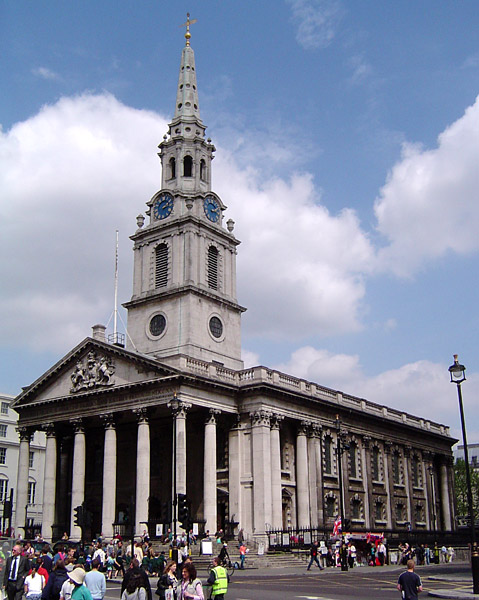
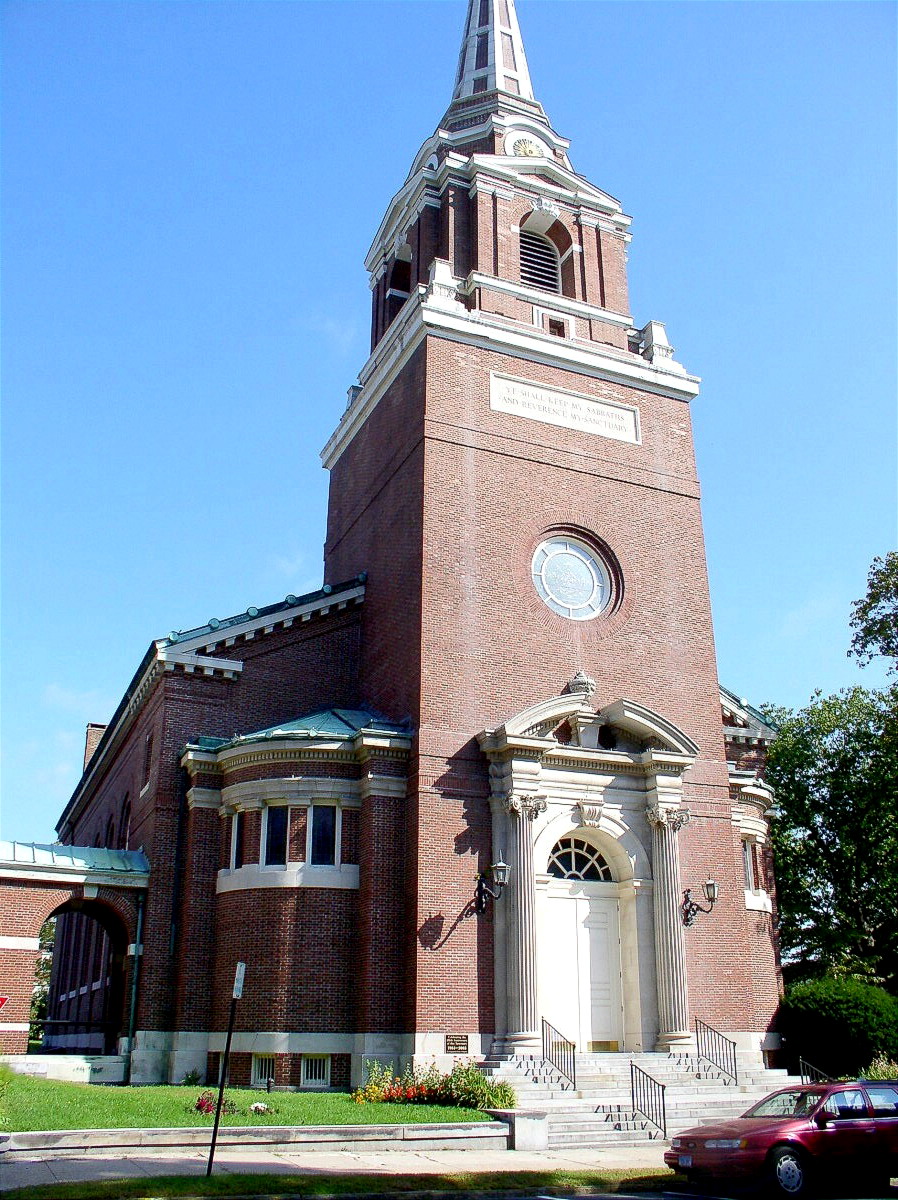
A fire in 1906 destroyed his father’s church, Central Presbyterian, which had occupied a quasi-gothic building constructed in 1858 at Jackson and MacNab Streets. The congregation decided to relocate a bit farther south of the city’s centre to Caroline and Charlton Streets. The completed structure borrows from a number of influences, including the Church of St. Martin-in-the-Fields in London and the Congregational Church of Naugatuck, Connecticut. One of its more unusual features is that it has a flat roof, thereby resembling more the public edifices favoured by the Beaux-Arts school than the traditional European church. Nevertheless, the church’s interior is dominated by a series of traditional stained-glass windows portraying stories from the Bible. This juxtaposition of the modern and the traditional appears to vindicate McArthur’s choice of title for his book. So satisfied was Lyle with the outcome of his efforts that he incorporated a black silhouette of the building into his personal bookplates. The spire of Central is a distinctive landmark visible throughout the surrounding neighbourhoods.
From here Lyle would go on in 1913 to design the Great Hall of Toronto’s Union Station (see book cover above), familiar to generations of commuters who have passed through it twice daily. While other urban railway terminals have seen the wrecker’s ball in recent decades, this building continues to serve the travelling public much as it did when it first opened.
Throughout his career, Lyle was much in demand by the nation’s banks, where the neoclassical style was favoured in the early years of the 20th century, perhaps as a way of impressing would-be depositors with the imposing nature of their own financial solidity.
Among the Hamilton landmarks for which Lyle was responsible are the palatial home Wynnstay, now Mount Mary Immaculate, in Ancaster (1925); the Gage Memorial Fountain in Gage Park (1926); and the Hamilton High Level Bridge, where York Boulevard passes over the Desjardins Canal (1932). Other well-known Lyle designs include the Memorial Arch at Kingston’s Royal Military College (1921); and the Runnymede branch of the Toronto Public Library (1929), which incorporated English, French Canadian and aboriginal elements. I myself used to live near that branch three decades ago and visited it on occasion.
Also notable are the designs Lyle submitted for projects later awarded to others. Two examples are worth mentioning. In 1907 his proposal for the buildings of the Justice Department would have altered the landscape of the federal government’s public architecture by making it more resemble that of Washington, DC. When in 1922 The Chicago Tribune sought designs for its new building, Lyle’s unsuccessful effort featured neoclassical columns and, of all things, a spire reminiscent of the one he had placed atop Central Presbyterian Church!
Incidentally, Lyle's grandson recently donated a copy of this book to that church's library, where I came across it a few weeks ago after sunday worship. The family is to be commended for helping to disseminate knowledge of their forebear's contribution to Canadian architecture.
06 August 2009
August snippets
My late mentor, Father Richard John Neuhaus, used to argue that if the state is secular and small, the danger to religious liberty can be contained. But if the state is large, and everywhere the state goes religion must retreat, then religious liberty is imperilled.
28 July 2009
'World-and-life-viewitis' revisited: a response to Hart
Now that we have returned from our holiday on the balmy shores of the Huron Sea, it is time to respond to Darryl Hart's Losing the Keys and Finding a World View and to one of the comments he left in my original post on the subject.
Let me begin by observing that, because Hart has not offered a point-by-point rebuttal to my arguments, I am unable to respond on that level. What he has done is to employ a form of argument which, if it is not precisely ad hominem in character, certainly skirts at its edges. Says Hart:
If a colleague gives me a paper he has written for my critique, it would generally not do for me to tell him in response that he has ugly circles under his eyes. To be sure, he may have been up late any number of nights working on this essay, and I may judge that he was unwise to do so at the expense of his health and alertness. In fact, his lack of sleep may have affected the quality of his paper. But to comment on his altered appearance does not in itself address the flaws in his argument.
Similarly, there may be all sorts of problems within the neocalvinist fold. Given that neocalvinists, like other Christians, are sinners saved by grace, it should not be unexpected that there will be failings — perhaps even spectacular failings — amongst them. To pretend otherwise would be naïve. Yet what is lacking in Hart's critique is a persuasive argument as to why the neocalvinist position logically leads in a liberalizing direction. Instead his argument is an appeal to fear: we don't want to end up like. . . [fill in the blank]. I might also point out that many of the older Reformed and Presbyterian bodies in Europe and North America experienced the effects of liberalism well before the arrival of neocalvinism on the scene.
Now it is true that neocalvinists have generally sought to build bridges to their fellow Christians in other traditions. They are not to be found in any single denomination, although their ecclesial roots are generally in Dutch Calvinism, and especially the Christian Reformed Church in North America. While many if not most of us, contrary to Hart's accusation, greatly appreciate the importance of the institutional church, we will not turn aside those evangelicals with more voluntaristic/baptistic views of the church. If Hart objects to this ecumenical focus in neocalvinism, then I suppose I would have to admit, for myself at least, to being guilty as charged. I will leave him to come up with the appropriate penalty for the likes of me.
One last point on the institutional church: I might indicate, to extend an olive branch, that I find much to like in many of the essays collected in Hart's Recovering Mother Kirk. His analysis and critique of evangelicalism with respect to ecclesiology and liturgy are dead-on. As someone with a special love for the biblical Psalms, I particularly applaud his endorsement of their use in the church's liturgy and hope his efforts at recovering sung psalmody bear fruit amongst his students and readers. I have listed his book in the bibliographic page of my own Genevan Psalter website. I would love to keep our conversation going on this topic at least.
Let us now turn to the rest of life outside the formal context of the worshipping community. Here once again is where Hart's position is weakest, and thus far he has said nothing to persuade me otherwise. Decades ago philosopher Herman Dooyeweerd showed the connection between the pretended autonomy of theoretical thought, as manifested in the special sciences, and the secularizing direction of western civilization. Hart again: "Many two-kingdom advocates [in whose company he counts himself] are not pleased with the way the West is going, or the state of higher learning in North America." Yet it is not at all clear how a solution will be found in re-emphasizing the neutrality of human reason in the face of the manifold ideological distortions it has facilitated and then tried to disguise. If there's a logical connection, he had best explain it, because his approach looks to me like an effort to turn back the clock to an earlier stage in the progression of the disease, rather than an attempt to remedy the disease itself.
But then there's this:
Whether or not Hart means this to apply to problems in the academy is unclear. If so, it appears to allow him an out with respect to the point I made in the previous paragraph. If we Christians must await the arrival of the eschaton to address the problems of this world, then perhaps it doesn't matter ultimately what we do with our schools, universities, businesses, labour unions, &c. And if this is true, then my objection that his commitment to neutral reason will inevitably secularize the university is perhaps beside the point, which I suppose leaves us nothing left to discuss.
Finally there's this curious remark from the comments to my first post. Hart again:
So neocalvinists are reactionaries? I thought we were liberalizers. Which is it? This smacks of going after the beast with whatever weapon is at hand, appropriate or not. If a spear doesn't do the trick, try poison. If poison fails, there's always a pistol. Something's bound to work eventually.
I will reiterate something I hinted at in my first post. The validity of a particular school of thought can be assessed by how well it accounts for the fulness of created reality. In this case there is simply too much of life that Hart's worldview — and yes, he does have one! — cannot take into account.
Let me begin by observing that, because Hart has not offered a point-by-point rebuttal to my arguments, I am unable to respond on that level. What he has done is to employ a form of argument which, if it is not precisely ad hominem in character, certainly skirts at its edges. Says Hart:
But we are befuddled that folks like Koyzis do not seem to notice that most of the places where neo-Calvinism has tried to remedy secularism have also brought liberal Protestantism (or at least a movement away from Reformed Christianity) with it.
If a colleague gives me a paper he has written for my critique, it would generally not do for me to tell him in response that he has ugly circles under his eyes. To be sure, he may have been up late any number of nights working on this essay, and I may judge that he was unwise to do so at the expense of his health and alertness. In fact, his lack of sleep may have affected the quality of his paper. But to comment on his altered appearance does not in itself address the flaws in his argument.
Similarly, there may be all sorts of problems within the neocalvinist fold. Given that neocalvinists, like other Christians, are sinners saved by grace, it should not be unexpected that there will be failings — perhaps even spectacular failings — amongst them. To pretend otherwise would be naïve. Yet what is lacking in Hart's critique is a persuasive argument as to why the neocalvinist position logically leads in a liberalizing direction. Instead his argument is an appeal to fear: we don't want to end up like. . . [fill in the blank]. I might also point out that many of the older Reformed and Presbyterian bodies in Europe and North America experienced the effects of liberalism well before the arrival of neocalvinism on the scene.
Now it is true that neocalvinists have generally sought to build bridges to their fellow Christians in other traditions. They are not to be found in any single denomination, although their ecclesial roots are generally in Dutch Calvinism, and especially the Christian Reformed Church in North America. While many if not most of us, contrary to Hart's accusation, greatly appreciate the importance of the institutional church, we will not turn aside those evangelicals with more voluntaristic/baptistic views of the church. If Hart objects to this ecumenical focus in neocalvinism, then I suppose I would have to admit, for myself at least, to being guilty as charged. I will leave him to come up with the appropriate penalty for the likes of me.
One last point on the institutional church: I might indicate, to extend an olive branch, that I find much to like in many of the essays collected in Hart's Recovering Mother Kirk. His analysis and critique of evangelicalism with respect to ecclesiology and liturgy are dead-on. As someone with a special love for the biblical Psalms, I particularly applaud his endorsement of their use in the church's liturgy and hope his efforts at recovering sung psalmody bear fruit amongst his students and readers. I have listed his book in the bibliographic page of my own Genevan Psalter website. I would love to keep our conversation going on this topic at least.
Let us now turn to the rest of life outside the formal context of the worshipping community. Here once again is where Hart's position is weakest, and thus far he has said nothing to persuade me otherwise. Decades ago philosopher Herman Dooyeweerd showed the connection between the pretended autonomy of theoretical thought, as manifested in the special sciences, and the secularizing direction of western civilization. Hart again: "Many two-kingdom advocates [in whose company he counts himself] are not pleased with the way the West is going, or the state of higher learning in North America." Yet it is not at all clear how a solution will be found in re-emphasizing the neutrality of human reason in the face of the manifold ideological distortions it has facilitated and then tried to disguise. If there's a logical connection, he had best explain it, because his approach looks to me like an effort to turn back the clock to an earlier stage in the progression of the disease, rather than an attempt to remedy the disease itself.
But then there's this:
One point that neo-Calvinists don’t seem to understand about two-kingdom thought is that the two-kingdom view is not a solution to this world’s problems; two-kingdom folk actually don’t believe solutions will come in this fallen world until the consummation.
Whether or not Hart means this to apply to problems in the academy is unclear. If so, it appears to allow him an out with respect to the point I made in the previous paragraph. If we Christians must await the arrival of the eschaton to address the problems of this world, then perhaps it doesn't matter ultimately what we do with our schools, universities, businesses, labour unions, &c. And if this is true, then my objection that his commitment to neutral reason will inevitably secularize the university is perhaps beside the point, which I suppose leaves us nothing left to discuss.
Finally there's this curious remark from the comments to my first post. Hart again:
If I accept the liberal [political] order it is simply because it is a historical reality that makes pining for the Netherlands circa 1901 or the Holy Roman Empire around 1400 unbecoming.
So neocalvinists are reactionaries? I thought we were liberalizers. Which is it? This smacks of going after the beast with whatever weapon is at hand, appropriate or not. If a spear doesn't do the trick, try poison. If poison fails, there's always a pistol. Something's bound to work eventually.
I will reiterate something I hinted at in my first post. The validity of a particular school of thought can be assessed by how well it accounts for the fulness of created reality. In this case there is simply too much of life that Hart's worldview — and yes, he does have one! — cannot take into account.
24 July 2009
Piper on Kuyper
I do not know John Piper's works at all well, though I had some contact with him personally during his stint teaching at my undergraduate alma mater, Bethel College (now University), some 35 years ago. I do know any number of people who have benefited from reading his many books. Up to now, however, I have not usually associated cultural critique with Piper and his followers. This could be changing, if the following is any indication: America's debt to John Calvin. Where he might go from here I don't know, but it is encouraging to see him recommend Abraham Kuyper's Lectures on Calvinism. Might this form the basis for a fruitful dialogue between Kuyperians and Piperians?
22 July 2009
Catholicism and international relations
For educators attempting to engage their students to think christianly in their respective academic endeavours, Daniel Philpott's essay is a welcome and inspirational effort rooted in the Roman Catholic tradition of political reflection: One Professor’s Guide To Studying International Relations and Peace Studies From a Catholic Perspective. From the introductory paragraph:
Whatever else this passage [Colossians 1:15-20] means, it seems to say that all things, including thrones, powers, rulers, and authorities — that is, politics — were created and redeemed by Christ. There is nothing in the universe which escapes this fact, this logic. Does not this then imply that political pursuits are to be oriented towards Christ and his creative and redeeming work? This may seem like a difficult thing to imagine in a world where Stalin’s logic — or at least the logic of power and interest — seems again and again to prevail, tempting us to conclude that what the Church professes only has a limited and circumscribed significance. But if we believe what the Church professes, then this is not the case. The victorious resurrection of Christ is a total victory, applying to all things, even if it is not yet consummated. And if we believe what the Church professes, then we are called to participate ourselves in this victory.
18 July 2009
Last of Great War survivors
We will not be seeing many more reports like this: Oldest WW1 veteran dies aged 113.
14 July 2009
July snippets
You would not cure the evil by resolving that there should be no more monarchs, nor ministers of state, nor of the gospel; no interpreters of law; no general officers; no public councils. You might change the names. The things in some shape must remain. A certain quantum of power must always exist in the community in some hands and under some appellation. Wise men will apply their remedies to vices, not to names; to the causes of evil which are permanent, not to the occasional organs by which they act, and the transitory modes in which they appear. Otherwise you will be wise historically, a fool in practice.
10 July 2009

01 July 2009
29 June 2009
An important debate
Comment has just published my article, titled: Religion and democracy: Habermas vs. Flores d'Arcais. From the first paragraph:
Feel free to read the rest if you are so inclined.
Few issues ruffle more feathers, more frequently, than the place of religion in the political realm. According to the reigning modernist framework, rooted either in liberal individualism or in some form of secular collectivism, the state is neutral territory. Here neutrality is defined, not merely as formal indifference to what John Rawls labels the comprehensive doctrines that divide the particular communities comprising the state or nation, but as emptying the public square of every value-laden worldview that resists rational discussion and therefore threatens to divide a polity.
Feel free to read the rest if you are so inclined.
25 June 2009
D. G. Hart and 'world-and-life-viewitis'
Darryl G. Hart has fought hard to make himself the bête noir of the christian university community in North America and, truth to tell, he has largely succeeded. This is a typical entry from his blog: If the Bible Speaks to All of Life, Why Not the Confession? Here's Hart in his own words:
Hart represents a particular school of Reformed Christians who not only put great emphasis on the confessions of the 16th and 17th centuries, but also put something of a lutheranizing two-kingdoms spin on these confessions and on the Scripture on which they are based. This school is primarily associated with Westminster Seminary California, Hart's former employer. The expanding influence of Abraham Kuyper's worldviewish Christianity comes in for special criticism from this group.
In response three points can be made here.
First, Hart is correct to observe that the Bible has nothing to say about quantum physics and a host of other issues. He is also right to assert that we should not try to make it say what it doesn't say. My friend Roy Clouser has addressed this error in speaking of the encyclopedic assumption, i.e., the belief that the Bible is a kind of encyclopedia giving us scientific data about human origins, astronomy and, well, even political science.
However, Hart is missing something of the all-embracing character of the life in Christ as understood in Scripture as a whole. One need hardly accept the encyclopedic assumption to recognize that biblical religion has implications for how we live all of life, not just what we do in church on sundays: "So, whether you eat or drink, or whatever you do, do all to the glory of God" (I Corinthians 10:31). Or this, also from St. Paul: "So then, just as you received Christ Jesus as Lord, continue to live in him, rooted and built up in him, strengthened in the faith as you were taught, and overflowing with thankfulness. See to it that no one takes you captive through hollow and deceptive philosophy, which depends on human tradition and the basic principles of this world rather than on Christ" (Colossians 2:6-8).
Second, and perhaps more seriously, Hart's approach to Scripture is based on an inadequate epistemology. The Bible, it seems, is filled with a number of propositions, which have relevance to some of our activities in God's world, but not to most. In this huge swath of territory we simply rely on our own native reason, which we share with all human beings, whatever their religious commitments. Scripture informs our spiritual life, but not much beyond that. If Hart is correct about this, then it is little short of amazing that so many people emphasizing the need for a consistent christian worldview have found so much to write about. Are the issues to which they draw attention not genuine issues? Can their concerns be dismissed so easily?
In my own Political Visions and Illusions I undertake to explore the five political ideologies of liberalism, conservatism, nationalism, democratism and socialism. Despite their respective followers having access to reason, they nevertheless manage to embrace quite different visions of politics and indeed of reality as a whole. It is not too difficult to see the impact of more than one mutually incompatible worldview at play. It is also evident that these are a matter of adherents making entirely too much of a good thing, which is what Scripture calls idolatry. If Scripture is silent on a lot of particular things, it speaks clearly on idolatry, which inevitably affects the whole of life, including those academic disciplines left up to "our reasonable ability."
Third, Hart's approach must be viewed against an historical trajectory that has seen the secularization of any number of universities over the centuries, despite their christian origins. Here's Hart once more: "Or could it be that what the creeds and confessions teach is pretty much the sum of what the Bible reveals? In which case, for the other areas of life we are left to our reasonable ability to make sense of God’s created order, thus leaving the church jurisdiction over divinity and the university faculty authority over the arts and sciences." I agree that the church as institution should not attempt to pronounce in the arts and sciences. But Hart appears to be saying more than this. If we read this in light of what he's said above, we are left with a pretty toxic mix, and one that has led to the erosion of the christian character of countless universities in the past, from Harvard and Yale to Hamilton's own McMaster University, whose Divinity College sits with increasing unease on its campus among the other faculties of arts and sciences.
Disparage as he might the supposed pandemic of world-and-life-viewitis amongst evangelical Christians, Hart's approach does not represent a workable alternative. There is simply too much that it does not take into account, and for that reason it is unlikely to gain a foothold in the christian universities of North America. Though he undoubtedly has much to offer in the fields of "divinity" and liturgy, if we seek discernment with respect to the idolatries afoot in "secular" areas of life, we had best turn elsewhere.
[A] recent speaking engagement at Grove City College . . . got me thinking about the world-and-life-viewitis that has reached epidemic proportions among Protestants. Most evangelical Protestant colleges these days are justifying their existence and identity by saying they provide a wholistic [sic] vision on learning that is grounded in the Christian faith. The Lordship of Christ, the authority of Scripture, even the cultural mandate come in for aid and comfort.
This ideal is an honorable one and springs from generally wholesome motives. Who would not want to see Christ honored in all aspects of the created order, and who would want to be unfaithful where Scripture has revealed God’s holy will?
There’s just one problem: the Bible doesn’t speak to all the arts and sciences, let alone whether incoming freshmen should receive a laptop or whether it should be an Apple or an IBM machine. In fact, the one place where Christ is revealed, the Bible, has very little to say about the curriculum of an undergraduate education. If we say that it does, we are in danger of putting the imaginations of men above the Word of God — that is, making the Bible say what we want it to say.
This point becomes pretty plausible if we consider that the Reformed creeds and catechisms have nothing to say about rhetoric, logic, grammar, music — the list could go on but not much longer for the medieval university’s curriculum. It has even less to say about quantum physics or critical theory and the vast range of subjects offered by today’s universities. But if the Bible speaks to all of these areas of human endeavor and inquiry, don’t we need to revise the confessions so that the church may rightly speak on what God has revealed?
Or could it be that what the creeds and confessions teach is pretty much the sum of what the Bible reveals? In which case, for the other areas of life we are left to our reasonable ability to make sense of God’s created order, thus leaving the church jurisdiction over divinity and the university faculty authority over the arts and sciences.
Hart represents a particular school of Reformed Christians who not only put great emphasis on the confessions of the 16th and 17th centuries, but also put something of a lutheranizing two-kingdoms spin on these confessions and on the Scripture on which they are based. This school is primarily associated with Westminster Seminary California, Hart's former employer. The expanding influence of Abraham Kuyper's worldviewish Christianity comes in for special criticism from this group.
In response three points can be made here.
First, Hart is correct to observe that the Bible has nothing to say about quantum physics and a host of other issues. He is also right to assert that we should not try to make it say what it doesn't say. My friend Roy Clouser has addressed this error in speaking of the encyclopedic assumption, i.e., the belief that the Bible is a kind of encyclopedia giving us scientific data about human origins, astronomy and, well, even political science.
However, Hart is missing something of the all-embracing character of the life in Christ as understood in Scripture as a whole. One need hardly accept the encyclopedic assumption to recognize that biblical religion has implications for how we live all of life, not just what we do in church on sundays: "So, whether you eat or drink, or whatever you do, do all to the glory of God" (I Corinthians 10:31). Or this, also from St. Paul: "So then, just as you received Christ Jesus as Lord, continue to live in him, rooted and built up in him, strengthened in the faith as you were taught, and overflowing with thankfulness. See to it that no one takes you captive through hollow and deceptive philosophy, which depends on human tradition and the basic principles of this world rather than on Christ" (Colossians 2:6-8).
Second, and perhaps more seriously, Hart's approach to Scripture is based on an inadequate epistemology. The Bible, it seems, is filled with a number of propositions, which have relevance to some of our activities in God's world, but not to most. In this huge swath of territory we simply rely on our own native reason, which we share with all human beings, whatever their religious commitments. Scripture informs our spiritual life, but not much beyond that. If Hart is correct about this, then it is little short of amazing that so many people emphasizing the need for a consistent christian worldview have found so much to write about. Are the issues to which they draw attention not genuine issues? Can their concerns be dismissed so easily?
In my own Political Visions and Illusions I undertake to explore the five political ideologies of liberalism, conservatism, nationalism, democratism and socialism. Despite their respective followers having access to reason, they nevertheless manage to embrace quite different visions of politics and indeed of reality as a whole. It is not too difficult to see the impact of more than one mutually incompatible worldview at play. It is also evident that these are a matter of adherents making entirely too much of a good thing, which is what Scripture calls idolatry. If Scripture is silent on a lot of particular things, it speaks clearly on idolatry, which inevitably affects the whole of life, including those academic disciplines left up to "our reasonable ability."
Third, Hart's approach must be viewed against an historical trajectory that has seen the secularization of any number of universities over the centuries, despite their christian origins. Here's Hart once more: "Or could it be that what the creeds and confessions teach is pretty much the sum of what the Bible reveals? In which case, for the other areas of life we are left to our reasonable ability to make sense of God’s created order, thus leaving the church jurisdiction over divinity and the university faculty authority over the arts and sciences." I agree that the church as institution should not attempt to pronounce in the arts and sciences. But Hart appears to be saying more than this. If we read this in light of what he's said above, we are left with a pretty toxic mix, and one that has led to the erosion of the christian character of countless universities in the past, from Harvard and Yale to Hamilton's own McMaster University, whose Divinity College sits with increasing unease on its campus among the other faculties of arts and sciences.
Disparage as he might the supposed pandemic of world-and-life-viewitis amongst evangelical Christians, Hart's approach does not represent a workable alternative. There is simply too much that it does not take into account, and for that reason it is unlikely to gain a foothold in the christian universities of North America. Though he undoubtedly has much to offer in the fields of "divinity" and liturgy, if we seek discernment with respect to the idolatries afoot in "secular" areas of life, we had best turn elsewhere.
24 June 2009
Wills on Buckley
Half a century later it is difficult to recall that William F. Buckley and Garry Wills were once friends and colleagues at the former's National Review. This was before they parted on less than amicable terms. Given this longstanding rivalry, ending with apparent reconciliation a few years before Buckley's death, some of us may not know quite how to read Will's testimonial to one of the leading lights of American conservatism: Daredevil. On the surface it reads like an affectionate tribute, but then there's this:
That doesn't even measure up to damning with faint praise. But Wills is kind enough to show us the salutary influence he himself had on his former mentor, successfully breaking him of his racism, antisemitism and, eventually, even his war-hawkishness. It's nice to know that Wills was in the right all along and that Buckley might even admit it if he were still around. Of course we'll have to take Wills' word for it, won't we?
Bill was not, and did not pretend to be, a real intellectual. He gave up on the “big book” that his father and others were urging him to write. For years he tried to do a continuation of José Ortega y Gasset’s The Revolt of the Masses. This had been a sacred text for his father’s guru, Albert Jay Nock. Bill took intellectual comrades like Hugh Kenner with him for his winter break in Switzerland, to help him get a grip on this ambitious project. But he told me he realized in time this was not his métier. He was not a reflective thinker. He was a quick responder. He wrote rapidly because he was quickly bored. His gifts were facility, flash, and charm, not depth or prolonged wrestling with a problem.
Bill needed people around him all the time. Frequently, when he told me he had to write a column, I would offer to withdraw from the boat cabin or hotel room where we were. He urged me not to, and as he typed (with great speed and accuracy) he would keep talking off and on, reading a sentence to me, trying out a word, saying that something he was writing would annoy old So-and-So. When I appeared on his TV show to discuss a new book of mine, it was clear to me that he had not read the book—he was given notes on each author he interviewed. Once he asked me if I had read all of Adam Smith’s Wealth of Nations. I said yes. “Haven’t you?” He had not. I suspect that was true of the other capitalist classics he referred to, by Ludwig von Mises, Wilhelm Roepke, and others. He could defend them with great panache. But he did not want to sit all by himself for a long time reading them. One of his teachers at Yale, the philosopher Paul Weiss, told me that Bill was very good at discussing books he had not read.
That doesn't even measure up to damning with faint praise. But Wills is kind enough to show us the salutary influence he himself had on his former mentor, successfully breaking him of his racism, antisemitism and, eventually, even his war-hawkishness. It's nice to know that Wills was in the right all along and that Buckley might even admit it if he were still around. Of course we'll have to take Wills' word for it, won't we?
The Burning (Unburnt) Bush
I have in my personal library two liturgical books issued by the Church of Scotland. One is The Scottish Psalter of 1929, a thin volume whose split pages, coupled with the regular metres of the versifications, enable a congregation to mix and match texts and tunes in the course of worship. The second is The Psalms and Church Hymnary: Revised Edition, containing only texts (with very small print!) and no music. Both are printed by Oxford University Press. On the front is a shield carrying the ancient symbol of the Reformed Churches, the Burning Bush. Here is the version used by the Church of Scotland, overlaid against the diagonal Cross of St. Andrew:

The motto, "Nec tamen consumebatur," is Latin for "And it was not consumed." Some versions of this shield, most notably that of the Presbyterian Church in Ireland, carry an alternative motto: "Ardens sed virens," meaning "burning but flourishing." The symbolism of the burning bush originates with the 12th national synod of 1583 of l'Église réformée de France, which now uses an updated version, overlaid with the Huguenot Cross:

Why the burning bush? The biblical allusion is, of course, to Exodus 3, especially verse 2: "And the angel of the LORD appeared to [Moses] in a flame of fire out of the midst of a bush; and he looked, and lo, the bush was burning, yet it was not consumed." Here's a rough translation from the website of l'Église réformée:
The Reformed Presbyterian Church, Hanover Presbytery, in the United States, uses a modified version of the burning bush:

while the Presbyterian Church in Canada currently uses this stylized version:

As far as I know the Presbyterian Church (USA) makes no use of this symbol, except for a possible allusion to it in the two small flames at either side of the cross below:

I have seen no evidence that either the Reformed Church in America or the Christian Reformed Church makes use of it. If anyone knows differently, please let me know.
Incidentally, in Orthodox usage the burning bush is referred to as the Unburnt Bush (perhaps a more accurate name), which is strongly associated with the virginity of Mary.

The motto, "Nec tamen consumebatur," is Latin for "And it was not consumed." Some versions of this shield, most notably that of the Presbyterian Church in Ireland, carry an alternative motto: "Ardens sed virens," meaning "burning but flourishing." The symbolism of the burning bush originates with the 12th national synod of 1583 of l'Église réformée de France, which now uses an updated version, overlaid with the Huguenot Cross:

Why the burning bush? The biblical allusion is, of course, to Exodus 3, especially verse 2: "And the angel of the LORD appeared to [Moses] in a flame of fire out of the midst of a bush; and he looked, and lo, the bush was burning, yet it was not consumed." Here's a rough translation from the website of l'Église réformée:
This burning bush, in addition to signifying the mysterious and unseen presence of the Lord, is also the symbol of the decisive meeting between Moses and God, that is to say, the call of God (who calls him by his first name) and the former's response to that call. . . . The logo thus indicates that each of us is personally called by God.
The Reformed Presbyterian Church, Hanover Presbytery, in the United States, uses a modified version of the burning bush:

while the Presbyterian Church in Canada currently uses this stylized version:

As far as I know the Presbyterian Church (USA) makes no use of this symbol, except for a possible allusion to it in the two small flames at either side of the cross below:

I have seen no evidence that either the Reformed Church in America or the Christian Reformed Church makes use of it. If anyone knows differently, please let me know.
Incidentally, in Orthodox usage the burning bush is referred to as the Unburnt Bush (perhaps a more accurate name), which is strongly associated with the virginity of Mary.
16 June 2009
Mid-June snippets
The 11 rock-hewn churches in the town of Lalibela have often been called the "Eighth Wonder of the World." Like the monoliths at Axum, they are a UNESCO World Heritage Site. And, according to legend, they were each carved out of a single piece of rock at record speed, "as angels worked on them during the night." The churches, many carved in deep trenches with only their roofs exposed, others cut directly into the rocks of caves, are all connected by a labyrinthine series of tunnels, paths and steep steps. Each has been used continuously since the beginning of the 13th century. Most are decorated with a Star of David, underscoring the church's close kinship with King Solomon. One displays a very old painting of a black Jesus.
Twilight Zone: The After Hours
Nancy and I have recently been watching old episodes of The Twilight Zone on youtube. We were reminded that there was more than one series with this title on television, the first running from 1959 to 1964, the second from 1985 to 1989, and the third in the 2002-2003 season. Here are two versions of the same episode, The After Hours, the first of which aired in 1960 and the second of which was first broadcast in 1986. Watch both and see which you think is the better version. I have my own preference, and you may be able to guess which it is.
Incidentally, while viewing the first version, pay attention to the music, which was scored by the incomparable Bernard Herrmann, who was in the middle of his famous cinematic collaboration with Alfred Hitchcock. Everyone knows the theme that the programme eventually settled on (listen to the arrangement of it in the colour episode above), which has become a musical cliché. But Herrmann scored the theme for the first season and, as expected, did a terrific job.
Incidentally, while viewing the first version, pay attention to the music, which was scored by the incomparable Bernard Herrmann, who was in the middle of his famous cinematic collaboration with Alfred Hitchcock. Everyone knows the theme that the programme eventually settled on (listen to the arrangement of it in the colour episode above), which has become a musical cliché. But Herrmann scored the theme for the first season and, as expected, did a terrific job.
15 June 2009
Managing decline
Though we North Americans tend to think of cities as permanent and expanding features on our landscape, it is a fact of life that, like everything else in the world, they wax and wane and may even die. Timbuktu was once a great centre of culture and learning, but is now a shadow of what it was half a millennium ago. There is no reason to think that our own cities are exempt from this process.
Indeed there are a number of American cities that have not fared well with the shift from an industrial to a service economy. The one with which I am most familiar is just over the border: Detroit. Now there is a co-operative effort by more than one level of government to manage the decline of such urban centres: US cities may have to be bulldozed in order to survive. Given my deep familial roots in southeastern Michigan, I am saddened at the decline of urban life in the region.
Yet all periods of mourning must end, and life must go on. For the city of Flint, Michigan, 60 miles north of Detroit, this means effectively abandoning up to 40 percent of the city's built-up land in a necessary downsizing effort.
Given that growth and decline are facts of life, and given that political authorities are under a divine mandate to do public justice, how do they manage decline in a just fashion? It is easy to distribute the pieces of an ever-expanding pie, but what happens when the pie is contracting? The corporate private sector has had to face these sorts of issues for decades, but now municipal governments are having to make similar tough decisions. Are there equitable ways to do so?
Indeed there are a number of American cities that have not fared well with the shift from an industrial to a service economy. The one with which I am most familiar is just over the border: Detroit. Now there is a co-operative effort by more than one level of government to manage the decline of such urban centres: US cities may have to be bulldozed in order to survive. Given my deep familial roots in southeastern Michigan, I am saddened at the decline of urban life in the region.
Yet all periods of mourning must end, and life must go on. For the city of Flint, Michigan, 60 miles north of Detroit, this means effectively abandoning up to 40 percent of the city's built-up land in a necessary downsizing effort.
Flint, sixty miles north of Detroit, was the original home of General Motors. The car giant once employed 79,000 local people but that figure has shrunk to around 8,000. Unemployment is now approaching 20 per cent and the total population has almost halved to 110,000. The exodus – particularly of young people – coupled with the consequent collapse in property prices, has left street after street in sections of the city almost entirely abandoned.Durant Hotel
In the city centre, the once grand Durant Hotel – named after William Durant, GM's founder – is a symbol of the city's decline, said Mr [Dan] Kildee [Genesee County Treasurer]. The large building has been empty since 1973, roughly when Flint's decline began. Regarded as a model city in the motor industry's boom years, Flint may once again be emulated, though for very different reasons.
But Mr Kildee, who has lived there nearly all his life, said he had first to overcome a deeply ingrained American cultural mindset that "big is good" and that cities should sprawl – Flint covers 34 square miles. . . . But some Flint dustcarts are collecting just one rubbish bag a week, roads are decaying, police are very understaffed and there were simply too few people to pay for services, he said. If the city didn't downsize it will eventually go bankrupt, he added. . . .
The local authority has restored the city's attractive but formerly deserted centre but has pulled down 1,100 abandoned homes in outlying areas. Mr Kildee estimated another 3,000 needed to be demolished, although the city boundaries will remain the same. Already, some streets peter out into woods or meadows, no trace remaining of the homes that once stood there.
Choosing which areas to knock down will be delicate but many of them were already obvious, he said. The city is buying up houses in more affluent areas to offer people in neighbourhoods it wants to demolish. Nobody will be forced to move, said Mr Kildee. "Much of the land will be given back to nature. People will enjoy living near a forest or meadow," he said.
Mr Kildee acknowledged that some fellow Americans considered his solution "defeatist" but he insisted it was "no more defeatist than pruning an overgrown tree so it can bear fruit again".

Given that growth and decline are facts of life, and given that political authorities are under a divine mandate to do public justice, how do they manage decline in a just fashion? It is easy to distribute the pieces of an ever-expanding pie, but what happens when the pie is contracting? The corporate private sector has had to face these sorts of issues for decades, but now municipal governments are having to make similar tough decisions. Are there equitable ways to do so?
14 June 2009
King of glory

Seven whole days, not one in seven,
I will praise thee;
in my heart, though not in heaven,
I can raise thee.
Small it is, in this poor sort
to enrol thee:
e'en eternity's too short
to extol thee.
I will praise thee;
in my heart, though not in heaven,
I can raise thee.
Small it is, in this poor sort
to enrol thee:
e'en eternity's too short
to extol thee.
George Herbert, 1633
Becoming adult
Writing for Breakpoint's Worldview Magazine, John Stonestreet explores Our Adolescent Culture. Taking as his springboard Diana West's The Death of the Grown-Up: How America’s Arrested Development Threatens Western Civilization, he suggests that, whereas adolescence as a distinct stage of development was unknown before the mid-20th century, what was originally seen as a transitional phenomenon has overtaken the entire culture such that our social and political institutions nurture a kind of permanent immaturity. Take note of Stonestreet's six marks of an adolescent culture, which seem all too evidently applicable to North America.
I have little to add to his analysis. Nevertheless, as an instructor at a post-secondary institution, I have sometimes wondered whether universities really help young people move into adulthood, or whether they inadvertently prolong adolescence beyond what is healthy for the student and the society at large. I ask this as someone who was not fully self-supporting until well beyond 18 years of age, due entirely to my pursuit of graduate studies towards a PhD.
But there's another factor. Forty years ago my own baby-boomer generation, under the cover of a radical critique of society, coined such terms as "the establishment" and "the system," and put retreads on "status quo," "capitalism," "patriarchy" and "military-industrial complex," all terms of opprobrium describing forms of society to be opposed. To be sure, there was an element of truth behind these labels, though they were too easily tossed about as means of discrediting a complex network of social patterns which such simplistic terms could never hope to capture in their entirety.
Could the use of such language have been the first signs of a society refusing to grow up? If one can blame "the system" for every personal failure, one is perhaps implicitly absolved from having to take responsibility for rectifying it. Far from empowering the young, as some would have it, such an attitude is more likely to nurture resentment and stifle initiative, the very things we expect adolescents to outgrow. Perhaps it's time, if not to abolish adolescence, at least to recover its original meaning: becoming adult!
12 June 2009
Thomas Nelson's bad idea
Americans have the reputation of being one of the most bible-reading nations on earth. There is a huge market in that country for specialty or niche bibles, which cater to certain sectors of the reading public. Some months ago I wrote of The Green Bible, which prints in green letters passages having to do with creation. Now Thomas Nelson has published The American Patriot’s Bible, something which, admittedly, makes my skin crawl:
One could pinpoint numerous errors and one-sided assertions in such a project, for example, the facile overstating of the christian beliefs of the founders. (The inclusion of Thomas Paine here is little short of ludicrous.)
But the principal reason this is such a misguided project is that it is based on a severe misunderstanding of the biblical covenant. In the Old Testament God entered into a special relationship with the children of Israel, promising them a homeland at the crossroads of three continents and giving them a law by which to order their lives as his peculiar people. When the psalmist says: "Blessed is the nation whose God is the LORD, the people whom he has chosen as his heritage!" (Psalm 33:12), he obviously has Israel in mind.
In the New Testament God continues to choose a people for himself, but on a different basis: the shed blood of Christ and his victory over death for their sins. The Apostle Peter says: "But you are a chosen race, a royal priesthood, a holy nation, a people for his own possession, that you may proclaim the excellencies of him who called you out of darkness into his marvelous light" (I Peter 2:9). The holy nation is not ethnic Israel, but the church, the Body of Christ, whose members are drawn from every nation on earth. One tires of having to remind people of this.
Perhaps it's time for a moratorium on niche bibles of all kinds. From now on there should be the biblical text only, bound in a plain black cover.
10 June 2009
Torture and the rule of law
The following is my regular Christian Courier column dated 8 June 2009:
At one time it was a commonplace occurrence to see convicted criminals treated in painful and humiliating ways. Grisly penalties were applied to murderers, pickpockets and heretics, and ordinary people turned out in large numbers to witness these spectacles, apparently learning the hard lesson that, to coin a cliché, crime does not pay. However the English Bill of Rights of 1689, adopted after the previous year’s ouster of King James II, prohibited the application of “cruel and unusual punishments,” in language that would eventually find its way into the US Bill of Rights and our own Charter of Rights and Freedoms, where the word “treatment” was notably added.
What then of pre-trial treatment? What means are permitted in questioning a suspected criminal, that is, someone who has not yet been found guilty of a punishable crime? Since ancient times brutal means have often been employed to elicit a confession or incriminating information from a defendant. Such means are still used throughout the globe, despite the existence, among other similar treaties, of the 1985 United Nations Convention Against Torture, of which Canada and the United States are signatories.
Arguments against torture are based on two types of reasoning, principled and pragmatic. On the principled side, it is argued that human beings have an intrinsic dignity that ought not to be violated through mistreatment, even if it is in the interest of a larger good, for example national security. An argument can also be made that those who engage in torture must suppress their own humanity to bring themselves to commit such an act. In short, torture is unjust.
Those of a more pragmatic bent insist that, even if torture were not morally wrong, its use is not effective, as the victim could easily confess to something he did not do in order to end the ordeal. Even if the suspect is guilty of harbouring information about fellow conspirators that might be crucial to stopping a terrorist act, he could just as easily give false or misleading information to his interrogators, who would not necessarily know the difference.
Nevertheless, the temptation to torture is one that many officials find irresistible when confronted with a threat to the lives of innocent people, much as in wartime a country’s government will be tempted to retaliate in kind against an attack on civilians. There can be no doubt that al Qaeda and similar organizations have employed unjust means, precisely to entice their opponents to respond in illegal ways and thereby discredit themselves.
Admittedly the United States was in a difficult international position as it sought an effective response to the 9/11 attacks. The Bush administration severely botched the public relations side of this as it needlessly alienated otherwise friendly governments needed to mount an effective multilateral defence.
Moreover, the fact that Washington claimed to be waging a war on terror was, from the outset, deeply misguided. It is precisely because this “war” has such a nebulous and unattainable aim that the government prosecuting it will tend to lose sight of which means are appropriate in its pursuit. If our aim is to eradicate terror, residual bourgeois sympathies, schoolyard bullying or something similarly unrealistic, any effort to do so will almost inevitably tempt us, in our choice of means, to flirt with the edges of legality and rectitude. Why? Simply because no means whatever will enable us to reach a goal so vague as to lack a reasonable chance of success.
Better to keep a feasible goal before us and to choose methods proper to its accomplishment, avoiding those that corrupt us and transgress the norms of justice.
09 June 2009
Cardus' coursepack
My good friends at Cardus have come up with something that looks like an invaluable resource for teachers, students and other Christians wishing to know how their faith impacts life. I've not yet seen a copy, but judging from their past work, I hope this gets wide circulation.
We also take note in passing that Cardus is now on youtube. I must admit to being puzzled at some of the so-called related videos shown at the lower right of the screen. Exactly how "Hitler Finds Out Canucks Sign Sundin" and "Original Alex Rios Video 'You are a bum!'" relate to the new Cardus video is not altogether clear.
We also take note in passing that Cardus is now on youtube. I must admit to being puzzled at some of the so-called related videos shown at the lower right of the screen. Exactly how "Hitler Finds Out Canucks Sign Sundin" and "Original Alex Rios Video 'You are a bum!'" relate to the new Cardus video is not altogether clear.
04 June 2009

01 June 2009
More resignations from Order
The fallout continues from last year's controversial award of this country's highest honour to abortion doctor Henry Morgentaler: Resignations from the Order of Canada. One of those whose resignation the Governor General accepted is Jean-Claude Cardinal Turcotte, Archbishop of Montreal.
June snippets
In a joyous ceremony in Redeemer’s Commons, David Sweet, Member of Parliament for Ancaster-Dundas-Flamborough-Westdale announced today that Redeemer University College will be receiving a $2.9 million investment from the federal government’s Knowledge Infrastructure Program (KIP).Unfortunately, plans for the construction of a new political science building were not included in the grant.
The 2.4m (8ft) long trumpet-like instrument was played in Ancient Rome but fell out of use some 300 years ago. Bach's motet (a choral musical composition) "O Jesu Christ, meins lebens licht" was one of the last pieces of music written for the Lituus. Now, for the first time, this 18th Century composition has been played as it should have been heard.Listen for yourself here. This would seem to put to rest the urban legend that the lituus fell out of use due to parents' inability to fit it in the family car when driving the children to their music lessons.
31 May 2009
Psalm scores posted
Ten years after I posted my Genevan Psalter website, I have now uploaded printable scores in PDF format for virtually all of the psalms, canticles and hymns I have written or arranged. In some cases these may not be precisely the same arrangements as the midi files. It will take me some time to go through these one by one to bring some consistency to them, which is a project for another day. For those wishing to sing them in formal or informal settings, I have posted at the bottom of the front page of this site my terms of use, along with the copyright information.
23 May 2009
Michigan Central Station
When driving into Detroit from Windsor over the Ambassador Bridge we have often puzzled at the identity of the abandoned multi-storey building off to the right, which seems to embody the sorry state of the once thriving Motor City. I have recently learnt that it's the shell of the Michigan Central Station, an architectural landmark built in 1913 and closed in 1987. Efforts to refurbish the old station have thus far been unsuccessful, stymied by the lack of available funds.
Here is a tour of the building made the year it closed:
I am not at all keen on the casino idea mentioned in the first video, but perhaps the example of LIUNA Station here in Hamilton offers some promise for MCS. This was the old Canadian National station on James Street north, which operated between 1931 and 1993. In 2000 it was reopened as a banquet hall by the Labourers' International Union of North America. Trains may once again use the station as part of a long-term transportation plan for Ontario's Golden Horseshoe, and a platform is being built to accommodate them. Detroiters should take note.
18 May 2009
Obama at Notre Dame
Whether or not it can justly be called America's premier Catholic university, Notre Dame has nevertheless made a unique place for itself in the country's educational landscape. Unlike many vestigially Catholic institutions, Notre Dame prides itself on its Catholic identity and commendably seeks to maintain it. This is what I found during my years there as a graduate student in the early 1980s. What happens at Notre Dame is often a bellwether for American Catholic culture at large.
Nevertheless, a quarter century ago my impression of the university's administration, then headed by its long-serving president, Fr. Theodore Hesburgh, was that, while it tried its best to hold the line on its Catholic identity, it did so with some embarrassment, seeking respectability with the larger educational establishment and even with the popular media. Against the background of an establishment that traditionally viewed Roman Catholics as un-American, Notre Dame has coveted a place for itself as a genuinely American university. Of course, sport has played a big role in this, as any collegiate football fan knows.
As part of its persistent effort to fit in, Notre Dame has invited six US presidents to speak at commencement and has conferred honorary degrees on nine. During my time there Ronald Reagan spoke in 1981, his first public appearance after the attempt on his life nearly two months earlier. In 1984 New York Governor Mario Cuomo, then a presidential aspirant, spoke at Notre Dame, making his notorious "I'm personally opposed, but. . ." speech with respect to abortion, thus antagonizing serious Catholics but receiving Fr. Hesburgh's blessing.
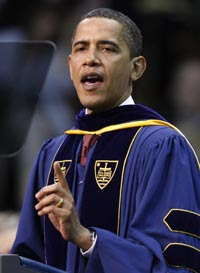
It is thus not surprising that Hesburgh's successor, Fr. John Jenkins, would invite the newly-elected president Barack Obama to speak at commencement this year. What he did not foresee is the controversy this would engender, thus bringing unwelcome negative publicity to the university and to him personally. Initially the Bishop of Fort Wayne and South Bend, John D'Arcy, signalled his disapproval and his intention to absent himself from the event, due to Obama's personal and political support for the pro-choice position on abortion. Many, if not most, of the other American bishops followed suit. Most dramatically, Harvard Law Professor Mary Ann Glendon, former US Ambassador to the Vatican, refused the Laetare Medal which she had been offered by the university.
Obama's address can be seen here in full at Notre Dame's website. To those watching it, the audience's excitement at his presence was obvious. Some 54 percent of Catholics seem to have voted for Obama, and this is reflected in the enthusiastic reception he received. As is his wont, Obama gave a great speech and, knowing his audience, mentioned the 91-year-old Fr. Hesburgh's role in President Eisenhower's Civil Rights Commission and in the eventual passage of the 1964 Civil Rights Act. This magnificent gesture could only endear him to the Notre Dame community, which responded with applause throughout. As for the pro-life protesters who disrupted the event, they came off looking very rude indeed.
The controversy raises at least three issues worth addressing here.
First — and I say this as a Reformed Christian — it is not especially healthy for a university's decisions to be subject to a bishop's veto. A university, even an overtly confessional university, has its own authoritative sphere that ought not to be confused with that of the institutional church. I am with Abraham Kuyper in believing that a christian university best functions free from the unwarranted interference of church and state alike. That said, in this case the diocesan bishop made no pretence of vetoing Jenkins' decision; he simply elected to stay away.
Second, at one time Notre Dame was controlled by an otherwise little known order, the Congregation of the Holy Cross (CSC). Although the university is now governed by a lay board, its self-definition as a Catholic university implies a fidelity to the teachings of Rome. Up to now the president has always been a CSC priest. The very nature of Roman Catholicism implies, not just a confessional orientation, but fidelity to the claims of a particular institutional manifestation of the church. That church has made clear its teachings on the sanctity of human life, and thus the university is presumably bound by them. At the very least, Fr. Jenkins put the American Catholic bishops in a difficult position and forced them to respond in some fashion. Had he invited Obama to speak without offering him an honorary degree, he might have avoided the fuss.
Third and finally, in trying to solidify its place as an American university at home with the larger educational establishment, is Notre Dame in danger of losing its soul, if I may be permitted that overused cliché? Might its quest for respectability come at the expense of its Catholic identity? Of course, Notre Dame is not alone in this, as there are many christian universities in North America, some church-related and some not, that must daily confront this very issue. Shall such universities, for example, simply accept the larger definitions of the academic disciplines, their subject matter, their preferred methods, their general orientations, and so forth? Or are they obligated to subject even these to a biblically-shaped worldview? From my own experience at Notre Dame, it's not clear to me that this way of phrasing the issue would make much sense to people there. In a Catholic milieu the question would once again revolve around church teachings, which, as noted above, are clear on this particular issue while remaining silent on much else.

Whither Notre Dame? I think we can safely say that it will continue to be a force to contend with in the world of football. It is also likely to keep the undying loyalty of Domers past and present, who give generously to their alma mater. But it's an open question whether Notre Dame will survive over the long term as a genuinely Catholic university or, in the short term, whether Fr. Jenkins will keep his job after his inept handling of this fiasco.
Nevertheless, a quarter century ago my impression of the university's administration, then headed by its long-serving president, Fr. Theodore Hesburgh, was that, while it tried its best to hold the line on its Catholic identity, it did so with some embarrassment, seeking respectability with the larger educational establishment and even with the popular media. Against the background of an establishment that traditionally viewed Roman Catholics as un-American, Notre Dame has coveted a place for itself as a genuinely American university. Of course, sport has played a big role in this, as any collegiate football fan knows.
As part of its persistent effort to fit in, Notre Dame has invited six US presidents to speak at commencement and has conferred honorary degrees on nine. During my time there Ronald Reagan spoke in 1981, his first public appearance after the attempt on his life nearly two months earlier. In 1984 New York Governor Mario Cuomo, then a presidential aspirant, spoke at Notre Dame, making his notorious "I'm personally opposed, but. . ." speech with respect to abortion, thus antagonizing serious Catholics but receiving Fr. Hesburgh's blessing.

It is thus not surprising that Hesburgh's successor, Fr. John Jenkins, would invite the newly-elected president Barack Obama to speak at commencement this year. What he did not foresee is the controversy this would engender, thus bringing unwelcome negative publicity to the university and to him personally. Initially the Bishop of Fort Wayne and South Bend, John D'Arcy, signalled his disapproval and his intention to absent himself from the event, due to Obama's personal and political support for the pro-choice position on abortion. Many, if not most, of the other American bishops followed suit. Most dramatically, Harvard Law Professor Mary Ann Glendon, former US Ambassador to the Vatican, refused the Laetare Medal which she had been offered by the university.
Obama's address can be seen here in full at Notre Dame's website. To those watching it, the audience's excitement at his presence was obvious. Some 54 percent of Catholics seem to have voted for Obama, and this is reflected in the enthusiastic reception he received. As is his wont, Obama gave a great speech and, knowing his audience, mentioned the 91-year-old Fr. Hesburgh's role in President Eisenhower's Civil Rights Commission and in the eventual passage of the 1964 Civil Rights Act. This magnificent gesture could only endear him to the Notre Dame community, which responded with applause throughout. As for the pro-life protesters who disrupted the event, they came off looking very rude indeed.
The controversy raises at least three issues worth addressing here.
First — and I say this as a Reformed Christian — it is not especially healthy for a university's decisions to be subject to a bishop's veto. A university, even an overtly confessional university, has its own authoritative sphere that ought not to be confused with that of the institutional church. I am with Abraham Kuyper in believing that a christian university best functions free from the unwarranted interference of church and state alike. That said, in this case the diocesan bishop made no pretence of vetoing Jenkins' decision; he simply elected to stay away.
Second, at one time Notre Dame was controlled by an otherwise little known order, the Congregation of the Holy Cross (CSC). Although the university is now governed by a lay board, its self-definition as a Catholic university implies a fidelity to the teachings of Rome. Up to now the president has always been a CSC priest. The very nature of Roman Catholicism implies, not just a confessional orientation, but fidelity to the claims of a particular institutional manifestation of the church. That church has made clear its teachings on the sanctity of human life, and thus the university is presumably bound by them. At the very least, Fr. Jenkins put the American Catholic bishops in a difficult position and forced them to respond in some fashion. Had he invited Obama to speak without offering him an honorary degree, he might have avoided the fuss.
Third and finally, in trying to solidify its place as an American university at home with the larger educational establishment, is Notre Dame in danger of losing its soul, if I may be permitted that overused cliché? Might its quest for respectability come at the expense of its Catholic identity? Of course, Notre Dame is not alone in this, as there are many christian universities in North America, some church-related and some not, that must daily confront this very issue. Shall such universities, for example, simply accept the larger definitions of the academic disciplines, their subject matter, their preferred methods, their general orientations, and so forth? Or are they obligated to subject even these to a biblically-shaped worldview? From my own experience at Notre Dame, it's not clear to me that this way of phrasing the issue would make much sense to people there. In a Catholic milieu the question would once again revolve around church teachings, which, as noted above, are clear on this particular issue while remaining silent on much else.

Whither Notre Dame? I think we can safely say that it will continue to be a force to contend with in the world of football. It is also likely to keep the undying loyalty of Domers past and present, who give generously to their alma mater. But it's an open question whether Notre Dame will survive over the long term as a genuinely Catholic university or, in the short term, whether Fr. Jenkins will keep his job after his inept handling of this fiasco.
15 May 2009
Desktop publishing?
Here is something that could conceivably remake academia as we know it and much else as well: Fit to print: Will the Espresso book machine revolutionize the publishing industry?
14 May 2009
Electoral reform failure
Efforts at electoral reform in British Columbia have received a severe setback as residents of that province decisively defeated proportional representation in yesterday's referendum: B.C. voters turn thumbs down on STV. It may take a political crisis similar to the one in New Zealand to galvanize the electorate to do something about our current first-past-the-post system.
13 May 2009
From CLAC to CPJ
Here is the official announcement from the Center for Public Justice on the appointment of its new head: Gideon Strauss Appointed New CPJ President. In anticipation of assuming these responsibilities, Strauss has begun a new blog: http://cpjustice.org/gideonstrauss/. Although we will certainly miss his presence with us here in southern Ontario, we wish him the best as he takes up this fresh challenge south of the border. May God grant him wisdom and courage.
12 May 2009
May snippets
07 May 2009
Spengler emerges
The man who has written for the Asia Times under the pseudonym "Spengler" for the past dozen years has dropped his persona: Confessions of a Coward. And what a colourful past he has had!
Subscribe to:
Posts (Atom)