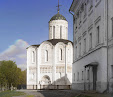
Three years ago I wrote of The fate of the Pontic Greeks, that is, those Greek Orthodox Christians who inhabited the southern shores of the Black Sea for nearly 2 thousand years prior to their treaty-mandated expulsion after 1923. Although I grew up hearing and singing Greek music, especially δημοτικά τραγούδια (folk songs) familiar to generations, it was less than a decade ago that I encountered the distinctive Pontic Greek music via this page maintained by LeighCline of Toronto.
As a child I learned to dance the καλαματιανό (kalamatiano), with its distinctive 7/8 time signature. Typical examples follow immediately below:
These are familiar to anyone attending one of the numerous Greek Orthodox church festivals held throughout North America during the summer months. However, one is less likely to see something like this at one of those festivals:
The music of the Pontic region boasts such distinctive instruments as the 3-stringed kemenche, played much like a western viol. It has a close relationship to the music of the surrounding cultures, especially that of the Caucasus, Iran and central Asia, and it may even have ancient Celtic roots. The Pontic Greeks are one of any number of displaced communities around the world who have brought their culture, including their music, with them in an attempt to maintain their distinctiveness in exile.
06 June 2007
Amazing likeness
Theresa D. C. Koyzis
Proof positive that children tend to idealize their parents.
05 June 2007
Lukashenka lauded
The man known as Europe's last dictator is being honoured by the Orthodox Church with its highest award for laymen, the Order of St. Grand Prince Vladimir Equal-to-Apostles. This is the second such ecclesiastical award conferred upon the saintly Alyaksandr Lukashenka, the President of Belarus. Why this award now? It seems Lukashenka has made a "considerable contribution" to the development of interchurch and interstate relations. Might this include a certain charism for quashing domestic political opposition and antagonizing neighbours?
04 June 2007
Anglican identity
The bishops of the Church of England are making a long overdue proposal to secure for itself and for the other churches in communion with it a stronger confessional identity: Anglican 'rule book' proposed. At first glance it sounds good, but the old cliché about closing the barn door after the horses have left would seem to have some relevance here. My question is this: Why not simply reaffirm the Thirty-Nine Articles of Religion?
Putin speaks
This interview with President Vladimir Putin is must reading for anyone with an interest in the politics of the Russian Federation and its relations with its foreign "partners." It will also likely be required reading for my students in POL 265 this autumn. An excerpt:
Of course, I am a pure and absolute democrat. But you know what the problem is? Not the problem, a tragedy, a real tragedy. The tragedy is that I am alone. I am the only such pure democrat. There are no such other democrats in the world. . . . After the death of Mahatma Ghandi, I have nobody to talk to.
Well, that is reassuring. It seems I've been too hasty in labelling poor Volodya "Stalin Lite."
Preparing for leadership
The Work Research Foundation's Comment is beginning its second annual series aimed at university-bound young people with an article by yours truly, titled: Making the most of college: Preparing for leadership. A brief selection:
If you are at a university where the larger questions of right and justice are posed, and where discussion of them is encouraged, throw yourself into the dialogue. Ask your own questions and consider thoughtfully the questions of others. Be daring and don't be afraid to put forward your own ideas. That's what you're there for. From my own time at Redeemer, I've discovered that a Christian university can provide an especially fertile ground for nurturing such discussions. This is because students are often given the tools to see through reductionist explanations — say, Marxism, Freudianism and Darwinism — for the complex phenomena of God's world. But it may also be that Christians are more aware than others of participating in an ancient tradition of reflection and a larger conversation that started long before they were born and will continue long after they are gone.
On the other hand, if you are at a university where the study of politics is narrowed to what can be addressed by the scientific method, then discussion of the larger questions is not likely to be encouraged. In fact, it might be actively discouraged, and you may find yourself being advised to switch to the study of philosophy or religion rather than politics. If this is your situation, it will be up to you to round up like-minded fellow students and to jump start the conversation with them on your own time. I know from personal experience that sometimes meeting regularly with an extracurricular discussion group, especially when accompanied by a shared meal, can be more life-changing than the formal courses offered by the university.
30 May 2007
Psalms in wartime
As a lifelong aficionado of old books, I have made a point of visiting the local antiquarian bookshops while travelling. During a visit to Prague in what was then still called Czechoslovakia in November 1976, I found more than one such shop and purchased a number of volumes dating from the 19th century. One of these was a metrical psalter and hymnal published in 1900, a scanned photograph of which can be found on my Genevan Psalter website.
Another volume dates from 1845 and contains the New Testament and Psalms translated into the Czech language. (Years later I was struck by the irony of my having taken a Bible out of a communist country!) The print is in the old German blackletter and the text uses an older spelling (with "w" for "v", "j" for "i", &c.). The frontispiece (shown above) indicates that this edition was intended for use by "Evangelical Christians of the Augsburg and Helvetic Confessions," i.e., by Lutheran and Reformed Christians.
The Psalms are, of course, of special interest to me, especially the various ways they are used in the course of the liturgy or by individual believers at prayer. Two days ago, while paging through this section, I discovered something I hadn't before noticed. The owner of this volume at the beginning of the 20th century, whose name seems to have been Karel (spelt "Carl" in the handwritten name at the bottom of the page opposite the frontispiece) Lány, read through the Psalms at the pace of one psalm per day (except for Psalm 119), taking time to mark the date at the top of each. (Might it have been this Karel Lány?) He started with Psalm 1 on "1./8.", i.e., 1 August 1914, and continued until he read Psalm 150 on "18./I. 1915", i.e., 18 January 1915.
The timing may not have been incidental. Lány lived in Austria-Hungary, whose heir to the throne, Archduke Franz Ferdinand, had been assassinated in Sarajevo on 28 June. Tensions had mounted after that, with Austria-Hungary issuing an ultimatum to Serbia on 23 July and declaring war five days later. This quickly brought the other European powers onside of either Austria or Serbia, with battles beginning and intensifying into the autumn and winter months. It seems rather likely that Lány — apparently a Lutheran or Reformed Christian living in the predominantly Catholic Czech provinces — turned to the Psalms as the Great War was breaking out.
Perhaps he had a son of conscription age and was concerned for his safety should his country go to war. As a member of a religious minority (and with Hungarian origins at that), he may have sensed how fragile his country's unity really was at the outset of what proved to be the defining event of the 20th century. One can only imagine the subsequent history of this little book. It is possible that Lány lived into the nazi and communist eras, when atheistic régimes made it costly to maintain a public witness to the faith. After Lány's death, the volume may have passed down to his children and grandchildren who were perhaps less appreciative of its significance, selling it to an antiquarian bookseller, whence it came into my hands three decades ago. Of course this can only be speculation.
One thing is certain. While the Battle of Tannenberg was raging to the north between Germany and Russia, Lány read these words from Psalm 27:
Though a host encamp against me, my heart shall not fear; though war arise against me, yet I will be confident. One thing have I asked of the LORD, that will I seek after; that I may dwell in the house of the LORD all the days of my life, to behold the beauty of the LORD, and to inquire in his temple. For he will hide me in his shelter in the day of trouble; he will conceal me under the cover of his tent, he will set me high upon a rock.
29 May 2007
A nonmarxist sartorial flourish
Note the neckwear (click to enlarge)
27 May 2007
Pentecost and Psalm 104
A little over two decades ago I wrote a hymn text titled simply A Hymn for Pentecost, which I have just posted on my Genevan Psalter website. Here is the text:
O Spirit of God, descend as a dove, alight on our hearts, fill them with your love. As once the apostles were touched by your flame, so rest upon us that new life we may claim.
O Fount of our faith, come, grant us your grace that we might believe and so find a place within your blest Kingdom, as promised to all whom God in his mercy has chosen to call.
O Breath of true life, breathe into our pleas the words that we dare to speak on our knees; for we are God's children and heirs of his love, therefore may we call on our Father above.
O Source of all strength, make us to be bold, as oft you inspired your prophets of old. Now give us the courage plainly to declare your life-giving message to all who will hear.
O Counsellor, come: our spirit renew, and guide your elect in paths that are true. O lead us through shadows that darken our way that we may walk joyfully into the day.
The tune I chose was OLD 104TH, composed by Thomas Ravenscroft for his Whole Book of Psalms, published in 1621. I had recently heard a recording of Ralph Vaughan Williams' Fantasia on the Old 104th Psalm Tune, which was my introduction to this melody. My choice was influenced by the ancient tradition appointing the singing of Psalm 104 on the feast of Pentecost.
There appears to be a curious relationship between Ravenscroft's 104 and the Genevan Psalter's tune for the same psalm. The metre (10.10.11.11) is identical save for two things: (1) That of the Genevan melody is double that of Ravenscroft (10.10.11.11.10.10.11.11), and (2) the internal stresses are quite different. In Ravenscroft's Psalter this text is joined to his tune, as sung by the choral ensemble in Vaughan Williams' Fantasia. Yet it seems that in the Scottish Psalter of 1635 the Genevan melody was used, as indicated here. I personally find it more difficult to sing "My soul, Praise the Lord, speak good of his Name" to the Genevan tune than to Ravenscroft's, which better fits the text. Yet my own assessment was obviously not shared by many Christians in the 17th century.
There is obviously a story to be told about the relationship between these two tunes, but I don't know whether anyone has ever looked into it. It could, I suppose, make up a chapter in someone's dissertation, if there's a graduate student somewhere interested in pursuing the topic.
25 May 2007
So soon?
Only weeks after the recent provincial election in La Belle Province comes this: Opposition to Quebec budget may trigger snap election. If so, then it seems to me that the new Lieutenant Governor might be within his constitutional authority to refuse dissolution of the National Assembly, either requesting Premier Jean Charest to negotiate further with the ADQ or the PQ, or summoning the leaders of the other two parties to see whether they might be able to form an alternative coalition government. Voters shouldn't have to go to the polls every few months, much less weeks. It's time for heads of minority governments at federal and provincial levels to recognize that they cannot continue to govern as if they had a majority.
23 May 2007
Church hostage to its own canon law
The Orthodox Patriarchate of Jerusalem is still in a state of uncertainty after the Kingdom of Jordan withdrew its recognition of Theophilos III as patriarch. "Church law dictates the Patriarch must have the blessing of the Holy Land's ruling powers — Jordan, the Palestinian Authority and Israel." So change the law already!
The latest contribution to the Center for Public Justice's new Root & Branch series is by James Skillen and titled, Watch Turkey! Skillen analyzes the current debate in that country as one between two religions: Islam and Kemalist securalism. He has fairly kind words for the current prime minister and would-be president Recep Tayyip Erdogan and his Justice and Development Party (AKP). These, he believes, are advancing, not an islamist establishment, but public pluralism:
[T]he AKP has demonstrated that it is not necessary for citizens to believe in secularism in order to enjoy full citizenship in the republic. In essence, the AKP is putting something new into practice, different from both monopolistic secularism and monopolistic Islam. We might call it public pluralism through which people of all faiths, including both secularists and Muslims, are given room to live out their faiths in public life without any one of them being allowed to monopolize the political arena.
The thing to watch in Turkey now, with the upcoming July election for president (the only office not yet won by the AKP), is whether the AKP government can maintain popular support for public pluralism and an open democratic society. Will the more radical Islamists support such a society in which they have more room to express themselves but cannot dominate? And will radical secularists, including the military leaders, accept a system that gives believing secularists continued access to political life but no longer a monopoly on government, the military, and the bureaucracy? If so, Turkey may well be developing a model that could have potent significance for other Muslim countries, for religiously diversified countries such as India and Indonesia, and even for Western countries such as France and the United States.
Those with experience of Turkey, whether direct or indirect, might be forgiven for doubting the plausibility of such a happy outcome. To secure the agreement of both radical Islamists and radical secularists for a new public pluralism would be a considerable task that runs counter to both post-1920s republican and pre-1920s Ottoman history. It is unclear whether Erdogan is up to it or whether the military would even allow it. Nevertheless it would unquestionably be an improvement over the status quo.
21 May 2007
Victoria Psalter
What better way to spend Victoria Day than to page through a copy of Owen Jones' The Psalms of David, "with permission dedicated to Her Most Gracious Majesty Queen Victoria," also known as the Victoria Psalter. Jones (1809-1874) was an architect and ornamental designer who served as a superintendent of works at the Great Exhibition of 1851. His 1856 Grammar of Ornament had an influence on subsequent architects and designers in the 19th and 20th centuries. In 1862 he published the Victoria Psalter, a chromolithographed illuminated psalter with colours limited to red, blue and gold. The text of the Psalms is that of Miles Coverdale's translation, as found in the Book of Common Prayer. The 150 Psalms are divided into 30 groups so as to be said or sung over a 30-day period. Each day is further divided into two for morning and evening prayer. The Psalm at the beginning of each group is preceded by chant tones, as can be seen by clicking on the image above.
I recently purchased a reprinted edition of this Psalter, published in 2002 by North Parade Publishing. For those who like illuminated manuscripts, this is worth purchasing, especially at the discounted price offered at Chapters. However, there are flaws in this edition. The dedicatory pages are in reverse order. It suffers from the lack of a comprehensive introduction to Jones and the Psalter. The dust jacket has two brief paragraphs on the inner flaps, but one of these manages to confuse this Jones with another Owen Jones by citing the latter's birth and death years. It further has him visiting the Middle East 9 years after his own death! The other flap claims that Jones created his Psalter at 79, an age he again never lived to see. These evident defects may explain the discount. Still, if one ignores these, the book is a visual feast.
For those wishing to explore further the tradition of illuminated manuscripts, check out the considerably more ancient — and more visually stunning — Book of Kells and Lindisfarne Gospels.
17 May 2007
UK PM to be RC?
Rumour has it that the soon-to-be former British Prime Minister, Mr. Anthony Charles Lynton Blair, will take the plunge and swim the Tiber once he has left office. We shall see.
Put away your skates
This sounds like something out of science fiction: Distant, hot world mostly ice: scientists. If you tried to play hockey on this ice, not only might your skates melt, but the pressure would get to you too.
For the first years following Confederation in 1867, Canada had no federal supreme court, though it had the right to establish one under section 101 of what was then called the British North America Act. Not until 1875 was the Supreme Court of Canada set up, and even then it was not technically supreme. Those dissatisfied with rulings of this court could appeal one more level to the Judicial Committee of the Privy Council in London. After the Statute of Westminster of 1931, however, Canada was authorized to abolish such appeals which it did in 1949. Probably the most famous Privy Council ruling for this country was the 1929 "Persons" case, which established that women are persons under the law and thus eligible for Senate appointments.
Gradually most Commonwealth countries have abolished appeals to the Privy Council, including New Zealand as recently as 2004. However, appeals of cases decided before then have continued to make their way across two oceans to London for final decision. In what is apparently its last decision relevant to New Zealand, the Judicial Committee of the Privy Council has thrown out the murder convictions of David Bain, thereby calling into question the justice system of that country. Many New Zealanders see merit in cutting one more tie to the United Kingdom. However, the Campaign for the Privy Council is not persuaded, as indicated in the group's press release: Bain Decision Vindicates Privy Council Appeals. Supporters argue that "however good the New Zealand judiciary might be, there is nothing to equal an independent outside body to ensure quality control." Prime Minister Helen Clark defends the decision to abolish appeals and believes that access to a local Supreme Court may actually facilitate the appeal process.
Here are some stories that were either not covered by the media or not deemed of sufficient importance to make the front page.
While thursday's March for Life in Ottawa was reported by the National Post, a Google News search reveals that few others paid attention to it. Footage of the march has been posted on Youtube but will likely not be seen on television. Joanne (True Blue) surveys media coverage of the event. Several Anglo-Catholic Ninjas (one of whom I taught a few years ago) were in attendance as well.
That same day my esteemed colleague, Deani Van Pelt, at a public event at Redeemer, presented the findings of a study exploring Ontario's Private Schools: Who Chooses Them and Why? The study was a collaborative effort amongst Van Pelt, Derek J. Allison and Patricia A. Allison of the University of Western Ontario, and was sponsored by the Fraser Institute. A report on this appears in the Ottawa Sun. Congratulations to Van Pelt and her associates.
Going overseas to what was once the heartland of the christian faith in ancient times, three Christians were murdered by Turkish nationals last month at a bible publishing house in the city of Malatya in east-central Turkey. This latest atrocity follows other attacks on Christians in that predominantly muslim but officially secular country.
Finally, Christians in Baghdad are being forced by Sunni insurgents to flee their homes and neighbourhoods. Sadly, American-led troops appear to be unaware of the Christians' plight and are thus doing nothing to stop it.
All of these stories deserve more publicity than they have received thus far.
10 May 2007
Swimming the Tiber
Here is a name that, admittedly, I had not known before, but this news is making waves in evangelical circles: Evangelical professor becomes Catholic. Christianity Today's David Neff interviews Francis Beckwith about his reconversion and the unexpected reverberations. Here's Beckwith himself on My Return to the Catholic Church. All of this reminds me of the fuss made over Tom Howard's reception into the Roman Catholic Church back in 1985. After reading such stories, I keep coming back to this question: Why Rome and not Constantinople?
If, as Melanie Philips puts it, human rights is a religion for a godless age, then this edifice must be its temple: Human rights museum details unveiled. The magisterium for this new faith will be located in Winnipeg. Of course every ecclesial establishment must have its own website. Just how many Canadians can be expected to make the annual hajj to the holy city on the Red and Assiniboine Rivers is unclear.
Is it just coincidence. . .
. . . or is there a genuine medical reason why my shoes are considerably more comfortable since my appendectomy? Just curious.
It is rare for a sitting government to make a change that would limit its ability to act, but Prime Minister Stephen Harper has done just that with this overdue constitutional reform: Bill setting federal elections every 4 years about to become law. Now if only we could adopt proportional representation on the federal level.
Tallis' famous theme
One of my favourite pieces of music is Ralph Vaughan Williams’ Fantasia on a Theme by Thomas Tallis, written by the famed English composer in 1910. I fell in love with this magnificent work 25 years ago while studying for one of my written comprehensive exams at Notre Dame. The “theme” in the title is a tune composed by the Renaissance composer Thomas Tallis for Archbishop Matthew Parker’s Psalter to which a versification of Psalm 2 is set. In most hymnals it is given the title THIRD MODE MELODY, because it’s in the phrygian mode, and it is sometimes paired with Horatius Bonar’s text, I Heard the Voice of Jesus Say. In the Christian Reformed Church’s Psalter Hymnal a metrical version of Psalm 62 is set to it.
The tune itself doesn’t seem especially strong, at least at first. There’s not much movement in the first half of the melody, which sneaks up on the listener hesitantly with a chant-like quality. But there’s something compelling about it, all the same. Like most music of the period, it lacks a regular time signature, yet it’s in the double common metre ubiquitous in English psalmody and hymnody. Above all it is an “ecclesiastical” tune, breathing the spirit of the church’s liturgy.
In the hands of Vaughan Williams this tune takes on an unforgettably haunting quality. The Fantasia is played entirely by strings, and the composer even employs parallel fifths, which defy musical convention but work wonderfully to heighten a sense of awe and mystery. When the piece finally brings us back to the original tune, we recognize that we have been on a remarkable musical journey – perhaps into a nearly forgotten past of some four and a half centuries ago. On more than one occasion this piece has left me with moist eyes. Listen for yourself below:
One can nearly picture the peaceful nobility of the English countryside in the composer’s swelling cadences. I myself tend to associate it with another tranquil landscape, viz., that formed by the land along the Illinois Prairie Path, where I rode my bicycle during that summer of a quarter century ago.
Remarkably, Vaughan Williams seems to have considered himself an agnostic, despite his having contributed so much to the music of the English church. Who does not love to sing For All the Saints, set to his whimsically (un)named SINE NOMINE? Incidentally Vaughan Williams was the grandnephew of Charles Darwin.
As for Tallis' THIRD MODE MELODY, here is another elaboration composed by the late Texas composer Fisher Tull in 1971, Sketches on a Tudor Psalm. This has a quite different feel to it. While Vaughan Williams' Fantasia is written entirely for strings, Tull's Sketches are for brass band. This gives the piece a less tranquil and more dynamic and agitated flavour, as underscored by the discordant tonality and energetic percussion. There are echoes of Vaughan Williams in a very few of Tull's phrases. Here is a description of Tull's work:
Sketches on a Tudor Psalm is based on a 16th Century setting of the Second Psalm by Thomas Tallis. The original version was in the Phygian mode with the melody in the tenor voice. A modern adaptation is still used today in Anglican services. The introduction sets the harmonic character by emphasizing the juxtaposition of major and minor triads. The theme is first presented by solo alto saxophone, continued by horns, and followed by a fully harmonized version from the brass. The variations begin to unfold in an Allegro section with a melody in the clarinets that was constructed from the retrograde of the theme. Fragments of the theme are selected for rhythmic and melodic transformation. Finally, the opening harmonic sequence returns in highly punctuated rhythms to herald the recapitulation of the theme beginning in the low woodwinds and culminating in a full-scored setting of the climactic measures. A coda continues the development as the music builds to a triumphal close on a major chord.
Finally, soon after discovering Tallis' tune, I wrote a metrical versification of Psalm 25 to be sung to it, along with my own arrangement of the melody. I will not claim it to be the equal of Vaughan Williams' or Tull's efforts, but it is intended to return it to its original use, namely, as a setting for a psalm.
29 April 2007
Robert E. Webber (1933-2007)
Nearly 30 years ago I read my first book by the prolific Bob Webber. It was called Common Roots, an eloquent plea for free-church evangelicals to reclaim the church of the first centuries as their own and to recognize their origins therein. A few years later I reviewed Webber's The Moral Majority: Right or Wrong? for the old Vanguard magazine, published by the Wedge Publishing Foundation in Toronto. Then on to an edited volume, Evangelicals on the Canterbury Trail, containing first-person accounts of evangelicals whose personal pilgrimages had led them to Anglicanism. This book inspired me to commit my own spiritual pilgrimage to writing, which, at the tender age of 31, I had the audacity to send to him. When I met him later, he told me he had actually read it, somewhat to my surprise.
In 1991 Webber was a guest speaker at a worship conference at Redeemer, and I had the opportunity not only to meet him but to spend time talking with him. Five years later he attended Nancy's and my wedding ceremony in Glen Ellyn, Illinois. Nancy had been teaching at Wheaton College up until then, so she and Bob were colleagues in the same department. I thus had more than one connection with the man.
Webber was best known for his writings on liturgy, including the edited multivolume Complete Library of Christian Worship, in which two of my own articles appear. He was less the scholar, along the lines of, say, Gregory Dix or Hughes Old, and more the popularizer, influencing Christians in a number of traditions to think more self-consciously about why and how they worship. He wrote in a way that was accessible to ordinary church-goers, and that's where his impact will be felt for some time to come.
Last autumn he was diagnosed with pancreatic cancer and, after enjoying a brief remission around Christmas, died last friday. He will be missed.
In response to the Archbishop of Canterbury's recent address at Wycliffe and Trinity Colleges in Toronto, Robert A. J. Gagnon, of Pittsburgh Theological Seminary, offers his own take on the issues dividing the Anglican Communion: Rowan Williams’ Wrong Reading of Romans (…and John 14:6).
Niko and Nazli
Could a television soap opera help to improve Greek-Turkish relations? Perhaps.
23 April 2007
Boris Nikolayevich Yeltsin (1931-2007)
More on abortion
If anyone doubts where the CBC stands on the abortion issue, this country's public broadcaster seems bent on removing any lingering uncertainties by giving Heather Mallick a voice (Abortion rights and abortion fights) without providing for an opposing viewpoint. Just a sample of her rhetoric: "anti-abortionists" engage in "mean, small-time work," and "try to lure women to change their minds, terrifying them with misleading photographs and false information."
South of the border, Jim Wallis has his own take on the issue: "We have supported a 'consistent life ethic' - which seeks a dramatic reduction in the actual abortion rate in America, without criminalizing what is always a tragic choice and often a desperate one." Some people failing to comprehend the intricacies of a consistent life ethic might be inclined to call his position, well, pro-choice.
If the Channel Tunnel made Great Britain part of Europe, might this proposed tunnel make Russia part of North America? or the US part of Asia? If successful, in theory one could take a very long automobile or rail trip covering every continent except for Australia and Antarctica. The question is: would Americans and Russians really wish to share a "land" border?
The birth of a classic
Film buffs, especially Alfred Hithcock aficionados, will find this of interest. A few weeks ago I pulled from my personal files a yellowed page of the Chicago Daily Tribune, dated June 30, 1958. Hollywood gossip columnist Hedda Hopper writes:
Here, by the way, is my own brief review of the film.
A quarter century ago today Prime Minister Pierre Trudeau achieved his highest political dream of patriating Canada's constitution. Prior to that point this country had no entrenched constitutional documents on a par with the United States Constitution or the German Grundgesetz. We had the British North America Act of 1867, but this was no more than an act of the British Parliament, its validity originally resting on Canada's legal subordination to that Parliament. After the Statute of Westminster of 1931, Canada had the right to adopt its own entrenched constitution, but the anomaly of Canada's subordinate constitutional status continued right up to 1982, primarily because for 50 years federal and provincial leaders could not agree on how to amend such a document. With the "gentle" urging of Trudeau, this all changed on 17 April 1982, when the Queen signed the new constitution in Ottawa.
After this date the British North America Act became, with some modifications, the Constitution Act, 1867, an entrenched document possessing the status of "supreme law of the land," to quote its American counterpart. More significant yet was the adoption of the Constitution Act, 1982, a completely new document consisting of a Charter of Rights and Freedoms and the formulae for amending these documents. Among the consequences of the adoption of entrenched constitution acts was the empowering of the courts, which now had the authority to invalidate federal and provincial laws deemed to conflict with these acts. Some would argue that this has strengthened constitutional government against the threat of majoritarian tyranny. Others see it as having diminished the democratic character of our political system and increased the threat of judicial tyranny.
Here, from the CBC archives, is a video timeline of the lengthy process of giving Canada its own constitution, as some would put it.
16 April 2007
Anglican news
The Archbishop of Canterbury, Dr. Rowan Williams, is in our neck of the woods today and tomorrow. I've not yet had a chance to read the speech he delivered in Toronto, but I'm linking to it here for those interested: The Bible Today: Reading & Hearing.
The Ontario Citizens' Assembly on Electoral Reform has made its recommendation for reforming the province's electoral system: replacing first-past-the-post (FPTP) with mixed-member proportional (MMP). I would like to think that my own submission had something to do with this, but it seems that MMP received the most support of the various suggested alternatives. This means we will be voting on whether to adopt MMP at the next provincial election in October. The Globe and Mail reports:
The referendum will have a high threshold in order to pass. It needs at least 60 per cent of the votes cast, along with at least 50 per cent of voters in a minimum of 64 individual provincial ridings. There are currently 103 ridings. . . .
Under [MMP], Ontario would have 90 MPs elected from local ridings, just as they are now, for 70 per cent of the seats in the legislature. Another 30 per cent of the seats, or 29 in total, would be awarded to candidates selected from lists put together by the parties. Candidates from the lists would be used to adjust the number of seats each party has to reflect its share of the popular vote.
Needless to say, I have already decided how I will vote.
15 April 2007
Pascha eggs
How did eggs come to be associated with Pascha? Here is an account worth reading as much for its visual setting as for its content: Eggs in the Christian Tradition. Be sure to click on the sound file on the final page to hear the paschal troparion sung in English, French and Greek. Hat tip to the Orthodoxy Today blog.
Doubt and faith
“My piercèd side, O Thomas, see; My hands, My feet, I show to thee; Not faithless but believing be.” Alleluia!
11 April 2007
The Paschal greeting
Somehow "Happy Easter" just doesn't cut it. At church on sunday I very much wanted people to follow the Orthodox tradition and greet me with "Christ is risen!" to which I would then respond: "Truly he is risen!" In our family we do this in Greek: "Χριστός ανέστη!" "Αληθώς ανέστη!" (Remember the post-vigil scene at Dancing Zorba's restaurant in My Big Fat Greek Wedding?) In Russian it is rendered thus: "Христос Воскресе!" "Воистину Воскресе!" Yesterday one of my students, an Orthodox Christian with Lebanese roots, taught me the greeting in Arabic.
Later in the day I discovered this marvellous website, Pascha Polyglotta, that gives us the ancient greeting in 250 languages (but not Russian or Old Church Slavonic for some reason). Each example of the greeting contains a sound file with pronunciation. It's a great resource and certainly worth bookmarking to gain a sense of the sheer diversity, yet catholicity, of Christ's church. (Hat tip to Orthodox Wiki.)
Later: While we're at it, I will link here to something I posted last year on the meaning of our English word Easter: Easter: what's in a name?
I have recently become aware of the existence of the Parti démocratie chrétienne du Québec, a provincial political party that is attempting to buck the secularizing trends that have overtaken Québec since the Quiet Revolution of the 1960s. It is avowedly Catholic, drawing on the social teachings of the Catholic Church. It is pronatalist, aims to protect the family and opposes abortion. It is nationalist, but not separatist, preferring to see Canada remodelled along the decentralizing lines of the Swiss confederation. In the recent provincial election the PDCQ received a somewhat less than impressive 1,635 votes, or 0.04 % of the total number of votes. An educated guess would not see it forming the government in Québec any time soon.
In the meantime the elderly Patriarch Pavle of the Orthodox Church of Serbia has denounced western plans to grant independence to the Serbian province of Kosovo. I am inclined to agree with those who argue that encouraging such a move would establish a dangerous precedent for other states plagued by secessionist movements. It is unlikely that, say, the United States would allow territories in its own southwest with Spanish-speaking majorities to claim independence or to rejoin Mexico.
08 April 2007
And the third day he rose again. . .
06 April 2007
Crucified for us. . .
05 April 2007
Climate change
The following story may or may not have appeared recently in the North American press:
Moratorium called for in climate change debate
WASHINGTON, DC - Concerned scientists are calling for a moratorium in the ongoing debate over climate change, noting that it is generating more heat than light and thereby inadvertently contributing to global warming.
High speed railways
This week France's famous Train à grande vitesse (TGV) set a new speed record for rail transportation, clocking an impressive velocity of 574.8km/h (356mph), as seen immediately below:
As a lifelong railfan, I have a certain affection for trains of all sorts, but especially for electric railways, such as subways, trams and interurbans/radials. Would the Windsor-Québec corridor here in Canada benefit from the kind of high-speed rail service found in France and Japan? It would be expensive, to be sure, and it's possible that numbers of potential riders would not warrant it. But given that airport capacity cannot be expanded indefinitely and that there's only so much air space over a metropolitan urban centre, there is much to be said for at least improving passenger rail travel between cities separated by short or intermediate distances, such as Toronto and Ottawa or Québec and Montréal. Moreover, anything that would decrease the numbers of private automobiles, with their heavy use of nonrenewable energy resources and emission of air pollutants, on our roads is to be welcomed.
02 April 2007
Facing up to the inevitable
My experience of the past three weeks has reminded me in a vivid way of my own mortality, which coincided with the celebration of 52 years of life last friday. Three mondays ago I was working out on the cross-trainer in Redeemer's weight room. Not 12 hours later my appendix burst in the waiting room at emergency at McMaster University Medical Centre. One moment I felt healthy; scarcely a moment later I was battling a potentially serious illness. It all happened so quickly.
After I left hospital, I learned through an internet search that the famed magician, Harry Houdini, died at age 52 (!) of a burst appendix and peritonitis. In another pre-antibiotic age, that could have been me. My life might easily be over by now.
During Holy Week we are liturgically thrust into the drama of Jesus' suffering, death and resurrection. This is the climax of the church year, when everything comes together in the events leading up to the paschal celebration. All of us face the eventuality of death. Two and a half years ago I decided to embark on an exercise regimen and successfully lost 20 pounds. This was in an effort to remain as healthy as possible for the sake of our young daughter. But such efforts can come to naught suddenly and unexpectedly, as I am freshly aware. In such circumstances all we can do is to hold on to the promise that, in Jesus' sacrifice for our sins, death does not have the final word.
01 April 2007
Happy birthday, EU
The European Union has just passed its half-century mark, with the celebration a week ago of the Treaty of Rome that brought into being the original European Economic Community. Like any political enterprise, the EU has its critics. Yet James W. Skillen believes that, despite its faults and its uncertain future, the EU is a significant achievement in co-operative institution-building amongst nations: The European Union at 50.
My question is this: Shouldn't we really be celebrating 55 years, given that the European Coal and Steel Community came into being in 1952 and is generally regarded as the beginning of the larger project of European integration?
This is from a post I wrote almost exactly one year ago:
On the first nice spring day I love to listen to Maurice Ravel's Piano Concerto in G Major, a personal favourite. I've observed this ritual virtually every year since 1973, when I was in my final year of high school, and I did so again today. This is one of two piano concertos created by the great French composer (1875-1937), the other being the single-movement Concerto for the Left Hand. Although they were written virtually simultaneously in 1929-31, their respective moods could hardly be more contrasting. Given that it was written for Paul Wittgenstein (philosopher Ludwig's brother), who had lost his right arm in the Great War, the Left Hand Concerto is sombre and dramatic.
By contrast, the G Major Concerto is lively and even daring. The first movement, Allegramente, opens with what sounds like the crack of a whip and the release of horses onto a parade ground. The middle movement, Adagio assai, is quiet and reflective, bearing some resemblance to Erik Satie's Gymnopédies. The final movement, Presto, is frenetic in its pace, with obvious jazz influence. This time the horses appear to be in a race, slowing not in the least even to show off for the crowds, as they did in the first movement.
Today is the first nice springlike day of the year in Hamilton. So here are the three movements below, in a wonderful interpretation by Argentine pianist Martha Argerich:
A watershed election
A new era has begun in Québec provincial politics, as Premier Jean Charest's Liberal government slips to minority position and Mario Dumont's Action Démocratique du Québec unexpectedly becomes the official opposition in the National Assembly. As for the previous second-place party, André Boisclair's Parti Québécois came in third, its worst showing in nearly four decades. Does this put an end to the old separatist dream of a sovereign Québec? Stay tuned.
The light of Christ continues to shine in an overwhelmingly secular Netherlands, as indicated here: Seeking security, Dutch turn to Bible Belt. (Hat tip to Joshua Eriksen.) Figuring prominently in the article is the small christian political party, ChristenUnie. This report comes on the heels of a recent Weekly Standard essay: Holland's Post-Secular Future. Perhaps the Netherlands really is turning the corner. May God grant it.
22 March 2007
A shorter book than planned
In memory of my recent health crisis, I have determined that my next book will not contain an appendix.
Liberty threatened
Are the traditional liberties enjoyed by English-speaking countries endangered in the motherland itself? Writing in Australia's The Age, this is what Melanie Phillips argues in Liberty fades as rights talk grows. Here's Phillips:
Real human rights — such as the equality of every human being and the intrinsic value of human life — are indeed universal and should be unarguable. The problem, however, comes with the "rights" that are enshrined in human rights law. These also claim to be universal and unarguable. But they are not. Indeed, the very act of codifying them makes them eminently contentious and divisive.
This is because almost every "right" in the convention is balanced by a rival "right". Judges have to decide between them. The way is therefore open for ideological, tendentious or prejudiced views to be set in judicial stone.
It has created a grasping "me too" culture that is as divisive as it is undemocratic. It has galvanised special interest groups to make demands, created a burgeoning industry of human rights lawyers and — despite acknowledging the ultimate supremacy of Parliament — effectively transferred much political power from Parliament to the courts. Instead of the rule of law, Britain now has rule by lawyers.
Though I disagree that "[h]uman rights law has nothing to do with true liberalism," I certainly concur with her belief that human rights has become "a religion for a godless age."
François Bayrou, leader of the Union for French Democracy, is making a surprisingly strong showing in the public opinion polls in the runup to his country's presidential election, as indicated in this report: French voters discover the third way. Bayrou is a practising Roman Catholic with six children and 12 grandchildren. He is sometimes labelled a christian democrat, due to UDF roots in the old Mouvement Républicain Populaire of the Fourth Republic.
Nevertheless, despite his Catholic faith, he is a defender of laïcité, a principle embodied in a 1905 law separating church and state and undertaking to privatize ultimate religious commitments.
18 March 2007
The end of Britain
Could Tony Blair's policies, including British participation in the Iraq war, inadvertently lead to the breakup of the 300-year-old United Kingdom? The Globe and Mail's Doug Saunders weighs this possibility in Vive le Scotland libre?
17 March 2007
Mediaeval tech support
16 March 2007
Prayer request
I have just returned from hospital where I received an emergency appendectomy on tuesday. There is still some cause for concern of infection of the mesh that was implanted at virtually the same spot back in 2000 to repair a hernia. I will be on antibiotics for the next 14 days. In the meantime, I would appreciate your prayers for healing and for no complications that might require further hospitalization and surgery. Thanks so much.
10 March 2007
A controversial decision
Could a court inadvertently contribute to a rise in violent crime? It's possible: Court rejects Washington, D.C., handgun ban. The Metropolitan Police will likely not be pleased.
09 March 2007
Nicosia barrier dismantled
The internationally-recognized government of Cyprus has removed the barrier at Ledra Street in the divided capital of Nicosia, in response to a similar move last December by the Turkish Cypriot authorities on their side: Greek Cypriots remove wall, seek Turkish pullout. I took the photograph below at the Ledra Street barrier in 1995.
Is this a move towards reuniting the island, or is it an effort to embarrass Turkey during a European Union summit? Unfortunately, reunification will likely remain stalled as long as Tassos Papadopoulos is president. I would much prefer to see Nikos Rolandis hold that office, for reasons I've indicatedbefore.
08 March 2007
Un jet d'eau pour Hamilton?
When in 1975 I visited Geneva, Switzerland, I was charmed by this lovely, clean city at the western end of Lac Léman. One of the city's landmarks is the famous jet d'eau reaching skyward from the placid waters of the lake below.
Now Hamilton city councillor Bob Bratina, of CHML radio fame, thinks we need one of these in our harbour: Giant geyser floated as way to market city. Not everyone is enthusiastic: Readers not gushing over geyser. The new mayor, Fred Eisenberger, is open to exploring the idea. While they're at it, they might do well to look up the word geyser.
Congratulations are due to my good friends Brian and Nicole Dijkema, who became parents for the first and second time late monday afternoon, 5 March 2007. Elias Richard and Micah Abraham were born at 6 ½ and 7 lbs. respectively at McMaster University Medical Centre here in Hamilton. Thanks be to God!
05 March 2007
Stay away from Hogtown
We've had water seepage in our basement in recent days, but that's nothing compared to the hazzards on the byways of the country's largest city: Falling ice shuts down busy Toronto street, expressway. In the meantime, we're heading for another severe cold snap. Let's just all stay home.
The son of a tribal chief, Nyerere was said to have remained true to his mission upbringing, becoming a devout Catholic who often fasted, attended Mass on an almost daily basis and translated parts of the Bible into his native Zanaki language.
He earned respect for his integrity and his lifestyle was modest to the point of austerity -- in stark contrast to the excesses of his contemporaries, including Uganda's Idi Amin, Zaire's Mobutu Sese Seko and Ethiopia's Mengistu Haile Mariam.
On the other hand, there are obstacles to his canonization:
In 1967, Nyerere issued the Arusha declaration, which announced a program of collectivization called Ujamaa or “familyhood.” Nyerere’s vision of African socialism won the admiration of many in the West. As the Cold War intensified, many saw it as the best alternative to Soviet-style Communism in the Third World. Moral and financial support poured in.
When Tanzanians didn’t move into the ujamaa villages the way he had hoped, Nyerere began losing patience with voluntary socialism. Nyerere veered toward Mao Zedong’s China as a more appropriate model for a developing country. In 1973 he began forcefully relocating villagers, uprooting communities in the middle of the agricultural season and moving them to new locations that didn’t always have a supply of water. The harvest suffered. By 1976, Tanzania had gone from being one of Africa’s largest exporters of agricultural products to its largest importer. Clashes with Uganda in the 1970s and the global oil crises only exacerbated the failing cycles of agricultural production. Nyerere retired in 1985, and Tanzania began to reverse some of the socialist policies that led to Tanzania’s economic collapse.
The Vatican would probably be wise not to rush his case.
03 March 2007
Overextended superpower
Is the United States, with its hyperactive (and expensive) foreign and defence policies, heading towards third-world status? Neil Macdonald raises this possibility: Washington's reluctance to pay the piper. If he's right, Canada can hardly afford to gloat. Our federal budget may be in a surplus position at the moment, but our economy is heavily dependent on that of our closest neighbour. What happens to the US will inevitably affect us as well.
01 March 2007
Trudeau's Catholic influences
Last autumn I was invited by the Canadian Journal of Political Science to review a book by Max and Monique Nemni, Young Trudeau: Son of Quebec, Father of Canada, 1919-1944. This is the first of a projected three-volume biography of the late prime minister by the authors, who were given unprecedented access to Trudeau's personal papers. I didn't at first know why I was selected to review this book, since I am hardly an expert on Trudeau. But as I began reading, it became clear: the biographers touch on Catholic social and political principles, as they developed from the time of Pope Leo XIII into the 20th century. This is a topic with which I am indeed familiar.
The surprise in this book is that, far from the antinationalist contrarian he portrayed himself to be in the context of interwar Québec, Trudeau was very much a product of the political climate of the times. Like many of his compatriots and coreligionists, he distrusted democracy and embraced the corporatism of Franco's Spain, Salazar's Portugal and Mussolini's Italy. And, yes, he was a separatist. The review should be out shortly, but one of the things for which I take the authors to task is in drawing a more or less straight line from Catholic social teachings to the antidemocratic corporatism of the 1930s.
However, it looks as though the Nemnis are having second thoughts about this assessment as they research the second volume, which one assumes will cover the years 1944-1968. Indeed Jacques Maritain's personalism apparently had a major impact on Trudeau as he matured. This can be seen in a new article by Max Nemni: La Charte canadienne des droits et libertés : reflet d'un humanisme chrétien, an abbreviated English translation of which appeared in The National Post a few weeks ago: The Charter's Christian roots. Nemni appears to have changed his tune from Young Trudeau, where Maritain is little mentioned and Trudeau's Jesuit education at Collège Jean de Brébeuf is credited only with moving him towards fascism. Now Nemni argues that it was Maritain's emphasis, unusual amongst Catholic intellectuals of his era, on the rights of man that eventually moved Trudeau to adopt a Charter of Rights and Freedoms when he patriated the constitution 25 years ago. Indeed, as Nemni sees it, the one value he retained from his theology courses at Brébeuf is the primacy of the human person.
Is Nemni persuasive? Is the Charter less influenced by liberal individualism than by a christian humanism? I myself doubt it, except in so far as individualism represents a secularization of a certain strand of Christianity. (The translator of the English abstract of the article incorrectly renders personnaliste as "individualist.") A perusal of the key guarantees of the Charter reveals a preponderance of expressions such as "everyone," "every citizen," "every person," "every individual" and "any member of the public." Conspicuously absent are any references to the integral place of communities in any society, except for the mention of the French and English communities of New Brunswick in section 16.1.(1). By contrast, the German Basic Law contains this provision: "Marriage and the family shall enjoy the special protection of the state" (article 6[1]), something which would certainly conform to Maritain's notion of subsidiarity. By contrast, Trudeau himself was a centralizing federalist championing an expanded state to advance individual autonomy in the face of a variety of institutions and traditions inhospitable to this vision. (See, for example, Daniel Cere's comparison of Michael Ignatieff and Trudeau in this respect.) Maritain would not have approved.
In the Greek-speaking world people do not generally celebrate their own birthdays; instead they observe the feast day of the saint for whom they were named. We do not follow this custom in our own family, but if we did, today would be my day. St. David is the patron of Wales. I have Welsh ancestry on my mother's side, going back several centuries to the early pre-English princes of Wales. (Then again, so do most, if not all, the readers of this blog.) There are a few other saints named David in especially the eastern church calendar, and these are mostly associated with the ancient kingdom of Georgia. Happy St. David's Day, everyone.