01 March 2022

Merkel saw it coming

My wife alerted me to a striking passage in the new book by Kati Marton, The Chancellor: The Remarkable Odyssey of Angela Markel:

A poignant alarm had been recently raised for Merkel in a newly published, nearly thousand-page tome, The Thirty Years War: European Catastrophe, German Trauma, 1618-1648, by German historian Herfried Münkler. The work, which she devoured, reconstructs the savege seventeenth-century war that eventually engulfed most of Europe, from Spain to Sweden, and decimated the continent's population. Merkel invited its author to the chancellery, where, for two hours, she and the historian discussed how war again erupted seventy years after the Peace of Augsburg had ended Europe's bloody religious wars in 1555. After seventy years of peace, few people with personal memories of the atrocities of the earlier war survived. Thus, Europe stumbled blindly into another round of mindless and savage fighting.

Gathara begs to differ


Yesterday I posted the impressively argued address by Kenya's ambassador to the United Nations, Martin Kimani, on this blog. I believe it flows out of a wise understanding of the horrors unleashed when one nation seeks unilaterally to revise existing international borders. Not everyone agrees. Kimani's fellow countryman Patrick Gathara writes in Al Jazeera: The Kenyan UN ambassador’s Ukraine speech does not deserve praise, with the following subtitle elaborating: "While Martin Kimani was right to condemn Russia, he seemed to embrace the colonial legacy in Africa." An excerpt:

28 February 2022

Kenya's progressive outlook: a lesson for Russia

Just before Russia's invasion of Ukraine, Kenya's ambassador to the United Nations, Martin Kimani, delivered a momentous speech that demonstrates the stark contrast between a progressive nation looking to the future and an ageing one stuck in a faded imperial past.


Here is a transcript of the most significant part of the address:

25 February 2022

Putin's gamble


Last month I posted three brief analyses of the Russian-Ukrainian relationship in which I observed that the division between a largely russophone east and a more nationalist west would likely prevent Ukraine moving definitively towards either the European Union and NATO or Vladimir Putin's Russia. The developments of recent days require an update to my earlier observations. Russia's invasion of Ukraine has now altered irrevocably the fraught relationship between the two countries, and it will likely serve to soften the historic division between Novorossiya and the parts of Ukraine once under Polish sovereignty.

24 February 2022

The Psalms in wartime

This evening after dinner we read Psalm 27, which I thought appropriate in light of the events of the past hours. Here is something I wrote for the Center for Public Justice eight years ago, which I thought relevant to the current crisis: One Hundred Years Later: The Psalms and the First World War. An excerpt:

Nearly four decades ago, I visited Prague, the capital of what was still communist-ruled Czechoslovakia and, before the First World War, part of Austria-Hungary. During my time there, I purchased in an antiquarian bookshop a Czech-language New Testament and Psalms published in 1845 for “Evangelical Christians of the Augsburg and Helvetic Confessions,” that is, for Lutheran and Reformed Christians. The print was in the old German black letter font, and even some of the spelling was obsolete.

Naked aggression: Putin finally moves

By August of 1914 Europeans had enjoyed just under a century of relative peace, punctuated by smaller regional conflicts such as the Crimean War and the Franco-Prussian War. Trouble had been brewing throughout the latter decades of this era. Nevertheless, Europeans had managed to muddle through these years, and the fact that so many royal families were related to each other appeared to guarantee continued peace. The 19th century had been an age of material progress as railways and telegraphs greatly enhanced transportation and communication. More people were entering the middle classes, and prosperity was more widespread than at any time in history. War? Unthinkable.

17 February 2022

February newsletter posted

I have just posted my Global Scholars Canada newsletter here: FEBRUARY 2022 newsletter, with the good news that last year's donation challenge was a great success. Thank you to everyone who made this possible. Your support means a lot to me as I continue my work as a Global Scholar in the service of God's kingdom.

SBNE lecture series

This week I was privileged to deliver three lectures to the community at Seminário Bíblico do Nordeste (Northeastern Biblical Seminary) in Carpina, Pernambuco, Brazil, not far from the major coastal city of Recife. The first lecture was titled "Ideology, Religion, and Idolatry," delivered on monday evening. The second was "The Redemptive Stories of the Ideologies," given on tuesday. And the third was "Towards a Non-Ideological Alternative: Two Approaches," on wednesday. The occasion was the opening week of the new semester. The lectures have been posted below:


My translator for the three evenings was a young man named Carlos Augusto. As someone with only a passing knowledge of Portuguese but with a general interest in languages, I was fascinated by the distinctive Nordestino accent, which hardens the či  sound to ti and softens the final s to š.


14 February 2022

Not our own: Noble's critique of self-belonging

Cateclesia Forum has published my review of Alan Noble's You Are Not Your Own: Belonging to God in an Inhuman World, which was published last year. My review is titled: Not Our Own: Noble’s Critique of Self-Belonging. An excerpt:

From social media profiles to our in-person interactions with others, we try to appear distinctive and important, while the world continues to treat us in increasingly standardizing ways. The numerous paradoxes flowing out of this constant quest for authenticity leave us perplexed and even angry at times. We want to define ourselves by ourselves, no matter the consequences for others, and yet we crave those others’ recognition of that identity. Thus, we are left feeling insecure and anxious as we seek to belong while keeping our communities at an ostensibly safe distance to protect our increasingly fragile sense of self.

04 February 2022

The synthetic gospel of Liberation Theology


A while back, a friend, knowing of my associations with the Christian community in Brazil, assumed that my contacts would be heavily into Liberation Theology, a praxis-oriented theology that began in Latin America just over half a century ago and reached its peak of popularity during the 1970s and 80s. But, no, most of the people I've come to know in Brazil are fairly negative towards it, seeing that its promises have not been fulfilled and have perhaps made matters worse. Nearly two years ago, I published an article with Kuyperian Commentary to which I did not link at the time but do now: The Synthetic Gospel of Liberation Theology. Here's an excerpt:

27 January 2022

Putin's destabilizing ambitions


Yesterday I wrote of Ukraine's impossible dream to maintain its own territorial integrity while allying with the west. Some readers may have interpreted this as a "blame the victim" strategy, unfairly holding Kiev and the west responsible for Russia's threats. This was not my intention. So today I turn my focus to Vladimir Putin and his ambitions for an increasingly aggressive Russia.

26 January 2022

Ukraine's impossible dream

Yesterday I posted my thoughts on the fraught relationship between Russia and Ukraine. Then last evening on the PBS Newshour, Nick Schifrin interviewed Oksana Markarova, Ukraine's ambassador to the United States. You can watch the interview below:

While one would not wish to excuse Russian aggression towards her country, Markarova's comments reveal the unrealistic aspirations of the current Volodymyr Zelensky administration in Kiev. This is why NATO would be unwise to take on Ukraine as a full member.

25 January 2022

Russia and Ukraine: a fraught relationship

In September 1990 famed novelist Aleksandr Solzhenitsyn wrote an article in the journal Komsomolskaya Pravda titled, "How to Revitalize Russia," which was translated the following year and published as a small book, Rebuilding Russia: Reflections and Tentative Proposals. This was just prior to the dissolution of the Soviet Union into its constituent republics. The essay took the form of a series of proposals for a renewed, post-communist Russia, reiterating his earlier Letter to the Soviet Leaders (1974). Much of what we read here was quickly overtaken by events in late 1991, including the failed August coup d'état and the subsequent end of the Union in December. Yet it is worth rereading the author's proposals for Ukraine and Belorussia during the present crisis between the former country and Russia.

18 January 2022

City on a Hill podcast interview

I was recently interviewed for the City on a Hill Podcast by Aeric Estep and Scott Reavely on the subject of my Political Visions and Illusions. This interview concludes a multi-week series they produced on the book's chapters and the ideologies they cover. It has now been posted here: Interview with Dr. David Koyzis. Estep and Reavely are pastors at New Life Church in West Linn, Oregon, United States.

17 January 2022

January newsletter posted

I have just posted my Global Scholars Canada newsletter here: JANUARY 2022 newsletter. Thank you to all of you who contributed financially to my work last year.

Incidentally, I have recently discovered that I had not been monitoring the comments on my blog for quite some time. I have now changed the settings to insure that I am informed by email when a comment is posted. My apologies for this oversight and for any frustrations it may have caused.


13 January 2022

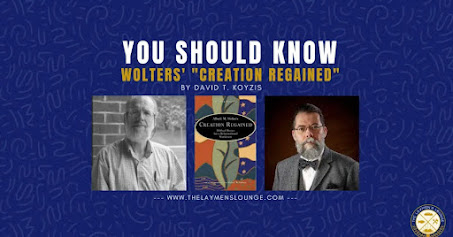
You Should Know 'Creation Regained'


The Layman's Lounge
has published my tribute to Al Wolters' greatest of worldview books: You Should Know "Creation Regained". An excerpt:

Wolters sees worldview playing a central role in the lives, not only of Christians, but of all human beings created in God’s image. A worldview provides orientation and guidance as we live our lives. It is foundational for everything else. Indeed, it is impossible to exist without one. “We need some creed to live by, some map by which to chart our course. The need for a guiding perspective is basic to human life, perhaps more basic than food or sex” (5). Synonyms include “life perspective,” “confessional vision,” “principles,” “ideals,” and “system of values” (2). Another possibility, which I favour, is basic heart orientation in that it describes the centring of our heart on something to which we ascribe ultimacy. For Christians our worldviews must constantly be tested by the Scriptures, lest we unknowingly absorb the basic beliefs and faux-redemptive narratives of the surrounding culture and thereby live divided lives.

Read the entire article here.

07 January 2022

How Marxism 'Won' the War of Ideas

In the first edition of Political Visions and Illusions, published a dozen years after the historic collapse of communism in eastern Europe and Russia, I treated Marxism as largely a spent force, a casualty of late modernity and of its own internal contradictions. However, when the Portuguese translation was in process, a copy editor at Vida Nova wrote me to disagree with my assessment. My analysis had not taken into account developments in Latin America where Marxism was still a potent force. He persuaded me to make one change in the text which went into the Brazilian edition published in 2014.

23 December 2021

Year-end appeal

December 2021

Dear faithful supporter:

Thank you for your financial contribution over the past year. I am deeply grateful for your concrete expression of support for my work with Global Scholars Canada. More than that, I appreciate your prayers for my international academic ministry.

Please consider making a donation at year's end so that I may continue this work. Your contribution provides:

  1. a small salary to top up my private and public pensions,

  2. equipment and incidentals related to my work, and

  3. funding for travel, which I hope will resume once the pandemic is over.

Canadians and others may donate here: http://www.globalscholarscanada.ca/give/.

Once you are in this webpage, please scroll down to the purple bar labelled DONATION DETAILS. Under “Fund” find the name of the scholar you wish to support.

Americans can donate via this site: https://global-scholars.org/donations/give-to-a-fellow/.

Under “Select a Professor” you may “- Select a Professor-” from the list provided.

Up until 31 December 2021, an anonymous donor will match every dollar raised over and above last year's funds up to $8,000. If a particular donor gave $200 last year, what counts this year for purposes of matching is what he or she gives above the $200 amount. All new donations from people who have not previously given count towards the total. This means that if someone gave $500 last year and gives $800 this year, $300 of that will be matched by the donor. A new donor who gives $1,000 this year will in effect be giving $2,000 in total.

Thank you once again for your support, and may God bless you.

Yours,

David Koyzis

21 December 2021

Gnosticism and the human body

This morning I received an unexpected note from Meghan Kort, assistant editor at Christian Courier, where I have published a monthly column since 1990. She wrote:

I’m just going through our CC website stats to gather a list of our top 10 articles from 2021 and I found a surprise near the top of the list. It’s not an article from this year at all, it’s from 2018! Your column “Gnosticism and the Human Body” was viewed 1176 times this past year putting it at #7 most viewed article of the year.

I can’t include it in our top 10 list since it wasn’t published in 2021, but I figured you should know about it’s popularity.

I am glad she included a link to the article, which I had forgotten I had written. Here is an excerpt:

17 December 2021

Ukraine: Church and civil society

Recently I received a copy of the journal, Християнська думка (Christian Opinion), whose current issue (no. 3(12), 2020) is devoted to "Church and Civil Society" and carries an article of mine, "Recovering Civil Society: Two Traditions." This journal is published by the Ukrainian Evangelical Theological Seminary in the capital city of Kiev.


In the same issue Jonathan Chaplin has contributed two articles and James W. Skillen one article.

16 December 2021

The coming kingdom


Christian Courier has published my December column, which can be accessed here: The coming kingdom. An excerpt:

While our churches look back to what Christ accomplished for our salvation in the past, we also look ahead during these first two seasons in the church calendar – ahead to the Messiah’s second advent. At his expected return, all human history will be wrapped up, with God’s kingdom finally triumphing over each of its rivals. These rivals include the various political ideologies, each of which tells a redemptive story promising salvation to its followers. But they also include the more subtle desires of our hearts – desires for good things created by a good God but made too much of: career success, sexual satisfaction, fame, fortune and so forth.

Read the entire article here.

14 December 2021

December newsletter posted

I have posted my latest Global Scholars Canada newsletter here: DECEMBER 2021 newsletter. As we are in the final weeks of the year, please consider making a financial contribution to my work. Thank you!

13 December 2021

The Illusion of Power & Choices

Late last year I was interviewed by the Rev. Dr. James Ellis III, University Chaplain and Director of Student Ministries at Trinity Western University, Langley, BC, Canada. This was shortly after I recorded a chapel talk on Job 11 for the university. The intervew has now been posted online: The Illusion of Power & Choices and can also be streamed Spotify, Google, Apple, and various other services.


10 December 2021

What is a worldview? Video lectures

My lectures to Brazil were indeed recorded, I am happy to say. Here they are:


09 December 2021

What is a worldview? Salvador, Brazil


On 7 and 8 December I addressed the members of the Igreja Batista Vilas do Atlântico in Salvador, Bahia, Brazil on the subject of "What is a worldview?" The first evening I spoke on "A Christian Worldview and Political Ideologies," based on my first book, and the second evening I lectured on "A Christian Worldview and Authority," based on my second. This was part of the church's annual Bible Celebration Week. My host was Roger Freitas, and my translator was Felipe Leite. I do not believe the event was recorded, but if I find that it was, I will link to the posted video here.

Nos dias 7 e 8 de dezembro, falei aos membros da Igreja Batista Vilas do Atlântico em Salvador, Bahia, sobre o tema "O que é uma cosmovisão?" Na primeira noite, falei sobre "Uma cosmovisão cristã e ideologias políticas", com base no meu primeiro livro, e na segunda noite dei uma palestra sobre "Uma cosmovisão cristã e autoridade", com base no segundo. Isso fazia parte da Semana de Celebração Bíblica anual da igreja. Meu anfitrião foi Roger Freitas e meu tradutor foi Felipe Leite. Não acredito que o evento tenha sido gravado, mas se eu descobrir que foi, farei o link para o vídeo postado aqui.

03 December 2021

CARE conversation


Today I was pleased to talk remotely with the latest cohort of young people in the CARE Leadership Programme in the United Kingdom. CARE stands for Christian Action, Research, and Education, and its website tells us what it is all about:

For over 20 years CARE has been equipping a generation of Christians to be salt and light in our culture. This 12 month graduate programme gives a unique insight into Parliament, political advocacy and Christian leadership.

22 November 2021

The True Nature of Freedom

Last week, on 18 November I delivered a lecture for the Society of Christian Scholars titled, The True Nature of Freedom, which can be accessed by clicking on the link or clicking below. Fellow Global Scholar Stephen M. Garrett moderated the lecture and discussion. An excerpt:

Since at least the French Revolution of 1789, authority has acquired a bad reputation, something that French American philosopher Yves R. Simon (1903-1961) explores in his writings. By contrast, I would like to argue that, far from being polar opposites, freedom and authority are integrally connected to each other. Moreover, what we think of as personal freedom is a type of authority. In the real world we are embedded in a network of authorities, all of which work together to enrich our lives. This network provides the backdrop to our lives, and without it we ourselves would scarcely be able to exercise authority.

Watch the lecture and conversation here:

19 November 2021

Christianity and Ideologies


Comment magazine has posted my article on Christianity and Ideologies, with the subtitle, "Embracing the rich diversity of God's world helps us resist distorting it." An excerpt:

Christians, like all of us, are prone to succumb to the temptation to embrace another such story—something that promises earthly salvation on human terms. As such we are not so much living out God’s kingdom in our daily lives as undertaking to build an approximation of that kingdom in our own societies. It is tempting to ascribe redemptive significance to our own fallible goals and policy proposals. Because the regnant ideologies have formulated their own solutions to social ills, and because one cannot simply draw a program of cultural or political renewal straight from the Scriptures, Christians too easily latch onto a ready-made agenda offered by the ideologies, bypassing the hard work of fleshing out the implications of the biblical narrative for our shared life as citizens of a political community. Hence the proliferation of Christian nationalists, Christian socialists, and even Christian Marxists.

Read the entire article here.

17 November 2021

Política (SBNE) conversation

Last evening I was privileged to participate in a conversation with Prof. Marcio Ribeiro of Seminário Bíblico do Nordeste (SBNE) in Carpina, Pernambuco, Brazil, which is about an hour or so from the coastal city of Recife. Click below to watch the discussion.

Na noite passada, tive o privilégio de participar de uma conversa com o Prof. Marcio Ribeiro, do Seminário Bíblico do Nordeste, em Carpina, Pernambuco, Brasil, que fica a cerca de uma hora da cidade costeira de Recife. Clique abaixo para assistir a discussão. 

A propósito, eu poderia facilmente pegar o sotaque nordestino em sua fala. A maioria das minhas conversas é com pessoas das regiões do centro e do sul do Brasil.

15 November 2021

Global Scholars newsletter posted

I have posted my latest Global Scholars Canada newsletter here: NOVEMBER 2021 newsletter. As we approach year's end, please consider making a financial contribution to my work. Thank you!

Face to Face and Side by Side: A Pluriformity of Friendships

Inspired by John von Heyking's recent address on Christian Faith and Friendship in the Academy, I have now published my own reflections in Cateclesia Forum: Face to Face and Side by Side: A Pluriformity of Friendships. An excerpt:

Then we have the “deep” friendships that approach Lewis’s “face-to-face” orientation yet do not quite conform to his understanding of eros. Here the two people take delight not just in their common interests but in each other, bound by a strong mutual affection and care transcending the pub and the sporting arena.

State and Non-state Communities: How Civil Society Contributes to Constitutional Government

On friday, 12 November, I was privileged to address an online gathering sponsored by ReMind Centro de Estudos, hosted by my friend Arthur Loureiro with Vinicius Pimentel serving as translator. The title of my lecture is "State and Non-state Communities: How Civil Society Contributes to Constitutional Government." Clicking on the link will enable you to see the lecture and ensuing conversation.


12 November 2021

Needed reforms


Christian Courier has just posted my monthly column which has a longer title online than in the print edition: Canada’s political institutions need reforms. Subtitle: "Three reforms Canada could make to restore a responsible government." An excerpt:

Efforts to democratize the leader selection process more thoroughly have not really empowered the grassroots, as many would like to see. Instead, they have disempowered the parliamentary caucus, increasing the dominance of the prime minister. The People (with an upper-case P) are too nebulous an entity to exercise effective control over an executive, but a party’s parliamentary caucus is small enough and more intimately associated with its leader to keep him or her in check.

This reality has led to a paradox: an effort to extend the validity of democracy throughout a political system inadvertently contributes to a rise of Napoleonic leadership and an erosion of democracy.

Read the entire article here.

11 November 2021

Brazil update: Oak Centre conversation

My Oak Centre conversation took place 10 November, and I have now posted my PowerPoint presentation here in pdf form: Serving God in a Global Academy: An Update on Brazil. Readers will note that some slides are duplicated with versions in both English and Portuguese, others are in Portuguese only, and others in English only. I have not striven for consistency, as will be evident to anyone. Those acquainted with French, Spanish, or Italian should be able to make sense of the Portuguese slides. Among the items covered in my talk are geography, history, politics, religion, the church's future prospects, and my own visit to the country in 2016.

One item of which few may be aware: some contrarians and historical revisionists believe that Christopher Columbus was actually Portuguese and not Genoese. Interesting notion, to be sure.

'Bible Belt' religion


The term "Bible Belt" usually refers to a swath of territory stretching across the American South and into the Midwest characterized by intense religious loyalties, although sometimes paradoxically associated with low levels of church attendance. It is easy to look down one's nose at Bible Belt religion, although Brandon Meeks expresses appreciation for its impact on his own faith: I Survived (Because of) Bible Belt Religion. An excerpt:

Some time ago, one leading evangelical influencer rejoiced over the decline of “Bible Belt Religion,” commenting that it “made bad people worse.” More recently, another Christian pundit took another swing at the cultural Christianity of the South, one of his favorite punching bags, calling it a form of “toxic religion” that is, at best, an expression of the Faith to be “survived.”

02 November 2021

Keller on justice

The Rev. Tim Keller, retired pastor of Redeemer Presbyterian Church in New York, New York, here offers readers A Biblical Critique of Secular Justice and Critical Theory. Keller is not new to reflections on justice, writing about it elsewhere, especially in his book, Generous Justice. In this particular essay, he offers a brief outline of biblical justice, focussing on community, equity, corporate responsibility, individual responsibility, and advocacy for the poor and marginalized.

29 October 2021

A novel conversion

I recently read Charlotte Mary Yonge's popular 1853 novel, The Heir of Redclyffe, a book that was instrumental in Abraham Kuyper's conversion to Christian orthodoxy. I have just published a piece in Kuyperian Commentary on this book: A Novel Conversion. Here is an excerpt:

While not great literature, Yonge’s best-selling novel is nevertheless compelling in that it is suffused with faith in Jesus Christ as mediated by the institutional church. Even as the characters navigate the intricate proprieties of Victorian England and incur guilt through various sins of commission and omission, the church is there for them, making up the mostly implicit backdrop for all their activities.

While Christendom has fallen into disrepute in recent decades, there can be no doubt that something has been lost in its decline. We can no longer hold our neighbours to the standards of a gospel to which they do not adhere, except in so far as its teachings continue to exert a vestigial influence on them. Our society validates the authentic self and the personal quest to find it, irrespective of the damage it may inflict on our communities and interpersonal relationships. If Christendom has declined, it has not made our society any less religious. Instead, it remains deeply religious, with its allegiance now focussed on the socially fragmenting idol of the ego and its desires.

Read the entire piece here.

28 October 2021

Taking the Bible Seriously in Scholarship

Peter Schuurman, Executive Director of Global Scholars Canada, has just posted on his blog a short essay that I wrote titled, Taking the Bible Seriously in Scholarship. An excerpt:

The typical research university today is a multiversity that sees scholars virtually imprisoned within the confines of their respective disciplines and methods, incapable of understanding the larger reality of which these are part except in terms of that discipline. Not only is cross-disciplinary dialogue not encouraged at such institutions; it may be implicitly discouraged as scholars keep ploughing within their respective ruts, unaware of what their colleagues are doing elsewhere. As such, it is not surprising that an entire discipline may be captured by an ideological vision while other disciplines remain blithely unaware of it. The humanities may be in the grip of a postmodern historicism, while the social sciences may pay homage to behaviourism.

A biblically Christian worldview is well positioned to compensate for the compartmentalization we see in the secular academy. After all, our most basic confession as Christians is that our world belongs to God, which has huge ramifications for our task as academics. If God has brought into being an orderly creation subject to his laws and norms, we can come to our respective fields of scholarly endeavour confident that they find their place within an integral whole sustained by God himself through Jesus Christ.

Read the entire essay here.

26 October 2021

Friendship, the University, and Politics

Last week I was privileged to be a part of an online Global Scholars conference, "Friendship That Makes a World of Difference - A Cross-Canada Virtual Conference", subtitled, "Exploring Faith and Friendship in the Academy." My colleague at the University of Lethbridge, John von Heyking, presented a keynote address, titled, "Christian Faith and Friendship in the Academy." John's address and my response have now been posted below:

25 October 2021

Serving God in a Global Academy: Brazil update

Next month I will be revisiting my work with Brazil at an online event sponsored by the Oak Centre for Studies in Faith and Culture. The announcement follows:


Inklings Conversations – Fall 2021 

(Wednesday Nov 10th   from 4:00 – 5:30)


Serving God in a Global Academy:  

An Update on Developments in Brazil

A conversation with David T. Koyzis,

Global Scholar, Politics & International Affairs   


Join by Zoom


21 October 2021

October newsletter

My latest Global Scholars Canada newsletter has been posted here: OCTOBER 2021 newsletter.

20 October 2021

A Vietnam War memory

When I was in elementary school in Illinois, my grade five teacher organized a letter-writing campaign to soldiers then serving in Vietnam. Whether all of them wrote back to us I can no longer recall more than half a century later. But I recently found the letter my GI had sent me, dated May 1, 1966, and I've posted it below:


13 October 2021

A humiliating defeat


My latest Christian Courier column assesses the recent American military loss in Afghanistan, which recalls to mind the Vietnam fiasco: A humiliating defeat. An excerpt:

When the U.S. invaded Afghanistan in 2001, many of us had hoped that the U.S. had learnt its lesson from a quarter century earlier. And what was that lesson? Make sure that any foreign military involvement clearly defends legitimate American interests, know the country and its people where your troops are stationed, and keep the goals realistic. Among other things, this rules out nation-building.

Unfortunately, the George W. Bush administration, once its troops were on the ground in Afghanistan and later Iraq, succumbed to idealistic dreams of reshaping these countries into stable constitutional democracies. Unfortunately, a successful democracy is dependent on two major factors: first, a cohesive sense of nationhood, and second, supportive political traditions. Both were absent in the two countries. This practically guaranteed that the wars would become quagmires with no easy exit.

Read the entire column here.

27 September 2021

Canada more divided than ever


First Things has published my brief postmortem on last week's federal election here in Canada: Canada more divided than ever. Here is an excerpt:

Earlier this year there was no sign that the other parties, including the Conservatives, New Democrats, Bloc Québécois, and Greens, were ready to bring down the government. Nevertheless, like his predecessors before him, Trudeau decided that parliament had become dysfunctional—because it was not following his every wish and was doing what a parliament ought to do, namely, holding the government accountable for its actions. So last month Trudeau went to the newly appointed governor general, Mary Simon, and requested an early dissolution of parliament—something no governor general has refused since 1926.

Trudeau wanted to try for another majority government so he would have a freer hand. Canadians saw through this immediately, and his standing in the public opinion polls began to slide. At that point he looked set to lose his gamble and possibly even his government. But when Canadians went to the polls this week, they delivered their verdict: more of the same.

Read the entire article here.

16 September 2021

September newsletter

My Global Scholars Canada newsletter has been posted here: SEPTEMBER 2021 newsletter.

14 September 2021

At last!


Christian Courier has published the story of my recently completed Genevan Psalter project: At last! An excerpt:

This more systematic method enabled me to work through the remainder of the Psalms at a faster pace than I had anticipated. Thus, by the middle of August, I had completed the remaining unfinished psalms, at last reaching 150, thereby exceeding the target I had set for myself in the Reid Trust proposal.

The result of my efforts is not literary elegance. Some of the Psalms are rhymed, but not all. In fact, reading some of them without the music will not suggest that we have crossed from prose into verse, but they definitely fit the Genevan tunes, conforming strictly to their somewhat irregular metres.

What will I do with all this? I hope to find someone to publish my collection so as to disseminate knowledge of the Genevan Psalter, not only among English-speaking Reformed Christians, but among other Christians unfamiliar with the liturgical use of the biblical Psalter.

Read the entire article here.

13 September 2021

The second Brazilian edition: Visões e Ilusões Políticas

Last week I finally received four copies of the second Brazilian edition of Political Visions and Illusions from InterVarsity Press.


11 September 2021

The choices before us


Christian Courier has posted a second online article of mine in the run-up to the federal election: The choices before us. An excerpt:

As is generally the case, there is no obvious choice that is more Christian than the others. While the Liberals and the New Democrats are usually stronger on care for the poor and vulnerable in our society, their dogmatism on the so-called social issues, such as abortion, euthanasia and gender issues, makes them suspect to followers of the older faith traditions. Similarly, while Conservatives often, but not always, manifest a greater appreciation for the diversity of nonstate communities in Canada, they can just as easily appear insensitive to marginalized groups and to the physical environment.

Voting one way or the other will not usher in God’s kingdom, nor would we expect it to. We will thus likely vote in one of two ways: either for the party we think will do the least damage to the country, or for the best features of one party while hoping and praying that they will outweigh its negatives.

Read the entire article here.

10 September 2021

Teoclub interview

Last evening I was interviewed by Jean Francesco in a live stream over YouTube on the subject of my Political Visions and Illusions. Much of it was in Portuguese, and Francesco translated my end of the conversation for the sake of his listeners in Brazil. The occasion was an online meeting of the Teoclub, a group of Brazilians interested in discussing theological matters.


07 September 2021

WeeklyTech podcast interview

I thoroughly enjoyed my recent conversation with Jason Thacker of the Ethics and Religious Liberty Commission of the Southern Baptist Convention on the subject of my book, Political Visions and Illusions: A conversation with Dr. David Koyzis on political ideologies and the Christian worldview.

25 August 2021

Trudeau's gamble


Canadians will be going to the polls next month, and many of us think that there is little reason at this point to do so, because the current government has been in office for under two years. Christian Courier has just posted an article of mine on the forthcoming federal election: Trudeau's gamble. An excerpt:

Trudeau may lose his gamble and retain only a plurality of seats in the Commons, prolonging his frustration for another four years. Or he may lose even more than that and suffer outright defeat at the hands of Erin O’Toole’s Conservatives.

If that happens, will O’Toole bring a different spirit to his office? Will his government, whether majority or minority, be less willing to employ the tactics of Harper and Trudeau for partisan advantage? While Trudeau may be in a gambling mood, I am not: I wouldn’t bet on it. The temptations that come with political power are often too great, even for someone with good intentions and promises of reform.

Read the entire article here.

21 August 2021

Wesley Seminary conversation

Two days ago I was privileged to spend an hour with doctoral students at Wesley Seminary in Marion, Indiana. These are students of Dr. Aaron Perry, who has had them reading my Political Visions and Illusions. May God bless them as they continue to minister to his people in parish settings.


19 August 2021

Genevan Psalter interview

This morning I was interviewed by the Rev. Uriesou Brito, pastor of Providence Church, Pensacola, Florida, on the subject of my recently-completed Genevan Psalter project:


10 August 2021

COVID fatigue


My August column has been published in Christian Courier, titled, COVID fatigue. An excerpt:

Quite honestly, I am weary. The past nearly two years have been difficult for so many of us. Our daughter lost three of her grandparents, and we’ve not been able to visit my widowed mother during that time. Last month we drove up to spend a few hours with a dear friend who co-owns a brewery north of Toronto. We thoroughly enjoyed ourselves, sitting on a patio drinking beer in the sunshine. A taste of normality went down along with the drafts.

In my current work with the Psalms, I have noticed how many contain this plaintive phrase: “How long, O LORD?” (Psalms 6, 13, 35, 74, 79, &c.) This question has been on so many of our lips over the past year and a half. I feel numb these days, as if I’m watching all this happen to someone else. I’ve wept very little, somewhat to my surprise. Perhaps this is a natural coping mechanism that has surfaced to enable me to get through each day. Patience is not something which comes easily to me. But patience is what we all need at present.

Read the entire article here.

27 July 2021

Cyprus: History, Politics, and Culture

I have posted a new page devoted to Cyprus: History, Politics, and Culture, which can also be accessed in the list of pages in the right sidebar. My father was born in the island over 90 years ago, and we still have extended family there. Cyprus has a colourful history as a crossroads of the eastern Mediterranean region and a pawn of competing empires. The original of this page was posted at my former website fifteen years ago, and this page is an edited version of the earlier one.

23 July 2021

Liturgy and archaic language


In light of the recent Motu Proprio of Pope Francis limiting the use of the extraordinary form of the Latin mass, I thought I would repost something I wrote for First Things a dozen years ago: Liturgy and archaic language. An excerpt:

I myself am of two minds about updating liturgical language. As an heir of the Reformation, I believe it is generally best for Christians to worship in a language they can easily understand. Even the most conservative protestant congregations have largely abandoned the King James Version of the Bible, substituting instead the New King James Version or possibly the English Standard Version. Most other churches now use the NIV or the NRSV. There is good reason for this, since we all should wish to see God’s word proclaimed in comprehensible form.

At the same time, it would be a pity if English-speakers were to lose their grasp of the Elizabethan forms altogether. Who would the Copts be if they were to lose their ancestral Coptic language? Or the Maronites without Aramaic? Without Church Slavonic would Russians be forced to change, say, the cities of Volgograd and Kaliningrad to Volgogorod and Kaliningorod, just so people could continue to understand their meaning?

Read the entire piece here.

15 July 2021

July newsletter

My Global Scholars Canada newsletter for July has been posted here.

O Evangelho da Paz e o Discurso do Ódio

No próximo mês GodBooks e Thomas Nelson Brasil publicarão um livro intitulado, O Evangelho da Paz e o Discurso do Ódio. Eu tenho um capítulo neste livro sobre a relação entre política e idolatria. Em breve.

Next month GodBooks and Thomas Nelson Brasil will be publishing a book titled, The Gospel of Peace and Hate Speech. I have a chapter in this collection about the relationship between politics and idolatry. Coming soon.

13 July 2021

On Canada's constitution

Last week The Six Cents Report reposted a brief snippet of an interview with me that was posted earlier this year. My interviewers were Darnell Samuels and Joel Nicoloff. The topic is Errors in the Canadian Constitution.


10 July 2021

The American Commons: interview

The American Commons has posted a recent interview between Ryan Ellington and me: A Conversation With David Koyzis. Here is a description of this online periodical from its website: "The American Commons is a free grassroots web magazine by rank-and-file American Solidarity Party members that provides commentary on faith, culture, and politics." An excerpt from the interview:

Koyzis: The smoke-filled rooms served a purpose, because they were an avenue whereby local officials and party functionaries would vet a candidate before he was presented to the public. And that stage has been largely removed from the process for the last 50 years. And I think Jimmy Carter, he was fairly ineffectual – a very good man, I like him personally; I heard him speak about 30 years ago in Atlanta, and I found him quite impressive as a speaker – but as a President, though, he had no connection with Congress. It was very difficult for him to govern, because he was this lone figure who was parachuted in and expected to govern in a system that is set up to disperse power.

So, this is the sort of thing that concerns me about the direction of American politics. The sort of figures that the 18th century founders would have blanched at putting in power, these are the kinds of people that are increasingly coming to office in the United States. . . .

09 July 2021

Reassessing our heroes


Christian Courier has published my July column, titled, Reassessing Our Heroes. An excerpt:

What do we do with our heroes from the past when we discover their flaws? What shall we do with the monuments to their achievements when the latter seem overshadowed by their errors?

Like so many Canadians, I was horrified to learn of the discovery of 215 unmarked graves of aboriginal children on the premises of a residential school in Kamloops, B.C. Soon after this grisly discovery, students at Ryerson University in Toronto upended a statue of Egerton Ryerson, a 19th-century Methodist leader who contributed to the formation of common public schools in Upper Canada and of “Indian” residential schools. As I write, Hamiltonians are debating the removal of statues of Queen Victoria and Sir John A. Macdonald in Gore Park downtown, because of the role they played in setting federal policy towards aboriginal Canadians.

What then do we do with our all too fallible heroes from the past? We cannot pretend that Macdonald was not our first prime minister and that he did not do much to create the country we love and to which we are loyal. In this respect, Macdonald is no different from other respected figures from the past who have shaped the world we live in.

Read the entire article here.

07 July 2021

We Seek Your Kingdom: about the song

Yesterday I posted two videos on this blog, one of this year's National Parliamentary Prayer Breakfast and the other of a beautiful hymn, We Seek Your Kingdom. Here is another video: We Seek Your Kingdom: The Story Behind the Song.


I especially appreciate the part of the conversation that begins at 10:56. 

"What's your favourite line, Andy?"

"The second line, actually: 'We long for heaven's demonstration here.' I think that word demonstration has become so key in my understanding of the kingdom in these last few years. Importantly, we're not building the kingdom. That's not our job. Our job is demonstrating the kingdom . . . . So just like Jesus' miracles. They were real. Transformation happened. But they were also a demonstration of what the future perfection was gonna be. And I think that takes a lot of the heaviness off our shoulders when we realize our call here is to demonstrate the kingdom, to show signs of that beauty, of that perfection, of that justice in our workplaces, in politics, in media, and everywhere. We're demonstrating that future perfection . . . . We're not building it to gradually get to this future utopia . . . . We're demonstrating what heaven is like in the now."

This text should be added to every future hymnal, as it so wonderfully sums up the nature of our earthly walk as we seek to do God's will in everyday life.

06 July 2021

We Seek Your Kingdom

I was recently alerted to last month's annual National Parliamentary Prayer Breakfast in the United Kingdom which moved online this year. It was recorded and I link to it below. I found it deeply inspirational. I wish we had something like this in Canada.


I especially want to draw your attention to the wonderful song at the end, which I hope will catch on in the churches. I would love to know more about Noel Robinson, Andy Flannagan, and Graham Hunter who wrote it. The text is, of course, set to the familiar tune EVENTIDE. The lyrics can be found here.

05 July 2021

Mouw on public service employees


Richard Mouw has written a very nice article for The Dallas Morning News with a somewhat unwieldy title: There’s no ‘deep state,’ there are federal employees doing deep work for the public good. It's a good reminder of the contributions made by the millions of government employees at all levels who are responsible for implementing public justice in the concrete on a daily basis. An excerpt:

Unelected government workers are crucial to sustaining the infrastructure of political life. They do not deserve the generic put-downs about getting the government out of our lives. Their work is necessary for promoting healthy patterns in the way we are governed.

One of the better-known passages about governments in the Bible says, “the powers that be are ordained of God.” Officials are properly fulfilling their mandates, the passage goes on to say, when they reward those who do good and punish those who do evil. That does cover the territory quite well.

In our contemporary mass societies, however, these functions require policies, programs, agencies, people with job descriptions — in a word, the bureaucracies that we so often complain about — in order to promote our social well-being. It is not difficult to think of government officials, elected and appointed, who do not live up to their callings. But we ought to be grateful for the many folks who are committed to doing it well, and for the long run.

Read the entire article here. 

Incidentally, Mouw, President Emeritus of Fuller Theological Seminary, was kind enough to write the foreword to the second edition of Political Visions and Illusions, now available in Portuguese translation and soon to be in Spanish as well.

Followers

Blog Archive

About Me

My photo
Contact at: dtkoyzis at gmail dot com