Fauré's Pavane
Many years ago I purchased a vinyl recording of Barbra Streisand singing a number of pieces conventionally styled as classical. This is when I first came into contact with Gabriel Fauré's Pavane, which she sang as a vocalise. The idea behind it is fairly simple: mostly parallel thirds, which are the basis of conventional western harmonization. Yet there is something about this piece that vindicates that otherwise overused word, haunting. Here it is performed by Hiromi Okada at the piano.
28 August 2006


A Prairie Home Companion
One evening back in 1978, at the end of my undergraduate education in Minnesota, I went with a good friend and his family to a theatre in St. Paul where, for nearly four years, a storyteller and a group of musicians had performed a live radio show with something of a down home feel. Broadcast over Minnesota Public Radio, it had become a regional fixture, drawing listening audiences from around the state. On the stage that evening was a man in his mid-thirties, one Garrison Keillor, who delighted those present with his stories of the fictional Lake Wobegon, "where all the women are strong, all the men good-looking and all the children above-average."
A few years later, A Prairie Home Companion began to be syndicated across the United States, and Keillor became a household name. I cannot claim to have been a regular listener to the programme, but if I had nothing better to do on a saturday evening, I would tune it in for some light, homespun entertainment with gentle humour and a human touch. This was during my graduate student days in South Bend, Indiana.
Although it is still on the air, I've not listened to it in nearly two decades. However, at the weekend my wife and I decided to see Robert Altman's new cinematic version of A Prairie Home Companion at the Westdale Theatre near McMaster University. Because it's been so long since I last heard PHC on the radio, I cannot say how well the movie captures the current atmosphere of its namesake. That said, we could not unequivocally say that we liked what we saw. The film seemed to be something of a bizarre combination of the original PHC and an Ingmar Bergman film, with Nikos Kazantzakis providing the unsatisfying ending. Death was an overriding theme — something that seemed out of character with the PHC I remember from the 1970s and '80s. Oddly enough, Lake Wobegon was not even mentioned. There was no storytelling, only music with various morbid themes, including murder and suicide. There were some pleasant surprises, such as the discovery that Lily Tomlin and Meryl Streep can sing. All in all, however, it is a shame to see Keillor, whom I recall to speak with such affection for the ordinary Lutheran and Catholic folk of his fictional hometown, peddling even a tongue-in-cheek nihilistic vision. Perhaps those Norwegian bachelor farmers can set him straight.
25 August 2006
To stir the patriotic heart. . .
Three years ago, when the Kofi Annan Plan to unify Cyprus was still alive and a year before the island state's entry into the European Union, a competition was held to come up with a new national anthem. I decided to submit a song, but it lost out to a mediocre (to put it charitably) tune boasting basic harmonization errors. In any event, when the Annan Plan died, so did the quest for an anthem. When I initially learned of the competition, I had considered entering this. I should have done so. I think it would have been a winner.
Three years ago, when the Kofi Annan Plan to unify Cyprus was still alive and a year before the island state's entry into the European Union, a competition was held to come up with a new national anthem. I decided to submit a song, but it lost out to a mediocre (to put it charitably) tune boasting basic harmonization errors. In any event, when the Annan Plan died, so did the quest for an anthem. When I initially learned of the competition, I had considered entering this. I should have done so. I think it would have been a winner.
Hola de Señorita Yolisa
I have just received word from the globetrotting Yolisa de Jager, easily my most peripatetic protégée. She is studying at the University for Peace in San José, Costa Rica. I trust she will be updating her blog accordingly to fill us in on her experiences there. Let's hope she posts photographs as well.
I have just received word from the globetrotting Yolisa de Jager, easily my most peripatetic protégée. She is studying at the University for Peace in San José, Costa Rica. I trust she will be updating her blog accordingly to fill us in on her experiences there. Let's hope she posts photographs as well.
Pluto demoted
It's official: Astronomers strip Pluto of planetary status. I guess Gustav Holst was right after all.
It's official: Astronomers strip Pluto of planetary status. I guess Gustav Holst was right after all.
23 August 2006
Christians on the front lines
Thanks to Michael Van Pelt for pointing me to this wonderful address delivered by Brian Stewart two years ago at Knox College in Toronto: On the Front Lines. This encouraging word to the christian community is all the more remarkable for coming from a veteran CBC journalist.
Thanks to Michael Van Pelt for pointing me to this wonderful address delivered by Brian Stewart two years ago at Knox College in Toronto: On the Front Lines. This encouraging word to the christian community is all the more remarkable for coming from a veteran CBC journalist.
22 August 2006
Visiting the WRF
Monday afternoon I was privileged to spend some time at the palatial offices of the Work Research Foundation here in Hamilton, meeting with Michael Van Pelt and looking in on two of my protégés who work there. Here is a visual record of the event.

The front gate

The stone wall surrounding
the central courtyard

In the outer lobby beneath
the rotunda

Um, let's stick with the fedora, shall we?
Monday afternoon I was privileged to spend some time at the palatial offices of the Work Research Foundation here in Hamilton, meeting with Michael Van Pelt and looking in on two of my protégés who work there. Here is a visual record of the event.


the central courtyard
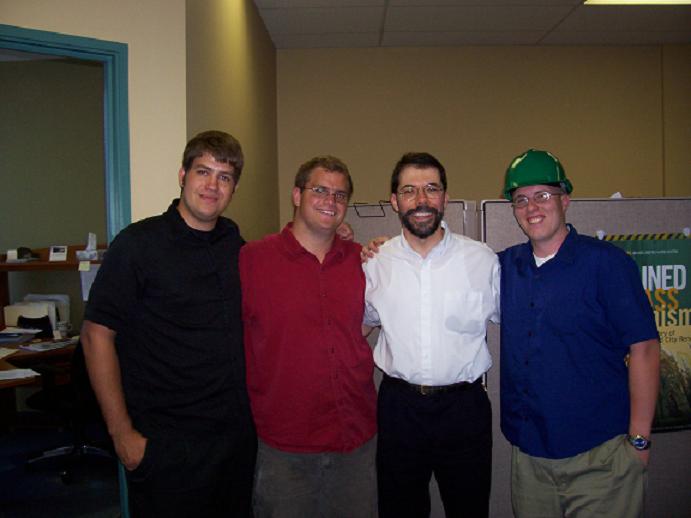
the rotunda

21 August 2006
The 'anklebiter', Ellul and neocalvinism
Brian Janaszek has written a response to my article on Jacques Ellul that merits a further response. Janaszek argues that neocalvinists do not take seriously enough the critiques of Ellul and Ivan Illich of institutions. He further charges that neocalvinists are guilty of triumphalism. I will not try to speak for all neocalvinists on this latter point. I know that some have indeed entertained what might be called postmillennial enthusiasms in assuming that the christian way will score a decisive victory in the present age.
But this is not what my critique of Ellul is all about. I make no claim that well-meaning Christians will inevitably succeed in reforming all the institutions in which they find themselves. Like every human effort, there will be successes and failures. Moreover the successes will always be tainted by the effects of sin, while the failures will never entirely efface the creational goodness that God in his mercy upholds through his common grace. Janaszek writes that
Off hand I cannot think of a neocalvinist who would disagree with this. Kuyper and Dooyeweerd would certainly affirm this augustinian insight. In a fallen world it could hardly be otherwise.
My own critique of Ellul (leaving out Illich, whom I do not know at all well) is that, while he correctly pinpoints the destructive potential of modern technology under the guise of an autonomous Technique, he is wrong to view it as uniquely destructive or as a source of evil in the world. Janaszek again:
Yet surely we must admit that institutions are not the unique repositories of sin? Sin is located in the human heart's rebellion against God's ways. Disobedience cuts through every human endeavour and relationship, whether these take the form of abstract institutions in a national capital city or of face-to-face friendships within the context of the rural village. Why be distrustful of institutions and not of the next-door neighbour? Why distrust technology and not one's own motives in desiring to fulfil one's life aspirations? To be sure, institutions are capable of being abused, but so is everything for which human beings are responsible before God. Institutions are no more caught up in sin than any other element of human life. If Ellul did indeed recognize this in his voluminous writings, then I will be pleased to have it pointed out to me.
If there is a moment of truth in Ellul's argument, it is perhaps in recognizing that, because of their impact on such large numbers of people, institutions may be more quantitatively destructive than a simple friendship going awry in a small town. Similarly, nuclear energy's destructive potential is greater than that of the simple act of whittling a piece of wood, however much both are caught up in human sin. Yet I believe Ellul is saying much more than this. Hence my critique.
Again here's Janaszek:
Meeting immediate human needs and formulating policies and programmes are by no means antithetical; each has its proper context. If a friend comes to your door in the middle of the night indicating that he and his family have been flooded out of their house, it's not necessary to call a committee to come up with a general policy for dealing with domestic deluges. On the other hand, in the context of the state, or political community, the lack of carefully researched and worked out policies can be fatal to the public interest. Recent history is littered with failed christian attempts to enter the political arena armed with good intentions and little else. This is not responsible political action.
I am grateful that during his life Ellul was involved in concrete efforts to help his fellow human beings in obedience to the gospel. But as a political scientist looking for policies serviceable to doing justice within the larger institution of the state, I simply do not find Ellul all that useful. Distrust of the state may be warranted in specific circumstances, but as a general principle it will leave us high and dry. This is why I believe that the neocalvinist vision behind the WRF, the Center for Public Justice and other likeminded organizations makes for a far better alternative. It recognizes that there is no substitute for doing one's homework in thinking through, to begin with, the normative task of the state and, subsequently, the policies and programmes serviceable to doing justice in a world caught up in the drama of creation, fall and redemption in Jesus Christ.
Brian Janaszek has written a response to my article on Jacques Ellul that merits a further response. Janaszek argues that neocalvinists do not take seriously enough the critiques of Ellul and Ivan Illich of institutions. He further charges that neocalvinists are guilty of triumphalism. I will not try to speak for all neocalvinists on this latter point. I know that some have indeed entertained what might be called postmillennial enthusiasms in assuming that the christian way will score a decisive victory in the present age.
But this is not what my critique of Ellul is all about. I make no claim that well-meaning Christians will inevitably succeed in reforming all the institutions in which they find themselves. Like every human effort, there will be successes and failures. Moreover the successes will always be tainted by the effects of sin, while the failures will never entirely efface the creational goodness that God in his mercy upholds through his common grace. Janaszek writes that
technology can bring about good, as can a government, or a school, but we cannot expect that these things will be completely turned back to God until this world passes away. To expect anything else would be an attempt to immanentize the eschaton. And while technology has in some ways made our lives better, this is a doubled-edged sword, as such progress often reduces the quality of our lives in other, less obvious ways.
Off hand I cannot think of a neocalvinist who would disagree with this. Kuyper and Dooyeweerd would certainly affirm this augustinian insight. In a fallen world it could hardly be otherwise.
My own critique of Ellul (leaving out Illich, whom I do not know at all well) is that, while he correctly pinpoints the destructive potential of modern technology under the guise of an autonomous Technique, he is wrong to view it as uniquely destructive or as a source of evil in the world. Janaszek again:
Ellul was, much as his contemporary Ivan Illich, distrustful of institutions (schools and governments, for example) as vehicles for the work of Christ. Institutions would simply become corrupt over time (as a result of sin), and while there is also the possibility for reform, the cycle would repeat itself. Illich, more than Ellul, saw this clearly, even at work within the family. Relying on the State, or a school system, to change culture [is] at best wishful thinking, and at worst rather dangerous.
Yet surely we must admit that institutions are not the unique repositories of sin? Sin is located in the human heart's rebellion against God's ways. Disobedience cuts through every human endeavour and relationship, whether these take the form of abstract institutions in a national capital city or of face-to-face friendships within the context of the rural village. Why be distrustful of institutions and not of the next-door neighbour? Why distrust technology and not one's own motives in desiring to fulfil one's life aspirations? To be sure, institutions are capable of being abused, but so is everything for which human beings are responsible before God. Institutions are no more caught up in sin than any other element of human life. If Ellul did indeed recognize this in his voluminous writings, then I will be pleased to have it pointed out to me.
If there is a moment of truth in Ellul's argument, it is perhaps in recognizing that, because of their impact on such large numbers of people, institutions may be more quantitatively destructive than a simple friendship going awry in a small town. Similarly, nuclear energy's destructive potential is greater than that of the simple act of whittling a piece of wood, however much both are caught up in human sin. Yet I believe Ellul is saying much more than this. Hence my critique.
Again here's Janaszek:
For both Ellul and Illich (and this is most visible in Ellul's Presence of the Kingdom, true Christian action was the act of rolling up one's sleeves and doing the dirty work of meeting the needs of your fellow man. For Ellul, this meant working with "troubled" youth and fighting for the preservation of the [French] sea coast. Christian action begins with a supple heart, listening for God's call, and more often than not, when this call comes, the Christian is simply asked to act. Ellul offers no specifics, no policies, no programs (in fact, he says [specifically] such things can be antithetical to real Christian action)--simply the exhortation that the Church (that is, the body of believers) help those that need it. For the Neocalvinist, however, Christian action often takes the form of [policy] and program. Government can be reformed (in the Christian sense) and used for the work of Christ. And (to get back to the point of Ellul's essay) Technique, being a part of the created order, should be molded by Christian hands.
Meeting immediate human needs and formulating policies and programmes are by no means antithetical; each has its proper context. If a friend comes to your door in the middle of the night indicating that he and his family have been flooded out of their house, it's not necessary to call a committee to come up with a general policy for dealing with domestic deluges. On the other hand, in the context of the state, or political community, the lack of carefully researched and worked out policies can be fatal to the public interest. Recent history is littered with failed christian attempts to enter the political arena armed with good intentions and little else. This is not responsible political action.
I am grateful that during his life Ellul was involved in concrete efforts to help his fellow human beings in obedience to the gospel. But as a political scientist looking for policies serviceable to doing justice within the larger institution of the state, I simply do not find Ellul all that useful. Distrust of the state may be warranted in specific circumstances, but as a general principle it will leave us high and dry. This is why I believe that the neocalvinist vision behind the WRF, the Center for Public Justice and other likeminded organizations makes for a far better alternative. It recognizes that there is no substitute for doing one's homework in thinking through, to begin with, the normative task of the state and, subsequently, the policies and programmes serviceable to doing justice in a world caught up in the drama of creation, fall and redemption in Jesus Christ.
17 August 2006
A musical favourite
I love virtually everything composed by Maurice Ravel (1875-1937), with the single exception of his monotonous Boléro, a piece he never expected — or wished — to reach such heights of popularity. One of my perennial favourites is his Tombeau de Couperin, originally written for piano in six movements. Ravel subsequently orchestrated and rearranged four of its movements, leaving out the Fugue and Toccata. Now guitarist Lee Zimmer has arranged three movements for guitar duo. Zimmer and Eric Brenton perform the opening movement, Prélude, here. Anyone with an affection for the guitar and for Ravel's music will applaud. Ravel himself would likely have approved.
Next day: Zimmer and Brenton have now posted the Minuet and Rigaudon from Ravel's Tombeau. The applause at the end of the Rigaudon suggests that the guitarists have taken the order of the movements from the orchestrated version rather than the piano version.
For all the saints. . .
Centuries from now, when the church is remembering the great deeds of its saints and martyrs of the 21st century, this will rank near the top: United Church considers boycott of bottled water.
Centuries from now, when the church is remembering the great deeds of its saints and martyrs of the 21st century, this will rank near the top: United Church considers boycott of bottled water.
14 August 2006

12 August 2006
Why is it. . .
. . . that, when North American Anglophiles seek to emulate English manners and mores, they rarely take as their model the soccer hooligan?
. . . that, when North American Anglophiles seek to emulate English manners and mores, they rarely take as their model the soccer hooligan?
Ellul's influence
This week's Comment piece is written by yours truly and is titled, Jacques Ellul: creation, fall and cultural engagement. Take a look.
This week's Comment piece is written by yours truly and is titled, Jacques Ellul: creation, fall and cultural engagement. Take a look.
The future of air travel?
In the wake of the recent abortive terror plots, tough new airline rules could get tougher, suggests air security boss. If current trends continue, all air travellers will eventually be required to board nude, picking up their clothes again when they arrive at their destination.
Or is that a slippery-slope argument?
10 August 2006
Eye-poppin' dance scene
Gideon Strauss claims an affection for this cinematic dance sequence — since removed from Youtube at the request of Warner Brothers. However, this scene by Whitey's Lindy Hoppers has to be seen to be believed. How the dancers could do what they did without broken bones and torn ligaments is a mystery to me.
Gideon Strauss claims an affection for this cinematic dance sequence — since removed from Youtube at the request of Warner Brothers. However, this scene by Whitey's Lindy Hoppers has to be seen to be believed. How the dancers could do what they did without broken bones and torn ligaments is a mystery to me.
New address for website
There is now a new, greatly simplified address for my Genevan Psalter website: http://genevanpsalter.redeemer.ca/. However, the old address still works and will take you to the same place.
There is now a new, greatly simplified address for my Genevan Psalter website: http://genevanpsalter.redeemer.ca/. However, the old address still works and will take you to the same place.
Whither the rule of law in Ontario?
As the Caledonia standoff heats up again, Premier Dalton McGuinty's talk of appealing Justice David Marshall's ruling is hardly a victory for the rule of law in this province. On tuesday Marshall ruled that negotiations over the disputed land be halted until the protesters leave the site. In allowing the blockade to continue, the Ontario government and the OPP are in effect tolerating the protesters' implicit threat of violence against anyone attempting to venture beyond the barricades. In other words, they are abandoning their duty to protect the public from illegal uses of coercive power.
As I wrote three months ago, if the land claim has any legitimacy, then the province should negotiate in good faith — but not under threat of violence.
08 August 2006
Janine Jansen in concert
I would love to have been present at this concert on the Prinsengracht in Amsterdam last August featuring violinist Janine Jansen. I especially love Béla Bartók's Romanian Dances. Jansen's visual style may be somewhat overdramatic, but her performance is otherwise compelling.
I would love to have been present at this concert on the Prinsengracht in Amsterdam last August featuring violinist Janine Jansen. I especially love Béla Bartók's Romanian Dances. Jansen's visual style may be somewhat overdramatic, but her performance is otherwise compelling.
A call to the priesthood?
Given that I am writing a book on authority, I find this story especially interesting for the issues it raises: Female priest has first Mass. Has Eileen DiFranco really received a call to the Catholic priesthood? In his followup analysis, Richard K. Taylor asks: Is church's code just or unjust? Whatever one thinks of the rightness of ordaining women to the presbyterate, I cannot help but conclude that both DiFranco and Taylor misunderstand the nature of the claimed teaching authority of the Roman Catholic Church, which holds that it lacks the authority to ordain women.
Therefore, if DiFranco believes that she has genuinely been called to be a Catholic priest in the face of Rome's assertion otherwise, the burden is on her to demonstrate the authenticity of her call, which must be based on more than subjective feeling. It seems to me that the honest route for her would be to seek ordination in a denomination willing to extend such a call, such as the Episcopal or Presbyterian churches. If she protests that she is not a protestant and cannot bring herself to abandon her Catholic faith, then she needs further to explain why she so willingly holds on to some of her Church's teachings while rejecting others.
07 August 2006
Polyamorous 'marriage'?
Those who argue that changing the legal definition of marriage will eventually open the floodgates have frequently been scoffed at. Now it seems that "eventually" has come sooner than expected, as Robert George reports here.
Those who argue that changing the legal definition of marriage will eventually open the floodgates have frequently been scoffed at. Now it seems that "eventually" has come sooner than expected, as Robert George reports here.
04 August 2006
Another of those (*sigh*) internet quizzes
I generally dislike these sorts of quizzes and tend to ignore them when tagged, but I prefer to remain in Gideon Strauss's good graces, so here's my 2 cents worth — and a bit more than was asked:
1. One book that changed your life: H. Evan Runner, Scriptural Religion and Political Task.
2. One book that you’ve read more than once: H. Richard Niebuhr, Christ and Culture.
3. One book you’d want on a desert island: Um, Political Visions and Illusions? (My wife knows the author personally.)
4. One book that made you laugh: Does a book of the Bible count? I've always thought Jonah reads like an elaborate practical joke.
5. One book that made you cry: Well, I didn't exactly cry, but this is difficult reading for someone with Greek roots: Marjorie Housepian, The Smyrna Affair, later retitled, Smyrna 1922: The Destruction of a City. Nevertheless, this book brought me even closer to tears: Ruth A. Tucker, Walking Away from Faith: Unravelling the Mystery of Belief & Unbelief.
6. One book that you wish had been written: The Greek Evangelical Church and How it Helped to Bring Peace between Greece and Turkey.
7. One book that you wish had never been written: Dan Brown, The Da Vinci Code. Also virtually everything by Nietzsche.
8. One book you’re currently reading: Oliver O'Donovan, The Ways of Judgment.
9. One book you’ve been meaning to read: Um, Ed Grootenboer, In Pursuit of Justice? (Hear that, Gideon?) Actually I've been meaning to read Alan Storkey, Jesus and Politics: Confronting the Powers. The title makes me uneasy, and I'm hoping the book's contents will allay my fears.
10. One book you've been meaning to write: A first-person account of our daughter's premature birth and her lengthy hospital stay in the ensuing weeks. Two things hold me back: (1) it's still painful for me to read my journals and email posts from that difficult time; and (2) will Theresa be embarrassed by such a book when she gets older? Perhaps I should write under a pseudonym and change her name.
11. One book you are currently writing: It's provisionally titled, We Answer to Another: Authority, Human Personhood and the Imago Dei. Authority has got a bad rap over the past two or three centuries. My argument is that, far from being antithetical to authority, freedom is simply another kind of authority.
12. Now tag five people: Listed in order from most likely to least likely to respond: Al Wolters, Justin Cooper, George W. Bush, Kim Jong Il, Brian Dijkema.
Oh, can I change my answer to number 9? I really should read Paul, Monotheism and the People of God: The Significance of Abraham Traditions for Early Judaism and Christianity. My wife knows the author better than herself.
02 August 2006
A familiar suburb and memory lane
Jordan J. Ballor links to this article by Joel Kotkin: The New Suburbanism. In addition to the substantive analysis in Kotkin's article, the following jumped out at me:
Ah, the sweet memory this brings back. The Naperville Riverwalk is where I proposed to my wife just over 11 years ago — next to a tree with seven trunks.
Jordan J. Ballor links to this article by Joel Kotkin: The New Suburbanism. In addition to the substantive analysis in Kotkin's article, the following jumped out at me:
Chicago-area developer David Fanagel . . . calls Naperville, a vibrant community of 138,000 some 30 miles southwest of Chicago, “a slam dunk” for suburban-village development because of its surviving cluster of historic buildings and surrounding expanse of single-family homes. Largely populated by white-collar families, the city has worked assiduously to develop its old downtown, adding new apartments and stores and creating an attractive esplanade called Riverwalk along the winding west branch of the DuPage River adjacent to its center.
Ah, the sweet memory this brings back. The Naperville Riverwalk is where I proposed to my wife just over 11 years ago — next to a tree with seven trunks.
31 July 2006
Love that sprawl: a (severely) qualified defence of the suburbs
Back in 1962 Malvina Reynolds wrote and sang a song, Little Boxes, that hit the charts that year and was further popularized the next year by Pete Seeger. Its memorable lyrics poked fun at the standardizing conformity of post-war suburban life in the United States:
I was in the lower elementary grades at the time, living — horror of horrors — in one of the western suburbs of Chicago: Wheaton, Illinois. I recall the song, and I can still sing at least some of it from memory, but its biting social commentary largely went over my head at the time.
Reynolds was not the first to look down on the suburbs. Ernest Hemingway is reputed to have said that his native village of Oak Park, just outside Chicago (and where yours truly happens to have been born), was characterized by "broad lawns and narrow minds." Countless books and films have made the suburbs look like fabricated, but fundamentally false, communities, where neighbours live adjacent to each other, but without forming lasting bonds of solidarity. Everyone, as the cliché puts it, tries to "keep up with the Joneses," i.e., to acquire that more expensive gas grill or to join the more exclusive country club.
I was inspired to reflect further on suburbia by this post from our resident Latin-rite Calvinist. As a product of the suburbs, I can attest to both their advantages and drawbacks.
Advantages: (1) As the central cores of American cities deteriorated, the suburbs offered a refuge where a way of life could be started anew. (2) They offered some of the virtues of both urban and rural life. The urban metropolis was never far away, especially if the suburb was served by a rail line or, later, one of the new limited-access highways begun in the 1950s and '60s. Yet there were often open spaces and farms outside of town. This was the case with Wheaton when I was growing up, though it's no longer true four decades later. (3) It seemed to be a good place to raise children. Wheaton had plenty of parks, and the public schools were amongst the best anywhere. (4) Although this was not true everywhere in the US, Wheaton had (and continues to have) thriving churches representing a variety of denominations.
Drawbacks: (1) The suburbs were just a tad too comfortable, especially the more prosperous ones. The social climate encouraged parental indulgence of children, who would grow up into the self-absorbed baby boomers, many of whom thought it their right not to grow up at all, at least with respect to manners, mores and dress. (2) The suburbs often contributed to the deterioration of city centres when those fleeing to the 'burbs took the tax base with them. This led to a situation in which residents of Wheaton, Evanston and Oak Park would commute into Chicago, using its services but contributing nothing to their upkeep, because only those actually living in Chicago were taxed. This has been less of a problem in Ontario, where regional or metropolitan governments are authorized to tax.
So what do we do with the peripheries of metropolitan areas? To begin with, they are not going to go away, the wishes of the Reynoldses, Seegers and Hemingways notwithstanding. As long as there have been cities, there have been people living at their edges. In third-world cities these take the form of shanty towns, inhabited by those who have left the countryside to seek work in the industries often associated with urban centres. But these are the polar opposite of the comfortable suburbs of North America and elsewhere in the western world, and they deserve to be treated as phenomena in their own right.
The place to start is to recognize that human settlement patterns are legitimately diverse, encompassing city centres, other urban neighbourhoods, near suburbs, far suburbs (near and far being relative to the available transportation), rural regions and small towns and villages. Each of these has its own beauty and integrity. Similarly each is in its own way subject to human sinfulness. There is nothing intrinsic to any of these settlement patterns that will insulate residents from the ravages of the fall. Nor should we wish to see any one of these squeeze the others out of existence.
I myself am currently living in a part of Hamilton, Ontario, that is generally considered to be suburban — that is, the part of the city above the escarpment popularly, if misleadingly, known as Hamilton Mountain. However, one of the benefits of living where we do is that we are within walking distance of two pharmacies, a supermarket, a variety store, a dry cleaner, a dollar store and the enormously popular Sweet Paradise Bakery. This is not generally characteristic of suburbia, where one must have an automobile to get anywhere at all.
Indeed, to my mind, the fact that suburbs are built around car ownership is one of the chief drawbacks of these communities. I think I was probably happiest living in the centre of Toronto nearly thirty years ago, where I didn't need a car. I was quite content to ride the trams, buses and subways, which would take me anywhere I wanted to go within the city. I could wish, among other things, that suburban areas would take more seriously the need for public transportation so as to diminish residents' dependence on the automobile.
So what is to be done. . . about the suburbs? Do they need renewal? Definitely. What shape should this take? That's for a future post.
Back in 1962 Malvina Reynolds wrote and sang a song, Little Boxes, that hit the charts that year and was further popularized the next year by Pete Seeger. Its memorable lyrics poked fun at the standardizing conformity of post-war suburban life in the United States:
Little boxes on the hillside,
Little boxes made of ticky tacky,
Little boxes on the hillside,
Little boxes all the same.
There's a green one and a pink one
And a blue one and a yellow one,
And they're all made out of ticky tacky
And they all look just the same.
I was in the lower elementary grades at the time, living — horror of horrors — in one of the western suburbs of Chicago: Wheaton, Illinois. I recall the song, and I can still sing at least some of it from memory, but its biting social commentary largely went over my head at the time.
Reynolds was not the first to look down on the suburbs. Ernest Hemingway is reputed to have said that his native village of Oak Park, just outside Chicago (and where yours truly happens to have been born), was characterized by "broad lawns and narrow minds." Countless books and films have made the suburbs look like fabricated, but fundamentally false, communities, where neighbours live adjacent to each other, but without forming lasting bonds of solidarity. Everyone, as the cliché puts it, tries to "keep up with the Joneses," i.e., to acquire that more expensive gas grill or to join the more exclusive country club.
I was inspired to reflect further on suburbia by this post from our resident Latin-rite Calvinist. As a product of the suburbs, I can attest to both their advantages and drawbacks.
Advantages: (1) As the central cores of American cities deteriorated, the suburbs offered a refuge where a way of life could be started anew. (2) They offered some of the virtues of both urban and rural life. The urban metropolis was never far away, especially if the suburb was served by a rail line or, later, one of the new limited-access highways begun in the 1950s and '60s. Yet there were often open spaces and farms outside of town. This was the case with Wheaton when I was growing up, though it's no longer true four decades later. (3) It seemed to be a good place to raise children. Wheaton had plenty of parks, and the public schools were amongst the best anywhere. (4) Although this was not true everywhere in the US, Wheaton had (and continues to have) thriving churches representing a variety of denominations.
Drawbacks: (1) The suburbs were just a tad too comfortable, especially the more prosperous ones. The social climate encouraged parental indulgence of children, who would grow up into the self-absorbed baby boomers, many of whom thought it their right not to grow up at all, at least with respect to manners, mores and dress. (2) The suburbs often contributed to the deterioration of city centres when those fleeing to the 'burbs took the tax base with them. This led to a situation in which residents of Wheaton, Evanston and Oak Park would commute into Chicago, using its services but contributing nothing to their upkeep, because only those actually living in Chicago were taxed. This has been less of a problem in Ontario, where regional or metropolitan governments are authorized to tax.
So what do we do with the peripheries of metropolitan areas? To begin with, they are not going to go away, the wishes of the Reynoldses, Seegers and Hemingways notwithstanding. As long as there have been cities, there have been people living at their edges. In third-world cities these take the form of shanty towns, inhabited by those who have left the countryside to seek work in the industries often associated with urban centres. But these are the polar opposite of the comfortable suburbs of North America and elsewhere in the western world, and they deserve to be treated as phenomena in their own right.
The place to start is to recognize that human settlement patterns are legitimately diverse, encompassing city centres, other urban neighbourhoods, near suburbs, far suburbs (near and far being relative to the available transportation), rural regions and small towns and villages. Each of these has its own beauty and integrity. Similarly each is in its own way subject to human sinfulness. There is nothing intrinsic to any of these settlement patterns that will insulate residents from the ravages of the fall. Nor should we wish to see any one of these squeeze the others out of existence.
I myself am currently living in a part of Hamilton, Ontario, that is generally considered to be suburban — that is, the part of the city above the escarpment popularly, if misleadingly, known as Hamilton Mountain. However, one of the benefits of living where we do is that we are within walking distance of two pharmacies, a supermarket, a variety store, a dry cleaner, a dollar store and the enormously popular Sweet Paradise Bakery. This is not generally characteristic of suburbia, where one must have an automobile to get anywhere at all.
Indeed, to my mind, the fact that suburbs are built around car ownership is one of the chief drawbacks of these communities. I think I was probably happiest living in the centre of Toronto nearly thirty years ago, where I didn't need a car. I was quite content to ride the trams, buses and subways, which would take me anywhere I wanted to go within the city. I could wish, among other things, that suburban areas would take more seriously the need for public transportation so as to diminish residents' dependence on the automobile.
So what is to be done. . . about the suburbs? Do they need renewal? Definitely. What shape should this take? That's for a future post.
Sixty psalms now posted
I have now posted Psalms 14, 19, 32 and 53 on my website. That makes ten psalms versified and arranged since the end of June and sixty altogether. Psalms 14 and 53 have the same tune and indeed are said by some scholars to be yahwistic and elohistic versions respectively of the same psalm, with a very few differences in wording, as reflected in my own versifications. Psalms 14, 19 and 53 are unrhymed versifications, while Psalm 32 is rhymed. The tune for Psalm 14 and 53 has a short phrase at the end of each stanza — unusual even for the Genevan Psalter with its irregular metres. But I enjoy the challenge of coming up with something fresh within the constraints of set tunes and metres.
I am gradually redoing some of the musical arrangements composed in 2001 and earlier, bringing in more instruments and adding transitional music before, between and after the tunes proper. Those completed include Psalms 23, 24, 62, 95 and 99.
In addition I have added much new material to the introductory essay and corrected some of the links on the liturgy page. I will probably be putting this project aside for now, as preparations for the beginning of the next academic year beckon with the approach of August.
25 July 2006
Artists' take on Vézelay
Vézelay is a delightful village in east-central France whose chief claim to fame is the romanesque Basilique de Marie Madeleine, which claims to house the remains of Mary Magdalene, the "apostle to the apostles," as she was called by some of the early church fathers. I visited this village back in 1975 and quickly fell in love with it. The following summer I painted one of the streets I had photographed. Here is a recent photograph of the street:

Immediately below is the oil painting I did of the same scene in the summer of 1976, when I was 21 years of age. It now hangs in the dining room of our home. It is obviously taken from a different angle and slightly farther away from the arch.

But it seems I was not the only one to find the scene worth committing to canvas. Here is Émile Wegel's rendition, which appears to be a water colour:

And here, finally, is Thérèse Verbery's oil on canvas version, which bears a certain likeness to my own, including the long shadows:

The principal difference between our two efforts is that mine makes the village appear somewhat hot and arid, while Verbery's brims with life and seems somehow more inviting. By contrast, though Wegel's painting may look brighter, with more vivid colours, it is just as lifeless as mine and no less forbidding. Looking at my own work from the vantage point of three decades later, I can't help but wonder whether I was influenced in some fashion by Edward Hopper. If I had to do it again, I'd try my best to communicate something of the warmth and hospitality of Vézelay, something I seem not to have successfully captured.
Incidentally, three days ago was the feast day of Mary Magdalene.
Vézelay is a delightful village in east-central France whose chief claim to fame is the romanesque Basilique de Marie Madeleine, which claims to house the remains of Mary Magdalene, the "apostle to the apostles," as she was called by some of the early church fathers. I visited this village back in 1975 and quickly fell in love with it. The following summer I painted one of the streets I had photographed. Here is a recent photograph of the street:

Immediately below is the oil painting I did of the same scene in the summer of 1976, when I was 21 years of age. It now hangs in the dining room of our home. It is obviously taken from a different angle and slightly farther away from the arch.

But it seems I was not the only one to find the scene worth committing to canvas. Here is Émile Wegel's rendition, which appears to be a water colour:

And here, finally, is Thérèse Verbery's oil on canvas version, which bears a certain likeness to my own, including the long shadows:

The principal difference between our two efforts is that mine makes the village appear somewhat hot and arid, while Verbery's brims with life and seems somehow more inviting. By contrast, though Wegel's painting may look brighter, with more vivid colours, it is just as lifeless as mine and no less forbidding. Looking at my own work from the vantage point of three decades later, I can't help but wonder whether I was influenced in some fashion by Edward Hopper. If I had to do it again, I'd try my best to communicate something of the warmth and hospitality of Vézelay, something I seem not to have successfully captured.
Incidentally, three days ago was the feast day of Mary Magdalene.
24 July 2006
Still more posted on psalter website
I have posted quite a lot more on my Genevan Psalter website in recent days, including the following:
1. Psalms 50 and 117, the latter of which is, of course, the shortest psalm. This I versified and arranged as recently as yesterday.
2. Six non-Genevan psalms written just over 20 years ago in the style of the English and Scottish psalters, with their regular metres. I wrote these prior to discovering the Genevan tunes, and they are posted for purposes of comparison with the more lively, and less regular metres of those tunes. Included are Psalms 25, 51, 95, 98, 130 and 137.
Psalms 51, 95 and 137 are set to original melodies composed especially for these texts. The tunes are titled MISERERE, VENITE and HICKORY ROAD respectively. I set Psalm 25 to Thomas Tallis' surprisingly haunting THIRD MODE MELODY, for which I composed transitional music between the stanzas. I say "surprisingly," because one wouldn't expect a tune with so little movement in the melody line to be as compelling as it is. The tune was further immortalized in 1910 by Ralph Vaughan Williams in his magnificent Fantasia on a Theme by Thomas Tallis, one of my all time favourites.
Psalm 98 is one of the earliest metrical psalms I wrote and it is set here to my own arrangement of KINGSFOLD, which I composed three years ago. Most of these six metrical psalms could easily be matched to another tune in common metre double (CMD) or long metre double (LMD).
3. Two more biblical canticles: the First Song of the Servant of the Lord from Isaiah 42:1,3b-7 (quoted by Jesus in Matthew 12); and the Magnificat of the Virgin Mary from Luke 1:47-55. The former is set to another tune by Orlando Gibbons, SONG 22. For the latter I composed a tune especially for the text which I named SOUTH BEND, after the city where I was living at the time. Last week I finally composed a descant for the last stanza.
4. Two extrabiblical hymns: my Credo in Septuple Metre, a metrical version of the Apostles' Creed; and I Belong, a versified paraphrase of Question and Answer 1 of the Heidelberg Catechism, easily the jewel of the 16th-century Reformation confessions. Both are set to original tunes. The Credo is set to a tune, LUSIGNAN, which I composed five years ago. It is written with a 7/8 time signature, unusual in western music but common in Greek music. I Belong was originally written some two decades ago to be sung to Jean Sibelius' beloved FINLANDIA, and I actually sang it with this tune as a solo at the South Bend Christian Reformed Church. However, five years ago I composed another tune for this, which I named simply HEIDELBERG. I hope it conveys something of the feel of the text.
19 July 2006
Copycats
Do Stephen Harper and John Howard have the same speech writers? Harper touts Canada as 'energy superpower'; PM's vision of Australia as energy superpower.
Do Stephen Harper and John Howard have the same speech writers? Harper touts Canada as 'energy superpower'; PM's vision of Australia as energy superpower.
18 July 2006
A Hamilton landmark

Here is the façade of the historic MacNab Street Presbyterian Church here in Hamilton, whose building dates from before Confederation.
Until yesterday the church's sign carried an intriguing sermon title, SINGING THE PSALMS, which must have been preached two days ago. I'm sorry to have missed it.

Here is the façade of the historic MacNab Street Presbyterian Church here in Hamilton, whose building dates from before Confederation.
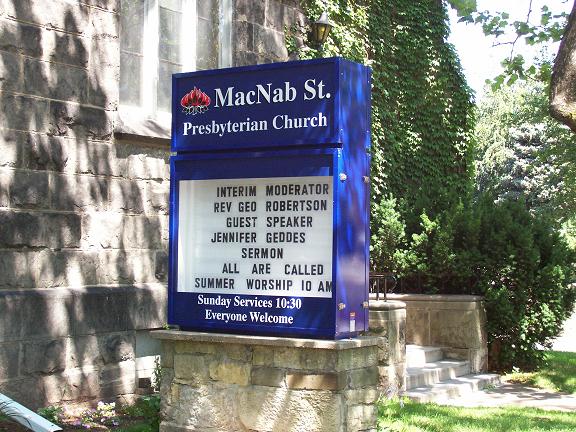
Until yesterday the church's sign carried an intriguing sermon title, SINGING THE PSALMS, which must have been preached two days ago. I'm sorry to have missed it.
Tuesday notes
Our pumpkin plant is in flower, as seen below, though in the intense sun and heat of recent days the flowers close in mid-day. This was taken early yesterday morning.

That's our tomato right behind, and behind that is our less-than-thriving roquette (arugula) plant.
One more thing: I have now posted Psalm 50 on my website.
Our pumpkin plant is in flower, as seen below, though in the intense sun and heat of recent days the flowers close in mid-day. This was taken early yesterday morning.

That's our tomato right behind, and behind that is our less-than-thriving roquette (arugula) plant.
One more thing: I have now posted Psalm 50 on my website.
15 July 2006
'Out of the mouths. . .'
Although I had said I would not be writing at length about my struggle with depression, this is too wonderful to keep to myself.
There have been a very few occasions when I knew that God was speaking to me plainly, for example, in a small, seemingly insignificant healing at age 5, in the words of a guest preacher whom I usually found difficult to listen to, in the scripture passages prescribed by the Daily Office Lectionary, in the prayers of a friend and — twice in my life — in dreams I knew to be visions from God. This time he spoke words of comfort to me through the lips of a seven-year-old.
The other evening, as we were sitting at our dining room table after family prayers, Theresa looked up at me and said something quite unexpected and uncharacteristic that elicited from me first a gasp, then tears, then a hug: "Daddy, God will give you healing in the name of Jesus Christ."
13 July 2006
More additions to psalter
I have added three more pieces to my Genevan Psalter website: the canticle from Jonah 2:2-9, and the two Pauline hymns from Philippians 2:6-11 and Colossians 1:15-20.
My versification for the Song of Jonah I wrote back in 1982, before I was acquainted with the tunes of the Genevan Psalter. Accordingly it is written in the double common metre (DCM) ubiquitous in the English psalters and hymnals of the 16th and 17th centuries. The tune is OLD 18TH from the English Psalter of 1561, with a slight altering of the arrangement from the Scottish Psalter of 1929.
The versification of the Philippians hymn I wrote around 1984 and it was subsequently published in the grey Psalter Hymnal of the Christian Reformed Church. I had chosen Orlando Gibbons' SONG 34 as the tune to which it should be set, but I was overruled by the committee, which chose Joseph P. Holbrook's rather pedestrian tune, BISHOP, instead. However, when the Mennonites republished my text a few years later, they did indeed use the Gibbons tune, to my delight.
My versification for the Colossians hymn I wrote in 1992 and sang with guitar accompaniment along with my sister at a church event near Boston that summer. I chose another Gibbons tune, SONG 1, for this text. It has thus far not been published in any hymnals, but it is meant as a complement to the Philippians hymn.
Protestants and natural law theory
The Acton Institute's Stephen J. Grabill has been posting a series on Why Protestants Don’t Like Natural Law, which is crossposted here. Grabill is a Reformed theological ethicist and author of the forthcoming book, Rediscovering the Natural Law in Reformed Theological Ethics, whose thesis should be evident from the title. Grabill writes:
I've not read Grabill extensively on the topic, but from these brief posts it looks to me as though he may be conflating two related, though by no means identical, issues: (1) the protestant rejection of natural law theory, and (2) the protestant rejection of the reality which natural law theory purports to explain, viz., God's creation as a normative order. If the central issue is the latter, then there's a genuine problem that he is right to address — and one contributing to the antinomian tendencies we see in much of contemporary mainline protestantism. Grabill quotes Karl Barth, arguably the greatest protestant theologian of the 20th century:
However, it is possible to agree with the church of the ages that God's creation is an orderly, lawful one, without necessarily accepting natural law theory's account of this. As I see it, there are at least five reasons for rejecting the natural law as a theory, four of which I find persuasive in varying degrees:
(1) It assumes a kind of religious neutrality in which thinking occurs independently of one’s ultimate commitments. I wouldn't wish to wield this objection as a blunt instrument, as some might be inclined to do. Yet this inevitably raises the issue of Thomas Aquinas' use of Aristotle and the Stoics in articulating his own natural law theory. To what extent can one draw on the insights of unbelievers without buying into at least fragments of their religious worldview? This does not have a simple answer, and indeed it lies at the heart of the ancient Athens and Jerusalem question posed by Tertullian in the patristic era. Without going into a detailed treatise here, I will indicate that the tendency for Christians to embrace composite worldviews joining biblical Christianity with other, incompatible worldviews is ubiquitous. I myself do not think that Thomas and his followers were entirely free of this tendency.
(2) It does not take seriously enough the fall into sin and its effects on the epistemic faculties. This is the objection one is most likely to hear from traditional protestants, i.e., from those heirs of the Reformation who are true to their own confessions. Such Christians would not, of course, be at all sympathetic to the antinomian tendencies of so-called mainline protestants. If anything, they might tend to err in the direction of a biblicism that does not take into account the reality of what Abraham Kuyper and his followers labelled common grace.
(3) It presupposes a kind of two realm conception of the cosmos in which the natural possesses a certain autonomy vis-à-vis God himself. This is most evident in Thomas' account of the virtues, in which four cardinal virtues — prudence, justice, fortitude and temperance — are deemed capable of being attained "according to the capacity of human nature," while the three theological virtues — faith, hope and charity — must be infused in us by God "supernaturally."
(4) Within the field of jurisprudence it has difficulty accounting for the status of an unjust law as a genuine law. Thomas Aquinas quotes Augustine to the effect that a human law that does not conform to the natural law is not a genuine law. In his famous Letter from Birmingham Jail, Dr. Martin Luther King quoted this to defend his and his followers' disobedience of the segregationist laws of Alabama. Yet as a defence of an act of civil disobedience, this is not fully adequate, because civil disobedience can only be to something possessing a lawful character requiring obedience. It would make better sense to recognize that the laws in question were unjust, viz., that they got the balance wrong, but that this did not diminish the character of these laws as genuine laws. Here the legal positivists, for all their considerable flaws, have a valid point.
(5) Within the realm of theology, it assumes that one can know God apart from his revelation in Jesus Christ, which is the basis of Barth’s objection to so-called natural theology. I think Grabill's objection to Barth is on solid ground, because Barth appears to be rejecting, not simply natural law as a theory, but the very reality of which it is an account. When I was researching my book, I took the opportunity to read relevant sections of Barth's massive Church Dogmatics, and it struck me that the specifics of his ostensibly christological ethics could hardly be based on christology alone but inevitably presupposed the creation order even as he denied it.
Has Grabill read Dooyeweerd? I should think that, as a Reformed ethicist, he would at least know the name. Dooyeweerd himself came to reject natural law theory after initially embracing it, yet, unlike Barth and other 20th-century protestants, he strongly affirmed the reality of God's normative creation order.
I look forwarding to reading Grabill's book when it comes out.
The Acton Institute's Stephen J. Grabill has been posting a series on Why Protestants Don’t Like Natural Law, which is crossposted here. Grabill is a Reformed theological ethicist and author of the forthcoming book, Rediscovering the Natural Law in Reformed Theological Ethics, whose thesis should be evident from the title. Grabill writes:
For much of Christian history, some type of natural-law theory has been used as a bridge to connect the Christian faith and culture, the church and the world. But in recent times, Protestant churches and theologians have rejected natural law as a way of showing their differences with the tradition of Roman Catholic moral theology.
I've not read Grabill extensively on the topic, but from these brief posts it looks to me as though he may be conflating two related, though by no means identical, issues: (1) the protestant rejection of natural law theory, and (2) the protestant rejection of the reality which natural law theory purports to explain, viz., God's creation as a normative order. If the central issue is the latter, then there's a genuine problem that he is right to address — and one contributing to the antinomian tendencies we see in much of contemporary mainline protestantism. Grabill quotes Karl Barth, arguably the greatest protestant theologian of the 20th century:
Barth’s prefered idea based ethics directly on the command of the living God, which as he said “is always an individual command for the conduct of this man, at this moment and in this situation; a prescription for this case of his; a prescription for the choice of a definite possibility of human intention, decision, and action.” Herein lies the root of Protestant situation ethics, popularized in the 1960s by Joseph Fletcher, and criticized by Paul Ramsey as a “wasteland of utility.”
However, it is possible to agree with the church of the ages that God's creation is an orderly, lawful one, without necessarily accepting natural law theory's account of this. As I see it, there are at least five reasons for rejecting the natural law as a theory, four of which I find persuasive in varying degrees:
(1) It assumes a kind of religious neutrality in which thinking occurs independently of one’s ultimate commitments. I wouldn't wish to wield this objection as a blunt instrument, as some might be inclined to do. Yet this inevitably raises the issue of Thomas Aquinas' use of Aristotle and the Stoics in articulating his own natural law theory. To what extent can one draw on the insights of unbelievers without buying into at least fragments of their religious worldview? This does not have a simple answer, and indeed it lies at the heart of the ancient Athens and Jerusalem question posed by Tertullian in the patristic era. Without going into a detailed treatise here, I will indicate that the tendency for Christians to embrace composite worldviews joining biblical Christianity with other, incompatible worldviews is ubiquitous. I myself do not think that Thomas and his followers were entirely free of this tendency.
(2) It does not take seriously enough the fall into sin and its effects on the epistemic faculties. This is the objection one is most likely to hear from traditional protestants, i.e., from those heirs of the Reformation who are true to their own confessions. Such Christians would not, of course, be at all sympathetic to the antinomian tendencies of so-called mainline protestants. If anything, they might tend to err in the direction of a biblicism that does not take into account the reality of what Abraham Kuyper and his followers labelled common grace.
(3) It presupposes a kind of two realm conception of the cosmos in which the natural possesses a certain autonomy vis-à-vis God himself. This is most evident in Thomas' account of the virtues, in which four cardinal virtues — prudence, justice, fortitude and temperance — are deemed capable of being attained "according to the capacity of human nature," while the three theological virtues — faith, hope and charity — must be infused in us by God "supernaturally."
(4) Within the field of jurisprudence it has difficulty accounting for the status of an unjust law as a genuine law. Thomas Aquinas quotes Augustine to the effect that a human law that does not conform to the natural law is not a genuine law. In his famous Letter from Birmingham Jail, Dr. Martin Luther King quoted this to defend his and his followers' disobedience of the segregationist laws of Alabama. Yet as a defence of an act of civil disobedience, this is not fully adequate, because civil disobedience can only be to something possessing a lawful character requiring obedience. It would make better sense to recognize that the laws in question were unjust, viz., that they got the balance wrong, but that this did not diminish the character of these laws as genuine laws. Here the legal positivists, for all their considerable flaws, have a valid point.
(5) Within the realm of theology, it assumes that one can know God apart from his revelation in Jesus Christ, which is the basis of Barth’s objection to so-called natural theology. I think Grabill's objection to Barth is on solid ground, because Barth appears to be rejecting, not simply natural law as a theory, but the very reality of which it is an account. When I was researching my book, I took the opportunity to read relevant sections of Barth's massive Church Dogmatics, and it struck me that the specifics of his ostensibly christological ethics could hardly be based on christology alone but inevitably presupposed the creation order even as he denied it.
Has Grabill read Dooyeweerd? I should think that, as a Reformed ethicist, he would at least know the name. Dooyeweerd himself came to reject natural law theory after initially embracing it, yet, unlike Barth and other 20th-century protestants, he strongly affirmed the reality of God's normative creation order.
I look forwarding to reading Grabill's book when it comes out.
11 July 2006
On holiday in 'the Boston States'
This is not my promised post on rest and leisure; these are more photos from our recent holiday in what (especially Atlantic) Canadians used to call "the Boston States." After Janine and Anthony's wedding, the three of us took a brief holiday to nearby Gloucester.
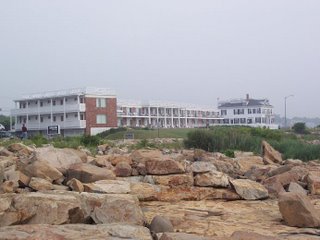
We stayed at the Bass Rocks Ocean Inn . . .
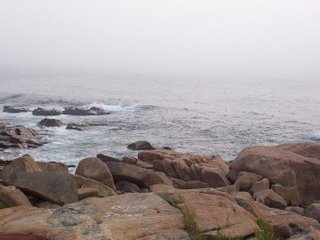
. . . which overlooks the Atlantic Ocean.

New Englanders chronically underestimate times and distances. We were told that the beach was a six-minute walk from the hotel. It was actually closer to 15 minutes — 25 minutes with a seven-year-old.
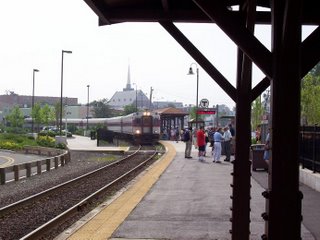
On wednesday we took the train into Boston. . .

. . . to visit the New England Aquarium, a special treat for our Theresa.

On thursday we visited Hammond Castle, Gloucester, where Nancy once had a graduation party after receiving her degree from. . .

. . . Gordon-Conwell Seminary.

This is Salem, where Nancy lived during one of her seminary years.

This has to be one of the most photographed buildings in the world. It's called Motif Number 1 and it's in Rockport. One of my sisters lived here during her studies at nearby Gordon College. Incidentally, Rockport is the basis for my notional cinematic horror sensation, Attack of the Killer Giftshops. I'm still trying to sell Hollywood on the idea.
This is not my promised post on rest and leisure; these are more photos from our recent holiday in what (especially Atlantic) Canadians used to call "the Boston States." After Janine and Anthony's wedding, the three of us took a brief holiday to nearby Gloucester.

We stayed at the Bass Rocks Ocean Inn . . .

. . . which overlooks the Atlantic Ocean.

New Englanders chronically underestimate times and distances. We were told that the beach was a six-minute walk from the hotel. It was actually closer to 15 minutes — 25 minutes with a seven-year-old.
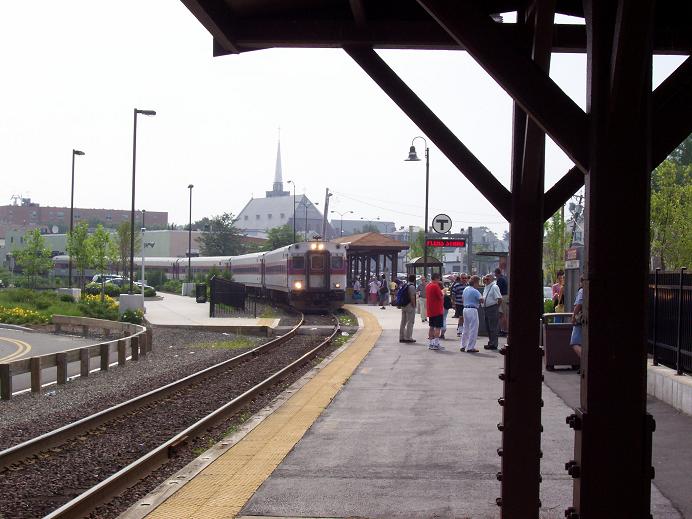
On wednesday we took the train into Boston. . .

. . . to visit the New England Aquarium, a special treat for our Theresa.

On thursday we visited Hammond Castle, Gloucester, where Nancy once had a graduation party after receiving her degree from. . .

. . . Gordon-Conwell Seminary.
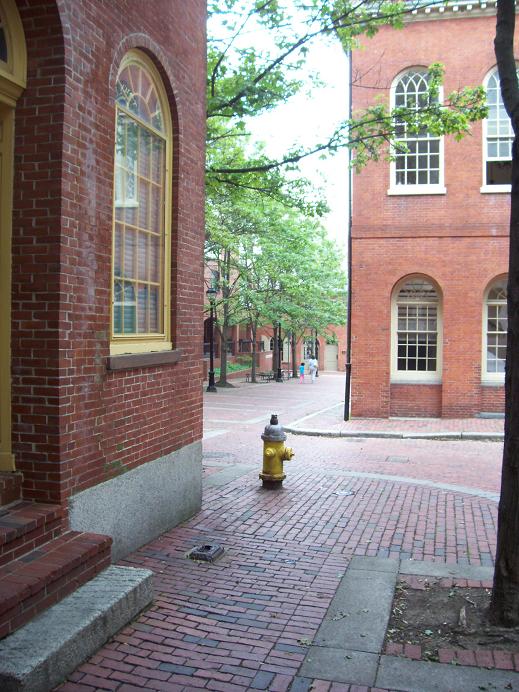
This is Salem, where Nancy lived during one of her seminary years.

This has to be one of the most photographed buildings in the world. It's called Motif Number 1 and it's in Rockport. One of my sisters lived here during her studies at nearby Gordon College. Incidentally, Rockport is the basis for my notional cinematic horror sensation, Attack of the Killer Giftshops. I'm still trying to sell Hollywood on the idea.
10 July 2006
Monday notes
Last evening we ate spaghetti for supper in inadvertent honour of Italy's victory in the World Cup. As we ate we were treated to scores of honking vehicles flying the green, white and red tricolour, parading down our street.
I have now posted three more Genevan Psalm versifications on my website: Psalms 27, 84 and 93. These are in addition to Psalm 77, which I posted before we took our holiday. For Psalm 27 I have posted only a text, as the tune is proving a bit trickier to harmonize than I had anticipated. The text and harmonization of Psalm 93 came quickly to me as recently as yesterday.
At some point I will be posting a more substantial piece on leisure and rest, something which has pulled more into focus for me since sliding into depression two months ago. Although the "labour, leisure and liturgy" in the sidebar to the right suggests a balanced life, I've come to see that my own life has been rather less than exemplary in this respect.
As part of this effort to find balance, I have paid rather less attention to politics than is my wont in recent weeks. Posts addressing political and cultural issues will return in the near future.
Oh, and I am feeling much better these days. Thanks for your prayers, which are much appreciated.
Later: I have now posted my musical arrangement of Psalm 27.
09 July 2006
What God has joined together. . .

Congratulations are due to Anthony and Janine Givens-Belsley, who were joined in matrimony in Andover, Massachusetts, on 1 July. Our family was privileged to be present at the marriage of my beautiful and gifted niece to the love of her life. May God bless their journey together.

The Givens family home, where the reception was held. A good time was had by all.

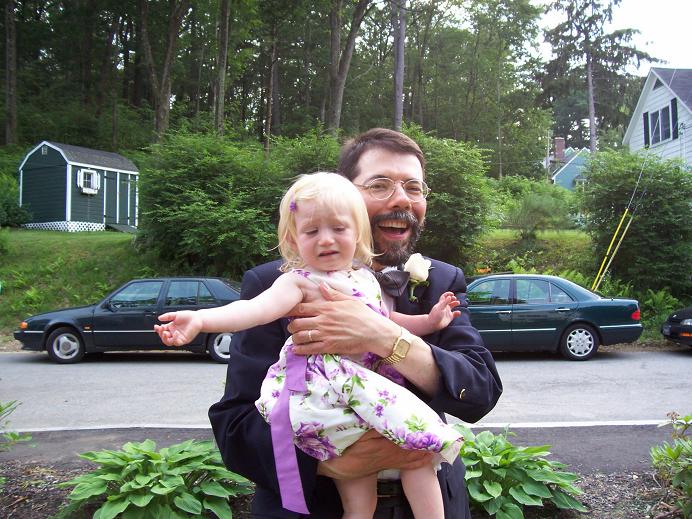
Here am I with my recalcitrant grandniece, Ingrid, who is enjoying the reception somewhat less than everyone else.
I composed this piece just over two years ago, Dancing Day (Copyright © 2004, David T. Koyzis), which was inspired by the dancing at the end of My Big Fat Greek Wedding. Though it wasn't played at the reception, it could have been. There are lyrics. Perhaps I'll post them at some point.

Congratulations are due to Anthony and Janine Givens-Belsley, who were joined in matrimony in Andover, Massachusetts, on 1 July. Our family was privileged to be present at the marriage of my beautiful and gifted niece to the love of her life. May God bless their journey together.

The Givens family home, where the reception was held. A good time was had by all.
Here am I with my recalcitrant grandniece, Ingrid, who is enjoying the reception somewhat less than everyone else.
I composed this piece just over two years ago, Dancing Day (Copyright © 2004, David T. Koyzis), which was inspired by the dancing at the end of My Big Fat Greek Wedding. Though it wasn't played at the reception, it could have been. There are lyrics. Perhaps I'll post them at some point.
03 July 2006
28 June 2006
Genevan psalms
During a previous bout with depression five years ago, I was afflicted by a compulsion to paraphrase biblical psalms and arrange their proper Genevan melodies so they could be easily sung. I then posted a website devoted to the Genevan Psalter. Nothing seemed to be effective in curing this compulsion, even that class of medications known as VRIs (versification reuptake inhibitors). Now it appears the compulsion has returned. The local medical community is stumped. Here is the first symptom:
During a previous bout with depression five years ago, I was afflicted by a compulsion to paraphrase biblical psalms and arrange their proper Genevan melodies so they could be easily sung. I then posted a website devoted to the Genevan Psalter. Nothing seemed to be effective in curing this compulsion, even that class of medications known as VRIs (versification reuptake inhibitors). Now it appears the compulsion has returned. The local medical community is stumped. Here is the first symptom:
I cried out for God to help me,
cried aloud that God might hear me.
When I languished in distress,
then I sought God’s faithfulness.
Through the night I reached for healing,
yet my heart refused consoling.
Thinking of my God, I sigh,
faint while pond’ring God on high.
You have kept my eyes from sleeping,
too distraught was I for speaking.
I remembered times of old,
former days have I recalled.
In the darkness do I ponder,
in my heart I can’t but wonder:
will God cast away at last?
is his love for ever past?
Have God’s mercies fled for ever?
Will his promise grace us never?
Shall we bear his wrath alone?
Is his steadfast love now gone?
This, I said, is why I’m grieving
and my happiness is leaving:
for the arm of the Most High
for the arm of the Most High
has abandoned us to die.
I recalled the deeds of our Lord,
marvels brought about by his word.
I reflect through all my days
on the wonders of your ways.
God, your paths are our savation,
you subdue the pagan nation.
You redeem us with your arm —
Jacob, Joseph — from all harm.
When the waters saw your power,
depths of sea before you cowered.
Torrents poured out from the sky;
arrows flashed from side to side.
Heaven shook with thunder crashes,
earth was lit by lightning flashes;
Your way led us through the sea,
where your footsteps were unseen.
Like a flock you led your people
in the midst of the upheaval,
by your servants' willing hand,
Moses, Aaron, through the land.
Text and arrangement copyright © 2006 by David T. Koyzis
Text and arrangement copyright © 2006 by David T. Koyzis
24 June 2006
Cuban awareness event
Sharon Boase of The Hamilton Spectator interviewed me last week for this story: Singing for Cuban prisoners: Christian union offers free concert to build support. Don't forget to be at FRWY Cafe, 333 King St. E., this evening at 7.
Sharon Boase of The Hamilton Spectator interviewed me last week for this story: Singing for Cuban prisoners: Christian union offers free concert to build support. Don't forget to be at FRWY Cafe, 333 King St. E., this evening at 7.
23 June 2006
Terror averted in Windy City
For a native of the Chicago area, this is a scary story: Seven Are Charged With Plot to Blow Up Sears Tower. And this so soon after a similar terrorist plot was foiled here in Canada.
For a native of the Chicago area, this is a scary story: Seven Are Charged With Plot to Blow Up Sears Tower. And this so soon after a similar terrorist plot was foiled here in Canada.
Liturgical language revised. . . again
The United States Conference of Catholic Bishops has made a number of adjustments to the language of the mass in order more faithfully to conform to the original Latin. This latest revision is thus a conservative revision. Reactions in the pews? Some people don't like it, while others think it no big deal. This raises at least two questions: First, will the Canadian Conference do the same? Second, will other denominations, e.g., Anglicans and Lutherans, who use the earlier and apparently less accurate translations produced by the International Commission on English in the Liturgy, follow the Catholic lead?
The United States Conference of Catholic Bishops has made a number of adjustments to the language of the mass in order more faithfully to conform to the original Latin. This latest revision is thus a conservative revision. Reactions in the pews? Some people don't like it, while others think it no big deal. This raises at least two questions: First, will the Canadian Conference do the same? Second, will other denominations, e.g., Anglicans and Lutherans, who use the earlier and apparently less accurate translations produced by the International Commission on English in the Liturgy, follow the Catholic lead?
21 June 2006
Allergies and depression
This is old news, but it's recently become relevant to me: The 'Bless You' Blues: A surprising relationship between allergies and depression. For me the link seems to work thus: allergies disturb my sleep patterns, which in turn induce depression. I am coming to see that I need to address my allergies, which have been worse in recent months, if I hope to find healing for depression, which is the source of the "difficult few weeks" of which I wrote earlier. I will not be writing at length about this, except to ask for prayers for healing as I attempt to rebalance my life and address what I now believe to be the proximate biological cause of this condition. In the meantime postings in this space are likely to be fewer than in the past.
This is old news, but it's recently become relevant to me: The 'Bless You' Blues: A surprising relationship between allergies and depression. For me the link seems to work thus: allergies disturb my sleep patterns, which in turn induce depression. I am coming to see that I need to address my allergies, which have been worse in recent months, if I hope to find healing for depression, which is the source of the "difficult few weeks" of which I wrote earlier. I will not be writing at length about this, except to ask for prayers for healing as I attempt to rebalance my life and address what I now believe to be the proximate biological cause of this condition. In the meantime postings in this space are likely to be fewer than in the past.
18 June 2006
A dirty joke?
It seems cleanliness may not after all be next to godliness, at least for those of us suffering from allergies and other autoimmune diseases: Dirty rats healthier than clean ones: Study.
It seems cleanliness may not after all be next to godliness, at least for those of us suffering from allergies and other autoimmune diseases: Dirty rats healthier than clean ones: Study.

Reformed Worship articles
I have recently discovered that four articles I wrote some 15 years ago have been posted at the Reformed Worship website: Restoring Psalms to Worship, Straight from Scripture, The Lord's Supper: How Often? and Sursum Corda: Lift Up Your Hearts. The first two articles are actually two parts of a single essay published in successive issues.
I have recently discovered that four articles I wrote some 15 years ago have been posted at the Reformed Worship website: Restoring Psalms to Worship, Straight from Scripture, The Lord's Supper: How Often? and Sursum Corda: Lift Up Your Hearts. The first two articles are actually two parts of a single essay published in successive issues.
15 June 2006
A union's future
The United Auto Workers is in trouble, according to this article: UAW to Begin Drive to Recruit New Workers. The statistics are grim: "UAW membership peaked in 1979 at 1.5 million, but it dropped to 676,000 in 2002 and now stands at just less than 599,000, according to the union." Perhaps it's time for the union's leadership to look north of the border and to learn something from the CLAC's successful model. As the latter continues to grow, it seems likely to pass the UAW in size at some point, in which case the UAW will have no choice but to take notice.
The United Auto Workers is in trouble, according to this article: UAW to Begin Drive to Recruit New Workers. The statistics are grim: "UAW membership peaked in 1979 at 1.5 million, but it dropped to 676,000 in 2002 and now stands at just less than 599,000, according to the union." Perhaps it's time for the union's leadership to look north of the border and to learn something from the CLAC's successful model. As the latter continues to grow, it seems likely to pass the UAW in size at some point, in which case the UAW will have no choice but to take notice.
12 June 2006
Hillsdale Holiday
We took a brief holiday in Hillsdale, Michigan, this past weekend, visiting family. Here are some of the highlights:

A walk along a not-quite-country road

Some flowers along the road

Picnic at Baw Beese Lake

Hillsdale College

Hillsdale Academy,
where my brother-in-law is headmaster

Remember Mail Pouch Tobacco?
We took a brief holiday in Hillsdale, Michigan, this past weekend, visiting family. Here are some of the highlights:


where my brother-in-law is headmaster

09 June 2006
Max Lucado
I've seen Max Lucado's books around for years, but until recently I had never actually read one. A few weeks ago Theresa brought home several of his children's books from school, and we read them together. These were about the Wemmicks and their various foibles. The Wemmicks are wooden creatures fashioned by Eli, the Woodcarver, who is obviously intended to represent God in his relationship with his human image-bearers. The Wemmicks are constantly engaging in oneupsmanship and status-seeking, and Eli has to keep reminding them they needn't do this and that he loves them as they are.
The stories are innocuous enough and reaffirming of children's self-esteem, but given that they were written by a professed christian author, one would expect to see more evident references to sin and redemption, which are conspicuous by their absence — at least from the Wemmick books. Others can perhaps tell me whether he rectifies this defect in his other books. I hope so.
05 June 2006
The sixties and the evolution of liberalism
Two years ago I came across this fascinating article by Bruce Bawer in The Wilson Quarterly: The Other Sixties, about that brief era wedged between the ostensibly mindless conformity of the 1950s and the turbulent "Sixties", with its drug culture, angry anti-war protests, and aggressive student rebellion against authority. The early 1960s roughly corresponds to the John F. Kennedy administration in the United States and its immediate aftermath, a time of idealism, a sophisticated blend of high and middle-brow culture, and widespread expectations for the efficacy of a variety of liberal reforms. It was the era of Kennedy's New Frontier, the Peace Corps, the New Math, and the quests to reach (literally) for the moon, to combat poverty and to end racial discrimination. Pope John XXIII headed the Roman Catholic Church, and the Second Vatican Council was bringing the winds of change into an ancient institution. Almost simultaneously European colonialism in Africa and elsewhere was being wound down, with high hopes expressed for these newly liberated nation-states. Setting the tone for the arts and entertainment were Jack Paar and The Dick Van Dyke Show on that still new medium of television; Leonard Bernstein's classic musical play, West Side Story; Julia Child's popularization of continental cuisine in a meat-and-potatoes culinary culture; and the fashionable Kennedies themselves. Films like The Apartment and Breakfast at Tiffany's began quietly to break sexual taboos, and Alfred Hitchcock's deliberately shocking Psycho marked a departure from his string of suspense hits of the previous decade.

Bawer's essay is less an analysis than a compelling evocation of an era marked at once by innocence and sophistication. As someone whose elementary school years coincided with this period, I believe he has done a good job of conveying to a contemporary audience something of its feel. Indeed Dick Van Dyke was (and remains) one of my favourite television shows, even if my juvenile mind did not quite grasp all of its humour at the time. I well recall the arrival of the New Math and other innovations in my own educational experience. Long before PowerPoint, overhead projectors were a fresh and exciting way to communicate knowledge to youngsters. Then there were Dr. Martin Luther King and the civil rights movement. Although my parents were moderately conservative Republicans — this was, after all, DuPage County, Illinois — I recall being told by them that those seeking equal rights for black Americans were unequivocally in the right. I have few memories of the Cuban Missile Crisis as such, but I do recall the global tensions characterizing the Cold War era and wondering whether my siblings and I would live to see adulthood. The idealism of the era was thus tempered by a vague and unprecedented fear for the future — a fear that at any moment our whole world might evaporate in a terrifying flash.
All of this began to change with Kennedy's assassination on friday, 22 November 1963, an event that marked a watershed for our generation. After that things were never quite the same. As I reached puberty a few years later, race riots were marring the landscapes of the major urban centres, and university students were protesting an Asian war that dragged on with no evident larger purpose. The sexual revolution unnervingly coincided with my own attainment of sexual maturity, and the entire culture seemed to be conspiring against the virtue of chastity, especially in the young. Rock music took on an increasingly hard edge, hair grew longer, and school dress codes went out the window as "nonconformist" young people donned the ubiquitous and standardizing blue jeans. The idealistic world in which I had been raised had been quickly supplanted by one where, despite the hope that "peace will guide the planets and love will steer the stars," a bohemian ethos of "do your own thing" made the defenders of social institutions and their larger public purposes appear hopelessly "square." Bawer ends his article with the summer of 1967 and the hippies in Tompkins Square Park in New York — a poignant glimpse into the next era.

While Bawer's portrait of the early 1960s is unabashedly nostalgic, James Piereson has a much less rosy portrait of the period and its immediate aftermath: Lee Harvey Oswald and the Liberal Crack-Up. Oswald was, of course, Kennedy's assassin, and Piereson argues that this professed communist and Castro sympathizer did more than anything else to discredit the moderate liberal reformism characterizing what would shortly come to be called "Camelot." The irony for Piereson is that many of the young who had been so enthralled by Kennedy's vision of a New Frontier would come a few years later to espouse doctrines not dissimilar to those animating his murderer under the guise of the New Left. Furthermore, while prior to 1963 liberalism in some fashion seemed to be in the ascendancy in the United States, with conservatism being relegated to the cranky right, the distortions of the late sixties and early seventies produced a reactive response that led to the rise of a new conservatism, initially under President Richard Nixon with his famous "silent majority," and eventually under Ronald Reagan after 1980. By the 1990s and into the first years of the 21st century the United States appeared to be permanently divided in a culture war between "red states" and "blue states," thus mirroring a much earlier development in the European continent following the French Revolution. The seeming liberal consensus of the early sixties had been replaced by hardened divisions over a host of issues, including abortion, marriage and homosexuality.
None of this could have been predicted in 1960. At that time the old New Deal coalition was still largely intact, although southern whites' loyalty to the Democratic Party was definitely eroding over racial segregation and civil rights. This coalition revolved largely around concrete economic issues — the very issues that had served to define the political landscape since the onset of the Great Depression a generation earlier. By this time the Republican Party had gained its reputation as the party of the "haves" and the Democratic Party was perceived to champion the "have nots." The industrial economy that had begun after the Civil War still characterized much of American life. A few miles from where I grew up the Elgin National Watch Company's factory was still standing and producing watches, as it had for nearly a century. In nearby Villa Park, the Ovaltine Company's plant was still producing its famous egg and malt-based beverage for the country. And the Union Stock Yard on the southwest side of Chicago continued to supply much of the meat that fed the region. Moreover, the country's transportation infrastructure still revolved around the railways, which fanned out in all directions from America's Second City. Famous passenger trains such as the Twentieth Century Limited and the Super Chief still rolled down the tracks towards their destinations.

By the middle of the decade all this was clearly changing. The Elgin Watch factory closed in 1965. Rail passenger service was mostly discontinued by the end of the decade, until Amtrak picked up the remnants in 1971. By the 1970s much of the old industrial infrastructure was, if not entirely gone, at least fading in significance for the larger economy, as increasing numbers of Americans found themselves employed in the growing service industries. So-called post-material values took over the two major political parties, especially the Democrats. By 1972 the transition was nearly complete. Once I had reached high school I was aware of living in a different world than the one I was born into. So much had things changed that the 1973 film American Graffiti could wax nostalgic about an era only a decade in the past. What had happened and why?
Francis Fukuyama argues, in The Great Disruption, that there is a causal connection between the changing economy and the changing social mores, with the former mostly effecting the latter. While this may not be precisely a marxist argument, it certainly shares with Marx the conviction that man is homo faber, man the producer, with concrete productive forces fuelling social and political change. In this account the shift from the industrial to the service economy in the 1960s disrupted the social mores that had held sway from the middle of the 19th century, leading in the short run to higher rates of out-of-wedlock births, higher crime rates and drug abuse, on the negative side, but at the same time expanded opportunities for minorities and women, and an increasing environmental awareness, on the positive side. Fukuyama's undergirding argument is historicistic in that it assumes that social mores are dependent on and appropriate to a particular stage in the productive process.
While I would not deny the material motives that Fukuyama points to, I myself have come to think that what happened four decades ago was in large measure due to the arrival of a crucial moment in the development of the liberal project that had begun in the 17th and 18th centuries. In my Political Visions and Illusions I trace the development of liberalism through five stages, beginning with the Hobbesian commonwealth, through the night watchman state, the regulatory state and the equal-opportunity state and finally to the choice-enhancement state. My argument is that the cultural shifts of the 1960s marked the transition between the fourth and fifth stages — from a focus on the expansion of material opportunities through state intervention to an emphasis on expanding the human capacity to choose, period. In the choice-enhancement state, government undertakes to maintain a benign neutrality towards a variety of personal lifestyle choices, ostensibly on the grounds of freeing individuals from oppressive constraints on their freedom. Hence Pierre Trudeau could claim that the state has no business in the bedrooms of the nation, a conclusion difficult to contest on the surface. Yet personal choices are not without consequences, not only for the individuals themselves but also for their immediate and extended communities. These consequences are by no means equal in their impact on the larger society, with some more evidently diminishing of human flourishing than others. Therefore, in order to maintain the illusion of equality of lifestyle choices, the state is called upon to compensate for these unequal consequences by means of the very welfare state programmes established during the previous stage of liberalism for different reasons.
Could Bawer's "other sixties" simply have been the high water mark, not of liberalism per se, but of liberalism's fourth stage, in which adherents believed it possible to bring its larger project to culmination while limiting the full working out of its inner logic? If so, then what happened in the mid to late sixties represented not really an abandonment of liberalism but the opening of a cleavage between those who wanted to push its logic further still (the radicals, hippies, &c.) and those who sought to return to an earlier stage of liberalism (the so-called conservatives). Because the conservatives were merely reactive and sought to turn back the clock on the liberal project rather than to posit a genuine alternative, they could never manage to secure a victory against a liberalism whose undergirding assumptions they themselves in large measure shared. Bawer's nostalgia notwithstanding, the "other sixties" could never have been but one brief, shining moment.
Two years ago I came across this fascinating article by Bruce Bawer in The Wilson Quarterly: The Other Sixties, about that brief era wedged between the ostensibly mindless conformity of the 1950s and the turbulent "Sixties", with its drug culture, angry anti-war protests, and aggressive student rebellion against authority. The early 1960s roughly corresponds to the John F. Kennedy administration in the United States and its immediate aftermath, a time of idealism, a sophisticated blend of high and middle-brow culture, and widespread expectations for the efficacy of a variety of liberal reforms. It was the era of Kennedy's New Frontier, the Peace Corps, the New Math, and the quests to reach (literally) for the moon, to combat poverty and to end racial discrimination. Pope John XXIII headed the Roman Catholic Church, and the Second Vatican Council was bringing the winds of change into an ancient institution. Almost simultaneously European colonialism in Africa and elsewhere was being wound down, with high hopes expressed for these newly liberated nation-states. Setting the tone for the arts and entertainment were Jack Paar and The Dick Van Dyke Show on that still new medium of television; Leonard Bernstein's classic musical play, West Side Story; Julia Child's popularization of continental cuisine in a meat-and-potatoes culinary culture; and the fashionable Kennedies themselves. Films like The Apartment and Breakfast at Tiffany's began quietly to break sexual taboos, and Alfred Hitchcock's deliberately shocking Psycho marked a departure from his string of suspense hits of the previous decade.
Bawer's essay is less an analysis than a compelling evocation of an era marked at once by innocence and sophistication. As someone whose elementary school years coincided with this period, I believe he has done a good job of conveying to a contemporary audience something of its feel. Indeed Dick Van Dyke was (and remains) one of my favourite television shows, even if my juvenile mind did not quite grasp all of its humour at the time. I well recall the arrival of the New Math and other innovations in my own educational experience. Long before PowerPoint, overhead projectors were a fresh and exciting way to communicate knowledge to youngsters. Then there were Dr. Martin Luther King and the civil rights movement. Although my parents were moderately conservative Republicans — this was, after all, DuPage County, Illinois — I recall being told by them that those seeking equal rights for black Americans were unequivocally in the right. I have few memories of the Cuban Missile Crisis as such, but I do recall the global tensions characterizing the Cold War era and wondering whether my siblings and I would live to see adulthood. The idealism of the era was thus tempered by a vague and unprecedented fear for the future — a fear that at any moment our whole world might evaporate in a terrifying flash.
All of this began to change with Kennedy's assassination on friday, 22 November 1963, an event that marked a watershed for our generation. After that things were never quite the same. As I reached puberty a few years later, race riots were marring the landscapes of the major urban centres, and university students were protesting an Asian war that dragged on with no evident larger purpose. The sexual revolution unnervingly coincided with my own attainment of sexual maturity, and the entire culture seemed to be conspiring against the virtue of chastity, especially in the young. Rock music took on an increasingly hard edge, hair grew longer, and school dress codes went out the window as "nonconformist" young people donned the ubiquitous and standardizing blue jeans. The idealistic world in which I had been raised had been quickly supplanted by one where, despite the hope that "peace will guide the planets and love will steer the stars," a bohemian ethos of "do your own thing" made the defenders of social institutions and their larger public purposes appear hopelessly "square." Bawer ends his article with the summer of 1967 and the hippies in Tompkins Square Park in New York — a poignant glimpse into the next era.

While Bawer's portrait of the early 1960s is unabashedly nostalgic, James Piereson has a much less rosy portrait of the period and its immediate aftermath: Lee Harvey Oswald and the Liberal Crack-Up. Oswald was, of course, Kennedy's assassin, and Piereson argues that this professed communist and Castro sympathizer did more than anything else to discredit the moderate liberal reformism characterizing what would shortly come to be called "Camelot." The irony for Piereson is that many of the young who had been so enthralled by Kennedy's vision of a New Frontier would come a few years later to espouse doctrines not dissimilar to those animating his murderer under the guise of the New Left. Furthermore, while prior to 1963 liberalism in some fashion seemed to be in the ascendancy in the United States, with conservatism being relegated to the cranky right, the distortions of the late sixties and early seventies produced a reactive response that led to the rise of a new conservatism, initially under President Richard Nixon with his famous "silent majority," and eventually under Ronald Reagan after 1980. By the 1990s and into the first years of the 21st century the United States appeared to be permanently divided in a culture war between "red states" and "blue states," thus mirroring a much earlier development in the European continent following the French Revolution. The seeming liberal consensus of the early sixties had been replaced by hardened divisions over a host of issues, including abortion, marriage and homosexuality.
None of this could have been predicted in 1960. At that time the old New Deal coalition was still largely intact, although southern whites' loyalty to the Democratic Party was definitely eroding over racial segregation and civil rights. This coalition revolved largely around concrete economic issues — the very issues that had served to define the political landscape since the onset of the Great Depression a generation earlier. By this time the Republican Party had gained its reputation as the party of the "haves" and the Democratic Party was perceived to champion the "have nots." The industrial economy that had begun after the Civil War still characterized much of American life. A few miles from where I grew up the Elgin National Watch Company's factory was still standing and producing watches, as it had for nearly a century. In nearby Villa Park, the Ovaltine Company's plant was still producing its famous egg and malt-based beverage for the country. And the Union Stock Yard on the southwest side of Chicago continued to supply much of the meat that fed the region. Moreover, the country's transportation infrastructure still revolved around the railways, which fanned out in all directions from America's Second City. Famous passenger trains such as the Twentieth Century Limited and the Super Chief still rolled down the tracks towards their destinations.

By the middle of the decade all this was clearly changing. The Elgin Watch factory closed in 1965. Rail passenger service was mostly discontinued by the end of the decade, until Amtrak picked up the remnants in 1971. By the 1970s much of the old industrial infrastructure was, if not entirely gone, at least fading in significance for the larger economy, as increasing numbers of Americans found themselves employed in the growing service industries. So-called post-material values took over the two major political parties, especially the Democrats. By 1972 the transition was nearly complete. Once I had reached high school I was aware of living in a different world than the one I was born into. So much had things changed that the 1973 film American Graffiti could wax nostalgic about an era only a decade in the past. What had happened and why?
Francis Fukuyama argues, in The Great Disruption, that there is a causal connection between the changing economy and the changing social mores, with the former mostly effecting the latter. While this may not be precisely a marxist argument, it certainly shares with Marx the conviction that man is homo faber, man the producer, with concrete productive forces fuelling social and political change. In this account the shift from the industrial to the service economy in the 1960s disrupted the social mores that had held sway from the middle of the 19th century, leading in the short run to higher rates of out-of-wedlock births, higher crime rates and drug abuse, on the negative side, but at the same time expanded opportunities for minorities and women, and an increasing environmental awareness, on the positive side. Fukuyama's undergirding argument is historicistic in that it assumes that social mores are dependent on and appropriate to a particular stage in the productive process.
While I would not deny the material motives that Fukuyama points to, I myself have come to think that what happened four decades ago was in large measure due to the arrival of a crucial moment in the development of the liberal project that had begun in the 17th and 18th centuries. In my Political Visions and Illusions I trace the development of liberalism through five stages, beginning with the Hobbesian commonwealth, through the night watchman state, the regulatory state and the equal-opportunity state and finally to the choice-enhancement state. My argument is that the cultural shifts of the 1960s marked the transition between the fourth and fifth stages — from a focus on the expansion of material opportunities through state intervention to an emphasis on expanding the human capacity to choose, period. In the choice-enhancement state, government undertakes to maintain a benign neutrality towards a variety of personal lifestyle choices, ostensibly on the grounds of freeing individuals from oppressive constraints on their freedom. Hence Pierre Trudeau could claim that the state has no business in the bedrooms of the nation, a conclusion difficult to contest on the surface. Yet personal choices are not without consequences, not only for the individuals themselves but also for their immediate and extended communities. These consequences are by no means equal in their impact on the larger society, with some more evidently diminishing of human flourishing than others. Therefore, in order to maintain the illusion of equality of lifestyle choices, the state is called upon to compensate for these unequal consequences by means of the very welfare state programmes established during the previous stage of liberalism for different reasons.
Could Bawer's "other sixties" simply have been the high water mark, not of liberalism per se, but of liberalism's fourth stage, in which adherents believed it possible to bring its larger project to culmination while limiting the full working out of its inner logic? If so, then what happened in the mid to late sixties represented not really an abandonment of liberalism but the opening of a cleavage between those who wanted to push its logic further still (the radicals, hippies, &c.) and those who sought to return to an earlier stage of liberalism (the so-called conservatives). Because the conservatives were merely reactive and sought to turn back the clock on the liberal project rather than to posit a genuine alternative, they could never manage to secure a victory against a liberalism whose undergirding assumptions they themselves in large measure shared. Bawer's nostalgia notwithstanding, the "other sixties" could never have been but one brief, shining moment.
03 June 2006
June flowers
Our rhododendrons are blooming for the first time in years, perhaps due to the mild winter we had here in southern Ontario.


Incidentally, I am taking a badly needed break after a difficult few weeks. Please remember me in your prayers. I will be posting something more substantive on monday, but subsequent postings are likely to be fewer in number than in the past.
Our rhododendrons are blooming for the first time in years, perhaps due to the mild winter we had here in southern Ontario.
Incidentally, I am taking a badly needed break after a difficult few weeks. Please remember me in your prayers. I will be posting something more substantive on monday, but subsequent postings are likely to be fewer in number than in the past.
Subscribe to:
Posts (Atom)
